The Product Telemetry Advantage in SaaS AI

Turn this article into takeaways for your work.


Each assistant summarizes the article only for you and suggests best practices for your work.
Every SaaS company sits on a data asset that traditional businesses would spend millions to acquire. A retail chain pays for loyalty program data to understand customer behavior. A consulting firm has no behavioral data on its clients between project engagements. A manufacturing company has machine sensor data but no data on how customers actually use the product they sold.
A SaaS company? The product itself generates structured behavioral data as a byproduct of normal operation. Every customer session, feature click, workflow completion, API call, and integration activation is a timestamped event in a database somewhere.
Most SaaS companies treat this data as analytics fuel: dashboard charts, feature usage reports, executive metrics. The companies that win with AI treat it differently. They treat product telemetry as a predictive signal set, and build AI models that can see what customer health and revenue trajectory look like before any human does.
What product telemetry actually is
Product telemetry is the stream of behavioral events generated when users interact with your software. It's distinct from:
- Business data (subscriptions, invoices, contracts): tells you what customers bought
- Support data (tickets, conversations): tells you when customers had problems
- CRM data (contacts, deal stages, account records): tells you what your sales team did
Telemetry tells you what customers are actually doing with your product. The difference matters for AI because behavioral patterns predict outcomes that business and support data reveal only in retrospect.
Key Facts: Product Telemetry for AI
- Companies with robust product telemetry achieve churn prediction accuracy rates of 75-82% using models trained on 80 or more distinct behavioral signals, with advanced implementations reaching 94% accuracy up to 18 months before renewal (Arete SaaS Research, 2025)
- B2B SaaS companies using AI-driven churn prediction backed by behavioral telemetry see average NRR (net revenue retention) improvements of 8-12 percentage points, with an average return of $4-7 in protected revenue per $1 spent on churn prediction AI (industry benchmarks, 2025)
- Top-performing SaaS retention teams intervene an average of 47 days before a customer shows observable dissatisfaction signals, enabled by behavioral telemetry flagging usage degradation before any human notices (Arete, 2025)
The event types that matter most for AI applications:
- Feature activation events: first use of a specific capability (often correlated with retention)
- Workflow completion events: user completed an end-to-end task (indicates successful value delivery)
- Session frequency: how often a user logs in per week (dropping frequency predicts churn weeks before cancellation)
- Collaboration events: user invited a teammate, shared a document, assigned a task (social engagement predicts retention more strongly than solo engagement)
- Integration activations: connected a third-party tool (users who integrate stay longer and pay more)
- Feature abandonment events: opened a feature, took one action, left (incomplete activation predicts churn)
These events are not expensive to collect. They're generated by your product if you instrument it properly. The question is whether they're flowing into AI training pipelines or sitting in Mixpanel reports that a product manager looks at once a month.
Why this data beats CRM for AI predictions
Product telemetry captures what customers actually do, while CRM data mostly captures what internal teams recorded about them.
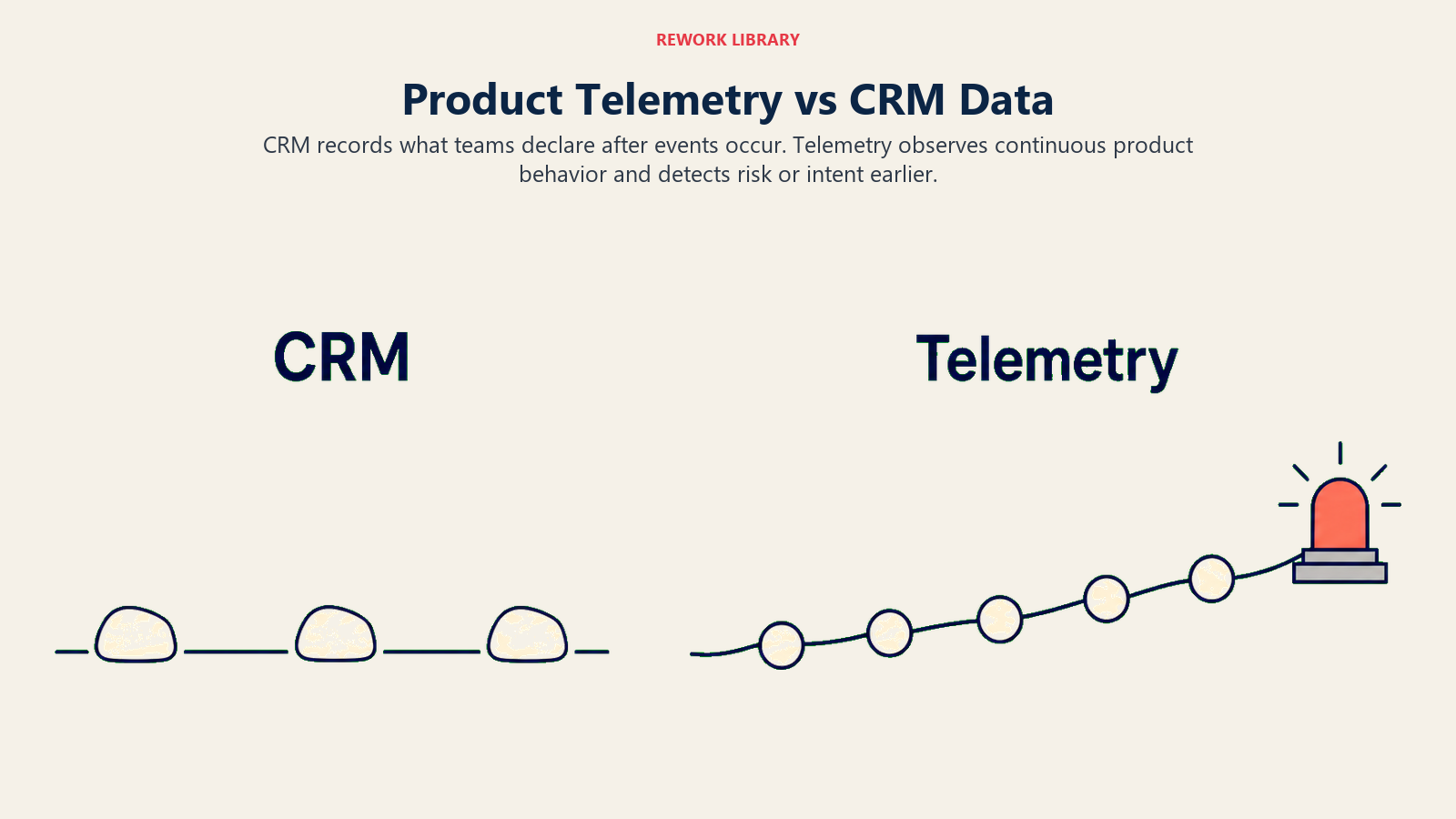
CRM data is the primary training input for most sales and customer success AI models. But CRM data is structured around human activity, not customer behavior. A CRM record knows that the CSM (Customer Success Manager) had a call on March 15. It doesn't know whether the customer used the product between February and March.
Predictive models trained on product telemetry consistently outperform CRM-only models for churn prediction and expansion identification. The gap is usually 2x to 3x in model accuracy, because product behavior is a leading indicator and CRM activity is often a lagging one. Research on behavioral modeling for churn prediction confirms that usage-pattern signals are early indicators of customer defection, outperforming demographic and transactional variables in predictive accuracy.
Here's the difference concretely:
CRM-only signal: Customer hasn't responded to CSM outreach in 30 days. (You find out when the CSM reports it.)
Telemetry signal: Daily active usage dropped 60% over the past three weeks. Two power users stopped logging in. The team's API call volume, which was growing, flattened. (You find out before the CSM has a chance to notice.)
The telemetry model sees the behavioral degradation happening in real time. The CRM model sees the downstream consequence (no response) after the fact. An Anomaly Agent running on product telemetry can surface that account to a CSM three weeks earlier than the CRM signal would.
Gainsight, Planhat, and ChurnZero are all built on this premise. Their core health scoring systems ingest product telemetry as the primary signal, supplemented by CRM activity, support ticket history, and billing data. The product behavior data carries the highest predictive weight in their models because it's the most current and most granular signal available.
Companies that deployed AI-driven churn prediction models using behavioral telemetry in 2024-2025 reduced gross churn by an average of 31% within the first 12 months, according to analysis of over 500 mid-market SaaS businesses.
The SaaS Telemetry Moat
The SaaS Telemetry Moat is the competitive advantage that compounds when a SaaS company consistently instruments its product, maintains clean event schema, and routes behavioral data into AI training pipelines. It has three layers: structural (machine-generated data exists passively, requiring no manual entry), temporal (behavioral signals are leading indicators that surface problems weeks before CRM or support data shows them), and compound (each year of telemetry makes models more accurate, creating a widening gap between early instrumenters and companies that start late). The moat is only a moat if it's built on. A competitor who starts telemetry instrumentation today begins building their own moat. The companies already 24 months into structured telemetry collection have a training data advantage that cannot be shortcut.
Use case 1: Churn prediction from usage patterns
Churn prediction from product telemetry is the most mature AI application in SaaS. The model architecture is well-understood and the ROI is directly measurable.
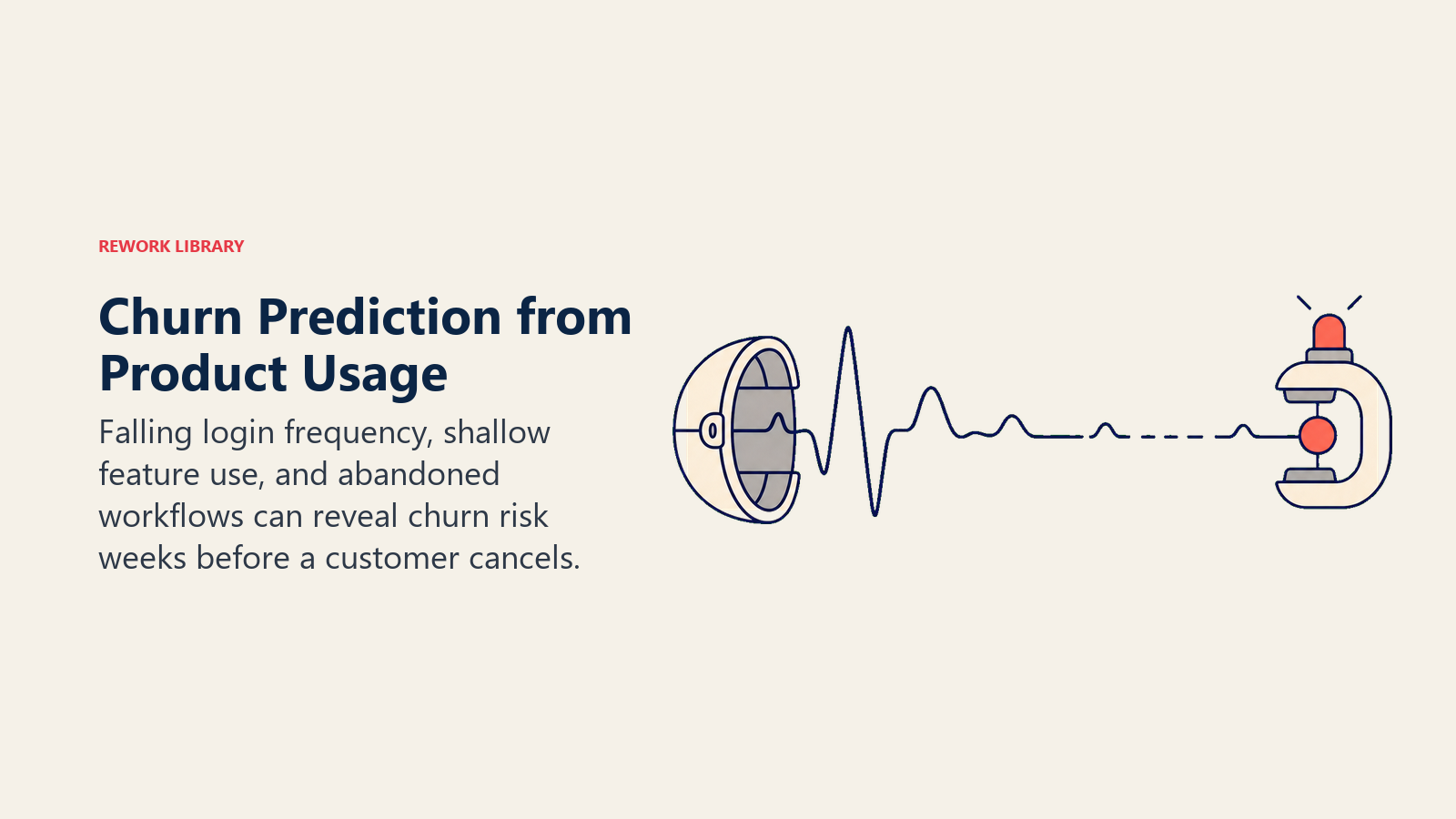
The training signal for a churn model built on telemetry includes:
- Feature adoption rate (how many of your core features does this account actively use?)
- Login frequency trend over the trailing 30 days (falling, flat, or rising?)
- Workflow completion rate (do users complete tasks or abandon them partway through?)
- Support ticket frequency (sudden spike often precedes churn)
- Collaboration breadth (is one person using the product, or the whole team?)
The patterns that predict churn look like this in practice: an account that was using five core features three months ago is now using two. The team of eight users that was logging in daily now has four active users, and those four are logging in every other day. The integration that was pushing data into the product stopped sending events two weeks ago.
None of these signals require a support ticket or a missed renewal call. They're happening in the product event stream right now. An Anomaly Agent running on this data flags the account as high risk before the CSM knows there's a problem.
Linear uses this approach to prioritize which engineering teams get proactive outreach from their CS team. The model isn't asking whether the CSM thinks an account is at risk. It's asking whether the account's usage pattern matches the historical pattern of accounts that churned. See how this connects to AI churn prediction in subscription models.
Use case 2: Trial conversion scoring
For PLG (product-led growth) companies, trial conversion scoring built on product telemetry is one of the highest-ROI AI applications available. The question it answers is simple: which free trial users will convert to paid?
The signals that predict conversion are almost entirely behavioral:
- Activation milestone: did the user complete the specific workflow that correlates with conversion in your historical data? (Notion's research showed that users who built a database in the first session converted at 3x the rate of users who didn't.)
- Return visit on day two: users who return within 48 hours convert at dramatically higher rates than one-and-done activations
- Invitation behavior: users who invite a teammate during trial are far more likely to upgrade
- Feature depth: users exploring advanced features are further along the activation curve than users who stayed in tutorial mode
The Scoring and Routing pattern trained on these signals can identify, by day three of a trial, which users are high-probability converts. The growth team (or the AI Sales Operator, in a hybrid PLG-to-enterprise model) can then prioritize outreach to these users.
Figma uses this approach to identify which self-serve teams are at the usage threshold where an account executive outreach is likely to convert to an enterprise contract. The signal isn't "they've been on the free plan for 90 days." It's "their team has hit the collaborator limit three times, and their design file volume matches the pattern of teams that converted to enterprise in the past."
That kind of precision targeting is impossible without product telemetry as a training input.
Use case 3: Expansion signals
Expansion revenue is the cleanest ARR (Annual Recurring Revenue) growth because there's no CAC (Customer Acquisition Cost). The AI application: identifying which accounts are ready to expand before they ask.
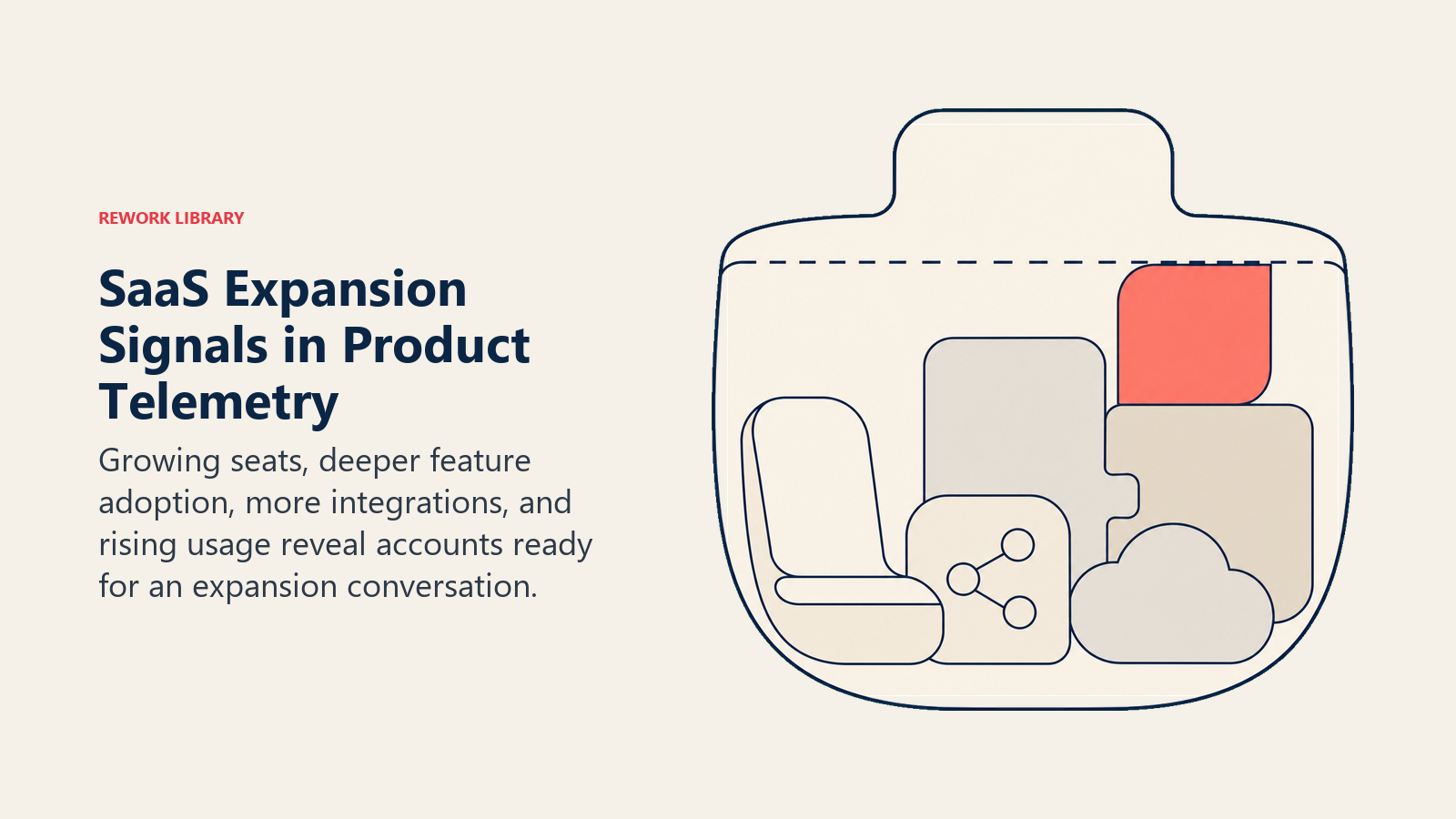
The telemetry signals that predict expansion readiness:
- Seat utilization approaching cap: teams at 85% or more of their licensed seat count are expansion candidates
- New workflow creation rate increasing: accounts building more automations or templates are finding more value
- Integration depth: accounts connecting more tools are more embedded in your product, and often have adjacent needs
- Power user concentration: if two people are using the product intensively and the rest of the team isn't, there's an expansion opportunity in broader team activation
- Feature exploration outside core tier: users clicking on features that are in a higher tier are signaling interest
Planhat's expansion AI scoring works on this signal set for usage-based and seat-based SaaS. The model flags accounts with high expansion probability 60 to 90 days before their renewal date, giving the CSM enough runway to have a proper expansion conversation rather than a last-minute upsell attempt.
The ROI math is straightforward: if your AI expansion model surfaces 30 accounts per quarter that convert at 40%, and your average expansion ACV (Annual Contract Value) is $15,000, that's $180,000 in expansion ARR per quarter that required a targeted conversation rather than a reactive renewal negotiation. McKinsey's analysis of net revenue retention in B2B tech shows that expansion-driven growth is increasingly the dominant growth lever at the $15M+ ARR stage, with top companies deriving 40% of growth from existing customers.
Use case 4: In-product AI personalization
The Workflow Copilot Pattern and Personalization Engine Pattern applied inside the product itself. This is AI that changes user experience based on behavioral signals, not just AI that runs in the background to flag things for a CSM.
Concrete examples of in-product telemetry-driven AI:
Adaptive onboarding: New users who complete certain early actions see a different onboarding checklist than users who took different initial paths. Notion uses this to route new workspace creators toward the templates and features most likely to deliver value given their early behavior.
Next-best-action suggestions: Based on what similar users did at the same product stage, the AI surfaces "users like you typically do X next." Linear shows teams features that similar-sized engineering teams use most actively, based on aggregate telemetry across all users at that stage.
Anomaly-triggered in-product prompts: When a user's workflow activity drops below a certain threshold, the product surfaces a re-engagement prompt. Not a generic "you haven't logged in recently" email, but a specific in-product message tied to the last incomplete workflow they started.
This class of personalization is only possible when the AI model has rich behavioral telemetry to learn from. Without it, personalization defaults to segment-level rules ("send the enterprise onboarding guide to enterprise plan users"), which is just conditional content delivery. McKinsey research on AI-powered personalization finds that companies excelling at behavioral personalization generate 40% more revenue from those activities than average players.
| Telemetry Signal | What It Predicts | Lead Time Before Event | Model Type |
|---|---|---|---|
| Daily active usage decline >50% | Churn within 60-90 days | 3-6 weeks before CSM notices | Anomaly Agent |
| Seat utilization >85% | Expansion readiness | 60-90 days before renewal | Scoring model |
| Trial activation milestone completed | Free-to-paid conversion | Within first 72 hours | Scoring+Routing |
| Integration connection count increasing | Retention and expansion | Ongoing | Health score input |
| Power user login frequency drop | Account-level churn risk | 2-4 weeks before cancellation | Anomaly Agent |
Source: Gainsight, Planhat, Userpilot, Arete research (2024-2025)
Rework Analysis: The most underused telemetry signal in most SaaS companies is integration activation. Accounts that connect your product to two or more third-party tools have dramatically lower churn rates than accounts using the product in isolation. But most CS teams don't track integration depth as a health score input, because it's not visible in the CRM. It's only in the product event stream. SaaS companies that add integration activation as a first-class health scoring signal consistently see their Anomaly Agent become more accurate at predicting at-risk accounts, because integration disconnection is a leading indicator that often appears before login frequency drops.
The data readiness trap
The competitive advantage is real. But it's contingent on schema discipline that most SaaS companies don't have.
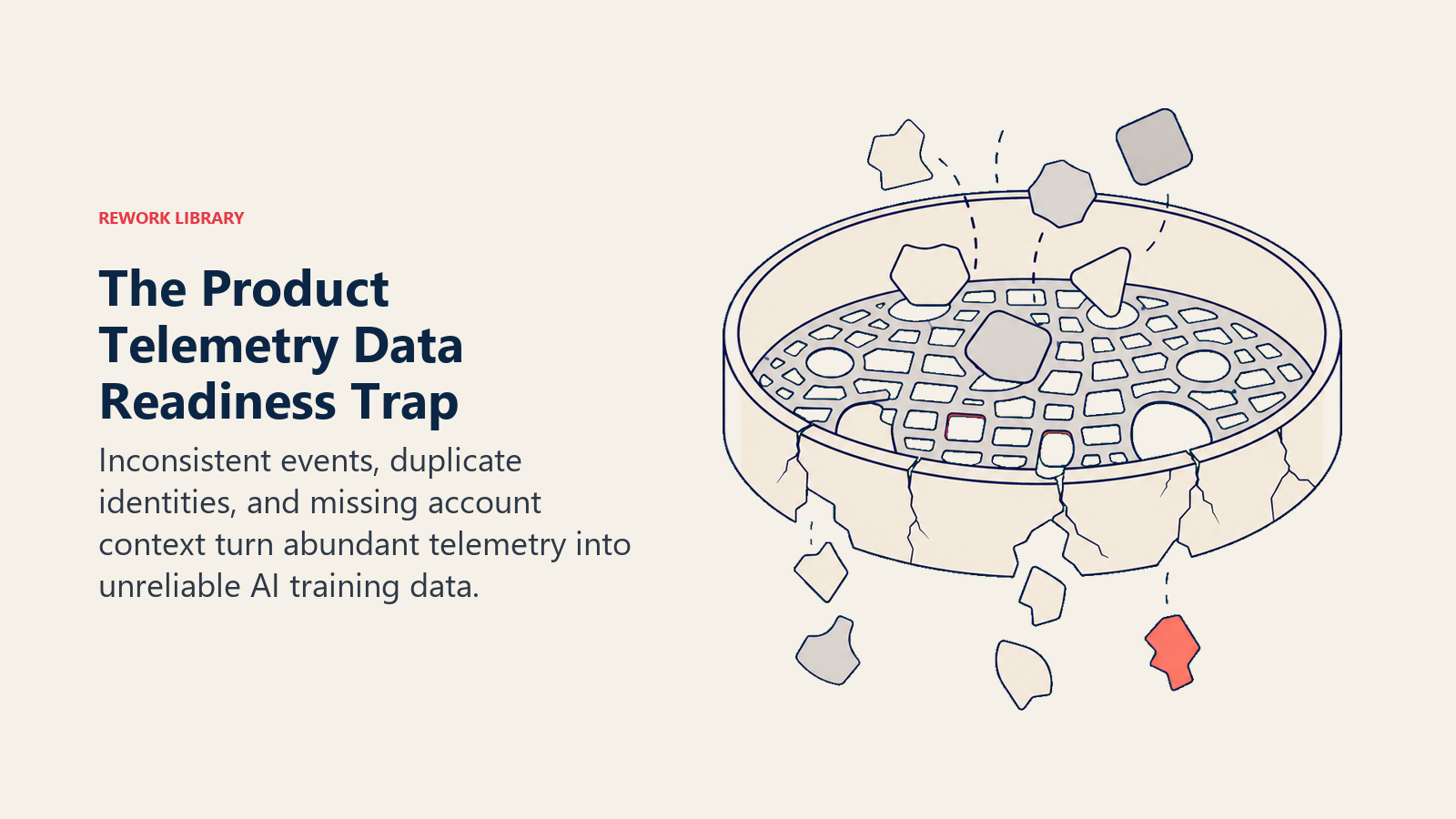
The problem shows up when you try to build an AI model on telemetry data and find that:
- Event names are inconsistent across different parts of the product (user_activated vs. activation_complete vs. feature_used)
- The same event means different things in different contexts
- Events are missing timestamps or user IDs
- High-value user actions were never instrumented at all
- Different product teams use different tracking systems that don't reconcile
A churn prediction model trained on telemetry data where "feature_abandoned" means something different in the mobile app versus the web app will produce unreliable predictions. The AI is faithfully learning patterns in data that doesn't mean what you think it means.
The fix is a telemetry schema governance process: a defined event taxonomy, naming conventions enforced across teams, a single tracking plan that all product development follows, and a data quality review before any telemetry data feeds an AI training pipeline.
Segment (now part of Twilio) is the standard approach for centralizing event collection and enforcing schema. Amplitude and Mixpanel consume clean telemetry well but don't enforce schema on the way in. Heap autocaptures events retroactively, which solves the instrumentation gap problem but creates schema noise that needs cleaning before AI training.
The sequence that works: audit current telemetry schema, define the event taxonomy you actually need for your target AI models, instrument the gaps, clean historical data where possible, then build models.
Building vs. buying the telemetry-to-AI pipeline
Most SaaS companies should buy the infrastructure layer and invest in the data quality layer.
The infrastructure decision:
- Amplitude for teams that want product analytics and AI insights in one tool. Their AI features are built on Amplitude telemetry natively.
- Mixpanel for teams that want more control over analysis and are comfortable with SQL.
- Heap for teams that need retroactive autocapture because historical instrumentation is incomplete.
- Segment for teams that want to route clean events to multiple downstream destinations (warehouse, Gainsight, analytics tool, etc.).
None of these tools build the AI models for you. They provide the clean event data that feeds into health scoring, conversion models, and expansion intelligence in Gainsight, Planhat, or a custom model built on top of your data warehouse.
The data quality investment is what most companies underestimate. Getting telemetry schema right and keeping it consistent as the product evolves is an ongoing process, not a one-time project. Teams that treat telemetry schema as a product requirement, just like a UI requirement, end up with AI models that actually work.
The competitive window
The telemetry advantage compounds only if the company turns raw product events into retention, conversion, and expansion workflows.
The structural advantage of SaaS telemetry for AI is real. But it's only a moat if you build on it. A competitor who instruments their product correctly and builds churn prediction, trial conversion scoring, and expansion intelligence has a customer retention machine that compounds over time.
Start with churn prediction. The data is already there. An account that's showing usage decline three weeks before your CSM notices is three weeks of relationship-saving time that you're currently leaving on the table. An Anomaly Agent running on your existing Amplitude or Mixpanel data can surface those accounts today.
The PLG-specific context for how telemetry data flows into the AI stack covers how to wire product telemetry into the Sales Operator and CSM agent for hybrid growth motions. And the foundation on data types explains why time-series behavioral data is structurally different from other data types in AI model construction.
Frequently Asked Questions
What is product telemetry in SaaS, and why does it matter for AI?
Product telemetry is the stream of behavioral events generated when users interact with your SaaS product: feature clicks, session starts, workflow completions, API calls, integration activations, and collaboration events. It matters for AI because it's a leading indicator, surfacing churn risk, expansion readiness, and conversion probability before any human or CRM record reflects a problem. Predictive models trained on telemetry consistently outperform CRM-only models by 2-3x in accuracy because behavioral patterns change before relationship signals do.
How accurate is AI churn prediction when trained on product telemetry?
Companies with robust telemetry achieve churn prediction accuracy of 75-82% using models trained on 80 or more behavioral signals. Advanced implementations reach 94% accuracy up to 18 months before renewal. Companies that deployed AI churn prediction in 2024-2025 reduced gross churn by an average of 31% within 12 months, according to analysis of over 500 mid-market SaaS businesses. The average return is $4-7 in protected revenue per $1 spent on churn prediction AI.
What is the SaaS Telemetry Moat?
The SaaS Telemetry Moat is the competitive advantage that compounds when a company consistently instruments its product, maintains clean event schema, and routes behavioral data into AI training pipelines. It has three layers: structural (machine-generated data requires no manual entry), temporal (behavioral signals surface problems weeks before CRM data shows them), and compound (each year of clean telemetry makes AI models more accurate). The moat requires deliberate building: companies already 24 months into structured telemetry collection have a training data advantage that cannot be shortcut by later starters.
Which telemetry signals best predict churn?
Daily active usage decline greater than 50% (surfaces churn risk 3-6 weeks before a CSM notices), integration disconnection (often appears before login frequency drops), session frequency trend over 30 days, collaboration breadth decline (fewer teammates actively using the product), and feature abandonment events (opened a capability and left without completing). Top-performing SaaS retention teams intervene an average of 47 days before observable dissatisfaction signals, enabled by these behavioral indicators.
How do companies use telemetry for expansion identification?
Seat utilization above 85% flags expansion candidates 60-90 days before renewal. Increasing new workflow creation rates signal accounts finding more value. Integration depth (accounts connecting more tools) indicates embeddedness and adjacent needs. Power user concentration suggests broader team activation opportunities. Planhat's expansion AI scoring surfaces these candidates based on this signal set, giving CSMs enough runway for a proper expansion conversation rather than a last-minute upsell.
What is the data readiness trap in SaaS telemetry?
The data readiness trap occurs when SaaS companies try to build AI models on telemetry data with inconsistent event naming, missing timestamps, or instrumentation gaps. A churn prediction model that trains on data where "feature_abandoned" means different things in the mobile app versus the web app learns patterns that don't generalize. The fix is telemetry schema governance: a defined event taxonomy, naming conventions enforced across teams, and a data quality review before any telemetry data feeds an AI training pipeline.
What tools help SaaS companies build the telemetry-to-AI pipeline?
Segment (now Twilio) is the standard for centralizing event collection and enforcing schema. Amplitude provides product analytics and AI insights on top of Amplitude telemetry natively. Mixpanel offers analysis flexibility for SQL-comfortable teams. Heap autocaptures events retroactively, solving instrumentation gaps but creating schema noise that needs cleaning. For health scoring and churn prediction, Gainsight AI, ChurnZero, and Planhat consume clean telemetry and build health models on top of it.
Related:

Co-Founder, Rework.com
On this page
- What product telemetry actually is
- Why this data beats CRM for AI predictions
- The SaaS Telemetry Moat
- Use case 1: Churn prediction from usage patterns
- Use case 2: Trial conversion scoring
- Use case 3: Expansion signals
- Use case 4: In-product AI personalization
- The data readiness trap
- Building vs. buying the telemetry-to-AI pipeline
- The competitive window