AI Support Agent for SaaS Self-Service
Turn this article into takeaways for your work.


Each assistant summarizes the article only for you and suggests best practices for your work.
SaaS support has a specific problem that generic AI chatbots don't solve. Your customers aren't asking where the bathroom is. They're asking why their webhook integration is failing intermittently at high payload volumes, or what the difference is between role-based permissions and attribute-based access control in your enterprise tier, or why their export to Salesforce is mapping fields incorrectly after last week's release.
Generic large language models trained on public internet data cannot answer product-specific questions accurately. They'll produce a confident answer that is plausible but wrong, which is worse than saying "I don't know" because the customer acts on it.
The AI support agents that actually work in SaaS are built differently. They use a Retrieval-Augmented Generation (RAG) approach at their core: the AI doesn't guess from training data. It retrieves from your docs.
The AI Support Agent Defined
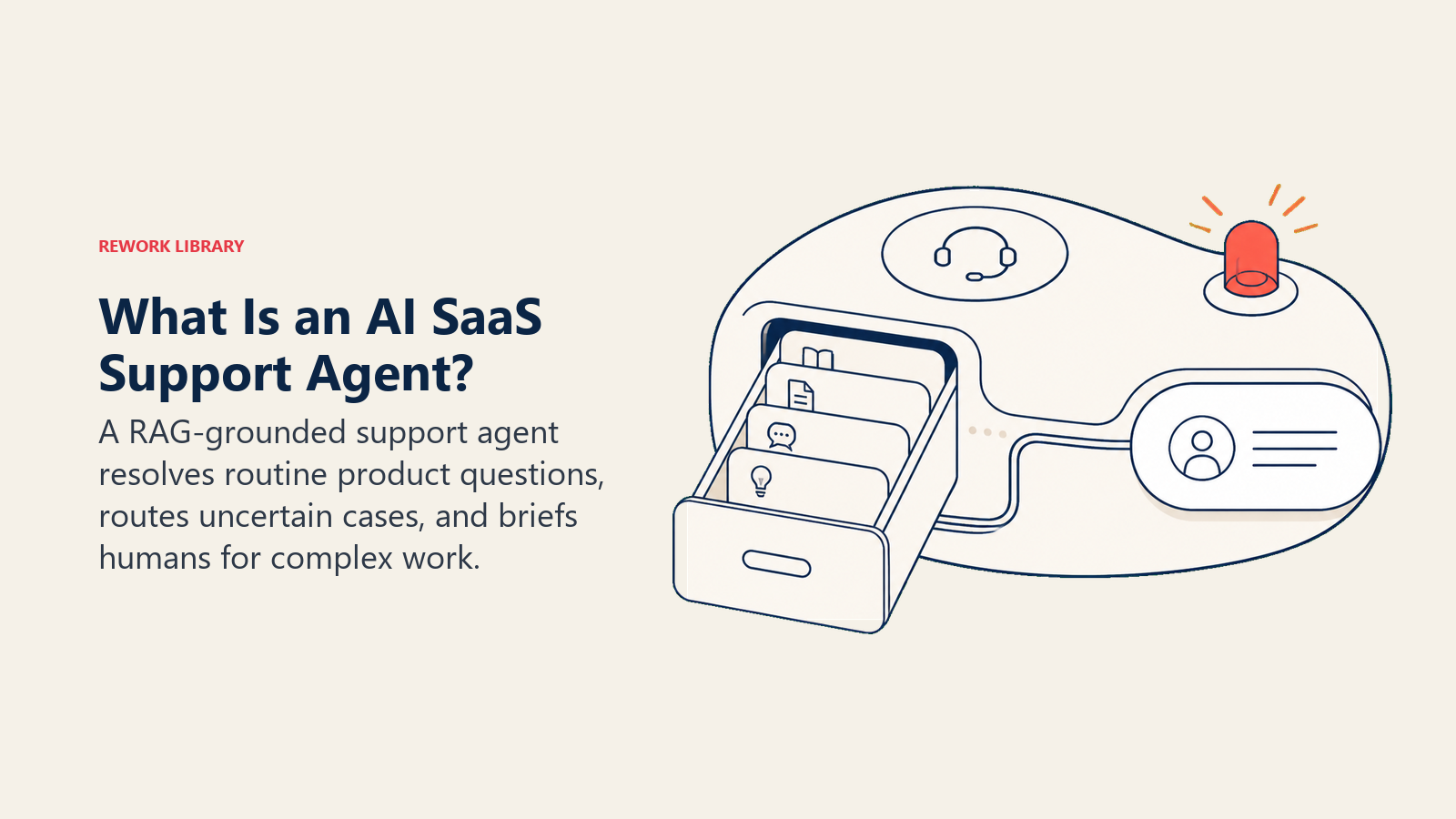
In the ACE Framework, an AI Support Agent combines three patterns: RAG Assistant (product knowledge retrieval), Scoring and Routing (ticket triage and tier assignment), and Workflow Copilot (agent assist for human-handled tickets).
The RAG Assistant is the front line. It receives an incoming question, retrieves the most relevant documentation or past ticket resolution from your knowledge base, and generates a response grounded in that retrieved content. The customer gets an accurate, specific answer without opening a ticket.
Scoring and Routing handles the cases the RAG Assistant cannot confidently resolve. The ticket is scored on complexity, customer tier, and match quality against the knowledge base, then routed to the appropriate human agent with context attached.
The Workflow Copilot operates at Tier 1 human handling: the agent gets a suggested response drafted from the knowledge base, a summary of the customer's account history, and relevant documentation links. They review, edit, and send rather than starting from scratch.
Intercom Fin operates this way. When a customer submits a message, Fin searches the connected knowledge base, generates a response, and either resolves the conversation or hands off to a human with context preserved. Zendesk AI runs similar deflection logic through its AI agents layer. Dialpad AI focuses on the human-agent assist side, surfacing relevant information in real time during live support interactions.
Key Facts: AI Support Agents in SaaS
- The median tier-1 deflection rate across enterprise customer experience programs is 41.2% in 2026, with top-quartile deployments reaching 58.7% (Zendesk/Salesforce benchmarks, 2026)
- Generative AI-powered support agents achieve 92% accuracy in understanding customer intent, versus 65-70% for older keyword-based bots (AI Business Weekly, 2026)
- 61% of customers prefer self-service for simple issues rather than contacting a live agent, but only 14% of customer service issues are fully resolved by self-service today, showing the documentation gap (Salesforce 2025, Gartner)
The L0-L1-L2 SaaS Support Tier
The L0-L1-L2 SaaS Support Tier is a three-level resolution model designed for SaaS products using RAG-based AI. L0 is full AI self-service: the RAG agent retrieves and answers from the knowledge base with no human involvement. L1 is AI-augmented human handling: a human agent receives the AI's attempted answer, retrieved documentation, and account context, then reviews, edits, and sends. L2 is expert escalation: complex, sensitive, or high-annual-recurring-revenue (ARR) tickets route directly to a specialist with full AI-summarized context attached. Each tier has explicit entry criteria, exit criteria, and handoff conditions to prevent escalation bottlenecks and cold transfers.
Why RAG Is the Core Pattern
The reason RAG works for SaaS support where generic chatbots fail comes down to grounding. A large language model trained on the internet knows roughly how SaaS products typically work. It does not know how your product works, what your current error codes mean, how your specific integration behaves, or what changed in your v3.2 API release.
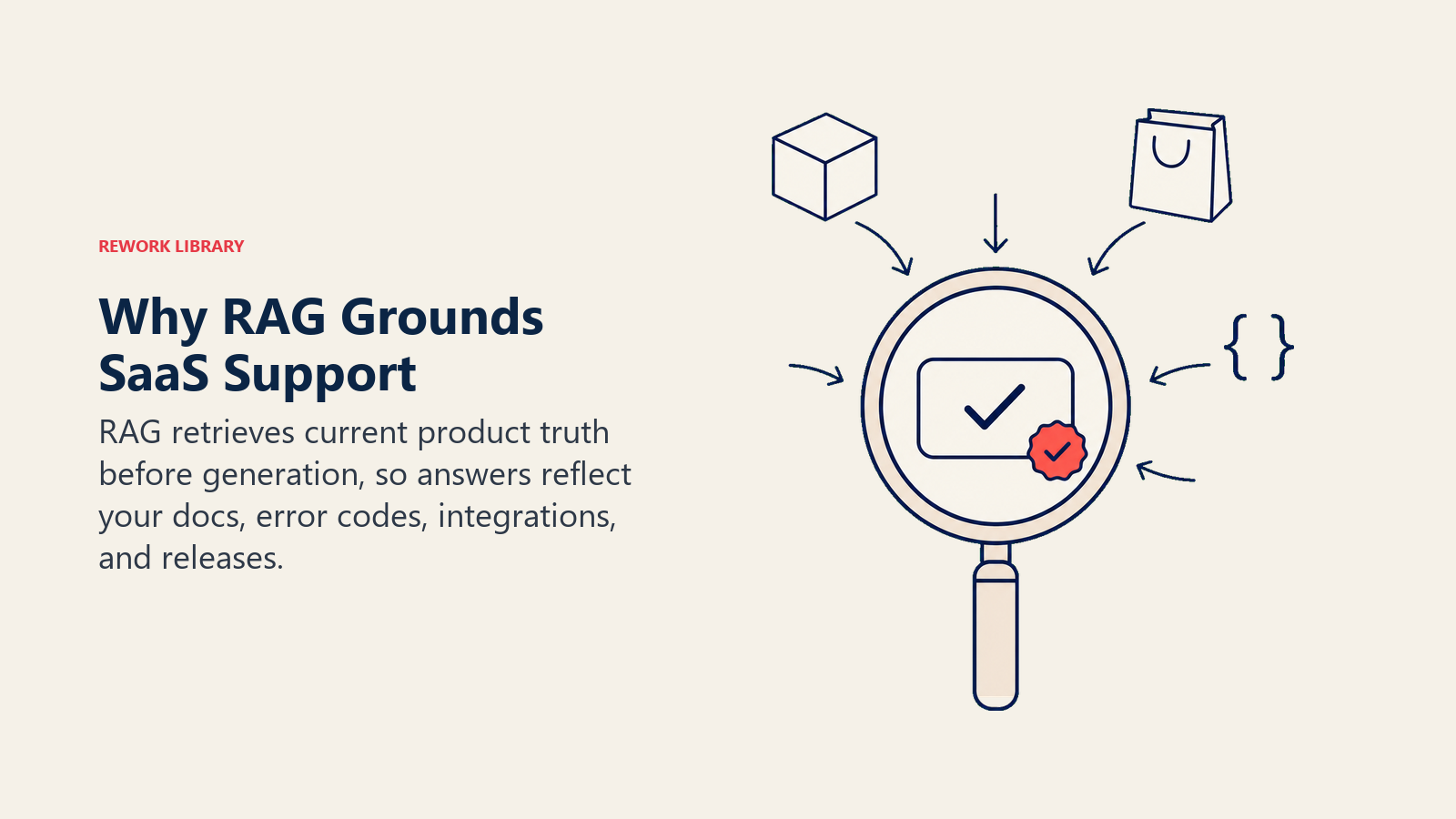
RAG Assistant Pattern: Ingest (customer question) then Analyze (retrieve from knowledge base) then Generate (answer with retrieved content). The retrieved content is the source of truth. The generation layer formats and explains it. AI Knowledge Base Maintenance for SaaS covers how to keep that retrieval corpus current as your product evolves.
This means the quality of your AI support agent is directly proportional to the quality of your knowledge base. If your docs are current, specific, and well-structured, the retrieval step returns the right content and the generated response is accurate. If your docs are outdated, incomplete, or poorly organized, the retrieval returns irrelevant content and the response is wrong, even if it sounds confident.
That's the investment that comes before the AI tool: documentation quality. Most SaaS companies underestimate this and are disappointed when their deflection rates are 15-20% instead of the 40-50% they expected. The gap is validated by Gartner research showing only 14% of customer service issues are fully resolved in self-service today, largely because the knowledge content behind self-service tools is incomplete.
Tier Structure for SaaS Support
Support tiers define what AI can resolve alone, what it can triage, and what must move quickly to a human.
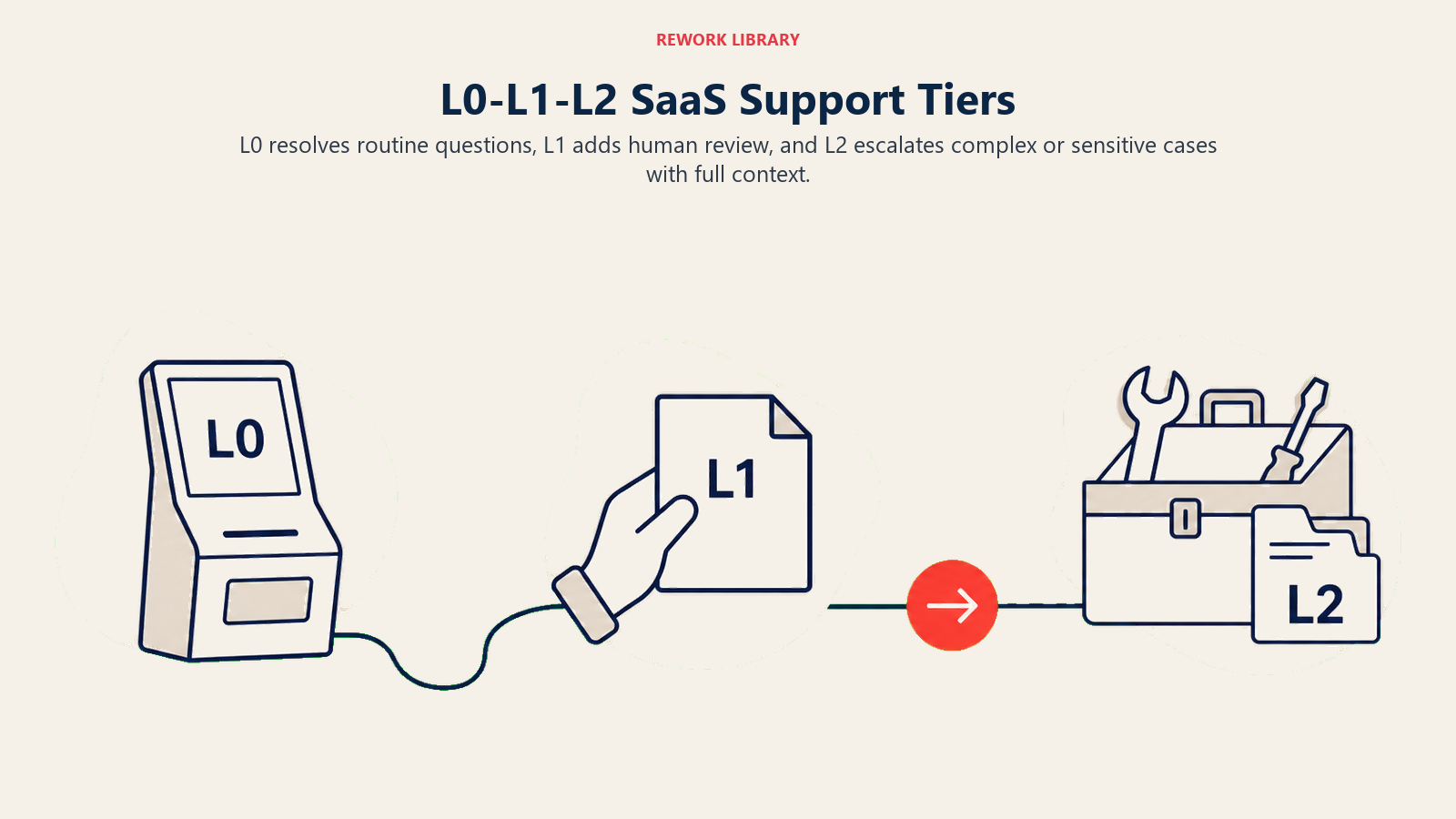
A well-designed AI support system has distinct tiers with clear handoff conditions.
Tier 0: Self-service AI resolution. The RAG Assistant handles the ticket fully, without human involvement. The customer asks a question, gets an accurate answer, and the interaction closes resolved. This is the deflection rate you're targeting. For a well-documented SaaS product with clear tier-0 candidates, realistic deflection rates are 30 to 50%. Claims of 70%+ typically reflect narrow ticket scopes (only certain product areas enabled for AI) or aggressive resolution counting (marking conversations as resolved that were actually escalated shortly after).
Tier 1: AI-augmented human agent. The RAG Assistant attempted a resolution but the customer indicated it didn't help, or the confidence score was below the escalation threshold. A human agent picks up the ticket with the AI's attempted response, the retrieved documentation, and the customer's account context already surfaced. The agent reviews what the AI tried, corrects if needed, and responds.
Tier 2: Specialist with AI summary. Complex technical issues, bug reports requiring investigation, or sensitive account situations (billing disputes, potential churn conversations) route to a specialist. The AI has already summarized the customer's recent ticket history, account status, and the current issue context. The specialist picks up a briefed ticket, not a blank one.
This tier structure is what separates effective AI support deployments from chatbots that annoy customers. The escalation path matters as much as the deflection rate. But which ticket types actually belong at each tier?
What AI Handles Well in SaaS Support
Certain ticket types have high deflection rates because the answer is clearly documented and the question maps closely to existing content.
"How do I do X?" questions are the strongest tier-0 candidates. Setting up an integration, configuring a permission, finding a specific setting, understanding a workflow. These questions have correct, documentable answers that don't require account investigation.
Error code explanations work well when the documentation covers specific errors with clear resolution steps. "What does error 403 in the API response mean and how do I fix it?" is a tier-0 candidate if that error code has a dedicated doc page.
Plan comparison questions (what's the difference between Starter and Standard, what do I get when I upgrade) are clean tier-0 territory because they're factual product questions with definitive answers.
Integration setup guides for common integrations (Salesforce, Slack, Zapier) resolve well through RAG because these guides are typically the most thoroughly documented content in a SaaS help center.
What AI Handles Poorly in SaaS Support
Equally important is knowing where to route immediately to humans rather than attempting AI resolution.
Bug investigation requires a human. When a customer reports unexpected behavior that seems product-related, diagnosing it requires access to logs, engineering review, and sometimes account-level investigation that the AI cannot conduct.
Data privacy requests (GDPR data exports, deletion requests, access requests) must be handled by a human with account access and legal awareness. These are not documentation retrieval tasks.
Billing disputes and contract questions require account-level context and often involve judgment calls that should not be automated. An AI attempting to resolve a disputed invoice is a liability.
Churn conversations and escalated complaints should route immediately to a senior human. Attempting AI self-service on a customer who is frustrated enough to threaten cancellation accelerates the churn. The AI can summarize the account context for the Customer Success Manager (CSM) receiving the escalation, but the conversation itself needs a human.
Knowledge Base Quality: The Real Investment
If you're planning to deploy an AI support agent and you haven't first invested in your documentation, the agent will underperform and you'll blame the AI.
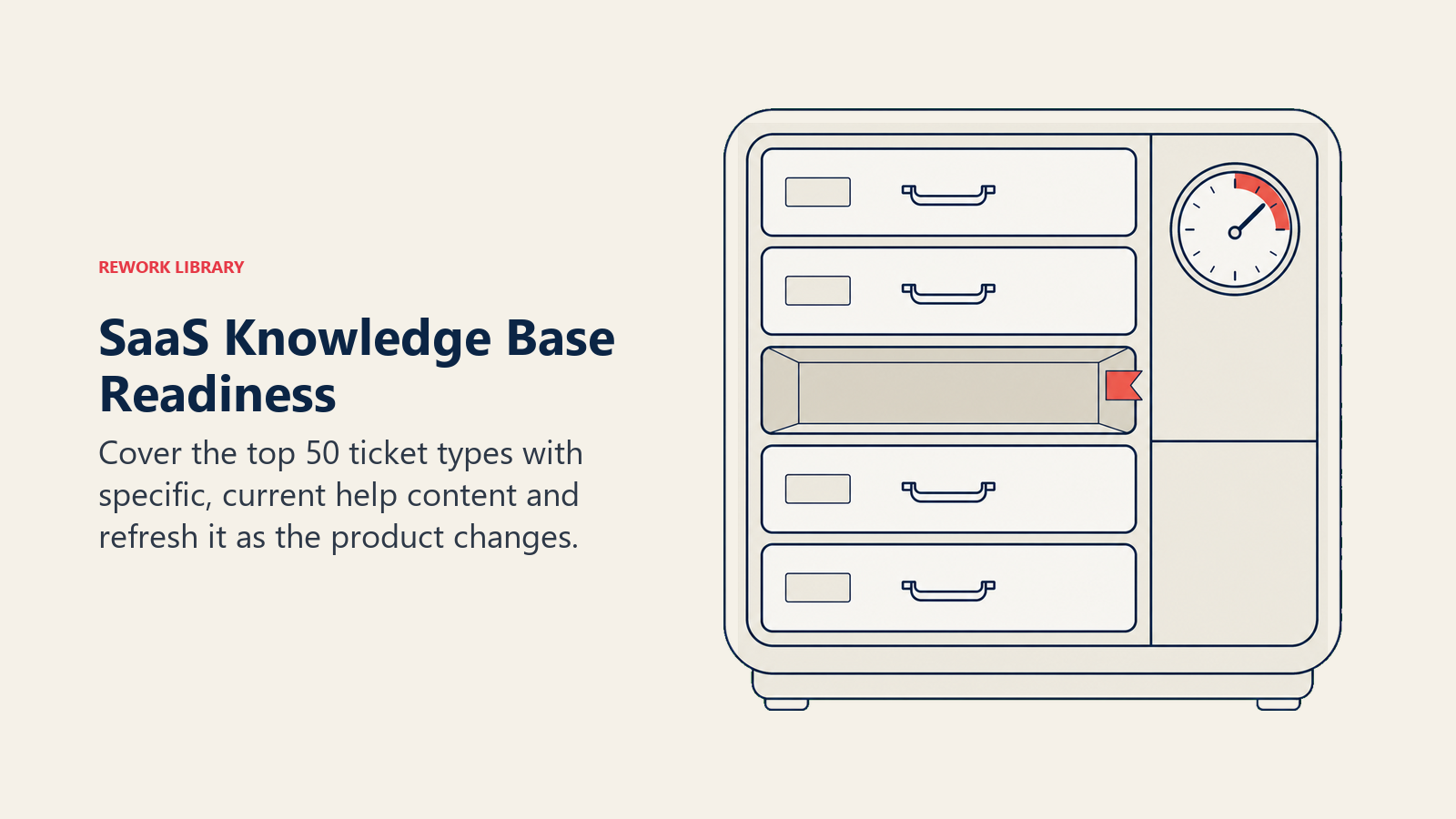
Before you evaluate Intercom Fin or Zendesk AI, audit your help center. Start by pulling the 30 most common tier-0 ticket types from the last 90 days. How many of them have a corresponding help article? Of those articles, how many are specific enough to actually answer the question (not just describe the feature at a high level)? How many are current with your most recent major release?
A practical documentation readiness target: your top 50 ticket types should have dedicated, specific help articles, each updated within the last 90 days. If they don't, build and update those first. Your AI deflection rate from those 50 ticket types will be substantially higher than from a sprawling, partially outdated knowledge base.
The retrieval step also benefits from past resolved tickets. When your AI can retrieve a previous ticket where an agent resolved the same issue, it has a precedent to draw from. Feeding your resolved ticket history into the retrieval corpus (after de-identifying customer data appropriately) meaningfully improves deflection quality for edge cases that aren't explicitly documented.
"SaaS companies using AI-first support platforms see 60% higher ticket deflection compared to traditional help desk software, but that ceiling requires documentation that covers the top 50 ticket types with specific, current answers. Without that foundation, real-world deflection stays at 15-20% regardless of the AI tier purchased." (Pylon/Fini Labs analysis, 2025)
"Deflection rates vary dramatically by ticket type. High-structure intents with a clear backend system of record deflect at 65-80%. Sentiment-heavy and dispute-style intents stay in the 19-34% range. Optimizing deflection means routing each category appropriately, not optimizing a single average." (Digital Applied, 2026)
The Cost Math
Let's run the economics on a mid-market SaaS support team.
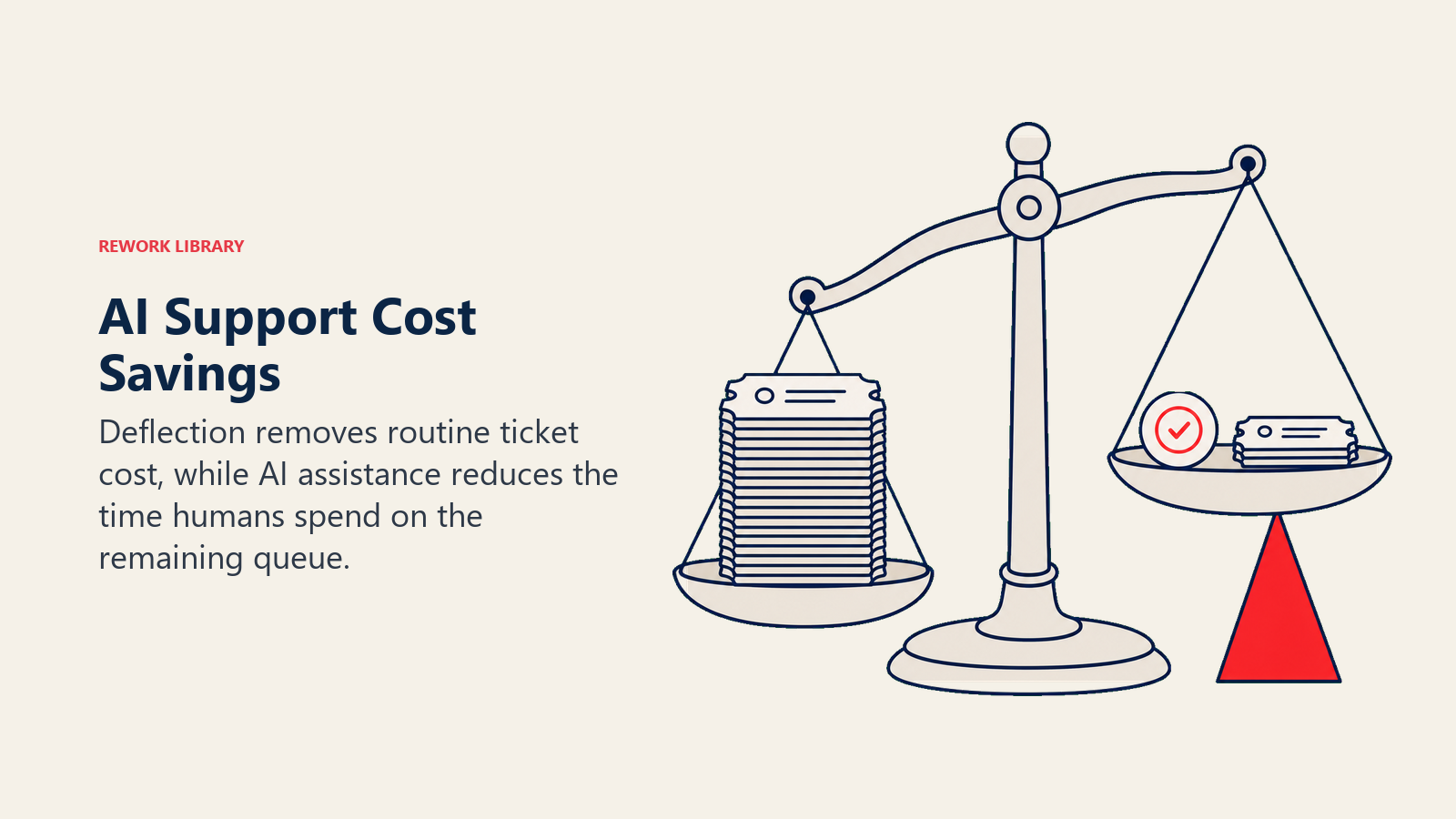
A 10-person support team handling 2,000 tickets per month, with an average cost-per-ticket of $12 (blended loaded cost including agent time, tooling, and overhead), runs $24,000 per month in support costs.
A well-implemented AI support agent with 40% deflection handles 800 of those tickets autonomously. At an AI cost-per-resolution of roughly $0.50 to $1.00 (depending on the vendor and volume), those 800 tickets cost $400 to $800 to resolve.
The remaining 1,200 tickets go to humans, but those agents are working faster with AI assist. Assume a 25% efficiency gain from Workflow Copilot-style draft responses and surfaced context: those 1,200 tickets now require 75% of the time they previously did.
Net effect: $24,000 in monthly support costs becomes roughly $15,000 to $17,000, with response speed improving and customer satisfaction (CSAT) stable or increasing. Over 12 months, that's $84,000 to $108,000 in savings for a single mid-market support team.
These numbers require good documentation and realistic deflection rates. Inflated deflection claims produce inflated savings projections that won't survive contact with reality. Gartner predicts agentic AI will autonomously resolve 80% of common customer service issues by 2029, but that ceiling requires mature knowledge infrastructure that most SaaS companies are still building.
CSAT Impact: The Two Outcomes
AI support either improves CSAT or tanks it, depending on implementation quality. There is no neutral outcome.
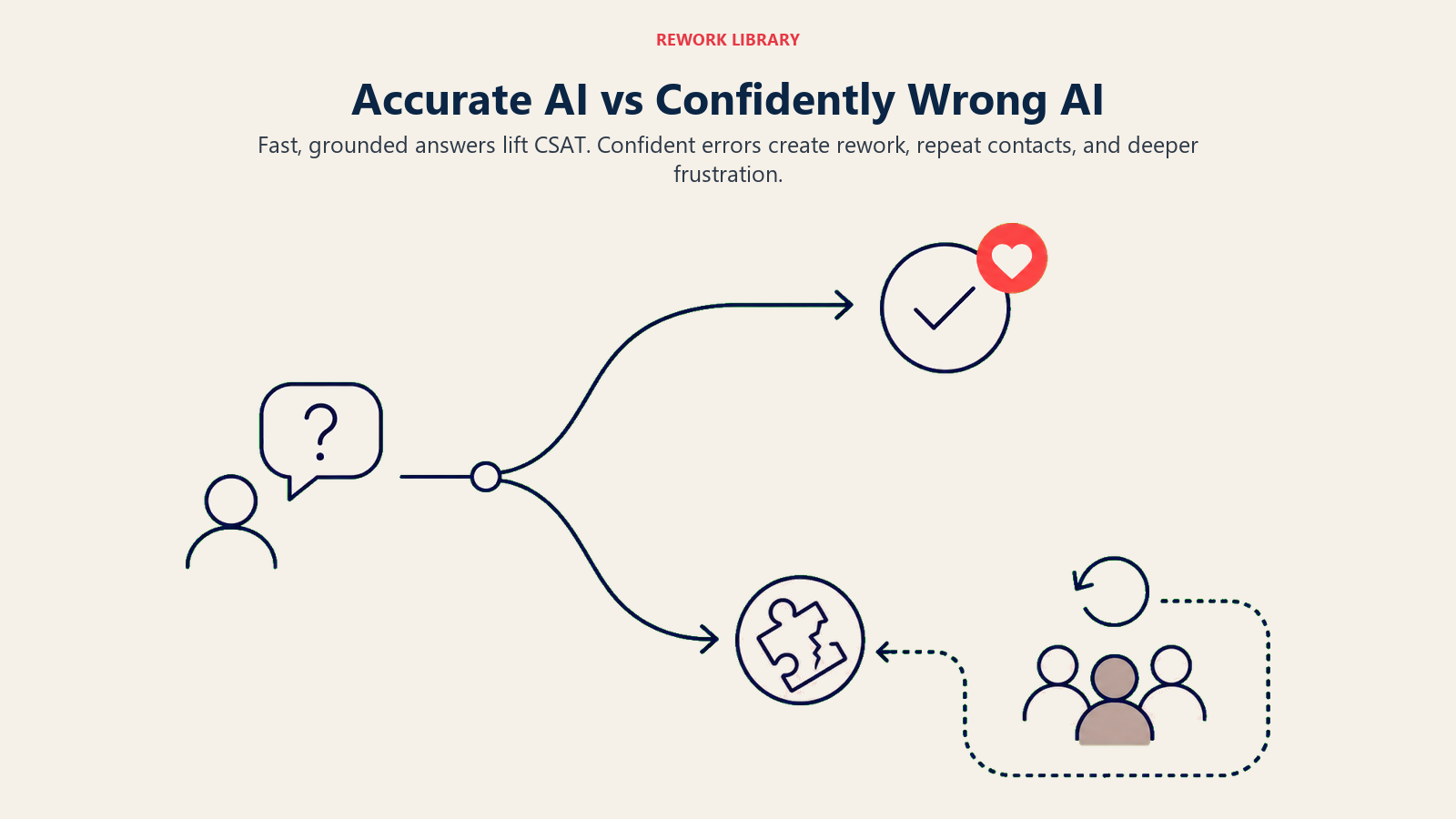
Well-implemented AI support improves CSAT because speed matters enormously in support. A customer who gets an accurate answer in 30 seconds is more satisfied than one who waits 4 hours for a human response, even if both answers are equally correct. For tier-0 questions with clear answers, AI resolution at speed outperforms human resolution at normal ticket queue pace.
Poorly implemented AI support tanks CSAT for the same reason but in reverse. A customer who gets a confident, detailed, incorrect answer from an AI, then has to open a new ticket to report that the first AI response made their problem worse, is significantly more frustrated than if they'd just gotten a human response in the first place. The time cost plus the accuracy failure plus the sense of being bounced around a chatbot is a CSAT disaster.
The difference between these outcomes is almost entirely knowledge base quality and escalation trigger quality. If the AI escalates when it should (low confidence, complex issue, frustrated customer) rather than attempting to resolve everything, the CSAT impact stays positive. Hallucination risk by pattern explains why RAG-grounded systems still fail on edge cases and what thresholds to set.
SaaS Support AI Performance Benchmarks
Benchmarks should balance deflection volume with answer quality, escalation accuracy, and customer satisfaction.
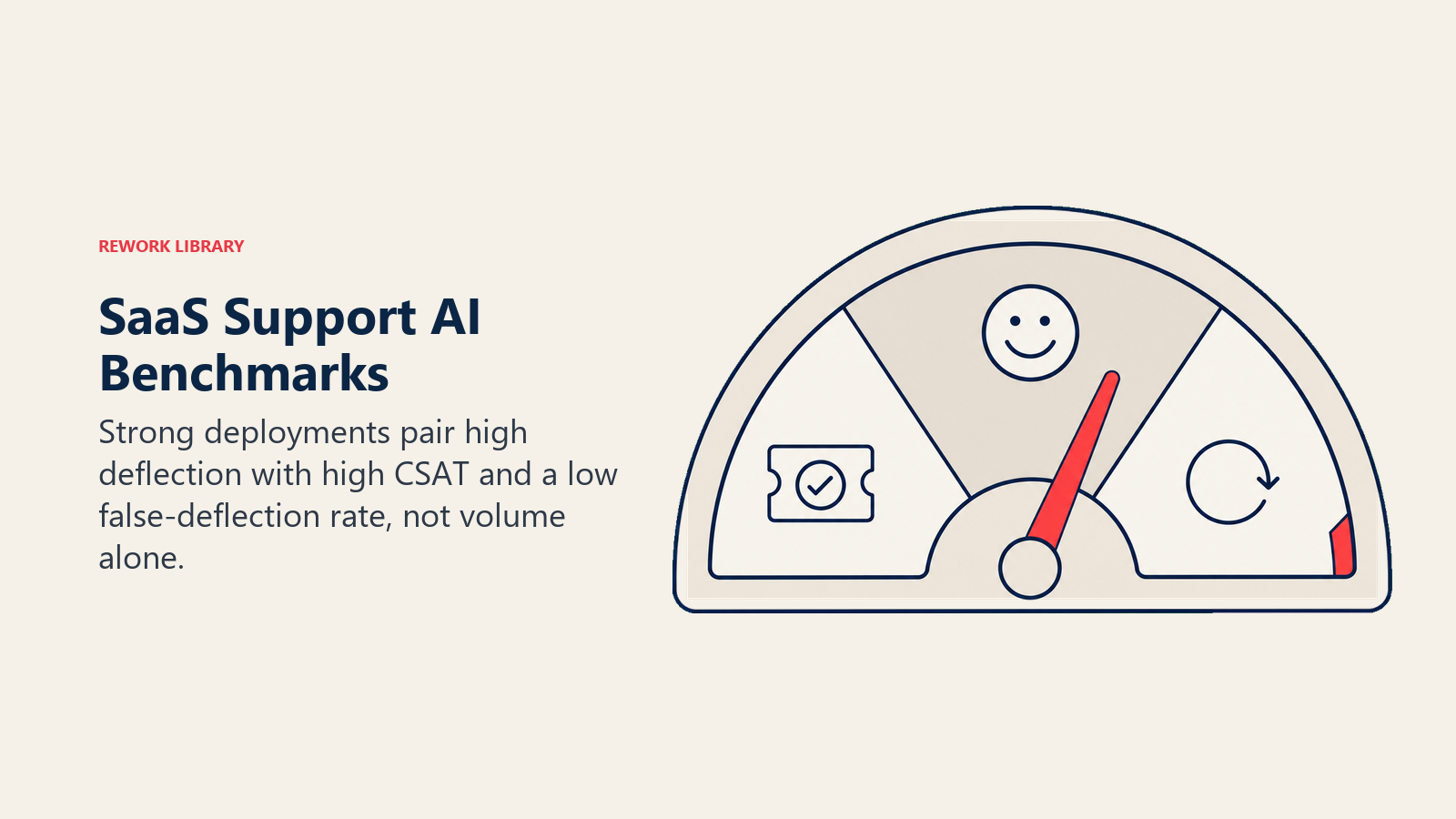
| Deployment Quality | Deflection Rate | CSAT on Deflected Tickets | False-Deflection Rate |
|---|---|---|---|
| Top quartile (mature KB, good escalation design) | 55-70% | 4.2-4.7/5 | Under 8% |
| Median (adequate KB, standard escalation) | 35-45% | 3.8-4.2/5 | 10-18% |
| Bottom quartile (stale KB, poor escalation thresholds) | 15-25% | 2.8-3.4/5 | 22-30% |
Sources: Zendesk CX Trends Report 2026, Intercom Benchmark Data 2025, Gartner Customer Service AI Analysis 2025
Rework Analysis: The deflection rate gap between top and bottom quartile SaaS support deployments is not a technology gap. Both use the same vendor tools. The gap is documentation maturity. Top-quartile teams have a release-to-doc pipeline that keeps their knowledge base within 2-3 weeks of the current product state. Bottom-quartile teams have a knowledge base that was comprehensive at launch and has drifted since. AI is a documentation quality amplifier: it makes good docs perform better and makes stale docs fail faster. Teams that audit documentation before evaluating vendors close 2-3x more support AI ROI than teams that evaluate vendors first.
Connecting to the Broader Support Stack
The AI Support Agent is the front line of a broader support intelligence architecture. Ticket Deflection with RAG in SaaS Support goes deeper on the RAG implementation: corpus design, retrieval quality optimization, and how to handle stale documentation without hallucination risk.
Multi-Tier AI Routing in SaaS Help Desk covers the routing layer in detail: how AI assigns tickets based on complexity, customer tier, product area, and agent specialization rather than simple keyword matching.
The 4 AI Agents Every B2B SaaS Company Needs places the AI Support Agent in the context of the broader SaaS AI stack alongside the Sales Operator, Customer Success Manager, and Content Operator.
Where to Start
If you're a VP of Support evaluating AI deflection, the honest starting point is a documentation audit, not a vendor evaluation. Find your top 50 ticket types. Check whether your help center can actually answer them accurately and specifically. Fix the gaps.
Then pilot with a narrow scope: one product area, one ticket type category, one customer segment. Run it for 60 days, measure deflection rate and CSAT, and expand based on what you learn.
The AI tool is not the constraint. Documentation quality and escalation design are. Get those right, and the deflection rate takes care of itself.
Frequently Asked Questions
What deflection rate should a SaaS company expect from an AI support agent?
Realistic deflection rates for well-documented SaaS products are 30-50%. Top-quartile deployments reach 55-70%, but these reflect mature knowledge bases covering the top 50-100 ticket types with specific, current documentation. Claims of 70%+ typically reflect narrow ticket scopes or inflated resolution counting. The median across enterprise CX programs in 2026 is 41.2% (Zendesk/Salesforce, 2026).
Why does a RAG-based AI perform better than a generic chatbot for SaaS support?
Generic chatbots generate responses from training data that approximates how SaaS products work. RAG retrieves from your actual knowledge base, so the answer is grounded in your specific API error codes, your permission model, and your current product behavior. The quality of the retrieved content determines the quality of the response. A slightly awkward answer from accurate retrieved docs outperforms a polished answer from the model's best guess.
What documentation does a SaaS AI support agent need to work well?
Five content types form the retrieval corpus: help documentation, API and developer docs, product release notes, de-identified resolved tickets, and FAQ or in-product guidance. Release notes are the most commonly neglected. Every new feature or API change creates new support questions, and if release notes aren't in the corpus, the AI answers with outdated information.
How do you prevent AI support from hurting CSAT?
Two design decisions determine whether AI support improves or tanks CSAT. First, escalation trigger quality: the AI must escalate when it should (low confidence, complex issue, frustrated customer) rather than attempting to resolve everything. Second, knowledge base quality: confident but wrong answers from stale documentation damage CSAT more than slow human responses.
What ticket types should never go to AI self-service?
Bug investigation, data privacy requests (GDPR exports, deletion), billing disputes, contract questions, and churn or escalation conversations should route directly to humans. These require account-level context, legal awareness, or relationship judgment that AI cannot provide. Attempting AI self-service on a customer threatening cancellation accelerates the churn.
How do you calculate the ROI of an AI support agent?
Baseline monthly support cost (agent time plus tooling). Apply deflection rate to ticket volume. AI cost per resolution is roughly $0.50-1.00 per ticket. For the remaining human-handled tickets, apply a 20-25% efficiency gain from AI-assisted drafting. The net cost reduction plus the time savings can be projected annually. A 10-person team handling 2,000 tickets per month typically achieves $84,000-108,000 in annual savings at 40% deflection with realistic cost assumptions.
Learn More:
- RAG Assistant Pattern: the core retrieval pattern that powers accurate AI support
- Hallucination Risk by Pattern: where RAG-grounded AI still fails and how to set escalation thresholds
- Ticket Deflection with RAG in SaaS Support: deeper on RAG implementation and corpus design
- Multi-Tier AI Routing in SaaS Help Desk: how smart routing works beyond keyword matching
- AI Knowledge Base Maintenance for SaaS: keeping your retrieval corpus current as the product evolves
- The 4 AI Agents Every B2B SaaS Company Needs: the full AI agent stack for SaaS

Co-Founder, Rework.com
On this page
- The AI Support Agent Defined
- The L0-L1-L2 SaaS Support Tier
- Why RAG Is the Core Pattern
- Tier Structure for SaaS Support
- What AI Handles Well in SaaS Support
- What AI Handles Poorly in SaaS Support
- Knowledge Base Quality: The Real Investment
- The Cost Math
- CSAT Impact: The Two Outcomes
- SaaS Support AI Performance Benchmarks
- Connecting to the Broader Support Stack
- Where to Start