Focus Strategy: Niche Competitive Advantage

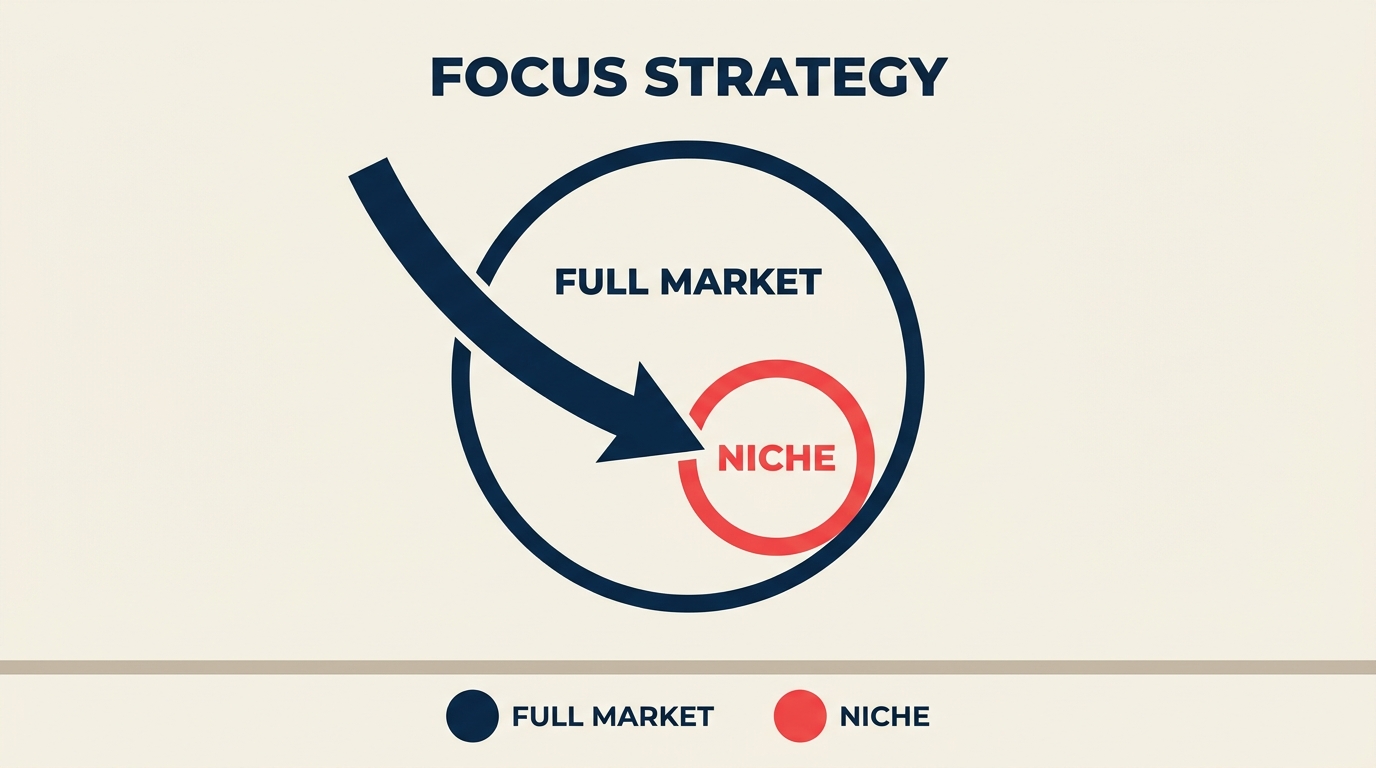
Focus strategy diagram showing a targeted niche segment within a larger market

Most companies try to compete everywhere. Focus strategy says the opposite: pick one narrow segment, serve it better than anyone else, and let everyone else fight over the rest.

Focus is one of Porter's three generic strategies, sitting alongside cost leadership and differentiation. Where those two aim at broad markets, focus deliberately shrinks the playing field. The idea is straightforward: a smaller arena means less competition, deeper expertise, and stronger relationships with the customers who actually matter.

What is a focus strategy?

Key facts

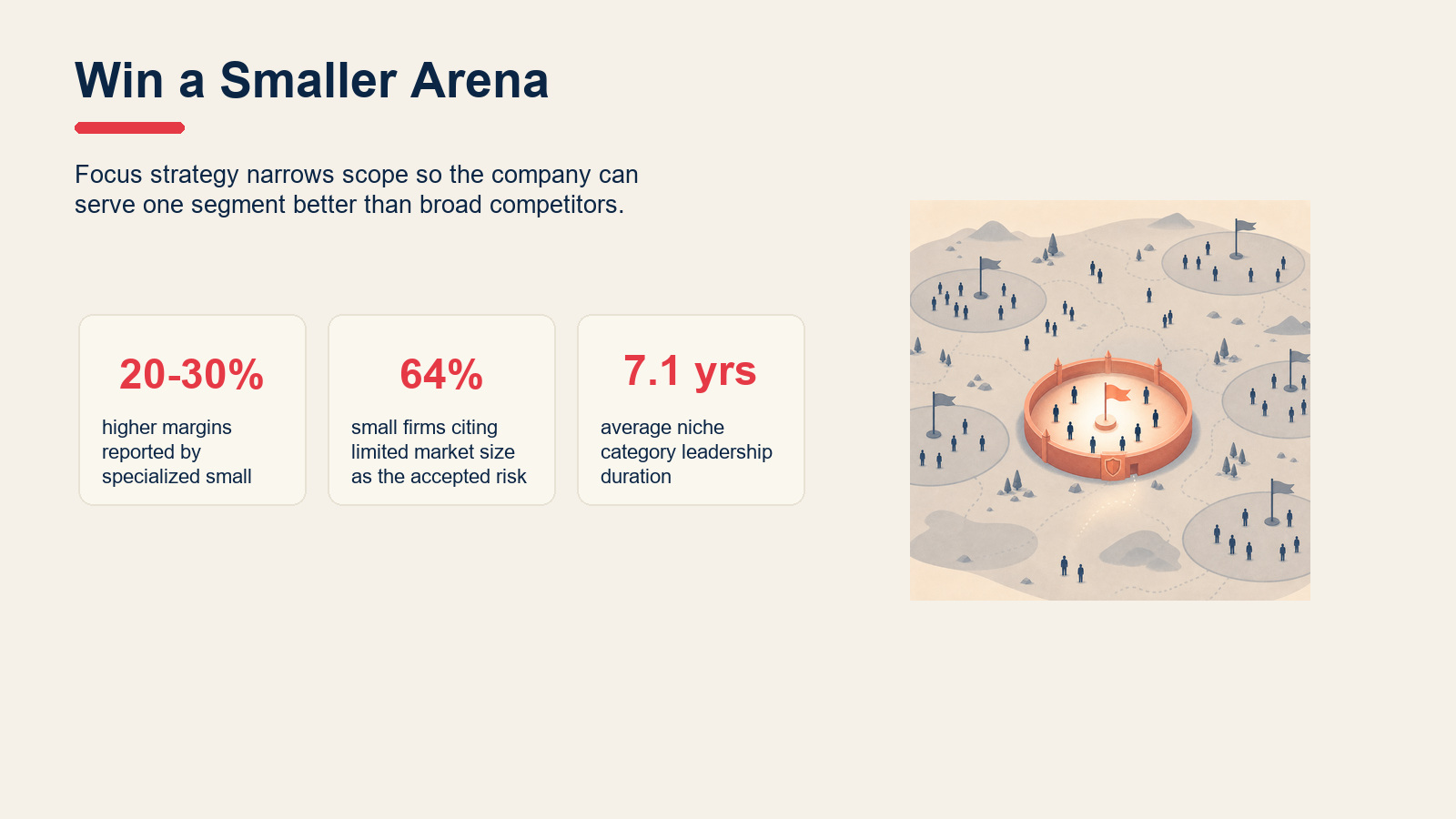
  • Small businesses that specialize in a niche report profit margins 20-30% higher than generalists in the same industry (National Federation of Independent Business Research, 2023).
  • 64% of small firms cite "limited addressable market" as the top risk they consciously accepted when choosing a niche (Deloitte SMB Outlook, 2022).
  • Focused competitors tend to hold their market share longer: niche leaders average 7.1 years as category leaders vs. 4.8 years for broad-market players (Harvard Business Review, 2021).

A focus strategy is a competitive approach in which a company concentrates its resources on a specific customer segment, geographic region, or product line rather than serving the whole market. The goal is to achieve either lower costs or superior value within that narrow scope, which broad competitors cannot match because their operations are built for scale across many segments.

Michael Porter introduced the concept in Competitive Advantage (1985) as part of his competitive advantage framework. He argued that companies stuck in the middle, trying to be both cheap and differentiated across a wide market, end up outcompeted on both dimensions. A focused firm avoids that trap by defining where it will compete before deciding how.

The two types: cost focus vs differentiation focus

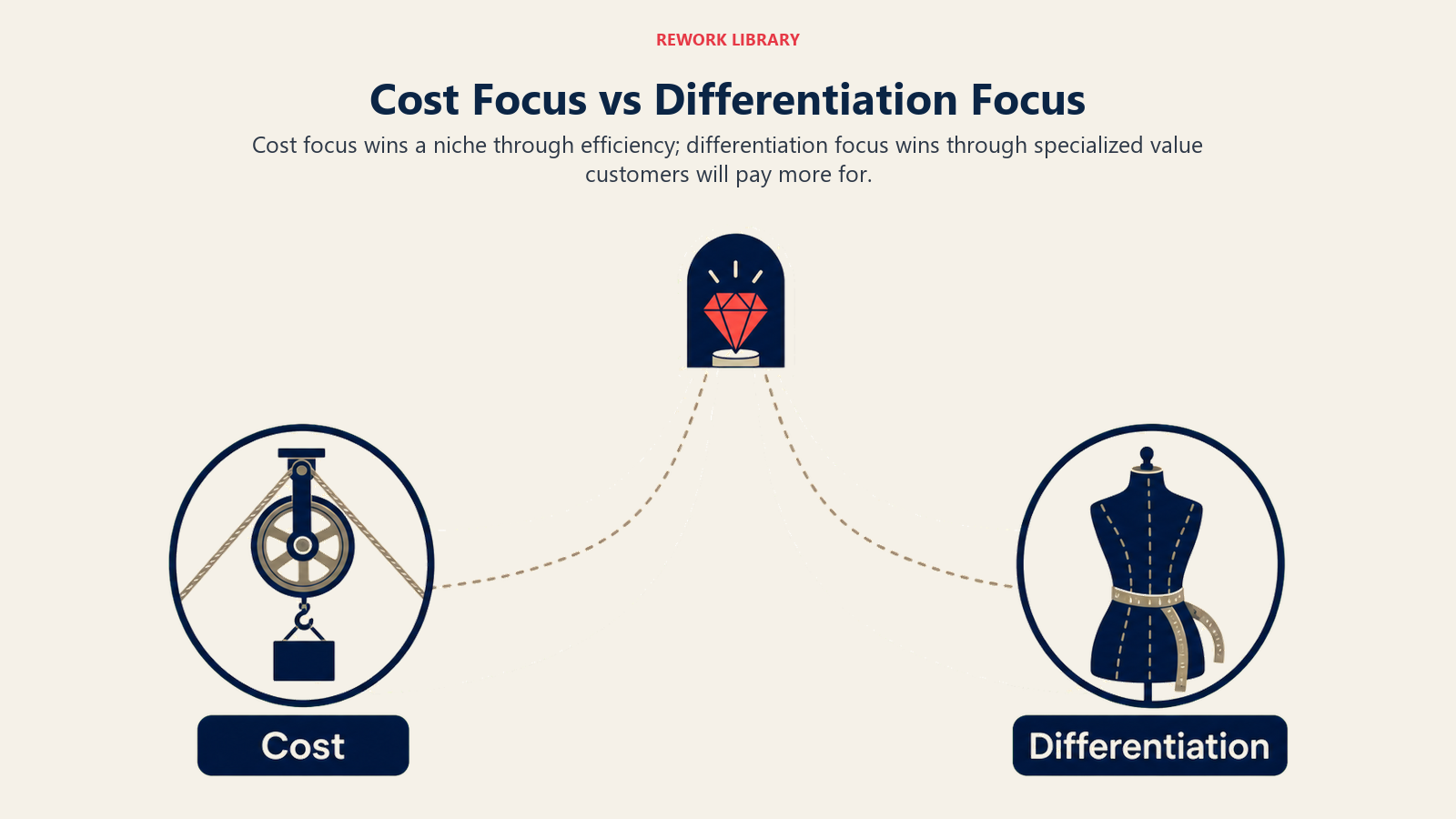
Focus strategy is not a single tactic. It splits into two distinct approaches depending on whether the firm competes on price or on uniqueness within its chosen niche.

Dimension Cost Focus Differentiation Focus
Core goal Lowest cost for the niche Unique value for the niche
Price point Below market or value-priced Premium
Customer profile Price-sensitive buyers in one segment Buyers who want something the mass market doesn't offer
Margin source Volume efficiency within niche Willingness-to-pay premium
Risk Broad cost leaders enter the niche Niche demand shifts away from specialization
Example Regional budget airline serving underserved routes Bespoke accounting firm for veterinary practices

Cost focus targets a narrow segment and serves it more cheaply than anyone else. A regional low-cost carrier flying routes that major airlines ignore doesn't need to be the cheapest airline in the world; it just needs to beat every rival on those specific routes.

Differentiation focus targets a narrow segment and serves it more distinctively than anyone else. A software vendor built exclusively for pediatric dental offices doesn't compete with SAP. It competes on domain depth: workflows, compliance templates, and terminology that a general-purpose ERP can't match.

The distinction matters because the two types fail differently. Cost-focused firms get squeezed when big players decide the niche is worth entering. Differentiation-focused firms get squeezed when customers' preferences homogenize and the segment's unique needs disappear.

Focus strategy vs cost leadership vs differentiation

Where does focus sit relative to the other Porter's generic strategies?

Strategy Competitive scope Competitive advantage Typical margin source
Cost leadership Broad market Lowest overall cost Volume, operational efficiency
Differentiation Broad market Unique product or brand Premium pricing across segments
Cost focus Narrow segment Lowest cost in segment Efficiency within niche
Differentiation focus Narrow segment Unique value in segment Premium pricing within niche

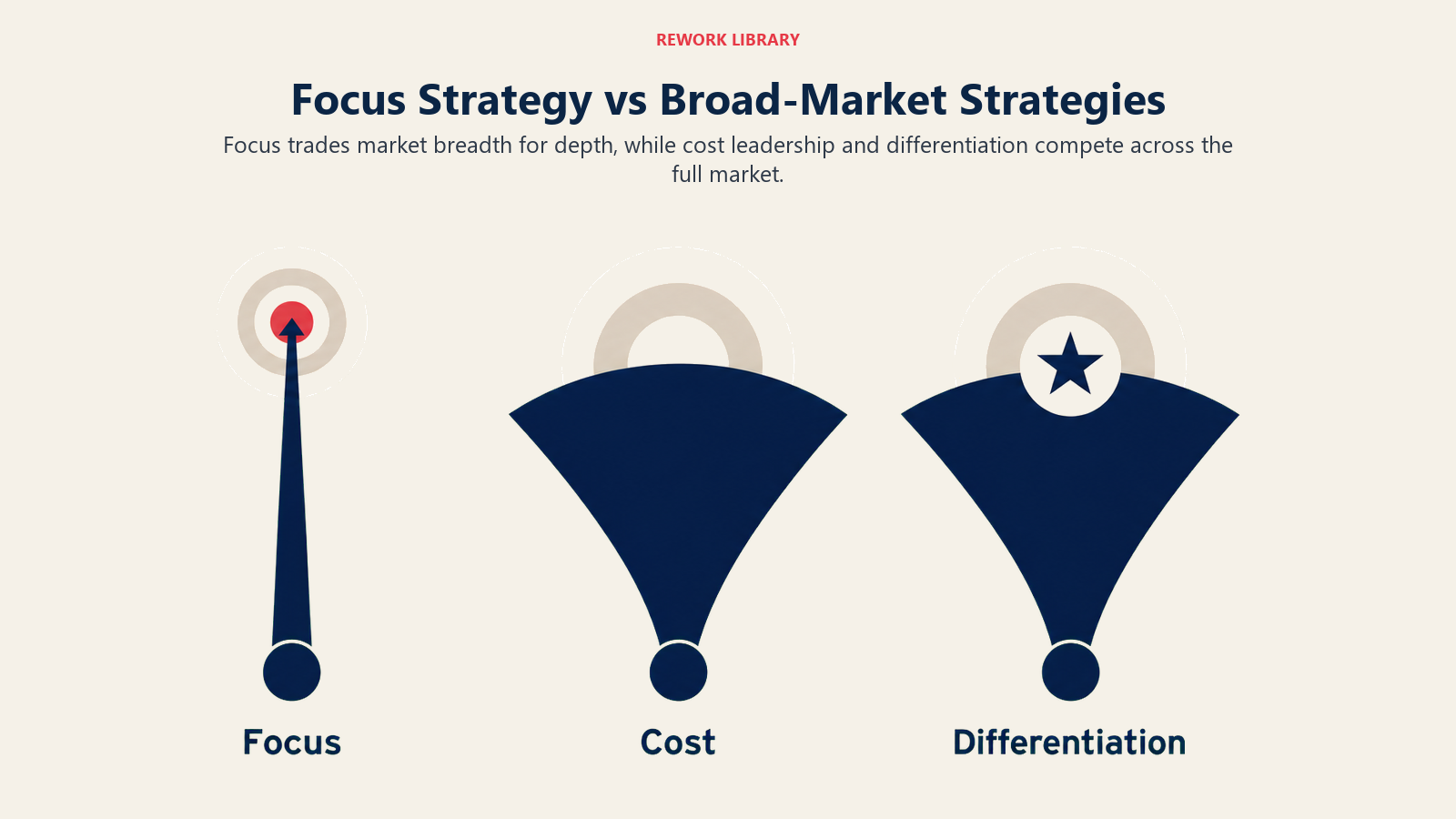
Cost leadership and differentiation both target the whole market. Focus strategies accept a smaller addressable market in exchange for a stronger position within it. That trade-off is the defining choice: you're giving up scale to win depth.

A useful complement is Bowman's Strategy Clock, which extends this framework by mapping eight competitive positions on a price-vs.-perceived-value grid. Most focus strategies land in the "focused differentiation" zone (high perceived value, high price, narrow scope) or the "low price" zone (low price, acceptable value, narrow scope). The value disciplines model offers another lens: focus strategy companies typically pick "customer intimacy" or "product leadership" as their primary discipline and invest in it obsessively for their niche.

Benefits of a focus strategy

Less direct competition. Broad players rarely find it worth restructuring their operations for a small segment. That indifference creates breathing room. A firm serving independent pharmacies with specialized inventory software isn't fighting Oracle; it's largely alone in its lane.

Deep customer knowledge. Serving one segment for years means understanding its workflows, seasonality, pain points, and buying triggers far better than a generalist ever could. That knowledge compounds. It informs product roadmaps, pricing, and sales conversations in ways that are genuinely difficult to replicate.

Premium pricing power. When customers believe no one else serves their specific needs as well, they're willing to pay for it. Specialized law firms, niche consultancies, and industry-specific SaaS products all demonstrate this: prices stay high even as the general market commoditizes, because the customer calculus is "there's no real substitute."

Stronger customer loyalty. Niche buyers tend to stay. The switching cost isn't just monetary; it's operational. A healthcare staffing agency that knows the quirks of a hospital system's compliance requirements is hard to displace, even if a cheaper generalist arrives.

Clearer strategic focus. When everything you do is built around one segment, internal decisions get simpler. Hiring, product features, marketing channels, and partnerships all point the same direction.

Risks and limitations

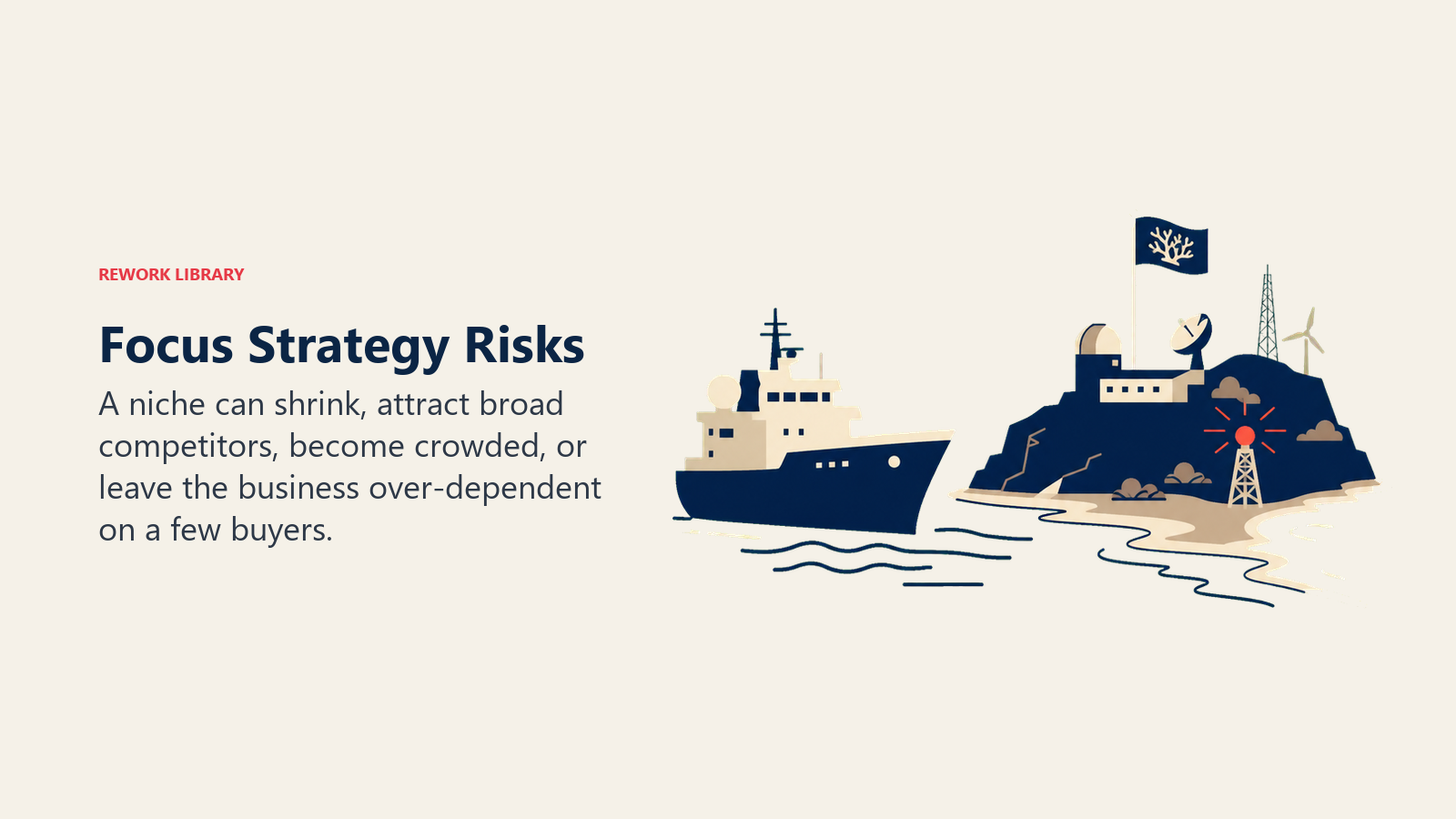
Niche shrinkage. Demographics shift. Regulations change. Technology disrupts. A firm that built its entire identity around serving print advertising agencies in 2005 had a difficult decade. The more specialized you are, the less diversification cushions you when the niche contracts.

Broad players moving in. If a niche grows large enough to be interesting, bigger competitors will eventually notice. Amazon entering a niche market has ended many focused retailers. The question isn't whether a broad player could theoretically compete; it's whether the niche is worth their operational distraction right now.

Imitation within the niche. Focused success attracts other focused competitors. A niche that once held one specialist often holds five within a few years. When that happens, the original firm has to defend its position without the luxury of a wide moat.

Segment definition risk. If you define your niche too narrowly, the addressable market may not be large enough to support a sustainable business. Too broadly, and you lose the focus advantage. Getting the segment definition right is genuinely hard and requires ongoing validation.

Over-dependence. Concentrated customer relationships are also concentrated risk. If 60% of your revenue comes from three clients in the same niche, one regulatory change or industry downturn can devastate the whole business.

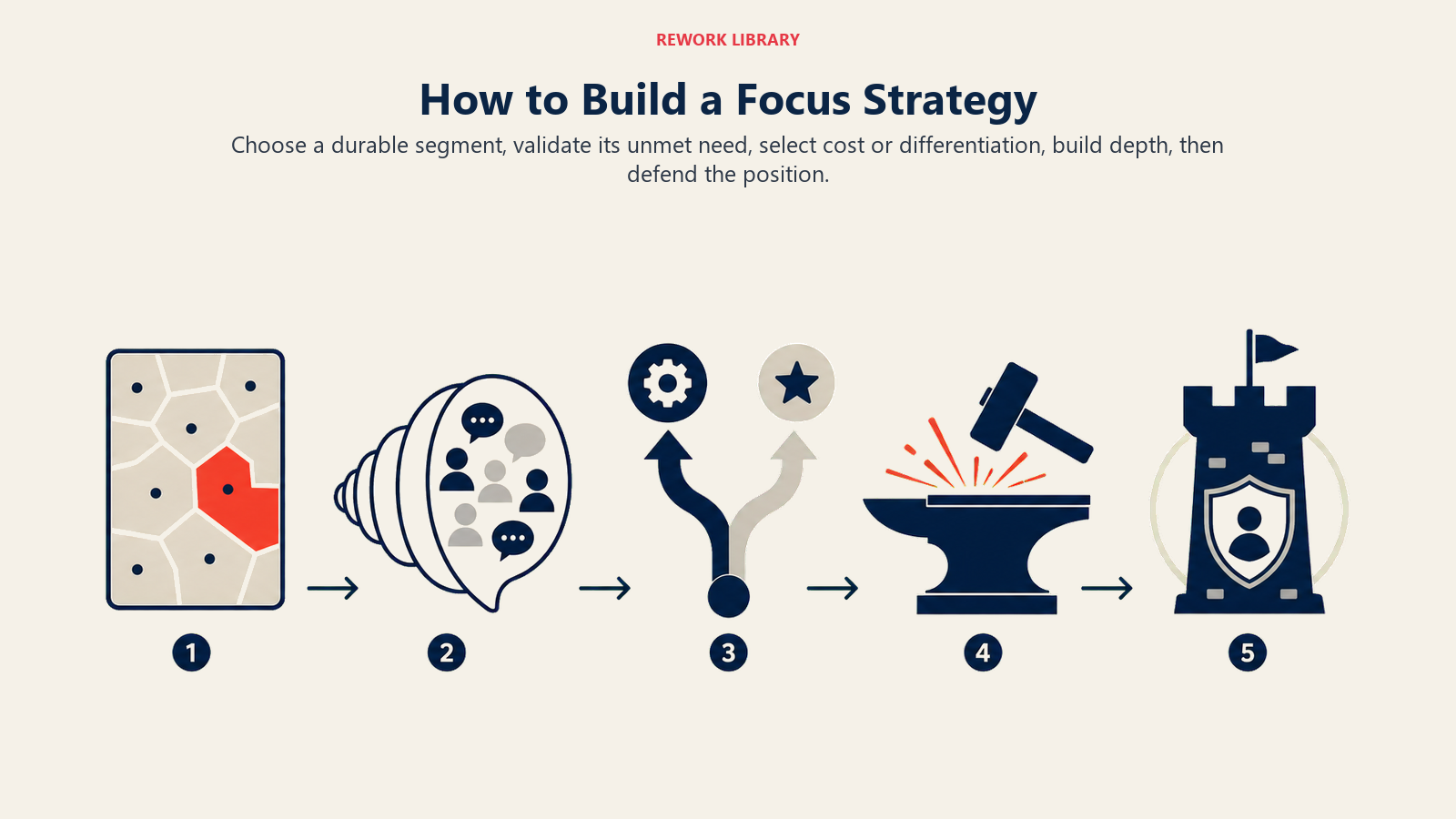
How to build a focus strategy

Step 1: Identify and evaluate candidate segments

Start by mapping all the segments in your current or potential market. Look for groups with distinct needs, distinct buying behaviors, or distinct cost structures. Useful signals: segments that competitors serve poorly, segments with high complaints about generic solutions, or segments where you already have disproportionate wins.

Screen each candidate against three criteria: Is the segment large enough to be profitable? Is it accessible through your current or buildable capabilities? Is it durable, meaning will it exist in five years?

Step 2: Validate the unmet need

Don't assume the segment needs something different. Talk to 15-20 customers or prospects inside the target segment. Ask about their current solutions, their biggest frustrations, and what they wish existed. You're looking for consistent pain points that generic competitors ignore because addressing them would require specialization.

If the segment's needs are basically the same as the broad market's, a focus strategy won't generate a sustainable advantage. Genuine focus requires genuine differentiation of needs.

Step 3: Choose your competitive mode

Decide whether you're pursuing cost focus or differentiation focus. This shapes every subsequent decision. Cost focus means obsessing over operational efficiency within the segment: lean processes, lower overhead, volume discipline. Differentiation focus means obsessing over depth: specialized features, domain expertise in your sales and support team, community and network effects within the niche.

Trying to do both simultaneously usually fails. Pick one.

Step 4: Build capabilities that are hard to replicate

Core competencies are the engine of a focus strategy. The narrow scope that limits your scale also gives you the opportunity to go deep in ways that broad competitors can't. That depth has to be real and tangible: proprietary data about the segment, specialized staff, unique partnerships, or process know-how.

Ask: if a well-funded generalist decided to enter our niche tomorrow, what would take them two or more years to replicate? Build those things. Capabilities that can be bought or hired overnight aren't defensible.

Step 5: Defend and extend the position

A focus strategy is not a launch-and-leave decision. It requires ongoing investment in the same segment as its needs evolve. That means regular customer research, segment-specific product development, and selective expansion into adjacent segments only when the core position is secure.

Watch for early signals that the niche is shifting: changing regulations, new technology the segment is adopting, consolidation among your key customers. Adjust before the market forces you to.

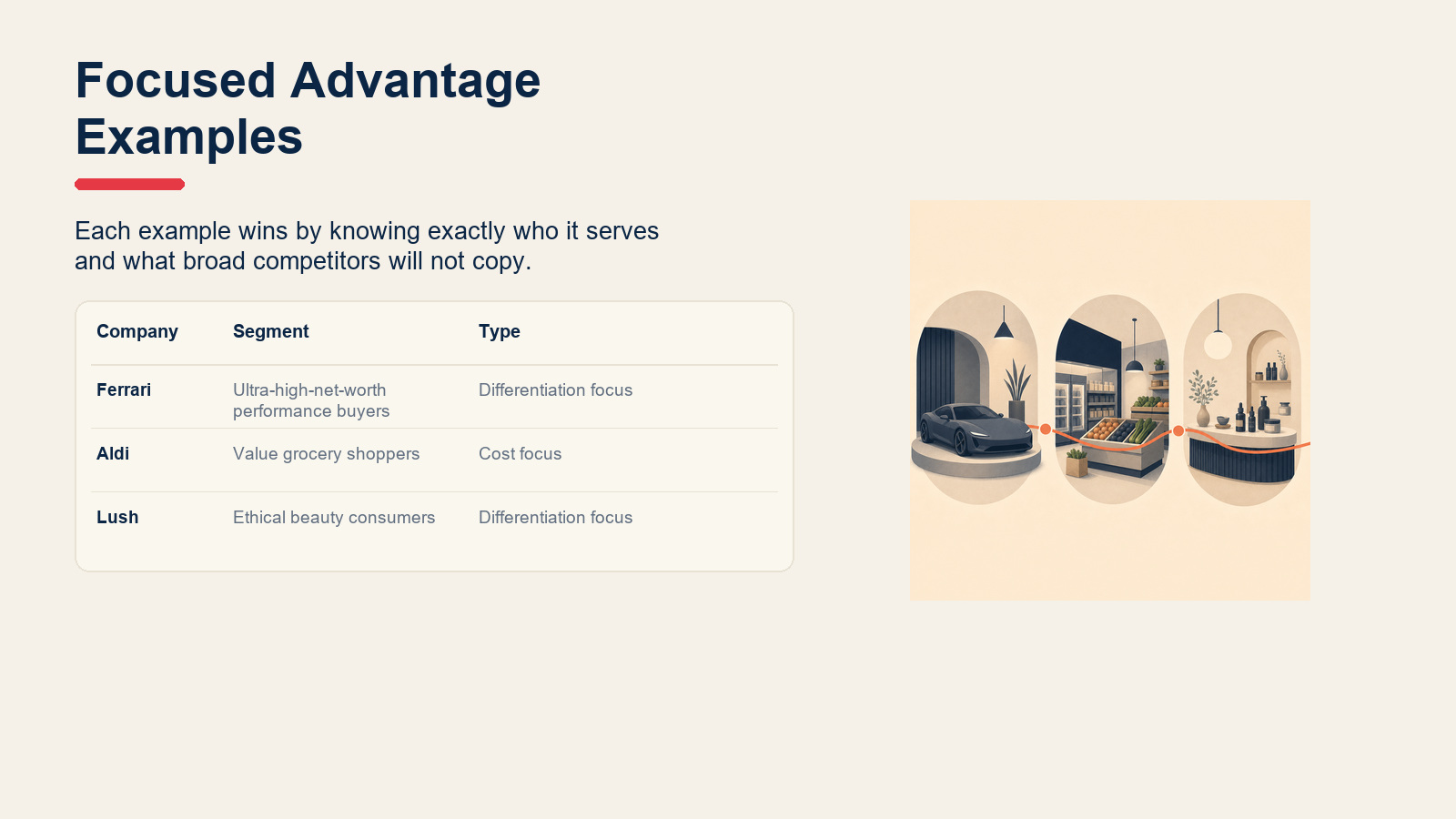
Focus strategy examples

Company Segment targeted Type How focus creates advantage
Ferrari Ultra-high-net-worth performance car buyers Differentiation focus Handcrafted production, racing heritage, strict supply limits preserve exclusivity and premium pricing
Rolls-Royce (cars) Ultra-luxury buyers wanting bespoke personal vehicles Differentiation focus Customization depth, craftsmanship standards, and white-glove delivery chain that volume manufacturers can't justify
Aldi (regional markets) Value-conscious grocery shoppers in specific geographies Cost focus Private-label simplicity and lean store formats reduce cost enough to undercut national chains in targeted regions
Lush Cosmetics Ethical beauty consumers wanting fresh, handmade products Differentiation focus Transparent sourcing, in-store demonstrations, and anti-packaging stance that resonates with a specific values-driven segment
Airbnb Luxe High-end travelers wanting unique, premium-service homes Differentiation focus Curated inventory, on-trip concierge, and verification process that separates it from standard Airbnb listings
WD-40 Industrial maintenance and consumer DIY segments Differentiation focus Singular brand identity built around one iconic product and its "2,000 uses," enabling premium shelf placement

Notice the pattern: in every case, the company knows exactly who it serves and has built something specifically for them that a generalist either can't replicate or doesn't want to. That specificity is what generates pricing power and customer loyalty that broad competitors struggle to match.

Best practices

Define the segment with precision. Vague targeting ("small businesses") doesn't generate focus advantage. Specific targeting ("small independent veterinary clinics with 3-10 staff in the US Southeast") does. The more precise your definition, the more precisely you can serve it.

Measure niche market share, not total market share. A focused company with 40% of its target segment is winning. That same company with 2% of the total market looks like it's losing. Track the metric that reflects your actual strategic intent.

Keep the team obsessed with the segment. The focus advantage comes from accumulated knowledge and relationships. That accumulation requires long attention spans. Avoid the temptation to "explore adjacent opportunities" before the core position is truly secure.

Monitor competitive positioning continuously. Focus strategies are more vulnerable to external shifts than broad strategies because there's no diversification buffer. Build a lightweight system for tracking niche trends, competitor moves, and customer sentiment changes.

Know when to expand. A strong niche position can become a platform for controlled expansion: adding adjacent segments, geographic replication, or a second product line. The key word is controlled. Expansion that dilutes the core niche expertise destroys the source of advantage.

Consider blue ocean strategy as a complement. When a niche becomes crowded, blue ocean thinking can help reframe the segment's boundaries or identify an entirely uncontested space. The two frameworks pair well: focus strategy wins in a defined niche; blue ocean strategy helps you redefine where the niche is.

Link to differentiation strategy principles. Differentiation-focused firms benefit especially from understanding the full breadth of differentiation techniques: product uniqueness, brand perception, channel exclusivity, and service quality all compound within a narrow segment.

Frequently asked questions

What is a focus strategy in simple terms? It's a competitive approach where a company competes in a small, specific part of the market rather than the whole market, aiming to serve that part better than anyone else. Think of it as winning a smaller game instead of playing the bigger, more crowded one.

Is focus strategy the same as niche marketing? They're related but not identical. Niche marketing is a communication and targeting tactic: reaching a specific audience. Focus strategy is a broader competitive choice that shapes your entire business model, operations, and resource allocation around a specific segment. Niche marketing can be part of a focus strategy, but focus strategy goes much deeper.

What is the main risk of a focus strategy? The biggest risk is that the niche disappears, shrinks, or gets invaded by a broad competitor who decides it's now worth their attention. Focused firms have less diversification to cushion those events. That's why ongoing monitoring of niche dynamics matters more for focused firms than for broad-market players.

How does a focus strategy differ from differentiation strategy? Differentiation strategy targets the whole market with a unique product or brand. Focus strategy targets a narrow segment. Differentiation focus combines both: a unique value proposition aimed specifically at one segment. The competitive scope is what distinguishes them.

Can a large company use a focus strategy? Yes, but typically through business units rather than at the whole-company level. A large conglomerate might run a focused unit that serves a specific niche while other units pursue broad strategies. At the enterprise level, a pure focus strategy is rare because large organizations need volume to justify their cost structure.

Serving one segment exceptionally well is harder than it sounds. It requires resisting the pull toward growth, complexity, and market expansion that most organizations feel as they mature. But the companies that hold their focus longest tend to build the most durable competitive positions. The niche is not a consolation prize; for many firms, it's the whole strategy.