日本語

Corporate Strategy: Definition and Components

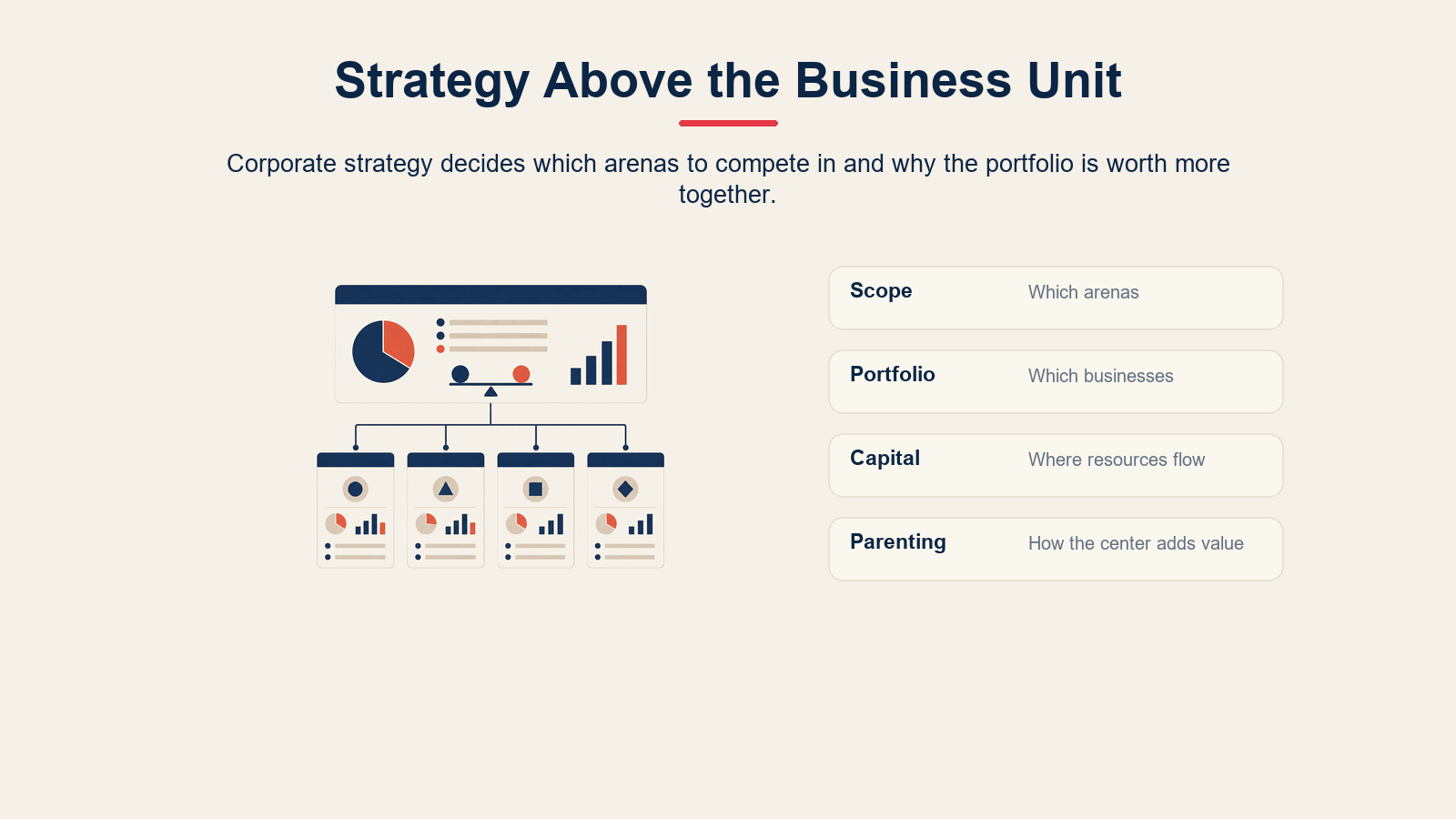
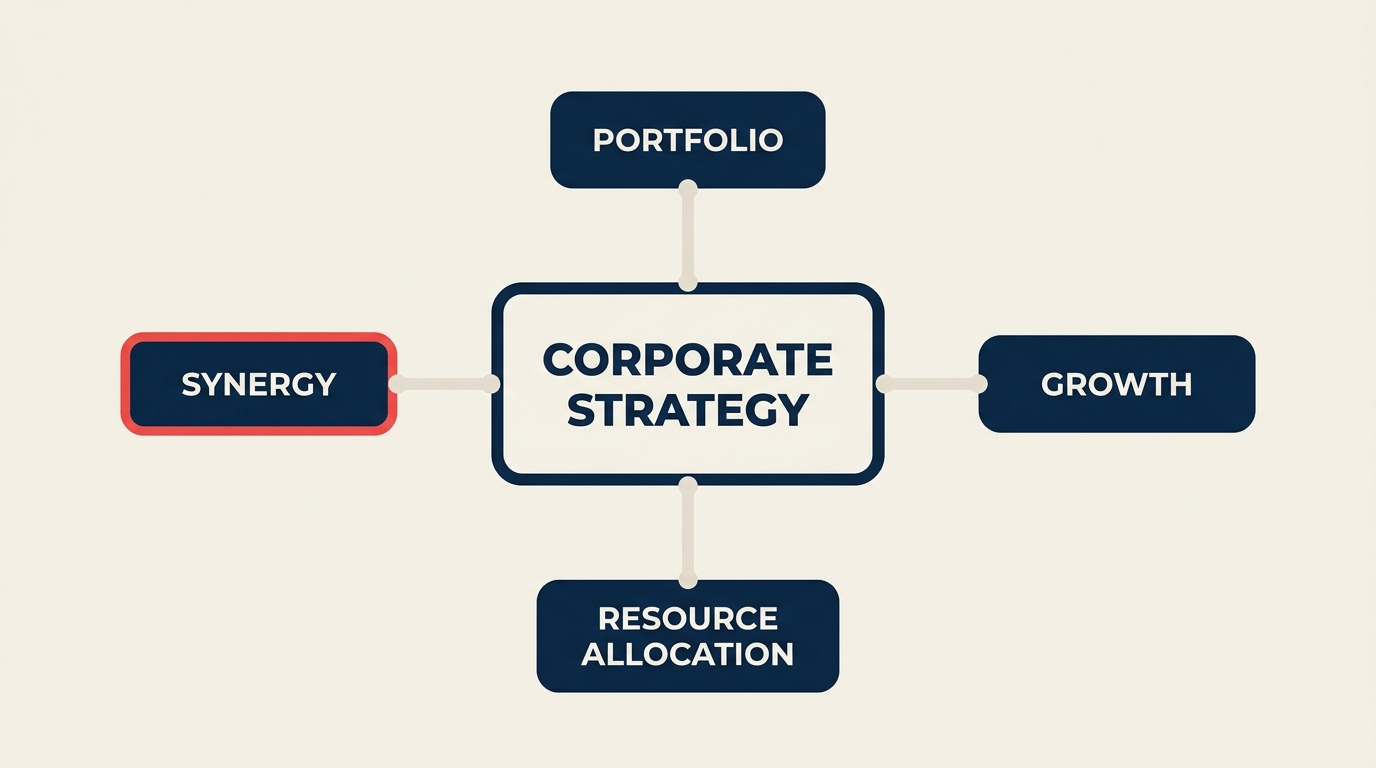
Corporate strategy framework showing portfolio, growth, resource allocation, and synergy components

Corporate strategy is the highest-level plan a company makes, and most leaders confuse it with something narrower. It doesn't answer "how do we win in our market?" That's business-unit strategy. Corporate strategy answers a more fundamental question: which markets should we even compete in, and why are we better off owning all of them together than separately?

Get this wrong and you end up with a portfolio of unrelated businesses that drain each other's resources while delivering mediocre returns in every one. Get it right and you create a group where each business performs better because of its membership in the whole, not despite it.

What Is Corporate Strategy?

Corporate strategy is the multi-business plan that defines which industries or markets a company will compete in, how it will allocate capital across those businesses, and what value the parent company adds to each one.

It sits one level above business-unit strategy. A business unit asks "how do we beat our competitors?" Corporate strategy asks "should we be in this business at all, and what does owning it do for everything else we own?" For a single-product startup those questions are the same. For a company running multiple divisions, products, or geographies, they diverge entirely.

The term comes from the Latin strategia (generalship), and the military analogy holds: a general decides which battles to fight before any commander decides how to fight them. Corporate leaders decide which arenas to enter before any business head decides how to compete.

Key Facts: Corporate Strategy

  • Companies with explicit portfolio management processes generate up to 40% higher shareholder returns than those managing businesses in isolation (McKinsey Global Institute, 2022).
  • Research by Harvard Business School found that roughly 70% of large diversification moves destroy shareholder value, typically because parent companies fail to add value above what the acquired business could generate independently.
  • BCG analysis of 200 global conglomerates found that those with a clear "parenting advantage" (genuine capability to help subsidiaries outperform) outperformed sector peers by an average of 1.5x total shareholder return over a decade.

The Components of Corporate Strategy

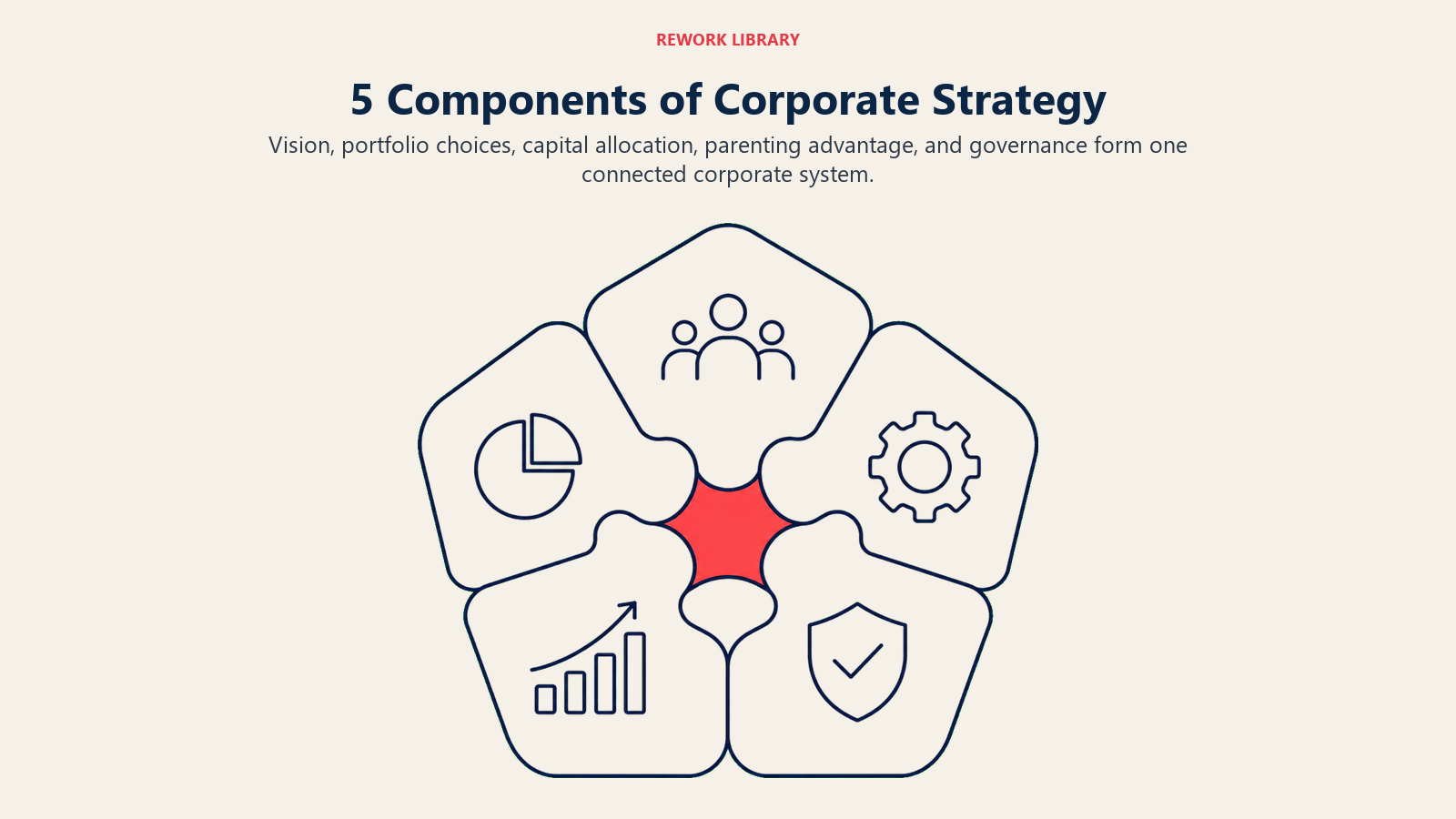
Corporate strategy has five recurring components. They're not sequential steps, they're ongoing decisions that interact with each other. A change in one typically forces a revisit of the others.

Component The question it answers Example
Vision and scope What kind of company do we want to be, and which arenas are in or out? Disney: "We are in the business of storytelling and family entertainment, across any medium"
Portfolio management Which businesses should we own, and how do we evaluate the mix? Amazon applying BCG Matrix logic to decide where to invest heavily versus where to harvest cash
Growth direction How do we grow: organically, by acquisition, or through new markets? Using the Ansoff Matrix to decide between penetration, development, and diversification
Resource allocation How do we distribute capital, talent, and management attention across units? GE's historic capital allocation reviews, where businesses competed for investment each year
Parenting and synergy How does the parent company make each business better than it would be alone? Apple sharing its chip design capability (M-series) across Mac, iPhone, and iPad lines

Each component connects to the others. Vision and scope sets the boundaries. Portfolio management evaluates what's inside those boundaries. Growth direction decides how to expand the portfolio. Resource allocation funds the choices. Parenting and synergy justify why the parent should own the portfolio at all.

Corporate Strategy vs Business Strategy

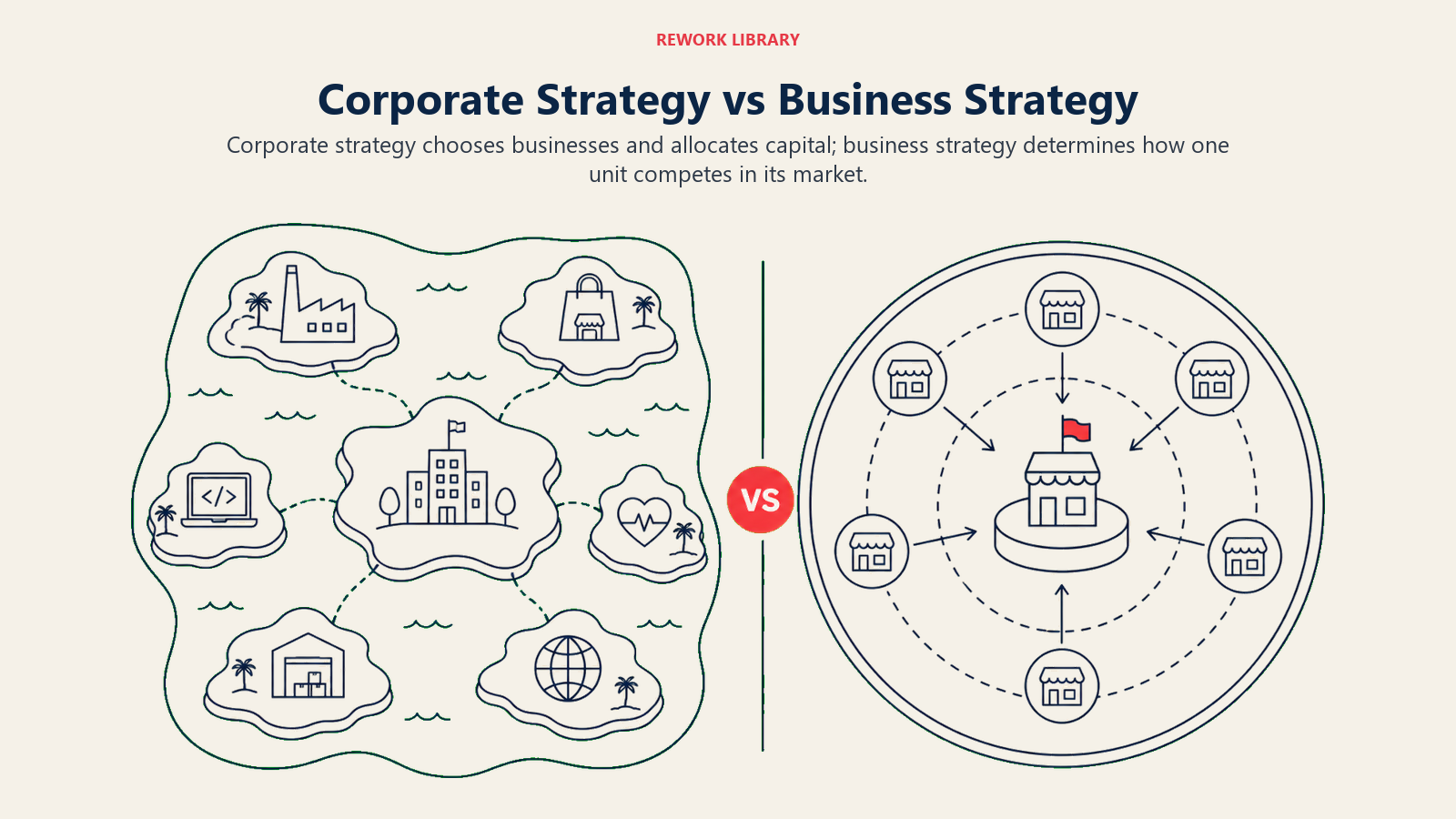
Most strategy conversations in companies are actually about business strategy, not corporate strategy. The distinction matters because the two levels ask different questions, use different tools, and involve different decision-makers.

Dimension Corporate Strategy Business Strategy
Level Parent company / board Business unit / division
Core question Which businesses to own and why How to win in a specific market
Time horizon 5-10+ years 1-5 years
Key tools Portfolio analysis, BCG Matrix, Diversification Strategy Porter's Five Forces, Competitive Advantage, positioning
Success metric Total shareholder return, portfolio health Market share, margin, revenue growth
Owners CEO, board, corporate planning team Business unit president, functional heads

The two levels have to align. A business unit can execute a brilliant competitive strategy and still fail if the corporate parent is starving it of capital, forcing it to share incompatible resources with a sister unit, or simply shouldn't own it in the first place.

See Corporate, Business, and Functional Strategy for a deeper treatment of how the three levels connect.

Common Mistakes

Treating corporate strategy as a sum of business plans. The classic error: each business unit submits a three-year plan, corporate adds them up, and calls the total a corporate strategy. That's not strategy; it's arithmetic. Corporate strategy requires an independent view of what the portfolio should look like and why the parent is the right owner.

Diversifying without a parenting rationale. Diversification strategy creates value when the parent company can genuinely help a new business outperform. It destroys value when the corporate center has no relevant capability to offer. The graveyard of failed conglomerates from the 1970s and 1980s is filled with companies that acquired businesses they had no idea how to improve.

Confusing size with strategy. Growing the portfolio through acquisitions can look like strategic action while it's actually destroying value. More businesses, more revenue, and more assets don't constitute corporate strategy unless there's a coherent rationale for how they fit together.

Ignoring the cost of complexity. Every additional business unit adds coordination costs, management bandwidth demands, and governance overhead. A corporate strategy that doesn't account for these costs will consistently overestimate the value of diversification.

Holding onto businesses too long. Portfolio management requires both adding businesses and exiting them. Companies that treat the existing portfolio as permanent often carry units that no longer fit the strategy, absorb capital, and distract management attention.

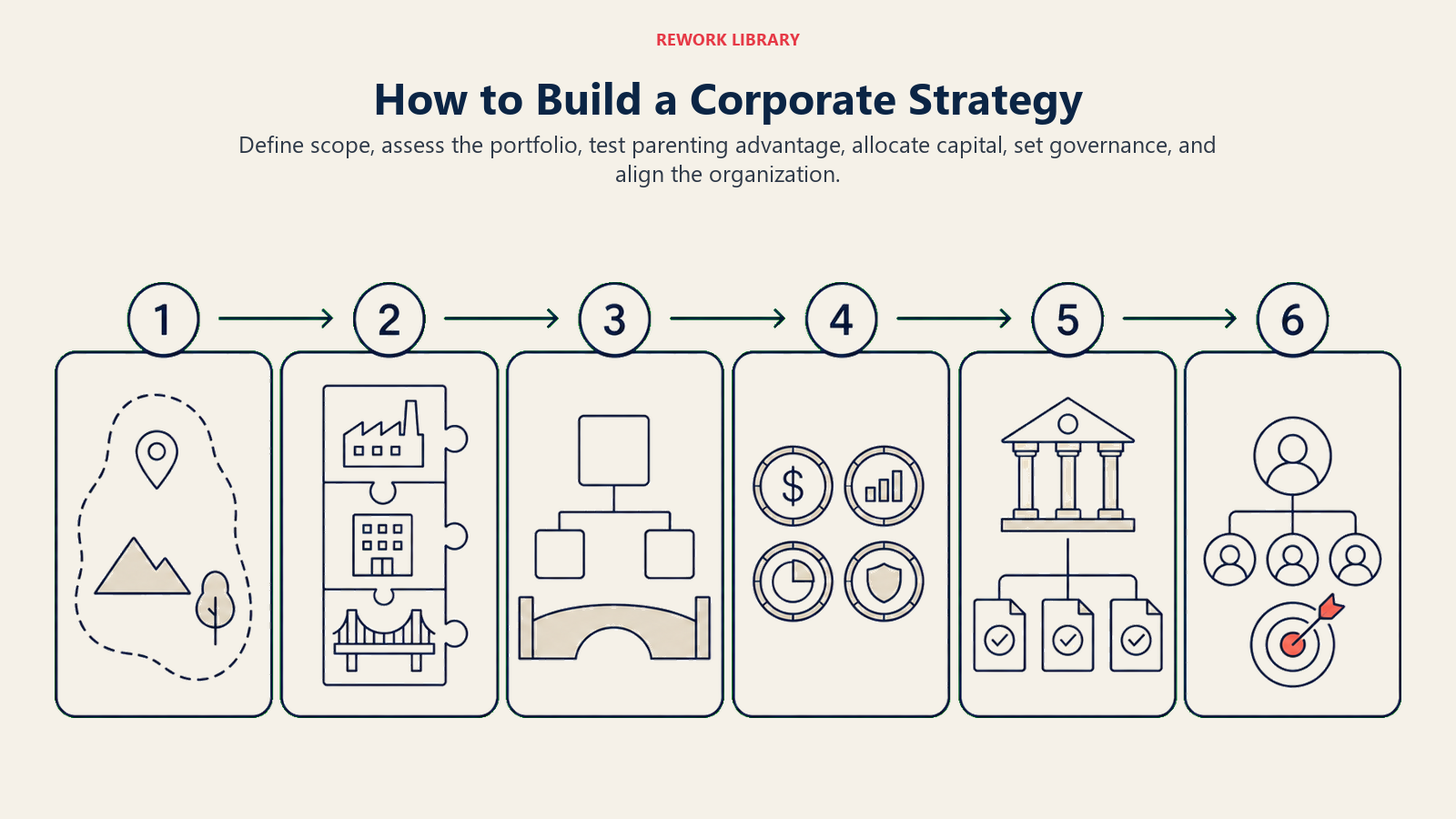
How to Build a Corporate Strategy

Step 1: Define the corporate vision and scope

Start with the question of identity: what kind of company do you want to build, and which arenas are genuinely on the table? Scope decisions include geography (global or regional), industry (single sector or multi-sector), and value chain position (using vertical integration or staying narrowly focused). Be explicit about what is out of scope, not just what is in.

Step 2: Audit the current portfolio

Map every business unit against a shared set of dimensions: growth rate, competitive position, margin profile, and strategic fit with the rest of the portfolio. The BCG Matrix is a starting framework. The Three Horizons of Growth model helps categorize businesses by maturity and time to value.

Step 3: Identify your parenting advantage

Be honest about what the parent company actually offers its businesses. Does it provide shared core competencies they couldn't build alone? Capital at lower cost? Brand equity? Distribution leverage? Management talent? If you can't name a specific capability that makes each business better under your ownership, the portfolio logic is weak.

Step 4: Set growth direction

Decide how the portfolio will expand: deeper penetration of current markets, horizontal integration into adjacent categories, new geographies, or true diversification. The Ansoff Matrix structures this decision cleanly. The key discipline is connecting each growth move to the parenting advantage identified in Step 3.

Step 5: Design resource allocation rules

Corporate strategy only has teeth if it's backed by capital. Define explicit allocation rules: which businesses get priority investment, which are expected to generate cash for others, and which are being evaluated for exit. Doing this without a framework leads to politics-driven budgeting where the loudest business unit wins.

Step 6: Define synergy targets and track them

Synergies rarely materialize on their own. Identify specific synergy opportunities (shared technology, cross-selling, shared procurement, talent transfer), assign ownership, and measure them. The strategy vs tactics distinction applies here: the synergy hypothesis is strategy; the concrete actions and metrics are tactics.

Step 7: Build in a regular portfolio review

Corporate strategy is not a one-time plan. Markets shift, businesses mature, competitive positions change. Set a cadence, annually at minimum, for reviewing the full portfolio against the original logic, identifying businesses that no longer fit, and updating resource allocation accordingly.

Corporate Strategy Examples

Amazon

Amazon's corporate strategy is one of the most studied cases of portfolio logic in modern business. The company's scope spans e-commerce, cloud computing (AWS), digital advertising, streaming entertainment, and physical retail. That looks chaotic from the outside, but each business serves a coherent corporate logic.

AWS was built initially to serve Amazon's own infrastructure needs. When the capability proved exceptional, Amazon turned it into a standalone business. The e-commerce platform generates massive consumer data that improves the advertising business. Prime Video drives Prime membership, which drives e-commerce retention. The core competency running through all of it is operational excellence at scale and a proprietary data infrastructure that gets more valuable as the portfolio grows.

Amazon business Corporate role
E-commerce Core revenue and customer data engine
AWS Cash generator, technology capability platform
Advertising High-margin layer on top of e-commerce traffic
Prime Video Membership retention, brand loyalty driver

Disney

Disney's corporate strategy is scope-defined. The company declares itself a family entertainment and storytelling company, and it applies that scope test to every portfolio decision. When Disney acquired Pixar (2006), Marvel (2009), and Lucasfilm (2012), each acquisition fit a clear logic: premium storytelling IP that could be distributed across Disney's parks, merchandise, streaming, and theatrical channels.

Disney's parenting advantage is its distribution infrastructure. Any IP it acquires immediately gains access to theme parks, merchandise licensing, streaming via Disney+, and theatrical release. A Marvel story that would generate $X under a smaller studio generates significantly more under Disney because of the distribution leverage the parent provides. That's what parenting advantage looks like in practice.

A cautionary case: GE in the 2000s

General Electric under Jack Welch built a portfolio spanning aviation engines, power generation, healthcare equipment, financial services, and media (NBC). For a period, the strategy worked because GE Capital provided cheap internal financing that other businesses couldn't access, and GE's management development system was a genuine parenting capability.

But when GE Capital grew to represent more than 50% of GE's earnings, the financial risks of that business began to dominate the whole company. The parenting advantage that justified the portfolio's diversity eroded. GE has spent the years since 2008 systematically unwinding the diversification, eventually splitting into three focused companies. The lesson: corporate strategy must be stress-tested not just for upside synergies but for downside interdependencies.

Best Practices

Let scope drive acquisitions, not the reverse. The worst corporate strategies are built deal by deal, with post-hoc rationale invented for each acquisition. Define scope first; let it filter which opportunities to pursue.

Distinguish the portfolio from the organizational chart. A business unit structure on the org chart doesn't automatically create a portfolio logic. Corporate strategy requires an explicit view of how the pieces relate to each other.

Treat exits as strategic, not failures. Divesting a business that no longer fits the portfolio is good corporate strategy, not a sign that the original acquisition was wrong. Markets change; the portfolio should change with them.

Keep the corporate center small and purposeful. The corporate center earns its cost only if it adds more value to the businesses than it costs them. Large corporate headquarters with unclear mandates typically subtract value rather than add it. Every corporate function should trace its contribution to the parenting advantage.

Tie executive incentives to portfolio-level outcomes. If business unit leaders are only evaluated on their own unit's performance, they have no incentive to cooperate on shared resources, refer customers to sister units, or contribute to cross-portfolio synergies. Corporate strategy requires portfolio-level incentive design.

Frequently Asked Questions

What is corporate strategy in simple terms? Corporate strategy is the company's plan for which businesses to be in and how to manage them as a group. It answers "what should our portfolio of businesses look like?" rather than "how do we compete in any particular market?" Think of it as the strategy above all other strategies.

How is corporate strategy different from business strategy? Business strategy is about winning in a specific market: how to position, price, differentiate, and outcompete rivals. Corporate strategy operates one level up and decides which markets to enter or exit, how to allocate capital across multiple businesses, and whether owning a set of businesses together creates more value than owning each one separately would. See Corporate, Business, and Functional Strategy for a full breakdown.

What are the main types of corporate strategy? The three classic types are growth strategy (expanding through new markets, products, or acquisitions), stability strategy (maintaining the current portfolio and optimizing it), and retrenchment strategy (shrinking, divesting, or restructuring the portfolio). Most large companies run a combination, with some units in growth mode, others in harvest mode, and some being evaluated for exit.

What is parenting advantage in corporate strategy? Parenting advantage is the specific capability or resource that a parent company provides to its business units, making each one perform better under the parent's ownership than it would independently. It's the justification for the portfolio. Without a clear parenting advantage, diversification tends to destroy rather than create value.

How often should corporate strategy be reviewed? Most companies do a formal corporate strategy review annually, tied to the planning cycle. But significant market shifts, a major acquisition or divestiture, or a sustained underperformance in the portfolio should trigger an off-cycle review. Corporate strategy should be durable enough to guide multi-year decisions but flexible enough to respond to genuine structural changes in the environment.

Corporate strategy is the work that happens before all other strategy work. Decide which arenas to compete in, build the rationale for why you're the right owner of each one, and design the resource flows that make the whole portfolio worth more than its parts. Companies that get this right don't just manage businesses, they multiply them.