日本語

Closing the Loop: How CS Sends Churn Root Cause Back to Sales (and Marketing)

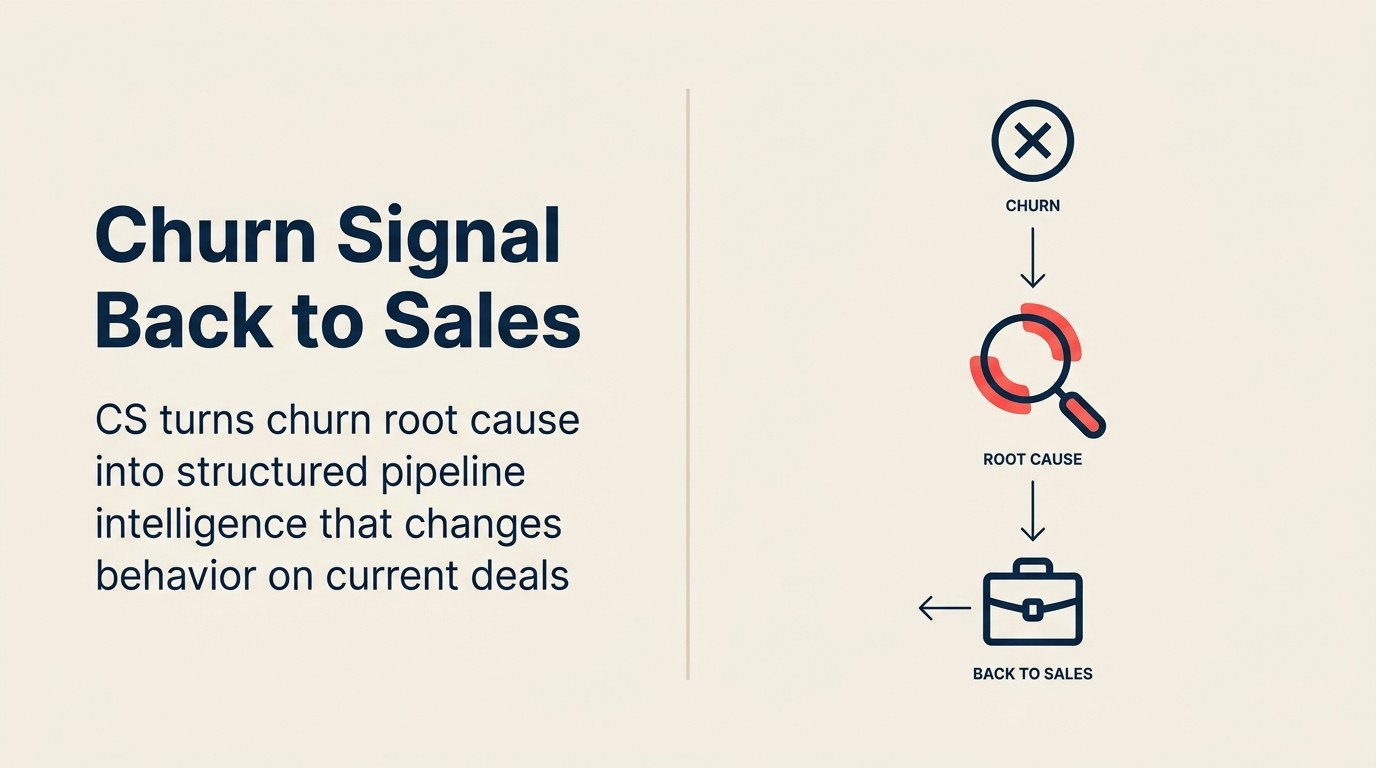
Closing the Loop: Churn Root Cause Back to Sales

CS watched the account churn. They knew it was coming for two months. And they knew exactly why: the deal was closed on a feature that wasn't in the product yet, the account was outside the ICP (ideal customer profile), and the champion the AE (account executive) built the relationship with had left the company in month four.

The churn reason went into the CS (customer success) platform. The account was marked lost. The CSM (customer success manager) moved on to the next renewal.

Six months later, CS is watching three accounts head toward the same cliff. Same root causes. Same pattern. Sales is still closing the same type of deal on the same feature promise. Marketing is still targeting the same segment that keeps churning in year one. Nobody changed anything because the signal that CS captured (specific, accurate, and actionable) never made it to the people who could act on it.

This is the loop that doesn't close. And it's not a communication failure or a culture problem. It's a structural one: there's no process that converts CS's post-sale intelligence into pre-sale behavior change at Sales and Marketing. Build the process and the loop closes. Skip the process and the same churn patterns repeat, quarter after quarter, cohort after cohort. For definitions of NRR (net revenue retention), ICP, CSM, and the other terms used throughout this article, the sales-CS alignment glossary is the reference. McKinsey's analysis of B2B SaaS companies shows that a relentless focus on customer success, including systematic churn prevention, is the primary driver of the low gross-revenue churn that separates top-quartile companies from the rest.

What This Article Covers (and What It Doesn't)

This is about the feedback loop between CS, Sales, and Marketing at the pattern level. Not individual account recovery.

Individual at-risk account escalation (when CS needs AE to step in before a specific renewal) is a different motion covered in when sales gets pulled into an at-risk account. That's reactive and account-specific.

This article is systemic. CS has seen five accounts churn from the same root cause. Sales hasn't changed its behavior because nobody showed them the pattern. The goal here is to build the mechanism that shows them.

The marketing angle (how churn signals affect targeting, ICP criteria, and messaging) is related but distinct from what Marketing does with win-loss data from Sales. Churn signal is post-sale intelligence. Win-loss analysis is deal-stage intelligence. Both matter. They feed different levers. Here, we're focused on the CS-to-Sales and CS-to-Marketing signal specifically, and why it's the input that neither Marketing nor Sales can generate on their own. For the parallel loop on the marketing-sales side, the win-loss feedback to marketing article covers how deal-stage intelligence reaches the marketing team.

Key Facts: Churn Root Cause and Revenue Impact

  • Companies that systematically feed CS churn data back to Sales reduce same-cause churn by 40-60% within two to three quarters of implementing a closed-loop process, per Gainsight's NRR benchmark research.
  • Only 22% of SaaS companies have a formal mechanism for CS to communicate churn root causes to Sales in a structured, actionable format, per TSIA's Customer Success survey.
  • Churn root cause data that reaches Sales within 30 days of churn produces 2x more behavior change than data shared in a quarterly review, per Totango's revenue retention research.

The Three Churn Root Causes That Actually Belong to Sales

Not every churn is a Sales problem. Some accounts churn because the product had a real deficiency. Some churn because the customer's business changed. Some churn because a competitor built something that genuinely fits them better.

But there's a category of churn that is directly attributable to pre-sale decisions, and this is the category that Sales can actually do something about.

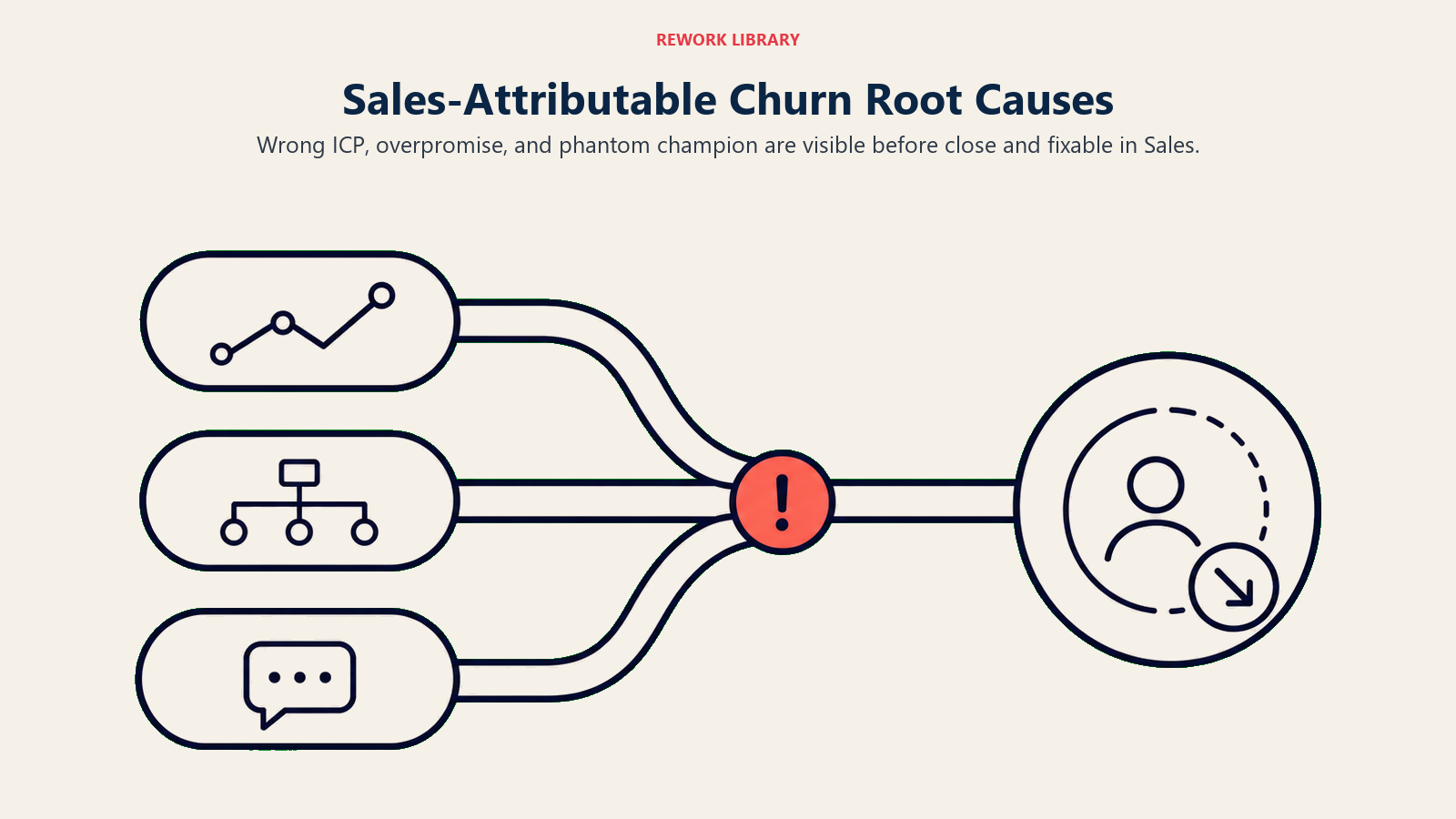
Named Framework: The Three Sales-Attributable Churn Root Causes These three root causes share a common characteristic: the condition that caused the churn was visible and actionable during the sales process, but wasn't acted on. Framing it this way (not "Sales did something wrong" but "the condition was present and addressable before the deal closed") is what makes the feedback conversation productive rather than defensive.

Root Cause 1: Wrong ICP (the account was never a fit)

CS inherits accounts that should never have been sold. The use case is too thin. The company size is at the edge of what the product was designed for. The team structure doesn't match the workflow the product requires. CS couldn't fix this. A product designed for 50-person ops teams doesn't serve a 5-person startup, no matter how hard CS works.

Sales closed it anyway, either because quota pressure made marginal deals look better than they were, or because the ICP criteria weren't tight enough to catch the gap at qualification. The fix is tighter ICP criteria, and that fix requires CS's churn data to prove where the edge actually is. Forrester's ICP research identifies a specific failure mode here: organizations that invest heavily in "quick wins" can build strong win rates but persistent churn, exactly the pattern that wrong-ICP accounts produce at scale. CS's pattern observations feed the ICP refinement loop, which is the structured process for converting churn signal into qualification changes that Sales can act on in the next pipeline cohort.

What this looks like in practice: CS is seeing consistent churn in companies under 20 employees, or in a specific vertical where the implementation complexity exceeds what those teams can absorb. That pattern, documented and delivered to Sales, becomes the evidence for an ICP revision. At the cross-functional level, this feeds directly into the shared ICP framework where Sales, CS, and Marketing align on the updated definition together.

Root Cause 2: Overpromise on feature or timeline

CS discovers it at kickoff, or at month two when the customer asks about the feature they were told was coming in Q1. The feature isn't shipped. Or the integration the AE described doesn't exist in the way the customer understood it. Or the implementation timeline the AE committed to informally is half what CS actually needs to deliver a stable deployment.

The prevention mechanism (getting Sales and CS aligned on what can be promised before the deal closes) is covered in the preventing over-promise article. But this feedback loop is what ensures the prevention mechanism gets built. CS seeing the same promise gap in three consecutive quarters is the data that convinces Sales leadership to change how deals are closed.

Root Cause 3: The champion was never real

The internal sponsor who signed the contract had no organizational power to drive adoption. They were enthusiastic in the sales process. They had the authority to sign. But they didn't have the influence to get their team to actually change how they worked. When the champion left, or got reorganized out of the relevant scope, there was no second internal advocate.

Sales is the one who could have surfaced this during the deal. Is the champion respected by their peers? Do they have a track record of driving internal change? Did their manager endorse this purchase, or just approve the budget? These aren't questions that CS can retroactively answer. But they're questions the AE could have asked and didn't, either because the process didn't require it or because the deal was moving fast.

Understanding what to capture is step one. Making it useful for Sales is the harder part.

What CS Needs to Capture to Make the Signal Useful

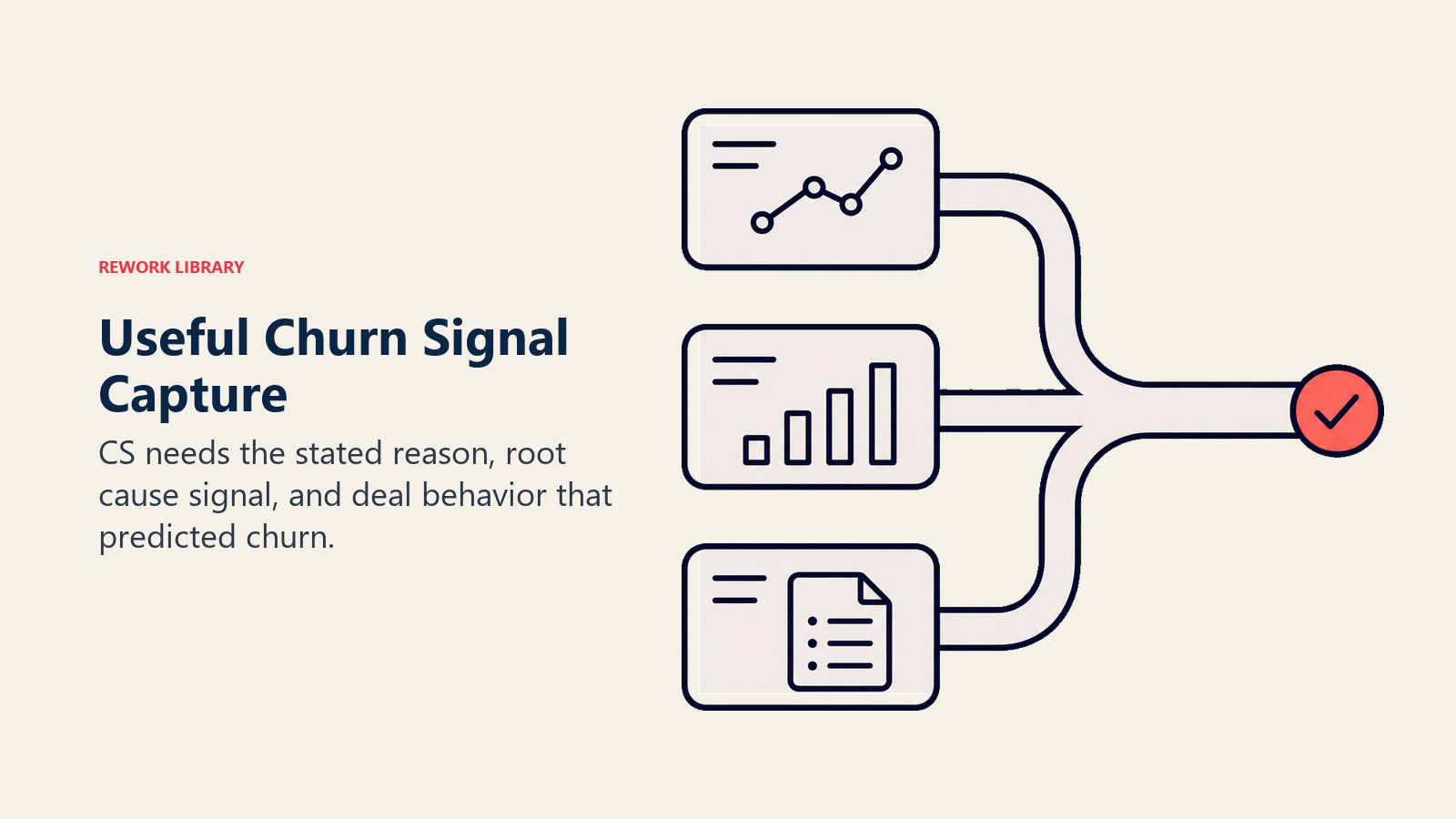
Logging "pricing issue" or "product gap" in the churn reason field doesn't give Sales anything to act on. The signal needs to be specific enough to connect to pre-sale behavior.

The operational record (for the CS platform): What the customer said when they decided to churn. In their language. "They said the reporting module didn't meet their requirements and they were moving to a competitor." This is the customer's stated reason.

The root cause signal (for Sales): What CS observed over the account lifecycle that explains the stated reason. "The reporting requirements this customer had were non-standard and were flagged by CS at kickoff as outside our typical use case. The account was closed in a segment we've seen churn at 3x the average rate." This is the CS intelligence.

The deal behavior that predicted it: What specific thing happened in the sales process that, in retrospect, predicted this outcome? "AE committed to a custom dashboard capability in a pre-sales demo that isn't available in the standard product." Or: "The champion was in their first 90 days in the role when the deal was signed. We've seen three accounts churn in year one where the champion had less than 6 months in the seat at time of close."

The third element is the hardest to produce consistently. It requires CS to connect post-sale observation to pre-sale events, which means having access to the deal record and the AE's context from the won deal review. This is another reason the won deal review matters: the AE's pre-close intelligence, recorded before kickoff, is what makes CS's post-churn signal actionable.

Once the signal is captured correctly, the question is which feedback model gets it to Sales fast enough to matter.

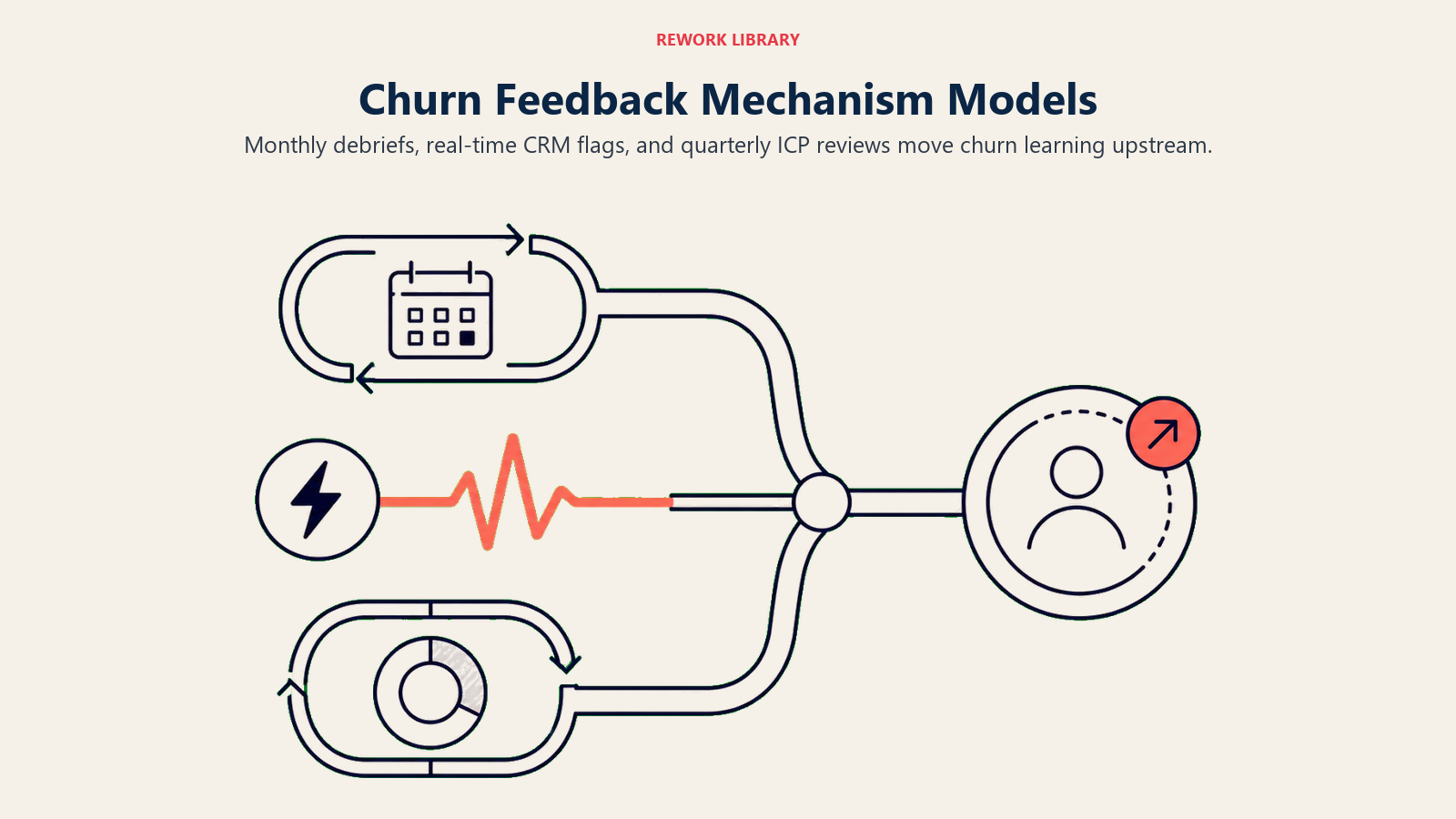
Three Feedback Mechanism Models

There's no single right way to structure the CS-to-Sales churn loop. The right model depends on company size, RevOps maturity, and the volume of churn you're processing.

Model A: Monthly Churn Debrief

CS and Sales leadership review churned accounts together, once a month. CS presents the churn summary: accounts lost, stated reasons, root cause tags. Sales leadership responds: does this pattern match what we're seeing in the pipeline? Are these the types of deals that are currently active?

One process change comes out of every monthly debrief. Not a list. One change, agreed by both leaders, owned by a named person, with a 30-day check-in.

Best for: Companies with 5-15 churned accounts per quarter. Enough volume to see patterns, not so much that a monthly meeting becomes overwhelming.

Risk: The monthly debrief becomes a reporting exercise if no change comes out of it. CS presents data, Sales nods, nothing changes. The "one change per meeting" discipline is what prevents this.

Model B: Real-Time CRM Flag

CS logs a "churn root cause" field on the churned account record. When it's tagged as deal-attributable (ICP miss, overpromise, phantom champion), an automatic notification goes to the AE who closed the deal and their Sales Manager. AE and CSM do a 20-minute debrief within the week.

This model creates accountability at the individual deal level. The AE who overpromised a feature knows within days of churn that the overpromise is documented. That's uncomfortable. It's supposed to be. Not as punishment, but as a learning signal that's close enough in time to be actionable.

Best for: Companies with RevOps capacity to set up the CRM workflow and Sales leadership that supports individual-level accountability without it becoming punitive.

Risk: AEs start gaming the root cause tags to avoid personal attribution. RevOps needs to audit the tagging periodically. CS Manager should have visibility into whether "product gap" is being used as a catch-all to avoid "deal-attributable" tags.

Model C: Quarterly ICP Review

Aggregate churn signal from CS (not individual accounts, but patterns across the cohort) feeds the ICP refinement meeting attended by CS leadership, Sales leadership, and Marketing. The output is a specific change to the ICP definition, the qualification criteria, or the targeting parameters.

This is the model that reaches Marketing directly. Which segments are churning fastest? What messaging did Marketing run that attracted the wrong-fit accounts that CS is now watching churn? Where is the gap between the ICP Marketing is targeting and the ICP that actually succeeds post-sale? The voice of customer from win-loss framework is a useful complement here. It captures customer language from the deal stage that can be compared against CS's post-sale observations to identify where expectation gaps originated.

Best for: Companies that have at least two quarters of churn data to analyze as a cohort. Too early and the patterns aren't reliable. At scale, this model should run in addition to Model A or B, not instead of them.

Risk: Quarterly cadence means slow feedback. A bad ICP that starts producing churn in January doesn't get corrected until April. Combine with a faster feedback mechanism (Model A or B) for the most time-sensitive signals.

The framing of the feedback conversation is what determines whether Sales acts on it. Getting that right is harder than building the process itself.

Getting This Into Sales Conversations Without Blame

This is the part where the loop fails most often. CS brings churn data to Sales. Sales hears "CS is blaming us for churn." The conversation becomes defensive. Nothing changes.

The framing matters more than the data.

What doesn't work: "These deals churned because AEs overpromised." Even if accurate, this framing triggers defensiveness and turns a process conversation into a personnel conversation. Sales leaders feel the need to defend their team. The fix discussion never happens.

What works: "Here's what we're seeing in the data that the current pipeline can avoid." The frame is forward-looking and revenue-aligned. "We've had four accounts churn in the last two quarters that fit this pattern: [specific profile]. We have eight accounts in the current cohort that match the same profile. If we adjust the qualification criteria here, we think we can improve NRR by [estimated amount]. Here's what that change would look like in practice."

This framing does two things: it makes CS an ally in Sales' revenue target (better NRR serves the Sales team's metrics), and it connects the churn data to specific in-flight accounts that Sales can act on right now.

The RevOps role here is to be the neutral translator. CS has the post-sale intelligence. Sales has the pre-sale context. RevOps structures the feedback into a format that's credible to Sales leadership: specific, data-backed, and forward-looking. When the churn signal goes directly from CS to Sales without RevOps structuring it, it tends to land as CS venting rather than CS informing.

Quotable: "Churn root cause data that reaches Sales within 30 days of churn produces 2x more behavior change than data shared in a quarterly review, per Totango's revenue retention research. Speed of signal is as important as quality of signal."

Rework Analysis: The three sales-attributable churn patterns (wrong ICP, feature overpromise, phantom champion) share a structural characteristic: the condition that caused the churn was visible and addressable before the deal closed, but wasn't surfaced by the process in place at the time. Framing the feedback conversation this way, "the condition was present and actionable" rather than "Sales did something wrong," is what makes the loop productive rather than defensive. Sales leaders who receive the signal framed as a process gap rather than a personnel failure change qualification criteria. Sales leaders who receive it framed as blame push back, document nothing, and repeat the pattern.

What Goes to Marketing

Marketing needs the churn signal too, but for different reasons. Sales needs it to change qualification behavior. Marketing needs it to change targeting and messaging.

ICP signal: Which segments are churning fastest? If accounts under 20 employees are churning at 4x the rate of accounts with 50-200 employees, Marketing should be adjusting paid targeting, firmographic filters, and content strategy to attract less of the former. But Marketing won't know this unless CS tells them.

Messaging signal: When customers churn because the product didn't match what Marketing promised (not what Sales said, but what the campaign landing page, the comparison guide, or the case study implied), that's a Marketing fix. CS is the one who hears from customers what they expected to get. That expectation was shaped somewhere, and often it was shaped by Marketing content.

This is distinct from win-loss analysis, which Marketing typically owns through the sales process. Churn signal is post-sale. It tells Marketing what happens to the customers their campaigns attracted six, nine, and twelve months after they bought. Win-loss analysis tells Marketing why deals were won or lost during the sales cycle. Both matter. The churn signal is the one Marketing usually never sees, and it's the most honest feedback they'll get about whether their ICP targeting is right. The closed-loop reporting explained framework shows how to wire this signal from CS back through the attribution stack so Marketing can connect campaign spend to post-sale retention outcomes.

Measuring Whether the Loop Is Working

Three metrics tell you whether the churn feedback loop is actually closing:

Are the same root causes repeating quarter over quarter? If "ICP miss" appears in the top three churn reasons for four consecutive quarters, the loop isn't closing. The signal is being generated but not acted on. Either it's not reaching Sales, or it's reaching Sales and not changing qualification behavior.

Is the ICP definition changing in response to CS data? The ICP document should be a living document. If it hasn't been updated in six months and CS has been generating churn data the whole time, the loop is broken at the conversion point. The data arrived but didn't change the definition.

Are Sales and CS tracking cohort churn by deal type or source? This requires a small amount of RevOps infrastructure: tagging deals at close with the source, segment, and qualification criteria met, then tracking churn rate by cohort. When Sales can see that "deals closed in Q3 with a champion in their first six months" churn at 2x the baseline, the ICP discussion has data behind it instead of CS opinion.

When churn root cause reaches Sales within 30 days of churn, behavior change is measurable within a quarter. When it arrives in a quarterly review deck three months later, the connection between the signal and the current pipeline is too diffuse to drive action.

Quotable: "Wrong-ICP accounts churn at 3.2x the rate of well-qualified accounts, but Sales closes them at the same rate as good-fit accounts because they don't see the post-sale outcome data, per ChurnZero's State of Customer Success. The churn feedback loop is what makes post-sale pattern visible to pre-sale behavior."

Implementation: Building the Loop Before the Next Churn Cohort

Four things to build before the next quarterly review:

Churn tagging taxonomy. Define the root cause categories explicitly: ICP miss, feature overpromise, timeline overpromise, phantom champion, product deficiency, competitive loss, business change, pricing. The first four belong to Sales. The others don't. Write down the definition of each so CS tags consistently rather than by judgment.

Monthly debrief template. A 30-minute agenda: CS presents the churn summary (10 minutes), Sales responds with pipeline implications (10 minutes), joint agreement on one process change (10 minutes). RevOps runs the meeting and documents the output.

ICP update cadence. The ICP definition gets reviewed quarterly by CS, Sales, and Marketing together. CS brings churn data. Sales brings qualification observations. Marketing brings segment performance. The output is a specific change (or explicit decision not to change) with a named owner.

Loop ownership. Someone owns this process. Usually RevOps, sometimes a CS Operations lead. Without a named owner, the loop runs when people remember to run it and stops when they don't. The churn-to-Sales feedback loop is worth too much to run on good intentions. The cost of broken handoff: NRR math article puts a dollar value on what unclosed loops like this cost at the portfolio level, useful context when making the case to leadership for investing in the process.

The signal CS has after a churn is the most accurate pipeline intelligence Sales will never generate on their own. Sales sees the deal before it closes. CS sees what happens after. Connecting those two vantage points, systematically and with a defined process, is what turns individual churn events into lasting behavior change. HBR's research on customer retention shows that increasing retention rates by just 5% lifts profits by 25 to 95%, which means the churn feedback loop is not just a process improvement. It's a revenue multiplier.

Frequently Asked Questions

What are the three sales-attributable churn root causes?

The Three Sales-Attributable Churn Root Causes are: wrong ICP (the account was never a fit: the use case, company size, or workflow structure was outside what the product was designed for, and the qualification process didn't catch it); feature or timeline overpromise (CS discovers at kickoff or month two that something committed during the sale isn't available as described); and phantom champion (the internal sponsor had the authority to sign but not the organizational influence to drive adoption, and when they departed or were reorganized, no second internal advocate existed). These three are sales-attributable not because Sales is at fault, but because the conditions were visible and addressable during the sales process.

How does CS surface churn root causes to sales without creating blame?

The framing that works is forward-looking and revenue-aligned, not backward-looking and accusatory. Instead of "these accounts churned because of overpromising," the presentation is: "here's what we're observing in the post-sale data, here are the in-pipeline accounts that match the same profile, and here's the specific qualification change that would reduce this pattern." The distinction matters: Sales leaders who receive churn signal as a process observation change qualification criteria. Sales leaders who receive it as blame protect their team and change nothing. RevOps as the neutral translator, structuring CS intelligence into a format credible to Sales leadership, is often what determines which version of the conversation happens.

What data does CS need to capture to make churn signal useful for sales?

Three levels: the customer's stated reason in their language ("the reporting module didn't meet our requirements"), CS's root cause diagnosis connecting stated reason to account history ("this customer's reporting requirements were flagged as non-standard at kickoff, and the account was closed in a segment we've seen churn at 3x the average rate"), and the specific deal behavior that predicted the outcome ("AE committed to a custom dashboard capability in a pre-sales demo that isn't available in the standard product"). The third level is the hardest to produce consistently. It requires connecting post-sale observation to pre-sale events. This is why the won deal review matters: the AE's pre-close intelligence, recorded before kickoff, is what makes CS's post-churn signal actionable rather than speculative.

What should sales do with churn root cause data?

Two actions: tighten qualification criteria for the pattern identified, and review in-pipeline accounts that match the same profile before they close. If wrong-ICP is the pattern, Sales updates the qualification checklist and flags active opportunities that match the at-risk profile. If overpromise is the pattern, Sales reviews the language being used in current deals for the specific capability that's being overstated. The goal is not accountability for past deals. It's prevention for the next cohort. When churn signal reaches Sales within 30 days of churn, behavior change is measurable within a quarter. When it arrives in a quarterly deck, the connection to current pipeline is too diffuse to drive action.

How is churn root cause feedback different from win-loss analysis?

Win-loss analysis is a Sales and Marketing exercise that identifies patterns in why deals are won or lost during the sales cycle. It runs on deal-stage intelligence and informs messaging, positioning, and competitive strategy. Churn root cause feedback is post-sale intelligence: CS observes what happens to customers six, nine, and twelve months after the deal closed, and routes that signal back to Sales and Marketing. Win-loss analysis tells you why prospects chose you or a competitor. Churn root cause tells you what happens to the customers your sales process attracted. Both matter, but they require different data sources and produce different interventions.

How do you know if the churn feedback loop is actually working?

Three diagnostic metrics: Are the same root causes repeating in the top three churn reasons quarter over quarter (if yes, the signal is being generated but not acted on)? Has the ICP definition been updated in response to CS data in the past six months (if not, the loop is broken at the conversion point)? Are Sales and CS tracking cohort churn by deal type or qualification criteria (if not, the signal lacks the specificity to drive qualification changes)? When all three are healthy, the loop is closing. When one or more stalls, the failure point is usually ownership: nobody is accountable for converting the CS signal into a named process change with a 30-day check-in.

Learn More