More in
SaaS Buying Insights
How to Budget AI Spend as Pricing Shifts From Seats to Meters
Oct 2, 2026
The New B2B Buying Committee: Who's Really in the Room
Mar 30, 2026
POCs That Predict Success — and POCs That Waste Everyone's Time
Mar 23, 2026 · Currently reading
Seat-Based Pricing Is Dying. Here's What's Replacing It
Mar 12, 2026
The True Cost of Software Sprawl at Mid-Market Companies
Jan 30, 2026
POCs That Predict Success: and POCs That Waste Everyone's Time
Turn this article into takeaways for your work.


Each assistant summarizes the article only for you and suggests best practices for your work.
A proof of concept should answer one question: will this product solve our specific problem in our specific environment? In practice, most B2B POCs answer a different question: can this vendor's sales engineer put on a good demo with our logo on it?
The gap between a useful POC and a theatrical one is enormous. Buyers who can't tell the difference are making expensive decisions with junk data. They discover six months post-contract that the integration complexity everyone glossed over during the evaluation is now a six-week IT project nobody budgeted for.
This isn't a vendor ethics problem. Vendors build POCs to win, not to surface failure modes. The responsibility for designing an evaluation that generates real signal sits with the buyer. Harvard Business Review's research on B2B purchasing decisions has long noted that buyers who define evaluation criteria upfront reach better long-term outcomes than those who rely on vendor-led demonstrations.
Five Signs Your POC Is Theater
Before designing a better process, recognize what a theatrical POC looks like. These patterns are common enough that most buyers encounter at least two or three of them in any major evaluation.
Vendor-controlled data. The POC runs entirely on the vendor's sample data or a sanitized version of yours that the vendor prepared. Your actual data, with its edge cases, historical inconsistencies, and non-standard field names, never touches the system. The demo looks clean because the data was curated for the demo.
No written success criteria. Everyone agrees before the POC that you're evaluating "ease of use" and "integration capability." Nobody writes down what that means. At the end of six weeks, the vendor asks how it went and the champion says "pretty well," but procurement and IT had completely different expectations that were never surfaced.
The vendor runs all the sessions. A useful POC involves your team actually using the product. A theatrical POC involves the vendor's sales engineer demonstrating the product to your team every Tuesday. If your users haven't done the work themselves, you haven't evaluated usability. You've evaluated the vendor's ability to present.
Scope expansion with no timeline adjustment. The POC starts as a CRM migration evaluation. By week three, the vendor has proposed also evaluating their marketing automation module, because "it's already set up and it'll show you the full platform value." The scope has doubled. The timeline hasn't changed. The depth of evaluation on the original scope has been cut in half.
No discussion of what failure looks like. A well-designed POC defines, upfront, what outcome would cause you not to buy. If everyone is operating as if purchase is the only possible outcome, you're not running an evaluation. You're running a choreographed close.
What a Useful POC Needs to Define Upfront
The single biggest predictor of POC quality is whether the buyer wrote a POC design brief before the first vendor kick-off session. Most don't. Here's what that brief needs to contain.
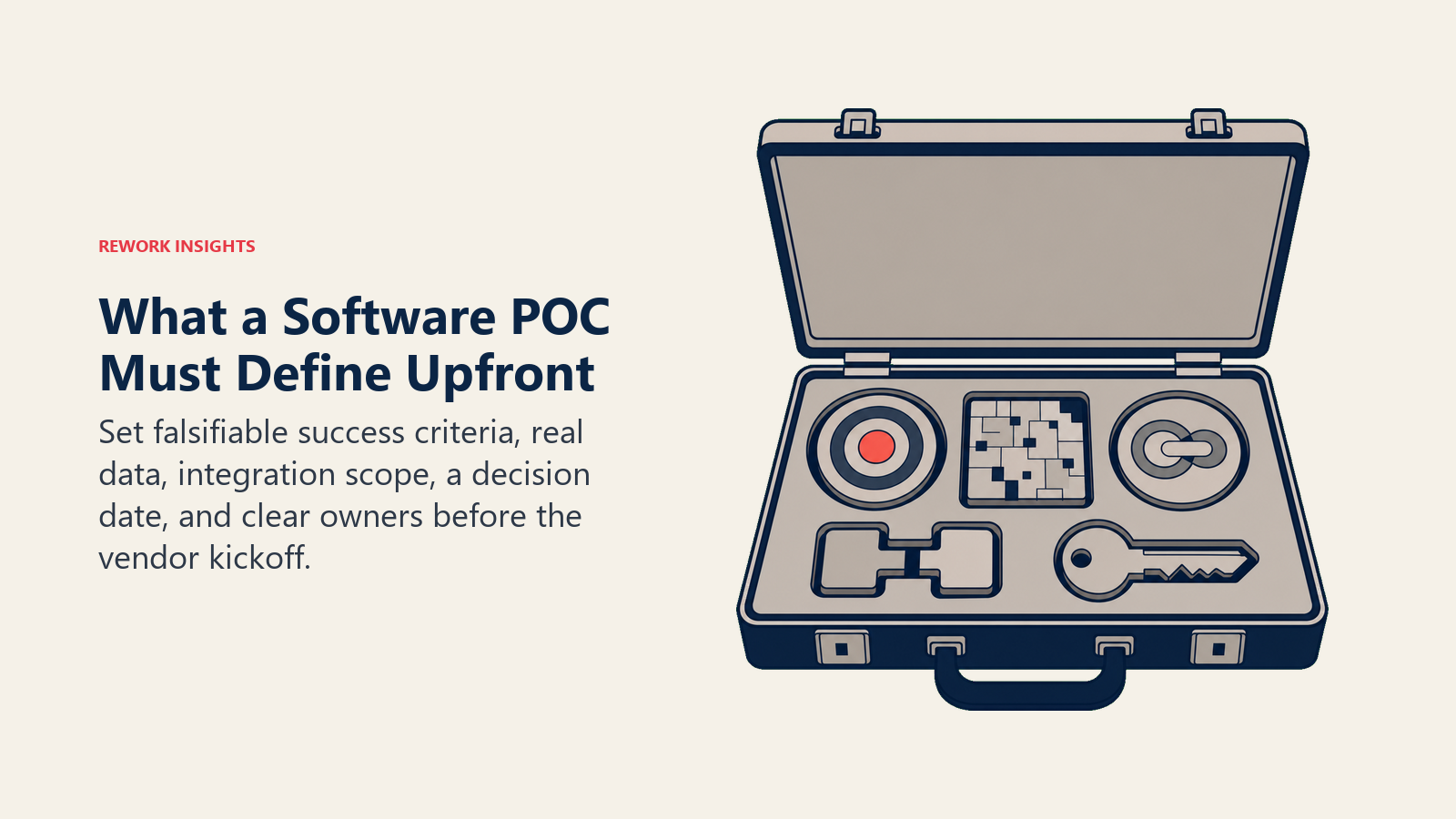
Written success criteria. Not "we want to see if it's easy to use." Written criteria look like: "User onboarding: 80% of pilot users complete their first core workflow without support intervention within 5 business days." Or: "CRM integration: all deal stage changes in the source CRM reflect in this platform within 15 minutes, validated over a 10-day observation period." These are falsifiable. They pass or fail. You don't need to debate whether they passed.
Real data, not demo data. Your actual data is your best stress test. If the vendor needs time to understand your data structure before the POC starts, that's fine, but the POC itself should run on representative samples of your real data, including the messiest parts. Any integration question that surfaces during this process would have surfaced post-contract anyway. Better to find it in week two than week ten after go-live. The data cleaning and deduplication guide is a useful pre-POC exercise, clean data reveals real integration problems faster than messy data hides them.
Integration scope definition. Before the POC starts, list every system this tool needs to connect to. Not "maybe someday." List only the integrations required for the baseline use case to work. For each integration, define who owns it (IT, vendor, or shared) and what the acceptance criterion is. This surfaces the hidden integration complexity that kills deals (and implementations) later.
A decision timeline. The POC has an end date, and that end date is when the buying committee reconvenes to make a decision based on POC results. Not a "debrief call" to plan next steps. A decision meeting. If the meeting gets pushed, the POC gets extended accordingly, but the expectation that a decision follows the evaluation is established at the start.
Roles and responsibilities. Who on your side owns the POC? Who is the vendor's primary contact? Who on your team is responsible for running the pilot workflows? This matters because POCs fail operationally when nobody on the buyer side has clear ownership and the evaluation runs in the background while everyone's actual job keeps moving.
The Vendor Incentive Problem
Here's something most buying guides don't say directly: your vendor wants the POC to succeed. That's not dishonest. It's rational. But their definition of "success" and yours may not align.
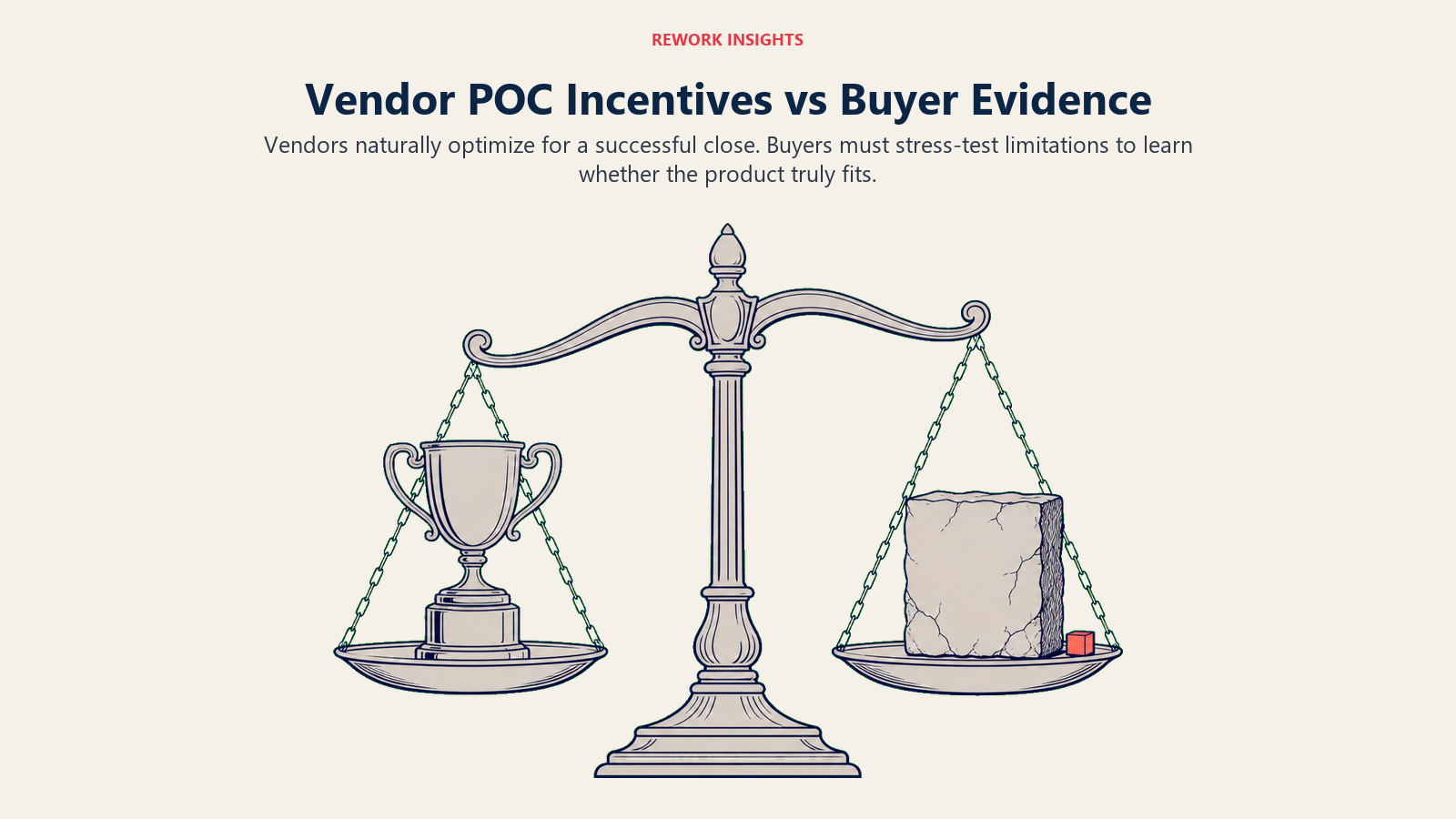
A vendor defines POC success as a closed deal. You define POC success as an accurate answer to the question "will this work for us?" Those are different objectives, and they create different behaviors.
Vendors will:
- Guide you toward features that work well and away from use cases that surface limitations
- Resolve blockers quickly during the POC that would take weeks post-contract
- Provide dedicated support resources during the evaluation that aren't available to normal customers
- Frame integration complexity optimistically because the sales engineer is confident it's solvable (the implementation team will discover otherwise)
This is especially visible in CRM POCs. A comparison like Rework vs. HubSpot CRM can surface the structural capability differences that vendors tend to downplay during demos.
None of this is lying. It's the natural consequence of a vendor deploying their best resources and most experienced people on a high-stakes evaluation. Post-contract, you're a normal customer.
The implication is that you should actively try to stress test the POC, not accept the path of least resistance. Use your messiest data. Ask about the use cases you're least sure will work. Request a conversation with a customer reference who had a similar integration challenge. Find one independently through a community or your network, not one curated by the vendor's customer success team.
The Three Most Common POC Failures
Three failure modes repeatedly weaken the signal a POC is supposed to produce.
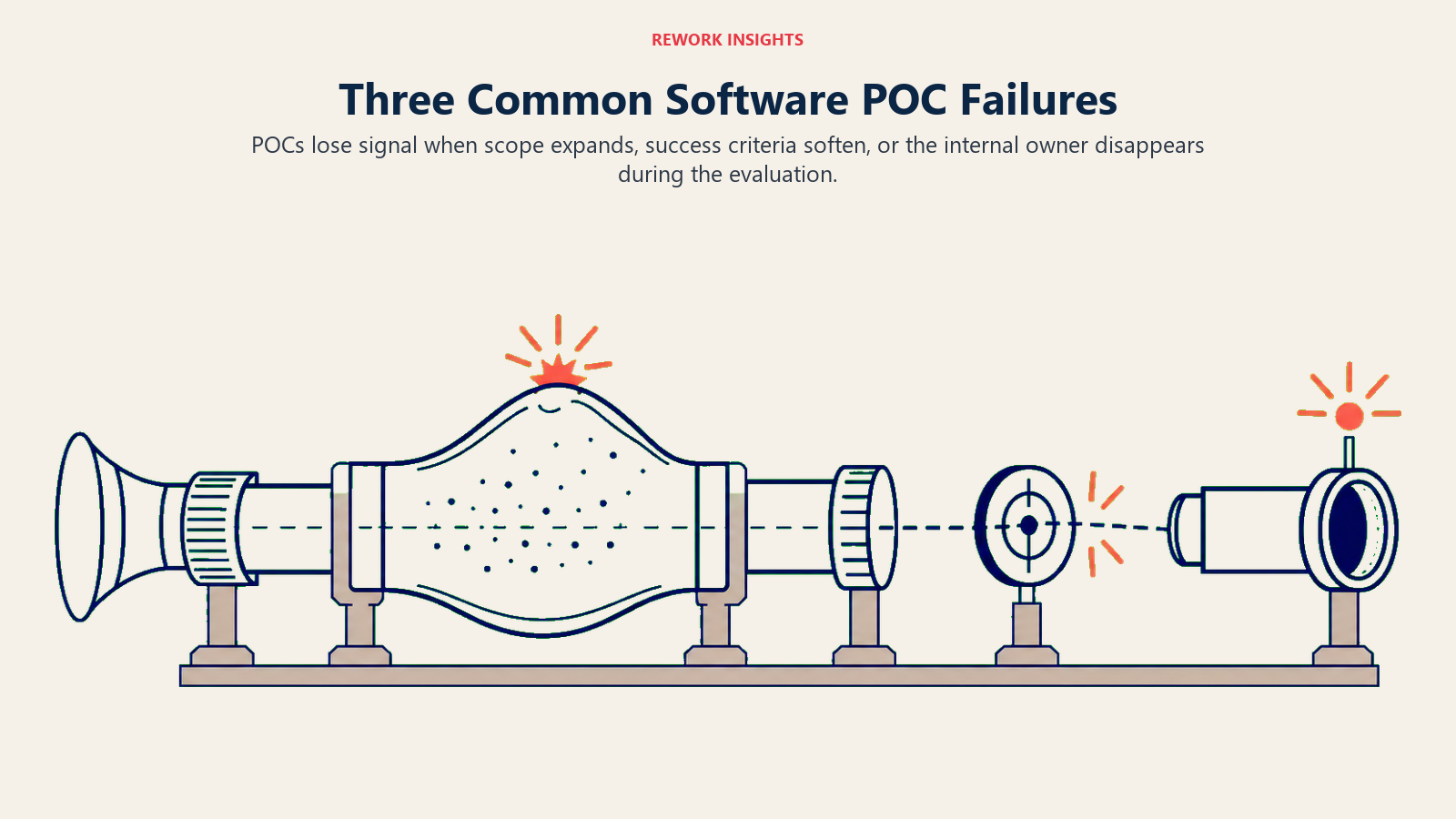
Scope creep without timeline adjustment. This was mentioned in the theater diagnosis, but it deserves expansion. Scope creep in a POC is almost always well-intentioned. The vendor sees an opportunity to show more value. Your champion wants to evaluate a capability they didn't initially plan for. Someone on the committee asks "can we also see how it handles X?" Each individual request seems reasonable. But the cumulative effect is an evaluation that covers everything shallowly rather than the original use case deeply.
Fix: any scope addition after the POC design brief is signed requires a written amendment that extends the timeline accordingly. No free expansions.
Success criteria drift. A POC starts with clear criteria. Three weeks in, the vendor hasn't met the integration criterion. A conversation happens. The criterion gets reframed as "aspirational" or "phase two." By the end of the POC, the original criteria have been replaced by a softer narrative about "promising signals" and "implementation roadmap."
Fix: the original success criteria are locked once the POC brief is signed. They can be formally amended by the buying committee, but the vendor can't unilaterally renegotiate them through informal conversations with the champion.
Champion departure during the evaluation. The person who designed the POC leaves the company, gets pulled onto a higher-priority project, or is promoted into a role where they no longer own this decision. The POC continues without its institutional knowledge. The new evaluation owner didn't write the brief, doesn't understand the original success criteria, and is susceptible to vendor-guided reframing.
Fix: a POC has two internal owners, not one. The backup owner is briefed on the criteria and approach at the start. If the primary owner leaves, the evaluation doesn't restart from scratch.
The POC Design Brief Template
Use this one-page structure before any vendor POC begins.
1. Business problem statement. One paragraph: what specific operational or revenue problem are we trying to solve? Not "we want better reporting." Something specific, like: "our sales team spends 6 hours per week manually reconciling pipeline data between our CRM and our forecasting tool, and the result is forecast error that's averaging 22%."
2. Success criteria (written). Three to five criteria, each falsifiable. For each: what we're measuring, how we're measuring it, and the threshold that constitutes success.
3. Integration requirements. Every system connection required for the baseline use case. Owner and acceptance criterion for each.
4. Pilot scope. Which team, how many users, which workflows. What they'll do during the POC, in their normal work, using real data.
5. Timeline. Start date, end date, key check-in milestones. The decision meeting date is set before the POC starts.
6. Failure clause. One paragraph: what outcome would lead us to not proceed? This is the most useful section and the one most buyers skip. Writing it forces clarity about what you're actually worried about.
7. Roles. Primary and backup evaluation owners. Vendor primary contact. IT integration owner. Decision-maker list for the final review.
Five Success Criteria Every Software POC Should Have
Regardless of category, these five criteria should appear in some form in every enterprise software POC:
Core workflow completion rate. Can users complete the primary intended workflow independently, without vendor support, within the pilot period? Set a threshold: 80% completion by day 10 is a reasonable starting point.
Integration latency and reliability. For every required integration: data syncs within the defined window (e.g., 15 minutes) at a defined reliability rate (e.g., 99%+ over the POC period). Test this actively, not by asking the vendor.
Edge case handling. Identify three to five use cases that represent non-standard situations in your environment. Run them explicitly during the POC. If the tool doesn't handle your edge cases, you'll find out post-contract unless you test them now.
Support response quality. Submit a real support request during the POC, not a softball one. How long does it take to get a substantive response? Who responds? Is the answer technically accurate? Post-contract support quality is often the most underevaluated dimension of an enterprise software purchase, and it's one of the clearest signals in any CRM implementation rollout.
Data portability validation. Before the POC ends, export your data from the system. Confirm you can export everything you put in, in a format you can actually use. Vendor lock-in questions are easier to evaluate with an empty contract than a full database. The TrustRadius B2B Buying Disconnect report consistently finds that data portability and integration quality are among the top factors buyers wish they'd evaluated more rigorously before committing.
What Good Looks Like
The POCs that generate reliable purchase signal share a few characteristics. They're short: four to six weeks, not open-ended. They run on real data and real workflows. The success criteria were written before the vendor's sales engineer joined the first call. The evaluation owner has the authority to say no, and everyone in the buying committee knows it. The RevOps maturity model describes what that organizational readiness looks like at different stages, a level 3 or higher RevOps function typically runs far more structured POCs than teams earlier in that progression.
They're also buyer-run, not vendor-run. The vendor supports. The buyer drives. That's a meaningful operational difference, and it's one most buyers have to establish deliberately because vendors will fill the vacuum if you let them. Forrester's technology purchasing research reinforces this: structured, buyer-controlled evaluations produce significantly higher satisfaction scores 12 months post-implementation than vendor-guided ones.
A POC that surfaces real problems before the contract is a gift. Most buyers don't see it that way in the moment. They see a problematic evaluation that's complicating a deal they wanted to close. But the alternative is always more expensive: signing a contract and discovering those problems during implementation is more disruptive than surfacing them during the evaluation.
Learn More
- The New B2B Buying Committee: Who's Really in the Room, the stakeholders who need to sign off on your POC results
- The True Cost of Software Sprawl at Mid-Market Companies, what happens when POC shortcuts lead to integration debt at scale
