More in
Productivity Insights
Decision-Making Velocity as a Competitive Moat
Feb 23, 2026
Why Your Best People Are Quietly Leaving Meeting-Heavy Teams
Feb 18, 2026 · Currently reading
Deep Work Isn't a Productivity Hack — It's a Business Strategy
Feb 10, 2026
Async-First Isn't the Same as Remote-First. Here's Why It Matters
Feb 6, 2026
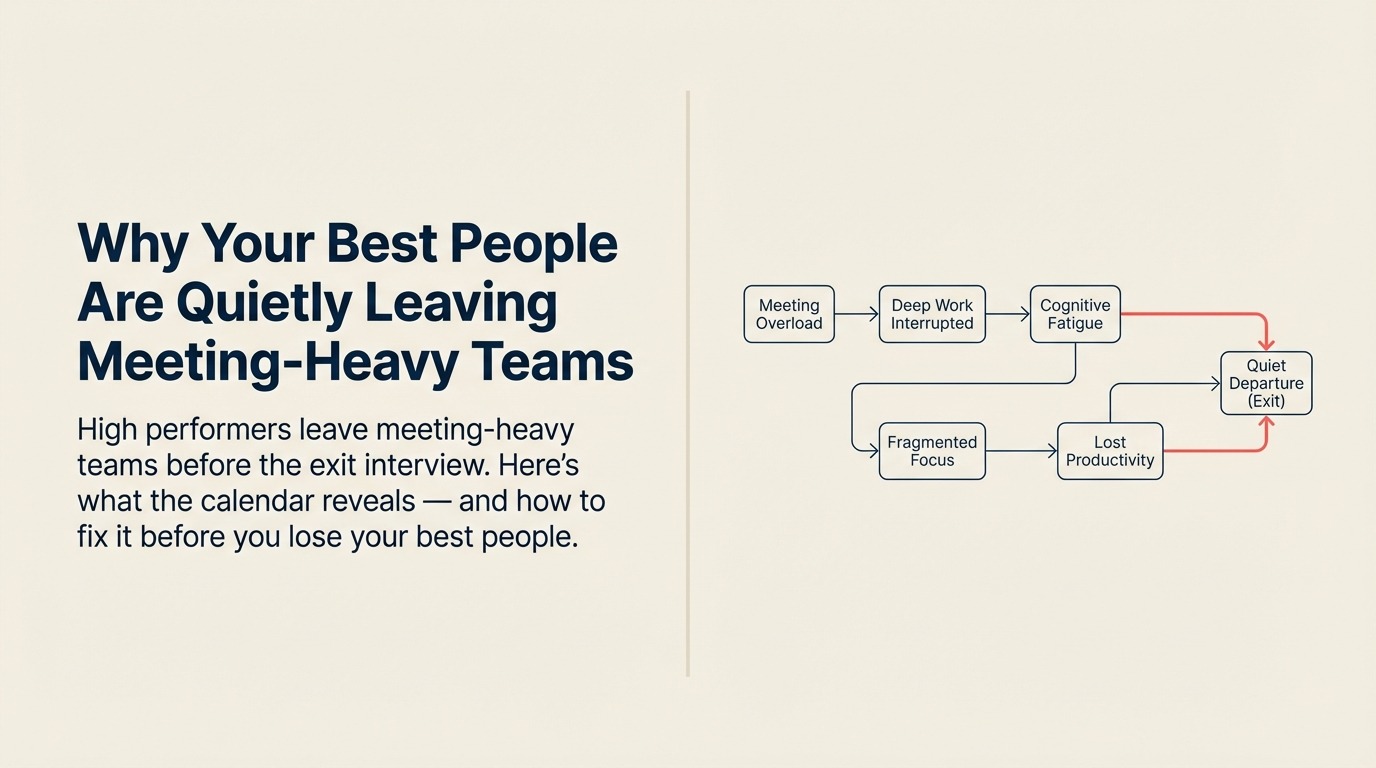
Why Your Best People Are Quietly Leaving Meeting-Heavy Teams
Turn this article into takeaways for your work.


Each assistant summarizes the article only for you and suggests best practices for your work.
Here's a number most leadership teams don't want to look at: replacing a senior individual contributor costs roughly 150% of their annual salary. For a $120,000 engineer or product manager, that's $180,000 in recruiting fees, onboarding time, and productivity drag before the new hire reaches full output. SHRM research puts voluntary turnover costs even higher for specialized roles. Most CFOs can tell you that figure on demand. Most CEOs couldn't tell you how many hours of focused work their top performers actually have per week after all recurring meetings are subtracted.
Those two things are connected. And not enough companies are treating them as a single problem.
The highest performers on any team share one trait: they know exactly what their time is worth. That's not arrogance. It's the reason they're high performers. They optimize ruthlessly, they spot waste fast, and when a company signals through its operating culture that their most valuable hours don't matter, they start taking interviews. The exit survey will say "better opportunity" or "growth trajectory." What it often means is: your meeting culture made it impossible for me to do the work I care about.
Why Meetings Signal Distrust, Not Coordination
Most meetings are sold internally as coordination. But coordination is just the surface function. Underneath, a meeting is a claim: "I don't trust that work will happen or decisions will be made correctly without real-time oversight."
That's not always conscious. Leaders who call daily standups, weekly syncs, monthly all-hands, and "quick touch-base" calls aren't necessarily micromanagers by temperament. But the cumulative effect of these meetings communicates something specific to your top performers: we don't have systems that can carry context without human intervention.
High performers read that signal clearly, and they respond to it. Not by complaining in the next 1:1. They respond by quietly expanding their external network, updating their LinkedIn, and evaluating whether their skills would be treated better elsewhere.
The autonomy-meetings relationship isn't subtle. A Microsoft WorkLab analysis of 31,000 global workers found that the clearest predictor of employee satisfaction wasn't compensation tier or title. It was having three or more hours of uninterrupted focus time per day. Your best people don't need three hours because they're lazy about collaboration. They need three hours because that's when the actual work happens.
How Top Performers Experience Meeting-Heavy Cultures Differently
A mid-level employee and a high performer in the same meeting-heavy team don't have the same experience. The mid-level employee may genuinely rely on meetings for context and direction. The high performer finds meetings actively destructive to their work cycle, and they have more exit options, so they use them sooner.
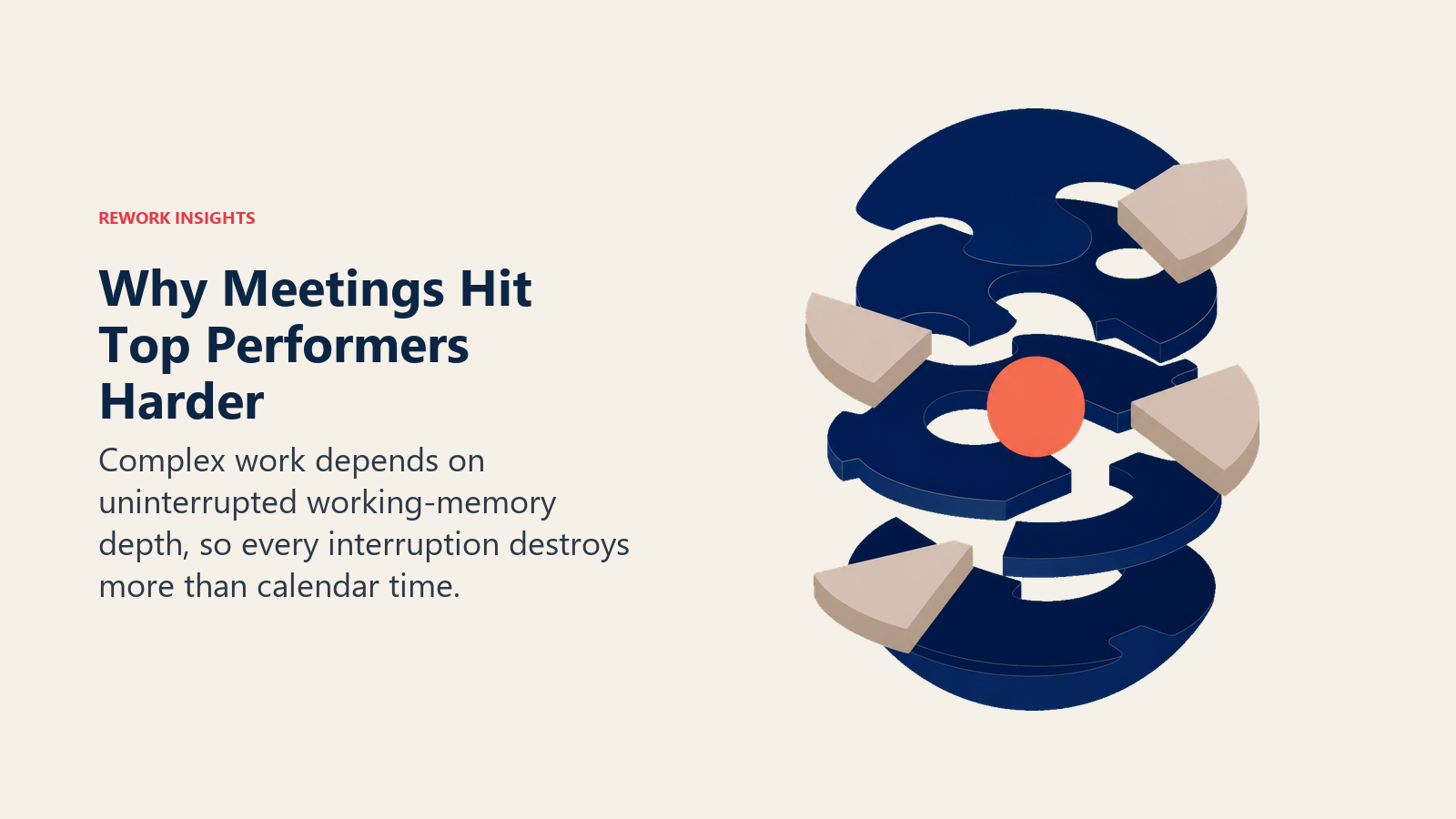
Think about what it takes to do genuinely hard intellectual work. A senior engineer architecting a complex feature, a product manager synthesizing research into a roadmap decision, a finance lead building a scenario model: these tasks require what cognitive scientists call "working memory depth." You need to hold multiple threads simultaneously and work through them without interruption. Getting pulled into a 30-minute meeting doesn't just cost 30 minutes. It costs the 15-minute reentry period afterward and the momentum that can't be recovered the same day if the fragmentation is severe enough.
Your high performers know this from experience. They can calculate how many such sessions they lost this week. And they're doing the math.
The medium performer may not notice as acutely because their work doesn't require that depth of focus as consistently. This creates a dangerous dynamic: meeting-heavy cultures quietly filter out the people least tolerant of them, which skews toward your strongest contributors.
The Calendar Audit: What One Hour Reveals
Here's an exercise any team lead can run without HR involvement, without a survey, and without any cultural initiative. Block one hour. Pull up your team's shared calendar for the last four weeks. (If you want a structured process for this, the meeting audit guide covers a three-step method for identifying which meetings to cut and what to replace them with.) Do this exercise:
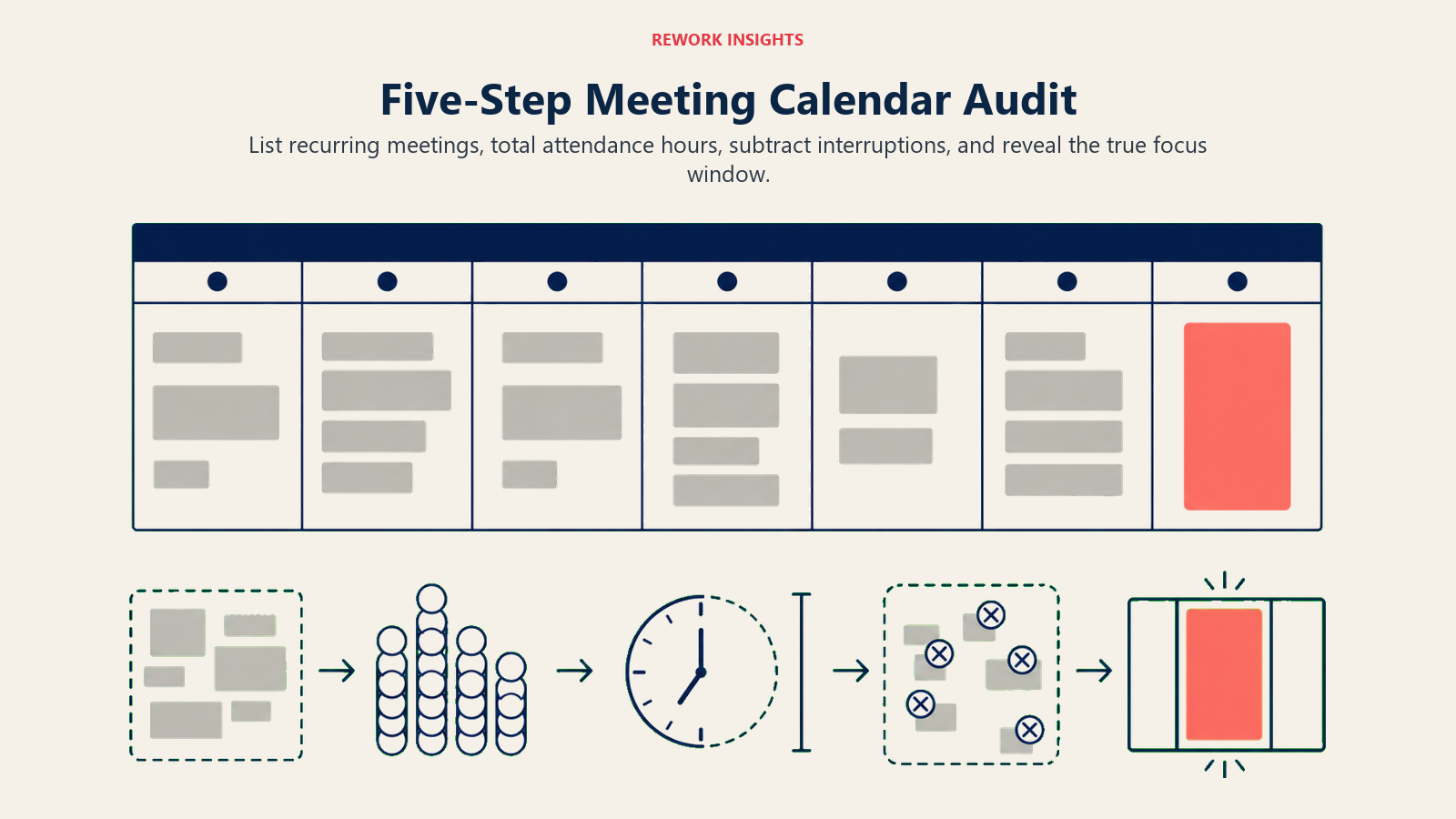
Step 1: List every recurring meeting that exists across your team: weekly syncs, standups, reviews, demos, planning sessions, town halls, 1:1s.
Step 2: For each meeting, write down the average attendance and the duration.
Step 3: Calculate total recurring meeting hours per person per week. (Sum of [duration × frequency] for all meetings each person is required to attend.)
Step 4: Subtract that from a standard 40-hour week.
Step 5: Subtract another 2 hours for ad hoc requests, Slack pings, and non-meeting interruptions (this is conservative; the actual figure is typically higher).
What's left is the realistic window for focused work. For many teams, this number lands between 12 and 20 hours. For some, it's below 10.
That number is what you're asking your best people to do their careers on.
The Meeting Drag Index
Here's a framework for making that audit legible across a leadership team. The Meeting Drag Index (MDI) converts your calendar structure into a single ratio that shows how much of the working week is structurally unavailable for deep work.
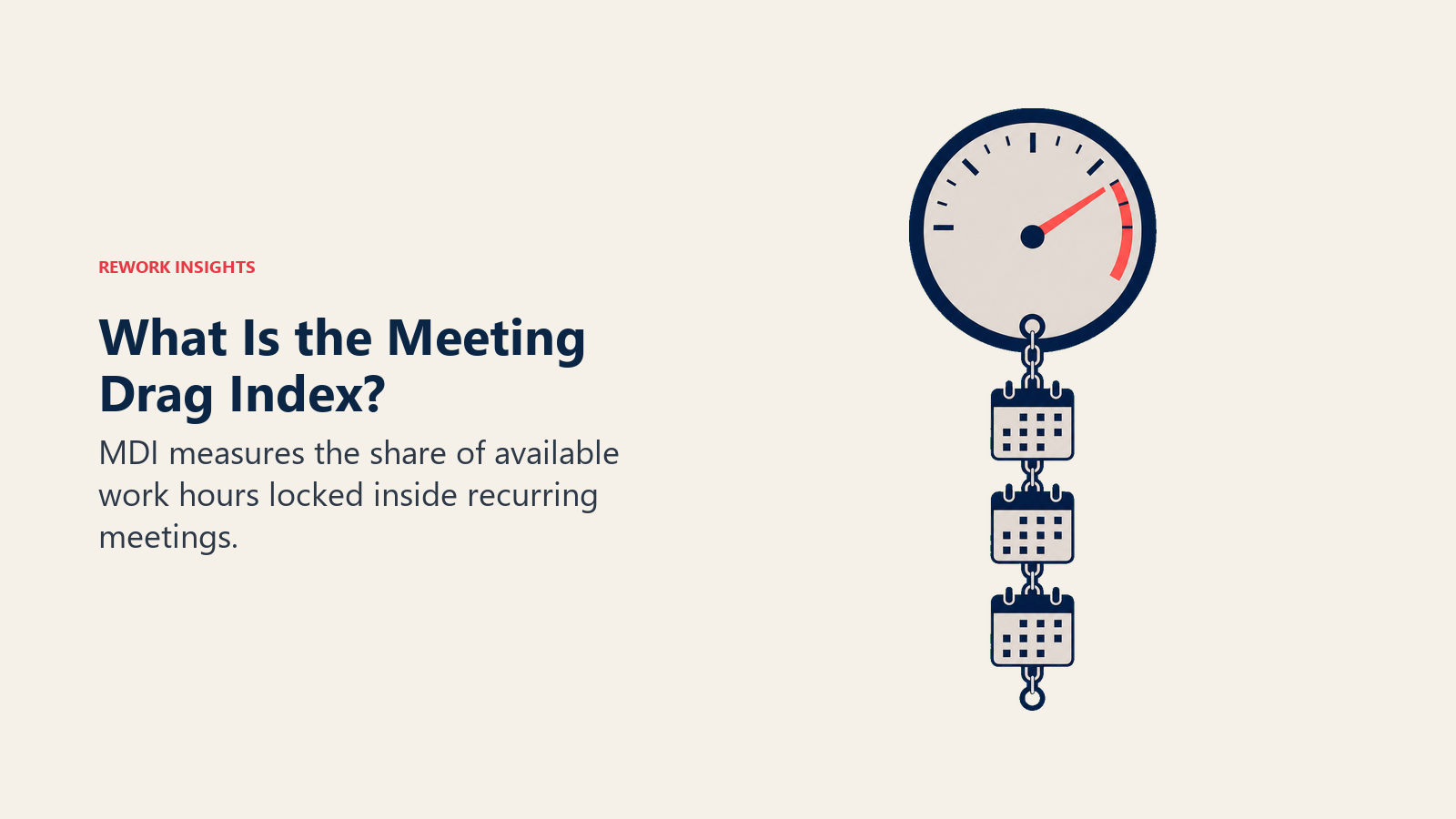
MDI = (Total recurring meeting hours per week) / (Available working hours) × 100
An MDI of 30 means 30% of the week is locked in recurring commitments before a single ad hoc request arrives. Most companies consider that reasonable. But when you add context-switching overhead (research suggests roughly 23 minutes to fully re-engage after an interruption), the effective focus window shrinks further.
Use these reference bands:
- MDI below 25: Meeting load is manageable; deep work is structurally possible
- MDI 25-40: High performers are feeling friction; expect quiet frustration building
- MDI above 40: Your best people are already looking
The MDI doesn't tell you which meetings to cut. It tells you whether you have a structural problem worth investigating. If your senior ICs are running an MDI above 35, the attrition risk is real regardless of what they say in engagement surveys. Harvard Business Review's analysis of meeting overload found that executives spent an average of nearly 23 hours a week in meetings, time that directly compresses the focus window for the people they manage.
Three Fixes That Aren't "Cancel Meetings"
Telling teams to cancel meetings isn't a strategy. It just moves the coordination need somewhere else without giving people the infrastructure to handle it. The companies that have actually fixed meeting-heavy cultures didn't do it by subtracting meetings. They did it by building systems that make most meetings unnecessary.
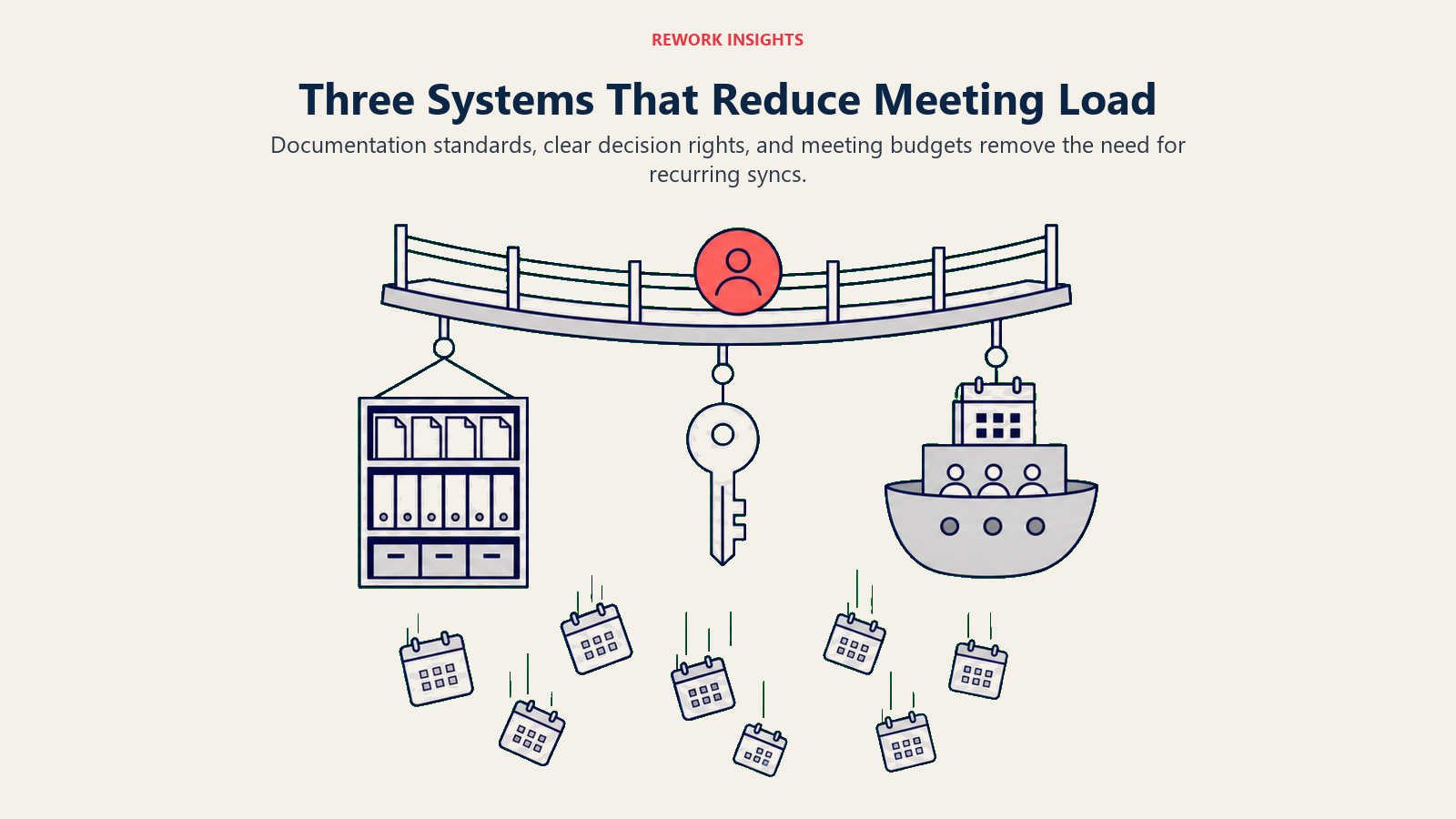
Fix 1: Async documentation systems with actual standards
The reason most meetings exist is because context lives in people's heads instead of in documents. When someone needs a decision, they schedule a meeting because that's the fastest path to the context holder. The fix isn't to tell people to document more. It's to create explicit documentation standards that make written context as accessible as a conversation.
This means: templates for how decisions get documented (what was considered, what was decided, who owns execution), shared spaces in Notion or ClickUp where project context lives and gets maintained, and a real expectation that important decisions don't happen verbally without a written record. When this works, you'll notice meeting frequency drop organically because people stop needing meetings to get context.
Fix 2: Decision-right frameworks
A huge percentage of recurring meetings exist because decision authority is unclear. Who can approve this? Does the CMO need to sign off? Should we loop in the CTO? When ownership is ambiguous, the default is to gather everyone and decide together. That's a meeting, which costs focus hours, which creates the exact problem you're solving.
A simple decision-rights mapping, a two-column doc that lists the 20 most common decisions in your team and who owns each, eliminates the ambiguity that spawns coordination calls. It doesn't need to be RACI. It just needs to be clear and shared.
Fix 3: The meeting budget concept
Some companies have started treating meeting time like headcount budget: finite, owned, and requiring justification to expand. A "meeting budget" gives each team a weekly ceiling of synchronous time (say, 6 hours per person per week in recurring meetings), and expanding it requires removing something else. One structural tool that reinforces this: a designated no-meeting day with explicit protection protocols, which forces the trade-off conversation rather than letting it accumulate quietly.
This sounds bureaucratic, but it has a useful forcing function. It makes the trade-offs visible. When a team lead wants to add a new weekly sync, they have to ask what it replaces. That question, asked consistently, surfaces the meetings nobody would miss if they disappeared.
The async-first vs. remote-first distinction matters here: a meeting budget only works if you've also built the async infrastructure that makes it safe to meet less often.
What Changing This Actually Looks Like
A 120-person SaaS company in the project management space ran a deliberate experiment two years ago. (The Monday.com vs. Asana AI comparison is worth reading alongside this if your team is also evaluating which tools actually support async documentation well.) Their Head of Engineering noticed that senior ICs in two teams were churning at a higher rate than the company average, and that the two teams also had the highest recurring meeting load: roughly 18 hours per person per week.
They ran a calendar audit, calculated the MDI for each team, and presented the math to the team leads: these engineers have roughly 14 hours of focus time per week after recurring meetings and a conservative estimate of interruptions. That's below the threshold for sustained deep technical work.
Over one quarter, they reduced recurring meetings by 40% across those two teams, replaced a weekly status sync with a Notion-based async update format, and gave team leads a standing meeting budget to stay within. The result: in the two quarters after the change, senior IC attrition in those teams dropped from above the company average to below it. The engineers who stayed said in feedback sessions that the single biggest change they noticed was being able to plan their week around focused work blocks.
The math on that retention improvement, calculated against replacement costs, was in the range of $800,000 in avoided recruiting and onboarding spend across two quarters.
The One-Week Audit Template
Any team lead can run this without budget, headcount, or approval. Here's the structure:
Day 1-2: Pull every recurring meeting you own or attend. List duration, frequency, and required attendees.
Day 3: Calculate your MDI. Calculate it for each person on your team if you have calendar visibility.
Day 4: For each meeting above 60 minutes, write one sentence answering: what would happen if this meeting didn't exist? If the honest answer is "we'd figure it out," it's a candidate for elimination or reduction.
Day 5: Pick the two meetings with the highest time cost and lowest strategic necessity. Propose either eliminating them or converting them to async documentation. Test for 30 days.
This isn't a full culture change. But it generates data and demonstrates intent, two things your best people are watching for when they're deciding whether to stay.
Your high performers aren't leaving because the market is good or because competitors have better titles. Many of them are leaving because their weeks are fragmented into uselessness and nobody is treating that as a retention problem worth solving. The exit interview rarely says that clearly. But the calendar will, if you look.
Related reading on building the conditions that keep high performers engaged:
