More in
Productivity Insights
Decision-Making Velocity as a Competitive Moat
Feb 23, 2026 · Currently reading
Why Your Best People Are Quietly Leaving Meeting-Heavy Teams
Feb 18, 2026
Deep Work Isn't a Productivity Hack — It's a Business Strategy
Feb 10, 2026
Async-First Isn't the Same as Remote-First. Here's Why It Matters
Feb 6, 2026
Decision-Making Velocity as a Competitive Moat
Turn this article into takeaways for your work.


Each assistant summarizes the article only for you and suggests best practices for your work.
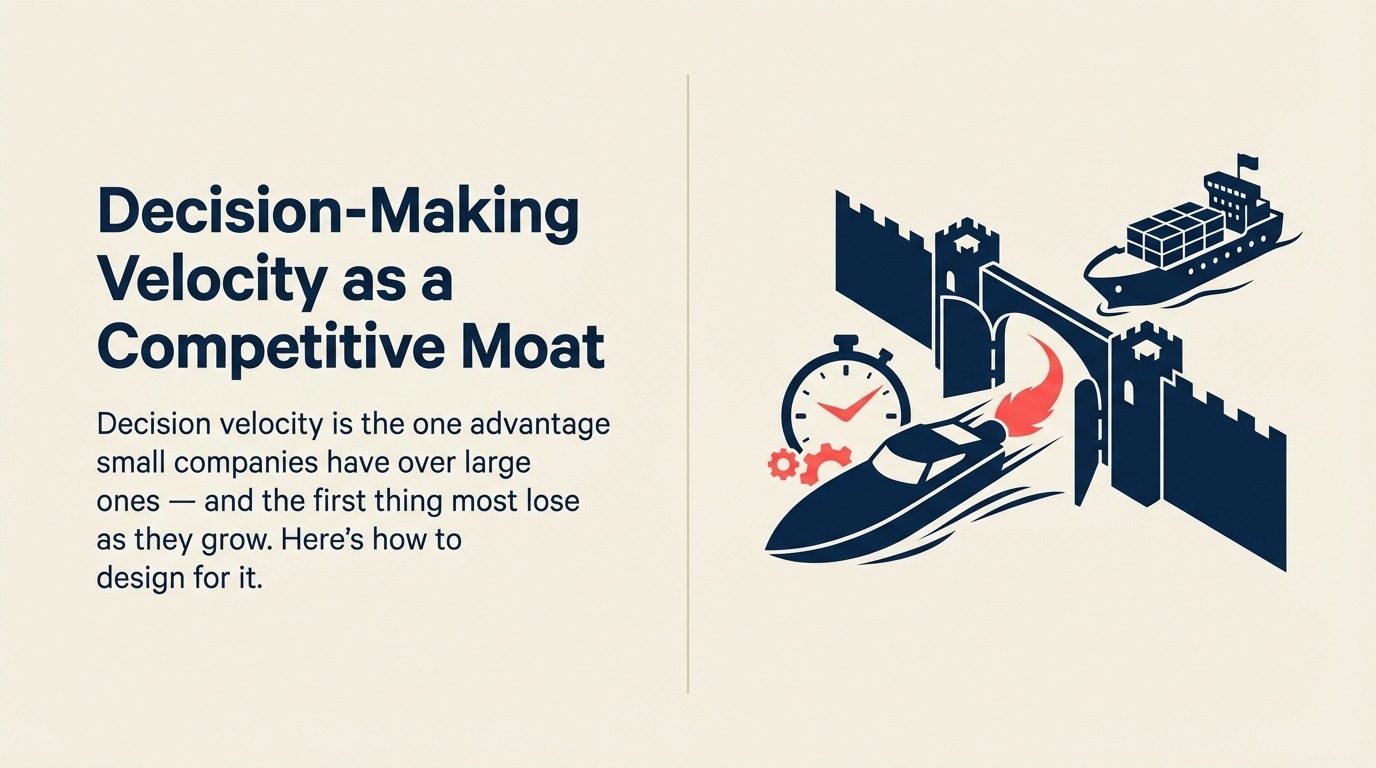
Speed of decision is one of the few genuine competitive advantages available to small and mid-size companies. You probably can't outspend a larger competitor. You can't out-distribute them or out-support them. But you can out-decide them: move faster, course-correct quicker, and ship before their approval process gets to round three. McKinsey research on decision making found that organizations with clear decision-making processes are 1.4 times more likely to make fast, high-quality decisions, and that ambiguous ownership is the single biggest obstacle.
The companies that maintain that advantage as they grow aren't just "staying scrappy." They're doing something specific: designing their decision architecture intentionally, rather than letting it accumulate by accident. Because the default is decay. Add headcount, add layers, add consensus culture, and within 18 months you have a company that takes two weeks to approve a landing page change. The decay isn't inevitable. But it happens to almost everyone who doesn't actively resist it.
Why Decision Velocity Degrades as Companies Scale
The early-stage company moves fast partly by necessity and partly by structure. Four people in a room can make a decision in 15 minutes because all the context is shared and the downside of a wrong decision is limited. But three organizational dynamics consistently destroy that velocity as headcount grows.
Layers and information attenuation. Each management layer between the person with the context and the person with the authority is a delay. The ICs know what's happening on the ground. The VP knows what the directors told them. The CEO knows what the VP summarized. By the time a decision request travels up and back down, the context has been compressed, nuance has been lost, and the turnaround time has stretched from hours to days. Nobody designed this. It emerged from growth.
Consensus culture as a risk mitigation strategy. When companies start losing decisions, shipping the wrong feature, hiring the wrong person, entering the wrong market, the institutional response is often to require more input before decisions get made. Which is sometimes right. But it becomes a default that applies to all decisions regardless of stakes, which means low-stakes decisions get routed through the same approval process as high-stakes ones. The cost of getting consensus isn't worth the risk reduction on most decisions, but the process doesn't discriminate.
Unclear ownership creating coordination overhead. When it's not obvious who owns a decision, every stakeholder becomes a potential veto. The PM, the engineering lead, the product designer, and the CMO all have opinions and all need to be "aligned before we move forward." That phrase, "aligned before we move forward," is often a symptom of unclear ownership masquerading as good process. When ownership is clear, alignment becomes optional context-sharing rather than a prerequisite for action.
The Three Decision Categories
The biggest structural mistake most organizations make is treating all decisions the same. They get routed through the same approval process, the same stakeholder review, the same sign-off chain. That's fine for high-stakes decisions. For low-stakes ones, it's a tax on velocity that accumulates into competitive slowness.
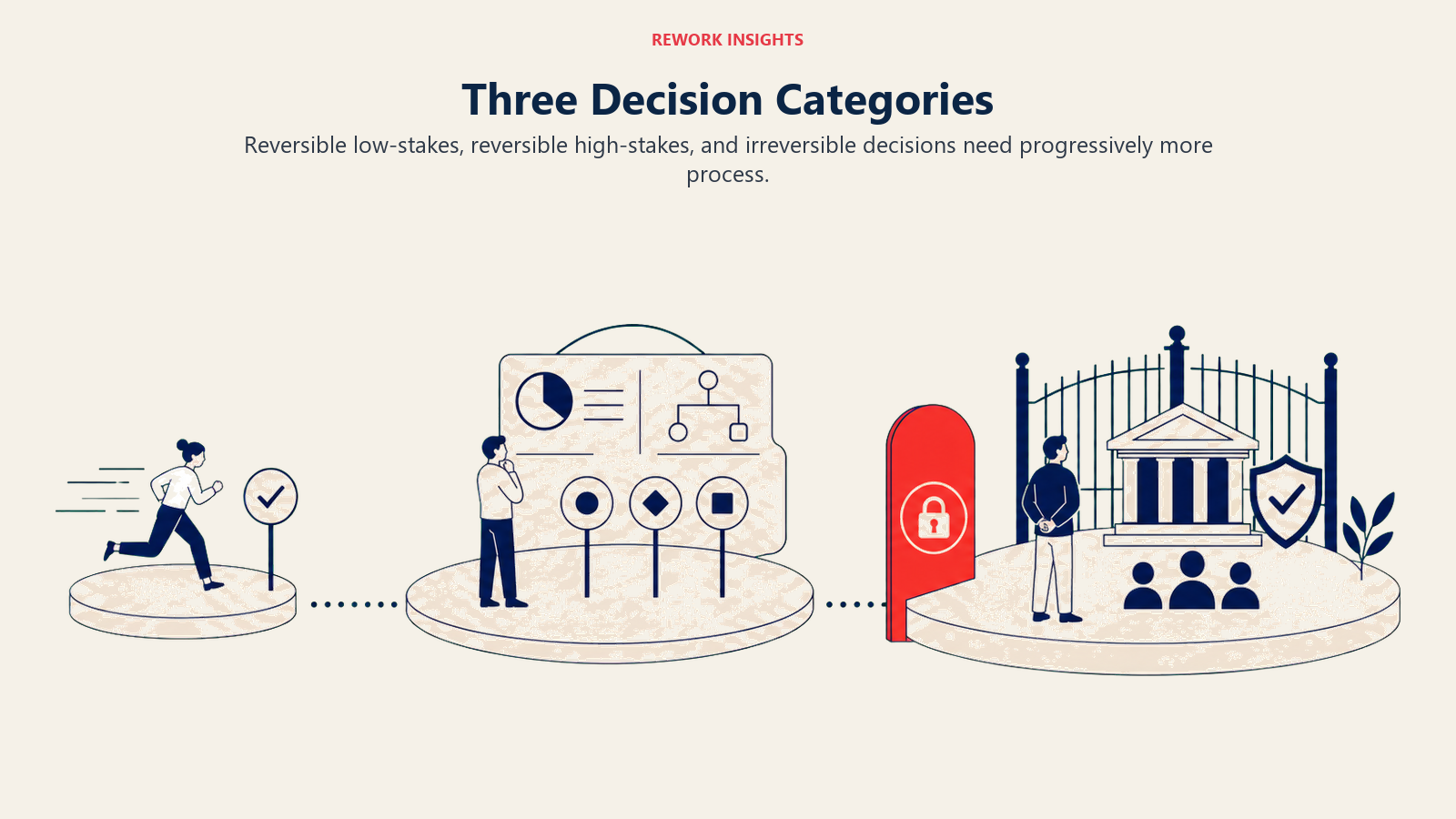
Decisions fall into three fundamentally different categories that warrant different handling:
Reversible, low-stakes decisions. These should be made by the closest person to the information, without escalation, without consensus, without documentation beyond a brief note. Copy changes, minor feature adjustments, vendor selection under a certain cost threshold, scheduling: the vast majority of decisions that cross a knowledge worker's desk fall here. The organizational goal is to push these decisions as far down as possible and establish clear authority so they don't escalate at all.
Reversible, high-stakes decisions. These warrant more process but shouldn't require real-time consensus. The pattern that works: the decision owner writes a brief describing the options, the reasoning, and their recommendation. Relevant stakeholders have 48-72 hours to respond with written input or objections. The owner makes the call. This approach mirrors what Harvard Business Review describes as "one-way and two-way door" thinking, a framework Amazon popularized to distinguish decisions that are reversible from those that aren't, and calibrate process accordingly. A decision log, even a lightweight one, captures the reasoning so the same question doesn't resurface six months later as if it were never answered. If it's wrong, it can be undone, but the written process creates accountability and surfaces objections without requiring a meeting. Most product decisions, go-to-market adjustments, and operational changes belong here.
Irreversible decisions. These deserve the full process: synchronous discussion, written analysis, multiple perspectives, explicit devil's advocacy. Hiring senior leaders, entering new markets, significant pricing changes, acquiring or divesting assets: the decisions that can't be easily undone warrant the slowest, most careful approach. The key is keeping this category narrow. When everything is treated as irreversible, nothing moves fast. When only genuinely irreversible decisions get the full process, velocity is preserved where it matters.
The framework isn't novel. But most organizations don't implement it explicitly, which means each decision gets processed based on whoever touches it first and what they're comfortable delegating. That's not a process; it's noise.
Disagreement Without Delay
Here's the thing about consensus culture: it often masquerades as good decision-making while producing worse outcomes and longer timelines. When every decision requires full buy-in, two pathologies emerge.
The first is that disagreement gets suppressed rather than surfaced. People learn that raising objections creates delay, so they pre-filter their concerns and save "real" disagreements for hallway conversations after the decision has been made. The decision gets consensus because objectors went quiet, not because they agreed. Then the decision fails to execute because the people implementing it don't actually believe in it.
The second is that decisions get made by whoever is most willing to wait out the process. The person with the highest tolerance for ambiguity and the most persistence gets the outcome they want, regardless of whether they have the best view. That's not consensus. That's attrition.
The alternative is explicit disagreement protocols. Two that work in practice:
"Disagree and commit." The stakeholder makes their objection clearly, in writing. The decision owner considers it and makes the call. The stakeholder commits to implementation regardless of their personal view. The objection is documented so it can be revisited if the decision fails. This preserves both the speed and the accountability: the owner owns the outcome, but the objection is on record.
Time-boxed deliberation. Set a decision deadline at the outset. "We'll gather input until Thursday; the owner will decide by Friday." This creates a window for real debate without allowing delay to become a veto mechanism. People who want to influence the decision know they need to engage before Thursday, not spend two weeks asking for more information.
Neither of these is comfortable for people who are used to consensus processes. Both produce faster, more accountable outcomes.
The RACI Trap
RACI, Responsible, Accountable, Consulted, Informed, gets implemented in most organizations as an accountability framework. In practice, it often creates the opposite. MIT Sloan Management Review's research on decision rights found that overly broad consultation lists are a primary driver of decision delay, and that the most effective organizations actively narrow who is consulted rather than expanding input at every level.
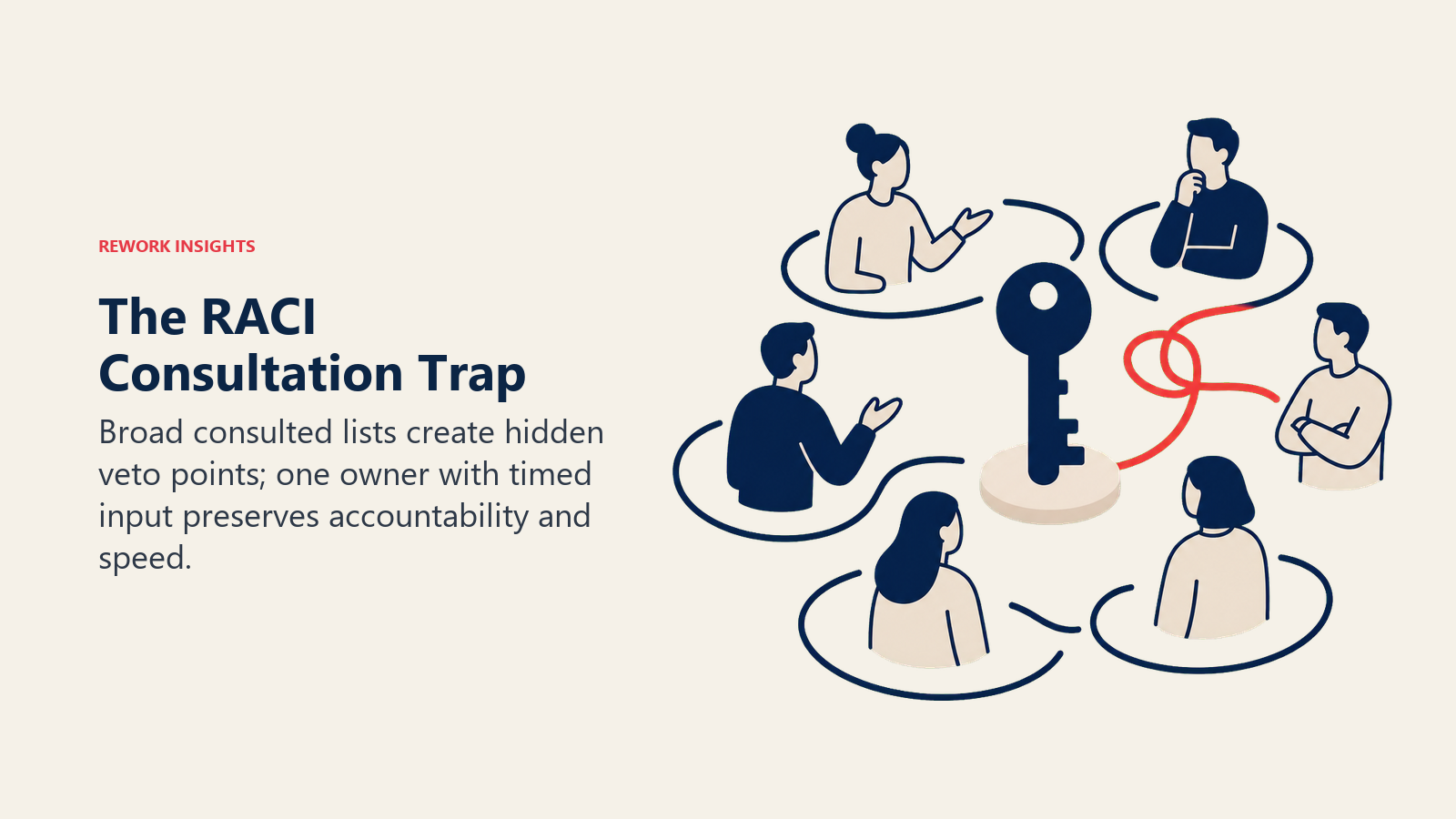
The problem is the "Consulted" column. When five people are marked as consulted on a decision, any one of them can slow it down by not responding, raising objections, or requesting more analysis. The broader the consulted list, the more potential veto points exist, and the slower the decision moves. RACI gives the illusion of clarity about ownership while creating real ambiguity about who can block whom.
The cleaner model is ownership with notification:
One owner. Not "R and A are shared between the PM and the engineering lead." One person owns the decision and is accountable for the outcome.
Explicit consulted list, with a deadline. Rather than "consult widely," name the two or three people whose input is genuinely necessary, and set a response window. After the window closes, the owner decides with whatever input they have.
Notification by exception. Everyone else who might have an opinion gets notified after the decision is made, not before. They have a defined window to escalate if they believe the decision is wrong. If they don't escalate, it proceeds.
This model is faster and more accountable than RACI because it removes the diffuse consultation layer that creates coordination overhead without clarifying who actually owns the outcome. The connection to async-first is direct: this model only functions if the decision documentation is written and accessible, which is why async-first operating models and decision velocity reinforce each other.
The Decision Architecture Audit
Here's a 60-minute workshop any leadership team can run to map their current decision-making failures. The output is an honest picture of where velocity is being destroyed and why.
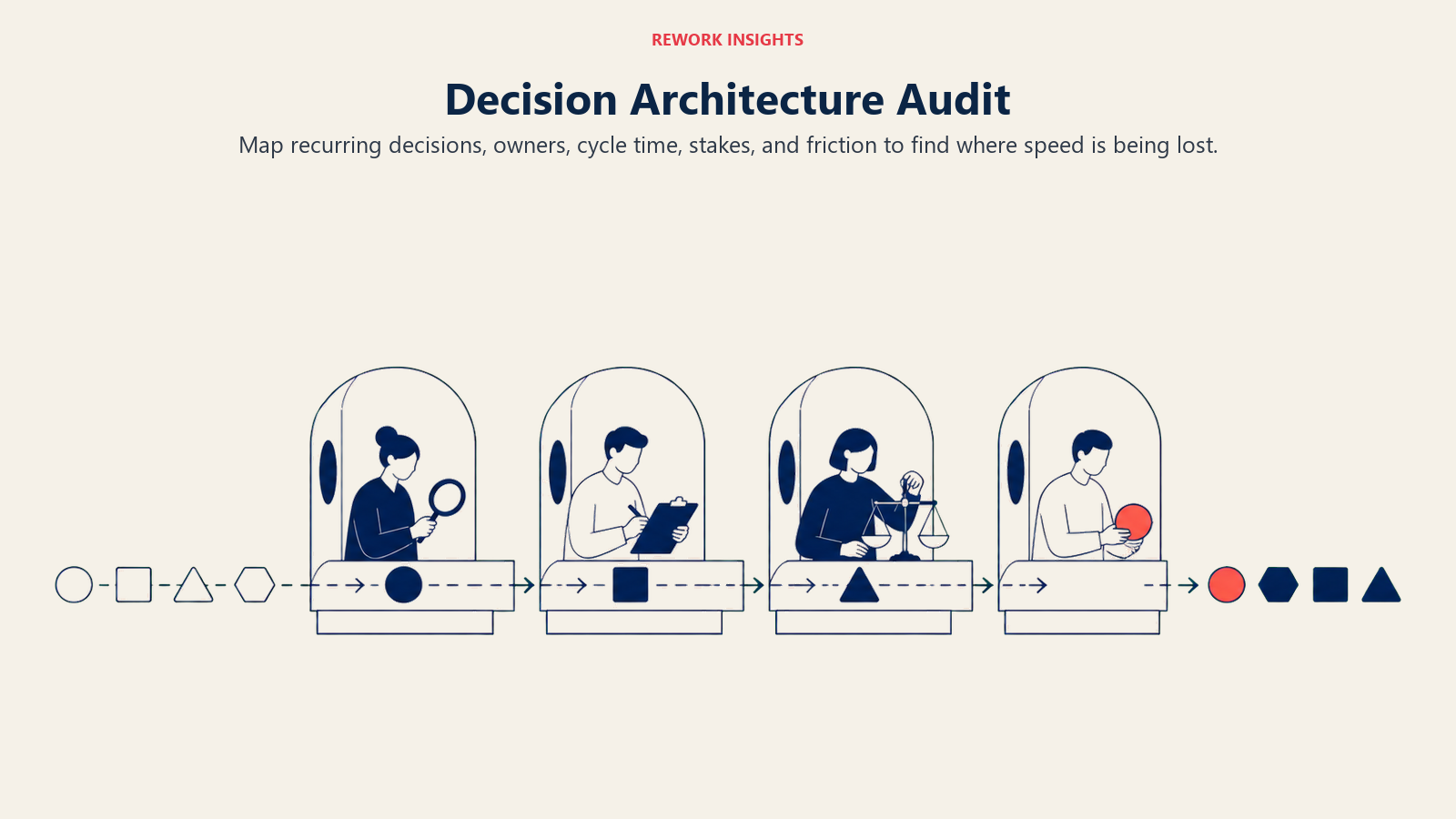
Step 1 (15 minutes): List the 10 most common decisions.
Pick decisions that happen repeatedly across the business, not one-time strategic choices, but the decisions that recur weekly or monthly: feature prioritization, hiring decisions at different levels, marketing spend allocation, customer escalations, pricing exceptions, vendor renewals, product roadmap adjustments. List 10 of them.
Step 2 (20 minutes): For each decision, write two answers.
First: who actually makes this decision today? Not who should in theory, but who actually makes the call? (Be honest. In many organizations, there's a gap between the formal org chart and where decisions actually get made.)
Second: how long does this decision typically take from when the need is identified to when it's made and communicated?
Step 3 (15 minutes): Classify each decision.
For each of the 10, categorize it: reversible/low-stakes, reversible/high-stakes, or irreversible. Then ask: does the current process match the category? Is a reversible/low-stakes decision being routed through a process appropriate for irreversible ones?
Step 4 (10 minutes): Identify the top three friction points.
Which decisions have the longest cycle time relative to their stakes? Which have the most ambiguous ownership? Where is the "consulted" list longest? These are the decisions worth redesigning first.
The audit rarely produces surprises about what the problems are. It does produce clarity about why they persist, and that clarity is usually enough to start changing the pattern.
How Project Management Tools Can Encode Bad Defaults
Monday.com, Asana, ClickUp, and similar tools can either support good decision architecture or enshrine bad defaults, depending on how they're configured.
When teams use these tools primarily as task trackers in a synchronous-default culture, they become a record-keeping layer that sits beneath the actual decision layer. The Monday.com vs. Asana AI architecture comparison is a useful lens here: the platform choice matters less than whether the team actually uses it as the decision surface. Decisions still happen in meetings or Slack; the tool just captures what was decided. The result is a tool adoption that adds overhead without reducing coordination costs.
When teams use these tools as the primary decision surface, where decisions get documented with context, stakeholders provide input through comments rather than meetings, owners make and record their choices, and the team can see the reasoning without a separate briefing, the tool reduces coordination overhead rather than adding to it.
The configuration matters less than the operating norm. A team that treats the project management tool as where decisions actually live will use it differently than a team that treats it as a task list. And the difference between those two uses is largely whether the organization has done the harder work of building a written-first decision culture before adopting the tool.
Tools don't create good decision architecture. But they can make good architecture cheap to operate once you've built it.
The Velocity Preservation Playbook
For companies that are currently fast and want to stay that way as they scale, three practices preserve decision velocity better than anything else.
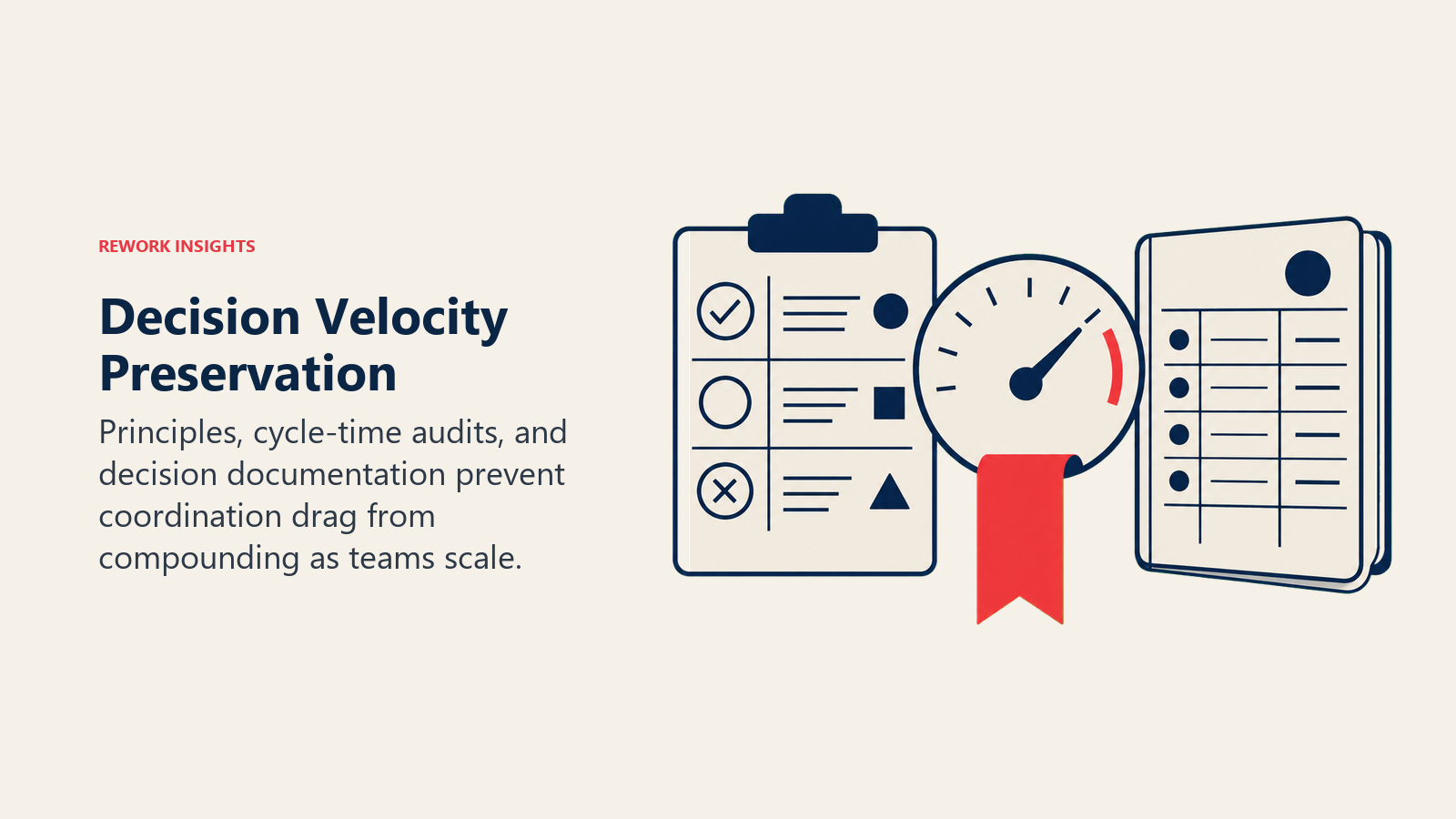
Set explicit decision-making principles before you need them. The time to define how decisions get made is when the company is small and fast, not when it's already getting slow. Write down how different categories of decisions get made: who owns them, what process applies, when escalation is appropriate. Embed this in onboarding. Refer to it when new team leads join and bring old patterns with them.
Audit decision cycle time regularly. Track how long decisions take in the same way you track how long features take to ship. If average decision cycle time is trending up, that's a signal worth investigating before it becomes embedded in culture. Most companies never measure this, which means they never notice the decay until it's substantial.
Create a "decision debt" mechanism. Just as technical debt accumulates when shortcuts are taken in code, decision debt accumulates when decisions get made informally and never documented. Every undocumented decision is context that will have to be reconstructed the next time it's relevant. Assign someone on each team the responsibility to document significant decisions as they're made, not in retrospect, but at the time. The cost is small; the compounding benefit is significant.
The connection to deep work and focus culture is direct: organizations where decisions move fast also tend to be organizations where focused work is structurally possible, because the two come from the same root design. Clarity about ownership, written-first communication defaults, and explicit rather than implicit processes.
Decision velocity isn't about moving fast on everything. It's about moving fast on the things that should move fast, and having the discipline to slow down only on the decisions that genuinely warrant it. Getting that distinction right is an architectural question, and the answer compounds in either direction over years.
Treat it like the strategy problem it is.
Related reading:
