More in
Productivity Insights
Decision-Making Velocity as a Competitive Moat
Feb 23, 2026
Why Your Best People Are Quietly Leaving Meeting-Heavy Teams
Feb 18, 2026
Deep Work Isn't a Productivity Hack — It's a Business Strategy
Feb 10, 2026
Async-First Isn't the Same as Remote-First. Here's Why It Matters
Feb 6, 2026 · Currently reading
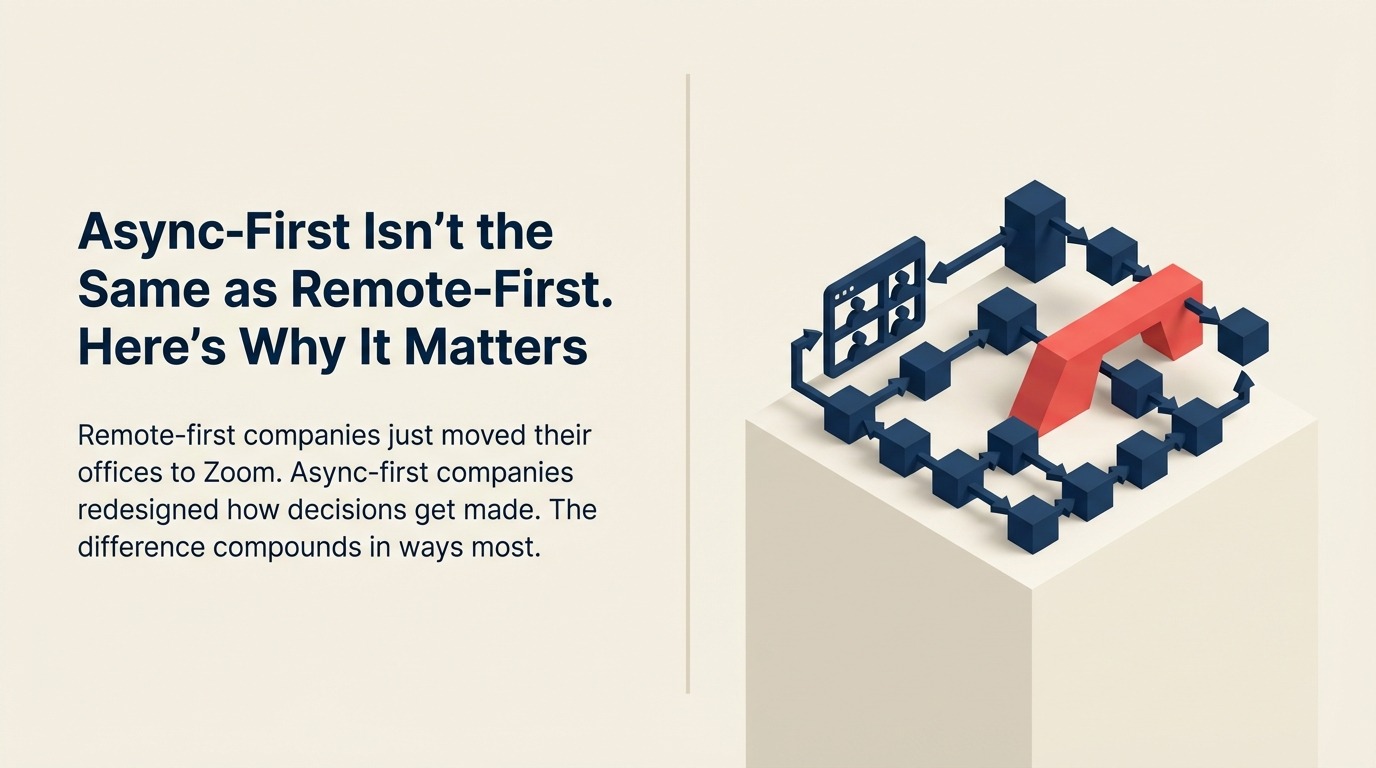
Async-First Isn't the Same as Remote-First. Here's Why It Matters
Turn this article into takeaways for your work.


Each assistant summarizes the article only for you and suggests best practices for your work.
Remote-first companies moved their offices to Zoom. Async-first companies redesigned how decisions get made. These aren't the same thing, and confusing them explains why so many "remote-friendly" teams still carry the worst productivity properties of co-located offices: synchronous defaults, ad hoc decision-making, and calendar fragmentation, just with worse audio quality and a commute that ends at a home desk. GitLab's annual Remote Work Report has documented this gap for years, finding that most self-described "remote" companies have not redesigned their communication or decision architecture. They've simply moved the same synchronous patterns online.
The confusion matters because the two models have very different compounding effects over time. A remote-first team that never becomes async-first eventually hits a scaling wall: coordination becomes harder as headcount grows, time zones create friction instead of leverage, and the calendar fills up with meetings that wouldn't have existed if decisions could travel in writing. An async-first team scales differently. Context travels without its author. Work happens across time zones rather than being blocked by them. And focused work becomes structurally possible in a way it never is in a synchronous-default culture.
Most teams never make this distinction explicitly. They go remote, adopt Slack, make video optional, and call themselves async. They're not.
The Misconception Taxonomy
There are three things remote teams consistently do that they mistake for async work.
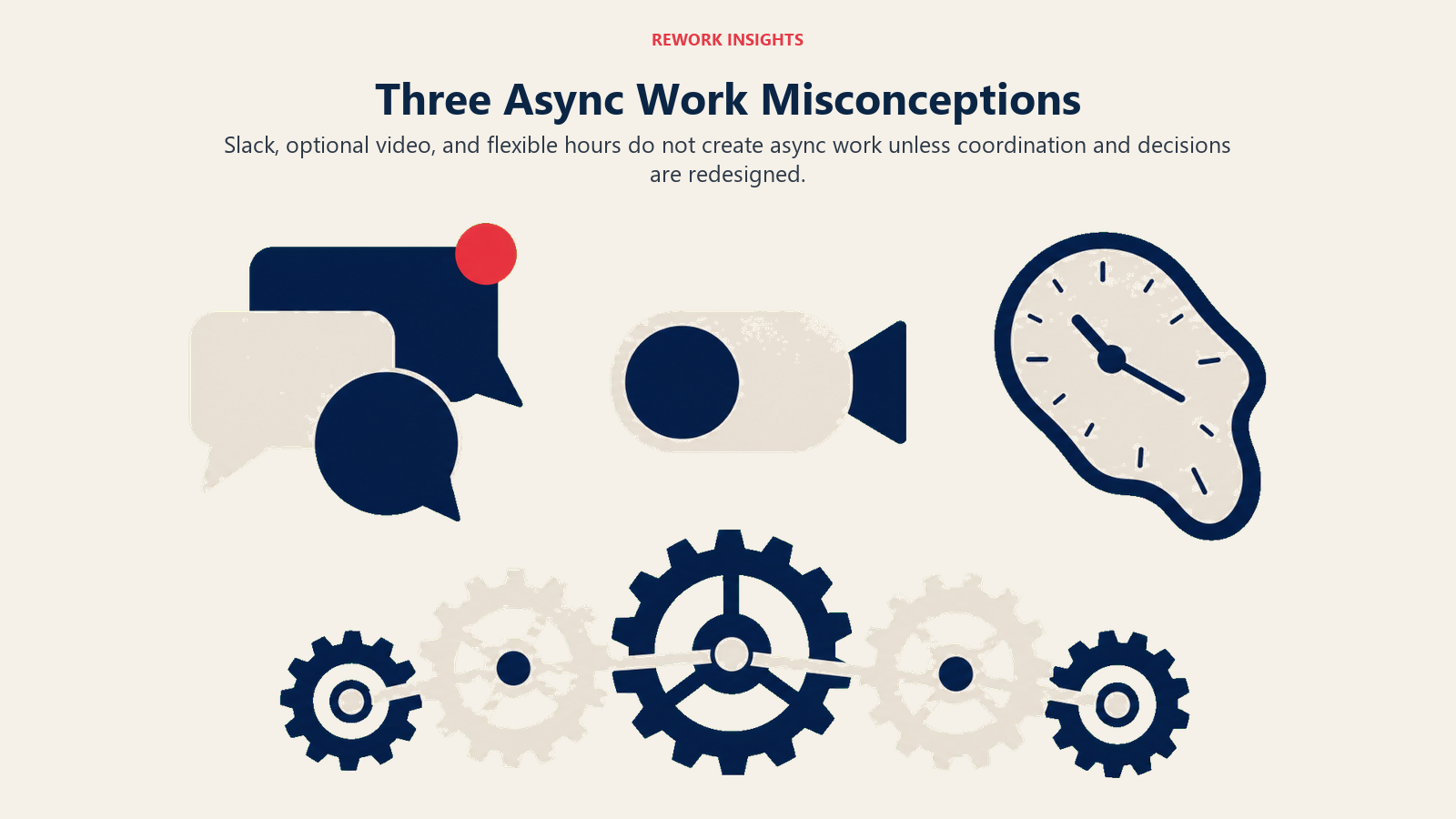
Using Slack instead of email. Switching from email to Slack doesn't change the communication model. It usually intensifies the synchronous expectation. Email has an implicit response window measured in hours; Slack has an implicit response window measured in minutes. When teams move to Slack, they often get faster responses and fewer long emails, but they also get a culture where being "away" for two hours triggers concern. That's not async. That's synchronous communication on a more anxiety-inducing medium.
Making video optional. Calling a meeting "async-friendly" because attendance isn't mandatory doesn't make it async. The meeting still happened in real time. The decision was still made synchronously. The people who weren't there missed the context and will need it summarized later, which is a cost, not a benefit. Making video optional is a flexibility perk; it's not an operating model change.
Offering flexible hours. Letting people work 7am to 3pm instead of 9am to 5pm is a schedule accommodation. It becomes async if and only if the work itself doesn't require real-time coordination at specific times. Many "flexible" teams are functionally synchronous: the core hours overlap, the decisions still happen live, and the people who work unusual hours find themselves excluded from the informal decision layer that runs through chat and ad hoc calls. Flexibility without redesigned coordination is just a schedule change.
Real async work looks different. It means the default mode for communication is written, permanent, and contextually complete enough that the recipient can act on it without a follow-up conversation. It means decisions have documented owners who make them in writing with written input from stakeholders, not in meetings. It means the question "can I just hop on a call for five minutes?" is treated as a last resort rather than the path of least resistance.
What Async-First Actually Requires
Three things need to be true before async-first actually delivers its productivity advantages.
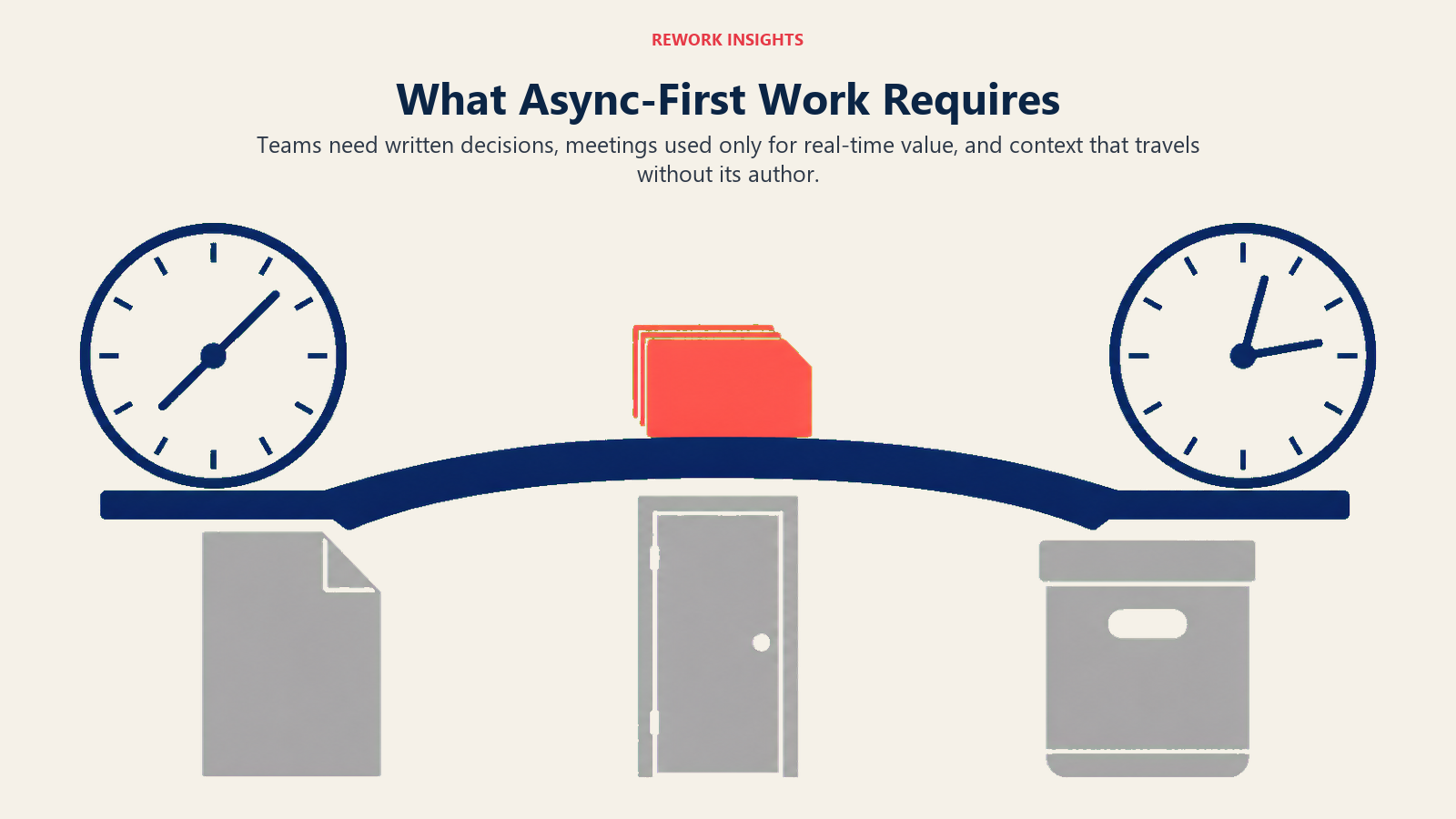
Written-first decision culture. Every significant decision needs a written record that can stand alone. Not just a summary after the fact, but the actual reasoning, the options considered, the owner's rationale, and the outcome. When this is the norm, a new team member can get up to speed on a project by reading instead of by interrogating colleagues. Doist's research on async communication found that written-first teams consistently report higher autonomy, fewer interruptions, and stronger outcomes on deep work tasks than their synchronous-default peers. A team member in a different time zone can make a decision with the same context as someone in the same office. And the decision doesn't evaporate from organizational memory when the person who made it leaves.
This requires investment. Writing a clear decision document takes longer than making the decision verbally. But the cost is one-time; the benefit accrues every time someone needs that context. Organizations that do this well, and tools like Notion and ClickUp make it substantially easier, find that the documentation investment pays back quickly in reduced coordination overhead. The async communication channel guide breaks down specifically when to use Slack, when to write a doc, and when a meeting is genuinely the right call.
Meeting as last resort. In synchronous-default organizations, meetings are how context gets transmitted. In async-first organizations, documentation transmits context and meetings happen when real-time interaction adds specific value that writing can't provide: creative problem-solving that benefits from real-time energy, emotionally complex conversations, situations where reading the room matters. Those meetings are worth having. The status meeting where everyone reports what they worked on last week is not.
The test for any recurring meeting: if all attendees wrote updates asynchronously and read each other's updates, would the meeting still need to happen? If the honest answer is no, the meeting exists because the organization hasn't built the documentation infrastructure to replace it.
Documented context that travels without its author. This is the hardest requirement and the most consequential. In most organizations, the most important context about a project lives in the project lead's head. What's been tried, what failed, what the constraints are, what the next decision point is: none of it is written down in a form that's findable and readable by someone who wasn't in the room.
When that context exists only in person, every transition creates a coordination tax. New hire? They need to be walked through everything. Project handoff? It requires a series of meetings. Team member takes vacation? Work slows down. Async-first organizations treat undocumented context as organizational debt and pay it down continuously, because the cost of documentation is almost always lower than the accumulated cost of the coordination it prevents.
The Timezone Leverage Argument
Here's where async-first becomes a genuine competitive advantage rather than just a comfort preference. Synchronous remote teams don't capture timezone diversity; they're penalized by it. MIT Sloan Management Review's research on distributed teams found that time zone friction is among the top three collaboration barriers for global organizations, and that it's resolved by process design, not scheduling accommodations. Every time you add a team member in a timezone that doesn't overlap with the core hours, you create meeting scheduling friction, you create communication delays, and you create a partial exclusion from the informal decision layer that runs through chat and ad hoc calls.
Async-first teams run this in reverse. A six-hour timezone spread doesn't mean coordination is hard; it means work happens in two sequential shifts that hand off through documentation. An engineer in Lisbon closes their work at 6pm and writes up exactly where they left off, what decisions are pending, and what the next person needs to know. An engineer in Austin picks up that documentation at 9am and continues with full context. No synchronous overlap required, no meeting scheduled across inconvenient hours, no work blocked by one person's sleep schedule.
This only works if the documentation is genuinely complete, which loops back to the written-first decision culture. When it works, teams with timezone distribution actually ship faster than co-located teams on complex projects, because work moves forward 16 hours a day instead of 8.
The companies that have figured this out treat geographic distribution not as a cost to manage but as a throughput multiplier. That's a different model than the remote-first team that schedules 7am calls so that London and San Francisco can overlap.
When Async Fails
Async-first has real failure modes, and most of them stem from the same source: treating the communication change as sufficient without building the supporting infrastructure.
Slow decisions masquerading as async process. When decision authority is unclear and the process for escalating decisions isn't documented, "async" becomes an excuse for indefinite delay. A decision sits in a document waiting for stakeholder input that nobody knows they're supposed to provide. The owner waits, the stakeholder doesn't know they're the stakeholder, and a week passes. That's not async process. That's unclear ownership wearing async clothing. The Meeting Drag Index approach and decision mapping are both relevant fixes here.
Low accountability in the absence of visibility. In a synchronous office, accountability is partly maintained through social visibility; people can see each other working. In an async environment, the visibility layer needs to be explicitly designed. Teams that go async without building check-in rhythms, public work logs, or shared status documents often find that low performers disappear into the absence of oversight. The accountability systems need to be architectural, not social.
Disappearing colleagues. When "async" means "nobody's expected to respond within any particular window," teams lose the ability to move quickly on time-sensitive decisions. Every async-first team needs explicit norms about response windows: urgent decisions get a 4-hour response window; routine decisions get 24 hours; non-urgent input gets 48 hours. Without those norms, "async" creates an unpredictable communication environment that erodes trust.
The Async Readiness Checklist
Before async-first delivers its productivity gains, eight organizational conditions need to be true. Be honest about which ones you don't have yet.
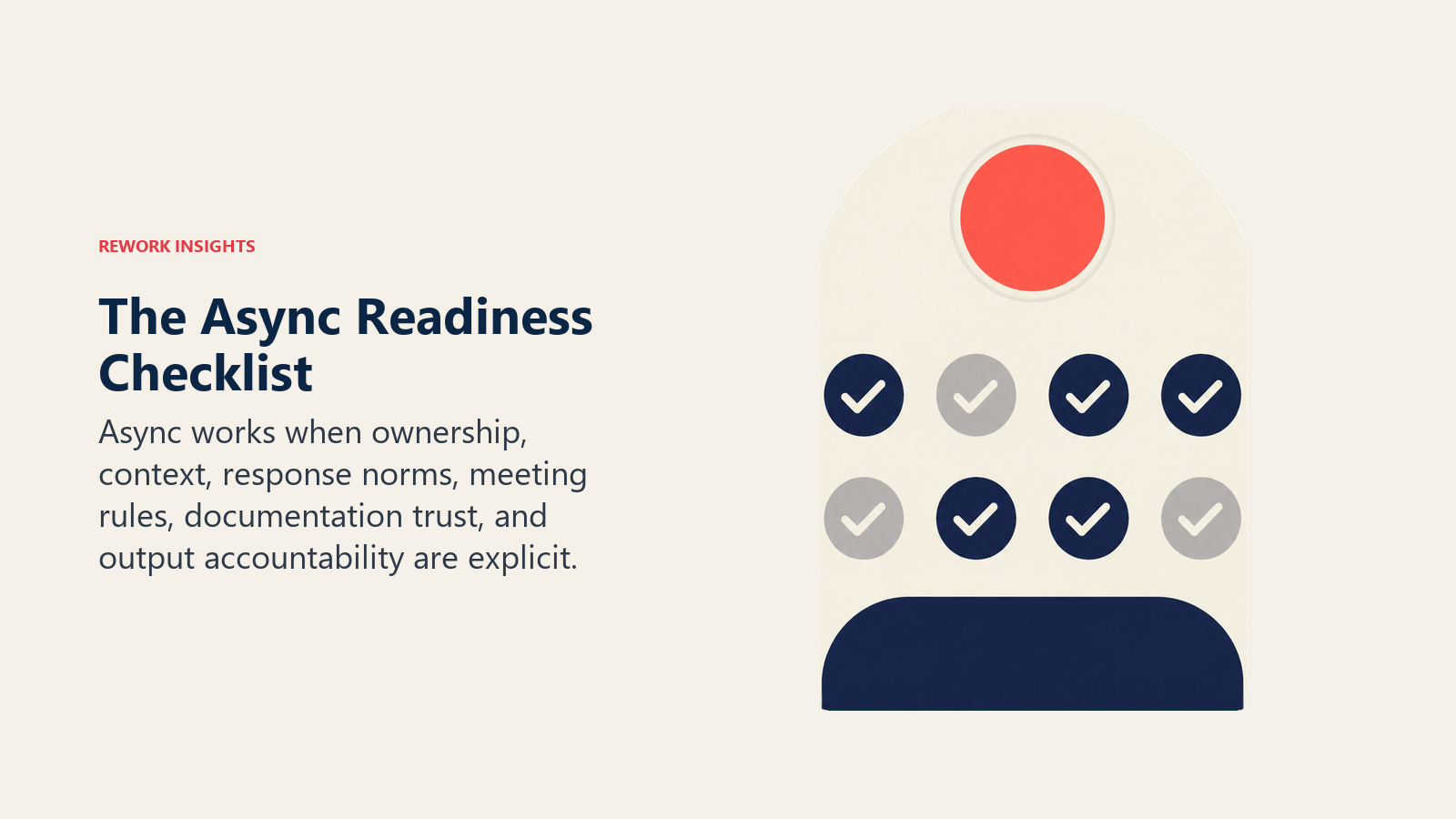
Decision ownership is documented. The 20 most common decisions in your team have a clear owner and a documented escalation path.
Project context is written and findable. Active projects have documents describing current state, decisions made, open questions, and next steps, and those documents are maintained.
Response norms are explicit. People know what "urgent," "routine," and "non-urgent" mean in terms of expected response windows.
Meetings have a clear bar. There's an articulated reason why a meeting was necessary rather than a written update.
Documentation is trusted. When someone writes a decision in a shared document, that decision is actually acted on without verbal confirmation.
New hires can orient from documentation. A new team member can understand a project's context and history by reading, not by scheduling onboarding conversations. The 30-60-90 plan template is a useful structure for making onboarding milestones concrete and tied to written context rather than verbal handoffs.
Performance is assessed on output. Managers are evaluating results rather than responsiveness. People aren't penalized for being away during core hours if their work is done.
There's a "how we make decisions" document. Not a generic values statement. A specific document that explains, with examples, how decisions get made at different levels and in different situations.
If fewer than five of these are true, going async-first will underdeliver. The coordination problems that synchronous meetings solve will still exist. They'll just become slower and murkier rather than noisier.
The One Document Every Async-First Team Needs
Most async-first guides recommend good tooling, meeting audits, and documentation standards. All of that is right. But there's one document that matters more than any of them: the "how we make decisions" operating guide.
This document answers the questions that, in a synchronous culture, get answered in real time through hierarchy and social pressure. A team operating agreement serves a related function: it's the written record of how the team works, not just how it decides, and it creates a shared reference point that makes implicit norms explicit. What decisions does each person own? What level of decision requires written sign-off from multiple stakeholders? When is a decision reversible and when isn't it? What's the escalation path when someone disagrees with a decision that's already been made?
In a synchronous culture, these answers exist informally in the heads of senior leaders, transmitted through decades of context and proximity. In an async-first culture, they need to be written down and shared, because the informal transmission mechanisms that make synchronous cultures function don't exist when people aren't in the same physical space having the same casual conversations.
The organizations that transition to async-first successfully almost always have a version of this document. It doesn't need to be long. It needs to be specific, honest about grey areas, and actually consulted when decisions are being made.
Without it, async-first defaults back to "remote team that uses Slack a lot." Which is what most remote companies already are.
Related:
