More in
Productivity Insights
Decision-Making Velocity as a Competitive Moat
Feb 23, 2026
Why Your Best People Are Quietly Leaving Meeting-Heavy Teams
Feb 18, 2026
Deep Work Isn't a Productivity Hack — It's a Business Strategy
Feb 10, 2026 · Currently reading
Async-First Isn't the Same as Remote-First. Here's Why It Matters
Feb 6, 2026
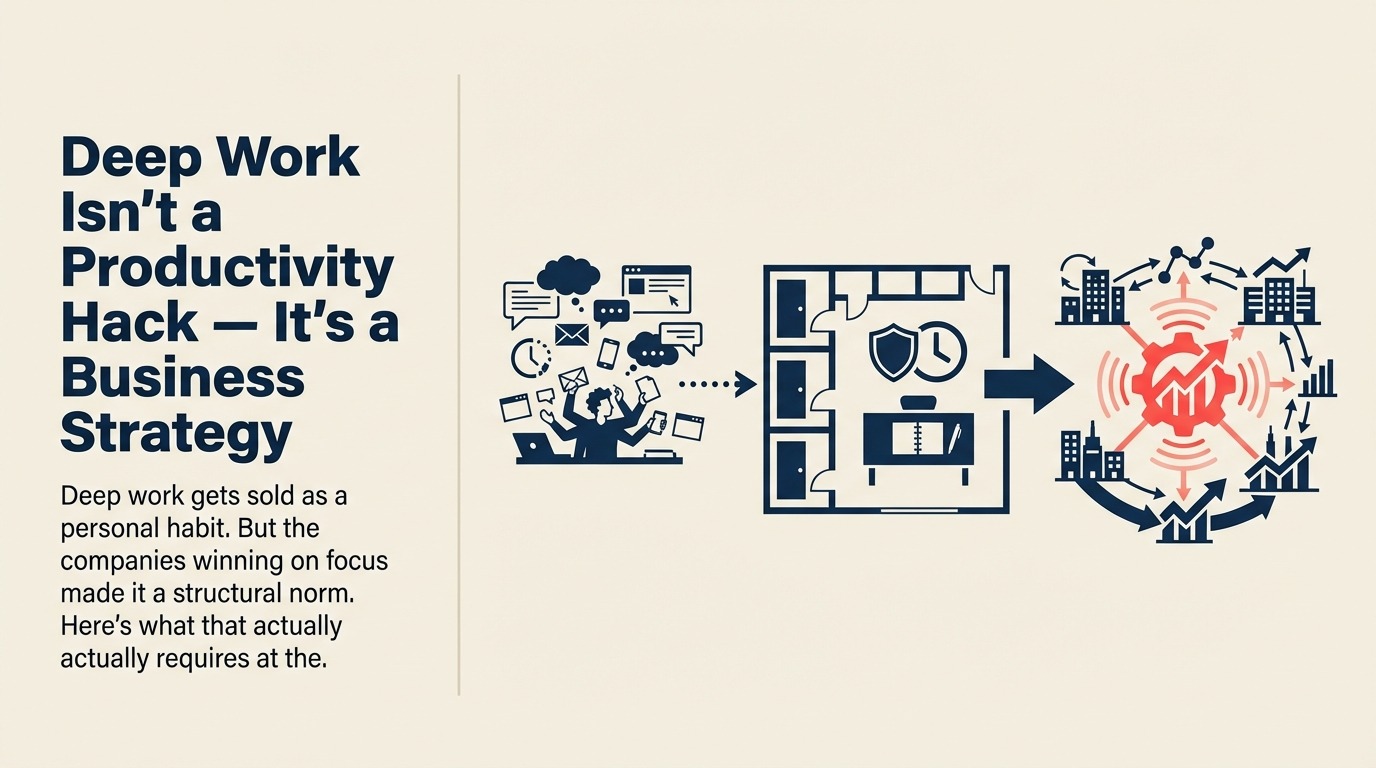
Deep Work Isn't a Productivity Hack. It's a Business Strategy
Turn this article into takeaways for your work.


Each assistant summarizes the article only for you and suggests best practices for your work.
There's a version of the deep work conversation that stops at the individual. Block your calendar, wear noise-canceling headphones, put your phone in a drawer. Those are useful habits. But they're individual solutions to an organizational problem, and they fail the moment a senior leader schedules a recurring Tuesday afternoon sync that wipes out the one protected block your best engineer had. Cal Newport's foundational argument in Harvard Business Review is that organizations, not just individuals, need to create the conditions for focused work.
The companies that have made focused work a genuine competitive advantage didn't get there through personal productivity systems. They got there by treating deep work as an architectural question: how do we design a company where sustained focus is the default, not the exception you have to fight for?
That's a fundamentally different problem. And most companies never ask it.
Where Individual Deep Work Advice Breaks Down
The personal deep work framework works well when your environment supports it. But consider what "environment" actually means for a knowledge worker in a mid-size company. It means: a Slack workspace where every notification is a potential demand on your attention. A calendar that's open to anyone with a meeting link. A culture where responsiveness is proxied for engagement. A management layer that measures visibility because output is hard to quantify.
In that environment, individual habit change runs headlong into organizational incentives that reward the opposite behavior. The person who blocks three hours for focused work gets marked "away" on Slack while colleagues assume they're unavailable. The engineer who turns off notifications gets a reputation for being slow to respond. The product manager who declines a meeting to protect deep work time gets uninvited from the next decision.
Individual productivity tactics without organizational design backing them up aren't just insufficient. They can actively disadvantage the people trying hardest to do good work.
How Distraction Compounds at the Team Level
Here's a calculation most managers never make. An interrupted engineer doesn't just lose their own 90 minutes. They also shift the team's coordination cost. Research by Gloria Mark at UC Irvine, covered in this Harvard Business Review piece on interruptions, found that workers take an average of 23 minutes to return to a task after an interruption, making every meeting more expensive than its listed duration.
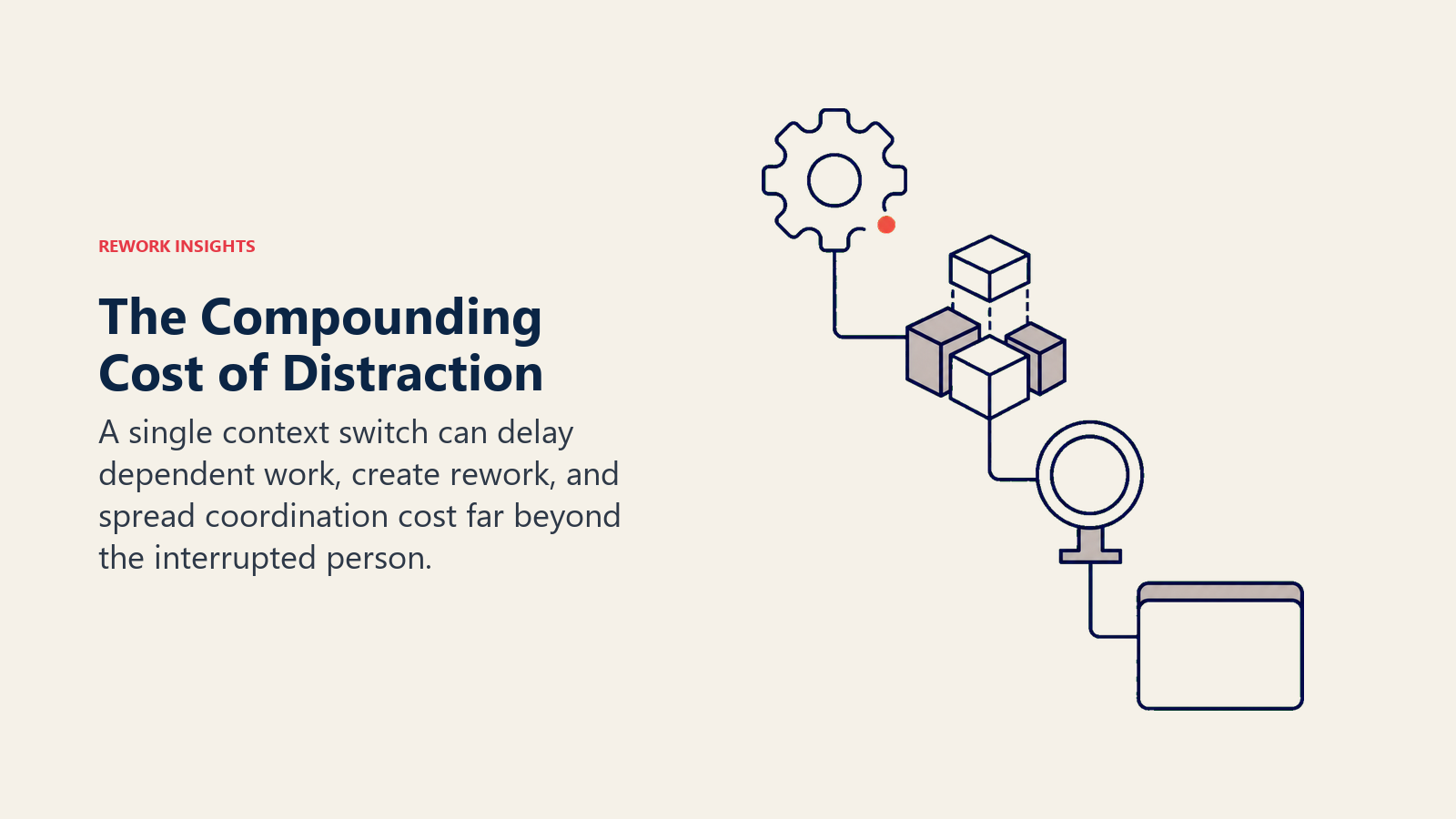
When a senior developer loses focus mid-task and gets pulled into a meeting, two things happen. First, the task doesn't get done on schedule, which means another team member waiting on that output also stops, or starts down a parallel path that may need to be undone. Second, the meeting that caused the interruption was likely triggered by missing context that a well-documented codebase or project brief would have surfaced without human intervention.
Each interruption has a blast radius. The senior engineer's context switch creates a downstream wait for the QA lead, which creates a delay in the product manager's sprint review, which pushes back the demo by a day. None of that shows up in anyone's individual productivity metric. It shows up in shipping speed, in rework cycles, in the calendar fragmentation that makes projects take twice as long as they should.
This compounding effect is why deep work as a personal habit makes limited impact at scale. One person protecting their focus blocks in a team of twelve creates friction; they're out of sync with the interrupt-driven rhythm everyone else is operating in. But when the whole team shifts to an async-first default, the compounding runs in the opposite direction. Work moves faster because context travels in writing, decisions happen without requiring real-time assembly, and focus blocks are mutually respected rather than individually defended.
The unit of deep work that matters isn't the individual. It's the team's operating rhythm.
What Deep-Work-First Organizations Actually Do Differently
Companies that have made deep work structural don't look dramatically different from the outside. They use the same tools: Notion, ClickUp, Slack, Zoom. But the way they use them is different in ways that accumulate into a significantly different work experience.
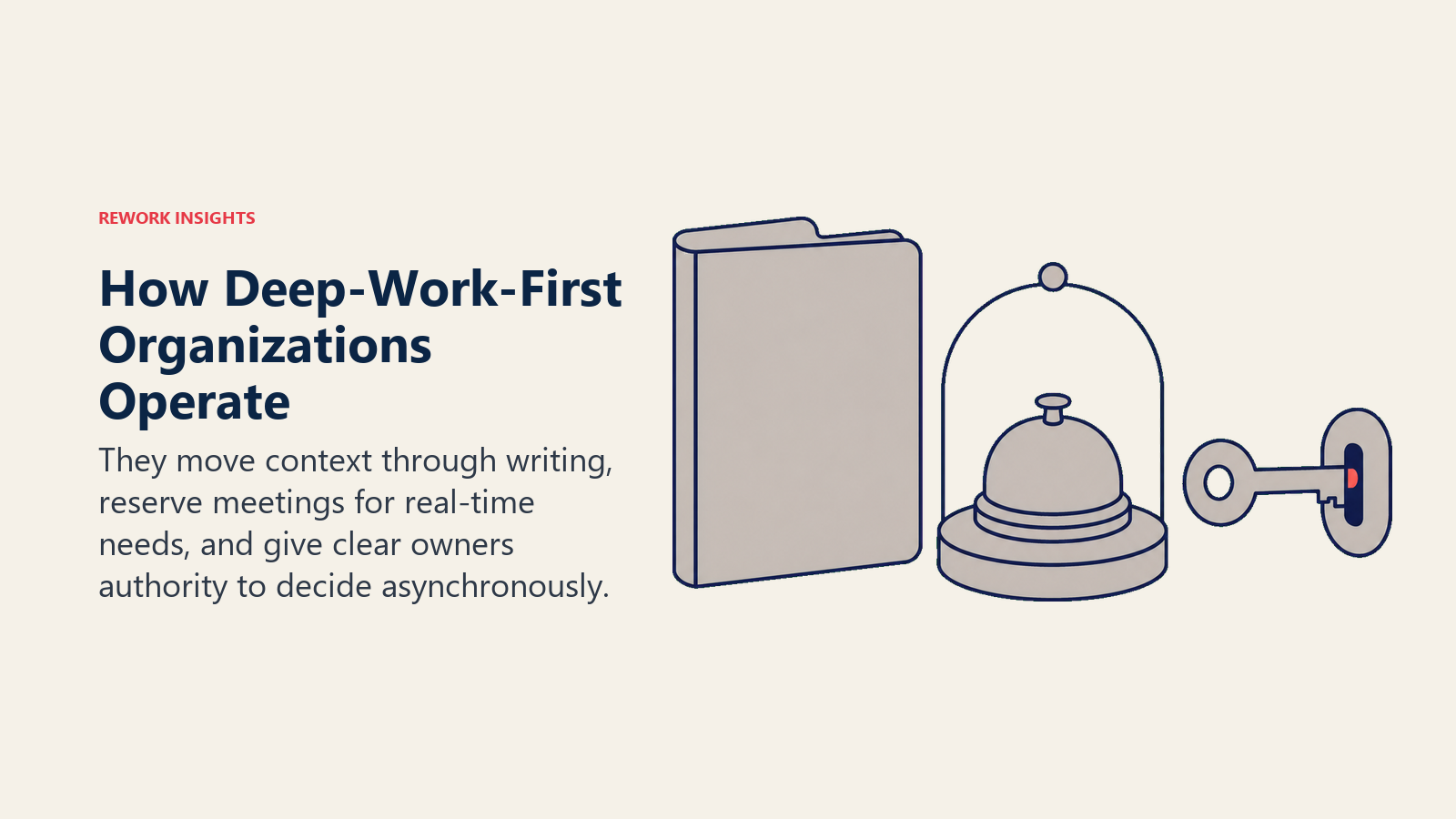
Written-first defaults. In a shallow-work-default organization, the primary medium for complex decisions is conversation, verbal, video, or real-time chat. Context lives in people's heads and gets transmitted through synchronous interaction. In a deep-work-first organization, the primary medium is the document. Decisions get written up before they get discussed. Project briefs capture what's already been considered so meetings don't have to. Status travels in async updates so it doesn't require assembly.
This isn't about creating bureaucratic paper trails. It's about building context that can travel without its author. When the PM writes up a product decision in enough detail that the engineer can act on it without a kick-off call, both people get time back. When a project context doc is thorough enough to answer the questions a new team member would ask, onboarding costs drop and knowledge stops evaporating every time someone leaves.
Meetings as the last-resort option. In most companies, meetings are the default response to coordination needs. Something's unclear, schedule a meeting. Decision needs to be made, schedule a meeting. Update needed, schedule a meeting. In a deep-work-first org, meetings are what you do when async has failed or the stakes require real-time interaction. The default is: can this be resolved in writing first?
This shift isn't about being anti-social or avoiding collaboration. It's about recognizing that most meetings are solving for coordination problems that could have been prevented by better documentation. When you fix the documentation, you don't need as many meetings, which means you get back the focus hours that were previously consumed by meetings that existed because documentation was poor.
Decision architecture that doesn't require real-time assembly. Most organizations require synchronous input to make decisions because decision authority is ambiguous. Who owns this? Does the VP need to sign off? Should we run it by the other team? When nobody is sure, the path of least resistance is to gather everyone in a room and decide together. That's a meeting, which is an interruption, which is a focus tax.
Deep-work-first organizations have invested in decision clarity: who owns what, at what scope, with what escalation path. When ownership is clear and documented, decisions can be made asynchronously by the owner, with written input from relevant stakeholders, without requiring real-time assembly. See Why Your Best People Are Quietly Leaving Meeting-Heavy Teams for what happens when organizations don't invest in that clarity.
The Productivity Tools Trap
Here's the thing nobody says in the vendor demo: adding a project management tool without changing meeting culture doesn't reduce coordination overhead. It adds another notification source. The Monday.com vs. Asana AI architecture comparison is a useful data point here. The platforms that reduce coordination costs are the ones teams use as the actual decision surface, not a checklist layer beneath the real work.
When a company adopts Monday.com or Asana or ClickUp into a synchronous-default culture, what typically happens is: tasks get logged in the tool, then people get pulled into meetings to discuss the tasks in the tool, then Slack messages get sent asking about the tasks in the tool, then the same conversations happen three times across three media instead of once. The tool becomes a record-keeping layer on top of an unchanged operating culture.
The contrast is with organizations that use project management tools as the primary decision-making medium. Where "this task is done" means it's documented in the tool with context, blockers, and next steps, not just checked off. Where tool updates replace the weekly status meeting because the tool carries sufficient context to make the meeting unnecessary. Where the tool is genuinely trusted as the source of truth rather than treated as a shadow of whatever's "really" happening in someone's inbox.
The tool can't create that culture. But it can encode and reinforce a culture that's already been designed for it. The organizations using these tools most effectively invested in the culture first, and the tools became the infrastructure for that culture.
The Organizational Deep Work Audit
Here's a framework for diagnosing whether your organization enables or destroys focused work. Five structural questions, honest answers:
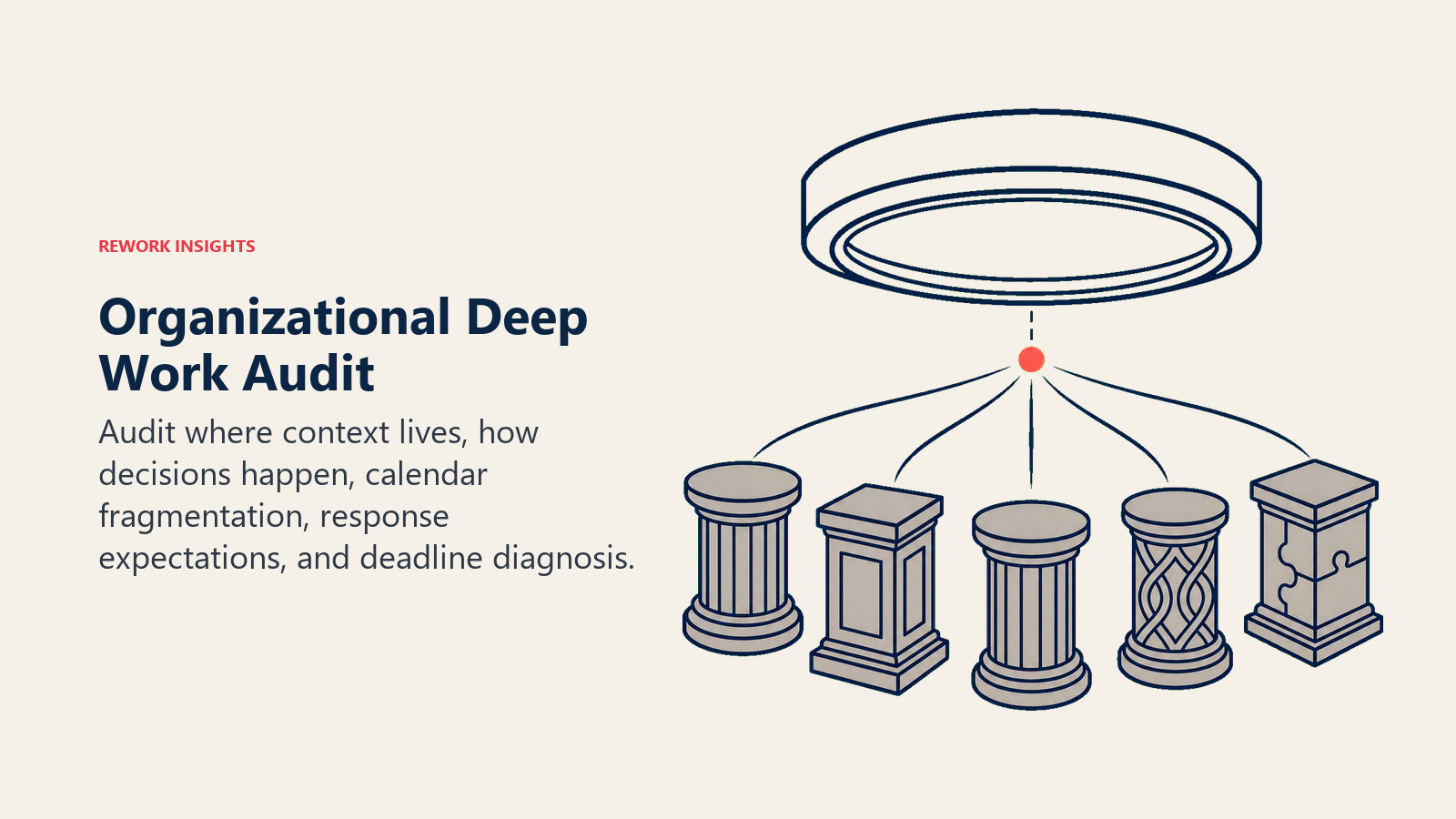
1. Where does project context live? If the answer is "in the project lead's head" or "spread across Slack threads and email chains," your organization relies on synchronous intervention to transmit context. Every knowledge transfer requires a meeting or a chat. Deep work requires that people can get context without asking.
2. How do decisions get made on a typical project? If the dominant pattern is "we schedule a meeting," your decision architecture depends on real-time assembly. Count how many decisions per week in your team require a synchronous interaction that could have been resolved in writing.
3. What does a senior IC's calendar look like on a typical Tuesday? If there are more than three one-hour blocks of uninterrupted time, you might be okay. If there aren't, the calendar is telling you something about what the organization actually values versus what it says it values.
4. What happens when someone doesn't respond to a Slack message for four hours? If the answer is "someone calls them" or "someone escalates," your culture has a responsiveness expectation that makes sustained focus feel risky. People protect focus by being responsive in real-time, which means they never go deep.
5. When a team misses a deadline, what's the primary diagnosis? If the answer is usually about individual effort or skill, you're missing the structural causes. If teams consistently struggle with focus and coordination, the cause is usually the operating model, not the people.
Score yourself honestly. Three or more unsatisfying answers and you have a structural problem, not a personal productivity problem.
Three Changes a COO Can Make in 30 Days
These don't require a culture overhaul. They're structural changes that create the conditions for deep work without requiring everyone to simultaneously change their behavior.
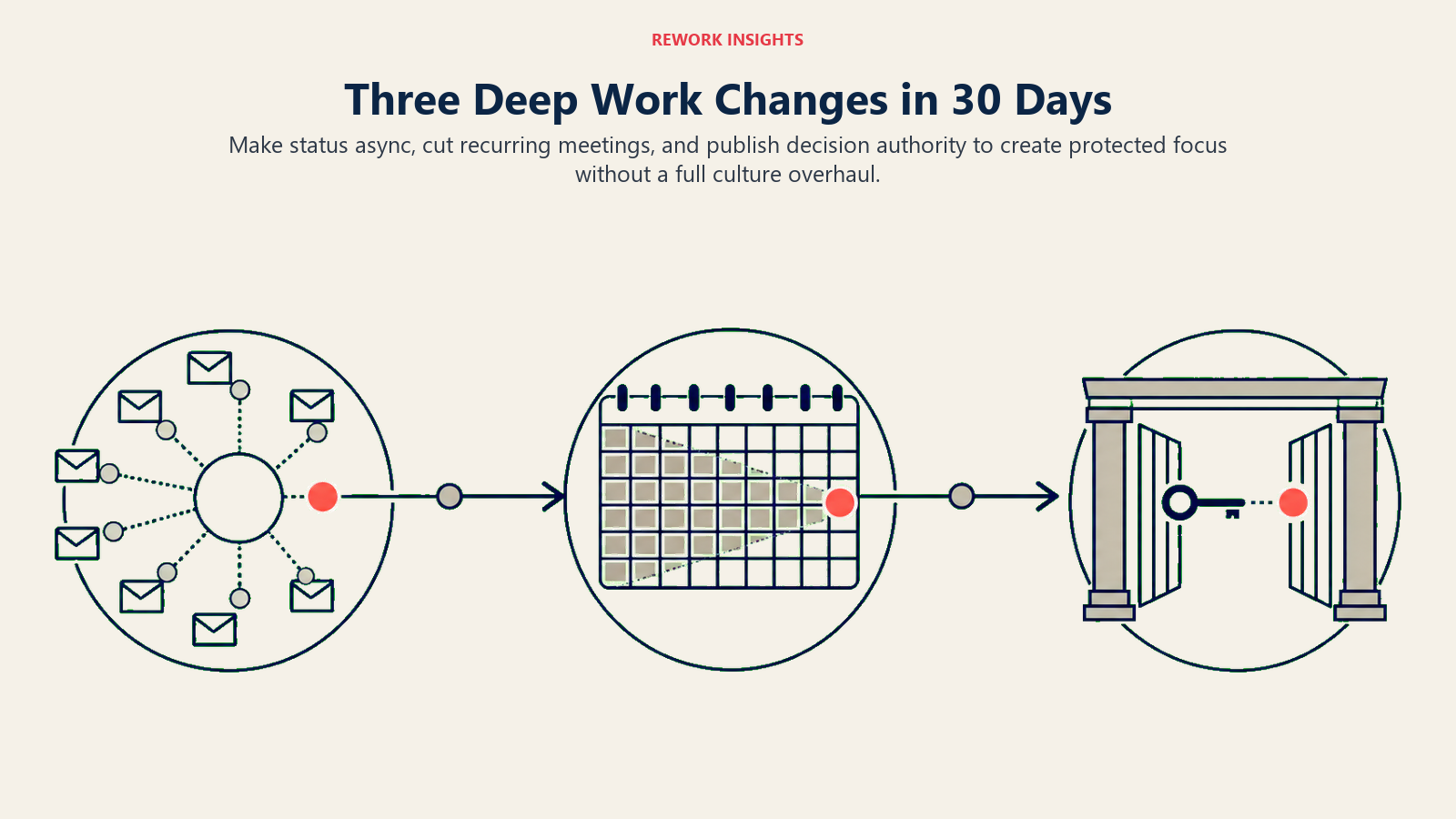
Change 1: Establish an async-first status norm. Announce that project updates, weekly statuses, and non-urgent decisions will happen in writing by default, and that not being immediately available on Slack is expected and respected. This single signal changes what responsiveness means in the organization, which is the prerequisite for everything else.
Change 2: Audit and cut recurring meetings by 30%. Take every meeting that's on the shared calendar. For each one, ask: does this require synchronous presence, or is it a habit? Recurring syncs, status reviews, and "check-ins" are prime candidates. Convert the ones you can to async formats. You'll almost certainly find that 30% is achievable without losing any real coordination. The meeting audit guide walks through a three-step decision matrix for doing this systematically across your team.
Change 3: Create and share a decision authority doc. List the 20 most common decisions your leadership team handles. Write one clear line for each: who owns this, who gets consulted, at what scope can the owner decide without escalation. Distribute it. Refer to it. This eliminates the ambiguity that spawns the majority of unplanned coordination calls.
None of these changes are dramatic. But they address the three structural conditions, context transmission, meeting defaults, and decision clarity, that determine whether your organization's operating model enables or destroys focused work.
The connection between this and the async-first operating model is direct: async-first is what deep-work-first looks like at the team level. You can't have one without investing in the other.
Why This Compounds
The reason to treat deep work as a business strategy rather than a personal habit is the compounding dynamic. An organization where focused work is structurally possible ships faster, retains more of its best people, and builds more complex things, because complex things require sustained attention that interrupt-driven cultures can't support. A McKinsey Global Institute report on knowledge worker productivity estimated that knowledge workers spend 28% of their week managing email alone, a figure that excludes meetings entirely and illustrates how structurally marginal deep work has become in most organizations.
The companies that figured this out early didn't do it by recruiting deep thinkers and hoping the culture would follow. They designed the culture first and found that good people stayed longer, output quality rose, and the work got harder and more interesting over time because the organization could actually support it.
That's the moat. Not a better tool stack. Not a better meeting cadence. An operating model where your best people can do their best work on a random Tuesday afternoon without fighting for it.
That's worth designing for.
Additional reading:
