Bahasa Indonesia
Haruskah AE Tetap Terlibat Hingga Renewal, atau Tidak? Kerangka Keputusan
Turn this article into takeaways for your work.


Each assistant summarizes the article only for you and suggests best practices for your work.
Perdebatan ini muncul di setiap sesi offsite ketika pemimpin Sales dan CS akhirnya berada di ruangan yang sama. VP Sales berargumen bahwa hubungan AE adalah aset paling berharga perusahaan, meninggalkan akun pada momen tekanan komersial maksimum menghancurkan kepercayaan dan membuat CS terekspos. VP CS berargumen bahwa keterlibatan AE saat renewal mengaburkan akuntabilitas dan membuat CSM tidak memiliki otoritas nyata untuk menolak cakupan atau penetapan harga.
Keduanya benar. Dan keduanya menggambarkan situasi yang berbeda.
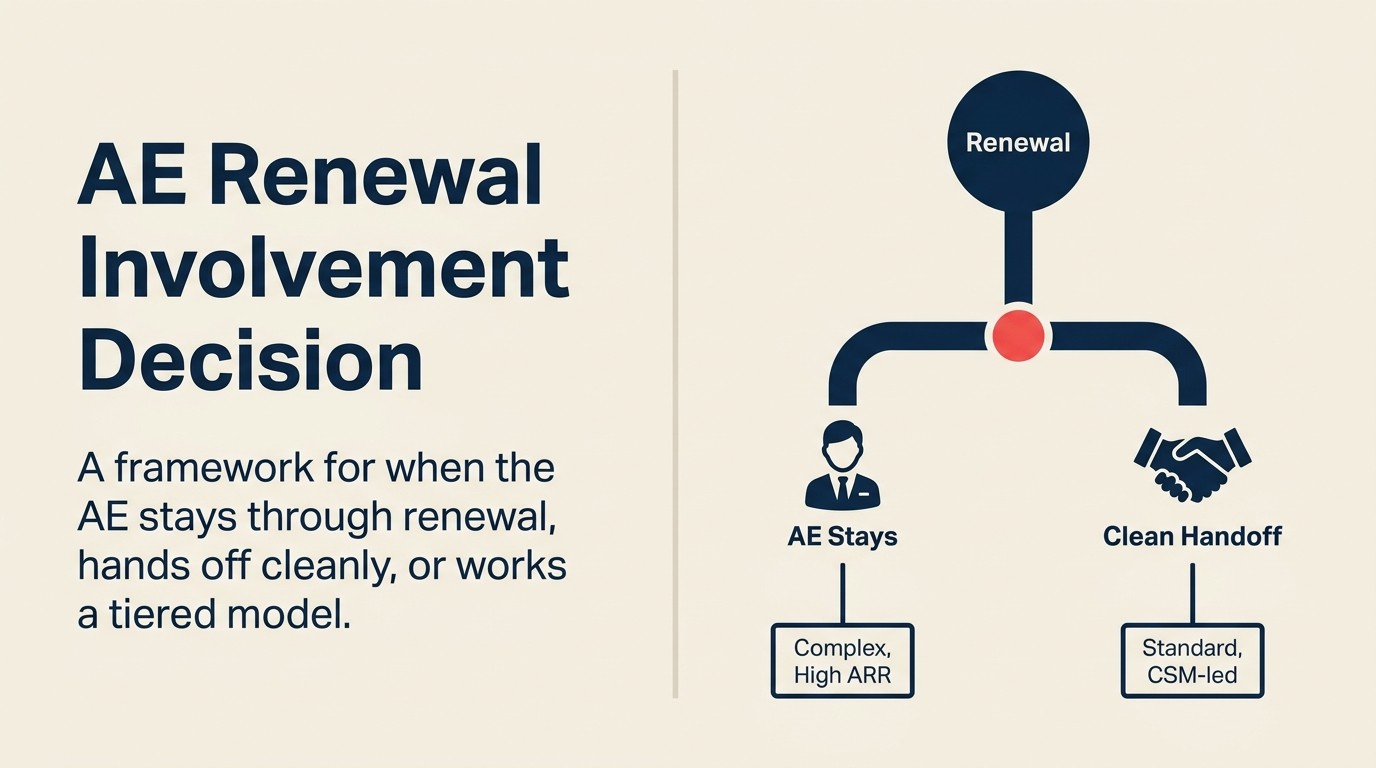
Kesalahan adalah memperlakukan ini sebagai pertanyaan kebijakan universal dengan jawaban yang benar. Ini bukan. Apakah AE tetap terlibat hingga renewal bergantung pada tier ARR, jenis sales motion, kompleksitas produk, desain kompensasi, dan kematangan tim CS. Salah satu variabel tersebut dan model menciptakan masalah yang diperingatkan masing-masing pihak.
Artikel ini memberikan kerangka kerja untuk membuat keputusan yang tepat untuk konteks Anda, bukan jawaban yang menyeluruh, tetapi keputusan dengan kriteria yang jelas.
Empat Model dalam Praktik: Keputusan Retensi 4 Model
Analisis Rework: Keputusan Retensi 4 Model (Handoff Bersih / AE Mempertahankan Komersial / Jembatan Account Manager / Berlapis berdasarkan ARR) bukanlah pilihan desain organisasi sekali jalan. Ini adalah keputusan kalibrasi yang berkelanjutan, didorong oleh lima variabel: tier ARR akun, jenis sales motion, keluasan produk, desain kompensasi, dan kematangan tim CS. Sebagian besar organisasi yang kesulitan dengan keputusan ini telah mencampuradukkan pertanyaan struktural (siapa yang memiliki akun?) dengan pertanyaan kompensasi (siapa yang diberi insentif untuk memperjuangkan renewal?). Menjawab pertanyaan struktural dengan benar sambil membiarkan kompensasi tidak berubah menghasilkan perangkap hybrid: AE yang secara nominal dipertahankan tetapi tidak benar-benar hadir ketika Pipeline memanas, dan CSM yang melepaskan otoritas komersial tetapi tidak punya insentif untuk menggunakannya.
Sebelum sampai pada kriteria keputusan, ada baiknya menamai model-model tersebut dengan jelas. Kebanyakan organisasi berakhir di suatu tempat dalam ruang ini, tetapi yang berakhir di sana secara sengaja daripada default mendapatkan hasil yang lebih baik.
| Model | Siapa yang Memiliki Renewal | Siapa yang Memiliki Adopsi | Paling Cocok |
|---|---|---|---|
| A: Handoff Bersih | CSM (atau AM) memiliki segalanya | CSM | Volume tinggi, transaksional, SMB |
| B: AE Mempertahankan Komersial | AE (komersial); CSM (hubungan) | CSM | Kompleks, multi-pemangku kepentingan, enterprise |
| C: Jembatan Account Manager | AM (khusus) | CSM | Mid-market dengan tim komersial pasca-penjualan khusus |
| D: Berlapis berdasarkan ARR | Handoff bersih di bawah ambang batas; AE dipertahankan di atas | CSM untuk keduanya | Mixed-motion, mid-market hingga enterprise |
Fakta Utama: Keterlibatan AE dalam Renewal
- Perusahaan yang menggunakan pendekatan berlapis, handoff bersih untuk SMB, AE dipertahankan untuk enterprise, melihat tingkat renewal enterprise 17% lebih tinggi dibandingkan perusahaan yang menerapkan satu model untuk seluruh perusahaan, menurut benchmark Gainsight 2024.
- Ketika AE tidak dikompensasi pada metrik retensi, keterlibatan renewal mereka tidak memberikan peningkatan statistik yang signifikan pada hasil renewal, dan meningkatkan biaya koordinasi internal sebesar sekitar 20-30% (SiriusDecisions, 2023).
- Otoritas CSM terkikis dalam organisasi di mana AE mempertahankan kepemilikan komersial saat renewal: CSM dalam organisasi ini 2,4x lebih mungkin menunda percakapan cakupan yang sulit kepada AE daripada menanganinya secara langsung, menurut riset Totango.
Model A: Handoff Bersih. AE menutup deal, memiliki periode transisi (30-60 hari), lalu keluar. CSM memiliki segalanya pasca-close: onboarding, adopsi, kesehatan, percakapan renewal, dan identifikasi ekspansi. Ini adalah model yang paling bersih secara operasional. Berhasil ketika renewal relatif transaksional, ketika CS memiliki pelatihan komersial, dan ketika produk tidak memerlukan negosiasi multi-pemangku kepentingan saat renewal. Proses handoff closed-won ke onboarded yang terstruktur dengan baik adalah prasyarat operasional agar model ini berhasil.
Yang dibutuhkan: tim CSM yang dapat melakukan percakapan komersial dan dikompensasi pada hasil renewal. CSM yang belum pernah diminta untuk memiliki renewal dan tidak mendapat komisi tidak bisa membawa model ini.
Model B: AE Mempertahankan Kepemilikan Komersial. CS memiliki hubungan sehari-hari, kesehatan, onboarding, dan adopsi. AE tetap terlibat dalam percakapan komersial, penetapan harga renewal, percakapan ekspansi, ketentuan multi-tahun, pemeliharaan hubungan eksekutif. Ini berhasil ketika deal kompleks, ketika hubungan executive sponsor dibangun selama proses penjualan dan benar-benar sulit ditransfer, dan ketika motion ekspansi membutuhkan keahlian AE.
Yang dibutuhkan: pembagian kerja yang jelas, kompensasi eksplisit untuk AE pada hasil renewal/ekspansi, dan jalur eskalasi yang ditentukan sehingga CS dan AE tidak berakhir dalam perselisihan wilayah ketika percakapan komersial muncul secara tak terduga.
Model C: Jembatan Account Manager. AM khusus mengambil kepemilikan komersial pasca-close. AE berpindah ke bisnis baru. CSM memiliki kesehatan dan adopsi. AM memiliki komersial: renewal, ekspansi, eskalasi komersial. Ini adalah model yang paling bersih untuk perusahaan mid-market dengan skala yang cukup untuk membenarkan fungsi AM khusus, tetapi membutuhkan investasi headcount.
Yang dibutuhkan: headcount AM khusus (bukan hanya mengubah judul CSM), desain kompensasi yang jelas untuk peran AM, dan handoff terstruktur dari AE ke AM yang tidak membuat pelanggan merasa ditinggalkan.
Model D: Berlapis berdasarkan ARR. Handoff bersih di bawah ambang batas ARR yang ditentukan. AE dipertahankan di atasnya. Ini adalah kompromi praktis yang paling umum, ini mengakui bahwa renewal SMB tidak menjamin keterlibatan AE dan renewal enterprise benar-benar mendapat manfaat darinya. Ambang batas biasanya ditetapkan sekitar $50K-$100K ARR, meskipun angka yang tepat bervariasi berdasarkan bisnis.
Yang dibutuhkan: ambang batas yang ditentukan yang disepakati terlebih dahulu (bukan kasus per kasus), struktur kompensasi yang selaras dengan ambang batas (AE tidak dikompensasi pada akun sub-ambang di mana mereka tidak terlibat), dan proses untuk akun yang melewati ambang batas di tengah kontrak.
Argumen untuk AE Tetap Terlibat
Argumen untuk keterlibatan AE yang dipertahankan paling kuat dalam empat skenario.
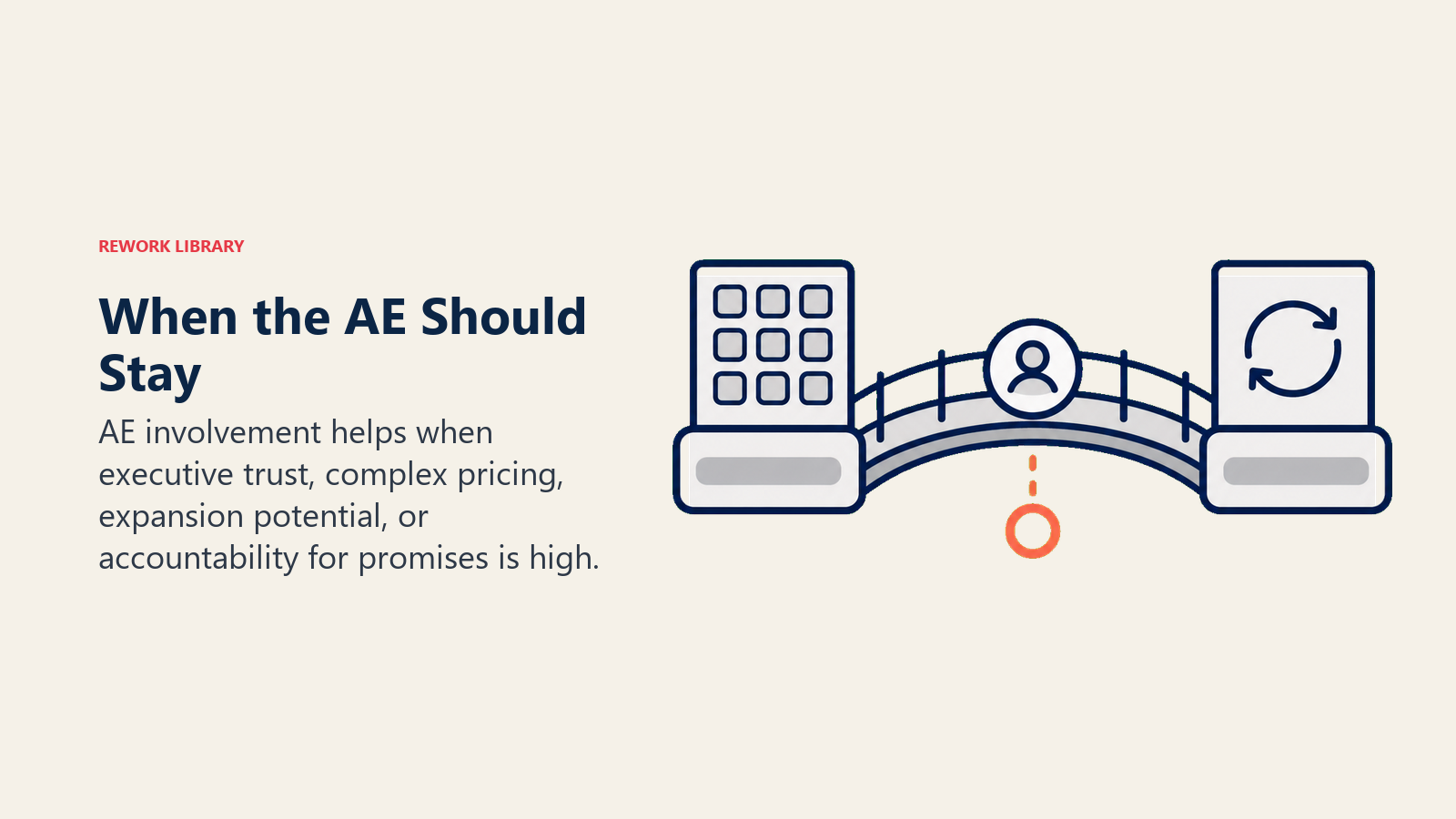
Kontinuitas hubungan eksekutif. Pada akun enterprise, champion yang membeli produk mempercayai AE secara pribadi. CSM yang datang pasca-close adalah orang asing bagi eksekutif itu. Mentransfer hubungan pada momen tekanan komersial maksimum, renewal, adalah waktu yang paling buruk. AE telah membangun konteks dan kepercayaan. Pergi menghancurkan keduanya.
Kompleksitas komersial. Kontrak multi-tahun dengan struktur penetapan harga yang kompleks, konfigurasi multi-produk, dan persetujuan multi-pemangku kepentingan melampaui kemampuan sebagian besar CSM. AE yang menjalankan deal mengetahui pengungkit penetapan harga, konteks kompetitif, dan politik internal di sisi pelanggan. Keahlian itu sulit ditransfer dalam panggilan handoff.
Peluang ekspansi. AE mengetahui lintasan pertumbuhan akun, headcount baru, use case baru, siklus anggaran baru yang akan datang, lebih baik dari siapa pun saat renewal. Jika AE tidak lagi terlibat, sinyal ekspansi harus berpindah dari pelanggan ke CSM ke AE sebelum tindakan komersial apa pun dapat terjadi. Latensi itu memakan biaya ARR ekspansi. Model kepemilikan ekspansi dan motion upsell menunjukkan cara menentukan siapa yang mencari dan siapa yang menutup, apa pun model renewal yang Anda gunakan.
Akuntabilitas atas apa yang dijanjikan. Jika AE menjual berlebihan, menjanjikan fitur yang belum dibangun, mengimplikasikan tingkat dukungan yang tidak bisa diberikan CS, merepresentasikan integrasi yang tidak bekerja seperti yang dijelaskan, mereka harus hadir saat renewal. Riset HBR tentang mempertahankan pelanggan yang tepat membingkai hal ini dengan baik: biaya pelanggan yang churn bukan hanya ARR yang hilang, tetapi juga perilaku penjualan di hulu yang dimungkinkannya ketika tidak ada loop akuntabilitas. Ketidakhadiran mereka melindungi mereka dari akuntabilitas sambil membiarkan CS menyerap kekecewaan pelanggan. Ini adalah "argumen akuntabilitas" yang sering dibuat tim VP CS secara terbalik: keterlibatan AE saat renewal menciptakan visibilitas atas konsekuensi penjualan berlebihan, yang mengubah perilaku AE pada titik penjualan.
Argumen untuk Handoff Bersih
Argumen untuk menghapus AE pasca-close sama kuatnya dalam skenario yang berbeda.
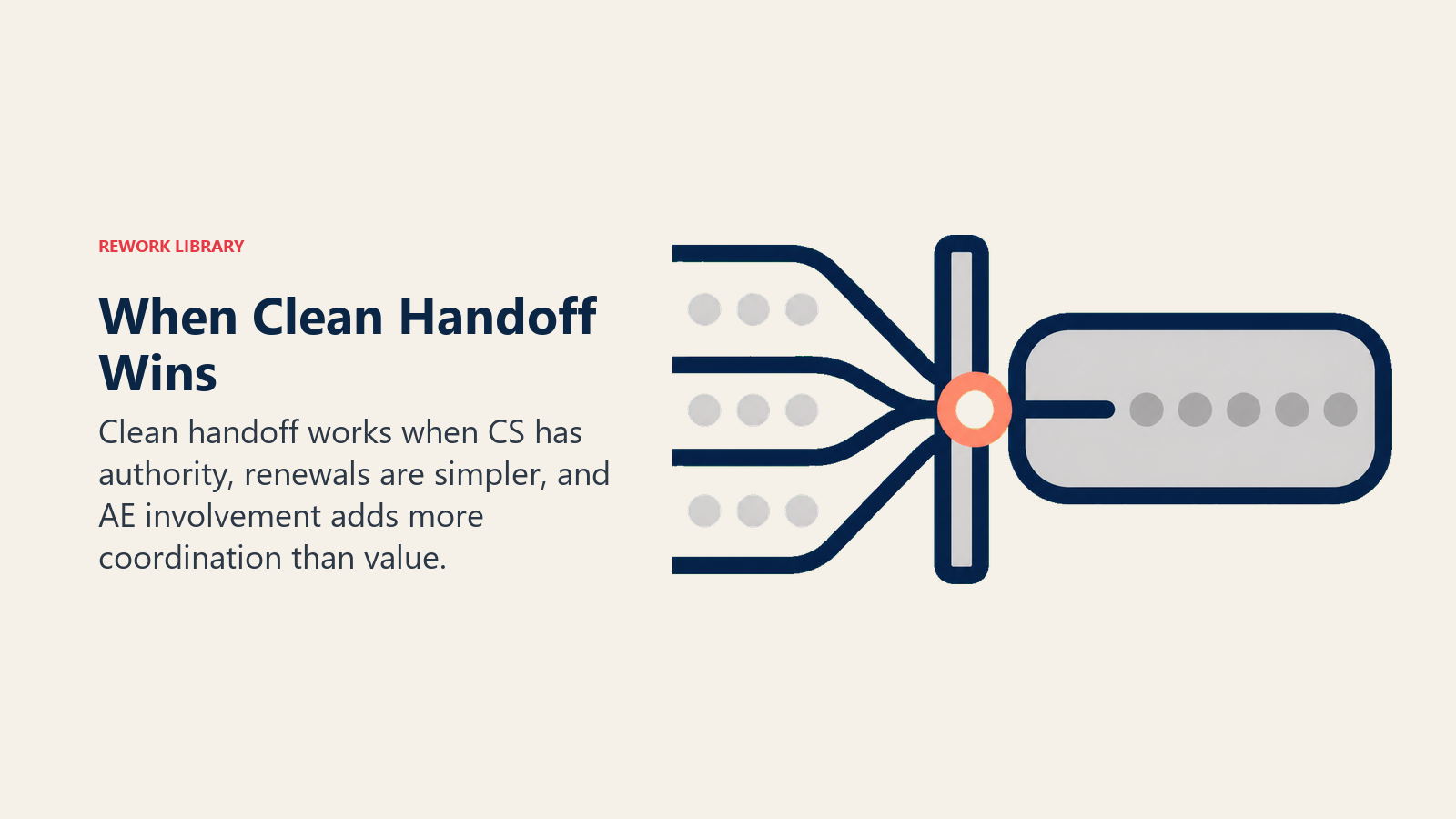
Otoritas CSM. Ketika AE mengontrol hasil komersial saat renewal, CSM tidak memiliki otoritas nyata. Jika pelanggan mengeluh tentang cakupan, CSM eskalasi ke AE. Jika pelanggan ingin pengurangan harga, CSM menunda. CSM menjadi manajer hubungan tanpa akuntabilitas aktual untuk hasil komersial, yang menciptakan masalah budaya spesifik: CSM yang tidak pernah mengembangkan kepercayaan diri komersial karena AE selalu menjadi safety net.
Ketidakselarasan insentif AE. AE yang dikompensasi terutama pada akuisisi logo baru jarang memprioritaskan perhatian renewal pada tingkat yang sama seperti menutup bisnis baru. Psikologinya berbeda: pekerjaan renewal bersifat reaktif dan intensif hubungan, sementara pekerjaan logo baru bersifat proaktif dan berbasis Pipeline. Ketika perhatian AE ditarik kembali ke Pipeline logo baru, model "AE dipertahankan" terdegradasi menjadi "AE secara nominal dipertahankan tetapi tidak benar-benar hadir."
Skala dalam motions kecepatan tinggi. AE dalam motion SMB volume tinggi mungkin memiliki 300-500 akun dalam buku mereka jika retensi adalah tanggung jawab mereka. Itu bukan angka yang dapat dikelola bersama Pipeline logo baru yang aktif. Handoff bersih pada skala SMB bukan preferensi kebijakan, ini adalah kebutuhan operasional. Spektrum alignment dari SMB hingga enterprise memetakan bagaimana model handoff harus bergeser seiring Anda naik ke segmen yang lebih besar.
Kebingungan pelanggan. Ketika AE dan CSM keduanya memiliki hubungan aktif di akun yang sama dan insentif mereka tidak sepenuhnya selaras, pelanggan memperhatikannya. Mereka mendapat jawaban berbeda untuk pertanyaan yang sama. Mereka mendapat panggilan dari kedua tim dalam minggu yang sama tentang topik yang berbeda. Ketidakselarasan internal menjadi masalah pengalaman pelanggan.
Variabel Keputusan yang Menentukan Model yang Tepat
Lima variabel yang harus mendorong pilihan:
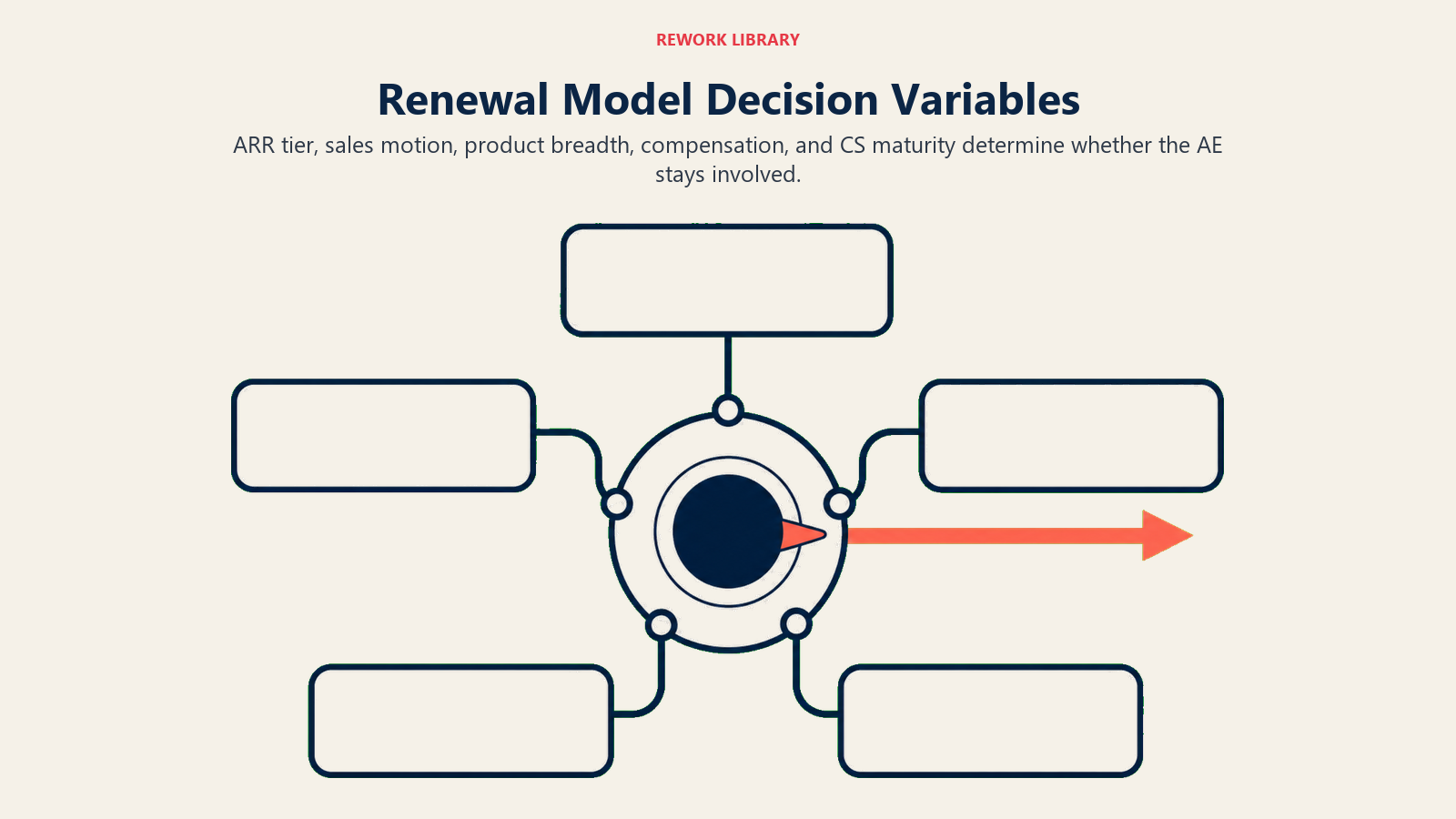
1. Tier ARR akun. Di bawah $50K ARR (sebagai titik awal kasar, kalibrasi terhadap ekonomi unit Anda), ekonomi keterlibatan AE saat renewal tidak membenarkan biaya koordinasi. Di atas $100K ARR, risiko ketiadaan AE saat renewal, ekspansi yang hilang, hubungan eksekutif yang rusak, sinyal kompetitif yang terlewat, cukup besar untuk membenarkan keterlibatan yang dipertahankan. Tetapkan ambang batas Anda berdasarkan distribusi ARR dan biaya satu jam AE vs. dampak renewal yang diharapkan.
2. Jenis sales motion. Sales motion transaksional dan velocity (siklus singkat, ACV lebih rendah, produk terstandarisasi) memetakan ke handoff bersih. Kompleksitas deal yang membenarkan kehadiran AE saat renewal tidak ada di sana. Sales motion kompleks dan konsultatif (siklus panjang, ACV tinggi, multi-produk, multi-pemangku kepentingan) memetakan ke retensi AE atau model jembatan AM. Hubungan dan konteks yang dibangun selama proses penjualan benar-benar sulit ditransfer.
3. Keluasan produk. Produk single-product, single-user-type dapat diperbarui oleh tim CS dengan pelatihan komersial. Produk multi-product, multi-user-type dengan potensi ekspansi yang signifikan mendapat manfaat dari keterlibatan AE, percakapan ekspansi membutuhkan pengetahuan produk dan otoritas komersial yang tidak dimiliki sebagian besar CSM.
4. Desain kompensasi. Ini adalah variabel forcing function, dan dalam praktiknya mengesampingkan yang lain. Jika AE tidak dikompensasi pada hasil renewal atau retensi, keterlibatan mereka adalah niat baik sukarela, tidak akan konsisten, tidak akan berkembang, dan akan menghilang di bawah tekanan kuota. Sebelum mengumumkan model apa pun, rancang struktur kompensasi terlebih dahulu. AE dipertahankan? Mereka membutuhkan kuota renewal atau bonus retensi yang terkait dengan akun yang mereka tanggung jawabi. Handoff bersih? CSM membutuhkan insentif renewal, atau model handoff tidak memiliki kekuatan. Lihat komisi sales atas retensi untuk opsi desain kompensasi yang spesifik.
5. Kematangan tim CS. Tim CS dengan pelatihan komersial, pengalaman menutup renewal, dan kompensasi terkait retensi dapat menjalankan renewal secara bersih. Tim CS yang masih terutama reaktif, mengeskalasi dukungan, menjalankan QBR, tetapi tidak memiliki percakapan komersial, tidak bisa membawa model handoff bersih tanpa dukungan. Jujurlah tentang di mana tim CS Anda sebenarnya berada, bukan di mana Anda ingin mereka berada dalam 18 bulan.
Kompensasi sebagai Forcing Function
Model apa pun yang Anda pilih, struktur kompensasi harus mendahului pengumuman. Ini tidak bisa ditambahkan belakangan.
Jika AE tetap terlibat (Model B atau Model D berlapis):
- AE harus memiliki kuota renewal atau metrik retensi yang terkait dengan akun mereka
- Ekspansi di atas ambang batas harus membawa komisi untuk AE
- Clawback churn pada deal yang close dan churn dalam periode yang ditentukan (biasanya 6-12 bulan) menyelaraskan insentif AE dengan siklus hidup pendapatan penuh
- Tanpa kompensasi retensi apa pun, kehadiran AE saat renewal hanyalah pertunjukan, mereka muncul ketika nyaman dan menghilang ketika Pipeline logo baru memanas
Jika handoff bersih (Model A atau tier SMB dari Model D):
- CSM harus memiliki kuota renewal atau bonus retensi yang terkait dengan buku mereka
- Identifikasi ekspansi CSM harus membawa bonus referral atau setara komisi, bahkan jika mereka menyerahkan close ke Sales
- Tanpa kompensasi renewal untuk CSM, model handoff bersih menghasilkan CSM yang bagus dalam onboarding dan pemantauan kesehatan tetapi tidak berjuang untuk renewal
Konflik struktural yang harus dihindari: AE memiliki hasil komersial saat renewal tetapi tidak memiliki kompensasi yang terkait dengannya. CSM memiliki hubungan tetapi tidak memiliki otoritas untuk membuat keputusan komersial. Ini menciptakan pemisahan "CSM memiliki hubungan, AE memiliki angka", perangkap hybrid yang paling umum, dan yang paling mungkin muncul sebagai perselisihan akuntabilitas di setiap renewal tunggal.
Perangkap Hybrid: Anti-Pattern yang Harus Dihindari
"AE tetap terlibat tetapi tidak memiliki peran formal." Ini menghasilkan ambiguitas abadi tentang siapa yang memiliki renewal. CSM menunggu AE untuk terlibat. AE mengasumsikan CS yang menanganinya. Pelanggan tidak mendengar dari siapa pun sampai seseorang panik 30 hari sebelum renewal. Tentukan peran sebelum mengumumkan model, atau jangan gunakan model ini.
"CSM memiliki hubungan tetapi AE memiliki angka." Ini menciptakan konflik struktural di setiap QBR. CSM telah membangun hubungan dan merupakan kontak utama pelanggan. Tetapi AE bertanggung jawab atas hasil renewal. Ketika masalah komersial muncul, CSM dan AE memiliki kepentingan yang berbeda, dan pelanggan terjebak di tengahnya. Jika AE memiliki hasil komersial, mereka perlu hadir secara aktif dalam hubungan, bukan hanya sebagai penutup saat renewal. Ketika konflik ini meningkat, sering kali itu adalah salah satu dari delapan tanda peringatan misalignment Sales-CS yang muncul jauh sebelum mencapai dewan direksi.
Keterlibatan informal tanpa handoff yang ditentukan. Dalam organisasi kecil ini sering berhasil karena semua orang saling mengenal dan komunikasi konstan. Ini berhenti berhasil begitu salah satu tim berganti. Rep yang bergabung enam bulan lalu tidak mengetahui protokol informal. CSM baru tidak tahu AE mana yang berharap untuk tetap terlibat. Setiap akun menjadi negosiasi. Tentukan handoff sekali, dokumentasikan, latih.
Kutipan: Ketika AE tidak dikompensasi pada metrik retensi, keterlibatan mereka dalam renewal tidak memberikan peningkatan yang signifikan secara statistik pada hasil renewal, tetapi meningkatkan biaya koordinasi internal sebesar sekitar 20-30%. Kehadiran AE tanpa insentif AE adalah pertunjukan, bukan akuntabilitas (SiriusDecisions, 2023).
Kutipan: CSM dalam organisasi di mana AE mempertahankan kepemilikan komersial saat renewal 2,4x lebih mungkin menunda percakapan cakupan yang sulit kepada AE daripada menanganinya secara langsung. Pola itu mengikis kepercayaan diri komersial CS di seluruh tim dari waktu ke waktu (riset Totango, 2024).
Kutipan: Perusahaan yang menggunakan model renewal berlapis (handoff bersih untuk akun SMB, AE dipertahankan untuk akun enterprise di atas ambang batas ARR yang ditentukan) melihat tingkat renewal enterprise 17% lebih tinggi daripada perusahaan yang menerapkan satu model di semua tier akun (Gainsight, 2024).
Panduan Implementasi
Sebelum memilih model, jawab tiga pertanyaan:
- Apa ambang batas ARR kami di mana handoff bersih adalah default yang tepat?
- Apakah desain kompensasi kami mendukung model ini, atau apakah kami perlu mengubah kompensasi terlebih dahulu?
- Apakah tim CS kami cukup matang untuk memiliki percakapan komersial untuk akun yang kami serahkan?
Pilot sebelum meluncurkan. Kerangka "Retain or Grow" dari Bain menawarkan lensa eksternal yang berguna di sini: perusahaan yang menyegmentasi model CS mereka berdasarkan jenis akun mengungguli perusahaan yang menjalankan satu model di semua tier pelanggan. Pilih kelompok 20-30 akun yang mewakili distribusi Anda (campuran tier ARR, jenis sales motion, masa kerja tim CS). Jalankan satu model dengan kelompok tersebut selama satu siklus renewal. Ukur tingkat renewal, tingkat ekspansi, dan waktu koordinasi AE/CSM. Bandingkan dengan kelompok baseline yang menjalankan model lama. Gunakan data tersebut untuk kalibrasi sebelum meluncurkan ke seluruh perusahaan. Melacak hasil renewal per model memerlukan perkiraan NRR bersama yang mengatribusikan hasil ke pemilik komersial yang tepat. Jika tidak, data pilot tidak dapat diinterpretasikan.
Komunikasikan model kepada pelanggan. Ketika Anda mengubah model, atau ketika Anda menerapkan model formal untuk pertama kalinya, beri tahu pelanggan siapa titik kontak mereka. Pelanggan yang dijual oleh AE dan berharap untuk menegosiasikan renewal dengan AE tidak harus menemukan handoff bersih di panggilan renewal. Beri tahu mereka secara proaktif: "Ke depan, hubungan utama Anda akan bersama [nama CSM], yang memiliki akun Anda termasuk renewal. [nama AE] tetap tersedia untuk eskalasi eksekutif."
Apa yang diharapkan ketika Anda mengubah model. Jika Anda berpindah dari AE dipertahankan ke handoff bersih, harapkan 60-90 hari turbulensi. Beberapa akun akan menolak kehilangan hubungan AE. Beberapa CSM akan merasa kurang siap untuk percakapan komersial yang belum pernah mereka jalankan sebelumnya. Siapkan struktur dukungan: pelatihan percakapan komersial untuk CSM, jalur eskalasi eksplisit kembali ke AE selama 30 hari pertama transisi, dan tinjauan bersama mingguan atas renewal yang sedang berjalan untuk menangkap masalah lebih awal.
Pertanyaan yang Sering Diajukan tentang Haruskah AE Tetap Terlibat Hingga Renewal, atau Tidak? Kerangka Keputusan
Apa saja empat model dalam Keputusan Retensi 4 Model?
Keempat modelnya adalah: Model A (Handoff Bersih), di mana CSM memiliki segalanya pasca-close termasuk renewal dan paling cocok untuk SMB volume tinggi; Model B (AE Mempertahankan Komersial), di mana AE menangani penetapan harga, ekspansi, dan hubungan eksekutif sementara CSM menangani adopsi dan operasional sehari-hari, paling cocok untuk enterprise yang kompleks; Model C (Jembatan Account Manager), di mana AM khusus mengambil kepemilikan komersial pasca-close sementara AE berpindah ke bisnis baru dan CSM memiliki kesehatan akun, paling cocok untuk mid-market dengan headcount yang memadai; dan Model D (Berlapis berdasarkan ARR), dengan handoff bersih di bawah ambang batas yang ditentukan dan AE dipertahankan di atasnya, kompromi praktis yang paling umum bagi organisasi mixed-motion.
Model renewal mana yang tepat untuk akun SMB vs. enterprise?
Model A (Handoff Bersih) biasanya tepat untuk akun SMB di mana renewal bersifat transaksional, produknya single-use, dan keterlibatan AE memakan biaya koordinasi lebih besar daripada yang dipulihkan dalam tingkat renewal. Model B (AE Mempertahankan Komersial) atau Model D (Berlapis) biasanya tepat untuk akun enterprise di mana hubungan eksekutif yang dibangun selama proses penjualan sulit ditransfer, kompleksitas produk melibatkan negosiasi multi-pemangku kepentingan, dan potensi ekspansi cukup tinggi untuk membenarkan keterlibatan AE. Ambang batas utamanya biasanya $50K-$100K ARR. Di bawah ini, ekonomi keterlibatan AE saat renewal tidak membenarkan biaya koordinasi.
Apa yang terjadi jika AE meninggalkan perusahaan? Siapa yang menangani renewal saat itu?
Ini adalah salah satu argumen terkuat untuk mendokumentasikan paket konteks deal (use case, janji yang dibuat, skor kesesuaian ICP, konteks kompetitif, peta pemangku kepentingan) di CRM saat close, bukan di kepala AE. Ketika AE keluar, CSM atau AE pengganti harus bisa melanjutkan dengan catatan akun yang terisi lengkap. Organisasi yang memformalkan transfer ini dengan paket konteks deal yang terdokumentasi melihat tingkat keberhasilan renewal hanya-CSM 23% lebih tinggi daripada yang mengandalkan briefing lisan informal (Gainsight, 2024). Proses handoff adalah polis asuransi untuk pergantian AE.
Struktur kompensasi apa yang mendukung setiap model renewal?
Model A (Handoff Bersih) membutuhkan kuota renewal CSM atau bonus retensi yang terkait dengan buku mereka, ditambah kredit referral ekspansi. Tanpa kompensasi renewal untuk CSM, handoff bersih menghasilkan CSM yang bagus dalam onboarding tetapi tidak berjuang untuk renewal. Model B (AE Mempertahankan Komersial) membutuhkan kuota renewal AE atau metrik retensi yang terkait dengan akun mereka, komisi ekspansi di atas ambang batas yang ditentukan, dan clawback churn pada deal yang close dan churn dalam 6-12 bulan. Tanpa kompensasi retensi apa pun, kehadiran AE saat renewal bersifat sukarela dan menghilang di bawah tekanan kuota. Model D (Berlapis) menerapkan kompensasi Model A di bawah ambang batas dan kompensasi Model B di atasnya.
Apa saja anti-pattern yang harus dihindari saat menerapkan Keputusan Retensi 4 Model?
Tiga anti-pattern paling sering muncul. Pertama: "AE tetap terlibat tetapi tidak memiliki peran formal," yang menghasilkan ambiguitas abadi tentang siapa yang memiliki renewal, dengan CSM menunggu AE dan AE mengasumsikan CS yang menangani, sampai seseorang panik 30 hari sebelum renewal. Kedua: "CSM memiliki hubungan tetapi AE memiliki angka," di mana konflik struktural muncul di setiap QBR karena orang yang memiliki hubungan tidak bisa membuat keputusan komersial dan orang yang memiliki hasil komersial tidak hadir dalam hubungan. Ketiga: keterlibatan informal tanpa handoff yang ditentukan, yang berhasil di organisasi kecil ketika semua orang saling mengenal tetapi langsung berhenti berhasil ketika salah satu tim berganti.
Pelajari Lebih Lanjut

Principal Solution Architect