More in
Team Onboarding Guide
How to Run Sales Shadowing That Actually Develops Reps
Apr 18, 2026
Buddy Systems That Actually Last: A Sales Onboarding Guide
Apr 18, 2026
First-Deal Coaching: How to Guide New Reps Without Doing It for Them
Apr 18, 2026
Product Knowledge Onboarding: How Much Is Enough Before a Rep Sells?
Apr 18, 2026
Onboarding Remote Hires Into an Office-Heavy Team Without Leaving Them Behind
Apr 18, 2026
When Should New Reps Start Prospecting? A Manager's Decision Framework
Apr 18, 2026
Sales Certification Programs: Which Ones Are Worth It and How to Build Your Own
Apr 18, 2026
How to Measure Time-to-Productivity in Sales Onboarding Without Fooling Yourself
Apr 18, 2026
Onboarding a Hiring Wave: How to Scale Without Dropping Quality
Apr 18, 2026
Offboarding Sales Reps: How to Capture Knowledge Before It Walks Out the Door
Apr 18, 2026
The 30-60-90 Plan Template That Actually Gets Used
Turn this article into takeaways for your work.


Each assistant summarizes the article only for you and suggests best practices for your work.
Two reps started the same week at a mid-market SaaS company. Same quota, same territory, same manager. One had a 30-60-90 plan with three defined milestones and a shared definition of "on track." The other got a calendar packed with onboarding calls and a Notion doc of things to read by week four. At day 90, the first rep had closed two deals and held a 4x pipeline multiple. The second was still inconsistently logging activities and hadn't had a structured coaching conversation.
The difference wasn't talent. It was structure.
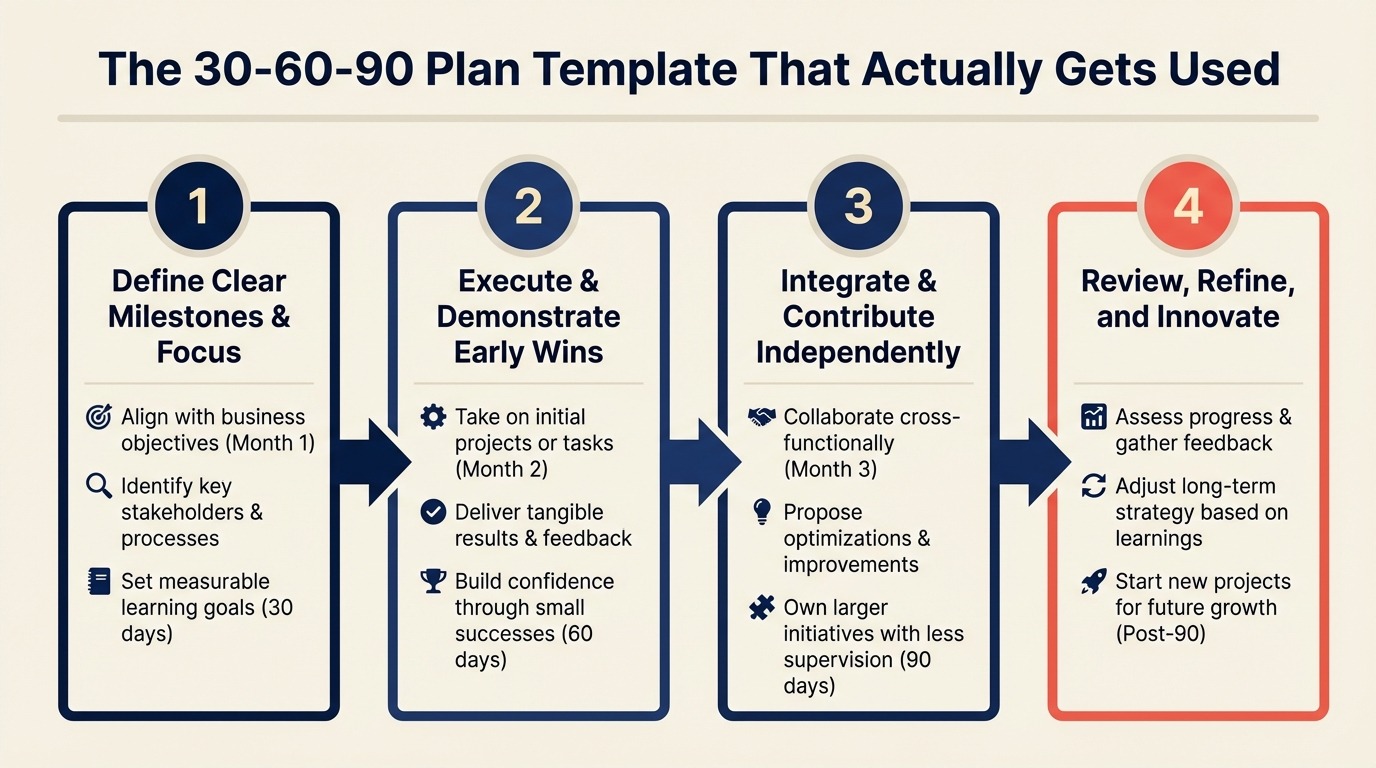
A 30-60-90 plan works when it answers one question for both the manager and the rep: what does "on track" look like right now? Not at quarter-end. Right now, at day 30. This guide gives you a template that answers that question with specific milestones, and a review cadence that keeps the plan a coaching tool rather than a verdict.
Step 1: Define Outcomes for Each Phase, Not Activities
The reason most 30-60-90 plans get ignored is that they're full of things to do (attend product demo, shadow three calls, read the sales playbook) with no definition of what success looks like afterward. Managers stop referencing them because there's nothing to check against. Research from the Bridge Group consistently shows that teams with structured ramp milestones outperform those using activity-only onboarding plans.
According to SHRM's onboarding research, organizations with a structured onboarding process improve new hire retention by 82% and productivity by over 70%. Replace activities with outcomes for each phase:
Days 1-30: Learn and Listen
- Outcome: Can describe the product and ICP without notes
- Outcome: Has completed first 5 discovery call shadows and submitted a written debrief for each
- Outcome: CRM profile is fully configured; all assigned accounts have been reviewed
- Outcome: Has had a 1:1 introduction with every internal stakeholder they'll work with
Days 31-60: Do with Coaching
- Outcome: Has conducted 5 live discovery calls (manager co-pilots or reviews recording within 24 hours)
- Outcome: Has 2x pipeline coverage against their prorated quota target
- Outcome: Can complete a full deal qualification against your framework without prompting
- Outcome: CRM activity logging is at 90% completeness on all open opportunities
Days 61-90: Do Independently
- Outcome: Has 3x pipeline coverage; at least one deal in late-stage
- Outcome: Is running discovery, demo, and proposal stages without co-pilot
- Outcome: Has hit at least 50% of prorated quota or is on a trajectory to close within 2 weeks of day 90
- Outcome: Has submitted a self-assessment on what they need to be fully ramped
This structure gives the rep a clear target at each checkpoint and gives the manager something concrete to coach against. Gallup's research on employee engagement finds that clarity of expectations is among the top two drivers of engagement for new employees in their first 90 days. If you need a companion framework for evaluating deal quality alongside ramp progress, the qualification frameworks guide covers MEDDIC, BANT, and GPCT side by side.
Step 2: The Milestone Metrics Table
Outcomes need numbers attached to them. Here's a template table you can adapt to your specific motion. Adjust the numbers based on your current team's median ramp data, not your top performer.
| Metric | Day 30 Target | Day 60 Target | Day 90 Target |
|---|---|---|---|
| Discovery calls booked | 5 (shadowed) | 10 (independent) | 20 (independent) |
| Pipeline coverage vs. prorated quota | N/A | 2x | 3x |
| CRM activity log completion | 90% | 95% | 95% |
| Deals in qualification stage | 0 (learning) | 3 | 5+ |
| Quota attainment | N/A | 0% (building) | 50-75% |
| Call recording review | 100% of shadowed calls | 100% of own calls | Weekly self-review |
Two things to get right here: First, don't set day-30 quota expectations unless your sales cycle is genuinely under 30 days. Most managers over-index on day-90 quota and ignore the leading indicators that predict whether you'll get there. Second, fill in this table with the rep during week one, not before day one. The numbers you set before meeting the rep will be wrong for an experienced enterprise hire. Korn Ferry's talent research puts the total cost of a failed sales hire at 150-200% of annual salary, a figure that makes the investment in precise milestone-setting look small by comparison.
Step 3: Adapt for Different Starting Points
The same template applies to all new sales hires, but the numbers shift based on where the rep is starting from.
Experienced hire (5+ years in similar role): Compress the learning phase. Day-30 outcomes can include independent discovery calls by week two. Pipeline expectations at day 60 should be 3x rather than 2x. Their gap is usually process and product, not skills.
First sales job: Double the shadowing requirement in days 1-30. Add explicit skill-building outcomes: "Can articulate three customer objections and a response to each without notes." Pipeline expectations at day 60 should stay at 2x, but track talk-time and call booking rate as leading indicators.
Inside vs. field sales: Inside reps should hit discovery call volume faster; field reps need territory warm-up time built into the plan. Adjust the pipeline coverage targets to reflect your average sales cycle length.
SMB vs. enterprise motion: Enterprise reps won't have pipeline to show at day 60 in a 6-month cycle. Replace pipeline coverage with "stakeholder map completed for 5 target accounts" and "champion identified in 2 active opportunities" as day-60 milestones.
Step 4: What the Rep Gets on Day One vs. After Week One
Don't hand the rep a complete 30-60-90 plan on their first morning. There's a better sequence:
Day one: Give them the framework and the day-30 outcomes only. Tell them the day-60 and day-90 targets will be refined after they've had their first week. This does two things: it signals that the plan is a conversation, not a decree, and it prevents the rep from anchoring on metrics that might not reflect their actual situation.
End of week one: Sit down together and fill in the full table. Ask the rep where they think they're starting from on each competency. The reps who give you an honest self-assessment in week one, something like "I've never sold to this ICP before, I'll need more shadow time," are telling you what the plan actually needs to account for.
After week one: Both manager and rep sign off on the milestones. This isn't a formality. When a rep has agreed to specific numbers, the day-30 conversation isn't a surprise.
Step 5: The Weekly Check-In Format
The 30-60-90 plan only works if you look at it every week. A weekly check-in against the plan takes 20 minutes and should replace whatever generic 1:1 format you're currently using for new reps.
Weekly check-in agenda:
- What's one win from this week? (5 min) Start here every time. New reps need to know their progress is visible.
- Where are we against this week's milestones? (8 min) Pull up the plan. Go through the numbers. Don't narrate the status; ask the rep to narrate it.
- What's one thing that would make next week better? (5 min) This is where the coaching lives. Let the rep identify the constraint before you offer a solution.
- What do you need from me? (2 min) Ask every week. The answers change, and managers who skip this question miss the 10-minute intervention that prevents a 3-week detour.
Keep a shared doc or CRM note for each check-in. You'll need the history at the 30-day review.
Step 6: The 30-Day Review Conversation
The 30-day review is not a performance review. It's a calibration conversation. Keep that framing explicit. Tell the rep at the start of the meeting what it's for.
What to cover:
- Review the day-30 milestones together (look at the data together, not you presenting to them)
- What did they hit? What did they miss?
- For any miss: what got in the way? Was it a skill gap, a resource gap, or a pipeline timing issue?
- What adjustments to day-60 milestones make sense given what you've both learned?
How to adjust without making it feel like a demotion: Frame adjustments as precision, not failure. "We set 2x pipeline coverage at day 60 before you'd done any prospecting calls. Now that we know your cycle length for this segment is 60 days, 1.5x with 5 deals in qualification is more meaningful. Let's update the target."
Reps who feel like the plan is adjusting to reality, not to their failure, stay engaged with it. Reps who feel like they've already failed at day 30 stop believing the plan tells them anything useful.
Step 7: Using the Plan as a Coaching Tool, Not an Evaluation Tool
Harvard Business Review research on what great managers do differently in onboarding emphasizes that a coaching orientation from day one, rather than a performance-management orientation, is the single biggest differentiator in new hire retention through month six. The framing you use when you introduce the plan shapes everything. If you say "here's what you need to hit to stay employed," you get a rep who games the metrics and hides problems. If you say "here's how we'll both know where to focus coaching," you get a rep who surfaces problems before they compound. This framing connects directly to how you set up feedback loops in the first 90 days. The tone of the plan sets the tone of every coaching conversation that follows.
In practice, the difference is this: when a milestone is missed, your first question is "what got in the way?" not "why didn't you hit it?" The first question opens a coaching conversation. The second closes one.
One concrete way to reinforce this: let the rep drive the 30-day review. Send them the milestones the day before and ask them to come prepared to walk you through each one. Managers who use this format consistently report fewer surprises and more candid conversations about what's actually going on.
Common Pitfalls
Plans with no measurable outcomes. "Build relationships with key stakeholders" is not a milestone. "Schedule and complete 1:1 introductions with all 7 internal stakeholders by end of week two" is.
Plans the manager builds alone. If the rep didn't have any input into the targets, they have no ownership of the outcomes. Even if you set all the targets based on your existing team data, walk through each one with the rep and get their agreement before week one ends.
Plans that don't account for pipeline-building time. A 30-day pipeline coverage target makes no sense in a 90-day sales cycle. Map your milestones to your actual cycle length.
Reviewing the plan only when something goes wrong. The plan should come out every week, not just at formal reviews. If the rep only sees it when they're off track, the plan becomes associated with problems rather than progress.
What to Do Next
Complete the day-30 milestones section of this template before your new hire's first day. Leave day-60 and day-90 to fill in together at the end of week one. Book the weekly check-ins on your calendar before they start, not after.
Learn More

On this page
- Step 1: Define Outcomes for Each Phase, Not Activities
- Step 2: The Milestone Metrics Table
- Step 3: Adapt for Different Starting Points
- Step 4: What the Rep Gets on Day One vs. After Week One
- Step 5: The Weekly Check-In Format
- Step 6: The 30-Day Review Conversation
- Step 7: Using the Plan as a Coaching Tool, Not an Evaluation Tool
- Common Pitfalls
- What to Do Next
- Learn More