More in
Team Onboarding Guide
How to Run Sales Shadowing That Actually Develops Reps
Apr 18, 2026
Buddy Systems That Actually Last: A Sales Onboarding Guide
Apr 18, 2026
First-Deal Coaching: How to Guide New Reps Without Doing It for Them
Apr 18, 2026
Product Knowledge Onboarding: How Much Is Enough Before a Rep Sells?
Apr 18, 2026
Onboarding Remote Hires Into an Office-Heavy Team Without Leaving Them Behind
Apr 18, 2026
When Should New Reps Start Prospecting? A Manager's Decision Framework
Apr 18, 2026
Sales Certification Programs: Which Ones Are Worth It and How to Build Your Own
Apr 18, 2026
How to Measure Time-to-Productivity in Sales Onboarding Without Fooling Yourself
Apr 18, 2026
Onboarding a Hiring Wave: How to Scale Without Dropping Quality
Apr 18, 2026
Offboarding Sales Reps: How to Capture Knowledge Before It Walks Out the Door
Apr 18, 2026
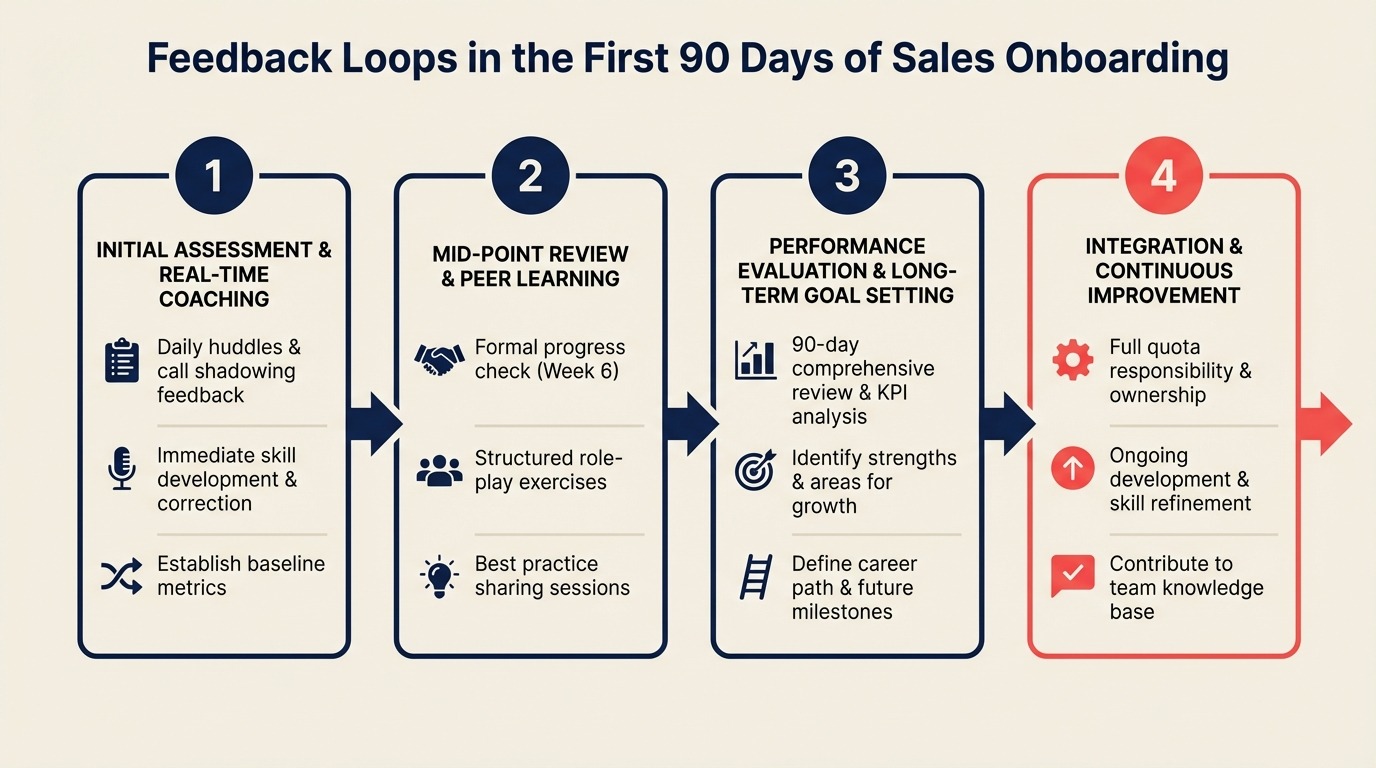
Feedback Loops in the First 90 Days of Sales Onboarding
Turn this article into takeaways for your work.


Each assistant summarizes the article only for you and suggests best practices for your work.
A new rep joined a SaaS sales team and spent her first 14 calls making the same mistake: jumping to the demo slide deck before she'd established the prospect's current pain. On call 15, her manager finally flagged it. She fixed it on call 16. But the previous 14 calls had generated stale opportunities that needed to be re-qualified. In some cases, the prospects had already moved on.
The manager wasn't negligent. He was following a common pattern: informal presence in week one, a formal 30-day review at week four, and not much structured feedback in between. The problem is that skill habits form in weeks one and two. The calls you don't give feedback on in the first two weeks are the calls that define what the rep considers normal. Gong Labs research on sales coaching shows that reps who receive structured call feedback within 24 hours of their first live calls ramp to quota 30% faster than those coached only at formal review intervals.
A structured feedback loop fixes this by spreading feedback across the full 90-day ramp in the right format and frequency: enough to shape habits early, spaced enough to be absorbable. Gallup's research on manager effectiveness shows that employees who receive frequent, meaningful feedback are nearly four times more likely to be engaged at work, a finding that holds even more strongly for employees in their first 90 days.
Step 1: The Feedback Cadence by Week
Feedback frequency and format should change as the rep's ramp progresses. Too much structure in week one is overwhelming; too little structure in weeks five through eight means skills plateau without coaching.
| Phase | Weeks | Frequency | Format |
|---|---|---|---|
| Early ramp | Week 1 | Daily informal (end-of-day check-in) | Verbal; 10 min max; observation only, no evaluation |
| Shadow phase | Weeks 2-4 | Post-call after every shadowed/reviewed call | Written 3-2-1 format; same day or within 24 hours |
| Independence phase | Weeks 5-8 | Weekly structured conversation | 20-min agenda-driven; covers skill, pipeline, process |
| Normalized ramp | Weeks 9-12 | Bi-weekly structured conversation | Same format; reduce frequency as rep normalizes |
The shift from daily informal to post-call structured happens in week two, not week five. That transition is the most important moment in the feedback cadence. The manager's weekly onboarding checklist maps this same progression week by week, which makes a useful companion to keep open alongside this guide. It's when you move from "let me know how you're doing" to "here's specific feedback on what I observed." Reps who don't get structured feedback until week four have four weeks of uncoached behavior to unlearn.
Step 2: The Post-Call Feedback Format: The 3-2-1 Method
The 3-2-1 method is simple enough to use consistently but specific enough to be actionable. Use it for every call you review or co-pilot in the first eight weeks.
The 3-2-1 feedback template:
- 3 things that worked: Be specific. Not "good rapport" but "you asked a follow-up question when the prospect mentioned their previous vendor. That opened the pain conversation." Specific positive feedback shows the rep what to keep doing on purpose rather than by accident.
- 2 things to adjust: Same specificity. Not "be more structured" but "you moved to pricing in minute 22 before we'd confirmed budget authority. Next time, confirm the decision process before the commercial conversation." Frame adjustments as technique changes, not character assessments.
- 1 specific thing to try on the next call: This is the action item. "On your next call, when the prospect says 'we're happy with our current vendor,' try asking 'what would need to be different for you to want to look at alternatives?' instead of moving to the product pitch." The rep should be able to execute this on the next call without any additional preparation.
Write the 3-2-1 down and share it. Don't just deliver it verbally. Verbal feedback in the moment is useful, but reps can't reference it when they're preparing for their next call. A written note they can review before call prep is worth three times as much. Harvard Business Review's research on feedback effectiveness distinguishes between feedback that identifies errors and feedback that reinforces specific effective behaviors: the latter produces significantly faster skill improvement, which is exactly what the 3-2-1 format is designed to deliver.
Step 3: The Call Review Process
How you review calls determines how useful the feedback is. A 10-minute review where you fast-forward to the parts you want to comment on produces worse feedback than a structured listen with a specific focus.
What to listen for:
- Discovery question quality: Are questions open-ended? Do they probe for impact, not just symptoms?
- Agenda control: Does the rep set an agenda at the start? Do they recover when the prospect goes off-script?
- Qualification criteria: Are the MEDDIC/SPICED elements being surfaced, or is the rep giving a product tour?
- Objection handling: Does the rep acknowledge, ask a clarifying question, and respond? Or do they apologize and move on?
- Close attempt: Does the rep ask for a next step with a specific date, or does the call end with "I'll send you some information"?
Using Gong or Chorus: Both tools let you create call playlists and add timestamped comments, which makes written 3-2-1 feedback much faster to produce. For managers who want to pair call coaching with a broader skill assessment, the sales playbook guide covers how to document qualification criteria so reps know exactly what "good" looks like before they're on a call. In Gong, use the "coaching" tab to add comments at specific moments in the call. In Chorus, use the "highlights" feature to mark clips and add notes. Share the link to the commented recording with the rep rather than a standalone document. That way they can listen to the exact moment you're referencing. Mindtickle's State of Sales Readiness found that reps who receive coaching tied to specific call recordings (rather than general skill assessments) improve targeted behaviors 40% faster.
The 10-minute review format:
- Skim the AI-generated transcript to find the 2-3 moments worth commenting on (3 min)
- Listen to those specific moments in full (4 min)
- Write the 3-2-1 feedback note (3 min)
You don't need to listen to the full call to give useful feedback. The moments worth your attention in most discovery calls are: the first three minutes (agenda setting and rapport), the moment when pain comes up (usually minutes 10-15), and the last 5 minutes (next steps). Start there.
Step 4: The Weekly Feedback Conversation
Starting in week five, replace the post-call format with a weekly 20-minute structured conversation. This covers more ground than a single-call debrief and gives the rep a chance to raise issues they haven't flagged in post-call notes.
Weekly conversation agenda:
- One win from the past week (3 min) Ask the rep to name it; don't skip this step.
- Skill focus: one thing from this week's calls (8 min) Pick one call behavior to examine together. Review a specific clip if available. Use the 3-2-1 format.
- Pipeline review: three numbers (5 min) Deals in qualification, pipeline coverage vs. target, stage movements from last week. The rep narrates the numbers; you ask one question per metric that's off.
- What do you need from me? (4 min) Ask every week. The answers are where you find out what's actually blocking them.
The meeting should feel more like a coach reviewing film than a manager conducting a check-in. Your job in this conversation is to ask better questions, not to deliver more information.
Step 5: Receiving Feedback from the Rep
Feedback loops work in both directions. The questions you ask the rep about their experience reveal problems you can't see from the outside. McKinsey's research on talent development found that organizations where managers actively solicit upward feedback during onboarding see 14% higher new hire productivity at the six-month mark compared to those using one-directional feedback only.
Questions worth asking in weeks two, four, and eight:
- "What's the one thing about the sales process here that you didn't expect from the interview?" (Surfaces process gaps and documentation problems)
- "Which calls have you felt best about, and what made them different?" (Reveals what's working that the rep can intentionally replicate)
- "What's the one thing I could do differently that would make your ramp faster?" (Direct and often surprisingly specific; reps usually have an answer)
- "Is there a tool or resource you'd need to feel more confident that you don't have right now?" (Surfaces training gaps before they become performance gaps)
What to do with the answers: write them down, address what you can within one week, and tell the rep what you did. "You mentioned last week that the product comparison matrix was outdated. I've asked marketing to update it and it'll be available by Thursday." That follow-through demonstrates that the feedback loop actually runs in both directions, which makes the rep more likely to give you honest answers in the future.
Step 6: The 30-Day Milestone Conversation
The 30-day milestone conversation is not a performance review. Say that explicitly at the start.
Format that reviews progress without making it feel like a verdict:
- Send the rep the milestone data the day before. Ask them to come prepared to walk you through each metric. This shifts the dynamic: they're presenting their progress, not receiving your judgment.
- Let them narrate first. Ask the rep to go through each day-30 milestone: "Where are you on this one, and what's your read on why?" Don't interrupt or correct until they've finished.
- Add your observations. After the rep's self-assessment, share what you've observed from the call reviews and weekly conversations. If your read matches theirs, say so. If it doesn't, say why, with specific examples.
- Agree on adjustments together. Don't announce updated day-60 targets. Propose them and ask the rep whether they reflect reality: "Based on what we both know now, does 2x pipeline coverage at day 60 still make sense, or should we adjust?" A rep who agrees with the adjusted target will own it; one who didn't agree with it will ignore it.
Delivering hard feedback at 30 days: If the rep is significantly off track at day 30, the worst approach is surprising them with it. The best approach requires that you've been giving specific post-call feedback since week two, so the 30-day conversation is a summary of what you've both already been discussing, not a revelation.
If you're giving hard feedback for the first time at 30 days, that's a signal that your week 2-4 feedback cadence wasn't specific enough. Calibrate that first; the rep's performance problem may be partly an information problem.
Step 7: Closing the Loop
Feedback only works if you follow up on it. The most common failure mode is giving specific feedback and then not checking whether the rep acted on it two weeks later.
The accountability conversation that isn't confrontational:
In the weekly feedback conversation, start by referencing feedback from two weeks prior: "Two weeks ago we talked about setting the agenda more explicitly at the start of each call. How did that feel on your calls this week?"
If they didn't try it: "What got in the way?" Not "why didn't you do this?" There's usually a reason: they forgot, they weren't sure how to phrase it, or they didn't believe it would work. Each answer tells you what to do next.
If they tried it: ask them to walk you through a specific call where they used it. Reinforce the behavior specifically: not "good job" but "I like that you said 'I want to make sure we cover X, Y, and Z today. Is there anything you'd add?' That's exactly the framing."
Closing the feedback loop isn't about accountability in the punitive sense. It's about demonstrating that the feedback mattered enough for you to remember it and check back in. Reps who experience that kind of follow-through start taking feedback more seriously because they know you'll ask about it. The ramp metrics guide covers how to track whether feedback is translating into behavior change, specifically through deal progression rate and CRM completion trends.
Common Pitfalls
Feedback only when something goes wrong. If the rep hears from you mostly when they've made a mistake, they'll start associating feedback conversations with problems. Build the habit of giving positive, specific feedback in weeks one and two, so the correction-oriented feedback isn't the only kind they receive.
Feedback so vague it can't be acted on. "Be more confident" and "ask better questions" are not actionable. Every piece of feedback should have a specific example and a specific alternative behavior attached.
No manager follow-through on the rep's feedback requests. If you ask "what do you need from me?" and then don't follow up on what the rep said, you'll stop getting honest answers. Track what you committed to and deliver it.
The 30-day review as a surprise. If the rep didn't know they were behind before the 30-day review, you've been withholding feedback for a month. The 30-day conversation should feel like a summary of conversations you've already had.
What to Do Next
Schedule post-call feedback sessions on your calendar before your new hire's first call. Block 20 minutes after each shadowed call in weeks two through four to write the 3-2-1 note. These sessions are easier to skip than they are to catch up on. Putting them on the calendar before the calls happen means feedback is a planned activity, not a reaction to how calls go.
Learn More

On this page
- Step 1: The Feedback Cadence by Week
- Step 2: The Post-Call Feedback Format: The 3-2-1 Method
- Step 3: The Call Review Process
- Step 4: The Weekly Feedback Conversation
- Step 5: Receiving Feedback from the Rep
- Step 6: The 30-Day Milestone Conversation
- Step 7: Closing the Loop
- Common Pitfalls
- What to Do Next
- Learn More