Los 4 Agentes de AI que Toda Empresa SaaS B2B Necesita

Turn this article into takeaways for your work.


Each assistant summarizes the article only for you and suggests best practices for your work.
La mayoría de las empresas SaaS B2B tienen entre 20 y 40 herramientas de software en su stack. En algún lugar de ese stack probablemente hay cinco o seis herramientas con "AI" en la descripción del producto. Algunas probablemente están generando valor. La mayoría son ruido de fondo.
El problema no es que las empresas SaaS no estén adoptando AI. Es que la están adoptando como una colección de herramientas individuales en lugar de como un conjunto de agentes coordinados, cada uno cubriendo una etapa distinta de la máquina de ingresos.
Solo hay cuatro agentes de AI que cambian estructuralmente los resultados de negocio en SaaS B2B. No porque otros casos de uso de AI no existan, sino porque estos cuatro se mapean directamente en la ecuación de ingresos SaaS: adquirir clientes, retenerlos, ayudarlos a expandirse y producir el contenido que impulsa la adquisición orgánica. Con los cuatro en funcionamiento, se cubre el ciclo de vida completo. Empiece con el que tenga la matemática más desajustada.
Por qué estos cuatro y no otros
La ecuación de ingresos SaaS es más simple de lo que la mayoría de las empresas la hacen:
ARR = (nuevo ARR adquirido) + (ARR de expansión) - (ARR perdido por churn)
Todo lo que importa para la salud de los ingresos SaaS fluye de esas tres variables. El período de recuperación del CAC (Customer Acquisition Cost) indica qué tan rápido se amortiza la adquisición de nuevo ARR. El NRR (Net Revenue Retention) indica si los clientes existentes se expanden más rápido de lo que hacen churn. Y el margen bruto indica si se puede sostener el modelo a escala.
Key Facts: Agentes de AI para SaaS B2B
- El 86% de los equipos de ventas que usan AI reportan ROI positivo en el primer año, incluyendo ahorros de costos, incrementos de Pipeline y mayores tasas de cierre (Cirrus Insight, 2025)
- Los casos de uso de AI específicos para SaaS entregan los multiplicadores más altos en contenido y ventas: el borrador de contenido SEO logra un ROI de 3,4x, la automatización de investigación SDR de 2,9x y la personalización de emails de ciclo de vida de 3,1x (Demand Gen Report, 2025)
- El mercado de software de customer success management está creciendo a una CAGR del 21,7%, alcanzando $2.680 millones en 2026, lo que refleja cuán central se ha vuelto el CS impulsado por AI para la matemática de retención en SaaS (Mordor Intelligence, 2025)
Cuatro agentes de AI se mapean en estas variables:
- AI Sales Operator comprime el período de recuperación del CAC haciendo que cada representante de ventas sea más productivo
- AI Customer Success Manager mejora el NRR detectando el churn antes y encontrando la expansión antes
- AI Support Agent mejora el margen bruto deflectando tickets y reduciendo el costo por cliente atendido
- AI Content Operator impulsa la adquisición orgánica, reduciendo el CAC con el tiempo
Cada otra herramienta de AI en su stack es un subcomponente de uno de estos cuatro agentes, o es una herramienta de productividad sin conexión directa con la ecuación de ingresos SaaS. Eso no es motivo para no usarla. Pero sí es motivo para priorizar estos cuatro cuando se toman decisiones de inversión.
Las empresas SaaS B2B que ejecutan los cuatro agentes en un stack coordinado comprimen la ecuación de ingresos desde ambos extremos a la vez: menor CAC del Sales Operator y del Content Operator en el lado de adquisición, mayor NRR del CSM y del Support Agent en el lado de retención. Los equipos que coordinan los cuatro agentes reportan una economía unitaria 2-3 veces mejor que los equipos que ejecutan herramientas de AI individuales sin coordinación arquitectónica.
En el ACE Framework, cada uno de estos es un agente de Nivel 3: un workflow a nivel de rol construido apilando dos a cinco patrones de Nivel 2. Un patrón es una combinación recurrente de las cinco capacidades centrales (Ingest, Analyze, Predict, Generate, Execute). El agente es lo que se obtiene cuando se conectan los patrones en un workflow coordinado.
Agente 1: AI Sales Operator
El Sales Operator es el agente orientado a ingresos dentro del stack, combinando priorización de leads, inteligencia de llamadas, investigación de cuentas y soporte al workflow del representante.
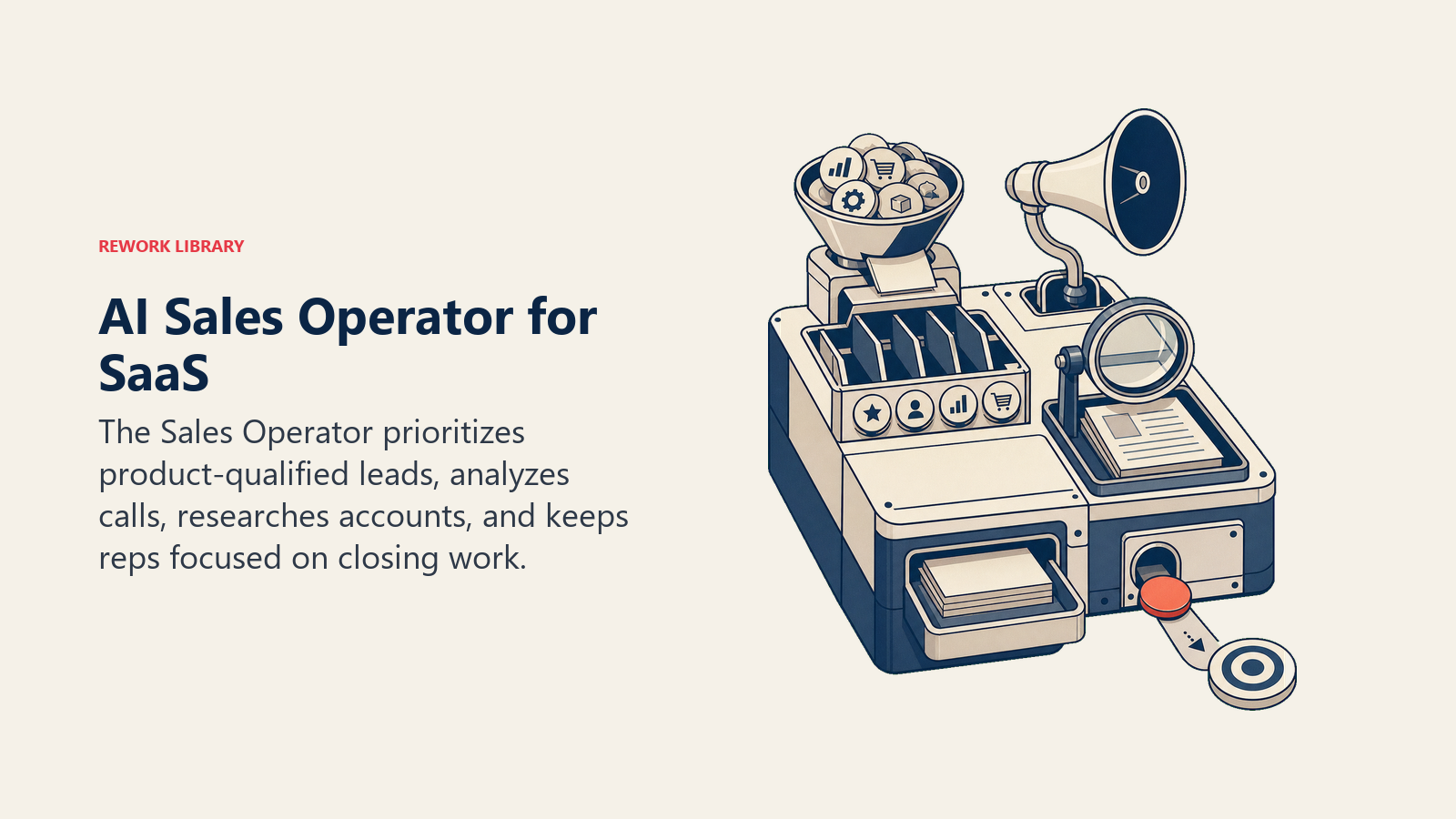
Patrones usados: Scoring+Routing, Meeting Intelligence, Generative Research, Workflow Copilot
El AI Sales Operator maneja la carga cognitiva de las operaciones de ventas para que los representantes puedan enfocarse en las llamadas y relaciones que realmente cierran negocios. En un contexto SaaS, trabaja a lo largo de todo el Pipeline desde la solicitud de prueba o Demo hasta el cierre, y luego hace handoff a customer success.
Qué hace: Puntúa los leads entrantes contra datos históricos de conversión (Scoring+Routing). Transcribe y analiza llamadas de descubrimiento para identificar próximos pasos, patrones de objeciones y riesgos de deals (Meeting Intelligence). Construye briefs de cuentas previos a la llamada a partir de datos firmográficos públicos e historial de CRM (Generative Research). Redacta emails de seguimiento, crea tareas en CRM y marca deals que se han quedado en silencio (Workflow Copilot).
En un contexto SaaS específicamente, el Sales Operator también procesa señales de PLG que las empresas puramente sales-led no tienen. Un usuario en prueba gratuita que ha activado tres funcionalidades centrales e invitado a dos compañeros de equipo es un lead diferente al que inició sesión una sola vez. El patrón Scoring+Routing puede incorporar telemetría de producto como input de puntuación, lo que significa que los usuarios de prueba con mayor tasa de conversión llegan a ventas antes de que hagan churn. La investigación de McKinsey sobre AI generativa en ventas B2B encuentra que los vendedores aumentados por AI pueden manejar ciclos de ventas más complejos con menos pasos manuales, reduciendo directamente el costo de adquisición de cada cliente.
Proveedores clave: Gong lidera Meeting Intelligence para la mayoría de los equipos de ventas SaaS. Clari y Salesforce Einstein manejan Scoring+Routing e inteligencia de Pipeline. Outreach cubre Workflow Copilot en el lado outbound. Rework Sales AI está construido para ejecutar los cuatro patrones dentro de un único CRM, reduciendo la sobrecarga de integración del enfoque de múltiples herramientas.
La señal de ROI a monitorear: El período de recuperación del CAC. Un representante que pasa el 40% de su tiempo en tareas administrativas cierra menos deals por trimestre que uno que pasa el 15% en administración y el 25% más de tiempo en conversaciones con clientes. Cuando se reduce esa carga administrativa con un Sales Operator coordinado, no solo se ahorra tiempo. Se aumenta la producción productiva del representante, lo que significa que se adquiere el mismo ARR con menos representantes, o se crece más rápido con el mismo equipo.
Las empresas que despliegan stacks coordinados de agentes de ventas de AI reportan un ROI anual promedio del 317% con períodos de recuperación inferiores a seis meses, según datos de benchmarks de 2025. El impacto en el CAC aparece en los primeros dos trimestres.
Consulte el análisis completo específico para SaaS del AI Sales Operator para ver cómo las señales de prueba gratuita, los datos PLG y la compensación basada en ARR interactúan con el stack de cuatro patrones.
Agente 2: AI Customer Success Manager
Patrones usados: Anomaly Agent, RAG Assistant, Meeting Intelligence, Workflow Copilot
En un negocio SaaS con ingresos por suscripción, el AI Customer Success Manager (CSM) es a menudo el agente con mayor ROI disponible. Eso se debe a que cada mejora en el NRR se acumula. Un equipo que pasa del 100% al 110% de NRR no solo agrega un 10% a los ingresos de un año. Transforma la trayectoria de ARR permanentemente. La investigación de McKinsey sobre net revenue retention encuentra que las empresas en el cuartil superior de NRR superan a sus pares en eficiencia de crecimiento y alcanzan la rentabilidad más rápido.
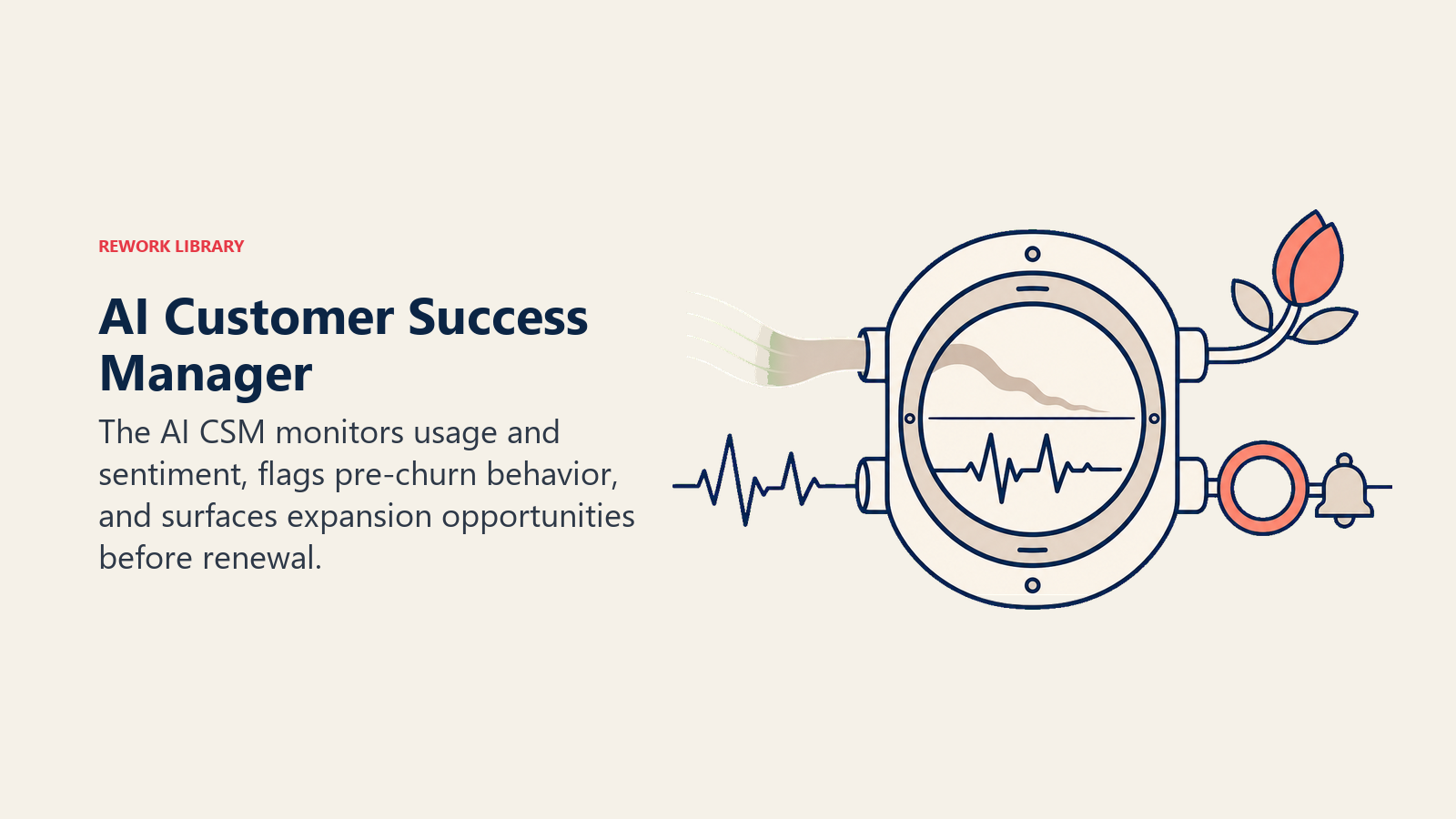
Qué hace: Monitorea la telemetría de uso del producto y los patrones de soporte para detectar señales tempranas de churn (Anomaly Agent ejecutando health scoring). Responde preguntas del CSM sobre el historial del cliente, términos contractuales y capacidades del producto usando datos de interacciones pasadas (RAG Assistant). Analiza grabaciones de QBR y llamadas de clientes para detectar sentimiento, señales de satisfacción y disposición para la expansión (Meeting Intelligence). Redacta comunicaciones de seguimiento, materiales de preparación para renovaciones y propuestas de expansión (Workflow Copilot).
En un contexto SaaS específicamente, la función más valiosa del AI CSM es la detección temprana del churn. El Anomaly Agent no espera la conversación de renovación para detectar riesgo. Monitorea los patrones diarios de uso del producto, los compara con firmas históricas de churn y marca cuentas que están mostrando comportamiento previo al churn semanas antes de que un CSM lo note. Un cliente que usaba su producto cinco días a la semana y ahora inicia sesión una vez a la semana está exhibiendo un patrón. El AI CSM lo detecta. El CSM humano contacta antes de que se convierta en una cuenta perdida.
La segunda función más valiosa es la identificación de expansión. Las cuentas que recientemente han aumentado su plantilla, han contratado roles que usan su producto intensivamente, o han comenzado a usar nuevas categorías de funcionalidades son señales de disposición para la expansión. El AI CSM las muestra al CSM humano antes de la llamada de renovación.
Proveedores clave: Gainsight AI es el líder del mercado para CS empresarial SaaS. ChurnZero se enfoca en el mercado medio y funciona bien para equipos donde el CSM gestiona entre 80 y 150 cuentas. Planhat es fuerte para modelos de facturación basados en uso. Cada uno tiene una fortaleza diferente en cómo maneja el componente Anomaly Agent del health scoring.
La señal de ROI a monitorear: NRR. Para una empresa con $10M de ARR, mover el NRR del 100% al 108% significa que se están agregando $800K en ingresos de expansión por año sobre el nuevo ARR. Con un NRR del 115%, la base de clientes existente está financiando una parte significativa del crecimiento. Ese número, y la tasa de churn que lo alimenta, es donde el ROI del AI CSM aparece directamente.
Para una empresa SaaS con $10M de ARR al 100% de NRR, desplegar un AI CSM que mueva el NRR al 108% agrega $800K en ingresos de expansión anuales sin adquirir un solo cliente nuevo. Esos ingresos de expansión tienen un CAC incremental casi nulo, razón por la cual el AI CSM a menudo entrega el mayor ROI a largo plazo de los cuatro agentes.
Agente 3: AI Support Agent
Patrones usados: RAG Assistant, Scoring+Routing, Workflow Copilot
El AI Support Agent es el caso de ROI más directo en el stack de cuatro agentes, porque los inputs y outputs son los más medibles: tickets entrantes, tasa de deflección, costo por ticket. Para las empresas SaaS que han escalado más allá de 500 clientes, el costo de soporte suele ser uno de los tres principales gastos operativos.
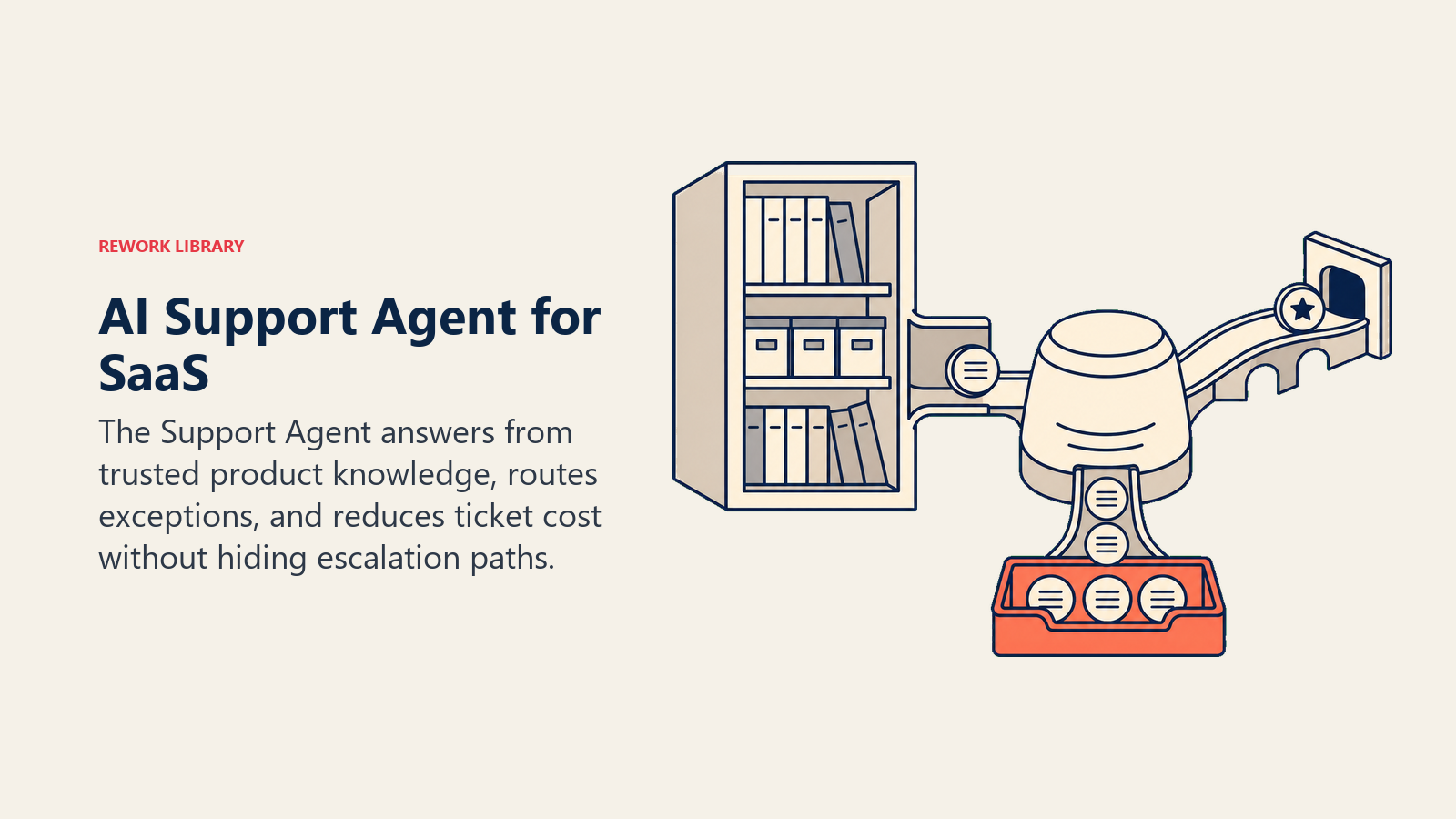
Qué hace: Responde preguntas de soporte L1 usando una base de conocimiento de documentación del producto, tickets resueltos anteriormente y artículos del centro de ayuda (RAG Assistant). Clasifica los tickets entrantes por intención, urgencia y complejidad, y los enruta al equipo o nivel correcto (Scoring+Routing). Redacta respuestas para agentes humanos que manejan tickets L2 y L3, y genera resúmenes de seguimiento post-resolución (Workflow Copilot).
En un contexto SaaS específicamente, el AI Support Agent funciona mejor cuando está entrenado en la documentación específica de su producto y en los patrones de resolución pasados. Los chatbots genéricos de AI fallan en preguntas específicas del producto. Un AI Support Agent construido sobre RAG (Retrieval-Augmented Generation) usando sus artículos de ayuda reales, sus datos históricos de tickets reales y la terminología real de su producto deflectará tickets que un chatbot genérico respondería con alucinaciones.
La distinción clave respecto a un chatbot es la capa Scoring+Routing. Un chatbot responde todas las preguntas de la misma manera. Un AI Support Agent correctamente configurado sabe que una pregunta de facturación de una cuenta empresarial debe enrutarse a un CSM humano, que una solicitud de funcionalidad debe etiquetarse para el equipo de producto, y que una pregunta de "¿cómo hago X?" de un usuario avanzado vale la pena atenderla con una respuesta RAG detallada. Esa lógica de enrutamiento es lo que separa tasas de deflección del 30% de las del 60%.
Proveedores clave: Intercom Fin se ha convertido en el estándar para empresas SaaS con PLG porque se integra directamente con el workflow de soporte existente de Intercom. Zendesk AI sirve a equipos que ya están en Zendesk. Forethought (ahora Moveworks) es fuerte para equipos con bases de conocimiento interno complejas. Dialpad AI maneja soporte de voz.
La señal de ROI a monitorear: Costo por ticket y tasa de deflección. La mayoría de las empresas SaaS gastan entre $15 y $50 por ticket de soporte resuelto (costo total con tiempo del agente, herramientas y gastos generales). Si está manejando 5.000 tickets al mes y un AI Support Agent deflecta el 45% de ellos, está viendo entre $34K y $112K en reducción de costos mensuales, dependiendo de su costo promedio por ticket. Eso llega directamente al margen bruto. Gartner predice que la AI agéntica resolverá autónomamente el 80% de los problemas comunes de servicio al cliente sin intervención humana para 2029, un benchmark que ya están alcanzando los mejores despliegues actuales.
Intercom reporta que Fin resuelve en promedio el 51% del volumen de soporte entrante sin intervención humana, en toda su base de clientes.
Agente 4: AI Content Operator
Patrones usados: Generative Research, RAG Assistant, Workflow Copilot
Para las empresas SaaS B2B, el contenido es Pipeline. La mayoría de las decisiones de compra de software comienzan con una búsqueda, un artículo de blog o una página de categoría en un sitio de reseñas. El AI Content Operator no solo hace que la producción de contenido sea más económica. Hace que la adquisición orgánica sea más escalable y más sistematizada.
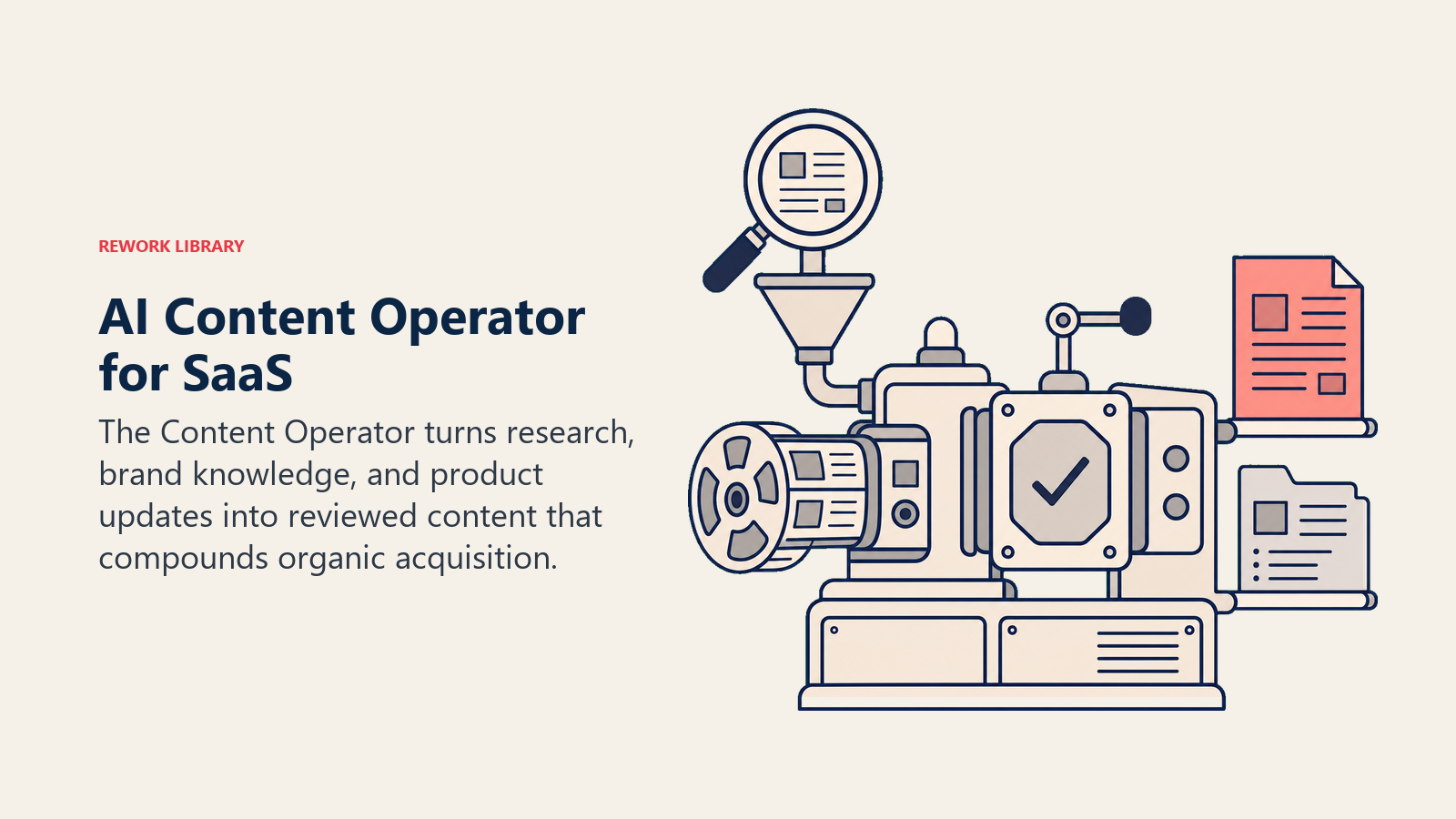
Qué hace: Investiga clusters de temas, brechas de contenido competitivo y oportunidades de palabras clave (Generative Research). Redacta artículos, páginas de destino, documentación de producto y secuencias de email con consistencia de voz y estilo de marca (RAG Assistant alimentando el contexto de la guía de estilo). Gestiona workflows editoriales, ciclos de revisión y colas de publicación (Workflow Copilot).
En un contexto SaaS específicamente, el AI Content Operator hace algo que la mayoría de los equipos de contenido no pueden hacer a escala humana: mapear contenido a cada etapa del proceso de compra con suficiente profundidad para realmente posicionarse. Las predicciones B2B de Forrester para 2025 señalan que más de la mitad de las grandes compras B2B se procesarán a través de canales digitales de autoservicio, lo que significa que el contenido que lleva a los compradores a ese canal tiene más valor comercial que nunca. Una empresa SaaS de 10 personas no puede producir suficiente contenido reflexivo de fondo de Funnel para competir en SEO contra actores establecidos si el equipo de contenido escribe manualmente. Con un AI Content Operator, ese mismo equipo puede producir un cluster de 40 artículos en el tiempo que antes llevaba escribir cinco.
La segunda función específica para SaaS es la documentación del producto. Los productos SaaS lanzan funcionalidades rápido. La documentación se queda atrás. Un AI Content Operator que puede ingerir especificaciones de ingeniería, entradas del registro de cambios y notas del equipo de ventas para generar primeros borradores de artículos de ayuda resuelve un problema operativo real, mientras también mantiene la base de conocimiento lo suficientemente actualizada para alimentar al AI Support Agent.
Proveedores clave: Writer.com es la opción para equipos que necesitan consistencia de voz de marca a escala en múltiples escritores y modelos de AI. Copy.ai maneja bien la automatización de workflows de contenido para equipos más pequeños. Typeface es fuerte para contenido con componentes visuales significativos. HubSpot AI integra la producción de contenido directamente con la atribución de marketing para equipos que ya están en el stack de HubSpot.
La señal de ROI a monitorear: Contribución de Pipeline orgánico. Para las empresas SaaS con programas de contenido bien ejecutados, la búsqueda orgánica puede contribuir entre el 20% y el 40% del Pipeline total. Si su AI Content Operator le ayuda a publicar más rápido, posicionarse en más consultas y mantener cobertura en un cluster de temas más grande, el ROI aparece como flujo de deals orgánico que no requiere gasto en adquisición paga. Es más lento de ver que los otros tres agentes (el contenido tarda de 3 a 6 meses en posicionarse), pero es el que más se compone durablemente.
El 4-Agent SaaS Stack
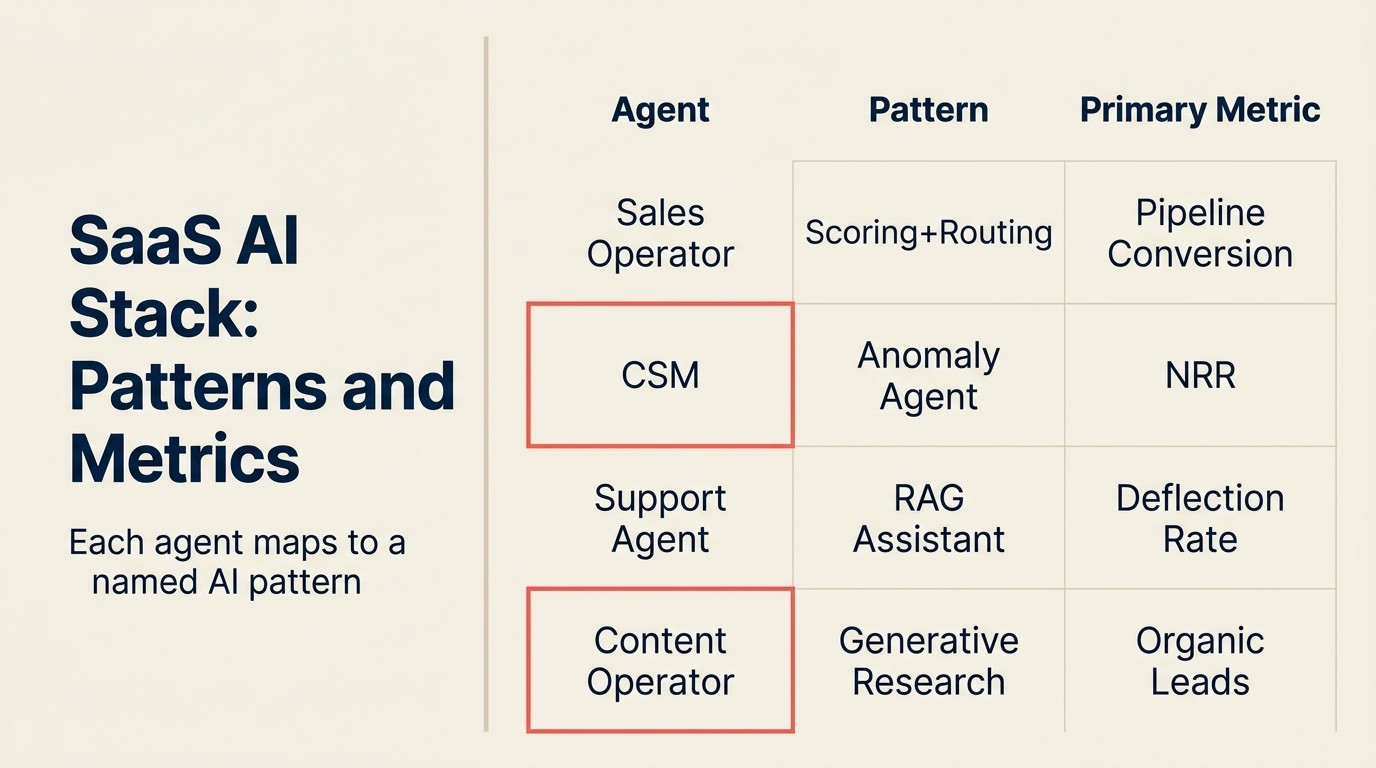
El 4-Agent SaaS Stack es la arquitectura canónica para el despliegue de AI en SaaS B2B: Sales Operator, Customer Success Manager, Support Agent y Content Operator ejecutándose como un sistema coordinado en lugar de cuatro herramientas independientes. Cada agente cubre una variable en la ecuación de ingresos SaaS, y el efecto compuesto ocurre cuando los cuatro comparten contexto. Los datos de closed-won del Sales Operator entrenan los modelos de expansión del CSM. Los datos de tickets deflectados del Support Agent alimentan las brechas de contenido del Content Operator. El tráfico orgánico del Content Operator reduce los inputs de CAC del Sales Operator. Ningún despliegue de un solo agente produce estos efectos de composición entre agentes.
| Agente | Variable de Ingresos | Patrones ACE Clave | Métrica Principal |
|---|---|---|---|
| AI Sales Operator | Reducir CAC, acortar ciclo de ventas | Scoring+Routing, Meeting Intelligence, Generative Research, Workflow Copilot | Período de recuperación de CAC |
| AI Customer Success Manager | Mejorar NRR, reducir churn | Anomaly Agent, RAG Assistant, Meeting Intelligence, Workflow Copilot | Net revenue retention |
| AI Support Agent | Mejorar margen bruto | RAG Assistant, Scoring+Routing, Workflow Copilot | Tasa de deflección de tickets |
| AI Content Operator | Reducir CAC orgánico | Generative Research, RAG Assistant, Workflow Copilot | Participación de Pipeline orgánico |
Fuente: Análisis del ACE Framework; benchmarks de proveedores de Gainsight, Intercom, Gong, Writer.com (2024-2025)
Cómo secuenciar los cuatro agentes
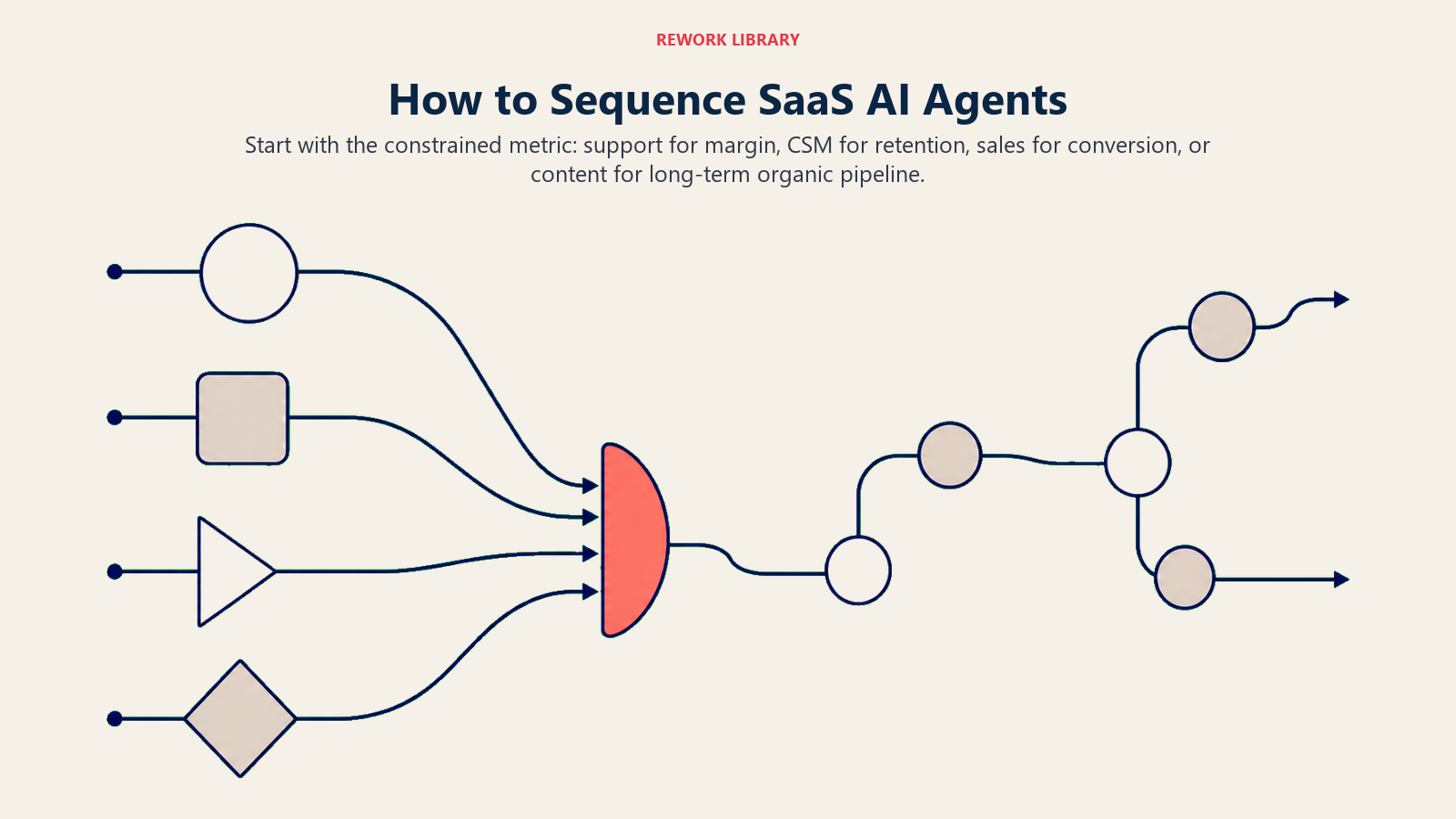
No todos a la vez. El punto de partida correcto depende de qué variable en la ecuación de ingresos SaaS esté más restringida.
Si está restringido en adquisición (el Pipeline es el problema), empiece con el AI Sales Operator. Una calificación de leads más rápida, mejor inteligencia de llamadas y representantes más productivos significa que convierte más del Pipeline que ya tiene. El AI Content Operator es la inversión paralela para mejorar el volumen de Pipeline orgánico durante los siguientes dos trimestres.
Si está restringido en retención (el churn está destruyendo el NRR), empiece con el AI Customer Success Manager. Detectar cuentas en riesgo antes e identificar candidatos de expansión antes de las conversaciones de renovación es donde la matemática está más desajustada. El AI Support Agent también suele reducir el churn, porque la mala experiencia de soporte es una de las tres principales causas de churn.
Si está restringido en margen (el costo de soporte está erosionando el margen bruto), empiece con el AI Support Agent. El ROI es el más rápido y el más directamente medible de los cuatro agentes. Despliegue Intercom Fin o Zendesk AI, mida la tasa de deflección a los 30 días y use la mejora del margen bruto para financiar la siguiente inversión en agentes.
La mayoría de las empresas SaaS en Serie A y más allá tienen los tres problemas en cierta medida. La disciplina consiste en elegir aquel donde se puede demostrar el ROI más rápido, construir el business case y secuenciar desde allí.
Rework Analysis: Los datos de secuenciación de los primeros despliegues del 4-Agent SaaS Stack muestran consistentemente una ventaja "margin-first": los equipos que empiezan con el AI Support Agent obtienen el retorno más rápido (30-60 días), lo que genera confianza en los stakeholders para el segundo y tercer agente. Los equipos que empiezan con el Sales Operator obtienen las victorias tempranas más visibles (las métricas de Pipeline son fáciles de señalar) pero una realización de ROI real más lenta. Los equipos que empiezan con el CSM obtienen la ventaja a largo plazo más duradera porque el NRR se acumula. La respuesta correcta depende de su burn rate actual y etapa de crecimiento, pero el error común es empezar con el Content Operator, que tarda de 3 a 6 meses en mostrar resultados de búsqueda orgánica y es el más difícil de defender en las primeras conversaciones del consejo directivo.
El error común: herramientas en lugar de agentes
La distinción importa porque los agentes son responsables de resultados a través de workflows, mientras que las herramientas desconectadas solo automatizan tareas aisladas.
El encuadre importa aquí. Las empresas que piensan en AI como un conjunto de herramientas obtienen un resultado. Las que piensan en ella como un conjunto de agentes coordinados obtienen un resultado diferente.
Una herramienta es algo que se compra. Un agente es un rol desempeñado por AI. La distinción cambia cómo se configura, quién lo gobierna y por qué se le pide cuentas.
Un AI Support Agent configurado como "herramienta" se activa, maneja algunos tickets y produce un Dashboard. Un AI Support Agent configurado como "agente" recibe un objetivo de SLA (resolver X% de los tickets L1 sin escalación), un responsable (el Head of Support es accountable de la configuración) y un ciclo de calibración trimestral donde las reglas de enrutamiento y la base de conocimiento se actualizan en función de los nuevos cambios del producto.
El encuadre de agente también mantiene a los humanos en el ciclo apropiado. Estos cuatro agentes no eliminan los roles humanos. Cambian en qué se enfoca el rol humano. El CSM pasa de gestionar hojas de cálculo de renovaciones a manejar las cuentas que el AI marcó como necesitadas de intervención relacional. El representante de ventas pasa de construir decks de investigación de cuentas a realizar más llamadas por semana. El agente de soporte pasa de responder preguntas L1 repetitivas a resolver los problemas L2 complejos que requieren juicio.
Ese es el patrón en los cuatro agentes: la AI maneja la cognición repetitiva, los humanos manejan las decisiones que requieren contexto y relación.
Por dónde empezar
La ecuación de ingresos SaaS apunta a uno de estos cuatro agentes como su palanca más restringida ahora mismo. La pregunta es cuál.
Calcule la matemática para cada uno:
- Sales Operator: ¿Qué haría una mejora del 20% en la productividad de los representantes a su período de recuperación del CAC?
- CSM: ¿Qué haría una mejora del 10% en el NRR a su ARR en 24 meses?
- Support Agent: ¿Qué haría deflectar el 40% de los tickets a su margen bruto?
- Content Operator: ¿Qué haría tener 3 veces más consultas de búsqueda orgánica a su CAC de Pipeline?
Elija el número que más cambia el negocio y empiece por ahí. El argumento completo de por qué SaaS tiene las ventajas estructurales para desplegar los cuatro explica por qué la velocidad está disponible. Este artículo trata de usar esa velocidad deliberadamente.
Preguntas Frecuentes
¿Cuáles son los cuatro agentes de AI que toda empresa SaaS B2B necesita?
Los cuatro agentes son el AI Sales Operator (reduce el CAC manejando la puntuación de leads, la inteligencia de llamadas y los borradores de seguimiento), el AI Customer Success Manager (mejora el NRR detectando el churn antes e identificando candidatos de expansión), el AI Support Agent (mejora el margen bruto deflectando tickets L1) y el AI Content Operator (reduce el CAC orgánico escalando la producción de contenido). Juntos forman el 4-Agent SaaS Stack que cubre la ecuación de ingresos SaaS completa.
¿Qué agente de AI tiene el retorno de inversión más rápido para una empresa SaaS?
El AI Support Agent entrega el ROI medible más rápido, típicamente en 30-60 días. Las tasas de deflección son inmediatamente visibles, el costo por ticket es una métrica directa y la mejora del margen bruto aparece en el próximo cierre mensual financiero. El AI Sales Operator viene segundo a 2-3 trimestres. El AI CSM tarda 1-2 trimestres para que el NRR se mueva. El Content Operator es el más lento (3-6 meses para que la búsqueda orgánica se acumule) pero el más duradero a largo plazo.
¿Cómo mejora el NRR el AI Customer Success Manager?
El AI CSM ejecuta una capa de Anomaly Agent continua que monitorea la telemetría de uso del producto diariamente, comparando el comportamiento de cada cuenta con los patrones históricos de churn. Marca cuentas que muestran señales previas al churn (disminución de inicios de sesión, desconexión de funcionalidades) semanas antes de que un CSM humano lo note. También identifica cuentas listas para la expansión detectando mayor uso, crecimiento de equipo nuevo o adopción de nuevas funcionalidades. Los clientes de Gainsight reportan una mejora del 15-20% en la retención de cuentas en riesgo versus workflows manuales.
¿Qué es el 4-Agent SaaS Stack?
El 4-Agent SaaS Stack es el patrón arquitectónico donde Sales Operator, Customer Success Manager, Support Agent y Content Operator se ejecutan como un sistema coordinado que comparte contexto. Los datos de closed-won del Sales Operator entrenan los modelos de expansión del CSM. Los patrones de tickets deflectados del Support Agent revelan brechas de contenido para el Content Operator. El tráfico orgánico del Content Operator reduce los inputs de CAC del Sales Operator. El efecto compuesto ocurre específicamente porque los agentes comparten contexto en lugar de operar de forma aislada.
¿Qué proveedores implementan los cuatro agentes de AI para SaaS?
Para el AI Sales Operator: Gong (Meeting Intelligence), Clari o Salesforce Einstein (Scoring+Routing), Outreach (Workflow Copilot) y Rework Sales AI (los cuatro patrones en una plataforma). Para el AI CSM: Gainsight AI (enterprise), ChurnZero (mercado medio), Planhat (modelos basados en uso). Para el AI Support Agent: Intercom Fin, Zendesk AI, Forethought/Moveworks. Para el AI Content Operator: Writer.com, Copy.ai, HubSpot AI.
¿Qué ROI pueden esperar los equipos de ventas de AI en SaaS B2B?
El 86% de los equipos de ventas que usan AI reportan ROI positivo en el primer año, y el 76% de las empresas logran ROI positivo de la automatización de ventas en 12 meses (Cirrus Insight, 2025). Las empresas ven un aumento promedio del 10-20% en el ROI de ventas, con algunos adoptadores tempranos reportando reducciones del 30% en CAC junto con valores de contrato anuales más altos. Los casos de uso específicos de AI con los multiplicadores más altos incluyen el borrador de contenido SEO con 3,4x y la personalización de emails de ciclo de vida con 3,1x de ROI.
¿Cómo debe una empresa SaaS secuenciar estos cuatro agentes?
Empiece con el agente que aborda la variable de ingresos más restringida. Si el margen bruto es el problema, empiece con el Support Agent (retorno más rápido). Si el churn es el problema, empiece con el CSM (ganancia más duradera a largo plazo). Si la conversión de Pipeline es el cuello de botella, empiece con el Sales Operator (victorias tempranas más visibles). Evite empezar con el Content Operator en etapas de crecimiento temprano porque tarda de 3 a 6 meses en mostrar resultados de búsqueda orgánica, lo cual es difícil de defender en las primeras conversaciones del consejo directivo.
Relacionado:

Co-Founder, Rework.com