IA para Expansión en SaaS: Upsell y Cross-Sell
Turn this article into takeaways for your work.


Each assistant summarizes the article only for you and suggests best practices for your work.
Los mejores negocios SaaS no solo retienen clientes. Los hacen crecer. El NRR (net revenue retention) por encima del 120% es el sello del nivel élite: Snowflake, Datadog y empresas similares que expanden cuentas de forma consistente más rápido de lo que las pierden por churn. La mayoría de las empresas SaaS se ubica entre el 105% y el 115%, lo que significa que su motion de expansión está rindiendo por debajo de su potencial.
El cuello de botella rara vez es el producto. Es la visibilidad. Los CSMs (customer success managers) gestionan demasiadas cuentas para notar cada plaza que se acerca a su límite, cada pico en el volumen de llamadas API, cada champion que acaba de pasar a un nuevo rol con autoridad presupuestaria. Esas señales desaparecen en hojas de cálculo y se actúa sobre ellas demasiado tarde, si es que se actúa.
La IA cambia el lado de expansión del NRR específicamente. No reemplazando a los CSMs, sino dándoles una lista continuamente actualizada de cuentas donde las conversaciones de expansión tienen probabilidades de resultar positivas.
La Ecuación del NRR y Dónde Interviene la IA
El NRR mide lo que le pasa a su base de ingresos existente después de 12 meses: cuánto se perdió por churn, cuánto se contrajo, cuánto se expandió. La fórmula es: ARR (annual recurring revenue) al inicio del período menos churn menos contracción más expansión, dividido entre el ARR al inicio del período.
Key Facts: IA para Ingresos de Expansión en SaaS
- Las empresas B2B SaaS del cuartil superior superan el 120% NRR, con cuentas enterprise promediando 118% NRR, mid-market al 108% y SMB al 97%. Las brechas son en gran medida impulsadas por la proactividad de CS en señales de expansión (Optifai NRR Benchmarks, 939 companies, 2025)
- Las mejores empresas generan más del 50% del nuevo ARR de upsells; las empresas por encima de $100M ARR derivan el 67% del nuevo ARR total de expansión en lugar de adquisición neta nueva, una tendencia que se acelera desde 2021 (Growth Unhinged SaaS Benchmarks, 2025)
- Las empresas de IA B2B que usan herramientas de análisis predictivo reportan un NRR hasta un 15% más alto que sus pares sin IA; las motions de expansión dedicadas logran un NRR del 15-25% más alto que la dependencia de la expansión orgánica (Sparkco AI NRR Research, 2025)
La mayoría de las empresas SaaS enfocan su energía de CS y renovación en prevenir el churn. La investigación de McKinsey sobre NRR en tech B2B confirma que las empresas del cuartil superior de NRR tienen mayores múltiplos de ingresos y alcanzan la rentabilidad más rápido que sus pares. Eso es correcto. Pero el lado de la expansión recibe menos atención sistemática, y ahí es donde la IA agrega el mayor valor incremental. Los benchmarks de ChartMogul muestran que las empresas con más de $15M ARR ahora derivan el 40% del crecimiento de la expansión en lugar de la adquisición de nuevos clientes, una tendencia que se ha acelerado desde 2021 y hace que la motion de expansión sea una palanca de crecimiento a nivel de directorio, no solo una métrica de CS.
La retención bruta y la expansión necesitan inputs diferentes. Prevenir el churn requiere detectar temprano la salud en declive. Impulsar la expansión requiere detectar temprano las señales de crecimiento. Un cliente que ha estado duplicando silenciosamente su uso durante 60 días no va a aparecer en su lista de vigilancia de churn. Pero es un candidato natural para una conversación de upsell. Esta señal se deriva directamente de la telemetría de producto que las empresas SaaS ya tienen. Sin IA, esa conversación ocurre en la renovación cuando el CSM finalmente revisa los datos. Con IA, ocurre en el pico del entusiasmo del cliente, cuando la adopción es alta y el valor es obvio.
La diferencia en tasa de cierre entre una conversación de expansión proactiva y una presionada por el contrato es sustancial. Las conversaciones de expansión desencadenadas por señales del producto cierran a aproximadamente tres veces la tasa de las desencadenadas por el vencimiento de un contrato.
Tipos de Señales de Expansión
Las señales de expansión varían según el comportamiento de la cuenta, los límites de uso y los cambios organizacionales, por lo que la IA debe clasificar el desencadenante antes de recomendar una acción.
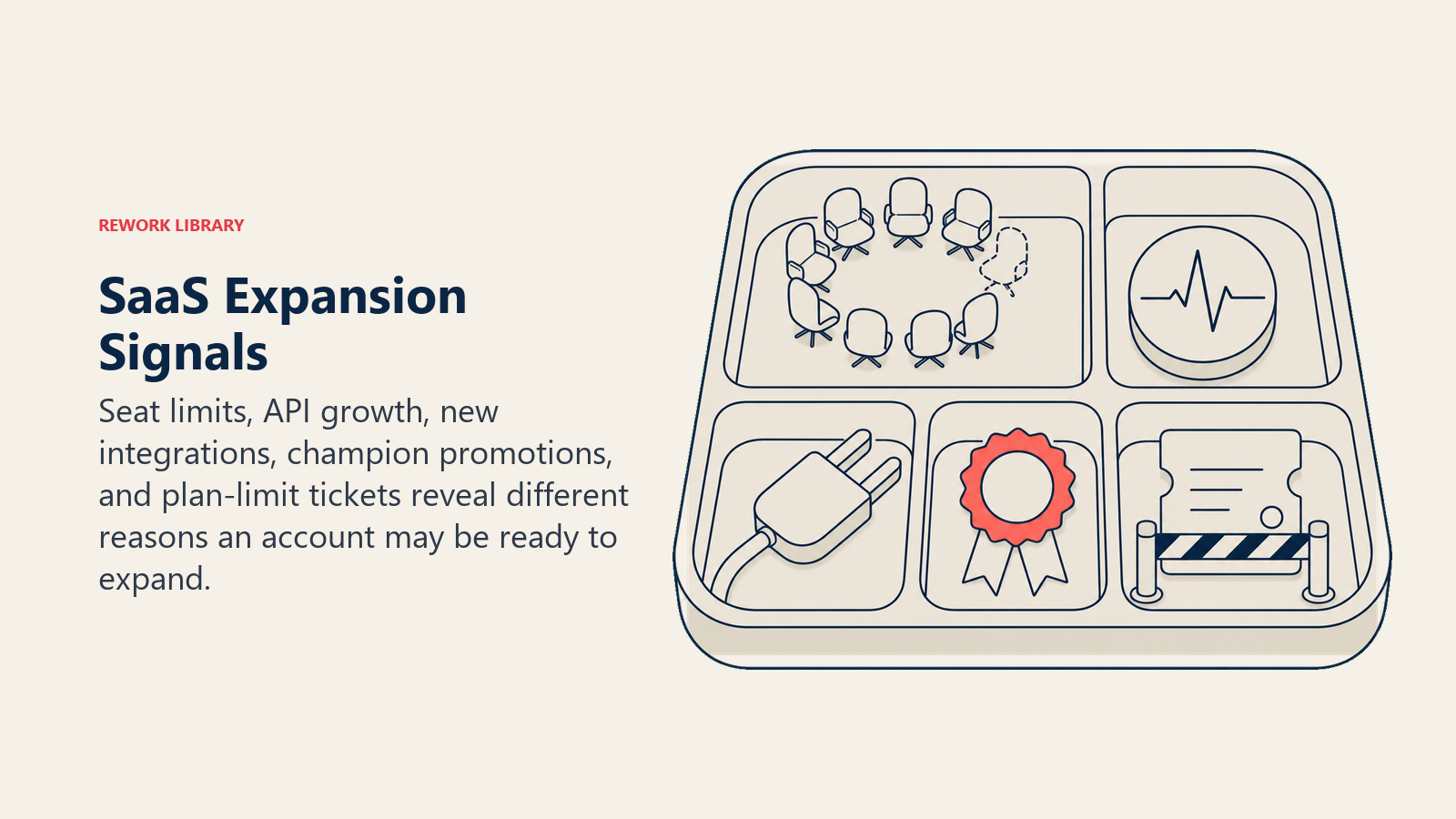
No todas las señales de expansión se parecen. La IA necesita observar varios patrones distintos, porque la conversación correcta depende de a qué señal está respondiendo.
Utilización de plazas acercándose al límite. Cuando un equipo está al 80-90% de su número de plazas licenciadas y agrega usuarios de forma consistente, el timing es ideal. Esperar hasta que lleguen al límite convierte eso en un problema de soporte. Detectarlo al 85% es una conversación de crecimiento.
Crecimiento en volumen de llamadas API. Para las herramientas SaaS orientadas a desarrolladores o con muchas integraciones, el uso de API es un proxy directo de qué tan integrado se ha vuelto su producto. Un aumento de 3x en las llamadas API en 60 días significa que el cliente ha ampliado su caso de uso. Eso es una apertura.
Nuevos flujos de trabajo e integraciones conectadas. Cuando un cliente conecta una nueva integración, eso generalmente representa un nuevo equipo o departamento que comienza a usar el producto. Un equipo de ventas que construyó un flujo de trabajo de CRM, luego conecta una integración de calendario, luego incorpora una herramienta de marketing le está mostrando que su huella se está expandiendo. Cada conexión es una señal potencial de expansión de plazas.
Promoción del champion. Cuando su contacto principal en una cuenta pasa a un rol de director o VP, dos cosas ocurren simultáneamente. Tiene más autoridad presupuestaria y está en la fase de demostrar su nuevo rol invirtiendo en las herramientas en las que cree. Esta es la señal de mayor valor en la venta de expansión, y es casi imposible detectarla sin monitorear los datos de cambios de trabajo junto con su CRM.
Tickets de soporte que revelan limitaciones del plan. Los clientes que alcanzan los límites del plan frecuentemente abren tickets antes de decirle algo a su CSM. "No podemos agregar otro usuario", "esta función aparece bloqueada para nosotros", "obtenemos un error cuando intentamos exportar más de 500 filas". Estos no son solo problemas de soporte. Son indicaciones de actualización.
El tipo específico de señal de expansión determina qué conversación tener, y con quién.
Señales de Upsell Específicamente
El upsell significa mover a un cliente a un nivel superior del mismo producto. Las señales son ligeramente diferentes de la expansión general.
Busque clientes que usen regularmente funciones que muestren una vista previa de un nivel superior, o que soliciten funciones del roadmap que ya existen en el siguiente nivel. Muchos productos SaaS muestran avances de funciones en los niveles inferiores: un botón que dice "actualice para desbloquear esto". Cuando un cliente hace clic en eso tres veces en un mes, esa es una señal registrada.
Los tickets de soporte que preguntan sobre funcionalidades disponibles en el siguiente nivel también son señales claras de upsell. Su IA debería escanear los patrones de texto de los tickets como "¿podemos hacer X?" o "¿hay alguna forma de Y?" donde X e Y corresponden a funciones en el nivel superior.
Las señales de cross-sell funcionan de forma diferente porque el desencadenante no son los límites del plan. Es el comportamiento que no encaja en el producto que el cliente está usando actualmente.
Señales de Cross-Sell Específicamente
El cross-sell significa introducir un producto adyacente a un cliente que ya usa una de sus líneas de producto. En el SaaS multi-producto, es aquí donde el NRR realmente se expande por encima del 120%.
Las señales aquí son de comportamiento en lugar de impulsadas por límites del producto. Un equipo que usa su módulo CRM de forma intensiva comienza a gestionar cronogramas de proyectos dentro de él, creando soluciones alternativas desordenadas. Esa es una señal de que necesitan un producto Work Ops. Un equipo que usa sus herramientas de captura de leads comienza a preguntarle a su CSM cómo rastrear deals. Esa es una señal de que necesitan un módulo de Sales Ops o gestión de pipeline.
La motion de cross-sell requiere que la IA observe el comportamiento que no encaja en el producto que el cliente está usando actualmente, y presente ese patrón antes de que se convierta en una evaluación de un producto competidor. El análisis de McKinsey sobre el product-led growth encuentra que las empresas SaaS multi-producto que pueden expandirse dentro de las cuentas usando señales de comportamiento superan consistentemente a los competidores de un solo producto en NRR, porque cada oportunidad de cross-sell compone la adherencia del producto.
Los tres tipos de señales, y más, alimentan el modelo de scoring de IA que determina la preparación para la expansión.
El Expansion Trigger Map
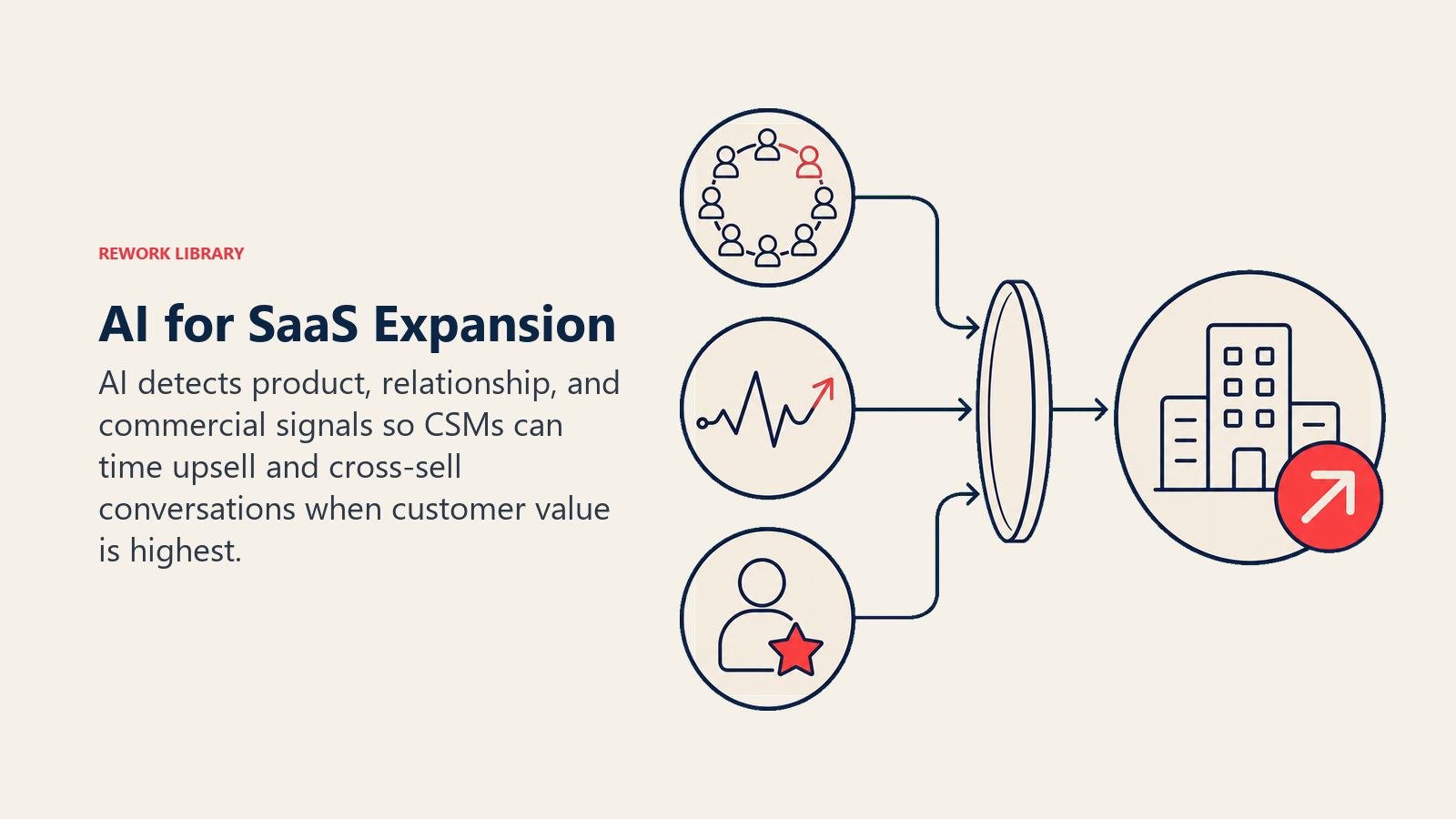
El Expansion Trigger Map es el framework de señales sobre el que opera el scoring de expansión con IA: señales de producto (utilización de plazas, tendencias de volumen API, amplitud de funciones, conexiones de integraciones), señales de relación (sentimiento del CSM, NPS, estabilidad del champion) y señales comerciales (días hasta el vencimiento del contrato, uso relativo a los límites del contrato, historial de pagos, nivel actual vs. uso). Estas tres categorías de señales alimentan una puntuación de preparación para la expansión que se actualiza continuamente. La clave que codifica el Expansion Trigger Map: las conversaciones de expansión desencadenadas por señales del producto cierran a aproximadamente 3x la tasa de las desencadenadas por el vencimiento del contrato, porque el timing ocurre en el pico del entusiasmo del cliente en lugar de bajo la presión de la renovación. El mapa también codifica una puerta: el health score debe estar en verde antes de que se presente la expansión. Una cuenta con un health score amarillo debería recibir una jugada de recuperación, no un pitch de upsell.
Cómo la IA Puntúa la Preparación para la Expansión
El scoring de expansión combina telemetría de producto, ajuste de la cuenta y contexto comercial en una única señal de preparación sobre la cual el CSM puede actuar.
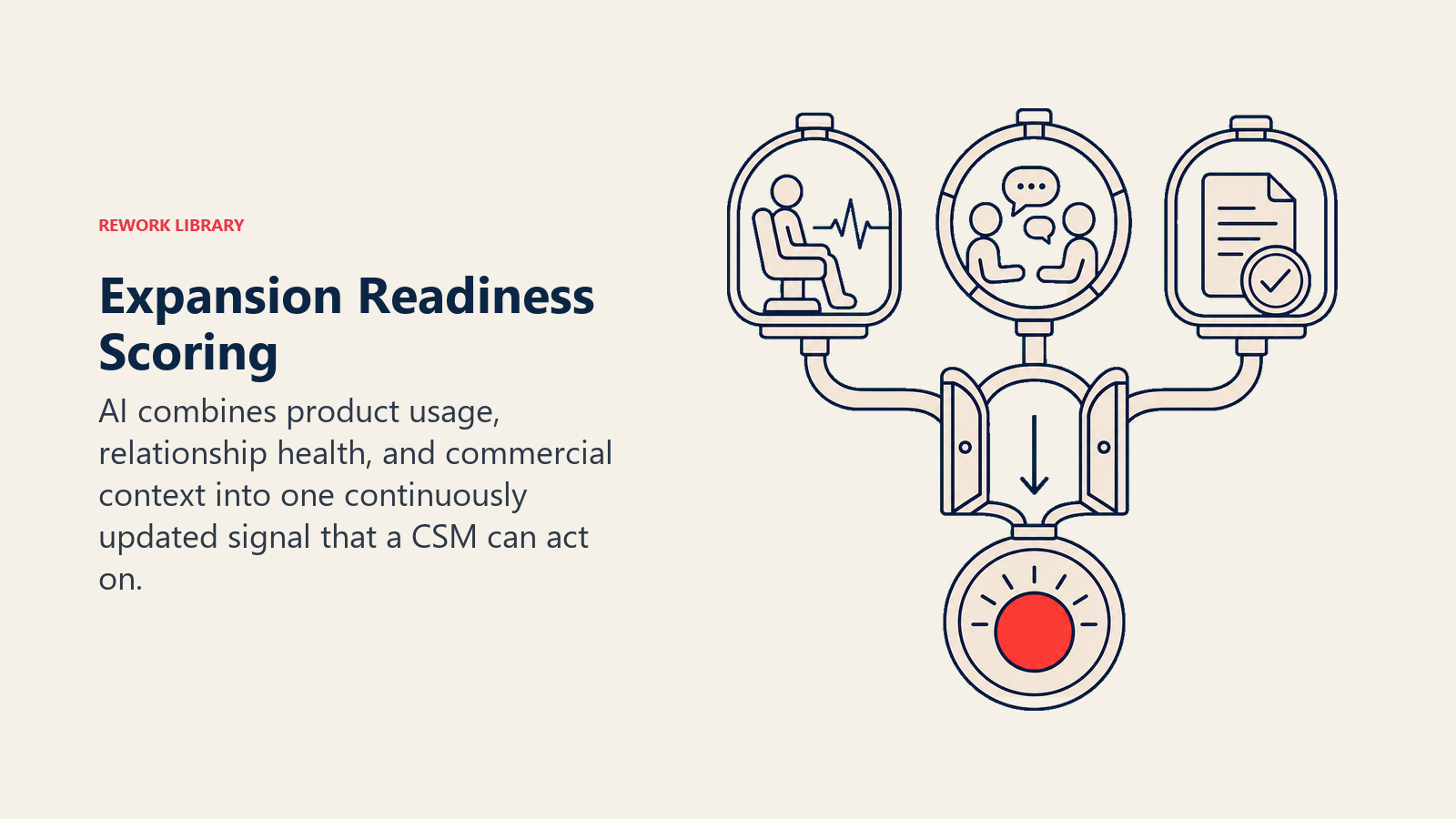
El Patrón Scoring and Routing (del ACE Framework) es el modelo mental correcto aquí. La IA hace Ingest de señales de múltiples fuentes de datos, las analiza contra las líneas base y produce una puntuación de preparación para la expansión sobre la que actúa el CSM.
Los inputs para una buena puntuación de expansión incluyen tres categorías:
Señales de producto. Profundidad de uso de funciones, porcentaje de utilización de plazas, tendencia de volumen API, integraciones conectadas, flujos de trabajo creados, frecuencia de engagement. Estas son las señales más fuertes porque son objetivas.
Señales de relación. Sentimiento del CSM de las transcripciones de llamadas, puntuaciones NPS, tiempo desde la última interacción significativa, estabilidad del champion. Una cuenta sana en el producto con una relación con el CSM desengagada necesita un enfoque de expansión diferente al de una cuenta sana con alto engagement del CSM.
Señales comerciales. Días hasta el vencimiento del contrato, uso relativo a los límites del contrato, historial de pagos de facturas, nivel de precios relativo al uso. Una cuenta que está un 40% por encima de su asignación de API con seis meses restantes del contrato ya está en territorio de expansión, lo haya notado o no.
Las funciones de playbook de expansión de Gainsight, el scoring de expansión de ChurnZero y herramientas similares combinan estos inputs. Las implementaciones personalizadas que usan telemetría in-product son frecuentemente más precisas porque tienen acceso directo a los datos de uso del producto en lugar de depender de integraciones que pueden tener un retraso de días.
Una puntuación que se activa en el momento correcto todavía requiere un flujo de trabajo que facilite al CSM actuar sobre ella.
El Flujo de Trabajo del Expansion Playbook
Una vez que la IA puntúa una cuenta como lista para la expansión, el flujo de trabajo importa. Presentar una señal es solo la mitad del valor. La otra mitad es asegurarse de que el CSM pueda actuar sobre ella de manera eficiente.
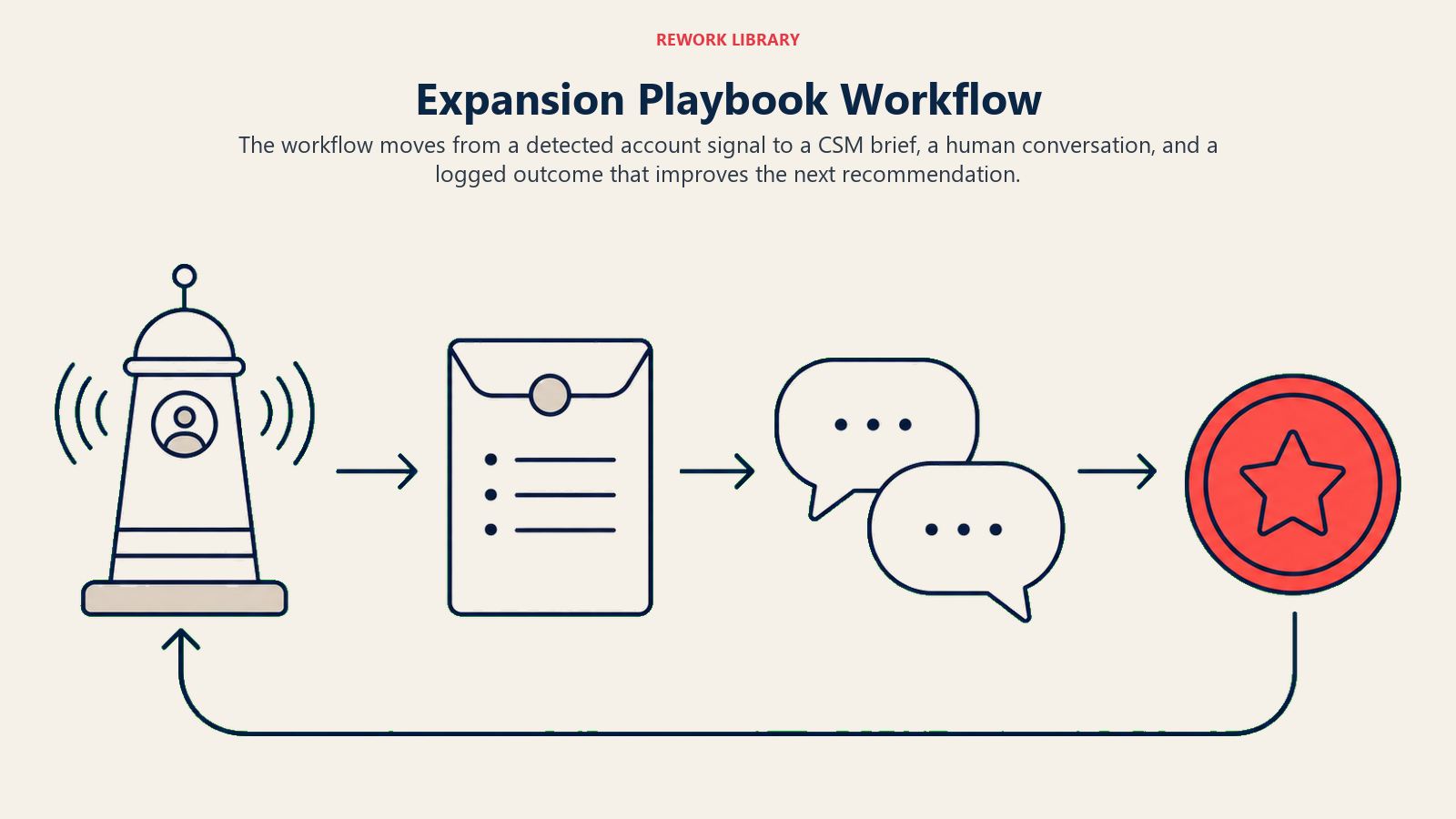
Un flujo de trabajo de expansion playbook bien diseñado se ve así:
- La IA marca la cuenta con la señal específica que desencadenó la puntuación (ejemplo: "El equipo de Sarah ha añadido 8 usuarios en 30 días y está al 87% del límite de plazas").
- La IA redacta un brief para el CSM: la señal, el ángulo de conversación recomendado, casos de estudio relevantes de cuentas similares que actualizaron por la misma razón, y recomendación de timing.
- El brief incluye puntos de conversación sugeridos, no solo datos. "Sarah es la líder de operaciones en una empresa de logística de 200 personas. Su equipo se expandió de la gestión de proyectos a los flujos de trabajo de comunicación con clientes el trimestre pasado. El siguiente paso natural es la expansión de plazas de Work Ops. El caso de estudio más cercano es su competidor directo que añadió plazas después de llegar al 85% y citó un 40% de mayor rapidez en el onboarding de nuevas contrataciones."
- El CSM revisa el brief, personaliza y reserva la conversación.
- El resultado se registra de vuelta en el sistema para que el modelo pueda aprender qué patrones de señales conducen a expansiones cerradas frente a las que se estancan.
El loop mejora con cada intento de expansión. Con el tiempo, el modelo aprende que "volumen de API 3x en 60 días en cuentas que usan la integración de exportación de datos" es una señal más fuerte que "utilización de plazas por encima del 85% en cuentas con más de 18 meses desde la renovación".
Para los equipos que usan Rework, este loop de retroalimentación es estructural a cómo interactúan las tres líneas de producto.
Contexto de Rework: Cross-Sell Entre Líneas de Producto
Para los equipos SaaS que usan Rework, las señales de cross-sell son estructurales a las tres líneas de producto: Sales Ops, Lead Ops y Work Ops.
Un equipo mid-market que comienza con Sales Ops para la gestión de pipeline eventualmente mostrará señales de que su equipo de CS necesita Work Ops para gestionar renovaciones y proyectos de clientes. Un equipo que usa Lead Ops para la captura inbound desarrollará flujos de trabajo de seguimiento de ventas que claramente han superado el producto para cuando necesitan gestión de pipeline a escala.
Los clientes del nivel Starter que están construyendo automatizaciones complejas, alcanzando límites de registros o solicitando regularmente funciones del nivel Standard son candidatos naturales para actualizaciones. La señal está en sus datos de uso. La conversación es directa: "Ha construido flujos de trabajo que necesitan el rendimiento del nivel Standard. Así es como se vería la actualización para su configuración específica."
Esas conversaciones funcionan mejor cuando el CSM entra con un brief que muestra los propios datos del cliente, no un pitch genérico de actualización.
El Factor Timing
Esto merece su propia sección porque es la variable que la mayoría de los equipos no gestiona bien.
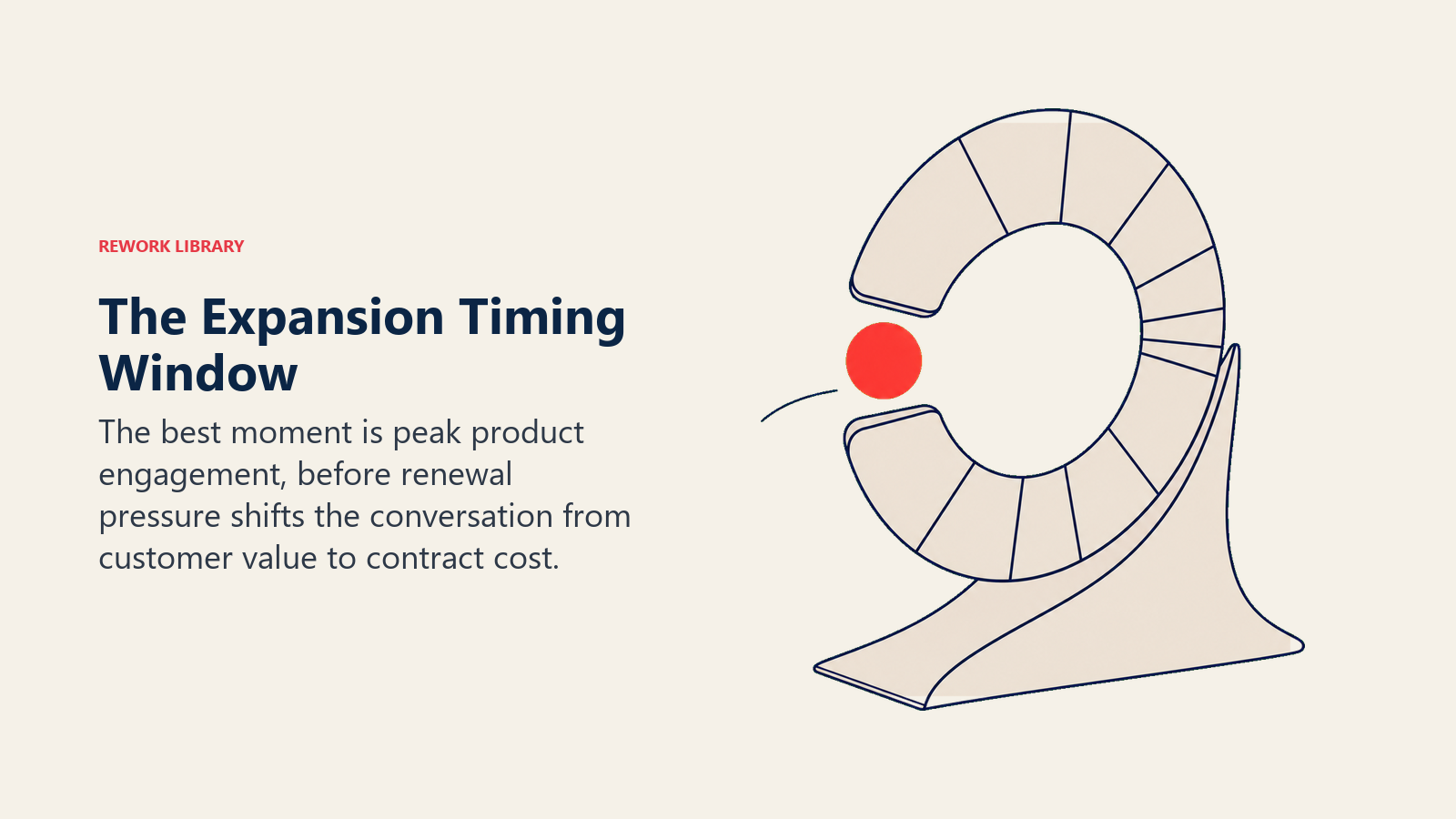
Las conversaciones de expansión tienen una ventana de apertura natural. Comienza cuando el cliente alcanza un alto engagement con el nivel actual y se cierra alrededor del momento en que la presión de la renovación se activa. En esa ventana, el cliente está experimentando el valor de su producto diariamente, su champion interno tiene confianza en la inversión y no hay una postura defensiva de "demuestre que vale la pena antes de que gastemos más" por parte de su equipo de finanzas.
Una vez que la renovación está a seis semanas de distancia, el marco cambia. Ahora la conversación está ligada a la economía del contrato, no al valor del producto. El cliente está comparando costos entre proveedores. El champion está defendiendo el presupuesto original, no abogando por la expansión.
La IA no hace que las conversaciones de expansión funcionen mejor. Asegura que ocurran en la ventana correcta en lugar de que se pierdan por completo o sean desencadenadas por el calendario en lugar de señales del producto.
Conexión con el Stack de Retención más Amplio
La IA de expansión no funciona de forma aislada. Es más efectiva como parte de un stack de inteligencia CS conectado.
Scoring de Salud con IA para Clientes SaaS cubre cómo el patrón Anomaly Agent proporciona la base de salud sobre la que se construye el scoring de expansión. Las cuentas con health scores en deterioro no deberían recibir empujones de expansión hasta que se resuelva el problema de salud. La IA de expansión debe verificar la salud antes de presentar una oportunidad.
AI Customer Success Manager para B2B SaaS cubre cómo el stack más amplio de IA para CSM maneja la vigilancia de cuentas, la preparación de QBR y la coordinación del outreach.
Predicción de Churn con IA en Modelos de Suscripción cubre lo inverso: detectar cuentas que se están reduciendo antes de que hagan churn. Una motion de expansión sana y una motion de retención sana usan señales diferentes pero comparten la misma infraestructura de datos.
Qué Medir
Los programas de IA de expansión necesitan su propio stack de métricas. Para verificar si "ahora tenemos IA de expansión" está funcionando requiere rastrear:
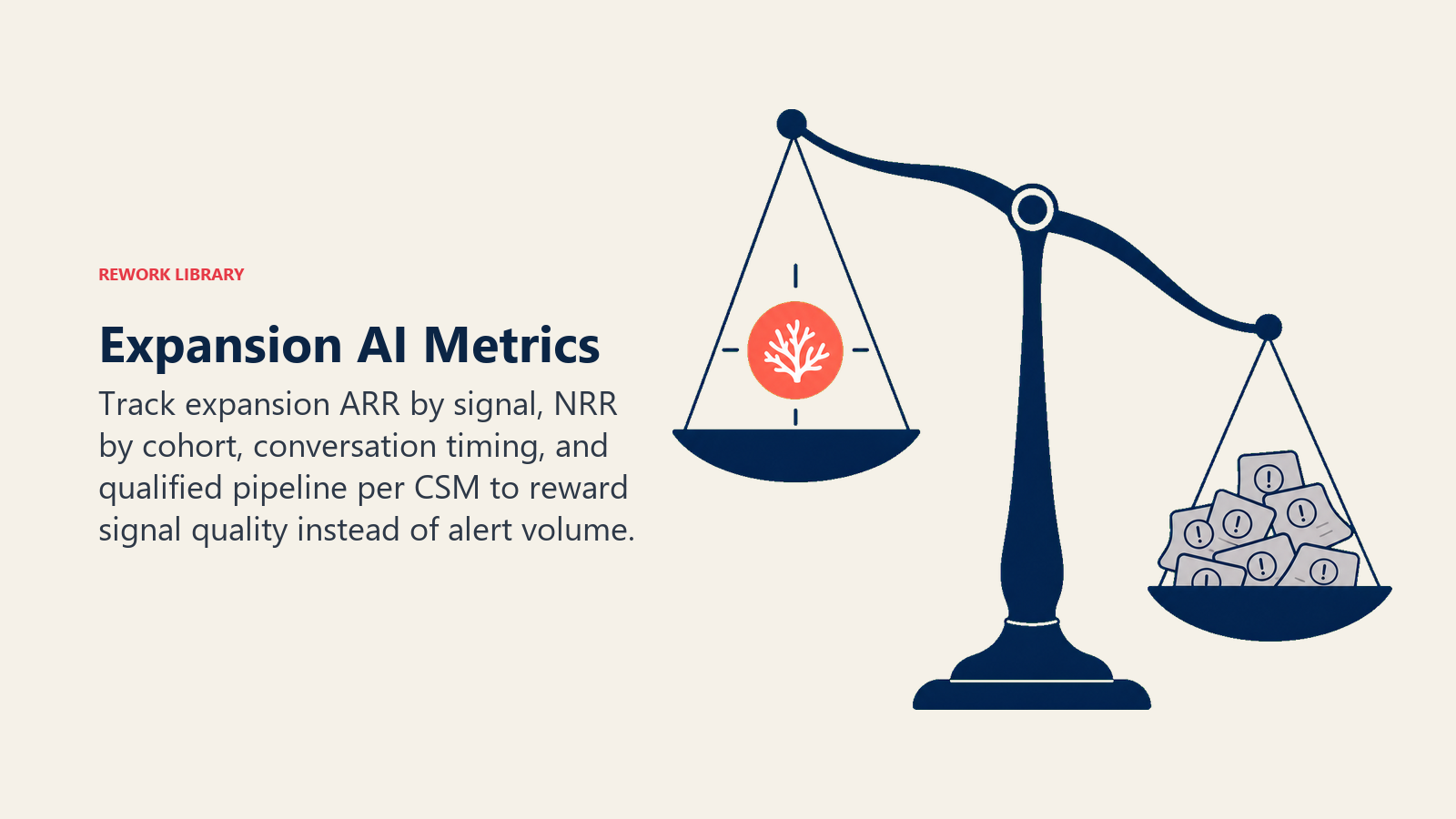
ARR de expansión por fuente de señal. ¿Qué señales condujeron realmente a expansiones cerradas? Las señales de utilización de plazas, señales de API, promociones de champion, señales de comportamiento de cross-sell deberían tener cada una su propio número de ARR de expansión cerrada.
Tendencia de NRR por cohorte. ¿Ha mejorado el NRR para las cohortes donde el modelo de expansión está activo frente a las que todavía siguen jugadas lideradas manualmente por CSMs?
Timing de conversación de expansión. ¿Qué porcentaje de conversaciones de expansión ocurrieron durante la ventana de alto engagement (90+ días antes de la renovación) frente a los últimos 60 días?
Pipeline de expansión del CSM por persona. ¿Cuántas oportunidades de expansión calificadas está trabajando cada CSM en cualquier momento? Más no siempre es mejor. Si la IA está inundando a los CSMs con señales débiles, las tasas de cierre caerán y los CSMs comenzarán a ignorar la cola.
El objetivo no son más conversaciones de expansión. Son conversaciones mejor cronometradas, mejor preparadas en cuentas que genuinamente están listas. Esa es la palanca de NRR que la IA está accionando realmente. Para las implicaciones en el modelo operativo, vea cómo la IA reformula el modelo operativo SaaS.
El Net Revenue Retention no es una métrica rezagada que lee en el informe del directorio. Es una señal prospectiva que puede gestionar activamente si el sistema correcto está observando los datos correctos. Las señales de expansión ya están en su producto. La IA las presenta. La conversación todavía es suya.
Rework Analysis: La señal de expansión que la mayoría de los equipos pierde sistemáticamente es la promoción del champion. Cuando su contacto principal en una cuenta es promovido a un rol de director o VP, dos cosas ocurren: tiene más autoridad presupuestaria y está en el modo de demostrar su nuevo rol invirtiendo en las herramientas en las que cree. Esta es la señal de expansión de mayor valor disponible. También es casi imposible detectarla a escala sin un sistema que monitoree los datos de cambios de trabajo. Un CSM que gestiona 80 cuentas no tiene forma de rastrear cada cambio de LinkedIn en su libro. La IA puede hacerlo. Los equipos que añaden el monitoreo de promoción del champion como un trigger de expansión de primera clase consistentemente lo encuentran entre sus tres señales de mayor conversión. Sin embargo, la mayoría de las implementaciones de IA de expansión lo tratan como algo secundario en comparación con las métricas de utilización de plazas.
Preguntas Frecuentes
¿Qué es el Expansion Trigger Map?
El Expansion Trigger Map es el framework de señales sobre el que opera el scoring de expansión con IA, construido a partir de tres categorías de señales: señales de producto (utilización de plazas, tendencias de volumen API, amplitud de funciones, conexiones de integraciones), señales de relación (sentimiento del CSM, NPS, estabilidad del champion y promociones) y señales comerciales (días hasta el vencimiento del contrato, uso vs. límites del contrato, historial de pagos). El mapa codifica una clave: las conversaciones de expansión desencadenadas por señales del producto cierran a aproximadamente 3x la tasa de las desencadenadas por el vencimiento del contrato, porque el timing ocurre en el pico del entusiasmo del cliente en lugar de bajo la presión de la renovación.
¿Qué NRR pueden lograr las empresas SaaS con motions de expansión con IA?
Las empresas B2B SaaS del cuartil superior superan el 120% NRR, con cuentas enterprise promediando 118% NRR. Las empresas de IA B2B que usan herramientas de análisis predictivo reportan un NRR hasta un 15% más alto que sus pares sin IA. Las mejores empresas generan más del 50% del nuevo ARR de upsells, con las empresas más grandes ($100M+ ARR) derivando el 67% del nuevo ARR total de la expansión. Las empresas con motions de expansión dedicadas logran un NRR del 15-25% más alto que las que dependen de la expansión orgánica.
¿Cuáles son las señales de expansión más fuertes para los productos SaaS?
Seis señales aparecen consistentemente en los modelos de expansión de alto rendimiento: utilización de plazas acercándose al límite del 85%+ (ventana de expansión ideal), promoción del champion a director o VP (autoridad presupuestaria más motivación de inversión), crecimiento del volumen de llamadas API de 3x o más en 60 días (expansión del caso de uso integrado), nuevas integraciones conectadas (adopción de nuevo equipo o departamento), avances de funciones clickeados 3+ veces (señala interés en funciones por encima del nivel actual) y tickets de soporte que revelan limitaciones del plan ("no podemos agregar otro usuario"). La promoción del champion es consistentemente la señal de mayor conversión pero más frecuentemente ignorada.
¿Cómo cronometra la IA las conversaciones de expansión correctamente?
La ventana de expansión se abre cuando un cliente alcanza un alto engagement con el nivel actual y se cierra cuando la presión de la renovación se activa. El monitoreo con IA observa el pico de engagement (alta utilización, crecimiento del uso, exploración de funciones) y desencadena la conversación de expansión en ese pico en lugar de esperar a la renovación del contrato. Las conversaciones de expansión proactivas a 90+ días antes de la renovación cierran a aproximadamente 3x la tasa de las conversaciones desencadenadas por el calendario de renovación en lugar de señales del producto.
¿Cuál es la diferencia entre las señales de upsell y las de cross-sell?
Las señales de upsell indican preparación para pasar a un nivel superior del mismo producto: hacer clic regularmente en avances de funciones, alcanzar los límites del plan, tickets de soporte preguntando sobre funciones disponibles en el siguiente nivel. Las señales de cross-sell indican preparación para un producto adyacente: un equipo que usa un CRM construyendo soluciones alternativas de gestión de proyectos dentro de él (necesita un módulo Work Ops), o un equipo que usa herramientas de captura de leads preguntando a su CSM sobre el seguimiento de deals (necesita un módulo Sales Ops). Las señales de cross-sell son de comportamiento en lugar de impulsadas por límites del producto, requiriendo que la IA observe los patrones de uso fuera de la categoría del producto.
¿Debería la IA de expansión impulsar conversaciones a cuentas con salud amarilla?
No. El Expansion Trigger Map incluye una puerta de salud: una cuenta debe tener un health score verde antes de que las señales de expansión se presenten al CSM. Una cuenta con salud amarilla o roja debería recibir primero una jugada de recuperación, no un pitch de expansión. Impulsar la expansión a cuentas en riesgo daña la relación y reduce las tasas de éxito de las jugadas de recuperación. Los sistemas deben compartir datos: la capa de health scoring controla la capa de expansión.
Relacionado:

Co-Founder, Rework.com
On this page
- La Ecuación del NRR y Dónde Interviene la IA
- Tipos de Señales de Expansión
- Señales de Upsell Específicamente
- Señales de Cross-Sell Específicamente
- El Expansion Trigger Map
- Cómo la IA Puntúa la Preparación para la Expansión
- El Flujo de Trabajo del Expansion Playbook
- Contexto de Rework: Cross-Sell Entre Líneas de Producto
- El Factor Timing
- Conexión con el Stack de Retención más Amplio
- Qué Medir