Buyer Intent Signal Synthesis mit KI
Turn this article into takeaways for your work.


Each assistant summarizes the article only for you and suggests best practices for your work.
Fit sagt Ihnen, wer kaufen könnte. Intent sagt Ihnen, wer kauft.
Ihr ICP-Modell identifiziert 4.000 Accounts, die auf firmografischen und technografischen Dimensionen zu Ihrem Ideal Customer Profile passen. Umsatzbereich, Mitarbeiterzahl, Tech-Stack, Branche. Alle diese Accounts sind plausible Käufer. Aber zu jedem gegebenen Zeitpunkt evaluieren vielleicht 200 von ihnen aktiv einen Kauf in Ihrer Kategorie. Diese 200 Accounts sind diese Woche Ihre Outbound-Bemühungen wert. Die anderen 3.800 können warten.
Das Problem ist herauszufinden, welche 200 es sind. Intent-Daten sind die Antwort, aber rohe Intent-Signale sind überwältigend. Ein einziger Drittanbieter für Intent-Daten könnte 600 Accounts pro Woche für Ihre Kategorie markieren. G2-Reviews, Preisseitenbesuche, Wettbewerberrecherche, Content-Downloads, Konferenzteilnahmen und Änderungen bei Stellenausschreibungen fügen jeweils Signale hinzu. Ohne Synthese ertrinkt Ihr Team in Rauschen.
KI synthetisiert Intent-Signale aus mehreren Quellen in einen einheitlichen In-Market-Score mit einer Begründung. Das macht das Signal umsetzbar. Dieser Artikel behandelt die Signal-Taxonomie, wie Synthese technisch funktioniert, die Anbieterlandschaft und das False-Positive-Problem, dem jedes Intent-getriebene Programm letztlich begegnet. The Forrester Wave for Intent Data Providers for B2B, Q1 2025 bewertet die wichtigsten Anbieter und stellt fest, dass Signal-Synthese über mehrere Quellen nach wie vor der entscheidende Unterschied zwischen Führern und Nachzüglern ist. Für das zugrundeliegende ACE-Muster, das dies antreibt, siehe Generative Research: Compressing Hours of Reading.
First-Party-, Second-Party- und Third-Party-Intent-Signale
Key Facts: Buyer Intent Data und ihre Auswirkung auf B2B-Vertrieb
- Unternehmen, die Intent-Daten in ihren Pipeline-Prozess integrieren, erzielen 37 % höhere Lead-Konversionsraten bei gleichzeitiger Reduzierung der Akquisitionskosten um 25 %. (The Insight Collective, 2025)
- Teams, die innerhalb von 48 Stunden auf Intent-Signale reagieren, erzielen 4-mal höhere Konversionsraten als Teams, die nach dem 48-Stunden-Fenster antworten. (Landbase, 2025)
- 93 % der B2B-Marketer berichten von Verbesserungen der Konversionsrate bei der Implementierung von Intent-basierten Targeting-Strategien. (Shortlister, 2025)
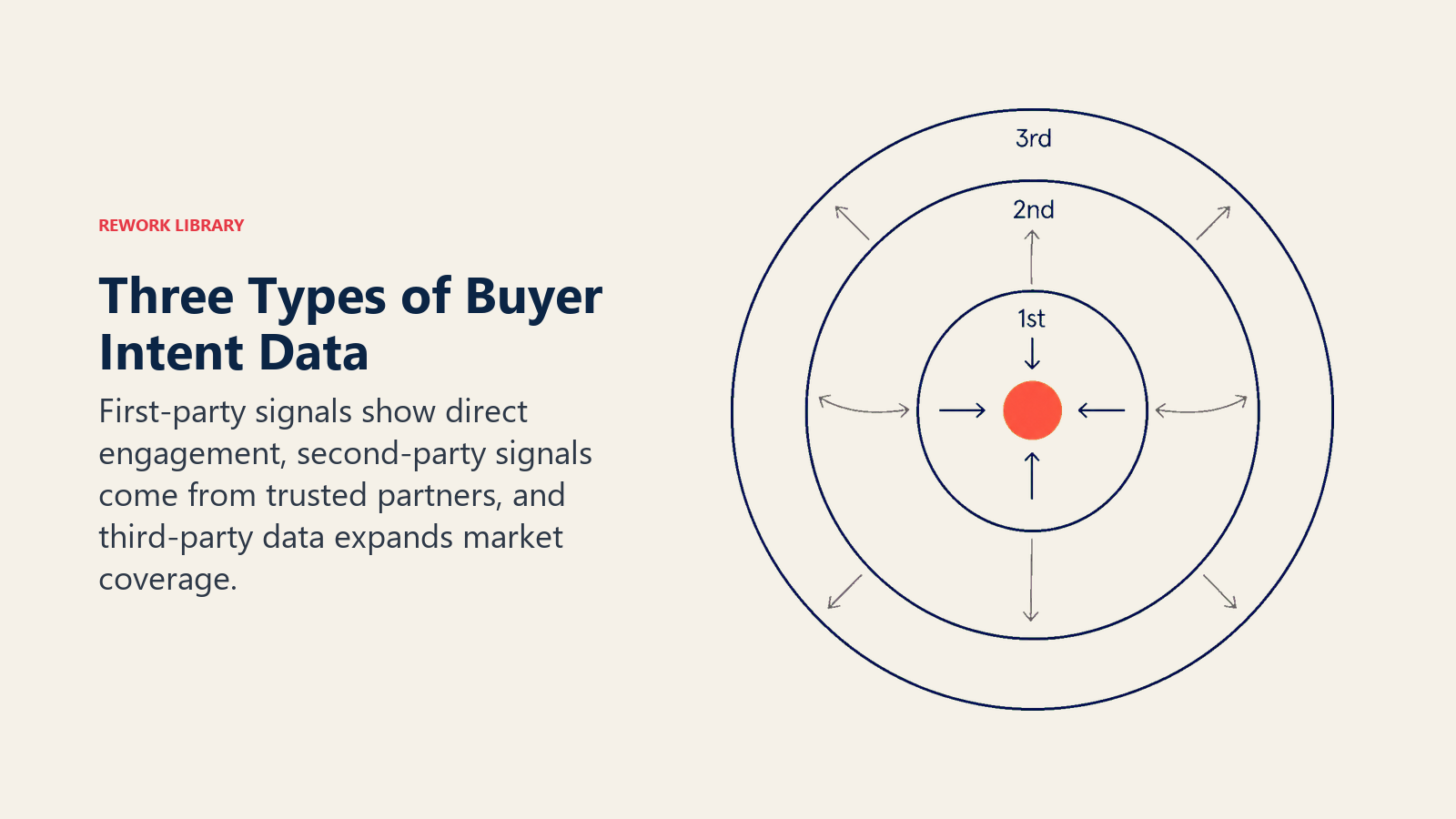
Nicht alle Intent-Signale kommen von demselben Ort. Die Taxonomie zu verstehen ist die Voraussetzung dafür, zu verstehen, warum Synthese wichtig ist.
First-Party-Signale
Das sind Signale von Ihren eigenen Kanälen. Der Account interagiert direkt mit Ihnen.
- Preisseitenbesuche (hoher Intent, besonders mehrere Besuche in einem kurzen Zeitfenster)
- Free-Trial-Starts oder Product-Qualified-Lead-Aktionen
- Dokumentations- oder Integrationsseiten (signalisiert laufende Evaluierung)
- Demo-Anfrage-Formular-Starts oder -Abbrüche
- Webinar-Registrierungen in einem bestimmten Produktbereich
- E-Mail-Öffnungs- und Klickmuster in Vertriebssequenzen
First-Party-Signale sind die Signale mit der höchsten Konfidenz, die Sie haben, weil Sie die Daten besitzen und der Kontext spezifisch für Ihr Produkt ist. Die Einschränkung ist die Abdeckung: First-Party-Signale sagen Ihnen nur etwas über Accounts, die Sie bereits gefunden haben. Sie identifizieren keine Accounts, die Ihre Kategorie evaluieren, die Ihre Website aber noch nicht besucht haben.
Second-Party-Signale
Das sind Signale von Partnern oder Kooperationen, wo Unternehmen Intent-Daten direkt teilen.
- G2 Buyer Intent: Accounts, die Ihre Auflistung oder Wettbewerberauflistungen auf G2 betrachten
- LinkedIn-Aktivität: Accounts, bei denen mehrere Mitarbeiter Ihre Unternehmensseite besucht oder mit Inhalten interagiert haben
- Kategoriespezifische Data Co-ops, wo Unternehmen Verhaltensdaten miteinander teilen
Second-Party-Signale erweitern Ihre Abdeckung auf Accounts, die die Kategorie recherchieren, aber noch nicht direkt mit Ihrer Website interagiert haben. G2 Buyer Intent ist die am weitesten verbreitete Quelle in B2B SaaS, weil Kategorierecherche auf G2 ein zuverlässiges Signal für eine aktive Evaluierung ist. Ein Account, bei dem 3 Mitarbeiter in einem 10-Tage-Fenster die G2-Auflistungen Ihrer Wettbewerber angesehen haben, führt eindeutig vergleichende Recherche durch.
Third-Party-Signale
Das sind Signale von externen Datenanbietern, die das Verhalten im breiteren Web überwachen.
- Bombora: verfolgt Content-Konsum über eine Co-op von 5.000+ B2B-Sites und markiert Accounts, die "Topic Surges" in relevanten Kategorien zeigen
- 6sense: prädiktiver Intent unter Verwendung von KI, um In-Market-Accounts aus anonymen Kaufsignalen zu modellieren
- TechTarget Priority Engine: überwacht Recherche-Aktivitäten auf TechTarget-Portalen
- DemandBase: Account-Identifikation plus Intent-Signal-Aggregation
- ZoomInfo Intent: Web-Recherche-Signale plus dem ZoomInfo-Datengraph
Third-Party-Signale haben die breiteste Abdeckung und das niedrigste Signal-zu-Rausch-Verhältnis. Ein Account, der auf einem Bombora-Intent-Thema "surgt", könnte aus Gründen recherchieren, die nichts mit dem Kauf zu tun haben: eine Wettbewerberanalyse, ein internes Schulungsprojekt, ein Journalist, der einen Artikel schreibt. Das Signal ist probabilistisch, nicht deterministisch.
| Signaltyp | Abdeckung | Konfidenz | Kosten | Am besten für |
|---|---|---|---|---|
| First-Party | Accounts, die Sie gefunden haben | Hoch | Minimal (Sie besitzen es) | Bottom-of-Funnel-Priorisierung |
| Second-Party (G2) | Accounts in der Kategorie | Mittel-hoch | Moderat | Mid-Funnel, Wettbewerberbewusstsein |
| Third-Party (Bombora/6sense) | Breiter Markt | Niedrig-mittel | Höher | Top-of-Funnel-Entdeckung |
| Stellenausschreibungen | Öffentlich | Mittel | Niedrig (Scraping) | Budget- und Personalsignale |
| Earnings-Call-Signale | Öffentliche Unternehmen | Hoch (kontextuell) | Variiert | Enterprise-strategische Recherche |
Das Signal-Synthese-Problem
Hier ist die Kerntechnische Herausforderung: Jede Quelle gibt Ihnen ein Fragment des Bildes.
Ein Account könnte moderaten Bombora-Intent zeigen (er liest Kategorie-Content), kein First-Party-Signal (er hat Ihre Website nicht besucht), einen G2-Wettbewerber-Auflistungs-Aufruf (er macht vergleichende Recherche) und eine aktuelle Stellenausschreibung für einen "Head of Revenue Operations" (er baut die Funktion auf, die Ihr Produkt kaufen würde). Keines dieser Signale allein überschreitet eine Schwelle. Zusammen erzählen sie eine kohärente Geschichte: Dieses Unternehmen evaluiert, ob es seinen RevOps-Stack formalisieren soll, wahrscheinlich in den nächsten 90 Tagen.
KI-Synthese kombiniert Signale über Quellen hinweg, um Accounts zu identifizieren, bei denen das Gesamtbild überzeugend ist, auch wenn keine einzelne Quelle ein klares Signal liefert.
Die Synthese-Pipeline im ACE-Framework:
Ingest sammelt Signale aus allen verbundenen Quellen. Intent-Feeds über API (Bombora, 6sense), CRM-First-Party-Event-Tracking, G2-Integration und alle benutzerdefinierten Signale (Stellenausschreibungs-Scraper, LinkedIn-Monitoring). Jedes Signal kommt mit einem Zeitstempel, einer Quelle, einem Account-Identifier und einem Signaltyp an. Die Ingest-Fähigkeit behandelt, wie Multi-Source-Datensammlung auf dieser Grundlagenebene funktioniert.
Analyze normalisiert, gewichtet und dedupliziert. Dasselbe Unternehmen könnte in einem Feed als "Acme Corp" und in einem anderen als "Acme Corporation" erscheinen. Account-Matching ist die erste Aufgabe. Dann Gewichtung: Nicht alle Signale tragen die gleichen Informationen. Ein Preisseitenbesuch gestern wird stärker gewichtet als ein Whitepaper-Download vor drei Monaten. Und Aktualitätsabfall: Signale, die älter als 90 Tage sind, werden im Modell typischerweise erheblich abgezinst.
Generate produziert einen In-Market-Score (eine Zahl, die die Wahrscheinlichkeit einer aktiven Evaluierung repräsentiert) und ein Begründungs-Brief. Die Begründung ist das, was KI-Synthese von einem rohen Score trennt: "Dieser Account zeigt Intent, weil: Preisseite 3-mal in 7 Tagen besucht, 2 Mitarbeiter haben Wettbewerber-G2-Auflistungen angesehen, Bombora Topic Surge auf 'Sales Analytics Software'. Kombinierter Score: 84. Empfohlene Aktion: Priorisierung für direkten Outreach durch Account Executive (AE) innerhalb von 48 Stunden."
Die Begründung ist das, was der Rep tatsächlich liest. Eine Zahl allein sagt dem Rep nicht, warum er anrufen soll. Die Begründung gibt ihm den Einstieg.
Wie Aktualitäts- und Signalstärke-Gewichtung funktioniert
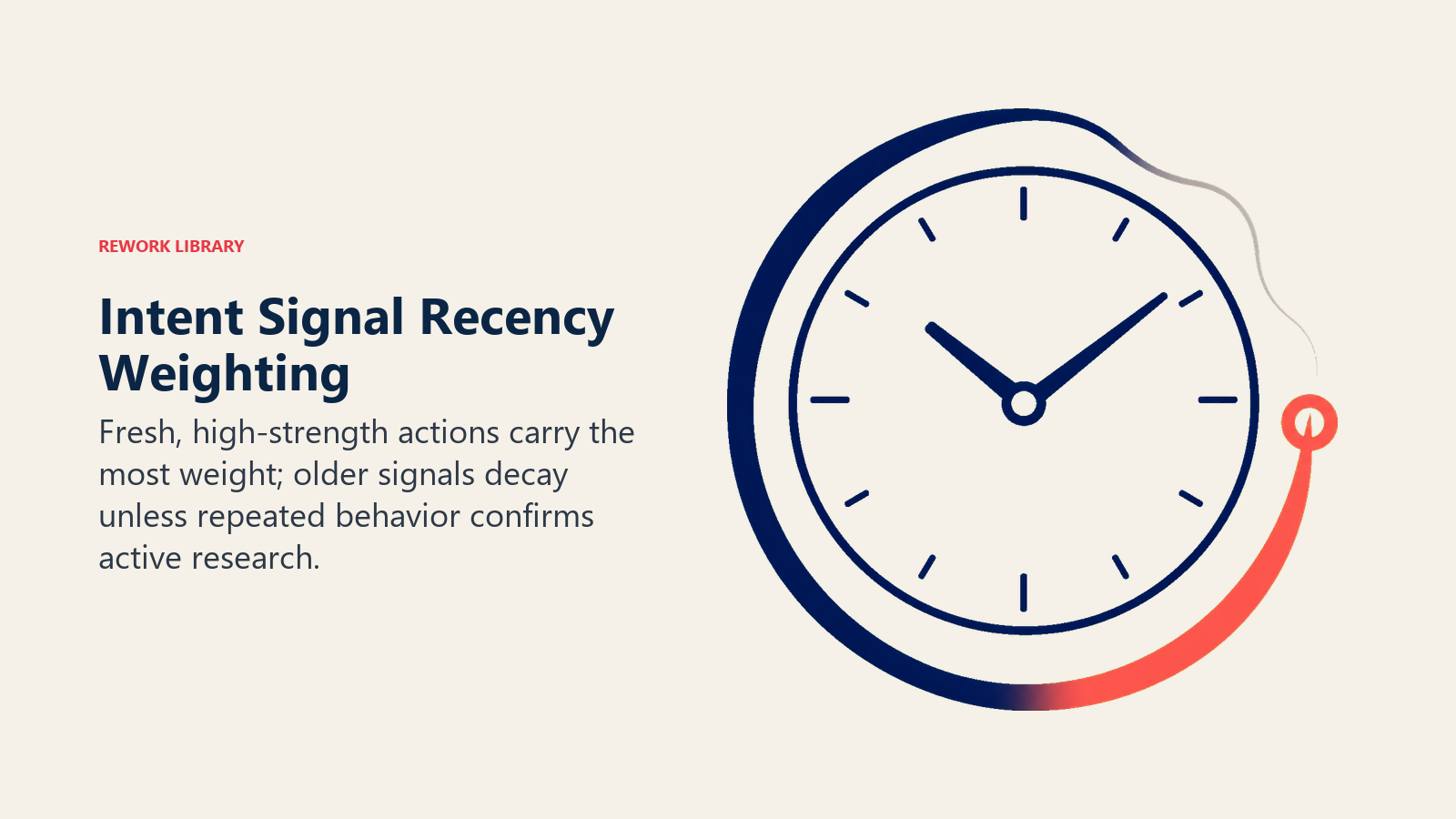
Intent-Signale zerfallen. Ein Account, der vor 6 Monaten ein Whitepaper heruntergeladen hat, war damals interessiert. Er könnte bereits einen Wettbewerber gekauft haben. Er könnte die Initiative aufgeschoben haben. Er könnte vergessen haben, dass er es jemals heruntergeladen hat.
Aktualitätsabfall in der Intent-Synthese funktioniert so: Signale werden durch eine Abfallfunktion basierend auf dem Alter gewichtet. Ein gängiges Modell verwendet exponentiellen Abfall, bei dem das Gewicht eines Signals sich alle 30 Tage halbiert. Ein Preisseitenbesuch gestern hat volles Gewicht. Derselbe Besuch vor 30 Tagen hat halbes Gewicht. Vor 90 Tagen hat er ein Achtel des Gewichts.
Signalstärke-Gewichtung ist von der Aktualität getrennt. Einige Signale sind von Natur aus stärker als andere, unabhängig davon, wann sie aufgetreten sind:
- Demo-Anfrage-Formular-Start: sehr stark (expliziter Kaufintent)
- Preisseitenbesuch: stark (Kosten evaluieren)
- G2-Wettbewerber-Vergleich: stark (vergleichendes Shopping)
- Blog-Post lesen: schwach (Awareness-Level-Content-Konsum)
- Bombora Topic Surge: moderat (Kategorieinteresse, nicht produktspezifisch)
Das Synthesemodell kombiniert Aktualitätsabfall mit Signalstärke. Ein Account mit einem Preisseitenbesuch heute plus 2 G2-Wettbewerber-Aufrufen diese Woche erzielt einen höheren Score als ein Account mit 10 Blog-Post-Lesungen über die letzten 60 Tage. Diese Unterscheidung ist für die Priorisierung wichtig.
Die meisten dedizierten Intent-Plattformen (6sense, Bombora) bauen diese Modelle intern auf. Wenn Sie Signale selbst über ein Tool wie Clay oder eine benutzerdefinierte Datenpipeline verbinden, müssen Sie die Gewichtungslogik explizit definieren. Die Standardeinstellung, alle Signale gleich zu behandeln, produziert eine laute Priorisierung.
Intent-Scores mit Routing und Aktion verbinden
Ein synthetisierter Intent-Score, der in einer Datenbank sitzt, tut nichts. Der Execute-Schritt ist das, was das Signal in eine Sales Motion umwandelt.
Wenn ein Account eine definierte Intent-Schwelle überschreitet (sagen wir, einen kombinierten Score über 75), sollte das System:
- Den Account im CRM mit einem Intent-Alert und dem Begründungs-Brief markieren
- Prüfen, ob der Account bereits in einem aktiven Deal oder einer Sequence ist
- Falls nicht in Bewegung, einen Alert an den besitzenden SDR oder AE mit der empfohlenen Aktion auslösen
- Falls Account-Routing-Regeln gelten (der Account gehört zu einem bestimmten Territorium oder ist ein bestehender Kunde), an den entsprechenden Verantwortlichen weiterleiten
AI Lead Scoring Beyond Rules-Based Models behandelt die Scoring-Mechanik ausführlich. Der Routing-Schritt hier ist spezifischer: Intent-Signale kommen oft für Accounts an, die nicht in den normalen eingehenden Lead-Flow passen -- Accounts, die kalt waren, bevor das Signal erschien. Ihre Routing-Regeln müssen diesen Fall behandeln.
Real-Time Account Tier Reassignment With AI beschreibt, wie Intent-Signale dynamische Account-Tier-Änderungen auslösen können und einen Account von Cold-Outreach zu priorisierter AE-Betreuung verschieben, ohne auf einen vierteljährlichen Planungszyklus zu warten.
Intent-Anbieter-Vergleich
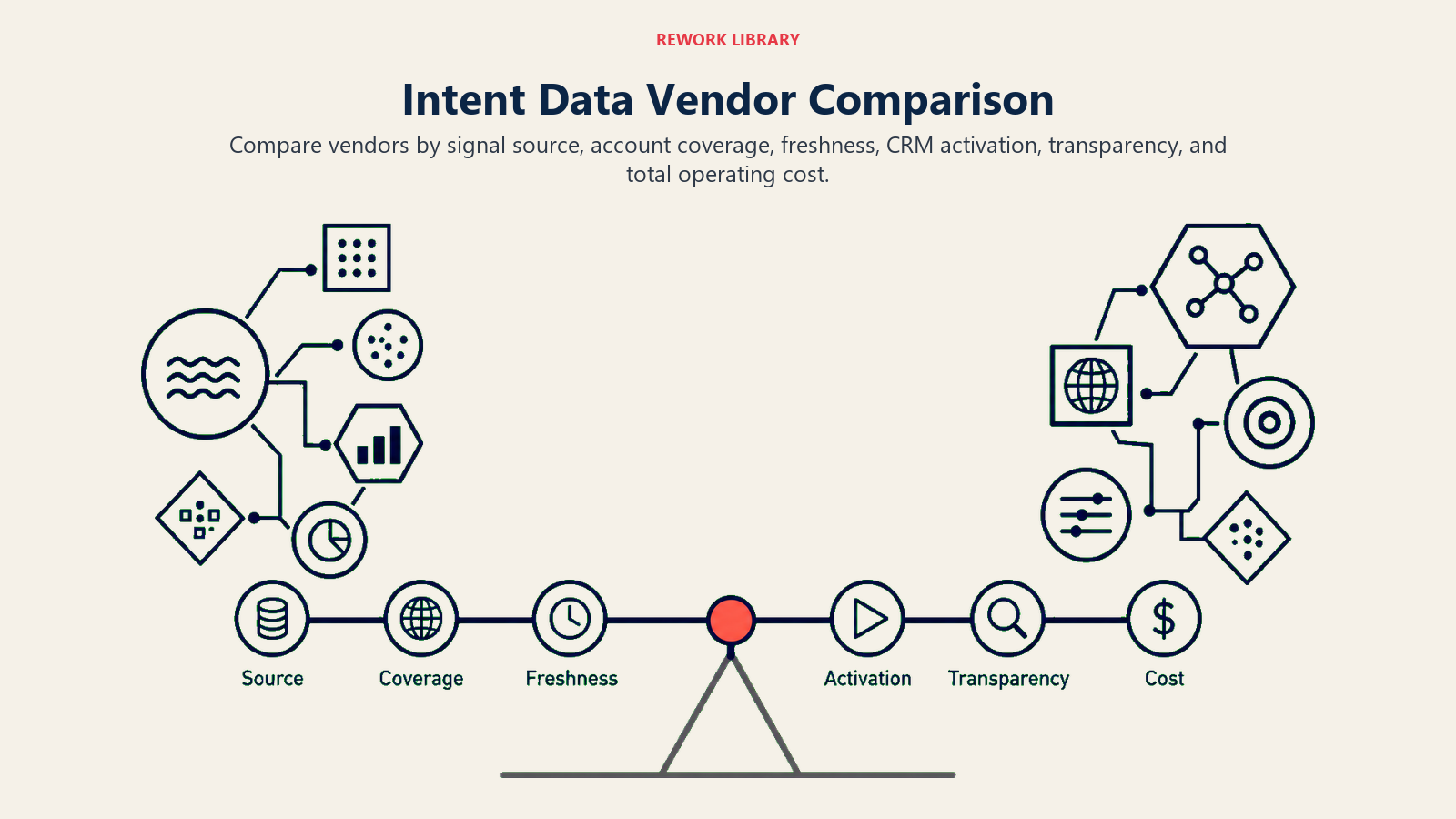
Sechs Anbieter dominieren den B2B-Intent-Daten-Markt. Jeder hat unterschiedliche Signalabdeckung, Anwendungsfälle und Kostenstrukturen.
Bombora ist die Grundlage der meisten Intent-Stacks. Ihre "Company Surge"-Daten überwachen den Content-Konsum über eine Co-op von 5.000+ Business-Content-Sites. Stark für breite Kategorierecherche-Signale. Integriert mit Salesforce, HubSpot und den meisten Customer Data Platforms (CDPs). Preisgestaltung ist Enterprise-Vertrag, typischerweise 2.000 bis 6.000 Dollar/Monat je nach Themen und Account-Volumen.
6sense geht über rohe Signale hinaus, um prädiktive In-Market-Accounts zu erstellen. Ihr KI-Modell versucht zu identifizieren, in welchem Stadium der Kaufreise sich Accounts befinden, nicht nur, welche davon Content konsumieren. Stark für Accounts, die ihr Web-Verhalten anonymisiert haben. Höhere Kosten und mehr Implementierungskomplexität. Am geeignetsten für Teams mit dedizierter RevOps-Kapazität.
DemandBase kombiniert Account-Identifikation (anonyme Website-Besucher mit Unternehmen verbinden) mit Intent-Daten. Stark für First-Party-Intent-Anreicherung: Wissen, welches Unternehmen auf Ihrer Website ist, noch bevor es ein Formular ausfüllt. Bietet auch Third-Party-Intent über seinen eigenen Datengraph.
G2 Buyer Intent zeigt Unternehmen, die Ihre G2-Auflistung, Wettbewerber-Auflistungen und Kategorieseiten recherchieren. Einzigartiger Wert, weil G2-Recherche spezifisch für Software-Evaluierung ist. Hohe Signalqualität, begrenzt auf G2-Plattform-Verhalten. Natürlicher Fit für SaaS-Unternehmen. Moderate Kosten; integriert direkt mit großen CRMs.
TechTarget Priority Engine ist domänenspezifisch für Technologiekäufe. Starke Abdeckung von Enterprise-IT-Evaluierungen. Am nützlichsten für Technologieanbieter, die an IT- und Engineering-Käufer verkaufen.
ZoomInfo Intent kombiniert seinen firmografischen Datengraph mit Intent-Signalen aus überwachten Web-Quellen. Praktisch, wenn Ihr Team bereits ZoomInfo für Prospecting nutzt. Die Intent-Datenqualität wird von Praktikern allgemein unter Bombora und 6sense eingestuft, aber die Datenkonsolidierung ist attraktiv.
B2B-Käufer führen durchschnittlich 12 Online-Suchen durch, bevor sie die Website einer bestimmten Marke besuchen, und 81 % der Vertriebsmitarbeiter beobachten, dass Käufer Anbieter zunehmend vor dem Erstkontakt recherchieren. (Gartner, 2025) Wenn ein First-Party-Signal ausgelöst wird (ein Preisseitenbesuch), hat der Käufer in der Regel bereits umfangreiche Wettbewerberrecherche über Kanäle durchgeführt, die Sie nicht sehen können.
Der Fit-Times-Intent-Quadrant
Der Fit-Times-Intent-Quadrant ist ein Zwei-Achsen-Priorisierungsmodell, das Accounts nach ICP-Fit (hoch vs. niedrig) auf einer Achse und Intent-Signalstärke (hoch vs. niedrig) auf der anderen aufzeichnet. Die vier resultierenden Quadranten produzieren unterschiedliche empfohlene Aktionen: hoher Fit plus hoher Intent bedeutet sofortige Priorisierung; hoher Fit plus niedriger Intent bedeutet systematisches Nurturing; niedriger Fit plus hoher Intent bedeutet qualifizieren, bevor AE-Zeit gebunden wird; und niedriger Fit plus niedriger Intent bedeutet nicht priorisieren. Teams, die vor dem Handeln auf Intent-Signale den Fit-Filter anwenden, wandeln 2-3-mal mehr intent-getriggerte Opportunities um als Teams, die alle hochintensiven Signale als gleich umsetzbar behandeln.
Der Fit-Times-Intent-Quadrant
Priorisierung wird klar, wenn Sie sie auf zwei Achsen aufzeichnen: ICP-Fit (hoch vs. niedrig) und Intent-Signal (hoch vs. niedrig).
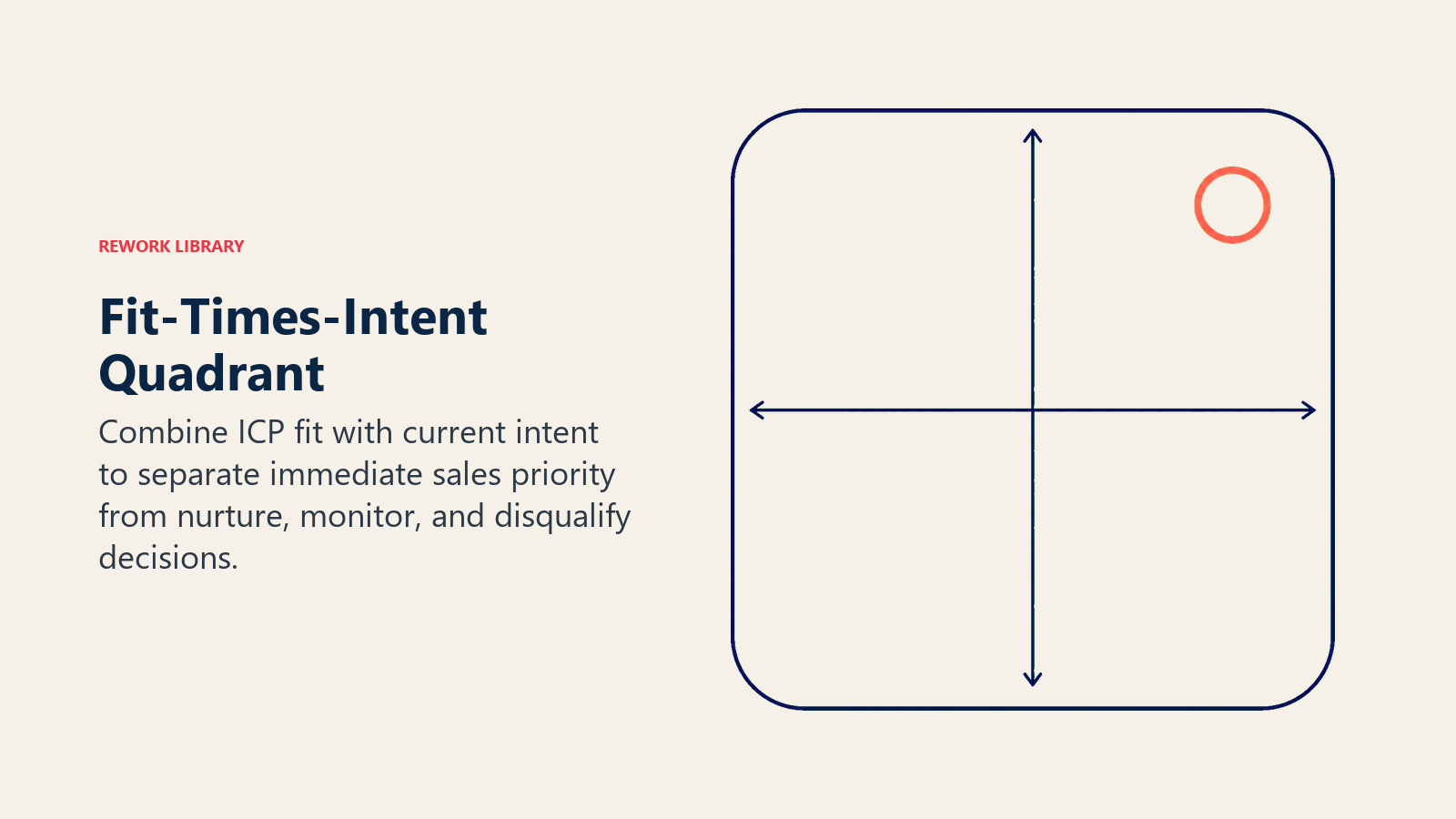
Hoher Fit, hoher Intent: Sofort priorisieren. Diese Accounts passen zu Ihrem ICP und evaluieren aktiv. Jeder Rep sollte diese Accounts diese Woche namentlich kennen. Der erste Kontakt sollte personalisiert und direkt sein.
Hoher Fit, niedriger Intent: Systematisch nurturieren. Das ist das richtige Unternehmen, aber es kauft noch nicht. Sichtbar bleiben mit relevanten Inhalten und Account-Kontakten. Gartners Forschung zu ABM Best Practices mit Intent-Daten empfiehlt einen gestaffelten Kadenz-Ansatz für das Nurturing von High-Fit-Low-Intent-Accounts. KI-generierter personalisierter Outreach in großem Maßstab behandelt automatisiertes Nurturing auf dieser Stufe.
Niedriger Fit, hoher Intent: Vorsichtig vorgehen. Sie kaufen, aber wahrscheinlich nicht Ihre Lösung. Einen schnellen Qualifikationsanruf wert, um zu verstehen, ob es einen Use Case gibt, der die Fit-Lücke überbrückt. Keine AE-Zeit binden, bis die Qualifikation den Fit bestätigt.
Niedriger Fit, niedriger Intent: Nicht priorisieren. Outbound an diese Accounts ist in der Regel Kosten ohne Rendite.
Der häufigste Fehler in Intent-getriebenen Vertriebsprogrammen ist es, "hohen Intent" als ausreichend für die Priorisierung zu behandeln, ohne den Fit-Filter anzuwenden. Ein Account mit massiven Intent-Signalen, der nicht zu Ihrem ICP passt, ist eine Verschwendung von SDR-Zeit.
Das False-Positive-Problem
Intent-Daten werden Ihr Team nach Accounts jagen, die nicht wirklich kaufen. Akzeptieren Sie das als Designbeschränkung, nicht als Produktversagen.
Mitarbeiter eines Unternehmens, die Ihre Kategorie recherchieren, könnten:
- Eine Branchenanalyse für interne Strategie schreiben
- Wettbewerberrecherche im Namen eines Unternehmens in Ihrem Bereich betreiben
- Ein Forscher oder Analyst sein, der einen Marktbericht vorbereitet
- Die Kategorie evaluieren, um nicht zu kaufen (um den weiteren Einsatz ihrer aktuellen Lösung zu rechtfertigen)
Das Signal ist real. Der Kaufintent vielleicht nicht.
Wie man die False-Positive-Rate managt:
Konversions-Tracking für Intent-getriggerten Outreach einrichten. Verfolgen, welcher Prozentsatz der Accounts, die Intent-Alerts ausgelöst haben, tatsächlich zu qualifizierten Opportunities konvertiert sind. Wenn die Rate unter 10 % liegt, ist Ihre Schwelle zu niedrig, Ihre Signalgewichtung falsch, oder Sie filtern nicht nach Fit.
Einen leichten Qualifikationsschritt vor AE-Zeit einbauen. Eine SDR-E-Mail oder ein Telefonat zur Qualifikation von Intent vor dem Routing an einen AE spart AE-Kapazität beim Signal-zu-Rausch-Verhältnis-Problem.
Abgelehnte Intent-Alerts überprüfen. Wenn ein SDR oder AE einen Intent-Alert ohne Aktion ablehnt, den Grund erfassen. Muster in Ablehnungsgründen decken Schwächen in Ihrer Syntheselogik auf.
Reps auf probabilistisches Framing schulen. Hoher Intent bedeutet höhere Wahrscheinlichkeit einer aktiven Evaluierung, keine Gewissheit. Reps, die Intent-Signale als garantierte Pipeline behandeln, bereiten sich auf Frustration vor. Reps, die sie als Priorisierungsinputs behandeln, verhalten sich effektiver.
KI-Account-Recherche vor dem ersten Kontakt behandelt, wie man ein Intent-Signal mit Account-Recherche validiert, bevor man sich meldet, und ein probabilistisches Signal in eine sicherere Entscheidung umwandelt.
Mit Intent-Synthese anfangen
Für Teams, die keinen vollständigen Multi-Source-Intent-Stack haben:
Mit First-Party beginnen. Ihre Website ordentlich instrumentieren. Wissen, welche Accounts welche Seiten besuchen. Tools wie Clearbit Reveal, 6sense oder DemandBase identifizieren das Unternehmen hinter anonymen Website-Besuchen. Das ist günstiger als Third-Party-Intent und hat eine höhere Signalqualität.
Eine Third-Party-Quelle hinzufügen. Entweder G2 Buyer Intent (wenn Sie ein SaaS-Unternehmen mit G2-Präsenz sind) oder Bombora (wenn Sie eine breitere Kategorieabdeckung möchten). Nicht gleichzeitig vier Intent-Anbieter abonnieren; Sie erzeugen mehr Rauschen als Signal, bevor Sie wissen, wie man einen davon gut nutzt.
Ihre Syntheselogik explizit definieren. Selbst wenn Sie Signale anfangs manuell in einer Tabellenkalkulation kombinieren, dokumentieren, wie Sie sie gewichten. Das wird die Spezifikation für das automatisierte System, das Sie später aufbauen.
Eine Schwelle festlegen und Konversion messen. Einen kombinierten Intent-Score wählen, der eine Outbound-Aktion auslöst, verfolgen, was passiert, und die Schwelle vierteljährlich basierend auf Konversionsdaten anpassen.
Das zugrundeliegende Muster ist Generative Research plus Scoring and Routing. Signalsammlung, Synthese, Score-Generierung und Aktions-Routing. Die Predict-Fähigkeit des ACE-Frameworks ist hier zentral: Das Synthesemodell ist im Wesentlichen eine Vorhersage des In-Market-Status aus verfügbaren Signalen.
Fit und Intent zusammen ist die umsetzbarste Kombination in KI-gestützter Vertriebspriorisierung. Keines allein sagt Ihnen genug. Fit ohne Intent ist eine statische Liste potenzieller Käufer. Intent ohne Fit ist Rauschen. Kombiniert und synthetisiert geben sie Ihnen die 200 Accounts, die diese Woche einen Anruf wert sind. Forresters Framework für die Bewertung von Intent-Daten-Anbietern bietet einen praktischen Ausgangspunkt für Teams, die einen Multi-Source-Synthese-Stack aufbauen: Es identifiziert, welche Signaltypen umsetzbare Ergebnisse produzieren gegenüber solchen, die Rauschen ohne Fit-Qualifikationsschicht erzeugen.
Rework Analysis: In Rework-Deployments ist der zuverlässigste Intent-Stack für Mid-Market-B2B-SaaS die Kombination aus drei Quellen: First-Party-CRM-Aktivität (Preisseite, Docs, Integrationsseiten), G2 Buyer Intent (Kategorievergreichs-Signale) und einem breiten Third-Party-Anbieter (Bombora oder 6sense). Das Hinzufügen einer vierten Quelle, bevor die ersten drei kalibriert sind, erhöht typischerweise das Rauschen, ohne das Signal-zu-Konversions-Verhältnis zu verbessern. Kalibrieren Sie zuerst die 48-Stunden-Antwort-Schwelle, dann erweitern Sie die Abdeckung.
| Intent-Quelle | Signal-Zuverlässigkeit | Typische False-Positive-Rate | Am besten für |
|---|---|---|---|
| First-Party Preisseite | Sehr hoch | Unter 15 % | Bottom-Funnel-Dringlichkeit |
| G2 Wettbewerber-Vergleich | Hoch | 20-25 % | Wettbewerbsevaluierung |
| Bombora Topic Surge | Mittel | 35-45 % | Top-Funnel-Entdeckung |
| Stellenausschreibung (RevOps/Sales Ops) | Mittel | 30-40 % | Budget- und Personalsignale |
| LinkedIn Unternehmensseiten-Aufrufe | Niedrig-mittel | 40-50 % | Nur Awareness-Level-Signal |
Häufig gestellte Fragen
Was sind Buyer Intent-Daten und wie werden sie im B2B-Vertrieb genutzt?
Buyer Intent-Daten sind Verhaltens-Signaldaten, die anzeigen, wann ein Unternehmen aktiv eine Kaufkategorie recherchiert. Sie stammen aus drei Quelltypen: First-Party-Signale (Ihre eigenen Website-Besuche, Trial-Starts, Preisseitenaufrufe), Second-Party-Signale (G2-Auflistungsaufrufe, Kategorierecherche auf Review-Plattformen) und Third-Party-Signale (Bombora, 6sense, die den Content-Konsum über Tausende von B2B-Sites überwachen). Sales-Teams nutzen synthetisierte Intent-Scores, um zu priorisieren, welche Accounts diese Woche kontaktiert werden sollen vs. welche über Zeit zu nurturieren sind.
Wie sehr verbessert schnelles Handeln auf Intent-Signale die Konversionsraten?
Teams, die innerhalb von 48 Stunden auf Intent-Signale reagieren, erzielen laut Landbase-Forschung 4-mal höhere Konversionsraten als Teams, die nach dem Zeitfenster antworten. Diese Dringlichkeit ist wichtig, weil Intent-Signale vergänglich sind: Ein Account, der diese Woche Ihre Kategorie aktiv evaluiert, könnte die Evaluierung abschließen oder sich für einen Wettbewerber entscheiden, wenn Outreach in Woche drei statt an Tag zwei ankommt.
Was ist der Fit-Times-Intent-Quadrant und wie funktioniert er?
Der Fit-Times-Intent-Quadrant ist ein Zwei-Achsen-Priorisierungsmodell, das Accounts nach ICP-Fit (hoch vs. niedrig) und Intent-Signalstärke (hoch vs. niedrig) aufzeichnet. Die vier Quadranten produzieren unterschiedliche Aktionen: hoher Fit plus hoher Intent erhält sofortige Priorisierung mit personalisiertem direkten Outreach; hoher Fit plus niedriger Intent erhält systematisches Nurturing; niedriger Fit plus hoher Intent erhält schnelle Qualifikation, bevor AE-Zeit gebunden wird; niedriger Fit plus niedriger Intent wird vollständig de-priorisiert. Das Framework verhindert den häufigen Fehler, hochintensiven Signalen für Accounts nachzujagen, die nie konvertieren werden, weil sie nicht zum ICP passen.
Wie hoch ist die False-Positive-Rate bei Third-Party-Intent-Daten?
Third-Party-Intent-Anbieter wie Bombora sehen typischerweise False-Positive-Raten von 35-45 %, was bedeutet, dass 35-45 % der "surgenden" Accounts aus Gründen recherchieren, die nichts mit einem aktiven Kauf zu tun haben (interne Analyse, Wettbewerber-Benchmarking, Journalismus). G2 Buyer Intent ist mit 20-25 % False Positives zuverlässiger, weil Kategorierecherche auf Review-Plattformen stärker an Anbieterevaluierung gebunden ist. First-Party-Preisseitenbesuche haben die niedrigste False-Positive-Rate (unter 15 %), weil der Kontext kaufspezifisch ist.
Welche Intent-Daten-Anbieter sind am besten für B2B-SaaS-Unternehmen?
Für B2B SaaS ist G2 Buyer Intent die zuverlässigste Quelle, weil Software-Kategorierecherche auf G2 spezifisch für Anbieterevaluierung ist. Bombora ergänzt mit breiterer Kategorieabdeckung für Accounts, die noch nicht auf G2 sind. 6sense bietet prädiktives KI-Modelling, um Accounts zu identifizieren, die noch keine Verhaltens-Signale ausgelöst haben. ZoomInfo Intent ist praktisch für Teams, die bereits ZoomInfo für Prospecting nutzen, wird aber von B2B-Praktikern in der Signalqualität allgemein unter Bombora und 6sense eingestuft. Mit einer Quelle anfangen und kalibrieren, bevor mehr hinzugefügt werden.
Wie verbinden Sie Intent-Signale mit CRM-Workflow und Vertriebsaktionen?
Wenn ein Account eine definierte Intent-Score-Schwelle überschreitet, sollte das System den Account automatisch im CRM mit dem Begründungs-Brief markieren, prüfen, ob er bereits in einem aktiven Deal oder einer Sequence ist, und einen Alert an den besitzenden SDR oder AE mit einer empfohlenen Aktion auslösen. Das 48-Stunden-Antwort-Fenster ist die kritische Einschränkung: Die meisten Teams handeln nicht schnell genug auf Intent-Signale, weil es keine automatisierte Eskalation gibt. Routing-Regeln sollten High-Intent-Accounts aus Cold-Outbound genauso behandeln wie eingehende Demo-Anfragen, mit gleichwertigen Antwortzeit-Erwartungen.
Was Sie als Nächstes lesen sollten
- Generative Research: Compressing Hours of Reading: das ACE-Muster, das Multi-Source-Intent-Synthese antreibt
- KI-gestützte Account-Recherche vor dem ersten Kontakt: Intent-Signale mit Account-Recherche validieren, bevor Sie sich melden
- AI Lead Scoring Beyond Rules-Based Models: wie Intent-Signale in das breitere Lead-Scoring-Modell fließen
- Competitor Battlecards Generated With AI: auf Wettbewerbs-Intent-Signale von G2 und Third-Party-Quellen handeln

Co-Founder, Rework.com
On this page
- First-Party-, Second-Party- und Third-Party-Intent-Signale
- First-Party-Signale
- Second-Party-Signale
- Third-Party-Signale
- Das Signal-Synthese-Problem
- Wie Aktualitäts- und Signalstärke-Gewichtung funktioniert
- Intent-Scores mit Routing und Aktion verbinden
- Intent-Anbieter-Vergleich
- Der Fit-Times-Intent-Quadrant
- Der Fit-Times-Intent-Quadrant
- Das False-Positive-Problem
- Mit Intent-Synthese anfangen
- Was Sie als Nächstes lesen sollten