Apollo AI vs ZoomInfo Copilot: AI Prospecting Tools Compared for Revenue Leaders in 2026
Turn this article into takeaways for your work.


Each assistant summarizes the article only for you and suggests best practices for your work.
If you're running a revenue team in 2026, the prospecting tool conversation has shifted. It's no longer just "who has the biggest database." It's "whose AI actually moves a deal forward." Both Apollo and ZoomInfo have made significant bets on AI layers sitting on top of their core data platforms. But the products underneath those AI layers are built for different buyers, different budgets, and different GTM motions.
This comparison is for CROs, VPs of Sales, RevOps leads, and Sales Directors who need to pick one, or justify why they've already picked one to a CFO or board. We're not going to sell you either platform. We're going to tell you what each one is actually good at, where each one falls short, and how to match the tool to your specific situation.
TL;DR
| Dimension | Apollo AI | ZoomInfo Copilot |
|---|---|---|
| Core identity | All-in-one sales intelligence + engagement platform | Enterprise data platform with AI layer on top |
| Database size | ~275M contacts, ~60M companies | ~260M contacts, ~100M companies (claimed) |
| AI features | Apollo AI (research, persona fit, email gen, deal scoring) | Copilot (account summaries, buying signals, rep coaching) |
| Free tier | Yes: functional free plan available | No: "contact sales" only |
| Pricing model | Transparent, self-serve | Enterprise, opaque |
| Built-in sequences | Yes: native multi-channel sequences | Limited: primarily surfaces signals, integrates with outreach tools |
| Best for | SMB to mid-market, self-serve sales teams, SDR/AE orgs | Enterprise accounts teams, ABM programs, intent-heavy GTM |
| Chorus integration | No | Yes: conversation intelligence built in |
| Contract requirement | Monthly or annual, self-serve | Annual enterprise contract typical |
Who Each Tool Is Built For
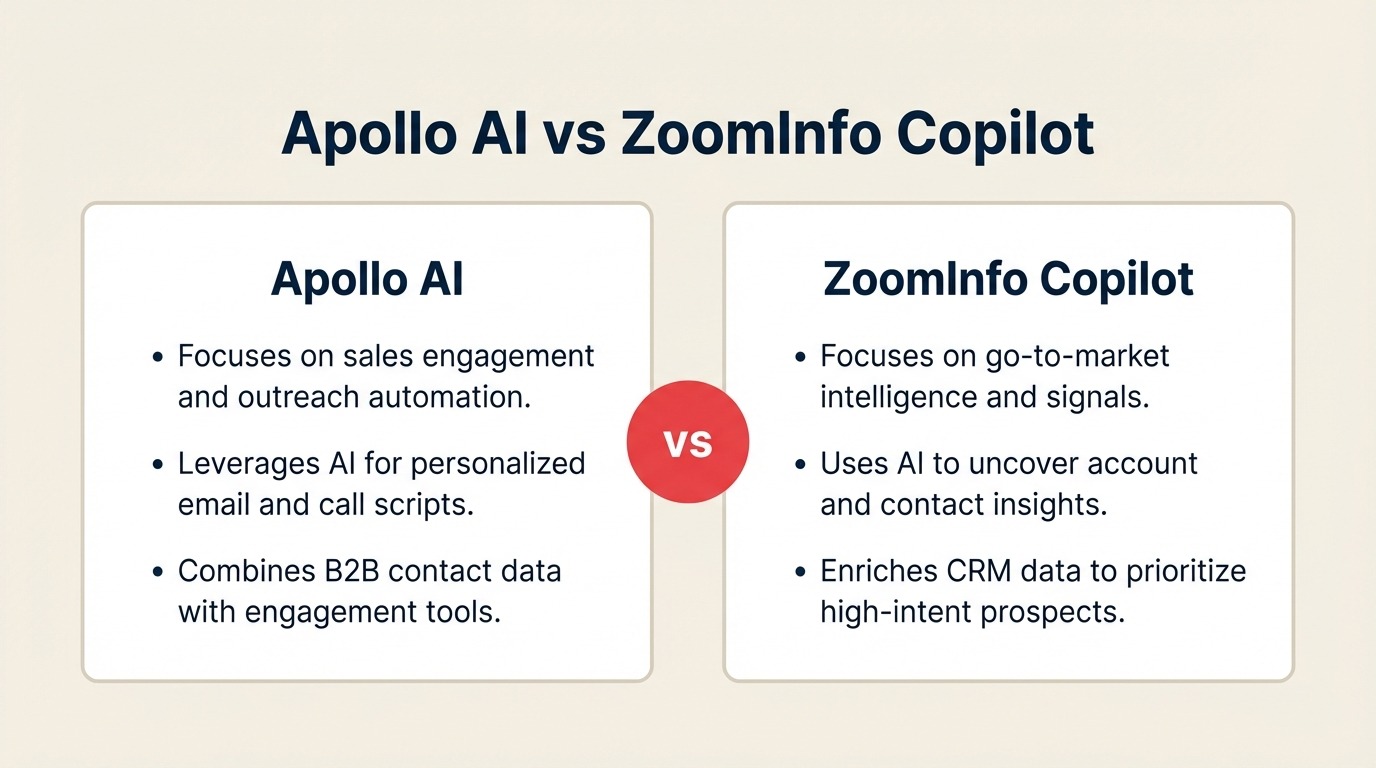
Apollo and ZoomInfo are not the same product with different branding. They solve a related problem from opposite directions.
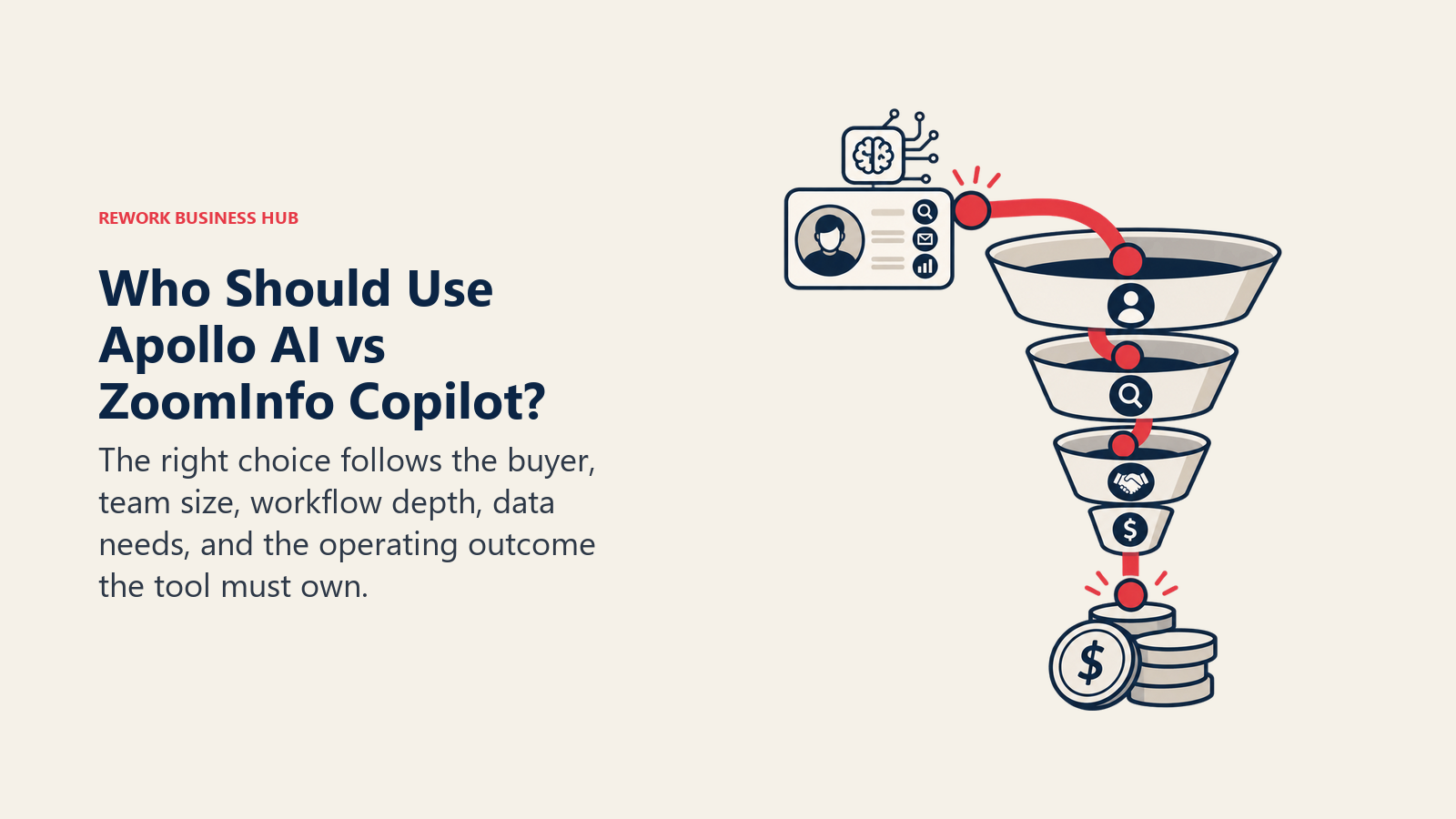
Apollo started as a contact database and evolved into a full engagement platform. The AI layer (Apollo AI) is woven into the prospecting and outreach workflow. It helps reps find the right people, understand why they might be a fit, write outreach, and prioritize their pipeline. It's designed to be used directly by SDRs and AEs, not just ops teams.
ZoomInfo started as an enterprise data aggregator and added Copilot as an intelligence layer on top of that data. Copilot pulls together account summaries, buying signals, intent data, and organizational insights and surfaces them in the context of an existing CRM or outreach workflow. It's designed to inform a mature GTM motion, not replace the tooling around it. ZoomInfo also owns Chorus, its conversation intelligence product: if call recording and coaching matter to your evaluation, see Gong vs Chorus vs Fathom for a detailed breakdown.
| Dimension | Apollo AI | ZoomInfo Copilot |
|---|---|---|
| Ideal company size | 10 - 500 employees (SMB to mid-market) | 500+ employees (mid-market enterprise to enterprise) |
| Ideal buyer | Sales Manager, RevOps, Head of Growth | VP Sales, CRO, Head of Revenue Enablement |
| Primary use case | Prospecting, outreach, pipeline building | Account intelligence, buying signals, rep coaching |
| GTM motion | Outbound-led, high-volume, self-serve | ABM, enterprise account-based, intent-driven |
| Setup path | Self-serve, credit card, free tier available | Procurement, legal, contract, custom onboarding |
| Team maturity required | Low: works well with early-stage sales teams | High: needs existing CRM + outreach stack to get value |
| Sequence capability | Built-in, native | Relies on third-party integrations |
Data Quality and Coverage
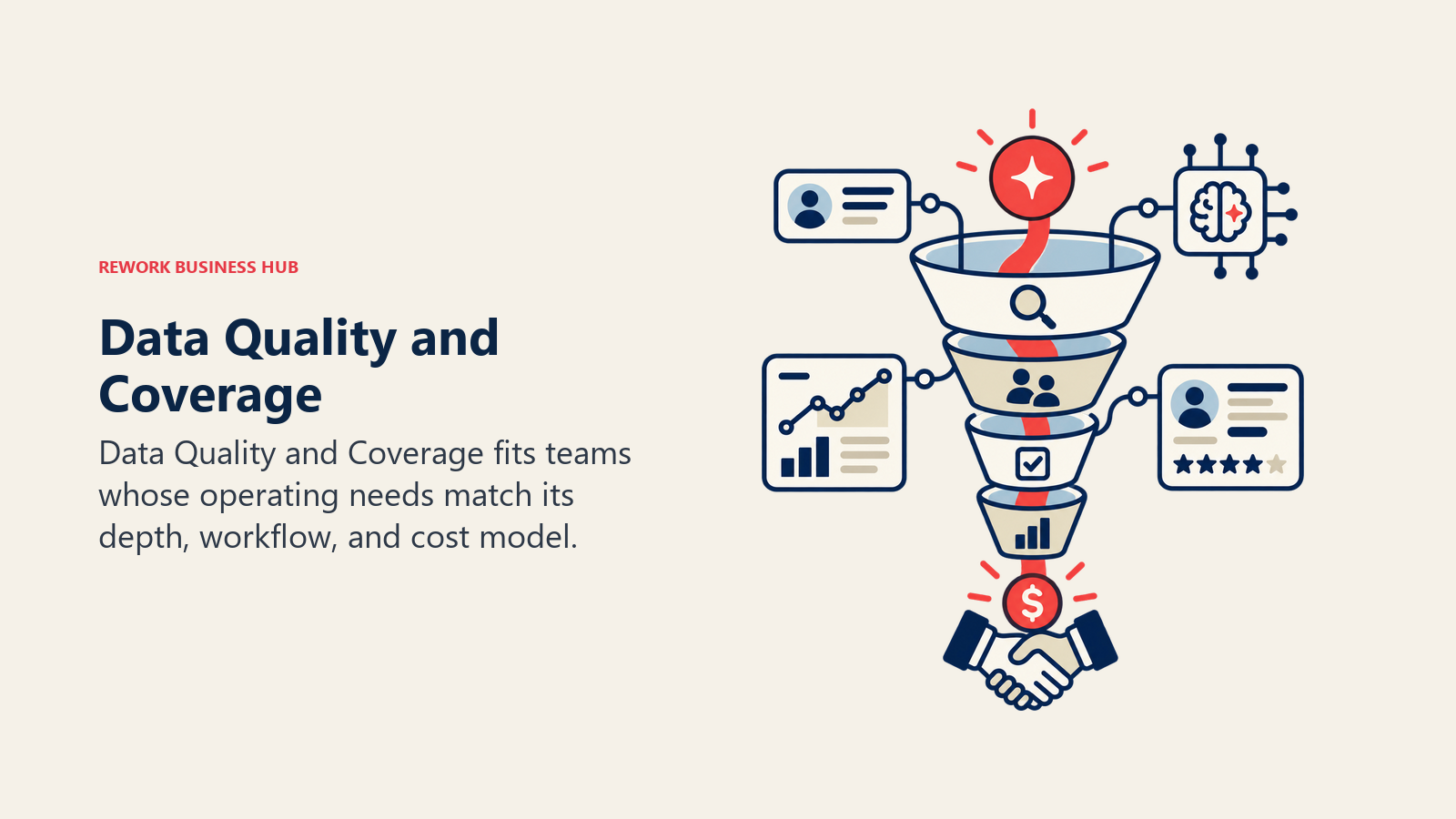
Data quality is the foundation both AI layers run on. If the underlying contact and account data is wrong, the AI outputs are wrong.
Apollo's database has grown significantly in the last two years, now covering approximately 275 million contacts across 60 million companies. They use a community-contributed data model combined with their own crawlers, which means freshness varies by segment. Their strength is depth in tech and SaaS contacts, especially at the individual contributor and manager level. Enterprise C-suite data in non-tech verticals is less reliable.
ZoomInfo's core differentiation has historically been data quality and coverage. Their machine-learning pipeline processes millions of data points continuously, and they have direct feeds from HR systems, job boards, and professional networks. For enterprise accounts in finance, healthcare, manufacturing, and large B2B sectors, ZoomInfo's firmographic data tends to outperform Apollo in accuracy and recency. But "tends to" is doing a lot of work in that sentence. Data quality is segment-specific, and both platforms have gaps.
| Data dimension | Apollo AI | ZoomInfo Copilot |
|---|---|---|
| Total contacts | ~275M | ~260M (claimed; third-party audits vary) |
| Total companies | ~60M | ~100M |
| Phone number accuracy | Moderate: crowdsourced model | Higher: proprietary data pipeline |
| Email bounce rate | Higher for cold personas | Lower for enterprise contacts |
| C-suite data quality | Mixed | Strong, especially non-tech verticals |
| Tech company contact coverage | Strong | Strong |
| Real-time job change signals | Yes (limited) | Yes (richer, via their data network) |
| GDPR/CCPA compliance | Self-certified | Enterprise-grade compliance framework |
| Data refresh frequency | Continuous (crawlers + community) | Continuous (proprietary pipeline) |
The honest verdict: for enterprise accounts in traditional industries, ZoomInfo wins on data quality. For tech-forward SMB and mid-market prospecting, the gap narrows considerably and Apollo often has enough. For the latest on how Apollo has been building out its agentic GTM capabilities, see Apollo's agentic GTM platform evaluation.
AI Features: Apollo AI vs ZoomInfo Copilot
This is the part both vendors are actively investing in, and the gap between them is significant. Not because one AI is smarter, but because they're doing different things.
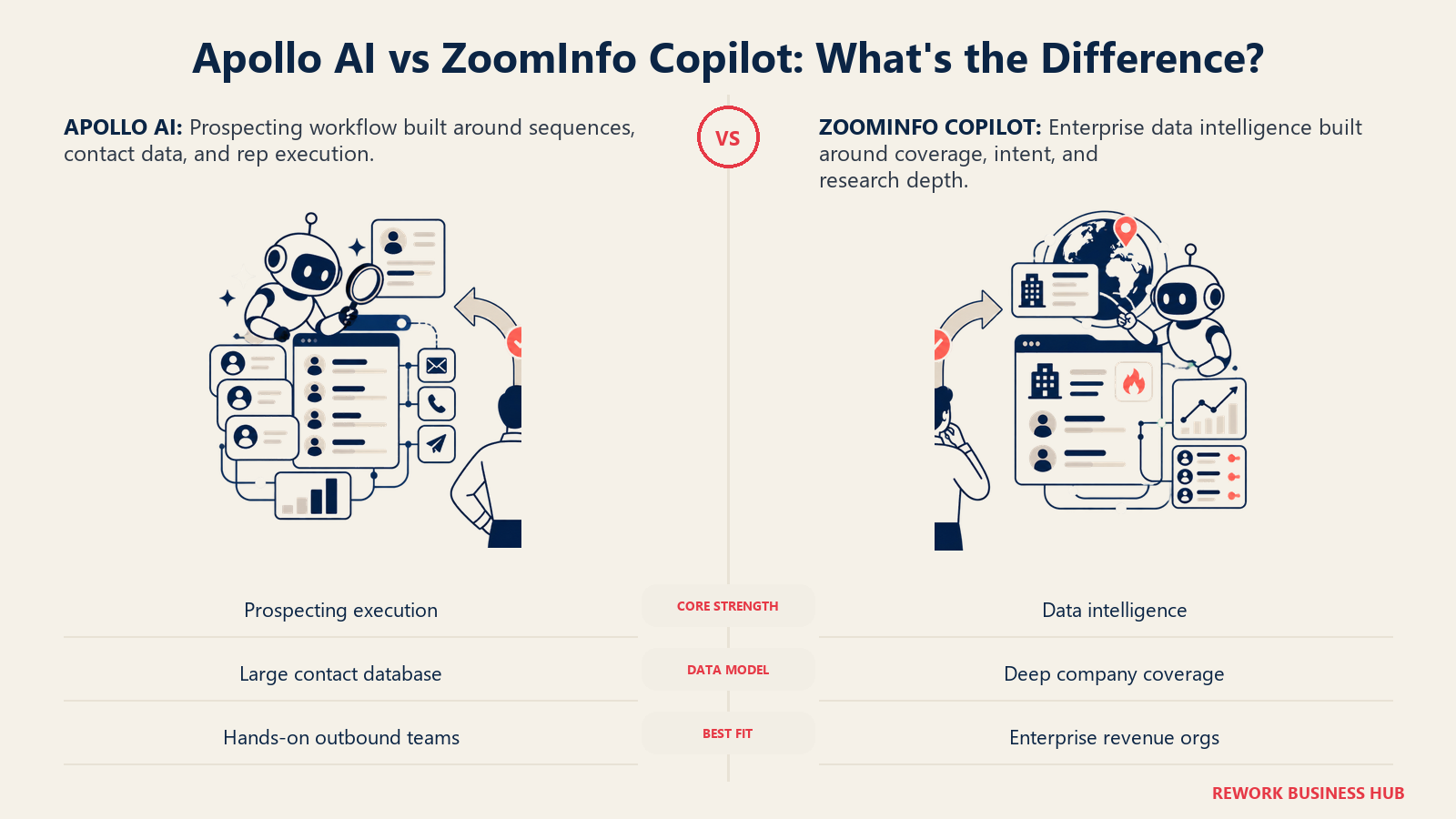
Apollo AI is embedded in the prospecting and outreach workflow. Key features include:
- AI-generated email copy: Given a prospect, Apollo AI drafts personalized outreach based on the contact's role, company signals, and your defined personas. It can rewrite subject lines and iterate on tone.
- Research assistant: Pulls together a summary of the prospect's company, recent news, and likely pain points before you reach out.
- AI persona matching: Scores how well a given contact matches your saved ICP before you include them in a sequence.
- Deal intelligence: Surfaces activity signals on existing pipeline records.
- AI search: Natural language prospecting, like typing "find me CTOs at Series B SaaS companies in EMEA with 100-500 employees" without building complex filters manually.
ZoomInfo Copilot operates at a higher altitude and focuses on account intelligence:
- Account summary cards: Auto-generated briefs on target accounts, pulling in news, hiring signals, org changes, and intent data in a single view.
- Buying signals: Surfaces accounts showing intent activity (topic surges, technology installs, job postings that signal pain) to help reps prioritize.
- Rep coaching: Integrated with Chorus (which ZoomInfo acquired), Copilot can surface relevant talk tracks and objection handling based on conversation patterns.
- AI-prioritized outreach queue: Tells reps which accounts to contact today, and why, based on signal scoring.
- Scoops and alerts: Real-time alerts on organizational changes (leadership hires, funding rounds, tech stack changes) that create outreach opportunities.
| AI capability | Apollo AI | ZoomInfo Copilot |
|---|---|---|
| Outreach email generation | Yes: native, in-workflow | Limited: requires third-party or manual step |
| Account intelligence summaries | Basic | Strong: purpose-built Copilot card |
| Intent data integration | Limited | Core product differentiator |
| Buying signal scoring | Basic | Advanced: ZoomInfo's main AI moat |
| Conversation intelligence | No | Yes: via Chorus integration |
| ICP persona scoring | Yes | Yes (through Copilot signal matching) |
| Natural language prospecting search | Yes | Partial |
| Rep coaching recommendations | No | Yes |
| Org change alerts (scoops) | Limited | Strong |
The pattern is clear: Apollo AI is built for reps doing outbound work. ZoomInfo Copilot is built for teams that need to prioritize which accounts to invest in.
Engagement Capabilities
This is where Apollo wins cleanly, and where ZoomInfo's positioning gets murky.
Apollo ships a full engagement stack alongside its data: multi-step email sequences, LinkedIn touchpoints, a built-in dialer, task management, and call recording. A rep can go from prospecting to first touch without leaving the platform. That all-in-one design is deliberate, and it's the core reason Apollo resonates with early-stage and growing sales teams who don't want to manage a four-tool stack.
ZoomInfo does not try to replace your outreach tools. Copilot is designed to feed intelligence into Outreach, Salesloft, HubSpot Sequences, or whatever engagement layer you already use. If you have a mature RevOps stack, that integration is clean and valuable. If you don't, you'll need to build it. ZoomInfo won't do it for you.
| Engagement capability | Apollo AI | ZoomInfo Copilot |
|---|---|---|
| Email sequences (native) | Yes | No: integrates with third-party tools |
| LinkedIn integration | Yes (Tasks + LinkedIn steps) | Limited |
| Built-in dialer | Yes | No |
| Call recording | Yes | Via Chorus (separate product) |
| Task management | Yes | No |
| Meeting booking | Yes (native scheduler) | No |
| Multi-channel sequences (SMS, calls, email) | Yes | No |
| CRM sync | Bi-directional (HubSpot, Salesforce, Pipedrive, others) | Bi-directional (Salesforce, HubSpot, Microsoft Dynamics) |
If engagement execution is part of what you're buying, Apollo is a complete platform. ZoomInfo is not trying to be one.
Pricing Reality
Pricing is where the two products diverge most sharply for most buyers.
Apollo publishes pricing on their website. As of 2026:
- Free tier: Real, functional, with limited credits (email + phone lookups, basic sequences)
- Basic: ~$49/user/month (annual), suitable for early teams
- Professional: ~$99/user/month (annual), includes AI features, full sequences, dialer
- Organization: ~$149/user/month (annual), advanced permissions, custom fields, API access
A 25-person sales team on Professional would run approximately $29,700/year. A 50-person team, approximately $59,400/year. These are real numbers, calculable without a sales call.
ZoomInfo does not publish pricing. Their model is "contact sales" for every tier, with contracts typically starting at $10,000-$15,000/year for small teams and scaling quickly to $30,000-$100,000+ annually for mid-market deployments. Enterprise deals with full Copilot access, intent data, Chorus, and FormComplete regularly exceed $100,000/year.
| Pricing scenario | Apollo AI | ZoomInfo Copilot |
|---|---|---|
| Free access | Yes: functional free tier | No |
| 10-person team | ~$11,880/year (Professional) | Contact sales: likely $10,000-$20,000+ |
| 25-person team | ~$29,700/year (Professional) | Contact sales: likely $25,000-$60,000+ |
| 50-person team | ~$59,400/year (Professional) | Contact sales: likely $50,000-$120,000+ |
| Self-serve purchase | Yes | No |
| Month-to-month option | Yes (at premium) | No: annual contracts standard |
| Negotiation required | No | Yes: standard procurement process |
The implication for budget owners: Apollo fits inside a department budget without a procurement cycle. ZoomInfo almost always requires CFO and legal sign-off, which extends the buying cycle and creates switching costs.
Integration Depth
Both platforms integrate with the major CRMs and some sales tools, but the integration philosophy differs.
Apollo integrates deeply with HubSpot, Salesforce, Pipedrive, and a range of smaller CRMs. Their integrations are designed so reps can work inside Apollo and sync data back. The platform also connects with Zapier, Slack, and common automation tools.
ZoomInfo's integration strategy is built around enterprise stacks. Salesforce and Microsoft Dynamics get the deepest native integrations, including Copilot signal surfacing directly in CRM records. HubSpot is supported but less deeply featured. Their FormComplete and WebSights products layer on top of marketing automation tools for intent capture on your own website.
| Integration | Apollo AI | ZoomInfo Copilot |
|---|---|---|
| Salesforce | Yes: bi-directional, deep | Yes: native, Copilot cards in-CRM |
| HubSpot | Yes: bi-directional | Yes: supported, less deep |
| Microsoft Dynamics | Limited | Yes: strong |
| Outreach / Salesloft | Yes | Yes: primary engagement connectors |
| LinkedIn Sales Navigator | Yes | Yes |
| Slack | Yes | Yes |
| Zapier | Yes | Limited |
| Marketing automation (Marketo, Pardot) | Limited | Yes: FormComplete, intent data push |
| Chorus (conversation intelligence) | No | Yes: owned product |
When Apollo Wins
Your team is under 200 people and building outbound from scratch. Apollo gives you prospecting + outreach + dialer in one product. You don't have to assemble a stack, manage three vendors, or hire a RevOps engineer to make it work.
Budget is a real constraint and speed matters. The free tier lets you start today. The professional tier is calculable without a sales call. You can be running sequences within hours of signing up.
Your reps need to own the full outbound cycle. SDRs and AEs who prospect, sequence, call, and book meetings in one tool move faster than those working across platforms. Apollo's workflow is built for that.
You're in tech, SaaS, or a knowledge economy vertical. Apollo's contact coverage is strongest in these segments. Data quality for SaaS, marketing, and growth roles is solid.
You want AI that helps reps write and execute, not just prioritize. Apollo AI's value shows up at the keyboard: in the email draft, in the persona match score, in the natural language search. It's a productivity multiplier for individual contributors.
When ZoomInfo Wins
You're running account-based enterprise sales. Copilot's buying signals, intent data, and account prioritization are purpose-built for teams working named account lists with long sales cycles. The ROI on knowing which account is actively researching your category before they've filled out a form is real in enterprise GTM.
Data quality in non-tech verticals is non-negotiable. Healthcare, finance, manufacturing, government, and professional services contacts are more accurate and complete in ZoomInfo than in most competitors. If your TAM is concentrated in these sectors, that gap matters.
You already have Outreach or Salesloft and need intelligence, not execution. ZoomInfo plugs into your existing engagement tools and makes them smarter. If your reps are already living in Outreach, adding ZoomInfo Copilot signals is a natural layer, not a workflow change.
Chorus integration is on your roadmap. If you want conversation intelligence (call recording, talk track analysis, rep coaching) integrated with your account intelligence, ZoomInfo's Chorus ownership gives you a single vendor for both.
Your ABM program needs intent and technographic data at scale. ZoomInfo's intent data product (website visitor identification, topic surge alerts, technology install data) is one of the strongest in the market. Apollo doesn't compete here.
Decision Framework
| Situation | Choose Apollo AI | Choose ZoomInfo Copilot |
|---|---|---|
| Team size | Under 200 | 200+ |
| Sales motion | High-volume outbound, self-serve | ABM, enterprise, named accounts |
| Budget process | Department card, self-serve | Procurement, annual contract |
| Current stack | Building or early-stage | Mature: Salesforce + Outreach/Salesloft already in place |
| Need sequences and dialer | Yes | No: already have it |
| Intent data is a priority | No | Yes |
| Data quality sector focus | Tech, SaaS, growth roles | Finance, healthcare, manufacturing, enterprise |
| Speed to first value | Hours | Weeks to months |
| Conversation intelligence | Not a priority | High priority (via Chorus) |
The decision isn't really about which AI is smarter. It's about what problem you're trying to solve and what your team is set up to use.
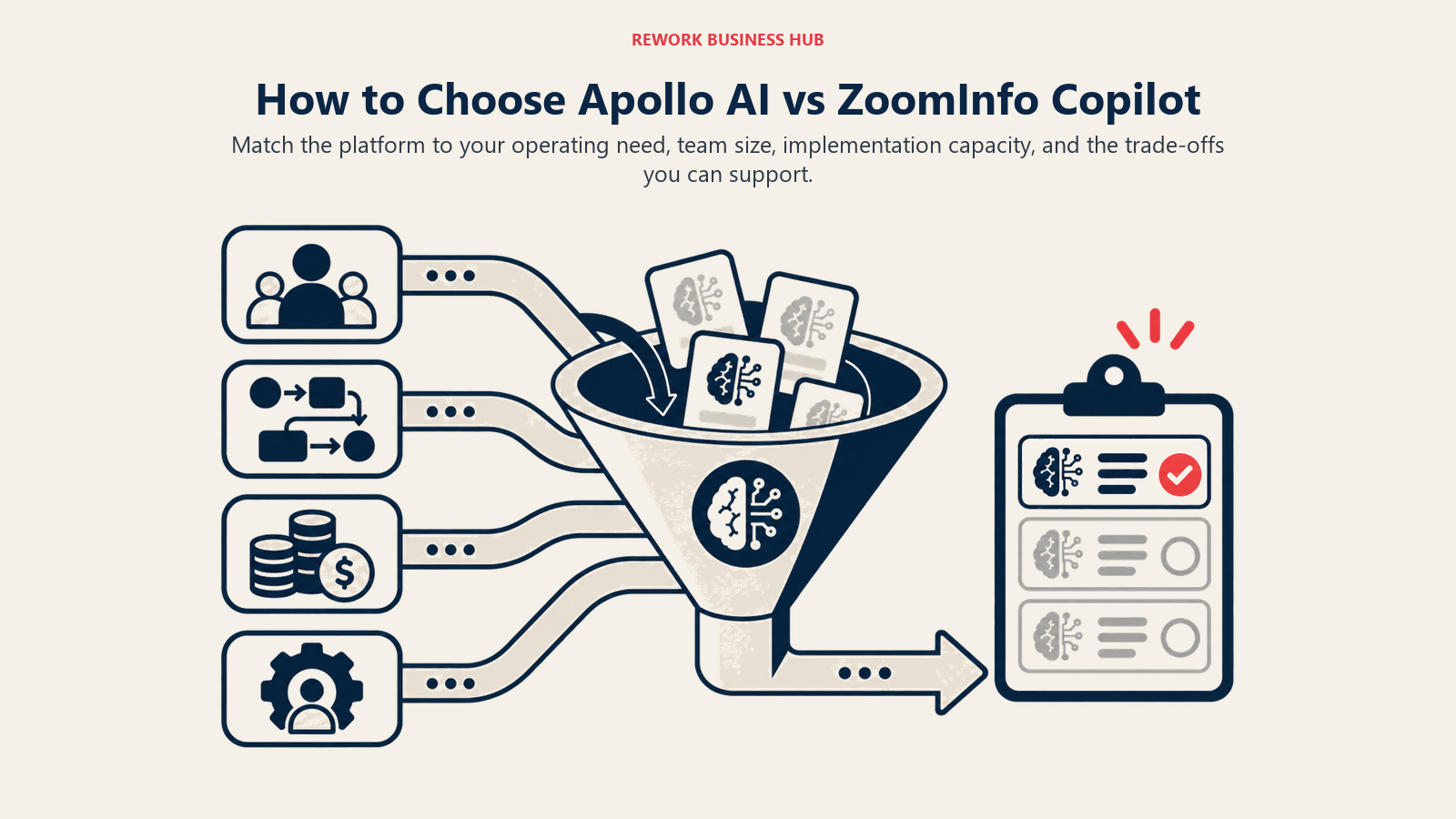
If you need a rep to open their laptop, find 50 good contacts, and send a personalized sequence before lunch, Apollo gets you there. If you need your enterprise account team to know, before their Monday review, which accounts showed intent signals last week and what's changed in those organizations, ZoomInfo Copilot gets you there.
What to Do Next
For Apollo, start with the free tier. It's functional enough to pressure-test data quality against your ICP and run a real sequence before you spend anything. Upgrade when you hit credit limits or need the dialer.
For ZoomInfo, request a demo with your actual target account list. Ask them to run a sample enrichment against your existing CRM data and show you intent signal overlap with accounts you closed or lost in the last 12 months. That exercise will tell you whether the data quality and signal coverage justify the contract.
Run both pilots if you're in the $50M-$200M ARR range and unsure. The products serve different enough use cases that some teams run Apollo for outbound SDR motion and ZoomInfo for enterprise account intelligence at the AE level.
If you're evaluating these tools because your current CRM doesn't connect prospecting data, lead routing, and engagement in one workflow, that's a separate problem: one that sits upstream of which sales intelligence tool you choose. See Rework vs HubSpot CRM or Rework vs Salesforce if cross-team pipeline visibility is the actual gap.