Rework vs Salesforce Agentforce: AI Agents for Mid-Size Sales Teams in 2026
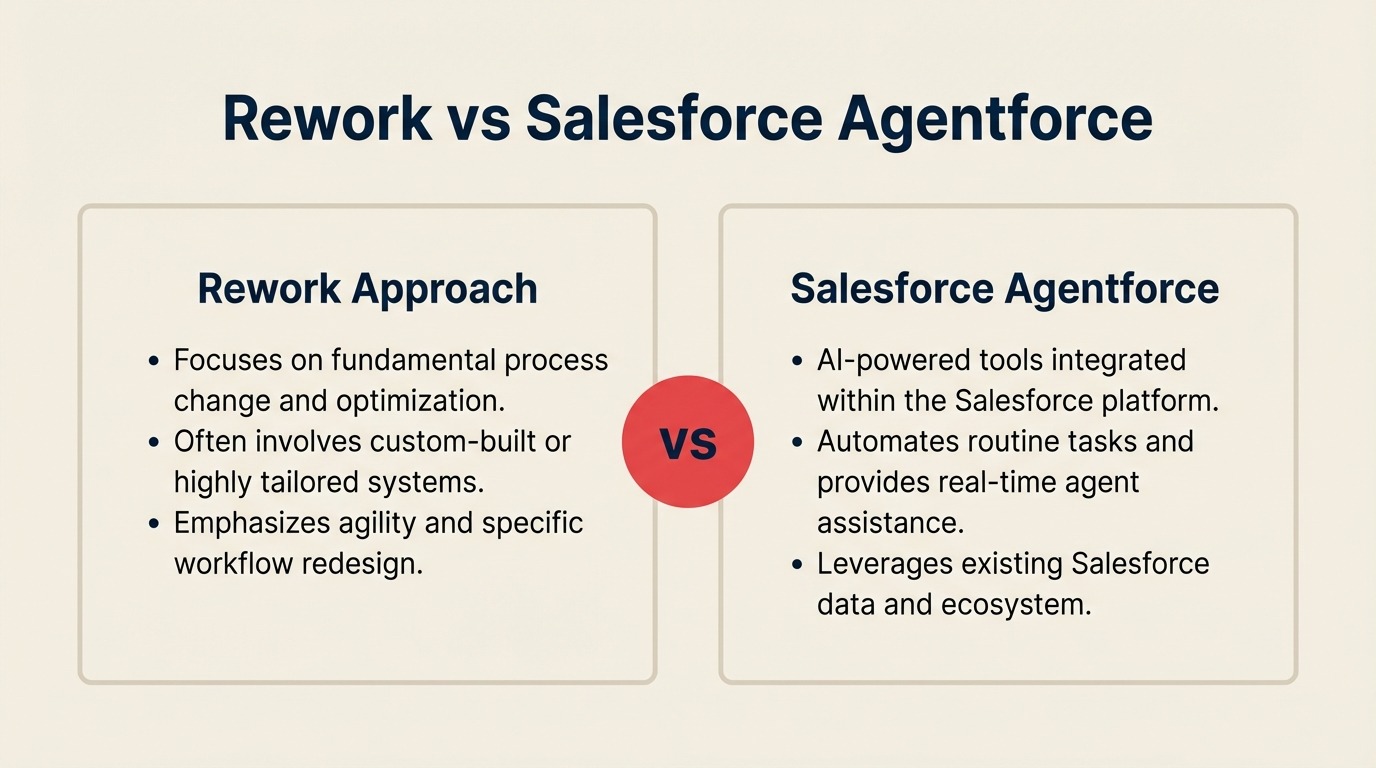
Salesforce launched Agentforce in late 2024 and spent most of 2025 putting it in front of every enterprise buyer it could reach. The pitch is genuinely interesting: autonomous AI agents that can prospect, coach reps, handle service queues, and run entire workflows without a human in the loop. If you've been in a Salesforce demo recently, you've seen the SDR Agent and Sales Coach demos. They're impressive.
But if you're running a sales team of 20 to 150 people, and you're not already deep in a Salesforce org, the pitch breaks down fast. Agentforce is an AI layer built on top of Salesforce Enterprise + Data Cloud. Before a single agent does anything for your team, you need the platform underneath it. That's where the math gets uncomfortable.
This comparison is for revenue leaders and RevOps teams at mid-size companies evaluating whether Agentforce is actually accessible, or whether a purpose-built CRM with native AI built in is the more practical path. We'll be straight about where Salesforce wins, and it wins in meaningful ways. But we'll also name what the real cost of entry looks like and where the mid-size use case falls through the cracks.
TL;DR
| Factor | Rework | Salesforce + Agentforce |
|---|---|---|
| Best for | Mid-size sales + RevOps teams (20-500 people) wanting a unified AI-native CRM | Enterprise orgs already on Salesforce with budget for AI agent add-ons |
| AI agent model | Native AI built into the CRM (lead scoring, routing, automation, inbox assistant) | Autonomous agents (SDR Agent, Sales Coach) running on top of Data Cloud |
| Starting price | $999/yr Starter (5 users) or $1,999/yr Standard (10 users included) | $25/user/mo (Starter Suite, billed annually) |
| Mid-tier price | $1,999/yr Standard + $12/user/mo above 10 users | $165/user/mo (Enterprise, billed annually) + Agentforce |
| Support | Email + chat + phone on all plans | Standard support; Premier add-on for priority support |
| Agentforce pricing | Included / no separate AI tax | $2/conversation for autonomous agents (on top of platform cost) |
| Lead distribution | Round-robin, territory, skill-based, SLA rules, all plans | Available via Flow automation or premium Sales Cloud features |
| Unified chat inbox | WhatsApp, Messenger, Instagram DM, web chat, email, SMS, native | Third-party or Einstein Messaging add-on; not native to Sales Cloud |
| Time-to-value | Weeks | Months to a year (full Salesforce deployment) |
| Setup speed | 1-3 days for basic CRM; 1-2 weeks for full Lead Management + chat, led by a team with hands-on experience onboarding mid-size sales, marketing, and ops departments end-to-end | 4-12 weeks for a functional Salesforce Enterprise deployment; Salesforce SI partners charge $100,000+ for Agentforce-ready implementations, Salesforce has no in-house team experienced with mid-size cross-department rollouts; Data Cloud configuration alone requires a dedicated project |
| AI trust / governance | Built-in audit trail and permissions | Einstein Trust Layer, genuinely enterprise-grade |
| AppExchange / ecosystem | 80+ native integrations | 7,000+ AppExchange apps, largest in the category |
Who Each Tool Is Built For
Target customer profile
| Dimension | Rework | Salesforce + Agentforce |
|---|---|---|
| Company size | 20 to 500 employees | 200 to 50,000+ employees |
| Revenue range | $2M to $100M ARR | $20M ARR and up (practically speaking) |
| Existing stack | Replacing disconnected tools (Pipedrive + Zapier + WhatsApp + spreadsheets) | Already on or evaluating Salesforce CRM |
| IT resources | Ops-led or RevOps-led; no dedicated Salesforce admin needed | Requires Salesforce admin, often a dedicated team at scale |
| AI readiness | Wants AI that works out of the box without custom build | Wants to configure autonomous agents to their specific process |
| Budget model | Predictable per-seat pricing | Platform + data + agent consumption fees |
| Primary pain | Tool fragmentation, lead handoff gaps, no unified contact view | Scale, automation depth, AI-driven workflows across large sales orgs |
Team fit
| Team | Rework | Salesforce + Agentforce |
|---|---|---|
| Sales (SDRs, AEs) | Pipeline, sequences, activity logging, AI lead scoring | Deep pipeline tooling; Agentforce SDR Agent handles outreach autonomously |
| Marketing | Lead capture, scoring, nurture workflows, marketing-to-sales handoff | Pardot / Marketing Cloud (separate product, separate cost) |
| RevOps | Unified data model across sales + marketing + CS, workflow automation | Highly customizable; near-infinite configuration depth |
| Customer Success | Unified contact timeline (chat + email + tickets) | Service Cloud (separate product); Agentforce Service Agent |
| Sales Ops | Lead routing, SLA rules, territory management built in | Powerful but requires configuration by a certified admin |
| IT / Systems | Minimal lift; self-serve setup | Significant deployment project; ongoing admin overhead |
AI Agent Capabilities Comparison
This is the core section. Agentforce is purpose-built for agent autonomy. Rework's AI is embedded and contextual. Those are different design philosophies, and the right one depends on your team's maturity and operational setup.
| Capability | Rework | Salesforce Agentforce |
|---|---|---|
| AI lead scoring | Native, built into lead records, surfaces high-intent contacts | Einstein Lead Scoring, available on Sales Cloud (requires configuration) |
| Autonomous SDR outreach | Not available, AI assists, reps execute | SDR Agent: drafts emails, books meetings, handles follow-up autonomously |
| Sales coaching AI | Not available | Sales Coach: AI feedback on call recordings, pitch quality, objection handling |
| Workflow automation | Drag-and-drop automation rules, multi-step triggers across lead lifecycle | Flow + Agentforce: autonomous agents can trigger and execute complex multi-step workflows |
| Inbox AI assistant | AI-suggested replies in unified inbox (WhatsApp, Messenger, email, SMS) | Einstein Copilot: AI within Salesforce UI; not natively in external chat channels |
| Meeting intelligence | Not available natively | Agentforce can process call transcripts via Einstein Conversation Insights |
| Forecasting AI | Pipeline forecasting with probability scoring | Einstein Forecasting, strong; one of Salesforce's most mature AI features |
| Custom agent build | No (AI is product-native, not extensible) | Yes, build custom Agentforce agents on the Salesforce platform using Agent Builder |
| AI data layer | CRM data in product | Salesforce Data Cloud required for full Agentforce capability |
| Trust / audit layer | Built-in permissions, activity logs | Einstein Trust Layer, enterprise-grade data masking, audit, governance |
The honest summary: if you need autonomous agents that can run outreach, coach reps on calls, and handle service at scale without constant human input, Agentforce is the more capable platform. But that capability requires the Salesforce stack under it. Rework's AI is narrower but operational immediately. It's in your lead scoring, your inbox, your routing logic on day one.
Core CRM Under the Hood
Salesforce Sales Cloud is the most mature CRM on the market. That's not marketing copy. It's twenty-five years of iteration with the world's largest enterprise customer base giving continuous feedback. If your team is also weighing HubSpot as an alternative platform, the Rework vs HubSpot Breeze comparison covers similar tradeoffs at a lower price point. Custom objects, advanced pipeline configuration, approval workflows, territory hierarchies, role-based forecasting: it handles complexity that Rework doesn't reach.
Rework is built for a different complexity profile. Its CRM is opinionated and pre-assembled for the cross-functional mid-size team. You don't configure your way to a working sales process; the process is already there.
| CRM Capability | Rework | Salesforce Sales Cloud |
|---|---|---|
| Contact and account management | Standard fields, custom fields, full activity timeline | Highly customizable, custom objects, record types, page layouts |
| Pipeline management | Multi-pipeline, drag-and-drop, visual board and list view | Multi-pipeline from Enterprise; highly configurable stages and fields |
| Deal / opportunity tracking | Core; probability scoring, close date, owner | Deep, custom opportunity stages, products, CPQ integration available |
| Territory management | Built in from Starter plan | Enterprise feature; sophisticated hierarchy support |
| Custom objects | Limited custom fields on standard objects | Full custom object creation, core Salesforce strength |
| Approval workflows | Drag-and-drop approval chains | Approval Processes, powerful and flexible |
| Mobile experience | Standard mobile app | Salesforce Mobile, mature; Agentforce accessible on mobile |
| API access | Standard tier | All tiers (REST + SOAP + Bulk) |
| Offline mode | No | Yes (Salesforce Mobile offline) |
Lead Management Deep Dive
Lead management is where the mid-size use case diverges most sharply. For a team that's generating inbound leads from ads, web chat, referrals, and WhatsApp, and needs those leads scored, assigned, and followed up within minutes, the operational plumbing matters as much as the AI on top of it.
| Lead Management Capability | Rework | Salesforce + Agentforce |
|---|---|---|
| Lead capture sources | Forms, ads (Meta, Google), web chat, WhatsApp, API, CSV import | Web-to-lead, forms, Pardot (separate), API, third-party integrations |
| Lead enrichment | Built-in enrichment via contact data layer | Einstein Lead Enrichment; third-party data via AppExchange |
| Lead scoring | AI-powered scoring built into lead records | Einstein Lead Scoring, available but requires Data Cloud for full context |
| Agentforce SDR Agent | Not available | Autonomous outreach, email drafting, meeting booking without rep action |
| Lead distribution, round-robin | Native; any plan | Available via Flow automation or third-party (LeanData, Chili Piper) |
| Lead distribution, territory rules | Native; all plans | Territory Management, Enterprise feature; powerful but requires setup |
| Lead distribution, skill-based routing | Native | Requires custom Flow or Agentforce configuration |
| SLA enforcement | Built-in SLA timers on leads; escalation rules | Possible via Flow + custom fields; not a standard out-of-box feature |
| Marketing-to-sales handoff | Native within the same product | Requires Pardot or Marketing Cloud (separate product, separate subscription) |
| Lead nurture sequences | Included in all plans | Sales Engagement add-on or Pardot; not in base Sales Cloud |
| Attribution back to pipeline | Built-in | Multi-touch attribution in full Marketing Cloud or third-party |
The gap here is structural. Rework ships lead distribution, SLA enforcement, and marketing-to-sales handoff in the same product. For a practical checklist of what to verify before committing to any CRM platform, see the CRM buyer's checklist. In Salesforce, those same capabilities are split across Sales Cloud, Marketing Cloud (or Pardot), and either custom Flow automation or paid third-party routing tools like LeanData or Chili Piper. Each layer adds cost and admin time.
Agentforce's SDR Agent addresses part of this. It can handle autonomous follow-up without a rep. But it still requires the Salesforce platform to be properly configured with the right lead data flowing through Data Cloud before the agents can act intelligently.
Unified Chat Channels
For sales teams running conversations across WhatsApp, Messenger, Instagram DM, and web chat, the channel inbox isn't a nice-to-have. It's where leads are. A CRM that can't tie those conversations to contact records forces reps to work across three apps and manually log activity.
| Channel | Rework | Salesforce Sales Cloud | Salesforce with Agentforce |
|---|---|---|---|
| Native, conversations tied to contact record | Third-party app (AppExchange) or Einstein Messaging (add-on) | Agentforce can handle WhatsApp conversations autonomously via Messaging | |
| Facebook Messenger | Native | Third-party or Einstein Messaging | Agentforce Service/Sales agents can work Messenger with Messaging setup |
| Instagram DM | Native | Third-party | Agentforce can handle via Messaging configuration |
| Live web chat | Native | Salesforce Chat / Einstein Chat (add-on) | Agentforce can respond autonomously to web chat |
| Email (two-way) | Native | Native (Gmail, Outlook sync) | Native + Agentforce email drafting via SDR Agent |
| SMS | Native | Third-party or Salesforce-native SMS (add-on) | Third-party or add-on required |
| Unified inbox view | All channels in one timeline on contact record | Not native; requires configuration or third-party | Agentforce operates across channels but UI unification requires custom build |
This is an area where Rework has a structural advantage for mid-size teams. WhatsApp, Messenger, Instagram DM, web chat, email, and SMS all land in one timeline tied to the contact record with no additional setup. With Agentforce, the autonomous agent capability across messaging channels is real, but the underlying channel connections require Einstein Messaging or third-party apps, and the cost scales up.
Implementation and Cost
This section is worth reading slowly if you're mid-size. The Agentforce value proposition is real, but the cost structure is not straightforward.
Salesforce + Agentforce pricing reality
| Cost Component | Estimate |
|---|---|
| Salesforce Sales Cloud Starter | ~$25/user/month (limited features) |
| Salesforce Sales Cloud Professional | ~$80/user/month |
| Salesforce Sales Cloud Enterprise | ~$165/user/month (required for most Agentforce use cases) |
| Salesforce Data Cloud | Required for Agentforce, pricing varies by data volume; starts ~$108,000/year at the low end for enterprises |
| Agentforce autonomous agent usage | $2/conversation (per agent interaction; not per seat) |
| Einstein Messaging (WhatsApp, Messenger, etc.) | Add-on; pricing varies by volume |
| Salesforce Marketing Cloud / Pardot | Separate product; separate contract |
| Salesforce implementation | Typically $20,000-$100,000+ for mid-size deployments |
| Ongoing admin | Typically requires a dedicated Salesforce admin ($70,000-$120,000/year salary) |
At 50 seats on Sales Cloud Enterprise ($165/user/month) alone: $99,000/year before Data Cloud, before Agentforce conversation fees, before any marketing automation, before implementation.
The $2/conversation pricing for Agentforce is usage-based, which can look manageable at low volume. At scale, with an SDR Agent handling hundreds of prospect conversations per day, the usage fees add up quickly. Salesforce has published guidance suggesting the efficiency gains justify the cost at enterprise volume, but that math doesn't always work for a 50-rep team.
Rework pricing at real seat counts
Rework Sales Ops has two packages:
- Starter, $999/year for up to 5 users
- Standard, $1,999/year with 10 users included, plus $12/user/month for each additional user
See rework.com/pricing for current details. All plans include lead management, routing, multi-channel inbox, workflow automation, and AI features, no conversation fees, no separate data platform required, no mandatory professional services.
| Team Size | Rework Sales Ops |
|---|---|
| 5 seats | $999/yr (Starter) |
| 10 seats | $1,999/yr (Standard base) |
| 25 seats | $4,159/yr |
| 50 seats | $7,759/yr |
| 100 seats | $14,959/yr |
Implementation timeline
| Dimension | Rework | Salesforce + Agentforce |
|---|---|---|
| Basic CRM setup | 1-3 days, led by team experienced with the full lead lifecycle | 4-12 weeks for Enterprise; Starter Suite faster but undersized for Agentforce |
| Team onboarding (reps) | 3-5 days for full product, included | Formal training program typically required; $500-$2,000/seat |
| Lead management configuration | 3-7 days with onboarding team walking through scoring, routing, forms | 4-8 weeks via Flow automation or LeanData/Chili Piper (paid partners) |
| Chat inbox connection | 1-2 hours per channel, led by team with mid-size multi-department onboarding experience | Einstein Messaging add-on required; each channel is a separate configuration project |
| Full implementation (CRM + lead mgmt + chat + Agentforce) | 1-2 weeks, led by team with mid-size multi-department onboarding experience | 6-18 months with a Salesforce SI partner ($100,000+); Data Cloud configuration is a prerequisite for Agentforce |
| Marketing-to-sales handoff | Week 2-4 | Requires separate Pardot/Marketing Cloud project |
| Admin overhead post-launch | Low, no dedicated admin required | High, Salesforce without active admin degrades; $80,000-$130,000/year for in-house admin |
| Support model | Email + chat + phone on all plans | Standard support; Premier add-on for priority |
Salesforce wins on basic CRM speed at the Starter Suite level. But Agentforce isn't accessible from Starter Suite, it requires Enterprise licensing ($165/user/mo), Data Cloud (starts ~$108,000/year), and enough properly structured CRM data for the agents to act on. Getting a mid-size team from zero to a working Agentforce deployment typically takes 6-18 months with a certified Salesforce SI partner, and those engagements start at $100,000. Salesforce has no in-house team experienced with mid-size cross-department rollouts, so that SI investment is unavoidable at any meaningful deployment scope. Rework's edge is institutional experience: the team has onboarded full Sales, Marketing, RevOps, and CS departments at mid-size companies and applies that hard-earned knowledge of what actually breaks during a multi-team rollout to every new customer. The full stack, including AI features, is operational from day one without a multi-year platform build.
When Agentforce Is the Right Call
Be direct about this: Agentforce is the most capable AI agent platform in the CRM category. Here's when it's genuinely the right decision.
1. You're already on Salesforce with a mature org. If your team has custom objects, AppExchange packages, and a Salesforce admin in place, adding Agentforce is an incremental investment, not a platform migration. The switching cost calculation is completely different for you.
2. You need truly autonomous AI agents at scale. The Agentforce SDR Agent and Sales Coach are purpose-built autonomous agents. No other CRM vendor has shipped this at Salesforce's maturity level. If autonomous outreach at scale (without reps touching individual emails) is the primary use case, Agentforce is ahead.
3. You need the deepest ecosystem in the category. The AppExchange has 7,000+ apps. Any integration you need probably exists. Any vertical solution (financial services cloud, health cloud, manufacturing cloud) is built on this platform. No other CRM comes close.
4. You're in a regulated industry that needs enterprise-grade governance. The Einstein Trust Layer is the most mature AI governance framework in the CRM market. If your legal or compliance team needs data masking, audit trails for every AI action, and certified security controls, Salesforce is the natural choice.
5. You have a global enterprise org with complex approval chains and territory hierarchies. Salesforce handles organizational complexity at a level that purpose-built mid-market tools don't reach.
When Rework Is the Right Call
1. You're mid-size and not already on Salesforce. If you're evaluating from scratch, the math is stark. Rework gives you a fully operational AI-assisted CRM, lead management, multi-channel inbox, and workflow automation in weeks, at a cost that doesn't require a board-level conversation.
2. You need lead management and chat inbox as one product. WhatsApp, Messenger, Instagram DM, email, SMS, and web chat in one contact timeline without add-ons or configuration projects. If your leads come through messaging channels, this is the most direct path to a unified view.
3. You want AI that works immediately, not after a configuration project. Rework's AI features (lead scoring, routing intelligence, inbox AI suggestions) are on from day one. They don't require Data Cloud to be populated, agents to be trained, or a consultant to configure the trust layer.
4. Your team needs cross-functional operations, not just a sales CRM. Rework's workflow and process templates extend to marketing, RevOps, CS, and ops teams. The lead lifecycle from capture through close through retention runs in one product.
5. Pricing predictability matters. No conversation fees, no usage-based agent charges, no separate data platform subscription. You know your annual cost from the pricing page.
Decision Framework
| Pick Salesforce + Agentforce if... | Pick Rework if... |
|---|---|
| You're already on Salesforce with a mature org and admin resources | You're evaluating from scratch and need something live in weeks |
| Your primary use case is autonomous AI agents at scale (SDR Agent, Sales Coach) | Your primary use case is unified CRM + lead management + multi-channel inbox |
| You need 7,000+ AppExchange integrations or vertical Salesforce clouds | Your stack is standard: Gmail/Outlook, Slack, Zoom, Meta Ads, Google Ads |
| You're in a regulated industry needing the Einstein Trust Layer | You need AI that works immediately without a configuration project |
| You have budget for platform + Data Cloud + agent consumption fees | You need predictable all-in per-seat pricing |
| You have dedicated Salesforce admin capacity or a systems integrator | Your RevOps or Ops team will manage the tool directly |
| You're 200+ employees with a complex enterprise sales motion | You're 20-500 employees with a cross-functional revenue team |
| Your CFO has approved a multi-year Salesforce enterprise contract | Budget approval is at the ops/sales leader level, not board level |
What to Do Next
If you're a mid-size revenue team that hasn't committed to Salesforce yet, the most useful thing you can do before making a decision is run a scoped proof of concept on both platforms. For Rework, that means getting a demo focused specifically on lead management, routing configuration, and the unified inbox. Those are the three places where the mid-size use case is clearest. For Salesforce + Agentforce, ask your SE to walk through the full cost stack: Enterprise license + Data Cloud + Agentforce consumption fees + estimated admin cost + implementation timeline. Put those numbers next to each other.
The tools are genuinely different. Agentforce is a platform play with the deepest AI agent ecosystem in the category. Rework is a product play where everything you need for a mid-size revenue operation ships in one place. The right answer depends on where you are today and what your team can actually operate, not which AI demo looks better in a conference room.
For more context on the broader shift toward autonomous agents in sales workflows, see AI agents in the sales pipeline. And if you're also evaluating the non-AI CRM comparison between Rework and Salesforce, see Rework vs Salesforce.

Principal Product Marketing Strategist
On this page
- TL;DR
- Who Each Tool Is Built For
- Target customer profile
- Team fit
- AI Agent Capabilities Comparison
- Core CRM Under the Hood
- Lead Management Deep Dive
- Unified Chat Channels
- Implementation and Cost
- Salesforce + Agentforce pricing reality
- Rework pricing at real seat counts
- Implementation timeline
- When Agentforce Is the Right Call
- When Rework Is the Right Call
- Decision Framework
- What to Do Next