Gong vs Chorus vs Fathom: AI Meeting Intelligence for Sales Leaders in 2026
You're a CRO or VP Sales evaluating AI meeting intelligence tools. Your reps are losing deals without your team knowing why, your forecast is built on gut feel, and your onboarding takes six months because there's no structured call library for new hires. You've heard of Gong. Someone from ZoomInfo mentioned Chorus. And half your team is already using Fathom for free.
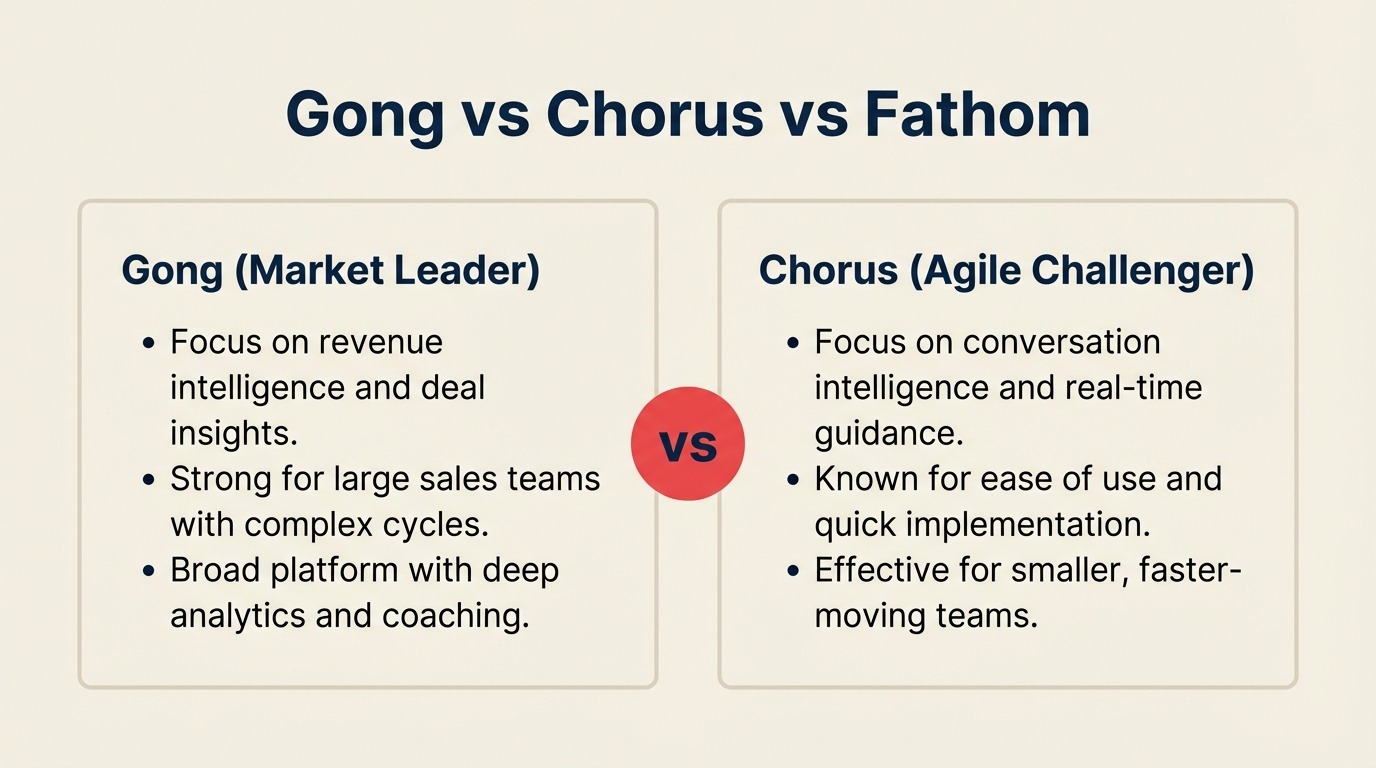
These three tools record, transcribe, and analyze sales meetings. But they are not the same product for the same buyer. Gong is a full-stack enterprise conversation intelligence platform built for revenue teams that want to manage performance at scale. Chorus is ZoomInfo's conversation intelligence layer, positioned as a bundled addition to ZoomInfo's data platform. Fathom is a lightweight AI meeting recorder that started as a personal productivity tool and is now growing fast into team territory. Which one fits depends less on your favorite feature list and more on your team's actual maturity, your existing stack, and what problem you're trying to solve first.
TL;DR
| Factor | Gong | Chorus (ZoomInfo) | Fathom |
|---|---|---|---|
| Primary strength | Enterprise conversation intelligence, deal analytics, rep coaching at scale | Bundled conversation intelligence inside ZoomInfo's data platform | Free AI meeting recorder with fast, clean summaries and growing team features |
| Best for | Enterprise and upper-mid-market sales teams (50+ reps) wanting deep analytics | Teams already on ZoomInfo who want meeting intelligence without a separate vendor | SMBs, fast-moving startups, and individual reps who need frictionless note-taking |
| Pricing model | Enterprise contract, starts ~$100-140/user/month | Bundled with ZoomInfo license, not separately priced on most tiers | Free for individuals; Team plan ~$19-29/user/month |
| CRM integration depth | Deep — Salesforce and HubSpot sync, activity logging, deal health | Moderate — Salesforce sync, part of ZoomInfo Engage workflow | Light — notes and summaries push to CRM, no deal analytics |
| Coaching tools | Scorecard libraries, call playlists, talk-track analytics, rep benchmarking | Scorecards, call review, basic rep tracking | No coaching framework; call summaries only |
| AI features | Deal risk signals, next-step tracking, topic trackers, market intelligence | Smart trackers, highlight clips, conversation insights | Meeting summary, action items, key moments, follow-up email draft |
| Standalone option | Yes | Rarely — usually bundled with ZoomInfo | Yes, free tier is fully functional |
| Setup complexity | High — enterprise onboarding, CSM-led | Medium — integrated into ZoomInfo ecosystem | Low — 5 minutes, self-serve |
Who Each Tool Is Built For
The three tools are targeting different buyers at different stages of sales team maturity. Getting this wrong means either buying a platform you won't use or running a tool that can't scale.
| Dimension | Gong | Chorus | Fathom |
|---|---|---|---|
| Company size | 100-5,000+ employees | 50-2,000 employees | 1-200 employees |
| Sales team size | 20+ reps | 10+ reps | 1-50 reps |
| Team maturity | Structured sales process, defined stages, active manager coaching | Aligned to ZoomInfo-driven outbound, moderate process maturity | Early-stage or founder-led sales, informal coaching |
| Primary buyer | CRO, VP Sales, RevOps | VP Sales, CRO bundled in ZoomInfo renewal | Individual reps, sales managers, or startup founders |
| Budget expectation | $60K-$500K+ annually | Negotiated as part of ZoomInfo contract | $0 to ~$5K for small teams |
| Decision driver | Revenue accountability, pipeline risk reduction, rep performance at scale | ZoomInfo bundle simplification, reducing vendor count | Speed, zero setup cost, clean AI summaries |
Gong's customer wins are concentrated in B2B SaaS companies with complex sales cycles, dedicated RevOps functions, and a VP of Sales who reports pipeline risk upward. Chorus fits best when the organization is already deep in ZoomInfo and wants to avoid managing another vendor relationship. Fathom wins when the goal is simple: record meetings, get clean summaries, push action items to the CRM, and stop paying anything. If you're also evaluating Otter or Fireflies as lightweight alternatives to Fathom, see Otter vs Fireflies vs Fathom for that comparison.
Core Capability Comparison
All three tools do the basics: join a meeting as a bot, record audio and video, produce a transcript, and summarize the conversation. But the floor is where the similarity ends.
| Capability | Gong | Chorus | Fathom |
|---|---|---|---|
| Meeting recording | Yes | Yes | Yes |
| Transcription accuracy | Enterprise-grade, multi-language | Good, English-primary | Good, English-primary |
| AI meeting summary | Yes, structured by topic | Yes | Yes, fast and clean |
| Action item extraction | Yes, synced to CRM tasks | Yes | Yes, with follow-up email draft |
| Deal health scoring | Yes — Gong Deals shows engagement gaps, risk signals | Partial — deal insights from call activity | No |
| Topic/keyword trackers | Yes — custom trackers with trend data across entire team | Yes — smart trackers with alerts | No |
| Competitor mention tracking | Yes | Yes | No |
| Talk ratio / monologue alerts | Yes | Yes | No |
| Call library / search | Yes — searchable across entire org | Yes | Basic personal history |
| Mobile app | Yes | Yes | Yes |
| Slack / Notion integration | Yes | Partial | Yes |
Gong and Chorus offer analytics layers that Fathom simply doesn't have. If you need to search "every call where a rep talked for more than 60% of the time and the deal closed lost," Gong and Chorus can do that. Fathom cannot. But if all you want is a reliable record of what was discussed, who owns the next step, and a draft follow-up email, Fathom does that faster than the other two.
Coaching and Rep Development
This is where Gong has the clearest advantage and where the price premium is easiest to justify for large teams.
| Coaching Feature | Gong | Chorus | Fathom |
|---|---|---|---|
| Scorecard frameworks | Yes — custom scorecards, team-level roll-up | Yes — basic scorecards | No |
| Call playlists for onboarding | Yes — curated libraries with context | Yes | No |
| Rep vs team benchmarking | Yes — talk ratio, question rate, topic depth by rep | Partial | No |
| Manager review workflow | Yes — assigned reviews, feedback threads | Yes — call review and comments | No |
| AI coaching suggestions | Yes — auto-flagged moments, "why this matters" context | Partial | No |
| New hire ramp time impact | Documented by customers at 20-40% reduction in ramp time | Modest data, bundled claims | Not applicable |
For a VP Sales managing 30+ reps, the coaching infrastructure in Gong changes how your managers spend their time. Instead of randomly sampling calls, managers work from auto-surfaced moments: a rep who buried the pricing objection too early, a call where the customer mentioned a competitor three times and the rep didn't respond. Chorus offers a version of this, but the tooling is thinner and the roadmap has been slower since the ZoomInfo acquisition.
Fathom has no coaching framework. That's not a criticism. It's a design choice. But if rep development is on your KPI list, Fathom isn't solving it.
CRM Integration
How deeply a meeting intelligence tool connects to your CRM determines whether it becomes infrastructure or a note-taking side project.
| CRM Integration Feature | Gong | Chorus | Fathom |
|---|---|---|---|
| Salesforce integration | Deep — activity sync, deal updates, contact association, opportunity risk | Moderate — activity logging, contact sync, part of ZoomInfo Engage | Basic — note and summary push, no field updates |
| HubSpot integration | Yes — deal tracking, activity sync | Limited | Yes — summary and tasks |
| Activity auto-logging | Yes — calls, emails, meetings logged automatically | Yes — within ZoomInfo workflow | Partial — summaries pushed but minimal auto-logging |
| Deal timeline in CRM | Yes — Gong Deals shows engagement cadence | Limited | No |
| Bi-directional sync | Yes | Partial | One-way push |
| Contact enrichment | No (not Gong's lane) | Yes — taps ZoomInfo data directly | No |
Chorus has a structural advantage over standalone tools when your stack already includes ZoomInfo: the contact record populated by ZoomInfo Enrich can be married to the call summary in Chorus without a third-party connector. But that advantage disappears if you're on HubSpot or a non-Salesforce CRM. Chorus's integration depth drops noticeably outside the Salesforce/ZoomInfo ecosystem.
Gong's CRM integration is the standard that others measure against. For teams running Salesforce, Gong essentially becomes a second layer of deal management: reps see their next steps in Gong, managers see engagement risk, and the data flows back to Salesforce automatically.
AI Features in 2026
All three tools have pushed AI capabilities aggressively in the past 18 months. The gap is narrowing on surface features but the underlying data advantage of Gong's long-running model is still real.
| AI Feature | Gong | Chorus | Fathom |
|---|---|---|---|
| Generative summaries | Yes — structured by meeting type | Yes | Yes — fastest time-to-summary in category |
| Deal risk detection | Yes — multi-signal, trained on closed/lost patterns | Partial | No |
| Next-step prediction | Yes | Partial | No |
| Market intelligence (keyword trends) | Yes — Gong Market Intelligence tracks topic trends across the customer base | Partial | No |
| Follow-up email draft | Yes | Yes | Yes |
| Real-time coaching (live calls) | Yes — Gong Assist can surface prompts during a live call | No | No |
| Custom AI models | Enterprise tier | No | No |
| Ask questions about your calls | Yes — Gong Ask | Partial | Partial (Fathom AI chat) |
Fathom's AI summary speed and quality is genuinely competitive with Gong and Chorus for the basic use case. The follow-up email drafts are good. The action item extraction is reliable. Where it falls short is anything that requires reasoning across multiple deals or multiple reps, because Fathom doesn't have a multi-call analytics layer.
Pricing
Pricing in this category is notoriously opaque, but here's the honest picture as of early 2026.
| Pricing | Gong | Chorus | Fathom |
|---|---|---|---|
| Free tier | No | No | Yes — unlimited recordings, summaries, 1 user |
| Entry pricing | ~$100-140/user/month (annual), minimum seat requirements | Bundled with ZoomInfo, typically not priced separately | Free |
| Team / paid tier | Contact sales; enterprise contracts start ~$50K-60K/year for small teams | Negotiated into ZoomInfo renewal; estimates ~$40-80/user/month depending on ZoomInfo tier | ~$19-29/user/month (Team plan) |
| 25-user team (annual estimate) | ~$30K-42K/year | Effectively $0 if ZoomInfo is already contracted; ~$12K-24K if priced standalone | ~$5,700-8,700/year |
| 50-user team (annual estimate) | ~$60K-84K/year | ~$24K-48K standalone | ~$11,400-17,400/year |
| 100-user team (annual estimate) | ~$120K-168K/year | ~$48K-96K standalone | ~$22,800-34,800/year |
| Contract structure | Annual, minimum commitments | Annual, tied to ZoomInfo renewal | Monthly available on Team plan |
| Price transparency | Low — contact sales required | Low — bundled and negotiated | High — published pricing |
The price gap between Gong and Fathom at 50 users is roughly 4-5x at the low end. That gap is the coaching infrastructure, the deal analytics, the market intelligence, and the enterprise onboarding. If you need those things, the gap narrows in value terms. If you don't, you're paying for a platform your team will underuse.
Chorus pricing is the murkiest. Because it's bundled with ZoomInfo, most buyers can't get a standalone quote that reflects the true cost. If your ZoomInfo renewal is coming up and your rep bundles in Chorus as an add-on, the incremental cost often looks low. But if ZoomInfo gets cut from the budget, Chorus goes with it.
When Gong Is the Right Call
You have 30+ reps and a manager coaching problem. Gong's scorecard and review workflow changes how your frontline managers work. They move from random call sampling to data-driven coaching. No other tool in this list offers that layer.
Pipeline risk is a board-level concern. If your CRO needs to stand in front of the board and explain forecast confidence, Gong Deals gives you engagement-based risk signals that gut-feel pipeline reviews don't. Chorus offers a version of this, but Gong's data depth is materially better.
You're onboarding new reps at scale. The call library, curated playlists, and AI-highlighted moments cut onboarding time. Customers consistently report 20-40% reduction in ramp time. That math becomes significant at scale.
Your sales cycle is complex and multi-threaded. Long B2B enterprise sales with multiple stakeholders, multiple meetings, and multi-month cycles extract the most value from Gong's conversation thread and deal engagement tracking.
When Chorus Is the Right Call
You're already a ZoomInfo customer and want to reduce vendor count. If ZoomInfo is central to your outbound workflow and your rep can bundle Chorus into the renewal negotiation, the incremental cost is often low and you avoid another integration project.
Your outbound motion is ZoomInfo-driven. Chorus and ZoomInfo Engage were built to work together. Intent data from ZoomInfo informs who you call, and Chorus analyzes what happened on the call. For Salesforce-heavy outbound teams, this is a coherent workflow.
You need conversation intelligence without Gong's price point and you're already in the ZoomInfo ecosystem. Chorus's analytics are thinner than Gong's, but for teams that don't need enterprise-grade coaching infrastructure, the bundled option is a reasonable middle ground.
When Fathom Is the Right Call
Your team is under 20 reps and coaching isn't yet systematized. Fathom gives every rep a reliable meeting record, clean action items, and a follow-up email draft in under two minutes. That value is real and immediate.
Budget is constrained or deal size doesn't justify enterprise tooling. The free tier of Fathom is genuinely useful. For a startup or a small sales team that isn't ready to invest in a full conversation intelligence platform, Fathom does the job.
Individual reps are pushing for a tool their manager hasn't approved yet. Fathom's self-serve, free tier means individual contributors adopt it without a procurement cycle. If Fathom becomes a habit for 10 reps before the company decides on Gong, that's not unusual.
You want meeting intelligence without disrupting your CRM workflow. Fathom's lightweight CRM push is enough for teams where reps log their own notes and don't need the system to do it automatically. The friction is minimal.
Decision Framework
| Scenario | Best Choice |
|---|---|
| 30+ reps, active manager coaching program needed | Gong |
| CRO needs board-ready forecast confidence from engagement data | Gong |
| New hire ramp time is a measurable KPI | Gong |
| Already on ZoomInfo, want bundled conversation intelligence | Chorus |
| Outbound motion is ZoomInfo-Engage-driven | Chorus |
| Need to reduce vendor count at ZoomInfo renewal | Chorus |
| Under 20 reps, no coaching infrastructure yet | Fathom |
| Budget under $10K/year for meeting intelligence | Fathom |
| Individual reps wanting personal productivity without a procurement cycle | Fathom |
| Complex multi-threaded enterprise deals needing deep signal | Gong |
What to Do Next
Start with the use case, not the demo. If your biggest gap is rep coaching and manager visibility, get a Gong demo with a focus on scorecard workflows and call review. If you're in a ZoomInfo renewal conversation, ask for a Chorus bundle quote alongside a standalone pricing scenario so you can compare honestly. And if your team is under 20 reps and you haven't started yet, run Fathom's free tier for 30 days before committing to anything — starting there costs you nothing.
The worst outcome is buying Gong's enterprise contract for a 12-person team that just needs clean meeting summaries. The second-worst is using Fathom when you're running 60 reps and your managers are flying blind on pipeline risk.
If you're evaluating meeting intelligence as part of a broader CRM and sales operations overhaul (including lead management, pipeline tracking, and cross-team workflows), that's a different conversation. The Gong Mission Andromeda evaluation for CROs covers how Gong's latest enablement capabilities are landing with revenue leaders. Tools like Rework are built for teams that want those layers in one product, not stitched together from five vendors. But if meeting intelligence is the specific gap you're solving today, these three tools cover the realistic market from free to enterprise.

Principal Product Marketing Strategist