Gong vs Clari: Revenue Intelligence Platforms Compared for Sales Leaders in 2026
Turn this article into takeaways for your work.


Each assistant summarizes the article only for you and suggests best practices for your work.
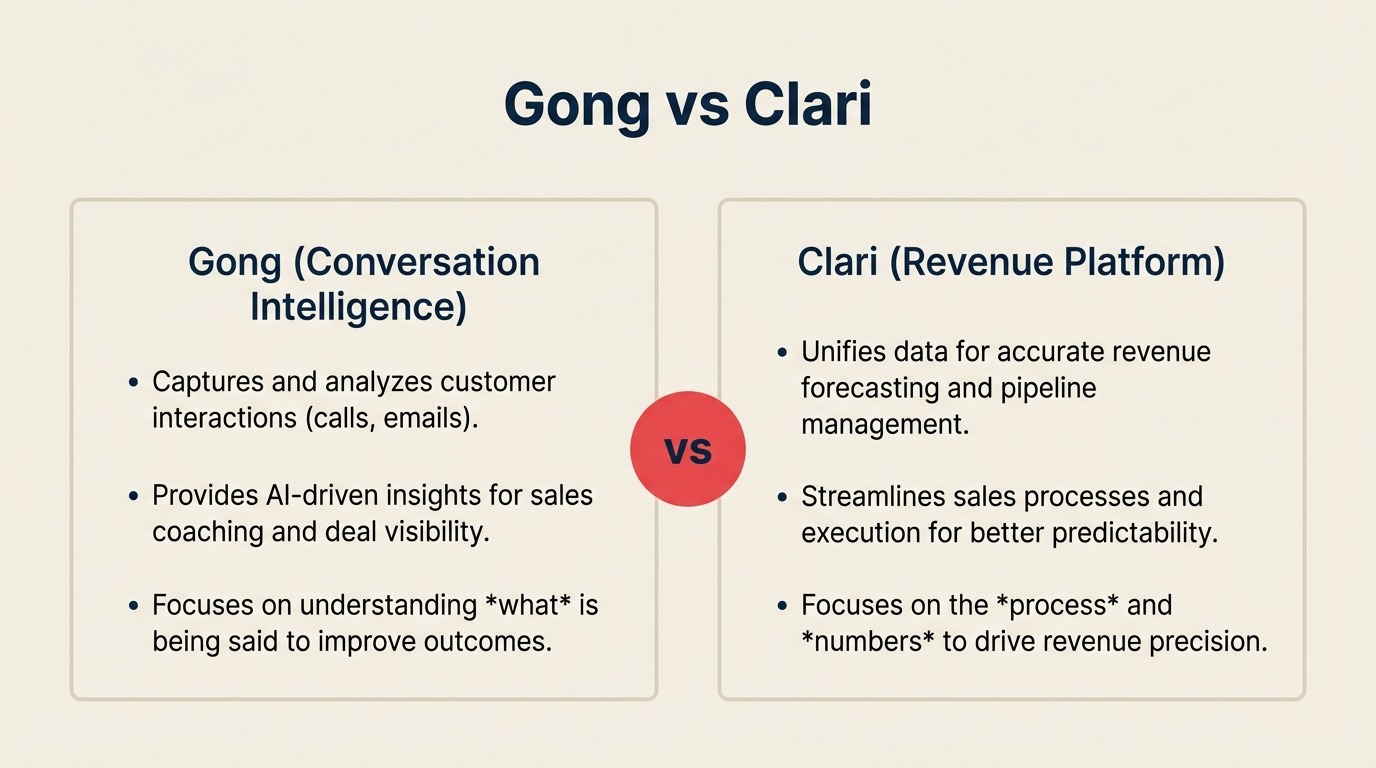
You're a CRO, VP Sales, or Head of Revenue and you're being asked to pick a revenue intelligence platform. Both Gong and Clari have been in your inbox. Both have strong logos on their customer pages. Both use the phrase "revenue intelligence" in every other sentence. But they come from fundamentally different starting points, serve different day-to-day users, and solve different problems first.
Gong started as a conversation intelligence tool. It records calls, transcribes them, surfaces deal risks from what reps actually say (and don't say), and gives sales managers a coaching layer grounded in real conversations. Clari started as a revenue operations platform. It consolidates CRM data, rep activity, and pipeline signals into a forecasting engine built for quarterly commits and board-level visibility. Both have expanded into each other's territory over time, but the DNA still shows. This comparison helps you understand which starting point actually fits your team's biggest gap.
TL;DR
| Factor | Gong | Clari |
|---|---|---|
| Primary strength | Conversation intelligence, call analytics, rep coaching | Revenue forecasting, pipeline analytics, board-ready reporting |
| Best for | Sales managers and reps focused on deal execution and coaching | CROs and RevOps teams focused on forecast accuracy and pipeline health |
| Core data source | Call recordings, email threads, meeting transcripts | CRM data, rep activity signals, historical pipeline patterns |
| AI focus | Deal risk from conversation signals, coaching nudges, talk track analysis | Forecast prediction, pipeline movement, revenue leak detection |
| CRM relationship | Writes insights back into CRM; reads deal data from CRM | Deep CRM sync; overlays AI on top of CRM pipeline data |
| Typical buyer | VP Sales, Sales Enablement, Sales Managers | CRO, Head of Revenue, RevOps Director |
| Pricing model | Enterprise; contact sales | Enterprise; contact sales |
| Implementation | 2-4 weeks for call recording; longer for full Revenue Intelligence | 4-8 weeks for forecasting configuration |
Who Each Platform Is Built For
The clearest way to separate these two is to ask: who uses it every single day?
With Gong, the daily users are sales reps reviewing their own calls, sales managers reviewing their team's calls, and enablement leads building playbooks. The platform pays off when you have a team generating volume (calls, demos, discovery sessions) and you want to understand what's actually happening in those conversations. If your reps are winging it on discovery questions or losing deals at the same stage repeatedly, Gong's coaching layer is the most direct path to fixing that.
With Clari, the daily users are RevOps analysts building forecast models, the CRO reviewing pipeline by segment, and finance pulling the latest commit number. The platform pays off when forecast accuracy is a persistent problem, when you're managing a complex pipeline across multiple products or segments, and when your board meetings involve awkward conversations about where the number actually stands. Clari's value is structural, not conversational.
| Dimension | Gong | Clari |
|---|---|---|
| Primary user | Sales reps, managers, enablement | CRO, RevOps, revenue leadership |
| Core problem solved | What's happening in deals at the conversation level | What's happening in pipeline at the aggregate level |
| Best company stage | Growth-stage and enterprise with active outbound/inbound volume | Companies managing complex multi-segment forecasts |
| Team maturity needed | Reps generating enough call volume to surface patterns | RevOps capacity to configure and maintain forecast models |
| Value realization timeline | 4-8 weeks (call patterns emerge quickly) | 8-16 weeks (forecast models need historical data to calibrate) |
Core Capability Comparison
Separate core platform coverage from add-ons so your shortlist reflects the workflows the business must run.
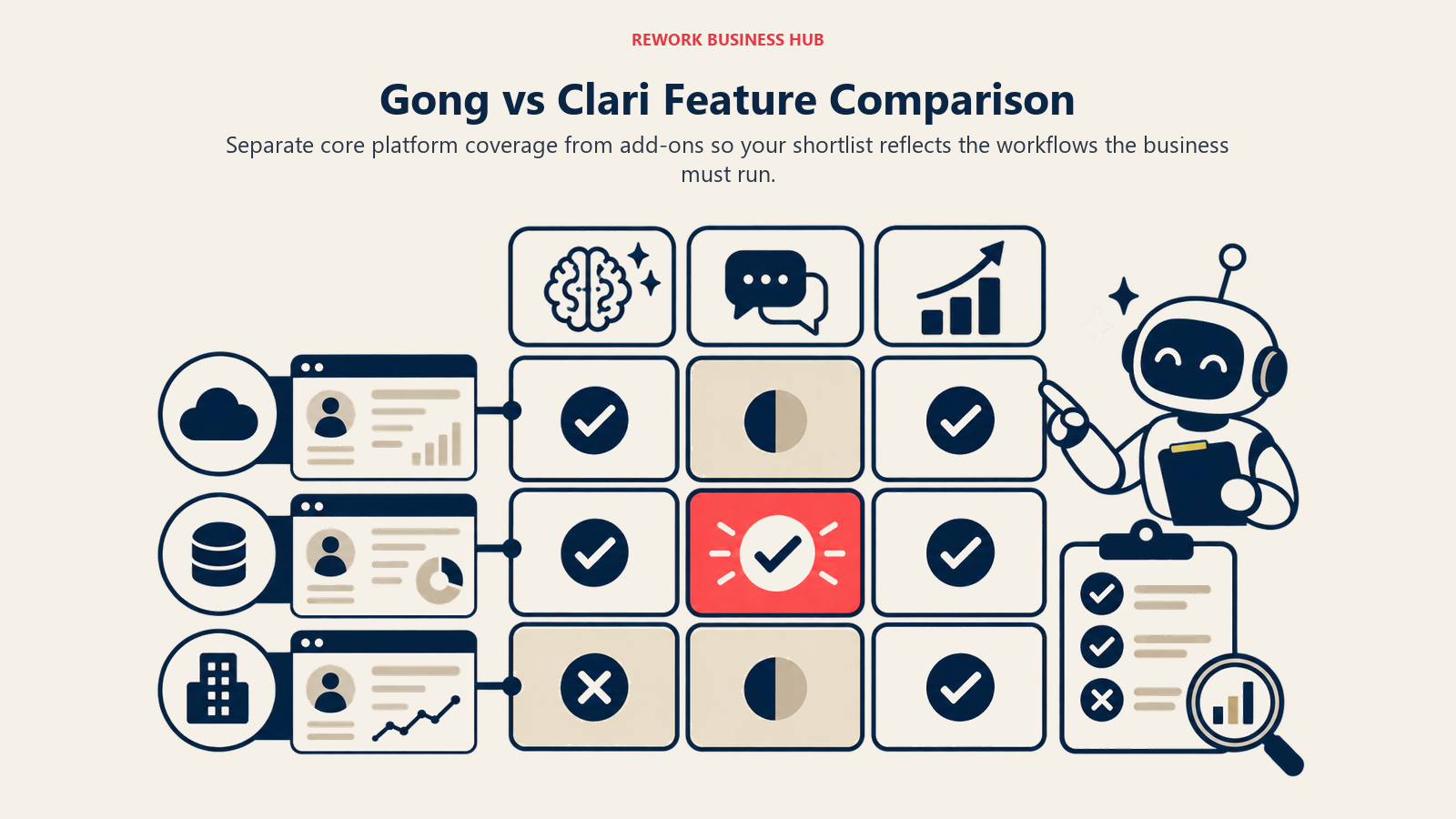
| Capability | Gong | Clari |
|---|---|---|
| Call recording & transcription | Core, class-leading | Available but not the focus |
| Deal intelligence from conversations | Strong: tracks engagement, topic patterns, risk signals from calls | Limited: uses CRM activity, not conversation content |
| Revenue forecasting | Available (Gong Forecast) | Core, class-leading |
| Pipeline analytics | Available | Strong |
| Rep coaching | Core: scorecards, playlists, call review | Limited: activity-based, not conversation-based |
| Revenue leak detection | Via conversation signals | Via pipeline movement signals |
| Board-ready reporting | Functional but not the primary design target | Strong: built for exec and board consumption |
| CRM data overlay | Reads + writes to CRM | Deep CRM sync with AI layered on top |
| Multi-segment forecasting | Single pipeline view | Supports product-line, geo, and segment splits |
| Sales playbook enforcement | Yes, via call scorecards | No |
Conversation Intelligence: Gong's Defining Strength
Gong's conversation intelligence is the reason most companies buy it. The platform records every call and meeting, produces a searchable transcript, and then runs a layer of AI analysis on top of each conversation. That analysis surfaces things like: how much time the rep talked versus the prospect, whether pricing came up and how the rep handled it, whether the next steps were confirmed before the call ended, and whether the language in this call matches the patterns from deals that historically closed.
For sales managers, this shifts coaching from opinion to evidence. Instead of asking a rep "how did that call go?" and getting a polished summary, you can watch the relevant two minutes yourself, or let Gong flag the moment where the rep stumbled on competitive objections. The coaching workflow is built around this: call libraries, scorecards tied to specific behaviors, and performance trends per rep over time.
| Conversation Intelligence Feature | Gong | Clari |
|---|---|---|
| Call recording | Yes: all channels (Zoom, Teams, phone, web conferencing) | Yes, but secondary to pipeline analytics |
| AI transcription | Yes, high accuracy with speaker identification | Yes |
| Talk ratio analysis | Yes | No |
| Next steps tracking | Yes: flags missing next steps from transcripts | No |
| Topic & keyword tracking | Yes: custom trackers for competitors, pricing, objections | Limited |
| Deal risk from conversation signals | Yes: engagement drop, topic avoidance, sentiment shift | No: uses CRM fields and activity, not conversation content |
| Rep coaching scorecards | Yes | No |
| Call libraries for onboarding | Yes | No |
| Competitive mention analysis | Yes | No |
Where Clari does have call recording (through its Clari Copilot product, formerly Wingman), it's positioned as a complement to the forecasting platform rather than the core. If your primary need is conversation intelligence at the rep and manager level, Gong is still the category leader. If you're comparing Gong against other meeting intelligence tools like Chorus or Fathom, see Gong vs Chorus vs Fathom for that breakdown.
Forecasting and Pipeline Analytics: Clari's Defining Strength
Clari's core bet is that most CRM data is garbage and that AI can build a more accurate forecast by weighing activity signals, historical patterns, and pipeline movement against what reps manually enter. For a practical framework on running consistent forecast cadences before layering on AI predictions, see the forecast cadence guide. The platform aggregates CRM data, email activity, calendar data, and call logs, then runs its AI forecast engine on top to produce a number the CRO can trust more than the sum of rep-submitted forecasts.
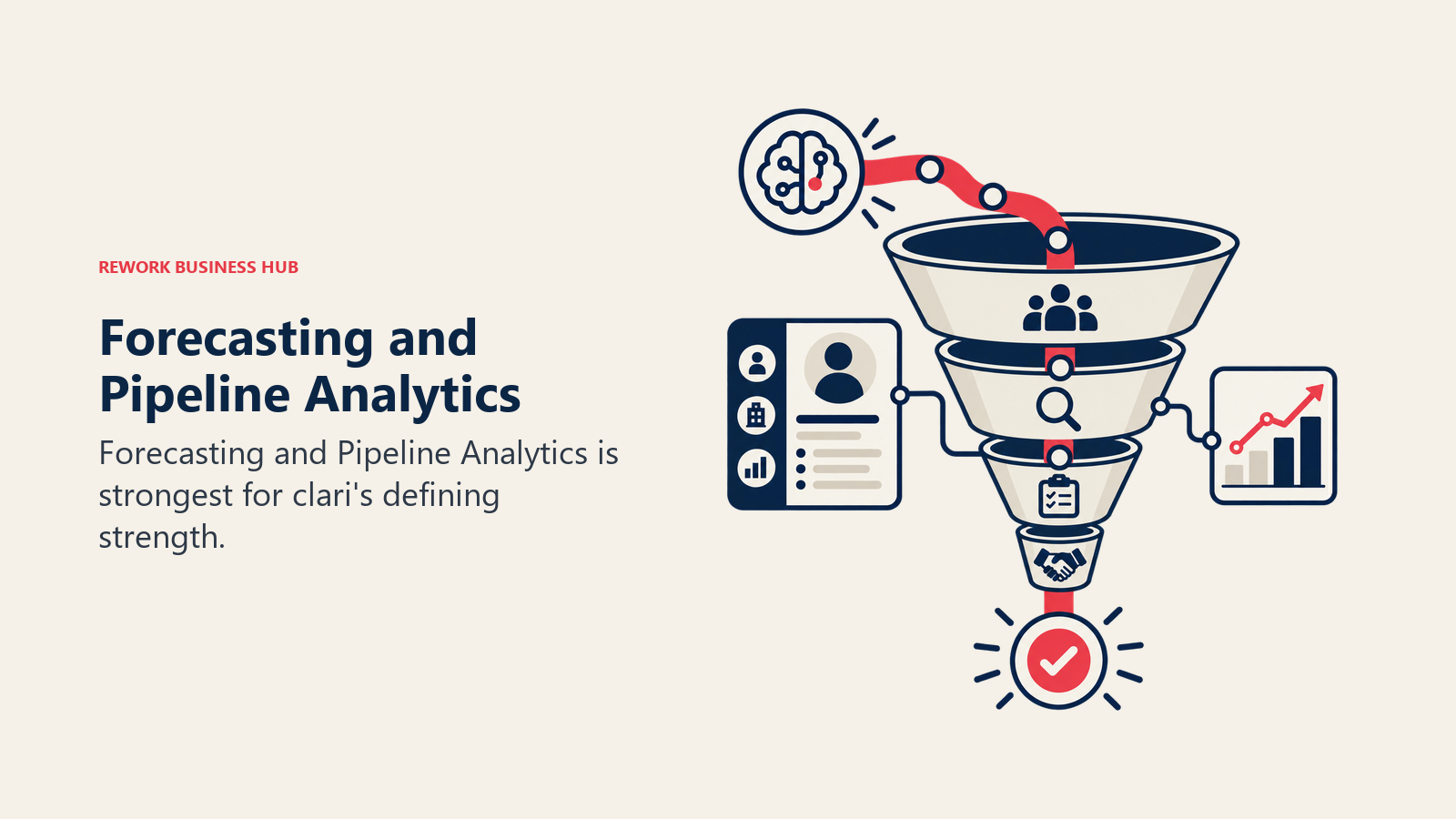
The product is designed around the rituals of revenue leadership: weekly forecast calls, pipeline reviews, quarterly business reviews. Clari structures these by letting each level of the org submit a commit number, which the platform then reconciles against AI-generated predictions. Discrepancies are flagged. Deals that have gone quiet get surfaced. Pipeline that's been sitting in the same stage for too long shows up in risk reports.
| Forecasting Feature | Clari | Gong |
|---|---|---|
| AI-powered forecast | Core: historical patterns, activity signals, pipeline velocity | Available (Gong Forecast), but newer and less mature |
| Forecast submission workflow | Yes: structured rep, manager, CRO rollup | Basic |
| Forecast vs. AI prediction comparison | Yes: flags where human commits diverge from AI model | Limited |
| Multi-segment forecasting | Yes: by product, geo, segment, team | Single pipeline view |
| Pipeline movement tracking | Yes: waterfall analysis, slippage, creation vs. close | Available |
| Deal progression analysis | Via pipeline stages | Via conversation signals |
| Board-ready revenue reports | Yes: designed for exec consumption | Functional but not the primary design target |
| Quota attainment tracking | Yes | Yes |
| Revenue leak detection | Yes: identifies deals going quiet or regressing | Via conversation engagement signals |
| Historical cohort analysis | Yes | Limited |
One distinction worth flagging: Gong has been building out its forecasting product over the past two years, and Gong Forecast is now a legitimate option for teams that are already on Gong for conversation intelligence. If you're also evaluating lighter meeting intelligence tools like Chorus or Fathom alongside Gong, see Gong vs Chorus vs Fathom for the three-way comparison. But Clari's forecasting engine has more years of calibration behind it and is still the default recommendation for teams where forecast accuracy is the primary problem.
AI Features in 2026
Both platforms have made significant AI investments since 2024. The AI directions, though, reflect the same underlying difference in DNA.
Gong's AI runs on conversation data. It's generative AI applied to calls: summaries, follow-up drafts, coaching suggestions, deal risk scores derived from what was said. The AI reads transcripts and surfaces patterns. For reps, this means less time on call notes and more signal on which accounts need attention. For managers, it means automated coaching triggers based on behaviors that historically predict deal outcomes.
Clari's AI runs on pipeline data. It's predictive AI applied to CRM signals and historical revenue patterns. The AI ingests deal age, stage progression, activity levels, and historical close rates to produce a forecast number and flag deals that are deviating from the expected path. For RevOps, this means less time stitching spreadsheets and more confidence in the number they're presenting to the board.
| AI Capability | Gong | Clari |
|---|---|---|
| AI call summaries | Yes | Yes (Clari Copilot) |
| AI follow-up email drafts | Yes | Yes (Clari Copilot) |
| AI deal risk scoring | Yes: from conversation signals | Yes: from pipeline signals |
| AI forecast prediction | Yes (Gong Forecast) | Yes: core feature |
| AI coaching nudges | Yes: behavior-based | No |
| AI pipeline anomaly detection | Limited | Yes |
| Generative AI for rep workflows | Strong | Available via Copilot |
| AI-generated QBR summaries | Limited | Yes |
CRM Integration Depth
Neither Gong nor Clari is a CRM. Both depend on a CRM for their core data model, and both integrate primarily with Salesforce, with secondary support for HubSpot and Microsoft Dynamics.
| CRM Integration | Gong | Clari |
|---|---|---|
| Salesforce | Deep: bi-directional sync, writes back to activities, opportunities | Deep: core integration, real-time sync |
| HubSpot | Yes | Yes |
| Microsoft Dynamics | Yes | Yes |
| CRM data writeback | Yes: call notes, next steps, engagement signals pushed to CRM | Yes: forecast data, deal scores pushed to CRM |
| Works without Salesforce | Yes, with reduced capability | More limited: Salesforce is the primary data layer |
| CRM data quality dependency | Lower: conversation data supplements or corrects CRM gaps | Higher: AI forecast quality depends on CRM hygiene |
One important consideration: Clari's forecast accuracy is directly tied to CRM data quality. If your reps are inconsistent about updating deal stages, close dates, and amounts in Salesforce, Clari's AI model will produce noisy predictions. Gong has a natural hedge here because conversation data tells Gong what's happening in a deal even when the CRM record hasn't been updated. That said, both platforms improve CRM hygiene indirectly by surfacing stale records and prompting updates.
Pricing
Both Gong and Clari are enterprise products. Neither publishes a pricing page. Both require a demo and a procurement cycle before you get to real numbers. That's worth naming honestly because it affects how you should plan your evaluation.
| Pricing Factor | Gong | Clari |
|---|---|---|
| Pricing model | Per user, per year: contact sales | Per user, per year: contact sales |
| Typical contract size | Mid-market teams often start at $50K-$100K/year depending on seats and modules | Mid-market teams often start at $60K-$120K/year depending on seats and modules |
| Free trial | Limited pilot available | Limited pilot available |
| Module bundling | Conversation Intelligence, Engage (sales engagement), Forecast sold separately or bundled | Forecasting, Revenue Platform, Copilot (call recording) sold separately or bundled |
| Pricing transparency | Low: requires sales cycle | Low: requires sales cycle |
| Budget planning | Build in 4-8 weeks for procurement | Build in 4-8 weeks for procurement |
Both platforms will require executive sponsorship to get through procurement. Budget for implementation services on top of license costs. Factor in Salesforce admin time for the integration work, especially with Clari's deeper CRM configuration requirements.
Implementation
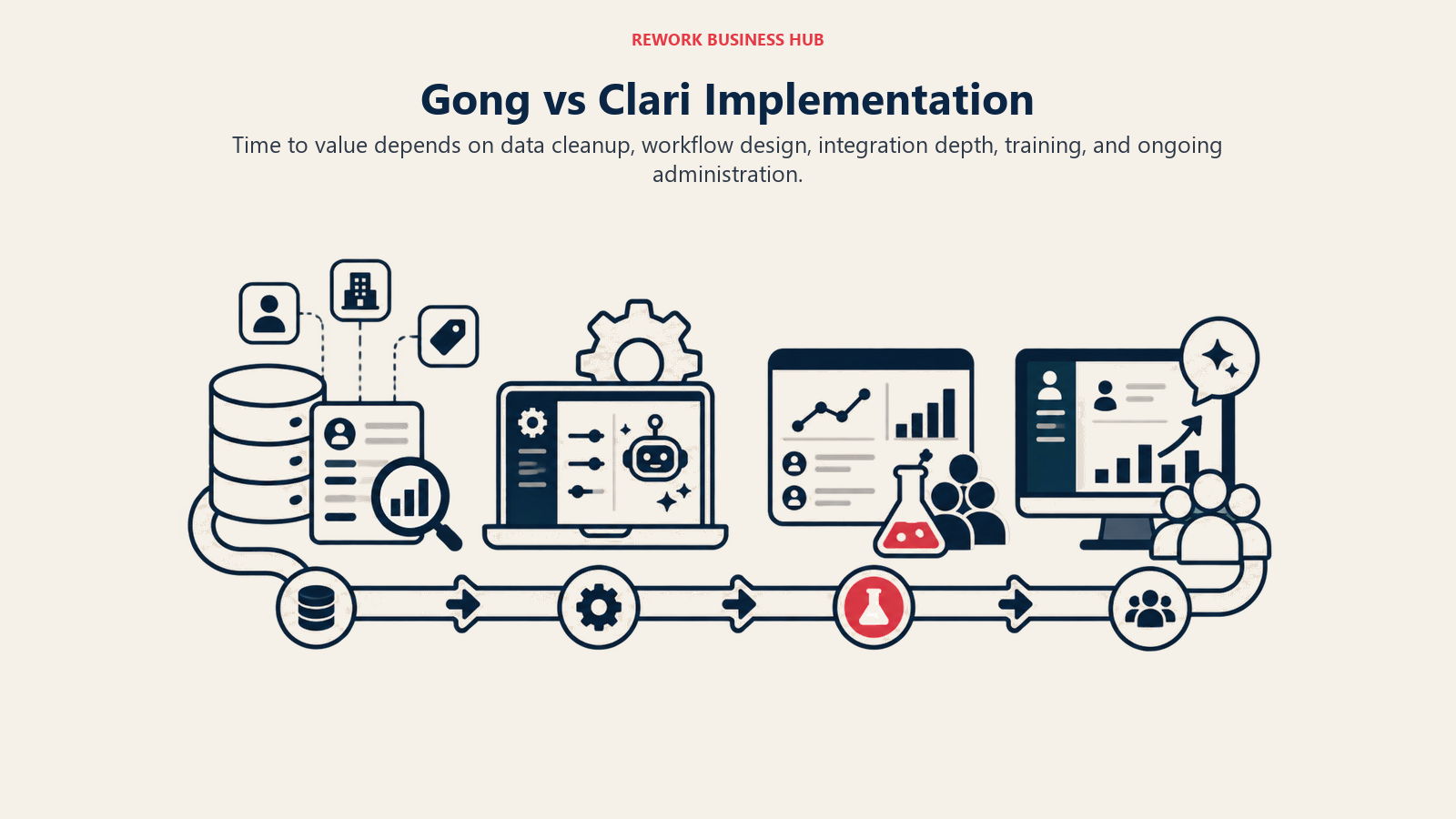
Time to value depends on data cleanup, workflow design, integration depth, training, and ongoing administration.
| Factor | Gong | Clari |
|---|---|---|
| Time to first value | 2-4 weeks (call recording live, patterns emerging) | 6-12 weeks (forecast model calibration needed) |
| Technical complexity | Medium: calendar, conferencing, CRM integration | High: CRM data model mapping, forecast hierarchy configuration |
| Admin burden | Moderate: call trackers, team structure, CRM field mapping | High: ongoing forecast model maintenance, rep training on commit workflow |
| Who does the setup | RevOps or sales operations with vendor support | RevOps with dedicated implementation engagement |
| Change management | Rep adoption is the main hurdle (call recording can be sensitive) | Manager and CRO adoption of forecast submission workflow |
| Training load | Low for reps (passive recording), moderate for managers | High for managers (forecast discipline required) |
When Gong Wins
Gong is the right platform when your biggest revenue problem is at the rep level, not the forecast level.
Your reps are inconsistent on calls. Some close at 40%, others at 18%, and you don't know why. Gong's call analytics and coaching workflows give managers the data to understand and close that gap. Clari doesn't solve this problem.
You're scaling a sales team fast. Onboarding reps with recorded call libraries, scoring their early calls against your best performers, and giving managers automated alerts when new reps go off-script is exactly what Gong was built for. Clari has nothing comparable.
Conversation data is your primary pipeline signal. If your CRM is messy but your reps are generating call volume, Gong can tell you what's actually happening in deals through transcripts and engagement signals even when the CRM record hasn't been updated.
You need competitive intelligence at scale. Gong's competitor mention tracking across all calls gives you a real-time view of who's showing up in your deals, what objections they're using, and how your reps are handling them. This is genuinely useful for product and competitive teams.
Sales enablement is a priority. If you're building a sales methodology, creating talk tracks, or trying to codify what your best reps do differently, Gong's call library and scorecard system is the direct mechanism for that work.
When Clari Wins
Clari is the right platform when your biggest revenue problem is at the forecast and pipeline visibility level.
Your quarterly forecast process is broken. If your CRO is manually stitching rep-submitted forecasts in spreadsheets, reconciling against gut feel, and still getting surprised at the end of the quarter, Clari's structured forecast submission workflow and AI prediction layer addresses that directly. Gong's forecasting product is improving but isn't Clari's primary battleground.
You manage a complex multi-segment business. Multiple products, multiple regions, multiple sales motions: Clari's ability to roll up forecasts across segments and compare them to AI predictions is purpose-built for this. Gong's pipeline view doesn't have this depth.
Board-level revenue reporting matters. Clari produces the kind of clean, structured revenue reporting that finance and boards expect, with waterfall analysis, pipeline creation vs. close rates, and historical cohort comparisons. For a CRO preparing a QBR or board presentation, Clari's output is ready to paste into slides.
Revenue leak is your primary concern. If deals are slipping through the pipeline without clear reasons, Clari's movement tracking and AI anomaly detection surfaces them faster than manual pipeline reviews. The platform is built around catching revenue risk before it hits the quarter.
You have a mature Salesforce org. Clari's depth of value scales with CRM data quality. If you've invested in CRM hygiene, Clari's AI model can produce genuinely accurate predictions. If your CRM is inconsistent, you'll need to fix that first.
Decision Framework
Match the platform to your operating need, team size, implementation capacity, and the trade-offs you can support.
| Scenario | Gong | Clari |
|---|---|---|
| Primary problem is rep performance and coaching | Strong fit | Not the right tool |
| Primary problem is forecast accuracy | Partial fit (Gong Forecast) | Strong fit |
| Need conversation-level deal intelligence | Strong fit | Not the right tool |
| Need pipeline-level revenue visibility | Partial fit | Strong fit |
| Scaling a sales team (onboarding, playbooks) | Strong fit | Not the right tool |
| Managing a complex multi-segment forecast | Limited | Strong fit |
| CRO needs board-ready revenue reporting | Functional | Strong fit |
| Sales managers need daily coaching data | Strong fit | Not the right tool |
| RevOps needs forecasting infrastructure | Partial fit | Strong fit |
| Want both: conversation + forecasting | Consider Gong + Gong Forecast | Consider Clari + Clari Copilot |
What to Do Next
The fastest way to cut through the noise is to name the specific problem you're trying to solve before you book the demos.
If you're a sales manager or VP Sales frustrated by inconsistent rep performance, start with Gong. Ask them to show you the coaching scorecard workflow, the deal risk alerts from conversation signals, and how teams like yours have moved average win rates. The conversation intelligence story is easy to evaluate with your own call data in a pilot.
If you're a CRO or RevOps leader who can't trust your quarterly forecast, start with Clari. Ask them to show you the AI prediction vs. rep commit comparison on a historical quarter, how multi-segment rollups work, and what the forecast submission workflow looks like for managers. The forecasting accuracy story requires historical CRM data to demo properly, so come prepared.
And if you're evaluating both because your team genuinely has gaps in both areas, the practical answer is to identify which problem is costing you more money right now and solve that first. For CROs who want to read more about building forecasting discipline as an organizational habit, see forecasting discipline for CROs. Both platforms have expanded into the other's territory, but neither has fully closed the gap. Gong remains the conversation intelligence category leader. Clari remains the revenue operations and forecasting category leader. Buy the one that matches your biggest problem, and revisit the other in 12 months.
If you're simultaneously evaluating your CRM layer alongside revenue intelligence, and wondering whether your pipeline data is clean enough to make either platform work well, that's worth examining separately before committing to either subscription.

Principal Product Marketing Strategist