Rework vs HubSpot Breeze: Which AI CRM Fits a Growing Team in 2026
Turn this article into takeaways for your work.


Each assistant summarizes the article only for you and suggests best practices for your work.
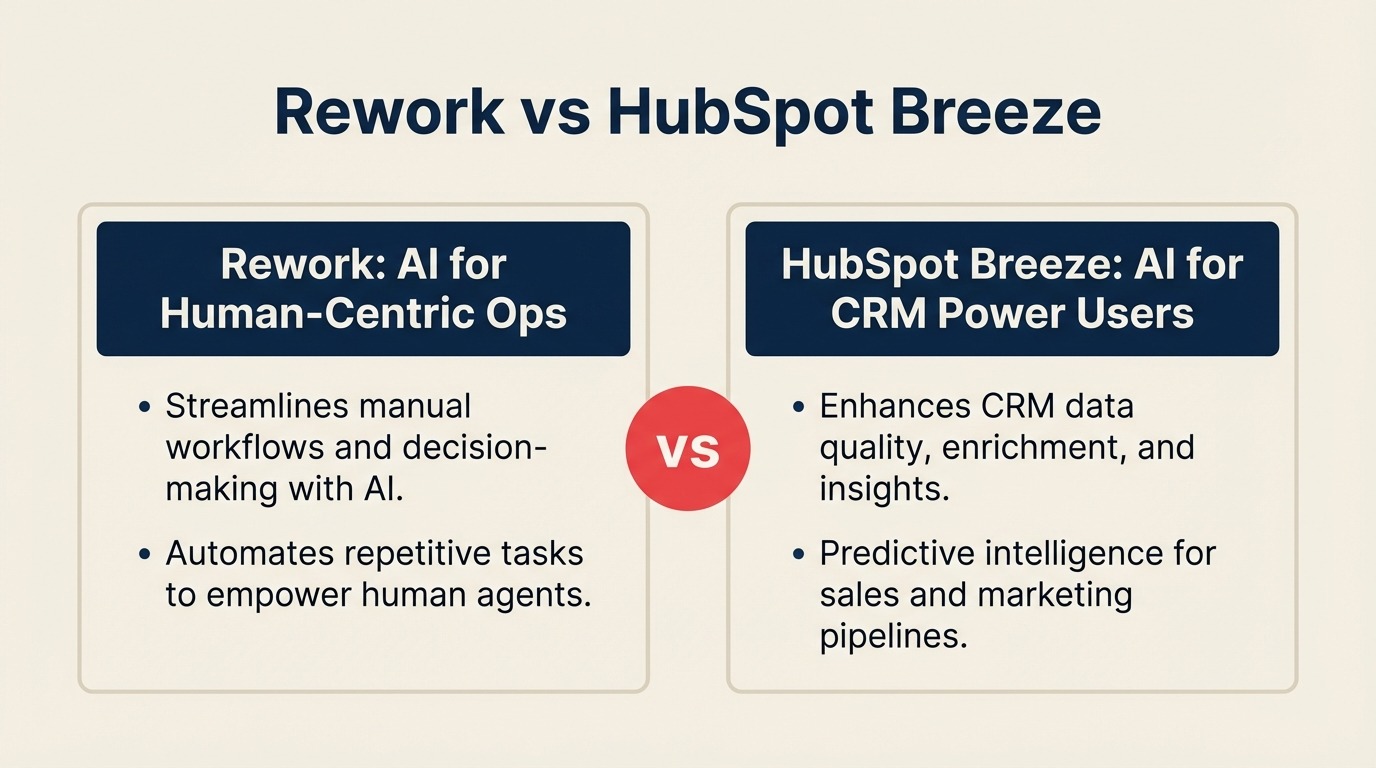
HubSpot launched Breeze in 2024 and spent most of 2025 expanding it. Today, Breeze Copilot sits inside every HubSpot hub, Breeze Agents automate prospecting, content creation, social posting, and customer support, and Breeze Intelligence enriches contact and company records with third-party data. For HubSpot's existing customers, it's a compelling upgrade. For everyone else evaluating a CRM in 2026, it raises a question: does this AI layer change the buying decision?
This comparison is written for mid-size sales and ops teams, typically 20 to 200 people, that are evaluating CRM platforms and want to know where the AI actually helps and where the marketing outpaces the reality. We'll give HubSpot Breeze credit where it earns it. And we'll be honest about where Rework's simpler, more integrated approach wins for the buyers this article is aimed at.
TL;DR
| Factor | Rework | HubSpot Breeze |
|---|---|---|
| AI layer | Built-in AI across pipeline, lead routing, inbox, and workflows | Breeze Copilot, Agents (Prospecting, Content, Social, Customer), Intelligence |
| AI availability | Included across plans | Breeze Copilot on all hubs; Breeze Agents and Intelligence on specific tiers |
| Best for | 20-200 person cross-functional teams running sales, marketing, and ops in one product | HubSpot customers adding AI on top of existing Marketing/Sales/Service Hubs |
| CRM core | Full CRM + Lead Management as one product | Sales Hub (CRM + pipeline + sequences) |
| Native chat inbox | WhatsApp, Messenger, Instagram DM, web chat, email, SMS unified | Facebook Messenger (Service Hub); WhatsApp and Instagram are paid add-ons |
| Lead distribution | Round-robin, territory, skill-based, SLA rules, all plans | Requires Professional tier + configuration; no native round-robin out of the box |
| Starting price | $999/yr Starter (5 users) or $1,999/yr Standard (10 users included) | Free (limited); $20/user/mo (Starter) |
| Mid-tier price | $1,999/yr Standard + $12/user/mo above 10 users | $100/user/mo (Sales Hub Professional) |
| Support | Email + chat + phone on all plans | Limited at Starter; phone from Professional |
| Marketing automation | Not included | Deep, via Marketing Hub (separate hub pricing) |
| Ecosystem | 80+ native integrations | 1,500+ app marketplace |
| Setup speed | 1-3 days for basic CRM; 1-2 weeks for full Lead Management + chat, led by a team with hands-on experience onboarding mid-size sales, marketing, and ops departments end-to-end | Under a day for the free CRM; 4-8 weeks for a multi-hub Breeze deployment, often requiring a HubSpot Solution Partner ($10,000-$50,000) since HubSpot has no in-house team experienced with mid-size cross-department rollouts and Breeze agents require properly configured hubs and data models |
Who Each Is Built For
Rework
Rework is built for mid-size teams that are past spreadsheets and shared inboxes but not yet ready for (or interested in) enterprise-grade complexity. The product handles the full lead lifecycle from capture to close to retention without stitching together separate tools. Sales, marketing, ops, and customer success all live in one data model.
The AI in Rework is operational: it helps route leads, surface next actions, prioritize follow-ups, and flag pipeline risk. It doesn't generate blog posts or social content.
HubSpot Breeze
HubSpot Breeze is an AI layer on top of HubSpot's existing suite of products. That suite is broad: Marketing Hub, Sales Hub, Service Hub, Content Hub, Operations Hub, and Commerce Hub. Breeze extends each of those hubs with AI capabilities, from writing assists in Copilot to fully automated prospecting and customer support agents.
If your team already runs HubSpot, Breeze is the path of least resistance for adding AI. If you're starting fresh, HubSpot's total cost equation includes the hub you actually need plus any others you layer on.
| Dimension | Rework | HubSpot Breeze |
|---|---|---|
| Company size | 20-200 employees | Any size; scales to enterprise |
| Revenue range | $2M-$100M ARR | Startup to Fortune 500 |
| Ideal buyer | COO, Head of RevOps, Head of Sales | CMO, VP Marketing, CRO, large RevOps teams |
| Primary use case | Cross-team CRM + ops + unified inbox | Sales + marketing + service (multi-hub) |
| AI readiness | Works out of the box | Richer AI, but best results with configured data model |
| Platform footprint | Single unified product | Modular; cost and complexity grow by hub |
Team Fit
| Team | Rework fit | HubSpot Breeze fit |
|---|---|---|
| Sales | Strong: pipeline, sequences, routing, forecasting | Strong: sequences, Breeze Prospecting Agent, deal management |
| Marketing | Lead capture, scoring, nurture, attribution | Excellent: Marketing Hub with Breeze Content and Social Agents |
| RevOps | Unified data across sales + marketing + CS, workflow automation | Excellent: Operations Hub + Breeze Intelligence for enrichment |
| Customer Success | Unified contact timeline with chat channels | Good: Service Hub + Breeze Customer Agent |
| Operations | Cross-team process templates, approval workflows | Partial: workflows across hubs, but ops templates aren't a focus |
AI Capabilities: Breeze vs Rework AI
HubSpot Breeze
HubSpot launched Breeze as a unified AI brand covering three distinct layers:
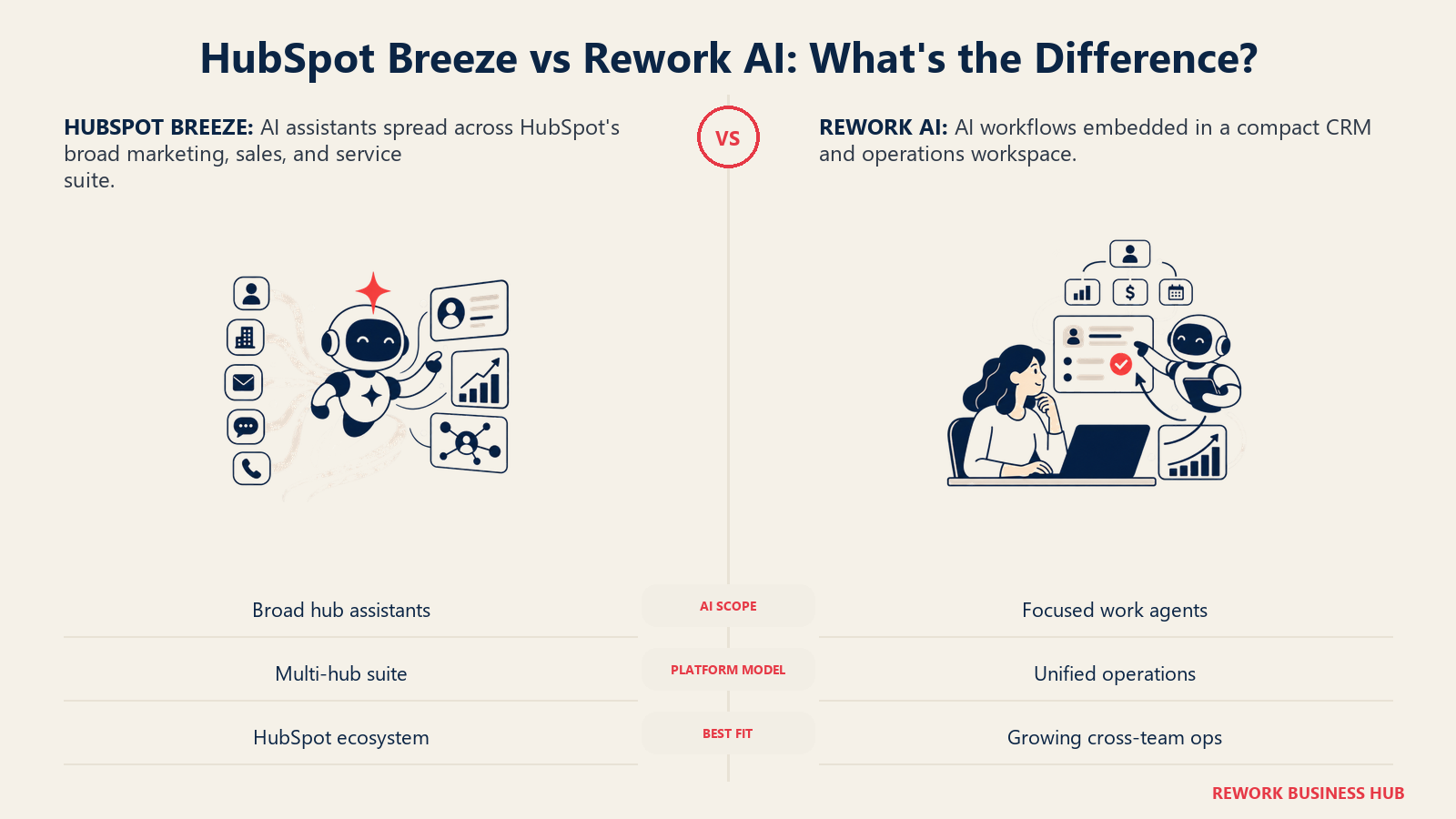
Breeze Copilot is a chat-based AI assistant embedded across all HubSpot hubs. It can summarize contact records, draft emails, suggest next steps, and answer questions about your data. Availability: all hubs, all paid tiers.
Breeze Agents are four specialized autonomous agents:
- Prospecting Agent: researches companies, identifies contacts, and creates personalized outreach. Available in Sales Hub Professional+.
- Content Agent: generates blog posts, landing pages, case studies, and social content using your brand voice. Available in Content Hub Starter+.
- Social Agent: plans and publishes social media posts. Available in Marketing Hub Professional+.
- Customer Agent: handles inbound support queries autonomously before escalating to a human. Available in Service Hub Professional+.
Breeze Intelligence is a data enrichment layer that appends buyer intent signals, company firmographics, and contact data to your CRM records from HubSpot's third-party data network. Priced separately per credit.
| AI Capability | Rework | HubSpot Breeze |
|---|---|---|
| AI writing assist | Email drafts, sequence copy | Breeze Copilot: email, blog, landing pages, social |
| AI prospecting | Not a feature | Breeze Prospecting Agent (Sales Hub Pro+) |
| AI content creation | Not a feature | Breeze Content and Social Agents (Content Hub / Marketing Hub Pro+) |
| AI customer support | Not a feature | Breeze Customer Agent (Service Hub Pro+) |
| Data enrichment | Integrated from contact data you own | Breeze Intelligence (paid per credit) |
| Lead scoring AI | Rule-based and AI-assisted scoring | Predictive lead scoring (Marketing Hub Pro+) |
| Next-best-action | Included: pipeline risk flags, follow-up prompts | Copilot-based suggestions |
| Conversation intelligence | Not included | Available via HubSpot or Gong/Chorus integration |
| Setup required | Minimal, works from day one | Best results after configuring data model and brand voice |
Rework AI
Rework's AI is narrower in scope and deliberately operational. It focuses on the decisions that affect revenue: which lead to route to which rep, when a deal is at risk, which contacts to prioritize today. The design philosophy is that AI should help teams act faster, not help teams produce more content.
If your primary AI use case is generating blog posts, social campaigns, or sales prospecting research, Breeze is meaningfully ahead. If your primary AI use case is making your CRM and sales process run with less manual intervention, Rework's approach is more direct.
Core CRM Comparison
| Feature | Rework | HubSpot Sales Hub |
|---|---|---|
| Contact + company records | Full records with activity timeline | Excellent, one of the best in category |
| Pipeline management | Multi-pipeline, all plans | Multi-pipeline from Professional ($100/user/mo) |
| Email sequences | Included in all plans | Professional tier |
| Workflow automation | Included in all plans | Professional tier |
| Custom reporting | Included in all plans | Professional tier |
| Forecasting | Deal stage + weighted pipeline | Advanced predictive forecasting at Pro+ |
| Custom objects | Roadmap | Enterprise tier |
| Mobile app | iOS + Android | iOS + Android |
| API access | Standard tier | Professional+ |
HubSpot's contact record remains one of the most detailed in the market. The full activity timeline, associated deals, marketing interactions, and email history all visible in one scroll is a genuine advantage for teams that track complex buyer journeys. But most of those capabilities require the Professional tier at $100 per user per month. For a deeper look at the non-AI CRM comparison, see Rework vs HubSpot CRM.
Lead Management Deep Dive
Lead management is where the two products diverge most clearly. HubSpot built its reputation on marketing-to-sales handoffs. Rework built its CRM with lead distribution as a first-class feature from day one.
| Capability | Rework | HubSpot |
|---|---|---|
| Lead capture | Forms, ads, chat (WhatsApp, web), imports, API | Forms, landing pages, ads, live chat, imports |
| Lead scoring | Rule-based + AI-assisted | Predictive lead scoring (Marketing Hub Pro+) |
| Round-robin distribution | Native, all plans | Not native; requires workflows + Professional tier configuration |
| Territory-based routing | Native | Custom properties + workflow logic required |
| Skill-based routing | Native | Not supported natively |
| SLA-based routing | Native | Custom workflows required |
| Marketing to sales handoff | Built-in lifecycle stage automation | Marketing Hub + Sales Hub handoff via lifecycle stages |
| Nurture workflows | Included in all plans | Marketing Hub (separate hub pricing) |
| Attribution back to pipeline | Built-in | Available in Marketing Hub Pro+ |
| Lead distribution reporting | Included | Custom reports required |
HubSpot's strength in lead management is on the marketing side: nurture sequences, ad attribution, and the content engine that fills the top of the funnel. But the handoff from marketing to sales, and specifically the routing of inbound leads to the right rep, requires Professional tier configuration that most teams underestimate. The HubSpot RevOps governance considerations are explored further in HubSpot Breeze: a RevOps governance guide.
Rework's lead distribution is built for ops-heavy teams: round-robin assignment, territory logic, SLA-based escalation, and skill matching work out of the box on every plan. For businesses where lead response time and fair distribution directly affect revenue, this matters.
Unified Chat Channels
One of the sharpest differences between Rework and HubSpot is how each handles the modern reality that buyers reach out on WhatsApp, Instagram, and Messenger as often as email.
| Channel | Rework | HubSpot |
|---|---|---|
| Native, all plans | Paid add-on (WhatsApp integration) | |
| Facebook Messenger | Native, all plans | Service Hub (included) |
| Instagram DM | Native, all plans | Paid add-on |
| Live web chat | Native, all plans | Included (across hubs) |
| Native | Native | |
| SMS | Native | Paid add-on |
| Unified inbox view | All channels in one contact timeline | Conversations inbox (separate from contact record in some views) |
Rework's unified inbox pulls every inbound message from WhatsApp, Instagram DM, Messenger, web chat, email, and SMS into a single conversation view tied to the contact record. A rep can see the full conversation history across every channel before responding.
HubSpot's conversation inbox exists, but WhatsApp and Instagram require additional add-ons, and the channel coverage depends on which hubs you've subscribed to. For businesses in e-commerce, education, real estate, or any market where customers prefer messaging apps over email, the gap here is significant.
HubSpot Hub Pricing Reality
HubSpot's pricing is modular by design. Each hub is sold separately, and Breeze AI features are distributed across those hubs. That means the cost of "HubSpot with AI" is the sum of the hubs you actually need.
| Hub | Starter | Professional | Enterprise |
|---|---|---|---|
| Sales Hub | $20/user/mo | $100/user/mo | $150/user/mo |
| Marketing Hub | $15/mo (flat, up to 1,000 contacts) | $800/mo (up to 2,000 contacts) | $3,600/mo |
| Service Hub | $15/user/mo | $100/user/mo | $130/user/mo |
| Content Hub | $15/user/mo | $450/mo | $1,500/mo |
| Operations Hub | $20/user/mo | $720/mo | $2,000/mo |
For Breeze Agents specifically: the Prospecting Agent is Sales Hub Professional+, the Content Agent is Content Hub Starter+, the Social Agent is Marketing Hub Professional+, and the Customer Agent is Service Hub Professional+.
A team that wants Breeze Prospecting and Breeze Customer Agent, plus full CRM and marketing automation, is looking at Sales Hub Professional + Marketing Hub Professional + Service Hub Professional. At 25 seats:
| Scenario | Annual cost (est.) |
|---|---|
| HubSpot Sales Hub Professional, 25 seats | $30,000/yr |
| + Marketing Hub Professional (2,000 contacts) | $9,600/yr |
| + Service Hub Professional, 25 seats | $30,000/yr |
| Combined | ~$69,600/yr |
| Rework Sales Ops, 25 seats ($999/yr Starter or $1,999/yr Standard + $12/user/mo above 10) | $4,159/yr |
These are list-price estimates. HubSpot frequently negotiates at volume. But the structural reality remains: each Breeze Agent lives behind a specific hub at a specific tier. If you're only using Sales Hub, you get Breeze Copilot and the Prospecting Agent. The content and social agents require separate hubs.
Rework Sales Ops has two packages:
- Starter, $999/year for up to 5 users
- Standard, $1,999/year with 10 users included, plus $12/user/month for each additional user
See rework.com/pricing for current details. All plans include lead management, multi-channel inbox, lead distribution, and workflow automation. No add-ons for WhatsApp or Instagram, no contact-tier pricing, no mandatory onboarding fees.
Implementation and Time-to-Value
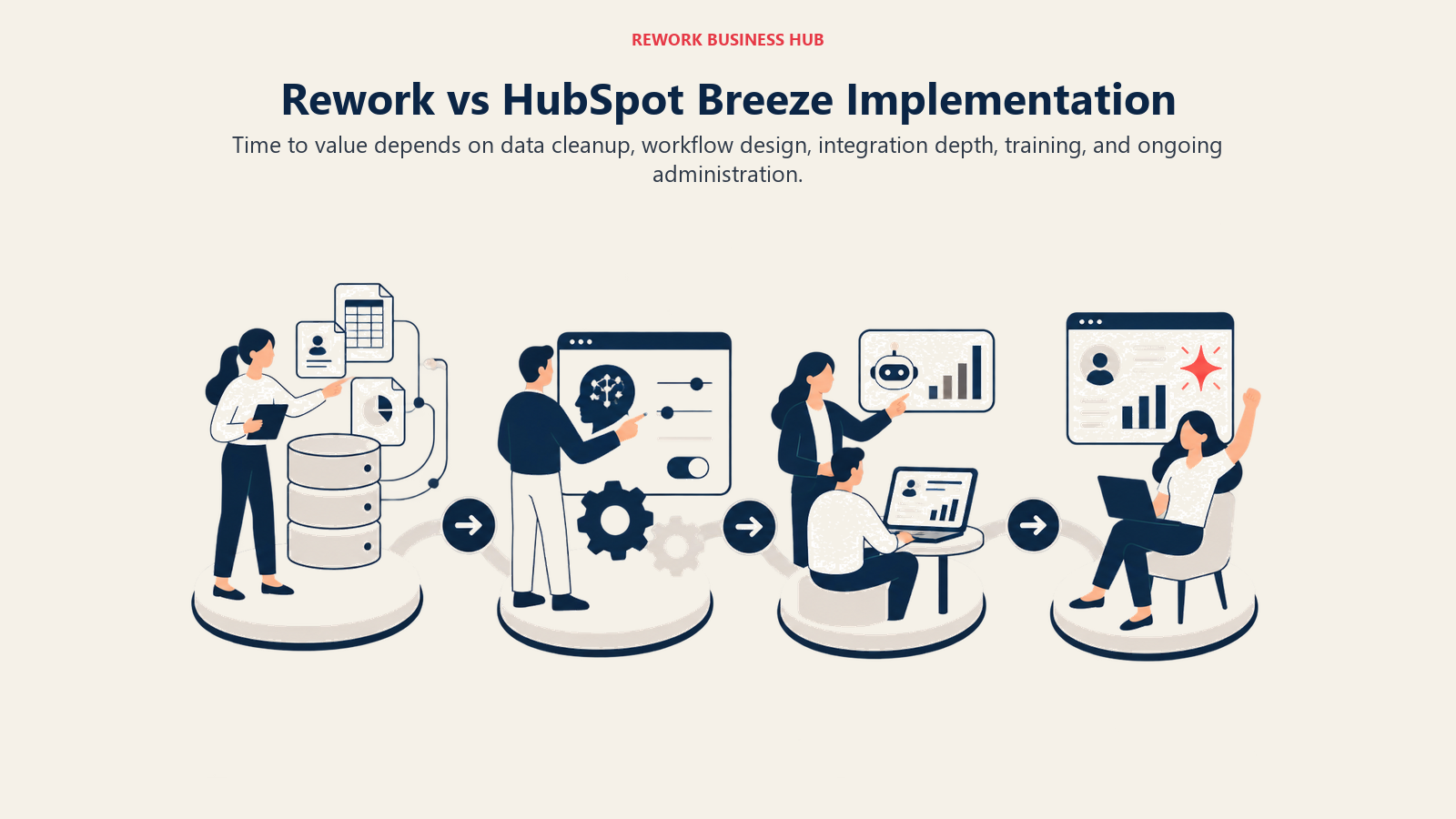
| Dimension | Rework | HubSpot Breeze |
|---|---|---|
| Basic CRM setup | 1-3 days, led by team experienced with the full lead lifecycle | Under a day for the free CRM; genuinely fast |
| Team onboarding (reps) | 3-5 days for full product, included | 1-2 days for Sales Hub Starter basics |
| Lead management configuration | 3-7 days with onboarding team walking through scoring, routing, forms | 2-6 weeks for round-robin + territory routing at Professional tier; no guided path |
| Breeze Agents activation | AI features operational from day one | Breeze Prospecting requires Sales Hub Pro+; each additional agent requires a separate hub at Pro+ tier |
| Chat inbox connection | 1-2 hours per channel, led by team with mid-size multi-department onboarding experience | WhatsApp and Instagram DM require paid add-ons; setup takes 1-3 days |
| Full implementation (CRM + lead mgmt + chat + Breeze) | 1-2 weeks, led by team with mid-size multi-department onboarding experience | 4-8 weeks self-serve or a HubSpot Solution Partner ($10,000-$50,000); mandatory onboarding fees at Professional ($1,500 per hub) |
| Data migration from prior CRM | CSV import + API, migration support on all plans | CSV import + API; well-documented, self-serve |
| Admin overhead post-launch | Moderate, more moving parts | High for multi-hub configurations; each hub has its own admin layer |
| Support model | Email + chat + phone on all plans | Limited at Starter; phone from Professional |
HubSpot's free CRM is fast to start, and for existing HubSpot customers adding Breeze, the upgrade path is logical. But a multi-hub Breeze deployment, covering Sales + Marketing + Service with the relevant Breeze agents activated, is a meaningful configuration project. Each agent lives behind a specific hub at a specific tier, each hub has a separate onboarding fee at Professional, and the brand voice and data model configuration that makes Breeze work well requires its own setup time. HubSpot has no in-house team experienced with mid-size cross-department rollouts, so Solution Partners handle these deployments (typically $10,000-$50,000 depending on hub count and complexity). Rework's edge is institutional experience: the team has onboarded full Sales, Marketing, RevOps, and CS departments at mid-size companies and applies that hard-earned knowledge of what actually breaks during a multi-team rollout to every new customer. The full stack ships in one product, so the 1-2 week implementation includes everything without a multi-hub rollout.
When HubSpot Breeze Is the Right Call
You already run HubSpot's marketing stack. If Marketing Hub is your demand gen engine and your CRM is Sales Hub, Breeze is a natural extension. Adding Copilot and the Prospecting Agent inside a product your team already uses daily is a low-disruption upgrade.
Your marketing team needs AI content and social agents. Breeze Content Agent and Social Agent are genuinely capable. For marketing teams that produce high content volume across blog, social, and landing pages, these agents reduce production overhead in ways Rework doesn't attempt.
You're at enterprise scale with a dedicated RevOps or marketing ops function. HubSpot's data model depth, Breeze Intelligence enrichment, and the breadth of the Operations Hub reward teams with the admin capacity to configure and maintain them. The platform gets better the more you invest in it.
Your integrations are unusual. HubSpot's 1,500+ app marketplace has native connectors for tools Rework would route through Zapier. For stacks built around niche vertical software, HubSpot's ecosystem depth reduces integration maintenance.
You're an early-stage company that wants to grow into the platform. HubSpot's free CRM and Marketing Hub Starter make it possible to start at near-zero cost and scale. There's no Rework equivalent for early-stage teams with minimal budget.
When Rework Is the Right Call
You need cross-team ops, not just a sales CRM. Rework handles sales, marketing, customer success, and operations in one product. If your processes cross department lines (sales hands off to CS, marketing runs nurture loops that feed sales, ops approves deals before they close), Rework's unified data model reduces the handoff friction that multi-hub setups create.
Your team sells through WhatsApp, Instagram, or other messaging channels. Rework's native multi-channel inbox handles these channels on every plan without add-ons. If your buyers live in messaging apps, this isn't a nice-to-have.
Lead distribution is a serious operational problem. Round-robin, territory, skill-based, and SLA routing are built into Rework. On HubSpot, replicating this requires Professional tier workflows and significant configuration. For businesses where a lead going to the wrong rep or sitting unassigned costs real revenue, Rework solves this faster.
You want AI that works without setup. Breeze delivers better results when your data model is clean, your brand voice is configured, and your team is trained on the agents. Rework's AI is narrower but requires almost no configuration to deliver pipeline risk flags, routing decisions, and follow-up prioritization from day one.
Budget predictability matters. Rework's per-seat pricing covers all features including the unified inbox, lead distribution, and workflow automation. There are no contact-based pricing tiers, no add-ons for native channels, and no mandatory onboarding fees.
Decision Framework
Match the platform to your operating need, team size, implementation capacity, and the trade-offs you can support.
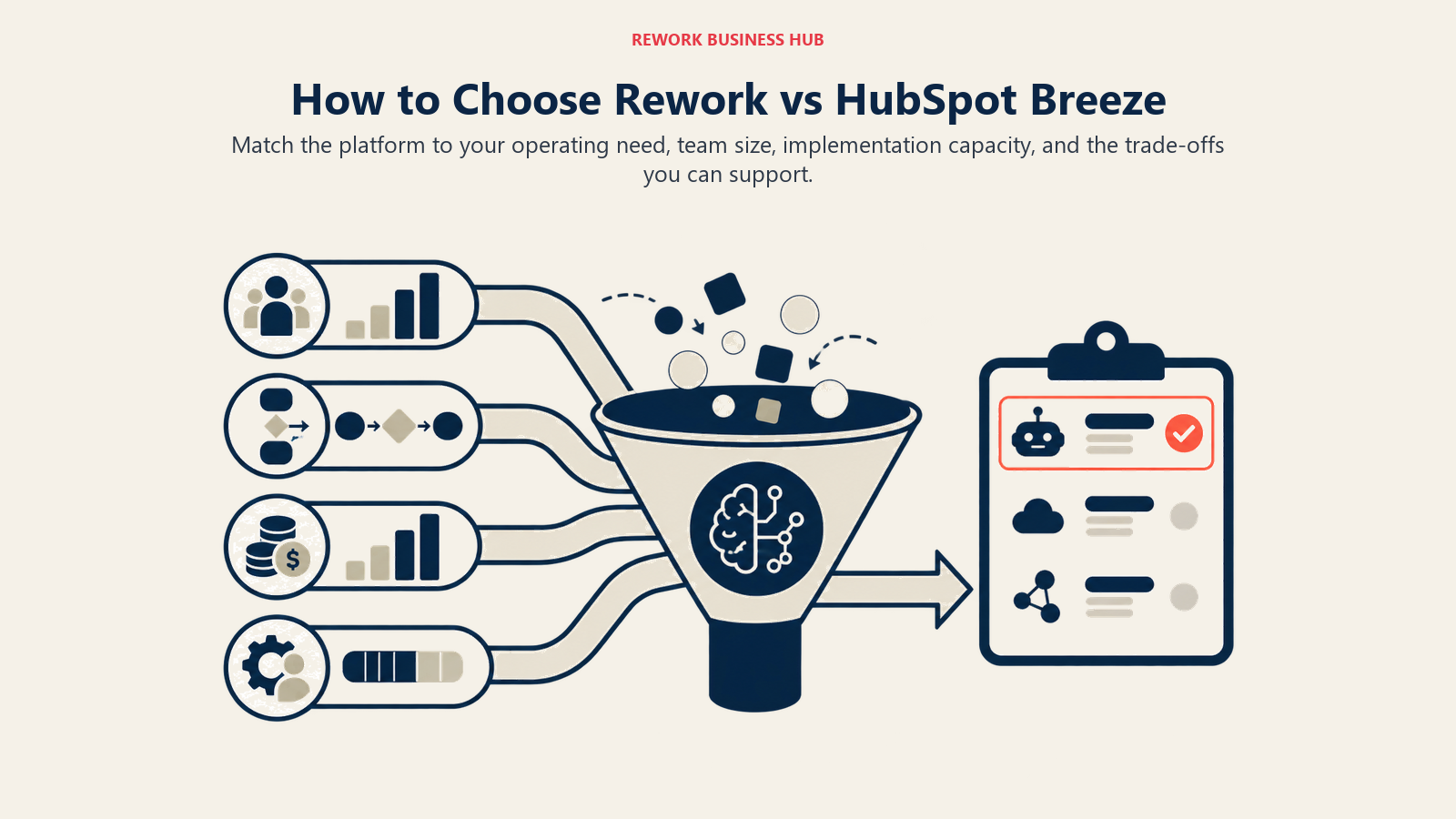
| Pick HubSpot Breeze if... | Pick Rework if... |
|---|---|
| You're already on HubSpot and adding AI to existing workflows | You're starting fresh and want one product for CRM + ops + inbox |
| Your primary AI use case is content, social, or prospecting research | Your primary AI use case is routing, prioritization, and pipeline health |
| You need a combined marketing + sales + service platform | You need cross-functional ops that goes beyond pure CRM |
| Your team is enterprise-scale with a dedicated HubSpot admin | Your team is 20-200 people without a full-time CRM admin |
| You need deep integrations with a complex tool stack | Your stack is standard (Gmail, Slack, Stripe, Zapier for edge cases) |
| You sell primarily via email and you're building inbound demand gen | You sell via WhatsApp, Messenger, Instagram DM, or SMS |
| Budget isn't the constraint, capability and brand are | Budget predictability and total cost at 25-100 seats matter |
What to Do Next
If you're evaluating both products seriously, the fastest way to resolve the decision is to map your actual use case against two questions.
First: which teams need to be in the CRM, and what do they need it to do? If the answer is sales plus marketing automation plus a content engine plus customer support, you're describing HubSpot's multi-hub model. If the answer is sales plus cross-team ops plus a multi-channel inbox plus lead distribution, you're describing Rework.
Second: which AI capability matters most in the next six months? Breeze's content and prospecting agents are ahead of what Rework offers in those areas. Rework's operational AI (routing, prioritization, risk flagging) is more immediately useful for teams that need their sales process to run faster with less manual intervention.
Both products offer trials. The right test is importing your actual pipeline data, running one lead from capture to close, and seeing where friction appears. For Rework, request a demo at rework.com. For HubSpot Breeze, their free CRM is a legitimate starting point if you're not already in the ecosystem.
For more context on how AI is reshaping mid-market CRM decisions, compare Rework against Salesforce Agentforce for the enterprise AI CRM side of the market. If your team is also evaluating conversation intelligence tools to sit on top of your CRM, the Gong vs Clari comparison covers the revenue intelligence layer separately.

Principal Product Marketing Strategist
On this page
- TL;DR
- Who Each Is Built For
- Rework
- HubSpot Breeze
- Team Fit
- AI Capabilities: Breeze vs Rework AI
- HubSpot Breeze
- Rework AI
- Core CRM Comparison
- Lead Management Deep Dive
- Unified Chat Channels
- HubSpot Hub Pricing Reality
- Implementation and Time-to-Value
- When HubSpot Breeze Is the Right Call
- When Rework Is the Right Call
- Decision Framework
- What to Do Next