More in
AI at Work News
OpenAI Opened ChatGPT Advertising to Small Businesses at Any Budget
thg 6 6, 2026
AI Is Everywhere at Work. Only 1 in 10 Say It Transformed the Job
thg 6 6, 2026
Vibe Coding's $10.5B Moment: AI Now Starts Most New Software Builds
thg 6 6, 2026
AI Agents Now Have More System Access Than Your Employees. Few Are Secured
thg 6 5, 2026
Should You Build Your AI or Buy It? Watch What the Giants Bought.
thg 6 5, 2026
Uber Caps Employee AI Spending at $1,500 Per Seat After a Budget Blowout
thg 6 5, 2026
Trump's AI Executive Order Is Deregulatory. Your Compliance Risk Didn't Move
thg 6 4, 2026
AI Pushed 220 Unicorns Below $1B. Pre-ChatGPT Companies Face a Reckoning
thg 6 4, 2026
Token Prices Fell 67% This Year. Your AI Bill Is Going Up Anyway
thg 6 3, 2026
Small Businesses Using AI Report Higher Revenue and Shorter Workdays
thg 6 3, 2026
Anthropic Shipped 10 Financial Services Agents With Jamie Dimon On Stage. Here's the CIO Vertical-Agent Decision
Turn this article into takeaways for your work.


Each assistant summarizes the article only for you and suggests best practices for your work.
Anthropic just entered the business no one expected a frontier model lab to touch: pre-built, role-specific, industry-native AI agents. And they brought JPMorgan Chase CEO Jamie Dimon on stage to say it's ready.
That signal deserves a clean-eyed read from every Chief Information Officer (CIO) sitting on an enterprise AI renewal.
On May 5, 2026, Anthropic held its "Briefing: Financial Services" event in New York. The company unveiled 10 new AI agent templates aimed directly at banking and investment back-office work, alongside a unified Microsoft 365 integration and a data partnership with Moody's. As reported by Fortune, JPMorgan Chase CEO Jamie Dimon appeared on stage alongside Anthropic CEO Dario Amodei, making JPMorgan the most visible launch partner for a set of agents that are available immediately on all paid Anthropic plans.
This is not a pilot program or a research preview. It's a marketplace play, and the model it proposes sits at the center of a real CIO decision: do you buy pre-built vertical agents, or do you build on a platform yourself?
What the 10 Agents Actually Do
The 10 agent templates Anthropic shipped are aimed at the tasks that occupy most of the back-office headcount in investment banking and commercial banking operations. The templates cover pitchbook assembly, credit memo drafting, Know Your Customer (KYC) file screening, financial statement auditing, risk summary generation, regulatory compliance checks, client onboarding workflows, account reconciliation, reporting automation, and document review for deal diligence.
These aren't general-purpose assistants that happen to work in finance. They're designed around the specific document structures, data formats, and workflow patterns that define financial services operations. The Moody's data partnership means the agents can ingest ratings data and financial indicators directly, rather than requiring a separate integration layer. The Microsoft 365 connection gives them read/write access to Excel workbooks, PowerPoint decks, and Outlook threads where most of that work actually lives.
For the CIO evaluating this, the distinction matters. These are autonomous agents executing defined tasks, not copilots assisting a human analyst step by step. That means governance, audit, and control requirements are different from what most enterprises have in place for AI assistants.
Key Facts
- Anthropic unveiled 10 financial-services AI agent templates at its "Briefing: Financial Services" event in New York on May 5, 2026. (Fortune, May 5, 2026)
- The agent templates are available immediately on all paid Anthropic plans via a financial services marketplace. (Fortune, May 5, 2026)
- The announcement landed one day after Anthropic disclosed a $1.5B joint venture with Blackstone, Hellman and Friedman, and Goldman Sachs to build an enterprise deployment company for mid-sized firms. (Fortune, May 5, 2026)
Why JPMorgan Co-Launched (and What That Signal Means)
JPMorgan's participation changes the announcement from a vendor launch into a market signal about where financial-services AI is heading.
Jamie Dimon's presence on stage was not casual product endorsement. JPMorgan Chase runs one of the largest enterprise AI programs in financial services. The bank has publicly committed more than 2,000 AI use cases across business lines and has repeatedly framed AI investment as central to its competitive strategy. When its CEO shares a stage with Anthropic to launch a specific set of agents, that's an endorsement of a category, not just a vendor.
The category being endorsed is vertical-specialist agents: pre-built, role-tied AI agents designed for a single industry, shipped with the data integrations and workflow patterns that industry already uses. This competes directly with the approach most enterprise CIOs have taken so far, which is buying a horizontal AI platform (Microsoft Copilot, Google Workspace AI, or an LLM API) and then building industry-specific logic on top of it.
The Blackstone joint venture context matters here too. Announced the day before, that $1.5B partnership is specifically aimed at deploying AI agents for mid-sized enterprises that don't have the engineering capacity to build custom agent workflows. Anthropic is building both a frontier model capability and a go-to-market path for companies that want to buy agent capability rather than construct it. The JPMorgan launch validates the demand signal from the enterprise end of that equation.
For CIOs outside financial services, the strategic read is the same: vertical-specialist agent marketplaces are coming to your industry. The question is not whether to engage with them. It's how to evaluate them when the renewal conversation arrives.
Understanding where vertical agents fit in your broader AI execution capability model is the right starting point for that conversation.
The Vertical Agent Decision Matrix: 4 Axes for Your Next Renewal
When Anthropic's financial-services agents land in your procurement conversation, the right evaluation framework isn't "are these agents any good?" Given JPMorgan's validation and Moody's data integration, the quality floor is credible. The right question is: does the pre-built vertical agent match your organization's specific profile well enough to outperform what you'd get from platform-plus-custom-build?
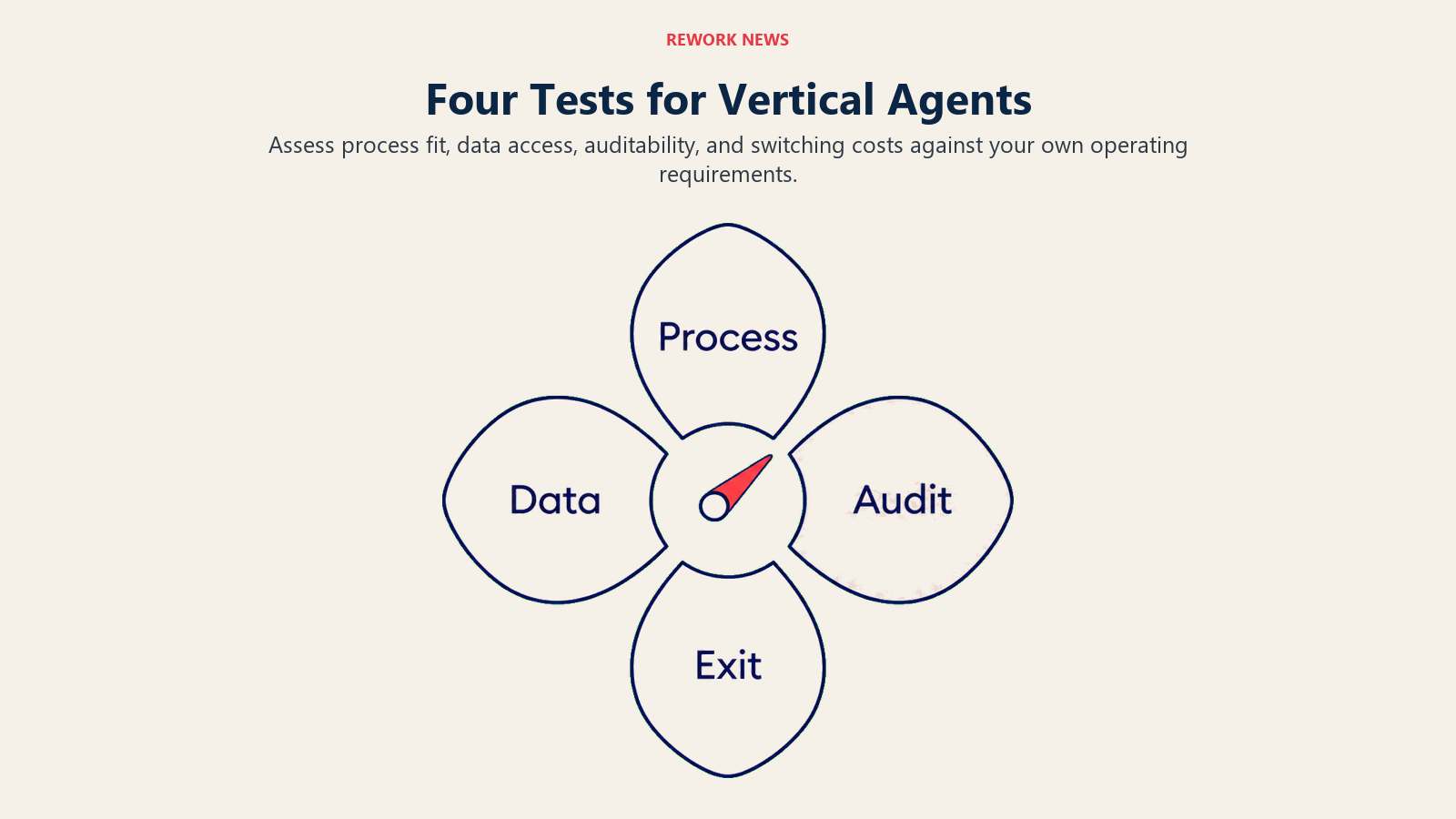
Score your situation on four axes. Three or above on all four is a strong signal to lean toward the pre-built vertical agent. Below three on any axis means platform-plus-custom-build likely serves you better.
1. Process specificity. How standard is the work pattern your agents will handle? Credit memo drafting and KYC screening follow industry conventions that dozens of banks have in common. If your version of that process is largely standard, a pre-built agent template maps well. But if your organization has developed proprietary underwriting criteria, risk models, or compliance workflows that differ materially from the industry baseline, the template becomes a constraint rather than a starting point. Score this axis on how far your process deviates from the industry norm.
2. Data alignment. Pre-built vertical agents are only as useful as the data feeds they can consume. Anthropic's financial-services agents ship with Moody's integration, which is meaningful for credit analysis. But if your core analytical workflows depend on Bloomberg data, proprietary deal databases, or internal warehouses that the agent can't access, you're adding integration work that narrows the advantage. Check specifically which data connections the agent ships with, which require additional configuration, and which require building custom connectors. The document review pattern the agents use is only valuable if the documents live where the agent can reach them.
3. Auditability. Financial services regulators don't care how good an agent's output is if you can't show your work. Before committing to a vertical agent deployment, confirm you can produce a defensible audit trail for every agent action, with attributable reasoning steps your compliance team can explain to an examiner. Pre-built agents can actually score well here if the vendor has built audit logging into the template. But "it's included" needs to be verified against your specific regulatory requirements, not assumed.
4. Lock-in cost. Vertical-specialist agent markets are early. Anthropic is not the only lab building financial-services agent templates, and what they ship today will have direct competitors within 12 months. Score this axis by asking: if you adopt these agents now and a competitor ships a meaningfully better or cheaper version next year, what does switching cost you? Consider data dependencies (how much proprietary context does the agent accumulate that doesn't transfer?), workflow dependencies (how many downstream processes will have been built around the current agent's output format?), and organizational habit (how much retraining does a switch require?). Review the buy vs. build by pattern framework for a structured approach to this calculation.
If your organization scores 3 or above on all four axes, lean toward the pre-built vertical agent. If you score below 3 on any axis, the smarter path is usually a horizontal platform where you control the integration layer and can swap components without full workflow disruption.
What to Do This Week
This week:
- Pull the list of AI agent initiatives currently under evaluation or in pilot at your organization. Identify which ones are industry-standard processes (KYC, credit memo, pitchbook assembly) versus org-specific processes. That split is the first input to your Vertical Agent Decision Matrix.
- Request a technical brief from your Anthropic account team (or procurement contact) on exactly which data integrations ship with the financial-services agent templates and which require additional configuration. Don't evaluate based on the marketing description.
- Check whether your current AI audit and governance framework covers autonomous agent actions, not just AI-assisted decisions. If it doesn't, that's the readiness gap to close before any vertical agent goes into production. The AI approval gates and vendor review process is the right starting point.
Next 30 days:
- Run the full Vertical Agent Decision Matrix scoring for each active AI agent initiative, using your own procurement team and at least one business process owner per initiative.
- Schedule a review of your current platform-level AI contracts (Microsoft, Google, or LLM API agreements) specifically to understand whether vertical agent templates from those vendors would trigger an upgrade tier. The competitive pressure from Anthropic's marketplace launch will likely accelerate similar announcements.
- Map the generative research pattern in your organization against the agent templates being offered. Where there's overlap, evaluate whether the pre-built template can absorb the current workflow or whether org-specific customization would degrade its value.
- Brief your CISO on the data access profile of each vertical agent under consideration. Agents that read from and write into Excel workbooks, PowerPoint presentations, and Outlook threads (which Anthropic's Microsoft 365 integration does) have a broader data exposure surface than copilot assistants. Make sure your data governance team has reviewed that surface before deployment.
Frequently Asked Questions
What are vertical-specialist AI agents, and how do they differ from platform AI tools?
Vertical-specialist agents are pre-built AI agents designed for a specific industry, built around the document formats, data feeds, and workflow patterns that industry uses. They contrast with horizontal platform AI tools, where an organization buys a general-purpose capability (such as an LLM API or enterprise copilot) and then builds industry-specific logic on top. Anthropic's financial-services agent templates are a vertical-specialist offering: designed for banking and investment work specifically, with Moody's data integration and Microsoft 365 connectivity included. The trade-off is that pre-built agents are faster to deploy in standard-process settings but harder to customize for org-specific workflows.
Why does the JPMorgan co-launch matter for CIOs outside financial services?
JPMorgan is among the most credible enterprise AI adopters globally. When its CEO co-launches a specific vendor's agent templates, it signals that the demand pattern, not just the technology, is ready for large-scale enterprise use. For CIOs in other verticals, the operational implication is that vertical-specialist agent marketplaces are being validated at the top of the market. Healthcare, legal, logistics, and manufacturing vertical agent templates are likely in development at multiple vendors. The evaluation framework you build for this financial-services launch is the same framework you'll use when those announcements land.
How should a CIO handle the audit trail requirement for pre-built vertical agents?
Require the vendor to demonstrate audit logging before procurement, not after. Ask specifically: what does the agent log for each action, at what granularity, and in what format? Then take that log format to your compliance team and ask whether it satisfies your specific regulatory documentation requirements. Many vendors say "audit logging is included" and mean something narrower than what financial-services examiners expect. The gap between vendor audit logging and regulatory audit trail requirements is one of the most common CIO surprises in agent deployments. Review the audit trail documentation standards for AI execute actions before signing any vertical agent contract.
Learn More
- The ACE Framework: Understand Where Vertical Agents Fit in Your AI Strategy
- Autonomous Agent Pattern: What It Means to Run Agents in Production
- Buy vs. Build by Pattern: How to Evaluate Vendor AI Against Custom Build
- Audit Trails for AI Execute Actions: The Compliance Baseline
- AI Copilots vs. Agents: The Decision That Changes Your Risk Profile
