More in
AI at Work News
OpenAI Opened ChatGPT Advertising to Small Businesses at Any Budget
thg 6 6, 2026
AI Is Everywhere at Work. Only 1 in 10 Say It Transformed the Job
thg 6 6, 2026
Vibe Coding's $10.5B Moment: AI Now Starts Most New Software Builds
thg 6 6, 2026
AI Agents Now Have More System Access Than Your Employees. Few Are Secured
thg 6 5, 2026
Should You Build Your AI or Buy It? Watch What the Giants Bought.
thg 6 5, 2026
Uber Caps Employee AI Spending at $1,500 Per Seat After a Budget Blowout
thg 6 5, 2026
Trump's AI Executive Order Is Deregulatory. Your Compliance Risk Didn't Move
thg 6 4, 2026
AI Pushed 220 Unicorns Below $1B. Pre-ChatGPT Companies Face a Reckoning
thg 6 4, 2026
Token Prices Fell 67% This Year. Your AI Bill Is Going Up Anyway
thg 6 3, 2026
Small Businesses Using AI Report Higher Revenue and Shorter Workdays
thg 6 3, 2026
NVIDIA Just Made AI Models 30% Cheaper. Renegotiate Your Contract
Turn this article into takeaways for your work.


Each assistant summarizes the article only for you and suggests best practices for your work.
Nemotron 3 Ultra goes general availability in two days at 30% lower inference cost than comparable frontier models, and every CTO who just signed a renewal with Anthropic, OpenAI, or Google is about to find out whether they overpaid for agent workloads.
The announcement lands at exactly the wrong time if you locked in annual pricing. But if your renewal window is still open, or your current contract has a renegotiation clause, this is the two-day window that matters.
What NVIDIA Actually Shipped at GTC Taipei
According to NVIDIA's GTC Taipei announcement on May 31, 2026, Nemotron 3 Ultra is a 550-billion-parameter mixture-of-experts open-weights model scheduled to go GA on June 4, 2026. Jensen Huang presented the model as part of the broader NVIDIA Agent Toolkit, framing the moment as enterprise software leaders embedding agents directly into the systems where work actually gets done.
The distribution footprint at GA is wide: Hugging Face, ModelScope, OpenRouter, build.nvidia.com, NVIDIA NIM microservices, and NVIDIA Cloud Partners. That's not a research preview behind a waitlist. It's a production-ready release across every channel CTOs already use to source and deploy models.
The Agent Toolkit itself ships with four components:
- NemoClaw blueprints: open-source agentic workflow templates, already live on GitHub
- Nemotron 3 Ultra: the 550B MoE model at the center of the cost story
- OpenShell secure runtime: early preview, targets containerized agent execution
- CUDA-X agent skill libraries: prebuilt capability modules for common agent tasks
Enterprise partners already building on NemoClaw include Cadence, Dassault Systemes, Siemens, Synopsys, and PhysicsX on the engineering-simulation side, with CrowdStrike, Palantir, SAP, ServiceNow, Microsoft, and Foxconn on the platform, security, and manufacturing side. That's not a pilot partner list. That's a production-intent signal.
Key Facts
- Nemotron 3 Ultra is a 550-billion-parameter mixture-of-experts open-weights model going GA June 4, 2026 (NVIDIA, GTC Taipei, May 31, 2026)
- NVIDIA claims up to 5x faster inference and up to 30% lower cost than comparable open frontier models for complex agentic tasks (NVIDIA Newsroom, May 31, 2026)
- Distribution at GA: Hugging Face, ModelScope, OpenRouter, build.nvidia.com, NVIDIA NIM microservices, and NVIDIA Cloud Partners (NVIDIA Newsroom, May 31, 2026)
Why 30 Percent Lower Inference Changes the Frontier-Model Math for Agent Workloads
Most enterprise AI cost conversations in 2025 focused on prompting efficiency: cut token count, compress context windows, cache repeated system prompts. That math helped but it hit diminishing returns fast. The new variable is model-level cost, and a 30% gap at 550B parameters changes the calculation for any team running agents at meaningful call volume.
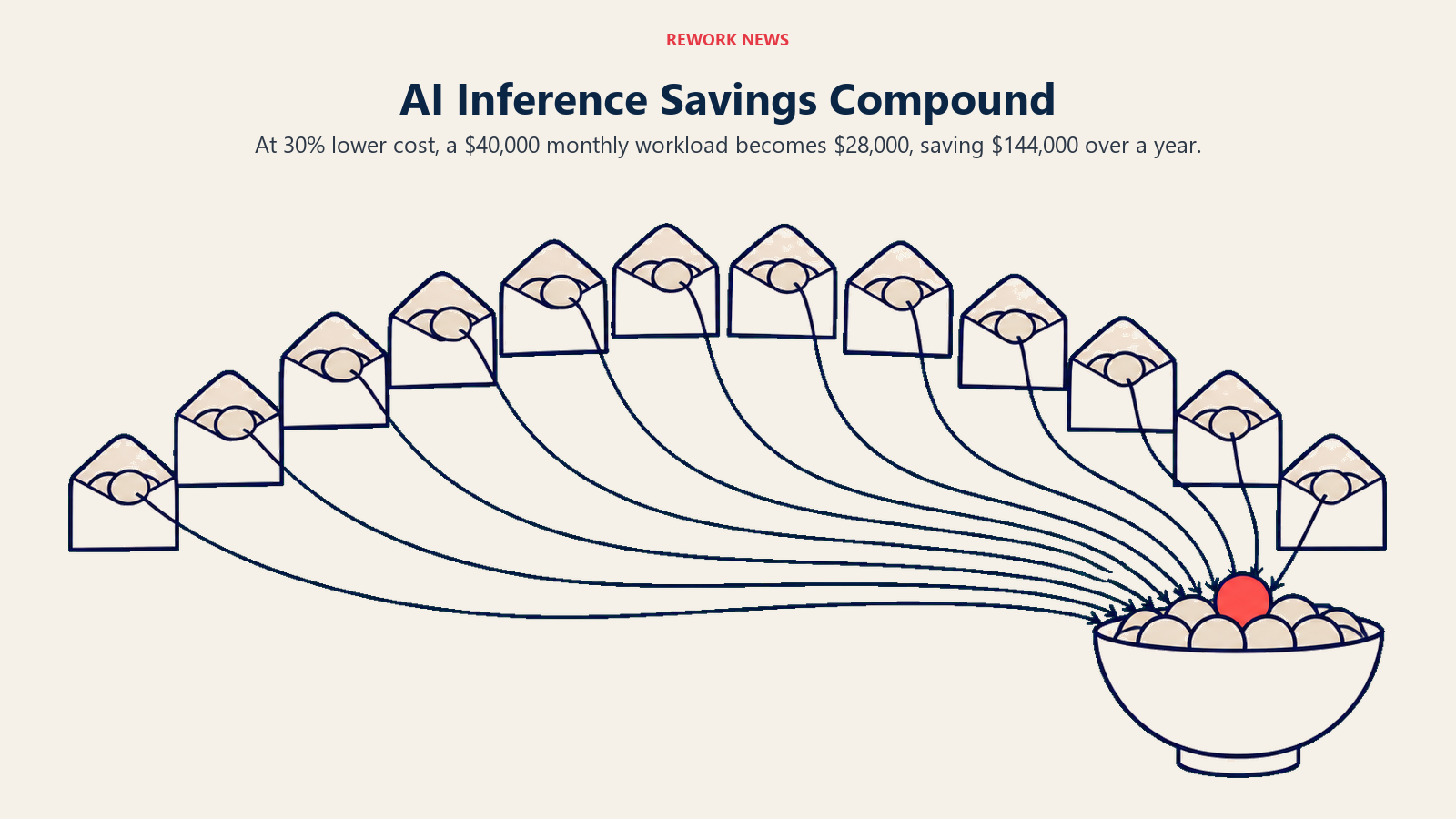
Here's how the numbers play out in practice. If your current frontier contract runs $40,000 per month in inference costs for agent pipelines, a 30% reduction puts you at $28,000. Over a 12-month contract, that's $144,000 back. For larger deployments scaling toward six figures monthly, the delta compounds further.
But the more important number is the 5x inference speed claim. Speed matters for agents in a way it doesn't for human-in-the-loop workflows. When an agent is calling a model 40 times inside a single orchestration run, latency multiplies. Faster inference doesn't just feel better; it directly affects whether your agentic pipeline can hit SLA targets for real-time or near-real-time use cases.
The catch: these are NVIDIA's benchmarks against "comparable open frontier models in its class." Independent validation will come once the model is in the wild after June 4. But even if the real-world number lands at 20% rather than 30%, or 3x speed rather than 5x, the directional shift still resets the procurement baseline. You can't evaluate your renewal without running the Nemotron 3 Ultra number through your actual workload.
For context on where the proprietary frontier sits right now: Anthropic's Opus 4.8 Series-H was positioned as the default enterprise reasoning model just days before this announcement. The open-weights challenger arriving two days later at lower cost is not a coincidence. This is the competitive pressure that moves renewal pricing.
The Three Procurement Postures CTOs Will Pick by Q3
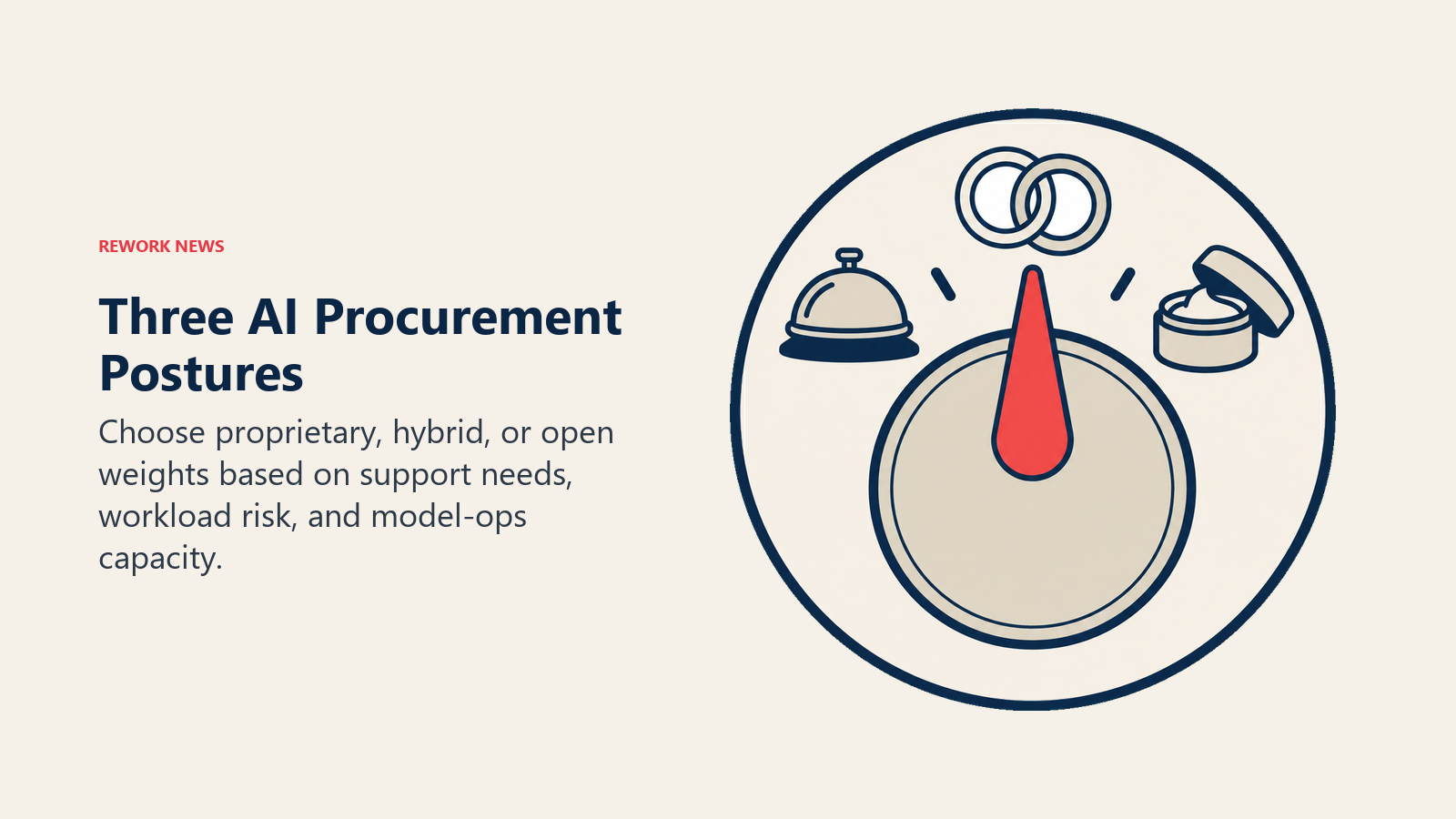
Every CTO with agent infrastructure will settle into one of three positions by Q3 2026. The decision isn't just technical. It's a procurement posture, and it has cost, risk, and organizational implications.
Posture 1: Stay Proprietary
You continue with Anthropic, OpenAI, or Google as your primary frontier model provider. You get vendor SLAs, safety fine-tuning, managed compliance tooling, and a single throat to choke when something breaks. The cost premium is real, but so is the support model. This posture makes sense if your legal and compliance teams have already signed off on the provider's data handling, your engineering team doesn't have the bandwidth to manage open-weights fine-tuning, or you're in a regulated industry where the audit trail from a named provider matters.
Posture 2: Hybrid Backbone
You use Nemotron 3 Ultra (or another open-weights model) for high-volume, lower-stakes agent calls, and reserve your proprietary frontier contract for complex reasoning tasks, customer-facing interactions, and anything that requires the vendor's safety guarantees. This is the most common posture for teams already running tiered model strategies. The operational complexity is real (you're now managing two model surfaces), but the cost optimization potential is highest here.
Posture 3: Open-Weights Default
You move the majority of agent workloads to Nemotron 3 Ultra and treat proprietary frontier models as specialists for specific use cases. This posture requires in-house capacity for fine-tuning, evaluation, and incident response. It's the right call for teams with strong ML engineering bench strength and workloads that don't touch regulated data pipelines. It's the wrong call for teams that stretched to adopt agents without building the underlying model-ops capability.
| Posture | Cost profile | Support model | Required capability | Best fit |
|---|---|---|---|---|
| Stay Proprietary | Higher per-token, predictable | Vendor SLA | Standard MLOps | Regulated industries, lean ML teams |
| Hybrid Backbone | 15-25% reduction (estimated) | Split: vendor + internal | Tiered model routing | Mid-scale agent deployments |
| Open-Weights Default | Maximum reduction, variable | Internal | Full model-ops stack | High-volume, strong ML bench |
Most enterprise CTOs will land on Hybrid Backbone in the near term. But the infrastructure you build for the hybrid posture is the same infrastructure that lets you shift more weight to open-weights as confidence grows.
The Open-Weights Risk Profile You Still Have to Underwrite
Before you brief procurement on a model swap, run through the risk matrix. Open-weights models shift the liability surface in ways that matter for enterprise deployment.
Fine-tuning responsibility: With proprietary models, the vendor continuously improves safety alignment, patches failure modes, and updates the model. With Nemotron 3 Ultra, you own the fine-tuning roadmap. If a domain-specific behavior emerges that causes problems, your team fixes it. That's not necessarily a problem, but it requires a dedicated ML engineer or team, not a prompt engineer.
Audit trail coverage: For industries with regulatory obligations around AI decision-making, you need to document which model version made which decision. Open-weights models are versioned, but the audit tooling you build around them is yours to maintain. NVIDIA's OpenShell secure runtime is in early preview and may eventually address this, but it isn't production-ready at GA.
Support escalation path: When a proprietary model produces unexpected outputs at 2 AM during a production incident, you call the vendor. With Nemotron 3 Ultra, you're filing a GitHub issue or engaging NVIDIA enterprise support, depending on your contract. Clarify that support tier before you sign off on production deployment.
Security posture: The Anthropic self-hosted sandbox and MCP tunnel architecture represents one approach to locking down the model execution surface. Open-weights deployments on your own infrastructure give you more control over the network boundary, but that control requires your security team to own the hardening. OpenShell in preview is not a complete substitute for a vendor-managed security model.
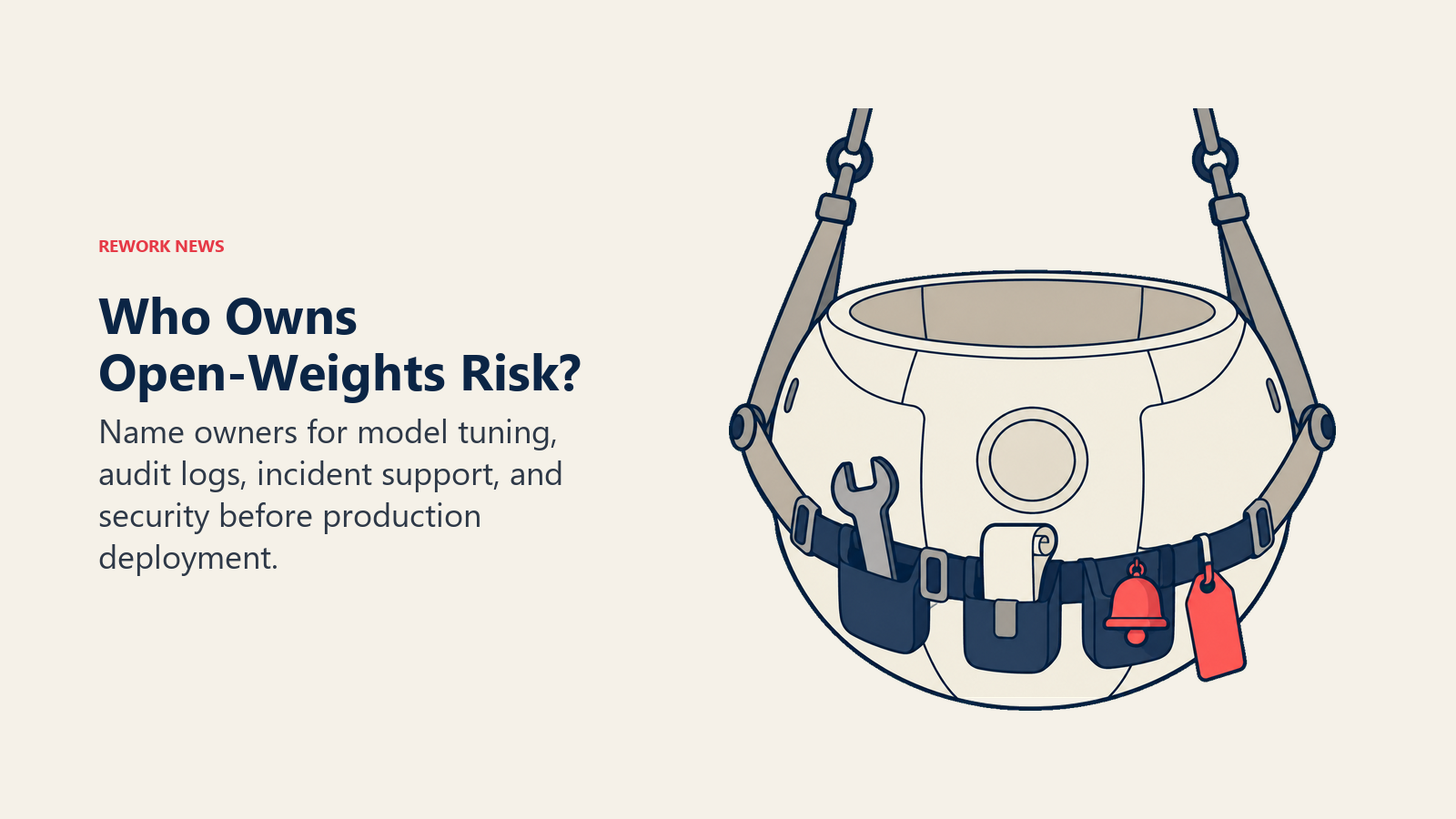
None of these risks are disqualifying. But each one requires a named owner on your team before you can move Nemotron 3 Ultra into production agent pipelines. If you can't name the owner today, you're not ready to swap your backbone.
What to Do This Week
The GA date is June 4. Your action window before the model is widely benchmarked in your competitors' hands is narrow.
Action 1: Pull your current per-token inference costs by workload type. Don't look at total AI spend. Break it down: which workloads are high-volume agent calls vs. low-volume reasoning tasks? The hybrid posture only makes sense if you know which calls are candidates for the cheaper model. Your cloud cost exports from Anthropic, OpenAI, or Azure OpenAI have this data at the request level.
Action 2: Request Nemotron 3 Ultra access on June 4 and run it against your three highest-volume agent workloads. Build.nvidia.com and NVIDIA NIM microservices will have access at GA. You don't need a full evaluation framework yet. You need a directional read: does quality hold at the cost reduction the benchmarks suggest? Run it against real production prompts, not synthetic benchmarks.
Action 3: Brief your procurement team on the renewal pause window now. If you have a frontier renewal coming in the next 90 days, procurement needs to know there's a credible open-weights challenger at 30% lower cost. That doesn't mean switching. It means your procurement lead can reference the alternative when negotiating. Vendors respond to credible alternatives, and Nemotron 3 Ultra at this scale and distribution footprint is credible.
The SAP Sapphire 2026 autonomous enterprise push and Snowflake's Summit stack decisions both signal that the enterprise software layer is hardening around agent infrastructure quickly. The model layer underneath that infrastructure is now the active cost variable. CTOs who treat model procurement as a set-and-forget decision will own the variance when the math shifts.
Related Reading
- NVIDIA Opens the Agent Platform: 17 Enterprise Adopters, NemoClaw Blueprints, and What CTOs Actually Inherit: The platform and stack angle from NVIDIA's GTC Taipei announcement.
- Anthropic Opus 4.8 Series-H: The CTO Model Decision Arriving Before Your Next Planning Cycle: How the leading proprietary frontier model positioned itself just before NVIDIA's open-weights challenge.
- Google AntiGravity 2 and the Gemini Enterprise Agent Platform: The CTO Integration Decision: Where Google's enterprise agent platform sits in the same competitive landscape.
- Microsoft Build 2026 Windows Agent Platform and Store: The CTO Architecture Decision: How Microsoft's agent platform strategy intersects with model procurement choices.
FAQ
What is NVIDIA Nemotron 3 Ultra and when is it available?
Nemotron 3 Ultra is a 550-billion-parameter mixture-of-experts open-weights model developed by NVIDIA. It goes generally available on June 4, 2026, announced at GTC Taipei on May 31, 2026. At GA it will be available through Hugging Face, ModelScope, OpenRouter, build.nvidia.com, NVIDIA NIM microservices, and NVIDIA Cloud Partners.
How does Nemotron 3 Ultra's cost compare to proprietary frontier models?
NVIDIA claims Nemotron 3 Ultra delivers up to 30% lower inference cost and up to 5x faster throughput compared to comparable open frontier models for complex agentic tasks. Independent benchmarks will emerge after the June 4 GA. Even if real-world results land below the headline figures, the cost differential is large enough to factor into enterprise procurement decisions, particularly for high-volume agent pipelines.
Should a CTO switch from Anthropic or OpenAI to Nemotron 3 Ultra?
Most enterprise CTOs won't do a full switch in 2026. The more common path is a hybrid backbone posture: using Nemotron 3 Ultra for high-volume, lower-stakes agent calls while keeping a proprietary frontier model for complex reasoning, customer-facing interactions, and regulated workloads. The key prerequisite is mapping current inference costs by workload type so you know which calls are candidates for the cheaper open-weights model.
What risks does an open-weights model like Nemotron 3 Ultra introduce?
The primary risks are fine-tuning responsibility (your team owns safety alignment updates, not a vendor), audit trail coverage (you build and maintain the versioning and decision-logging infrastructure), support escalation (no vendor SLA for production incidents), and security hardening (OpenShell runtime is in early preview, not production-ready at GA). None of these are disqualifying, but each requires a named owner on your engineering or ML team before you can run Nemotron 3 Ultra in production agent pipelines.
Source: NVIDIA Newsroom (GTC Taipei, May 31, 2026). Coverage: SiliconANGLE.

Co-Founder, Rework.com