Teamtailor vs Pinpoint: Which Quote-Only ATS Fits Your Hiring Team in 2026?
Turn this article into takeaways for your work.


Each assistant summarizes the article only for you and suggests best practices for your work.
If you're a Head of Talent, VP People, or founder-operator comparing Teamtailor and Pinpoint, you've probably already hit the same wall twice: neither one will tell you what it costs. Teamtailor's pricing page is a form headed "Let us give you a quote." Pinpoint's old pricing URL 404s; the live one is headed "Request pricing," and it asks for your details before showing a single figure. No plan names on either page. No dollar signs. No rate card to screenshot and forward to your CFO.
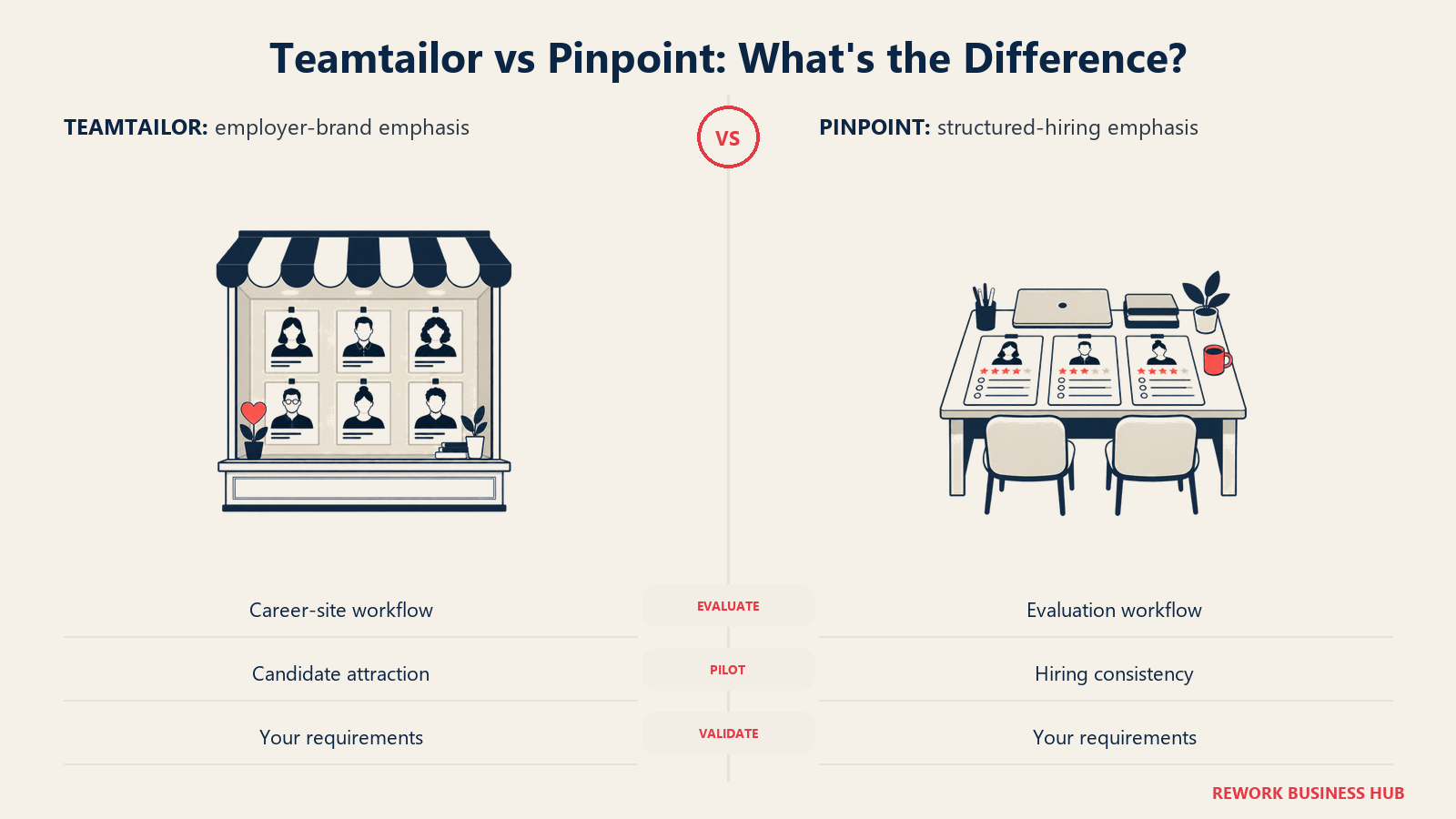
That's a deliberate choice both vendors have made, and it changes what this comparison needs to be about. You can't shop these two on a spec sheet of prices, so the real decision comes down to hiring model, pricing structure, and what each platform was actually built to do. Teamtailor is employer-branding and career-site led, priced on a job-slot model that rewards a steady hiring pace and gets more expensive the moment you post a surge of new roles. Pinpoint is candidate-experience and structured-hiring led, priced flat by company size, so adding hiring managers doesn't trigger a new pricing conversation. Both are genuinely good products built for different hiring philosophies; this article is about matching that philosophy to your team, not comparing numbers neither company will confirm.
TL;DR
| Teamtailor | Pinpoint | |
|---|---|---|
| Core philosophy | Employer branding and career-site led, priced by open job slots | Candidate experience and structured/DEI reporting led, priced flat by company size |
| Best for | Teams that want a design-forward, brand-heavy career site and a steady hiring cadence | Teams that want structured, defensible hiring without a per-seat pricing conversation |
| Pricing model | Job-slot based (more open roles, higher tier) | Flat rate by company size (Growth and Enterprise tiers) |
| Published price | None; quote form only | None; quote form only |
| Job postings | Unlimited, per Teamtailor's own pricing page | Not priced by job slot, so the question doesn't apply the same way |
| Seats and users | Unlimited, per Teamtailor's own pricing page | Widely reported as unlimited; confirm with Pinpoint |
| Feature depth claimed | Over 250 features, per Teamtailor's own pricing page | Not a stated feature count; positioning leans on structure and DEI reporting instead |
| Reported entry price | Roughly $300 to $400/month for a small team, per Vendr | Roughly $345/month on annual billing (Growth), per SelectSoftware Reviews |
Who Each Platform Is Actually Built For
Teamtailor's product starts from the career site outward. The platform is built around a customizable, brand-heavy career page, and its own pricing page leads with "unlimited job postings and unlimited users" alongside a claim of more than 250 features, telling you who it's chasing: a company that wants a polished, on-brand front door to hiring and doesn't want to think about seat counts while building one.
Pinpoint starts from the other end of the funnel. Its pricing page states plainly that the company works with organizations "of all sizes" and that "company size doesn't always correlate with hiring complexity," signaling a product built around process consistency rather than brand polish. The pitch leans on structured hiring, candidate experience through the application itself, and reporting that holds up under a DEI or compliance review, pointing to a team that has already decided evaluation needs standardizing across every hiring manager.
| Teamtailor | Pinpoint | |
|---|---|---|
| Sweet-spot team | Employer-brand-conscious HR or talent team building a career site as a recruiting asset | Talent acquisition function standardizing structured, defensible hiring at scale |
| Team maturity | Wants a design-forward career presence live quickly | Has already committed to structured interviews and DEI-grade reporting |
| Primary use case | Attract and convert candidates through a branded career site, then manage the pipeline | Run a consistent, auditable hiring process across every open role and hiring manager |
| Buying trigger | Outgrowing a generic careers page that undersells the employer brand | Outgrowing an informal or inconsistent interview process that can't survive scrutiny |
| Org shape | Any size; pricing is job-slot based so cost tracks hiring volume, not headcount | Any size; pricing is flat by company size so cost doesn't track hiring volume directly |
Neither framing is a knock on the other. Teamtailor assumes your career site is a marketing asset worth investing in; Pinpoint assumes how you evaluate candidates matters more than how the career site looks. Most teams lean toward one priority more than the other, and that lean is a better starting filter than any feature checklist.
Key Facts
Key Facts: Candidate Experience, Career Sites, and Hiring Speed
- 71% of candidates research a company before they apply, most often through its career site and LinkedIn presence. (LinkedIn Talent Solutions, 2021, figure still cited on LinkedIn's live page)
- Median time-to-fill for non-executive roles sits at 39 calendar days, per SHRM's most recent recruiting benchmarking research. (SHRM 2026 Recruiting Executives Benchmarking, 2026)
- 58% of hiring managers say it now takes four weeks or longer to fill a permanent role, and most describe the process as slower than it was two years ago. (Robert Half, 2026)
- The global recruitment software market is valued at $3.74 billion in 2026, projected to reach $7.48 billion by 2034, an 8.95% CAGR. (Fortune Business Insights, 2026)
That first stat is worth sitting with. If seven in ten candidates research your company before they hit apply, the career site isn't a cosmetic layer on top of the ATS, it's part of the funnel, Teamtailor's entire thesis. Pinpoint's bet is the opposite half of the same problem: once a candidate applies, is the process consistent enough to survive a slow labor market and a compliance audit.
Two Vendors, Zero Published Prices: The Core Difference
Search "Teamtailor pricing" today and you land on a page headed "Let us give you a quote." No plan names, no monthly figures, just a form and a promise that Teamtailor gives you "unlimited job postings and unlimited users" plus more than 250 features. Search "Pinpoint pricing" and the page you land on is headed "Request pricing," subhead "See the product and get pricing," and it carries zero plan names and zero figures, same as Teamtailor's.
Both vendors have made the identical strategic bet: sell through a conversation, not a rate card. But how each one prices what it eventually quotes is genuinely different, and that's the more useful comparison.
Teamtailor prices by job slots, so your tier depends on how many roles you have open at once, not headcount. Vendr's marketplace data describes a Starter tier around $300 to $400/month for 5 to 10 open slots, a Growth tier from $600 to $1,200/month for 10 to 30 slots, and an Enterprise tier above $1,500/month for 30-plus openings, a reported range, not a confirmed quote, but one that maps cleanly onto the job-slot structure the company itself describes.
Pinpoint prices flat by company size instead. SelectSoftware Reviews reports a Growth tier starting around $345/month on annual billing and an Enterprise tier at roughly $1,200-plus/month, with the vendor's own site confirming the two-tier structure even though it won't attach numbers to either. Multiple third-party sources describe this tier as including unlimited team members and job postings, meaning a 10-recruiter team and a 3-recruiter team would land in the same tier for the same price. We could not find that "unlimited seats" language stated directly on Pinpoint's own pages, so treat it as a widely repeated third-party characterization until it shows up in your own quote.
| Capability | Teamtailor | Pinpoint |
|---|---|---|
| Pricing model | Job-slot based; tier tracks number of open roles | Flat rate by company size; tier tracks headcount band |
| Published dollar figures | None | None |
| Job postings | Unlimited, per Teamtailor's own site | Not priced by job count |
| Seats and users | Unlimited, per Teamtailor's own site | Reported as unlimited by multiple third-party sources; confirm with Pinpoint |
| What drives the quote | Number of simultaneous open roles | Company size and, per the vendor's own framing, hiring complexity |
| Free trial | Not published | Not published |
Pricing Structure and the True Cost of Ownership
Because neither vendor prints a number, the honest way to compare cost is to compare what makes the bill go up, not to pretend you can hold either company to a specific figure before the sales call.
Teamtailor's job-slot model rewards a steady cadence and punishes a surge: a company running two or three open roles at a time stays in the lowest tier, but the same company opening fifteen roles at once can jump tiers overnight, even with headcount unchanged.
Pinpoint's flat-by-size model runs the opposite way. Once quoted into a tier, adding hiring managers, recruiters, or interviewers doesn't move the bill, since seats are reported as unlimited within it. That's more predictable if hiring volume swings unpredictably. The tradeoff: a lean team running only a couple of roles pays the same company-size rate as a similarly sized company hiring far more aggressively.
| Pricing input | Teamtailor | Pinpoint |
|---|---|---|
| What increases your tier | More simultaneous open job postings | Company headcount growth |
| What does NOT increase your tier | Adding users or hiring managers (unlimited, per vendor) | Adding open roles or hiring volume, since seats are reported as unlimited |
| Best cost fit | Steady, planned hiring at a predictable pace | Hiring volume that swings unpredictably month to month |
| Worst cost fit | A sudden hiring surge across many roles at once | A lean team with very few open roles, paying a company-size rate regardless |
| Reported entry range | ~$300 to $400/month, small team (Vendr) | ~$345/month, Growth tier, annual billing (SelectSoftware Reviews) |
| Reported top-end range | $1,500-plus/month, larger orgs (Vendr) | ~$1,200-plus/month, Enterprise tier (SelectSoftware Reviews) |
| Onboarding | Not detailed on the public pricing page | Widely reported as bundled into the quoted contract rather than sold as a separate implementation fee, though we found conflicting third-party accounts on this point; confirm it explicitly in your quote |
Neither reported range belongs in a budget line item without a written quote behind it. What you can plan around is the shape of the cost, not the number: ask Teamtailor what happens to your tier if you open ten roles for a quarter, and ask Pinpoint whether headcount growth mid-contract triggers a repriced quote. Those two questions tell you more than either vendor's marketing page.
Career Site and Employer Brand
This is Teamtailor's strongest ground, and it shows in how the product is built rather than bolted on. The career site is a first-class, highly customizable surface: custom domains, video, employee stories, and design flexibility meant to make the page feel like a genuine extension of the company's marketing, not a generic listings page with a logo swapped in.
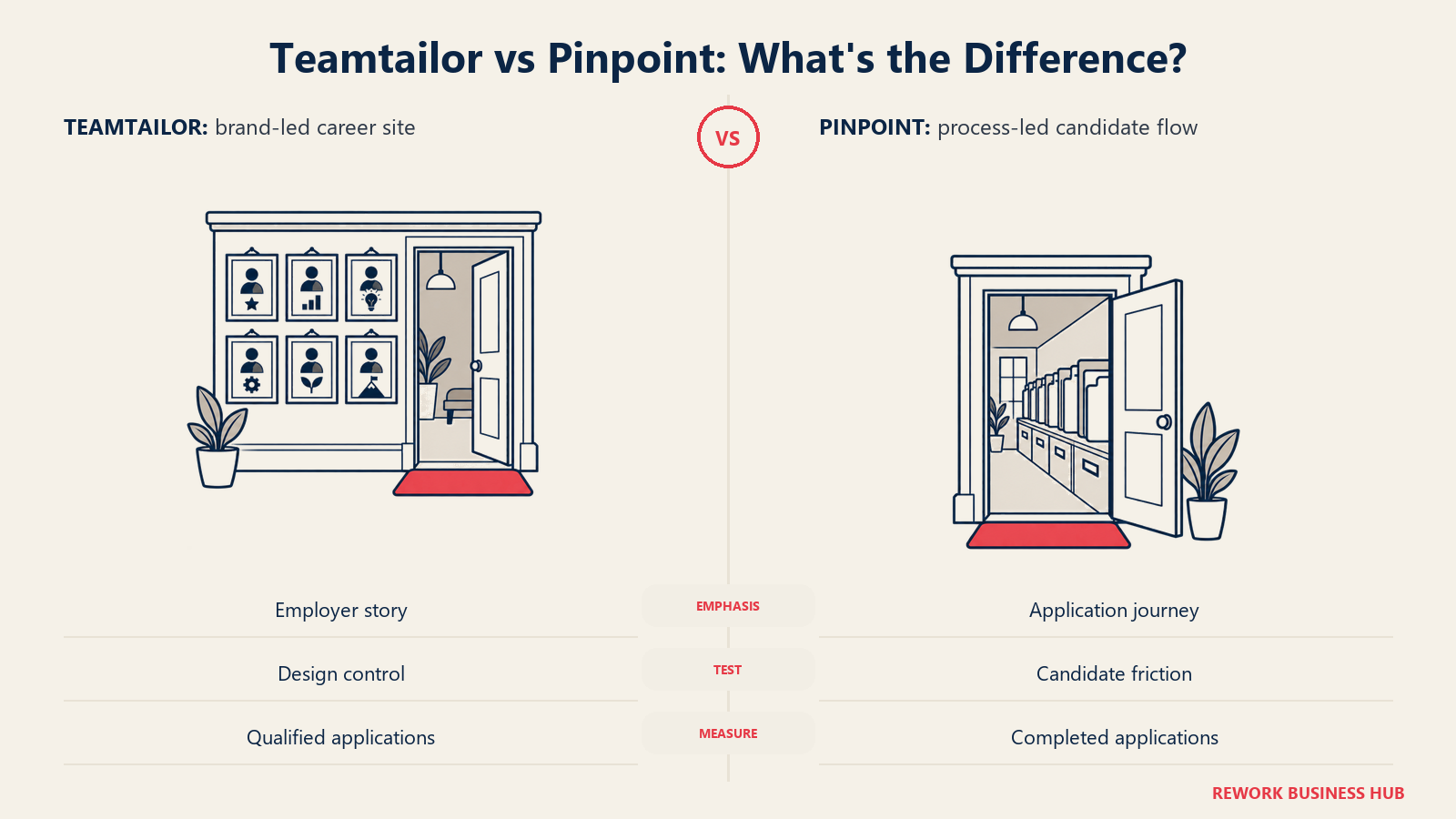
Pinpoint ships a career site too, and it's a real, functional part of the product, but the company's own positioning doesn't lead with design depth the way Teamtailor's does. It exists to support the structured, candidate-experience-first process downstream of it, not to be the primary showcase for employer brand. If your recruiting marketing team already treats the career site as a design project, Teamtailor's tooling is built for that job specifically; Pinpoint's is built to be functional and get out of the way.
| Capability | Teamtailor | Pinpoint |
|---|---|---|
| Career site customization depth | Deep; design-forward, brand-led, the product's centerpiece | Functional; supports the hiring process rather than leading the pitch |
| Custom domain support | Yes | Yes |
| Video and rich media on job pages | Yes, prominently featured | Available |
| Employer brand as primary positioning | Yes, explicitly | No; structured hiring and DEI reporting lead instead |
| Best fit | Teams treating the career site as a marketing asset | Teams that want a functional career site without a dedicated design investment |
If employer branding and career-site design is genuinely your top priority, it's worth widening the search past just these two. Our best career page software roundup and best recruitment marketing software roundup cover tools built specifically around that job, some going deeper on brand design than either platform here.
Candidate Experience and Application Flow
Pinpoint's positioning leans hardest on candidate experience as a deliberate design choice: a short application, frequent communication, and a process that stays transparent at every stage. That's a direct response to a well-documented problem. Robert Half found that 58% of hiring managers now say it takes four weeks or longer to fill a permanent role, and every extra week of silence is a week a strong candidate can accept a competing offer.
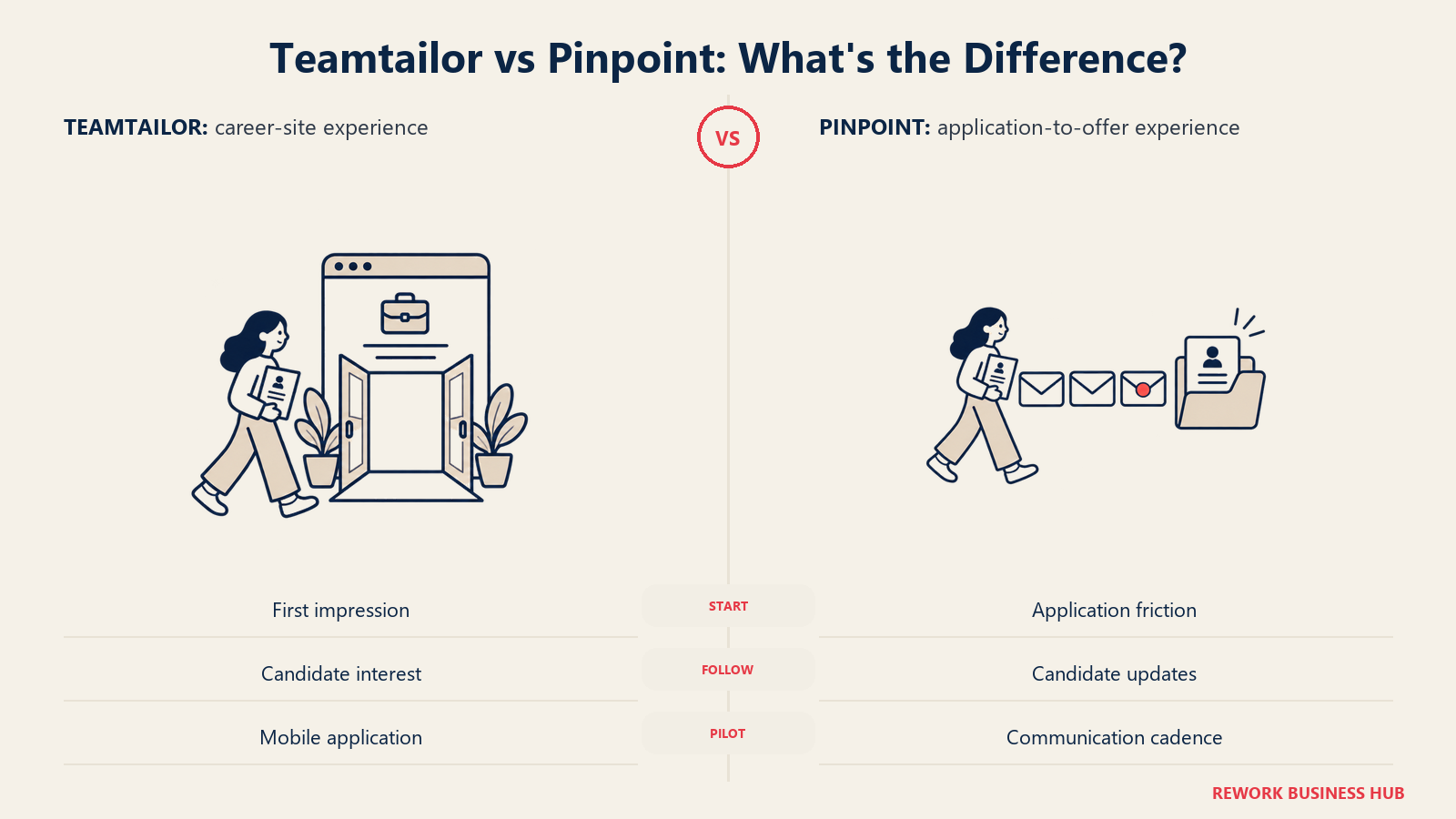
Teamtailor supports a smooth application flow too, and its mobile-friendly process is a genuine strength, but its design energy visibly goes toward the career site and first impression more than the process discipline downstream. Teamtailor wants to win the candidate's attention first; Pinpoint wants to keep them engaged once they're already in the pipeline.
| Capability | Teamtailor | Pinpoint |
|---|---|---|
| Mobile application experience | Strong; career site and application are mobile-optimized | Strong; built around minimizing friction and drop-off |
| Candidate communication cadence | Available, standard ATS messaging tools | Central to the product's design philosophy |
| Application length and friction | Standard | Explicitly minimized as a design priority |
| Where design effort concentrates | Career site and first impression | Application-to-offer process and candidate updates |
Structured Hiring and DEI Reporting
This is where the two platforms diverge most sharply, worth reading closely if compliance, DEI reporting, or evaluation consistency is any part of why you're shopping.
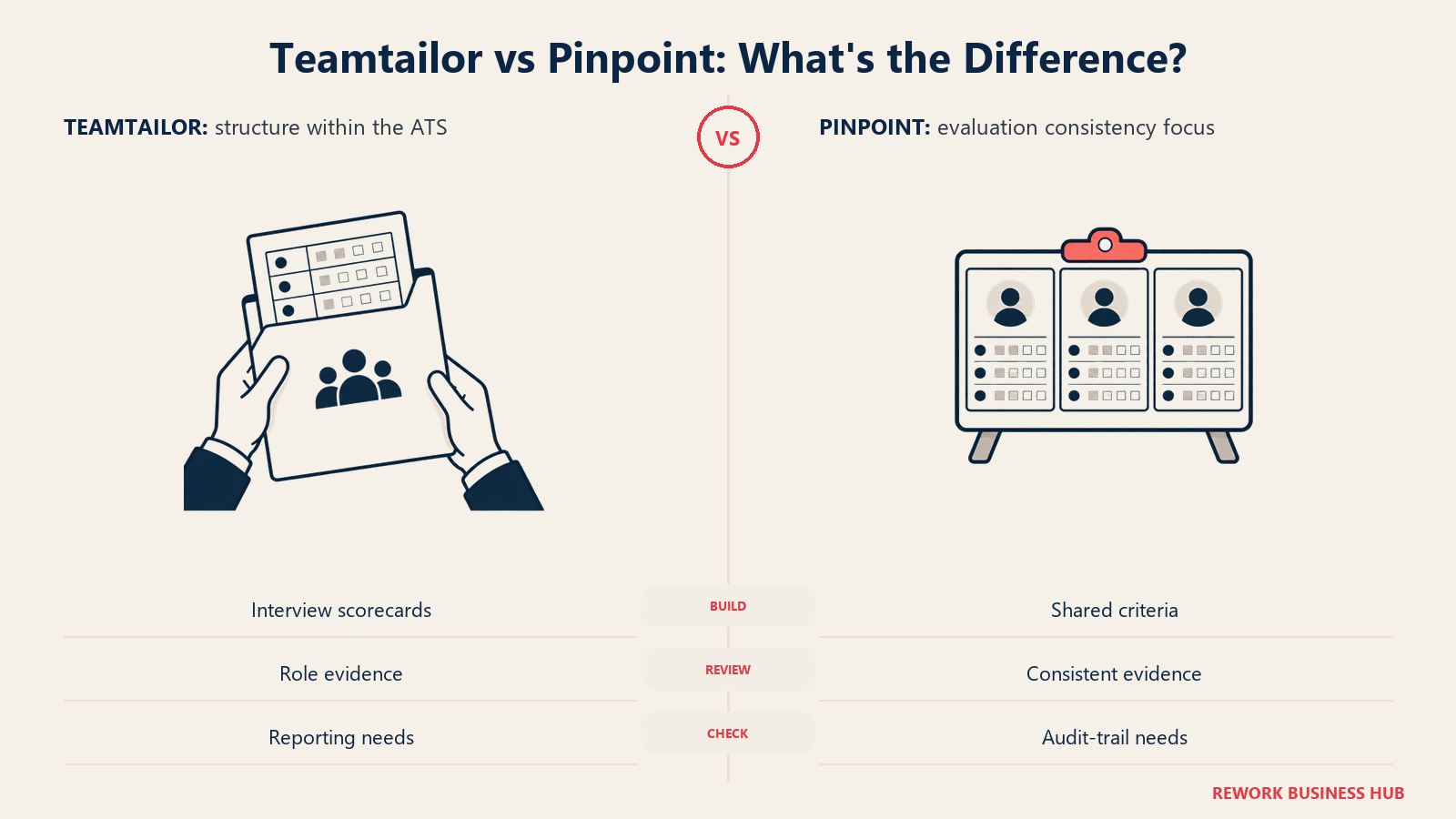
Pinpoint's product is built around structured, standardized hiring: scorecards, defined evaluation criteria, and reporting designed to hold up under scrutiny, whether that's an internal audit, a DEI report to leadership, or an external compliance review, fitting a talent acquisition function that has already decided consistent evaluation matters more than a fast, informal process.
Teamtailor supports structured interviews and scorecards too, and the tooling is genuinely usable, but it's a feature inside a broader employer-branding-led product rather than the organizing principle the way it is for Pinpoint. A team that wants some structure without a full DEI-reporting practice will find what it needs; a team that needs an audit-ready trail across every hiring manager will find Pinpoint's tooling built specifically for that job, the same reason structured-hiring-first platforms come up against each other directly; see our Greenhouse vs Ashby comparison for scorecard depth beyond these two.
| Capability | Teamtailor | Pinpoint |
|---|---|---|
| Interview scorecards | Available as a feature | Core to the product's design |
| Structured evaluation criteria | Supported | Primary organizing principle |
| DEI and compliance reporting | Basic reporting available | Built as a named strength, positioned explicitly around it |
| Audit-ready evaluation trail | Possible with setup | Designed in from the start |
| Best fit | Some structure without a heavy process build-out | Standardizing evaluation across every hiring manager and role |
Reporting and Analytics
| Reporting | Teamtailor | Pinpoint |
|---|---|---|
| Standard pipeline reporting | Built in | Built in |
| Sourcing and career-site funnel analytics | Strong; ties directly to the career site's marketing role | Available, secondary to structured-hiring reporting |
| DEI and interviewer-consistency reporting | Basic | A named strength, tied to scorecards |
| Best for | Understanding where career-site traffic converts | Analyzing evaluation consistency and compliance readiness |
Integrations
Neither vendor publishes a specific partner count on the pages we reviewed today, worth noting since several competitors in this category lead with an integration-marketplace number as a selling point. Both offer standard connections to job boards, calendar tools, background check providers, and HRIS systems through their respective marketplaces, plus an API for custom connections. If integration breadth is a deciding factor, verify the current partner list directly with each vendor's sales team rather than relying on a homepage number, since neither was displaying one.

| Integration area | Teamtailor | Pinpoint |
|---|---|---|
| Job board posting | Yes, standard multi-board syndication | Yes, standard multi-board syndication |
| Calendar and scheduling | Yes | Yes |
| Background checks | Via integration marketplace | Via integration marketplace |
| HRIS connectivity | Via integration marketplace | Via integration marketplace |
| Open API | Yes | Yes |
| Published partner count | Confirm with Teamtailor | Confirm with Pinpoint |
Implementation and Time to Go Live
| Teamtailor | Pinpoint | |
|---|---|---|
| Setup effort | Moderate; career site design and branding take real time to configure well | Moderate; interview kits and scorecards need defining per role before structured hiring works |
| Who typically leads rollout | HR, talent acquisition, or a marketing-adjacent employer-brand owner | Talent acquisition function, often with vendor-side implementation support |
| Onboarding | Not detailed on the public pricing page | Widely reported as bundled into the initial contract; confirm this explicitly rather than assuming it |
| Training load | Light to moderate for day-to-day use; heavier if you're building out the career site design yourself | Moderate; scorecard and interview-kit design is the real setup work |
The honest read on both: neither is a same-day, self-serve setup the way some lighter ATS platforms are. Teamtailor's setup time mostly depends on how much career-site design work you want done before launch; Pinpoint's depends on how many role families need their own interview kit and scorecard before structured hiring actually works. Budget real weeks for either, not days.
Scaling Past 200 Employees
The two pricing models diverge most in practice past this size, and it's worth modeling before a multi-year contract. A 250-person company with a lean, steady hiring pace can stay in a low Teamtailor tier indefinitely regardless of headcount, but the same company opening a large batch of roles for an expansion can jump tiers quickly without adding a single employee to the ATS. Pinpoint's rate stays tied to company size instead, holding steady, per the reported unlimited-seats structure, regardless of how many roles open in a given quarter, though that also means no reward for a quieter hiring stretch.
Neither structure is objectively better here. It comes down to whether growth is driven by steady, predictable hiring or by bursty, campaign-style pushes, so ask each vendor's sales team directly how a specific 12-month hiring plan would move your renewal number before signing anything multi-year.
When Teamtailor Is the Right Call
- Your career site is a genuine competitive asset in a crowded talent market, and you want design depth to match
- Your hiring is steady and predictable rather than bursty, so a job-slot pricing model tracks your real cost fairly
- You want unlimited users on the account without a seat-based pricing conversation as the team grows
- Employer branding sits with a marketing-adjacent HR function that wants real design control over the career page
- You're comfortable buying through a quote process and don't need a published rate card to start evaluating
When Pinpoint Is the Right Call
- You need a structured, defensible hiring process with scorecards and DEI-grade reporting as a first-class capability, not an add-on
- Your hiring volume swings unpredictably, and a flat rate by company size protects you from tier jumps during a hiring surge
- You want implementation and onboarding folded into the initial contract rather than negotiated as a separate line item
- Adding hiring managers or interviewers to the account shouldn't be a pricing event
- Your team has already decided that evaluation consistency matters more than career-site design depth
If Neither Fits: When Hiring Needs to Connect Straight to HR
Worth naming honestly: if what you want is a career site people remember and a structured process people trust, you may end up shortlisting both Teamtailor and Pinpoint, since they solve genuinely different halves of the same funnel. But there's a third gap neither addresses, because both are hiring products first: what happens the moment an offer is accepted.
Rework's E-Hiring, Interview, and Career modules run on the same People platform as HRIS, time and attendance, and timesheets, so a candidate record becomes an employee record at offer acceptance, attendance tracking and timesheet setup already connected rather than handed to a second system weeks later. That's a meaningfully different starting point than either vendor here, both of which excel at hiring and stop there. It's honestly not the right fit if you need a design-led employer-branding studio to rival Teamtailor's career-site builder, a high-volume agency tool, or a deep sourcing-led talent CRM. Where it's worth a look: hiring as one connected piece of a broader people-operations platform, instead of an ATS bridged into HR after the fact. Pricing is quote on request, same as both vendors here; see rework.com/pricing for current details.
Decision Framework
| If you are... | Pick |
|---|---|
| Prioritizing a design-forward, brand-heavy career site | Teamtailor |
| Standardizing structured hiring with DEI-grade reporting | Pinpoint |
| Running steady, predictable hiring volume | Teamtailor (job-slot pricing rewards this) |
| Running unpredictable, bursty hiring volume | Pinpoint (flat rate by size absorbs this) |
| Wanting unlimited users without a seat-pricing conversation | Teamtailor |
| Wanting implementation reportedly bundled into the initial contract | Pinpoint |
| Wanting hiring connected directly to HRIS, attendance, and timesheets | Rework (see rework.com/pricing) |
| Comparing every option in the category, not just these two | See our Best Applicant Tracking Systems roundup |
What to Do Next
- Get both quotes in writing before comparing anything else. Neither vendor publishes a price, so a verbal ballpark isn't something you can hold either company to later; ask for the number tied to your actual role count and headcount.
- Model your next 12 months of hiring against each pricing structure, not just current headcount, since that's what actually moves the bill under either model.
- Confirm the "unlimited seats" and "unlimited job postings" claims in your own quote, in writing. Teamtailor states the "unlimited job postings and unlimited users" language on its own pricing page; Pinpoint's version shows up consistently in third-party reviews.
- Decide which half of the funnel matters more right now: the career site and first impression, or the structured process after the application lands. That single priority separates these two more than any feature list.
- If your real gap is career-site design specifically, our best career page software roundup and best recruitment marketing software roundup go deeper than either vendor here.
- Still building your shortlist? See our Teamtailor alternatives guide, our Workable vs Greenhouse comparison for the published-price side of this category, and our guide to choosing recruiting software for the full evaluation framework. Under 50 employees, see our best recruiting software for small business roundup; weighing sourcing-led platforms instead, see our Beamery and Phenom alternatives guides.
Frequently Asked Questions about Teamtailor vs Pinpoint
Does Teamtailor or Pinpoint publish pricing?
No. Both pricing pages route every visitor to a quote request form with no plan names and no dollar figures. Teamtailor's page is headed "Let us give you a quote," and Pinpoint's live pricing page (the old pinpointhq.com/pricing URL now 404s) is headed "Request pricing." Reported third-party figures exist for both, but neither is a confirmed vendor price.
How does Teamtailor's pricing actually work if there's no rate card?
By job slots: your tier depends on how many roles you have open at once, not headcount. Vendr's marketplace data describes a reported range from roughly $300 to $400/month for a small team up toward $1,500-plus/month for larger organizations, but treat that as reported, not a confirmed quote.
How does Pinpoint's pricing actually work if there's no rate card?
Flat by company size, with two tiers, Growth and Enterprise. SelectSoftware Reviews reports Growth starting around $345/month on annual billing and Enterprise running roughly $1,200-plus/month, though these are third-party figures, not vendor-confirmed prices.
Are Teamtailor's job postings and users really unlimited?
Yes, according to Teamtailor's own pricing page, which states "unlimited job postings and unlimited users" directly. That claim is vendor-confirmed, not just a third-party characterization.
Does Pinpoint really offer unlimited seats?
It's widely reported that way across third-party review sites, and the flat-by-company-size pricing model is consistent with it. We could not find that specific language stated directly on Pinpoint's own pricing or product pages, so confirm it explicitly in your own quote rather than assuming it from secondhand sources.
Which platform is better for employer branding and career site design?
Teamtailor, by a clear margin. The career site is the product's centerpiece, built for custom domains, video, and design flexibility. Pinpoint's career site is functional and supports the hiring process, but design depth isn't the organizing focus the way it is for Teamtailor.
Which platform is better for structured hiring and DEI reporting?
Pinpoint, by design. Structured evaluation, scorecards, and DEI-grade reporting are positioned as a primary strength, not an add-on. Teamtailor supports scorecards too, but as a feature inside a broader, employer-branding-led product.
Do either of these platforms handle HR, time tracking, or payroll?
No. Both are applicant tracking systems focused on the hiring funnel from job posting through offer. If you need hiring connected directly to HRIS, attendance, or payroll rather than bridged afterward, that's a different category of platform worth evaluating separately.

On this page
- TL;DR
- Who Each Platform Is Actually Built For
- Key Facts
- Two Vendors, Zero Published Prices: The Core Difference
- Pricing Structure and the True Cost of Ownership
- Career Site and Employer Brand
- Candidate Experience and Application Flow
- Structured Hiring and DEI Reporting
- Reporting and Analytics
- Integrations
- Implementation and Time to Go Live
- Scaling Past 200 Employees
- When Teamtailor Is the Right Call
- When Pinpoint Is the Right Call
- If Neither Fits: When Hiring Needs to Connect Straight to HR
- Decision Framework
- What to Do Next