Best AI Recruiting Tools in 2026: 12 Tools Ranked by Use Case
Turn this article into takeaways for your work.


Each assistant summarizes the article only for you and suggests best practices for your work.
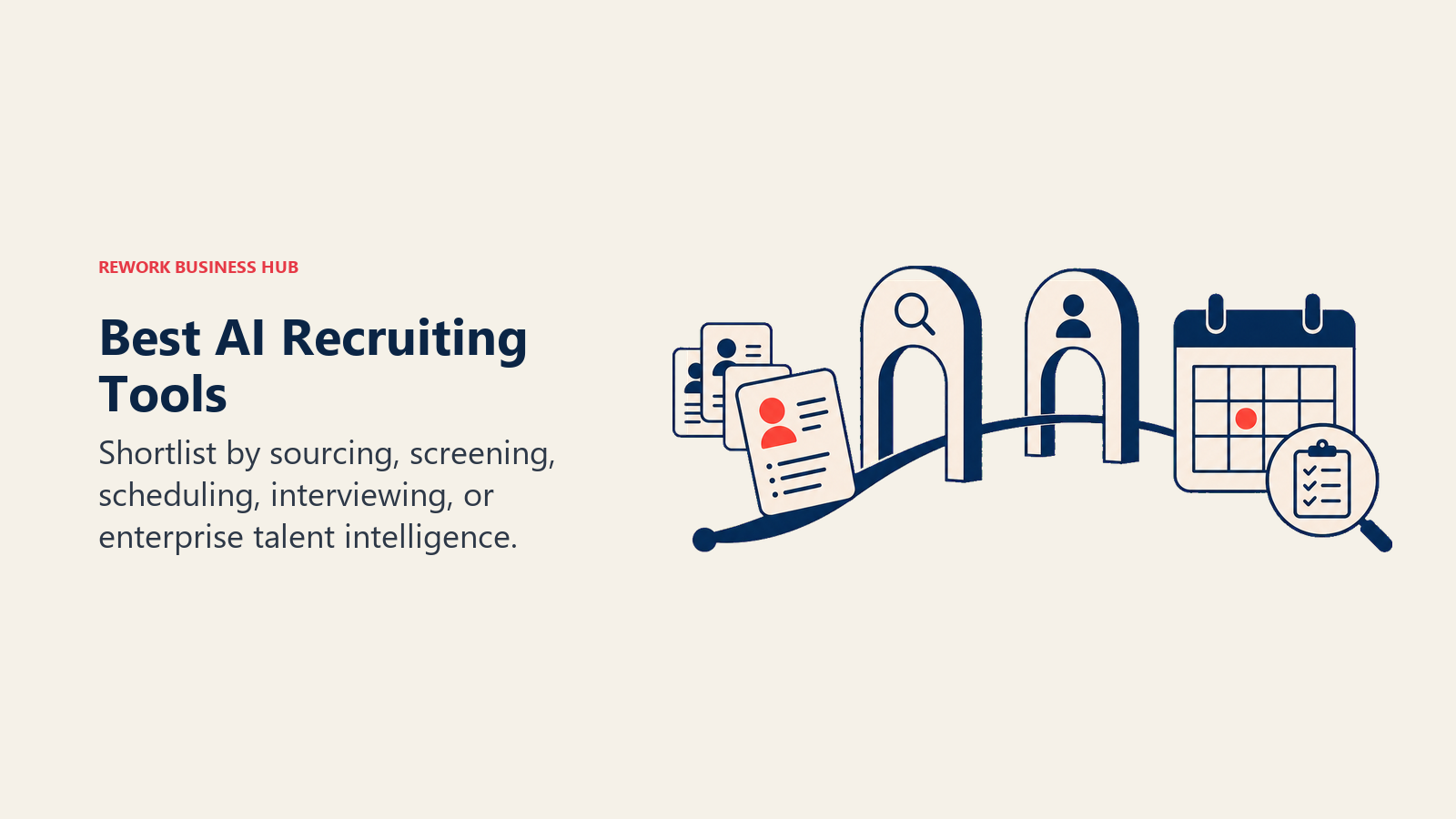
If you're building an AI-assisted recruiting stack in 2026, Paradox's Olivia leads conversational screening and scheduling for high-volume hiring, HireVue leads structured AI video interviewing, SeekOut and hireEZ lead AI sourcing, Eightfold and Findem lead enterprise talent intelligence, and LinkedIn's Hiring Assistant brings an AI agent into the sourcing network most recruiters already live in. This guide ranks 12 tools by the recruiting job you actually need done, not by feature count, and it tells you honestly where a general HR platform like Rework does and doesn't fit.
Most "best AI recruiting tools" roundups list a $150,000-a-year enterprise talent intelligence suite next to a $100-a-month sourcing add-on and call it a ranking. That's not useful if you're trying to shortlist in an afternoon. Each tool below is evaluated on what it actually automates (sourcing, screening, scheduling, interviewing, or writing), who it's built for, and what it costs, based on real-world adoption and fit for teams hiring 10 roles a year up to teams hiring 10,000.
Updated July 2026: What Changed
- LinkedIn's Hiring Assistant, its first AI agent for recruiters, reached full global English availability in September 2025, growing from a 500-company charter pilot to 8,000+ early users, and it now sits as a paid add-on on top of Recruiter Professional Services and Corporate seats rather than a bundled feature.
- Moonhub, the AI-agent-plus-human-recruiter hybrid, was acquired by Salesforce in June 2025, which is already reshaping its packaging and roadmap; expect deeper CRM-adjacent positioning over the next year.
- Findem shipped Intelligent Job Posts, which turns a job post into an autonomous sourcing agent, moved toward outcome-aligned pricing tied to actual hires, and acquired Glider AI to add skills validation on top of its talent data model.
- Gartner now projects 82% of CHROs will adopt AI agents within the next year, and SHRM's 2026 data shows AI use across HR functions nearly doubled since 2024, both signs that "AI-assisted recruiting" is quickly becoming just "recruiting."
Key Facts
- Among organizations already using AI in HR, the most common recruiting applications are writing job descriptions (66%), screening resumes (44%), and automating candidate searches (32%), per SHRM's State of AI in HR 2026 report.
- 37% of talent acquisition organizations are actively integrating or experimenting with generative AI tools in hiring, up from 27% a year earlier, per LinkedIn's Future of Recruiting report.
- Recruiters using AI save roughly a full workday a week, about 20% of their work week, per LinkedIn's Future of Recruiting report.
- Charter customers of LinkedIn's Hiring Assistant reviewed 62% fewer candidate profiles and saved 4+ hours per role during its rollout, per LinkedIn's official data reported by HR Brew.
- 82% of CHROs plan to adopt AI agents within the next year, per Gartner's "Prepare for the Future of AI Agents in HR" research, cited via Eightfold.
Quick Comparison Table
| Tool | Best For | Standout Capability | Starting Price | Free Tier? |
|---|---|---|---|---|
| Paradox (Olivia) | High-volume, frontline, and retail hiring | Conversational AI screening and scheduling over SMS and chat, 24/7 | Not published; estimated from roughly $1,000+/mo for smaller deployments | No |
| HireVue | Structured AI video interviews at scale | Async video interviews with competency-based AI scoring | Not published; Vendr median $20,900/yr | No |
| SeekOut | AI sourcing across 1B+ profiles | Deep diversity and skills filters on a massive candidate index | $149/mo (Recruit Core, annual) | No |
| hireEZ | AI outbound sourcing and ATS rediscovery | Finds "silver medalist" candidates already sitting in your ATS | Not published; Vendr median $13,000/yr | No |
| Eightfold | Enterprise talent intelligence at scale | Internal mobility, succession, and external hiring on one AI model | Not published; enterprise-only, typically $150K+/yr | No |
| Findem | Attribute-based AI talent data cloud | 3D data model tracks skills and career trajectory over time | Not published; Vendr median $58,000/yr | No |
| Fetcher | Human-reviewed AI sourcing | AI candidate lists reviewed by a human sourcer before they reach you | $115/mo (Self-Serve, annual) | No |
| Humanly | AI screening and scheduling for high-volume teams | Chat, SMS, voice, and video screening with a shared talent CRM | Not published; estimated $15,000-$50,000+/yr | No |
| Moonhub | AI recruiting agent plus a human recruiter | AI-run search paired with a dedicated recruiter, success-fee options | $5,000/mo per search (custom, negotiable) | No |
| LinkedIn Recruiter + Hiring Assistant | Sourcing on the largest professional network | AI agent builds pipelines and pre-screens over InMail automatically | $170/mo (Recruiter Lite) | No |
| Metaview | AI interview notes plus sourcing agents | Auto-generated interview notes and reports feeding structured scorecards | Free (100 profiles sourced) | Yes |
| Textio | Bias-aware AI job description writing | Flags biased or exclusionary language before a post goes live | Not published; Vendr median $24,405/yr | No |
How to Choose: Decision Framework
| If you need... | Pick... | Why |
|---|---|---|
| 24/7 conversational screening and scheduling for high-volume, frontline roles | Paradox (Olivia) | Purpose-built for retail, hospitality, and healthcare-scale hiring, not knowledge-work pipelines |
| Structured, scored video interviews for large candidate pools | HireVue | Competency-based AI scoring standardizes what would otherwise be dozens of inconsistent live interviews |
| Deep AI sourcing across the widest public candidate index | SeekOut | 1B+ profiles with strong diversity and skills filtering out of the box |
| To rediscover qualified candidates already sitting in your ATS | hireEZ | Purpose-built "silver medalist" rediscovery most ATS platforms don't do well natively |
| Enterprise-wide talent intelligence spanning hiring, mobility, and succession | Eightfold | The only tool here built to unify external hiring with internal talent decisions |
| Attribute-based sourcing that tracks career trajectory, not just keywords | Findem | 3D data model surfaces candidates keyword search misses entirely |
| AI sourcing with a human quality check before candidates reach you | Fetcher | Human-reviewed output reduces false positives a pure-AI sourcing tool would send you |
| AI screening and scheduling with a shared talent CRM for a mid-size team | Humanly | Chat, SMS, voice, and video screening in one product without enterprise pricing |
| A dedicated AI-plus-human recruiter for a hard-to-fill search | Moonhub | Hybrid model fits searches where a pure AI agent alone isn't trusted yet |
| AI-assisted sourcing inside the network most candidates already have a profile on | LinkedIn Recruiter + Hiring Assistant | No other tool reaches LinkedIn's own candidate graph directly |
| AI interview notes and reporting that feed structured scorecards | Metaview | Removes manual note-taking without replacing your actual interview process |
| Bias-aware job description writing before a role even posts | Textio | Catches exclusionary language and jargon that suppresses qualified applicants |
Framework: By Hiring Volume and Team Size
| Hiring Volume | Budget Signal | Best Fits |
|---|---|---|
| Under 20 roles/year | Self-serve or low commitment | Metaview free/Pro, Fetcher Self-Serve, SeekOut Recruit Core, LinkedIn Recruiter Lite |
| 20-100 roles/year | Structured budget, 1-3 recruiters | Humanly, Fetcher Growth, hireEZ, Textio (small tier) |
| 100-500 roles/year, high-volume frontline | Dedicated TA function | Paradox (Olivia), HireVue, LinkedIn Corporate + Hiring Assistant |
| 500+ roles/year or enterprise-wide | RevOps-style TA operations team | Eightfold, Findem, SeekOut Enterprise, Textio (enterprise) |
| One hard, senior, or confidential search | Fractional / outcome-based | Moonhub |
1. Paradox (Olivia): Conversational AI for High-Volume Hiring
Paradox's bet is that most hiring friction isn't a sourcing problem, it's a response-time problem. Its AI assistant, Olivia, texts and chats with candidates 24/7 in 100+ languages, answering questions, screening against basic criteria, and booking interviews without a recruiter touching a calendar. For retail, hospitality, healthcare, and logistics employers hiring thousands of frontline roles a year, that speed is the entire value proposition.
Best for: High-volume, frontline, and retail hiring where speed to first contact decides whether a candidate stays in the funnel
Key strengths:
- Conversational screening and scheduling over SMS and chat, live 24/7 without recruiter involvement
- Handles a large volume of simultaneous candidate conversations, purpose-built for seasonal and frontline surges
- Deep ATS integrations built specifically for high-volume hiring workflows
Limitations:
- Pricing isn't published; expect a sales conversation and a real commitment even at the low end
- Built for volume screening and scheduling, not deep candidate assessment or structured interviewing
- Less relevant for low-volume, highly specialized professional or executive hiring
Pricing: Not published. Paradox negotiates per account based on company size, modules, and integration depth. Third-party buyer estimates put entry deployments in the low four figures per month, scaling into six figures annually for large enterprise rollouts.
| What you get | What you don't |
|---|---|
| 24/7 conversational screening and scheduling, no recruiter needed for first contact | No published pricing; real commitment even at entry scale |
| Purpose-built for high-volume, frontline, and seasonal hiring | Not designed for deep candidate assessment or structured interviews |
| Deep ATS integrations for volume workflows | Overkill and poor fit for low-volume specialist or executive searches |
2. HireVue: AI Video Interviewing and Structured Assessments
HireVue's product philosophy is that a live first-round interview doesn't scale, and an async, structured one does. Candidates record video responses to a fixed set of questions, and HireVue's AI scores language patterns and competency signals against a standardized rubric, giving hiring teams a consistent first pass across hundreds or thousands of applicants. It integrates with your existing ATS rather than replacing it.
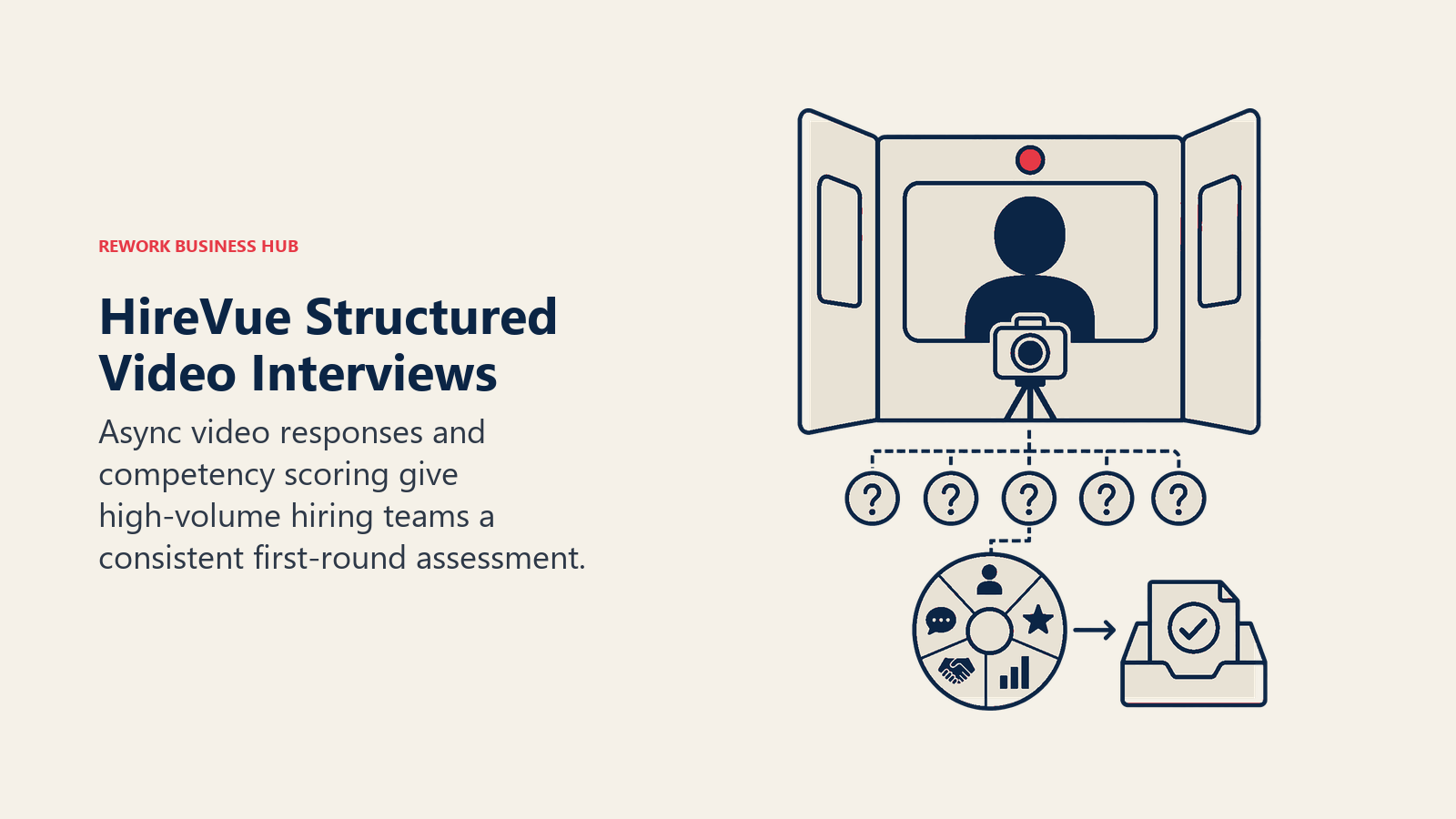
Best for: Structured, at-scale first-round interviews for high-applicant-volume roles
Key strengths:
- Async video interviews remove scheduling friction for both recruiters and candidates
- Competency-based AI scoring standardizes what would otherwise be wildly inconsistent live first-rounds
- Deep integration with existing ATS platforms rather than competing as a standalone system of record
Limitations:
- No published pricing; expect a genuine sales process and real onboarding cost on top of the license
- HireVue discontinued facial expression analysis in 2021, so current scoring leans on language and competency signals only
- Adds real cost at $9,794-$41,056/yr median range, not a fit for teams hiring under a few hundred candidates a year
Pricing: Not published. Vendr's buyer-reported data puts the median annual contract at $20,900, with a range of $9,794 to $41,056 depending on volume and modules. See Vendr's HireVue marketplace page.
| What you get | What you don't |
|---|---|
| Async, structured video interviews at scale | No published pricing; real sales process required |
| Competency-based AI scoring standardizes first rounds | Facial expression analysis was discontinued in 2021 |
| Integrates into your existing ATS instead of replacing it | Real cost lands well above self-serve tools; not for low-volume hiring |
If bias and defensibility in AI-scored interviews concern your legal team, pair HireVue's output with the same scrutiny you'd apply to any AI hiring decision, and read how to write job descriptions for an HR manager role that set clear, defensible criteria before candidates even reach the interview stage.
3. SeekOut: AI Sourcing Across 1B+ Profiles
SeekOut's differentiator is breadth plus depth: a candidate index of over a billion profiles, layered with AI multi-step outreach campaigns and genuinely strong diversity and skills filters. Where a lot of sourcing tools bolt AI onto a thin database, SeekOut built the database first and the AI campaigns on top of it, which shows in how granular its search filters get.
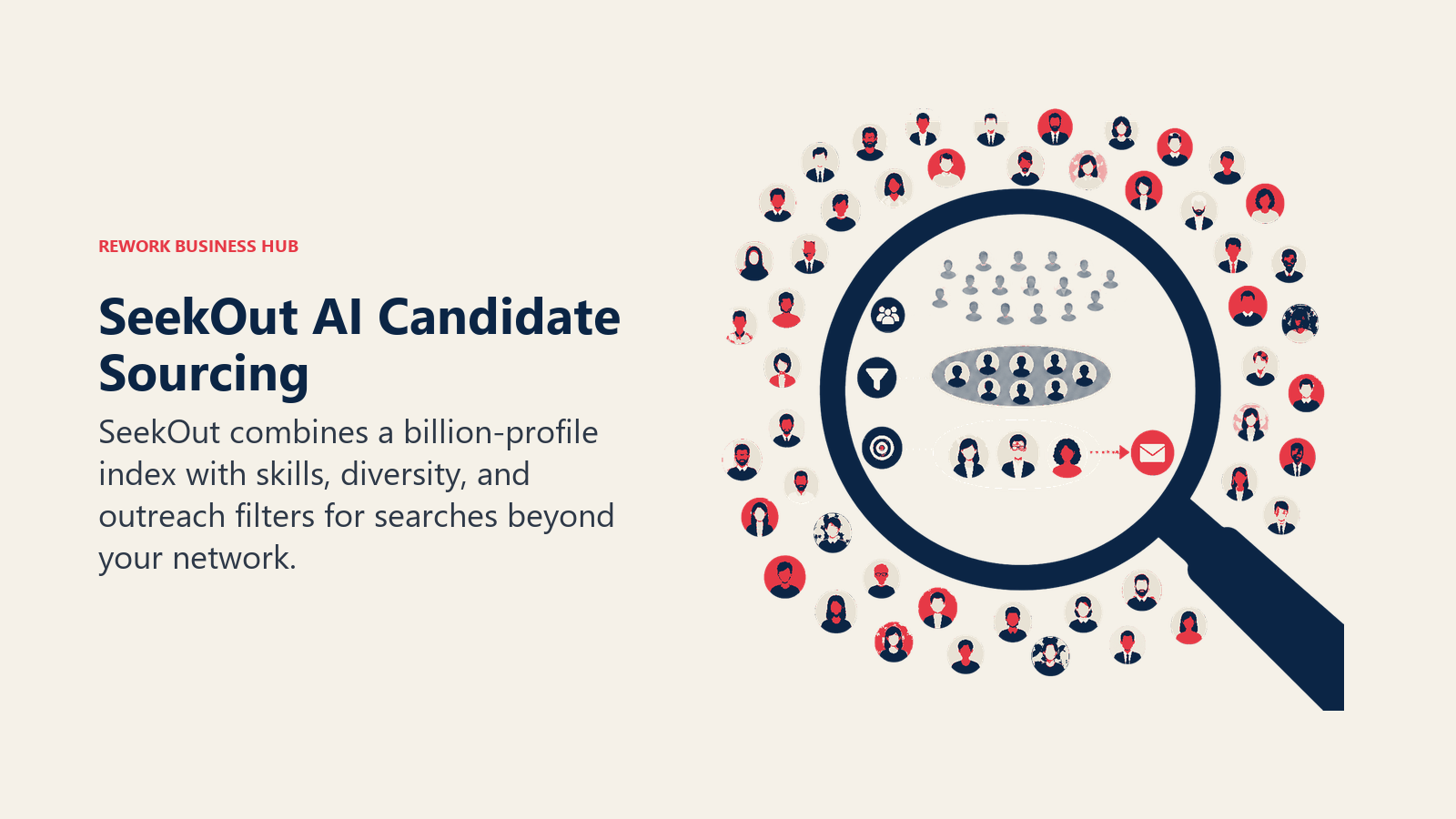
Best for: Recruiting teams that need to source candidates outside their existing network, especially for diversity-focused or skills-based searches
Key strengths:
- One of the largest public candidate indexes available, at 1B+ profiles
- AI multi-step outreach campaigns run sourcing sequences without manual follow-up
- Genuinely strong diversity and skills filtering, not just a checkbox feature
Limitations:
- The self-serve Recruit Core tier caps at 500 contact credits and 1,000 exports a month
- Team and Enterprise tiers require a sales call and a minimum seat commitment
- Full-funnel features (ATS rediscovery, agentic workflows) sit behind the highest, custom-priced tier
Pricing: Recruit Core starts at $149/month billed annually ($179/month billed monthly), including unlimited search, 500 contact credits, and 1,000 exports a month. Sourcing, Sourcing + Integration, and Full Recruiting Funnel tiers are custom, billed annually. Vendr's buyer-reported median across all tiers is $20,000/year, ranging $5,820 to $54,920. See SeekOut's pricing page and Vendr's SeekOut marketplace page.
| What you get | What you don't |
|---|---|
| One of the largest candidate indexes on the market | Self-serve tier caps credits and exports fairly low |
| Strong diversity and skills filtering | Full-funnel features require a custom, higher-priced tier |
| AI multi-step outreach campaigns built in | Team/Enterprise tiers need a sales call and seat minimum |
4. hireEZ: AI Outbound Sourcing and ATS Rediscovery
hireEZ's core bet is that most companies already have the candidate they need, buried in an ATS full of past applicants nobody re-searches. Its AI rediscovers "silver medalist" candidates (people who applied before but didn't get the job) alongside standard outbound AI sourcing across public profiles, which makes it as much a data-hygiene tool as a sourcing one.
Best for: Teams that want to mine their own ATS for qualified past candidates alongside new outbound sourcing
Key strengths:
- AI-powered candidate matching surfaces qualified profiles from both outbound search and your own ATS history
- Rediscovery of "silver medalist" candidates is a genuinely differentiated feature most competitors don't do well
- Professional Plan includes a meaningful monthly search-credit allotment for active sourcing teams
Limitations:
- Pricing isn't published; requires a sales conversation to get a real number
- Per-recruiter licensing plus contact credits can get expensive fast for larger sourcing teams
- Less useful for companies without an existing ATS history worth mining
Pricing: Not published. Vendr's buyer-reported median annual contract is $13,000, ranging $7,000 to $25,000 depending on recruiter seat count and credit volume. See Vendr's hireEZ marketplace page.
| What you get | What you don't |
|---|---|
| AI rediscovery of qualified candidates already in your ATS | No published pricing; sales conversation required |
| Outbound AI sourcing across public candidate profiles | Per-recruiter plus credit pricing scales cost with team size |
| Meaningful search-credit allotment on the Professional Plan | Less value for teams without deep existing ATS history |
5. Eightfold: Enterprise Talent Intelligence Platform
Eightfold's philosophy is that hiring, internal mobility, and succession planning shouldn't run on three separate systems. Its AI model builds a single skills-based profile for every person, whether they're an external candidate or an existing employee, and uses that same model to power external sourcing, internal talent marketplace matching, and workforce planning.
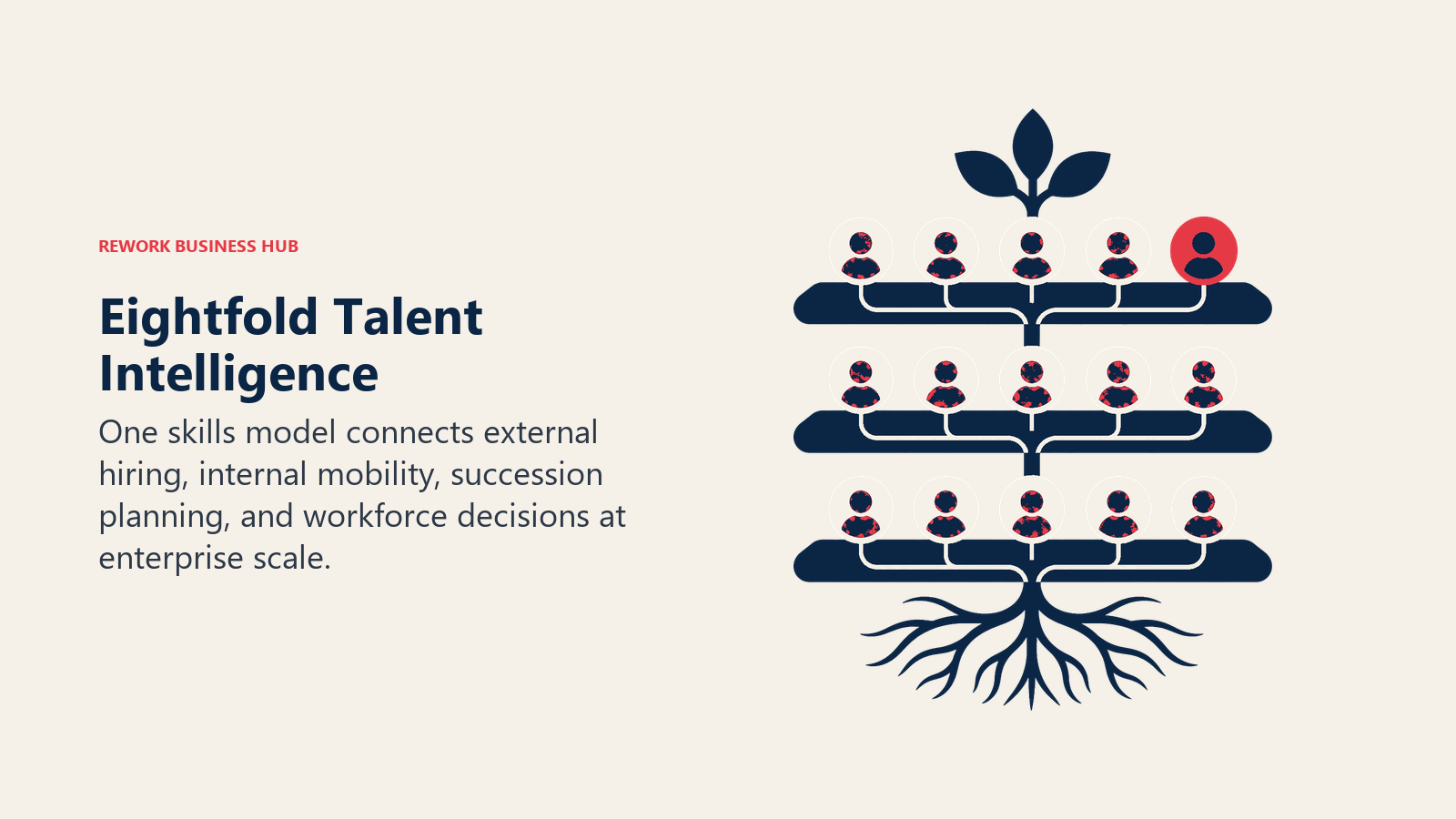
Best for: Large enterprises (typically 5,000+ employees) that want AI unifying external hiring with internal mobility and succession, not just faster sourcing
Key strengths:
- One AI skills model spans external hiring, internal mobility, and succession planning
- Deep enterprise integrations and a dedicated TA operations relationship at scale
- Strong for large-scale skills-based matching across a big, complex workforce
Limitations:
- No published pricing; typically $150,000-$500,000+ a year for full enterprise deployment
- Genuinely overbuilt for companies under roughly 2,000 employees; the per-employee model gets expensive fast at smaller scale
- Requires real implementation investment and a dedicated internal team to run
Pricing: Not published. Industry estimates put per-employee costs around $7-$10/employee/month, which translates to roughly $150,000-$500,000+ a year for large enterprise deployments, per third-party buyer analysis.
| What you get | What you don't |
|---|---|
| One AI model spanning external hiring, mobility, and succession | No published pricing; enterprise sales process required |
| Deep skills-based matching across a large, complex workforce | Cost-prohibitive under roughly 2,000-5,000 employees |
| Built for organizations running a full internal talent marketplace | Requires real implementation effort and a dedicated team to run |
If your team is deciding whether an enterprise talent platform like Eightfold is worth the investment versus upskilling your current recruiters, the hiring versus upskilling AI framework walks through that tradeoff before you commit budget either way.
6. Findem: Attribute-Based AI Talent Data Cloud
Findem's differentiator is its "3D data model," which tracks a candidate's skills and career trajectory over time instead of matching on static keywords from a single resume or profile snapshot. It aggregates data from hundreds of sources to build a deeper picture of where someone's career is headed, not just where they've been, which surfaces candidates a keyword search would miss entirely.
Best for: RevOps-style talent acquisition teams that want attribute and trajectory-based sourcing, not keyword matching
Key strengths:
- 3D data model tracks skills and career trajectory over time, not a single-point-in-time resume snapshot
- Intelligent Job Posts (added in 2026) turn a job posting itself into an autonomous sourcing agent
- 2026 acquisition of Glider AI adds skills validation on top of sourcing, moving toward "hire-ready" candidates
Limitations:
- No published pricing or self-serve tiers; entirely quote-based
- Higher cost than most sourcing-only tools on this list, reflecting its broader talent-data ambitions
- Newer outcome-aligned pricing model (tied to hires) is still maturing and not yet standard across all deals
Pricing: Not published. Vendr's buyer-reported median annual contract is $58,000, ranging $7,225 to $94,840. See Vendr's Findem marketplace page.
| What you get | What you don't |
|---|---|
| Attribute and trajectory-based sourcing beyond keyword matching | No published pricing or self-serve entry point |
| Intelligent Job Posts turn a posting into a sourcing agent | Higher median cost than most sourcing-only competitors |
| Skills validation added via the 2026 Glider AI acquisition | Outcome-aligned pricing model still maturing across deals |
7. Fetcher: Human-Reviewed AI Sourcing
Fetcher's pitch is a hybrid most pure-AI sourcing tools skip: AI generates candidate lists, but a human sourcer reviews them before they land in your inbox. For teams that have been burned by AI-sourced lists full of near-misses, that human quality gate is the actual product, not a marketing line.
Best for: Teams that want AI-speed sourcing without wading through false-positive candidate matches
Key strengths:
- Human review layer catches the false positives that pure-AI sourcing tools routinely send through
- Amplify tier adds a dedicated sourcer covering 4-6 roles at a time, closer to an outsourced sourcing function
- Published, self-serve pricing, rare among tools at this depth
Limitations:
- Sourced-candidate caps are real: 500/year on Growth, 1,000/year on Amplify, which high-volume teams will hit fast
- Self-Serve tier is limited to a single user seat and modest lead volume
- No free tier or free trial as of 2026
Pricing: Self-Serve is $115/month (annual). Growth is $379/month (annual) or $499/month (monthly), covering up to 500 Fetcher-sourced candidates a year. Amplify is $649/month (annual) or $849/month (monthly), covering up to 2,000 sourced candidates a year with a dedicated sourcer. Enterprise is custom. Vendr's buyer-reported median is $11,000/year. See Fetcher's pricing page and Vendr's Fetcher marketplace page.
| What you get | What you don't |
|---|---|
| Human-reviewed AI sourcing, fewer false positives | Real annual sourced-candidate caps on every tier |
| Dedicated sourcer on the Amplify tier | Self-Serve limited to one seat and modest volume |
| Published, self-serve pricing | No free tier or trial |
8. Humanly: AI Screening and Scheduling for High-Volume Teams
Humanly occupies the space between Paradox's enterprise-scale conversational screening and a basic ATS chatbot. Its AI Recruiter engages candidates across chat, SMS, email, voice, or video, screens against customizable criteria, conducts structured interviews, and books next steps automatically, all logged into a shared Talent CRM rather than scattered across channels.
Best for: Mid-market teams that want AI screening and scheduling across multiple channels without enterprise-tier pricing or commitment
Key strengths:
- Screens across chat, SMS, email, voice, and video from one AI Recruiter, not a single channel
- Structured, customizable screening criteria instead of a generic keyword filter
- Shared Talent CRM keeps candidate history in one place across recruiters
Limitations:
- Pricing isn't disclosed upfront; requires a sales conversation for a real number
- Built for mid-market and enterprise frontline, professional, and specialized hiring, less suited to very small teams
- Less name recognition and ecosystem depth than Paradox at true enterprise scale
Pricing: Not published. Industry estimates suggest $15,000-$50,000+ annually for typical mid-market deployments, though Humanly does not confirm public figures.
| What you get | What you don't |
|---|---|
| Multi-channel AI screening: chat, SMS, email, voice, video | No published pricing; sales conversation required |
| Structured, customizable screening criteria | Built for mid-market/enterprise, not very small teams |
| Shared Talent CRM across recruiters | Less enterprise-scale track record than Paradox |
9. Moonhub: AI Recruiting Agent Backed by a Human Recruiter
Moonhub's model is genuinely different from every other tool on this list: instead of software you operate yourself, you get an AI-run search paired with a dedicated human recruiter, priced closer to a contingency search than a SaaS seat. For a single hard-to-fill, senior, or confidential search, that hybrid is the point, not a limitation.

Best for: A single hard-to-fill, senior, or highly specialized search where a pure self-serve AI tool doesn't inspire enough confidence yet
Key strengths:
- Pairs AI-run sourcing and screening with an actual dedicated human recruiter on your search
- Flexible commercial models, including subscription or success-based fees tied to a completed hire
- Now backed by Salesforce (acquired June 2025), which may deepen CRM-adjacent capability over time
Limitations:
- Pricing is entirely custom and negotiated; there's no way to compare cost quickly against other tools on this list
- Priced and positioned as a per-search service, not a recruiting platform you scale across an entire TA team
- Post-acquisition roadmap and standalone availability are still settling in as of mid-2026
Pricing: Not published as a standard rate card. Reported pricing places a dedicated recruiter on a search at roughly $5,000/month, with flexible subscription or success-fee structures depending on hiring volume and role difficulty.
| What you get | What you don't |
|---|---|
| AI-run search paired with a dedicated human recruiter | No published pricing; fully custom and negotiated |
| Flexible subscription or success-based fee models | Priced per search, not built as a team-wide platform |
| Backed by Salesforce since the June 2025 acquisition | Post-acquisition roadmap still settling as of mid-2026 |
10. LinkedIn Recruiter + Hiring Assistant: AI Sourcing on the World's Largest Professional Network
LinkedIn's advantage was never in question, it has the candidate graph everyone else is trying to approximate. What changed in 2026 is that LinkedIn now layers an actual AI agent, Hiring Assistant, on top of Recruiter: it reads job descriptions and intake notes, builds candidate pipelines from LinkedIn's own network, runs InMail-based pre-screening, and drafts personalized outreach, largely without a recruiter manually building a search string.
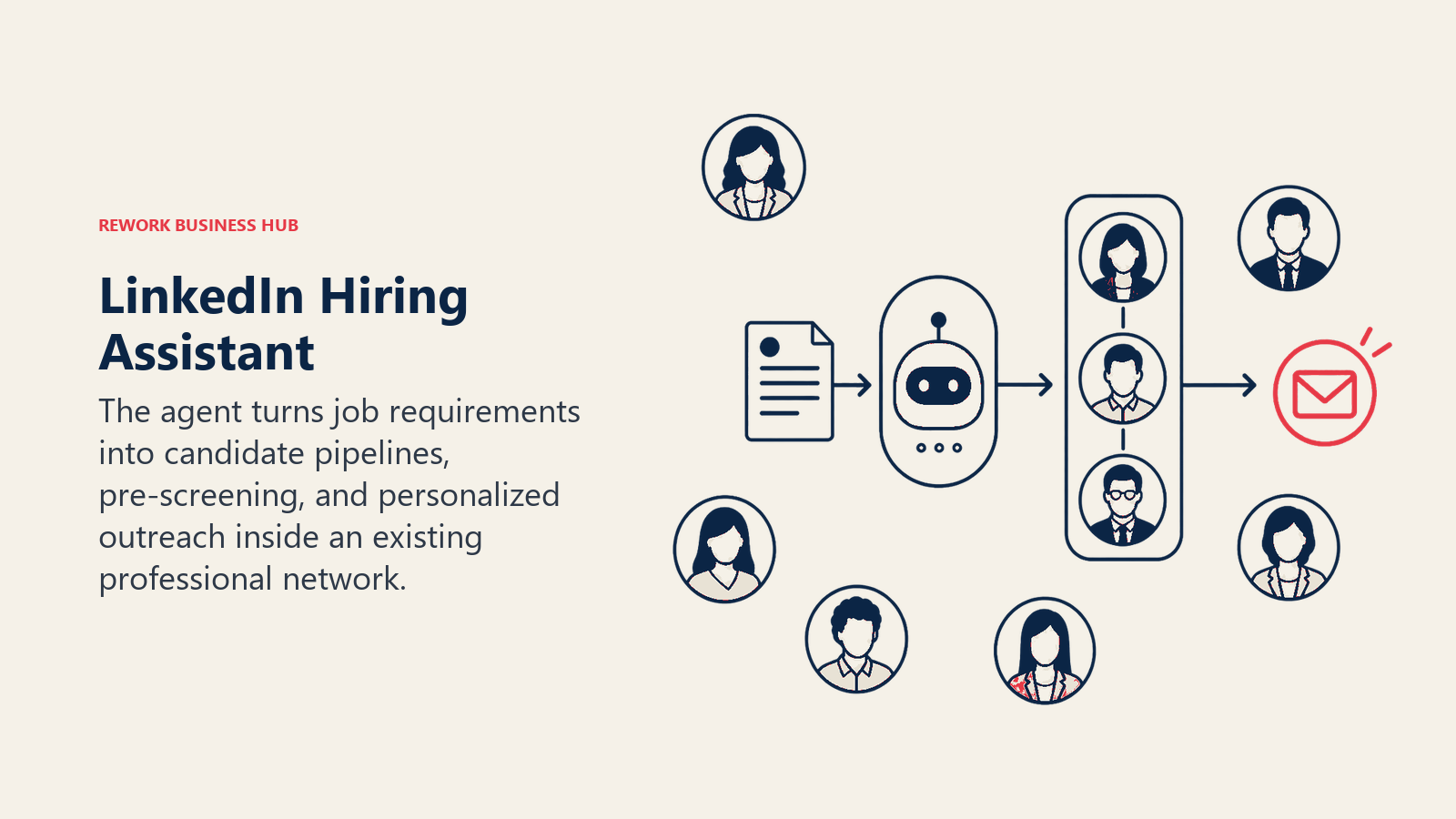
Best for: Teams that want AI-assisted sourcing inside the same network where most candidates already maintain an up-to-date profile
Key strengths:
- Hiring Assistant reads job requirements and builds pipelines directly from LinkedIn's own candidate graph
- Charter customers saw meaningful, independently reported gains in profile-review efficiency and InMail response
- No new data source or integration required if your team already runs Recruiter
Limitations:
- Hiring Assistant is a paid add-on on top of RPS+ or Corporate seats, not included in base Recruiter pricing, and requires its own sales conversation
- InMail overages, Talent Insights, and promoted job posts stack real cost on top of the base seat price
- Recruiter Lite doesn't include Hiring Assistant at all; it's built for higher committed tiers
Pricing: Recruiter Lite is $170/month ($1,680/year) per seat. Recruiter Professional Services and Corporate seats run roughly $6,000-$12,960/seat/year based on buyer-reported data, with Hiring Assistant priced separately through a direct sales conversation. See LinkedIn's Hiring Assistant page.
| What you get | What you don't |
|---|---|
| AI sourcing and pre-screening inside LinkedIn's own network | Hiring Assistant is a paid add-on, not bundled with base seats |
| Reported gains in profile-review time and InMail response | InMail overages and Talent Insights add real cost on top |
| No new data source needed if you already run Recruiter | Recruiter Lite doesn't include the AI agent at all |
11. Metaview: AI Interview Notes and Sourcing Agents
Metaview started as an AI notetaker for interviews and has grown into a lighter-weight AI recruiting platform that also sources candidates. Its core value is still the notes: it auto-generates structured interview notes and reports from live conversations, feeding directly into scorecards instead of leaving that context trapped in a recruiter's memory or a messy Google Doc.
Best for: Teams that want AI interview notes and reporting feeding structured scorecards, with optional lightweight sourcing on top
Key strengths:
- Auto-generated interview notes and reports remove manual note-taking without changing how you actually interview
- Sourcing agents run continuous, 24/7 candidate search once configured
- Genuinely usable free tier for teams that want to try AI sourcing before committing
Limitations:
- Sourcing volume is capped fairly low on the Pro tier (200 profiles/month) before jumping to Max
- Less deep candidate database than dedicated sourcing tools like SeekOut or hireEZ
- Notetaking and sourcing are priced and packaged somewhat separately, worth clarifying before you buy
Pricing: Sourcing: Free (100 profiles sourced), Pro $100/month per user (200 profiles/month), Max $300/month per user (unlimited profiles), Enterprise custom. See Metaview's pricing page.
| What you get | What you don't |
|---|---|
| Auto-generated interview notes feeding structured scorecards | Sourcing volume caps low on the Pro tier before Max |
| Free tier to test AI sourcing before committing | Smaller candidate database than dedicated sourcing tools |
| Continuous, 24/7 sourcing agents once configured | Notetaking and sourcing pricing are somewhat separate tracks |
12. Textio: AI-Powered, Bias-Aware Job Description Writing
Textio's bet is that hiring outcomes start before a single candidate applies, in the language of the job post itself. Its AI flags biased, exclusionary, or jargon-heavy phrasing in real time as recruiters and hiring managers write, and it's the one tool on this list that improves your funnel by changing what goes into it, not by processing what comes out.
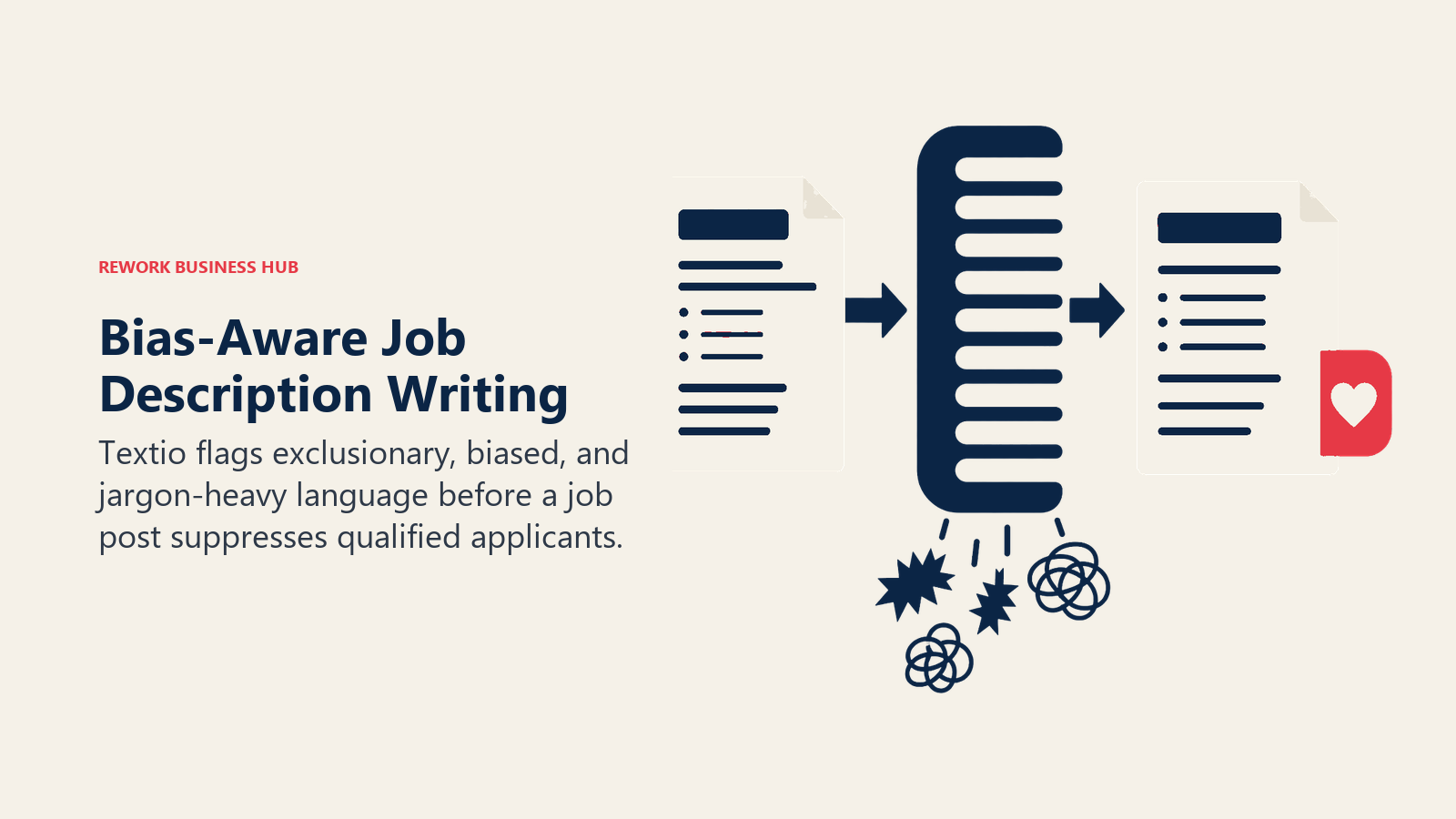
Best for: Companies that want to catch biased or exclusionary language in job postings before it suppresses qualified applicants
Key strengths:
- Real-time flagging of biased, exclusionary, or jargon-heavy language as you write
- Textio Hire targets recruiting content specifically; a separate Textio Perform product extends the same augmented-writing approach to performance reviews
- Strong enterprise track record on measurable applicant-quality and diversity outcomes
Limitations:
- No self-serve or low-cost tier; this is enterprise software with enterprise pricing from the start
- Pricing isn't published; expect a genuine sales process even for a small team
- Value depends on actually rewriting flagged language, not just seeing the flags
Pricing: Not published. Vendr's buyer-reported median annual contract is $24,405, ranging $9,600 to $52,197: small teams (10-50 users) typically pay $15,000-$45,000/year, mid-market (50-200 users) $45,000-$120,000/year, and enterprise (200+ users) $120,000-$250,000+/year. See Vendr's Textio marketplace page.
| What you get | What you don't |
|---|---|
| Real-time bias and exclusionary-language flagging | No self-serve or low-cost tier |
| Separate Perform product extends the same approach to reviews | No published pricing; sales process required at every size |
| Strong track record on applicant-quality outcomes | Value depends on actually rewriting flagged content |
If job description quality is the actual bottleneck in your funnel, pairing Textio's flags with a solid starting template, like this campus recruiter job description, gives writers a clean structure to apply the fixes to.
A Quick Note on Rework
Rework isn't on this list, and it shouldn't be. Its People app covers HRIS, time & attendance, and timesheets, unified with Rework's CRM, lead management, and work ops products, but it doesn't source, screen, or interview candidates. If your actual gap is an applicant tracking or sourcing tool, none of Rework's product lines fill that need honestly, and it would be misleading to force it into a ranked list next to Paradox or SeekOut.
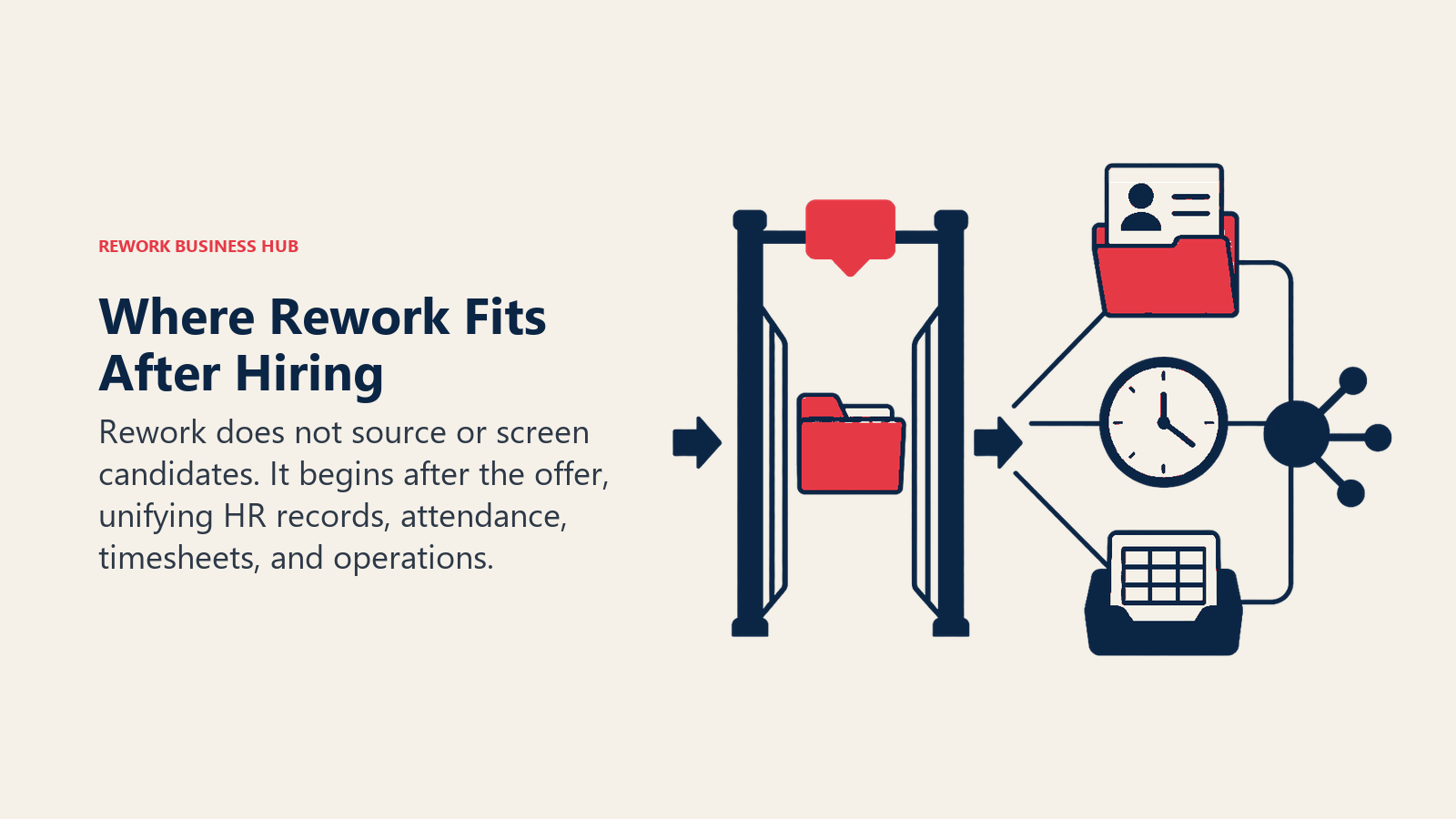
Where Rework does show up in recruiting-adjacent workflows is after the hire: once someone accepts an offer, People app handles their HR record, attendance, and timesheets in the same platform where sales, marketing, and ops already run, instead of a separate HRIS nobody else in the company touches. If that's the gap you're solving (unifying HR admin with the rest of your operating stack, not sourcing candidates) it's worth a look. See the best HR software in 2026 for how Rework compares to dedicated HRIS platforms like BambooHR and Rippling on that specific job.
Pricing at a Glance
| Tool | Entry Price | Pricing Model | Free Tier? |
|---|---|---|---|
| Paradox (Olivia) | Not published (est. $1,000+/mo entry) | Custom, negotiated by account | No |
| HireVue | Not published (Vendr median $20,900/yr) | Per-license, quote-based | No |
| SeekOut | $149/mo (Recruit Core, annual) | Tiered self-serve + custom enterprise | No |
| hireEZ | Not published (Vendr median $13,000/yr) | Per-recruiter + credits, quote-based | No |
| Eightfold | Not published (est. $150K-$500K+/yr) | Per-employee, enterprise quote | No |
| Findem | Not published (Vendr median $58,000/yr) | Quote-based, moving toward outcome-aligned | No |
| Fetcher | $115/mo (Self-Serve, annual) | Tiered, published self-serve pricing | No |
| Humanly | Not published (est. $15K-$50K+/yr) | Quote-based | No |
| Moonhub | ~$5,000/mo per search (custom) | Subscription or success-fee, per search | No |
| LinkedIn Recruiter + Hiring Assistant | $170/mo (Recruiter Lite) | Per-seat, add-on priced separately | No |
| Metaview | Free (100 profiles); $100/mo (Pro) | Tiered, published self-serve pricing | Yes |
| Textio | Not published (Vendr median $24,405/yr) | Quote-based, by deployment size | No |
Where AI Recruiting Is Headed
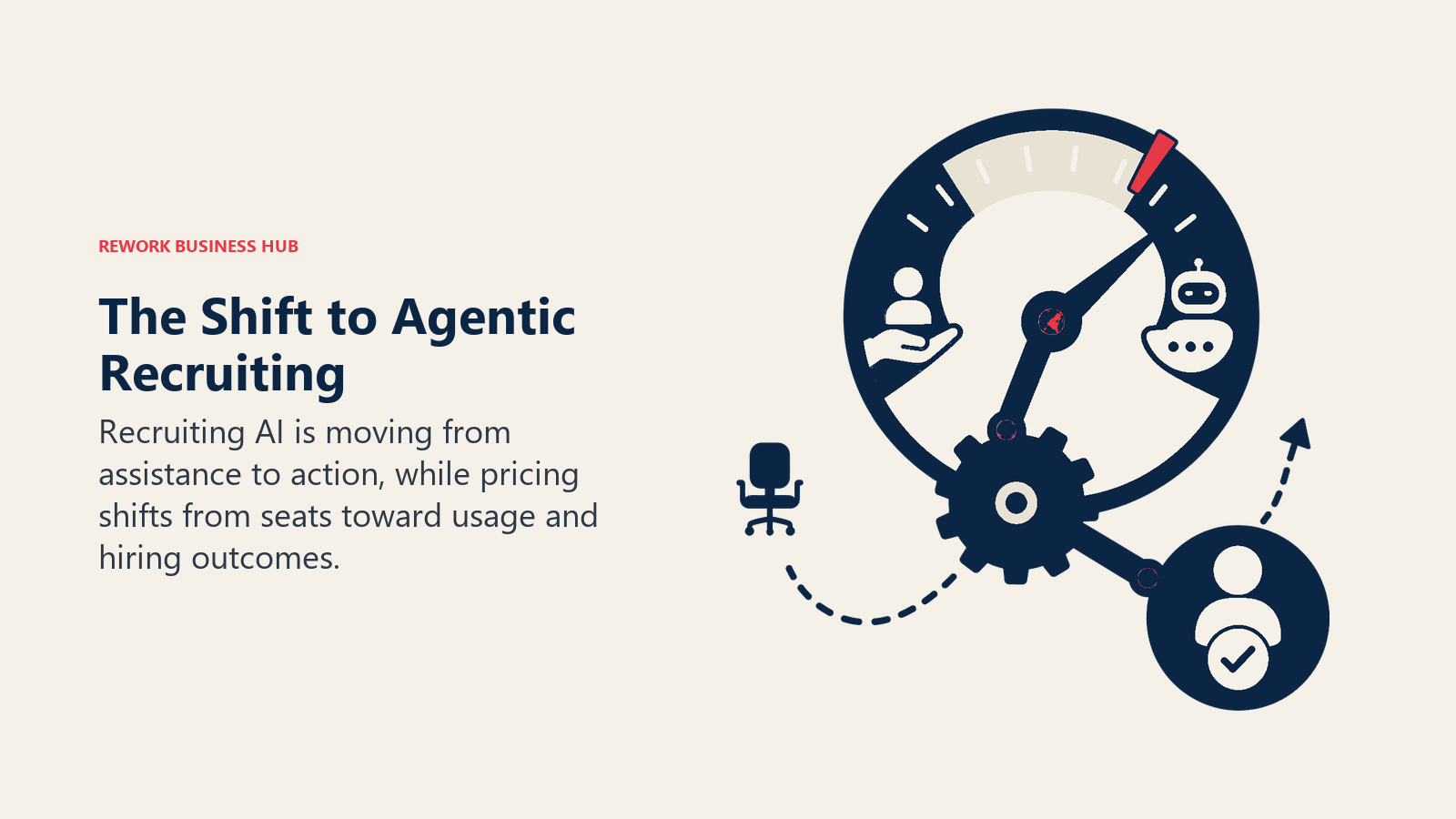
Two shifts are converging fast. First, AI agents are moving from assisting a recruiter to acting on a recruiter's behalf: LinkedIn's Hiring Assistant, Findem's Intelligent Job Posts, and Metaview's sourcing agents all run candidate search and pre-screening with less human input at each step than the tools they replaced. Second, pricing is starting to shift from flat per-seat licenses toward outcome-aligned models, Findem's move toward pricing tied to hires is an early signal, echoing the same usage-based shift already underway in AI sales tools. Expect more vendors to blur the line between "software you operate" and "an agent that does the work," and expect buyers to keep pushing back on quote-only pricing as agentic tools get easier to compare head-to-head.
Frequently Asked Questions about AI Recruiting Tools
What is the best AI recruiting tool in 2026?
There's no single best tool. Paradox leads conversational screening for high-volume, frontline hiring, SeekOut and hireEZ lead AI sourcing, Eightfold leads enterprise talent intelligence, and LinkedIn's Hiring Assistant leads AI sourcing inside the professional network most candidates already use. Match the tool to the specific recruiting job, not a general ranking.
Are there free AI recruiting tools?
Yes, though options are limited compared to other AI tool categories. Metaview offers a genuinely free tier (100 sourced profiles), and several tools, including SeekOut and Fetcher, offer low-cost entry tiers under $200/month before jumping to custom enterprise pricing.
Is an enterprise talent intelligence platform like Eightfold worth it for a mid-size company?
Usually not below a few thousand employees. Eightfold's per-employee pricing model and $150,000+ typical annual cost are built for organizations running internal mobility and succession planning alongside external hiring, not just faster sourcing. Mid-size teams typically get more value from a focused sourcing tool like SeekOut or hireEZ plus a screening tool like Humanly.
What's the difference between an AI sourcing tool and an AI screening tool?
Sourcing tools (SeekOut, hireEZ, Findem, Fetcher) find and rank candidates who might be a fit, largely before any conversation happens. Screening tools (Paradox, Humanly, HireVue) engage candidates who've already applied or been sourced, asking questions, scheduling, or scoring interview responses. Most recruiting stacks need at least one of each, not one tool doing both.
Is candidate data safe with AI recruiting tools?
Most established vendors on this list, including HireVue, SeekOut, Eightfold, and LinkedIn, publish SOC 2 compliance and standard data processing agreements. Ask any AI recruiting vendor directly whether candidate data or interview recordings are used to train models beyond your own account, and get that answer in writing, especially given growing regulatory scrutiny of AI in hiring decisions (New York City's Local Law 144 and similar state rules require bias audits for automated employment decision tools).
Does Rework belong on a list of AI recruiting tools?
No, and it isn't ranked here for that reason. Rework's People app covers HRIS, time & attendance, and timesheets after someone is hired, not sourcing, screening, or interviewing. If HR administration unified with the rest of your operating stack is the actual gap, it's worth a look; if you need to source or screen candidates, one of the 12 tools above is the right fit.
Which AI recruiting tool is best for a small team versus a large enterprise?
Small teams (hiring under 20 roles a year) usually get the most value from Metaview's free tier, Fetcher Self-Serve, or SeekOut Recruit Core, all with published entry pricing under $200/month. Large enterprises hiring at high volume typically need Eightfold, Findem, HireVue, or Paradox, which carry six-figure annual costs but are built for that scale.
What to Do Next
Pick the one recruiting job that's actually costing you time or quality right now, whether that's slow first response on high-volume roles, sourcing candidates outside your existing network, or inconsistent first-round screening, and shortlist two tools against the decision framework above. Run a real pilot on live requisitions before you sign anything longer than a quarter; AI recruiting tools live or die on how they perform against your actual candidate pool, not a demo. And once your funnel is producing hires faster, the 30-60-90 day plan and day-one tool setup checklist are worth reading next, since a faster hiring process only pays off if onboarding keeps pace with it. If you're also weighing where AI should sit across your broader HR and ops stack, workforce planning for AI-era roles and the full AI tools roundup are good next reads.

Principal Product Marketing Strategist
On this page
- Updated July 2026: What Changed
- Key Facts
- Quick Comparison Table
- How to Choose: Decision Framework
- Framework: By Hiring Volume and Team Size
- 1. Paradox (Olivia): Conversational AI for High-Volume Hiring
- 2. HireVue: AI Video Interviewing and Structured Assessments
- 3. SeekOut: AI Sourcing Across 1B+ Profiles
- 4. hireEZ: AI Outbound Sourcing and ATS Rediscovery
- 5. Eightfold: Enterprise Talent Intelligence Platform
- 6. Findem: Attribute-Based AI Talent Data Cloud
- 7. Fetcher: Human-Reviewed AI Sourcing
- 8. Humanly: AI Screening and Scheduling for High-Volume Teams
- 9. Moonhub: AI Recruiting Agent Backed by a Human Recruiter
- 10. LinkedIn Recruiter + Hiring Assistant: AI Sourcing on the World's Largest Professional Network
- 11. Metaview: AI Interview Notes and Sourcing Agents
- 12. Textio: AI-Powered, Bias-Aware Job Description Writing
- A Quick Note on Rework
- Pricing at a Glance
- Where AI Recruiting Is Headed
- What to Do Next