Deel vs Remote: Which Global Employment Platform Fits Your Team in 2026?
Turn this article into takeaways for your work.


Each assistant summarizes the article only for you and suggests best practices for your work.
You've already decided to hire outside your home country, and you've narrowed the field to the two platforms every founder, Head of People, and COO ends up comparing: Deel and Remote. Both will legally employ someone where you have no entity, both will pay a contractor in another currency without a local bank account, and both call their compliance the safest way to do it. That's where the similarity ends.
This is for a 10 to 500 person company facing a real decision this quarter: one EOR hire in Portugal, a contractor roster spread across four continents, or a first push into 25 headcount across five countries. We ran the math at the mixes you're actually facing, and any unconfirmed claim is labeled as such.
TL;DR
| Deel | Remote | |
|---|---|---|
| What it is | Broader platform: EOR, contractor management, US PEO, HR, immigration, and an ATS, priced as separate add-ons | Narrower, entity-owned platform: EOR, global payroll, contractor management, bundled HR core |
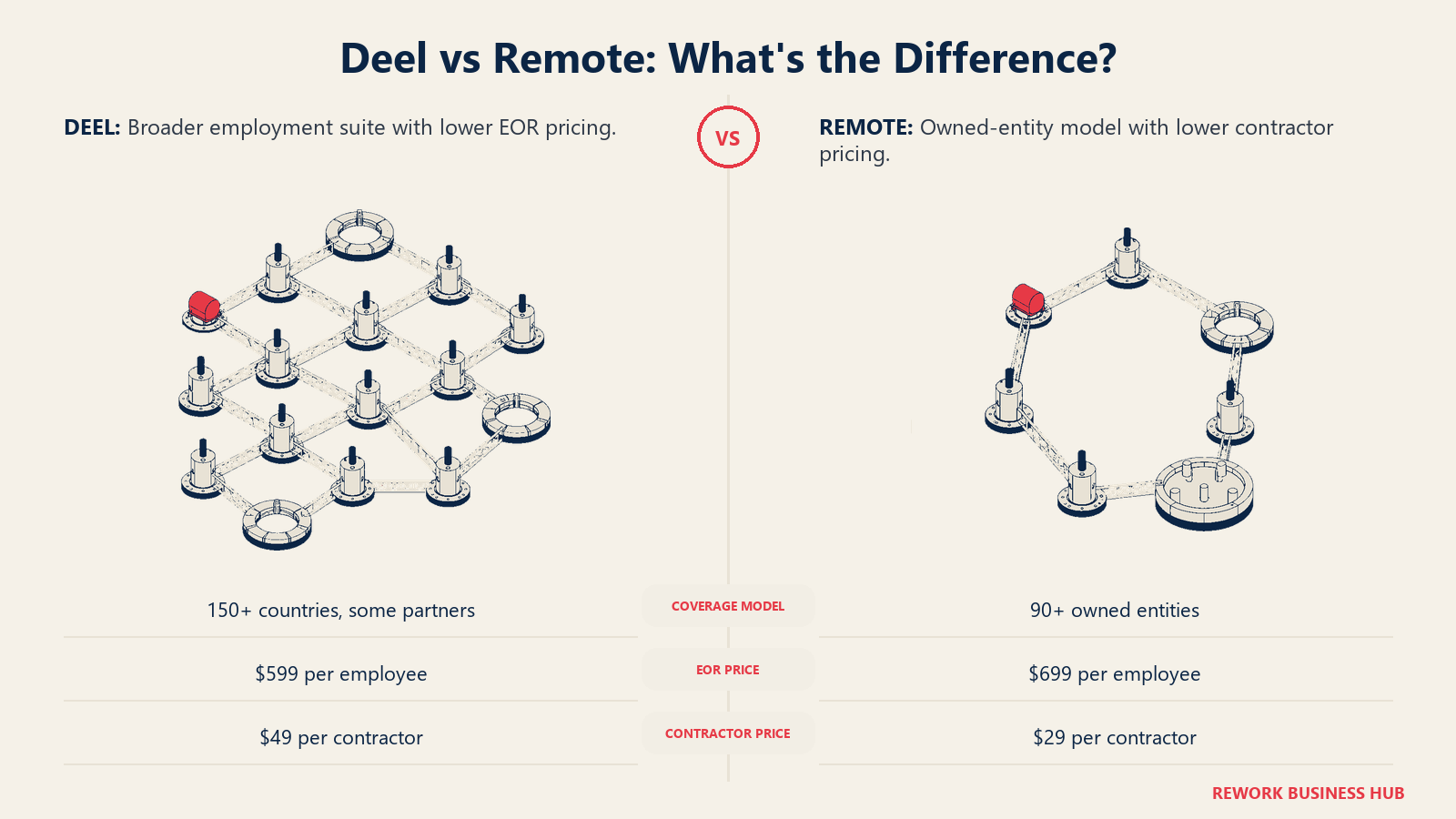
| EOR price | $599/employee/month | $699/employee/month |
| Entity model | Mix of owned entities (130+ countries for payroll) and local partners across 150+ countries | 100% owned entities, no third-party partner handoffs, in 90+ countries |
| Contractor Management | $49/contractor/month | $29/contractor/month, with a $99 "Plus" tier adding $100,000 indemnity |
| Contractor of Record (misclassification protection) | $325/contractor/month | From $325/contractor/month, with uncapped indemnity |
| US PEO | $125/employee/month | From $99/employee/month |
| Global Payroll (own entity) | Not publicly priced, quote-based | $29/employee/month |
| HR / HRIS | Core tier from $5/employee/month, not free | HR Core bundled free with any paid employment product |
| Immigration | Custom quote, $250 right-to-work fee, covers 70+ countries | Not a named standalone product |
| Onboarding speed claim | "As little as one day" | 2.3-day average, per Remote's own published assumption |
| Best for | Teams wanting one vendor for EOR, PEO, HR, immigration, and recruiting under one login | Teams wanting the cleanest compliance chain and simpler, mostly lower per-seat pricing |
| Not really built for | Teams wanting every module priced on one page before talking to sales | Teams hiring in the roughly 60 countries where Remote relies on partners, not its own entity |
Who Each Platform Is Built For
Deel started in 2019 as a contractor payments tool and expanded fast: EOR, US PEO, a full HRIS, immigration, equity and cap table management (via its 2023 Capbase acquisition), and an ATS. The strategy is breadth, one login for every stage of the employment lifecycle, priced as separate line items, so a buyer who wants "everything" assembles a bill from several product pages rather than one flat number.
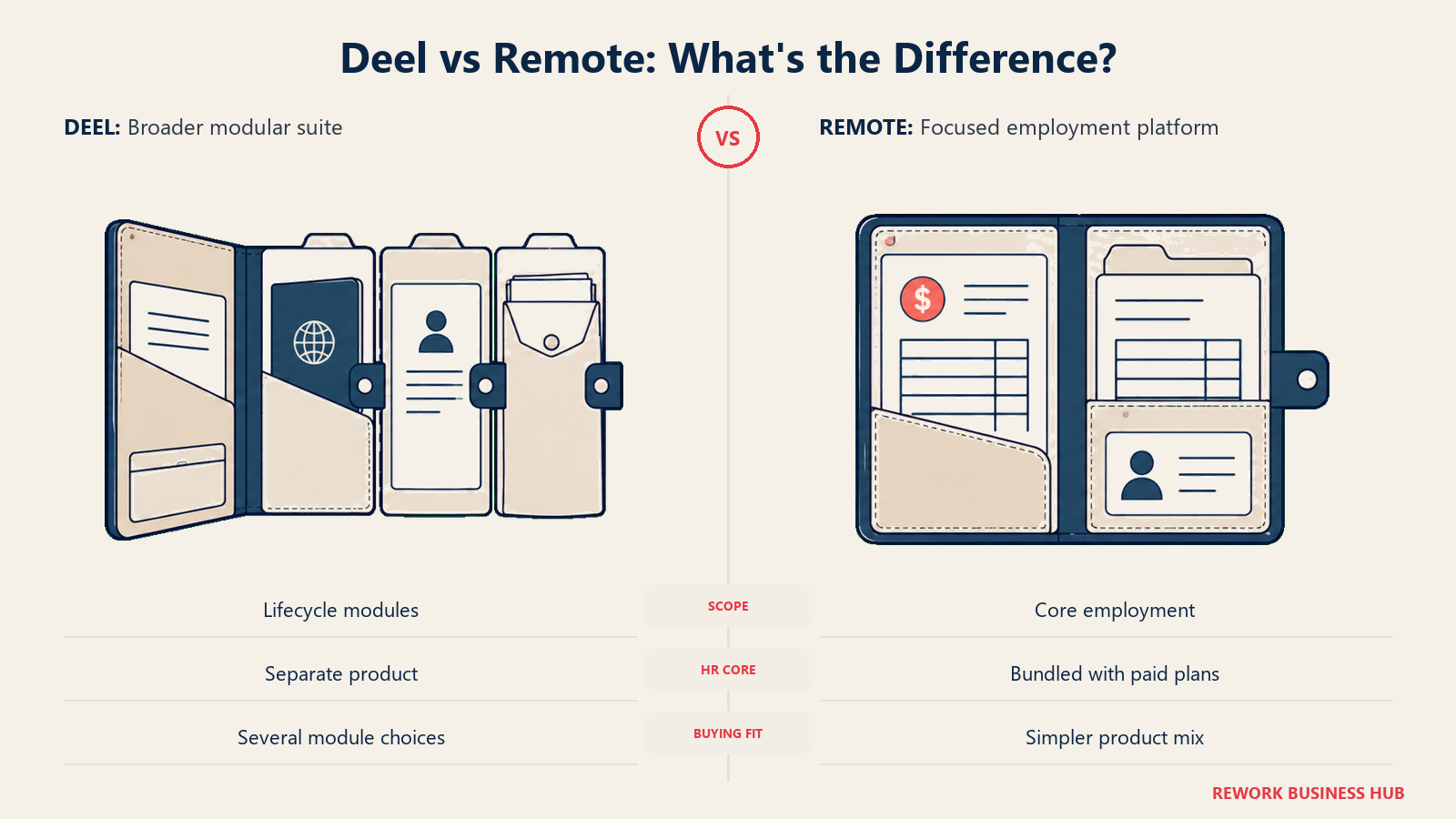
Remote, also founded in 2019, made the opposite bet: own the legal entity everywhere it operates rather than lean on local partners, and keep the product surface simpler. Its pricing page lists six core products (EOR, Global Payroll, Contractor Management, Contractor Management Plus, Contractor of Record, PEO) plus Equity, bundling a baseline HR Core module free with any of them. The tradeoff is coverage: Remote's owned-entity footprint runs to roughly 90 countries, smaller than Deel's blended 150-country claim.
| Deel | Remote | |
|---|---|---|
| Natural buying trigger | Want EOR, contractor payments, US PEO, HR, and immigration handled by one vendor | Want the cleanest legal chain (no local partner) in markets Remote already owns |
| Team maturity assumed | Comfortable managing several product tiers across HR, Talent, and Immigration | Wants EOR, payroll, and contractors to work the same way everywhere |
| Primary champion | Head of People or COO wanting one system of record | Head of People or Legal counsel prioritizing entity ownership |
| Company profile that fits best | Fast-growing teams that will need HR, immigration, and recruiting eventually | First 1 to 25 international hires, wanting predictable per-seat cost |
Neither platform is chasing the enterprise buyer that needs 180-plus country coverage and a dedicated account team; that segment sits closer to Globalization Partners. The real split here is module breadth against entity purity, not company size.
Key Facts
- Deel's own State of Global Hiring Report 2026, analyzing over a million worker contracts across 37,000-plus companies in 150-plus countries, found AI trainer roles grew 283% in cross-border hiring in 2025, the fastest growth of any tracked role.
- California's Labor Code Section 226.8 sets civil penalties of $5,000 to $15,000 per violation for willful worker misclassification, rising to $10,000 to $25,000 per violation for a pattern or practice, per the California Legislative Information site.
- Misclassifying a worker exposes the employer to liability for that worker's employment taxes, and the worker can file Form 8919 to report their own uncollected Social Security and Medicare share, per the IRS.
- Deel says it owns entities and runs its payroll engine directly in 130-plus countries within a broader 150-plus country EOR footprint, per Deel's own EOR page.
- Remote says it owns 100% of its legal entities with no local outsourcing partners across the 90-plus countries where it offers EOR, per Remote's own EOR page.
EOR Coverage and Owned-Entity Footprint
This section decides everything else, because "employer of record" only means what it claims to mean if the vendor actually owns the entity doing the employing. A partner-reliant EOR adds a second company to your compliance chain: not automatically a problem, but a longer chain to trust.
Deel's own language is that it "owns entities and payroll engine in 130+ countries" inside a wider 150-plus country EOR claim, meaning 20 to 30 markets run through local partners. Deel does not publish a country-by-country breakdown, so if a specific market matters, get written confirmation from sales before you sign.
Remote's structure is simpler: 100% owned entities, in its words "no handoffs to third-parties," across roughly 90 countries. That's a smaller footprint than Deel's blended number, but every country on the list is the same kind of entity, which matters if your legal team wants one answer instead of "it depends which country."
| Capability | Deel | Remote |
|---|---|---|
| Total EOR country claim | 150+ countries | 90+ countries |
| Owned-entity country claim | 130+ countries (payroll engine + entity) | 90+ countries, stated as 100% owned |
| Local partner reliance | Yes, for the gap between 130+ and 150+ | No, by Remote's own claim |
| Country-level entity transparency | Not published; confirm markets with sales | Simpler by design, the claim covers the full list |
| Native payroll engine | Live in 50+ markets, per third-party reporting; confirm with sales | Owned infrastructure in every market it lists |
If your hiring plan is concentrated in countries both vendors own outright (the US, UK, Canada, most of Western Europe, much of Latin America), the entity question mostly washes out and price becomes the deciding factor. Hiring somewhere less common, get written confirmation of entity status before you compare price at all.
Contractor Management and Misclassification Risk
Paying a contractor and employing someone are legally different acts, and the gap between them is where most global hiring risk lives. Both platforms sell products mapped to different risk postures, and the mistake most buyers make is defaulting to the cheapest one regardless of what the working relationship actually looks like.
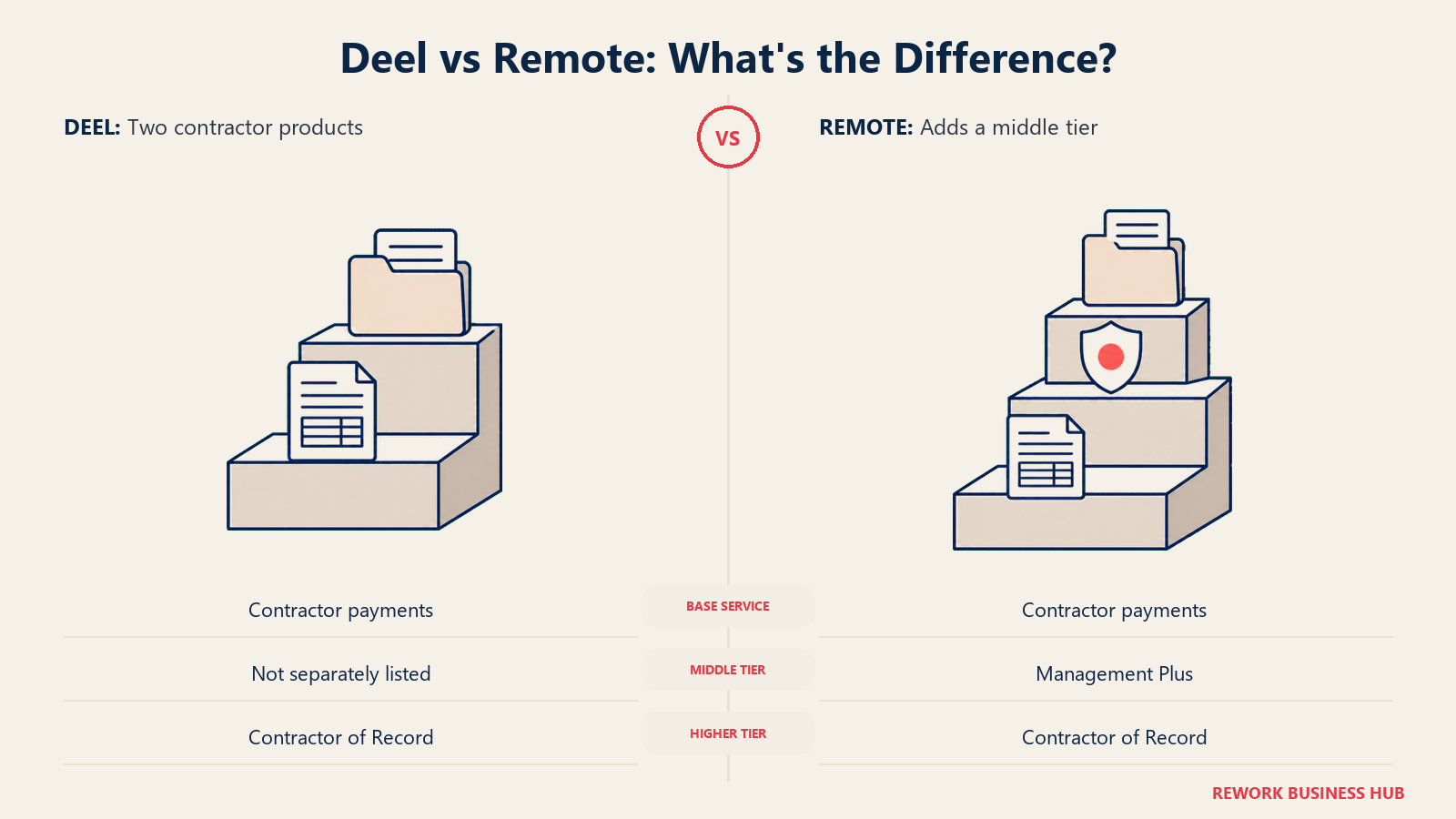
Deel's ladder has two rungs: Contractor Management at $49/contractor/month handles payments, invoicing, and basic classification guidance; Contractor of Record at $325/contractor/month has Deel itself become the contractor's legal counterparty to absorb misclassification exposure.
Remote's ladder has three rungs, more useful if your risk tolerance sits between "just pay the invoice" and "fully transfer the risk." Contractor Management at $29/contractor/month is the base tier. Contractor Management Plus at $99/contractor/month adds indemnity up to $100,000 per contractor, a middle option Deel doesn't publish. Contractor of Record, from $325/contractor/month, matches Deel's price but adds uncapped indemnity and Remote's IP Guard tool.
| Capability | Deel | Remote |
|---|---|---|
| Base contractor payments tier | $49/contractor/month | $29/contractor/month |
| Mid-tier indemnity option | Not published as a separate tier | $99/contractor/month, Contractor Management Plus, $100,000 cap |
| Full misclassification risk transfer (Contractor of Record) | $325/contractor/month | From $325/contractor/month |
| Indemnity cap at CoR tier | Not separately quantified | Uncapped, per Remote's own claim |
| IP assignment tooling | General contract-level clauses | Named "IP Guard" tool, including moral-rights waivers where permitted |
The practical read: for a handful of genuine freelancers doing project work, either base tier is fine and Remote is cheaper per head. If someone is working full-time hours on your systems for months, using your equipment, and taking direction like an employee, that's a misclassification-shaped relationship regardless of what the contract says, and the Contractor of Record tier on either platform exists to convert that risk into a fixed monthly line item instead of an open-ended one.
Global Payroll
Global Payroll is the product for a country where you already have a legal entity and just need payroll run correctly against local tax and labor rules. It is not the same purchase as EOR, and conflating the two is the single most common pricing mistake in this category: own the entity, and Global Payroll should cost a fraction of EOR; don't, and it can't legally do EOR's job.
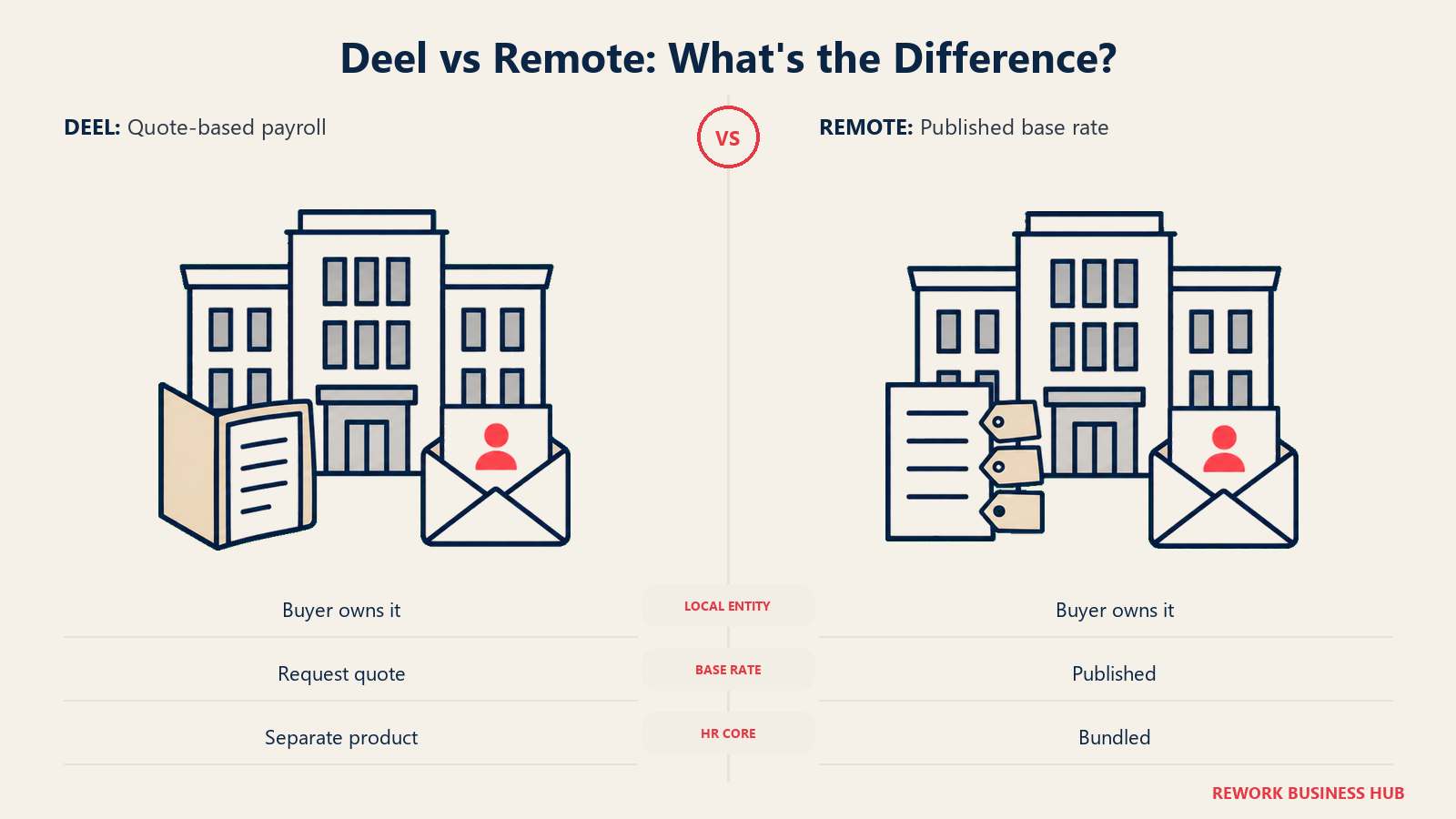
Remote publishes Global Payroll at $29/employee/month, plus an implementation fee for entity setup and a recurring delivery fee, and covers HR Core as part of the purchase.
Deel does not publish a per-employee rate on its own Global Payroll product page; pricing there is quote-based, citing "$20B+ compliantly processed" and 150-plus country coverage but no public number. Some resellers report a figure near $29/employee/month plus a roughly $1,000 per-entity implementation fee, but that isn't confirmed on deel.com, so treat it as reported, not verified, until your own quote confirms it.
| Capability | Deel | Remote |
|---|---|---|
| Published per-employee price | Not published, quote-based | $29/employee/month |
| Implementation fee | Not published | Per-entity implementation fee applies, amount confirmed at quote |
| Requires the buyer to own the local entity | Yes | Yes |
| HR module included | Separate purchase (Deel HR, from $5/employee/month) | HR Core bundled at no extra charge |
| Country coverage claim | 150+ countries | Runs alongside Remote's 90+ owned-entity footprint |
If your near-term plan is "own entities in a handful of countries, just need clean local payroll," get an itemized Deel quote before assuming it beats Remote's published $29 rate. Remote currently gives you price transparency before a sales call and Deel doesn't. Our guide to choosing global payroll software walks through the EOR-versus-payroll decision in more depth.
US Payroll and US PEO
If your headcount question is really about the US, the math changes, because you likely already have a US entity and don't need EOR at all.
Deel's US PEO is $125/employee/month, a co-employment model running through Deel's existing US entity, with benefits access alongside payroll and HR. Remote's PEO starts from $99/employee/month, billed in USD, requiring a US bank account, covering all 50 states with payroll, compliance, and group benefits.
Both cost more than a dedicated US payroll or PEO specialist. Justworks, fetched from its own pricing page, charges $79/employee/month for PEO Basic and $124 for PEO Plus, putting Remote's entry point near Justworks Basic and Deel's closer to Plus. If your hiring is 100% domestic, run the comparison against dedicated US platforms before defaulting to whichever global EOR vendor handles your international hires; our best payroll software roundup and best Paychex alternatives guide cover that domestic-first comparison directly.
| Capability | Deel | Remote | For reference: Justworks |
|---|---|---|---|
| US PEO price | $125/employee/month | From $99/employee/month | $79 (Basic) to $124 (Plus) |
| Requires existing US entity | Yes | Yes | Yes |
| Benefits access included | Yes | Yes | Yes, tier-dependent |
| Bundled with international EOR platform | Yes, one login | Yes, one login | No, US-only |
The one-login argument is real if you're already running international EOR through either vendor and want US headcount in the same system. If US payroll is your whole problem, a domestic specialist usually wins on price; our guide to choosing payroll software and best PEO services roundup are better starting points for that narrower search.
HRIS, Immigration, and Equity Add-Ons
This is where "which platform is broader" stops being a marketing claim and becomes a real line item, and where an outdated claim about either vendor is most likely to cost you money if you don't check the current page.
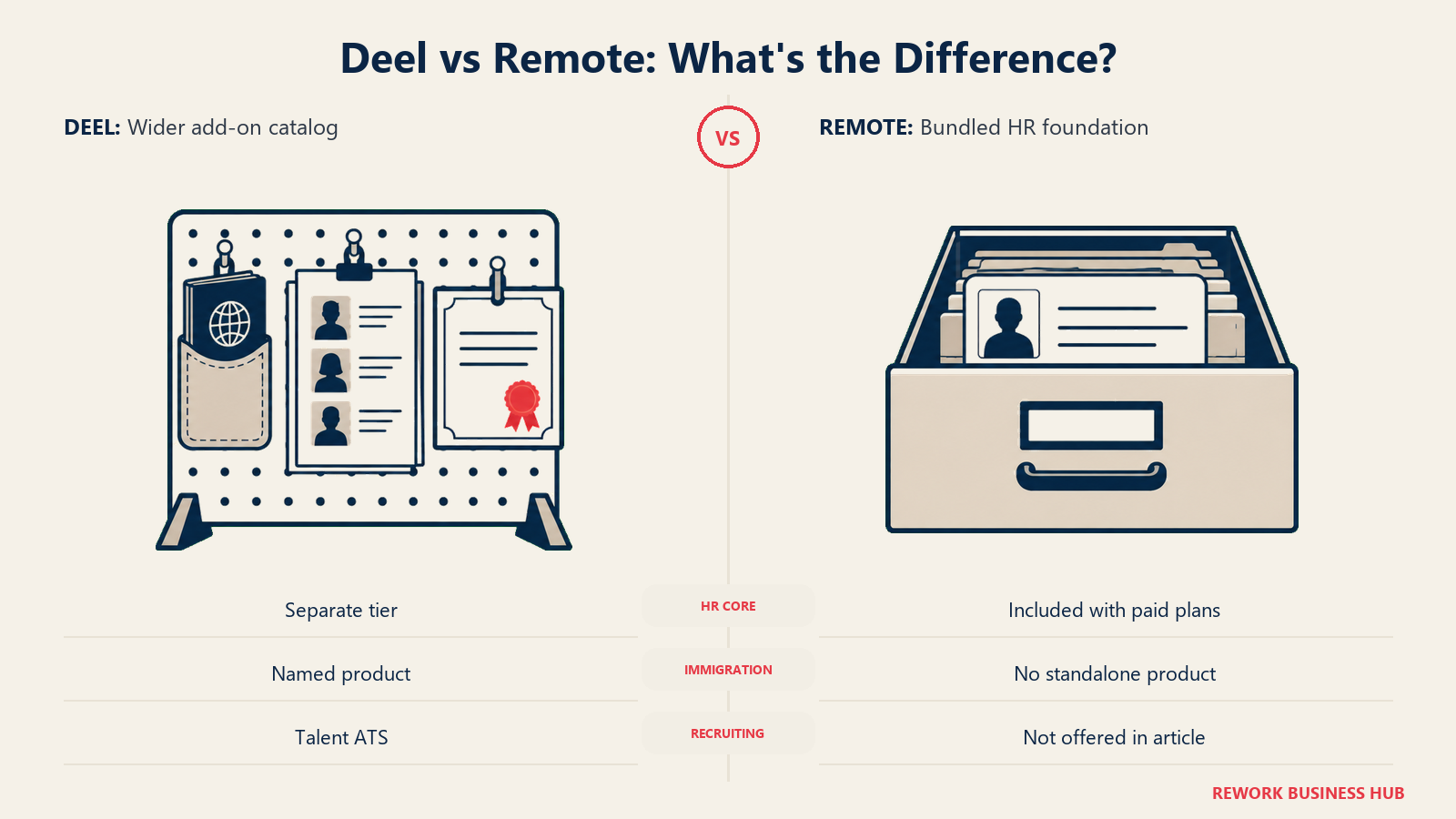
HRIS. Deel HR is not free. Its Core tier starts at $5/employee/month and includes worker profiles, org charts, time off, job architecture, workflows, and people analytics, with Advanced and Elite tiers priced separately. Remote takes the opposite approach: HR Core (employee records, document management, time off, org charts, compliance tools) is bundled free with any paid employment product, per Remote's own pricing page. Buying EOR or payroll from Remote, HR costs nothing extra. Buying the same from Deel, budget $5/employee/month on top.
Immigration. Deel Immigration covers visa sponsorship in 70-plus countries, per Deel's own immigration page, with a $250 right-to-work fee plus a custom monthly fee once a visa is active. Remote sells no named standalone immigration product; where offered, visa support runs through its general EOR compliance team. If sponsoring visas is part of your plan, Deel has the dedicated product.
Equity. Remote publishes Equity from $39/month flat (not per employee), covering tax handling, compliance documentation, and equity analytics for Delaware C-Corp employees, EOR workers, and contractors. Deel entered equity management through its 2023 Capbase acquisition but doesn't publish a price; it's a custom quote.
| Add-on | Deel | Remote |
|---|---|---|
| HR / HRIS | From $5/employee/month, Core tier, not free | Bundled free with any paid employment product |
| Immigration | 70+ countries, $250 right-to-work fee plus custom monthly fee | Not a named standalone product |
| Equity / cap table management | Custom quote, via 2023 Capbase acquisition | From $39/month flat |
| Recruiting / ATS | Talent, $14/worker/month | Not offered |
| Published pricing transparency across add-ons | Partial, HR and Immigration pricing require a quote for full detail | Higher, most add-ons list a public starting number |
If you want every stage of the employment lifecycle, sourcing through equity grants, in one system, Deel is the more complete platform today. If you'd rather see a number before you talk to sales, Remote publishes more of them. Our guide to choosing HR software for a small business and best HR software roundup cover the HRIS layer in more depth than either vendor's own pricing page does.
Compliance and IP Protection
Both platforms sell compliance as the core reason to use an EOR instead of just wiring money abroad, and both back it with real contractual language, but the emphasis differs.
Deel's public claim is broad: "the strongest intellectual property protection clauses built into our contracts," ensuring IP passes to the customer, plus access to "200+ legal experts" monitoring regulatory change.
Remote's claim is narrower: a named tool, IP Guard, providing "automatic protection of your company's IP in every country," including moral-rights waivers where those apply, backed by unlimited EOR indemnity with, in Remote's words, "no caps, no hidden disclaimers."
| Capability | Deel | Remote |
|---|---|---|
| IP assignment approach | Contract-level clauses across markets | Named tool (IP Guard), including moral-rights waivers where permitted |
| Legal / compliance team size claim | 200+ legal experts | In-house legal team, "Compliance Watchtower" across 90+ countries |
| EOR indemnity | Not separately quantified as "unlimited" | Unlimited indemnity coverage, per Remote's own claim |
| Where to verify before signing | Specific contract language for your hire's country | Specific contract language for your hire's country |
Neither claim should be taken at face value for a specific country without asking your own counsel, or Deel's or Remote's legal team, to confirm the contract terms that apply where you're hiring. Marketing language about "unlimited indemnity" and "strongest IP protection" is not the same as the indemnification clause in the agreement you'll actually sign.
Onboarding Speed
Speed to first paycheck matters when a candidate has a start date and you're racing a competing offer, but the published numbers deserve a second look before repeating them to a hiring manager.
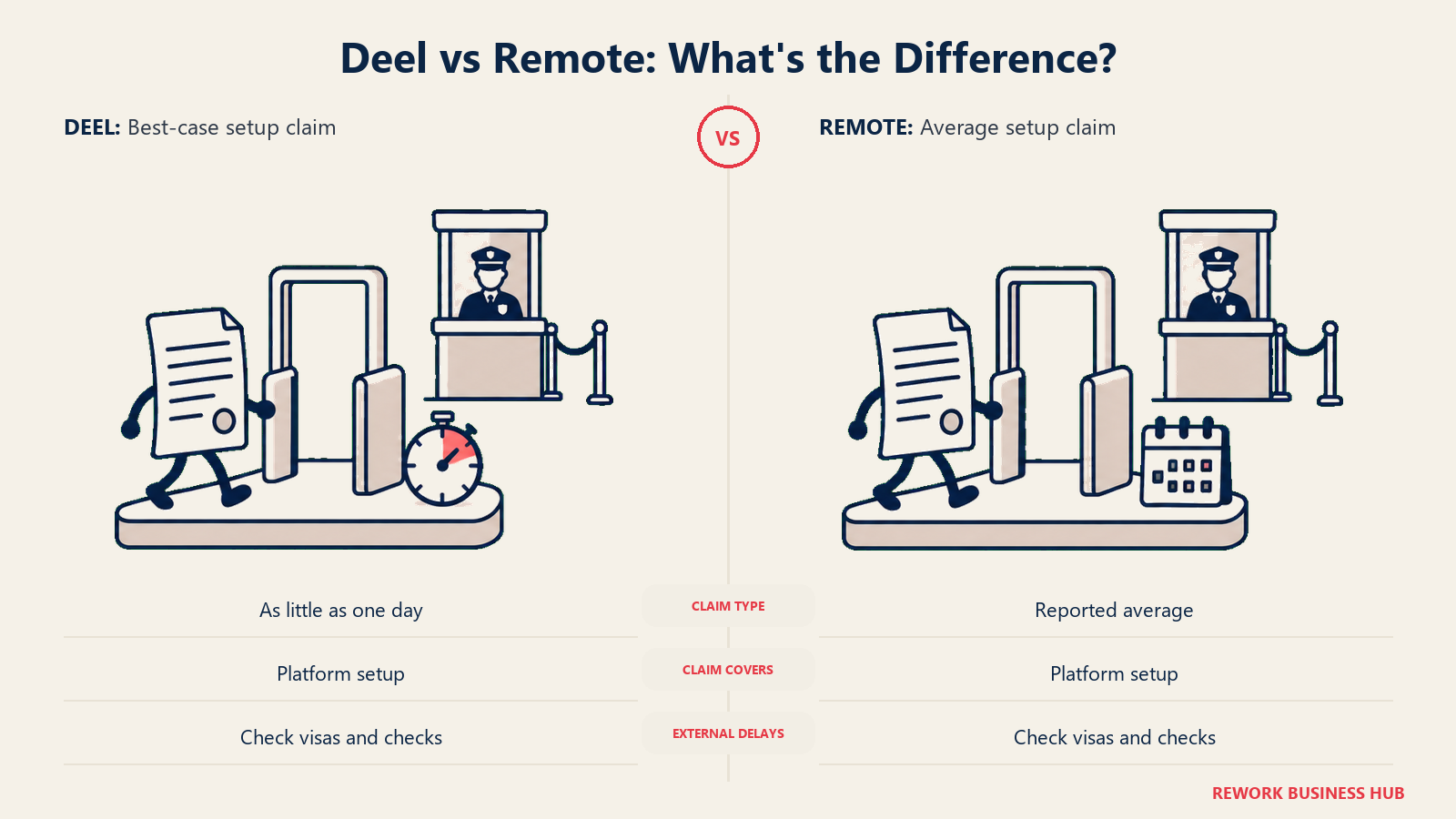
Deel claims it can onboard a new EOR employee "in as little as one day." Remote claims a "2-day average," footnoted with the assumption: "standard onboarding may take 30 days and Remote's average onboarding time is 2.3 days." Both describe platform mechanics (contract generation, document collection, payroll setup) rather than the parts neither vendor controls: work permit processing, background checks, or a slow-moving candidate.
| Claim | Deel | Remote |
|---|---|---|
| Headline onboarding claim | "As little as one day" | 2.3-day average (rounded to "2-day" in marketing copy) |
| What the claim covers | Platform-side contract and setup steps | Platform-side contract and setup steps |
| Dedicated onboarding support | Dedicated onboarding manager | Named CSM, structured five-step process |
| Realistic floor with visas or background checks | Days to weeks, market-dependent | Days to weeks, market-dependent |
Treat both numbers as best-case, platform-only figures. For a straightforward hire in a country either vendor owns outright, with no visa requirement, both can plausibly get someone paid within the first week. For anything requiring immigration support, that section, not the onboarding claim, sets your real timeline.
Support Model
Deel positions support as always-on: "24/7 help across continents in your language and time zone," plus a dedicated onboarding manager. Remote's public page describes a structured five-step onboarding process anchored by a named Customer Success Manager, but doesn't publish a 24/7 claim or a formal response-time SLA the way Deel does.
| Capability | Deel | Remote |
|---|---|---|
| 24/7 support claim | Yes, explicitly stated | Not published |
| Dedicated onboarding contact | Dedicated onboarding manager | Named Customer Success Manager |
| Structured onboarding process | Described generally | Named five-step process |
If a documented, always-on support commitment is a procurement requirement, get it in writing from either vendor rather than relying on the marketing page, since only Deel's public copy makes an explicit 24/7 claim.
Platform Breadth vs Depth
Step back from any single feature and the real strategic difference is breadth against depth. Deel has spent since 2019 layering products onto its contractor-payments core: EOR, US PEO, a full HRIS, immigration, equity, and an ATS, each priced and sold somewhat independently. That's an advantage if you'll eventually need most of those modules and would rather manage one vendor than five, and a disadvantage if you only need EOR.
Remote has stayed narrower on purpose: EOR, Global Payroll, contractor management at three risk tiers, PEO, and Equity, with HR Core bundled rather than sold separately. Fewer modules means fewer pricing decisions and, in most scenarios below, a lower total bill for teams that only need employment and payroll, not the full HR stack.
| Dimension | Deel | Remote |
|---|---|---|
| Number of distinct paid products | 8+ (Contractor Mgmt, CoR, EOR, US PEO, HR, Immigration, Equity, Talent/ATS) | 6 (EOR, Global Payroll, Contractor Mgmt, Contractor Mgmt Plus, CoR, PEO), plus Equity, with HR Core bundled |
| Pricing transparency across the full catalog | Partial, HR/Immigration/Equity/Global Payroll require a quote | Higher, most products list a public number |
| Best fit | Teams that want one vendor across the full employment lifecycle | Teams that want EOR, payroll, and contractors handled well, without buying a full HR suite alongside it |
Real Cost at Realistic Mixes
Sticker prices per seat don't tell you what your bill looks like once headcount is a mix of contractors and EOR employees across several countries. Here's the math at four mixes founders and People leads actually face.
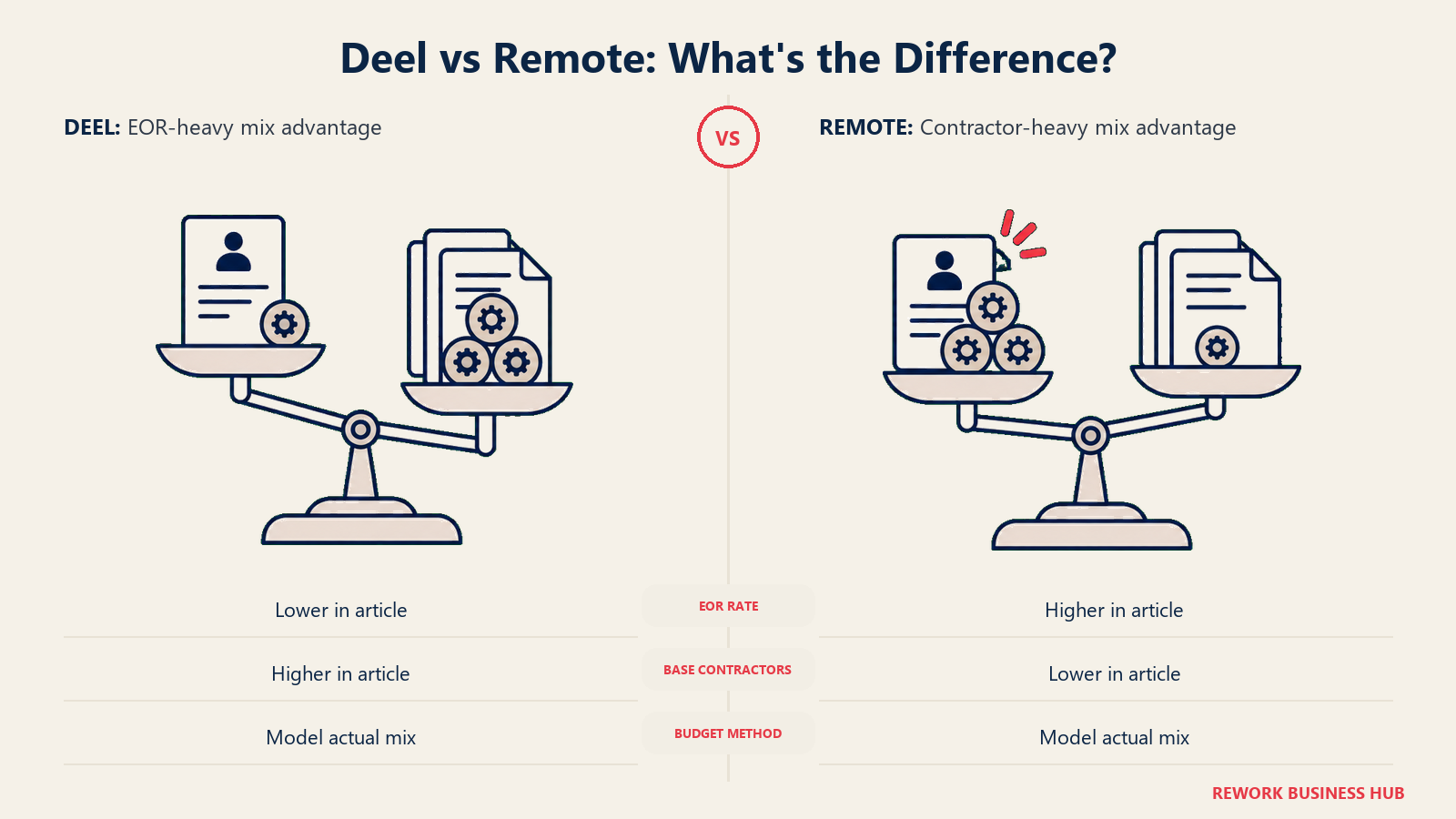
One note first: EOR pricing ($599 to $699/employee/month) only applies where you have no local entity. Already own an entity somewhere? The right product is Global Payroll ($29/employee/month on Remote, quote-based on Deel), a fraction of the EOR price. Mixing the two up is the fastest way to overpay.
| Scenario | Deel | Remote | What's driving the gap |
|---|---|---|---|
| 3 contractors, base Contractor Management | 3 × $49 = $147/mo, $1,764/yr | 3 × $29 = $87/mo, $1,044/yr | Remote's base contractor rate is $20/head cheaper |
| 1 EOR employee + 5 contractors | $599 + (5 × $49) = $844/mo, $10,128/yr | $699 + (5 × $29) = $844/mo, $10,128/yr | The bills land on the exact same number: Deel's cheaper EOR seat offsets Remote's cheaper contractor rate at this mix |
| 10 EOR employees, no contractors | 10 × $599 = $5,990/mo, $71,880/yr | 10 × $699 = $6,990/mo, $83,880/yr | Remote costs $1,000/mo, $12,000/yr more at this headcount |
| 25 employees across 5 countries, no local entity yet (EOR) | 25 × $599 = $14,975/mo, $179,700/yr | 25 × $699 = $17,475/mo, $209,700/yr | Remote costs $2,500/mo, $30,000/yr more; if you already hold an entity in some of those 5 countries, move those seats to Global Payroll instead and the total drops sharply |
The pattern that matters more than any single row: Deel's EOR stays $100/employee/month cheaper than Remote's, so the gap widens in dollar terms as EOR headcount grows, while Remote's contractor pricing stays cheaper per head, so a contractor-heavy mix favors Remote. A blended team, like the 1 EOR plus 5 contractor row above, can land on identical totals almost by coincidence. Run your own mix through both rate cards; "it depends" is the accurate answer here, not a dodge.
Who Should Pick Deel
- You want EOR, US PEO, HR, immigration, equity, and recruiting under one vendor, and you're comfortable pricing each module separately
- Your hiring plan includes visa sponsorship, and you want a dedicated, named immigration product rather than general compliance support
- Your EOR headcount will scale into the double digits, where Deel's $100/employee/month lower EOR rate compounds into real savings
- You're fine with some markets running through a local partner instead of a Deel-owned entity, as long as you confirm the country in writing first
Who Should Pick Remote
- Entity ownership is a hard requirement for legal or finance, and you want every country on the list to be the same kind of structure
- Your contractor roster outnumbers your EOR headcount, where Remote's lower per-contractor rate adds up faster than its EOR premium does
- You want a mid-tier, capped indemnity option ($99/contractor/month, $100,000) between "just pay the invoice" and the full $325 Contractor of Record commitment
- You want HR Core included free the moment you buy EOR, payroll, or contractor management, rather than a separate line item
If Neither Fits
Some teams read through both platforms and realize their actual problem is narrower or wider than what either one solves best.
If your real need is US-only PEO, Justworks is worth pricing against both vendors' PEO tiers, and our best Justworks alternatives guide covers that narrower category. If the actual friction is HR, IT, and finance data living in different systems, Rippling competes with both on EOR but built its case around unifying HR and IT instead; our best Rippling alternatives guide covers that angle.
For a lower published EOR price, smaller providers like Oyster HR and Multiplier are worth a look, though fetch their current pricing yourself rather than trust a third-party estimate. For enterprise-scale coverage (180-plus countries, dedicated account management), Globalization Partners and Velocity Global sit a tier up in price and company size served. If your hiring is purely domestic, skip EOR entirely; our Gusto vs ADP comparison and best payroll software roundup are more direct starting points.
Decision Framework
| If you are... | Pick |
|---|---|
| Wanting one vendor for EOR, PEO, HR, immigration, and recruiting | Deel |
| Sponsoring work visas as part of your hiring plan | Deel |
| Scaling EOR headcount into the double digits | Deel, for the lower per-seat EOR rate |
| Requiring 100% owned-entity compliance with no partner handoffs | Remote |
| Running a contractor-heavy roster with a handful of EOR hires | Remote |
| Wanting a mid-tier, capped indemnity option for contractors | Remote, via Contractor Management Plus |
| Needing HR included at no extra charge with your EOR purchase | Remote |
| US-only, no international hiring planned | Compare directly against Justworks or a dedicated PEO, not Deel or Remote |
| Needing 180-plus country coverage and enterprise account management | Globalization Partners or Velocity Global |
| Still comparing the wider payroll category before narrowing down | See our full payroll software roundup |
The verdict: want one platform covering the entire employment lifecycle, sourcing through equity, and building EOR headcount past a handful of employees? Deel's lower EOR rate and wider module set save more money and vendor-management time as you scale. Want a clean, fully owned-entity compliance chain more than breadth, with a contractor-heavy team? Remote is the cheaper, simpler platform, and its bundled HR Core removes a line item Deel charges for separately.
What to Do Next
- Map your actual mix first. Count your contractors, your EOR-needed hires, and any country where you already hold an entity, since that last group belongs on Global Payroll, not EOR.
- Confirm entity status for your specific countries in writing. Both owned-entity claims leave gaps; get the exact country confirmed by sales before you compare price.
- Price out the full module set you'll actually need, not just EOR. If HR, immigration, or equity are on your roadmap this year, get real quotes before comparing headline EOR numbers.
- Run the cost table above against your own headcount, since the crossover point between Deel and Remote depends entirely on your contractor-to-EOR ratio.
- Not sure global EOR is the right layer at all? If US-only, see our best payroll software roundup; if the real gap is domestic HR software, our guide to choosing HR software for a small business is the better next stop.
Frequently Asked Questions about Deel vs Remote
Is Deel or Remote cheaper?
It depends on your mix. Deel's EOR is $100/employee/month cheaper than Remote's ($599 versus $699). Remote's base contractor rate is $20/contractor/month cheaper than Deel's ($29 versus $49). At a mix of 1 EOR employee plus 5 contractors, both vendors land on the exact same monthly total, $844. Run your own headcount through both rate cards rather than assuming either is cheaper across the board.
Does Deel or Remote own its entities, or rely on local partners?
Remote states it owns 100% of its entities with no local partner handoffs, across roughly 90 countries. Deel owns entities and its payroll engine in 130-plus countries within a broader 150-plus country EOR claim, so a portion of its coverage runs through local partners. Neither publishes a full country-by-country breakdown, so confirm your specific target countries with sales.
Is Deel HR or Remote HR free?
Remote's HR Core is bundled free with any paid Remote employment product. Deel HR is not free: its Core tier starts at $5/employee/month, with Advanced and Elite tiers priced separately and not published on Deel's main pricing page.
Which platform offers better misclassification protection for contractors?
Both offer a Contractor of Record product starting around $325/contractor/month that transfers misclassification risk to the platform. Remote also sells a middle tier, Contractor Management Plus at $99/contractor/month, adding $100,000 in indemnity per contractor, a mid-point Deel doesn't publish an equivalent for. Deel's base tier includes classification guidance but not a quantified indemnity cap.
What is the difference between EOR and Global Payroll?
EOR is for hiring someone in a country where you have no legal entity; the vendor becomes the legal employer on your behalf. Global Payroll is for a country where you already own the entity and just need payroll run correctly against local law. It costs a fraction of EOR (Remote publishes $29/employee/month versus $699 for EOR) because it doesn't carry the same legal-employer liability.
Does either platform sponsor work visas?
Deel has a named Immigration product covering visa sponsorship in 70-plus countries, with a $250 right-to-work fee plus a custom-quoted monthly fee once a visa is active. Remote does not publish a standalone immigration product; where offered, visa support runs through its general EOR compliance team.
What if I only need US payroll, not international hiring?
Neither is the strongest fit if your hiring is purely domestic. Both PEO products (Deel at $125/employee/month, Remote from $99) cost more than dedicated US PEO or payroll specialists; compare against Justworks or a domestic payroll platform before defaulting to a global EOR vendor for a problem that doesn't require one.
Related Resources:
- Best Payroll Software in 2026
- Best Paychex Alternatives in 2026
- Best Paycom Alternatives in 2026
- Best Justworks Alternatives in 2026
- Best PEO Services in 2026
- Gusto vs ADP
- How to Choose Global Payroll Software
- How to Choose Payroll Software
- How to Choose HR Software for a Small Business
- Best Deel Alternatives in 2026
- Best Rippling Alternatives in 2026
- Best HR Software in 2026

Principal Product Marketing Strategist
On this page
- TL;DR
- Who Each Platform Is Built For
- Key Facts
- EOR Coverage and Owned-Entity Footprint
- Contractor Management and Misclassification Risk
- Global Payroll
- US Payroll and US PEO
- HRIS, Immigration, and Equity Add-Ons
- Compliance and IP Protection
- Onboarding Speed
- Support Model
- Platform Breadth vs Depth
- Real Cost at Realistic Mixes
- Who Should Pick Deel
- Who Should Pick Remote
- If Neither Fits
- Decision Framework
- What to Do Next