Best Deel Alternatives in 2026: 9 Global HR and Payroll Platforms for Distributed Teams
Turn this article into takeaways for your work.


Each assistant summarizes the article only for you and suggests best practices for your work.
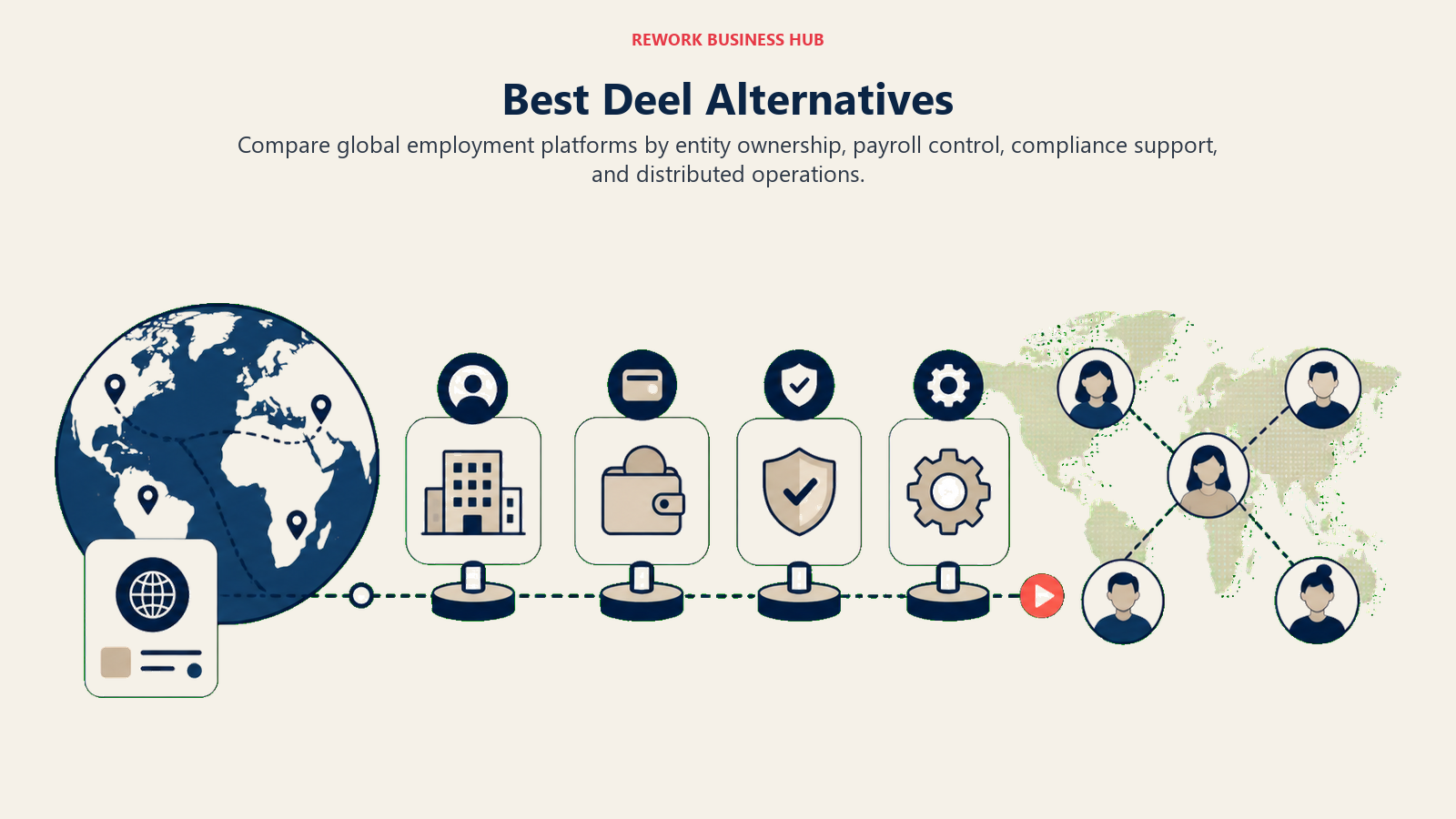
The best Deel alternatives in 2026 are Remote.com and Oyster HR for clean owned-entity EOR, Multiplier for fast APAC hiring, Skuad for the lowest EOR price, and Rippling for HR plus IT consolidation. The right choice depends on your headcount countries, budget, and whether your real problem is payroll or internal operations. This guide compares 9 platforms by price, coverage, and fit.
Deel is genuinely impressive at what it was built for: hiring contractors and employees across 150+ countries without setting up local entities. If your company is scaling fast across borders, Deel removes a real obstacle. But a growing number of HR ops leaders and COOs report the same friction points after six to eighteen months on the platform: aggressive upselling cycles, EOR margin variability that surprises finance teams, support response times that don't match contract complexity, and an HRIS module (Deel HR) that's still catching up to dedicated people-ops tools.
If you're not yet sure whether Deel's global payroll is what you actually need, it's worth reading the best BambooHR alternatives first; that guide covers the full HRIS decision, with Deel positioned clearly for what it does and doesn't replace.
If you're a team of 10 to 1,000 people managing a distributed workforce and you're re-evaluating your global HR stack, this guide is for you. We've assessed 9 platforms on methodology, pricing transparency, target audience fit, and what they genuinely do better (or worse) than Deel. No vendor-speak, just the tradeoffs.
Quick Comparison Table
| Tool | Best For | Starting Price | Key Strength | Key Limitation |
|---|---|---|---|---|
| Remote.com | Full-stack EOR + payroll, owned entities | $299/mo per employee (EOR) | Fully owned entities in 180+ countries | Expensive for small headcounts |
| Oyster HR | SMB-friendly EOR with transparent pricing | $399/mo per employee (EOR) | Pricing clarity, strong onboarding UX | Fewer owned entities than Remote |
| Papaya Global | Enterprise payroll intelligence + analytics | Custom pricing | Payroll data consolidation across countries | Steep learning curve for smaller teams |
| Rippling | All-in-one HR + IT + Finance platform | No public price; $8/user/mo reported | Unified device + HR + payroll management | Complexity overkill for lean teams |
| Gusto | US-focused payroll + benefits | $49/mo + $6/user | Best-in-class US payroll UX | Limited international payroll support |
| Multiplier | EOR + contractor management for growth-stage teams | $300/mo per employee (EOR) | Fast onboarding, strong Asia-Pacific coverage | Newer platform, fewer native integrations |
| Velocity Global | Enterprise EOR with legal advisory depth | Custom pricing | Deep legal compliance expertise | Not self-serve, requires sales engagement |
| Globalization Partners (G-P) | Enterprise EOR, 15+ years track record | Custom pricing | Longest track record in EOR market | High cost, slower product iteration |
| Skuad | Budget-conscious EOR + contractor payments | $199/mo per employee (EOR) | Lowest EOR price point, fast deployment | Less mature compliance tooling |
Why Teams Leave Deel
Before evaluating alternatives, it's worth naming what's actually driving the switch. Not generic complaints, but the specific friction that comes up repeatedly.
Aggressive upselling cadence. Deel packages features into add-on modules (Deel Advance, Deel HR, Deel Equity) that require separate contracts. Teams report regular outreach to upgrade tiers they didn't initially need.
EOR margin variability. Deel's pricing varies by country and isn't always transparent upfront. Finance teams managing multi-country headcounts sometimes find the total cost of employment significantly higher than quoted.
Support inconsistency. Complex situations (immigration-linked employment, mid-year equity events, country-specific compliance questions) can hit slow response queues. For most standard use cases, support is adequate. For edge cases, it's a risk.
Contract management complexity. Managing a mix of contractors, EOR employees, and direct employees in Deel requires navigating separate contract workflows that don't always integrate cleanly.
Deel HR still maturing. The HRIS module added in 2023-2024 covers basics but lacks depth in performance management, organizational design, and career pathing that teams need as headcount grows past 50.
Stage Fit Matrix
| Company Stage | Best Options | Why |
|---|---|---|
| Pre-PMF (1-10 people) | Skuad, Gusto (US) | Low cost, low complexity |
| Early growth (10-50 people) | Oyster HR, Multiplier, Remote.com | EOR + clean onboarding, no enterprise overhead |
| Scaling (50-200 people) | Remote.com, Rippling, Multiplier | Deeper automation, multi-country coverage |
| Mid-market (200-500 people) | Rippling, Papaya Global, Velocity Global | Platform consolidation, payroll analytics |
| Enterprise (500+ people) | G-P, Velocity Global, Papaya Global | Legal depth, dedicated CSM, compliance SLAs |
Team Size and Buyer Persona Table
| Tool | Team Size Sweet Spot | Primary Buyer | Secondary Buyer |
|---|---|---|---|
| Remote.com | 20-500 | VP People, HR Ops | Finance, Legal |
| Oyster HR | 10-200 | HR Manager, Founder | COO |
| Papaya Global | 200-2000 | VP People, CHRO | Finance, Payroll Manager |
| Rippling | 50-1000 | IT + HR jointly | COO, CFO |
| Gusto | 1-200 (US) | Founder, HR Manager | CFO |
| Multiplier | 20-300 | HR Ops, Talent Lead | COO |
| Velocity Global | 100-2000 | VP People, Legal | CFO |
| G-P | 200+ | CHRO, Legal Counsel | CFO |
| Skuad | 5-100 | Founder, HR Manager | COO |
1. Remote.com: Full-Stack EOR With Fully Owned Entities
Remote.com's core differentiator is entity ownership. Most EOR providers (including Deel in some countries) rely on local partners and aggregator networks to employ workers. Remote operates its own legal entities in 180+ countries, which means the compliance chain is shorter and accountability is clearer.
Their philosophy is "own the whole stack." Employment contracts, payroll processing, benefits sourcing, IP protection, and tax filing all happen within Remote's infrastructure. For companies that have had a bad experience with a partner-reliant EOR, this matters a great deal.
Remote is best for growth-stage and mid-market companies (20-500 employees) that need a reliable, self-serve EOR with strong legal standing. The product UX is clean, onboarding new hires in most countries takes under a week, and their equity management tools are more mature than most competitors.
The main friction point is cost. At $299/month per EOR employee (billed annually), Remote is one of the more expensive options for small headcounts. Contractor management starts at $29/month per contractor, which is competitive.
| What you get | What you don't |
|---|---|
| Fully owned entities in 180+ countries | Budget pricing for small headcounts |
| Clean self-serve onboarding UX | Complex equity event management at scale |
| Strong IP and equipment management | Deep HRIS functionality |
| Transparent flat-rate pricing | Dedicated CSM on base tiers |
| Contractor + EOR in one platform | Native ATS integration |
Pricing: EOR from $299/mo per employee. Contractor from $29/mo.
Best for: Growth-stage companies (20-200 employees) hiring in multiple countries who want a legally clean, fully owned entity stack. Not ideal for: Teams under 10 people where the per-seat cost is prohibitive, or enterprises needing deep payroll analytics.
2. Oyster HR: SMB-Friendly EOR With Transparent Pricing
Oyster positioned itself from day one as the EOR for smaller companies that couldn't afford Globalization Partners or Velocity Global. Their bet was on pricing clarity and onboarding speed, and it's largely paid off.
Where Deel and Remote can feel enterprise-heavy in their contract structures, Oyster is designed for HR managers and founders who don't have a full-time legal team. The platform surfaces total cost of employment estimates before you commit to hiring in a new country, which eliminates the "surprise invoice" problem that plagues variable-margin EOR providers.
Oyster's methodology centers on what they call "global employment graph": a pre-built library of country-specific contract templates, benefits benchmarks, and compliance guides that non-specialists can actually use. Teams managing headcount in 15+ countries without a dedicated international HR function appreciate this kind of structured hand-holding.
The tradeoff is entity coverage. Oyster uses a mix of owned entities and vetted local partners, so in some markets the compliance chain is longer than Remote's. For most standard employment scenarios this isn't a problem. For legally complex situations (dual-status workers, equity grants in regulated markets), it warrants scrutiny.
| What you get | What you don't |
|---|---|
| Transparent total-cost-of-employment estimates | Fully owned entities in all markets |
| Strong onboarding UX for non-specialists | Advanced payroll analytics |
| Built-in benefits benchmarking by country | Deep API ecosystem |
| Contractor + employee management | Dedicated account management on base tier |
| GDPR-compliant data handling | Native performance management |
Pricing: EOR from $399/mo per employee (lower in some markets). Contractor from $29/mo.
Best for: SMBs (10-150 employees) with HR generalists rather than specialists, hiring across 5-20 countries. Not ideal for: High-complexity employment structures or enterprise teams needing dedicated legal advisory.
3. Papaya Global: Enterprise Payroll Intelligence and Analytics
Papaya Global approaches global HR from a finance and data angle rather than an employment-first one. Their core product is a payroll aggregation and analytics platform that consolidates payroll data across your existing providers, in-house payroll teams, and EOR arrangements into a single dashboard.
This is a fundamentally different product vision from Deel. Where Deel wants to be your single provider, Papaya wants to be the intelligence layer above your existing payroll infrastructure. If you're a 500-person company running payroll through five different local providers and you can't get a clean headcount report without emailing three teams, Papaya solves that.
Their EOR offering exists and is competitive, but it's not their primary value proposition. The platform shines brightest for payroll managers and CHROs at companies where the payroll data problem is bigger than the global hiring problem.
Pricing is custom and typically positions Papaya in the enterprise bracket. Teams under 100 people rarely find the ROI story compelling. Above 200 people, especially with payroll complexity across regions, the analytics value justifies the cost.
| What you get | What you don't |
|---|---|
| Unified payroll analytics across providers | Self-serve SMB pricing |
| Workforce intelligence and headcount reporting | Lightweight onboarding for small teams |
| Compliance monitoring across 160+ countries | Built-in ATS or recruiting tools |
| Payroll provider network (EOR + managed) | Strong contractor management UX |
| Bi-directional HRIS integrations | Pre-built templates for non-specialists |
Pricing: Custom. Generally $20-30/employee/month for managed payroll; EOR pricing negotiated.
Best for: Mid-market and enterprise teams (200-2000 employees) with multi-provider payroll complexity. Not ideal for: Companies under 100 people or teams whose primary need is basic EOR hiring.
4. Rippling: All-in-One HR, IT, and Finance Platform
Rippling's methodology is consolidation. They're building the operating system for the modern company: HR, IT device management, payroll, benefits, spend management, and more, all in one platform where data flows between modules without manual re-entry.
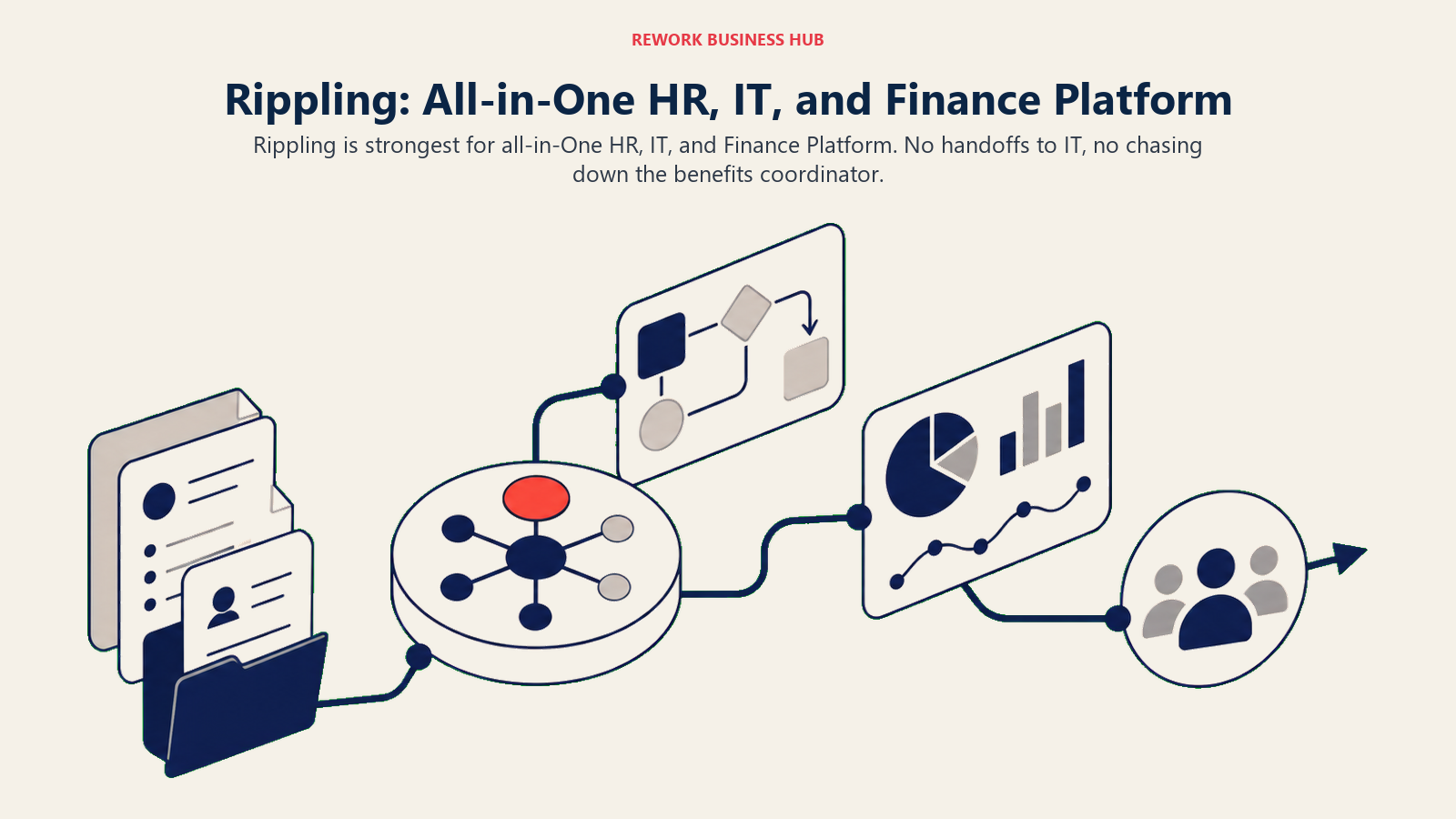
The practical effect is striking. When you onboard a new employee in Rippling, you can simultaneously set up their payroll, provision their laptop, assign their apps, enroll them in benefits, and add them to org chart, all from one workflow. No handoffs to IT, no chasing down the benefits coordinator.
Rippling competes with Deel on global payroll and EOR, but that's not its core selling point. The core selling point is that your HR data, IT data, and financial data live in the same system. For COOs managing distributed teams where HR and IT friction is a constant, this integration layer has real operational value.
Rippling is best for companies in the 50-1000 range that are willing to invest in a platform migration. It's not a drop-in replacement. The implementation is non-trivial and the module pricing stacks up. But for teams tired of reconciling data between five separate tools, the consolidation payoff is significant.
| What you get | What you don't |
|---|---|
| Unified HR + IT + payroll in one platform | Simple pricing (module cost adds up) |
| Global payroll in 50+ countries | Lightweight EOR for early-stage companies |
| Automated device management + app provisioning | Easy self-serve setup for non-technical buyers |
| Strong US payroll and benefits engine | Deep international EOR entity coverage |
| Powerful workflow automation (Rippling Automations) | Budget-friendly entry point |
Pricing: Base at $8/user/month. Global payroll, EOR, and IT modules priced separately. Total cost for a 100-person company runs $15,000-40,000/year depending on modules.
Best for: Scaling companies (50-500) that want to consolidate HR + IT + payroll into one platform and have the ops capacity to implement it. Not ideal for: Teams under 30 people, or companies that just need EOR without device and IT management.
5. Gusto: Best-in-Class US Payroll With Limited International Reach
Gusto is the gold standard for US-based payroll and benefits administration. If your distributed team is primarily US-based (remote workers in different states, not contractors in different countries), Gusto is hard to beat on UX, pricing, and compliance automation.

The platform processes payroll with a level of polish that larger platforms rarely achieve. Tax filing, W-2s, benefits enrollment, time-off tracking, and direct deposit all work cleanly with minimal configuration. For a 10-100 person US company, Gusto removes nearly all payroll administrative overhead.
International support is improving but still limited. Gusto supports contractor payments in 120+ countries, but full employment (payroll + benefits + compliance) is largely US-centric. If you're hiring internationally (even a small number of employees in Canada or the UK), you'll need a second tool.
The smart use case for Gusto alongside a Deel alternative: use Gusto for your US headcount and pair it with Remote or Oyster for international employees. You get best-in-class tooling for each context rather than a mediocre unified platform.
| What you get | What you don't |
|---|---|
| Best-in-class US payroll + benefits UX | Full international EOR employment |
| Transparent flat-rate pricing | Advanced HRIS for growing teams |
| Multi-state payroll automation | Global benefits administration |
| 1099 contractor management | Equity management tools |
| Strong SMB ecosystem (QuickBooks, Xero integrations) | Complex international compliance |
Pricing: Simple: $49/mo base + $6/user/mo. Plus at $80/mo + $12/user/mo. Premium at $180/mo + $22/user/mo.
Best for: US-based teams of 1-200 employees needing clean, affordable payroll. Ideal as the US leg of a two-platform global HR stack. Not ideal for: Companies with significant international headcount that need EOR or multi-country employment compliance.
6. Multiplier: Fast EOR Onboarding With Strong Asia-Pacific Coverage
Multiplier launched in 2020 with a specific bet: Asia-Pacific was underserved by EOR providers, and the onboarding process for global EOR platforms was too slow for fast-moving growth-stage companies. Both bets have held up.
Their platform is notable for EOR coverage in Southeast Asia, India, and Australia, in markets where Deel and Remote have good coverage but where Multiplier's local partnerships and legal teams are often stronger. If your global hiring is weighted toward APAC, Multiplier is worth evaluating specifically on that coverage map.
Onboarding speed is a genuine differentiator. Multiplier claims to have new hires ready to start within 5 business days in most markets, with a streamlined contract-to-compliance workflow that routes around common delays. In practice, users report average onboarding times of 7-10 days, still faster than the EOR industry average.
The platform is newer (founded 2020 vs. Deel's 2019, Remote's 2019), which means the integration ecosystem and native HRIS depth are less mature. If you rely heavily on HRIS integrations or need performance management tooling, Multiplier will require more workarounds than Remote or Rippling.
| What you get | What you don't |
|---|---|
| Strong APAC EOR coverage (SEA, India, ANZ) | Deep HRIS feature set |
| Fast onboarding (5-10 days most markets) | Mature integration ecosystem |
| Competitive EOR pricing | Long enterprise track record |
| Multi-currency contractor payments | Complex equity event management |
| Clean UX for HR managers | Fully owned entities in all markets |
Pricing: EOR from $300/mo per employee. Contractor from $25/mo.
Best for: Growth-stage companies (20-300 employees) with significant APAC hiring, or any team that needs fast EOR deployment without enterprise overhead. Not ideal for: Enterprises needing deep HRIS functionality or teams with primarily European and US headcount.
7. Velocity Global: Enterprise EOR With Legal Advisory Depth
Velocity Global's methodology is compliance-first. They were founded in 2014 and built their reputation on navigating the most complex international employment scenarios: immigration-linked employment, dual-status workers, in-region entity setup advisory, and cross-border equity events. Their legal team depth is industry-leading.
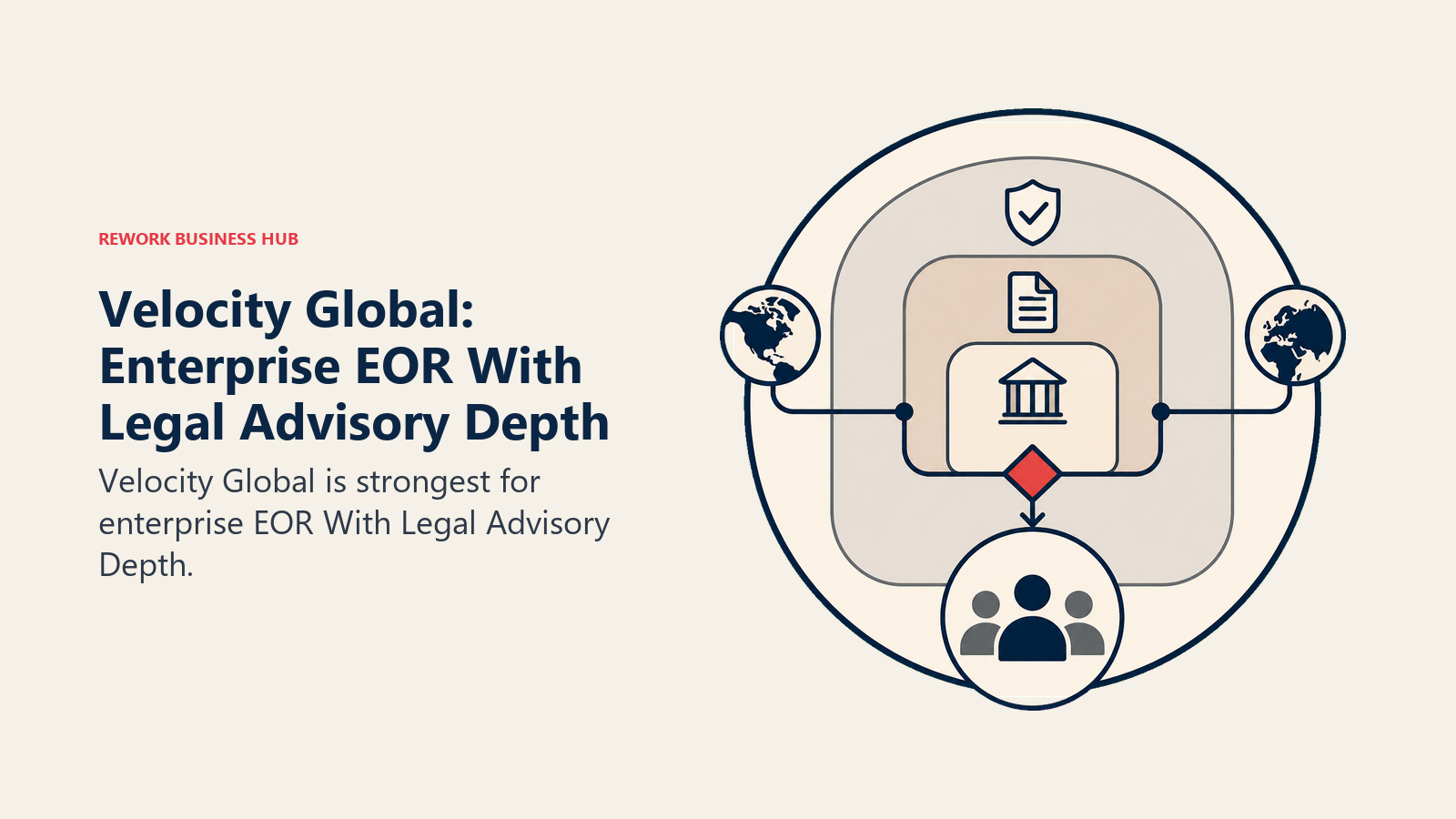
Where newer EOR platforms optimize for self-serve speed, Velocity Global optimizes for getting complex situations right. If you're hiring a senior executive in Germany who needs a work permit, or a contractor in Brazil who needs to convert to an employee without triggering local labor law penalties, Velocity Global's advisory layer is genuinely valuable.
The product is designed for enterprise buyers and requires sales engagement to price and implement. There's no self-serve tier. Implementation typically involves an assigned customer success manager and a legal consultant for complex markets. This is appropriate for the deal complexity involved, but it means Velocity Global is a poor fit for teams under 50 people or anyone wanting instant onboarding.
| What you get | What you don't |
|---|---|
| Deep legal compliance expertise in 185+ countries | Self-serve pricing or onboarding |
| Dedicated CSM and legal advisory team | Budget-friendly entry point |
| Strong immigration and work-authorization support | Fast time-to-hire for standard roles |
| Entity setup services alongside EOR | Modern self-serve UX |
| Enterprise SLAs and compliance guarantees | Lightweight contractor management |
Pricing: Custom. Enterprise contracts typically $500-800/mo per EOR employee depending on country and services.
Best for: Enterprise teams (100-2000 employees) with legally complex employment scenarios, particularly immigration-dependent hires or equity events in regulated markets. Not ideal for: SMBs, fast-moving growth-stage teams, or anyone who needs self-serve onboarding.
8. Globalization Partners (G-P): The Established Enterprise EOR Standard
G-P is the company that built the employer of record category as an enterprise product. Founded in 2012, they operated for years without meaningful competition, and that history shows in their legal infrastructure, compliance track record, and enterprise customer list.
Their EOR platform covers 180+ countries through a combination of owned entities and vetted partners. More importantly, their compliance and legal team is the most tenured in the industry. When employment law changes in Indonesia or a new contractor classification rule passes in France, G-P's compliance updates are typically first to market.
The product evolution story is mixed. G-P was very slow to build a modern UX, and newer competitors caught up in platform experience while G-P maintained its compliance moat. In 2023-2024 they significantly upgraded their Meridian platform, closing much of the UX gap. But the culture is still more enterprise services company than product-led SaaS.
Cost is a material consideration. G-P is among the most expensive EOR options. That reflects their service depth, but it's a barrier for growth-stage companies. Teams under 200 employees rarely find the cost-to-value ratio competitive against Oyster or Remote.
| What you get | What you don't |
|---|---|
| Longest track record in EOR (since 2012) | Modern self-serve UX |
| Best-in-class compliance update speed | Competitive pricing for SMBs |
| Enterprise SLAs with legal guarantees | Fast product iteration cycles |
| Owned entities in 60+ countries | Lightweight HR workflow tools |
| Deep immigration support | Transparent public pricing |
Pricing: Custom. Generally $599-799/mo per EOR employee in major markets.
Best for: Large enterprises (200+ employees) for whom compliance track record and legal guarantees justify premium pricing, especially in regulated industries (finance, healthcare, legal). Not ideal for: Growth-stage teams, budget-conscious buyers, or companies that need fast self-serve deployment.
9. Skuad: Budget-Conscious EOR for Early-Stage and Leaner Teams
Skuad is the lowest-cost EOR on this list and serves a specific audience well: early-stage companies (5-100 employees) that need compliant international hiring without the pricing of enterprise EOR providers.
Founded in 2020, Skuad covers 160+ countries for contractor payments and 50+ countries for full EOR employment. Their EOR pricing at $199/month per employee is meaningfully below Remote ($299), Oyster ($399), and Multiplier ($300), which matters a great deal when you're hiring your first three or four international employees and every dollar is watched.
The tradeoff for lower pricing is compliance maturity and platform depth. Skuad relies more heavily on local partner networks than Remote, and their compliance tooling for edge cases (unusual tax situations, work authorization adjacent to employment) is less robust. For standard full-time employment in common markets (India, Philippines, UK, Canada), the coverage is solid. For complex scenarios, there's more execution risk than with G-P or Velocity Global.
Their UX is clean and the onboarding flow is among the fastest in the market. Most teams get a new hire contract out within 3-5 business days.
| What you get | What you don't |
|---|---|
| Lowest EOR price point on the market ($199/mo) | Mature compliance tooling for edge cases |
| Fast contractor + EOR onboarding | Fully owned entities in all markets |
| Clean, simple UX | Deep HRIS or performance management |
| Good coverage for India, SEA, UK, Canada | Enterprise SLAs |
| Multi-currency contractor payments | Long compliance track record |
Pricing: EOR from $199/mo per employee. Contractor from $19/mo.
Best for: Early-stage teams (5-100 employees) making their first international hires and prioritizing cost over compliance depth. Not ideal for: Enterprises, legally complex employment situations, or teams needing advanced HRIS functionality.
Feature Comparison: EOR and Global Payroll Coverage
| Feature | Remote | Oyster | Papaya | Rippling | Gusto | Multiplier | Velocity Global | G-P | Skuad |
|---|---|---|---|---|---|---|---|---|---|
| EOR services | Yes | Yes | Yes | Yes | No | Yes | Yes | Yes | Yes |
| Contractor management | Yes | Yes | Yes | Yes | Yes (US) | Yes | Yes | Yes | Yes |
| Countries (EOR) | 180+ | 130+ | 160+ | 50+ | US only | 150+ | 185+ | 180+ | 50+ |
| Owned entities | 180+ | Partial | Partial | N/A | N/A | Partial | Partial | 60+ | Partial |
| Payroll analytics | Basic | Basic | Advanced | Good | Basic | Basic | Good | Good | Basic |
| HRIS depth | Moderate | Moderate | Moderate | Very strong | Good | Moderate | Moderate | Moderate | Basic |
| IT management | No | No | No | Yes | No | No | No | No | No |
| Self-serve | Yes | Yes | No | Yes | Yes | Yes | No | No | Yes |
| Benefits admin | Yes | Yes | Yes | Yes | Yes | Yes | Yes | Yes | Basic |
Pricing Comparison at a Glance
| Tool | Contractor (per seat/mo) | EOR (per employee/mo) | Minimum | Notes |
|---|---|---|---|---|
| Remote.com | $29 | $299 | None | Annual billing discount available |
| Oyster HR | $29 | $399 | None | Cost varies by country |
| Papaya Global | Custom | Custom | Custom | Enterprise positioning |
| Rippling | No public price; $8 base reported + modules | $500+ (EOR add-on) | $8/user | Module pricing adds up quickly |
| Gusto | $6/user | US only | $49/mo + $6/user | US payroll only |
| Multiplier | $25 | $300 | None | APAC pricing competitive |
| Velocity Global | Custom | $500-800 | Custom | Enterprise only |
| G-P | Custom | $599-799 | Custom | Premium compliance tier |
| Skuad | $19 | $199 | None | Most affordable EOR |
Compliance and Legal Depth Comparison
| Tool | Owned Entities | Local Partners | Immigration Support | Equity Event Support | Compliance SLAs |
|---|---|---|---|---|---|
| Remote.com | 180+ countries | Minimal | Yes | Basic | Standard |
| Oyster HR | Partial | Yes | Basic | No | Standard |
| Papaya Global | Via network | Yes | No | No | Enterprise |
| Rippling | 50+ countries | Yes | Basic | Yes | Standard |
| Velocity Global | Partial | Yes | Deep | Yes | Enterprise SLAs |
| G-P | 60+ countries | Yes | Deep | Yes | Enterprise SLAs |
| Multiplier | Partial | Yes | Basic | Basic | Standard |
| Skuad | Partial | Yes | Basic | No | Standard |
Use Case Fit Matrix
| Use Case | Best Option | Second Choice |
|---|---|---|
| First international hire (1-5 employees) | Skuad or Oyster | Remote.com |
| Fast APAC hiring | Multiplier | Remote.com |
| US payroll + benefits only | Gusto | Rippling |
| Platform consolidation (HR + IT + payroll) | Rippling | Remote.com |
| Payroll analytics across existing providers | Papaya Global | Rippling |
| Complex immigration-linked employment | Velocity Global | G-P |
| Enterprise compliance with long track record | G-P | Velocity Global |
| Budget-conscious growth-stage scaling | Skuad | Multiplier |
| Self-serve EOR with owned entities | Remote.com | Oyster HR |
How to Choose: Decision Framework
| If your primary need is... | Best pick | Why |
|---|---|---|
| Lowest-cost EOR for early hiring | Skuad | $199/mo EOR, fast onboarding, adequate for standard markets |
| Legally cleanest EOR (owned entities) | Remote.com | Fully owned entities, clear accountability chain |
| SMB-friendly EOR with pricing transparency | Oyster HR | Pre-built country templates, transparent total cost |
| APAC-heavy hiring | Multiplier | Stronger APAC coverage and local relationships |
| HR + IT + payroll consolidation | Rippling | Only platform that unifies device management with HR |
| US payroll only | Gusto | Best-in-class UX, transparent pricing |
| Payroll data across multiple providers | Papaya Global | Built for payroll analytics, not just payroll execution |
| Complex immigration and equity compliance | Velocity Global | Legal advisory depth justifies premium |
| Maximum compliance track record | G-P | 14 years in market, industry-standard for regulated industries |
What to Do Next
Don't switch platforms based on a comparison article alone. The migration cost for global HR and EOR is real: open employment contracts, benefits continuity, data migration, and employee communication all add up.
The practical path: identify your top two platforms from this list, request demos for both, and run a parallel proof-of-concept with a small number of new hires over 4-6 weeks. Focus the evaluation on your specific markets and use cases, not on feature lists. The platform that handles your highest-volume countries cleanly, with acceptable support response time on edge cases, wins.
If your HR platform search extends to European teams or includes HRIS depth as a core requirement, the best Personio alternatives covers that side of the market. For distributed teams where onboarding a new hire spans IT, Finance, and the manager, the manager onboarding checklist outlines the cross-team workflow that most EOR platforms leave you to build yourself. Teams evaluating Rippling as the unified alternative to Deel should also read the best Rippling alternatives to understand where module pricing creates friction. And if you're also looking at the payroll side of the stack, the best Gusto alternatives covers US-focused payroll options that often sit alongside an EOR tool for the domestic headcount.
According to the Employer of Record Institute, the average EOR contract runs 6-18 months before a company either expands to direct entity setup or switches providers. That timeline is worth baking into your evaluation; switching mid-year is harder than switching at contract renewal.
Frequently Asked Questions
What is the best Deel alternative for a small team? For early-stage teams making their first international hires, Skuad ($199 per month per EOR employee) and Oyster HR offer the best mix of low cost and clean onboarding. Skuad wins on price, while Oyster wins on transparent total-cost-of-employment estimates.
Which Deel alternative has fully owned entities? Remote.com is the strongest option for owned entities, operating in 180+ countries directly rather than through partner networks. That shortens the compliance chain and clarifies accountability, which matters most for legally complex hires.
Is there a cheaper alternative to Deel for EOR? Yes. Skuad starts at $199 per month per employee, below Remote ($299), Multiplier ($300), and Oyster ($399). The tradeoff is thinner compliance tooling for edge cases, so it fits standard employment in common markets best.
What should I use instead of Deel for APAC hiring? Multiplier has the strongest Asia-Pacific EOR coverage, with local partnerships across Southeast Asia, India, and Australia, plus onboarding in roughly 7 to 10 days. It's the clearest fit when your hiring is weighted toward that region.
Do I need to replace Deel's payroll, or just its HRIS? Many teams leaving Deel are frustrated with the internal operations layer, not the payroll. If that's you, pair a lean EOR like Oyster or Remote with a stronger HRIS layer rather than ripping out global hiring entirely. Rippling rates strongest on HRIS depth in this list, and the best Personio alternatives guide covers dedicated HRIS tools.
This article reflects pricing and product information available as of April 2026. Global HR and payroll pricing changes frequently. Verify current pricing directly with vendors before committing.

Senior Customer Retention Strategist
On this page
- Quick Comparison Table
- Why Teams Leave Deel
- Stage Fit Matrix
- Team Size and Buyer Persona Table
- 1. Remote.com: Full-Stack EOR With Fully Owned Entities
- 2. Oyster HR: SMB-Friendly EOR With Transparent Pricing
- 3. Papaya Global: Enterprise Payroll Intelligence and Analytics
- 4. Rippling: All-in-One HR, IT, and Finance Platform
- 5. Gusto: Best-in-Class US Payroll With Limited International Reach
- 6. Multiplier: Fast EOR Onboarding With Strong Asia-Pacific Coverage
- 7. Velocity Global: Enterprise EOR With Legal Advisory Depth
- 8. Globalization Partners (G-P): The Established Enterprise EOR Standard
- 9. Skuad: Budget-Conscious EOR for Early-Stage and Leaner Teams
- Feature Comparison: EOR and Global Payroll Coverage
- Pricing Comparison at a Glance
- Compliance and Legal Depth Comparison
- Use Case Fit Matrix
- How to Choose: Decision Framework
- What to Do Next
- Frequently Asked Questions