Best PEO Services for Small Business in 2026: 16 Providers Ranked by Buying Situation
Turn this article into takeaways for your work.


Each assistant summarizes the article only for you and suggests best practices for your work.
Source for CPEO status: the IRS's own active CPEO public listing.
The best PEO for a small business isn't the one with the biggest name, it's the one that matches why you're buying co-employment in the first place. Justworks and TriNet lead this list because they solve the two most common reasons a 5 to 200 employee company goes looking for a PEO: a founder who wants large-group health insurance without building an HR department, and a company in a regulated industry that needs compliance expertise built into payroll. ADP TotalSource and Insperity win when you want an older, bigger brand behind the co-employment relationship. Paychex PEO, ExtensisHR, Sequoia, CoAdvantage, Engage PEO, Amplify, and Vensure fill out the rest of the market by industry fit, region, and company size. Rippling PEO, Deel PEO, and Remote PEO solve a narrower problem: PEO bundled with a modern HRIS, or PEO paired with global Employer of Record coverage for a company hiring outside the US. Gusto is on this list too, but only so you stop mistaking it for a PEO: it's payroll and benefits brokerage, not co-employment, and that distinction matters more than most buyers realize before they've already signed something.
This guide ranks 16 real PEO services by the buying situation they solve, not alphabetically. Before the list: what co-employment actually means, why the master health plan is usually the real reason to buy, IRS certification and why it matters, what happens to your benefits when you leave, and the two pricing models you'll be quoted so you can compare providers on equal footing.
Key Facts
Key Facts: The PEO Industry
- More than 200,000 US businesses use a PEO today, covering roughly 4.5 million worksite employees across about 500 PEOs nationwide (NAPEO).
- 14% of all employers with 20 to 499 employees now use a PEO, per NAPEO's own industry data (NAPEO).
- Businesses that use a PEO grow more than twice as fast as comparable non-PEO businesses, based on a McBassi & Company study commissioned by NAPEO (NAPEO).
- PEO clients are 50% less likely to go out of business than matched non-PEO companies of the same size, industry, and state, and see 12% lower employee turnover (NAPEO).
- The IRS Failure to Deposit penalty for a late payroll tax deposit climbs from 2% to 15% of the unpaid amount depending on how late it's paid, one of the compliance risks a PEO's tax-filing liability transfer is built to absorb (IRS).
Quick Comparison Table
| PEO | Best For | Starting Price | Key Strength | Key Limitation |
|---|---|---|---|---|
| Justworks | Founders who want benefits without an HR team | $79/employee/mo (PEO Basic) | Only major PEO with fully published pricing | Cost per employee doesn't shrink at scale |
| TriNet | Regulated industries needing built-in compliance | Quote-only | Industry-specific compliance guidance | No published pricing anywhere |
| ADP TotalSource | Companies wanting the ADP brand behind co-employment | Quote-only, priced % of payroll | Decades of payroll tax infrastructure | Bill moves with raises and bonuses |
| Insperity | High-touch, dedicated HR support | Quote-only (~$150-210/employee/mo reported) | Long-tenured full-service model | Expensive, five-employee minimum |
| Paychex PEO | Existing Paychex customers upgrading to PEO | Quote-only | Same vendor as Paychex Flex payroll | Pricing opacity carries over from Flex |
| Rippling PEO | PEO bundled with a modern HRIS and IT platform | Quote-only, core platform from $8/employee/mo | Single system for HR, IT, and PEO | Not an IRS-certified CPEO |
| ExtensisHR | Broker-sold PEO for established small businesses | Quote-only | Long CPEO track record since 2017 | Pricing invisible outside a broker |
| Sequoia | VC-backed startups and tech companies | Quote-only | Deep bench in tech-company benefits | Narrower industry focus |
| CoAdvantage | Multi-state generalist PEO | Quote-only (~$120-180/employee/mo reported) | Broad multi-state, multi-industry coverage | Only certified as a CPEO since July 2026 |
| Engage PEO | Attorney-led compliance oversight | Quote-only (~$40-160/employee/mo reported) | In-house legal and compliance team | Smaller regional footprint |
| Amplify PEO | Very small teams, under 10 employees | Quote-only (~$100-180/employee/mo reported) | Works at headcounts most PEOs skip | Cost per employee climbs at tiny sizes |
| Vensure | Multi-brand PEO holding company | Quote-only | Wide network of PEO brands under one parent | Not on the IRS CPEO list under this name |
| Gusto | Payroll and benefits without co-employment | $49/mo + $6/employee/mo (Simple) | Transparent pricing, easy setup | Not a PEO, no liability transfer |
| Deel PEO | US co-employment plus global EOR on one platform | $125/employee/mo | Same login as Deel's EOR and contractors | Not on the IRS CPEO list under this name |
| Remote PEO | Lower-priced US PEO paired with global EOR | From $99/employee/mo | Lower published floor than Deel | Newer entrant than Deel to US PEO |
| Helpside | Businesses hiring only within the Intermountain West | Quote-only | 35+ years and a named local support team | Regional only, and not on the IRS active CPEO list |
What a PEO Actually Is (Read This Before You Buy)
"Co-employment" is the term that confuses people, so start there. When you sign with a PEO, your employees become co-employed by two entities: your company, which still controls hiring, firing, pay rates, and day-to-day work, and the PEO, which becomes the employer of record for tax filing, benefits administration, and workers' compensation purposes. You don't lose control of your team. You give up sole legal responsibility for a specific list of employment obligations in exchange for the PEO's scale.
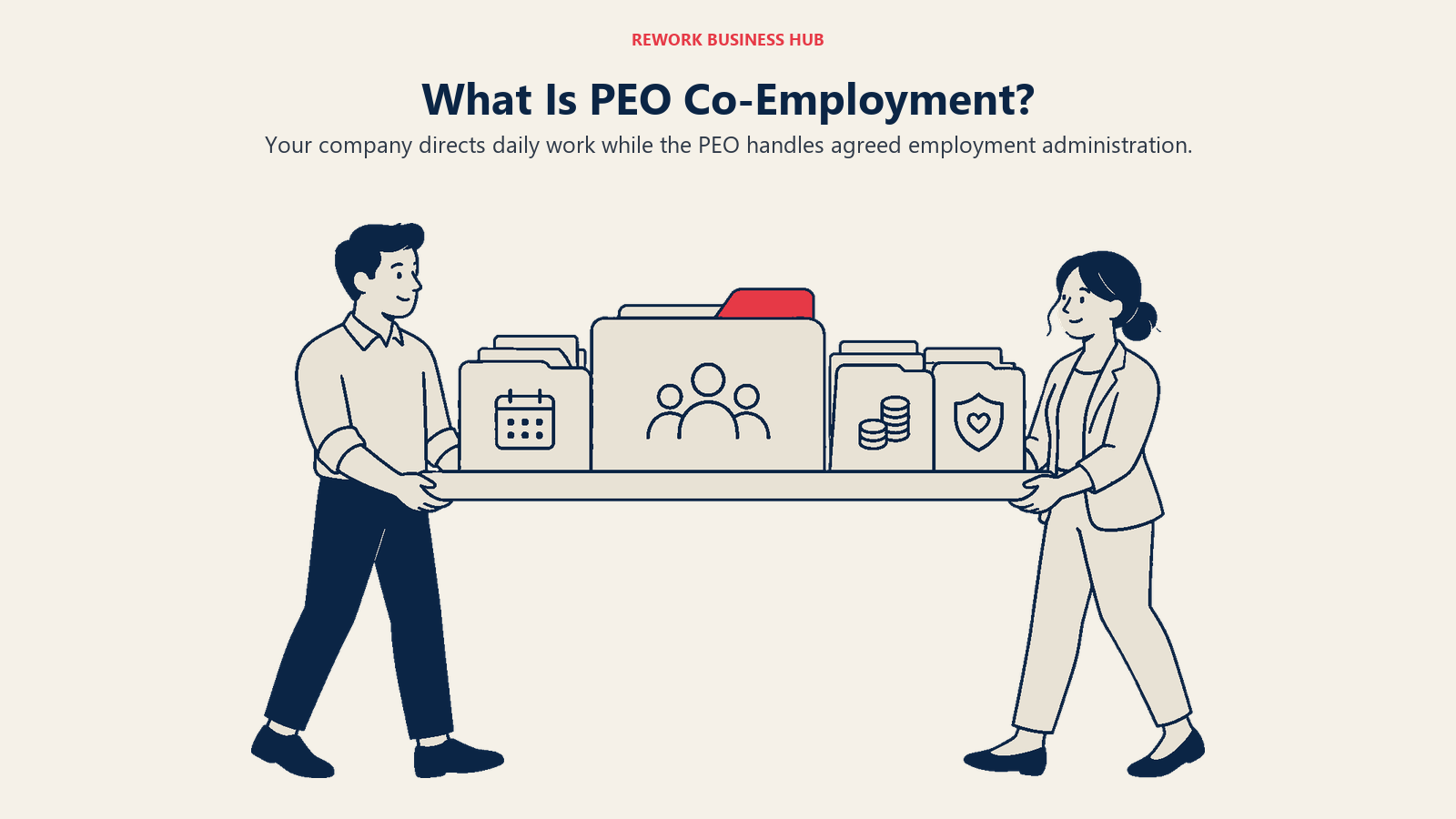
That distinction is why a PEO isn't the same thing as three other categories people confuse it with.
| Model | Who's the legal employer | What it actually does | When it fits |
|---|---|---|---|
| PEO (Professional Employer Organization) | Co-employer (you and the PEO) | Payroll, tax filing, workers' comp, and access to the PEO's master benefits plan under one shared employment relationship | You want group benefits access and shared compliance liability, and you're comfortable with co-employment |
| ASO (Administrative Services Organization) | You, solely | The same admin work as a PEO (payroll processing, HR support, compliance guidance) but with no co-employment and no shared liability | You already have decent benefits, or don't want a joint employer, but still want outsourced payroll and HR admin |
| HRO (HR Outsourcing) | You, solely | Broader HR consulting and process outsourcing (recruiting, performance, policy), usually without full payroll processing | You need HR expertise and process support more than you need payroll or benefits |
| EOR (Employer of Record) | The EOR, entirely | Legally employs workers in a country or state where you have no entity, and handles all local compliance | You're hiring somewhere you have no legal presence, most often outside the US |
The master health plan is usually the real reason to buy. The plan document, not the payroll software, is what actually drives most small companies toward a PEO. A PEO pools every one of its client companies' employees into one master health insurance plan, then negotiates group rates the way a much larger employer would. A 15-person startup shopping on its own gets small-group rates, or in some states, no group coverage at all. Inside a PEO's master plan, that same 15-person company buys into the PEO's combined risk pool instead, which is why PEO health plans routinely beat what a standalone small-group broker can quote a company that size. Missing this is the most common PEO buying mistake: comparing a PEO's administrative fee against payroll software's subscription fee, when the real trade being made is administrative fee plus master-plan benefits access against a standalone broker relationship.
The workers' comp master policy works the same way. A PEO carries one master workers' compensation policy across all its client companies and allocates a rate to each client based on that client's own claims history and industry classification, underwritten against the PEO's much larger combined pool. For a small company in a claims-prone industry (construction, manufacturing, logistics), that pooled underwriting can mean meaningfully better workers' comp pricing and faster claims handling than a standalone policy from a regional carrier.
IRS certification (CPEO status) is the detail buyers skip and later regret. The IRS runs a voluntary certification program under Section 7705 of the tax code, and a Certified Professional Employer Organization (CPEO) has met bonding, financial reporting, and tax compliance requirements the IRS checks quarterly. The practical benefit: a CPEO gets "successor employer" status for FICA and FUTA taxes, so if you switch PEOs mid-year, or leave a PEO for direct employment, your employees' wage bases carry over instead of restarting at zero. Without CPEO status, a wage base restart can mean two employers both withhold Social Security tax on the same wages up to the annual cap ($176,100 for 2026), an error nobody automatically catches or refunds. Source for the certification table further down this guide: the IRS's own active CPEO listing, not a vendor's marketing page.
Exiting a PEO is not like canceling a SaaS subscription. Your employees' health, dental, and vision coverage under the PEO's master plan ends on a fixed date, commonly the last day of the month you leave, and every enrolled employee gets a COBRA continuation offer instead of automatic coverage under whatever plan you set up next. That means your next payroll or benefits provider needs new group coverage live before, or very close to, your PEO exit date, or your team faces a real coverage gap. Ask a PEO exactly what its exit process looks like, in writing, before you sign, not after you've already decided to leave.
PEOs quote in one of two pricing structures, and the two aren't directly comparable without doing the math yourself.
| Model | How it's billed | Predictability | Who uses it |
|---|---|---|---|
| Flat PEPM (per employee per month) | A fixed dollar amount per enrolled employee, regardless of that employee's actual pay | High: cost scales with headcount, not with raises or bonuses | Justworks, TriNet, ExtensisHR, and most of the newer PEOs on this list |
| Percentage of payroll | A percentage (commonly reported at 2% to 12%) applied to each pay run's actual gross wages | Lower: cost rises with raises, bonuses, and overtime, not just headcount | ADP TotalSource, and some of the older, insurance-brokerage-style PEOs |
To compare a flat-PEPM quote against a percentage-of-payroll quote honestly, convert the percentage into a dollar-per-employee figure using your own average payroll: multiply your average monthly pay per employee by the quoted percentage. A 4% quote against a $6,000/month average salary works out to $240/employee/month, a very different number than the same 4% quote against a $3,500/month average salary. Ask every percentage-of-payroll PEO to run that math against your actual payroll, not a generic example, before you set it next to a flat-PEPM quote from a competitor.
Not Sure You Need a PEO at All?
If the PEO vs ASO row above made you realize what you actually want is payroll or HR software, not co-employment, you're not far off. The guide to choosing payroll software and the best payroll software for small business roundup cover 14 standalone payroll platforms. Comparing two specific platforms head to head? See Gusto vs ADP, Paycom vs Paylocity, or best QuickBooks Payroll alternatives. If payroll itself is fine but you want a broader HRIS wrapped around it, the guide to choosing HR software for small business covers that adjacent decision.
1. Justworks: PEO for Founders Who Want the Simplest Buying Process
Justworks is the PEO most founders find first, and it earns that spot by being the only major PEO on this list with fully published, per-employee pricing instead of a quote-only sales process. Pick PEO Basic or PEO Plus, and the number you see is the number you pay, no sales call required.
PEO Basic covers payroll, tax filing, compliance monitoring, workers' comp, and access to Justworks's large-group health plans. PEO Plus adds Justworks-administered health insurance on top. Justworks Employment Group and its affiliated entities have held CPEO certification since 2017, confirmed on the IRS's own active listing.
| Pros | Cons |
|---|---|
| Fully published, transparent per-employee pricing | Cost per employee doesn't shrink much as headcount grows |
| IRS-certified CPEO since 2017 | Co-employment makes an exit more involved than canceling software |
| 24/7 support, month-to-month billing, no long-term contract | Benefits premiums sit on top of the platform fee |
| Also sells payroll-only and global EOR products under one login | Not built for companies much past a few hundred employees |
Pricing: PEO Basic $79/employee/month, no base fee. PEO Plus $124/employee/month, no base fee. Justworks Payroll, its non-PEO product, is priced separately at $8/employee/month plus a $50/month base fee. All figures per Justworks's own pricing page. This corrects a "$59 to $79 reported" figure that circulates elsewhere: the published PEO Basic floor is $79.
Best for: Startups and small businesses of 5 to 100 employees that want the simplest possible PEO buying process and are willing to pay for pricing transparency. See best Justworks alternatives if the $79 floor is more than your budget supports, or Justworks vs TriNet for the two most-compared PEOs side by side.
2. TriNet: PEO for Regulated and High-Risk Industries
TriNet runs the same co-employment model as Justworks but built for a different buyer: companies in healthcare, legal, financial services, staffing, and other regulated or higher-risk industries where a generalist PEO's compliance knowledge runs out fast.
Every TriNet client gets a dedicated HR service team plus industry-specific guidance, and TriNet HR III-B, Inc. has held CPEO certification since 2018. TriNet's own pricing page confirms it uses a flat per-employee-per-month admin fee rather than a percentage of payroll, but it doesn't publish the actual rate.
| Pros | Cons |
|---|---|
| Industry-specific compliance and HR guidance | No published pricing anywhere on TriNet's own site |
| IRS-certified CPEO since 2018 | Runs more expensive than generalist PEOs for a similar team |
| Dedicated HR advisor assigned per account | Harder to exit once benefits and payroll are fully integrated |
| Confirmed flat PEPM billing, never a percentage of payroll | Support quality varies by region, per user reviews |
Pricing: Quote-only. TriNet's own pricing page states it charges a flat administrative fee per employee per month and explicitly does not charge a percentage of payroll, but it doesn't publish the rate. Get a quote against your actual headcount and industry before comparing it to a published-price competitor.
Best for: Healthcare, legal, staffing, or financial services companies of 10 to 200 employees where industry-specific compliance risk outweighs the value of self-serve pricing. See best TriNet alternatives if you want the same vertical depth at a published rate.
3. ADP TotalSource: The Percentage-of-Payroll Brand-Name Option
ADP TotalSource is ADP's PEO product, distinct from ADP RUN (ADP's standalone payroll product for companies that don't want co-employment). It runs on the same decades-old tax-filing infrastructure as the rest of ADP's business, and ADP TotalSource CO XXI, Inc. and its many affiliated filing entities have held CPEO certification since 2017.
The structural detail that separates ADP TotalSource from most of this list: it typically bills as a percentage of total payroll rather than a flat per-employee fee, commonly reported in the 2% to 12% range depending on company size and services included. That means your ADP TotalSource bill moves with raises, bonuses, and overtime, not just headcount, worth modeling against a flat-PEPM competitor before you sign.
| Pros | Cons |
|---|---|
| Decades of payroll tax-filing infrastructure and audit history | No published pricing, and percentage-of-payroll is harder to forecast |
| IRS-certified CPEO since 2017 across its filing entities | Bill moves with pay raises and bonuses, not just headcount |
| Deep integration with ADP's broader HR and benefits ecosystem | Sales process is known for surfacing add-on fees late |
| Large-employer scale behind the master benefits plan | Less nimble than newer, smaller PEOs |
Pricing: Quote-only. ADP does not publish TotalSource pricing; third-party trackers (including Bolto's and PEO Marketplace's 2026 ADP TotalSource breakdowns) report a 2% to 12% of payroll range, or an equivalent $70 to $200 PEPM admin fee depending on company size and risk profile (reported, unconfirmed by ADP). Ask ADP to model both structures against your actual payroll before comparing quotes.
Best for: Companies that already trust the ADP brand and want a percentage-of-payroll structure that scales down automatically in a slow month.
4. Insperity: High-Touch PEO for Companies That Can Pay a Premium
Insperity is one of the oldest full-service PEOs in the country, and it leans into a high-touch model: a five-employee minimum, a dedicated HR team per account, and a new HRScale tier, launched in partnership with Workday in February 2026, for companies that want PEO-level support layered on enterprise HCM technology. Insperity PEO HR, Inc. and Insperity PEO Services, L.P. are both IRS-certified CPEOs.

| Pros | Cons |
|---|---|
| Long operating history and dedicated HR support per client | No published pricing anywhere |
| IRS-certified CPEO | Reported costs run higher than most PEOs on this list |
| New HRScale tier pairs PEO support with Workday HCM | Five-employee minimum excludes the smallest teams |
| Strong benefits negotiating power from a large combined pool | Onboarding fees can add $500 to $2,000 upfront (reported) |
Pricing: Quote-only. Third-party estimates (including business.com's and Ignition Benefits's 2026 Insperity pricing guides) put Insperity in the $150 to $210 per employee per month range, or roughly 2% to 6% of total payroll once benefits are included (reported; Insperity does not publish a rate). Confirm the current number directly with Insperity.
Best for: Companies of 20 to 200 employees that want a long-tenured, high-touch PEO and can absorb a price above the market median for dedicated support. See best Insperity alternatives if the January 2026 price increase pushed your renewal past what the service is worth to you.
5. Paychex PEO: The Natural Upgrade From Paychex Flex
Paychex PEO is the co-employment product sold alongside the much better-known Paychex Flex payroll platform, and it's the natural next step for a company already running payroll through Paychex that wants benefits and compliance liability handled too. Paychex PEO VI LLC and Paychex PEO VII, LLC are both IRS-certified CPEOs, certified since 2017.
| Pros | Cons |
|---|---|
| Same vendor as Paychex Flex payroll, one less integration | No published PEO pricing on Paychex's own site |
| IRS-certified CPEO since 2017 | Pricing opacity and hidden-fee complaints carry over from Flex |
| Broad SMB coverage, including non-desk and multi-location workforces | UI feels dated compared to newer PEO platforms |
| Dedicated payroll specialists rather than a ticket queue | Long-term contract terms on some plans |
Pricing: Quote-only. Paychex does not publish PEO pricing anywhere on its own site; treat any number from a third-party guide as an estimate, not a confirmed rate, and request a quote against your actual headcount. See best Paychex alternatives if Paychex's payroll-side pricing opacity is already a dealbreaker before you evaluate the PEO.
Best for: Companies already on Paychex Flex that want to add benefits access and compliance liability transfer without switching vendors.
6. Rippling PEO: Co-Employment Bundled Into a Modern HR and IT Platform
Rippling sells PEO as one module inside a much broader HR, IT, and finance platform, the same way it sells payroll, benefits administration, and device management. That's a real advantage if your actual goal is one employee record driving payroll, PEO, IT provisioning, and spend management together.
It's also the one structural gap worth knowing before you sign: Rippling does not appear on the IRS's active CPEO list and carries no ESAC accreditation, so it is not currently an IRS-certified PEO the way Justworks, TriNet, or ADP TotalSource are.
| Pros | Cons |
|---|---|
| PEO bundled with payroll, IT, and finance on one employee record | Not an IRS-certified CPEO, and not ESAC-accredited |
| Strong automation across onboarding, offboarding, and device provisioning | Pricing isn't published, a sales call is required |
| Global payroll and EOR options available alongside the US PEO | Easy to overbuy modules during the sales process |
| Modern interface relative to legacy PEO platforms | Newer to co-employment than the CPEO-certified names on this list |
Pricing: Rippling publishes no pricing at all, PEO included: rippling.com/pricing is a quote request form carrying no dollar figures. Third-party trackers report a core HRIS and Domestic Payroll around $8/employee/month each (reported), with PEO priced separately and quote-based.
Best for: Tech-forward companies of 25 to 500 employees that want PEO unified with IT and finance and are comfortable that Rippling isn't IRS-certified for the co-employment relationship itself. See best Rippling alternatives if the module-based pricing feels harder to forecast than you want.
7. ExtensisHR: Broker-Sold PEO for Established Small Businesses
ExtensisHR has held CPEO status since the program's first certification round in 2017 (its Extensis-named filing entities appear on the IRS's active list), and it sells primarily through insurance and benefits brokers rather than direct self-serve signup. That broker-first model is the point: if your company already works with a benefits broker, ExtensisHR is built to plug into that relationship instead of replacing it.
| Pros | Cons |
|---|---|
| IRS-certified CPEO since 2017 | Pricing is essentially invisible outside a broker relationship |
| Built to work alongside an existing broker rather than replace one | Less self-serve than Justworks or Gusto |
| Broad benefits and compliance support for established small businesses | No published rate card |
| Long operating history in the PEO industry | Direct sign-up is less common than through a broker channel |
Pricing: Quote-only, and typically arranged through a broker rather than a direct online quote. Third-party estimates put typical PEO engagements in this tier in the $40 to $200 PEPM range industry-wide (reported); ask your broker for an ExtensisHR-specific number against your actual headcount.
Best for: Established small and mid-size businesses that already work with a benefits broker and want that relationship to carry into the PEO decision.
8. Sequoia: PEO Built for VC-Backed Tech Companies
Sequoia One PEO has built its reputation specifically inside venture-backed tech companies, where competitive, tech-industry-benchmarked benefits matter more to hiring than in most other sectors. Sequoia One PEO, LLC has held CPEO certification since 2018, and the broader Sequoia platform added AI-assisted benefits renewal and cost-modeling tools in mid-2026 that PEO clients get first.
| Pros | Cons |
|---|---|
| IRS-certified CPEO since 2018 | Narrower industry focus than a generalist PEO |
| Deep specialization in tech-company and startup benefits design | Less natural fit outside VC-backed or tech-adjacent industries |
| AI-assisted benefits renewal and cost-modeling tools (2026 rollout) | Pricing isn't published |
| Strong reputation specifically among Silicon Valley-style employers | Smaller footprint than the largest generalist PEOs |
Pricing: Quote-only. Sequoia does not publish PEO pricing; request a quote against your headcount and benefits goals directly.
Best for: VC-backed and tech-adjacent companies of 20 to 200 employees where competitive, benchmarked benefits are a hiring requirement, not a nice-to-have.
9. CoAdvantage: Generalist, Multi-State PEO
CoAdvantage is a generalist, multi-state PEO built for small businesses without a specific industry focus, and it's one of the more recently certified names on this list: CoAdvantage Resources 85, LLC shows a CPEO effective date of July 1, 2026 on the IRS's active listing, only weeks old.
| Pros | Cons |
|---|---|
| Broad multi-state and multi-industry coverage | Very recently CPEO-certified, a short track record under this filing entity |
| Custom pricing structured around headcount and services selected | Pricing not published, and third-party estimates vary widely |
| Bundles admin fees, benefits premiums, and workers' comp into one quote | Total year-one spend can exceed a headline admin-fee-only quote |
| Works with businesses across a wide range of industries | Less brand recognition than Justworks, TriNet, or ADP |
Pricing: Quote-only. Third-party PEO advisory estimates commonly place CoAdvantage-style engagements around $120 to $180 per employee per month (reported), with service-industry clients carrying higher workers' comp exposure often landing at the top of that range.
Best for: Multi-state small businesses without a specific regulated-industry need that want a generalist PEO beyond the largest four names.
10. Engage PEO: Attorney-Led Compliance PEO
Engage PEO differentiates on legal and compliance oversight: its HR and compliance guidance is attorney-led rather than generalist, which matters most for companies in employment-law-heavy states or industries with frequent HR disputes. Engage PEO, LLC has held CPEO certification since 2017.
| Pros | Cons |
|---|---|
| IRS-certified CPEO since 2017 | Smaller regional footprint than the largest national PEOs |
| Attorney-led compliance and HR guidance | Pricing not published |
| Personalized HR support for small to mid-size regulated businesses | Less name recognition outside markets it actively serves |
| Broad service bundle including payroll, benefits, and workers' comp | Third-party pricing estimates vary by a wide margin |
Pricing: Quote-only. Reported estimates place Engage PEO in roughly the $40 to $160 per employee per month range, or 2% to 12% of payroll depending on structure (reported); confirm directly with Engage.
Best for: Small to mid-size businesses in employment-law-sensitive states that want compliance guidance backed by in-house legal expertise.
11. Amplify PEO: PEO for Teams Under 10 Employees
Amplify PEO is a newer, smaller PEO built to work at headcounts most PEOs consider too small to be economical, including companies under 10 employees. Amplify HR Management, LLC appears on the IRS's active CPEO list with a certification effective date of January 1, 2025.

| Pros | Cons |
|---|---|
| Works with very small teams other PEOs price out | Per-employee cost runs high at tiny headcounts |
| IRS-certified CPEO since January 2025 | Newer to the certified-PEO market than most names on this list |
| Straightforward PEPM pricing structure | No published rate card |
| Reasonable fit for a founder's first co-employment purchase | Less brand recognition and smaller client base than established PEOs |
Pricing: Quote-only. Third-party estimates put Amplify PEO around $100 to $180 per employee per month (reported), with the higher end more common at very small headcounts where fixed costs spread across fewer employees.
Best for: Very small businesses, often under 10 employees, that want PEO-style benefits access despite a headcount most larger PEOs treat as uneconomical.
12. Vensure: Multi-Brand PEO Holding Company
Vensure Employer Solutions is functionally a holding company for a large collection of acquired PEO brands, which means the actual entity handling your account, and its actual pricing structure, depends on which legacy brand you land with. That structure is worth knowing upfront: it's why pricing reports on Vensure vary more than for any other name on this list, and it's why Vensure does not appear under that name on the IRS's active CPEO list. Whichever underlying legal entity ultimately signs your contract may carry its own separate CPEO status, worth confirming in writing before you sign.

| Pros | Cons |
|---|---|
| Wide network of PEO brands and services under one parent company | Not found under the Vensure name on the IRS's active CPEO list |
| Can often assemble a package for very small, HR-less businesses | Pricing model (flat PEPM vs percentage) varies by which legacy brand handles you |
| Bundles multi-state compliance, benefits, and workers' comp | Harder to evaluate consistently than a single-brand PEO |
| Global EOR services available alongside domestic PEO | Reported EOR pricing runs $600 to $850/employee/month, on the high end for that service |
Pricing: Quote-only, and the pricing structure depends on which Vensure-owned brand services your account. Confirm the exact contracting entity and its CPEO certification status directly with Vensure before signing.
Best for: Small businesses under 50 employees without in-house HR that want one PEO conversation to cover multi-state compliance, benefits, and workers' comp, and are comfortable verifying which underlying brand they're actually contracting with.
13. Gusto: Not a PEO, and That's the Point
Gusto belongs on this list for one reason: enough buyers land here comparing it to Justworks or TriNet that the distinction is worth stating plainly. Gusto is payroll software with benefits brokerage attached, not a co-employment PEO. Your company stays the sole legal employer of every worker on Gusto; Gusto processes pay and helps you shop for a group health plan, but it never becomes a joint employer, never carries workers' comp risk on your behalf, and doesn't appear on the IRS's CPEO list because it isn't applying to be one.
| Pros | Cons |
|---|---|
| Fully published, transparent pricing | Not a PEO: no co-employment, no shared compliance liability |
| No co-employment complexity to exit later | Benefits access reflects your own company's group size, not a pooled PEO rate |
| Familiar, easy self-serve setup for a first payroll | Workers' comp stays entirely your own company's policy and risk |
| Genuinely good fit if you don't want or need co-employment | Won't solve the "small-group insurance rates are bad" problem a PEO solves |
Pricing: Simple $49/month base plus $6/employee/month. Plus $80/month base plus $12/employee/month. Premium is quote-only. Per Gusto's own pricing page.
Best for: Companies that want payroll and benefits shopping help but have decided against co-employment, or that already have solid group benefits and don't need a PEO's master plan. See best Gusto alternatives if you're comparing Gusto against a bigger payroll platform rather than against a PEO.
14. Deel PEO: US Co-Employment Alongside Global EOR
Deel's US PEO product exists mainly to let a company that already uses Deel for international contractors or Employer of Record coverage add domestic US co-employment without switching platforms. That's a real advantage for a distributed company managing global and domestic headcount in one place, but Deel's US PEO does not appear under that name on the IRS's active CPEO list, worth confirming directly if IRS certification specifically is a requirement for your company.
| Pros | Cons |
|---|---|
| One platform for US PEO, global EOR, and contractor management | Not found on the IRS's active CPEO list under the Deel name |
| Published, transparent per-employee pricing | Primarily built for companies with international headcount already on Deel |
| Fast to add domestic co-employment alongside existing Deel global hires | Less specialized in US-only compliance than a dedicated domestic PEO |
| Backed by Deel's broader global payments and compliance infrastructure | US PEO is a smaller part of Deel's business than its EOR product |
Pricing: US PEO $125/employee/month. Global EOR from $599/employee/month. Contractor management $49/contractor/month. All figures per Deel's own pricing page.
Best for: Companies that already run international contractors or EOR hires through Deel and want US domestic co-employment on the same platform. See Deel vs Remote if you're weighing Deel against its closest global competitor first.
15. Remote PEO: The Lower-Priced Alternative to Deel's US PEO
Remote is Deel's closest direct competitor in global EOR, and it entered the US PEO market with the same single-platform pitch: domestic co-employment alongside the international Employer of Record coverage Remote is better known for. Remote's PEO doesn't appear under the Remote name on the IRS's active CPEO list either, the same caveat that applies to Deel's PEO product.
| Pros | Cons |
|---|---|
| Lower published PEO starting price than Deel | Not found on the IRS's active CPEO list under the Remote name |
| One platform for US PEO and global EOR/contractor management | Newer entrant to the US PEO market than Deel |
| Published, transparent pricing | Smaller US domestic PEO track record than dedicated US-only PEOs |
| Useful if you're already comparing Remote's EOR for international hires | US PEO is a smaller focus than Remote's core global EOR business |
Pricing: PEO from $99/employee/month. Employer of Record $699/employee/month. Global Payroll $29/employee/month. Contractor Management $29/contractor/month. All figures per Remote's own pricing page.
Best for: Companies already evaluating Remote for international EOR that want to compare its newer US PEO option before defaulting to Deel. See the guide to choosing global payroll software before committing to either platform for international headcount.
16. Helpside: Regional PEO for the Intermountain West
Helpside is a regional PEO, and that belongs in the first sentence rather than the drawbacks column. It serves roughly 800 businesses across the Intermountain West and has been operating for more than 35 years, so if you are hiring in Utah, Idaho, or the surrounding states it is a genuine local option with a long track record. If you are anywhere else in the country, stop reading here and go back to the national providers above.
Inside that footprint the pitch is the opposite of the big national PEOs: one responsive team instead of a ticketing system and a national support queue. The model is aimed squarely at businesses with 20 to 150 employees that need real HR support but cannot justify a full department, and it is sold with no long-term contract and a broker-friendly structure, which matters if you already work with a benefits broker you trust.
The material caveat is certification. Helpside does not appear on the IRS's active CPEO list, under that name or any obvious variant. That means no confirmed successor-employer wage-base protection, the same caveat that applies to Rippling, Deel, and Remote in this list. Ask which legal entity signs your contract and what its certification status is before you sign.
| Pros | Cons |
|---|---|
| 35+ years and roughly 800 clients in one region | Intermountain West only; no national coverage |
| One named support team rather than a ticket queue | Not on the IRS's active CPEO list |
| No long-term contract, broker-friendly structure | No published rate to compare before a call |
| Sized deliberately for 20 to 150 employee businesses | Too small a footprint for multi-region hiring |
Pricing: Quote-only. Helpside publishes no rate card, so request a quote against your headcount, directly or through your broker.
Best for: Businesses of 20 to 150 employees hiring within the Intermountain West that want a named local team rather than a national call centre, and that do not need CPEO wage-base protection.
CPEO Certification Status: Who's Actually IRS-Certified
Source: the IRS's own active CPEO public listing. Certification status can change quarterly, so confirm current status directly with any vendor before signing.
| PEO | IRS-Certified CPEO? | Certified Since | What That Means for You |
|---|---|---|---|
| Justworks | Yes | 2017 | Wage bases carry over cleanly if you switch or leave mid-year |
| TriNet | Yes | 2018 | Same wage-base protection, plus confirmed flat PEPM billing |
| ADP TotalSource | Yes | 2017 | Wage-base protection under a percentage-of-payroll billing model |
| Insperity | Yes | 2017 | Wage-base protection across a long operating history |
| Paychex PEO | Yes | 2017 | Wage-base protection under the same vendor as Paychex Flex |
| ExtensisHR | Yes | 2017 | Wage-base protection, typically arranged through a broker |
| Sequoia | Yes | 2018 | Wage-base protection for VC-backed and tech-focused clients |
| Engage PEO | Yes | 2017 | Wage-base protection plus attorney-led compliance oversight |
| CoAdvantage | Yes | July 2026 | Wage-base protection, but a short certification track record |
| Amplify PEO | Yes | 2025 | Wage-base protection at very small headcounts |
| Rippling PEO | Not on the IRS's active list | n/a | No confirmed successor-employer wage-base protection; verify directly |
| Vensure | Not found under this name | n/a | Confirm which underlying legal entity signs your contract, and its status |
| Deel PEO | Not found under this name | n/a | Confirm certification status of the underwriting entity directly |
| Remote PEO | Not found under this name | n/a | Confirm certification status of the underwriting entity directly |
| Helpside | Not on the IRS's active list | n/a | No confirmed successor-employer wage-base protection; verify directly |
| Gusto | Not applicable | n/a | Not a PEO; co-employment and CPEO status don't apply |
Source: IRS CPEO Public Listings.
Stage Fit Matrix
| PEO | Startup (5-20) | Growth (20-50) | Established SMB (50-200) | Larger (200+) |
|---|---|---|---|---|
| Justworks | Strong fit | Strong fit | Possible | - |
| TriNet | Possible | Strong fit | Strong fit | Possible |
| ADP TotalSource | Possible | Strong fit | Strong fit | Possible |
| Insperity | - | Strong fit | Strong fit | Possible |
| Paychex PEO | Possible | Strong fit | Strong fit | Possible |
| Rippling PEO | Possible | Strong fit | Strong fit | Possible |
| ExtensisHR | Possible | Strong fit | Strong fit | - |
| Sequoia | Strong fit (VC-backed) | Strong fit | Possible | - |
| CoAdvantage | Strong fit | Strong fit | Possible | - |
| Engage PEO | Possible | Strong fit | Possible | - |
| Amplify PEO | Strong fit (under 10) | Possible | - | - |
| Vensure | Strong fit | Possible | - | - |
| Gusto (not a PEO) | Strong fit | Strong fit | Possible | - |
| Deel PEO | Possible | Strong fit | Strong fit | Strong fit |
| Remote PEO | Possible | Strong fit | Strong fit | Strong fit |
| Helpside | Possible | Strong fit | Strong fit | - |
Sizing and Persona Table
| PEO | Ideal Team Size | Primary Buyer |
|---|---|---|
| Justworks | 5-100 employees | Founder, operations lead |
| TriNet | 10-200 employees, regulated industries | HR director, general counsel |
| ADP TotalSource | 10-200 employees | CFO, office manager |
| Insperity | 20-200 employees (5-employee minimum) | Head of HR, COO |
| Paychex PEO | 5-300 employees | Existing Paychex Flex customers |
| Rippling PEO | 25-500 employees | Head of People, IT director |
| ExtensisHR | 20-200 employees | HR director, benefits broker |
| Sequoia | 20-200 employees, VC-backed | Head of People, founder |
| CoAdvantage | 10-150 employees, multi-state | Office manager, HR generalist |
| Engage PEO | 10-150 employees | HR director, general counsel |
| Amplify PEO | 1-25 employees | Founder |
| Vensure | 5-50 employees | Founder, office manager |
| Gusto (not a PEO) | 1-100 employees | Founder, bookkeeper |
| Deel PEO | 5-500+ employees, global | People ops lead, CFO |
| Remote PEO | 5-500+ employees, global | People ops lead, CFO |
| Helpside | 20-150 employees, Intermountain West | Owner, operations lead |
True Cost Example: A PEO for 25 Employees
Numbers below assume a 25-employee US team with an illustrative $65,000 average annual salary (about $5,417/month per employee). Justworks is vendor-published and fully calculated. The quote-only rows are shown as "not disclosed" rather than an invented figure, with the reported range noted separately for planning purposes only.
| PEO | Monthly Estimate | Annual Estimate | Basis |
|---|---|---|---|
| Justworks (PEO Basic) | 25 x $79 = $1,975 | ~$23,700 | Vendor-published, platform fee only, before any additional benefits premium |
| Justworks (PEO Plus) | 25 x $124 = $3,100 | ~$37,200 | Vendor-published, adds Justworks-administered health insurance |
| ADP TotalSource (illustrative, 4% of payroll) | 4% x ($5,417 x 25) = ~$5,417 | ~$65,000 | Illustrative only: applies a reported mid-range percentage to a hypothetical average salary. ADP does not publish a rate; this shows the calculation method, not a quote |
| TriNet | Not disclosed | Not disclosed | Confirmed flat PEPM billing, but no published rate. Request a quote against this same scenario |
| Insperity | Not disclosed (reported ~$150-210/employee/mo) | Not disclosed | Reported estimate only; Insperity does not publish a rate |
The Justworks rows are the only fully vendor-confirmed numbers in this table, which is exactly the point: a PEO's real cost depends on its published rate card if it has one, or an actual quote against your specific headcount and average pay if it doesn't. Resist averaging the reported ranges above into a single "PEO costs about X" number, since a percentage-of-payroll quote and a flat-PEPM quote respond completely differently to a raise, a bonus cycle, or a new hire at a different salary band than your team's average.
Decision Framework
| If you need... | Pick... | Why |
|---|---|---|
| The simplest possible PEO buying process, no sales call | Justworks | Fully published per-employee pricing |
| Compliance depth for a regulated industry | TriNet | Industry-specific HR and legal guidance |
| A percentage-of-payroll model from a household brand | ADP TotalSource | Confirmed percentage-of-payroll structure, decades of infrastructure |
| High-touch, dedicated HR support, and you can absorb a premium | Insperity | Long-tenured full-service model, new Workday-backed tier |
| To stay inside your existing Paychex relationship | Paychex PEO | Same vendor as Paychex Flex payroll |
| PEO bundled with a modern HRIS, IT, and finance platform | Rippling PEO | Single employee record across HR, IT, and PEO (not CPEO-certified) |
| Benefits access competitive with VC-backed tech peers | Sequoia | Deep specialization in startup and tech-company benefits |
| A generalist, multi-state PEO outside the largest four names | CoAdvantage | Broad industry and state coverage |
| Domestic PEO plus global EOR on one platform | Deel or Remote | Same login for US co-employment and international hiring |
| Payroll and benefits shopping without co-employment | Gusto | Transparent pricing, no shared liability, no PEO complexity |
Frequently Asked Questions about PEO Services for Small Business
What is a PEO and how is it different from payroll software?
A PEO (Professional Employer Organization) co-employs your workforce, becoming a joint employer for tax filing, benefits, and workers' comp purposes while you keep control of hiring and day-to-day management. Payroll software like Gusto or QuickBooks Payroll just processes pay and files taxes for employees who remain solely your legal employees, with no shared liability and no pooled benefits access.
How much does a PEO cost for a small business?
Pricing runs one of two ways: a flat per-employee-per-month fee, commonly reported from around $79 up to $200 or more depending on the provider and benefits included, or a percentage of total payroll, commonly reported at 2% to 12%. Justworks is the only major PEO on this list with fully published pricing, at $79/employee/month for PEO Basic; most others are quote-only.
What's the difference between a PEO and an ASO?
A PEO co-employs your staff and shares compliance liability with you in exchange for access to its master benefits and workers' comp plans. An ASO (Administrative Services Organization) provides the same payroll and HR administration without co-employment, so you stay the sole legal employer and don't get access to the PEO's pooled group rates.
What does IRS CPEO certification actually protect me from?
A CPEO has met IRS bonding, financial reporting, and tax compliance requirements checked quarterly, and it earns "successor employer" status for FICA and FUTA taxes. That means if you join or leave a CPEO mid-year, your employees' wage bases carry over instead of restarting at zero, avoiding the risk of double-paying Social Security tax on the same wages up to the annual cap.
What happens to my employees' health insurance if I leave a PEO?
Coverage under the PEO's master plan typically ends on a fixed date, often the last day of the month you leave, and every enrolled employee is offered COBRA continuation rather than automatic enrollment in whatever plan you set up next. Line up your next benefits provider before your PEO exit date to avoid a coverage gap.
Is Gusto a PEO?
No. Gusto is payroll software with benefits brokerage attached. Your company stays the sole legal employer of everyone on Gusto, and Gusto doesn't share workers' comp risk, doesn't pool you into a master benefits plan, and isn't IRS CPEO-certified because it isn't applying to be one.
Is a PEO cheaper than hiring an in-house HR person?
It depends on your headcount and what you're buying. At 25 employees, a published-price PEO like Justworks runs roughly $23,700 to $37,200 a year in platform fees alone, before benefits premiums, usually less than a full-time HR hire's salary and benefits. But you're buying software plus liability transfer plus benefits access, not a dedicated internal advocate, so the two aren't a like-for-like swap.
Can a company leave a PEO mid-year without a tax penalty?
With an IRS-certified CPEO, yes, wage bases carry over cleanly under the CPEO's successor-employer status. With a non-certified PEO, a mid-year exit can trigger a wage base restart, risking double-withheld Social Security tax on the same employee up to the year's wage base cap ($176,100 for 2026).
What to Do Next
Name your actual reason for shopping a PEO before you take a single sales call. If it's benefits access for a team under 100 people, get quotes from Justworks and one quote-only competitor, TriNet or Insperity, and compare the published Justworks number against what the other two quote for your exact headcount. If it's a regulated industry, start with TriNet or Engage PEO instead. If you're not sure you want co-employment at all, read the PEO vs ASO table again before any call, since that single decision determines which of the 16 providers above are even the right conversation to have.

Principal Product Marketing Strategist
On this page
- Key Facts
- Quick Comparison Table
- What a PEO Actually Is (Read This Before You Buy)
- Not Sure You Need a PEO at All?
- 1. Justworks: PEO for Founders Who Want the Simplest Buying Process
- 2. TriNet: PEO for Regulated and High-Risk Industries
- 3. ADP TotalSource: The Percentage-of-Payroll Brand-Name Option
- 4. Insperity: High-Touch PEO for Companies That Can Pay a Premium
- 5. Paychex PEO: The Natural Upgrade From Paychex Flex
- 6. Rippling PEO: Co-Employment Bundled Into a Modern HR and IT Platform
- 7. ExtensisHR: Broker-Sold PEO for Established Small Businesses
- 8. Sequoia: PEO Built for VC-Backed Tech Companies
- 9. CoAdvantage: Generalist, Multi-State PEO
- 10. Engage PEO: Attorney-Led Compliance PEO
- 11. Amplify PEO: PEO for Teams Under 10 Employees
- 12. Vensure: Multi-Brand PEO Holding Company
- 13. Gusto: Not a PEO, and That's the Point
- 14. Deel PEO: US Co-Employment Alongside Global EOR
- 15. Remote PEO: The Lower-Priced Alternative to Deel's US PEO
- 16. Helpside: Regional PEO for the Intermountain West
- CPEO Certification Status: Who's Actually IRS-Certified
- Stage Fit Matrix
- Sizing and Persona Table
- True Cost Example: A PEO for 25 Employees
- Decision Framework
- What to Do Next