Best Paycom Alternatives in 2026: 12 HCM and Payroll Platforms Compared
Turn this article into takeaways for your work.


Each assistant summarizes the article only for you and suggests best practices for your work.
Paycom built its reputation on a single idea: one database for payroll, HR, time, and talent, with no third-party integrations stitching the pieces together. That's a genuine differentiator, and Beti, Paycom's employee-driven payroll self-service tool, backs it up by pushing pay verification onto employees before submission, which Paycom's own data ties to fewer post-run corrections. Add in tax compliance built on decades of US payroll experience and a single vendor to call when something breaks, and it's easy to see why Paycom has scaled past 40,000 clients.
It's also easy to see why HR directors and CFOs at 50 to 2,000-employee companies start shopping. Pricing is quote-only and hard to benchmark against a competitor's quote. Implementation runs long, often measured in months rather than weeks. What looked like flat, single-database pricing at the sales stage tends to grow per-module line items by renewal. The UI works, but it needs real training before an HR generalist feels confident in it. And support quality depends heavily on which specialist gets assigned to your account, a variable no org chart shows you in advance. If any of that sounds familiar, the 12 platforms below are worth a serious look, evaluated at the same size and honestly, including where Paycom still wins.
Key Facts
- The average company runs at an 80% payroll accuracy rate and makes about 15 corrections every pay period, per EY's analysis of payroll errors.
- A payroll tax deposit that's 1 to 5 days late costs a 2% penalty, climbing to 15% once the IRS sends a formal notice demanding payment, per the IRS.
- 73% of organizations now outsource at least part of their payroll operation, per Deloitte's 2025 Global Payroll Benchmarking Survey.
- Nearly 1 in 4 organizations say a new HR technology implementation failed to meet their adoption expectations, per SHRM.
- Only 23% of small businesses outsource payroll to a third party; most still run it themselves with payroll software, per OnPay's 2024 survey data.
Quick Comparison Table
| Tool | Best For | Starting Price | Key Strength | Key Limitation |
|---|---|---|---|---|
| Paylocity | Mid-market teams wanting Paycom's single database with stronger engagement tools | Custom quote (~$22-33 PEPM, reported) | Modern UX, strong culture and engagement features | Quote-only, no published price |
| UKG Ready | Multi-location, shift-heavy employers needing deep scheduling | Custom quote (~$20-33 PEPM, reported) | Best-in-class time and scheduling engine | Implementation cost climbs fast with scheduling complexity |
| ADP Workforce Now | Multi-state or multi-country compliance-heavy teams | Custom quote (~$23-30 PEPM software-only, reported) | Unmatched compliance bench and integration marketplace | Modules stitched together, not a true single database |
| Paycor | HR directors who want workforce analytics without enterprise cost | Custom quote (~$19-27 PEPM all-in, reported) | Strong analytics and workforce reporting | Now owned by Paychex, pricing pulled from its site in 2025 |
| isolved | Teams that prefer a local reseller relationship over a national vendor | Custom quote (~$17-25 PEPM, reported) | Flexible modular pricing sold through regional partners | Experience varies by which reseller you buy through |
| Dayforce | Larger mid-market employers with frequent pay changes | Custom quote (~$15-35 PEPM, reported) | Real-time, continuous payroll calculation | Heaviest implementation lift on this list |
| Rippling | Tech-forward companies wanting HR, IT, and payroll unified | ~$8/employee/mo core, plus modules | Automation and device provisioning built in | Costs stack quickly as modules add up |
| Workday | The 1,000+ employee tier, at or above Paycom's ceiling | Custom enterprise quote | Unified HR, finance, and planning data model | 6 to 18 month implementation, not built for mid-market budgets |
| TriNet | Employers who'd rather outsource HR risk than run software | Custom quote (~$80-150 PEPM admin fee, reported) | Industry-specific PEO compliance support | Co-employment model complicates switching later |
| Namely | Budget-conscious mid-market buyers comparing older HRIS platforms | Custom quote (~$18-26 PEPM, reported) | Familiar single-platform HRIS and payroll | Post-acquisition service complaints, losing momentum |
| BambooHR | The smaller end of Paycom's range, wanting HR experience first | $10-25/employee/mo (Core/Pro/Elite), payroll is an add-on | Best HR UX and onboarding, transparent published pricing | Payroll is bolted on, not a true single database |
| Deel | Paycom buyers adding international employees or contractors | $49/contractor/mo; EOR from $599/employee/mo | Best global contractor and EOR coverage | Not a domestic payroll replacement |
PEPM figures marked (reported) come from Outsail's vendor pricing analyses; none of the quote-only vendors above publish a public price list, so treat these as directional ranges, not quotes.
Why HR Teams Actually Shop Paycom Alternatives
None of this is a knock on Paycom's core product. It's a pattern in how buyers end up here. A quote-only price means an HR director can't sanity-check what they're being asked to pay against a public number, so every renewal conversation starts from a position of doubt rather than data. Implementation timelines that run past the original estimate push a go-live date into the next payroll cycle, which is its own kind of stressful. The per-module fees that show up on year-two invoices contradict the "one database, one price" story that closed the deal in year one. Beti's employee-driven verification is genuinely useful for accuracy, but it also means employees now do work that used to sit with HR, and that shift needs real change management or it just reads as more work dumped on the workforce. And because Paycom assigns a dedicated payroll specialist to each account, the actual support experience depends on which specialist you get, not on the product itself.
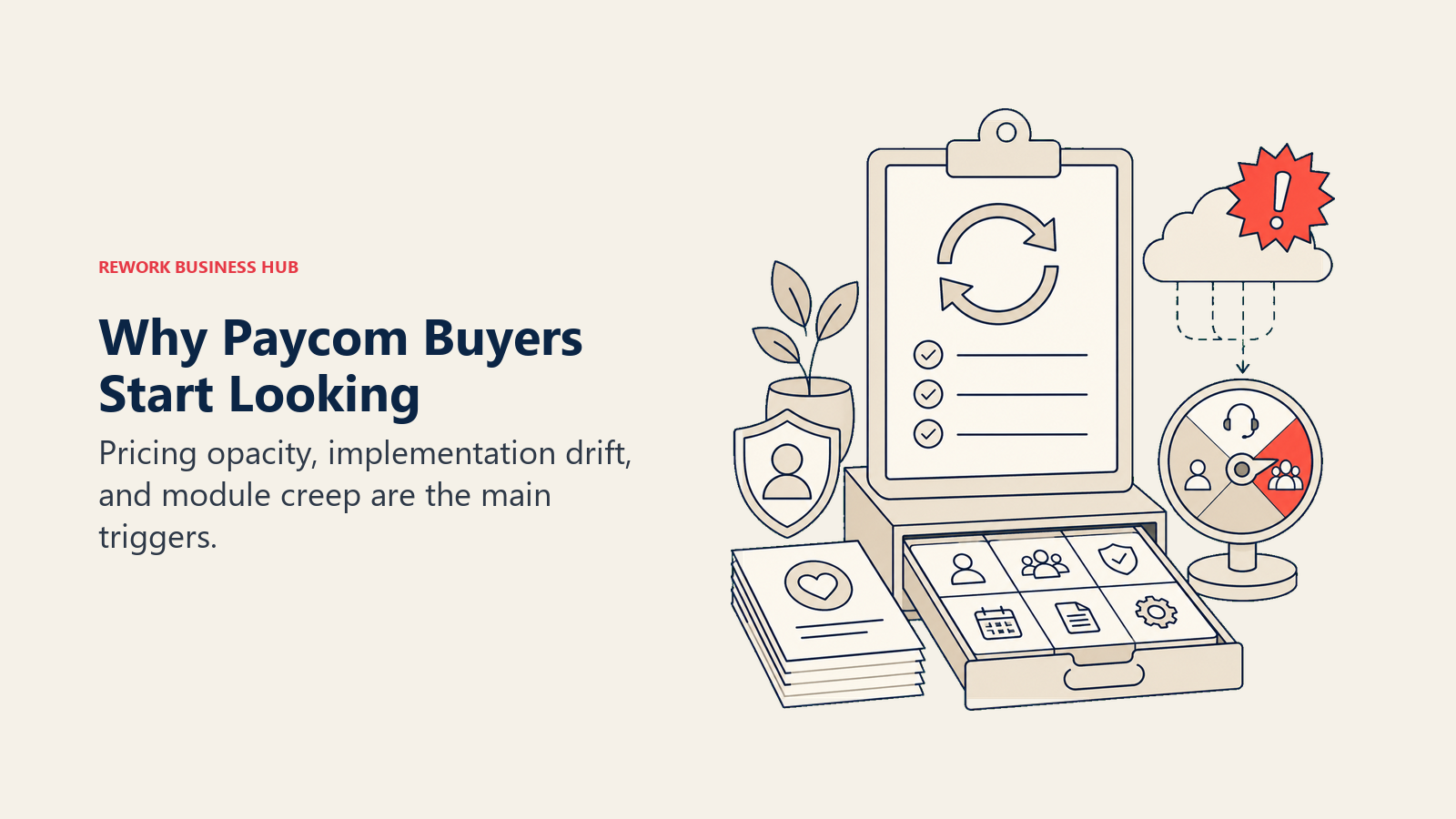
None of those are dealbreakers on their own. Together, they're why HR directors and CFOs at growing companies start building a shortlist instead of just renewing.
1. Paylocity: The Closest Head-to-Head Match
Paylocity is the alternative most Paycom buyers compare first, and for good reason: it's the same basic thesis (payroll, HR, time, and talent in one database) built by a vendor that leads with employee engagement instead of employee self-service. Recognition feeds, pulse surveys, and a built-in learning management system are core product, not bolted-on add-ons, which matters to HR leaders trying to build a real culture program alongside compliant payroll.
Target audience: Mid-market US companies with 100 to 1,000 employees where HR owns both compliance and culture. The buyer is typically a Head of People or HR director at a company that recently crossed 100 employees and is formalizing its people programs.
| Pros | Cons |
|---|---|
| Best employee engagement features of any platform on this list | Quote-only, no published price to benchmark |
| Genuinely unified database, matching Paycom's core pitch | Implementation still takes several weeks |
| Modern UX for both HR admins and employees | Higher reported cost than Paycom's payroll-only configurations |
| Strong learning management built in, not a third-party add-on | Overkill for companies under 100 employees |
Pricing: Quote-only. Reported range is $22-33 PEPM depending on modules and headcount, per Outsail, plus a one-time implementation fee of roughly 10-20% of annual software cost.
Best for: HR teams that want Paycom's single-database model without giving up a modern, employee-facing UX. See the full best Paylocity alternatives breakdown if Paylocity itself is the one you're replacing.
2. UKG Ready: Built for Complex Scheduling
UKG Ready is the mid-market half of UKG's two-product lineup (UKG Pro serves larger enterprises), and it's the strongest option here for employers where scheduling, not payroll, is the hard problem. Multi-location retail, healthcare, and hospitality employers with rotating shifts, overtime rules, and labor law variance by state lean on UKG Ready's time and attendance engine in ways Paycom's more generalist time module doesn't match.
Target audience: 50 to 2,000-employee organizations with hourly, shift-based workforces spread across multiple locations. The buyer is usually an HR director or VP of Operations who also owns labor cost control.
| Pros | Cons |
|---|---|
| Deep time and scheduling engine for complex shift rules | Quote-only, custom pricing for every deal |
| Single database across HR, payroll, time, and talent | Implementation fees climb fast with scheduling complexity |
| Strong compliance handling for multi-state, multi-location employers | UI feels dated in spots next to Paylocity or Rippling |
| Good talent acquisition module bundled in | Less suited to office-only, non-shift companies |
Pricing: Quote-only. Reported range is $20-33 PEPM, per Outsail, with implementation fees historically running 20-40% of first-year software costs.
Best for: Multi-location, shift-heavy employers where Paycom's scheduling tools aren't deep enough to handle real labor complexity.
3. ADP Workforce Now: The Compliance Heavyweight
ADP Workforce Now isn't trying to win on single-database elegance. It's winning on breadth: five decades of payroll tax compliance history, coverage in 140+ countries, and a marketplace of 300+ integrations that most competitors, Paycom included, can't match. For a company with operations in multiple states or countries, that compliance bench is worth real money in avoided risk.
Target audience: Mid-market to large companies with multi-state or multi-country payroll complexity. The buyer is often a CFO or HR director who's been burned by a compliance gap before and is buying certainty as much as software.
| Pros | Cons |
|---|---|
| Deepest compliance and tax-filing track record in this category | Not a true single database, modules are stitched together |
| Marketplace of 300+ integrations for complex existing stacks | Quote-only, and pricing often includes surprise line items |
| Global payroll reach that Paycom doesn't offer | UI lags years behind newer competitors |
| Dedicated compliance and HR advisory services available | Contract exit terms can be restrictive |
Pricing: Quote-only. Reported range is $23-30 PEPM for software alone, rising to $30-50 PEPM with ADP's outsourced services included, per Outsail.
Best for: Multi-state or multi-country employers who'd rather buy ADP's compliance depth than Paycom's self-service pitch. See the full best ADP alternatives guide for more detail on where ADP itself falls short.
4. Paycor: Strong Analytics, New Ownership
Paycor built its name on workforce analytics that go beyond what Paycom's standard reporting offers, giving HR directors real visibility into turnover, labor cost, and headcount trends without exporting to a separate BI tool. The wrinkle worth knowing before you shortlist it: Paychex acquired Paycor in April 2025, and Paycor pulled its pricing pages down shortly after. Every deal now requires a sales conversation, and it's fair to ask a rep how the roadmap changes now that Paycor sits inside Paychex.
Target audience: 50 to 1,000-employee companies in healthcare, manufacturing, and financial services where an HR director needs analytics as much as payroll accuracy.
| Pros | Cons |
|---|---|
| Strong analytics and workforce planning dashboards | Now owned by Paychex, roadmap uncertainty for buyers |
| Solid recruiting and talent management tools included | Pricing removed from its website in 2025, quote-only now |
| More modern UX than ADP Workforce Now | Implementation can run slow for mid-market deals |
| Good multi-state payroll compliance | Mobile app trails the desktop experience |
Pricing: Quote-only. Prior published tiers ran $99-299/mo base plus $6-16/employee/mo, with mid-market all-in rates around $19-27 PEPM, per Outsail. Confirm current numbers directly, since Paychex's acquisition changed how quotes are issued.
Best for: HR directors who want real workforce analytics without Workday-level cost, and who are comfortable buying into a platform now owned by Paychex. If Paychex itself is on your list, see best Paychex alternatives for the parent company's own strengths and gaps.
5. isolved: The Reseller-Network Alternative
isolved takes a structurally different go-to-market approach than everything else on this list: it's sold almost entirely through a network of regional HCM resellers rather than a direct national sales team. That means your actual buying and support experience depends heavily on which local partner you work with, which cuts both ways. A strong regional partner can mean better, more personal service than Paycom's assigned-specialist model. A weak one means an inconsistent product experience despite isolved's platform being solid underneath.
Target audience: 50 to 1,000-employee companies that want a local implementation and support relationship rather than a direct national vendor. Common in regions where a specific reseller has a strong reputation.
| Pros | Cons |
|---|---|
| Flexible, modular pricing sold through regional partners | Quality and pricing vary by which reseller you buy from |
| Single "People Cloud" platform for payroll, HR, time, and talent | UI less polished than Paylocity or Rippling |
| Reasonable payroll tax compliance track record | Harder to compare pricing since it's reseller-negotiated |
| Local support relationship can mean faster issue resolution | National brand consistency is weaker than Paycom's |
Pricing: Quote-only. Reported software fees run $17-25 PEPM depending on modules and company size, per Outsail, plus an implementation fee of roughly 10-25% of annual costs.
Best for: Mid-market employers who'd rather build a relationship with a local HCM partner than work through Paycom's direct-sales, assigned-specialist model.
6. Dayforce: Real-Time Pay for Complex Workforces
Dayforce, Ceridian's flagship platform, solves a different problem than Paycom does. Where most payroll platforms, Paycom included, calculate pay in a batch run at the end of a pay period, Dayforce recalculates continuously as hours, rates, and deductions change throughout the period. For a large, high-turnover, high-shift-volume workforce, that removes the end-of-period scramble to catch errors before submission, the same problem Beti addresses from the employee side.
Target audience: 200 to 2,000+ employee organizations in retail, healthcare, and hospitality with complex, high-volume shift scheduling and frequent mid-period pay changes.
| Pros | Cons |
|---|---|
| Real-time, continuous payroll calculation reduces correction crunches | Heaviest, most expensive implementation on this list |
| Strong global payroll and workforce management depth | Arguably overkill below a few hundred employees |
| Handles high-volume, high-turnover scheduling well | Quote-only, wide reported pricing range |
| Deep talent and workforce planning tools bundled in | Requires a dedicated internal admin resource |
Pricing: Quote-only. Reported range is $15-35 PEPM depending on module mix, per Outsail, with implementation fees historically running 40-60% of annual software costs, the heaviest on this list.
Best for: Larger mid-market employers who've outgrown Paycom's batch payroll model and need continuous calculation for a complex, fast-moving workforce.
7. Rippling: HR, IT, and Payroll as One Problem
Rippling starts from a different premise than Paycom: HR and IT provisioning are the same operational problem, so they should live in the same system. Add an employee in Rippling and it can simultaneously provision their Google Workspace and Slack accounts, configure their laptop, and enroll them in payroll and benefits. For a tech-forward company with a real IT footprint, that automation saves hours Paycom's HR-only database can't touch.
Target audience: 20 to 500-employee tech-forward companies with distributed or remote teams and a real IT management need. The buyer is typically a Head of People or VP of Operations.
| Pros | Cons |
|---|---|
| HR, IT, and payroll unified with real automation | Costs stack quickly as modules get added |
| Faster implementation than Paycom, UKG Ready, or Dayforce | Pricing isn't public, requires a demo to get a real number |
| Strong global payroll and EOR layer for distributed teams | Payroll depth is newer than Paycom's decades of tenure |
| Excellent reporting across the full employee lifecycle | Smaller teams may not need the IT automation layer |
Pricing: Core platform runs about $8/employee/mo, plus per-module pricing for payroll, benefits, time tracking, and IT management. A full stack typically lands in the $25-50/employee/mo range; a custom quote is required for exact numbers.
Best for: Growth-stage tech companies that want Paycom's single-database idea extended to device and app provisioning too. See the full best Rippling alternatives guide if Rippling is the one you're replacing.
8. Workday: Where Paycom Buyers Graduate To
Workday isn't a Paycom alternative for a 200-person company. It's where companies land once they outgrow Paycom's ceiling, typically somewhere north of 1,000 employees. Its real differentiator is architectural: HR, finance, and workforce planning share one data model instead of talking to each other through an integration, which lets finance and HR build headcount budgets and compensation models together instead of trading spreadsheets.
Target audience: Enterprises with 1,000+ employees, particularly in finance, healthcare, and tech, where HR and finance need deeply integrated data. The buyer is a CHRO, CFO, or CIO evaluating a long-term system of record.
| Pros | Cons |
|---|---|
| Unified HR, finance, and planning data model | Enterprise-only pricing, not built for mid-market budgets |
| Modern UI relative to other enterprise-grade HCM systems | Implementation runs 6 to 18 months |
| Strong workforce planning and compensation modeling | Requires a dedicated internal admin and IT team |
| Continuous product investment and innovation cadence | Per-module costs add up quickly at scale |
Pricing: Custom enterprise quote, no public pricing published. There isn't a reliable per-employee range worth reporting at this scale since deals vary enormously by module count and negotiated terms.
Best for: Companies at or above Paycom's ceiling that need HR, finance, and planning running from a single source of truth. See best Workday alternatives if you're evaluating at this tier more broadly.
9. TriNet: Outsource the Risk Instead of Buying the Software
TriNet takes Paycom's proposition and flips it. Instead of selling you software to run payroll and HR yourself, TriNet becomes a co-employer through a PEO (Professional Employer Organization) structure, taking on much of the compliance risk and negotiating benefit rates your company couldn't get alone. It specializes by industry vertical, which matters for companies in healthcare, legal, staffing, or financial services facing regulatory complexity a generalist platform doesn't cover.
Target audience: 5 to 500-employee companies in regulated or high-risk industries that want compliance expertise bundled with payroll rather than a self-service database.
| Pros | Cons |
|---|---|
| Industry-specific PEO compliance support | Co-employment model complicates switching later |
| Dedicated HR advisor assigned to your account | No public pricing, quote-only |
| Strong benefits access via TriNet's negotiated rates | Can be more expensive than a pure software platform |
| Reduces employer-side compliance risk directly | Not a real single-database alternative if that's what you want |
Pricing: Quote-only. Reported admin fees run $80-150 PEPM, per Outsail; other third-party estimates put the full PEO cost as high as $150/employee/mo, so treat this as a wide directional range rather than a number to plan a budget around.
Best for: Employers in regulated industries who'd rather outsource HR and compliance risk than run their own HCM database.
10. Namely: A Familiar Platform Under New Ownership
Namely had a genuine run as the mid-market HRIS that understood 50 to 500-employee companies before Vensure Employer Solutions acquired it in 2022. Since then, the platform has tilted toward supporting Vensure's PEO business rather than competing head-on as a standalone HRIS, and service quality complaints have piled up in review forums. It's still a workable single-platform option, but it's fair to shortlist it with clear eyes about where the company's attention has gone.
Target audience: 50 to 500-employee companies comparing established, budget-conscious HRIS platforms rather than the newest entrants.
| Pros | Cons |
|---|---|
| Familiar, workable single-platform HRIS and payroll | Post-acquisition service and support complaints |
| Historically straightforward mid-market fit | Feels dated next to Paylocity, Rippling, or UKG Ready |
| Payroll and benefits administration in one place | Less product investment and momentum than peers |
| Lower reported cost than several alternatives here | No meaningful international payroll support |
Pricing: Quote-only. Reported software fees run $18-26 PEPM for the Plus and Complete tiers, per Outsail, plus an implementation fee typically 10-25% of annual software costs.
Best for: Budget-conscious mid-market buyers evaluating older-generation HRIS platforms, going in aware of the 2022 ownership change. See the full best Namely alternatives breakdown for a deeper look at why teams are leaving it.
11. BambooHR (Plus Payroll): HR Experience First
BambooHR doesn't try to match Paycom's single-database pitch head-on. It leads with the employee lifecycle, hiring, onboarding, performance, and org data, and treats payroll as a paid add-on rather than the core product. For companies at the smaller end of Paycom's range where HR experience matters more than payroll depth, BambooHR has the cleanest UI and onboarding flow of anything on this list, and it's one of the only platforms here that publishes its pricing outright.
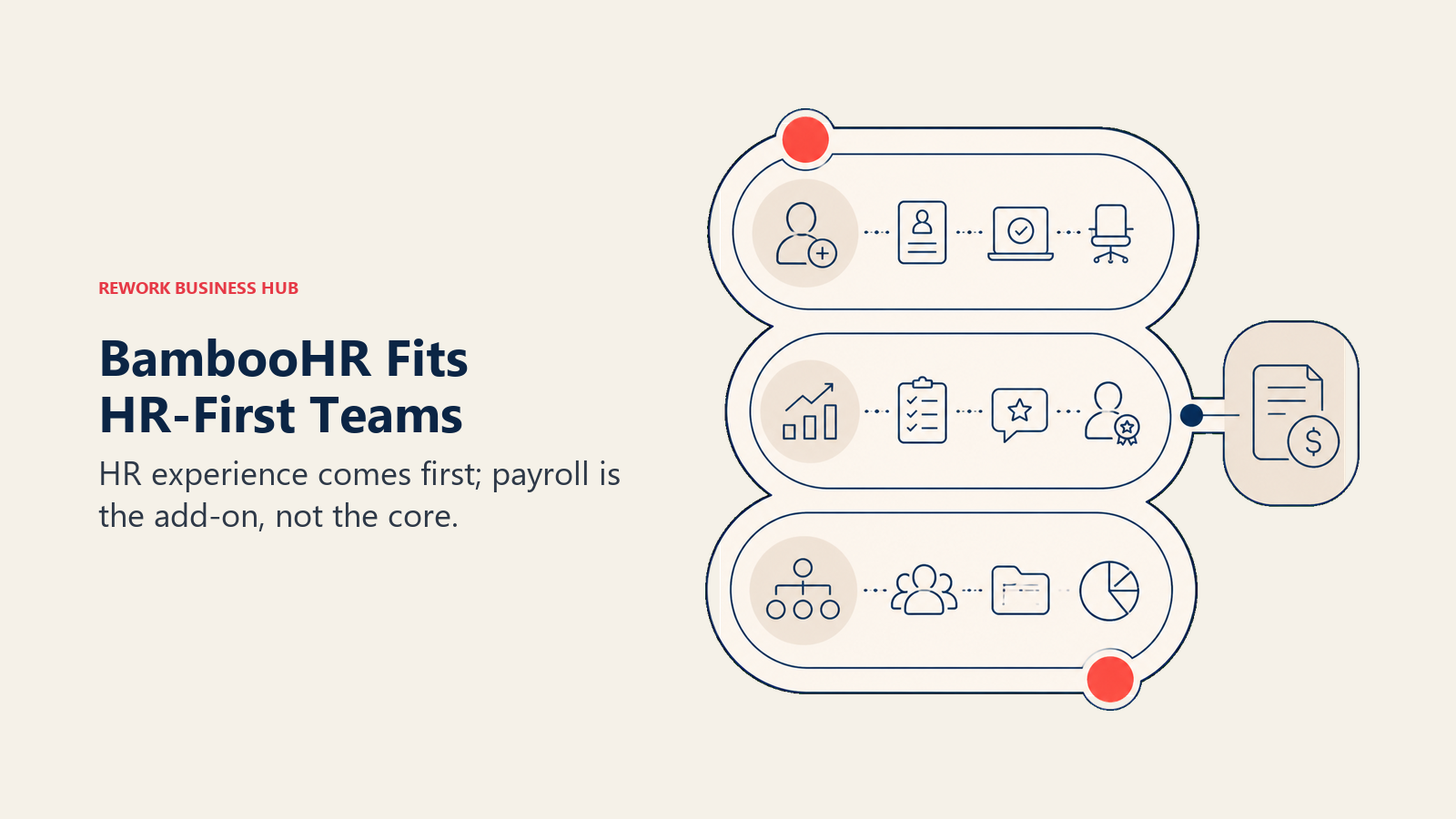
Target audience: 20 to 500-employee companies, with a sweet spot around 20 to 300, that want HR software to feel like a consumer app and are fine treating payroll as a bolt-on.
| Pros | Cons |
|---|---|
| Best HR UX and onboarding flow of any platform in this guide | Payroll is an add-on, not the core single-database product |
| Transparent, published pricing, rare in this category | Less depth for complex time and attendance needs |
| Fast implementation relative to Paycom or UKG Ready | Not built for companies with heavy shift-scheduling needs |
| Strong performance management at lower price tiers | Elite-tier analytics cost more to unlock |
Pricing: Published on bamboohr.com/pricing: Core $10/employee/mo, Pro $17/employee/mo, Elite $25/employee/mo, or a flat $250/mo for companies under 25 employees. Payroll is billed as a separate add-on, with a 15% discount when bundled with benefits administration.
Best for: The smaller end of Paycom's range (roughly 50 to 150 employees) that wants HR experience to lead and doesn't need payroll to be the center of the platform. See best BambooHR alternatives for a closer look at where BambooHR itself falls short.
12. Deel: The Companion Platform for Global Teams
Deel isn't a Paycom replacement so much as a companion for the part of the workforce Paycom doesn't reach. Paycom is built around US domestic payroll; Deel is built around hiring, paying, and staying compliant with employees and contractors in other countries. If your 300-person US company just hired its first three engineers in Portugal and Argentina, Deel handles that without requiring you to open a local entity.
Target audience: Companies of any size with international headcount, from a handful of contractors to a full EOR-based global team, sitting alongside a domestic HCM rather than replacing it.
| Pros | Cons |
|---|---|
| Contractor management and compliance in 150+ countries | Not a domestic payroll replacement for Paycom |
| Employer of Record (EOR) coverage in 90+ countries | EOR pricing is a real cost at scale |
| Vendor-published, transparent pricing | Adds a second system to keep in sync with your core HCM |
| Multi-currency payments and global HRIS layer | Domestic US payroll features are less mature than Paycom's |
Pricing: Published on deel.com/pricing: contractor management runs $49/contractor/mo, a US PEO plan runs $125/employee/mo, and Employer of Record coverage starts from $599/employee/mo.
Best for: Paycom buyers who've added international hires and need a companion platform, not a full swap. See best Deel alternatives for more on where Deel itself has gaps.
Stage Fit Matrix
| Tool | Startup (0-20) | Growth (20-100) | Mid-Market (100-500) | Enterprise (500+) |
|---|---|---|---|---|
| Paylocity | Not suitable | Moderate | Strong | Good |
| UKG Ready | Not suitable | Limited | Strong | Excellent |
| ADP Workforce Now | Limited | Good | Strong | Strong |
| Paycor | Limited | Good | Strong | Good |
| isolved | Limited | Good | Strong | Moderate |
| Dayforce | Not suitable | Limited | Good | Excellent |
| Rippling | Light | Strong | Excellent | Good |
| Workday | Not suitable | Not suitable | Not suitable | Excellent |
| TriNet | Good (regulated) | Strong (regulated) | Good | Moderate |
| Namely | Limited | Good | Strong | Moderate |
| BambooHR | Good | Excellent | Strong | Moderate |
| Deel | Excellent (global) | Excellent (global) | Strong | Strong |
Sizing and Persona Table
| Tool | Team Size Sweet Spot | Primary Buyer | Secondary Buyer |
|---|---|---|---|
| Paylocity | 100-1,000 employees | Head of People / HR director | CHRO |
| UKG Ready | 50-2,000 employees | HR director / VP Operations | Payroll manager |
| ADP Workforce Now | 200-5,000 employees | CFO / HR director | Compliance lead |
| Paycor | 50-1,000 employees | HR director | VP Finance |
| isolved | 50-1,000 employees | HR manager | Small business owner |
| Dayforce | 200-2,000+ employees | VP of People / CHRO | Payroll operations lead |
| Rippling | 20-500 employees | Head of People | VP of Engineering / IT |
| Workday | 1,000+ employees | CHRO / CIO | CFO |
| TriNet | 10-500 (regulated) | HR director | General counsel |
| Namely | 50-500 employees | HR director | Office manager |
| BambooHR | 20-300 employees | HR director | Recruiting manager |
| Deel | Any size with global headcount | People ops lead | CFO / Legal |
Implementation Effort Table
| Tool | Typical Implementation Time | Implementation Fee (reported) | What Drives the Effort |
|---|---|---|---|
| Paylocity | 4-8 weeks | ~10-20% of annual software cost | Data migration plus engagement feature setup |
| UKG Ready | 8-16 weeks | ~20-40% of first-year software cost | Scheduling rules and multi-location configuration |
| ADP Workforce Now | 6-12 weeks | ~10-20% of annual software cost | Module count and multi-state tax setup |
| Paycor | 6-10 weeks | Varies, quote-only since 2025 | Data migration and analytics configuration |
| isolved | 4-10 weeks | ~10-25% of annual software cost | Depends heavily on your specific reseller |
| Dayforce | 12-24 weeks | ~40-60% of annual software cost | Heaviest on this list, real-time engine setup |
| Rippling | 2-6 weeks | Included in quote, varies by module | IT provisioning rules plus payroll and benefits setup |
| Workday | 6-18 months | Custom enterprise scope | Full HR, finance, and planning data model rebuild |
| TriNet | 3-6 weeks | Bundled into PEO fee | Co-employment transition and benefits enrollment |
| Namely | 4-8 weeks | ~10-25% of annual software cost | Data migration from legacy platforms |
| BambooHR | 2-4 weeks | Included, low relative to this list | Fastest setup here, payroll add-on takes longer |
| Deel | 1-3 weeks per country | Included in per-employee pricing | Country-by-country compliance and contract setup |
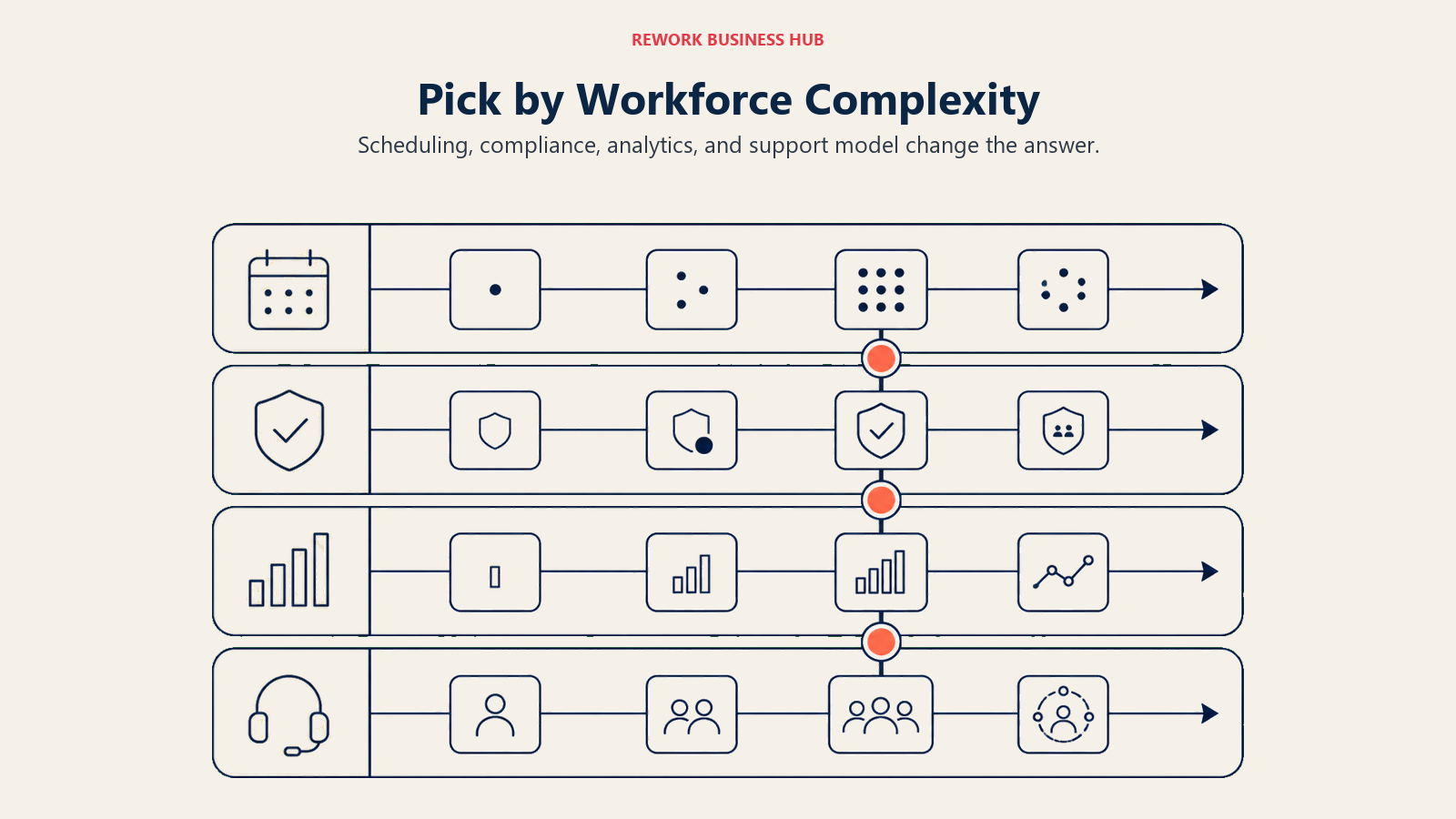
How to Choose: Decision Framework
| If you need... | Choose |
|---|---|
| Paycom's single database with better engagement and culture tools | Paylocity |
| Deep scheduling for a multi-location, shift-based workforce | UKG Ready |
| The deepest compliance bench for multi-state or multi-country payroll | ADP Workforce Now |
| Strong workforce analytics without enterprise-level cost | Paycor |
| A local implementation partner instead of a national direct-sales team | isolved |
| Real-time payroll calculation for a large, high-turnover workforce | Dayforce |
| HR, IT, and payroll unified with real automation | Rippling |
| Enterprise-grade HR, finance, and planning at 1,000+ employees | Workday |
| To outsource HR compliance risk instead of running software | TriNet |
| A familiar, budget-conscious mid-market HRIS | Namely |
| HR experience to lead, with payroll as a secondary need | BambooHR |
| A companion platform for employees or contractors outside the US | Deel |
| Staying put makes sense | Paycom (when a genuine single database and Beti's self-service model outweigh the pricing and implementation friction) |
What Paycom Still Does Best
None of the above should read as "just leave." Paycom earns its renewal with a lot of customers, and the honest reasons are worth naming before you sign with someone else. It's a genuinely unified database, not a payroll module bolted to an HR module through an API. Beti's employee-driven self-service model is a real mechanism for catching pay errors before submission, not just a marketing claim. Its US tax compliance track record is solid, built over more than two decades. And for an HR director who's tired of juggling four vendor relationships, one company to call when payroll breaks is worth something real, even if the price to get there isn't published anywhere you can check in advance.
If your company is US-only, values a single vendor relationship over the lowest possible price, and has the internal bandwidth to get through a multi-month implementation once, Paycom is probably still a reasonable answer. The platforms above earn a second look when quote-only pricing, per-module creep, or a mismatch between Paycom's generalist tools and your specific complexity (global headcount, heavy shift scheduling, deep analytics) start costing you more than switching would.
Frequently Asked Questions about Paycom Alternatives
What is the biggest reason companies leave Paycom?
Quote-only pricing that's hard to benchmark against competitors is the most common trigger, closely followed by implementation timelines that run longer than sales conversations suggested and per-module fees that show up after the first renewal.
Does Paycom publish its pricing anywhere?
No. Paycom, like most vendors on this list, quotes per organization. Third-party trackers report a range around $25-35 PEPM for the full HCM platform, per Outsail, but you'll need a real quote to know your actual cost.
Is Paylocity really different from Paycom, or just a rebrand of the same idea?
Both sell a genuinely unified database across payroll, HR, time, and talent. The real difference is emphasis: Paycom leans on Beti's employee-driven payroll verification, while Paylocity leans harder into employee engagement features like recognition feeds and pulse surveys built into the core product.
Which Paycom alternative fits a 50 to 150 employee company best?
BambooHR paired with its payroll add-on is the strongest fit at that size if HR experience matters more than payroll depth. isolved or a smaller Paylocity deployment are reasonable options if you want the database to stay unified from day one.
Which alternative makes sense once a company passes 1,000 employees?
Workday and Dayforce both start to make more sense above that mark, Workday for the finance-and-HR-in-one-system pitch, Dayforce for organizations with continuous, high-volume pay changes across a large hourly workforce.
What happened to Paycor's pricing page?
Paychex acquired Paycor in April 2025, and Paycor removed published pricing from its site shortly after. Every deal now goes through a sales quote, so ask directly how the Paychex acquisition affects the product roadmap before you sign.
Do any of these alternatives handle international employees the way Paycom can't?
Deel is the strongest option here, built specifically for contractor management and Employer of Record coverage outside the US. ADP Workforce Now also has real global payroll reach if you need one platform to span both domestic and international operations.
How long does implementation typically take?
It ranges widely by platform and complexity. BambooHR and Rippling can go live in a few weeks. Paylocity, ADP Workforce Now, and Namely typically run 4 to 12 weeks. UKG Ready and Dayforce, given their scheduling and real-time payroll engines, often run several months, and Workday implementations commonly stretch 6 to 18 months.
What to Do Next
Pick two platforms from the decision framework above, sized to where your company actually sits today, not where it might be in three years. Run a two-week parallel evaluation using a real scenario: one full pay cycle, one new hire, one termination, and one PTO policy change. Push both platforms through the same scenario and note where HR or a manager hits friction, not just where the demo looked smooth.
If you're under 150 employees and HR experience matters most, start with BambooHR against Paylocity. If scheduling complexity is your real pain point, put UKG Ready against Dayforce. If you're past 1,000 employees, Workday against ADP Workforce Now is the more realistic matchup. And if part of the evaluation is really about whether your next platform should handle payroll tasks with less manual review, it's worth reading how AI payroll agents are starting to change that work before you lock in a five-year contract. For a broader look at the category before you commit, the best payroll software roundup and the how to choose payroll software guide are good next stops, along with how to choose HR software if you're evaluating the HR side alongside payroll.
The platform that wins your evaluation should be the one your HR team can run confidently without a specialist on standby. If you're still waiting on a support ticket to close out a payroll question during a live pay week, that's the signal worth acting on.
Camellia writes about HR and operations tooling for B2B teams. Last updated August 2026.

Principal Product Marketing Strategist
On this page
- Key Facts
- Quick Comparison Table
- Why HR Teams Actually Shop Paycom Alternatives
- 1. Paylocity: The Closest Head-to-Head Match
- 2. UKG Ready: Built for Complex Scheduling
- 3. ADP Workforce Now: The Compliance Heavyweight
- 4. Paycor: Strong Analytics, New Ownership
- 5. isolved: The Reseller-Network Alternative
- 6. Dayforce: Real-Time Pay for Complex Workforces
- 7. Rippling: HR, IT, and Payroll as One Problem
- 8. Workday: Where Paycom Buyers Graduate To
- 9. TriNet: Outsource the Risk Instead of Buying the Software
- 10. Namely: A Familiar Platform Under New Ownership
- 11. BambooHR (Plus Payroll): HR Experience First
- 12. Deel: The Companion Platform for Global Teams
- Stage Fit Matrix
- Sizing and Persona Table
- Implementation Effort Table
- How to Choose: Decision Framework
- What Paycom Still Does Best
- What to Do Next