Mailchimp vs ActiveCampaign in 2026: Newsletter Tool or Automation Engine?
Turn this article into takeaways for your work.


Each assistant summarizes the article only for you and suggests best practices for your work.
If you're a marketing director, founder, or growth marketer sizing up email tools right now, you've probably already narrowed the list to these two names. Almost every "best email marketing software" search eventually routes through Mailchimp and ActiveCampaign, and for good reason: they're two of the most-installed platforms in the category, at genuinely different starting points. If you're comparing more than just these two, the best email marketing software roundup ranks 12 platforms by fit instead of feature count.
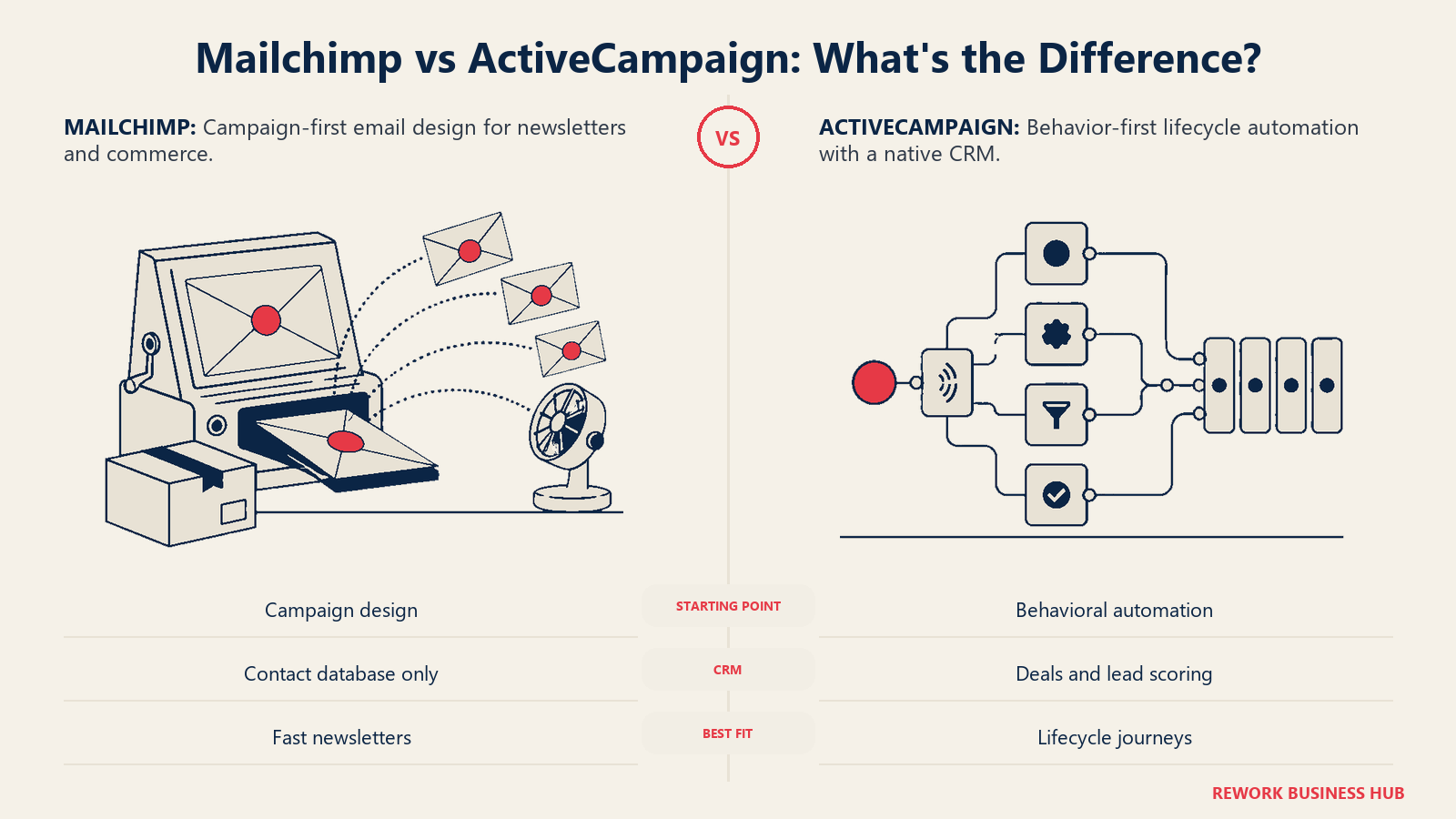
Here's the distinction that actually decides this, and it isn't a feature checklist. Mailchimp started as a broadcast tool, the thing you use to design a newsletter and hit send to a list, and has spent the last several years adding automation on top of that foundation. ActiveCampaign started as an automation engine built to react to what a contact does and route them through a sequence, and email happens to be the channel most of that logic runs through. Neither description is a knock on either product. But it means the two platforms solve different jobs well, and the job you actually have, sending a good newsletter or running behavior-triggered lifecycle journeys, should decide this more than any feature table. So should the money: both tools meter by contacts, and the cost gap between them doesn't stay constant as your list grows. The comparison below prices both tools at 1,000, 10,000, and 50,000 contacts instead of quoting the marketing-page number, because that's where the real answer lives.
TL;DR
| Mailchimp | ActiveCampaign | |
|---|---|---|
| Built for | Designing and sending campaigns, automation added on top | Behavior-triggered automation, email is the channel it runs through |
| Pricing model | Free up to 250 contacts, then Essentials/Standard/Premium, billed monthly by contacts and metered by sends | No free plan, Starter/Plus/Pro/Enterprise, billed annually by contact count |
| Automation ceiling | Up to 200 flows on Standard and Premium; Essentials caps around 4 steps | Unlimited automation actions from Plus up; Starter caps at 5 actions per workflow |
| Native CRM | Contact database only, no deal pipeline | "Deals" CRM with pipeline stages and contact scoring from Plus up |
| E-commerce fit | Deep native Shopify/WooCommerce integration, predictive segmentation | Ecommerce integrations present, deeper on Pro and Enterprise, automation-triggered |
| AI features | Generative AI bundled free from Standard up | Active Intelligence, limited on Starter and Plus, full access on Pro and Enterprise |
| Learning curve | Fast, most teams send a first campaign the same day | Real setup investment; multi-branch automation takes time to build correctly |
| Cheapest way to just send a newsletter | Yes, Essentials from $13/mo | No, Starter's design assumes automation, not pure broadcast |
Key Facts
- Automation-capable tiers cost more on ActiveCampaign than on Mailchimp at every contact count we tested: at 10,000 contacts, Mailchimp's Standard plan runs $135 a month against ActiveCampaign's comparable Plus plan at $189, and AC's deeper Pro tier runs $375, according to both vendors' own pricing calculators.
- Email marketing returned $36 to $50 for every $1 spent for roughly 30% of marketers, and more than $50 for another 5%, according to Litmus's 2025 State of Email survey of nearly 500 marketing professionals.
- The average email campaign nets a 35.63% open rate and a 2.62% click rate across industries, per Mailchimp's own benchmark data, the baseline either platform's automation has to beat to earn its price.
- ActiveCampaign's own pricing page describes its product as "autonomous marketing plans" built around Active Intelligence, a materially different self-positioning than Mailchimp, which bundles generative AI as a drafting and design aid rather than a framing for the whole platform.
- Mailchimp's free plan covers 250 contacts and 500 sends a month; ActiveCampaign has no free plan at any list size, only a 14-day trial.
What Each Tool Is Actually Built For
Mailchimp built its name on one specific job: making a newsletter or promotional email look like a design team made it, sent by someone who doesn't have a design team. That's still the center of the product. The template editor, the brand asset manager, and the predictive segmentation all point at "send something that looks good, to the right slice of your list." Automation exists (welcome series, abandoned cart, re-engagement), and it's genuinely useful, but it was added to a campaign tool, not built as the reason the tool exists. You can feel that in the ceiling: Essentials caps automations at around four steps, and even Standard and Premium, which unlock up to 200 separate flows, don't give you the branching, goal-tracking logic that automation-first platforms are built around. If Brevo's send-based pricing is also on your radar for the newsletter side of this decision, Mailchimp vs Brevo walks through that specific tradeoff.
ActiveCampaign runs the opposite direction. Its own pricing page, as of August 2026, headlines with "Autonomous marketing plans" and organizes every tier around Active Intelligence, its automation and AI layer, not around campaign design. The product's actual center of gravity is the automation builder: what happens when a contact opens an email, clicks a specific link, or reaches a certain deal stage. Email is the channel most of that logic runs through, but the logic itself, not the email, is what you're buying. That shows up in what's missing, too. ActiveCampaign's template library and design tools are functional, not a selling point, and they consistently rate behind Mailchimp's in side-by-side reviews. Brevo bundles similarly-styled automation and a basic CRM at a notably lower price point, and ActiveCampaign vs Brevo covers exactly where that tradeoff holds up.
Decision by Business Goal
| Your actual goal | Pick |
|---|---|
| Send a newsletter that looks professional without a designer on staff | Mailchimp |
| Route a lead into a different sequence the moment they click a pricing link | ActiveCampaign |
| Keep marketing and sales working off the same contact record without a separate CRM integration project | ActiveCampaign |
| Run Shopify or WooCommerce abandoned-cart and post-purchase campaigns with minimal setup | Mailchimp |
| Get AI-drafted campaign copy without paying extra for it | Mailchimp (Standard tier) |
| Score leads by behavior so sales knows who to call first | ActiveCampaign |
| Keep the bill as low as possible for a list under 5,000 that gets a monthly newsletter | Mailchimp Essentials |
| Build a five-step, multi-branch sequence with conditional logic | ActiveCampaign |
Team and Role Fit
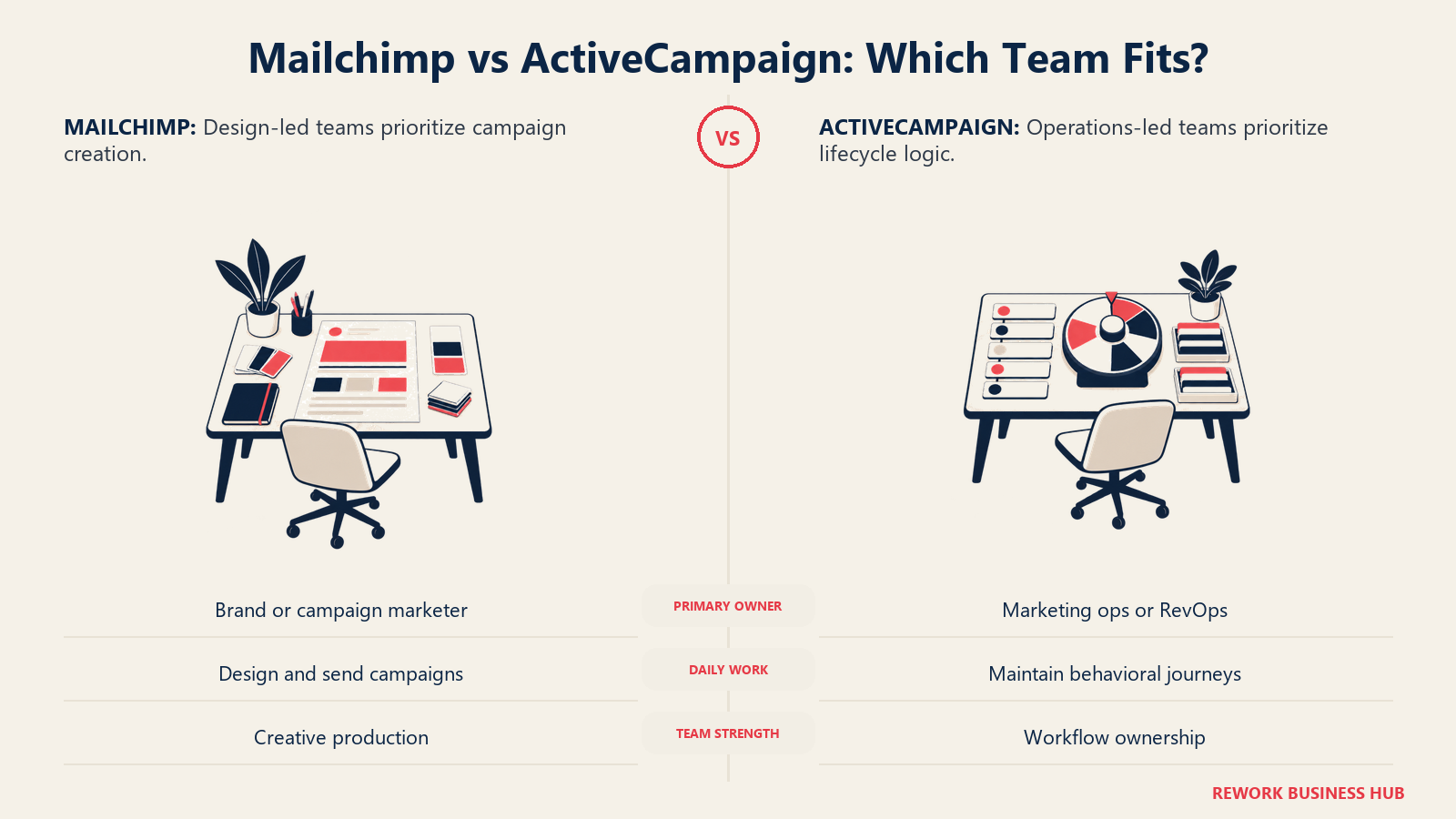
A solo marketer or founder gets to a first send faster on Mailchimp; there's no automation builder to learn before the tool starts paying for itself. A brand or design-led marketing team leans the same way, since template quality and asset management are stronger out of the box. Marketing ops and RevOps roles tend to prefer ActiveCampaign, because the product is built around branching logic, goal tracking, and CRM-triggered actions, the exact toolkit that role exists to use. A sales team that wants visibility into email engagement, without asking marketing to export a report, gets that natively from ActiveCampaign's Deals CRM, not from Mailchimp.
| Team / role | Better fit | Why |
|---|---|---|
| Solo marketer or founder | Mailchimp | Fastest to a first send, familiar interface, no automation builder to learn first |
| Brand or design-focused marketing team | Mailchimp | Template quality and asset management are stronger out of the box |
| Marketing ops or RevOps | ActiveCampaign | Built around branching logic, goal tracking, and CRM-triggered actions |
| Sales team wanting pipeline visibility into email engagement | ActiveCampaign | Deals CRM surfaces opens and clicks directly on the contact record |
| E-commerce manager on Shopify or WooCommerce | Either, context-dependent | Mailchimp's integration is broader out of the box; ActiveCampaign's ties tighter into automation triggers on Pro and up |
| Growth marketer running lifecycle experiments | ActiveCampaign | Split testing runs inside automations, not just on single campaigns |
Automation Depth and the CRM Gap
This is where the two products actually diverge, and it's worth being specific instead of waving at "automation" as a vague strength. Mailchimp's automation is trigger-based and mostly linear: a contact does one thing, a sequence of emails follows. Standard and Premium raise the ceiling to 200 separate flows, plenty for most teams, but the logic inside each flow stays comparatively simple. There's no native lead scoring, no goal-based branching where a contact's path changes based on what they do three steps in, and no CRM to hand any of that data off to.
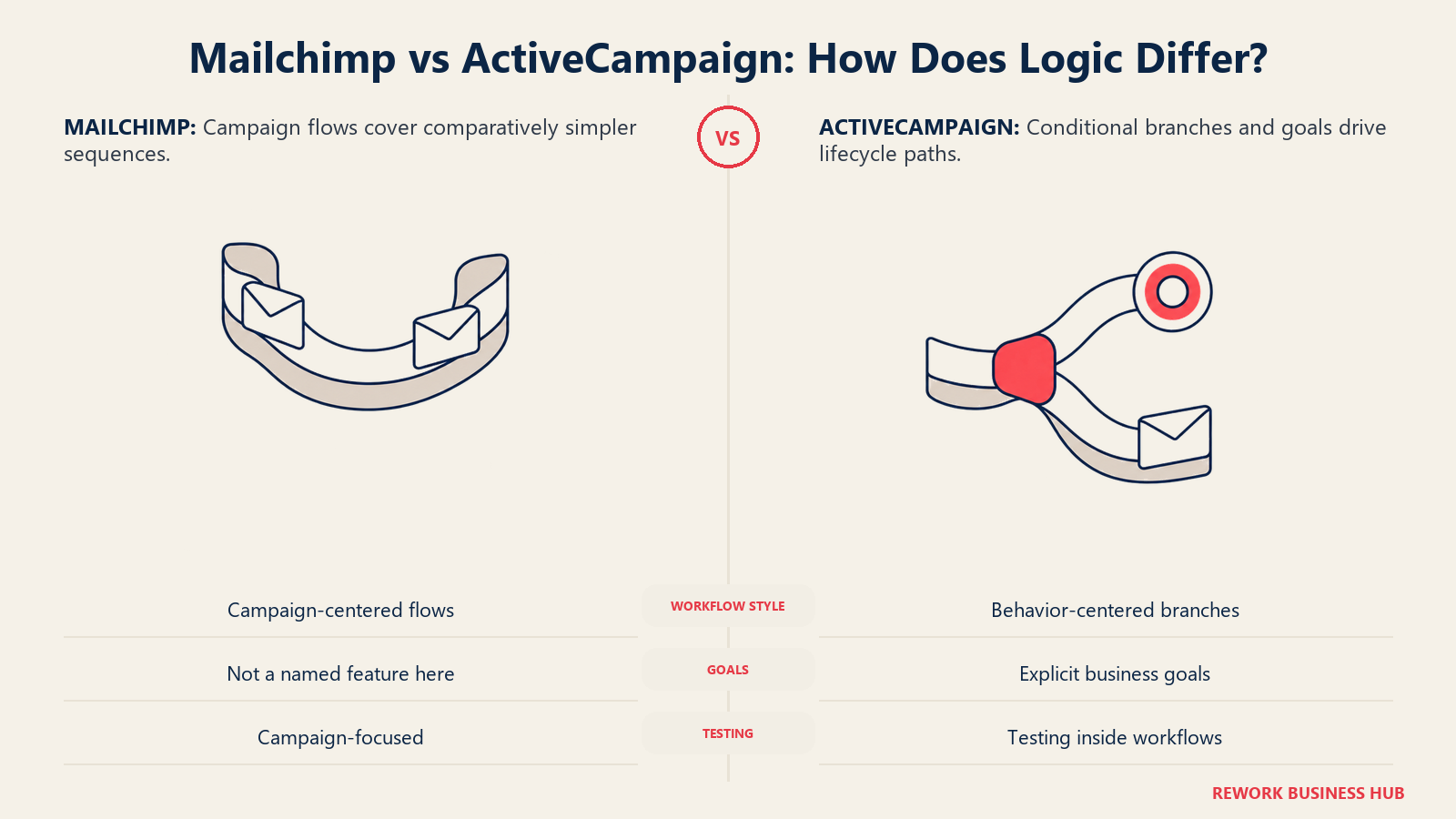
ActiveCampaign is built around exactly that branching. From the Plus tier up, automation actions are unlimited per workflow, and the builder supports conditional splits, wait steps tied to real time or behavior, and goals that track whether a contact actually did the thing the sequence was built to cause. Layered on top is Deals, ActiveCampaign's built-in CRM: pipeline stages, contact scoring, and a record that shows a sales rep exactly which emails a lead opened before they call. Mailchimp has nothing that competes with this, and it isn't trying to. If your team's real complaint about email tools is "marketing and sales can't see the same data," Mailchimp doesn't solve that at any tier. For a closer look at where AI is starting to run more of this segmentation and timing work on its own rather than just assisting with it, best AI agents for email marketing covers both platforms alongside nine others on exactly that question.
| Automation capability | Mailchimp | ActiveCampaign |
|---|---|---|
| Entry-tier automation | Essentials: about 4 steps per flow | Starter: 5 actions per workflow |
| Mid-tier automation | Standard/Premium: up to 200 flows | Plus and up: unlimited automation actions |
| Conditional branching | Basic, tier-dependent | Multi-branch if/then logic from Plus up |
| Goal-based tracking | Not a named feature | Yes, "Business Goals" tracked, 15 to 200 active goals by tier |
| Predictive send timing | Not standard | Yes, Pro and up |
| Split testing inside a workflow | Not standard | Yes |
| CRM capability | Mailchimp | ActiveCampaign |
|---|---|---|
| Contact database | Yes, all tiers | Yes, all tiers |
| Deal or pipeline stages | No | Yes, Deals CRM from Plus up, premium CRM on Pro/Enterprise |
| Lead or contact scoring | No | Yes |
| Sales-visible engagement history | Limited | Yes, opens and clicks surface on the contact and deal record |
| Custom objects | No | Enterprise tier only |
| Built for a marketing-to-sales handoff | No | Yes, that's the second half of the product |
Ecommerce and Template Quality
Mailchimp's other clear win is anything template- or commerce-driven. Its Shopify and WooCommerce integrations pull product feeds, cart events, and order history natively, and the predictive segmentation (purchase likelihood, predicted demographics) is genuinely ahead of what ActiveCampaign offers in the same tier range. If the job is sending a beautiful, on-brand campaign to segments built from real purchase data, Mailchimp does it with less setup.
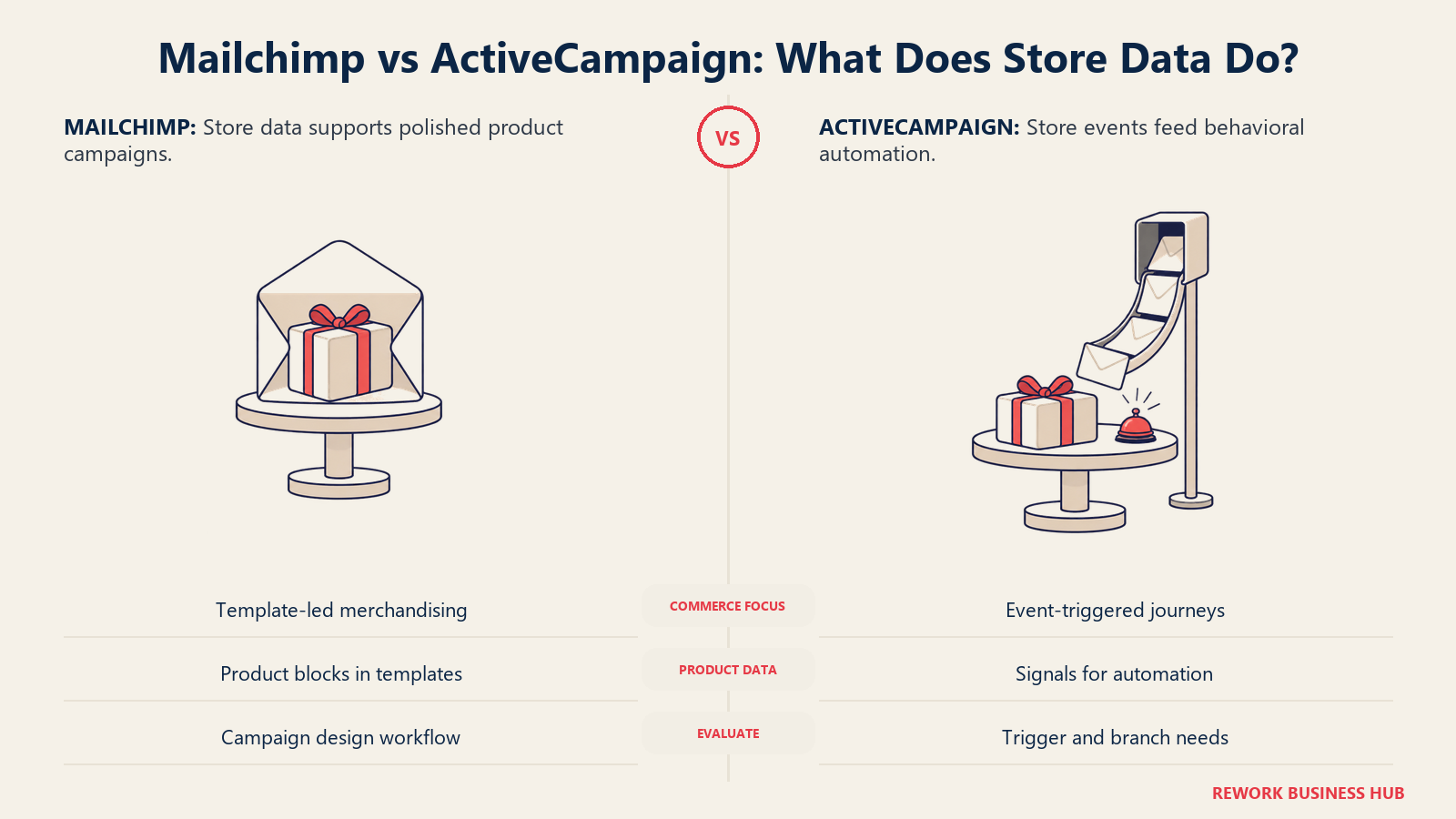
ActiveCampaign's ecommerce integrations are real too, standard on every tier and premium from Pro up, but they're built to feed automation triggers (an abandoned cart starts a sequence) rather than to make the campaign itself look better. Neither platform is the deepest option for e-commerce specifically; that's a different comparison. Brands whose main question is revenue attributed to a specific send, not template quality or automation logic, are usually better served by a platform built around that from the ground up. Best Klaviyo alternatives covers that field on its own terms.
| Ecommerce capability | Mailchimp | ActiveCampaign |
|---|---|---|
| Native Shopify/WooCommerce integration | Yes, deep, all paid tiers | Yes, standard on Starter/Plus, premium on Pro/Enterprise |
| Predictive demographics / purchase likelihood | Yes | Not a named feature |
| Abandoned cart flows | Yes, automation-driven | Yes, automation-driven |
| Product recommendation blocks in templates | Yes, template-native | Via automation and integration, less template-native |
| Revenue-per-campaign reporting | Basic | Basic, deeper on Pro/Enterprise via attribution and conversion tracking |
Pricing at Real List Sizes: 1,000, 10,000, and 50,000 Contacts
Every pricing page in this category leads with its cheapest number, and that number tells you almost nothing about what you'll actually pay once your list looks like a real business instead of a free trial. Both platforms meter primarily by contact count, so the numbers come from each vendor's own pricing calculator at three sizes: 1,000 contacts (a genuinely small list), 10,000 (where most growth-stage teams land), and 50,000 (a real mid-market list). The figures below are the regular, steady-state monthly rate, not a limited-time promotional number.
Mailchimp (monthly billing, contacts and monthly sends both metered):
| Contacts | Essentials | Standard | Premium |
|---|---|---|---|
| 1,000 | $26.50/mo | $45/mo | $350/mo |
| 10,000 | $110/mo | $135/mo | $350/mo |
| 50,000 | $385/mo | $450/mo | $815/mo |
ActiveCampaign (annual-billed monthly-equivalent rate, Email plan):
| Contacts | Starter | Plus | Pro | Enterprise |
|---|---|---|---|---|
| 1,000 | $15/mo | $49/mo | $79/mo | $145/mo |
| 10,000 | $149/mo | $189/mo | $375/mo | $589/mo |
| 50,000 | Not sold above 25,000 contacts | $609/mo | $969/mo | $1,169/mo |
Mailchimp bills monthly by default, with contact and send caps enforced per tier (overages are billed if you exceed either one), and it automatically applies a 15% discount for the first 12 months on accounts with 10,000 or more contacts, an incentive that doesn't show up in the steady-state numbers above. ActiveCampaign's public calculator shows only annual-committed pricing; there's no flat monthly-without-commitment number published for any tier, so budget for a higher figure if you don't want to commit for a year.
Line the two up by capability, not by tier name, and the story changes from the one most people assume going in:
| Contacts | Mailchimp Essentials | Mailchimp Standard | ActiveCampaign Starter | ActiveCampaign Plus |
|---|---|---|---|---|
| 1,000 | $26.50/mo | $45/mo | $15/mo | $49/mo |
| 10,000 | $110/mo | $135/mo | $149/mo | $189/mo |
| 50,000 | $385/mo | $450/mo | Not sold | $609/mo |
ActiveCampaign's cheapest tier, Starter, undercuts Mailchimp at 1,000 contacts ($15 against $26.50 for Essentials), but it's cheap because it does less: five actions per automation and none of the branching logic that's the actual reason to buy ActiveCampaign. By 10,000 contacts, Mailchimp Essentials ($110) is already cheaper than AC Starter ($149), and by 50,000 contacts Starter isn't sold at all; ActiveCampaign caps it at 25,000. Once you compare the tiers that actually deliver each platform's real pitch, automation-capable Standard against Deals-enabled Plus, Mailchimp is cheaper than ActiveCampaign at every size we tested: $45 against $49 at 1,000 contacts, $135 against $189 at 10,000, and $450 against $609 at 50,000. Even at the top, Mailchimp Premium runs behind ActiveCampaign Pro once your list clears 10,000 contacts ($350 against $375), and stays behind at 50,000 ($815 against $969).
That doesn't make ActiveCampaign the worse deal. It makes the real question sharper. Mailchimp isn't cheaper because it's a worse product, it's cheaper because it isn't trying to sell you a CRM and a branching automation engine. If you don't need those, paying ActiveCampaign's premium for them is pure waste, no matter how the entry-tier sticker price compares. If you do need them, and Mailchimp genuinely can't build the sequence you have in mind at any tier, ActiveCampaign's extra cost is the price of the one thing Mailchimp doesn't sell.
Implementation and Change Management
None of this automation depth is free in setup time, and that cost doesn't show up on either pricing page. Mailchimp's onboarding is close to frictionless: most teams send a first campaign within an hour of signing up, and the interface doesn't require anyone to learn a new mental model. ActiveCampaign asks more of you upfront. Building a correct multi-branch automation, the kind that actually justifies its price over Mailchimp, takes real time to get right, and teams commonly spend real hours, sometimes spread over a few weeks, getting their first one to behave the way they intended. That's not a knock on the product; it's the same tradeoff as any tool built around depth, the depth has to be configured before it pays off.
| Mailchimp | ActiveCampaign | |
|---|---|---|
| Time to first campaign send | Same day, typically under an hour | Same day for a basic broadcast |
| Time to first working automation | A few hours for a basic welcome series | Real setup time; a correctly built multi-branch sequence commonly takes weeks the first time |
| Who needs to be involved | One marketer | A marketer, plus whoever owns the sales handoff if you're using Deals |
| Training load | Minimal | Real, proportional to how much of the automation depth you actually use |
| Migrating in | Straightforward CSV import | Straightforward CSV import; pipeline and deal structure has to be modeled, not just imported |
Risk and Governance
Ownership and stability matter less here than in most B2B software categories, since both platforms are established and neither shows signs of an acquisition or shutdown risk. Mailchimp has been owned by Intuit since 2021, which brings financial stability but also explains some of the pricing and free-tier changes users have flagged since (the free tier now caps at 250 contacts, tighter than it was a few years ago). ActiveCampaign remains independently operated.
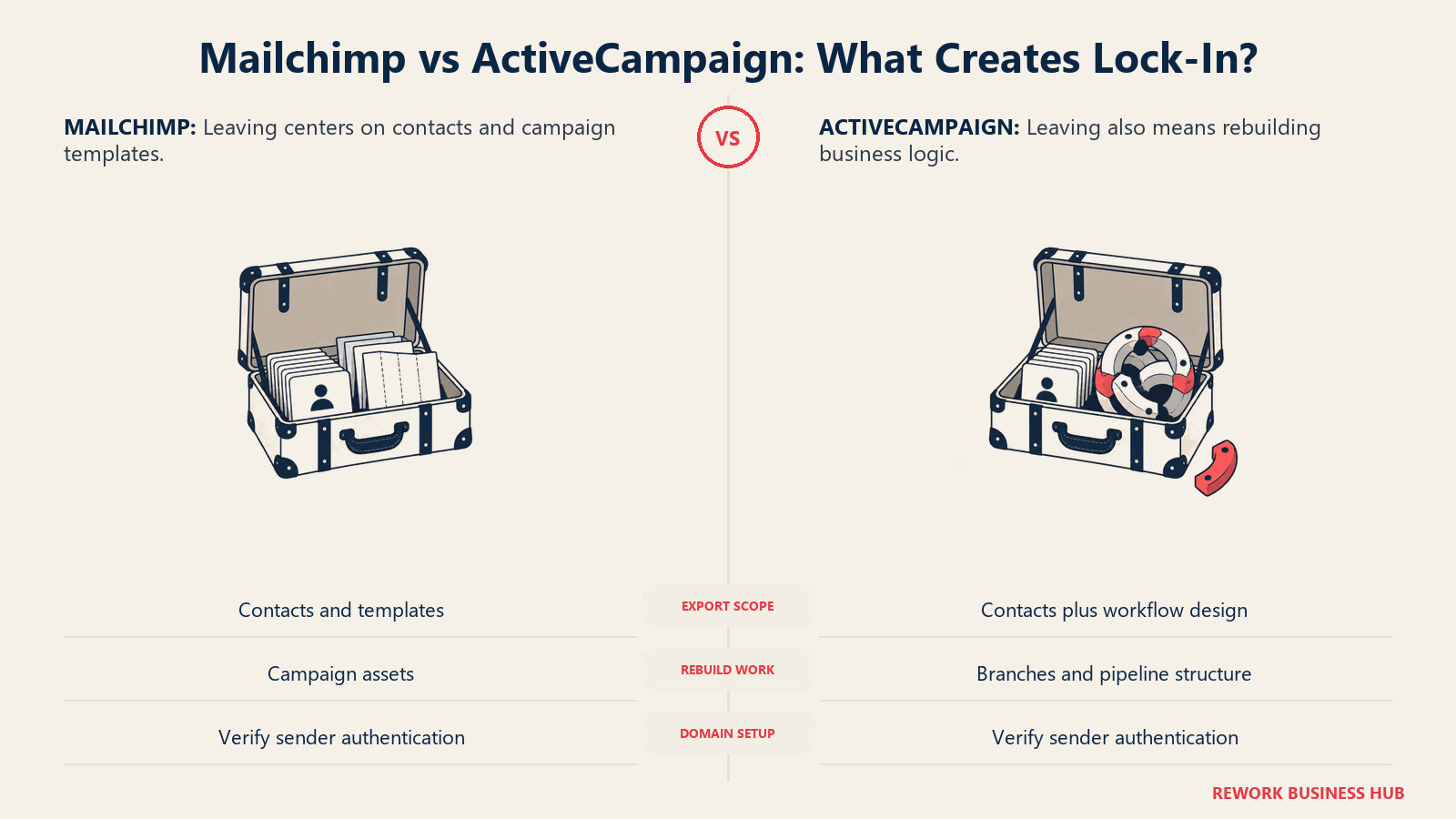
The more practical risk is lock-in, and it isn't symmetrical. Leaving Mailchimp mostly means exporting a contact list and rebuilding templates, a job of hours. Leaving ActiveCampaign after you've built real pipeline stages, lead scoring rules, and multi-branch automations in Deals means rebuilding actual business logic somewhere else, not just re-uploading a CSV. That's worth weighing before you invest deeply in the CRM side specifically, separate from the email side.
One governance point applies equally to both: neither platform authenticates your sending domain for you. Google has required bulk senders (5,000 or more messages a day) to publish SPF, DKIM, and a DMARC record since February 1, 2024, and Microsoft added a parallel requirement for Outlook.com senders at the same volume, effective May 5, 2025. That's DNS-level setup your team owns either way, regardless of which tool sends the mail.
| Mailchimp | ActiveCampaign | |
|---|---|---|
| Ownership | Owned by Intuit | Independently operated |
| Free tier | Yes, 250 contacts, 500 sends/month | No free tier, 14-day trial only |
| Sending domain authentication (SPF/DKIM/DMARC) | Your responsibility either way | Your responsibility either way |
| Data lock-in | Low; contact lists and templates export cleanly | Higher; pipeline stages and automation logic take real work to rebuild elsewhere |
| How overages are handled | Contact and send limits enforced, overages billed | Contact-tier based; moving up a bracket is the main lever |
When Mailchimp Is the Right Call
- Your actual job is sending a newsletter or promotional campaign that needs to look professional, not routing contacts through behavioral logic
- You're running an e-commerce brand on Shopify or WooCommerce and want predictive segmentation and abandoned-cart flows with minimal setup
- You want generative AI drafting and design help bundled into your plan instead of paid for separately
- Your list is small enough that Essentials or Standard genuinely covers what you need, and you'd rather not pay for CRM depth you won't touch
- Nobody on your team wants to own building and maintaining a multi-branch automation
If Mailchimp's automation ceiling, or the pricing and free-tier changes since the Intuit acquisition, are what's pushing you to look elsewhere, best Mailchimp alternatives covers 12 other platforms against the specific reasons teams leave.
When ActiveCampaign Is the Right Call
- Marketing and sales genuinely need to work off the same contact record, with pipeline stages and lead scoring, not just a shared spreadsheet export
- You're building sequences with real conditional logic (if this, wait for that, then branch a different way) that Mailchimp's flow builder can't express at any tier
- Someone on your team has the time to build and maintain automation properly, because a badly built branch is worse than no automation at all
- You want goal-based tracking that tells you whether an automation actually caused the outcome you built it for, not just whether it sent
- The premium over Mailchimp at your contact count is smaller than the value of the CRM and behavioral logic you'd otherwise pay to bolt on separately
If ActiveCampaign's tier-gated feature access or setup time is the sticking point rather than the automation depth itself, best ActiveCampaign alternatives covers 11 platforms built around similar behavior-triggered logic.
Decision Framework
| If you are... | Pick |
|---|---|
| A solo marketer or small team sending newsletters and simple promos | Mailchimp Essentials |
| A brand-focused team that wants AI-assisted drafting and design bundled in | Mailchimp Standard |
| An e-commerce brand prioritizing template quality and predictive segmentation | Mailchimp |
| A team that needs multi-branch, goal-based automation and has time for the setup | ActiveCampaign Plus or Pro |
| A team where marketing and sales need to share one contact record with a real pipeline | ActiveCampaign |
| Mainly deciding on price at your current list size | Model both plans at your real contact count; the ranking is not the same at every size |
| Comparing more than these two platforms | See the best email marketing software roundup |
The verdict: if the job is sending a good newsletter, Mailchimp does it cheaper and faster to learn at every list size we tested, including the automation-capable Standard tier. If the job is running lifecycle automation with a real pipeline behind it, ActiveCampaign is the only one of the two that actually does that, and its premium over Mailchimp is the cost of buying a capability Mailchimp doesn't sell at any price.
What to Do Next
Pull your actual contact count, not your target for next year, and run it through the tables above; the ranking between these two genuinely moves depending on where you sit today. If you're leaning Mailchimp, spend real time in the Standard tier specifically, since that's the plan that competes with ActiveCampaign on capability, not the cheaper Essentials tier most people default to first. If you're leaning ActiveCampaign, build one real multi-branch automation with your own contacts during the trial before you commit annually. The CRM and behavioral logic are the entire reason to pay its premium over Mailchimp at every size tested here, and if your team won't actually use that depth, you're paying for headroom you'll never touch.
For the buying framework behind this decision, not just these two vendors, how to choose email marketing software and how to choose marketing automation software both go deeper on evaluation criteria than a single head-to-head can cover.
Frequently Asked Questions about Mailchimp vs ActiveCampaign
Is Mailchimp or ActiveCampaign cheaper?
It depends on the tier you actually need, not the entry price. At 10,000 contacts, Mailchimp's automation-capable Standard plan runs $135 a month against ActiveCampaign's comparable Plus plan at $189, and Mailchimp stays cheaper at 1,000 and 50,000 contacts too. ActiveCampaign's cheapest tier, Starter, undercuts Mailchimp at very small list sizes, but it isn't sold at all above 25,000 contacts and lacks the automation depth ActiveCampaign is actually known for.
What's the real difference between Mailchimp and ActiveCampaign?
Mailchimp is built around designing and sending campaigns, with automation added on top. ActiveCampaign is built around behavior-triggered automation and a native CRM, with email as the channel most of that logic runs through. The decision usually comes down to whether your job is sending a good newsletter or running lifecycle sequences that react to what a contact does.
Does Mailchimp have a CRM?
Not in the way ActiveCampaign does. Mailchimp manages contacts and segments but has no deal pipeline, pipeline stages, or lead scoring. ActiveCampaign's Deals CRM, included from the Plus tier up, gives sales a pipeline and surfaces email engagement directly on the contact record.
Can I switch from Mailchimp to ActiveCampaign later, or the other way around?
Yes, and it's a common path as teams grow into needing automation depth or a CRM. Moving to ActiveCampaign means rebuilding your automation logic and pipeline structure, not just importing a contact list, since that logic doesn't exist in Mailchimp to migrate over. Moving from ActiveCampaign to Mailchimp is simpler, since you're moving to a less complex data model, but you'll lose whatever CRM and branching logic you built.
Which one is better for e-commerce?
Mailchimp has the edge on template-driven campaigns and predictive segmentation for Shopify and WooCommerce stores. ActiveCampaign's e-commerce integrations are real but built to feed automation triggers rather than to make campaigns look better. Neither is built specifically around revenue-per-send attribution the way a dedicated e-commerce platform is; see our Klaviyo alternatives guide if that's your actual priority.
Does ActiveCampaign's AI, Active Intelligence, cost extra?
It's included at every tier but with limits. Starter and Plus get Active Intelligence with usage limits, while Pro and Enterprise get unlimited access. Mailchimp bundles its generative AI features (drafting and design help) into Standard and Premium at no additional add-on cost, but not into Essentials.
What happens to pricing as my list grows on each platform?
Both bill primarily by contact count, and the gap moves as you scale. Mailchimp's Standard plan grows from $45 a month at 1,000 contacts to $450 at 50,000, a 10x increase for a 50x larger list. ActiveCampaign's Plus plan grows from $49 to $609 over the same range, a roughly 12x increase. Model your actual list size and projected growth against both vendors' calculators before committing to either.
Which one is easier to learn?
Mailchimp, by a wide margin, for anyone whose job is sending campaigns rather than building automation logic. Most teams send a first campaign within an hour of signing up. ActiveCampaign's interface isn't confusing on its own, but building a correct multi-branch automation, the kind that justifies its price over Mailchimp, takes real setup time regardless of how intuitive the builder is.

Principal Product Marketing Strategist
On this page
- TL;DR
- Key Facts
- What Each Tool Is Actually Built For
- Decision by Business Goal
- Team and Role Fit
- Automation Depth and the CRM Gap
- Ecommerce and Template Quality
- Pricing at Real List Sizes: 1,000, 10,000, and 50,000 Contacts
- Implementation and Change Management
- Risk and Governance
- When Mailchimp Is the Right Call
- When ActiveCampaign Is the Right Call
- Decision Framework
- What to Do Next