Best AI Agents for Email Marketing in 2026: 11 Platforms for Segments, Sends, and Journeys
Turn this article into takeaways for your work.


Each assistant summarizes the article only for you and suggests best practices for your work.
If revenue attribution to a specific send matters most, Klaviyo AI leads for ecommerce. If you're already on the world's most-used ESP and want AI layered in without switching, Mailchimp is the easy on-ramp. If you want the platform that most aggressively markets itself as autonomous, ActiveCampaign's Active Intelligence is built around that pitch. And if you want an agent extensible enough to write its own execution logic, Customer.io's AI Agent is the technical pick. This guide ranks 11 real platforms by how much of the segment-building, send-timing, and journey work their AI actually runs on its own, evaluated against each vendor's own pricing and product pages in August 2026, not a features list lifted from a sales deck.
This is specifically about agents that work an opted-in list: people who signed up for your newsletter, bought something, or filled out a form. That's a different job from cold outbound to people who never gave you their email address, where the legal exposure (consent law) and the deliverability math both work differently, so it isn't covered here. It's also a different job from managing your own inbox: if what's slowing you down is triaging and drafting your personal email, see best AI email tools instead. And if you just need to compare email service providers on templates, deliverability, and price without the AI angle, best email marketing software ranks the category more broadly. If none of these fit and you'd rather wire your own agent on top of your existing ESP and brand guide instead of buying one pre-built, the AI email marketing agent blueprint walks through building that from scratch.
For the broader agent-versus-tool distinction that applies well beyond email, and for how no-code and enterprise agent platforms fit alongside a lifecycle ESP's own AI, see best AI agent platforms, the pillar guide this roundup sits under.
What Changed in 2026
- "AI Agent" now has a name and a beta tag on most major ESPs, not just a chatbot bolted onto the compose window. Customer.io ships an "AI Agent (beta)" with configurable execution skills, Klaviyo has a beta Customer Agent alongside its Composer drafting tool, and Iterable rebuilt its AI layer under one brand, Nova, split into Insights, Decisioning, and Agents.
- Natural-language segmentation is now a real, testable feature, not a demo. Ortto's AI filters turn a typed sentence like "people in Europe" into a working audience filter, and several platforms now suggest segments from a plain-language prompt instead of requiring you to build the logic by hand.
- Google and Microsoft both now enforce authentication on bulk senders, and neither vendor's AI features get you out of that requirement. Google's rules have applied since February 2024; Microsoft's Outlook.com authentication requirement for senders of 5,000 or more messages a day took effect May 5, 2025. See the deliverability section below.
- Some platforms are opening their data to outside AI assistants instead of only building their own. Ortto ships a native MCP Server that lets an external assistant like Claude or ChatGPT read audiences and campaign performance directly, a different bet than keeping every AI interaction inside one vendor's chat window.
Key Facts
- Email marketing keeps beating every other channel on ROI: in Litmus's 2025 State of Email survey of nearly 500 marketing professionals, 30% of respondents reported $36 to $50 back for every dollar spent, and another 5% reported more than $50.
- That return is highest in retail and ecommerce specifically, at roughly 45:1, against 36:1 for software and technology companies, per the same Litmus survey, which is a large part of why ecommerce-focused platforms lead this list.
- Google requires bulk senders (5,000 or more messages a day to Gmail addresses) to keep spam complaint rates under 0.30% in Postmaster Tools, publish a DMARC record, and support one-click unsubscribe, effective since February 1, 2024, per Google's own sender guidelines.
- Microsoft extended a parallel authentication requirement (SPF, DKIM, and DMARC) to Outlook.com senders of 5,000 or more messages a day starting May 5, 2025; mail that fails is routed to the junk folder rather than rejected outright at first, per Microsoft's postmaster guidance at sendersupport.olc.protection.outlook.com.
- Enterprises buying ready-made AI instead of building it in-house rose from 53% in 2024 to 76% in 2025, a shift that shows up directly in this category as ESPs ship agent features rather than marketers hand-rolling their own, per Menlo Ventures' State of Generative AI in the Enterprise.
Quick Comparison Table
| Tool | Best For | Starting Price | Key Strength | Key Limitation |
|---|---|---|---|---|
| Klaviyo AI | Ecommerce brands wanting revenue attribution | Free (250 profiles); paid tiers priced by list size | Composer and Customer Agent tied to deep purchase-behavior data | Paid pricing needs a live calculator, no flat number |
| Mailchimp | SMBs wanting AI without switching ESPs | Free (250 contacts); AI included from $20/mo (Standard) | Massive install base, AI bundled at no extra add-on cost | AI leans drafting and design, not autonomous journeys |
| ActiveCampaign | Mid-market teams wanting the deepest automation logic | Contact-based, confirm at checkout | Markets itself as an "autonomous marketing platform" with AI agents | Full AI access gated to Pro and Enterprise tiers |
| Customer.io | Technical, product-led teams | Essentials: 5,000 profiles/1M emails, price on request | AI Agent with configurable "execution skills" | Requires comfort with data schemas and templating |
| Braze | Enterprise consumer apps at large scale | MAU and credit-based, quote only | BrazeAI Agent Console spans every channel on one bill | No public self-serve pricing at any size |
| Iterable | Enterprise teams wanting a decisioning layer first | Quote only | Nova Agents build and optimize journeys from behavioral signals | No public pricing to shortlist against |
| Bloomreach | Enterprise retail and commerce brands | Quote only | Loomi AI factors inventory and margin, not just engagement | Built around a product catalog; weak fit outside commerce |
| HubSpot Breeze | Teams already living inside HubSpot CRM | Free (2 seats); Professional from $800/mo (3 seats) | Breeze agents read the same contact record sales uses | You're paying for the whole Marketing Hub, not just email |
| Attentive | SMS-led DTC brands adding email | Usage-based, no public flat rate | AI Journeys coordinate SMS and email from one signal | Built SMS-first; email is the secondary channel |
| Ortto | Technical teams wanting outside AI wired to their data | Quote only, trial/demo | Native MCP Server plus natural-language AI filters | No public pricing at any tier |
| Omnisend | Budget-conscious ecommerce SMBs | Free (250 contacts); Standard $11.20/mo | Forms AI and Reports AI on every plan, even Free | AI still leans assistive; deeper personalization is Pro-only |
Agent or Assistant? What Each Platform's AI Actually Does
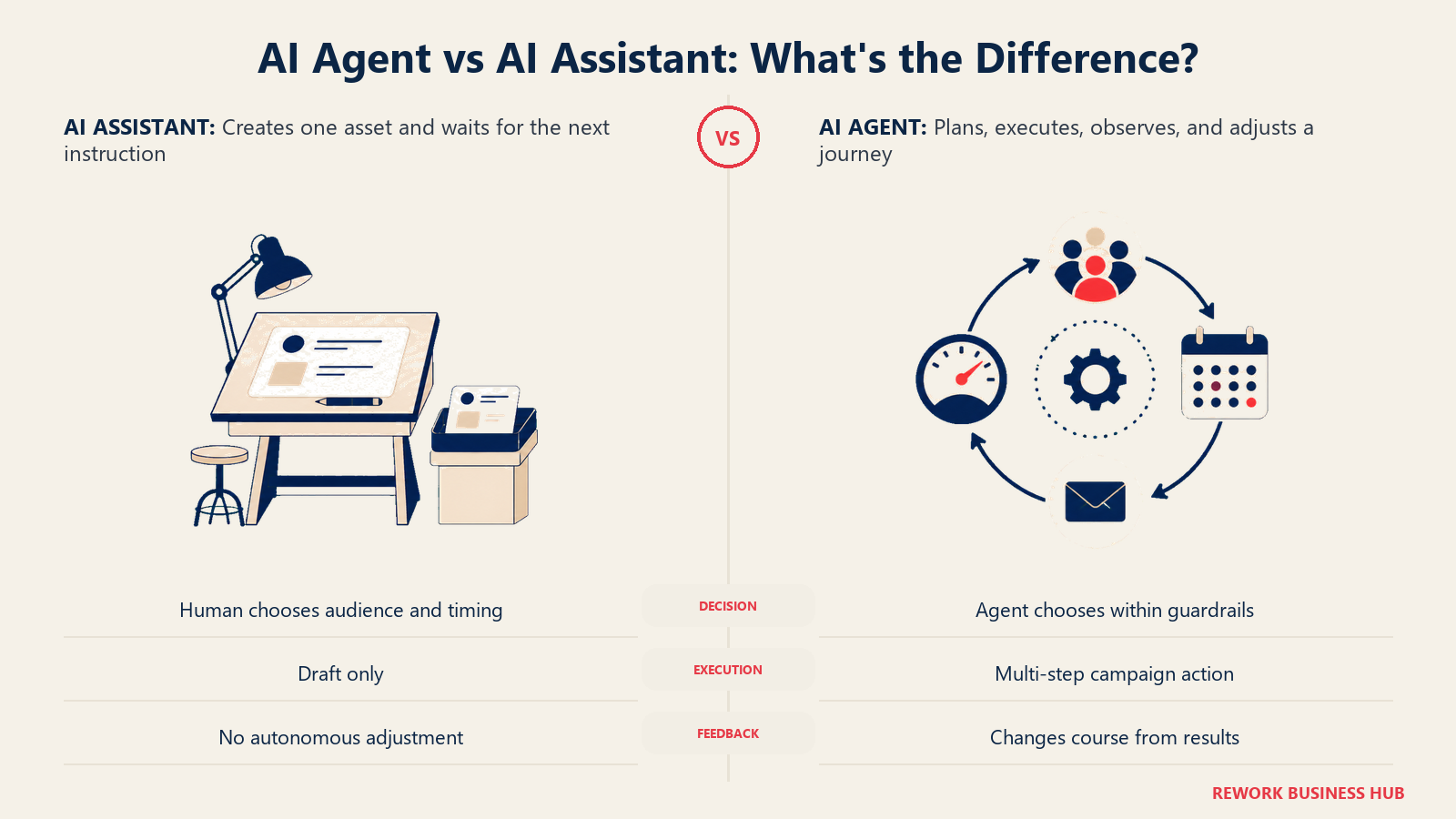
"AI-powered" gets stamped on nearly every ESP feature list now, and not all of it plans, executes, and adjusts on its own the way an agent does. Some of what's below is a real agent: it decides who gets an email, drafts it, times it, and can change course based on what happens. Some of it is still an assistant that drafts a paragraph and waits for you to take it from there. Both are useful, but they're not the same purchase, so here's what we could actually verify for each platform rather than what the marketing page implies.
| Platform | What the AI Does | Agentic or Assistive |
|---|---|---|
| Klaviyo AI | Composer drafts content; Customer Agent (beta) handles agentic, customer-facing tasks | Agentic (beta) |
| Mailchimp | Generates campaign content and design from a brief | Mostly assistive |
| ActiveCampaign | Suggests segments, predicts send times, self-described as autonomous agents | Agentic (vendor framing) |
| Customer.io | AI Agent executes defined "skills" and custom routines | Agentic (beta) |
| Braze | AI Operator and Agent Console act across channels via credits | Agentic |
| Iterable | Nova Agents build and optimize audiences, journeys, and campaigns | Agentic |
| Bloomreach | Marketing Agent runs and optimizes full campaigns with limited oversight | Agentic |
| HubSpot Breeze | Credit-funded agents act inside Marketing Hub workflows | Agentic (credit-gated) |
| Attentive | AI Journeys coordinate cross-channel sends from customer signals | Agentic (AI Journeys tier only) |
| Ortto | AI filters build segments from plain language; MCP Server lets outside agents act on the data | Agentic (segmentation and integration) |
| Omnisend | Forms AI and Reports AI assist; personalization automates at Pro and up | Mostly assistive, agentic elements at Pro+ |
If your ESP lands in the "mostly assistive" row above and that's not enough, the fix usually isn't switching ESPs, it's adding an agent layer on top of the one you have. A no-code AI agent builder can treat Mailchimp or Omnisend as one tool it calls (send the campaign, pull the report) while the actual planning and decision-making happens a layer up, which is often faster than waiting for your ESP's own roadmap to catch up.
How Pricing Actually Scales
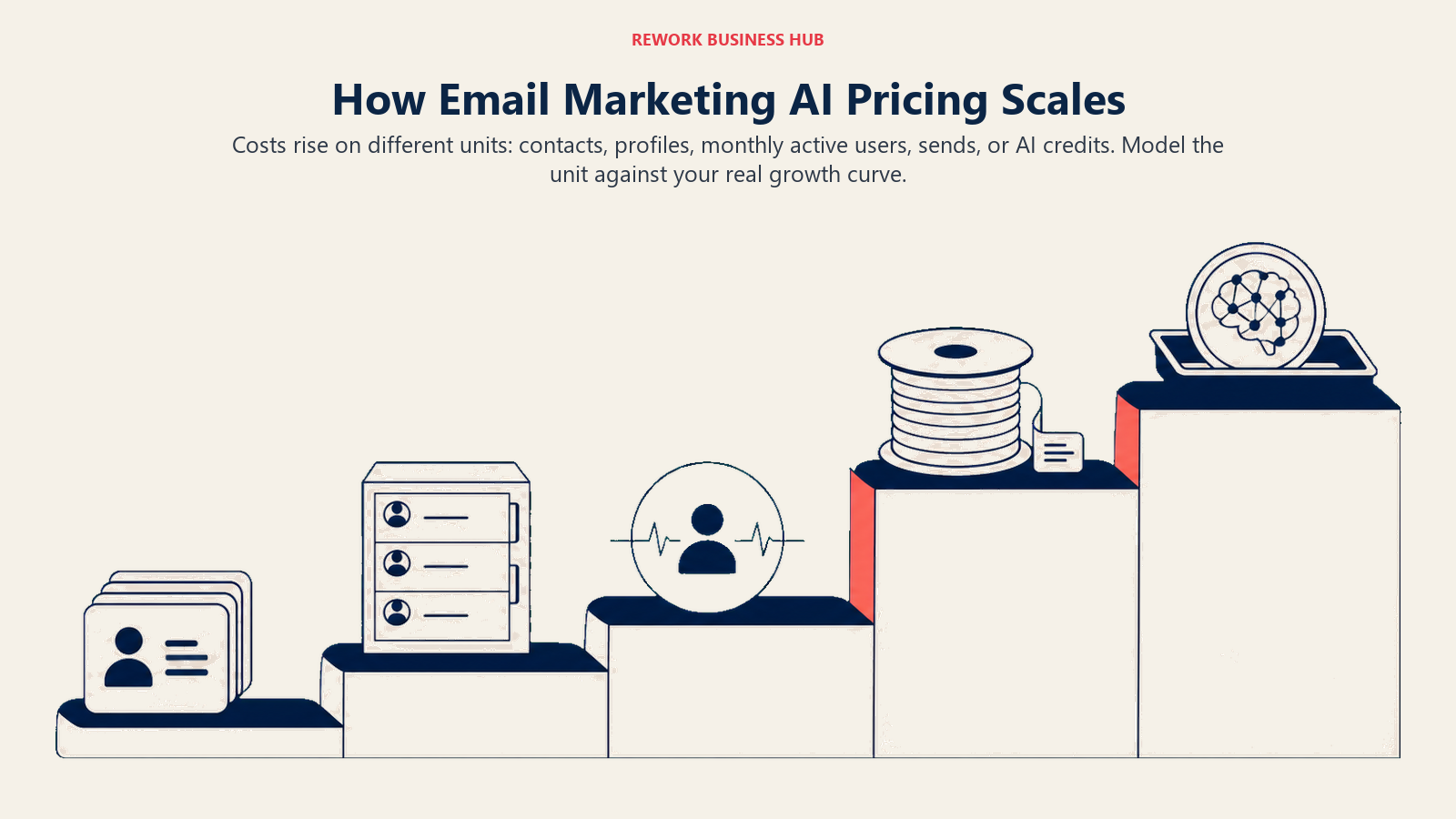
The real cost surprise in this category almost never shows up on the pricing page. It shows up six months later when your list crosses a threshold and the bill jumps a tier. Every platform below bills on a different unit, so "starting price" alone tells you less than the unit it's attached to.
| Platform | Billing Unit | Entry Point | What to Watch |
|---|---|---|---|
| Klaviyo AI | Profiles (contacts), via calculator | Free up to 250 profiles | No flat paid tier; recalculate as your list grows |
| Mailchimp | Contacts plus monthly sends | Free up to 250 contacts | Send caps (5,000 to 150,000/mo) can bind before contact caps do |
| ActiveCampaign | Contacts, tiered | Confirm at checkout | AI access itself is tier-gated, separate from the contact tier |
| Customer.io | Profiles plus emails plus AI credits | 5,000 profiles / 1M emails (Essentials) | Overage is metered: $0.009/profile, $0.12/1,000 emails, $10/100K AI credits |
| Braze | Monthly Active Users (MAU) plus credits | Quote-based | Credits are shared across every channel, including the Agent Console |
| Iterable | Not publicly disclosed | Quote-based | Ask specifically how Nova Agents usage is metered before signing |
| Bloomreach | Not publicly disclosed | Quote-based | Pricing conversations reportedly hinge on catalog size and channel count |
| HubSpot Breeze | Seats plus contacts plus Credits | Free (2 seats) | Extra AI credits cost $0.01 each once you exceed the plan allotment |
| Attentive | Messages, list size, channels, and which AI products you turn on | Usage-based | AI Journeys is priced pay-per-click, a different meter than the rest of the plan |
| Ortto | Not publicly disclosed | Trial/demo | No published unit at all; get a number before you assume a fit |
| Omnisend | Contacts plus emails; SMS billed separately | Free up to 250 contacts | SMS starts around $0.007/message and scales with volume |
Deliverability: What Google and Microsoft Now Require
An agent that writes and sends faster doesn't make your domain more trustworthy to an inbox provider. Authentication is still infrastructure you own, not something a vendor's AI configures for you by default, and both Google and Microsoft have raised the bar on it in the last two years.
| Requirement | Google (Gmail, 5,000+/day) | Microsoft (Outlook.com, 5,000+/day) |
|---|---|---|
| Authentication | SPF and DKIM required; DMARC required (policy can be set to p=none) |
SPF, DKIM, and DMARC all required |
| Spam complaint ceiling | Under 0.30% in Postmaster Tools | Not separately published; enforcement centers on authentication |
| Unsubscribe | One-click unsubscribe plus a visible link in the message body | Not separately specified in Microsoft's published guidance |
| Enforcement date | February 1, 2024 | May 5, 2025 |
| Consequence of failing | Higher spam foldering, potential rejection | Non-compliant mail routed to the junk folder |
None of the 11 platforms in this guide will authenticate your sending domain for you. That's still a DNS change you or your IT team make once, and it's worth doing before an AI agent starts sending on a schedule you're not personally watching.
Sizing and Persona Table
| Platform | Ideal Use Case | Primary Buyer Persona |
|---|---|---|
| Klaviyo AI | Ecommerce brands from first sale through scale | Ecommerce marketing lead, CRM manager |
| Mailchimp | SMBs and solo marketers, first real ESP | Founder, marketing generalist |
| ActiveCampaign | SMB to mid-market wanting deep automation | Marketing ops manager, growth marketer |
| Customer.io | Product-led SaaS and mobile apps | Lifecycle marketing manager, growth engineer |
| Braze | Enterprise consumer apps, millions of MAU | VP Marketing, martech lead |
| Iterable | Enterprise cross-channel programs | Head of Lifecycle Marketing, CRM director |
| Bloomreach | Enterprise retail and commerce | Director of Digital Commerce, CRM lead |
| HubSpot Breeze | SMB to enterprise, inbound-led | Marketing director, RevOps |
| Attentive | DTC and retail, SMS-first | Head of Retention Marketing |
| Ortto | SMB to mid-market, technical teams | Marketing ops lead, technical marketer |
| Omnisend | Budget-conscious ecommerce SMBs | Solo ecommerce marketer, small brand owner |
1. Klaviyo AI: Deepest Tie Between Agent Actions and Revenue Attribution
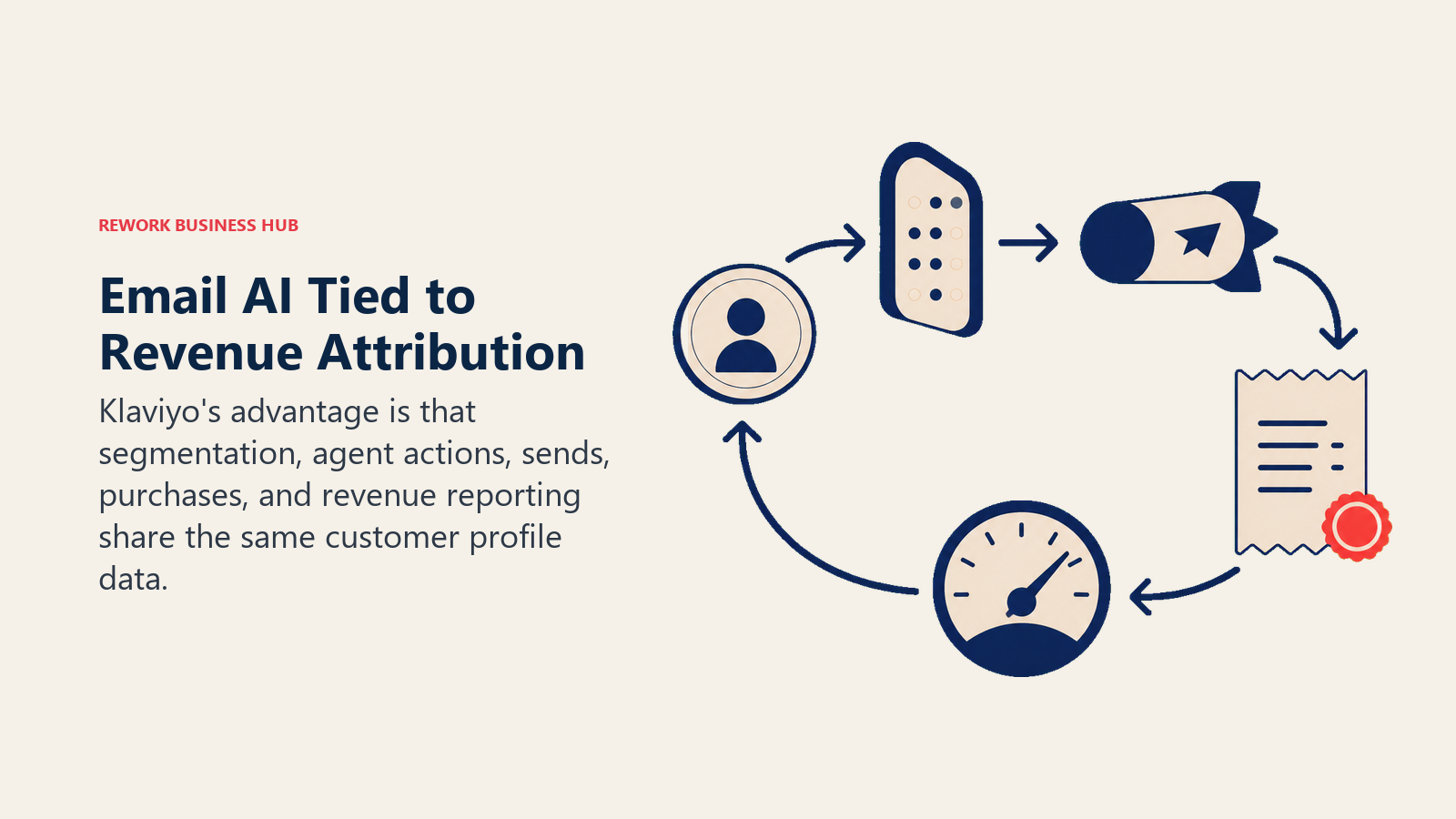
Klaviyo built its reputation on connecting every send to actual purchase data, and its AI layer inherits that advantage: Composer drafts campaign content and Customer Agent, now in beta, handles agentic customer-facing work grounded in the same profile data Klaviyo already uses for revenue reporting. For an ecommerce brand, that means the AI isn't reasoning over generic engagement signals, it's working from purchase history, browse behavior, and predicted lifetime value in one place.
But the tradeoff is pricing transparency. The Free plan is straightforward ($0 for up to 250 profiles and 500 email sends a month, with 10,000 Composer credits included even at that tier), but paid Email and Email+SMS plans price against your live contact count through a calculator rather than publishing flat tiers, so there's no single number to compare against a competitor's sticker price.
| What you get | What you don't |
|---|---|
| AI grounded in real purchase and revenue data | No flat paid-tier price; must use the live calculator |
| Composer and Customer Agent, both in beta at 30% off intro pricing | Beta discount pricing will not last |
| Free tier genuinely usable for a small list | Mobile messaging (SMS) billed as a separate credit pool |
Pricing: Free: $0/month (250 profiles, 500 email sends, $5/mo mobile credit). Paid Email and Email+SMS plans scale by contact count via Klaviyo's live calculator; no flat self-serve number is published independent of list size. Composer and Customer Agent are in beta as of August 2026 at 30% off eventual list pricing.
Best for: Ecommerce brands that want AI campaign and customer-facing work tied directly to the same data driving their revenue reporting.
If the calculator-based pricing or the ecommerce-first design isn't the fit, best Klaviyo alternatives covers the wider field on the non-AI axis.
2. Mailchimp: The Easiest On-Ramp for Teams Already on the Platform
Mailchimp's advantage isn't depth, it's reach. Millions of small businesses already run their email program through it, and its generative AI writing and design tools are now bundled into the Standard and Premium plans at no additional add-on cost, meaning a team doesn't need to evaluate and onboard a separate AI vendor to get campaign drafting help.
Where it's honest to be clear: Mailchimp's AI today is mostly drafting and design assistance rather than an agent that independently plans and runs a multi-step journey. It writes a strong first draft and helps with layout; a human is still assembling the sequence and deciding what happens next.
| What you get | What you don't |
|---|---|
| AI writing and design bundled at no extra add-on cost from Standard up | Not an autonomous journey agent, more of a drafting assistant |
| Free tier for small lists (250 contacts, 500 sends/mo) | Send caps can bind before contact caps do at lower tiers |
| Familiar platform most teams have already used | Premium jumps to $350/mo for unlimited-contact scale |
Pricing: Free: $0/month (250 contacts, 500 sends). Essentials: $13/month (500 contacts, 5,000 sends), no AI. Standard: $20/month (500 contacts, 6,000 sends), AI writing and design tools included. Premium: $350/month (unlimited contacts, quoted at 10,000; 150,000 sends), generative AI features included. Monthly billing shown; a 15% discount applies on 12-month commitments above 10,000 contacts.
Best for: SMBs and solo marketers who want AI content help without switching off the ESP they already know.
3. ActiveCampaign: The Platform That Calls Itself Autonomous
ActiveCampaign doesn't hedge on the framing: its own site describes itself as an "autonomous marketing platform" built around "AI agents," powered by what it calls Active Intelligence (now at version 2.8), which the company says "remembers every detail of your brand, learns from your top campaigns, and gets smarter every time you use it." That's a stronger agentic claim than most competitors make about themselves, backed by AI-suggested segments, predictive send timing, and an AI-assisted automation builder.
But the catch is access. Active Intelligence is available in a limited form on the Starter and Plus tiers, with unlimited access reserved for Pro and Enterprise, so the version of the platform most worth calling "autonomous" is also the more expensive one.
| What you get | What you don't |
|---|---|
| Vendor explicitly builds toward autonomous, agent-based marketing | Full AI access requires Pro or Enterprise, not the entry tiers |
| AI-suggested segments and predictive send timing | Flat pricing not published without selecting a contact count |
| Automation builder is genuinely mature, not a bolt-on | Billed annually by default on the public pricing page |
Pricing: Contact-based tiers (Starter, Plus, Pro, Enterprise); ActiveCampaign's pricing calculator did not return a flat dollar figure independent of a selected contact count, so confirm your number directly at activecampaign.com/pricing before comparing it to a competitor's headline price. Active Intelligence access is limited on Starter and Plus, unlimited on Pro and Enterprise.
Best for: Mid-market teams that want the deepest automation logic and are willing to pay for the tier where the AI framing is fully unlocked.
See best ActiveCampaign alternatives if the tier-gating on Active Intelligence doesn't line up with your budget.
4. Customer.io: An Agent You Can Extend With Custom Execution Skills
Customer.io's bet has always been that a lifecycle platform should be API-first and data-model-flexible rather than a fixed template. Its AI Agent, currently in beta, follows the same philosophy: lower tiers get "core execution skills," while Premium and Enterprise unlock "custom execution skills" and "Custom Routines," meaning a technical team can extend what the agent is allowed to do rather than being boxed into a vendor-defined feature set.
That flexibility comes with the same learning curve Customer.io has always had. Its whole design assumes comfort with data schemas, liquid templating, and event-based triggers, which is a real barrier for a marketer without engineering support.
| What you get | What you don't |
|---|---|
| AI Agent with configurable, extensible execution skills | Requires technical comfort with schemas and templating |
| Clear entry scope: 5,000 profiles and 1,000,000 emails on Essentials | Flat price for Essentials not published independent of a quote |
| Metered overage instead of a hard wall | AI credits are a separate line item ($10 per 100,000) |
Pricing: Essentials includes 5,000 profiles and 1,000,000 emails/month; exact monthly price requires a quote. Overage: $0.009 per additional profile, $0.12 per additional 1,000 emails, AI credits $10 per 100,000. Standard, Premium, and Enterprise scale up from there; Enterprise is fully custom.
Best for: Product-led and technical teams that want an AI agent they can extend with custom logic rather than a fixed feature set.
If the schema-and-templating learning curve is more than your team wants to take on, best Customer.io alternatives lists platforms with a gentler ramp.
5. Braze: One MAU-Based Bill for AI Across Every Channel
Braze's pitch to enterprise consumer brands is that a single Monthly Active User count, not a per-seat or per-contact number, should drive the bill, with a shared credit system spent across email, SMS, in-product messaging, and what it calls the BrazeAI Agent Console. For a brand with millions of app users, that's a materially different cost shape than a per-contact ESP.
But pricing is entirely a sales conversation. Braze publishes four editions (Go, Select, Pro, Enterprise) by name but no numbers, so this isn't a platform you shortlist by price; it's one you shortlist by scale and then get a quote.
| What you get | What you don't |
|---|---|
| One MAU-based bill instead of per-contact math at scale | Zero public self-serve pricing, sales conversation required |
| BrazeAI Agent Console spans every channel on one credit pool | Credit consumption across channels takes time to model upfront |
| Built for enterprise governance and scale from day one | Overkill and likely priced out of reach for a small list |
Pricing: Four editions (Go, Select, Pro, Enterprise), priced on Monthly Active Users plus a cross-channel credit system; no public self-serve numbers. Get pricing directly from Braze's sales team.
Best for: Enterprise consumer apps with millions of MAU that want one usage-based bill instead of per-seat or per-contact pricing.
6. Iterable: Nova Agents Reason Over Behavioral Signals Before They Act
Iterable rebuilt its AI story in 2026 under a single brand, Nova, split into three parts: Nova Insights surfaces performance signals, Nova Decisioning evaluates behavioral data to pick the next best action, and Nova Agents handles the actual work of building and optimizing audiences, journeys, and campaigns. The layered structure is deliberate: decisions get reasoned through Insights and Decisioning before an Agent acts on them, rather than one model doing everything at once.
Like Braze, none of this comes with a public price tag. Iterable has long sold on a quote basis, and Nova doesn't change that.
| What you get | What you don't |
|---|---|
| A layered AI stack: insight, decisioning, then agent action | No public pricing at any size |
| Nova Agents optimize audiences, journeys, and campaigns together | Enterprise sales process, not a self-serve signup |
| Strong fit for teams that already think in behavioral data | Overkill for a team without an existing data/event pipeline |
Pricing: Not publicly listed; quote-based. Ask specifically how Nova Agents usage is metered relative to your existing send volume before signing.
Best for: Enterprise teams that want a dedicated decisioning layer reasoning over behavioral data before an agent builds or adjusts a journey.
7. Bloomreach: The Only Platform Weighing Inventory and Margin, Not Just Engagement
Bloomreach's Loomi AI includes what it calls a Marketing Agent that builds, runs, and optimizes campaigns with limited manual intervention, coordinating email, SMS, and in-app messaging through Journey Orchestration across more than 17 channels. The genuinely distinct part is that Bloomreach markets this as "business-aware": the AI factors in inventory levels, margin, and pricing alongside customer behavior before it decides what to send, which matters a great deal if you're a retailer and not at all if you're not.
But that commerce-first design is also the limitation. Outside retail and ecommerce, the inventory- and margin-aware angle has nothing to attach to, and pricing isn't published, so this is a demo-first evaluation either way.
| What you get | What you don't |
|---|---|
| AI that factors inventory and margin, not just engagement | Built around a product catalog; weak fit outside commerce |
| Journey Orchestration across 17+ channels from one signal | No public pricing; demo required to get a number |
| Real-time personalization triggered by purchase intent | Enterprise sales cycle, not a fast self-serve start |
Pricing: Not publicly listed; demo and quote-gated. Pricing conversations reportedly scale with catalog size and channel count; confirm directly with Bloomreach.
Best for: Enterprise retail and commerce brands that want AI weighing inventory and margin before it decides what to send.
Braze, Iterable, and Bloomreach all sell into the same procurement motion: a security review, a governance checklist, and a quote, not a self-serve signup. If you're running that evaluation alongside other AI purchases at the same time, best enterprise AI agent platforms covers the procurement and security-review angle across categories beyond just email.
8. HubSpot Breeze: Campaign Agents That Read the Same Record Sales Uses
HubSpot's advantage for a team already running its CRM is that Breeze agents act on the same contact record the sales team sees, funded by a shared HubSpot Credits system rather than a separate AI add-on SKU. HubSpot's own language is direct about the mechanism: "HubSpot Credits provide a simple, flexible way to power AI agents and features that deliver work."
The cost structure is layered and worth reading closely. Professional and Enterprise both carry one-time onboarding fees on top of the monthly seat and credit pricing, and HubSpot's own pricing page lists the Starter tier at two different figures, $7 and $20 per seat/month, under separate billing toggles that weren't clearly distinguished, so confirm the current number at signup rather than trusting either figure blind.
| What you get | What you don't |
|---|---|
| Breeze agents read the same contact record sales already uses | Starter tier's monthly-vs-annual pricing wasn't clearly split; confirm at signup |
| Free tier available (2 seats) to start | Professional and Enterprise both carry one-time onboarding fees |
| Credits fund AI usage flexibly across Marketing Hub features | You're buying the whole Marketing Hub context, not email alone |
Pricing: Free: $0/month (2 seats). Starter: listed at $7/mo/seat and $20/mo/seat under different billing toggles (1,000 contacts, 500 Credits); confirm at signup. Professional: $800/month billed monthly or $890/month on an annual commitment (3 core seats, additional seats $45/mo; 2,000 contacts, 3,000 Credits; plus a one-time $3,000 onboarding fee). Enterprise: from $3,600/month (5 core seats, additional seats $75/mo; 10,000 contacts, 5,000 Credits; plus a one-time $7,000 onboarding fee). Extra Credits cost $0.01 each beyond your plan's allotment.
Best for: Teams already running HubSpot CRM that want campaign agents working from the same contact data as sales.
9. Attentive: AI Journeys Built for SMS-Led Brands That Also Send Email
Attentive built its name on SMS, and that shows in how its AI is packaged: AI Essentials (copy generation, automated retargeting) comes free with every plan, AI Pro and AI Grow are flat monthly add-ons for predictive optimization and sign-up automation, and AI Journeys, its most agentic tier, is priced pay-per-click and explicitly coordinates cross-channel journeys automatically rather than triggering one channel at a time.
For a retail or DTC brand that already treats SMS as a primary channel, folding email into the same AI Journeys logic is a real advantage. For an email-only team, Attentive's pricing gravity and product design both assume SMS is doing at least as much work as email, which may not match your program.
| What you get | What you don't |
|---|---|
| AI Journeys coordinate SMS and email from one customer signal | Product and pricing are built SMS-first, email second |
| Usage-based pricing, no credit system to manage | Most AI tier pricing (Pro, Grow) not published |
| Free AI Essentials included on every plan | Bundling discounts require adopting multiple channels |
Pricing: Usage-based, priced on message volume, subscriber list size, channel count, and which AI products you enable; no flat published rate. AI Essentials is included free on every plan; AI Journeys is billed pay-per-click; Enterprise bundles all channels plus the full AI suite under a custom quote.
Best for: SMS-led DTC and retail brands that want email coordinated inside the same AI Journeys as text.
10. Ortto: Natural-Language Segments and a Direct Line for Outside AI Assistants
Ortto's most distinct feature isn't a chatbot, it's a native MCP Server that gives an external AI assistant like Claude or ChatGPT secured, direct access to Ortto's contact data, audiences, and campaign performance, letting a team reason over their marketing data from whichever assistant they already use rather than a walled-off vendor chat window. Layered on top, AI filters turn a typed sentence like "people in Europe" into a working segment, and AI decision shapes score how well a contact matches a journey's targeting criteria as they move through it.
None of that comes with a published price. Ortto requires a trial signup or a demo to get a number, so it's a platform you test on your own data before you know what it costs.
| What you get | What you don't |
|---|---|
| Native MCP Server for outside AI assistants to act on your data | No public pricing at any tier |
| Natural-language AI filters for segment building | Requires a trial or demo before you see a number |
| AI-drafted subject lines with open-rate prediction | Smaller brand recognition than the enterprise names on this list |
Pricing: Not publicly listed; requires a trial signup or demo. Get a quote before assuming a fit against a competitor's published price.
Best for: Technical marketing teams that want to point their own AI assistant at their marketing data through MCP rather than stay locked inside one vendor's interface.
11. Omnisend: The Budget Pick for Ecommerce SMBs
Omnisend's AI today is genuinely useful but honestly more assistive than autonomous: Forms AI helps build higher-converting sign-up forms and Reports AI surfaces insights from your data, both included on every plan including Free. More automated personalization and advanced segmentation are reserved for the Pro and Custom tiers, where the platform starts making more decisions on its own rather than just assisting with the ones you make.
What Omnisend does well is price. A usable Free tier and a $11.20/month entry paid tier make it accessible to a brand that isn't ready to pay enterprise rates just to get AI-assisted forms and reporting.
| What you get | What you don't |
|---|---|
| Genuinely affordable entry point ($11.20/mo Standard) | AI leans assistive; deeper personalization is Pro-only |
| Forms AI and Reports AI included even on Free | Unlimited emails require the $41.30/mo Pro tier |
| SMS available from $0.007/message if you want to add it | Not built for the deep autonomous journey logic bigger brands want |
Pricing: Free: $0/month (250 contacts, 500 emails, 500 web push). Standard: $11.20/month (6,000 emails/mo, unlimited web push). Pro: $41.30/month (unlimited emails; SMS from $0.007/message). Custom: tailored for high-volume senders, with a dedicated account expert included once monthly spend passes $400. Prices shown are monthly billing.
Best for: Budget-conscious ecommerce SMBs that want AI-assisted forms and reporting without an enterprise price tag.
Outgrown the assistive tier and want to compare beyond Omnisend on price alone? Best Omnisend alternatives picks up from there.
Email Marketing AI Buying Mistakes to Avoid
Most of the mistakes in this category show up months after signup, not during the demo.
| Mistake | What It Looks Like | What to Do Instead |
|---|---|---|
| Buying the AI tier before you need it | Paying for Pro-level Active Intelligence on a 2,000-contact list with one segment | Match the AI tier to when segmentation complexity actually shows up |
| Assuming "agent" means unsupervised sending | Letting a beta AI Agent send to the full list with no review step | Keep a human approval gate until the agent's track record on your own list is proven |
| Ignoring authentication until a send gets junked | Finding out about DMARC only after Outlook starts foldering campaigns | Set up SPF, DKIM, and DMARC before you cross 5,000 sends a day, not after |
| Pointing a lifecycle agent at a cold list | Using an opted-in-list platform for purchased or scraped contacts | These platforms and their deliverability reputations assume consent; treat cold outreach as a separate problem |
| Repeating a vendor's lift number with no source | Citing "40% higher open rates" in a planning doc with no citation | Ask whether the figure is independently audited or vendor-reported, and label it either way |
| Not modeling the bill at next year's list size | Budgeting off today's contact count only | Price your shortlist at your list size today and at a realistic size 12 months out |
| Picking the platform before the channel mix | Choosing an email-first tool when SMS is half the real program | Match the platform to where the program is actually headed, not just where it is now |
| Skipping a real test of natural-language segmentation | Assuming "AI filters" will understand your specific data model | Test the segment builder on your own awkward, multi-condition segment before buying |
How to Choose: Decision Framework
| If you need... | Pick... | Why |
The matrix maps eleven platforms to materially different buying needs rather than one generic email job.
 |---|---|---|
| Revenue attribution tied directly to AI-driven sends | Klaviyo AI | Composer and Customer Agent work from the same purchase data as revenue reporting |
| AI without switching off the ESP you already use | Mailchimp | AI writing and design bundled into Standard and Premium at no extra cost |
| The platform that markets itself as fully autonomous | ActiveCampaign | Active Intelligence is built and sold as an agentic marketing platform |
| An AI agent you can extend with custom logic | Customer.io | Configurable execution skills and Custom Routines for technical teams |
| One MAU-based bill across every channel at enterprise scale | Braze | BrazeAI Agent Console spans channels on a shared credit pool |
| A dedicated decisioning layer before an agent acts | Iterable | Nova Insights and Decisioning reason over behavior before Nova Agents act |
| AI that factors inventory and margin, not just engagement | Bloomreach | Loomi AI is explicitly business-aware for retail and commerce |
| Campaign agents grounded in the same CRM record as sales | HubSpot Breeze | Breeze agents run on HubSpot Credits inside Marketing Hub |
| SMS and email coordinated by one agent | Attentive | AI Journeys explicitly coordinates cross-channel sends automatically |
| Your own AI assistant wired directly to your marketing data | Ortto | Native MCP Server plus natural-language AI filters |
| The lowest-cost real AI-assisted ESP | Omnisend | Usable Free tier, $11.20/mo entry paid tier, Forms and Reports AI included |
|---|---|---|
| Revenue attribution tied directly to AI-driven sends | Klaviyo AI | Composer and Customer Agent work from the same purchase data as revenue reporting |
| AI without switching off the ESP you already use | Mailchimp | AI writing and design bundled into Standard and Premium at no extra cost |
| The platform that markets itself as fully autonomous | ActiveCampaign | Active Intelligence is built and sold as an agentic marketing platform |
| An AI agent you can extend with custom logic | Customer.io | Configurable execution skills and Custom Routines for technical teams |
| One MAU-based bill across every channel at enterprise scale | Braze | BrazeAI Agent Console spans channels on a shared credit pool |
| A dedicated decisioning layer before an agent acts | Iterable | Nova Insights and Decisioning reason over behavior before Nova Agents act |
| AI that factors inventory and margin, not just engagement | Bloomreach | Loomi AI is explicitly business-aware for retail and commerce |
| Campaign agents grounded in the same CRM record as sales | HubSpot Breeze | Breeze agents run on HubSpot Credits inside Marketing Hub |
| SMS and email coordinated by one agent | Attentive | AI Journeys explicitly coordinates cross-channel sends automatically |
| Your own AI assistant wired directly to your marketing data | Ortto | Native MCP Server plus natural-language AI filters |
| The lowest-cost real AI-assisted ESP | Omnisend | Usable Free tier, $11.20/mo entry paid tier, Forms and Reports AI included |
What to Do Next
Pick two platforms whose pricing unit actually matches your list, not just the two with the best AI pitch. Then run each one's natural-language segment builder against a real, messy segment from your own data, the kind with three overlapping conditions you'd normally build by hand, and check whether what it produces matches what you'd have built yourself. That test tells you more about whether the AI is actually agentic for your use case than any comparison table, including this one. While you're evaluating, confirm your domain's SPF, DKIM, and DMARC records are already in shape for Google and Microsoft's bulk-sender rules; that's infrastructure no AI agent here will set up for you.

Principal Product Marketing Strategist
On this page
- What Changed in 2026
- Key Facts
- Quick Comparison Table
- Agent or Assistant? What Each Platform's AI Actually Does
- How Pricing Actually Scales
- Deliverability: What Google and Microsoft Now Require
- Sizing and Persona Table
- 1. Klaviyo AI: Deepest Tie Between Agent Actions and Revenue Attribution
- 2. Mailchimp: The Easiest On-Ramp for Teams Already on the Platform
- 3. ActiveCampaign: The Platform That Calls Itself Autonomous
- 4. Customer.io: An Agent You Can Extend With Custom Execution Skills
- 5. Braze: One MAU-Based Bill for AI Across Every Channel
- 6. Iterable: Nova Agents Reason Over Behavioral Signals Before They Act
- 7. Bloomreach: The Only Platform Weighing Inventory and Margin, Not Just Engagement
- 8. HubSpot Breeze: Campaign Agents That Read the Same Record Sales Uses
- 9. Attentive: AI Journeys Built for SMS-Led Brands That Also Send Email
- 10. Ortto: Natural-Language Segments and a Direct Line for Outside AI Assistants
- 11. Omnisend: The Budget Pick for Ecommerce SMBs
- Email Marketing AI Buying Mistakes to Avoid
- How to Choose: Decision Framework
- What to Do Next