Best Jira Service Management Alternatives in 2026: 15 ITSM Platforms Without the Premium Upgrade
Turn this article into takeaways for your work.


Each assistant summarizes the article only for you and suggests best practices for your work.
Most teams do not leave Jira Service Management because it is bad. Atlassian was named a Leader in the 2026 Gartner Magic Quadrant for IT Service Management Platforms, and for a shop already running Jira for development work, JSM is the path of least resistance. Teams leave for a narrower reason: on 16 October 2024, Atlassian moved change management, problem management and the advanced parts of incident management out of the Free and Standard plans and into Premium and Enterprise. If an auditor asks you for a change approval workflow and you are on Standard, the answer is a plan upgrade for every agent, not a settings toggle.
This guide covers 15 alternatives for teams that hit that wall, teams whose agent count has outgrown progressive per-seat pricing, and teams that want ITIL practice depth without a tier jump. Tools are evaluated on which practices are included at the entry tier, the billing basis (this category mixes per agent, per technician, per admin, per endpoint, flat bundles, GBP and EUR), and whether the tool keeps a real link back to a development backlog, since that link is usually why the team was on JSM in the first place. Comparing the wider IT tooling stack rather than replacing one tool? Start with Best SaaS Management Software in 2026.
Key Facts
- The global ITSM market was valued at $11.91 billion in 2024 and is projected to grow from $13.58 billion in 2025 to $36.78 billion by 2032, a 15.3% CAGR. (Fortune Business Insights)
- Effective 16 October 2024, Atlassian moved change management, problem management and advanced incident management (conference calls, chat tools, major incidents, post-incident reviews) out of Jira Service Management Free and Standard and into Premium and Enterprise. Free and Standard keep the incident work category, incident queues, alerts and on-call schedules. (Atlassian)
- ServiceNow made a comparable move in April 2026, retiring five legacy ITSM tiers for three AI-native ones (Foundation, Advanced, Prime). Foundation covers incident, request, asset and cost, while problem and change management sit in Advanced. (ServiceNow Community)
- Atlassian was named a Leader in the 2026 Gartner Magic Quadrant for IT Service Management Platforms, published 27 July 2026 by Rich Doheny and Jen Lichucki. (Atlassian)
- Atlassian states that Jira Service Management is trusted by over 60,000 organizations worldwide, a vendor claim rather than an independent count. (Atlassian)
Quick Comparison Table
| Tool | Best For | Starting Price (basis and billing labeled) | Key Strength | Key Limitation |
|---|---|---|---|---|
| Freshservice | The closest like-for-like cloud ITSM swap | Starter $19/agent/mo, annual billing (no monthly rate published) | Full ITIL practice set without an enterprise contract | No free plan at any headcount |
| HaloITSM | Teams that want every practice on one flat rate | £66/agent/mo (GBP), billed annually | No tiers, no bolt-ons, nothing gated behind an upgrade | Headline pricing is GBP, so US buyers convert |
| InvGate Service Management | Small IT teams priced out by per-seat maths | $1,499/year fixed price (Starter), billed annually | Cheapest full ITSM entry point verified here | Publishes annual prices only, no monthly rate |
| ManageEngine ServiceDesk Plus | Value buyers and on-premises shops | From US$13/technician/mo (on-premises Standard) | Free edition for up to 5 technicians | Cloud and on-premises are quoted separately |
| ServiceNow | The enterprise ITSM ceiling | Quote-only, no published list price | Deepest platform, workflow and integration depth | Foundation tier excludes problem and change, the same trap |
| SysAid | Mid-market teams that want AI without an add-on line | $89/agent/mo, AI included | No usage caps and no separate AI surcharge | One published tier, so there is no cheap starting rung |
| SolarWinds Service Desk | ITSM tied to discovery-driven asset management | Essentials $39/agent/mo billed annually (reported) | Asset discovery wired straight into tickets | Advanced and Premier tiers are not publicly priced |
| TOPdesk | Service management beyond IT (HR, facilities) | Essential £51/agent/mo (GBP) | One service desk shared across departments | GBP headline pricing, 50+ agents routed to sales |
| Ivanti Neurons for ITSM | Regulated shops needing on-premises or hybrid | Quote-only, no published price | 14 ITIL 4 certified practices, any deployment model | No self-serve pricing and no public trial |
| Siit | Internal IT that lives in Slack or Teams | Essentials $23/admin/mo, billed annually | Unlimited employees, you pay only for admins | Lighter on formal change and problem practice |
| Atera | Teams managing endpoints and tickets together | From $149/technician/mo annual, $169 monthly (reported) | Unlimited devices per technician | Expensive per seat, cheap per endpoint |
| Zendesk | Teams whose real job is customer support | Suite Team $55/agent/mo billed annually (reported) | Best-in-class customer-facing ticketing | Not an ITIL ITSM platform |
| Jitbit Helpdesk | Small teams that refuse per-seat pricing | Freelancer $29/mo flat (1 agent); Startup $69/mo (4 agents) | Flat plans by agent bucket, self-hosted option exists | A help desk, not an ITSM suite |
| Spiceworks Cloud Help Desk | Zero-budget internal IT | Free ad-supported Core; Premium about $5/seat/mo annual (reported) | A genuinely free cloud help desk still shipping | Free tier is ad-supported and cloud-only |
| GLPI | Open-source shops with in-house Linux skill | Free self-hosted core; GLPI Network cloud from €19/user/mo (EUR) | Full asset management plus ITSM with no licence cost | You own hosting, upgrades and security |
What Actually Changed in Jira Service Management
The packaging change is the single most useful buying fact about JSM, and almost no competing comparison page carries it. Here is what moved and what stayed.
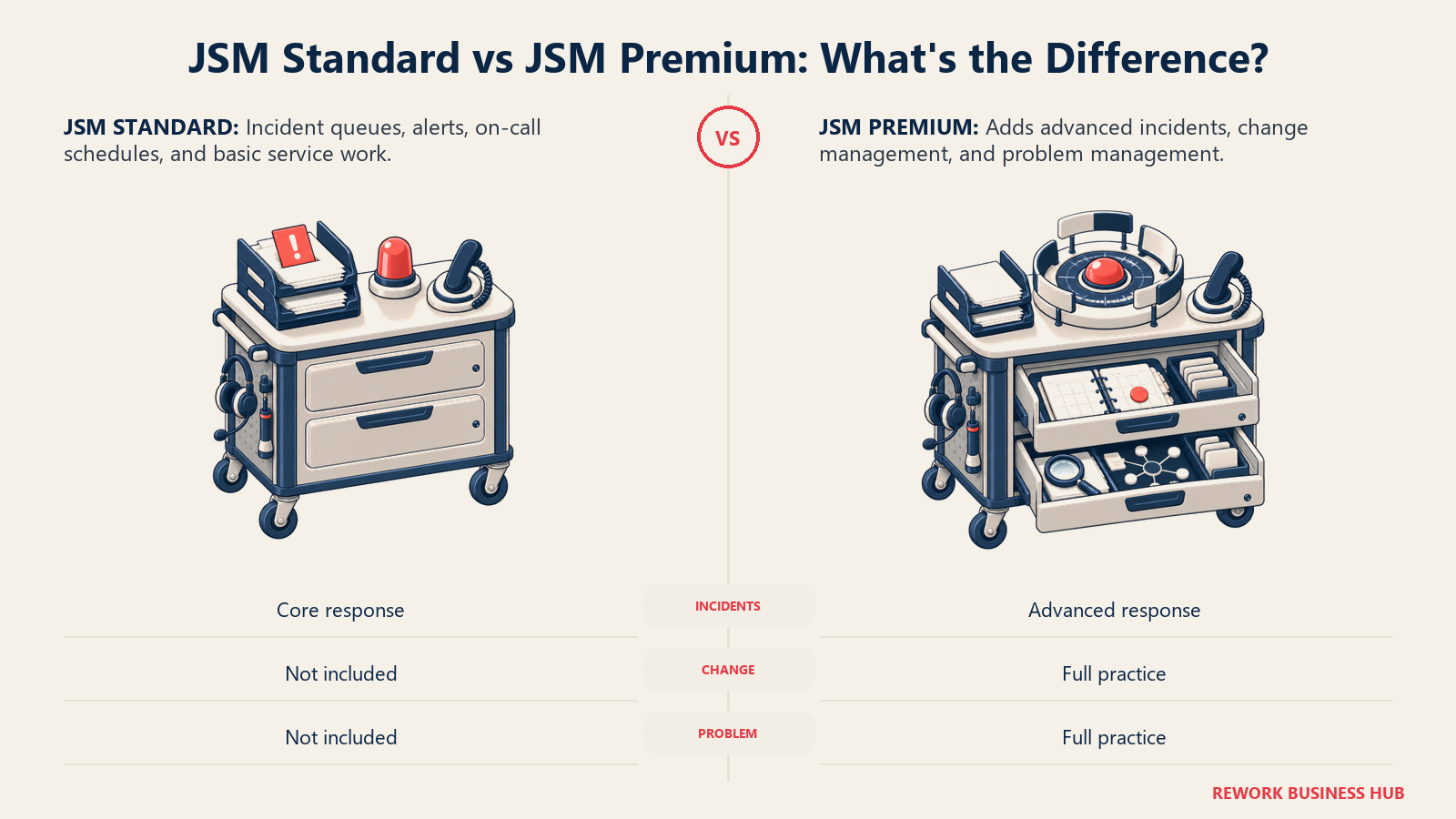
| Practice or capability | Free and Standard | Premium and Enterprise |
|---|---|---|
| Incident work category and incident queues | Included | Included |
| Alerts and on-call schedules | Included | Included |
| Advanced incident management (conference calls, chat tools, major incidents, post-incident reviews) | Removed 16 Oct 2024 | Included |
| Change management (work category, queues, calendar, automated risk assessments, CI/CD integrations, automation rules) | Removed 16 Oct 2024 | Included |
| Problem management (work category, queues) | Removed 16 Oct 2024 | Included |
Read that table twice if you are on Standard. You have incident response, alerting and on-call, which covers a lot of real IT work. You do not have a change calendar, automated change risk assessment, or a problem management practice. For a team that adopted JSM as a ticketing tool, that gap never surfaces. For a team facing a SOC 2 audit, an ISO 27001 review, or a board that has started asking about change failure rates, it surfaces all at once and the fix is priced per agent across the whole team.
ServiceNow did the same thing eighteen months later, gating problem and change behind its Advanced tier. When the two biggest vendors in the category fence off the same two practices, that is a pricing strategy rather than a technical constraint. Several tools below refuse to play, and that refusal is their whole pitch.
What JSM actually costs, honestly
Atlassian publishes JSM per-agent prices only through a JavaScript pricing calculator, so there is no static figure to quote and any listicle that gives you one flat number is quoting something it did not verify. What Atlassian does publish:
| Element | What Atlassian states |
|---|---|
| Free plan | Up to 3 agents, 2GB storage, Community Support |
| Standard | Up to 100,000 agents, 250GB storage, support during local business hours |
| Premium | Unlimited storage, 24/7 Premium support, 99.9% uptime SLA |
| Enterprise | Unlimited storage, 24/7 Enterprise support, 99.95% uptime SLA, up to 150 instances |
| Pricing model | "Monthly pricing is progressive: We offer volume discounts as you add more seats" |
| Billing rule | Maximum Quantity Billing, so your bill follows the highest seat count reached during the cycle |
| Assets objects | Atlassian's licensing page prices additional objects at \(0.02 per object per month with volume discounts, with 50K objects allowed on Premium and 500K on Enterprise. The October 2024 announcement introduced them at "\).05(USD)/object/month" above a 50,000-object free allowance, so confirm your rate at quote time |
| Virtual Service Agent | 1,000 assisted conversations per month free, then from "$.30(USD)/assisted conversation/month" with volume discounts |
Two consequences. Maximum Quantity Billing means a contractor added mid-cycle bills you for the whole cycle even after the seat goes away, which hurts teams that flex agents around projects. And progressive pricing means the per-agent number your CFO found in a blog post is wrong at your seat count. Model it from a quote, and if you are building the spreadsheet, our TCO modeling guide for SaaS covers the line items most teams forget.
The Billing Basis Problem
There is no honest single "starting price" column in this category, because these vendors do not sell the same unit. Comparing a per-endpoint rate to a per-agent rate to a fixed annual bundle produces a ranking that means nothing.
| Billing basis | Who prices this way | What it means for you |
|---|---|---|
| Per agent per month, annual billing only | Freshservice, SysAid | Cost scales with your service desk headcount. No monthly escape hatch at Freshservice |
| Per agent per month in GBP | HaloITSM (£66), TOPdesk (from £51) | Real cost depends on the exchange rate on your invoice date, not on a converted figure in a blog post |
| Per agent per YEAR | InvGate (Pro at $500/agent/year) | The published number is annual. Divide by 12 yourself and never assume the vendor sells a monthly plan |
| Fixed annual bundle | InvGate Starter ($1,499/year) | Flat regardless of small headcount changes, which is the exact opposite shape to progressive per-seat pricing |
| Per technician or agent per month | ManageEngine (from US$13 on-premises), SolarWinds ($39 reported), Atera (from $149 reported) | Cheap or expensive depending entirely on how many endpoints each seat covers |
| Per admin per month, unlimited employees | Siit ($23 to $89) | Employee headcount growth is free. Only your IT team size drives cost |
| Per user per month in EUR, or flat self-hosted subscription | GLPI Network (from €19/user/mo cloud, from €100/month self-hosted) | Priced in euros, and the self-hosted tiers are banded by agent and asset counts |
| Flat plan by agent bucket | Jitbit ($29 for 1 agent up to $249 for 9, then $29 each) | You buy a bucket, not a seat, so adding your fourth agent can cost nothing |
| Progressive per agent with volume discounts | Jira Service Management | No published rate. The unit price falls as seats grow, and Maximum Quantity Billing sets the bill |
| Quote-only | ServiceNow, Ivanti, and SolarWinds above Essentials | Budget for a procurement cycle, not a credit card |
Which Alternatives Have a Real Free Tier
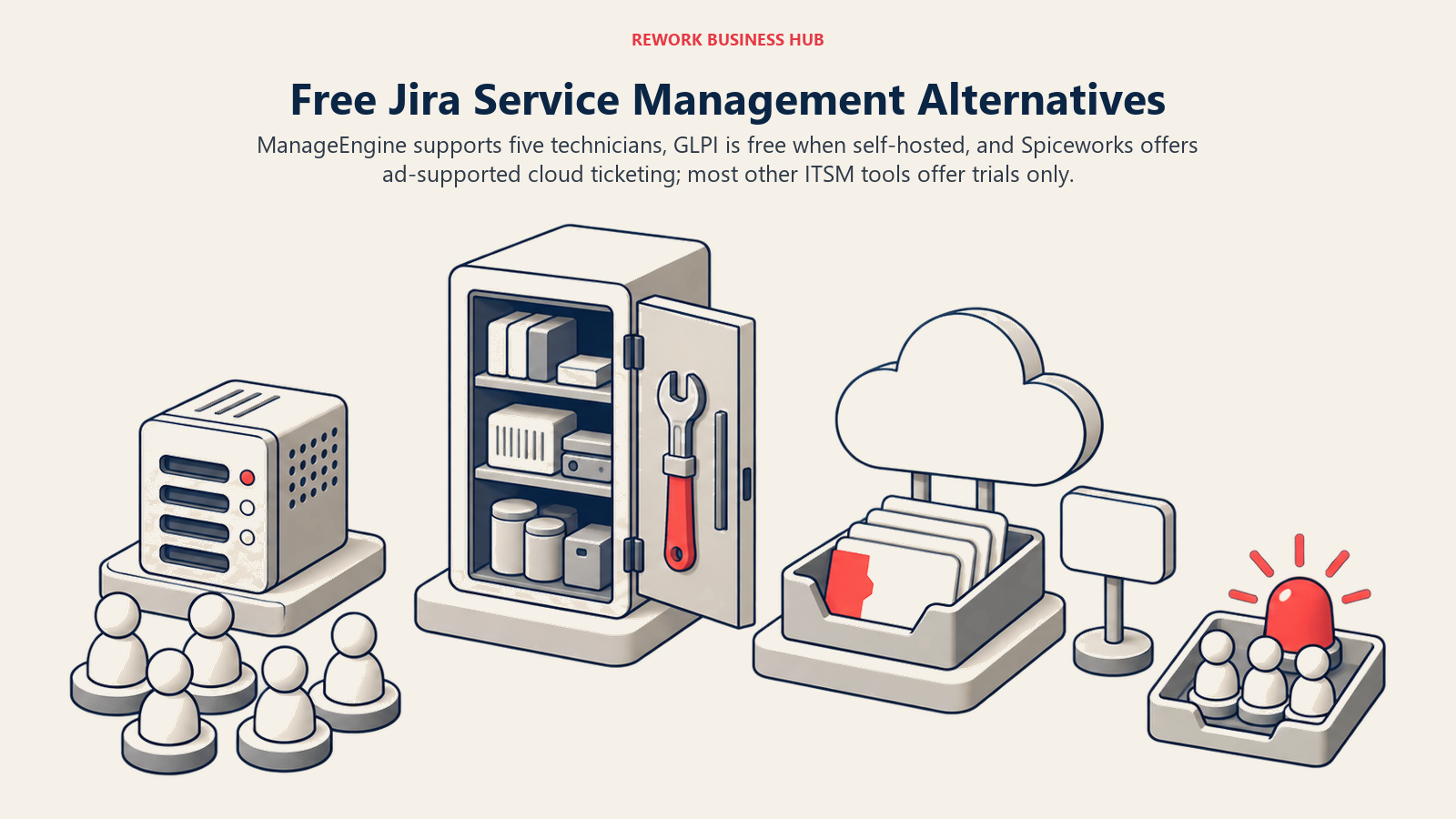
If you are on JSM Free, you are used to a 3-agent ceiling with 2GB of storage and community support. Most of this category has no free plan at all, which is the biggest surprise for teams shopping down rather than up.
| Tool | Free plan | What the free tier covers |
|---|---|---|
| Jira Service Management | Yes, up to 3 agents | 2GB storage, Community Support, no change or problem management |
| ManageEngine ServiceDesk Plus | Yes, Standard edition up to 5 technicians | On-premises Standard features. An annual maintenance option runs $35 per technician per year |
| GLPI | Yes, the core product is free and open source | Everything, if you host, patch and secure it yourself |
| Spiceworks Cloud Help Desk | Yes, the Core plan (reported) | Ad-supported ticketing, asset tracking, alerts and reporting, unlimited end users |
| Freshservice | No | 14-day trial of everything, then paid |
| SysAid | No | Free trial only, no credit card required |
| TOPdesk | No | Demo and trial routed through sales |
| InvGate Service Management | No | Free trial on Starter and Pro |
| HaloITSM | No | Free trial, then the flat agent rate |
| Atera | No | Free trial, then per technician |
| SolarWinds, ServiceNow, Ivanti | No | Trials and demos routed through sales |
The honest read: only ManageEngine beats JSM's free tier on agent count while remaining a genuine ITSM product, and it does so by asking you to run the server. Everything else in this category treats free as a trial.
What 12 Agents Cost Per Year
Twelve agents is the point where a JSM Standard team usually starts feeling the seat maths, so it is a fair yardstick. Figures below use each vendor's entry tier at its published billing terms. Currencies are left as the vendor publishes them, deliberately, because converting hides the FX exposure you actually carry.
| Tool | Entry tier at 12 agents | Annual cost |
|---|---|---|
| ManageEngine ServiceDesk Plus | Standard, on-premises, from US$13/technician/mo | About $1,872 |
| Siit | Essentials, $23/admin/mo billed annually | $3,312 |
| GLPI Network | Public Cloud, €19/user/mo | About €2,736 (EUR) |
| Freshservice | Starter, $19/agent/mo billed annually | $2,736 |
| Jitbit Helpdesk | Enterprise, $249/mo for 9 agents plus 3 at $29 | About $4,032 before the annual discount |
| SolarWinds Service Desk | Essentials, $39/agent/mo annual (reported) | About $5,616 |
| InvGate Service Management | Pro, $500/agent/year | $6,000 |
| Freshservice | Growth, $49/agent/mo billed annually | $7,056 |
| TOPdesk | Essential, £51/agent/mo | About £7,344 (GBP) |
| Zendesk Suite | Team, $55/agent/mo annual (reported) | About $7,920 |
| HaloITSM | Flat rate, £66/agent/mo billed annually | About £9,504 (GBP) |
| SysAid | Professional, $89/agent/mo | $12,816 |
| Atera | From $149/technician/mo annual (reported) | About $21,456 |
| ServiceNow, Ivanti | Quote-only | Not published |
Two readings matter. The cheap end asks you to run infrastructure: ManageEngine on-premises and GLPI both land under the price of a mid-tier cloud seat. And the expensive end is not always bad value. Atera at $149 per technician looks brutal next to Freshservice at $19 per agent, until you notice Atera includes unlimited managed devices, so a three-technician team covering 900 endpoints pays $5,364 a year for both the help desk and the endpoint management that would otherwise be a separate line item.
Keeping the Link to the Dev Backlog
This is the question that separates a JSM replacement from a JSM regret. The reason your team landed on JSM was probably that a support ticket could become a Jira issue in one click, with the same project keys, the same sprints and the same people. Atlassian leans on this hard, promising that teams can "create, link, and even comment on issues across Jira Service Management and Jira projects" and pointing to deployment tracking that auto-creates change requests when a deploy fires.
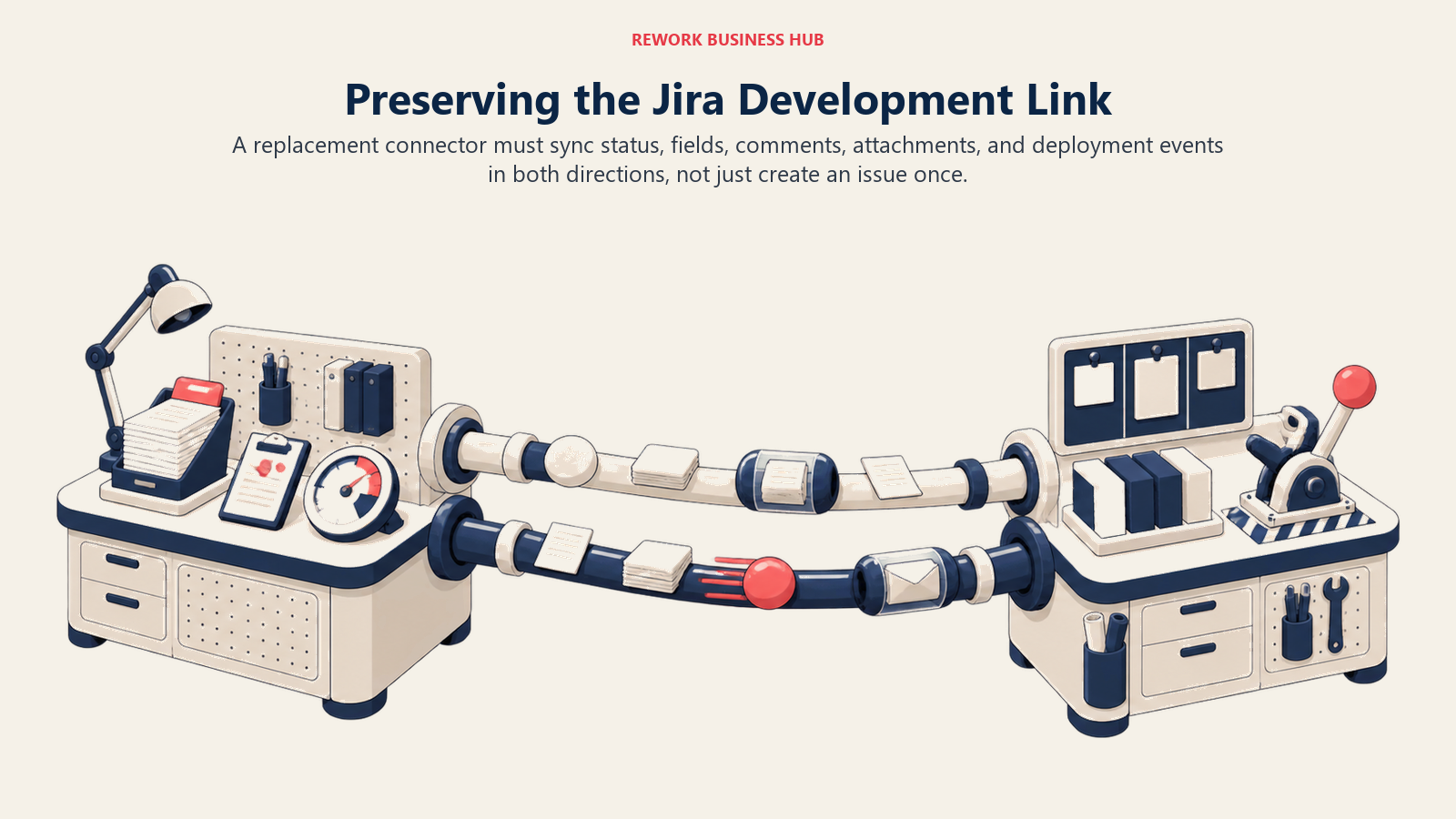
No alternative reproduces that natively, because none of them own your dev backlog. What they offer is an integration, and integrations vary enormously in depth. Before you sign anything, test the things that actually break.
| What to test in the trial | Why it matters |
|---|---|
| Two-way sync, not just one-way create | One-way create means your service desk never learns that engineering closed the bug, so agents chase status in Slack |
| Field and status mapping | If your ticket priority does not map to a Jira field, your SLA reporting quietly detaches from reality |
| Comment sync and attachment sync | Agents will not switch tools to read an engineer's reply, and attachments are where the diagnostic detail lives |
| Deployment and CI/CD events into change records | This is the piece JSM Premium automates. Most alternatives can do it, but usually through webhooks you configure yourself |
| Who owns the connector | A vendor-built connector gets fixed when an API changes. A third-party marketplace app may not |
Every vendor here advertises a connector for the major issue trackers and the catalogs change monthly, so treat marketing pages as a starting point rather than proof. Ivanti claims over 1,000 integration connectors, and ServiceNow ships DevOps Change Velocity in its Prime tier, the closest thing in the category to the native deploy-to-change-request link JSM gives you. If the dev link is the whole reason you are hesitating, our guides on choosing issue tracking software and choosing a DevOps platform cover the same trade-off from the engineering side.
1. Freshservice: The Closest Like-for-Like Swap
Freshservice is the tool most JSM teams end up shortlisting first, and for a straightforward reason: it is a cloud ITSM platform built around ITIL practices, sold self-serve, with the practice set that JSM pushes into Premium available without an enterprise conversation. Freshworks positions it as AI-assisted service management, and Freddy AI now runs across ticket triage, agent assist and the employee-facing portal.
The pricing detail that trips people up: every published Freshservice figure is an annual rate. Starter is $19 per agent per month, Growth $49, Pro $99, all billed annually, and the pricing page does not publish a monthly rate at all. Enterprise is custom. There is no free plan, only a 14-day trial of everything. Add-ons stack on top: Freddy AI Copilot is $29 per agent per month on Pro or Enterprise (included in the Enterprise base), orchestration transaction packs run $250 per 1,000 transactions, e-signature is $90 per pack, and project management licences are $15 per user per month. (Freshworks)
| What you get | What you don't |
|---|---|
| A full ITIL practice set without an enterprise contract | Any free plan, at any headcount |
| Asset management with 100 Growth asset units included | A published monthly billing rate |
| Freddy AI across triage, agent assist and the portal | Freddy AI Copilot in the base price below Enterprise |
| Self-serve signup and a 14-day full trial | Native ownership of your dev backlog |
Pricing: Starter $19, Growth $49, Pro $99 per agent per month, all billed annually. Enterprise custom. No free plan. Best for: Teams that want JSM Premium's practice depth on a mid tier, bought with a credit card rather than a procurement cycle. Not ideal for: Teams under budget pressure who were relying on JSM's free 3 agents, since Freshservice charges from agent one. For the head-to-head, see Freshservice vs Jira Service Management, and if Freshservice itself is the tool you are trying to replace, Best Freshservice Alternatives runs the mirror comparison.
2. HaloITSM: One Rate, Nothing Gated
HaloITSM is the direct answer to the complaint that opens this article. Its pitch is that there are "no tiers, no bolt-ons, no locked-away features" and that it is "priced only by the number of agents, never by tickets, end-users, or data volume". Change management, problem management, CMDB, asset management and the rest of the ITIL practice set arrive in the box. There is no upgrade path to buy, because there is nothing above you.
The rate is £66 per agent per month billed annually, published in GBP with a switcher for USD, EUR, CAD, AUD and NZD. Named and concurrent licences cost the same, which matters for shift-based service desks where two part-time agents share one seat's worth of work. Very large organisations can take the Halo Enterprise Package with unlimited licences and funded implementation at $1M annually. Note the domain move: haloitsm.com now redirects to usehalo.com/haloitsm. (HaloITSM)
| What you get | What you don't |
|---|---|
| Every ITIL practice at one flat agent rate | A cheap entry rung for a two-person team |
| Named and concurrent licences at the same price | A free plan |
| No feature gated behind a tier upgrade | USD as the headline currency, so budget for FX |
| A single number your CFO can forecast | A light, low-configuration setup |
Pricing: £66 per agent per month billed annually (GBP), with a currency switcher. Enterprise Package at $1M annually for unlimited licences. Best for: Teams that got burned by a practice moving up a tier and never want to repeat the conversation. Not ideal for: Small teams where £66 per agent is more than the practice depth is worth, or US-only buyers who dislike carrying FX exposure on a core tool.
3. InvGate Service Management: The Cheapest Real ITSM Entry Point
InvGate is the pick for the specific reader this article is written for: a small IT team that does not want progressive per-seat pricing and does want a genuine ITSM product rather than a help desk wearing an ITIL badge. It is a full service management platform with a workflow builder, an asset-management sibling product, and an interface that is unusually approachable for the category.
The pricing is annual, and this is the trap. Starter is a fixed price of $1,499 per year, not a per-agent rate, which makes it a flat bundle for a small desk. Pro is $500 per agent per year starting at $2,500 per year, so the entry point implies a five-agent floor, which works out near $42 per agent per month if you insist on monthly maths the vendor does not sell. Enterprise is custom and starts at $12,000 per year. The page notes that listed prices are MSRP for the base subscription and exclude taxes. (InvGate)
| What you get | What you don't |
|---|---|
| A fixed annual bundle that does not punish seat growth | A monthly billing option |
| Full ITSM practice depth at a small-team price | The brand recognition of ServiceNow or Atlassian |
| A workflow builder that non-developers can drive | A free plan |
| Companion asset management from the same vendor | A rate card you can compare per agent without doing arithmetic |
Pricing: Starter $1,499/year fixed. Pro $500 per agent per year, from $2,500/year. Enterprise custom, from $12,000/year. All annual. Best for: A three-to-eight-person IT team that wants the practice set without watching the bill climb with every hire. Not ideal for: Teams that need monthly billing, or buyers who cannot get an annual commitment through finance.
4. ManageEngine ServiceDesk Plus: The Value Play, If You Run the Server
ServiceDesk Plus is the long-running Zoho Corporation ITSM product, and it wins on price per practice by a wide margin. It also has the only free tier in this list that beats JSM's on agent count while still being a real ITSM tool: the Standard edition is free for up to 5 technicians.
Say which deployment you are quoting, because ManageEngine sells both Cloud and On-Premises and they are priced separately. What the vendor page renders for the on-premises table: Standard from US$13 per technician per month, Professional from US$27, Enterprise from US$67, with asset counts bundled to technician bands and extra assets above 10,000 handled by sales. Worked examples on the same page put 10 technicians with 500 IT assets at $1,195 a year on Standard, $2,295 on Professional and $5,995 on Enterprise. Cloud figures did not render to us, so get those from a quote rather than a comparison page. (ManageEngine)
| What you get | What you don't |
|---|---|
| The best practice-per-dollar ratio in the category | A modern, opinionated interface |
| A genuinely free 5-technician Standard edition | Cloud pricing you can read without a sales conversation |
| Change, problem and project management in Enterprise | Freedom from asset-count bands |
| A real on-premises option for regulated environments | A quick, low-effort setup |
Pricing: On-premises from US$13 (Standard), US$27 (Professional) and US$67 (Enterprise) per technician per month. Free Standard edition up to 5 technicians. Cloud priced separately. Best for: Budget-conscious IT teams with the in-house skill to run a server, and shops that need on-premises for compliance reasons. Not ideal for: Teams that want the polish of a modern SaaS interface, or buyers who will not tolerate asset-count bands in a contract.
5. ServiceNow: The Ceiling, With the Same Tier Trap
ServiceNow is where large enterprises land, and it earns that position. It is less a service desk than a workflow platform with a service desk on top, which is why it ends up running HR cases, facilities requests and vendor onboarding alongside IT.
Two things a JSM refugee should know. First, ServiceNow publishes no list prices and never has, so treat every per-seat figure you see as third-party. Industry estimates put ITSM near $70 to $100 per fulfiller per month at the low tier and $150 to $200 or more at the top, but these are reported customer disclosures, not a rate card, and enterprise buyers routinely negotiate well below them. Second, and more importantly, ServiceNow made the same packaging move Atlassian did. On 9 April 2026 it retired five legacy tiers for three AI-native ones, and its entry tier, Foundation, covers incident, request, asset and cost while problem and change management sit up in Advanced. Now Assist AI is bundled into every tier rather than sold as an add-on, and Virtual Agent conversations are unlimited. (ServiceNow Community)
| What you get | What you don't |
|---|---|
| The deepest workflow and integration platform in ITSM | Any published price |
| AI bundled into every tier as of April 2026 | Change and problem management on the entry tier |
| DevOps Change Velocity on the Prime tier | A self-serve purchase path |
| A platform that scales past IT into every department | A short implementation |
Pricing: Quote-only. Reported ranges of roughly $70 to $200 per fulfiller per month circulate in third-party guides, none of them vendor-confirmed. Best for: Enterprises that want one platform for every department and have the budget and implementation capacity to match. Not ideal for: Anyone leaving JSM specifically because change management sat behind an upgrade, since Foundation repeats that pattern. If ServiceNow is on your list mainly by reputation, Best ServiceNow Alternatives covers the cheaper end of the same category.
6. SysAid: AI Without an Add-On Line
SysAid has been in ITSM for two decades and spent the last two years rebuilding around AI-first service delivery. The pitch that matters in 2026 is packaging rather than features: AI is included in the price rather than metered as a separate line, which is increasingly unusual in a category where AI add-ons run $29 to $50 per agent per month on top of the base seat.
Professional is $89 per agent per month with AI included and 100K Workato automation credits. Enterprise is custom, starts at 20 agents, and adds 300K Workato credits, a sandbox and a Gold service package. There is no free plan, only a free trial with no credit card required. Note the correction: SysAid is often listed in comparison tables somewhere in a $19 to $99 band, but the published Professional rate today is $89. (SysAid)
| What you get | What you don't |
|---|---|
| AI included rather than sold as a per-agent add-on | A cheap starting tier |
| Workato automation credits bundled into the plan | A free plan |
| No usage caps or surprise invoices on Professional | A published Enterprise price |
| Two decades of ITSM product history behind it | A 20-agent-free path to Enterprise features |
Pricing: Professional $89 per agent per month, AI included. Enterprise custom, from 20 agents. No free plan. Best for: Mid-market teams that want AI triage and agent assist without a second line item on the invoice. Not ideal for: Small desks, since there is no cheaper rung below Professional, and teams that will not commit before seeing the Enterprise number.
7. SolarWinds Service Desk: Asset Discovery Tied to Tickets
SolarWinds Service Desk (originally Samanage) is strongest where a ticket needs to carry hardware and software context with it. Discovery-driven asset management feeds the CMDB automatically, so an incident about a laptop arrives with the laptop's configuration, warranty and installed software attached rather than requiring an agent to go find it.
Treat the figure below as reported rather than vendor-confirmed. Essentials is reported at $39 per agent per month billed annually, covering core ticketing, the service portal, knowledge base, service catalog and IT asset management. Confirm Advanced and Premier per-agent prices with SolarWinds; Premier is where the visual CMDB, runbooks and SolarWinds AI live, with hosting in US, EU and Australian data centres. (SolarWinds)
| What you get | What you don't |
|---|---|
| Discovery-driven asset data attached to every ticket | Pricing you can verify without contacting sales |
| ITAM included in the entry tier rather than bolted on | Published Advanced or Premier rates |
| Regional data residency options at the top tier | A free plan |
| A mature product with a long enterprise track record | The AI packaging clarity SysAid offers |
Pricing: Essentials $39 per agent per month billed annually (reported). Advanced and Premier not publicly priced. Best for: Teams whose biggest pain is not knowing what hardware and software a ticket relates to. Not ideal for: Buyers who need a transparent rate card before they will start an evaluation.
8. TOPdesk: One Service Desk for IT, HR and Facilities
TOPdesk is the enterprise service management pick on this list. The product is built around the idea that IT is one of several service departments, so HR onboarding, facilities requests and IT incidents share a portal, a knowledge base and a reporting model. For organisations where the IT desk keeps getting asked about desks and door badges, that is a meaningful consolidation.
Pricing is per agent per month and renders in GBP, with USD, EUR and CAD available through a currency selector. Essential is £51, Engaged £72 (marked most popular) and Excellent £101. TOPdesk defines an agent as "anyone who can open and adjust tickets in TOPdesk", says there are no hidden charges beyond the listed rates, and applies volume discounts as agent counts rise. Deployments above 50 agents are routed to sales for a tailored conversation. Optional add-ons and implementation services carry a surcharge. (TOPdesk)
| What you get | What you don't |
|---|---|
| One service desk shared across IT, HR and facilities | USD as the headline currency |
| Volume discounts as agent count grows | Self-serve purchasing above 50 agents |
| A clear three-tier structure with no hidden charges | A free plan |
| Strong European presence and support footprint | Implementation included in the sticker price |
Pricing: Essential £51, Engaged £72, Excellent £101 per agent per month (GBP), with a currency switcher. 50+ agents via sales. Best for: Organisations running shared services where IT is one department among several. Not ideal for: A pure IT shop with no HR or facilities use case, which pays for breadth it will not use.
9. Ivanti Neurons for ITSM: When Deployment Model Is the Constraint
Ivanti is the pick when the decision is driven by where the software runs rather than what it costs. Ivanti states its ITSM product "can be deployed in the cloud, on-premises or as a hybrid combination", with movement between those models later without losing functionality or data. For defence contractors, healthcare systems and public-sector buyers whose data cannot leave a boundary, that narrows the shortlist fast.
The product covers 14 ITIL 4 certified practices, ships AI for ticket classification, knowledge article generation and summarisation, and advertises over 1,000 integration connectors, which is the largest published connector count in this comparison. Pricing is not published; the page routes to Contact Sales. (Ivanti)
| What you get | What you don't |
|---|---|
| Cloud, on-premises or hybrid, with migration between them | Any published price |
| 14 ITIL 4 certified practices out of the box | A self-serve trial |
| Over 1,000 integration connectors | A short procurement cycle |
| No-code workflow design across departments | Simplicity, if your needs are basic |
Pricing: Quote-only, no published rate. Best for: Regulated organisations where the deployment model, not the price, sets the shortlist. Not ideal for: Small teams that want to trial and buy the same week.
10. Siit: Internal IT That Lives in Slack
Siit takes the opposite bet from the ITIL platforms above. Instead of asking employees to visit a portal, it runs service requests inside Slack, Teams and email, with a service catalog, approvals and knowledge-base integrations behind the conversation. For an internal IT team whose real problem is that nobody uses the portal, that is the whole pitch.
The billing basis is the standout. Essentials is $23 per admin per month billed annually, Standard $45 and Pro $89, with a custom tier above that. Employees are unlimited and free; you pay only for the people who resolve requests. Standard adds automated workflows, asset and SaaS management, and HRIS, MDM and ticketing integrations. Pro adds AI agents, AI triage and custom reporting. There is a 14-day trial with full feature access. (Siit)
| What you get | What you don't |
|---|---|
| Unlimited employees at no extra cost | Deep formal change and problem management practice |
| Requests handled where employees already work | An on-premises option |
| Asset and SaaS management from Standard up | A free plan |
| AI triage and AI agents on Pro | The audit heritage of a full ITIL suite |
Pricing: Essentials $23, Standard $45, Pro $89 per admin per month, billed annually. Custom tier above. Best for: Internal IT and workplace teams that want adoption over ceremony, especially in Slack-first companies. Not ideal for: Teams that left JSM specifically to get formal change management, which is not Siit's strength.
11. Atera: Cheap Per Endpoint, Expensive Per Seat
Atera inverts the pricing model everything else on this list uses. It charges per technician for an unlimited number of managed devices, which makes it the outlier in both directions: costly if you count seats, cheap if you count endpoints. For a small IT team responsible for a large estate, that shape is exactly right, and it is the opposite of the seat maths that pushed you off JSM.
These figures are reported rather than vendor-confirmed. Its IT department pricing is reported to start from $149 per technician per month billed annually, $169 billed monthly, across Professional, Expert and Master tiers, with AI Copilot included at no extra cost on every plan and an April 2026 update that raised entry-tier list prices while leaving the unlimited-devices commitment intact. Do not use the older $99 or $129 figures still circulating. (Atera)
| What you get | What you don't |
|---|---|
| Unlimited managed devices per technician | A cheap per-seat rate |
| Remote monitoring, patching and ticketing in one tool | Pricing you can verify on the vendor page |
| AI Copilot bundled into every plan | Deep ITIL practice modelling |
| One bill instead of separate RMM and help desk | A free plan |
Pricing: From $149 per technician per month billed annually, $169 monthly (reported). No free plan. Best for: Small IT teams managing a large device estate who want endpoint management and ticketing on one invoice. Not ideal for: Large service desks, where per-technician pricing at this rate gets expensive fast. If endpoint management is the real gap, compare it against Best Intune Alternatives before buying a combined tool.
12. Zendesk: Only If the Real Job Is Customer Support
Some teams discover mid-evaluation that they were never doing ITSM. If the tickets come from paying customers rather than employees, an ITIL platform is the wrong shape and Zendesk is the obvious answer.
Zendesk's pricing page refuses automated connections, so treat these as reported: Suite Team is widely listed at $55 per agent per month billed annually and Suite Professional at $115, with a Growth tier between them that Zendesk does not publish on its public card. Monthly billing typically runs 20% to 30% above the annual rate, the Copilot add-on is reported at $50 per agent per month, and AI agents bill per automated resolution at a rate Zendesk does not publish. (Zendesk)
| What you get | What you don't |
|---|---|
| The best customer-facing ticketing in the category | ITIL change, problem or release management |
| Mature messaging, voice and help-centre tooling | Transparent AI pricing |
| A very large app and integration marketplace | A CMDB or asset management practice |
| Enterprise-grade routing and SLA management | A cheap entry point |
Pricing: Suite Team $55, Suite Professional $115 per agent per month billed annually (reported). Copilot add-on $50 per agent per month (reported). Best for: Teams whose queue is customers, not colleagues. Not ideal for: Anyone who needs a change calendar. See Best Zendesk Alternatives if you have already ruled it out on price.
13. Jitbit Helpdesk: Flat Plans, Not Seats
Jitbit is the anti-per-seat option. It sells buckets of agents at flat monthly prices, so adding your fourth agent to a four-agent plan costs nothing, and a self-hosted version exists for teams that want the data on their own hardware.
The cloud plans are Freelancer at $29 a month for 1 agent, Startup at $69 for 4 agents, Company at $129 for 7 agents, and Enterprise at $249 for 9 agents with additional agents at $29 each. Annual payment saves roughly 15%, which brings Freelancer to $24.92 a month. Higher tiers add downloadable backups, custom domain branding, expedited support and HIPAA compliance. It is a help desk rather than an ITSM suite, so calibrate expectations on practice depth. (Jitbit)
| What you get | What you don't |
|---|---|
| Flat plans that do not bill per seat | ITIL change, problem or release practices |
| A self-hosted option alongside the cloud version | A CMDB or discovery-driven asset management |
| Roughly 15% off for annual payment | AI features at the level of the ITSM platforms here |
| Genuinely low cost for a small desk | A free plan |
Pricing: Freelancer $29, Startup $69 (4 agents), Company $129 (7 agents), Enterprise $249 (9 agents, then $29 each) per month. About 15% off annual. Best for: Small internal desks that want cheap, predictable ticketing and nothing ceremonial. Not ideal for: Anyone with an audit requirement. If you are unsure whether you need a help desk or a shared inbox at all, Help Desk vs Shared Inbox settles it quickly.
14. Spiceworks Cloud Help Desk: Free, With Caveats
Spiceworks is famous for a free help desk, and that reputation needs three corrections. The free Core plan is ad-supported, which is how it stays free, and some organisations will not accept advertising inside an IT tool. Free is no longer the only option either: Spiceworks launched a Premium plan on 1 June 2025, reported at roughly $5 per seat per month billed annually or $6 monthly. And the self-hosted Spiceworks Desktop help desk reached end of life on 31 December 2021, so self-hosting is gone.
The Premium figures here are reported rather than vendor-confirmed. The free Core plan is consistently described as covering basic ticketing, asset tracking, alerts and reporting with unlimited end users. (Spiceworks)
| What you get | What you don't |
|---|---|
| A genuinely free cloud help desk still shipping in 2026 | An ad-free experience on the free plan |
| Unlimited end users on the free tier | A self-hosted option, discontinued end of 2021 |
| Basic asset tracking and reporting at no cost | ITIL practice depth of any kind |
| A low-risk way to run a first ticket queue | Vendor pricing you can verify directly |
Pricing: Core free and ad-supported. Premium reported at about $5 per seat per month billed annually, $6 monthly. Best for: Internal IT with no software budget that needs a queue today. Not ideal for: Any team with a compliance requirement, or one that cannot run ads inside an internal tool.
15. GLPI: Open Source, If You Have the Skills
GLPI is the open-source answer, and it is unusually complete: full IT asset management alongside service management, with a plugin ecosystem covering inventory agents and financial tracking. The core is free software you can self-host indefinitely, making it the only option here with no licence cost at any scale.
Paid GLPI Network subscriptions buy support, hardened builds and hosting. Prices are published in euros, so label the currency. Public Cloud is €19 per user per month with a one-user minimum and a 45-day free trial; Private Cloud is €21 per user per month with a 25-user minimum. Self-hosted subscription tiers are banded rather than per seat: Basic €100 per month covers up to 10 IT agents and 500 assets, Standard €300 covers up to 50 agents and 5,000 assets, Advanced €1,000 goes beyond that, and Enterprise €4,500 covers unlimited assets. (GLPI)
| What you get | What you don't |
|---|---|
| A free, open-source core you can run forever | A managed experience unless you pay for Network |
| Asset management and service management together | Euro-free pricing, so budget for FX |
| Banded self-hosted tiers instead of per-seat billing | Hand-holding during implementation |
| Full control over data residency and retention | Freedom from patching and upgrade work |
Pricing: Core free and open source. GLPI Network Public Cloud €19 per user per month, Private Cloud €21 (25-user minimum). Self-hosted from €100 per month. Best for: Teams with Linux and database skill in-house who would rather spend engineering time than licence budget. Not ideal for: Teams without operational capacity to run, patch and secure their own service desk.
Match the Alternative to Your Team Size and Setup
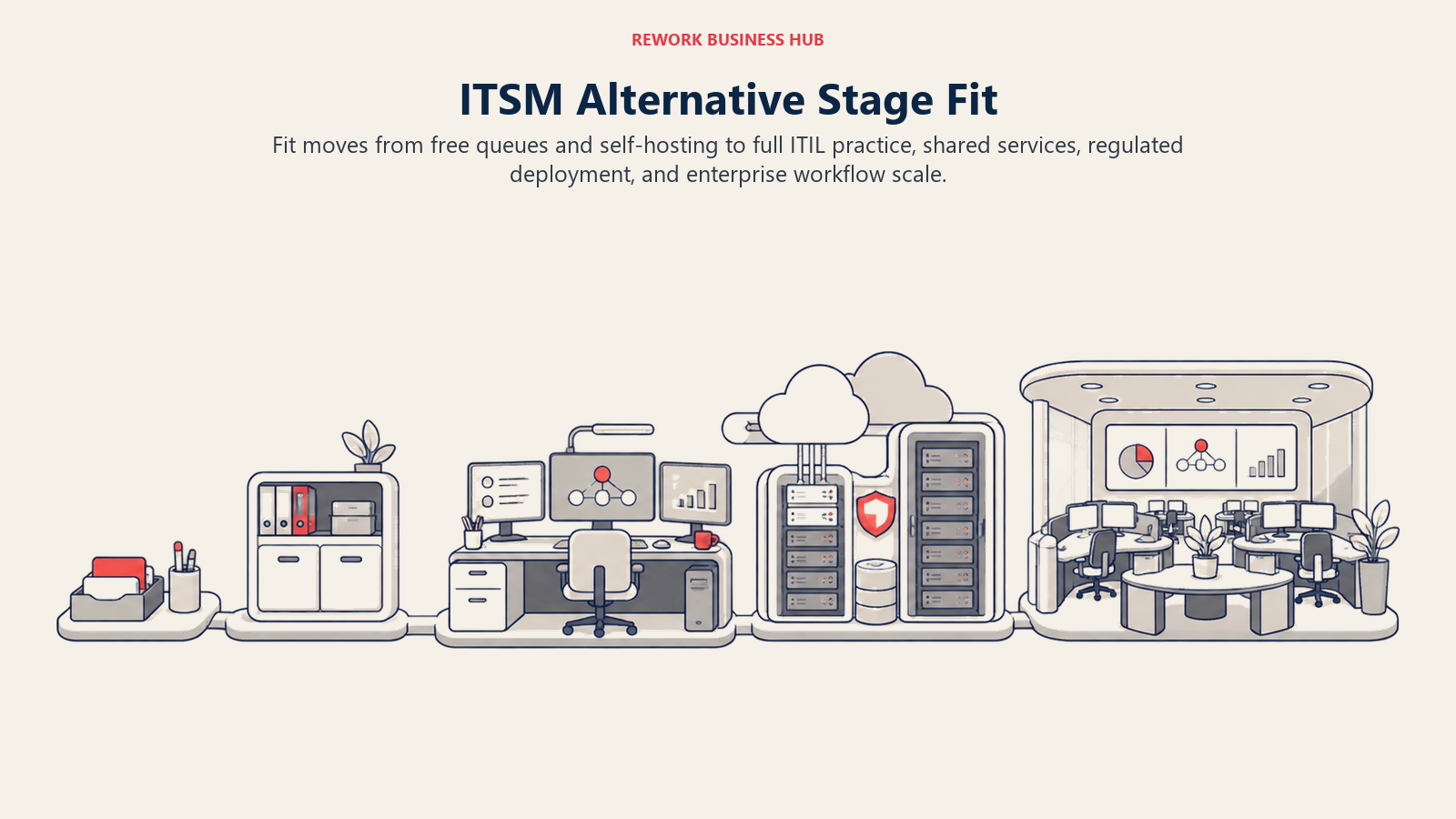
Team size is only useful when it is paired with deployment constraints, practice depth, and the device estate your technicians actually support. This stage map shows where the free, self-hosted, mid-market, and regulated options begin to separate.
| Your situation | Best-fit pick |
|---|---|
| 3 agents, no budget, need a queue this week | Spiceworks Cloud Help Desk (Core) |
| Up to 5 technicians, willing to run a server | ManageEngine ServiceDesk Plus (free Standard edition) |
| 3 to 8 agents, want real ITSM on a fixed annual price | InvGate Service Management (Starter) |
| 10 to 30 agents, want JSM Premium depth self-serve | Freshservice (Growth) |
| Any size, never want a practice gated behind a tier again | HaloITSM |
| IT plus HR plus facilities on one desk | TOPdesk |
| Small team, large device estate | Atera |
| Slack-first company, portal adoption is the problem | Siit |
| Regulated, must run on-premises or hybrid | Ivanti Neurons for ITSM |
| Asset context is the biggest gap in every ticket | SolarWinds Service Desk |
| Want AI included rather than metered per agent | SysAid |
| Engineering skill in-house, licence budget at zero | GLPI |
| Enterprise, every department on one platform | ServiceNow |
| The tickets are from customers, not employees | Zendesk |
| Small internal desk, flat pricing, nothing ceremonial | Jitbit Helpdesk |
How to Choose: Decision Framework
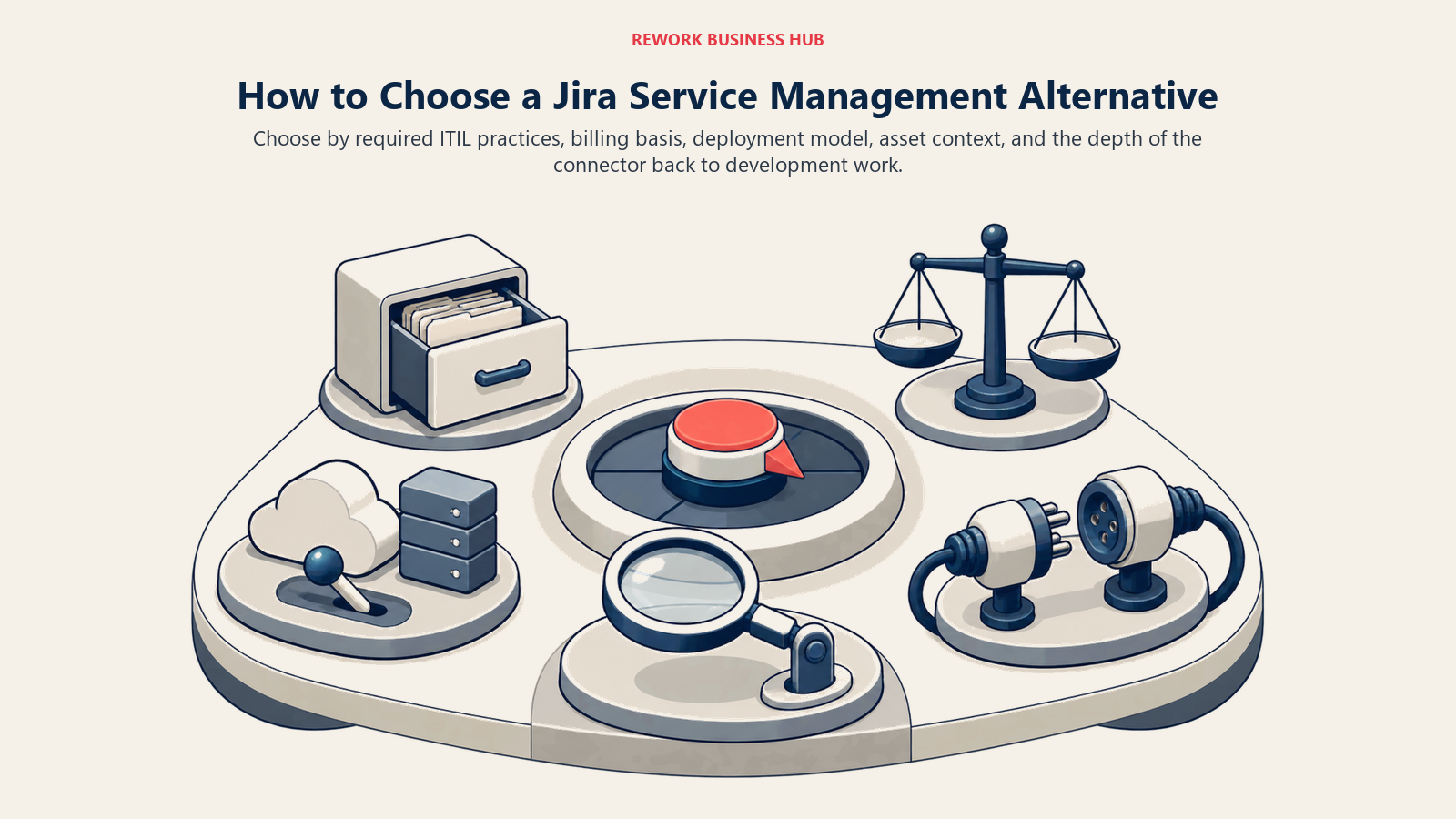
Start with the constraint that would disqualify a platform even if its ticket queue looked perfect. The framework below routes those non-negotiables across ITIL depth, billing model, deployment, assets, AI, and the development backlog.
| If your team needs... | Best pick |
|---|---|
| Change and problem management on the entry tier | HaloITSM or Freshservice (Growth) |
| A fixed annual price that does not move with headcount | InvGate Service Management |
| The lowest total cost with in-house server skill | ManageEngine ServiceDesk Plus or GLPI |
| A genuinely free plan beyond 3 agents | ManageEngine (5 technicians) or Spiceworks Core |
| Endpoint management and ticketing on one bill | Atera |
| Service management across IT, HR and facilities | TOPdesk |
| On-premises or hybrid deployment for compliance | Ivanti Neurons for ITSM or ManageEngine |
| AI triage without a separate per-agent add-on | SysAid |
| Requests handled inside Slack or Teams | Siit |
| Asset discovery feeding the CMDB automatically | SolarWinds Service Desk |
| An enterprise platform that scales past IT | ServiceNow |
| Customer-facing support, not internal ITSM | Zendesk |
| Flat pricing for a very small desk | Jitbit Helpdesk |
| Open source with no licence cost at any scale | GLPI |
If you are still deciding what practices you actually need before you shortlist tools, work through How to Choose ITSM Software first. Picking a platform before you have written down which ITIL practices you are audited on is how teams end up buying Premium twice.
Frequently Asked Questions about Jira Service Management Alternatives
Does Jira Service Management still have a free plan?
Yes. Atlassian's licensing page confirms a free plan for up to 3 agents with 2GB of storage and Community Support. What changed is what the free plan contains: since 16 October 2024 it excludes change management, problem management and advanced incident management, which moved into Premium and Enterprise.
Why did change management disappear from my Jira Service Management plan?
It did not disappear from the product, it moved up the price list. Atlassian's October 2024 packaging update relocated the change management work category, queues, calendar, automated risk assessments, CI/CD integrations and automation rules out of Free and Standard and into Premium and Enterprise. Free and Standard kept the incident work category, incident queues, alerts and on-call schedules.
How much does Jira Service Management cost per agent?
There is no single answer, and any page that gives you one flat number did not verify it. Atlassian publishes JSM per-agent prices only through a JavaScript pricing calculator and states that "monthly pricing is progressive" with volume discounts as you add seats. Billing also uses Maximum Quantity Billing, so your invoice follows the highest seat count reached during the cycle, not the count at the end of it.
What is the cheapest full ITSM alternative to Jira Service Management?
InvGate Service Management's Starter plan at $1,499 per year is the cheapest genuine ITSM entry point verified here, because it is a fixed annual bundle rather than a per-seat rate. If you can run your own server, ManageEngine ServiceDesk Plus on-premises starts from US$13 per technician per month and has a free Standard edition for up to 5 technicians.
Which alternative keeps the link to my Jira development backlog?
None of them reproduce it natively, because none of them own your backlog. Every vendor here advertises a connector for the major issue trackers, so the question is depth rather than existence. Test two-way sync, field and status mapping, comment and attachment sync, and whether deployment events can create change records before you commit.
Is ServiceNow a safe upgrade from Jira Service Management?
Only if the tier trap is not why you are leaving. ServiceNow retired five legacy ITSM tiers in April 2026 for Foundation, Advanced and Prime, and its entry tier covers incident, request, asset and cost while problem and change management sit in Advanced. That is the same gating pattern that pushed you off JSM Standard, just at a much higher price point.
Are there free alternatives to Jira Service Management?
Three worth knowing. ManageEngine ServiceDesk Plus is free for up to 5 technicians on its Standard on-premises edition, which beats JSM's 3-agent cap. GLPI's core product is free and open source if you host it yourself. Spiceworks Cloud Help Desk keeps a free, ad-supported Core plan, though it is a help desk rather than an ITSM platform and self-hosting ended in 2021.
What to Do Next
Start by writing down which ITIL practices you are actually accountable for. If the honest answer is incident and request only, JSM Standard still does that job well and switching is a distraction. If change or problem management is on the list, price JSM Premium at your real agent count and compare it against two alternatives with different billing shapes, not two per-agent tools that produce nearly identical spreadsheets.
A useful pairing: one per-agent cloud platform (Freshservice or HaloITSM) against one fixed-price or self-hosted option (InvGate or ManageEngine). Run both against a real month of tickets rather than a demo dataset, and test the dev-backlog connector properly, since that is the piece most likely to disappoint after signature. Then read Switching SaaS Vendors for the migration checklist, especially exporting ticket history and preserving audit trails. Nobody remembers those two until the old contract has lapsed.

Principal Product Marketing Strategist
On this page
- Key Facts
- Quick Comparison Table
- What Actually Changed in Jira Service Management
- What JSM actually costs, honestly
- The Billing Basis Problem
- Which Alternatives Have a Real Free Tier
- What 12 Agents Cost Per Year
- Keeping the Link to the Dev Backlog
- 1. Freshservice: The Closest Like-for-Like Swap
- 2. HaloITSM: One Rate, Nothing Gated
- 3. InvGate Service Management: The Cheapest Real ITSM Entry Point
- 4. ManageEngine ServiceDesk Plus: The Value Play, If You Run the Server
- 5. ServiceNow: The Ceiling, With the Same Tier Trap
- 6. SysAid: AI Without an Add-On Line
- 7. SolarWinds Service Desk: Asset Discovery Tied to Tickets
- 8. TOPdesk: One Service Desk for IT, HR and Facilities
- 9. Ivanti Neurons for ITSM: When Deployment Model Is the Constraint
- 10. Siit: Internal IT That Lives in Slack
- 11. Atera: Cheap Per Endpoint, Expensive Per Seat
- 12. Zendesk: Only If the Real Job Is Customer Support
- 13. Jitbit Helpdesk: Flat Plans, Not Seats
- 14. Spiceworks Cloud Help Desk: Free, With Caveats
- 15. GLPI: Open Source, If You Have the Skills
- Match the Alternative to Your Team Size and Setup
- How to Choose: Decision Framework
- What to Do Next