Freshservice vs Jira Service Management: Which ITSM Platform Fits Your Team in 2026?
Turn this article into takeaways for your work.


Each assistant summarizes the article only for you and suggests best practices for your work.
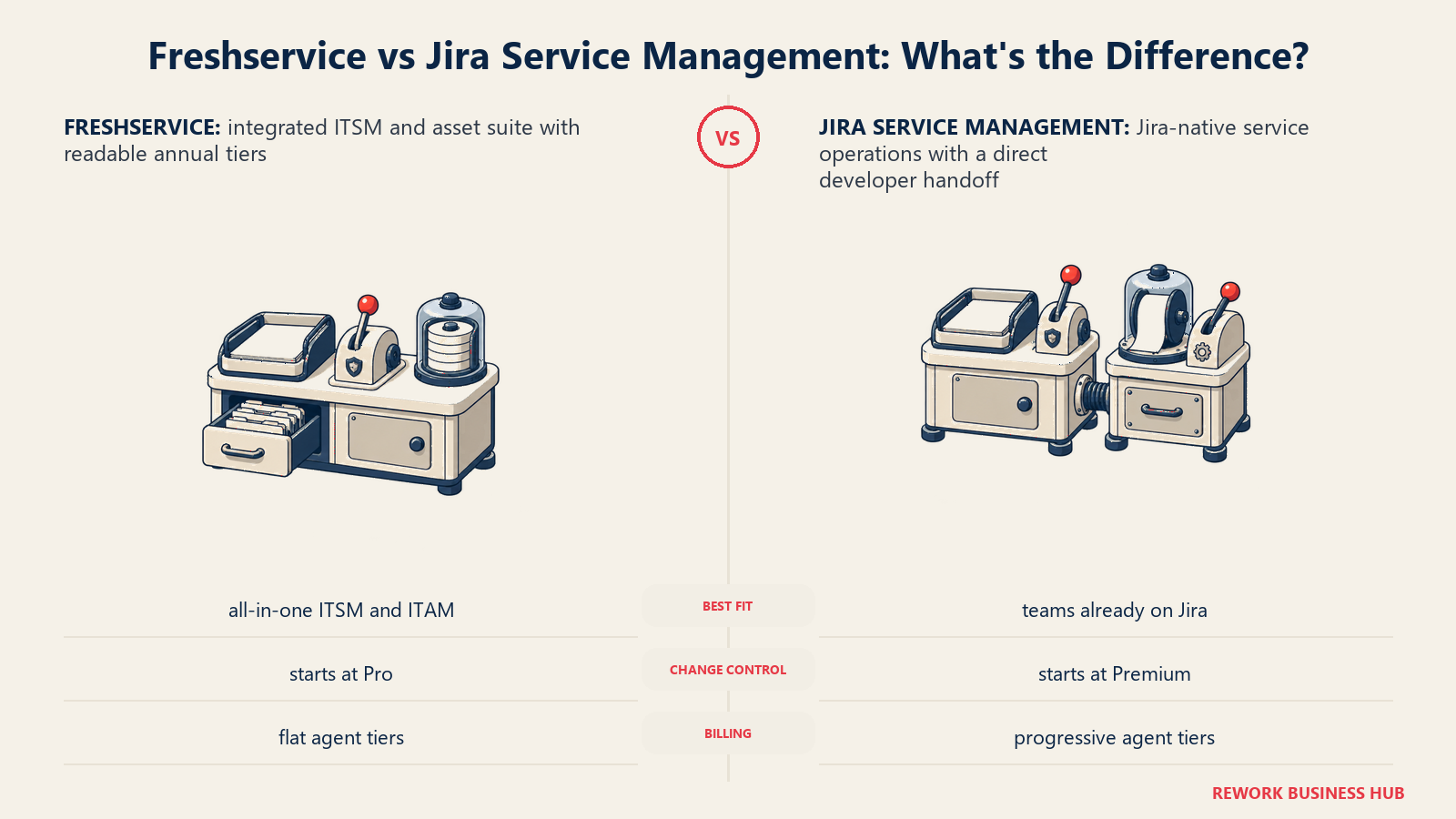
Almost every page comparing these two opens with a pair of headline prices and a tick-box feature grid. That framing falls apart on contact with the actual bills, because Freshservice and Atlassian don't price on the same basis and don't unlock the same ITIL processes at the same point on their ladders. Freshservice publishes flat per-agent tiers on annual billing. Atlassian publishes no per-agent figure in readable HTML at all: its rate is progressive, drops as you add seats, and bills against the highest seat count you touched during the cycle. Setting "$19" next to "$20" tells you close to nothing about what either platform costs a real team of fifteen.
This is for whoever owns the decision: an IT director, a service desk lead, or the ops person who inherited the ticket queue and now has to defend a three-year platform choice. What separates these two is which ITIL processes sit behind which paywall, whether your service desk needs to live next door to a developer backlog, how each vendor charges for AI, and what happens to the bill when the team grows.
TL;DR
| Freshservice | Jira Service Management | |
|---|---|---|
| What it is | A purpose-built ITSM suite with ITIL processes, asset management and an employee portal in one product | An ITSM layer on the Jira platform, now sold inside Atlassian's Service Collection with Customer Service Management, Assets and Rovo |
| Free plan | None. 14-day trial, unrestricted access | Yes, up to 3 agents, 2GB storage, Community Support |
| Published entry price | Starter, $19 per agent per month, billed annually | Not published in readable form. Reported around $19 to $24 on Standard |
| Billing basis | Flat per-agent tiers, annual rates only | Progressive per-agent pricing with volume discounts, plus Maximum Quantity Billing on monthly plans |
| Change management starts at | Pro, $99 per agent per month | Premium, reported around $47 to $55 |
| Problem management starts at | Pro | Premium |
| Release management | Pro | Not a named plan feature. Release work lives in Jira Software |
| Asset management | Every tier, 100 Growth Asset Units included | Bundled into Service Collection. Discovery is Premium, and objects meter above the allowance |
| AI | Freddy AI Copilot, $29 per agent per month on Pro and Enterprise. Freddy AI Agent (Classic) included in Enterprise | Rovo bundled. Virtual service agent on Premium, 1,000 assisted conversations a month included |
| Developer handoff | Native Jira connector plus marketplace apps | Native. Same platform, same issues, same automation engine |
| Best for | IT teams wanting the whole ITIL and ITAM stack from one vendor at a readable price | Teams already on Atlassian, or software organisations where incidents, changes and dev work belong together |
| Worst for | Small teams needing ITIL change control, where the jump to $99 is brutal | Buyers who need a budget number before a sales call |
The short version: if your service desk sits next to a developer backlog, Jira Service Management wins on both integration and cost at the tier where change management actually lives. If you want one vendor for incidents, changes, assets, discovery and an employee portal, at a price you can budget against before talking to anyone, Freshservice wins on transparency and breadth. Neither is cheap once you need change management, and both make you climb a tier to get it.
Key Facts
- Nearly 40% of organizations have suffered a major outage caused by human error in the past three years, and 85% of those incidents came down to staff not following procedures or to flaws in the procedures themselves, per Uptime Institute's Annual Outage Analysis 2025. The share caused by failure to follow procedure rose ten percentage points against 2024.
- Jira is used by 46.4% of all respondents and 52.1% of professional developers in the 2025 Stack Overflow Developer Survey, second only to GitHub among async work and collaboration tools.
- Only 31% of organizations have visibility into their AI software, against 66% for their SaaS estate, per the Flexera 2026 State of ITAM Report, drawn from more than 500 IT professionals.
- Gartner predicts that 40% of enterprise applications will feature task-specific AI agents by the end of 2026, up from less than 5% in 2025. Both vendors charge for that separately from the seat price.
- Effective 16 October 2024, Atlassian moved change management, problem management and parts of incident management out of Free and Standard into Premium and Enterprise, per Atlassian's own packaging announcement. Most comparison pages have not caught up, and it changes the answer for anyone budgeting Standard for ITIL work.
Who Each Platform Is Actually Built For
Freshservice is a purpose-built ITSM product. Freshworks designed it as an IT service desk first, so incidents, service requests, assets, contracts and the employee portal come from one vendor and one data model. Nothing needs assembling. The trade is that Freshworks decides which processes belong on which tier, and it has put the ITIL processes most IT managers came shopping for behind its third tier.
Jira Service Management came at it from the opposite direction: a service management layer on the Jira platform, inheriting Jira's issue model, permission schemes, automation engine and marketplace, and inheriting Jira's configuration surface too. As of 2026 Atlassian no longer sells it standalone to new buyers. The Service Collection licensing page states the collection covers "Jira Service Management, Customer Service Management, Assets, and Rovo" and that these "cannot be purchased separately." Existing customers move across at renewal.
| Freshservice | Jira Service Management | |
|---|---|---|
| Natural buying trigger | Wanting ITSM and ITAM from one vendor without stitching products together | Engineering already runs Jira, and IT tickets keep needing developer work |
| Internal champion | IT manager or service desk lead who owns process and asset compliance | Platform or engineering leadership, often before IT is consulted |
| Configuration appetite | Moderate. Opinionated defaults, workflow automator on every tier | High. Permission schemes, request types and automation reward a real Jira admin |
| Employee-facing scope | Strong. Onboarding journeys, service catalog and portal are core | Portal plus request types. Knowledge base requires Confluence, a separate product |
| Where it gets awkward | Cost. Change, problem and release management sit at $99 per agent per month | Budgeting. No readable per-agent price, and the bundle includes products you may not want |
| Company shape that fits | IT departments of 10 to 500 with a mixed device estate and real asset compliance duties | Software companies and IT teams inside product organisations |
Neither is aimed at the very small business. Freshservice has no free plan, and Jira Service Management's free tier stops at three agents, which is a pilot rather than a service desk. If you're sizing a first help desk rather than a full ITSM platform, our guide to choosing help desk software is a better starting point.
The Change Management Gate Nobody Mentions
If you read one section here, read this one. Both vendors gate ITIL change management behind an upper tier, and both do it quietly. The cheap plan you priced in your budget almost certainly cannot run a change advisory board, a change calendar, or a risk-assessed approval flow.
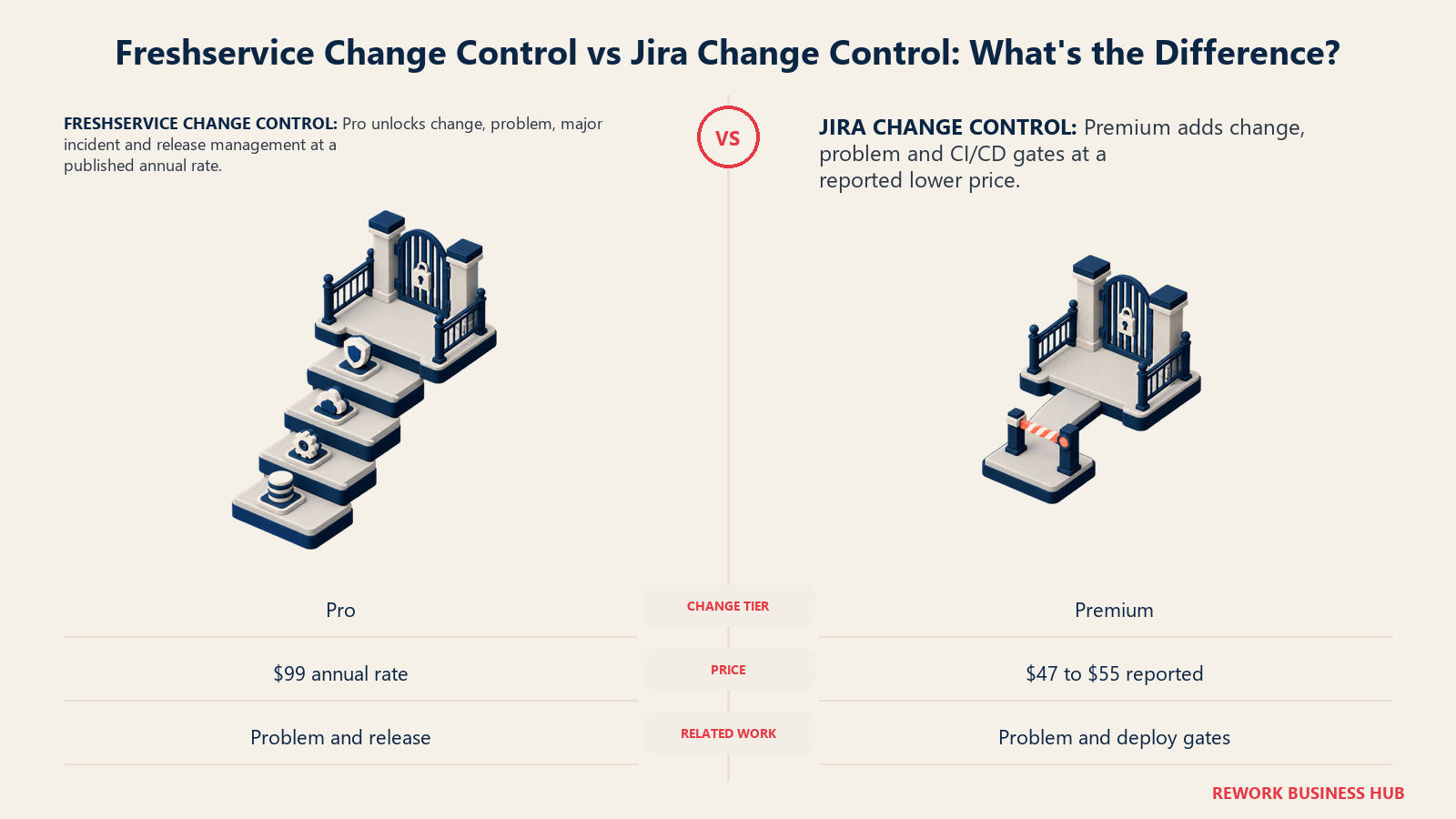
On the Atlassian side this was explicit. The October 2024 packaging update moved the "Change work category," "Change queues," "Change calendar," "Automated risk assessments," "Integrations with CI/CD tools" and "System-level change automation rules" out of Free and Standard into Premium and Enterprise. Problem management went the same way, taking the "Problem work category" and "Problem queues" with it. Free and Standard kept the incident work category, incident queues, alerts and on-call schedules. A team on Standard has incident handling and paging, but not change control.
On the Freshworks side there was no announcement, just a plan structure. The Freshservice pricing page lists problem, change, major incident, release and workload management plus employee journeys as Pro features. Growth carries the service catalog, SLA management, on-call management and cloud management. Starter is incident management, knowledge management, task management and a support portal, and nothing more.
| Process | Freshservice: first tier | Jira Service Management: first tier |
|---|---|---|
| Incident management | Starter, $19 per agent per month (annual) | Free, up to 3 agents |
| Knowledge management | Starter | Free, but the knowledge base runs on Confluence, a separate product |
| Service catalog / request types | Growth, $49 per agent per month (annual) | Free |
| SLA management | Growth | Free |
| On-call management and alerts | Growth | Free |
| Major incident management | Pro, $99 per agent per month (annual) | Standard has a capped allowance, Premium removes the cap |
| Problem management | Pro | Premium |
| Change management | Pro | Premium |
| Release management | Pro | Handled in Jira Software, not a named JSM plan feature |
| Sandbox | Enterprise, custom pricing | Premium |
One wrinkle worth flagging rather than smoothing over. Atlassian's Jira Service Management Premium page, read this month, presents Premium as offering unlimited major incidents against 100 a month on Standard, and unlimited post-incident reviews against 5 on Standard. That reads as a softening of the 2024 change, where both were described as leaving Standard entirely. Treat Standard as having a capped allowance rather than nothing, confirm the current cap, and note that change and problem management are firmly Premium either way.
This is not an Atlassian quirk, it's becoming an industry pattern, and that's the more useful way to read it. ServiceNow made the same move eighteen months later. Its own community licensing explainer, ITSM Licensing in April 2026, describes replacing the legacy Standard, Pro, Pro Plus, Enterprise and Enterprise Plus tiers with Foundation, Advanced and Prime from 9 April 2026, with change and problem management landing in Advanced. Modules that used to sit at Standard or Pro, including Change, Problem and Major Incident, now need Advanced or above, and legacy SKUs reached end of sale on 1 July 2026. Three of the largest ITSM vendors have now fenced off the same two ITIL practices. Budget on the assumption that change and problem management are premium features everywhere.
The commercial consequence is blunt. For a team that genuinely needs ITIL change control, the entry price is not $19 and it is not the Standard rate. It is Freshservice Pro at $99 per agent per month on annual billing, or Jira Service Management Premium at a reported $47 to $55. That gap is the largest number on this page, and it points the other way from the headline prices everyone quotes.
What Freshservice Costs, and What the Page Does Not Say
Freshservice is the transparent half of this comparison. Four tiers, three with a number on them, and a 14-day trial with unrestricted access rather than a crippled sandbox.
The detail almost every roundup drops: the published figures are annual-billing rates, and the pricing page publishes no monthly per-agent rate at all. Monthly billing exists as an option, but you won't learn what it costs until checkout or a call. So "$19" means $19 per agent per month paid annually, which makes a five-agent Starter commitment $1,140 up front, not $95 you can cancel next month.
| Freshservice line item | Published price | Basis |
|---|---|---|
| Starter | $19 per agent per month | Annual billing. Incident and knowledge management, task management, support portal |
| Growth | $49 per agent per month | Annual billing. Adds service catalog, SLA management, on-call management, cloud management |
| Pro | $99 per agent per month | Annual billing. Adds problem, change, major incident, release and workload management, employee journeys |
| Enterprise | Custom | Contact sales. Adds sandbox, audit logs, Freddy AI Agent (Classic), Freddy AI Insights |
| Freddy AI Copilot | $29 per agent per month | Add-on, Pro and Enterprise only |
| Orchestration transactions | $250 per pack of 1,000 transactions | Consumption pack |
| E-signature | $90 per pack per account, 30 credits per pack | Consumption pack |
| IT asset management | 100 Growth Asset Units included, more purchasable | Included allowance |
| Free plan | None | 14-day trial, unrestricted access |
Two add-on lines deserve more attention than they get. Orchestration transactions fire when workflows reach into other systems to provision an account, push a config change, or trigger a downstream job. At $250 per thousand, a service desk that automates aggressively turns a predictable seat cost into a variable one. And Freddy AI Copilot at $29 is a 29% surcharge on a $99 Pro seat, landing Pro plus Copilot at $128 per agent per month, or $1,536 per agent per year.
Freddy AI Agent (Classic), the bot that answers employees without a human, is a different product from Copilot and is included in the Enterprise base. Freshservice's own support documentation states each Enterprise licence includes 1,200 sessions annually, that a session counts when a unique user interacts with the agent inside a 24-hour window, and that overage charges apply beyond the entitlement. That's a usage meter attached to a seat price, so model it as one.
What Jira Service Management Costs, and Why There Is No Single Number
This is where most comparison pages quietly invent a number. Here's what is actually verifiable.
Atlassian renders its plan cards through a JavaScript pricing calculator, so the dollar figures aren't in the pricing page's plain text. What Atlassian does publish in readable text, on its Service Collection licensing page and its Jira Service Management licensing page, is the shape of the model:
- Free is real and capped at three agents, with "2GB storage and Community Support."
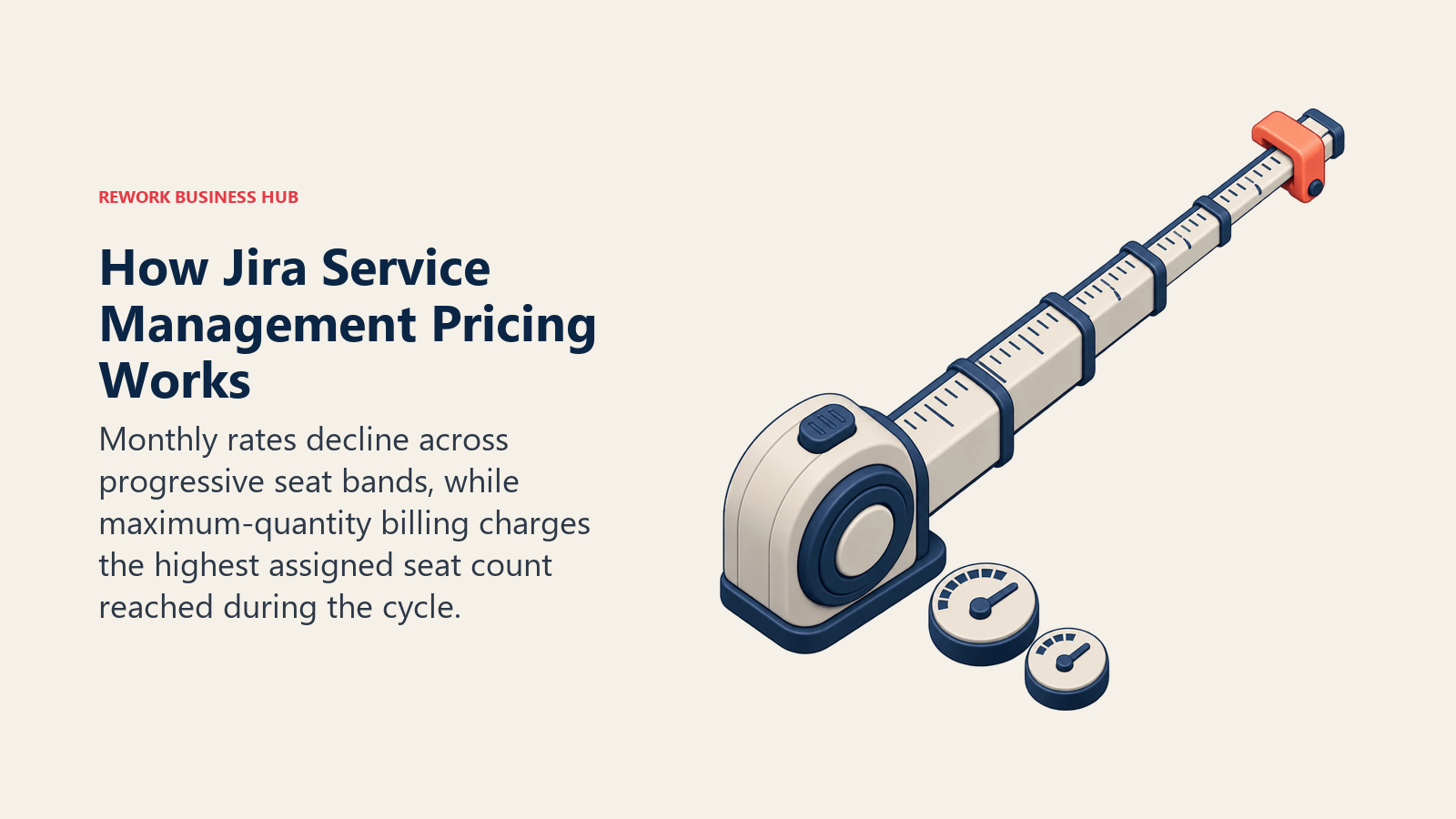
- Monthly pricing is progressive. Atlassian's wording: "We offer volume discounts as you add more seats. Each user's unit price is based on the pricing rate in which the user falls." There is no single correct per-agent figure to quote.
- Monthly plans use Maximum Quantity Billing. "Your bill is based on the highest number of seats ('maximum quantity') assigned to each product at any point during your billing cycle." Add five contractors mid-cycle and remove them a week later, and you still pay for them.
- Annual pricing requires a quote, with Net-30 terms available on orders above $10,000.
- Consumption charges sit on top of seats. The virtual service agent includes "1,000 assisted conversations per month or 12,000 assisted conversations per year for free" on Premium and Enterprise, then bills at "$0.30(USD)/assisted conversation/month with volume discounts." Rovo Customer Service is included "for the cost of $1 per resolution."
- Atlassian contradicts itself on the Assets object rate, and both sources are its own. The 2024 packaging announcement says additional objects "will start at $.05(USD)/object/month." The current licensing page says "As of October 7, 2025, Assets objects cost $0.02 per object per month with the ability to purchase at volume discount," with allowances of 50,000 objects on Premium and 500,000 on Enterprise. Both pages are live. On a 200,000-object CMDB that is a 2.5x swing, so get the rate and the allowance confirmed in writing.
For the figures Atlassian won't render, here's what third parties report. Treat these as directional and confirm them in Atlassian's calculator before signing.
| Figure | Value | Source and status |
|---|---|---|
| Free plan | $0, up to 3 agents, 2GB storage, Community Support | Vendor-published on atlassian.com |
| Standard at 10 agents | ~$23.80 per agent per month, monthly billing | (reported) by ClearFeed, published 4 August 2026 |
| Standard at 500 agents | ~$11.43 per agent per month | (reported) by ClearFeed |
| Premium at 10 agents | ~$53.30 per agent per month, monthly billing | (reported) by ClearFeed |
| Premium at 500 agents | ~$29.43 per agent per month | (reported) by ClearFeed |
| Standard and Premium annual averages | ~$19.04 and ~$47.82 per agent per month | (reported) by eesel AI |
| Enterprise | Custom, annual only. Roughly $157,000 a year for around 800 agents | (reported) by ClearFeed |
| Assets objects | 50,000 on Premium, 500,000 on Enterprise, then $0.02 or $0.05 per object per month | Vendor-published on two Atlassian pages that disagree |
Notice what progressive pricing does to a small team: the reported ten-agent Standard rate of $23.80 is higher than the $19.04 annual average that gets quoted as the headline. Small teams pay above the sticker on Atlassian, large teams pay well below it. That's the exact opposite of Freshservice, where fifty agents and five agents pay the same $19, $49 or $99. Anyone comparing "$19 Freshservice against $20 Jira Service Management" has compared two numbers that are true in different worlds.
One caution on Standard's feature set. Atlassian's 2024 announcement is explicit about what left Standard, and request types, SLAs, queues, alerts and on-call schedules were not on that list, so they remain. But Atlassian publishes no readable plan-by-plan feature grid, so anything beyond that list should be confirmed with the vendor rather than taken from a comparison page, this one included.
Cost at 5, 15 and 50 Agents
A single "$19 against $20" row is misleading even when both numbers are correct. So here are both at three realistic team sizes, with the basis of every cell stated.
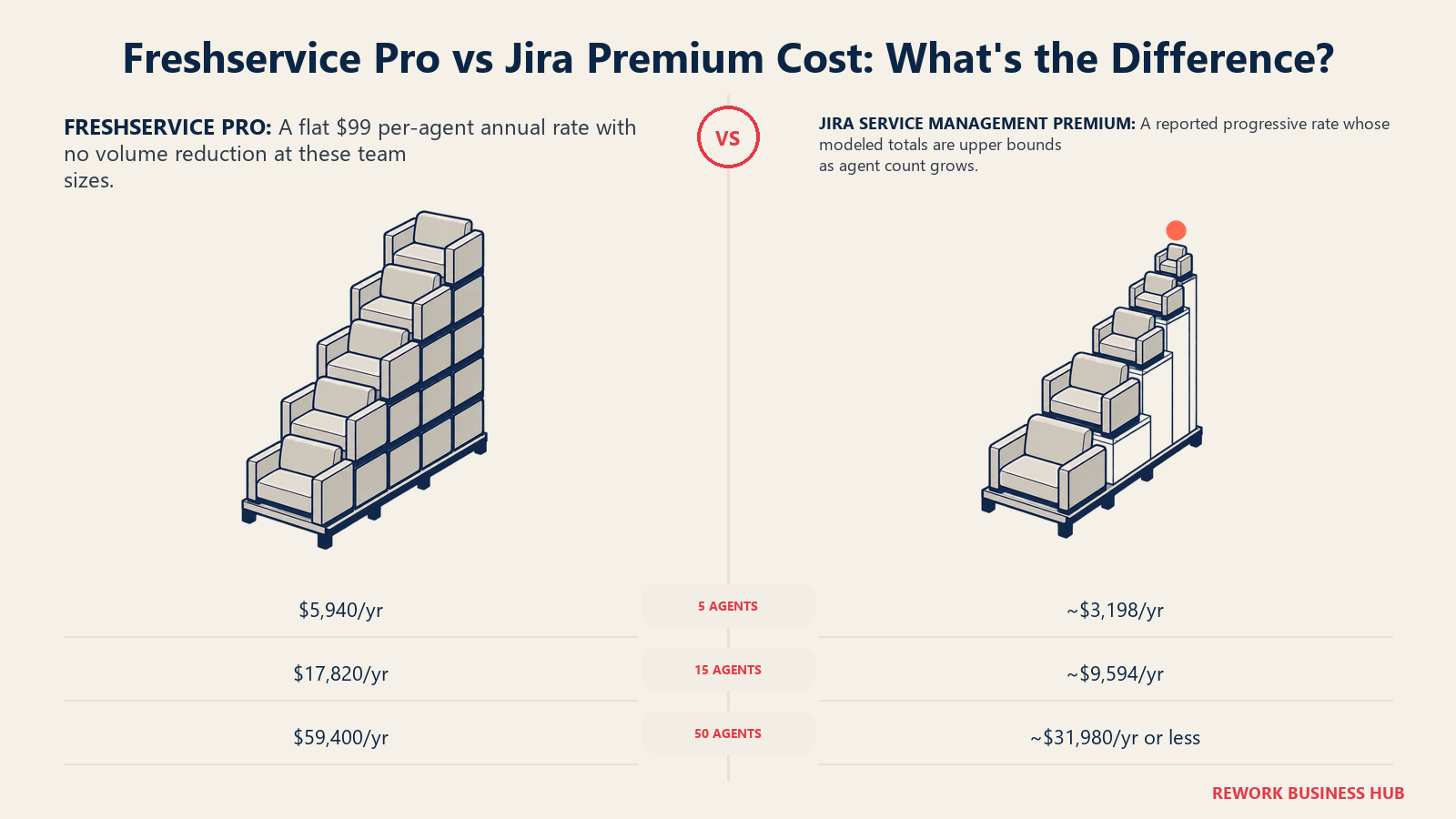
Freshservice first, because it's arithmetic. Flat per-agent tiers, annual billing, no volume break at any of these sizes.
| Agents | Starter ($19) | Growth ($49) | Pro ($99) |
|---|---|---|---|
| 5 | $95/mo, $1,140/yr | $245/mo, $2,940/yr | $495/mo, $5,940/yr |
| 15 | $285/mo, $3,420/yr | $735/mo, $8,820/yr | $1,485/mo, $17,820/yr |
| 50 | $950/mo, $11,400/yr | $2,450/mo, $29,400/yr | $4,950/mo, $59,400/yr |
Jira Service Management can't be tabled the same way, because there is no flat rate. What follows is modelled at the reported ten-agent rate for every row, which makes the 15 and 50 figures an upper bound: Atlassian's progressive discount means the real bill at those sizes is lower, and materially lower at 50.
| Agents | Standard, modelled at reported $23.80 | Premium, modelled at reported $53.30 |
|---|---|---|
| 5 | $119/mo, $1,428/yr | $266.50/mo, $3,198/yr |
| 15 | $357/mo, $4,284/yr or less | $799.50/mo, $9,594/yr or less |
| 50 | $1,190/mo, $14,280/yr or less | $2,665/mo, $31,980/yr or less |
Now the comparison that matters, which is not tier against tier but process against process. If your requirement includes ITIL change management, the only honest pairing is Freshservice Pro against Jira Service Management Premium.
| Agents | Freshservice Pro (vendor-published, annual) | JSM Premium (reported, upper bound) | Difference |
|---|---|---|---|
| 5 | $5,940/yr | ~$3,198/yr | JSM roughly 46% less |
| 15 | $17,820/yr | ~$9,594/yr | JSM roughly 46% less |
| 50 | $59,400/yr | ~$31,980/yr or less | JSM at least 46% less, and the gap widens with the volume discount |
Add AI and the spread grows. Freshservice Pro plus Freddy AI Copilot is $128 per agent per month, or $23,040 a year for fifteen agents before any orchestration or e-signature packs. Jira Service Management Premium includes the virtual service agent at no extra seat charge, and Rovo comes bundled. Freshservice's comparable deflection agent is Enterprise-only and therefore quote-only.
Two caveats keep this honest. The Freshservice figures are vendor-published and the Atlassian ones are not, so the gap could narrow once you have a real quote. And the Jira Service Management bill is not the whole Atlassian bill: a knowledge base needs Confluence, the developer backlog needs Jira Software seats for non-agents, and both Assets and Customer Service Management meter. Freshservice's number is more complete out of the box. Building both into a proper three-year model is exactly what our SaaS TCO modelling guide is for.
Asset Management, CMDB and Discovery
This is Freshservice's strongest ground, and the reason a lot of IT departments choose it despite the Pro price.
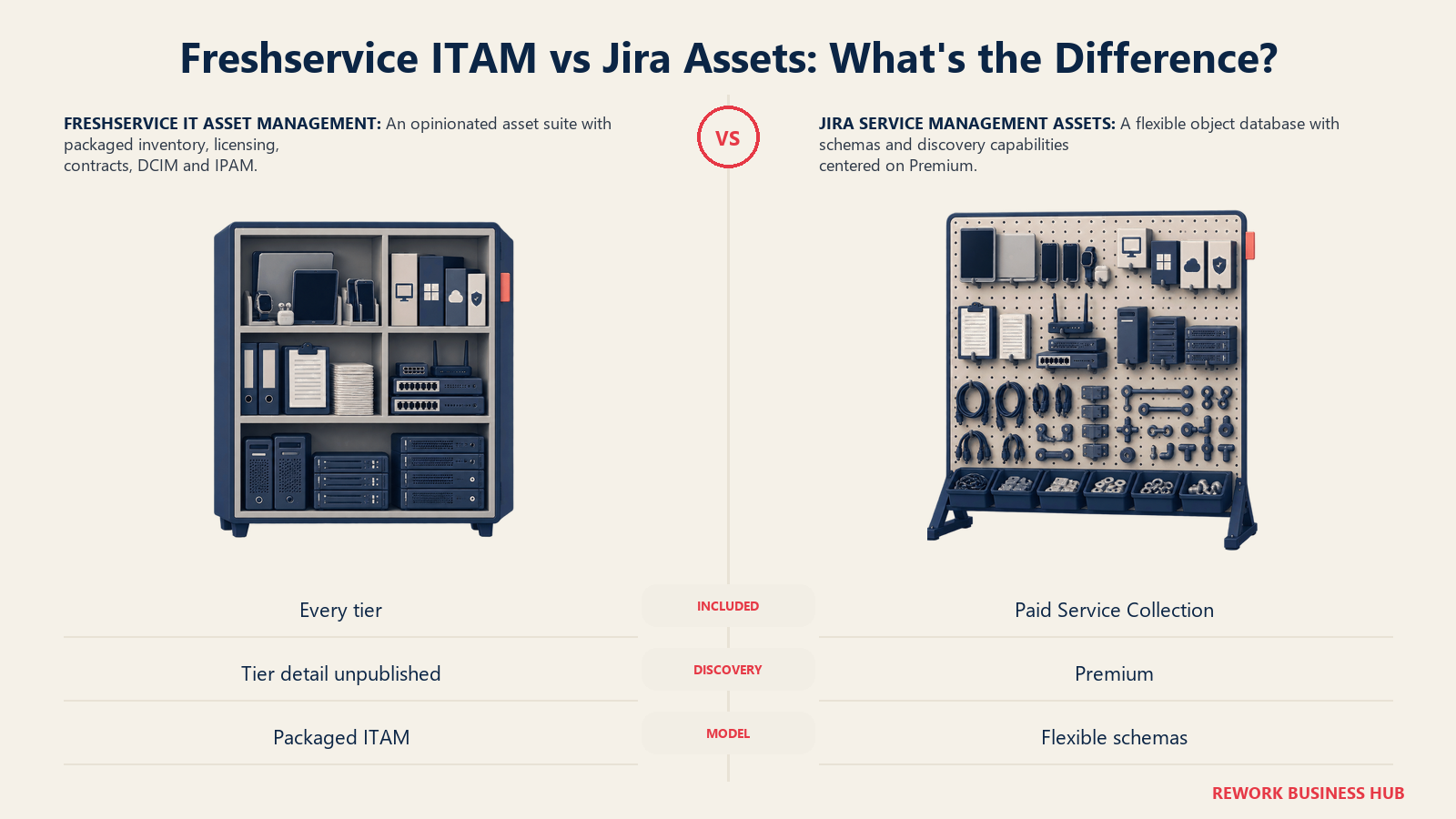
Freshservice ships IT asset management on every tier, with 100 Growth Asset Units included. Freshworks' ITAM page describes automated discovery across "on-prem, cloud, and hybrid environments," software license management, dependency mapping between apps, services and infrastructure, data centre infrastructure management, IP address management, and utilisation data covering CPU, memory and I/O. That page does not break capability down by plan tier, so if a specific discovery mechanism is decisive, get it confirmed in writing.
Atlassian's Assets is now part of Service Collection rather than a separate purchase, which is an improvement on the old arrangement. But discovery and schema modelling sit on Premium: Atlassian's Premium page lists "Asset discovery, object schemas, object types, schema templates" among what Premium adds. And Assets meters once you exceed the allowance, at the two different rates Atlassian's own pages state.
| Capability | Freshservice | Jira Service Management |
|---|---|---|
| Included from | Every tier, starting at Starter | Bundled into Service Collection at all paid tiers |
| Automated discovery | Yes, across on-prem, cloud and hybrid. Tier availability not published per feature | Premium and above |
| CMDB / relationship mapping | Dependency mapping between apps, services and infrastructure | Object schemas and object types, Premium and above |
| Included allowance | 100 Growth Asset Units | 50,000 objects on Premium, 500,000 on Enterprise |
| Overage cost | Additional units purchasable, price not published | $0.02 or $0.05 per object per month, depending which Atlassian page you read |
| Software licence management | Yes, named on the ITAM page | Via Assets object modelling, not a packaged licence module |
| DCIM and IP address management | Yes, both named | Not published as native capabilities |
The allowance figures are not comparable, and that trips people up. Atlassian counts objects in a configuration database, where one laptop might be several objects once you model its software, owner and location. Freshservice counts asset units against a licence entitlement. Do not read "50,000 versus 100" as a five-hundred-fold advantage. Ask each vendor to price your actual estate, and note that the ten-times step from Premium's 50,000 objects to Enterprise's 500,000 is a real negotiating lever if your CMDB is large.
Freshservice leads on packaged breadth: contract management, licence tracking, DCIM and IPAM arrive as product features rather than things you model yourself. Atlassian leads on flexibility: if your CMDB has an unusual shape, Assets will model it, because it's a generic object database rather than an opinionated asset register. For the wider question of who owns the SaaS and device estate once discovery runs, our SaaS management software roundup covers the adjacent tooling, and if the pain is device management rather than service management, Jamf versus Intune is the more useful page.
The Developer Backlog Link
Ask why a company runs Jira Service Management and the honest answer is usually not "we evaluated ITSM platforms." It's "engineering already had Jira." That's a rational read, not a cynical one. If half your engineers already work in a system, putting IT tickets there removes an entire class of handoff.
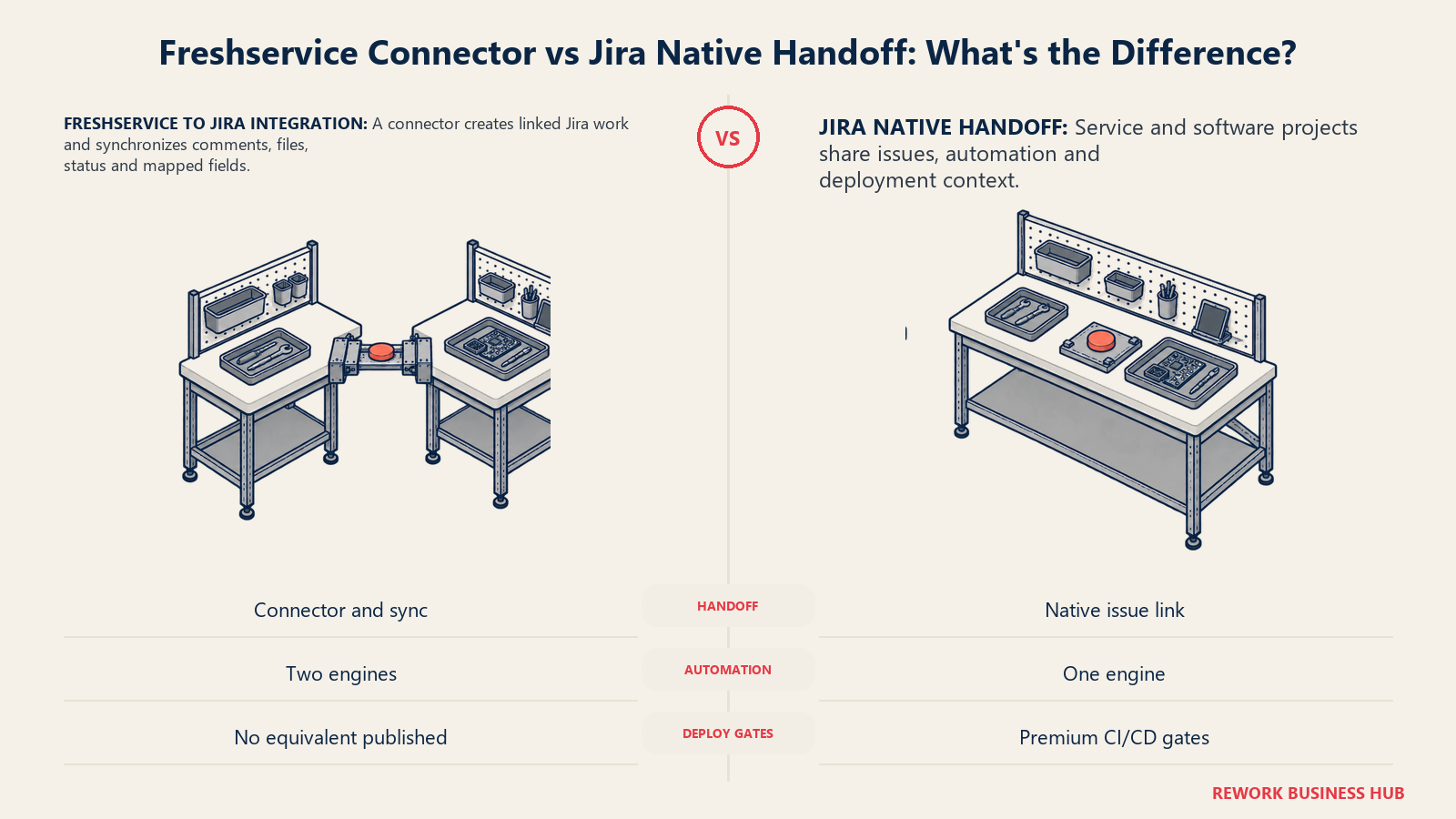
What "native" buys is more than a shared login. A service request and a bug are the same underlying issue type, so escalation is a link rather than a sync. Automation rules span both projects. Deployment gating on Premium reaches into Bitbucket, Jenkins and GitLab, so a change record can block a deploy rather than describe one afterwards. And a developer looking at a linked issue doesn't need a second licence to see why IT raised it.
Freshservice's answer is integration, and it's a competent one. Freshworks ships a native Atlassian Jira integration that syncs comments and attachments across incidents, problems, changes and releases, and maps statuses between the two systems. Marketplace connectors add deeper two-way field sync for teams that need it.
| Freshservice | Jira Service Management | |
|---|---|---|
| Relationship to the backlog | Integration. Native connector plus marketplace two-way sync apps | Same platform. Service and software projects share the issue model |
| Escalating to engineering | Creates and links a Jira issue, syncs comments, attachments and mapped statuses | Links or moves the issue. No cross-system mapping to maintain |
| Automation across IT and dev | Two engines, coordinated through the connector | One automation engine across both project types |
| Change gating on deployments | Not a published capability in the same form | CI/CD deployment gating on Premium, with Bitbucket, Jenkins and GitLab named |
| Cost of the link | Connector licensing where a marketplace app is used, plus maintenance | Jira Software seats for developers who need more than issue visibility |
| Fails when | Field mappings drift, or the systems disagree about status | IT wants an opinionated ITSM product and gets a configurable platform instead |
The counter-argument deserves airtime. Plenty of IT teams have no developer backlog to link to. If your tickets are laptops, access requests, onboarding and printer queues, and the nearest engineer works for a vendor, the Jira adjacency is worth nothing and you're paying in configuration complexity for a benefit you won't use. That's the clearest single case for Freshservice. If you're weighing the developer side specifically, our guide to choosing issue tracking software covers that half properly.
AI: Freddy vs Atlassian Intelligence and the Virtual Service Agent
Both vendors have an AI story. They charge for it very differently, and that difference is bigger than any feature gap between them.
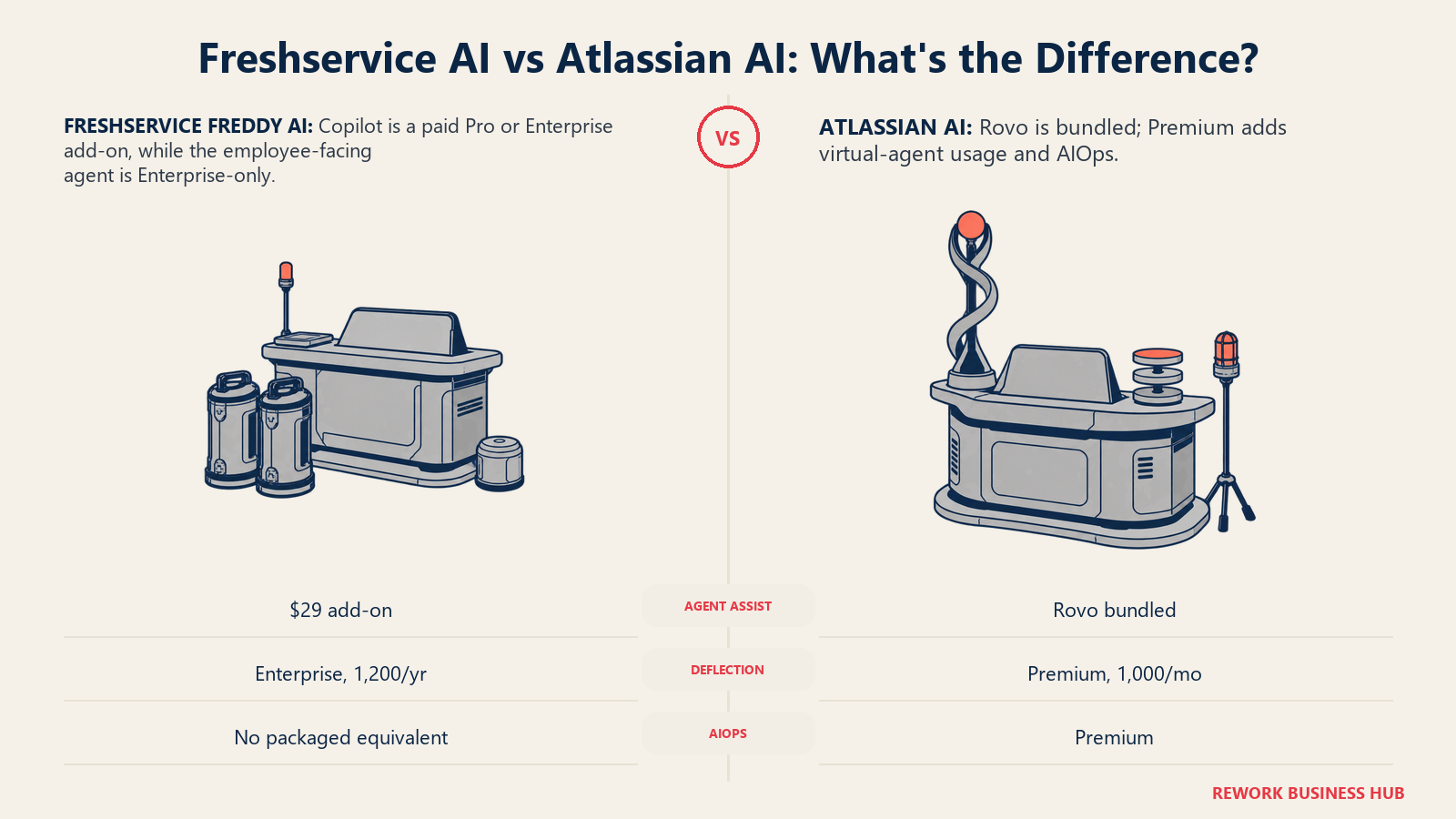
Freshservice splits AI in two. Freddy AI Copilot helps the agent by summarising, drafting and suggesting, and it's a $29 per agent per month add-on on Pro and Enterprise. Freddy AI Agent (Classic) is the deflection bot, included in the Enterprise base with 1,200 sessions per licence per year and overage charges beyond that.
Atlassian bundles. Rovo is one of the four things inside Service Collection, so it carries no separate seat charge. The virtual service agent arrives with Premium, includes 1,000 assisted conversations a month, then bills at $0.30 each. Premium also carries AIOps features Freshservice does not advertise an equivalent for: alert grouping, AI incident creation, and AI-generated post-incident reviews.
| Freshservice | Jira Service Management | |
|---|---|---|
| Agent-assist AI | Freddy AI Copilot, $29 per agent per month, Pro and Enterprise only | Rovo, bundled at no separate seat charge |
| Employee-facing deflection | Freddy AI Agent (Classic), Enterprise only, 1,200 sessions per licence per year, overage charged | Virtual service agent, Premium and above, 1,000 assisted conversations a month, then $0.30 each |
| AIOps (alert grouping, AI incident creation, AI post-incident reviews) | Not published as an equivalent packaged capability | Premium and above |
| Cost shape | Predictable per-seat surcharge plus session overage | Bundled seat cost plus per-conversation meter |
The practical read: if your AI use case is helping agents work faster, Atlassian's bundling is cheaper because Rovo carries no seat price. If it's deflecting employee tickets at volume, model the meters carefully, because $0.30 per assisted conversation adds up at a few thousand a month, and 1,200 sessions per licence per year is a modest allowance once employees actually adopt the bot. Given how fast the category is moving, buy for the pricing model, which changes slowly, rather than the feature list, which doesn't.
Reporting, Admin Burden and Time to Value
Licence cost is the number you defend in the budget meeting. Admin burden is the number that actually shows up, and it lands on one or two people rather than on a line item.
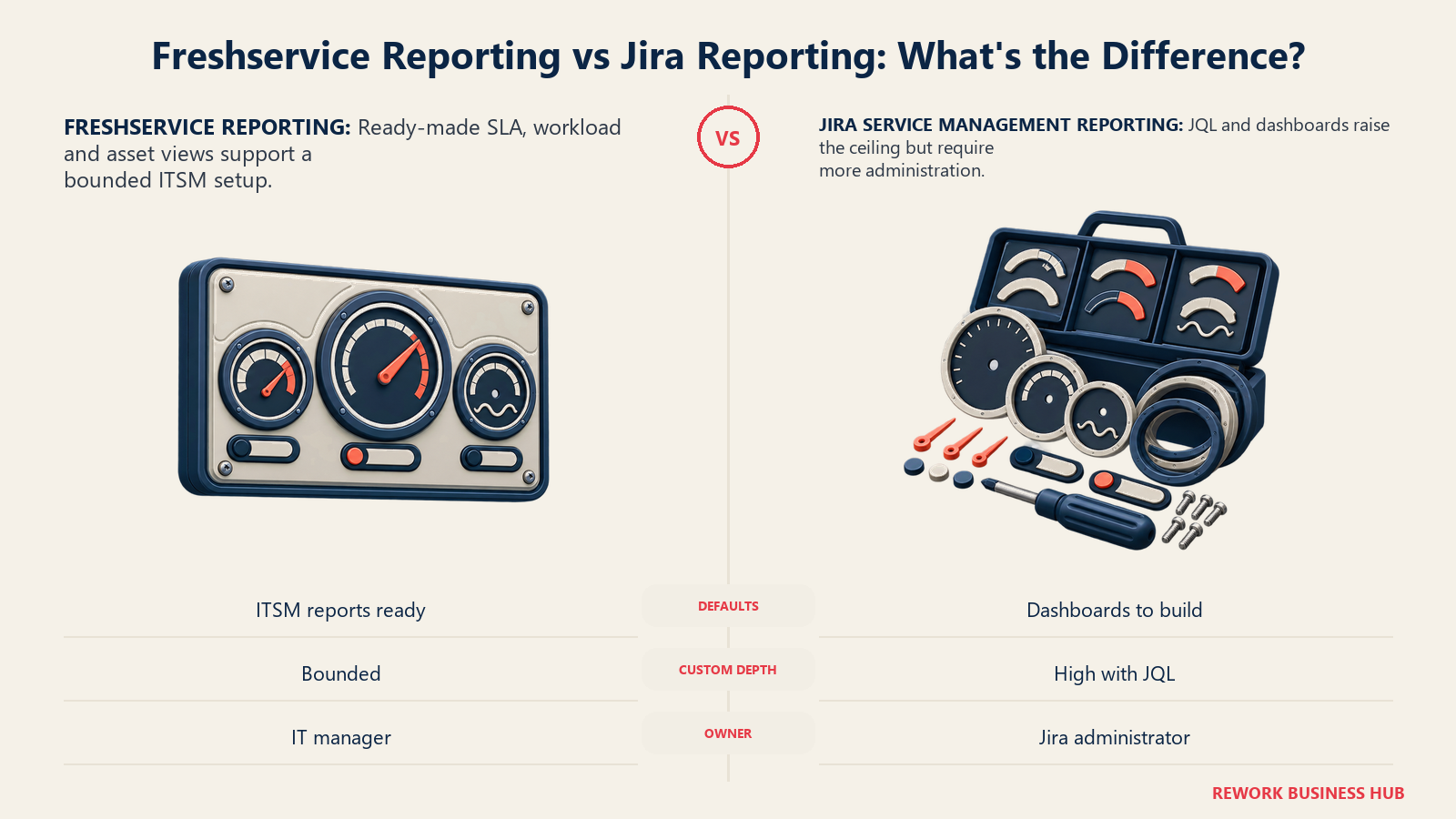
Freshservice gives ITSM reporting shaped like ITSM reporting: SLA attainment, ticket volume by category, agent workload, asset lifecycle, with Freddy AI Insights on Enterprise. You get answers to the questions an IT manager asks weekly without building anything, and fewer answers to unusual questions. Setup is bounded to the same degree: configure service categories, build the catalog, set SLAs, import assets, publish the portal. The workflow automator is on every tier, so you're not blocked from automating on the cheap plan.
Jira Service Management reports through the Jira dashboard stack: gadgets, JQL-driven filters, and whatever the marketplace sells. Premium adds admin insights plus service and infrastructure health analysis. If you can express a question in JQL you can usually chart it. If you can't, you're waiting for someone who can. Setup is unbounded in both directions. Atlassian's own migration documentation for the agent-based licensing model spells out the work: build an agent list, add agents to the service-desk-agents group, assign project roles across Administrators, Agents, Customers and Collaborators, resolve permission scheme errors by upgrading schemes, and decide whether the customer portal is open or restricted.
| Freshservice | Jira Service Management | |
|---|---|---|
| Out-of-the-box ITSM reports | Strong. SLA, volume, workload and asset lifecycle without configuration | Present, but depth comes from dashboards and filters you build |
| Custom reporting ceiling | Bounded by what the product exposes | High. JQL plus marketplace reporting apps |
| Time to a usable service desk | Days to a couple of weeks for a standard setup | Days with a Jira admin, weeks to months without |
| Who has to own it | An IT manager can own it directly | Realistically a Jira administrator, shared with engineering |
| Common failure mode | Outgrowing what the product will let you express | Permission schemes and request types drifting into a mess nobody wants to touch |
| Sandbox and audit logs | Enterprise tier | Sandbox and admin insights on Premium, org-level controls on Enterprise |
| Support floor | 24/7 email and 24/5 chat on every plan | Community Support on Free, 24/7 Premium Support with under one hour on critical issues from Premium |
That support row matters if you're small. Freshservice puts real support on the entry plan. Atlassian's equivalent commitment arrives at Premium, which for a small team is also the tier with the worst per-agent rate thanks to progressive pricing. Small teams face Atlassian's highest unit cost and its thinnest support at the same time.
Migration Cost in Both Directions
Nobody prices the exit when they're buying. Both directions have a specific cost, and they are not symmetrical.
| Migration factor | Freshservice to Jira Service Management | Jira Service Management to Freshservice |
|---|---|---|
| Ticket history | Exportable and importable, but status and category mappings need rebuilding by hand | Same mapping work in reverse |
| Workflow and automation | Full rebuild. Workflow automator rules do not translate to Jira automation | Full rebuild in the other direction |
| Asset data | Asset records need remodelling as Assets objects and schemas | Objects need flattening into asset units, usually losing relationship depth |
| Knowledge base | Rebuild in Confluence, an additional product and licence | Import into Freshservice knowledge management, included from Starter |
| Reporting | Rebuild as Jira dashboards and JQL filters | Rebuild inside Freshservice reporting, accepting a lower custom ceiling |
| Hidden cost | Jira Software and Confluence licences you did not previously need | Losing the native developer link, replaced by a connector to maintain |
The asymmetry is in the direction of complexity. Moving to Atlassian usually means acquiring more products. Moving to Freshservice usually means consolidating into fewer and losing expressiveness, particularly in the CMDB. Either way, do the exit maths before signing the entry contract. Our guides on switching SaaS vendors and negotiating a SaaS contract cover the clauses that make an exit cheap or expensive, and both apply here given that Atlassian's annual terms are quote-based and Freshservice's published rates are annual-commitment rates.
Who Should Pick Freshservice
- Your IT department has no developer backlog to link to, so the Atlassian adjacency buys nothing and costs configuration complexity
- Asset management, licence tracking, contract management, DCIM or IPAM are core requirements you want as product features rather than objects you model
- You need a budget number before a sales call, and an annual figure you can defend without a quote
- The team owning the platform is an IT manager rather than a Jira administrator, and there's no admin to borrow
- Support matters on day one, not at the top tier: 24/7 email and 24/5 chat sit on every plan
- Your process needs stop at incidents, requests, SLAs and on-call, in which case Growth at $49 covers you and you never touch the $99 tier
Who Should Pick Jira Service Management
- Engineering already runs Jira, and a meaningful share of IT tickets end up needing developer work anyway
- You need ITIL change management and the budget is tight: Premium lands roughly 46% below Freshservice Pro at the sizes modelled here, and further below as you add agents
- Change control needs to gate deployments rather than document them, with CI/CD integration into Bitbucket, Jenkins or GitLab
- Incident response is a first-class discipline: incident command centre, AIOps alert grouping and AI-generated post-incident reviews all sit on Premium
- You have a Jira administrator, or you're happy to fund one, and you want a configuration ceiling rather than a product's opinions
- You're growing fast, so progressive pricing works for you rather than against you
If Neither Fits
Plenty of teams work through this and realise the real constraint is elsewhere: a tier gate they resent, a currency, an on-premises requirement, or a preference for one flat price with nothing locked away.
The most interesting alternative for anyone annoyed by tier gating is HaloITSM, which sells the opposite model. Its pricing page publishes £66 per agent per month billed annually for the UK, in pounds sterling with a currency switcher for other regions, and states plainly that "Halo has no tiers, editions or add-ons." Change, problem, asset management, projects, billing, AI and analytics all arrive in the one price. Label the currency when you compare: £66 is not $66.
SysAid takes a similar all-in position. Its pricing page lists Professional at $89 per agent per month, including "Request, incident, change & problem management," all-in-one asset management, AI Copilot for agents and end users, pre-built AI agents with 100K Workato credits, and SLA management with dashboards and BI analytics. The page does not split annual against monthly billing, so confirm the basis before comparing it to Freshservice's annual rates.
| Alternative | Published price | Why you'd look at it instead |
|---|---|---|
| HaloITSM | £66 per agent per month, billed annually (GBP, currency switcher available) | One flat price with nothing gated. The cleanest answer to "why is change management a tier up?" |
| SysAid | $89 per agent per month, Professional. Enterprise custom from 20 agents | Change and problem management at a single rate, without climbing to a $99 tier |
| ManageEngine ServiceDesk Plus | From US$13 per technician per month on-premises Standard, US$27 Professional, US$67 Enterprise | The strongest option if you need on-premises deployment. Confirm which deployment you're quoted, since cloud prices differently |
| ServiceNow | Not published. Every circulating per-seat figure is (reported) | Enterprise governance and scale neither platform here targets, though its April 2026 repackaging gates change and problem management the same way. See the best ServiceNow alternatives if the quote lands badly |
If you're still at the framework stage, how to choose ITSM software sets out the requirements exercise, and the deep dives on Freshservice alternatives and Jira Service Management alternatives cover the wider field around each.
Decision Framework
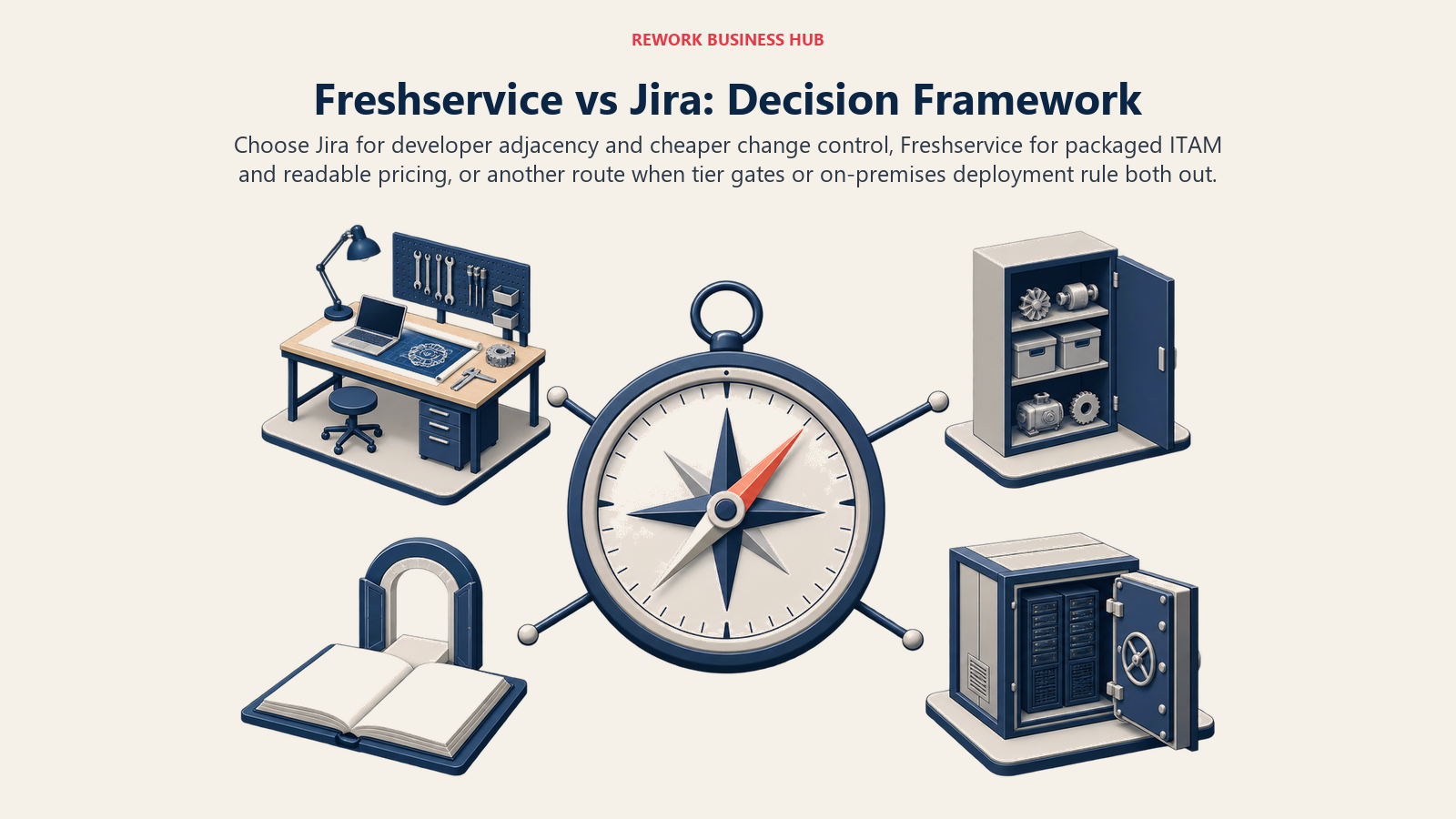
Use the IT operating model below as the routing guide. Developer adjacency and lower-cost change control point toward Jira Service Management, while packaged ITAM and readable pricing point toward Freshservice. Flat-price and on-premises constraints lead elsewhere.
| If you are... | Pick |
|---|---|
| Running IT next to an engineering org already living in Jira | Jira Service Management |
| Buying ITIL change management on a constrained budget | Jira Service Management Premium, roughly 46% below Freshservice Pro at the sizes modelled here |
| Running IT with no developer backlog and no Jira admin | Freshservice |
| Treating asset management, licence tracking and contracts as core requirements | Freshservice |
| Needing a defensible budget number before any sales conversation | Freshservice, the only one that publishes readable prices |
| Needing change control that gates deployments in Bitbucket, Jenkins or GitLab | Jira Service Management Premium |
| Only ever going to need incidents, requests, SLAs and on-call | Freshservice Growth at $49, or Jira Service Management Standard if you already run Jira |
| Piloting with three agents or fewer before committing | Jira Service Management Free, the only free option here |
| Fed up with paying a tier up for change management | HaloITSM or SysAid, both single-rate with nothing gated |
| Required to deploy on-premises | ManageEngine ServiceDesk Plus |
The verdict: Freshservice sells clarity. You can read the price, asset management is on every tier, support is decent from day one, and the product has opinions so you don't have to. You pay for that with a $99 per agent per month gate on the ITIL processes most buyers came for. Jira Service Management sells leverage. If Jira is already in the building, the service desk is nearly free of integration cost, change management gates real deployments, and Premium runs materially cheaper than Freshservice Pro. You pay with an unquotable price, a configuration burden, and a bundle that now includes products and meters you may not have asked for.
The tiebreaker is rarely the feature grid. It's whether you have a Jira administrator, and whether IT tickets in your organisation regularly end in developer work.
What to Do Next
- Write down which ITIL processes you actually need, in order. If change and problem management are on that list, ignore both entry tiers and compare Freshservice Pro against Jira Service Management Premium. That one step removes most of the confusion on this page.
- Get a real Atlassian quote at your exact agent count. Progressive pricing means your number depends on your seat count. Ask whether you're being quoted Service Collection, and what Assets and Customer Service Management metering costs at your volume.
- Count the companion products. For Atlassian, price Confluence for the knowledge base and Jira Software seats for developers. For Freshservice, price Freddy AI Copilot, orchestration packs and additional asset units. Compare totals, never stickers.
- Ask each vendor in writing which tier your discovery requirement lands on. Freshworks does not publish ITAM capability by tier and Atlassian gates discovery to Premium. This is the most common place a shortlist decision turns out to be wrong.
- Run both trials with your real ticket flow, then model the exit before signing the entry. Read switching SaaS vendors and get the data-export and termination terms right while you still have leverage.
Frequently Asked Questions about Freshservice vs Jira Service Management
Is Freshservice or Jira Service Management cheaper?
It depends on which processes you need. For incidents and requests only, Freshservice Starter at $19 per agent per month on annual billing is close to Jira Service Management Standard, which third parties report at roughly $19 to $24 per agent per month depending on seat count and billing basis. For ITIL change management, Jira Service Management Premium is substantially cheaper: reported figures put it around $47 to $55 against Freshservice Pro at a vendor-published $99. Atlassian also discounts progressively as you add agents, while Freshservice charges the same rate at 5 agents as at 500.
Does Freshservice have a free plan?
No. Freshservice has no free tier as of August 2026, only a 14-day trial with unrestricted access to all features. Jira Service Management does have a free plan, capped at 3 agents with 2GB of storage and Community Support, which Atlassian confirms on its Service Collection licensing page.
Which tier of Jira Service Management includes change management?
Premium. Atlassian's pricing and packaging update of 16 October 2024 moved the change work category, change queues, change calendar, automated risk assessments, CI/CD integrations and system-level change automation rules out of Free and Standard into Premium and Enterprise. Problem management moved the same way. Free and Standard retain the incident work category, incident queues, alerts and on-call schedules, so a Standard subscription cannot run ITIL change control.
Which tier of Freshservice includes change management?
Pro, at $99 per agent per month billed annually. Freshworks' pricing page lists change management, problem management, release management, major incident management, workload management and employee journeys as Pro features. Growth at $49 covers the service catalog, SLA management, on-call management and cloud management, and Starter at $19 covers incident management, knowledge management, task management and the support portal.
Why can't I find Jira Service Management's per-agent price anywhere?
Because Atlassian only renders it through a JavaScript pricing calculator, and because there genuinely is no single number. Atlassian's licensing page states that "Monthly pricing is progressive" with "volume discounts as you add more seats," and that each user's unit price depends on the rate band they fall into. Monthly plans also use Maximum Quantity Billing, so your bill follows the highest seat count assigned at any point in the cycle. Any single per-agent figure quoted elsewhere is an average at one particular seat count.
Is Jira Service Management still sold on its own?
Not as a standalone product for new purchases. Atlassian's Service Collection licensing page states the collection includes Jira Service Management, Customer Service Management, Assets and Rovo, and that these cannot be purchased separately. Existing customers transition at renewal. Two of the bundled products meter separately: Assets per object above the included allowance, and Customer Service Management at $1 per resolution. Note that Atlassian's own pages currently quote the Assets rate as both $0.02 and $0.05 per object per month, so confirm it at quote time.
Do I need Confluence to use Jira Service Management?
For a knowledge base, yes. Atlassian's documentation directs administrators to set up the knowledge base with Confluence and to add Confluence in order to do so. Freshservice includes knowledge management from its Starter tier with no additional product required. If self-service deflection is central to your plan, price Confluence into the Atlassian side of the comparison.
Related Resources:
- Best SaaS Management Software in 2026
- Best Freshservice Alternatives in 2026
- Best Jira Service Management Alternatives in 2026
- Best Intune Alternatives in 2026
- Jamf vs Intune
- How to Choose ITSM Software
- How to Choose Help Desk Software
- How to Choose Issue Tracking Software
- Help Desk vs Shared Inbox
- Best ServiceNow Alternatives in 2026
- Best Help Desk Software in 2026
- TCO Modeling for SaaS
- Negotiating a SaaS Contract

Principal Product Marketing Strategist
On this page
- TL;DR
- Key Facts
- Who Each Platform Is Actually Built For
- The Change Management Gate Nobody Mentions
- What Freshservice Costs, and What the Page Does Not Say
- What Jira Service Management Costs, and Why There Is No Single Number
- Cost at 5, 15 and 50 Agents
- Asset Management, CMDB and Discovery
- The Developer Backlog Link
- AI: Freddy vs Atlassian Intelligence and the Virtual Service Agent
- Reporting, Admin Burden and Time to Value
- Migration Cost in Both Directions
- Who Should Pick Freshservice
- Who Should Pick Jira Service Management
- If Neither Fits
- Decision Framework
- What to Do Next