Best Microsoft Intune Alternatives in 2026: 10 MDM and UEM Platforms for Mixed Fleets
Turn this article into takeaways for your work.


Each assistant summarizes the article only for you and suggests best practices for your work.
Where a vendor publishes nothing, that is stated plainly and any third-party figure is labeled (reported) with its source named.*
If you're shopping Microsoft Intune alternatives, you're probably one of three people: a Mac-heavy shop that finds Intune's Apple support thin, an IT lead who doesn't want device management welded to a Microsoft 365 licence, or an admin on a two-person team who needs patching and remote control without buying four add-ons. The short answer by profile: Jamf Pro if Apple is the business and budget follows, Mosyle if Apple is the business and budget doesn't, JumpCloud if you want identity and devices on one per-user bill the way Intune does it, Hexnode or ManageEngine Endpoint Central for genuinely mixed fleets, and NinjaOne if patching and remote control matter more than policy depth.
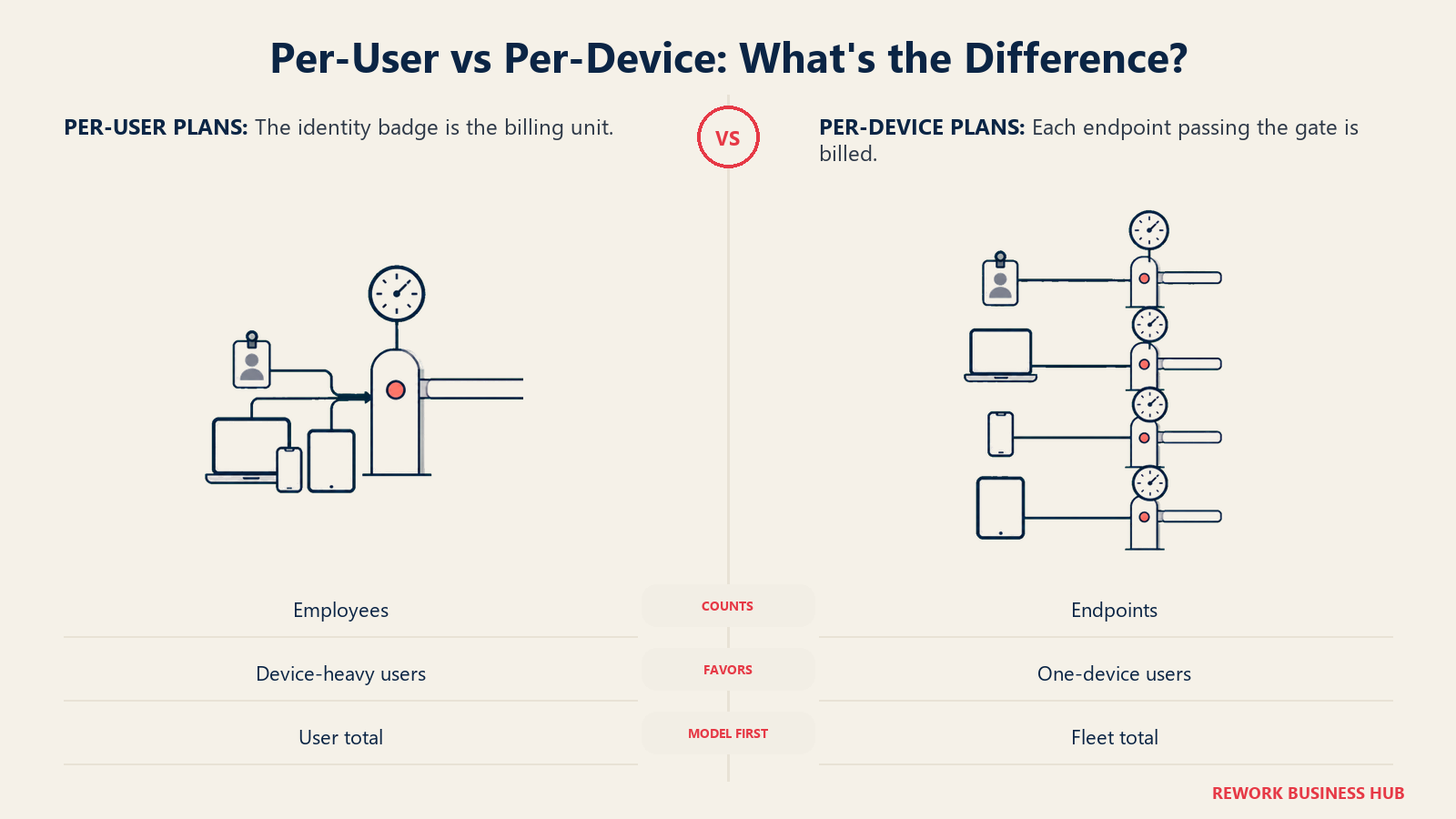
One warning first. Intune and JumpCloud are priced per user. Mosyle, Hexnode, Addigy and SimpleMDM are priced per device. NinjaOne is per endpoint with volume bands, and ManageEngine bills an annual fee per fleet-size band. That difference swings your bill two or three times depending on how many devices your average employee carries, yet most comparison tables stack those bases in one column. Every price cell below names its basis.
Key Facts
- Over 80% of the customers using Kandji (now Iru) for Apple device management use something else, such as Intune, to manage their Windows or Android devices, per CEO Adam Pettit at the October 2025 rebrand. (Computerworld)
- 63% of organizations that use mobile device management regularly audit AI-generated content, against only 48% of organizations without MDM, per Verizon's 2025 Mobile Security Index. (Verizon)
- 93% of employees use generative AI tools on mobile devices in their daily workflows, and 64% of organizations name data compromise from staff entering proprietary information into those tools as their top mobile risk, per the same Verizon index. (Verizon)
- The global unified endpoint management market is projected to reach $30.73 billion by 2032, growing at a 22.0% CAGR across the 2025 to 2032 forecast period, per KBV Research. (KBV Research)
- Microsoft 365 Business Premium, the cheapest Microsoft plan bundling Intune Plan 1, lists at $22.00 per user per month paid yearly ($26.40 billed monthly), which is $1.50 less than Business Standard with Copilot at $23.50, a plan carrying no device management at all. Every Microsoft 365 business plan caps at 300 users. (Microsoft)
Two Prices Everyone Still Quotes That No Longer Exist
This section invalidates most of the Apple MDM comparisons currently online.
Jamf stopped publishing per-device prices. The $4.17 per device per month Jamf Pro figure that appears in nearly every listicle is not on jamf.com/pricing today. The page names Jamf for Mac, Jamf for Mobile and Jamf Now, then says: "Contact a Jamf representative or your local authorized reseller for a detailed quote in your local currency." The circulating third-party figures don't even agree with each other: $4.17, $6.25, $8.25, $12.50 and $13.33 all appear in current roundups, and none traces back to a live Jamf URL (reported). Any dollar figure attached to Jamf Pro in 2026 is reported or historical, not a vendor commitment.
Worth noting as sequence, not cause: Francisco Partners completed a take-private of Jamf on 30 January 2026 at $13.05 per share, roughly $2.2 billion enterprise value, and the stock left Nasdaq. (Francisco Partners) The pricing page has been quote-only since. Those facts sit next to each other; we can't show one caused the other.
Kandji is now Iru, and Iru publishes nothing. Kandji rebranded to Iru on 22 October 2025, kandji.io now redirects to iru.com, and the product expanded past Apple-only into Windows and Android. Six products launched alongside (Workforce Identity, Endpoint Management, EDR, Vulnerability Management, Compliance Automation and Trust Center) plus an MSP program, and existing customers migrated automatically with no functionality change. But iru.com/pricing publishes no tiers and no numbers, only "Iru offers scalable pricing that is based on the solutions your organization needs, as well as the number of users and devices" beside Request a quote and Book a demo.
So the two most-cited Apple MDM prices in the category are both unverifiable in 2026. Meanwhile Mosyle still publishes real numbers and a real free tier, which makes it the only Apple-first platform here you can budget against without a sales call.
What Intune Actually Costs in 2026
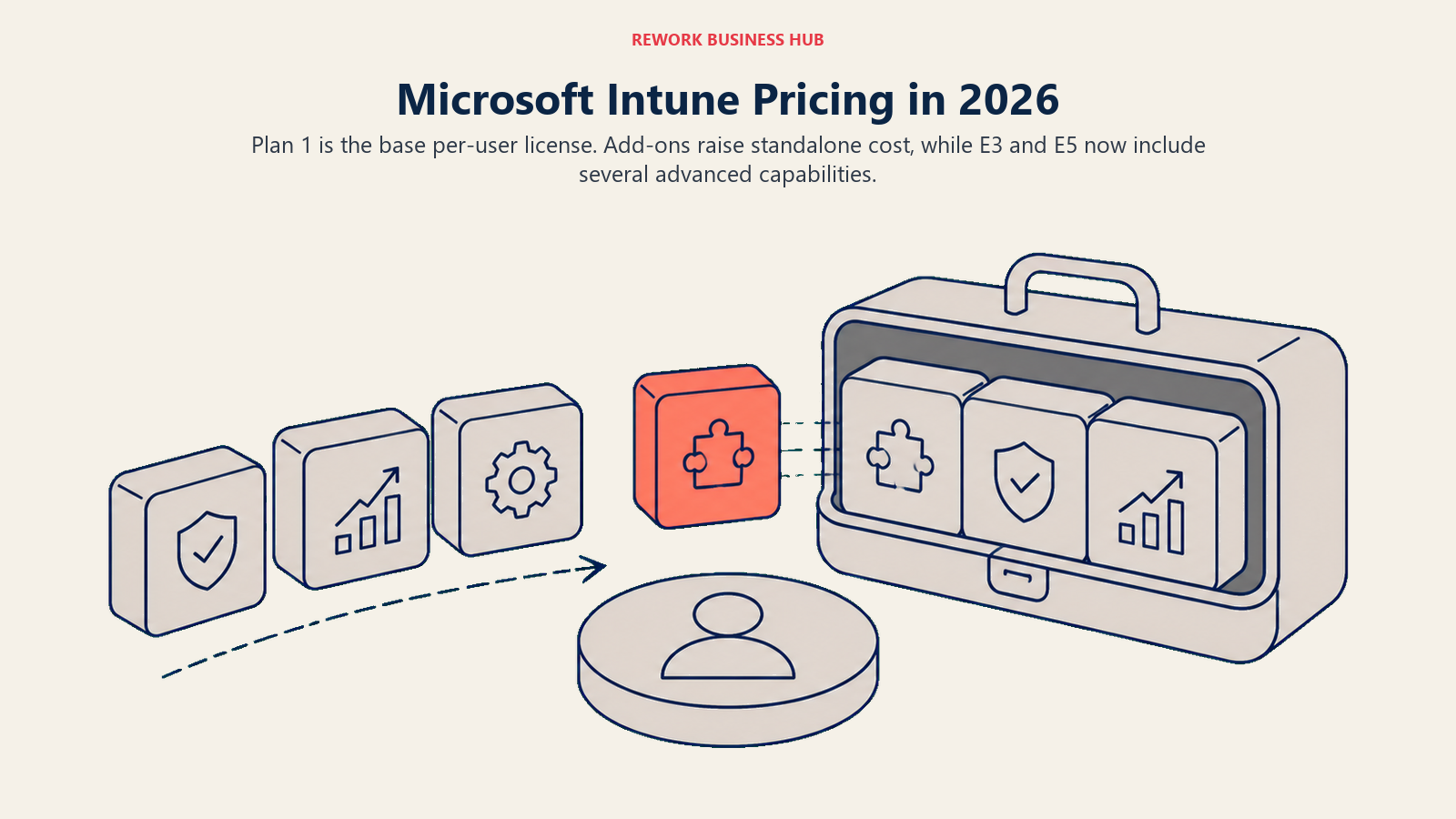
Price the incumbent properly first. Intune is sold per user per month, paid yearly, on an auto-renewing annual subscription.
| Intune SKU | Price (per user/mo, paid yearly) | Requires Plan 1? |
|---|---|---|
| Intune Plan 1 | $8.00 | The base plan |
| Intune Plan 2 | $4.00 | Yes |
| Intune Suite | $10.00 (add-on rate) | Yes |
| Remote Help | $3.50 | Yes |
| Endpoint Privilege Management | $3.00 | Yes |
| Advanced Analytics | $5.00 | Yes |
| Enterprise Application Management | $2.00 | Yes |
| Microsoft Cloud PKI | $2.00 | Yes |
Source: Microsoft Intune pricing.
Sit with the add-on column, but scope it correctly. For a standalone Plan 1 or Business Premium buyer, remote control of a user's screen (bundled free by NinjaOne and ManageEngine) is a $3.50 line item, and stacking Remote Help, Endpoint Privilege Management and Advanced Analytics onto Plan 1 puts you at $19.50 per user per month before a single Office app.
For E3 and E5 holders that argument no longer lands, which most comparison pages have not caught up with. Microsoft's pricing page states that "Starting July 2026, Microsoft is rolling select advanced endpoint management capabilities directly into M365 E3 and E5." E3 gains Remote Help, Advanced Analytics and Intune Plan 2 capabilities; E5 gains those plus Endpoint Privilege Management, Cloud PKI and Enterprise App Management, with 30 days' notice before activation. On E5, most of the stack that makes Intune look expensive is already included, so the honest comparison is capability, not price.
The argument for staying: you may already own it
Intune Plan 1 is included in Microsoft 365 E3, E5, and Enterprise Mobility + Security E3 and E5. It's also included in Microsoft 365 Business Premium, the single most important fact for a small or mid-size buyer, because that's the plan most SMBs already run.
| Microsoft 365 plan | Price (per user/mo, paid yearly) | Includes Intune? |
|---|---|---|
| Microsoft 365 Business Basic | $7.00 | No |
| Microsoft 365 Apps for business | $10.00 | No |
| Microsoft 365 Business Standard | $14.00 | No |
| Microsoft 365 Business Premium (no Teams) | $18.79 | Yes, Intune Plan 1 |
| Microsoft 365 Business Premium | $22.00 | Yes, Intune Plan 1 |
| Microsoft 365 Business Standard with Copilot | $23.50 | No |
| Microsoft 365 Business Premium with Copilot (no Teams) | $28.80 | Yes, Intune Plan 1 |
| Microsoft 365 Business Premium with Copilot | $32.00 | Yes, Intune Plan 1 |
| Microsoft 365 E3 (with Teams) | $39.00 | Yes, plus Plan 2, Remote Help and Advanced Analytics from July 2026 |
| Microsoft 365 E5 (with Teams) | $60.00 | Yes, plus EPM, Cloud PKI and Enterprise App Management |
Copilot is not included in base Business Premium; the $32.00 and $28.80 rows are the with-Copilot variants of the same plan. Business Premium is $26.40 per user per month on a monthly subscription rather than paid yearly. Sources: Microsoft 365 Business Premium, Microsoft 365 business plan comparison and Microsoft Intune pricing.
Two caveats most pages skip, and the first one cuts against every tool on this page. Look at the order of that table: Business Premium bundles Intune Plan 1 at $22.00, which is $1.50 less than Business Standard with Copilot at $23.50, a plan with no device management in it at all. Comparing base to base rather than variant to variant, the step from Business Standard at $14.00 to Business Premium at $22.00 is exactly $8.00, which is precisely what Microsoft charges for standalone Intune Plan 1. You pay the same for Intune whether you bundle it or buy it on its own. For an SMB already on Business Premium, the marginal cost of Intune is effectively zero, and no third-party MDM competes with free. It can only compete by being better. That is the bar the ten tools below have to clear, and it is a higher bar than most alternatives articles admit. The second caveat: every 365 business plan caps at 300 users, so crossing that line pushes you to E3 at $39.00, E5 at $60.00, or standalone Intune Plan 1 at $8.00.
The Per-User vs Per-Device Trap
Here's the comparison almost nobody runs honestly. Take a 100-person company where everyone has a laptop, and design and sales also carry an iPad and a company iPhone. That's 100 users and 160 devices.
| Platform | Pricing basis | Rate | Bill at 100 users / 160 devices |
|---|---|---|---|
| Intune Plan 1 | Per user | $8.00/user/mo | $800/mo |
| JumpCloud Device Management | Per user | $9.00/user/mo (annual) | $900/mo |
| Mosyle Business Premium | Per device | $1.00/device/mo (annual) | $160/mo |
| Hexnode Pro | Per device | $1.98/device/mo (annual) | $317/mo |
| SimpleMDM Standard | Per device | $2.50/device/mo (annual) | $400/mo |
| Addigy Apple MDM | Per device | From $8.25/Mac/mo | $1,320/mo at 160 Macs |
Per-device pricing rewards you when employees carry one device and punishes you when they carry three; per-user pricing does the opposite. Addigy at $8.25 per Mac looks close to Intune's $8.00 per user until you remember Intune's $8.00 covers every device that user owns. TCO modeling for SaaS covers the multi-year version, including the renewal uplift per-device tools apply as fleets grow.
What "Free" Actually Means in MDM in 2026
Free tiers in this category are unusually unreliable, and two of the famous ones have quietly changed shape.
| Platform | Free offer | The catch |
|---|---|---|
| Mosyle Business FREE | Up to 30 devices | Paid plans carry a 30-licence minimum, so the step up is real |
| Jamf Now | "Manage up to 3 devices for free" | Scoped to organizations with fewer than 25 employees; paid rate not published |
| JumpCloud | 10 users and 10 devices, grandfathered only | Closed to accounts created after 1 February 2024 |
| Hexnode | None | 14-day trial, no credit card |
| SimpleMDM | None | 30-day trial, unlimited devices enrolled during it |
| Microsoft Intune | None | Trial only, then Plan 1 or a Microsoft 365 plan that bundles it |
JumpCloud deserves the callout. Its free tier is one of the most-repeated facts in IT tooling writeups, and it isn't available to you unless you already had an account. JumpCloud's support documentation states that "Customers who signed up for a JumpCloud account prior to February 1, 2024 can still use JumpCloud for free with up to 10 users and 10 devices." (JumpCloud) New signups get a free evaluation account meant for testing rather than production, plus a 30-day trial (reported). Price JumpCloud from $9 per user per month and treat anything else as a bonus. Of the tools here, Mosyle's 30-device tier is the one free plan both verified and genuinely usable in production.
Quick Comparison Table
| Tool | Best For | Starting Price | Key Strength | Key Limitation |
|---|---|---|---|---|
| Jamf Pro | Apple-first enterprises and education | Not published, quote only | Deepest Apple management available | No published price, Apple only |
| Iru (formerly Kandji) | Apple shops wanting security in one console | Not published, quote only | Automation plus EDR, identity and compliance | Pricing opacity since the rebrand |
| Mosyle | Apple fleets on a real budget | Free to 30 devices; $1.00/device/mo annual | The only transparent, cheap Apple MDM | Apple only, 30-licence minimum on paid |
| JumpCloud | Replacing Intune and Entra together | $9/user/mo annual, Device Management | Identity and devices on one per-user bill | Free tier closed to new accounts |
| Hexnode | Mixed Windows, Apple and Android fleets | $1.98/device/mo annual, Pro | Published per-device pricing on every OS | 15-device minimum, technician caps |
| ManageEngine Endpoint Central | Intune-scope UEM with patching included | $1,045/yr cloud at 50 endpoints | Patching, remote control and UEM in one licence | Annual fleet-band billing, not per user |
| NinjaOne | Patching and remote control over policy depth | Quote only; $1.50 to $3.75/endpoint/mo | Fast patching and strong remote access | Cheap end requires 10,000 endpoints |
| Omnissa Workspace ONE | Large enterprises leaving Intune sideways | Not published, quote only | Mature enterprise UEM with DEX and virtual apps | Enterprise sales motion, no self-serve price |
| Addigy | MSPs managing many Mac fleets | From $8.25 per Mac/mo | Multi-tenant Apple management for partners | Highest per-device Apple rate here |
| SimpleMDM | Small Apple fleets wanting simplicity | $2.50/device/mo annual | No minimums, no contracts, no setup fees | Apple only, light on advanced policy |
Stage Fit Matrix
| Company stage | What matters most | Strongest fits |
|---|---|---|
| Under 25 employees, Apple only | Staying free or near-free | Mosyle Business FREE, Jamf Now |
| 25 to 100, Apple-dominant | Real automation without a sales call | Mosyle, SimpleMDM |
| 25 to 100, mixed OS | One console at a published price | Hexnode, ManageEngine Endpoint Central |
| 100 to 300, mixed OS, small IT team | Patching and remote control bundled | NinjaOne, ManageEngine Endpoint Central |
| 100 to 500, identity is the real problem | Replacing Entra and Intune in one move | JumpCloud |
| 500-plus, Apple is strategic | Depth, ecosystem, day-zero OS support | Jamf Pro, Iru |
| 1,000-plus, regulated or global | Compliance evidence and enterprise support | Omnissa Workspace ONE |
| MSP managing many client tenants | Multi-tenancy and per-client billing | Addigy, NinjaOne, Hexnode UEM MSP |
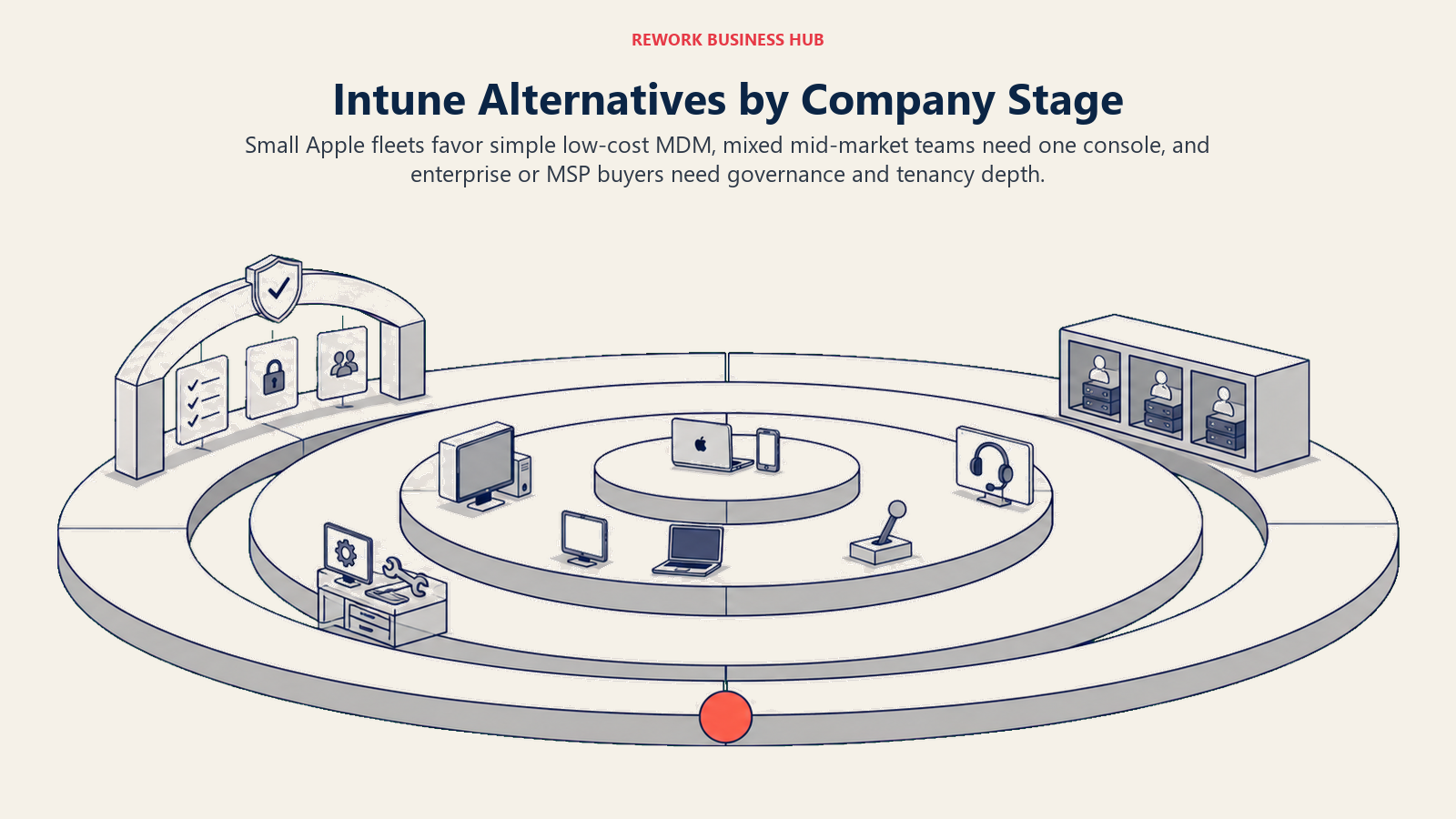
Transparency runs backwards to size here. The small-fleet end (Mosyle, SimpleMDM, Hexnode) publishes numbers you can budget against in an afternoon; the enterprise end (Jamf Pro, Iru, Omnissa, NinjaOne) publishes essentially nothing. If procurement needs a figure before a sales call, that alone halves this list, so run the vendor diligence checklist first.
1. Jamf Pro: The Apple Standard, Now Without a Public Price
Jamf is what Apple-first organizations mean when they say "we don't use Intune": the deepest macOS and iOS management on the market, same-day support for new OS releases, and an ecosystem (Jamf Connect, Jamf Protect, Jamf School) Intune's Apple coverage doesn't match. What changed in 2026 is commercial, not technical.
| What you get | What you don't |
|---|---|
| The deepest Apple device management available | Any published per-device price |
| Same-day support for new macOS and iOS versions | Windows or Android management |
| A full ecosystem: Connect, Protect, School | A self-serve path from evaluation to purchase |
| Jamf Now free for up to 3 devices at very small orgs | Predictable budgeting without a reseller quote |
Pricing: Not published, and Jamf has been privately held by Francisco Partners since 30 January 2026. The pricing page names Jamf for Mac, Jamf for Mobile and Jamf Now, then directs buyers to "Contact a Jamf representative or your local authorized reseller for a detailed quote in your local currency." Jamf Now is scoped to "organizations with less than 25 employees" and its product page states verbatim "Manage up to 3 devices for free"; the paid Jamf Now rate is not published anywhere we could reach, including Jamf's support subdomain. (Jamf) Best for: Organizations where Apple is the primary platform and management depth outranks budget certainty. For the direct head-to-head, see Jamf vs Intune. Not ideal for: Mixed fleets needing one console for Windows, or teams that need a number before a sales conversation.
2. Iru (formerly Kandji): Apple-First, Now Cross-Platform, Still Quote-Only
Kandji built its reputation on Apple management that felt modern: pre-built compliance templates, automated remediation, an admin experience people enjoyed. It rebranded to Iru on 22 October 2025 and expanded into Windows and Android. The logic aims squarely at Intune: per CEO Adam Pettit, over 80% of customers using Kandji for Apple management already ran something else, commonly Intune, for Windows and Android. (Computerworld)
| What you get | What you don't |
|---|---|
| Apple heritage plus Windows and Android | Any published price at any tier |
| EDR, vulnerability management and compliance in one console | The Kandji brand, which no longer exists |
| Workforce Identity with hardware-backed passkeys | A Windows track record as long as Intune's |
| An MSP program for partners | Old Kandji per-device pricing you can rely on |
Pricing: Not published. The Iru pricing page states that "Iru offers scalable pricing that is based on the solutions your organization needs, as well as the number of users and devices" and offers only Request a quote and Book a demo. Every per-device Kandji figure circulating online predates the October 2025 rebrand. (Iru) Best for: Apple-centric, security-conscious teams wanting endpoint management and detection under one console. Teams weighing what else to automate on the security side should see Best AI Tools for Cybersecurity. Not ideal for: Buyers who need a budget figure this week, or Windows-first shops, where the cross-platform side is the newest part of the product.
3. Mosyle: The Only Apple MDM Still Publishing Real Numbers
With Jamf and Iru both publishing nothing, Mosyle is the transparency story in Apple device management. Its free tier covers up to 30 devices with no time limit, and Business Premium is $1.00 per device per month, neither a typo nor an introductory rate. Fuse bundles MDM with identity, security and encryption, and even the top macOS tier stays at $3.00.
| What you get | What you don't |
|---|---|
| A genuinely free plan for up to 30 devices | Windows or Android management |
| Published per-device rates you can budget against | The enterprise ecosystem depth of Jamf |
| Apple Watch and Apple TV management at no extra licence | Deep MSP multi-tenancy compared to Addigy |
| Fuse folds security and identity into the same rate | A paid path below the 30-licence minimum |
Pricing: Billed annually with a 30-licence minimum on paid plans. Business FREE covers up to 30 devices. Business PREMIUM is "$1.00 USD per Mac, iPhone, iPad & visionPro per month." Fuse for macOS is "$3.00 USD per device per month"; Fuse for iOS, iPadOS and visionOS is "$1.50 USD per device per month." watchOS management carries no additional licence, and each paid macOS or iOS licence covers one Apple TV at no cost. (Mosyle) Best for: Apple fleets of any size where cost transparency matters, and small Apple shops staying free under 30 devices. Not ideal for: Mixed fleets, where a second tool for Windows undoes the savings.
4. JumpCloud: Replace Intune and Entra in the Same Move
JumpCloud changes the shape of the problem rather than swapping one MDM for another, combining a cloud directory, SSO, MFA, conditional access and cross-platform device management (Windows, macOS, Linux) into one per-user bill. For teams whose complaint is "we pay for Entra and Intune and still run an on-prem domain controller," it's the consolidation play, and its per-user basis makes it directly comparable to Intune.
| What you get | What you don't |
|---|---|
| Directory, SSO, MFA and MDM on one per-user bill | A free tier, unless your account predates February 2024 |
| Linux management alongside Windows and macOS | The Apple policy depth of Jamf or Mosyle |
| A-la-carte modules if you only need part of it | Published pricing on the Platform tiers |
| Per-user pricing directly comparable to Intune | A per-device option for device-heavy fleets |
Pricing: Per user per month, annual figure first, monthly second. Device Management $9/$11. SSO $11/$13. Device and Identity Management $13/$15. Platform Essentials is capped at 300 users and is contact-sales, as are Platform and Platform Prime. A-la-carte modules run $3/$4 for most (Cloud Directory, MFA, SSO, Patch Management, Remote Access, Asset Management), $5/$6 for MDM and Passwordless Authentication, and $2/$3 for Premium Support. A 30-day trial is offered "with zero restrictions." (JumpCloud) Best for: Companies replacing Active Directory, Entra and Intune together rather than swapping MDM alone. Not ideal for: Teams with far more devices than users, or anyone counting on that grandfathered free tier.
5. Hexnode: Published Per-Device Pricing Across Every OS
Hexnode is the most straightforward answer for a mixed fleet that wants a number without a sales call. It covers Windows, macOS, iOS, iPadOS, Android, tvOS and Fire OS from one console and publishes a full per-device tier table, which almost no cross-platform competitor here does. The tradeoff is technician seats: each tier caps admins, so a bigger IT team can push you up a tier regardless of fleet size.
| What you get | What you don't |
|---|---|
| Published per-device prices across every major OS | A free plan of any kind |
| A 14-day trial with no credit card required | Unlimited admin seats (technicians are capped) |
| Kiosk and rugged support alongside laptops | The Apple depth of Jamf or Windows depth of Intune |
| An MSP edition for multi-tenant partners | Any price below the 15-device minimum |
Pricing: Per device per month, 15-device minimum, annual billing saves 10%, 14-day trial, no free plan. Pro $2.20 monthly / $1.98 annual (2 technicians). Enterprise $3.20 / $2.88 (3 technicians). Ultimate $4.70 / $4.23 (4 technicians). Ultra is quote-only (5 technicians). Hexnode UEM MSP pricing is on request. (Hexnode) Best for: Mixed Windows, Apple and Android fleets of 50 to 500 devices wanting transparent pricing and one console. Not ideal for: Large IT teams that would hit technician caps, or Apple-only shops where Mosyle costs half as much.
6. ManageEngine Endpoint Central: Intune's Scope With Patching Included
Endpoint Central is the closest thing here to a like-for-like Intune replacement in scope: OS and third-party patching, software deployment, configurations, remote control, asset management and MDM across every major OS, with capabilities Microsoft sells as separate Intune add-ons largely inside the licence.
| What you get | What you don't |
|---|---|
| Patching, remote control and MDM in one licence | A per-user rate you can set beside Intune's |
| Cloud or on-premises deployment, your choice | A free edition anywhere on the pricing page |
| Deep third-party application patching | The polish of a modern cloud-only console |
| Add-on security modules (EDR, ransomware protection) | Pricing you can read off in ten seconds |
Pricing: This bills differently from everything else here, so read the basis carefully. Endpoint Central is sold as an annual fee for a fleet-size band, not a per-device monthly rate, and On-Premises and Cloud are quoted separately across four editions (Professional, Enterprise, UEM, Security). Professional runs $795 on-premises / $1,045 cloud at 50 endpoints, and $8,945 / $11,245 at 1,000 endpoints. Enterprise runs $945 / $1,245 at 50 endpoints and $10,795 / $14,045 at 1,000. UEM runs $1,095 / $1,395 at 50 endpoints. Additional technicians cost $345 to $5,995 annually, and perpetual licences carry annual maintenance of "20% of the invoice total." For rough comparability only, Professional Cloud at 1,000 endpoints works out to a little under $0.94 per endpoint per month, but that is our arithmetic, not a ManageEngine price. (ManageEngine) Best for: Mixed fleets wanting Intune's breadth plus patching without four add-ons, and teams needing an on-premises option. Not ideal for: Buyers who want one flat per-user number, or Apple-only shops that will never use the Windows depth.
7. NinjaOne: Patching and Remote Control Above Policy Depth
NinjaOne approaches endpoint management from the RMM tradition rather than the MDM one, and it shows in what users praise: fast patching, good remote control, and a console a small team can run without a specialist. If your complaint about Intune is that third-party patching is painful and remote support costs extra, NinjaOne addresses both.
| What you get | What you don't |
|---|---|
| Strong OS and third-party patching out of the box | Public per-tier pricing |
| Remote control included, not a paid add-on | The compliance-policy depth of a true UEM |
| A console small IT teams can operate unaided | The advertised $1.50 rate at normal fleet sizes |
| Backup and endpoint security modules available | Apple management as deep as Jamf or Mosyle |
Pricing: Deliberately quote-only. NinjaOne explains why: "like many companies who sell through the channel, we don't publicly list our full pricing. The reason is we don't want to interfere with how our partners are pricing their services." The one figure it does publish, quoted with its conditions intact: "NinjaOne starts as low as $1.50 USD per month at 10,000 endpoints, increasing to $3.75 USD at 50 or fewer endpoints; pricing varies by region and products purchased." That is per endpoint per month, and the cheap end requires 10,000 endpoints, so never read "$1.50" as an entry price. (NinjaOne) Best for: Small IT teams and MSPs where patching speed and remote support matter more than policy granularity. Not ideal for: Organizations needing formal compliance policy engines, or anyone budgeting off the $1.50 headline.
8. Omnissa Workspace ONE: The Enterprise UEM That Left VMware
Workspace ONE is the alternative most likely to appear opposite Intune in a large RFP. It spun out of VMware into Omnissa in 2024 and retains genuine breadth: UEM across every major OS, digital employee experience monitoring, virtual apps and desktops, and identity. At several thousand endpoints it's a real peer to Intune, not a lighter substitute.
| What you get | What you don't |
|---|---|
| Mature enterprise UEM across every major OS | Any published price on the vendor site |
| DEX monitoring and virtual apps in the same family | A fast, self-serve evaluation path |
| Deep conditional access and zero-trust tooling | Simplicity for a small IT team |
| Independence from Microsoft licensing | Confidence that reseller list prices are your price |
Pricing: Confirm current pricing with Omnissa. Reseller and review-site listings put Workspace ONE Standard, Advanced and Enterprise in roughly the $3 to $15 per device per month band, with Enterprise around $10 per device per month (reported) per TrustRadius and reseller catalogs such as CDW. Treat that as indicative only. (TrustRadius)
Best for: Large enterprises moving off Intune without losing enterprise-grade capability, especially where virtual desktops are already in play.
Not ideal for: Anyone under a few hundred endpoints, or teams needing to price a decision before engaging sales.
9. Addigy: Apple Management Built for MSPs
Addigy is Apple device management built around the multi-tenant reality of an MSP: one console, many client organizations, per-client policy and billing. In-house teams use it too, but its shape and pricing make most sense when you're managing Macs for other companies. It carries the highest per-device Apple rate here, the tradeoff for that tenancy model.
| What you get | What you don't |
|---|---|
| True multi-tenancy built for MSPs | A low per-device rate |
| Apple MDM bundled with SentinelOne EDR on Security Suite | A published tier table |
| Month-to-month terms, no multi-year contract required | Windows or Android management |
| A 14-day trial with no credit card | Published iOS management pricing |
Pricing: "Plans start at $8.25 per Mac per month" for Apple MDM, and "Security Suite pricing starts at $16 per Mac per month" for MDM plus SentinelOne EDR with 24/7 MDR. iOS management and MSP rates are custom-quoted. The annual versus monthly split isn't published, so treat $8.25 as the published entry point and nothing more. (Addigy) Best for: MSPs and consultancies managing Mac fleets across many client tenants. Not ideal for: In-house teams on a budget, where Mosyle delivers Apple MDM at a fraction of the per-device rate.
10. SimpleMDM: Small Apple Fleets, No Minimums, No Contracts
SimpleMDM does what its name promises: Apple MDM with a short learning curve, no device minimum, no contract, and a pricing page that reads in fifteen seconds. For a 40-Mac company needing enrollment, app deployment, configuration profiles and OS update enforcement, it clears the bar without anyone becoming a specialist.
| What you get | What you don't |
|---|---|
| No minimums, no contracts, no setup or support fees | Windows, Android or Linux management |
| A 30-day trial with unlimited device enrollment | Advanced compliance and automation depth |
| Predictable flat per-device pricing | A free production tier |
| Straightforward Apple enrollment and app deployment | Enterprise features at the Jamf or Omnissa level |
Pricing: $3.00 per device per month billed monthly, or $2.50 per device per month billed annually (an 18% saving). Enterprise is custom-quoted and billed annually, with discounts for large fleets, MSPs and education. The vendor states "No hidden fees or contracts, ever" and that there are "no additional fees for account setup, onboarding, training, or technical support." The free 30-day trial allows unlimited device enrollment. (SimpleMDM) Best for: Small to mid-size Apple fleets that value simplicity and want to avoid minimums or annual lock-in. Not ideal for: Mixed-OS environments, or teams needing sophisticated compliance automation.
How to Choose: Decision Framework
| If you need... | Typical profile | Best pick |
|---|---|---|
| The deepest Apple management available, budget second | Apple admin at a 1,000-seat enterprise | Jamf Pro |
| Apple management with EDR and identity in one console | Security lead consolidating tools | Iru (formerly Kandji) |
| Apple MDM at the lowest verifiable cost | IT lead at a 60-person all-Mac studio | Mosyle |
| A genuinely free tier you can run in production | Under 30 devices, all Apple | Mosyle (up to 30 devices) |
| To replace Entra and Intune in a single move | Head of IT retiring Active Directory | JumpCloud |
| Published per-device pricing across Windows and Apple | IT director at 400 people, 70% Windows | Hexnode |
| Patching and remote control bundled, not add-ons | Sysadmin who is the whole IT department | ManageEngine Endpoint Central or NinjaOne |
| An on-premises deployment option | Regulated or air-gapped environment | ManageEngine Endpoint Central |
| Enterprise UEM at several thousand endpoints | CISO with a mature IT function | Omnissa Workspace ONE |
| Multi-tenant Apple management for client fleets | MSP owner with 40 client tenants | Addigy |
| Simple Apple MDM with no minimum and no contract | 40 Macs, no dedicated MDM specialist | SimpleMDM |
| To stay put because you already pay for it | Already on E3, E5 or Business Premium | Intune |
Device management touches identity, security and compliance at once, so run the shortlist through a structured evaluation rather than a feature checklist. The security and compliance review matters more here than in most categories, and how to choose ITSM software covers where ticketing and assets should live.
What Leaving Intune Actually Costs
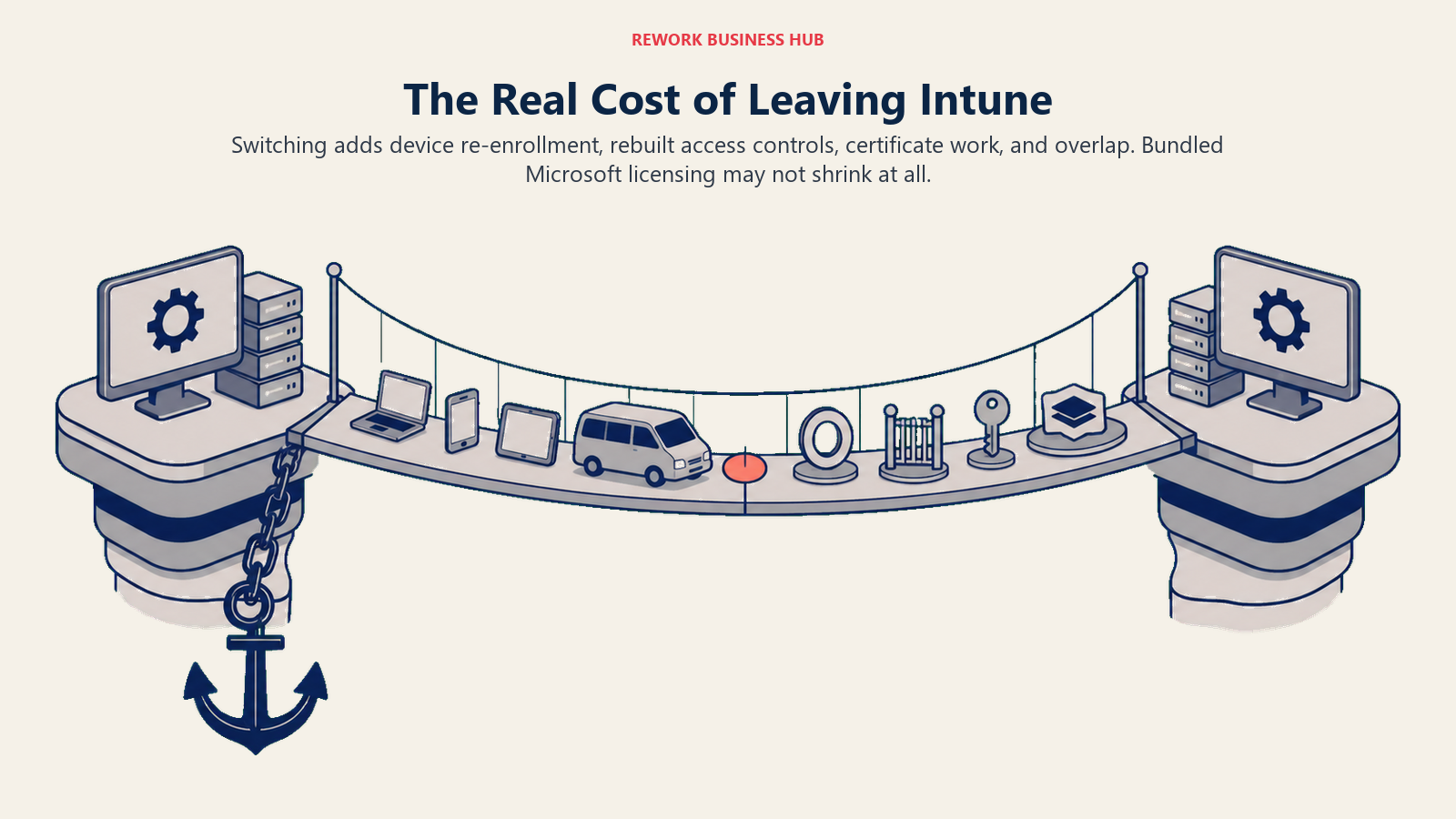
Nobody switches MDM for free: most moves require re-enrolling every device, conditional access chains keyed to Intune compliance have to be rebuilt, certificates rarely port cleanly, and you should budget one to three months running both platforms. The part that catches SMBs is licence timing. If Intune arrives bundled inside Business Premium, leaving it doesn't cut your Microsoft bill by a cent: you keep paying $22.00 per user per month for the rest of the plan and add the new tool on top. It only pays back if the new platform replaces enough Microsoft add-ons, or enough manual labor, to cover itself. Switching SaaS vendors covers sequencing this without a coverage gap.
What to Do Next
Count your users, count your devices, and divide. If the ratio is close to 1.0, per-device tools like Mosyle and Hexnode beat Intune on cost easily. If it's 1.5 or higher, Intune's per-user model is more competitive than it looks and the decision should turn on capability, not price. Then pilot two tools, not five, against thirty real devices for two weeks, testing what you actually run: zero-touch enrollment, an OS update enforcement, a third-party app patch, and one remote support session. If your fleet is Apple-heavy, the honest head-to-head is Jamf vs Intune. For the wider view of what else belongs in your IT stack, see Best SaaS Management Software in 2026, and if service desk tooling is the next decision, Best Freshservice Alternatives and Best Jira Service Management Alternatives cover that category.

Principal Product Marketing Strategist
On this page
- Key Facts
- Two Prices Everyone Still Quotes That No Longer Exist
- What Intune Actually Costs in 2026
- The argument for staying: you may already own it
- The Per-User vs Per-Device Trap
- What "Free" Actually Means in MDM in 2026
- Quick Comparison Table
- Stage Fit Matrix
- 1. Jamf Pro: The Apple Standard, Now Without a Public Price
- 2. Iru (formerly Kandji): Apple-First, Now Cross-Platform, Still Quote-Only
- 3. Mosyle: The Only Apple MDM Still Publishing Real Numbers
- 4. JumpCloud: Replace Intune and Entra in the Same Move
- 5. Hexnode: Published Per-Device Pricing Across Every OS
- 6. ManageEngine Endpoint Central: Intune's Scope With Patching Included
- 7. NinjaOne: Patching and Remote Control Above Policy Depth
- 8. Omnissa Workspace ONE: The Enterprise UEM That Left VMware
- 9. Addigy: Apple Management Built for MSPs
- 10. SimpleMDM: Small Apple Fleets, No Minimums, No Contracts
- How to Choose: Decision Framework
- What Leaving Intune Actually Costs
- What to Do Next