Best Intranet Software in 2026
Turn this article into takeaways for your work.


Each assistant summarizes the article only for you and suggests best practices for your work.
The best intranet software in 2026 starts with a question most buyers skip: build on the Microsoft 365 or Google Workspace you already pay for, or buy a dedicated platform. Simpplr and Unily lead on AI-native governance for large, regulated workforces. Staffbase and LumApps lead on frontline reach after a year of consolidation that reshaped who owns what here. Rework earns its spot at #6 for a narrower reason: it keeps the company announcement, the chat underneath it, and the people directory on the same login as the work itself, instead of a standalone intranet synced through an integration. This guide ranks 15 platforms, plus one option to stop evaluating and two that changed owners this year.
Tools are evaluated on pricing transparency, governance and personalization depth, frontline reach, and fit by company size. Enterprise intranet is still mostly quote-only, so this guide says that plainly and labels any third-party estimate (reported) rather than vendor-confirmed.
Key Facts
- Employees spend an average of 1.8 hours a day, 9.3 hours a week, searching for and gathering information instead of doing their jobs. (McKinsey)
- Companies that fully adopt collaboration and social technologies internally could raise the productivity of knowledge workers by 20 to 25 percent. (McKinsey)
- 47% of digital workers say they struggle to find the information they need to do their jobs effectively. (Gartner)
- Global employee engagement fell to 21% in 2024, only the second decline in 12 years, costing the world economy an estimated $438 billion in lost productivity. (Gallup)
- Just 10% of deskless and frontline workers say they're happy with the quality of workplace communication they receive. (Staffbase and YouGov's 2025 Employee Communication Impact Study, via GlobeNewswire)
What Changed in the Intranet Market in 2026
Three ownership changes and one shutdown reset this category this past year, and many competing roundups haven't caught up.
- Workplace from Meta is gone. Meta cut it to read-only on September 1, 2025, and permanently deleted all access and data on June 1, 2026. Not buyable, it's the event that pushed several migrations reflected in this guide.
- Beekeeper is now part of LumApps, acquired July 2, 2025.
beekeeper.ioredirects tolumapps.com; the frontline product is folding into a unified "LumApps AI Employee Hub" over 12 to 18 months. - Igloo Software is now part of Appspace, acquired September 11, 2025.
igloosoftware.comredirects toappspace.com. - Workvivo (Zoom) is Meta's only preferred migration partner for teams displaced by the shutdown, why it appears in nearly every "what do we do now" conversation this year.
- Staffbase is still independent, despite being a serial acquirer itself (Bananatag, Valo Solutions), and opened a Middle East and Africa office with UAE data hosting in August 2026.
If a roundup still lists Igloo or Beekeeper as standalone companies, or Workplace as something buyable, that's the tell it hasn't been updated since mid-2025.
Quick Comparison Table
| Tool | Best For | Starting Price | Key Strength | Key Limitation |
|---|---|---|---|---|
| Simpplr | AI-native governance at scale | Custom quote (no public pricing) | 3x Gartner MQ Leader | No self-serve pricing |
| Unily | Large, regulated enterprises (1,000+) | Custom quote (no public pricing) | AI-native "Futures" agent | Overkill below ~1,000 employees |
| LumApps (incl. Beekeeper) | Consolidating desk and frontline comms | Custom quote (no public pricing) | One platform post-Beekeeper merger | Still unifying through 2027 |
| Interact | Mid-market wanting governance and UX | Custom quote (no public pricing) | Award-winning UX, AI added 2026 | Recent ownership change (Castik) |
| Staffbase | Mixed desk-plus-frontline, any size | Custom quote (no public pricing) | 3x Gartner MQ Leader, M365-native (Valo) | No generic price list |
| Rework | Comms on the same platform as the work | Quote on request (rework.com/pricing) | Townhall, Chat, Docs, People directory, one login | No page builder or document hub |
| Workvivo (Zoom) | Ex-Workplace from Meta teams | Custom quote (no public pricing) | Meta's only preferred migration partner | No free trial |
| Microsoft Viva Connections / SharePoint | Already-M365 shops | From $2.00/user/month paid yearly | Included in M365 enterprise plans | Needs real configuration effort |
| Happeo | Google Workspace-native teams | Custom quote (no public pricing) | Deepest Drive/Docs/Meet integration | Weaker outside Google Workspace |
| Appspace (incl. Igloo) | Intranet plus physical-space signage | Custom quote (no public pricing) | Signage, wayfinding, visitor mgmt bundled | No published dollar pricing |
| Axero | Budget-transparent mid-market | $10 to $15/user/month (vendor range) | Published rate range, 500+ APIs | Small vendor (48 employees) |
| Jostle | SMB culture and engagement | Rates not published | High reported participation rates | Tier rates don't render publicly |
| Blink | Frontline-first, budget-conscious | From $3.75/user/month billed annually | Cheapest published per-user rate | Lighter governance depth |
| Firstup | Large enterprise comms distribution | Custom quote (no public pricing) | Reaches 40%+ of the Fortune 100 | No published pricing |
| Guru | Knowledge layered into daily tools | Custom quote (no public pricing) | Browser-extension knowledge cards | Not a full intranet CMS |
Intranet Software vs. Employee Communication Apps
A few names on "best intranet" shortlists really solve a narrower problem. An intranet is a structured home base: pages, a people directory, permissions, a place content gets organized. An employee communication app is feed-first: announcements, surveys, tracking who read the CEO's memo. Staffbase and Workvivo compete credibly in both; several others lean hard to one side.
If your real gap is reaching frontline and desk workers with the same message and knowing who saw it, start with Best Employee Communication Software in 2026 instead, a narrower comparison built around reach and read receipts. The 15 platforms below answer the broader question: a home page, an org chart, a knowledge base, a place departments publish to.
1. Simpplr: AI-Native Governance for the Largest Workforces
Simpplr's pitch centers on AI doing intranet work that used to require manual content operations: intent-based search, auto-tagging, content feeds personalized by role and location. It's been a Gartner Magic Quadrant Leader for Intranet Packaged Solutions three years running through 2025, and also a Leader in Forrester's Wave and IDC's MarketScape. Simpplr doesn't publish pricing; the process is volume-based, discounted at 500+ employees.
| What you get | What you don't |
|---|---|
| 3x Gartner MQ Leader, AI-native search | Published, self-serve pricing |
| Volume pricing at 500+ employees | Fit for teams under a few hundred |
| Recognized by Gartner, Forrester, and IDC | A fast, sales-free evaluation |
| Deep engagement and productivity analytics | The lightest onboarding here |
Pricing: Custom quote (no public pricing); volume-based, discounted at 500+ employees. Best for: Large organizations wanting AI-native search and governance backed by three years of analyst leadership. See Best Simpplr Alternatives if scale or price doesn't fit. Not ideal for: Smaller teams below a few hundred employees, where the enterprise depth is overkill.
2. Unily: The Enterprise Employee Experience Platform
Unily positions itself for organizations of 1,000 or more employees, pitched as a "digital front door" to the people, tools, and knowledge employees need during the workday. Its late-2025 Unily Futures launch added Indy, an experience agent that turns plain-language requests into governed, on-brand pages in minutes, and Unily Glass, a conversational layer for finding information across systems. Customers include Shell, CVS Health, and American Airlines, and it was named a Leader again in the 2026 Forrester Wave for Intranet Platforms. Unily doesn't publish pricing; it's based on enterprise needs and scale.
| What you get | What you don't |
|---|---|
| AI-native "Futures" platform (Indy, Glass) | Published, self-serve pricing |
| Forrester Wave Leader, 2026 | A fit under ~1,000 employees |
| Proven at global-enterprise scale | Fast time-to-value |
| Governed, on-brand experience at speed | A budget-friendly entry point |
Pricing: Custom quote (no public pricing), scaled to enterprise size and scope. Best for: Large, global enterprises wanting AI-native experience creation and governance from headquarters to frontline. Not ideal for: Mid-size companies without the scale to justify enterprise-tier intranet software.
3. LumApps (including Beekeeper): One Platform for Desk and Frontline
LumApps built its name on deep Google Workspace and Microsoft 365 integration for desk-based teams, then added frontline reach by acquiring Beekeeper in July 2025. The plan is to fold Beekeeper's mobile-first product into a unified "LumApps AI Employee Hub" over 12 to 18 months, so a company evaluating LumApps today should ask where that migration stands before signing anything new. LumApps publishes no pricing page; the /pricing URL 404s, so every deal is a custom quote.
| What you get | What you don't |
|---|---|
| Combined desk-plus-frontline reach post-merger | Published, self-serve pricing |
| Deep Google Workspace and M365 integration | A finished, fully unified product yet |
| A $1.1B combined group, 2,000+ clients | Certainty on the migration timeline |
| AI Employee Hub roadmap across both lines | A short evaluation cycle |
Pricing: Custom quote (no public pricing page). Best for: Companies wanting one vendor across desk and frontline, comfortable evaluating a platform still mid-merger. Not ideal for: Existing Beekeeper customers wanting certainty before committing further, and teams that need a settled roadmap rather than one that resolves over the next year.
4. Interact: Governance-Minded Mid-Market Intranet
Interact serves more than 1,000 organizations, including Levi's, Domino's, Teva Pharmaceuticals, and Sony PlayStation, built around structured content governance. Castik Capital S.a r.l. acquired Interact in December 2025, followed by new AI-native features and a Workday integration in February 2026, a sign of continued investment. Interact doesn't publish pricing; every deal runs through a tailored quote.
| What you get | What you don't |
|---|---|
| Governance-first structure, proven at 1,000+ orgs | Published, self-serve pricing |
| New Workday integration and AI (Feb 2026) | Certainty under new ownership |
| Recognized enterprise and Fortune 500 base | The fastest onboarding here |
| Offices across North America, EMEA, Australia | A budget tier for tiny teams |
Pricing: Custom quote (no public pricing), tailored to company size. Best for: Mid-market to enterprise teams wanting strong content governance and an established track record. Not ideal for: Buyers wanting pricing certainty upfront, or wary of a platform's first year under new ownership.
5. Staffbase: Mixed Desk-Plus-Frontline at Any Size
Staffbase has been a Gartner Magic Quadrant Leader for Intranet Packaged Solutions three consecutive years, and it's grown by acquisition itself: Bananatag brought email communications, Valo Solutions brought a Microsoft 365 and SharePoint-native intranet layer into the same platform. It raised $115 million at a $1.1 billion valuation and opened a Middle East and Africa office with UAE data hosting in August 2026. Staffbase publishes no generic price list; its page states "no two workforces look alike" and promises most teams a tailored proposal within 3 to 5 business days. Vendr's buyer guide reports a median annual spend of $28,544 (reported).
| What you get | What you don't |
|---|---|
| 3x Gartner MQ Leader for Intranet Solutions | Published, self-serve pricing |
| M365/SharePoint-native layer via Valo | A flat, one-size price list |
| Frontline, desk, and email comms in one | The fastest possible sales cycle |
| New UAE data hosting for compliance needs | A budget entry point |
Pricing: Custom quote (no public pricing); Vendr reports a median of $28,544/year (reported).
Best for: Any-size teams wanting desk, frontline, and email comms in one platform, with M365-native options via Valo. See Best Staffbase Alternatives, or Staffbase vs Workvivo if those two are the shortlist.
Not ideal for: Buyers who want an exact number before a sales call.
6. Rework: Comms on the Same Platform as the Work Itself
Rework's Townhall module handles company-wide communication, sitting inside the same platform as Chat, Exchange (chat across companies), Square for internal Q&A, Docs, a People directory, and Meeting, so an announcement, the discussion under it, and the person who posted it share one login instead of several synced tools. That's the whole pitch: consolidation for a mid-size company, roughly 20 to 200 people, not a designed intranet with page-builder depth. Worth being direct: Rework's Home module (a personal homepage), Knowledge, and Drive are not live, so there's no designed homepage, no page or site builder, and no document hub the way a purpose-built intranet has one.
| What you get | What you don't |
|---|---|
| Comms, chat, docs, People directory, one login | A designed intranet homepage or page builder |
| Internal Q&A and knowledge sharing via Square | A document-management hub (Drive isn't live) |
| No integration to sync data with a separate tool | Publishing governance depth of Simpplr or LumApps |
| Packaged annual pricing, not per-seat licensing | A free or solo tier |
Pricing: No published price for Townhall. Pricing is quoted per organization; see rework.com/pricing. Best for: Mid-size companies (roughly 20-200 people) wanting comms, chat, docs, and the People directory in one platform instead of three or four logins. Not ideal for: Teams that need a designed intranet homepage with a page builder and publishing governance. Look at Simpplr, Unily, LumApps, or Interact instead. See Best HR Software for how the People side compares.
7. Workvivo (Zoom): Meta's Preferred Migration Partner
Zoom acquired Workvivo in 2023, and Meta has since named it the only preferred migration partner for companies moving off Workplace from Meta, now permanently shut down. Its platform splits into Workvivo HQ (the core communication platform) and Seer, a people-intelligence layer sold standalone or as an add-on, plus HQ Agent, Chat, and Workvivo TV add-ons. Workvivo publishes no prices; it offers no free trial, only "a comprehensive demo."
| What you get | What you don't |
|---|---|
| Official, Meta-endorsed migration path | Published, self-serve pricing |
| Zoom-backed platform investment | A free trial to test first |
| Modular add-ons (Seer, HQ Agent, Chat, TV) | A flat, predictable starting price |
| Strong fit for ex-Workplace communities | The fastest possible evaluation |
Pricing: Custom quote (no public pricing); no free trial offered. Best for: Teams displaced by the Workplace shutdown wanting the closest, most directly endorsed migration path. See Best Workvivo Alternatives if a demo-only process doesn't fit your timeline. Not ideal for: Buyers who want to self-serve a trial before involving sales.
8. Microsoft Viva Connections / SharePoint: Build on What You Already Pay For
For companies already on Microsoft 365, SharePoint is the intranet layer already included in the subscription, and Viva Connections, Viva Engage, and Viva Amplify sit on top as the polish layer: a curated home experience, communities, and multi-channel publishing. The SKU that matters for internal comms, Viva Employee Communications and Communities, is priced at $2.00 per user per month paid yearly. Core Viva Engage communities are included with M365 enterprise plans at no extra cost, so the real question is whether that free layer is good enough. Heavier add-ons go further: Workplace Analytics is $6.00/user/month, Learning and Insights are $4.00 each, and the full Viva Suite bundles everything at $12.00.
| What you get | What you don't |
|---|---|
| Core comms included in M365 enterprise plans | A dedicated intranet CMS |
| A clear, published $2.00/user/month upgrade path | Governance depth of Simpplr or Staffbase |
| No new vendor relationship or data migration | A finished look without real effort |
| Optional Viva Suite bundle at $12.00/user/month | Frontline reach as strong as Staffbase |
Pricing: Viva Employee Communications and Communities from $2.00/user/month paid yearly; core Viva Engage included with M365 enterprise plans; full Viva Suite $12.00/user/month. Best for: Microsoft 365 shops wanting to build on infrastructure they already pay for before adding a new vendor. Not ideal for: Companies wanting frontline-grade reach or dedicated governance tooling without heavy internal configuration.
9. Happeo: The Google Workspace-Native Intranet
Happeo is built around the assumption that Google Workspace is already a company's operating layer, not an integration to bolt on. Employees access, edit, and share Google Docs, Sheets, and Calendar items directly inside the intranet, and search spans Gmail, Drive, and the intranet from one bar. It holds a 4.5 out of 5 rating across 150+ G2 reviews. Happeo doesn't publish prices; tiers are Starter (under 100 users, monthly), Growth, and Enterprise (both annual).
| What you get | What you don't |
|---|---|
| Deepest Google Workspace integration here | Published, self-serve pricing |
| Search across Gmail, Drive, intranet, one bar | A natural fit for M365-first orgs |
| A Starter tier built for under-100 teams | Enterprise-scale governance depth |
| Strong G2 reputation (4.5/5, 150+ reviews) | Monthly billing above Starter |
Pricing: Custom quote (no public pricing); tiers are Starter (monthly, under 100 users), Growth, Enterprise (both annual). Best for: Small and mid-size companies on Google Workspace wanting a searchable, structured intranet. See Best Google Workspace Alternatives if the underlying suite is up for debate too. Not ideal for: Microsoft 365-first organizations, or enterprises needing governance depth beyond a few hundred users.
10. Appspace (including Igloo): Intranet Plus the Physical Workplace
Appspace's pitch goes beyond the browser: one platform for intranet, an employee mobile app, digital signage, space reservation, visitor management, and wayfinding, for companies managing both a digital and a physical workplace. Its September 2025 acquisition of Igloo Software added more than 325 customers, including Fortune 500 names across healthcare, retail, manufacturing, and hospitality. Appspace publishes tier structure but no dollar figures: Free (2 premium users, 1 device), Express (25 users, 25 devices), Enterprise (50+). The only published prices are add-ons: storage at $0.10/GB/month, bandwidth at $0.15/GB/month.
| What you get | What you don't |
|---|---|
| Intranet, signage, space booking, wayfinding | Published dollar pricing at any tier |
| A free entry tier (2 users, 1 device) | Fortune 500 readiness on the free tier |
| 325+ added customers via Igloo | A single, unified product experience yet |
| Published add-on rates (storage, bandwidth) | Fast time-to-value without a demo |
Pricing: Free (2 users, 1 device); Express (25 users, 25 devices) and Enterprise (50+) are custom quote; add-ons: storage $0.10/GB/month, bandwidth $0.15/GB/month. Best for: Companies managing hybrid teams and physical office space wanting intranet, signage, and visitor management on one vendor. Not ideal for: Teams that only need a digital intranet and won't use physical-workplace features.
11. Axero: Budget-Transparent, Configurable Mid-Market Intranet
Axero is a smaller, independent vendor (48 employees, founded 2007 in San Diego) that competes on configurability and transparency rather than analyst-report leadership. Its intranet lets companies shape branded portals with 500+ REST APIs and integrations across Microsoft 365, Google Workspace, and Slack, and it holds a 4.3 out of 5 rating across 100 G2 reviews, support and ease of use called out as strengths. It's one of the few names here that publishes an actual rate range: $10 to $15 per user/month, scaling down with volume across Standard, Premium, Enterprise, and On-Premises tiers.
| What you get | What you don't |
|---|---|
| A published starting rate range, rare here | Exact per-tier figures without a quote |
| 500+ REST APIs, broad M365/Workspace ties | Analyst-report leadership (Gartner) |
| Strong reported support and ease-of-use | The scale of larger vendors |
| An on-premises deployment option | The deepest AI-native features here |
Pricing: $10 to $15 per user/month (vendor-published range), scaling down with volume, across Standard, Premium, Enterprise, and On-Premises tiers. Best for: Mid-market teams wanting configurable branded portals and a published starting price range before a sales call. Not ideal for: Enterprises wanting analyst-validated governance depth or the largest vendor and support organization.
12. Jostle: SMB Culture and Engagement Platform
Jostle positions itself less as an intranet and more as an "employee success platform," built around belonging and participation rather than page-building depth. It reports participation rates over 85%, several times typical industry norms, and most customers sit in the 100-to-1,000-employee range rather than at global-enterprise scale. Jostle publishes named tiers, Bronze, Silver, Gold, Platinum, but per-user dollar figures don't render on its pricing page (every tier shows $0.00). Prices are USD, prepaid annually, with monthly billing adding 15%.
| What you get | What you don't |
|---|---|
| Reported participation well above the norm | Dollar figures that render on the page |
| Named, structured tiers (Bronze-Platinum) | Enterprise-scale governance or AI search |
| A clear SMB-to-mid-market focus | A large brand-name customer roster |
| Prepaid annual pricing, defined surcharge | Fit above 1,000 employees |
Pricing: Named tiers (Bronze, Silver, Gold, Platinum) with add-ons; per-tier rates aren't published (page shows $0.00). Annual prepaid; monthly billing adds 15%. Best for: SMB and mid-market teams prioritizing culture and participation over governance depth. See what business culture is for that framework. Not ideal for: Larger organizations needing analyst-validated governance or global-scale deployment support.
13. Blink: The Cheapest Published Rate in the Category
Blink is built frontline-first, with the clearest published pricing of any vendor here: Core at $3.75 per user/month billed annually ($5.60 monthly), Pro at $5.00 annually ($7.00 monthly), adding events management, multi-language publishing, an AI assistant, and priority support. There's no stated minimum user count, which matters for a small deployment that would get priced out of an enterprise vendor's minimum seats. Enterprise pricing is quote-only for deeper customization beyond Pro.
| What you get | What you don't |
|---|---|
| The cheapest published per-user rate here | Enterprise governance depth |
| No stated minimum user count | Analyst-report leadership recognition |
| A clear, self-serve upgrade path | Physical-workplace features |
| AI assistant, multi-language publishing on Pro | The largest vendor scale or brand |
Pricing: Core $3.75/user/month billed annually ($5.60 monthly); Pro $5.00 annually ($7.00 monthly); Enterprise custom quote. Best for: Frontline-heavy teams wanting transparent, budget-friendly per-user pricing without a sales negotiation. Not ideal for: Large enterprises needing deep governance or physical-workplace features beyond core comms.
14. Firstup: Enterprise Communication Distribution at Fortune 100 Scale
Firstup formed from the 2021 merger of SocialChorus and Dynamic Signal, and today reaches more than 40% of the Fortune 100, with named customers including Walmart, Estee Lauder, Hilton, Ford, and Bayer. Its tiers are Essential, Professional, and Premier, with an Employee Intranet add-on available on any of them, so a company starts with distribution and layers in intranet functionality later. Firstup publishes no pricing for any tier or add-on.
| What you get | What you don't |
|---|---|
| Distribution reach at Fortune 100 scale | Published, self-serve pricing |
| An Employee Intranet add-on on any tier | A budget-friendly entry point |
| Proven base (Walmart, Ford, Hilton, Bayer) | Fast, self-serve evaluation |
| A communication-distribution-first heritage | The lightest onboarding here |
Pricing: Custom quote (no public pricing) across Essential, Professional, and Premier tiers, plus an Employee Intranet add-on. Best for: Large enterprises prioritizing communication distribution and reach, with intranet as a layered add-on. Not ideal for: Smaller companies wanting a self-serve, budget-transparent evaluation.
15. Guru: Knowledge Layered Into the Tools People Already Use
Guru isn't a traditional intranet, and doesn't pretend to be one. It's a knowledge-management platform that surfaces "knowledge cards" inside the tools people already work in (a CRM, a ticketing system, Slack, Teams) based on page context, plus a searchable knowledge base and wiki layer. Guru is explicit it positions itself as "a platform and expertise solution, not just a per-seat tool." It publishes no pricing on its site; every deal is a custom quote.
| What you get | What you don't |
|---|---|
| Knowledge surfaced in-context in daily tools | A structured intranet homepage or builder |
| A searchable wiki and knowledge base layer | Company-wide publishing governance |
| Positioning as expertise infrastructure | Published, self-serve pricing |
| Strong fit alongside, not instead of, an intranet | Frontline broadcast features |
Pricing: Custom quote (no public pricing); positioned as a platform and expertise solution, not a per-seat license. Best for: Teams whose real gap is scattered tribal knowledge inside support, sales, or IT tools, not a company-wide home page. Compare it against Confluence if you need a wiki plus heavier page-building. Not ideal for: Anyone whose primary need is a company-wide homepage, org chart, or governed publishing workflow.
Build on Microsoft 365 vs. Buy a Dedicated Intranet
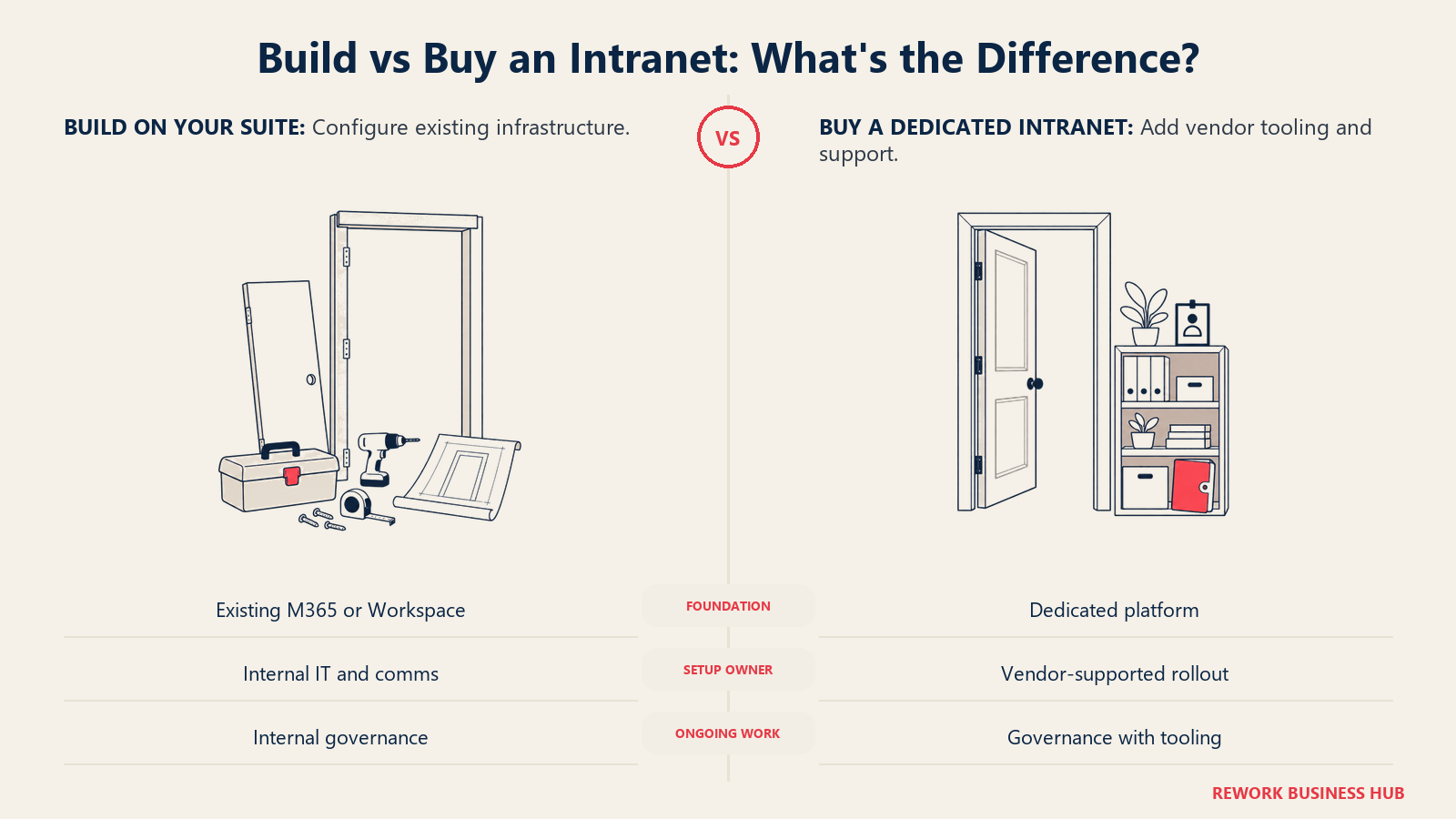
Most companies should settle this question before comparing vendors, since it decides which half of the list above is even relevant. If you're already paying for Microsoft 365 or Google Workspace, SharePoint or Google Sites gives you a base layer for free. The real cost of "building" is configuration time and ongoing governance effort, not a license fee. Buying a dedicated platform trades that effort for a real invoice, in exchange for AI-native search, frontline reach, and governance tooling a stock deployment doesn't include.
| Factor | Build on Microsoft 365 / Google Workspace | Buy a dedicated intranet |
|---|---|---|
| Upfront license cost | Often $0 to $2/user/month, on existing subscription | Custom quote in nearly every case |
| Time to a usable homepage | Weeks to months of internal configuration | Weeks, with vendor-led support |
| Frontline / deskless reach | Limited without add-ons | Strong with Staffbase, Workvivo, Blink |
| AI-native search and personalization | Requires the Viva Suite ($12/user/month) | Built in with Simpplr, Unily, LumApps |
| Physical-workplace features | Not included | Available via Appspace |
| Ongoing content governance | Falls on internal IT and comms teams | Vendor-provided tooling and support |
| Best fit | Teams under a few hundred, or IT-led builds | Teams needing frontline reach or governance |
The 47% of digital workers who struggle to find the information they need don't care which path got them there. A well-configured SharePoint site beats a half-implemented enterprise intranet. Building only fails when nobody owns the governance, the job a dedicated vendor is selling.
How to Choose: Decision Framework
| If your team needs... | Best pick |
|---|---|
| AI-native search and three years of Gartner leadership | Simpplr |
| A governed AI-native experience platform at 1,000+ scale | Unily |
| One vendor across desk and frontline after an acquisition | LumApps |
| Strong content governance and an enterprise track record | Interact |
| Desk, frontline, and email communication in one platform | Staffbase |
| Comms, chat, docs, and People directory on one login | Rework |
| The officially endorsed migration off Workplace from Meta | Workvivo |
| To build on Microsoft 365 already paid for | Microsoft Viva Connections / SharePoint |
| The deepest native fit with Google Workspace | Happeo |
| Intranet plus digital signage and physical-space management | Appspace |
| A published rate range and configurable branded portals | Axero |
| SMB culture and engagement over governance depth | Jostle |
| The cheapest published per-user rate, frontline-first | Blink |
| Enterprise-scale communication distribution and reach | Firstup |
| Knowledge surfaced inside daily tools, not a full intranet | Guru |
Frequently Asked Questions about Intranet Software
What happened to Workplace from Meta?
Meta cut it to read-only access on September 1, 2025, and permanently deleted all remaining access and data on June 1, 2026. It's no longer buyable. Zoom's Workvivo is Meta's only officially preferred migration partner for displaced customers.
Is Beekeeper still a separate company?
No. LumApps acquired Beekeeper, announced July 2, 2025, and beekeeper.io now redirects to lumapps.com. Its frontline product is folding into a unified "LumApps AI Employee Hub" over 12 to 18 months, though existing contracts and data persist.
What happened to Igloo Software?
Appspace acquired Igloo, announced September 11, 2025, and igloosoftware.com now redirects to appspace.com, Appspace's third workplace-technology acquisition after Beezy and The Marlin Company.
How much does intranet software actually cost in 2026?
Most of the category is quote-only. Microsoft Viva Connections and Blink are the only clear published starting points, at $2.00 and $3.75-$5.00 per user/month; Axero publishes a range ($10-$15). Everyone else, including Simpplr, Unily, Staffbase, and LumApps, requires a custom quote; Vendr reports a median Staffbase deal around $28,544/year (reported).
Should we build an intranet on Microsoft 365 or buy a dedicated platform?
If someone can own ongoing content governance, SharePoint plus Viva Connections is often good enough for $0 to $2/user/month. If you need frontline reach, AI-native search at scale, or physical-workplace features, a dedicated vendor's tooling closes gaps a stock M365 build won't on its own.
Does Rework replace a dedicated intranet like Simpplr or Staffbase?
Not for a team that needs a designed homepage, a page builder, or granular publishing governance. Rework's Townhall module fits a mid-size company wanting comms, chat, docs, and the People directory on the same login as the rest of its work, not a full intranet CMS.
What to Do Next
Settle build-versus-buy first: if nobody owns ongoing content governance, a dedicated vendor's tooling saves more time than its price tag costs. Then shortlist two platforms from the same tier, enterprise governance (Simpplr, Unily, Staffbase) or budget-transparent (Axero, Blink), and pilot one department's real content to see who finds what they need without asking IT. If your real gap is comms, work, and the people directory sitting in three disconnected logins rather than a missing page builder, start with Rework's Townhall module instead.

Principal Product Marketing Strategist
On this page
- Key Facts
- What Changed in the Intranet Market in 2026
- Quick Comparison Table
- Intranet Software vs. Employee Communication Apps
- 1. Simpplr: AI-Native Governance for the Largest Workforces
- 2. Unily: The Enterprise Employee Experience Platform
- 3. LumApps (including Beekeeper): One Platform for Desk and Frontline
- 4. Interact: Governance-Minded Mid-Market Intranet
- 5. Staffbase: Mixed Desk-Plus-Frontline at Any Size
- 6. Rework: Comms on the Same Platform as the Work Itself
- 7. Workvivo (Zoom): Meta's Preferred Migration Partner
- 8. Microsoft Viva Connections / SharePoint: Build on What You Already Pay For
- 9. Happeo: The Google Workspace-Native Intranet
- 10. Appspace (including Igloo): Intranet Plus the Physical Workplace
- 11. Axero: Budget-Transparent, Configurable Mid-Market Intranet
- 12. Jostle: SMB Culture and Engagement Platform
- 13. Blink: The Cheapest Published Rate in the Category
- 14. Firstup: Enterprise Communication Distribution at Fortune 100 Scale
- 15. Guru: Knowledge Layered Into the Tools People Already Use
- Build on Microsoft 365 vs. Buy a Dedicated Intranet
- How to Choose: Decision Framework
- What to Do Next