Staffbase vs Workvivo: Which Employee Communication Platform Fits Your Workforce in 2026?
Turn this article into takeaways for your work.


Each assistant summarizes the article only for you and suggests best practices for your work.
A lot of the traffic landing on this comparison has the same backstory. Workplace from Meta went read-only on 1 September 2025, and every scrap of data on it was permanently deleted on 1 June 2026. Thousands of companies that ran their internal comms on that platform had to pick a replacement, and Zoom's Workvivo spent that whole window marketing itself as Meta's only preferred migration partner. Staffbase, which had already spent years courting the same buyers, fought hard for those same accounts. If you're comparing these two now, there's a decent chance you're one of them, or a comms, HR, or IT lead who watched a peer go through that migration and wants to get it right the first time.
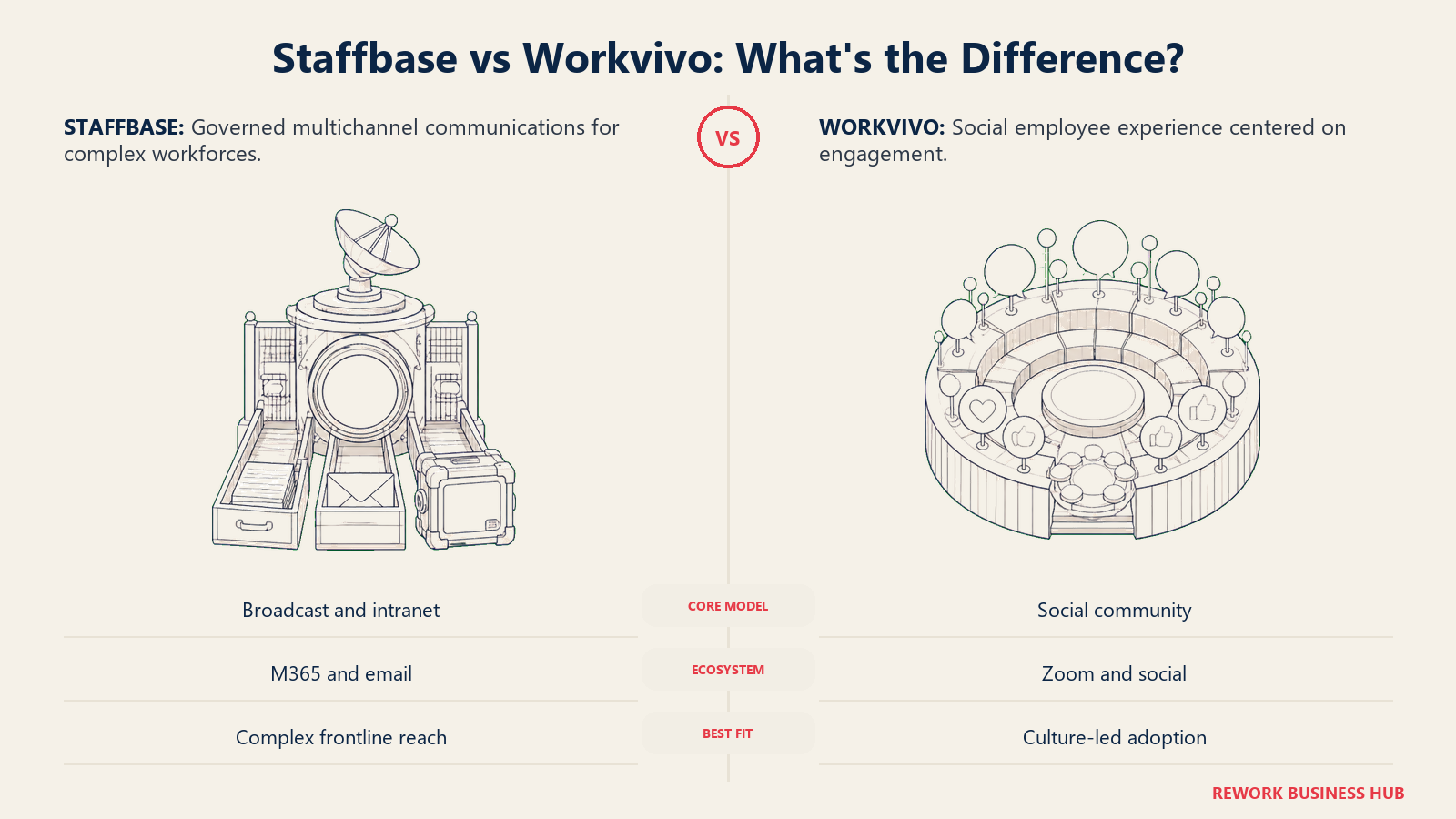
Both companies sell into the same rough space: mid-size to large organizations with a dedicated comms or employee experience team, managing a workforce that includes people who don't sit at a desk all day. Beyond that, they built different platforms. Staffbase grew out of employee app and intranet roots, then added email and a Microsoft 365 intranet layer through acquisitions. Workvivo grew out of a social, activity-feed app, then added a people-intelligence layer after Zoom bought it. Neither publishes a price list, which makes this less a spreadsheet exercise and more a question of which platform's shape matches how your workforce actually communicates.
Key Facts
- Only 20% of employees worldwide were engaged at work in 2025, and Gallup puts the cost of that low engagement at roughly $10 trillion in lost productivity, or 9% of global GDP. Source: Gallup, State of the Global Workplace
- Just 49% of employees strongly agreed they know what's expected of them at work in the first half of 2026, up slightly from 47% in 2025 but still well below the 61% peak Gallup recorded in 2015. Source: Gallup, Employee Engagement Remains Flat as AI Adoption Accelerates
- Only 59% of workers trust their organization's senior leadership team, a gap that internal comms teams are directly on the hook for closing. Source: Deloitte Digital, Workforce Experience by Design
- Replacing an employee typically costs 50% to 200% of that employee's annual salary, and disengagement driven by poor internal communication is a recurring factor cited in that turnover math. Source: SHRM, The Myth of Replaceability
TL;DR
| Staffbase | Workvivo | |
|---|---|---|
| Owned by | Independent (raised $115M at a $1.1B valuation) | Zoom, acquired in 2023 |
| Built from | Employee app and intranet, extended with Bananatag (email) and Valo (Microsoft 365 intranet) | Social, activity-feed employee experience app, extended with Seer (people intelligence) |
| Core plan structure | Frontline-specific, mixed desk-plus-frontline, and enterprise multi-brand pricing | Workvivo HQ (core) plus Seer, with HQ Agent, Chat, and Workvivo TV add-ons |
| Meta Workplace migration | Competed hard for the same accounts | Meta's only named preferred migration partner |
| Microsoft 365 / SharePoint fit | Native, via the acquired Valo intranet product | Available via integration, not built on the M365 stack |
| Zoom fit | Standard integration | Deepest, being a Zoom company product |
| Free trial | Not offered | Not offered |
| Published pricing | None; reported median $28,544/year (Vendr) | None; no reported buyer-data range we could verify |
| Best for | Large or multi-brand organizations wanting a Microsoft-native intranet plus comms in one platform | Teams that want a social, engagement-first employee app, especially ex-Workplace-from-Meta and Zoom-centric shops |
Who Each Platform Is Built For
Staffbase's growth path tells you who it fits. It started as an employee app and intranet vendor, then merged with Bananatag to add employee email, then acquired Valo Solutions to add a genuine Microsoft 365 and SharePoint intranet layer. The result is a platform built for comms teams reaching people through several channels at once, already living inside the Microsoft ecosystem. In August 2026, Staffbase opened a Middle East and Africa office and launched UAE data hosting, a sign it's still chasing large, regulated, multinational accounts.
Workvivo's path is different. It was built as a social employee experience app first, with an activity feed, recognition, and engagement mechanics closer to a private social network than a traditional intranet. Zoom's 2023 acquisition folded it into the Zoom ecosystem, and its Seer product adds people-intelligence analytics on top, standalone or as an add-on. Its natural buyer is a comms or HR leader driving engagement and participation, not just publishing top-down.
| Staffbase | Workvivo | |
|---|---|---|
| Natural buying trigger | Need one platform for intranet, email comms, and employee app, often replacing several disconnected tools | Want a social, engagement-first employee experience layer, often replacing Workplace from Meta |
| Team maturity assumed | Comms or IT team comfortable managing a Microsoft-integrated intranet | Comms or HR team focused on participation and culture metrics |
| Primary champion | Head of internal comms, corporate communications, or IT in a Microsoft shop | Head of employee experience, HR, or comms wanting social engagement |
| Vendor relationship | Independent vendor, own roadmap | Part of Zoom, roadmap tied to the broader Zoom Workplace suite |
| Recent proof point | UAE data hosting and MEA office launch, August 2026 | Named Meta's only preferred Workplace migration partner |
Neither approach is objectively better: one is a single source of truth across every channel a Microsoft-centric organization uses, the other a place people want to check in on, backed by Zoom's infrastructure.
Desk vs Frontline Workforce Fit
Both vendors market heavily to organizations with a mixed desk and frontline workforce, the segment where most legacy intranets fail: a SharePoint site only desk workers can reach is useless to a retail associate or a warehouse worker.
Staffbase's pricing structure signals its frontline ambition: a frontline-specific track distinct from desk pricing, a mixed desk-plus-frontline option, and a separate enterprise tier for multi-brand configurations, relevant for holding companies or franchises running several employee brands under one deployment. That's a more deliberately segmented model than most competitors publish, even without dollar figures attached.
Workvivo doesn't publish a similarly segmented frontline track. Its core HQ platform and app work for both desk and frontline populations from day one, with add-ons (HQ Agent, Chat, Workvivo TV) layered on top regardless of worker type.
| Capability | Staffbase | Workvivo |
|---|---|---|
| Frontline-specific pricing track | Yes, explicitly separate from desk pricing | No separate frontline pricing tier published |
| Mixed desk-plus-frontline pricing | Yes, explicitly offered | Bundled into standard HQ licensing |
| Multi-brand / multi-entity configuration | Yes, dedicated enterprise pricing track | Not a distinct published tier |
| Mobile app for deskless workers | Yes | Yes |
| Digital signage / screen support | Yes, part of the broader channel mix | Via Workvivo TV add-on |
If your organization runs several brands under one holding company, Staffbase's segmented pricing at least signals it has priced that scenario before. If your workforce is more uniform, that matters less.
Communication Channels and Reach
Staffbase's channel mix is its most differentiated strength, largely because of what it acquired. The Bananatag merger gave it a genuine employee email platform, not just an app notification that says "check your inbox." The Valo acquisition gave it native SharePoint intranet pages, so an announcement can go out through the app, a branded email, and an intranet page inside the same environment employees already use for files and Teams.
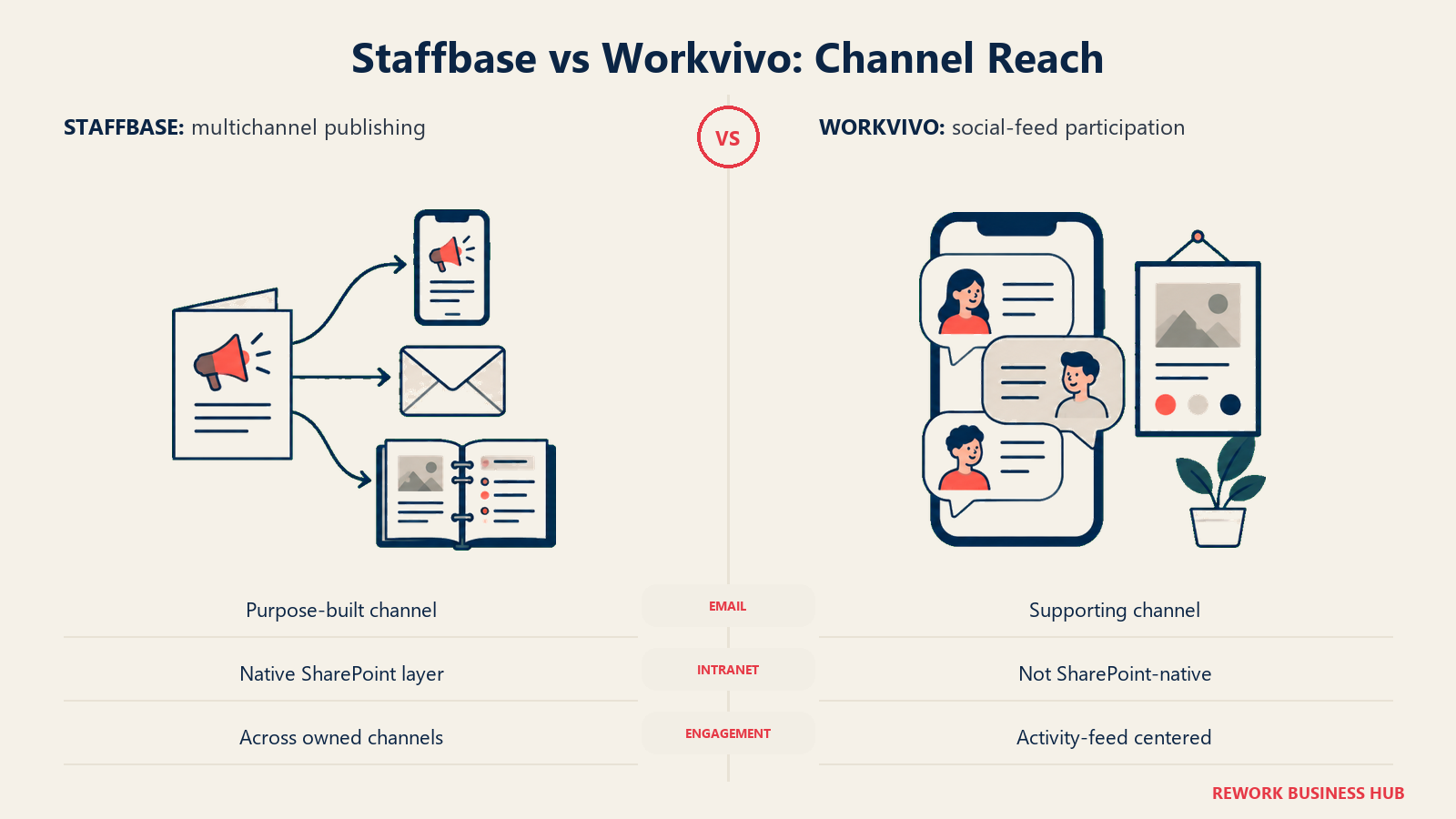
Workvivo's channel strength centers on the app itself, with an activity feed that surfaces content the way a social platform does: comments, reactions, and visibility into who's actually seen a post. Its Workvivo TV add-on extends reach to digital signage for frontline environments without a desk or company device. Email exists as a channel but isn't the acquired, purpose-built product Staffbase's Bananatag tooling is.
| Channel | Staffbase | Workvivo |
|---|---|---|
| Mobile app | Yes | Yes, social feed model |
| Employee email | Yes, via acquired Bananatag platform | Basic, not a dedicated acquired product |
| Native Microsoft 365 / SharePoint intranet pages | Yes, via acquired Valo | Not native |
| Digital signage | Yes | Yes, via Workvivo TV add-on |
| Social/engagement feed (comments, reactions) | Available | Core to the product's design |
| Push notification targeting | Yes, segmented by audience | Yes, segmented by audience |
If email and a Microsoft-native intranet page both need to be first-class channels, Staffbase's acquisition history gives it the edge. If the priority is a feed people actually want to scroll and engage with, Workvivo's social-first design is the more purpose-built answer.
Content Authoring and Governance
Large organizations publishing through dozens of local comms teams or franchise owners need governance controls that stop an off-brand blast from going out company-wide.
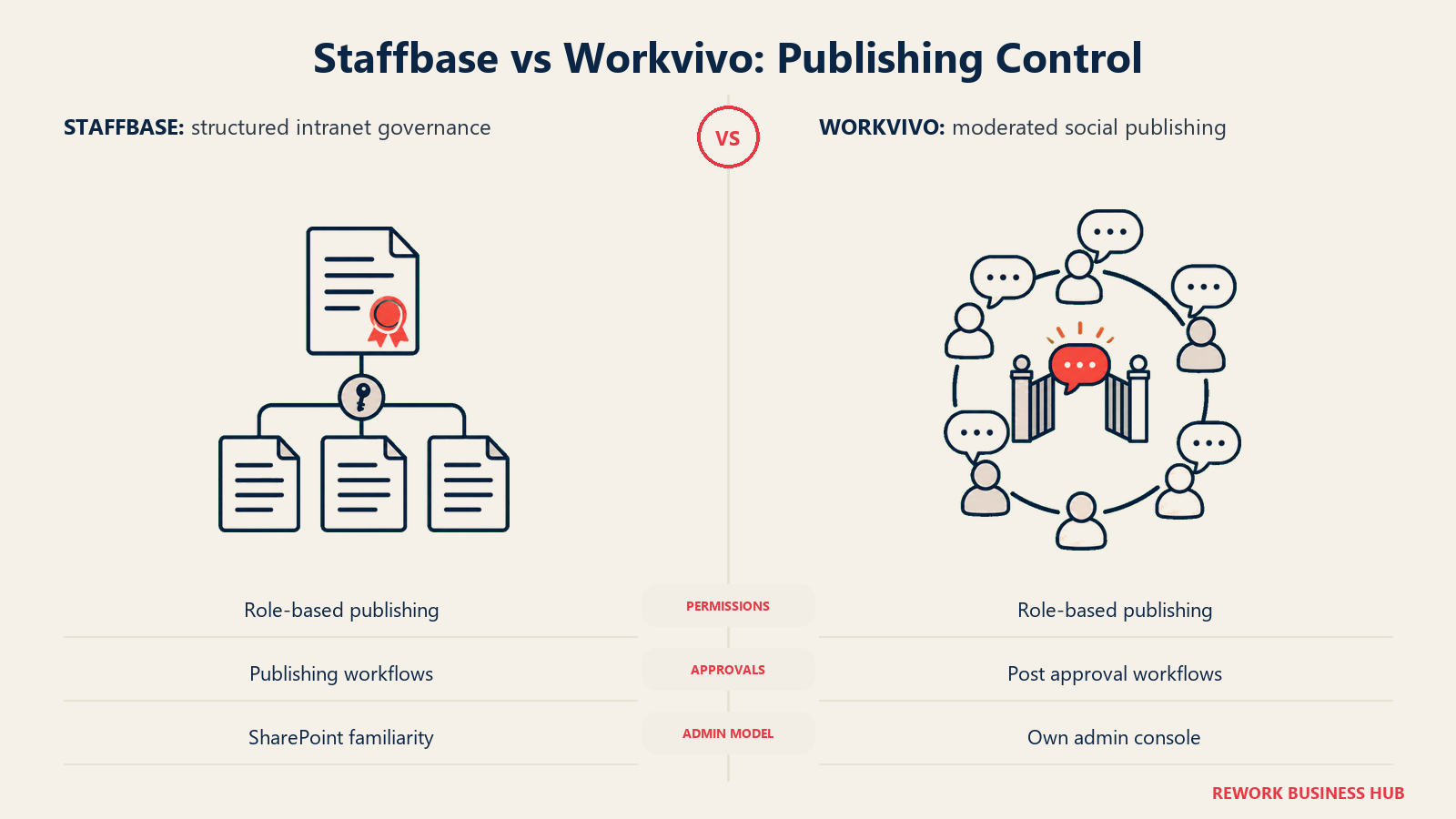
Staffbase's Microsoft 365 heritage, again via Valo, shows up here: permissions, page ownership, and publishing workflows map closely to the SharePoint governance model many IT and comms teams already understand, shortening the learning curve for teams migrating off a Microsoft-centric intranet. Its multi-brand enterprise tier implies parallel governance for organizations running several brands from one back end.
Workvivo's governance is built around its own admin console rather than an inherited enterprise CMS, with role-based publishing permissions and approval workflows for posts. It's less about replicating an enterprise pattern and more about controlling who can post into a feed designed to feel open by default, a different problem than locking down a formal intranet page tree.
| Governance capability | Staffbase | Workvivo |
|---|---|---|
| Role-based publishing permissions | Yes | Yes |
| Approval workflows before publish | Yes | Yes |
| Multi-brand / multi-entity content separation | Yes, dedicated enterprise pricing track | Not a distinct published tier |
| Familiar to Microsoft 365 / SharePoint admins | Yes, inherited from Valo | No, purpose-built admin console |
| Local/regional publisher controls | Yes | Yes |
Analytics and Measurement
Both vendors now sell a named analytics layer rather than treating measurement as an afterthought, a sign of how hard comms teams have had to fight for a seat at the leadership table by proving reach and impact.
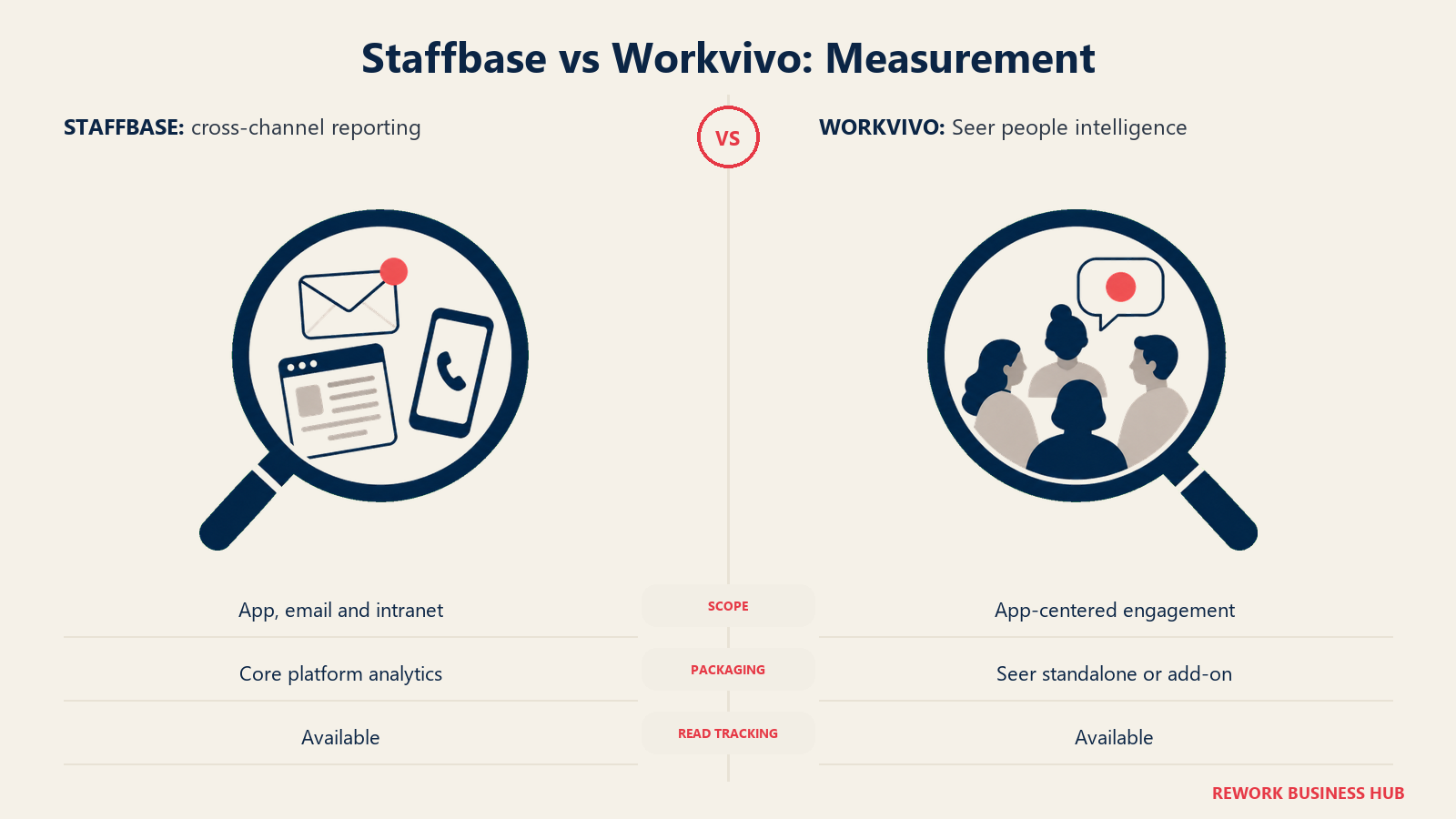
Workvivo's answer is Seer, a people-intelligence product sold standalone or as an add-on to Workvivo HQ. Positioning it as a distinct, separately named product suggests Zoom treats measurement as a real expansion line, not a reporting tab.
Staffbase's analytics live inside the core platform rather than as a separately branded product, covering reach, open rates, and engagement across every channel it manages. That gives it more surface area to report on in one dashboard, at the cost of a dedicated measurement product the way Seer is positioned.
| Analytics capability | Staffbase | Workvivo |
|---|---|---|
| Named, separately positioned analytics product | No, built into the core platform | Yes, Seer (standalone or add-on) |
| Cross-channel reporting (app, email, intranet) | Yes, spans all three natively | Primarily app-centric, plus TV where deployed |
| Engagement/read tracking | Yes | Yes |
| People-intelligence framing | Not a distinct positioning | Central to the Seer product |
Integrations: Microsoft 365, SharePoint, Teams, Zoom, and HRIS
Integration depth is usually the deciding factor once two platforms look close on paper.
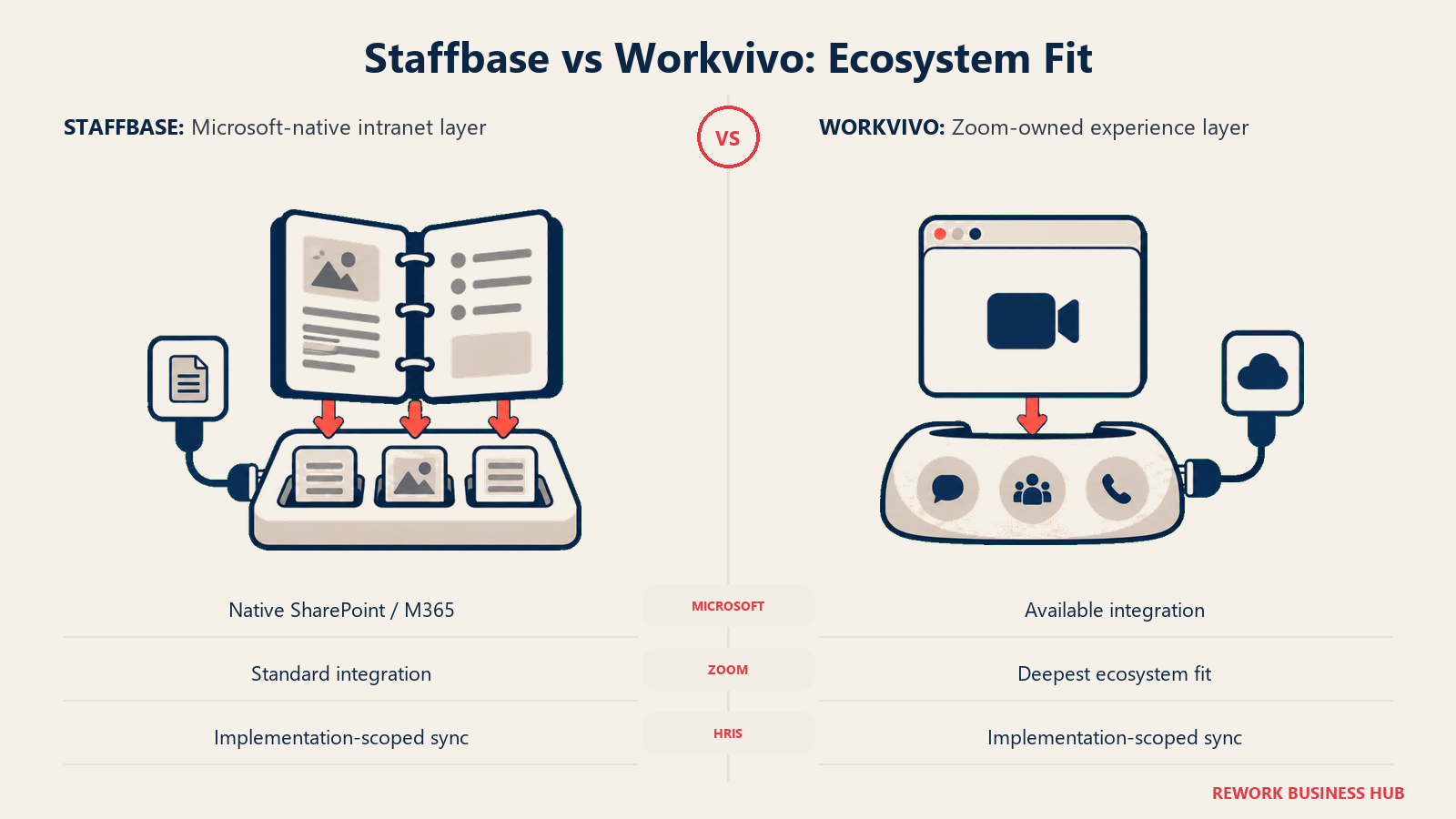
Staffbase's Microsoft integration is native rather than bolted on, a direct result of the Valo acquisition: SharePoint pages, Microsoft 365 identity, and Teams notifications are core to how it was built, not a connector added later. For organizations standardized on Microsoft, that's Staffbase's clearest structural advantage.
Workvivo's deepest integration is with Zoom itself, unsurprising given the ownership, spanning Zoom Meetings, Zoom Team Chat, and the broader Zoom Workplace suite. It also connects to Microsoft 365 and Teams, but as an integration rather than a platform it was built on. HRIS connectivity, needed for org charts and audience segmentation, is offered by both, typically scoped during implementation rather than published as a self-serve connector list.
| Integration | Staffbase | Workvivo |
|---|---|---|
| Microsoft 365 / SharePoint | Native (via Valo) | Integration available, not platform-native |
| Microsoft Teams | Native notifications and presence | Integration available |
| Zoom Meetings / Zoom Workplace | Standard integration | Deepest, being a Zoom-owned product |
| HRIS sync (org chart, audience segmentation) | Yes, scoped during implementation | Yes, scoped during implementation |
| Open API / webhooks | Yes | Yes |
If your company runs on Microsoft, Staffbase's native SharePoint and Teams fit removes a real integration burden. If it runs on Zoom, Workvivo's home-field advantage is equally real, and it's the specific fit that made it Meta's chosen migration partner for Workplace customers.
Implementation and Time to Value
Neither vendor publishes a standard timeline, and neither offers a free trial. Workvivo says so explicitly ("we do not offer a free trial, but we will give you a comprehensive demo"), while Staffbase routes every prospect to a tailored proposal instead of a self-serve signup.
Staffbase says most teams get a tailored proposal within 3 to 5 business days, a proxy for scoping speed, not the full timeline. Given the platform spans app, email, and a Microsoft 365 intranet, expect the SharePoint and Valo component to be the longer pole in the tent on larger deployments, the same way any enterprise intranet migration adds template and permission-mapping time regardless of vendor.
Workvivo's implementation centers on the app plus HRIS sync for audience segmentation, without a SharePoint-scale migration to plan around. That narrower scope generally means a shorter path to a working app, though Seer and Workvivo TV extend the timeline if deployed in the same rollout rather than phased in later.
| Staffbase | Workvivo | |
|---|---|---|
| Free trial | No | No |
| Proposal turnaround (reported) | 3 to 5 business days | Not published |
| Biggest implementation variable | SharePoint/Valo intranet setup and template migration, at scale | HRIS sync and audience segmentation setup |
| Multi-brand rollout complexity | Higher, by design for enterprise multi-brand pricing | Lower, single-brand app model |
| Demo availability | Yes | Yes, explicitly offered in place of a trial |
Pricing and the True Cost of Ownership
Neither vendor publishes a price list. Staffbase's page says "no generic price list, because no two workforces look alike," offering frontline, mixed, and enterprise multi-brand tracks, all quote-only. Workvivo's page is equally direct: price depends on license count and needs, contact for a quote, with no free trial in its place.
The one number worth citing comes from buyer-reported data, not either vendor: Vendr's Staffbase buyer guide (last updated February 2026) reports a median buyer pays $28,544 a year, a $20,000 to $153,200 range, and roughly $8 to $15 per employee per year on the core tier, plus $15,000 to $75,000 in typical implementation costs. For Workvivo, request a quote directly: this guide cites no comparable buyer-reported range.
| Staffbase | Workvivo | |
|---|---|---|
| Published pricing | None | None |
| Free trial | No | No |
| Reported median annual cost | $28,544/year (reported, Vendr) | Not independently verified |
| Reported buyer range | $20,000 to $153,200/year (reported, Vendr) | Not independently verified |
| Reported per-employee rate, core tier | $8 to $15/employee/year (reported, Vendr) | Not published or independently verified |
| Reported implementation cost | $15,000 to $75,000, one time (reported, Vendr) | Not published |
| Proposal turnaround | 3 to 5 business days (vendor-stated) | Not published |
What drives the real cost is scope, not the per-seat rate: how many brands you're configuring, how much SharePoint content you're migrating, and which add-ons you bundle at signing versus later. Get an itemized quote separating license, add-ons, and implementation before comparing any "total" number.
When Staffbase Is the Right Call
- You're standardized on Microsoft 365 and SharePoint, and a native intranet layer (not just an integration) reduces IT lift
- You run several distinct employee-facing brands or business units and need pricing and governance built for that from the start
- Email is a first-class channel for your comms team, and you want a purpose-built employee email tool, not a notification workaround
- You're expanding into the Middle East or need in-region data hosting, an area Staffbase has invested in as recently as August 2026
- You'd rather assemble comms, intranet, and email under one roadmap than manage three separate point tools
When Workvivo Is the Right Call
- Your organization runs on Zoom for meetings and chat, and deep native integration matters more than a Microsoft-native intranet
- You're migrating off Workplace from Meta and want the vendor Meta itself pointed customers toward, with migration experience specific to that move
- Engagement and participation, not just top-down publishing, is the primary goal, and a social, activity-feed app fits your culture better than a formal intranet
- You want a dedicated, separately positioned analytics product (Seer) rather than a reporting tab folded into a broader platform
- Your workforce doesn't need a SharePoint-scale content migration, and a faster path to a working app matters more than intranet page governance
Decision Framework
| If you are... | Pick |
|---|---|
| Standardized on Microsoft 365 and SharePoint across the business | Staffbase |
| Running several distinct brands or business units needing separate governance | Staffbase |
| Built around Zoom for meetings and daily collaboration | Workvivo |
| Migrating off Workplace from Meta and want Meta's own preferred partner | Workvivo |
| Prioritizing a social, engagement-first employee experience over formal intranet structure | Workvivo |
| Needing employee email as a genuinely first-class, purpose-built channel | Staffbase |
What to Do Next
- Ask both vendors for an itemized quote, split into core platform, add-ons, and implementation, before comparing any "total" number.
- Map your channel mix first. If email and a native Microsoft 365 intranet both need to be first-class, that points toward Staffbase. If Zoom is your daily collaboration hub, that points toward Workvivo.
- Run a real content migration test, not a clean demo, if you're moving off an existing intranet or Workplace from Meta. Template and permission migration is consistently the biggest time sink here.
- Still narrowing the category? Start with our best employee communication software roundup, or go deeper with our Staffbase alternatives guide and Workvivo alternatives guide.
- Evaluating the intranet piece specifically? Our best intranet software roundup covers that category on its own.
- If neither fits because you want comms and the work itself on one platform, that's a different category of answer, see our employee communication software roundup.
Frequently Asked Questions about Staffbase vs Workvivo
Is Staffbase or Workvivo cheaper?
Neither publishes pricing, so any comparison relies on buyer-reported data, not a vendor-confirmed number. Vendr's tracked deal data puts the median Staffbase contract at $28,544 a year, with a $20,000 to $153,200 range. For Workvivo, request a quote directly, and treat any Workvivo price you see elsewhere with caution unless it cites its source.
Is Workvivo really Meta's official Workplace migration partner?
Yes. After Workplace from Meta went read-only in September 2025 and was fully deleted by June 2026, Zoom's Workvivo was named Meta's only preferred migration partner. That doesn't make it the automatic right choice for every former Workplace customer, but it built specific migration tooling around that exact transition.
Does Staffbase have a real Microsoft 365 intranet, or just an integration?
A real one. Staffbase acquired Valo Solutions to add a native Microsoft 365 and SharePoint intranet layer, a structural difference from vendors that only connect via API. If your organization is Microsoft-standardized, that's one of Staffbase's clearest advantages over Workvivo.
Which platform is better for a frontline or deskless workforce?
Both reach frontline workers through a mobile app, but Staffbase publishes a more segmented pricing structure for it, with separate frontline-specific and mixed desk-plus-frontline tracks. Workvivo's core HQ platform serves frontline workers too, plus a TV add-on for digital signage, without a separately published frontline tier.
Do either Staffbase or Workvivo offer a free trial?
No. Neither offers a self-serve trial. Workvivo states this directly and offers a demo instead, while Staffbase routes prospects through a sales conversation toward a tailored proposal, typically delivered within 3 to 5 business days.
Related Resources:

Principal Product Marketing Strategist
On this page
- Key Facts
- TL;DR
- Who Each Platform Is Built For
- Desk vs Frontline Workforce Fit
- Communication Channels and Reach
- Content Authoring and Governance
- Analytics and Measurement
- Integrations: Microsoft 365, SharePoint, Teams, Zoom, and HRIS
- Implementation and Time to Value
- Pricing and the True Cost of Ownership
- When Staffbase Is the Right Call
- When Workvivo Is the Right Call
- Decision Framework
- What to Do Next