Gusto vs Rippling in 2026: Which Payroll and HR Platform Fits Your Team?
Turn this article into takeaways for your work.


Each assistant summarizes the article only for you and suggests best practices for your work.
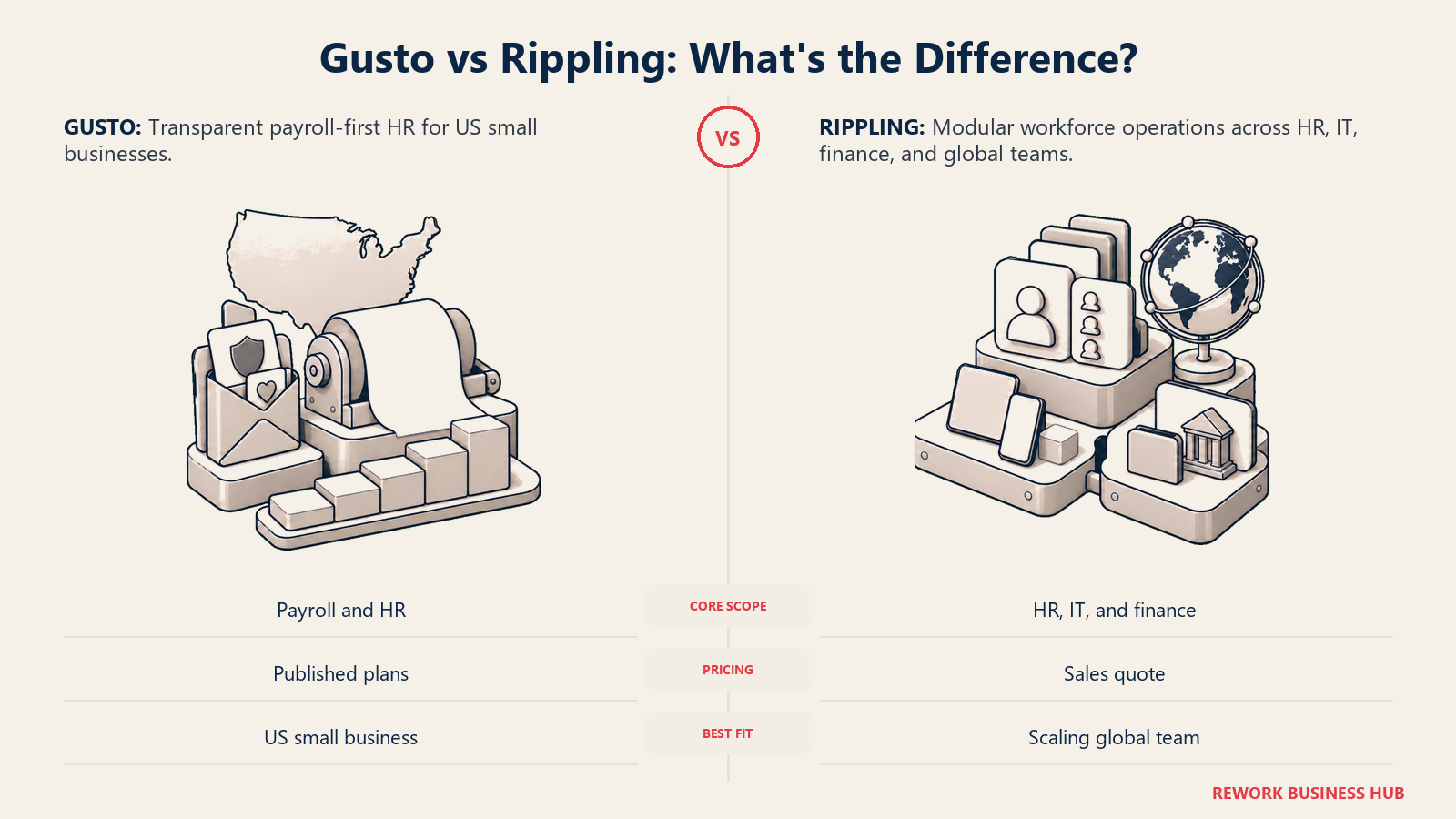
You're running payroll for a US company somewhere between 10 and 200 people, and the spreadsheet-plus-outsourced-accountant setup has stopped working. You need tax filing that doesn't depend on one person remembering deadlines, benefits your team can actually shop for, and, if you're issuing laptops to new hires, some way to track who has what. Gusto and Rippling both show up on that shortlist for opposite reasons: one is a payroll-first tool that grew HR features around a transparent price tag, the other is an IT-and-HR platform built around a single employee record that happens to run payroll too.
That difference in origin story is also the difference in how each company sells. Gusto puts a number on its website and lets you sign up without a call. Rippling puts a form on its website and makes you talk to sales before you see a price, for every module you want. This page works through what each vendor actually publishes, models real cost at three team sizes using Gusto's own numbers, and is honest about where Rippling's structure, not its secrecy, is the better fit.
TL;DR
| Gusto | Rippling | |
|---|---|---|
| What it is | Payroll-first HR platform with a published price ladder across four plans | Modular HR, IT and finance platform built on one required core platform, with payroll, benefits and device management sold as separate add-ons |
| Pricing transparency | Full price ladder published on gusto.com: Simple, Plus, Premium and a contractor-only plan | None published. Every product page routes to a "get pricing" quote form |
| Billing basis | Monthly base fee per plan, plus a flat per-person add-on | Not disclosed. Rippling states most products bill per employee per month, plus some products carry their own base fee, on top of the required core platform |
| Multi-state payroll | Included on Plus and Premium only; Simple is single-state | Included in the Payroll module for US employees |
| Global payroll and EOR | Not offered. Gusto is a US-only payroll product | Native payroll built in 10 countries, contractor payments in 185+ countries, and Employer of Record coverage in 185+ countries |
| Device management | Not a Gusto feature | Procures, configures, ships and remotely wipes company laptops in 30+ countries, tied to the same employee record as HR and payroll |
| Best for | A US team that wants a working price on day one and a fast, self-serve setup | A distributed or IT-heavy team that wants HR, device provisioning and app access managed from a single employee record, and is prepared to negotiate |
The short version: Gusto answers the budget question before you've had a single conversation with anyone. Rippling answers a different question, how do I stop app access and laptop tracking from living in a different system than HR, but you'll need a call to find out what that costs.
Key Facts
- Companies spend an average of more than 570 hours a year on HR administration, and larger teams report staff-time costs as high as $413,000 annually, according to Paychex's 2025 Business Leader Priorities survey. That's the underlying cost either platform is trying to bring down. Paychex, 2025 Business Leader Priorities
- 83% of former employees say they could still access accounts from a previous employer after leaving, and 56% admitted using that access to cause harm, per a Beyond Identity survey of more than 1,100 employees and business leaders. That's the exact risk Rippling's device management and app-provisioning pitch is built to close. Beyond Identity
- 97% of US employers offer health coverage, and 88% of HR leaders call it their most important benefit, according to SHRM's 2025 Employee Benefits Survey of nearly 4,000 HR professionals. Benefits administration isn't optional for either platform's buyer. SHRM, 2025 Employee Benefits Survey
- Only 13% of US roles were hybrid or fully remote as of Q2 2026, per Robert Half's research, but that's still enough for most growing companies to end up with employees working from more than one state, which is exactly where Gusto's Simple plan runs out of road. Robert Half, Remote Work Statistics
- 92.7% of US workers are now paid by direct deposit, up from 91.9% the year before, according to the 2025 Getting Paid in America survey of more than 25,900 workers nationwide. Payroll accuracy expectations keep rising even as the mechanics get more standardized. Nacha, on the 2025 Getting Paid in America survey
Who Each Tool Is Built For
| Gusto | Rippling | |
|---|---|---|
| Target company size | 1 to roughly 200 employees, strongest fit under 100 | 10 to a few thousand employees, strongest fit once IT and HR overlap |
| Team maturity | Wants payroll and basic HR handled without a dedicated ops or IT hire | Has, or is building, an ops or IT function that wants one system of record for people and devices |
| Primary job | Run US payroll correctly, add benefits and light HR as you grow | Run payroll, HR, device provisioning, app access and (optionally) finance from one employee record |
| Ideal buyer | A founder, office manager or first HR hire who needs a working price today | An HR or IT leader consolidating tools who is comfortable negotiating a multi-product deal |
| Team fit | Gusto | Rippling |
|---|---|---|
| HR / People | Core strength: onboarding, PTO, org chart, compliance alerts | Core strength: same, plus policy and workflow automation tied to IT events |
| IT | Not a Rippling-style fit. No device or app provisioning | Core strength: device procurement, MDM, SSO and app provisioning tied to hire/termination |
| Finance | Payroll journal entries sync to QuickBooks or Xero | Payroll plus optional Spend, Bill Pay and expense management modules |
| Global / Remote | US-only | Native fit: global payroll, EOR and contractor payments across 185+ countries |
Both tools serve the same broad customer, a US small or mid-size company that has outgrown a bookkeeper running payroll by hand. The split isn't industry, it's whether IT and device management belong in the same buying decision. If your next hire needs a laptop shipped and Slack access provisioned on day one, that's Rippling's pitch. If you just need payroll to run correctly and benefits your team can shop for, Gusto gets you there with less setup. Teams weighing more than these two should also check our best HR software roundup for 2026, which ranks 14 platforms by fit.
Pricing: Published Ladder vs Custom Quote
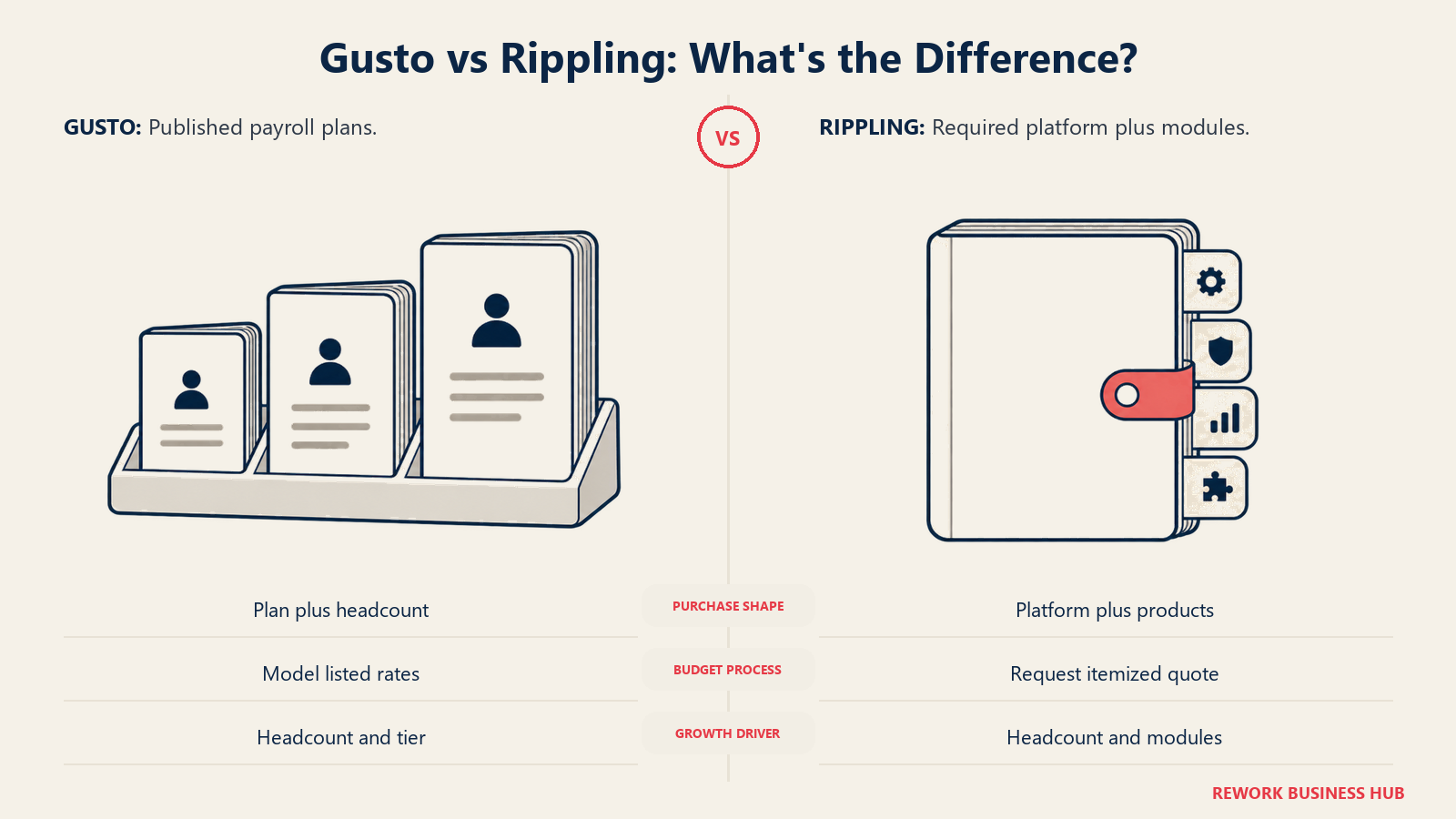
Every other section on this page is a real trade-off. This one mostly isn't. Gusto tells you a number. Rippling tells you to book a call.
What Each Vendor Actually Publishes
| Gusto | Rippling | |
|---|---|---|
| Pricing page behavior | gusto.com/product/pricing shows four named plans with real dollar figures | rippling.com/pricing is a quote-request form. No plan names, no numbers, anywhere on the vendor's own site |
| Simple plan | $49/month base + $6/month per person. Single-state payroll only, contractor-only start option available | Not applicable, Rippling has no single-state-only tier |
| Plus plan | $80/month base + $12/month per person. Adds multi-state payroll and more HR tools | Not applicable |
| Premium plan | $180/month base + $22/month per person. Rework's own read: this used to be quote-only; it is now publicly priced, so any source telling you Premium is "contact sales" is out of date | Not applicable, no equivalent published tier exists |
| Contractor-only plan | $35/month base + $6/month per contractor | Not applicable, though Rippling does support contractor payments as part of its global payroll module |
| Current promotion | $0 base fee for the first 6 months, per Gusto's own pricing page | None published |
| Required platform fee | None. The plan price is the whole price | Yes. Every Rippling product is sold "alongside the core, required Rippling Platform," per Rippling's own pricing page. You cannot buy Payroll, Benefits or Device Management without it |
Source for Gusto: gusto.com/product/pricing. Source for Rippling: rippling.com/pricing.
What Each Vendor Meters On
| Gusto | Rippling | |
|---|---|---|
| Billed on | Headcount, flat per-person add-on regardless of role or module | Headcount, per product. Most products bill per employee per month, and Rippling states some products also carry their own monthly base fee on top of the platform fee |
| Number of separate charges | One: your plan's base fee plus your per-person rate | Potentially several: the platform fee, plus a per-employee rate for Payroll, plus a separate rate (and possibly a separate base fee) for Benefits, Device Management, or any other module you add |
| What grows your bill | Headcount, and stepping up a plan tier for multi-state or more HR tools | Headcount, and every additional module you turn on |
| The widely repeated "$8 per user per month" figure | Not applicable | Not published by Rippling. Rippling's own pricing page shows neither that figure nor any other per-user rate. Treat any source stating a specific Rippling dollar amount as unverified unless it links Rippling's own domain |
Gusto's billing basis is one number you can hold in your head. Rippling's is a stack of numbers you can't see until sales builds a quote around your module list, which is why the next table has real figures on one side and structure, not numbers, on the other.
Modeled Cost at 10, 50 and 100 Employees
Picture a company at three stages: a 10-person team just past its first HR hire, a 50-person team with a full People function, and a 100-person team running multi-state payroll. Multi-state is the realistic case for most growing US companies (see the Key Facts above), so the Plus plan, not Simple, is the fair comparison for Gusto here. Every figure below comes straight from Gusto's own published rate card; nothing is estimated.
| Employees | Gusto Simple (single-state only) | Gusto Plus (multi-state) | Rippling |
|---|---|---|---|
| 10 | $49 + ($6 × 10) = $109/month → $1,308/year | $80 + ($12 × 10) = $200/month → $2,400/year | Unknowable without a quote. Platform fee plus Payroll module rate, neither published |
| 50 | $49 + ($6 × 50) = $349/month → $4,188/year | $80 + ($12 × 50) = $680/month → $8,160/year | Unknowable without a quote |
| 100 | $49 + ($6 × 100) = $649/month → $7,788/year | $80 + ($12 × 100) = $1,280/month → $15,360/year | Unknowable without a quote |
Two caveats belong next to this table. First, Gusto's current promotion waives the base fee for the first 6 months, so year-one actual spend runs below the figures above; the table shows the steady-state rate from month 7 onward. Second, the blank Rippling cells are deliberate: Rippling publishes no base platform fee and no per-employee Payroll rate, and the widely repeated third-party figure doesn't come from Rippling itself. The only path to a real number is a sales call, so ask for the platform fee and every module's rate as separate line items.
Payroll Depth: Filing, Multi-State and Contractors
| Capability | Gusto | Rippling |
|---|---|---|
| Federal, state and local tax filing | Yes, calculated, filed and paid automatically on every plan | Yes, calculated, filed and paid automatically as part of the Payroll module |
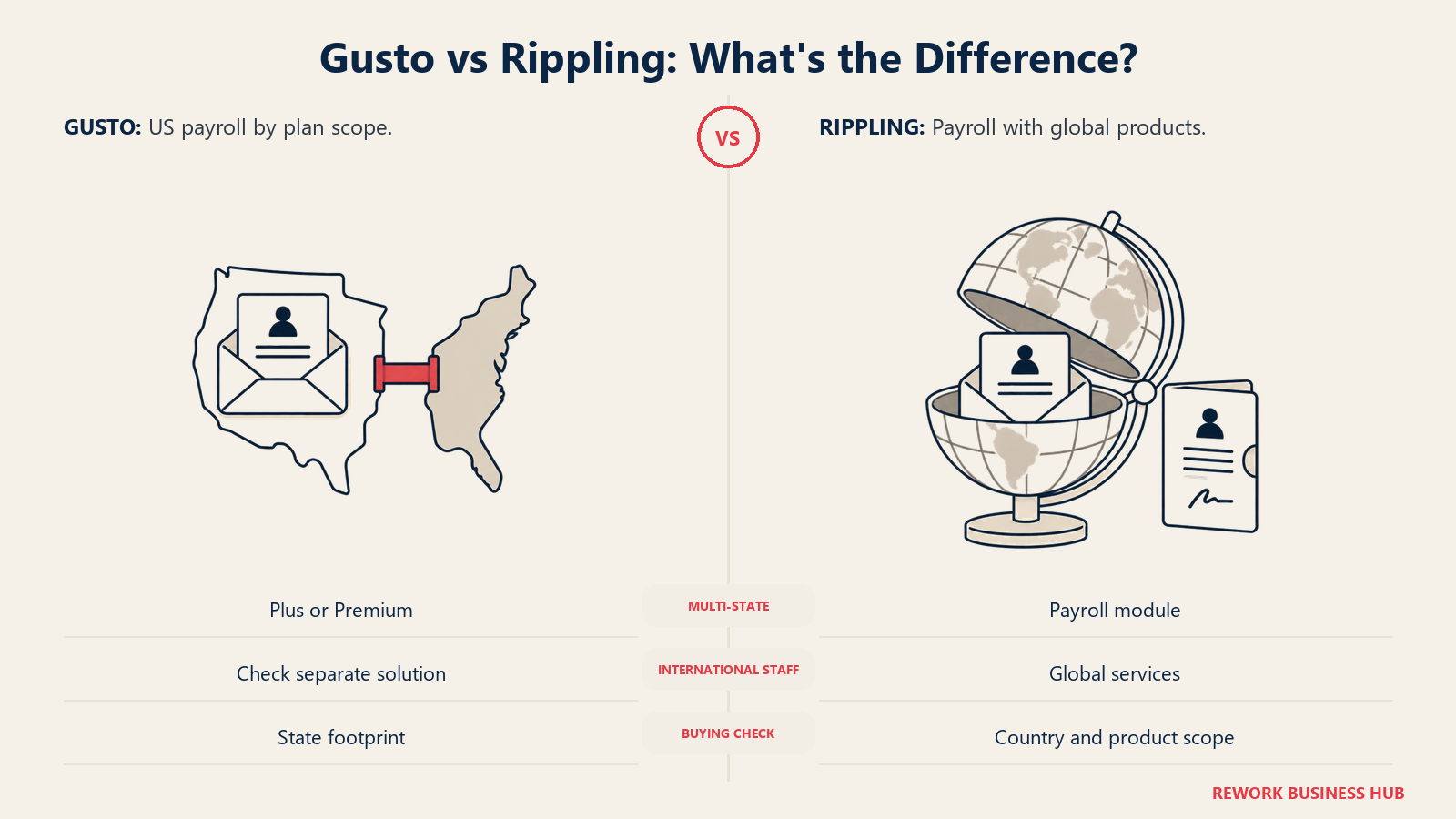
| Multi-state payroll | Gated. Included on Plus and Premium only. The Simple plan runs single-state payroll exclusively, a real limit for any company hiring outside its home state | Included in the core Payroll module, not gated behind a separate tier |
| Contractor payments (US) | Included on every plan, or available standalone on the $35/month contractor-only plan. 1099s generated and filed automatically, with per-contractor filing toggles | Included as part of global payroll, with contractor payments supported in 185+ countries |
| Global contractor payments | Limited. Gusto added Wise and stablecoin payout options for paying contractors abroad faster, but Gusto itself remains a US-payroll product | Native. Contractor payments in 185+ countries through the same platform that runs US payroll |
| International employees (EOR) | Not offered | Employer of Record coverage in 185+ countries, so you can hire full-time employees abroad without setting up a local entity |
| Natively-run international payroll | Not offered | Natively built payroll in 10 countries, beyond the EOR and contractor-payment options |
If your company stays US-only, both vendors run payroll correctly. The gap opens the moment you hire in a second state or your first employee abroad: Gusto forces a plan upgrade for the first case and can't solve the second at all, while Rippling handles both inside one Payroll module. If global EOR coverage is the actual deciding factor for your shortlist, our Rippling vs Deel comparison goes deeper on how the two stack up on international hiring specifically.
Where Rippling Pulls Ahead: Device Management, App Provisioning and Global Reach
| Capability | Rippling | Gusto |
|---|---|---|
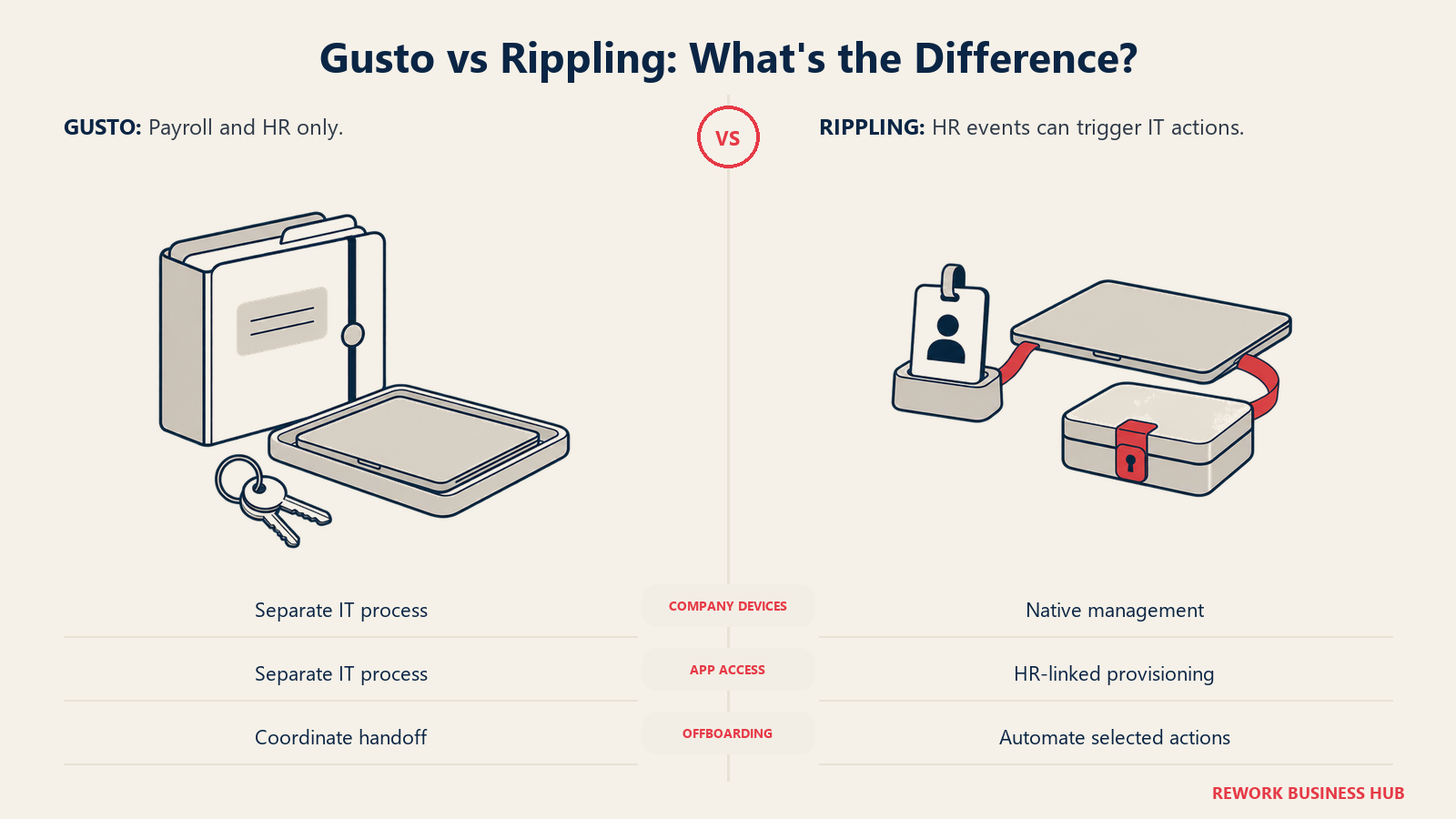
| Laptop procurement and shipping | Procures, configures and ships company laptops with pre-installed software to employees in 30+ countries | Not a Gusto feature |
| Remote lock and wipe | Yes, tied to the same employee record used for HR and payroll, so offboarding a person in HR can trigger a device action | Not a Gusto feature |
| App provisioning and deprovisioning | New hires get app access (Slack, Google Workspace, Zoom, and similar) automatically when they're added in HR; access is revoked automatically on termination | Not a Gusto feature |
| Unified employee record across HR, IT and payroll | Yes, by design. One record drives payroll, app access and device management, with no CSV exports or manual handoff between HR and IT | Gusto is payroll and HR only; there's no IT layer to unify with |
| Global reach | Native payroll in 10 countries, EOR in 185+ countries, contractor payments in 185+ countries, device management in 30+ countries | US only |
| Third-party integrations | 650+ integrations reported across Rippling's own marketing pages and independent review sites (verify the current count on rippling.com before citing a specific figure) | Integrates with accounting platforms like QuickBooks and Xero, time tracking, and other HR tools, though Gusto does not publish a comparable total integration count |
The offboarding-access statistic in the Key Facts section above is the real argument here: 83% of former employees say they could still get into a previous employer's accounts after leaving. A payroll tool has no mechanism to prevent that; a platform tying app access to the same record as the termination date does. That's Rippling's actual pitch, not device management as a nice-to-have, but as a security gap HR-only tools structurally cannot close.
Where Gusto Pulls Ahead: Price Transparency, Onboarding Speed and Small-Team Fit
| Capability | Gusto | Rippling |
|---|---|---|
| See a real price without a sales call | Yes, on gusto.com/product/pricing | No, every product routes to a quote form |
| Self-serve signup | Yes, start running payroll without talking to anyone | Sales-assisted onboarding is the norm given the quote-based model |
| Simplicity for a first-time HR buyer | High. One plan, one bill, one login, built for a company without a dedicated ops or IT function | Rippling's modular structure rewards companies that already know which modules they need; it asks more of a first-time buyer |
| Benefits shopping with no broker fees | Yes. Access to more than 9,000 plans across 30+ carriers through Gusto's in-house licensed brokers, with no broker fees charged by Gusto | Rippling offers benefits administration and PEO-based group rates, but the buying motion runs through sales rather than a self-serve marketplace |
| Cost predictability at small headcounts | High. The modeled-cost table above shows the exact number at 10, 50 or 100 employees using only published rates | Low, by design. No published base fee or per-employee Payroll rate means no company can model its own cost without a quote |
| Built for | A company whose core need is "run payroll correctly and add HR as we grow" | A company whose core need is "unify HR, IT and finance," where payroll is one module among several |
Gusto's edge isn't a longer feature list, it's that a founder or first HR hire can answer the budget question today, without waiting on a callback. For a company without IT-and-device-management on its list of problems, that speed matters more than any module Rippling could bundle in.
Benefits Administration and Compliance
| Gusto | Rippling | |
|---|---|---|
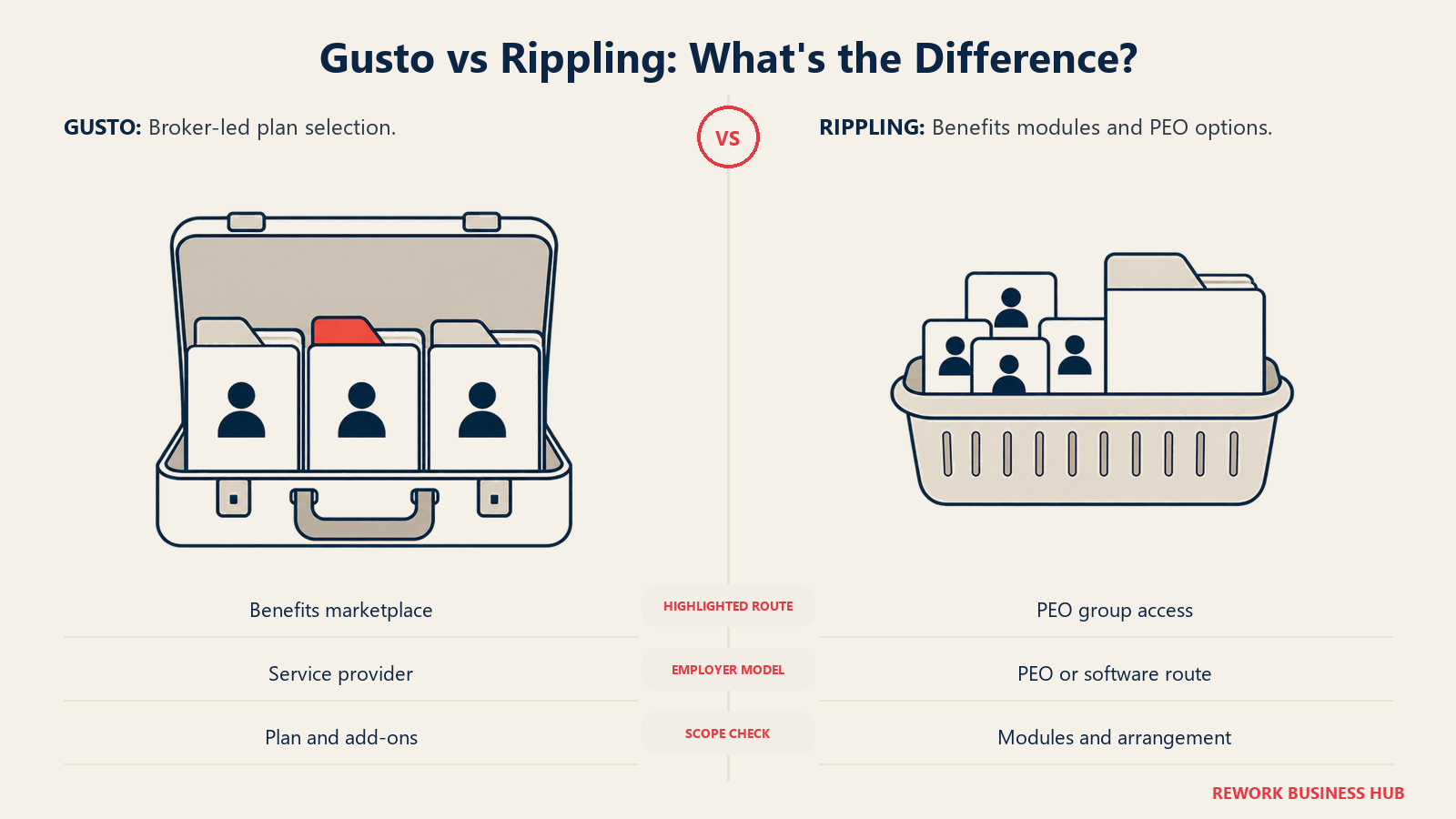
| Health insurance shopping | In-house licensed brokers, 9,000+ plans across 30+ carriers, no broker fees charged by Gusto | Benefits administration and, for smaller companies, a PEO option that pools employees with Rippling's broader client base to access group rates |
| Keep an existing broker | Yes, for $6 per eligible employee per month, your broker can manage plans inside Gusto | Not the standard model; Rippling's own PEO and brokerage paths run through its own network |
| Retirement plans | 401(k) plans through Guideline, a retirement provider Gusto agreed to acquire in August 2025, syncing payroll and compliance in the background | 401(k) administration included under Rippling's PEO and benefits offerings |
| Workers' compensation | Pay-as-you-go workers' comp through AP Intego on the Plus plan, with premiums calculated from actual payroll runs rather than an annual estimate | Available as part of PEO-based benefits, administered alongside the rest of the employee record |
| Additional wellness perks | Not a stated Gusto feature | Access to Rightway Health for benefits navigation, Spring Health for mental health support, and Wellthy for caregiving assistance under Rippling's PEO offering |
| ACA and compliance alerts | Included as part of HR tools on Plus and Premium | Included as part of Rippling's broader HR compliance tooling |
| Benefits included on the entry tier | No. Gusto's own comparison of plans states the Simple plan does not include benefits administration; 401(k), life and disability insurance, FSAs, HSAs and workers' comp are add-ons above the base plan you're on | Benefits access depends on which modules and, for the PEO option, which co-employment structure you choose; not included by default with the core platform alone |
Both vendors solve the same underlying problem, a small company can't get insurer-negotiated rates on its own, from different angles. Gusto's marketplace model puts the shopping experience in your hands with no broker fee. Rippling's PEO model pools your headcount into its own client base to unlock rates, which can beat a standalone small company's options, but ties your benefits more tightly to Rippling's own network.
Integrations, Automation and Reporting
| Gusto | Rippling | |
|---|---|---|
| Accounting sync | Native integrations with QuickBooks Online, QuickBooks Desktop and Xero | Native accounting integrations as part of its broader integration catalog |
| Total integrations | Not a published total; Gusto's own site organizes integrations by category (accounting, time tracking, expense management, and more) rather than stating a headline number | 650+ integrations reported by Rippling's marketing pages and echoed across independent review sites, spanning HR, IT, finance and productivity tools |
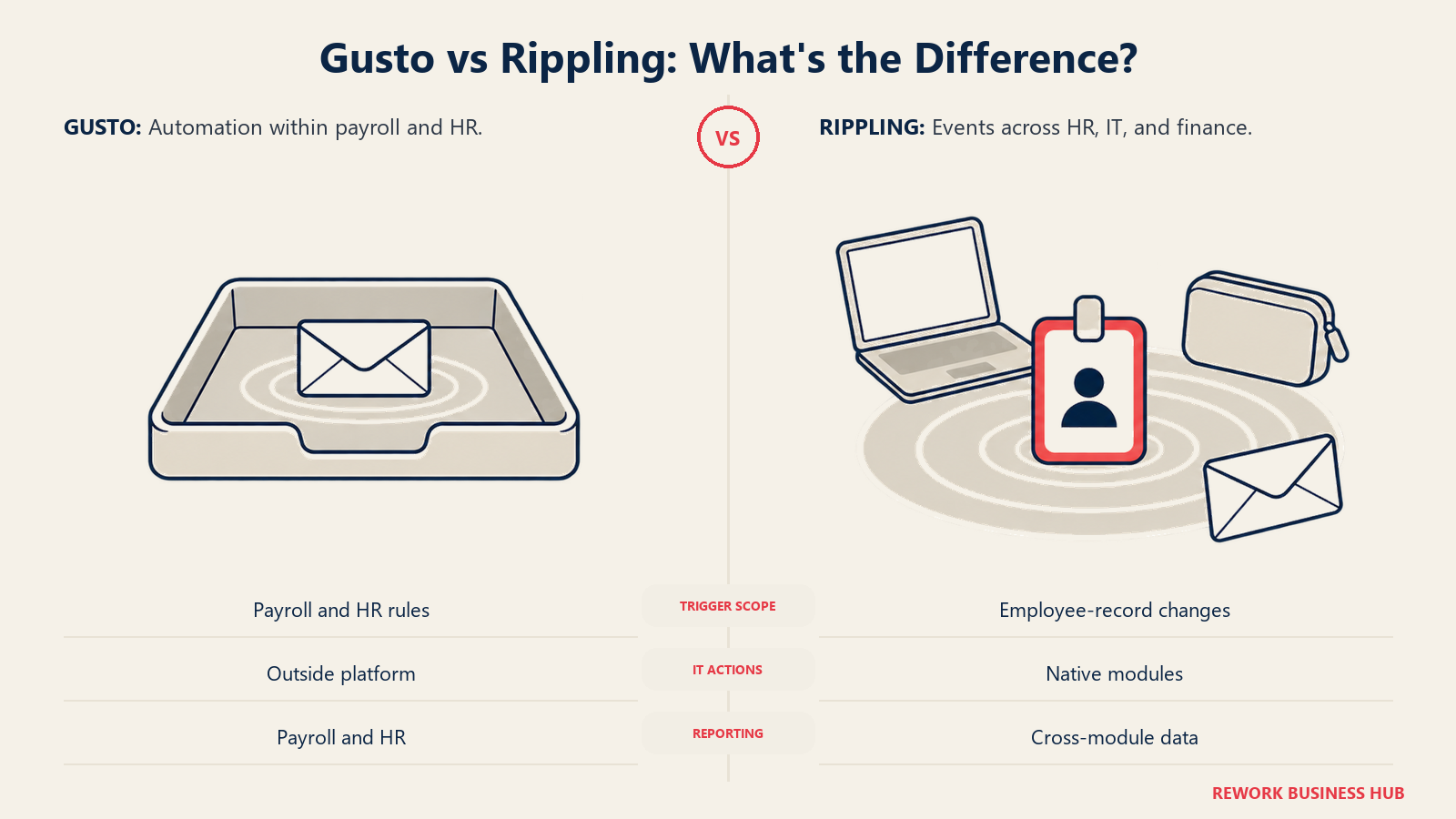
| Automation model | Rule-based: payroll runs, tax filings and benefits deductions sync automatically inside Gusto's own modules | Event-driven across modules: a change to an employee's HR record (a hire, a role change, a termination) can automatically trigger payroll updates, app provisioning changes and device actions |
| API | Documented API, used primarily to power Gusto Embedded for platforms building payroll into their own product | Documented REST API, used both by Rippling customers and by Rippling's own App Shop marketplace |
| Reporting | Standard payroll and HR reports, exportable, built around the plan tier you're on | Customizable reporting across HR, IT and finance data, since all three sit on the same underlying record |
The reporting gap tracks the same pattern as the rest of this page: Gusto's reports live inside payroll and HR, because that's the whole product. Rippling's reporting can span HR, device inventory and spend because those are facets of one record, not three systems bolted together.
Implementation and Time to Value
| Gusto | Rippling | |
|---|---|---|
| Typical setup shape | Lightweight. Add your company, employees and bank details, and run your first payroll, often within days | Heavier at the start. Configuring the core platform plus each module (Payroll, Benefits, Device Management) takes longer, but each module you add afterward inherits the same employee record |
| Where the time goes | Entering employee and tax details correctly the first time | Deciding which modules you need, negotiating the quote, and mapping device and app policies to the unified record |
| Sales involvement before go-live | None required. Self-serve signup | Required. A quote-based model means a sales conversation happens before implementation starts |
| Best fit for a fast go-live | Yes, especially for a company on its first real payroll system | Not the fastest path for a company that only needs payroll; the platform's value shows up more clearly once multiple modules are live |
Support and Onboarding
| Gusto | Rippling | |
|---|---|---|
| Support channels | Chat and email support across plans, with phone support available depending on plan tier (confirm current tier details on Gusto's own pricing page before you sign) | Support channels vary by module and plan; confirm specifics during your sales conversation since Rippling does not publish a general support-tier breakdown |
| Review standing | Roughly 4.6 stars across G2 reviews (approximate, current), with Gusto ranked #1 on G2's Highest Satisfaction Products list for 2026 | Roughly 4.8 stars across a considerably larger G2 review base (approximate, current) |
| Common praise | Fast setup, transparent pricing, ease of use for a first-time payroll buyer | Breadth of what one platform can do, and the value of not re-entering employee data across separate HR, IT and finance tools |
| Common friction point | Feature ceiling once a company needs deep IT or global employment tooling | Pricing opacity, and a heavier initial setup for a company that only wants payroll |
Neither review base signals a support gap serious enough to decide a purchase on its own. The friction points are structural: Gusto's ceiling is real once your needs go past US payroll and HR, and Rippling's pricing model requires a sales conversation for every module, every time.
When Gusto Is the Right Call
- You want a real price before you talk to anyone. The modeled cost table above is the whole story: pick a plan, add your headcount, and you have your annual number, no quote required.
- Your company is US-only and stays that way. Gusto is a US payroll product built for exactly that case, with 50-state tax filing and a benefits marketplace that doesn't require a broker relationship.
- You're a first-time HR buyer without a dedicated ops or IT function. Self-serve signup and same-day payroll setup beat a longer, sales-assisted rollout when the whole team is you and a founder.
- You don't issue company laptops or manage app access as an HR function. If device provisioning isn't a problem you have, Rippling's core differentiator doesn't move the needle for you.
If none of that describes your team and the deciding issue is Gusto's ceiling on multi-entity, global or IT-heavy needs, our best Gusto alternatives roundup covers the field, Rippling included, alongside vendors like ADP built for deeper compliance needs; see our best ADP alternatives roundup if ADP itself is also on your shortlist.
When Rippling Is the Right Call
- You're hiring outside the US, whether as employees or contractors. Native payroll in 10 countries, EOR in 185+ countries and contractor payments in 185+ countries put international hiring inside the same system as US payroll, something Gusto structurally can't do.
- You issue company laptops and manage app access as part of onboarding and offboarding. Device procurement, remote wipe and automatic app provisioning tied to the HR record close the exact access-after-departure risk the Key Facts section above documents.
- You're consolidating HR, IT and finance tools that currently don't talk to each other. One employee record driving payroll, device management and app access removes the CSV-export handoffs between departments.
- You have the internal bandwidth to negotiate a multi-module quote and configure a heavier initial setup. Rippling's structure rewards a company that already knows which modules it needs, not one hoping to figure it out live in a sales call.
If none of that fits, and what you actually need is a defendable annual number before finance signs off, our best Rippling alternatives roundup covers that end of the category, including several vendors that publish a real rate card the way Gusto does. If your shortlist is really an HR-first platform question rather than an IT-and-payroll one, our BambooHR vs Rippling comparison is a closer match for that specific trade-off.
A Third Option Worth Knowing About
Neither Gusto nor Rippling tries to be an operations platform outside HR and IT. If your real gap is that payroll, HR, sales and project work all live in tools that don't share a record, that's a different problem than either of these solves.
Rework's People app runs HRIS, timesheets, payroll, an ATS (E-Hiring), interview scheduling and a career site on the same platform as a Sales CRM and Lead pipeline, Task, Project, Workflow and BPM on the operations side, and a unified inbox spanning WhatsApp, Messenger, Instagram DM, TikTok, Zalo and web chat. The argument is consolidation, not payroll depth: for a company already juggling a CRM, a project tool and an HR system as three separate logins, running all three on one platform removes the handoffs, not just the HR ones. Our how to choose HR software for a small business guide walks through that trade-off against a specialist tool like Gusto or Rippling.
Not ideal for: Rework isn't a US payroll tax-filing engine the way Gusto is, and it doesn't run multi-country statutory payroll or Employer of Record coverage the way Rippling does. If your core need is deep US payroll compliance or global employment infrastructure, stick with the specialist built for that job. Rework isn't built for solo or single-user buyers either.
Price: Quote on request, per organization. See rework.com/pricing.
Decision Framework
| If you are... | Pick |
|---|---|
| A US-only company that wants a real price before signing up | Gusto |
| Hiring employees or contractors outside the US | Rippling |
| Issuing company laptops and managing app access as part of onboarding | Rippling |
| A first-time HR buyer without a dedicated ops or IT function | Gusto |
| Consolidating HR, IT and finance into one employee record | Rippling |
| Running multi-state payroll but staying US-only | Gusto Plus or Premium, provided the per-person add-on math still works at your headcount |
| Your real problem is a CRM, project tool and HR system that don't share data at all | Neither. See the third option above |
| Comfortable negotiating a multi-module quote for the right long-term fit | Rippling |
What Carries Over If You Switch
| What carries over | Gusto to Rippling | Rippling to Gusto |
|---|---|---|
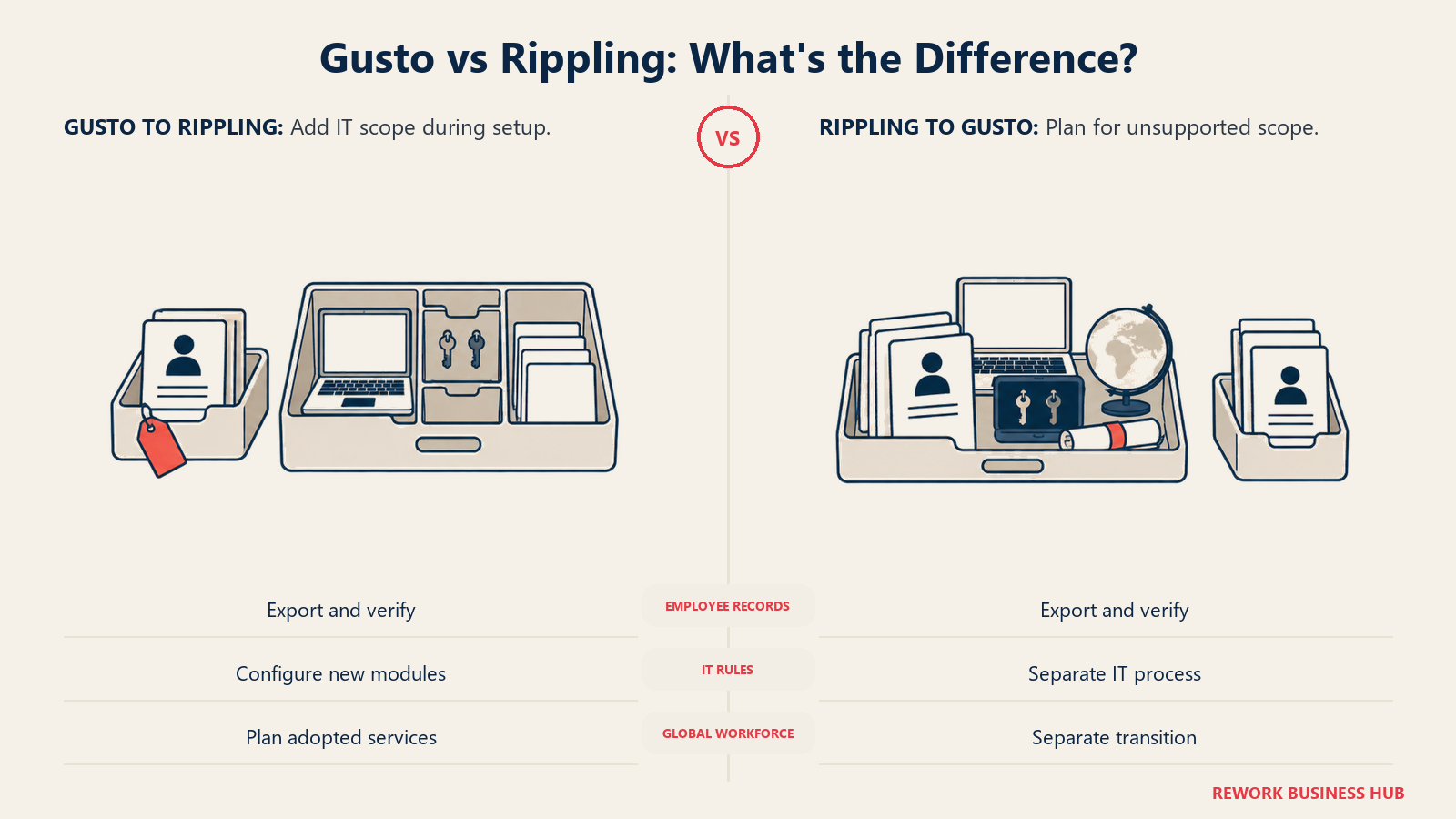
| Employee records (name, role, pay rate, tax details) | Yes, via export and import, though tax setup needs to be re-verified in the new system | Yes, via export and import, with the same tax re-verification step |
| Payroll history and YTD tax filings | Partial. Historical filings stay with the original provider of record; the new provider typically starts fresh from your transition date | Partial, for the same reason |
| Benefits enrollment | Needs to be rebuilt or re-mapped to the new carrier relationships, since each vendor's broker or PEO structure differs | Needs to be rebuilt the same way, and any PEO co-employment arrangement needs to be formally exited first |
| Device inventory and app access rules | Not applicable moving into Rippling since Gusto never tracked this | Does not carry over. Gusto has no device or app-provisioning layer to import into, so this needs a separate IT process |
| International employee and contractor records | Not applicable moving into Rippling since Gusto never supported this | Does not carry over. Any EOR or international contractor relationships need their own transition plan outside Gusto entirely |
One practical note either direction: run your first payroll on the new system in parallel with your last payroll on the old one before cutting over. A quiet mismatch in tax setup is far cheaper to catch before go-live than after the IRS notices it. Our switching SaaS vendors guide covers the non-payroll parts of that transition, and our TCO modeling guide prices the migration itself, not just the subscription.
Frequently Asked Questions about Gusto vs Rippling
Is Gusto cheaper than Rippling?
Gusto is the only one of the two with a published price, so it's the only one you can compare without a sales call. Its Plus plan, the realistic pick for a multi-state company, runs $80/month plus $12/month per person. Rippling publishes no base platform fee or per-employee Payroll rate, so there's no vendor-confirmed number to compare it against.
Why doesn't Rippling publish its pricing?
Rippling sells its products modularly (Payroll, Benefits, Device Management and others), each alongside a required core platform, with most products billing per employee per month and some carrying their own base fee. That structure doesn't reduce to one number the way a flat plan does, which is likely why Rippling's pricing page is a quote form rather than a rate card.
Can Gusto handle international employees?
No. Gusto is a US payroll product; it added Wise and stablecoin payout options for paying contractors abroad faster, but it doesn't offer natively-run international payroll or Employer of Record coverage. Rippling offers both, with native payroll in 10 countries and EOR coverage in 185+ countries.
What's the real difference between Gusto and Rippling's core pitch?
Gusto is payroll and HR built for a US company that wants a working price on day one. Rippling is a broader platform where payroll is one module among several, including device management and app provisioning, tied to one employee record. The offboarding statistic in the Key Facts section, 83% of former employees retaining account access after leaving, illustrates the gap Rippling closes and Gusto structurally can't.
Does Gusto's Simple plan support multi-state payroll?
No. Gusto's own plan comparison states multi-state payroll and filings are available only on the Plus and Premium plans; Simple runs single-state payroll exclusively. If you have even one employee working from a second state, budget for at least Plus.
Is either platform a PEO?
Rippling offers a PEO option for smaller companies that want to pool into its client base for group benefits rates, alongside a non-PEO software model. Gusto is not a PEO; it operates as a payroll and HR service provider without assuming employer status, and its benefits marketplace runs through in-house licensed brokers instead.
How long does it take to get running on each platform?
Gusto is built for a fast, self-serve setup, often days, since no sales call is required. Rippling's setup is heavier at the start because it involves a sales-driven quote and configuring each module, though every module you add afterward shares the same employee record instead of its own setup.
What actually carries over if I switch between them?
Core employee records move through an export and import either direction, though tax details need re-verification. Payroll history, benefits enrollment, and, moving away from Rippling, any device inventory or international employee records generally need to be rebuilt rather than imported, since Gusto has no equivalent to Rippling's IT and global-employment layers.
What to Do Next
- Model your own headcount against the Gusto table above. Plug in your employee count at Simple and Plus rates for a real number you can bring to a budget conversation today.
- If Rippling is on your shortlist, ask for a written quote broken out by module. Get the platform fee, the Payroll rate, and every add-on module's rate as separate line items so you can model growth the way the Gusto table lets you.
- Confirm your multi-state and international footprint first. If you have even one out-of-state employee, Gusto's Simple plan is off the table; if you have any employee or contractor outside the US, Gusto is off the table entirely.
- Run both trials against your real employee list, not a sample dataset. If device management matters, ask Rippling to walk through the offboarding flow, not just onboarding, since that's where the real difference shows up.
- Decide which kind of uncertainty you can live with. Gusto's number is knowable today and grows on a schedule you can calculate. Rippling's requires a conversation and can include line items you didn't anticipate. Our TCO modeling guide is a reasonable way to structure that comparison before you sign anything.

Senior Customer Retention Strategist
On this page
- TL;DR
- Key Facts
- Who Each Tool Is Built For
- Pricing: Published Ladder vs Custom Quote
- What Each Vendor Actually Publishes
- What Each Vendor Meters On
- Modeled Cost at 10, 50 and 100 Employees
- Payroll Depth: Filing, Multi-State and Contractors
- Where Rippling Pulls Ahead: Device Management, App Provisioning and Global Reach
- Where Gusto Pulls Ahead: Price Transparency, Onboarding Speed and Small-Team Fit
- Benefits Administration and Compliance
- Integrations, Automation and Reporting
- Implementation and Time to Value
- Support and Onboarding
- When Gusto Is the Right Call
- When Rippling Is the Right Call
- A Third Option Worth Knowing About
- Decision Framework
- What Carries Over If You Switch
- What to Do Next