Rippling vs Deel in 2026: Own the Entities or Rent the Employer?
Turn this article into takeaways for your work.


Each assistant summarizes the article only for you and suggests best practices for your work.
You're a 25 to 300 person company with people in more than one country, and you've outgrown the point solutions. Maybe it's a spreadsheet tracking who's on which entity, maybe it's three different vendors handling US payroll, contractor invoices, and a single employee in Portugal. Rippling and Deel are the two names that come up on almost every shortlist for fixing that, and for good reason: both now sell HRIS, payroll, benefits, contractor management, and some form of global employment in one product. That overlap is exactly what makes the choice hard.
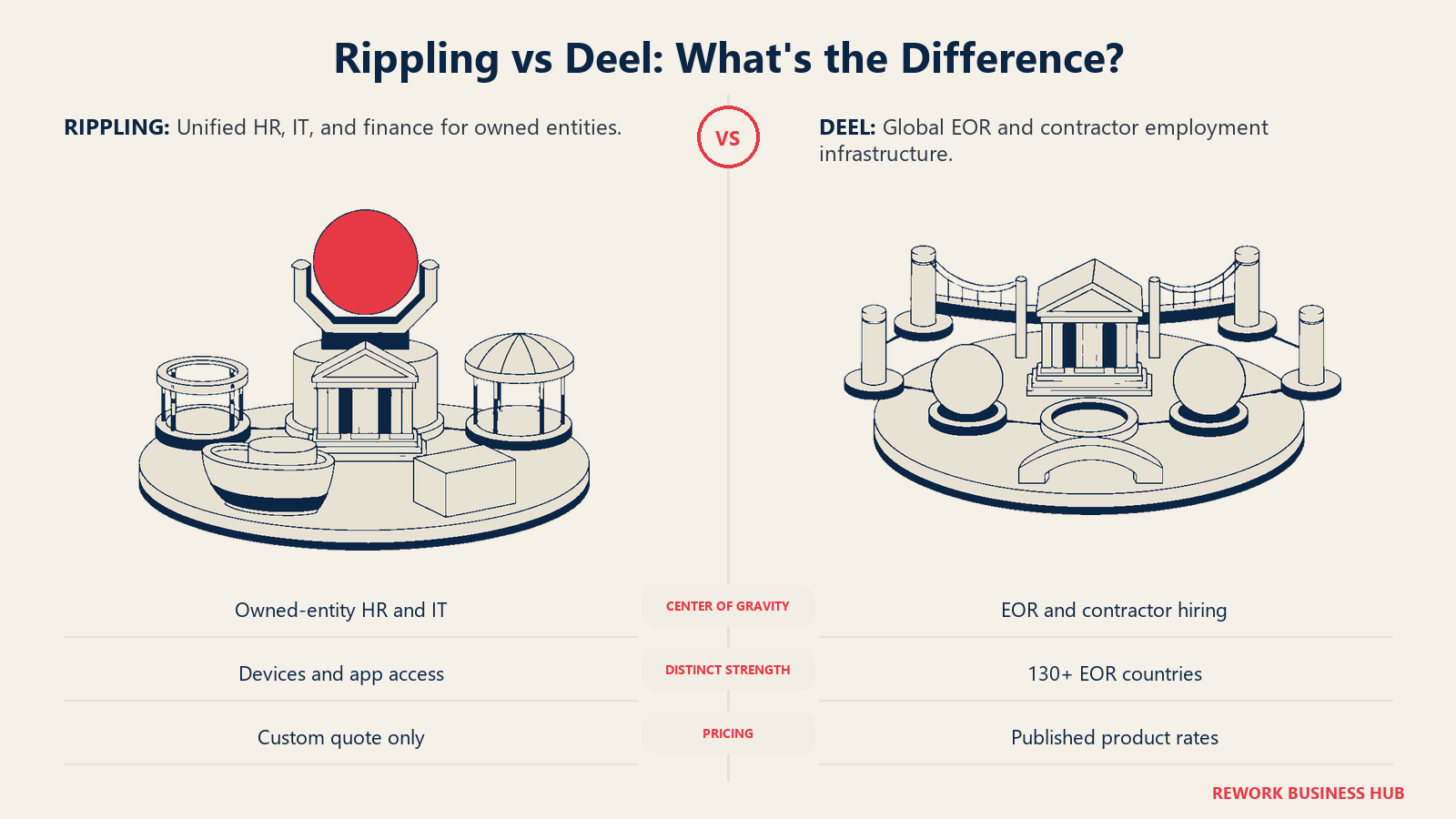
A feature grid won't settle this comparison, because both vendors now check most of the same boxes. The question that actually decides it is where your headcount lives relative to your legal entities. If you mostly employ people in countries where you already have a registered entity, you're in Rippling's home territory: one system of record for HR, IT, and finance. If you need someone else to be the legal employer in a country where you have no entity, you're in Deel's home territory: employer of record built to handle exactly that. Layer a second fork on top, procurement: Deel publishes a rate card you can screenshot into a budget request today, and Rippling asks you to fill out a quote form first. Both forks matter more than any single feature row below.
TL;DR
| Rippling | Deel | |
|---|---|---|
| What it is | Unified HR, IT, and finance platform built around a single employee record, with payroll, benefits, device management, and EOR bolted on as modules | Global employment platform built around EOR and contractor payments, now expanded into HR, payroll, and hiring |
| Center of gravity | People you employ directly through entities you already own | People you need someone else to legally employ, plus contractors, across 130+ countries |
| Pricing model | No published price list. Most products bill per employee per month, some carry an added monthly base fee, and every product sits on top of a required, unpriced Rippling Platform. Quote only | Published per-product rate card. HR Core from $5/employee/month, EOR at $599/employee/month, Contractor Management at $49/contractor/month, and more |
| IT and device management | Deep, native: identity, SSO/SCIM, mobile device management, zero-touch deployment | Not a product focus |
| EOR coverage | 80 countries, per Rippling's own site | 130+ countries for entity-owned payroll, compliance support in 150+ |
| Free or entry-level tier | None published at any tier | No free-forever HRIS tier. Core starts at $5/employee/month (a widely repeated "Deel HR is free" claim is out of date, see below) |
| Best for | Companies employing people mainly through entities they already own, especially with heavy device/app provisioning needs | Companies hiring in countries where they have no entity, or running a mix of EOR employees and contractors |
| Ongoing legal dispute | Active federal litigation against Deel since March 2025, still in discovery | Same case, from the other side. See the note below the pricing section |
Key Facts
- Three-quarters of payroll leaders describe managing employment regulation across jurisdictions as a major challenge, per ADP's "The Potential of Payroll in 2026" survey of 1,816 senior payroll leaders across 20 countries. That's the exact pain both EOR and multi-entity payroll exist to reduce. ADP, "The Potential of Payroll in 2026" (PDF)
- Almost 40% of tax and finance leaders name rising compliance burden as the single biggest tax-related impact on their business, according to Deloitte's 2026 Global Tax Policy Survey of 1,010 leaders across 28 jurisdictions. Deloitte, 2026 Global Tax Policy Survey
- 49% of organizations with an international workforce say managing operational complexity across countries is very or extremely challenging, per a December 2025 Atlas HXM survey of 425 senior HR, legal, finance, and operations leaders. HR Dive, "US companies say they plan to accelerate global hiring despite hurdles"
- The maximum US federal civil penalty for a willful or repeated minimum wage or overtime violation is $2,515 per violation in 2026, unchanged from 2025 because the Department of Labor made no inflation adjustment this year. That's before any state-level or country-level exposure from misclassifying a contractor who's functionally an employee. US Department of Labor, Civil Money Penalty Inflation Adjustments
The Real Fork: Entities You Own vs Employment You Rent
Rippling and Deel didn't start as the same company solving the same problem, and the difference still shows even though both have expanded hard into each other's territory.
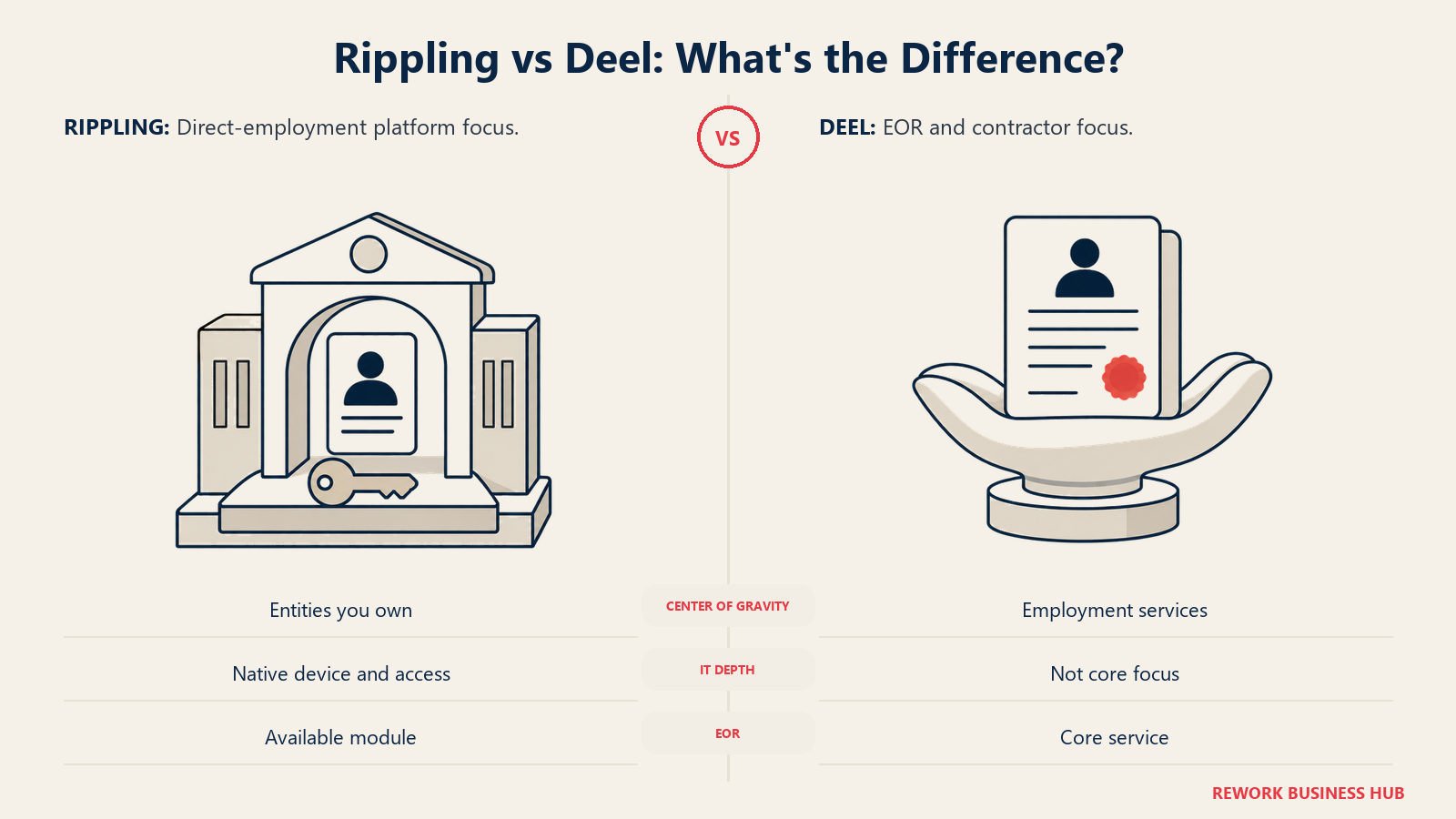
Rippling started from the employee system of record: one place that holds HR data, payroll, benefits, devices, and app access for people you employ directly. Its argument is that HR, IT, and finance are all downstream of the same employee record, so they should live on the same platform. That model assumes you already have (or are willing to set up) the legal entity to employ someone in a given country. Rippling's own EOR product, live in 80 countries, is the newer answer for when you don't.
Deel started from the opposite direction: you need to pay someone in a country where setting up an entity would take months and cost real money, so Deel becomes the legal employer on your behalf. EOR and contractor payments are still what Deel is built deepest for, with entity-owned payroll infrastructure or compliance support across more than 130 countries. Deel HR, its newer HRIS layer, is the answer for teams that want one vendor for both the people they employ directly and the people Deel employs on their behalf.
Neither company replaces your own legal or tax counsel, and neither claim in this article should be read as legal advice. What the fork actually predicts is where each vendor's depth sits: Rippling goes deeper on IT and device management because it assumes you own the employment relationship end to end; Deel goes deeper on EOR country coverage and contractor compliance because it assumes, for at least part of your headcount, you don't.
Who Each Tool Is Built For
| Rippling | Deel | |
|---|---|---|
| Target company size | Roughly 25 to 2,000+ employees, historically US-entity-centric, now expanding global reach | Roughly 20 to 2,000+ employees, global-first from the start |
| Primary buyer | Head of People or Head of IT who wants HR, payroll, and device management on one employee record | Head of People or Finance who needs to hire or pay someone in a country without an entity |
| Team maturity | Ready for a full system of record across HR, IT, and finance, not just a point tool | Needs EOR or contractor infrastructure now; HR process maturity varies widely |
| Ideal starting problem | Device and app sprawl across a growing headcount, plus fragmented HR and payroll tools | Can't legally hire in a target country without months of entity setup, or a growing pile of contractor invoices |
| Where each name shows up first | IT and ops teams standardizing device provisioning and access | Finance and People teams trying to hire their first employee outside their home country |
Both tools now serve a similar band of company sizes and industries: SaaS, professional services, agencies, and any mid-size company with a distributed or international workforce. The split isn't industry, it's operating model, which is why the fork above matters more than a size or vertical filter.
Pricing: A Published Rate Card vs a Custom Quote
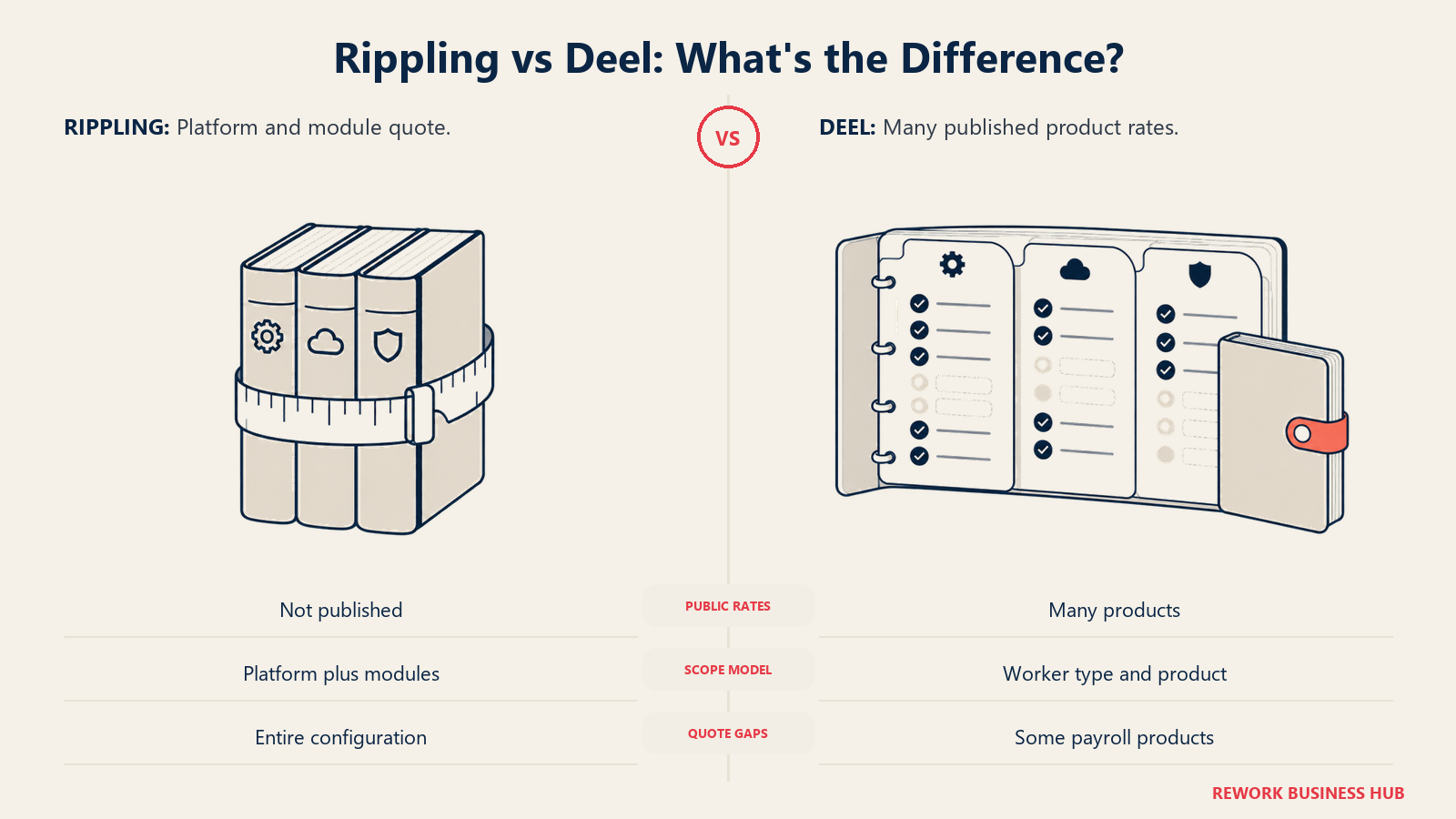
Every other section on this page is a real trade-off between two capable products. This one isn't close. Deel tells you a number for almost every product it sells. Rippling tells you to fill out a form.
What Each Vendor Actually Publishes
| Rippling | Deel | |
|---|---|---|
| Pricing page behavior | rippling.com/pricing shows a quote request form asking for work email, company name, employee count, and HQ location, with a "Get my free quote" button. No dollar figures anywhere on the page | deel.com/pricing lists a per-product rate card with real numbers for HR, Hire, Contractor Management, Contractor of Record, EOR, and US PEO |
| Published floor price | None at any tier, for any product | Deel HR Core starts at $5 per employee/month |
| Billing cycle stated | Not applicable, since there's no number to attach a cycle to. The page does confirm the billing shape: most products are per-employee-per-month, some carry an added monthly base fee, and every product sits on top of a required Rippling Platform | Yes. Every published Deel figure is explicitly stated as a monthly per-employee, per-contractor, or per-worker rate |
| Free trial | Not stated on the pricing page | Not stated on the pricing page |
Rippling's own pricing page is direct about the structure even without numbers: "most Rippling products are billed on a simple per-employee, per-month basis, some may be charged at (or include) a monthly base fee," and "each HR, Finance, and IT product...can be purchased separately, alongside the core, required Rippling Platform." That's useful for understanding the shape of the bill. It's not useful for putting a number in a budget request, which is the one thing Deel's page gives you that Rippling's doesn't.
The Deel HR "free forever" claim is stale. It's the single most repeated line about Deel online, and Deel's own HR product page states plainly that Core starts at $5 per employee per month, with no free tier advertised. If you're comparing Deel to Rippling on the assumption that Deel HR is free, start over: it isn't.
What Each Vendor Meters On
| Rippling | Deel | |
|---|---|---|
| Billed on | Headcount, per product, on top of the required Rippling Platform fee | Headcount, metered separately per product: per employee/month for HR and Hire, per contractor/month for Contractor Management, per EOR employee/month for EOR, per contractor of record/month for COR, per employee/month for US PEO |
| What grows your bill | Adding employees, and adding more of Rippling's HCM, IT, or Spend products | Adding headcount in any product category, since each is priced and billed independently |
| Enterprise tier | Custom quote, same intake form as every other deal size | Not listed with a number on deel.com/pricing; large accounts likely negotiate off the published floor |
| Global Payroll and US Payroll pricing | Not published | Not published either. Deel's rate card is real, but it stops short of Global Payroll, US Payroll, and Immigration, all of which carry no published figure |
Worth flagging: Deel's transparency has a real edge, but it isn't total. The published rate card covers HR, Hire, Contractor Management, Contractor of Record, EOR, and US PEO. It does not cover Global Payroll, US Payroll run as a standalone product, or Immigration, so a shape that leans on those specific products still ends in a quote on Deel's side too.
Modeled Cost for Three Real Shapes
Three shapes a real buyer might be sizing this against, using each vendor's own published numbers where they exist.
Shape 1: 60 US employees, single entity, no international hiring
| Rippling | Deel | |
|---|---|---|
| Modeled monthly cost | Not calculable. Requires the required Platform fee (unpublished) plus per-employee rates for whichever of Payroll, HR, Benefits, and IT modules you turn on (all unpublished) | Deel HR Core: 60 x $5 = $300/month ($3,600/year) covers the HRIS layer only. Running actual US payroll on top requires Deel's US Payroll product, which carries no published price |
| What you can budget today | Nothing, without a quote | $3,600/year for HR Core is real and quotable. Full payroll cost still needs a sales conversation |
Shape 2: 30 US employees plus 10 employed abroad via EOR
| Rippling | Deel | |
|---|---|---|
| Modeled monthly cost | Not calculable. Rippling's own EOR product exists for the 10 international hires, but neither its price nor the domestic Platform and HR fees are published | Deel HR Core for the 30 US employees: 30 x $5 = $150/month. Deel EOR for the 10 international hires: 10 x $599 = $5,990/month. Combined: $6,140/month, $73,680/year |
| What you can budget today | Nothing, without a quote | $73,680/year is a real, vendor-published figure you can defend in a budget meeting today |
Shape 3: 20 direct employees plus 25 contractors
| Rippling | Deel | |
|---|---|---|
| Modeled monthly cost | Not calculable. Rippling sells contractor management as part of the platform, price unpublished | Deel HR Core for 20 employees: 20 x $5 = $100/month. Deel Contractor Management (self-managed) for 25 contractors: 25 x $49 = $1,225/month. Combined: $1,325/month, $15,900/year |
| What you can budget today | Nothing, without a quote | $15,900/year, using only published rates |
Notice what doesn't appear in any Rippling column: a number. That's not an oversight in this modeling, it's the honest result of a pricing page that publishes none. If a defendable number for finance is what you need this week, only one of these two vendors can give you one without a sales call, on any of these three shapes.
A note on the ongoing dispute between these two companies. In March 2025, Rippling sued Deel in federal court in California, alleging Deel cultivated an employee inside Rippling as a corporate spy who searched Rippling's internal systems for competitive information. Deel countersued in Delaware that April, alleging Rippling ran its own competitive-intelligence operation against Deel's platform. By mid-2026, Deel had acknowledged in court filings that it paid the individual at the center of the case, and in February 2026 a federal judge denied Deel's motion to dismiss, allowing Rippling's trade-secret and racketeering claims to proceed toward trial; the U.S. Attorney's office was also reported to be investigating the matter. None of this is settled, and this article does not take a side on the outcome. It's mentioned here because a buyer doing diligence on either vendor in 2026 will run into it, and because "who employs your people" comparisons involve exactly the kind of sensitive workforce and customer data both companies are accusing each other of mishandling. Bloomberg Law, "Rippling to Advance Corporate Espionage Suit Against Deel" · PYMNTS, "Justice Department Investigates Allegations That Deel Recruited Spy at Rival Firm Rippling"
Core HRIS Comparison
| Capability | Rippling | Deel |
|---|---|---|
| Core HRIS / system of record | Yes, the Platform plus HCM modules | Yes, Deel HR across Core, Advanced, and Elite tiers |
| US payroll | Native, full-service | Native "US Payroll" product, price not published |
| Global payroll on your own entity | Native in 10 countries today | Deel Global Payroll module, country count and price not published |
| Time and attendance | Native module | Included within Deel HR |
| Benefits administration | Native, US-focused benefits and broker tools | Handled locally for EOR employees; separate for direct hires |
| Recruiting / ATS | Native Recruiting module | Deel Hire, $14/worker/month |
| Performance management | Native Performance Management module | Included starting in Deel HR Advanced |
| Learning management | Native Learning Management module | Included starting in Deel HR Advanced |
| Workforce and headcount planning | Native module | Included in Deel HR Elite |
| US PEO | Native PEO module, price not published | Deel US PEO, $125 per employee/month |
Read this table next to the pricing section and the pattern holds: Rippling ships more of this list natively as part of one system, and Deel ships an equally deep list, but stitched from named, separately priced products, several of which don't carry a public number at all.
Global Payroll and EOR Coverage
| Rippling | Deel | |
|---|---|---|
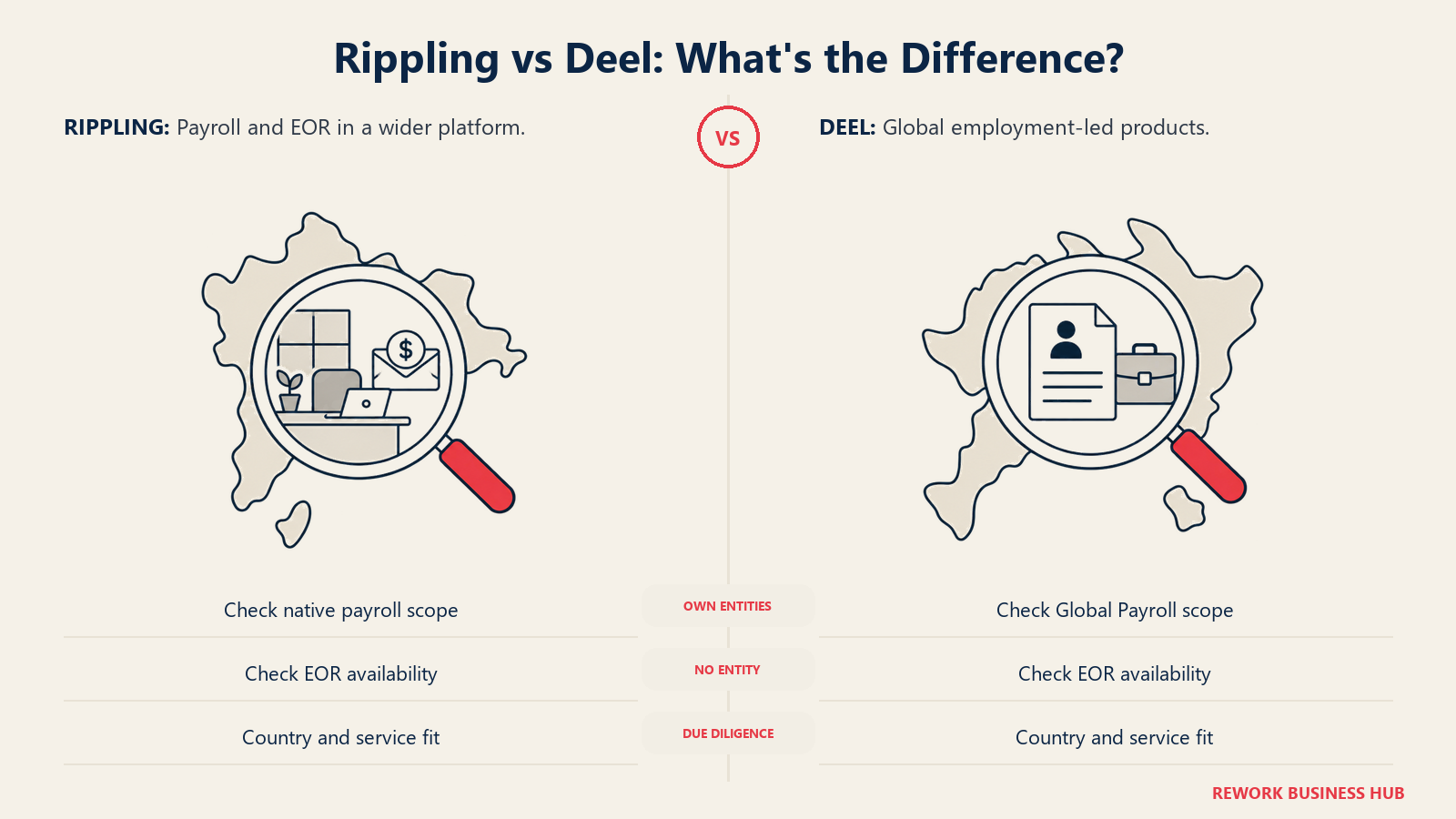
| EOR countries | 80 countries, per Rippling's own site, covering what Rippling describes as over two-thirds of the global population | 130+ countries for entity-owned payroll and EOR, with compliance support extending to 150+ |
| Native global payroll (your own entity) | 10 countries today | Via Deel Global Payroll, country count not published |
| HRIS localization | 85+ countries | Not stated as a separate localized-HRIS figure on Deel's site |
| Contractor payment reach | 185+ countries, 50+ currencies | Broad country coverage through Contractor Management, exact count not stated as a single figure |
| EOR price | Not published | $599 per EOR employee/month |
| Speed to hire via EOR | Confirm timing with Rippling | "As little as one day" to onboard, per Deel's own EOR page |
The country-count gap (80 versus 130+) is real, but it understates the deeper difference: Deel built its entire company around being the compliant local employer at scale, so EOR depth, in-country legal review, and speed to hire are the product, not an add-on. Rippling's 80-country EOR footprint is genuinely broad and growing fast, but it's one module inside a platform whose center of gravity is still entities you already own.
Contractors, Compliance and Misclassification
| Rippling | Deel | |
|---|---|---|
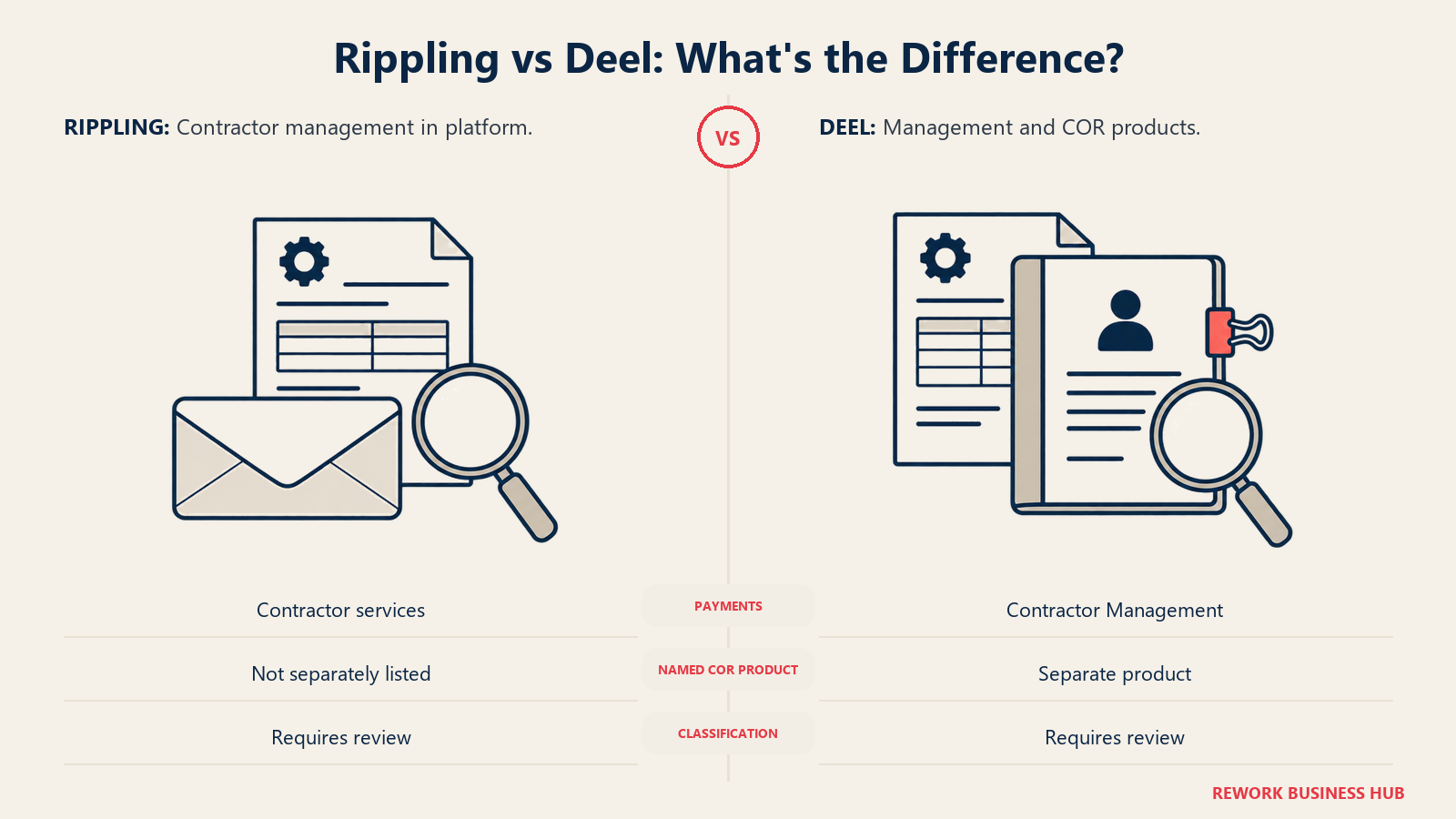
| Contractor management | Native, part of the platform, price not published | Self-managed Contractor Management, $49 per contractor/month |
| Contractor of Record (converts a contractor into a compliant local structure) | Not a named, separately published product on Rippling's pricing page | Contractor of Record, $325 per contractor of record/month |
| Misclassification risk framing | Rippling's own content on EOR and global hiring treats misclassification as the reason a contractor relationship graduates to EOR or a formal local structure | Same underlying logic; Deel's COR product exists specifically to convert a contractor doing employee-like work into a compliant arrangement |
| What's actually at stake | US federal penalties alone reach $2,515 per willful or repeated minimum wage or overtime violation, before state or country-level exposure abroad (see Key Facts) | Same exposure. Neither vendor's tooling removes the underlying legal risk, both reduce it if configured and used correctly |
If a contractor is doing work that looks like an employee's job, in a country where your company has no entity, contractor payments alone don't fix the classification risk. That's the gap both Contractor of Record (Deel) and EOR (either vendor) exist to close, and it's worth a real conversation with counsel before assuming a contractor agreement is enough.
Where Rippling Pulls Ahead: Device Management, App Provisioning and Unified Admin
This is the section where Rippling's original pitch still shows, and it's a genuine differentiator rather than a marketing line. Rippling's IT product handles identity and access management, mobile device management across macOS, Windows, iOS, and iPadOS, and what Rippling calls zero-touch deployment: a new hire's laptop arrives already configured with the right apps and permissions before they open the box. Because HR, IT, and device data sit on the same employee record, a role change or an offboarding in HR automatically triggers the matching access and device changes in IT, without someone manually reconciling two systems. Rippling's App Shop lists more than 650 pre-built integrations, giving IT and ops teams a single console for identity, apps, and devices rather than a separate MDM tool bolted onto payroll.
For a company that issues laptops, manages SaaS access at scale, and treats onboarding/offboarding as a security event as much as an HR event, this is a real, specific advantage. Deel doesn't compete here. It isn't trying to.
Where Deel Pulls Ahead: EOR Depth, Country Coverage and a Rate Card
Deel's advantage isn't one feature, it's the combination of three things Rippling can't currently match at the same depth: more EOR countries (130+ against Rippling's 80), a business built from day one around being the compliant local employer rather than adding that capability onto an existing HR platform, and a rate card you can screenshot into a budget request without a sales call. For a People or Finance leader whose actual bottleneck is "we need to legally hire this specific person in this specific country by next month," Deel's depth and speed on that exact problem, not a broader feature count, is what wins the deal.
Automation, Integrations and Reporting
| Rippling | Deel | |
|---|---|---|
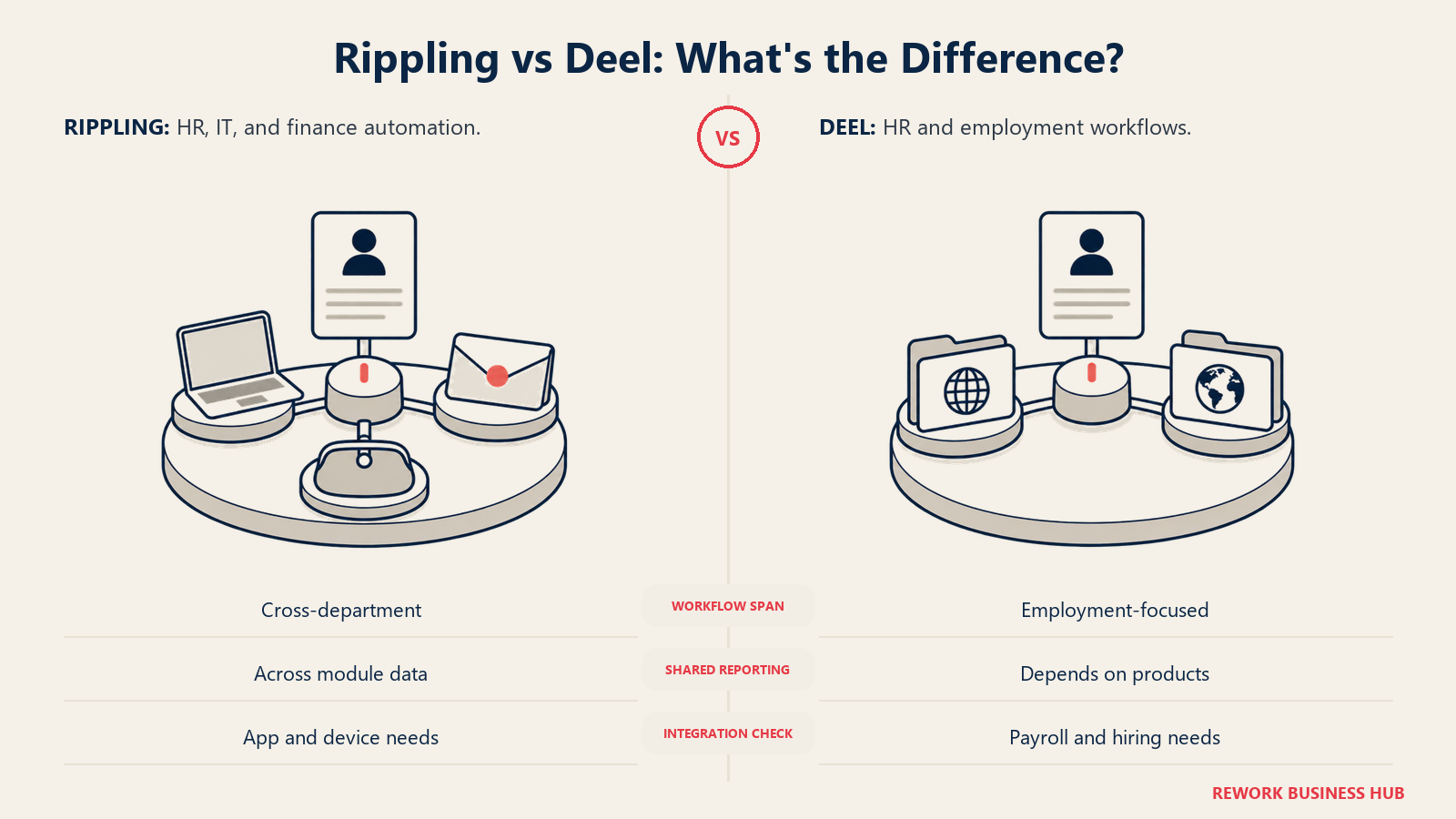
| Workflow automation | Native automation builder that triggers actions across HR, IT, and Finance from one employee-record change | Workflow and approval automation scoped mostly within HR and hiring processes |
| App marketplace | 650+ apps in the Rippling App Shop | App Store integrations spanning HR, accounting, payroll, and legal tools, exact count not published |
| Open API | Rippling Developer platform with a documented API | Deel Developer platform with a documented API and open endpoints for payroll, EOR, and HR data |
| Reporting | Unified analytics across HR, IT, and Finance since all three sit on one data layer | Reporting scoped mostly per product; a unified cross-product view depends on which Deel modules you've bought |
Both platforms treat integrations and automation as core infrastructure, not an afterthought. The difference tracks the same pattern as everywhere else on this page: Rippling's advantage is breadth across HR, IT, and Finance on one record; Deel's is depth within global employment and hiring workflows specifically.
Implementation and Time to Value
| Rippling | Deel | |
|---|---|---|
| Typical setup shape | Heavier up front if you're adopting HR, IT, and Finance together, since you're standing up one system of record across departments | Lighter for a single use case (adding one EOR country, starting contractor payments), heavier if you're also migrating full HRIS |
| Where the time goes | Mapping existing HR, IT, and Finance data into one employee record, plus device and app provisioning rules | Country-specific compliance setup for each new EOR hire, or configuring HR Core if you're moving your full HRIS over |
| Best fit for a fast, narrow rollout | No, the platform's value depends on connecting multiple departments | Yes, adding a single EOR hire or a batch of contractors is close to self-serve once your account is set up |
| Best fit for a company already juggling several unconnected tools | Yes, that's the direct pitch: replace the point solutions with one record | Only for the specific slice Deel covers (global employment and contractor payments); it isn't pitched as an IT or device platform |
When Rippling Is the Right Call
- You mostly employ people directly, through entities you already own, and your core problem is fragmented HR, IT, and finance tools rather than a lack of global hiring infrastructure.
- Device and app provisioning is a real operational burden. If IT spends meaningful time manually setting up laptops and revoking access when people leave, Rippling's unified employee record turns that into an automatic side effect of an HR change instead of a separate IT project.
- You want one vendor and one data layer across HR, IT, and Finance, and you're willing to go through a sales quote to get there, since none of it is self-serve pricing.
- Your international footprint is real but limited, and Rippling's 80-country EOR coverage already includes the specific countries you need.
If none of that describes your team, and the deciding issue is Rippling's lack of published pricing rather than any feature above, our best Rippling alternatives roundup covers the field, including vendors that publish a real rate card.
When Deel Is the Right Call
- You need to legally hire someone in a country where you have no entity, on a timeline measured in days, not the months a new entity would take.
- You want a number today, not after a sales call. Deel's published per-product rates for HR, Hire, Contractor Management, Contractor of Record, EOR, and US PEO are real figures you can put in a budget request this week.
- Your workforce is a genuine mix of direct employees, EOR hires, and contractors, and you want one vendor handling the compliance layer across all three rather than stitching together separate tools per category.
- You're running contractor relationships that are edging toward employee-like work, and you need a Contractor of Record option to convert that risk into a compliant structure before it becomes a misclassification problem.
If none of that fits and what you actually need is deeper IT and device management alongside HR, our best Deel alternatives roundup covers that end of the category.
A Third Option Worth Knowing About
Be clear about what Rework is not here: it is not an EOR, and it does not become the legal employer of your people in another country. If your actual problem is employing people across 40 countries without setting up entities, neither Rework nor any general HRIS solves that. Deel solves that.
What Rework offers instead is consolidation for a company that employs its people directly. The People app covers HRIS, E-Hiring (an applicant tracking system), Interview, Career site, ESOPs, Timesheets, and Payroll as live, shipping modules, alongside a Sales CRM and Lead pipeline, Task, Project, Workflow, and BPM on the operations side, and a unified inbox spanning WhatsApp, Messenger, Instagram DM, TikTok, Zalo, and web chat. For a mid-size company whose real pain isn't global entity coverage but a stack of disconnected tools for sales, ops, and people, Rework's argument is one platform instead of several, not deeper EOR reach than Deel or deeper device management than Rippling.
Not ideal for: solo or single-user buyers, companies whose core problem is hiring across many countries without entities (that's Deel's job), and companies needing IT device management and app provisioning at Rippling's depth.
Price: Quote on request, per organization. See rework.com/pricing.
Decision Framework
| If you are... | Pick |
|---|---|
| Mostly employing people through entities you already own | Rippling |
| Hiring your first employee in a country where you have no entity | Deel |
| Struggling with device provisioning and app access at scale | Rippling |
| Running a mix of EOR employees and contractors across many countries | Deel |
| Needing a defendable number for finance before you'll get a demo scheduled | Deel |
| Trying to unify HR, IT, and Finance on one employee record | Rippling |
| Converting a contractor doing employee-like work into a compliant structure | Deel, via Contractor of Record |
| Your real problem is a stack of disconnected sales, ops, and people tools, not global entity coverage | Neither. See the note on Rework above |
What Carries Over If You Switch
| What carries over | Rippling to Deel | Deel to Rippling |
|---|---|---|
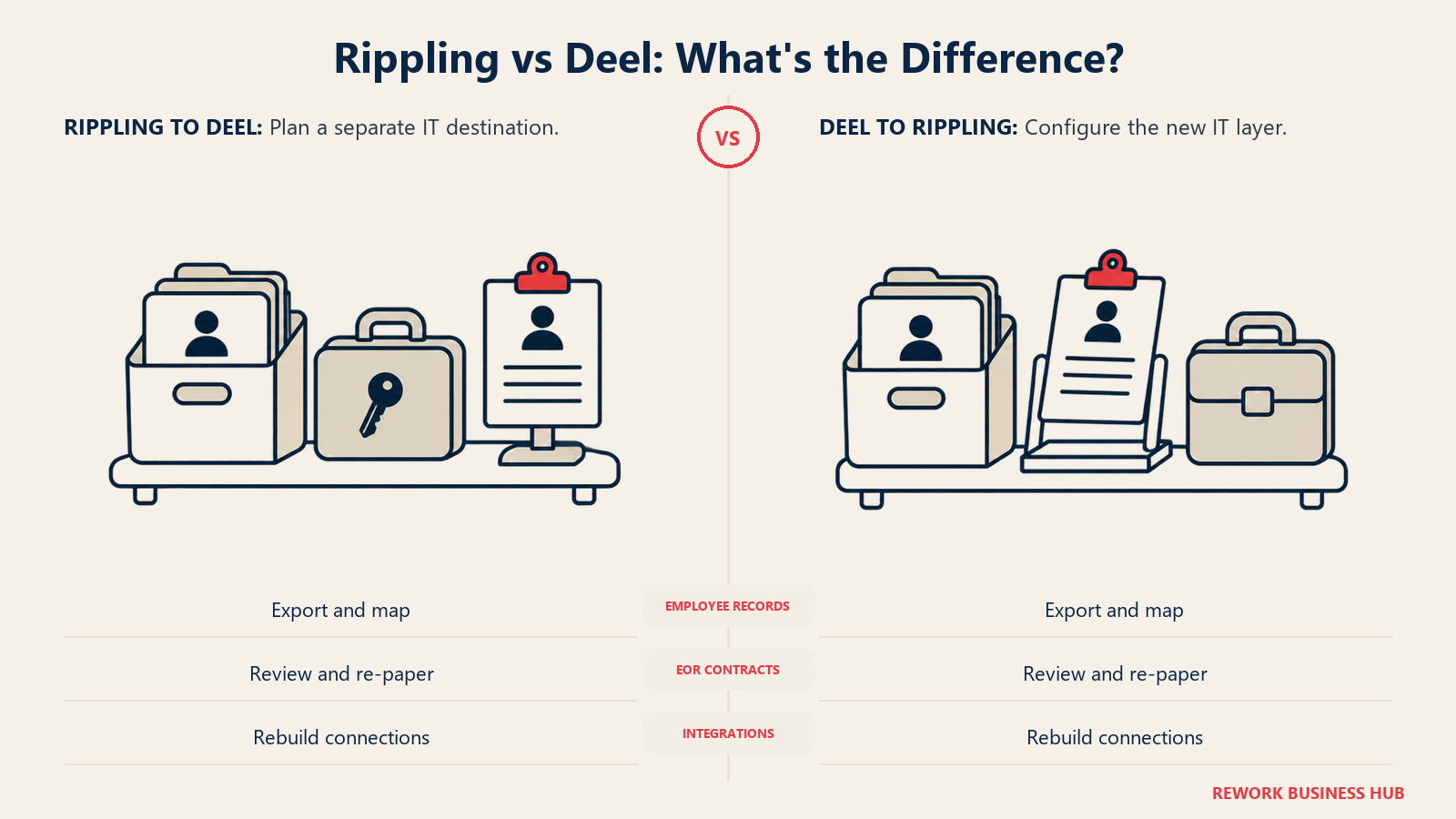
| Core employee records (name, role, compensation, start date) | Yes, via export and import, though field mapping needs review | Yes, via export and import, though field mapping needs review |
| Device and app provisioning rules | Rebuild manually. Deel has no equivalent IT/device management product | Not applicable in reverse, since Deel never held this data |
| EOR employment contracts and in-country compliance history | Partial. Existing EOR relationships generally need to be re-papered under the new EOR of record, a legal process, not just a data export | Partial, for the same reason: EOR is a legal employment relationship, not a database row |
| Contractor agreements and payment history | Payment history exports cleanly; active agreements may need to be reissued under the new platform | Same, in reverse |
| Payroll history and tax filings | Retained for compliance purposes regardless of platform; consult your accountant on continuity requirements | Same |
| Integrations and API-connected tools | Rebuild. Rippling's App Shop and Deel's App Store are separate ecosystems with no direct migration path | Rebuild, for the same reason |
Switching either direction is a compliance and legal exercise as much as a software migration, especially anywhere EOR is involved. Our vendor diligence checklist and negotiating a SaaS contract guide are both reasonable starting points before you sign anything new.
Frequently Asked Questions about Rippling vs Deel
Is Rippling cheaper than Deel?
There's no way to confirm that from Rippling's own pricing, because Rippling doesn't publish a single dollar figure for any product. Deel publishes real per-product rates, starting at $5 per employee/month for HR Core and running to $599 per employee/month for EOR. Whether Rippling ends up cheaper or more expensive for your specific headcount and product mix is only knowable after a quote.
Is Deel HR really free?
Not anymore, and possibly not ever in the way that claim implies. Deel's own HR product page states Core starts at $5 per employee per month, with no free tier advertised. The "Deel HR is free" claim is one of the most repeated facts about Deel online and it's stale. Verify current pricing directly on deel.com before relying on it.
Does Rippling offer Employer of Record services like Deel?
Yes. Rippling's EOR product is live in 80 countries, covering what Rippling describes as over two-thirds of the global population. Deel's EOR footprint is larger, at 130+ countries for entity-owned payroll and EOR, with compliance support extending further. Neither vendor publishes an EOR price without a quote, except that Deel's published rate is $599 per EOR employee/month.
Which one is better for IT and device management specifically?
Rippling, without much of a contest. Its IT product natively handles identity and access management, mobile device management across macOS, Windows, iOS, and iPadOS, and zero-touch deployment tied to the same employee record as HR and payroll. Deel doesn't compete in this category.
What's the lawsuit between Rippling and Deel about?
Rippling sued Deel in March 2025, alleging Deel cultivated a corporate spy inside Rippling to steal trade secrets and competitive information. Deel countersued that April with its own allegations against Rippling. As of February 2026, a federal judge had denied Deel's motion to dismiss, letting Rippling's claims proceed toward trial, and the case remains unresolved. This article doesn't take a position on the outcome; it's a real, ongoing dispute worth knowing about if you're evaluating either vendor.
Can I use Deel for EOR and Rippling for everything else?
Some companies do run a mixed stack, using Deel or another EOR specifically for employees in countries where they have no entity, while running domestic HR, IT, and payroll on Rippling or a similar platform. It adds integration overhead, since the two systems won't share a single employee record, but it can make sense if your international headcount is small relative to your domestic team.
How do I estimate what Rippling will actually cost before I talk to sales?
You can't get an exact number, but you can estimate the shape. Rippling's own pricing page confirms the billing structure: a required base Rippling Platform fee, plus per-employee-per-month charges for each additional product (Payroll, HR, Benefits, IT, and so on), with some products carrying an added monthly base fee. Multiply your expected headcount by the products you'd actually turn on, and treat the total as a rough floor, not a quote.
Which is the safer long-term bet given the lawsuit?
Neither company's product functionality is currently affected by the litigation, and both continue to ship features and sign new customers. The safer approach is standard vendor diligence regardless of the lawsuit: check data processing terms, ask each vendor directly how the case affects their roadmap or your data, and don't let headline risk substitute for reading your own contract.
What to Do Next
Get Deel's exact rate card for the specific products you'd actually use, HR Core, EOR, and Contractor Management if that's your mix, and multiply it against your real headcount using the modeled math above. Then request a Rippling quote using the same headcount and product list, so you're comparing two real numbers instead of one real number against a guess. If your workforce is genuinely split between entities you own and countries where you have none, model both vendors against that exact split, not a single blended headcount, since that's the variable this whole comparison turns on. For a broader look at HR platform options beyond these two, our best HR software roundup and our guide to choosing HR software are both reasonable next stops, and if global payroll specifically is your bottleneck, our guide to choosing global payroll software covers that decision in more depth. It's also worth reading our BambooHR vs Rippling and Gusto vs Rippling comparisons if a domestic-only, lighter-weight HRIS turns out to be a better fit than either global platform here.

Senior Customer Retention Strategist
On this page
- TL;DR
- Key Facts
- The Real Fork: Entities You Own vs Employment You Rent
- Who Each Tool Is Built For
- Pricing: A Published Rate Card vs a Custom Quote
- What Each Vendor Actually Publishes
- What Each Vendor Meters On
- Modeled Cost for Three Real Shapes
- Core HRIS Comparison
- Global Payroll and EOR Coverage
- Contractors, Compliance and Misclassification
- Where Rippling Pulls Ahead: Device Management, App Provisioning and Unified Admin
- Where Deel Pulls Ahead: EOR Depth, Country Coverage and a Rate Card
- Automation, Integrations and Reporting
- Implementation and Time to Value
- When Rippling Is the Right Call
- When Deel Is the Right Call
- A Third Option Worth Knowing About
- Decision Framework
- What Carries Over If You Switch
- What to Do Next