BambooHR vs Gusto in 2026: Which Should Be Your HR System of Record?
Turn this article into takeaways for your work.


Each assistant summarizes the article only for you and suggests best practices for your work.
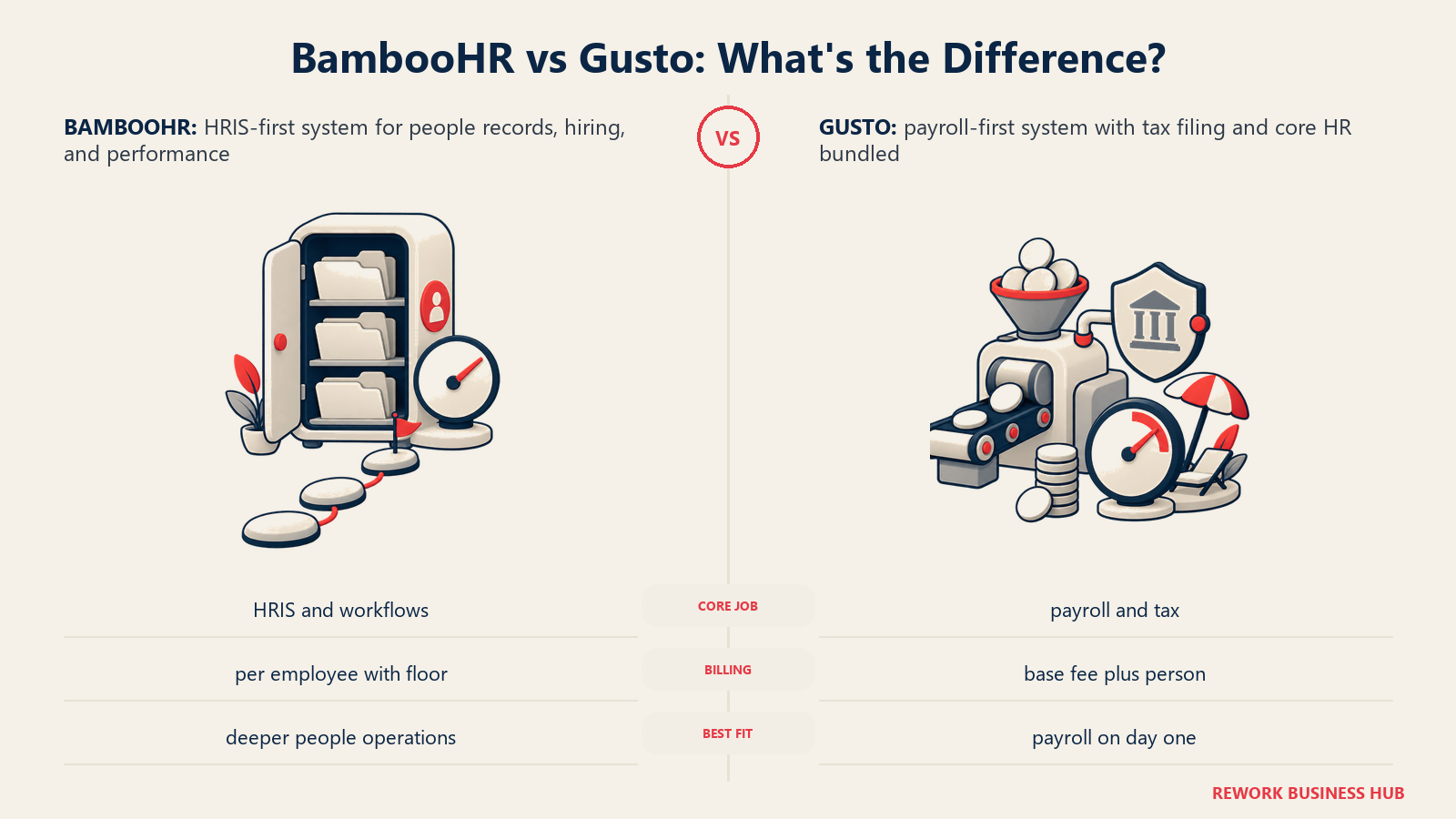
You've got people spread across a spreadsheet, a shared drive of offer letters, and whatever your payroll processor happens to store. Every new hire means typing the same person into two or three places, and every year end means reconciling a headcount number that doesn't quite match between HR and finance. You're past the point where a folder of PDFs counts as a personnel file, and you're deciding which platform becomes the one your company treats as true: BambooHR, built as an HR information system with people data, hiring and workflow tools first, or Gusto, built as payroll with HR tools layered on top.
Both vendors publish prices, which sounds like it should make this easy. It doesn't, because they charge for two different things. BambooHR prices access to its HRIS per employee, with payroll and benefits administration sold separately at a price it won't tell you until you talk to sales. Gusto prices a bundle: a flat monthly base fee plus a per-person add-on that already includes payroll, tax filing and PTO tracking, no separate purchase required. That difference decides more of this comparison than any single feature does, and it changes your total cost more at some headcounts than others. This page works through both vendors' own published pricing, models the real cost at 10, 25, 50 and 100 employees, and lays out which one should actually hold your company's HR data.
TL;DR
| BambooHR | Gusto | |
|---|---|---|
| What it is | Configurable HRIS: employee records, workflows, hiring and performance tools, with payroll and benefits sold as separate, unpriced add-ons | Payroll-first platform: tax filing, direct deposit and PTO tracking built into every tier, with HR tools layered on by plan |
| Pricing transparency | Publishes 3 tiers and a small-company flat rate; the Payroll and Benefits Administration add-ons carry no published price | Publishes all 4 tiers, including the top Premium tier, with no module priced separately from the plan |
| Billing basis | Per employee per month (Core $10, Pro $17, Elite $25), with a flat monthly floor starting at $250 for companies with 25 or fewer employees | Flat monthly base fee plus a per-person charge (Simple $49 + $6, Plus $80 + $12, Premium $180 + $22) |
| Core identity | HRIS core; payroll and US benefits administration are separate modules you buy and price later | Payroll core; every tier already files taxes and tracks PTO, HR depth increases by tier |
| Best for | Teams that want deep people data, hiring and performance tools and are fine treating payroll as its own purchase | Teams that want payroll and tax filing solved on day one, with HR features added as headcount grows |
| Company fit | Small to mid-size US companies, roughly 10 to 500+ employees, per its own tier structure | Small to mid-size US companies, from contractor-only up through more complex multi-state operations |
The short version: BambooHR is an HRIS with a payroll price it won't quote you upfront. Gusto is a payroll platform with HR tools priced right into the same bill. Whichever one becomes your system of record, budget for that gap before you sign anything.
Key Facts
- The global HR technology market is projected to grow from about $46.3 billion in 2026 to $86.1 billion by 2034, an 8.1% compound annual growth rate, as more mid-size employers move HR and payroll off spreadsheets and into dedicated platforms. Fortune Business Insights
- 41% of small business owners say they spend 3 to 10 hours a month handling payroll taxes internally, and another 10% spend more than 10 hours, according to a National Small Business Association survey cited by the U.S. Chamber of Commerce. That's exactly the time both platforms are competing to take off your plate. U.S. Chamber of Commerce
- Payroll software already sits in 75% of small business HR tech stacks, and HRIS software sits in 65%, per Capterra's 2025 HR Software Trends Survey of 3,256 respondents across 11 countries. Most small companies already run both categories of software, whether or not it's from the same vendor. Capterra
- The average cost to hire a nonexecutive employee is $5,475, per SHRM's 2025 HR benchmarking data, a number that climbs fast when a new hire's paperwork, benefits enrollment and first paycheck don't happen cleanly. SHRM
Who Each Tool Is Built For
| BambooHR | Gusto | |
|---|---|---|
| Target company size | Roughly 10 to 500+ employees; pricing scales from a small-company flat rate up through per-employee metering at any size | Roughly 1 to 200 employees; Simple suits single-state teams under 15, Premium targets more complex, multi-state operations |
| Team maturity | Ready to run HR as its own function: hiring pipelines, performance cycles, compliance tracking | Wants payroll handled correctly first, then adds HR process as the team grows |
| Primary use case | Employee records, org charts, applicant tracking, performance management and compliance training, held as the source of truth for people data | Payroll runs, tax filing, PTO tracking and contractor payments, with HR tools layered on by tier |
| Ideal buyer | An HR or People Ops lead who needs a real HRIS: hiring, onboarding workflows and performance reviews in one system | A founder, controller or office manager who needs payroll tax filing to just work, with HR features to grow into over time |
If your shortlist runs wider than these two, our best HR software for 2026 roundup covers the broader field, including tools built for headcounts and use cases neither BambooHR nor Gusto targets well.
HRIS First or Payroll First: The Real Difference
Every BambooHR plan, even Core at $10 a head, starts you with the same foundation: an employee database, org chart, time-off management, workflows and approvals, and an applicant tracking system with job postings included. That's the HRIS core, and it's the whole product. Payroll is not in it. If you want BambooHR to also calculate withholding and file federal, state and local taxes, that's the separate Payroll add-on, priced only after a sales conversation.
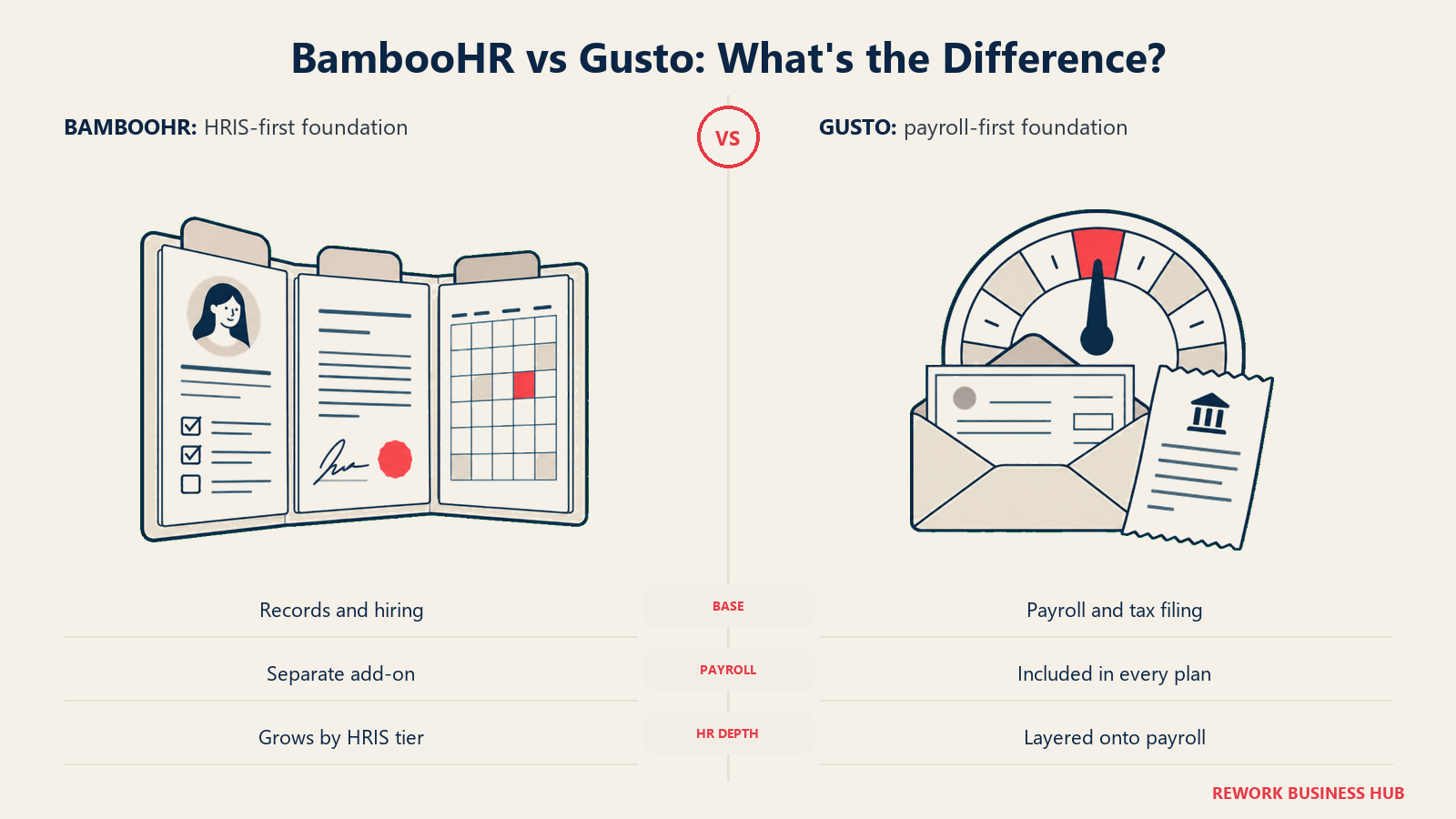
Gusto runs the opposite direction. Every plan, including the $49-a-month Simple tier, already includes unlimited payroll runs, direct deposit, tax filings and payments, PTO requests and approvals, multiple pay rates and schedules, and domestic contractor payments. That's the floor, not an upsell. What Gusto adds as you move up its tiers is expense and reimbursement tracking plus workforce cost reporting at Plus, then priority support, a dedicated service advisor and a complimentary health insurance broker integration at Premium.
| Included at the entry tier | BambooHR Core ($10/employee/mo) | Gusto Simple ($49/mo + $6/person) |
|---|---|---|
| Employee database and org chart | Yes, native | Basic employee directory |
| Payroll runs and direct deposit | Not included; a separate, unpriced add-on | Unlimited runs, included |
| Federal, state and local tax filing | Not included; part of the same unpriced Payroll add-on | Included in every plan |
| PTO requests and approvals | Yes, native | Included |
| Applicant tracking / hiring | Included, with job postings and a hiring pipeline | Basic hiring and onboarding tools |
| Performance management | Not on Core; arrives at Pro | Not included at Simple |
| Benefits administration (US) | Not included; a separate, unpriced add-on | Insurance shopping available; broker integration is complimentary starting at Premium |
That table is the whole story in miniature. BambooHR's entry price buys you HR depth with a payroll-shaped hole in it. Gusto's entry price buys you a working payroll with an HR-shaped gap that narrows as you move up.
Pricing: Two Different Meters
Both vendors publish real numbers. The difference is what those numbers actually buy.
What Each Vendor Actually Publishes
| BambooHR | Gusto | |
|---|---|---|
| Pricing page behavior | bamboohr.com/pricing lists three named tiers and a small-company flat rate | gusto.com/product/pricing lists four named tiers with the base fee and per-person add-on shown for each |
| Published tiers | Core $10/employee/month, Pro $17/employee/month, Elite $25/employee/month | Simple $49/mo + $6/person, Plus $80/mo + $12/person, Premium $180/mo + $22/person, Contractor-only $35/mo + $6/person |
| Small-company rate | Flat monthly rate starting at $250/mo for companies with 25 or fewer employees, in place of the per-employee math | No separate small-company rate; the base-fee-plus-per-person formula applies from employee one |
| Unpriced add-ons | Payroll (US only), Benefits Administration (US only), Time & Attendance, and Global Employment (powered by Remote): none has a published price | None; every module Gusto sells is priced on the same page |
| Discounts named | Volume discounts applied automatically by headcount; 15% off for registered nonprofits; 15% off when Payroll and Benefits Administration are bundled with any plan (US employees only) | A promotional $0 base fee for the first 6 months on the Contractor-only plan; no volume or nonprofit discount named on the pricing page |
What Each Vendor Meters On
| BambooHR | Gusto | |
|---|---|---|
| Billed on | Employee headcount, at a per-employee monthly rate above 25 employees, or a flat monthly floor below that | A flat base fee per company, plus a per-person add-on |
| What grows your bill | Every employee past your flat-rate ceiling adds $10, $17 or $25 a month depending on tier | Every person on payroll adds $6, $12 or $22 a month depending on tier, on top of the fixed base |
| Where payroll sits | Entirely outside this meter; Payroll is a separate, unpriced module | Inside the meter from the first dollar; every tier already includes it |
| Pricing beyond what's shown here | Not published; volume discounts apply automatically at scale, but the rate isn't disclosed | Not published beyond Premium; larger or more complex accounts are directed to a sales conversation |
Modeled Cost at 10, 25, 50 and 100 Employees
Picture a US company that starts at 10 employees today and grows to 100 over a few years, a realistic band for the buyer this page is written for. Here's what each vendor's own published pricing says at every stage. The BambooHR column reflects Core, its cheapest tier, and covers HRIS only, no payroll and no benefits administration; both of those sit on top of every figure below as unpriced add-ons. The Gusto columns include full payroll and tax filing at every tier shown.
| Employees | BambooHR Core (HRIS only, floor under 25) | Gusto Simple (payroll + basic HR) | Gusto Plus (payroll + HR tools) |
|---|---|---|---|
| 10 | $250/mo flat floor = $3,000/yr | $109/mo = $1,308/yr | $200/mo = $2,400/yr |
| 25 | $250/mo (25 × $10 lands exactly at the floor) = $3,000/yr | $199/mo = $2,388/yr | $380/mo = $4,560/yr |
| 50 | $500/mo (50 × $10, above the floor) = $6,000/yr | $349/mo = $4,188/yr | $680/mo = $8,160/yr |
| 100 | $1,000/mo (100 × $10) = $12,000/yr | $649/mo = $7,788/yr | $1,280/mo = $15,360/yr |
Every BambooHR figure above is a floor, not a full cost. Add its unpriced Payroll and Benefits Administration add-ons to compare like for like against Gusto's all-in numbers, and remember BambooHR applies volume discounts automatically at scale that it doesn't disclose, so the real 50- and 100-employee figures likely run lower than shown.
Here's the crossover that matters more than either headline price. At 10 employees, Gusto Plus is the cheaper way to get payroll and real HR tools in one bill: $2,400 a year against BambooHR's $3,000 floor, and that BambooHR floor doesn't even include payroll. The crossover happens around 14 to 15 employees, where BambooHR Core's per-employee rate ($10 times headcount) catches up to and passes its own $250 floor, while Gusto Plus keeps climbing at $12 a head on top of its $80 base. By 25 employees, BambooHR Core is already cheaper than Gusto Plus on a pure dollar basis, $3,000 versus $4,560, and the gap widens every employee after that, reaching $12,000 versus $15,360 at 100 employees. But that comparison still isn't apples to apples: the BambooHR number buys HRIS only, and the Gusto number buys HR tools plus a fully running payroll. Add even a modest unpriced BambooHR Payroll fee back into that $12,000 floor and the real gap at 100 employees likely closes, maybe reverses.
Core HRIS Capability Comparison
| Capability | BambooHR | Gusto |
|---|---|---|
| Employee database and org chart | Native across all tiers | Basic employee directory, included |
| Custom workflows and approvals | Native from Core | Not a stated feature beyond PTO request approvals |
| Time-off tracking and policies | Native | Included on all plans |
| Applicant tracking / hiring | Native ATS with job postings, included from Core | Basic hiring and onboarding tools, included |
| Performance management | Added at Pro: review cycles, 1:1s, engagement surveys | Not included at Simple or Plus; Gusto isn't built as a performance suite |
| Compensation management | Added at Elite | Not a stated feature |
| Compliance training library | Added at Pro, expanded at Elite | Not a stated feature |
| AI assistant for HR questions | Native, answers questions about company policy and HR data | Not a stated feature |
| E-signatures and document storage | Native | Available for onboarding and tax forms |
Payroll and Tax Filing Depth
| Capability | BambooHR (Payroll add-on, priced separately) | Gusto (included in every tier) |
|---|---|---|
| Included in base price | No; Payroll is a separate, unpriced module | Yes, in Simple, Plus and Premium alike |
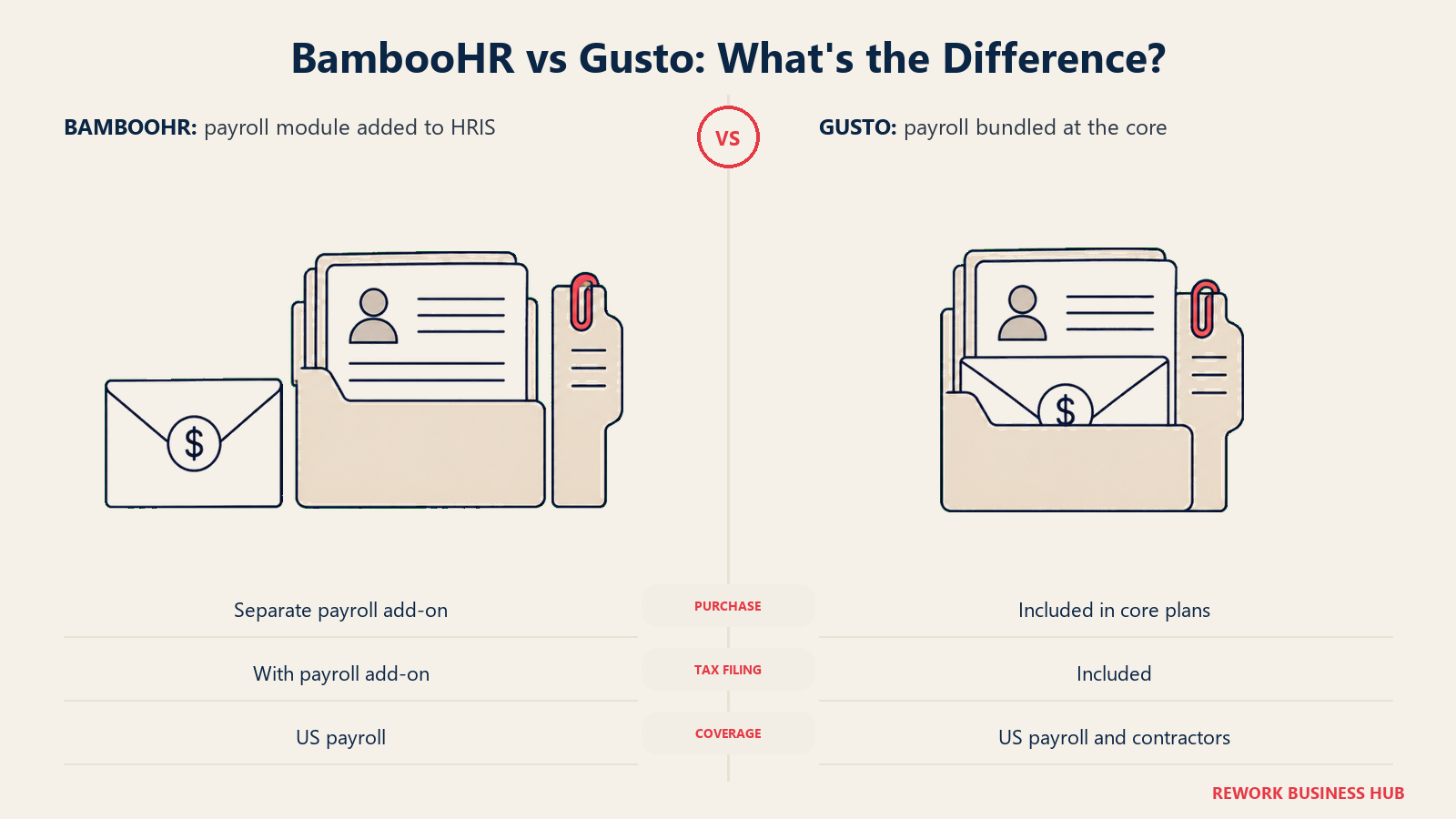
| Federal, state and local tax filing | Yes, once you buy the add-on | Yes, native to every plan |
| Direct deposit | Yes, once you buy the add-on | Yes, native |
| W-2 and 1099 generation and filing | Yes, once you buy the add-on | Yes, native |
| Multi-rate, multi-schedule pay | Yes, once you buy the add-on | Yes, native |
| Geographic coverage | US employees only | US employees and domestic contractors; global contractor payments available as an add-on |
| International / global payroll | Global Employment add-on, powered by Remote, unpriced | Not part of the core plans; handled through the global contractor add-on |
If payroll compliance is the single thing you can't get wrong, our how to choose payroll software guide walks through the questions worth asking either vendor before you sign, including exactly how each one prices the states you actually operate in.
Benefits Administration
| Capability | BambooHR (Benefits Administration add-on) | Gusto |
|---|---|---|
| Included in base price | No; separate, unpriced add-on, US employees only | Health insurance shopping and enrollment available; broker integration complimentary starting at Premium |
| Open enrollment management | Yes, once you buy the add-on | Yes, integrated with payroll |
| New-hire and qualifying-life-event elections | Yes, automated once you buy the add-on | Yes, integrated with onboarding |
| Carrier connections | Yes, direct connections to benefits carriers | Yes, through Gusto's insurance marketplace |
| Bundle discount available | 15% off when Payroll and Benefits Administration are bundled with any plan (US employees only) | Not applicable; benefits shopping is part of the core product, not a separate bundle |
Hiring, Onboarding and Employee Experience
| Capability | BambooHR | Gusto |
|---|---|---|
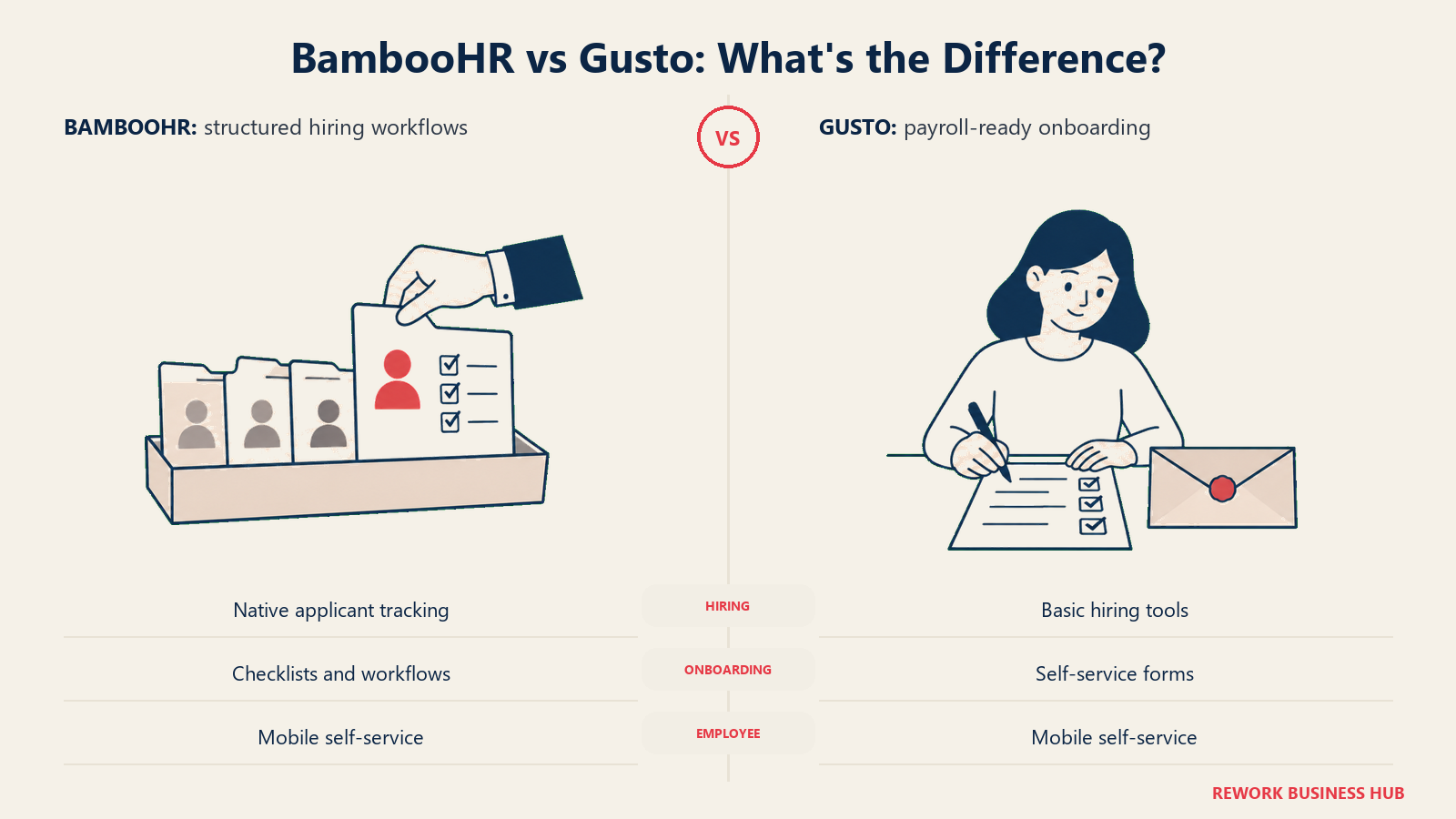
| Applicant tracking system | Native, included from Core, with job postings and a hiring pipeline | Basic hiring tools; not a full ATS |
| Onboarding workflow | Native new-hire checklists and workflows | Self-service, paperless onboarding: new hires complete their own information, upload documents and sign forms electronically |
| Employee self-service | Native, mobile app included | Native, employee and employer mobile apps included on every plan |
| Employee community / engagement | Added at Pro | Not a stated feature |
| HR expert access | Not a stated feature on BambooHR's own pricing page | HR Resource Center with certified HR expert access, positioned at Premium |
Whichever tool ends up holding your new-hire process, a written checklist still matters more than the software running it. Our manager onboarding checklist is a reasonable starting point for the parts neither platform automates for you.
Reporting, Integrations and Automation
| Capability | BambooHR | Gusto |
|---|---|---|
| Custom / real-time dashboards | Added at Elite | Workforce cost reports at Plus and Premium |
| Compliance intelligence / alerts | Native on Core, expanded through Pro and Elite | Compliance alerts positioned at Premium |
| Reporting exports | Native | Native |
| Marketplace integrations | 140+ pre-built integrations across ATS, payroll, LMS, identity and communication tools, plus an open API | Integrates with accounting, time-tracking and benefits platforms |
| Payroll-to-HRIS sync with the other tool | BambooHR lists Gusto as a payroll integration in its own marketplace | Syncs new hires, terminations and compensation changes back to BambooHR when both are run together |
Implementation and Time to Value
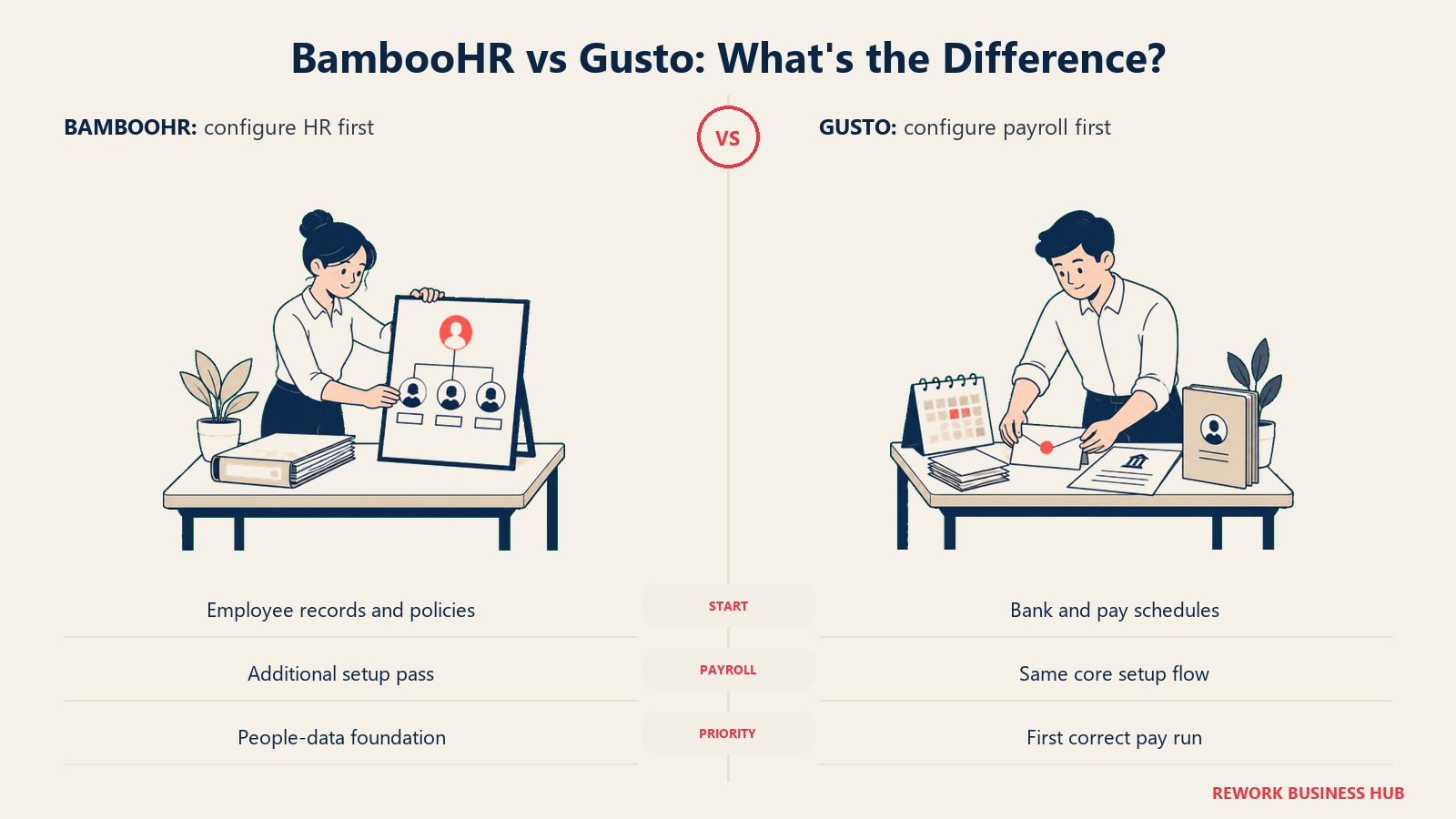
BambooHR starts with employee records and HR workflows, while Gusto starts with the first correct payroll run.
| BambooHR | Gusto | |
|---|---|---|
| Typical setup shape | Configure employee records, org structure and workflows, then a second setup pass if Payroll or Benefits Administration gets added later | Connect a bank account, add employees, set pay schedules and run payroll; HR tools activate by tier |
| Where the time goes | Building out HRIS structure first | A single, payroll-centered setup that already includes tax registration and filing |
| Best fit for a fast go-live on payroll specifically | Slower; Payroll is a separate purchase and onboarding process from the core HRIS | Faster; payroll is part of the same signup flow as everything else |
| Best fit for a fast go-live on HR and people data specifically | Faster; HRIS is the whole product from day one | Slower; deeper HR tooling arrives progressively across Plus and Premium |
When BambooHR Is the Right Call
- You want HR to run as its own function, with a real ATS, structured onboarding, performance review cycles and compensation planning, not features bolted onto a payroll product.
- Your company is already past 25 employees, where BambooHR Core's per-employee rate turns out cheaper than Gusto's higher-tier per-person add-on, per the modeled cost above.
- You're comfortable buying Payroll and Benefits Administration as separate line items, and you want the 15% bundle discount when you buy both together for US employees.
- You want an AI assistant employees can ask HR-policy questions to, or you need compliance training content and HR benchmarking, both concentrated in BambooHR's Pro and Elite tiers.
If your priority is that payroll has to be right and predictable and everything else is secondary, our best BambooHR alternatives roundup covers vendors that price payroll into the base plan instead of selling it separately. And if a broader IT-plus-HR platform is also on your shortlist, our BambooHR vs Rippling comparison covers that angle directly.
When Gusto Is the Right Call
- You need payroll and tax filing solved correctly on day one, with no separate purchase, sales call or add-on price to negotiate.
- You're under roughly 15 to 20 employees, where Gusto's flat base fee plus per-person rate beats BambooHR's $250 monthly floor, especially once BambooHR's unpriced Payroll add-on gets added back in.
- You want a single published number for your entire HR-and-payroll spend, since Gusto has no add-on sitting outside its four listed tiers.
- You're a single-state or lightly multi-state team that doesn't need deep performance management, compensation planning or a full ATS, just the basics plus a payroll that runs itself.
If your team has outgrown Gusto's HR depth specifically, structured performance reviews, compensation bands or a real applicant pipeline, our best Gusto alternatives roundup covers the HRIS-first vendors built for that, BambooHR included. Comparing against a broader HR-plus-IT platform is also fair game; see our Gusto vs Rippling breakdown for that specific matchup.
A Third Option Worth Knowing About
Neither BambooHR nor Gusto is trying to be your whole operations platform, and for most companies at this size, that's fine. They're both good at the specific job they do. But if the real problem is that HR, sales and operations all live in separate tools that don't talk to each other, that's a different question than which HRIS or payroll vendor to pick.
Rework's People app ships HRIS, time and attendance, timesheets and payroll as live modules, alongside E-Hiring, Interview and Career site tools, on the same platform as Rework's Sales CRM and Lead pipeline, Task, Project, Workflow and BPM tools, and a unified inbox spanning WhatsApp, Messenger, Instagram DM, TikTok, Zalo and web chat. The argument isn't that Rework's HRIS goes deeper than BambooHR's or that its payroll beats Gusto's feature for feature. It's consolidation: one platform holding HR, sales and operations data instead of three or four tools that each need their own login, their own sync job and their own integration to keep in step.
Not ideal for: solo or single-user buyers, companies that need a specialist global EOR (Rework doesn't run one), or US payroll tax-filing depth to the level Gusto has built as its core specialty. If deep, best-in-class payroll or HRIS is what you need, BambooHR and Gusto both do that job better on their own.
Price: Quote on request, per organization. See rework.com/pricing.
Decision Framework
| If you are... | Pick |
|---|---|
| Under 15 employees and want payroll and basic HR solved at one published price | Gusto |
| Over 25 employees and want the lower per-head rate on the HR side | BambooHR |
| Building out a real hiring pipeline, performance cycles and compensation planning | BambooHR |
| Needing payroll tax filing correct from day one with no separate add-on to price | Gusto |
| Wanting an AI assistant for HR-policy questions and a compliance training library | BambooHR (Pro or Elite) |
| Wanting a dedicated HR expert and compliance alerts bundled with payroll | Gusto (Premium) |
| Running international contractors or considering global employment | Check both: BambooHR's Global Employment add-on (via Remote) or Gusto's global contractor add-on |
| Your real problem is HR, sales and ops living in different logins | Neither. See the Rework section above |
Running Both Together
A meaningful share of the market doesn't pick one of these tools, it runs both: BambooHR as the HRIS holding employee records, org structure, hiring and performance data, and Gusto actually cutting paychecks and filing taxes. BambooHR's own integrations marketplace lists Gusto as a payroll connection for exactly this reason, and the sync keeps new hires, terminations and compensation changes moving between the two systems without manual re-entry.
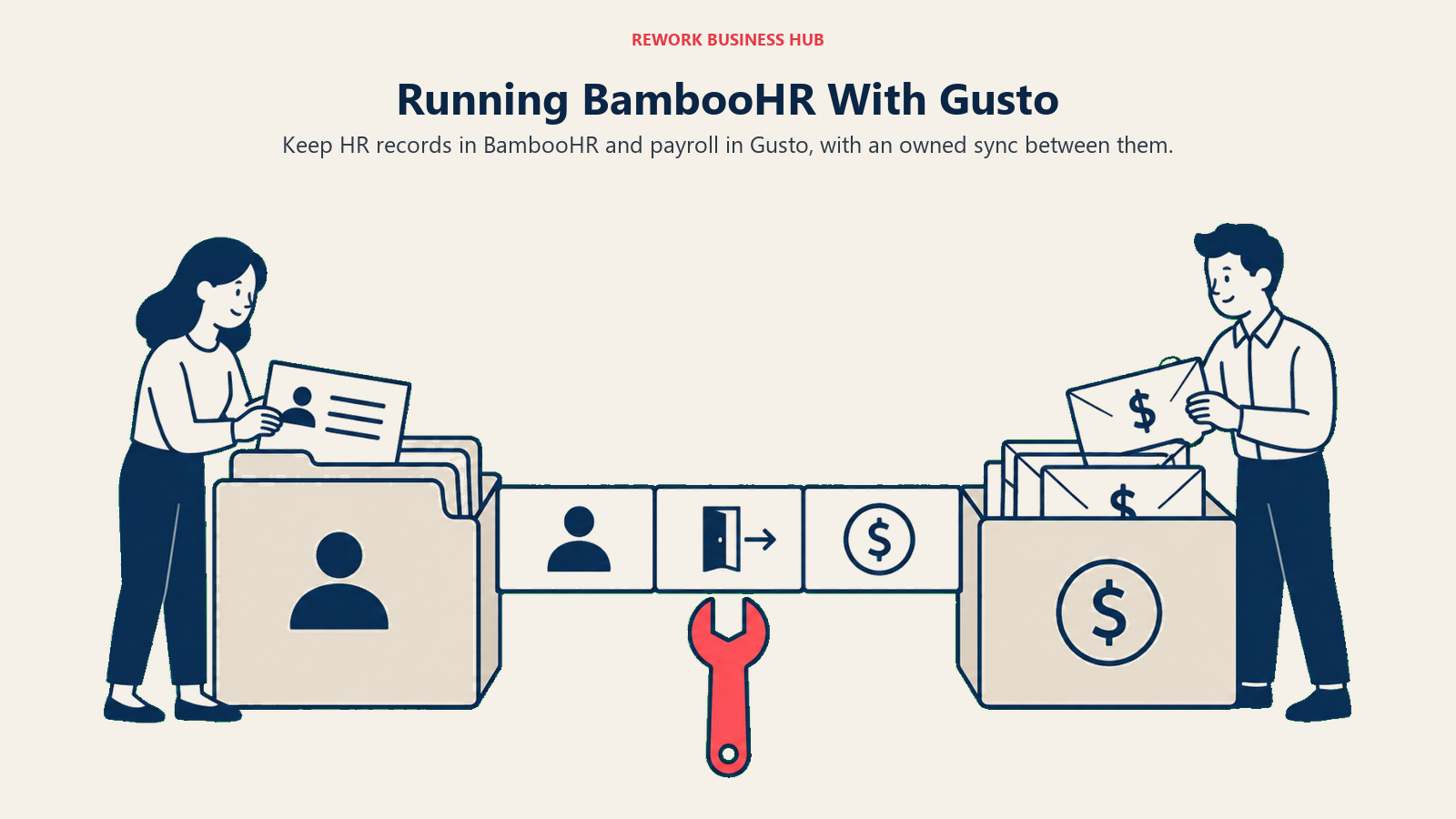
That combination makes sense once you've already invested in BambooHR's HR depth, hiring pipeline and performance process, and you'd rather keep a payroll specialist running payroll than have your HRIS vendor sell you an add-on it built second. It stops making sense once you're paying for two platforms' worth of overlapping features, two logins for the same HR team to manage, and a sync job someone has to babysit whenever either vendor changes its data model. If your team is small enough that one person handles both HR and payroll, and neither system's depth is fully used, consolidating onto whichever vendor's core product matches your bigger need, HRIS-first or payroll-first, usually beats running two. Our TCO modeling guide is a reasonable way to price out whether the integration tax of running two systems is actually cheaper than standardizing on one, and our how to choose HR software for small business guide is a good next stop if you're still narrowing the field.
Frequently Asked Questions about BambooHR vs Gusto
Is BambooHR cheaper than Gusto?
It depends on headcount and what you're buying. At 10 employees, Gusto Plus runs about $2,400 a year against BambooHR Core's $3,000 flat-rate floor, and that BambooHR number doesn't even include payroll. Above roughly 25 employees, BambooHR Core's per-employee rate becomes cheaper than Gusto Plus on paper, but BambooHR's Payroll and Benefits Administration add-ons carry no published price, so the real total depends on a number BambooHR won't quote until you talk to sales.
Does BambooHR include payroll?
Not by default. BambooHR's Core, Pro and Elite tiers cover HRIS only: employee records, workflows, hiring and, on higher tiers, performance management. Payroll is a separate add-on for US-based employees, with no price published on BambooHR's own pricing page. Benefits Administration is priced the same way, as a separate, unpriced US-only add-on.
Does Gusto include HR features or only payroll?
Every Gusto plan, including the entry-level Simple tier, already includes PTO requests and approvals, multiple pay rates and schedules, and self-service onboarding, on top of payroll and tax filing. Deeper HR features, expense and reimbursement tracking, and workforce cost reports arrive at Plus, and an HR Resource Center with certified HR experts and compliance alerts is positioned at Premium.
What's the real difference between BambooHR and Gusto?
BambooHR is built HRIS-first: people data, hiring, performance and compliance tools are the core product, and payroll is bolted on as a priced-on-request add-on. Gusto is built payroll-first: every tier already runs payroll and files taxes, and HR functionality gets added as you move up the plan tiers. The real question isn't which platform has more features, it's which job you need solved as the default, not the add-on.
How does the cost compare at 25, 50 and 100 employees?
Using each vendor's own published Core and Plus pricing, at 25 employees BambooHR Core runs $3,000 a year against Gusto Plus's $4,560. At 50 employees, it's $6,000 versus $8,160. At 100 employees, it's $12,000 versus $15,360. BambooHR's numbers cover HRIS only and exclude its unpriced Payroll and Benefits Administration add-ons, so treat them as a floor, not a final total.
Can I run BambooHR and Gusto together?
Yes, and a meaningful share of companies do: BambooHR as the HRIS and hiring system of record, Gusto running payroll separately. BambooHR lists Gusto as a payroll integration in its own marketplace, and the two sync new hires, terminations and compensation changes to avoid double entry. It adds a second login and a sync to maintain, so it's worth it mainly for teams that need BambooHR's HR depth and don't want to switch payroll providers.
Does either platform handle international employees?
Both offer it as an add-on rather than a core feature. BambooHR sells Global Employment, powered by Remote, with no published price. Gusto handles domestic contractors natively and offers global contractor payments as an add-on across its plans. Neither is built as a specialist global payroll or EOR platform.
Which one is better for a company under 25 employees?
On price alone, Gusto usually wins below about 15 employees, since its base-fee-plus-per-person model comes in under BambooHR's $250 monthly floor, and that Gusto number already includes payroll. If your priority is HR depth, a real applicant tracking system and structured onboarding rather than the lowest sticker price, BambooHR's Core tier is still worth pricing out even at a small headcount.
What to Do Next
- Price BambooHR's Payroll and Benefits Administration add-ons before you compare anything else. Every number in the modeled-cost table above is a BambooHR floor until you know what those two add-ons actually cost for your US employees.
- Confirm which Gusto tier matches the HR features you actually need, not just the payroll basics. Simple covers payroll and PTO; Plus adds expense tracking and reporting; Premium adds a dedicated advisor and compliance alerts.
- Model your own headcount at year one and year three, not just today's number. The crossover between these two pricing models sits around 14 to 15 employees, and it moves further out once you add BambooHR's unpriced add-ons back in.
- Ask both vendors about bundle or nonprofit discounts if you qualify. BambooHR names a 15% bundle discount and a 15% nonprofit discount directly on its pricing page; ask Gusto whether an equivalent exists for your situation, since none is listed publicly.
- If you're weighing a switch rather than a first purchase, our TCO modeling guide is a reasonable template for pricing the migration itself, not just the sticker price.

Senior Customer Retention Strategist
On this page
- TL;DR
- Key Facts
- Who Each Tool Is Built For
- HRIS First or Payroll First: The Real Difference
- Pricing: Two Different Meters
- What Each Vendor Actually Publishes
- What Each Vendor Meters On
- Modeled Cost at 10, 25, 50 and 100 Employees
- Core HRIS Capability Comparison
- Payroll and Tax Filing Depth
- Benefits Administration
- Hiring, Onboarding and Employee Experience
- Reporting, Integrations and Automation
- Implementation and Time to Value
- When BambooHR Is the Right Call
- When Gusto Is the Right Call
- A Third Option Worth Knowing About
- Decision Framework
- Running Both Together
- What to Do Next