Juro vs PandaDoc: A Legal Contract Platform vs a Sales Document Tool in 2026
Turn this article into takeaways for your work.


Each assistant summarizes the article only for you and suggests best practices for your work.
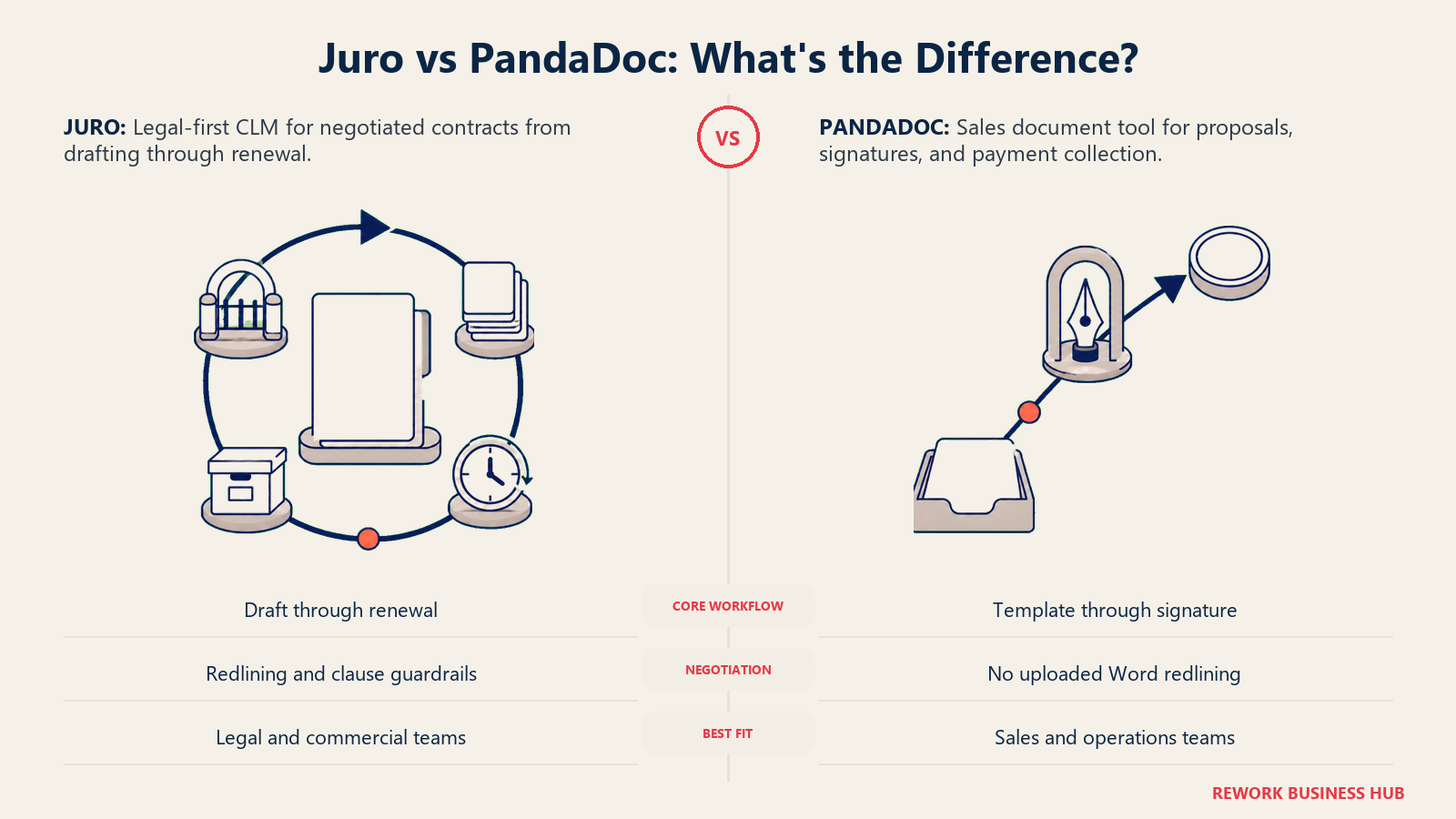
These two show up on the same shortlist constantly, and that's usually a sign something is off. A search for "contract management software" throws both names at the reader, and review sites happily rank them against each other, but the two tools solve genuinely different jobs for genuinely different buyers. Juro is a browser-native contract lifecycle platform built for in-house legal and commercial teams who need to draft, negotiate, approve, and track contracts with real workflow control. PandaDoc is a document and e-signature platform built for sales teams who need proposals, quotes, and simple agreements out the door fast, with signature collection built in.
If you're general counsel or a legal ops lead evaluating a real CLM, PandaDoc probably doesn't survive a serious look once you get past the demo: its own support documentation confirms redlining doesn't work on uploaded Word content, which rules out the negotiated, clause-heavy paper that's Juro's entire reason for existing. If you're a sales director who just needs proposals signed faster, Juro's legal-grade approval chains are more machinery than your team needs, and its pricing model, built around contract volume and integration depth rather than seats, isn't shaped around your budget conversation at all. Here's the honest, function-by-function breakdown, with a clear recommendation for each buyer instead of one forced winner.
TL;DR
| Juro | PandaDoc | |
|---|---|---|
| What it actually is | Browser-native contract lifecycle management platform | Document workflow and e-signature platform for proposals and simple agreements |
| Built for | In-house legal, commercial, and procurement teams managing negotiated contracts | Sales, ops, and HR teams sending proposals, quotes, and standard agreements |
| Contract negotiation | Native redlining, AI-assisted review, clause guardrails | No native redlining on uploaded Word content, per PandaDoc's own help documentation |
| AI | AI Assistant: Draft, Review, Extract, claims contracts turn around "up to 90% faster" | Smart content and content library; no dedicated contract-clause AI redlining |
| E-signature | Native Advanced Electronic Signature (AdES), eIDAS/ESIGN/UETA compliant | Native e-signature, legally binding, broad recipient and payment collection tools |
| CRM integration | Native Salesforce (Enterprise plan only) and HubSpot, deeper integrations cost extra | Native Salesforce, HubSpot, Pipedrive, and 30+ connectors from the Business tier up |
| Pricing model | Quote-only, based on monthly contract volume, unlimited users on every plan | Published tiers from $0 to $49/user/month (annual), Enterprise custom |
| Word round-trip | Word add-in with real-time sync, plus export/import; 97% of contracts still finish inside Juro | DocX import converts Word files, but redlining and page editing don't work on uploaded content |
| Best for | Legal teams running negotiated, clause-heavy contracts at real volume | Sales and ops teams sending standardized proposals and simple agreements |
Who Actually Buys Each One
Both tools sell into companies that have outgrown emailing Word documents back and forth, but they get there from opposite ends of the deal.
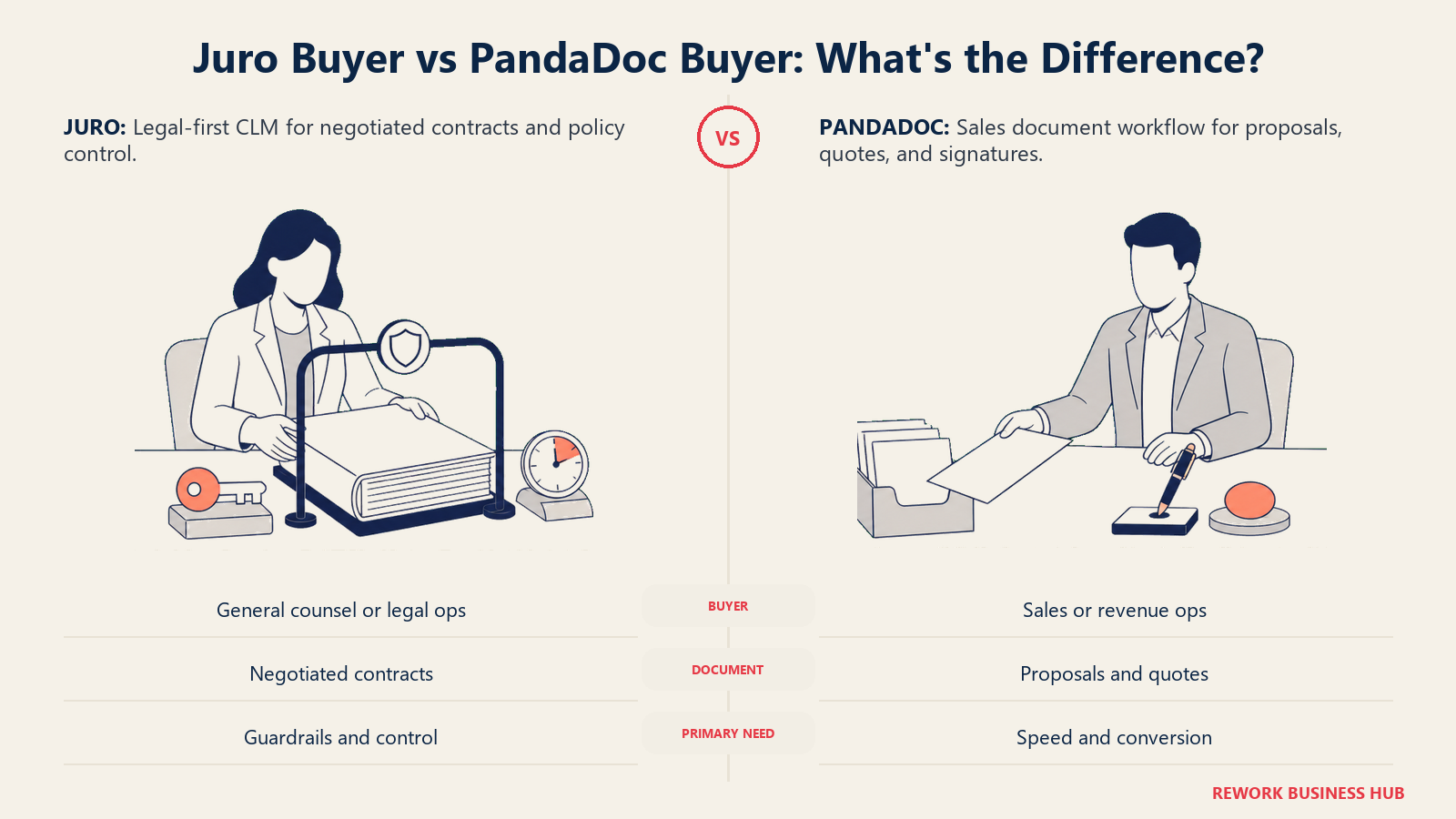
Juro's buyer is almost always legal: a general counsel, head of legal ops, or commercial counsel who owns contract templates, redlining standards, and approval policy, and who wants business teams (sales, HR, procurement) to self-serve within guardrails instead of routing every request through legal. Juro's own pricing page puts a number on this: the company says businesses signing roughly 10 or more contracts a month see a return on investment that scales with volume, which tells you the ideal Juro customer already has enough contract flow to justify a dedicated CLM.
PandaDoc's buyer is almost always sales: a sales ops lead, VP of sales, or founder who needs proposals, quotes, and order forms out fast, with e-signature collection and basic tracking, and who doesn't necessarily have (or need) a legal team reviewing every document that goes out. Its own G2 listing describes it as trusted by "68,000+ sales, legal, and operations teams," a scale that reflects a much broader, lighter-weight buyer base than Juro's legal-first customer list.
| Juro | PandaDoc | |
|---|---|---|
| Natural buying trigger | Legal team drowning in Word-doc redlines and version control across email threads | Sales team needs faster proposals and signatures without a heavyweight CPQ rollout |
| Primary champion | General counsel, head of legal ops, commercial counsel | Sales ops lead, VP of sales, founder |
| Team maturity assumed | Willing to define clause guardrails and own an approval policy | Comfortable with a simpler drag-and-drop document builder |
| Vendor relationship | One vendor for the full contract lifecycle, legal owns the platform | One vendor for documents plus signature, sales usually owns the platform |
| Notable customer proof point | Pfizer, Deliveroo, Trustpilot, WeWork, and Velocity Global use Juro, per G2's product listing | Autodesk, Rakuten, and Sysco use PandaDoc, per G2's product listing |
Neither buyer is wrong to be looking at the other tool once, most legal teams have tried to stretch a Word-and-email process further than it should go, and most sales teams have wondered whether a CLM would solve their proposal problem too. But the fit rarely survives contact with actual usage, which is the point of the sections below.
Key Facts
- On G2, Juro holds a 4.5 out of 5 rating across 248 reviews, while PandaDoc holds a 4.7 out of 5 rating across 3,705 reviews, a gap that partly reflects PandaDoc's much larger, more sales-oriented user base.
- Juro's own pricing page confirms its plans are not seat-based at all: "all Juro plans offer unlimited users, unlimited workflows and unlimited templates," with price instead driven by monthly contract volume, and deeper integrations like Salesforce, HubSpot, and Workday costing extra.
- PandaDoc's own help center documentation states plainly that redlining "does not work for uploaded content," meaning a Word document imported into PandaDoc cannot be natively redlined the way a document drafted inside Juro can.
- Buyer-reported data from Vendr puts Juro's median annual contract at roughly $31,164 across tracked deals, while Vendr's PandaDoc data shows a median of about $14,868 a year, a gap that roughly mirrors the difference between buying a legal CLM and buying a sales document tool.
- The global CLM software market is valued at $3.32 billion in 2026 and projected to reach $8.84 billion by 2035, an 11.56% CAGR, according to Precedence Research, a category PandaDoc explicitly sits outside of by its own tools' design.
Contract Lifecycle Depth vs Sales Document Speed
This is the real fork in the road, and it's worth naming plainly before getting into feature tables.
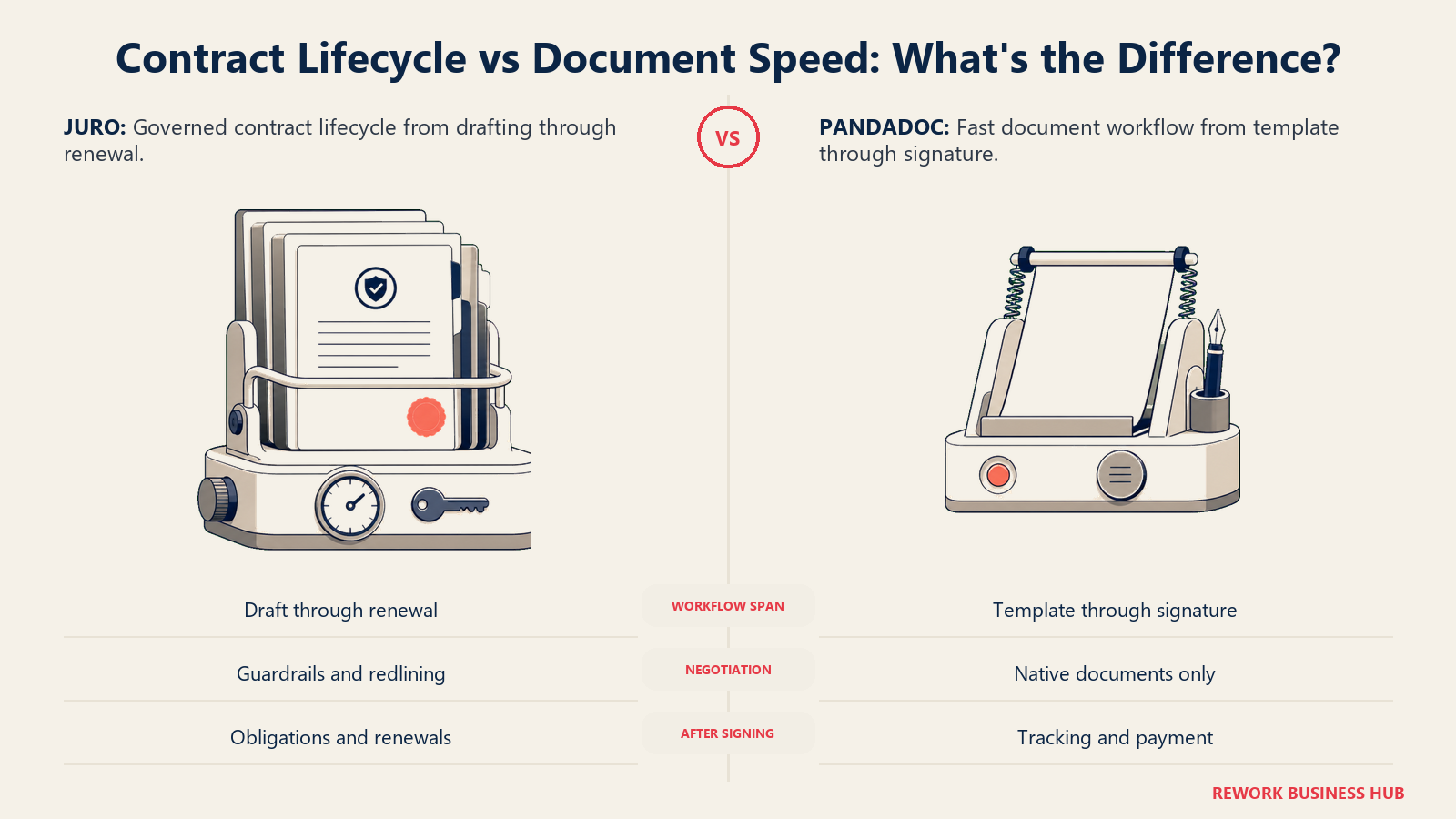
Juro is built to manage a contract's entire life, from a business user requesting a template, through legal-defined guardrails, AI-assisted drafting and review, multi-party negotiation with full version history, approval routing, native signature, and post-signature tracking with renewal reminders. It treats a contract as a living record that legal owns and other teams borrow, not a document that gets created once and forgotten after signature.
PandaDoc is built to move a document from draft to signed as fast as possible. It's strong at exactly that: build a proposal or quote from a template, send it, track whether the recipient opened it, collect a signature, maybe collect a payment. What it isn't built for is negotiated legal paper with back-and-forth clause changes, which is precisely where its own documentation draws the line (see the redlining limitation above).
| Capability | Juro | PandaDoc |
|---|---|---|
| Contract drafting from playbooks/guardrails | Yes, core feature | Limited, template-based only |
| Native redlining on documents drafted in-platform | Yes | Yes, for documents created natively (not uploaded) |
| Native redlining on uploaded Word documents | Yes, contracts stay editable regardless of origin | No, PandaDoc's own help center confirms this doesn't work |
| Multi-party negotiation with full version history | Yes, purpose-built | Limited, comment and re-upload flow |
| Post-signature obligation and renewal tracking | Yes | Basic, document-level tracking only |
| Speed for simple, standardized documents | Adequate, but more setup than needed | Fast, purpose-built for this |
If your contracts are mostly negotiated with a counterparty's legal team, this section alone should settle the decision. If your documents are standardized and rarely negotiated clause by clause, PandaDoc's speed is the more relevant strength.
AI, Templates, and Clause Guardrails
Both companies market AI features, but they're solving different problems with them.
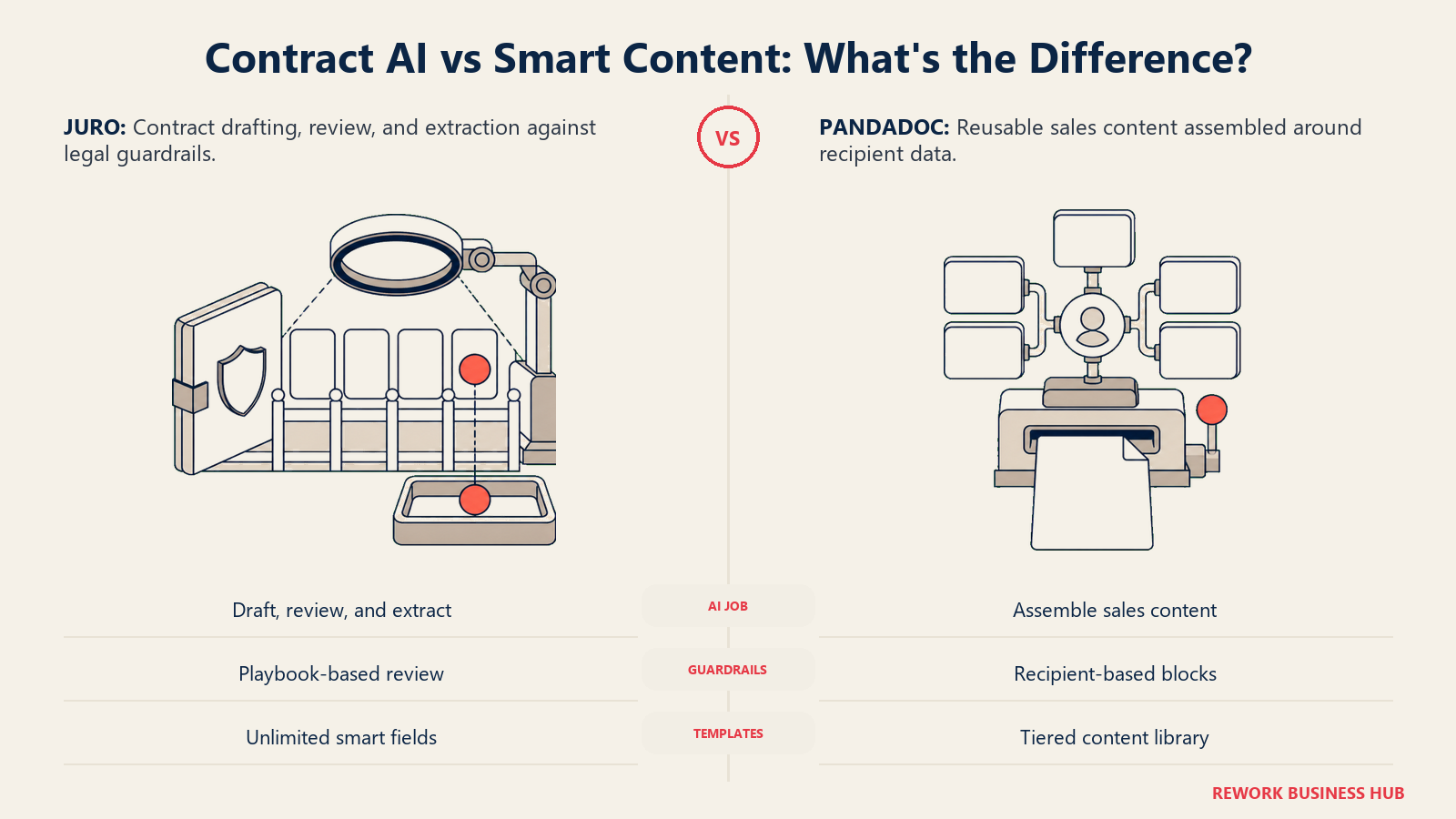
Juro's AI Assistant covers three jobs: AI Draft, which creates or amends contract language from a prompt and a defined playbook; AI Review, which checks contract language against guardrails and flags risk; and AI Extract, which pulls structured data out of contracts for reporting and workflow triggers. Juro's own product page states its AI Review lets teams "turn around contracts up to 90% faster while keeping control," a claim worth treating as a vendor-reported ceiling rather than a guaranteed outcome, but directionally consistent with what AI-assisted redlining tools across the category report. Templates in Juro use smart fields that auto-populate from CRM or workflow data, and every plan includes unlimited templates.
PandaDoc's content tooling centers on a drag-and-drop document editor, a reusable content library, and "smart content" blocks that adjust based on recipient data, strong for assembling proposals fast, weaker for anything resembling clause-level legal review. PandaDoc does not market a dedicated contract-redlining AI product the way Juro does, and its own documentation confirms redlining is unavailable on uploaded content in the first place.
| Feature | Juro | PandaDoc |
|---|---|---|
| AI contract drafting from playbook | Yes (AI Draft) | No |
| AI-assisted redlining against guardrails | Yes (AI Review) | No |
| AI data extraction from existing contracts | Yes (AI Extract) | No |
| Template library | Unlimited templates, every plan | Up to 5 templates on Free/Starter, unlimited on Business+ |
| Smart/dynamic content blocks | Smart fields tied to workflow data | Smart content tied to recipient data |
| Content library for reusable clauses/blocks | Yes | Yes (Business tier and up) |
Approval Workflow and Contract Routing
Juro's approval workflows exist to give legal control without becoming a bottleneck. Contract owners, usually legal, can decide which contract types require sign-off before going to a counterparty, route approvals to the right stakeholder, and send automated reminders to keep things moving. Business teams like sales or HR can self-serve within those guardrails without looping legal into every routine agreement.
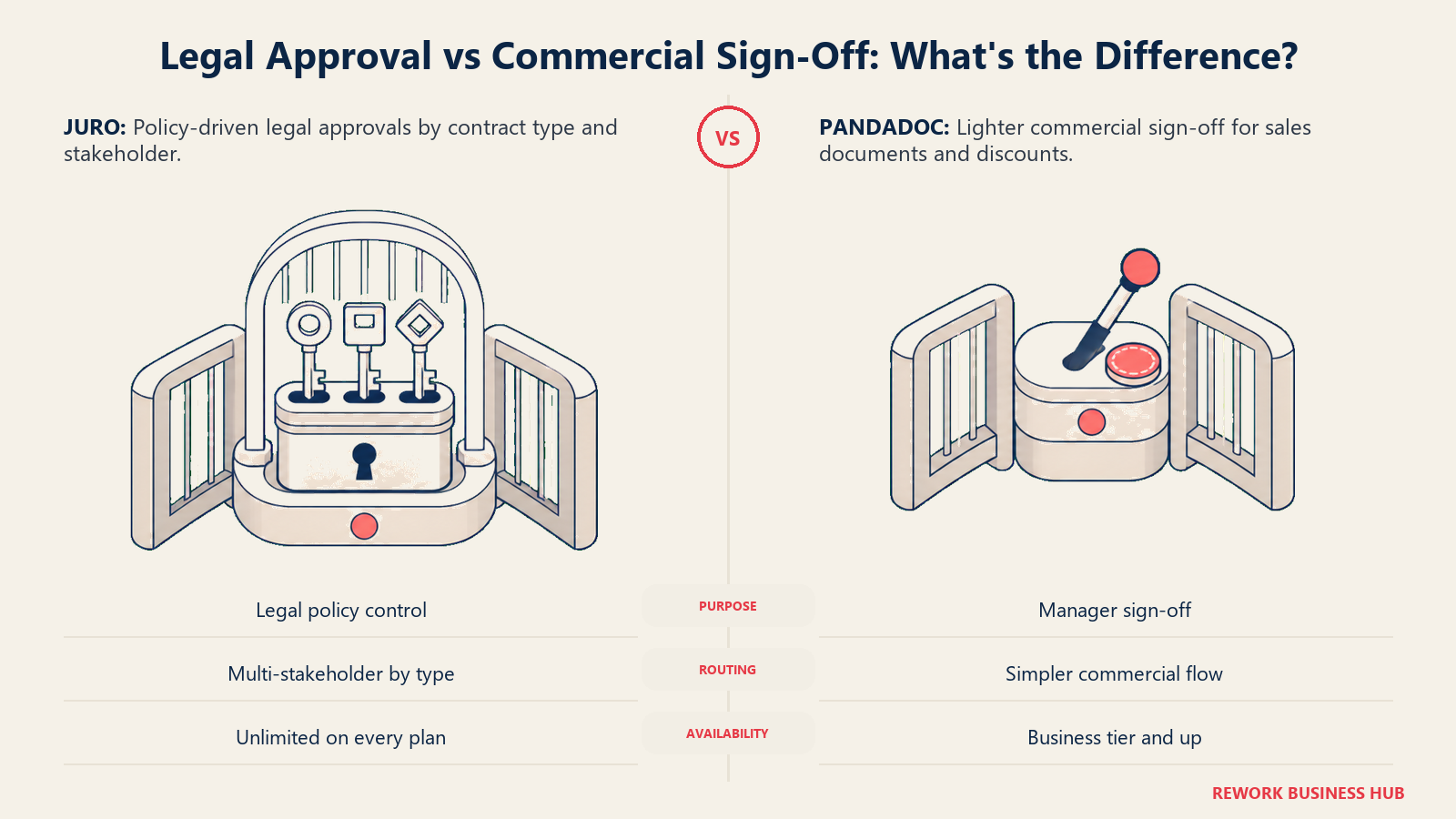
PandaDoc's approval workflows, available from the Business tier up, are simpler and aimed at commercial sign-off rather than legal review, think a manager approving a discount before a quote goes out, not a lawyer approving a liability clause. That's a fine fit for its buyer, but it's a materially lighter workflow engine than Juro's.
| Capability | Juro | PandaDoc |
|---|---|---|
| Legal-defined approval guardrails by contract type | Yes | No, workflows are simpler commercial sign-off |
| Self-serve contract creation for non-legal teams | Yes, within defined templates and guardrails | Yes, any user with a seat can create documents |
| Automated approval reminders | Yes | Yes |
| Available on entry-level plan | Yes, unlimited workflows on every Juro plan | No, approval workflows require Business tier or higher |
E-Signature: Native in Both, Built for Different Stakes
Neither tool makes you bolt on a separate e-signature product, which removes one common objection buyers raise about pure-play CLMs like Ironclad (see our Ironclad vs DocuSign CLM comparison for a platform that doesn't include e-signature at all).
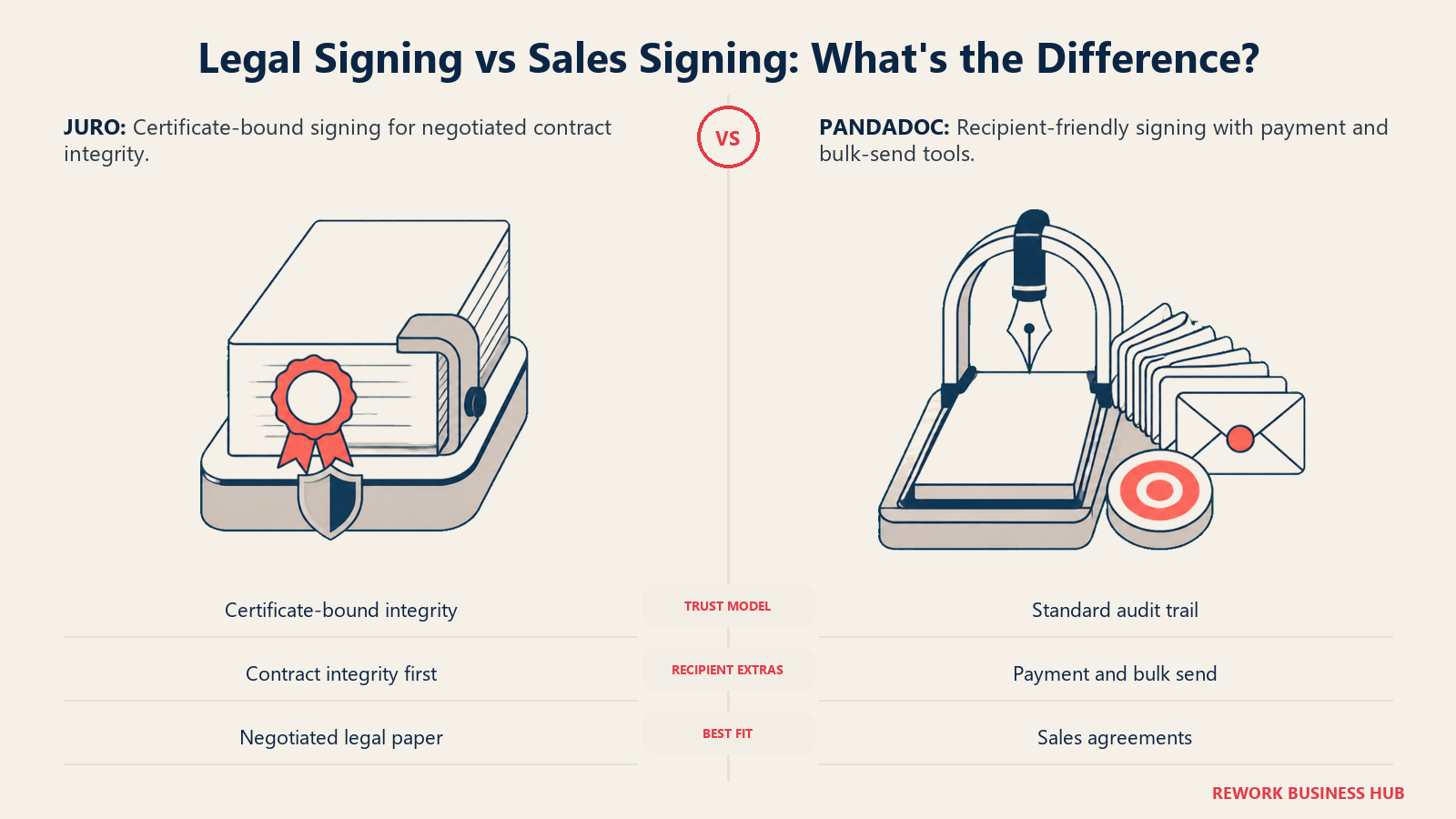
Juro's native signature is an Advanced Electronic Signature (AdES) under eIDAS in Europe, cryptographically bound to the signed document via a certificate from HARICA, a qualified trust service provider on the EU trusted list, and it also complies with the US ESIGN Act and UETA. Any alteration after signing invalidates the signature, which matters for legal enforceability in a negotiated-contract context.
PandaDoc's e-signature is also legally binding and broadly recognized, and it comes with more built-in recipient-facing extras: in-person signing, signing order control, bulk send, and payment collection at the point of signature, useful for a sales team closing a deal and collecting the first invoice in the same motion. That combination of signature plus payment is not something Juro tries to compete on.
| Capability | Juro | PandaDoc |
|---|---|---|
| Native e-signature (no separate tool needed) | Yes, AdES standard | Yes |
| Regulatory compliance | eIDAS, ESIGN Act, UETA | eIDAS, ESIGN Act, UETA, per PandaDoc's compliance documentation |
| Certificate-backed signature binding | Yes, via HARICA | Standard e-signature audit trail |
| Payment collection at signature | No | Yes |
| Bulk send / in-person signing | Limited | Yes, both included from Business tier |
CRM Integration Depth
If your sales or legal team lives inside a CRM, the fine print here matters more than the headline "we integrate with Salesforce" both vendors put on their site.
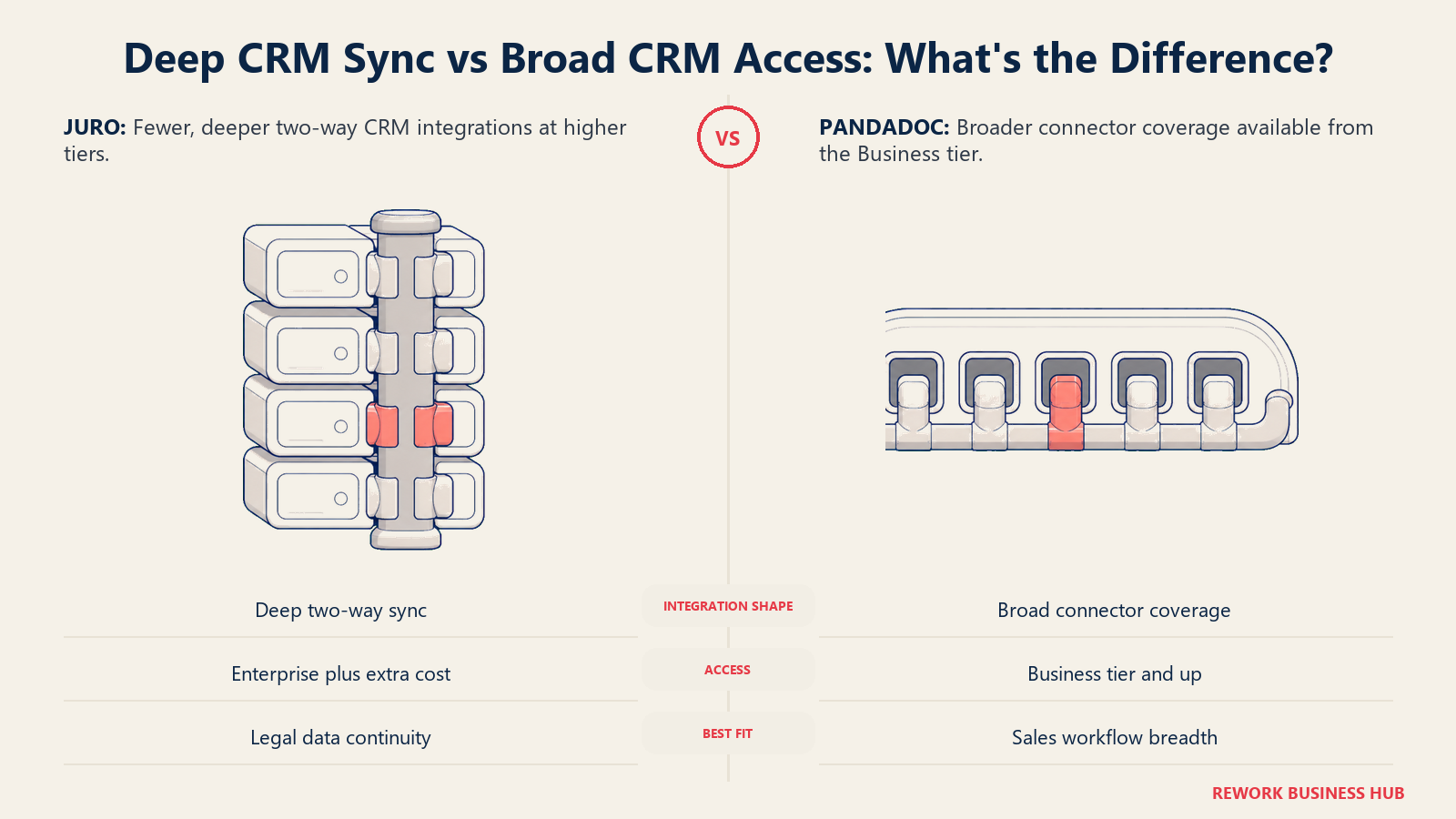
Juro's Salesforce integration runs through an iFrame embedded directly in Salesforce, with live two-way sync down to custom object fields, letting reps generate a contract in a few clicks without leaving their CRM. The catch: Juro's Salesforce integration is gated to its Enterprise plan, and per Juro's own pricing FAQ, "deeper integrations, such as Salesforce, HubSpot and Workday, will incur additional cost" on top of the base contract-volume price. Its HubSpot integration triggers contract creation directly from a HubSpot deal and syncs status back automatically.
PandaDoc's CRM integrations are broader out of the gate: native Salesforce, HubSpot, and Pipedrive, plus more than 30 other CRM and payment platforms according to its G2 listing, and CRM integrations are included starting at the Business tier rather than gated to the top plan.
| Integration | Juro | PandaDoc |
|---|---|---|
| Salesforce | Native, two-way sync, Enterprise plan only | Native, included from Business tier |
| HubSpot | Native, generates contracts from deal data | Native, included from Business tier |
| Pipedrive | Not a primary integration | Native |
| Total CRM/payment connectors | Handful of deep, native integrations | 30+ per G2's product listing |
| Cost to unlock CRM integration | Extra, on top of base plan | Included once you're on Business tier or above |
For a sales-heavy org that just needs proposals to flow in and out of the CRM without a special conversation about which plan unlocks it, PandaDoc's breadth wins. For a legal team that wants a genuinely deep, two-way Salesforce sync and is already paying for Enterprise-tier features elsewhere, Juro's integration is the more capable one once it's switched on.
Analytics and Reporting
Juro's reporting is built around a customizable contract dashboard: table and kanban views, filters on any contract data field (value, counterparty, renewal date, contract type), and dynamic reports legal can build without exporting to a spreadsheet. Combined with AI Extract pulling structured data out of both new and legacy contracts, this turns a contract archive into something queryable rather than a folder of PDFs.
PandaDoc's analytics are document-centric: real-time notifications when a recipient opens or interacts with a document, recipient-level engagement analytics (which page they lingered on, how long), a full audit trail, and automated reports, genuinely useful for a sales team optimizing proposal content, but not built to answer "how many contracts renew in Q3" the way Juro's dashboard is.
| Capability | Juro | PandaDoc |
|---|---|---|
| Customizable contract dashboard | Yes | No, document list view only |
| Query contracts by custom data fields | Yes | Limited |
| Recipient engagement analytics (opens, time on page) | Not the focus | Yes, a core strength |
| Renewal and key-date reminders | Yes, automated | Renewal notifications, simpler scope |
| Audit trail | Yes | Yes |
Word Round-Trip for Counterparties
This matters more than it sounds like it should, because most counterparties on the other side of a negotiation are not going to adopt your CLM.
Juro's approach is to let the counterparty stay in Word if that's what they prefer, while keeping the source of truth in Juro. Its Word add-in syncs edits, comments, redlines, and versions between Word and Juro in real time, and Juro also supports exporting a contract as a Word or PDF file and re-importing it once external negotiation wraps, tracking every edit in an in-platform audit trail. Juro reports that 97% of contracts initiated in its platform are ultimately executed inside it, suggesting the Word flexibility is a safety valve rather than the default path.
PandaDoc's approach is DocX Import: upload a .docx file and it converts into an editable PandaDoc document or template without reformatting headaches. The gap is the one already flagged above: redlining does not work on uploaded content, so a negotiated Word contract dropped into PandaDoc becomes a static document recipients can comment on and re-upload a revised version of, not something either side can mark up inline the way Juro's Word add-in allows. For proposal-style documents built natively in PandaDoc, this isn't a limitation at all, redlining was never really the point.
Pricing and the True Cost of Ownership
PandaDoc publishes its pricing. Straight from PandaDoc's own pricing page: Free ($0, 5 documents a month, up to 5 templates), Starter ($19 per seat/month billed annually, or $35/month billed monthly, unlimited documents and e-signatures), Business ($49 per seat/month billed annually, or $65/month billed monthly, adds CRM integrations, custom branding, content library, deal rooms, approval workflows, web forms, and bulk send), and Enterprise (custom, "Let's talk," adds CPQ, workflow automation, SSO, and API access). Going over your document allowance on the Starter plan costs $2 to $3.50 per extra document depending on billing cycle, per PandaDoc's own FAQ.
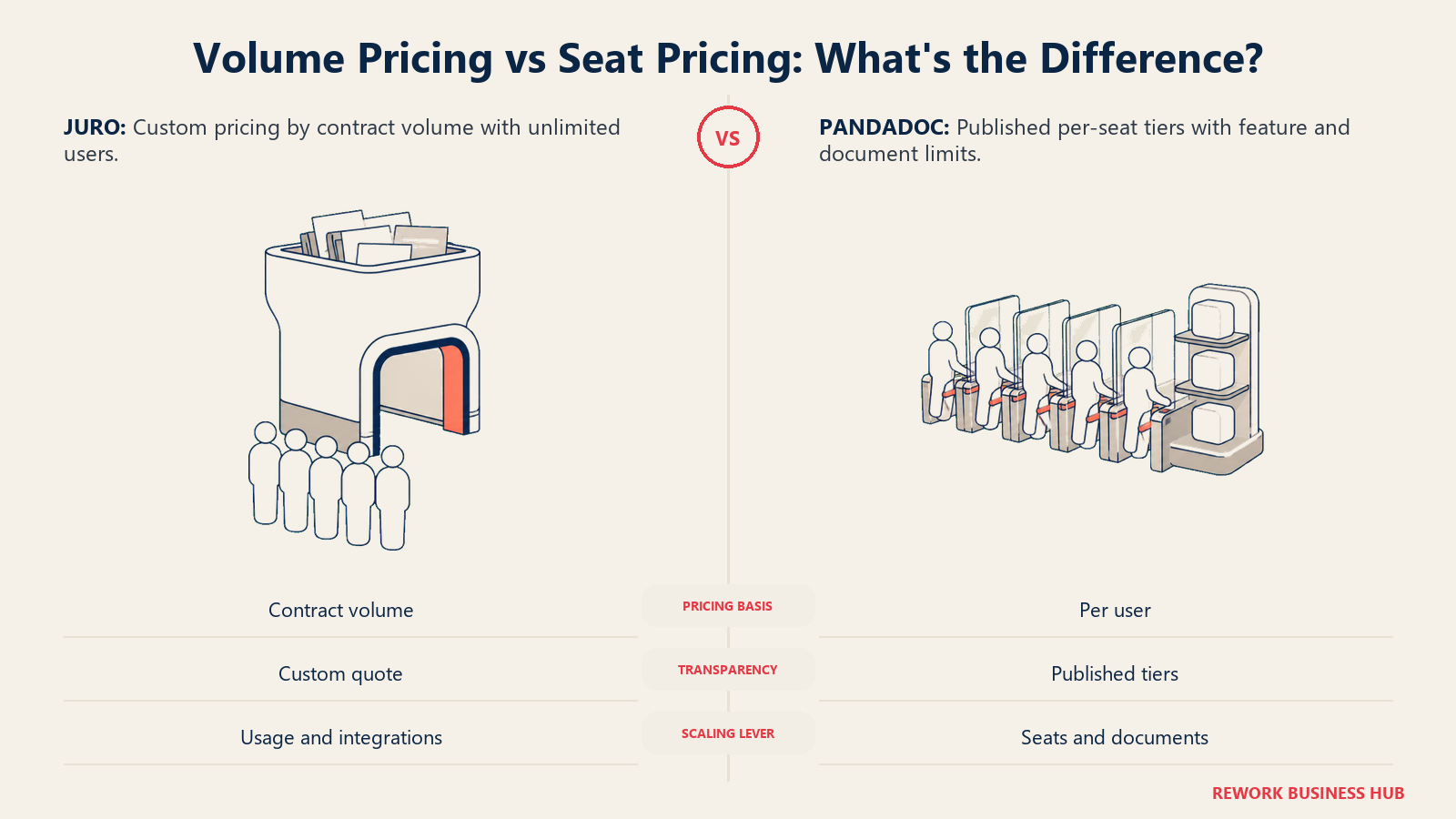
Juro does not publish pricing. Juro's pricing page is a request-a-quote calculator based on monthly contract volume, not a price list, and Juro is explicit that this is deliberate: "our pricing plans are based on your contract volumes and on the complexity of any integrations you might need," with every plan including unlimited users, workflows, and templates. That's a genuinely different pricing philosophy from PandaDoc's per-seat model, and it can work in either direction: a 50-person legal-adjacent team with modest contract volume might pay less on Juro's volume-based model than it would on a seat-based one, while a high-volume, small-headcount legal team could pay more.
| Juro | PandaDoc | |
|---|---|---|
| Published pricing | None, quote-only | Yes, published tiers from $0 to $49/user/month (annual) |
| Pricing basis | Monthly contract volume, unlimited users | Per user/seat |
| Reported median annual contract | ~$31,164/year (reported, Vendr) | ~$14,868/year (reported, Vendr) |
| Reported buyer-negotiated savings | 15-30% below initial quote (reported, Vendr) | ~26% average savings (reported, Vendr) |
| Extra cost for deeper CRM integrations | Yes, Salesforce/HubSpot/Workday cost extra | No, included from Business tier |
| Overage cost | Not seat-based, volume renegotiated at contract renewal | $2 to $3.50 per document over the Starter plan's allowance |
The honest takeaway: PandaDoc's transparency lets you model cost before you ever talk to sales. Juro's opacity is the tradeoff for a pricing model that isn't punishing you for adding users, which matters if your legal team wants sales, HR, and procurement all self-serving on contracts without a per-seat bill climbing every time someone new gets access.
Implementation and Time to Value
PandaDoc is close to self-serve: sign up, use a template, send a document, most teams are productively using it within days, which fits its buyer's expectation of a lightweight sales tool. Business-tier features like CRM integrations and approval workflows take longer to configure properly, typically one to two weeks with a sales ops owner involved.
Juro's implementation is heavier, appropriately so for a CLM. Basic template and workflow setup can go live in a few weeks, but building out clause guardrails, playbooks, and a properly configured Salesforce integration is a real project, often one to three months, and it assumes someone in legal owns the rollout the way a legal ops hire would. Juro's own marketing cites customers reporting the equivalent of saving a full-time hire once the platform is running, which is a believable outcome for a mature deployment, but it isn't a week-one result.
| Juro | PandaDoc | |
|---|---|---|
| Basic setup | A few weeks | Days |
| Full deployment (guardrails, integrations, adoption) | 1 to 3 months | 1 to 2 weeks |
| Dedicated internal owner needed | Yes, typically legal ops | Helpful but not always required |
| Biggest time sink | Defining clause guardrails and playbooks | Configuring CRM integrations and approval logic at Business tier |
When Juro Is the Right Call
- Your legal team is running real negotiated contracts, not standardized paper, and redlining, version history, and clause guardrails matter more than send speed
- You're signing roughly 10 or more contracts a month and want the platform's cost to scale with contract volume rather than headcount
- You want business teams (sales, HR, procurement) to self-serve on contracts within legal-defined guardrails, without paying per seat for every new user
- A deep, two-way Salesforce sync tied to custom objects is worth paying for the Enterprise tier to unlock
- Post-signature obligation tracking, renewal reminders, and a queryable contract dashboard matter as much as getting the document signed
When PandaDoc Is the Right Call
- Your documents are proposals, quotes, and simple agreements that rarely get negotiated clause by clause
- Speed of send and a familiar drag-and-drop editor matter more than legal-grade workflow control
- You want to see actual pricing before talking to a salesperson, and a per-seat model is easier to budget against than a volume-based quote
- Collecting payment at the moment of signature is part of your sales motion
- You need CRM integration depth (Salesforce, HubSpot, Pipedrive, and more) without a separate conversation about which plan unlocks it
If Neither Fits: Contracts Living on the Same Record as the Customer and the Deal
Worth naming honestly: this comparison assumes the contract tool is a separate system from wherever your customer data lives. For a legal team that is usually the right assumption. For a sales-led or ops-heavy business it often is not, and the friction people blame on Juro's templates or PandaDoc's redlining is really the cost of the agreement living somewhere the CRM cannot see.
Rework's Contract module keeps agreements, renewals, and approvals on the same record as the customer, the deal, and the account, alongside Sales Ops, Work Ops, and the People app. That is a narrower job than Juro does on negotiated legal language, and a slower path than PandaDoc's send-and-track speed, so neither team should switch for it if those are the actual bottlenecks. But if contracts are one part of a broader sales and operations record you would rather keep unified, it is worth a look. Rework's Contract module is not publicly priced; it is quoted per organization, see rework.com/pricing for current details.
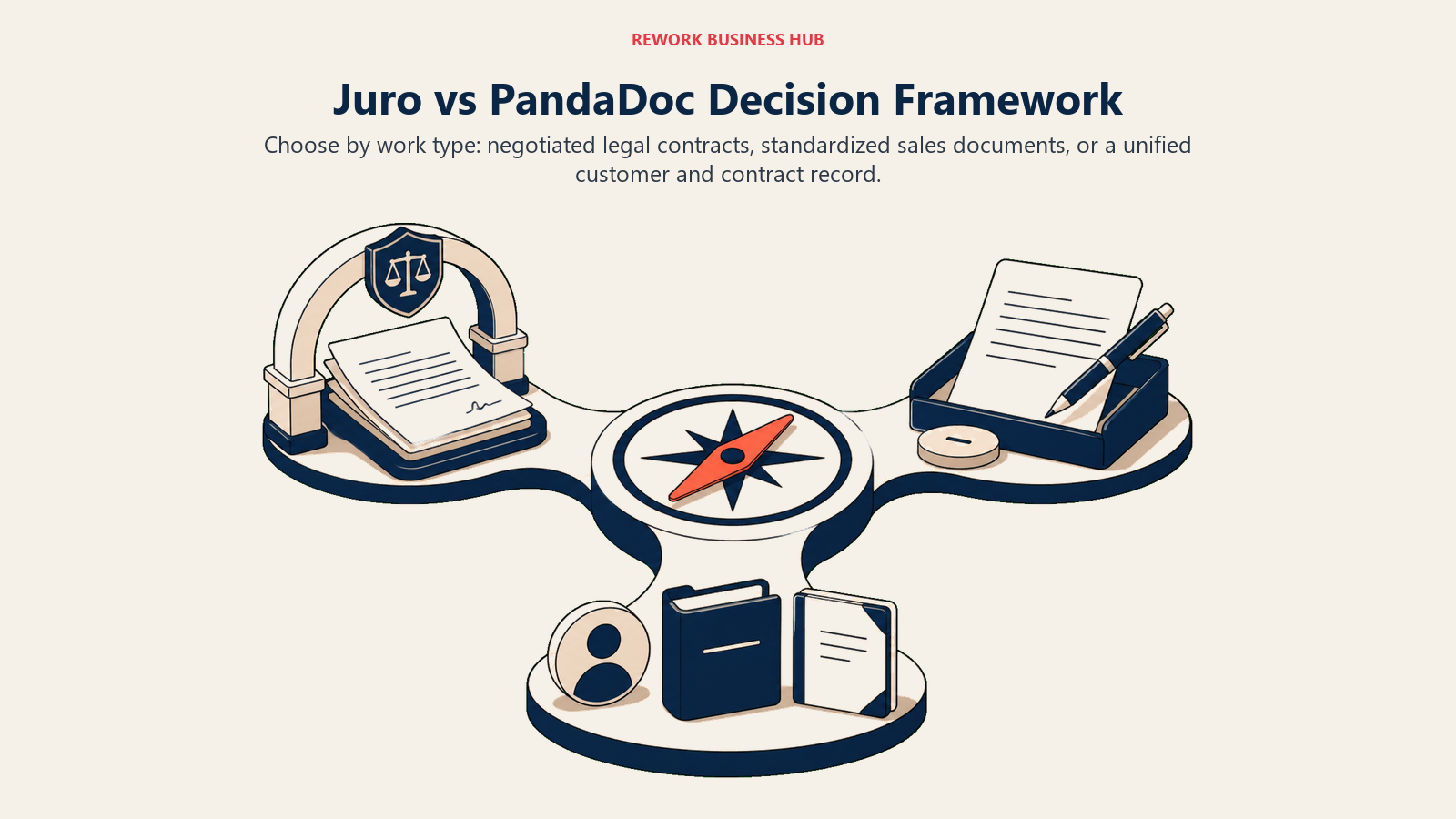
Decision Framework
| If you are... | Pick |
|---|---|
| A legal or legal ops team managing negotiated, clause-heavy contracts | Juro |
| A sales or ops team sending proposals, quotes, and simple agreements | PandaDoc |
| Most focused on redlining, clause guardrails, and post-signature tracking | Juro |
| Most focused on send speed, recipient analytics, and payment collection | PandaDoc |
| Wanting pricing you can model before a sales call | PandaDoc, since Juro's pricing is quote-only |
| Wanting a platform that doesn't charge more per new self-serve user | Juro, given its unlimited-user model |
| Looking for contracts to live on the same record as the customer and the deal, not a standalone CLM | Rework (see rework.com/pricing) |
| Comparing more of the category before narrowing down | See our full contract management software roundup |
The verdict: if your team's actual problem is legal contracts, negotiated language, and post-signature obligations, Juro is built for that job and PandaDoc's own documentation confirms it isn't. If your team's actual problem is getting standardized sales documents signed fast without a legal bottleneck, PandaDoc does that job well and Juro's approval-heavy, quote-only model would be overkill. This isn't a case where one tool is simply better, it's a case where the two tools are answering different questions.
What to Do Next
- Name your actual document type before you demo either tool. If more than a handful of your agreements get redlined by a counterparty's legal team, that alone should point you toward Juro over PandaDoc.
- Ask Juro for a quote based on your real contract volume, not a hypothetical, and separately ask whether Salesforce integration requires the Enterprise plan for your team size.
- Model PandaDoc's real cost at your seat count using its published pricing page plus expected document overage, since the sticker price understates cost for high-volume senders on the Starter plan.
- If you're not sure a full CLM is even the right category, our contract management software roundup and Ironclad vs DocuSign CLM cover the heavier end of the category, while our PandaDoc alternatives guide and DocuSign alternatives guide cover the lighter, sales-document end.
- Still comparing CLM platforms broadly? Best Agiloft Alternatives, Best Ironclad Alternatives, and Best LinkSquares Alternatives each cover a different corner of the legal-grade CLM market. For the Juro-replacement angle specifically, see Best Juro Alternatives.
Frequently Asked Questions about Juro vs PandaDoc
Is Juro or PandaDoc better for legal teams?
Juro. It's built specifically for legal and commercial teams managing negotiated contracts, with native redlining, AI-assisted review against clause guardrails, and post-signature obligation tracking. PandaDoc's own help documentation confirms redlining doesn't work on uploaded Word content, which rules out most negotiated legal paper.
Can PandaDoc replace a CLM like Juro?
Not for negotiated contracts. PandaDoc is strong for standardized proposals, quotes, and simple agreements that rarely change clause by clause, but it lacks native redlining on imported documents, clause guardrails, and the deep post-signature tracking a legal team managing real contract volume needs.
Does Juro have e-signature built in?
Yes. Juro's native signature is an Advanced Electronic Signature (AdES) compliant with eIDAS in Europe and the ESIGN Act and UETA in the US, cryptographically bound to the document via a certificate from HARICA. You don't need a separate e-signature tool to use it.
How is Juro priced compared to PandaDoc?
Differently in kind, not just in amount. PandaDoc publishes per-seat pricing from $0 to $49 a user a month (billed annually) plus a custom Enterprise tier. Juro doesn't publish pricing at all; it quotes based on monthly contract volume, with unlimited users included on every plan, and charges extra for deeper integrations like Salesforce.
Can counterparties who don't use Juro still negotiate contracts with it?
Yes. Juro's Word add-in syncs edits, comments, and redlines between Word and Juro in real time, and contracts can also be exported to Word or PDF and re-imported once external negotiation is done. Juro reports that 97% of contracts initiated in its platform are ultimately executed there, so the Word flexibility functions as a fallback rather than the typical path.
Related Resources:

Principal Product Marketing Strategist
On this page
- TL;DR
- Who Actually Buys Each One
- Key Facts
- Contract Lifecycle Depth vs Sales Document Speed
- AI, Templates, and Clause Guardrails
- Approval Workflow and Contract Routing
- E-Signature: Native in Both, Built for Different Stakes
- CRM Integration Depth
- Analytics and Reporting
- Word Round-Trip for Counterparties
- Pricing and the True Cost of Ownership
- Implementation and Time to Value
- When Juro Is the Right Call
- When PandaDoc Is the Right Call
- If Neither Fits: Contracts Living on the Same Record as the Customer and the Deal
- Decision Framework
- What to Do Next