Best Juro Alternatives in 2026: 13 Contract Management Platforms for Fast-Growing Legal and Ops Teams
Turn this article into takeaways for your work.


Each assistant summarizes the article only for you and suggests best practices for your work.
Juro built its reputation on being the CLM legal teams enjoy using: contract creation, negotiation, and e-signing happen inside one browser tab, with implementation speed G2 ranks among the fastest in the category. If you're reading this, you know where that trade-off shows up. Pricing is quote-only and scales with monthly contract volume rather than a flat seat count, so the bill can move as a team grows. Redlining stays at accept-or-reject rather than clause-by-clause markup, a real ceiling for negotiated paper. And templates that felt flexible at low volume get rigid once legal fields edge cases from procurement, sales, and finance at once, especially when a counterparty insists on a Word attachment.
This guide covers 13 alternatives, from enterprise platforms built for deep negotiation to Rework for teams whose contracts live apart from the CRM and ops data around them. Evaluated on redlining depth, legal-ops overhead, and pricing transparency, not raw feature count, since Juro buyers chose it for speed and low overhead. For the broader category, see the Best Contract Management Software in 2026 roundup.
Figures marked "reported" come from third-party pricing analyses and buyer benchmark data, since most CLM vendors, including Juro, don't publish rates.*
Key Facts
Contract Management Software and the Cost of Doing It Manually
- Poor contract management costs the average organization 9.2% of annual revenue through missed deadlines, unfavorable renewals, and overlooked terms. (World Commerce & Contracting, 2026)
- The global CLM software market is valued at $3.39 billion in 2026 and is projected to reach $6.26 billion by 2031, a 13.06% compound annual growth rate. (Mordor Intelligence, 2026)
- Legal teams spend an average of three hours reviewing a single contract, before negotiation even starts. (LegalOn, 2026 State of AI for In-House Legal)
- 87% of general counsel now report using AI within their teams, up from 44% a year earlier. (FTI Consulting and Relativity General Counsel Report)
- 77% of in-house legal professionals report regularly working beyond contracted hours, and only a third expect their legal team to grow in 2026, per Juro's own survey of the market it sells into. (Juro, State of In-house 2026)
Quick Comparison Table
| Tool | Best For | Starting Price | Key Strength | Key Limitation |
|---|---|---|---|---|
| Ironclad | Legal teams needing clause-level redlining Juro doesn't support | Custom quote (reported $30K+/yr) | Drag-and-drop Workflow Designer, deep Word redlining | Enterprise pricing and a longer rollout than Juro |
| PandaDoc | Sales teams whose "contracts" are simple proposals | From $19/user/mo (reported) | Fast, affordable, familiar to sales reps | Not a legal-grade CLM |
| DocuSign CLM | Teams already standardized on DocuSign eSignature | Custom quote (reported $10K-$100K+/yr depending on scale) | One vendor for signing and lifecycle management | No published pricing; limited redlining depth for the price |
| Agiloft | Teams wanting to configure their own contract data model | Free (Astra AI); full CLM from ~$6K/yr (reported) | Deepest no-code configurability in the category | Configuration still takes real admin time |
| LinkSquares | Legal teams needing AI analytics across an existing archive | Custom quote (reported ~$31K/yr median, $30K-$100K+/yr at scale) | Strong repository search and analytics (LinkAI) | Workflow depth is newer than Ironclad's or Agiloft's |
| Rework | Contracts tied to CRM, deals, and cross-team ops | Quote on request (rework.com/pricing) | Contract, CRM, Work Ops, and People data on one contact timeline | Not built for clause-level AI redlining or obligation management |
| Icertis | Fortune 500 legal and procurement at massive contract volume | Custom quote (reported ~$88K median ACV, $150K-$500K+/yr at scale) | Deepest enterprise governance and AI contract intelligence | Dated UI, 6 to 12-month implementations |
| Conga CLM | Salesforce-native contract generation from Opportunity records | Custom quote (reported ~$360-$889/user/yr, roughly $15K-$60K+/yr standalone) | Native Salesforce trigger-to-contract workflow | Weaker fit for teams not running Salesforce |
| Workday CLM (formerly Evisort) | Enterprises already running Workday for HR and Finance | Custom quote (no published price) | AI extraction backed by Workday's enterprise data platform | Weaker redlining; steep admin learning curve |
| ContractWorks | Small teams wanting a flat-rate, unlimited-user repository | Reported ~$600-$700/mo (Standard, billed annually) | Unlimited users at every tier, fast setup | Limited negotiation and workflow depth |
| Malbek | Enterprise teams wanting contract data as business intelligence | Custom quote (no published price) | BusinessIQ commercial-intelligence layer, strong support scores | Pricing opacity and an enterprise-first sales process |
| SpotDraft | In-house legal teams standardizing NDA and MSA workflows | Custom quote (reported $5K-$50K+/yr) | AI-native review (VerifAI), implementation included | Overkill for a team without a legal ops function yet |
| Concord | SMBs wanting flat, transparent packaged pricing | $499/mo (5 users, billed annually) | Published pricing, unlimited eSignatures | Less workflow depth than a dedicated enterprise CLM |
Stage Fit Matrix
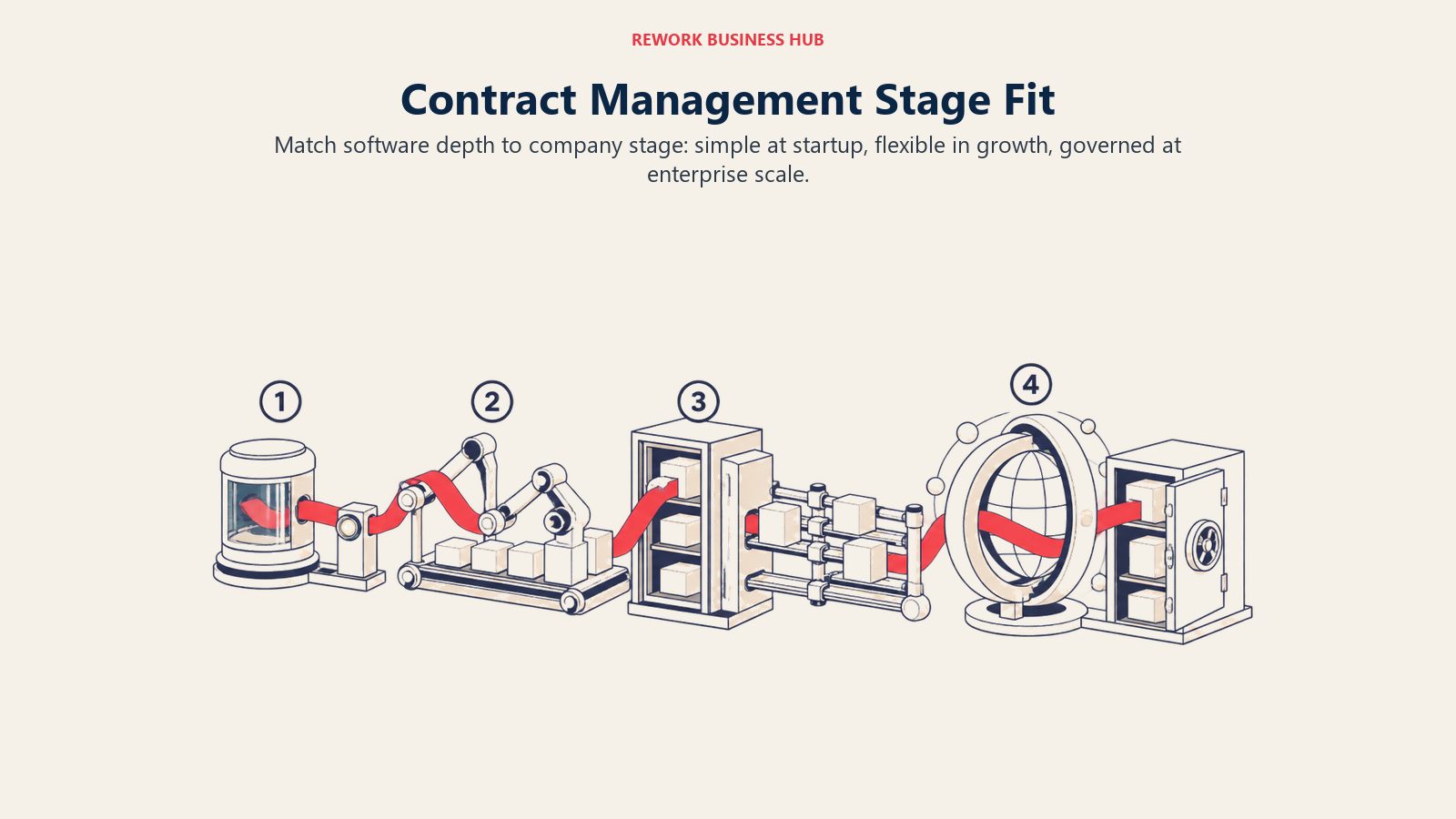
The right Juro alternative changes with company stage. Smaller teams need simple setup and predictable cost, growing teams need flexible approvals, and enterprises need deeper governance and global control.
| Tool | Startup/SMB (1-50) | Growth (50-500) | Enterprise (500-5,000) | Global Enterprise (5,000+) |
|---|---|---|---|---|
| Ironclad | Limited | Good | Best fit | Good |
| PandaDoc | Best fit | Good | Limited | Not ideal |
| DocuSign CLM | Limited | Good | Best fit | Best fit |
| Agiloft | Limited | Good | Best fit | Good |
| LinkSquares | Limited | Best fit | Best fit | Good |
| Rework | Good | Best fit | Good | Limited |
| Icertis | Not ideal | Not ideal | Good | Best fit |
| Conga CLM | Not ideal | Good | Best fit | Best fit |
| Workday CLM (formerly Evisort) | Not ideal | Limited | Good | Best fit |
| ContractWorks | Best fit | Good | Limited | Not ideal |
| Malbek | Not ideal | Limited | Best fit | Good |
| SpotDraft | Limited | Best fit | Good | Limited |
| Concord | Best fit | Good | Limited | Not ideal |
Sizing and Persona Table
| Tool | Team Size Sweet Spot | Primary Buyer | Use Case Fit |
|---|---|---|---|
| Ironclad | 200-2,000 | General Counsel, Legal Ops | Enterprise legal wanting deep no-code workflow and redlining |
| PandaDoc | 1-200 | Sales or Ops Manager | Standard proposals and simple agreements, not negotiated contracts |
| DocuSign CLM | 200-5,000 | Legal Ops, IT | Enterprises standardized on DocuSign eSignature |
| Agiloft | 50-2,000 | General Counsel, Legal Ops | Teams that want to configure their own workflow and data model |
| LinkSquares | 50-1,000 | General Counsel | AI-driven analytics across a growing contract repository |
| Rework | 10-200 | COO, RevOps, Sales Ops | Contracts tied to CRM, deals, and cross-team ops |
| Icertis | 3,000+ | Chief Procurement Officer, GC | Fortune 500 procurement and legal at massive scale |
| Conga CLM | 100-5,000 | RevOps, Salesforce Admin | Salesforce-native quote-to-contract generation |
| Workday CLM (formerly Evisort) | 1,000+ | General Counsel, VP Finance | Enterprises already on Workday wanting AI contract intelligence |
| ContractWorks | 5-200 | Office Manager, Small Legal Team | Simple, searchable contract storage without workflow complexity |
| Malbek | 500-5,000 | General Counsel, VP Commercial Ops | Enterprise teams wanting contract data as business intelligence |
| SpotDraft | 50-1,000 | General Counsel, Legal Ops | In-house legal standardizing NDA/MSA workflows |
| Concord | 20-500 | Operations Manager, Founder | SMB and mid-market teams wanting flat pricing |
1. Ironclad: The Redlining Depth Juro Doesn't Have
Ironclad is the tool most Juro evaluators demo next, because it solves the exact gap Juro leaves open: clause-level negotiation. Where Juro's redlining is effectively accept-or-reject on a whole document, Ironclad's fully editable .docx workspace and Jurist AI let legal teams mark up individual clauses through multiple rounds. Its drag-and-drop Workflow Designer keeps that depth from feeling like a step backward: non-technical staff can build approval chains without an engineer.
| What you get | What you don't |
|---|---|
| Clause-level redlining and multi-round negotiation Juro doesn't support | Juro's fastest-in-category implementation speed |
| A drag-and-drop Workflow Designer built for non-technical admins | Published pricing before a sales call |
| Best-in-class Salesforce integration | Unlimited users at the entry tier |
| Jurist AI clause work inside a fully editable .docx workspace | Fast search across a large, older contract repository |
Pricing: No public pricing. Third-party pricing analyses report base annual licensing from $30,000 to $150,000 or more per year, with total first-year costs (implementation, integrations, professional services) reaching $80,000 to $320,000-plus for complex deployments. (checkthat.ai)
Best for: Legal teams outgrowing Juro's redlining ceiling, willing to pay enterprise pricing for real clause-by-clause negotiation. See Best Ironclad Alternatives if Ironclad isn't the fit, and Ironclad vs DocuSign CLM for the direct comparison. Not ideal for: Teams that chose Juro to avoid a multi-month rollout; Ironclad's deployments run longer.
2. PandaDoc: Simple Proposals, Not Negotiated Contracts
PandaDoc solves a narrower problem than Juro, and that's the point for teams that land here by mistake. If the "contracts" causing pain are standard sales proposals rather than negotiated legal paper, PandaDoc's document workflow and e-signature tooling gets the job done at a fraction of the price, with no legal-ops learning curve.
| What you get | What you don't |
|---|---|
| A free plan for occasional use, no CLM-style seat minimum | Contract negotiation or redlining workflow depth |
| Simple, affordable document and e-signature workflow | Clause libraries or obligation management |
| Familiar to sales teams already sending proposals | A fit for high-volume, negotiated legal contracts |
| Fast setup, no implementation project | Juro's collaborative, browser-native negotiation experience |
Pricing: Free (5 documents/month); Starter from $19/user/month billed annually (2-seat cap, no CRM integrations); Business from $49/user/month billed annually; Enterprise custom (reported, Vendr, Proposify).
Best for: Sales and ops teams sending standard proposals, not negotiated legal contracts. See Best PandaDoc Alternatives for the category, or how to choose document automation software for the buying framework. Not ideal for: Legal teams that need clause libraries, multi-stage approvals, or negotiated workflows, the gap Juro was built to fill.
3. DocuSign CLM: Lifecycle Management on Top of eSignature You Already Use
DocuSign CLM makes the most sense as an extension, not a fresh start, the trade-off Juro asks a team to make in reverse. If your team already runs DocuSign eSignature, adding the lifecycle layer keeps everything in one vendor relationship instead of layering a separate workspace on top.
| What you get | What you don't |
|---|---|
| Deep integration with the eSignature workflow teams already use | Juro's fast, self-serve implementation |
| Collaborative, real-time editing inside Microsoft Word files | Published CLM pricing; enterprise deals are custom quotes |
| Broad template and clause library support | A UI built specifically for legal workflows first |
| Wide API and integration ecosystem | A fast rollout; enterprise deployments run months, not weeks |
Pricing: DocuSign does not publish CLM pricing; even the "Plans & Pricing" link on its own CLM product page routes to eSignature pricing, not CLM. Third-party trackers report enterprise CLM quotes typically starting around $10,000 to $50,000 per year for smaller deployments, scaling past $200,000 for large, multi-thousand-user rollouts (reported, Bind Legal).
Best for: Enterprises standardized on DocuSign eSignature that want lifecycle management without a second vendor. If e-signature alone is the need, see Best DocuSign Alternatives, or Ironclad vs DocuSign CLM against the workflow leader. Not ideal for: Teams that chose Juro for a fast, self-serve setup; DocuSign CLM's rollout runs on an enterprise timeline.
4. Agiloft: No-Code Configurability for Non-Standard Contracts
Agiloft sits at the opposite end of the configurability spectrum from Juro. Where Juro ships opinionated templates that move fast out of the box, Agiloft is a no-code platform admins configure to match their own process, worth the extra setup once Juro's templates stop bending. In 2026 Agiloft added Astra, a free AI assistant tier open to any legal, procurement, finance, or sales professional with no waitlist. (PR Newswire)
| What you get | What you don't |
|---|---|
| A fully configurable no-code data model and approval chains | Juro's speed to a first signed contract |
| Astra, a free AI assistant tier with no waitlist | A modern, consumer-grade interface out of the box |
| Six consecutive years as a Gartner CLM Magic Quadrant Leader | Fast implementation without configuration effort |
| Deep customization for non-standard, cross-department workflows | Unlimited users on every tier |
Pricing: The full CLM platform is quote-only. Third-party estimates place the Essentials tier around $6,000 per year, scaling past $60,000 annually for enterprise-grade Premium packages, split across power users, licensed users, and lower-cost portal users for external counterparties (reported, Aavenir).
Best for: Teams whose contract process is genuinely non-standard and has outgrown Juro's templates. See Best Agiloft Alternatives if the configuration overhead turns out to be the next problem. Not ideal for: Teams that picked Juro to avoid a configuration project; a full Agiloft build usually needs its professional services or a partner.
5. LinkSquares: AI-Driven Analytics Once the Repository Gets Big
LinkSquares picks up where Juro's simpler reporting leaves off. Juro tracks contracts well through creation and signing, but once a legal team needs to mine a growing repository for obligations, risk clauses, and renewal dates across hundreds of executed agreements, LinkSquares's AI engine (LinkAI) is built specifically for that analytics layer.
| What you get | What you don't |
|---|---|
| Strong AI-driven contract analytics and repository search | Juro's browser-native negotiation speed |
| A G2 Leader badge in both overall and Mid-Market CLM (Summer 2026) | A flat, predictable price as you add Analyze plus Finalize |
| High customer satisfaction scores (98% rate it 4 or 5 stars) | Published pricing; quotes depend on modules, users, and volume |
| Over 1,200 customers and a decade of legal-ops-specific product work | Juro-level simplicity for a first CLM rollout |
Pricing: No public pricing. Reported figures put the median annual cost around $31,000, with enterprise deployments exceeding $75,000 depending on whether a team licenses Analyze, Finalize, or both. (vendr.com)
Best for: Legal teams whose real gap is visibility into what's already signed, not intake speed. See Best LinkSquares Alternatives if the analytics focus isn't quite the fit. Not ideal for: Teams that need Juro-level speed for a first rollout; LinkSquares leads with analytics on an archive, not day-one simplicity.
6. Rework: CRM, Contracts, and Ops on One Platform
Rework is the relevant pick when the problem with Juro isn't speed, it's that a fast-growing team's contracts still live apart from the CRM and ops data that produced them. Rework's Contract module tracks agreements, renewals, and approvals inside the same platform as Sales Ops (CRM plus pipeline), Lead Management, Work Ops, and the People app (HRIS plus time and attendance), so a sales-led team gets one contact timeline instead of a contract nobody outside legal opens.
| What you get | What you don't |
|---|---|
| Contracts tied to the CRM deal and contact record, not a standalone tool | Clause-level AI redlining or contract-language risk scoring |
| Work Ops approval routing for contract sign-off | Deep obligation management or SLA compliance tracking |
| One timeline across sales, contract, and ops history | Juro's purpose-built, browser-native negotiation workspace |
| Packaged annual pricing, not a per-seat or volume-based CLM contract | A dedicated legal-team workspace built for outside counsel |
Pricing: Rework does not publish a price for the Contract module. Rework sells packaged plans, not per-user or volume-based licenses, and Contract is quoted per organization. See rework.com/pricing for the published Sales Ops, Lead Ops, and Work Ops lines, or ask the team for a Contract quote.
Best for: Mid-size sales-led or operations-heavy businesses (roughly 10-200 people) that want contracts, CRM, and internal workflows on one platform instead of a standalone legal tool disconnected from the deal. Not ideal for: Legal teams needing clause-level AI redlining, formal obligation management, or Juro's dedicated negotiation workspace; those teams need a purpose-built CLM.
7. Icertis: Fortune 500 Governance at Massive Scale
Icertis sits at the opposite end of the market from Juro's fast-growing SaaS base. It's purpose-built for Fortune 500 procurement and legal departments managing enormous volume, and reports its platform manages more than 10 million contracts and over a trillion dollars in contract value.
| What you get | What you don't |
|---|---|
| The deepest enterprise contract governance and AI intelligence here | Juro's implementation speed; rollouts run 6 to 12 months |
| Engage, Operate, and Analyze modules covering the full lifecycle | A modern interface; the dated UI is a recurring complaint |
| Consistent recognition as a Gartner and Forrester CLM Leader | Pricing anywhere close to what a fast-growing startup budgets |
| Purpose-built compliance depth for regulated industries | Simplicity for a team without a dedicated implementation team |
Pricing: No public pricing. Third-party analyses report annual subscriptions from $150,000 to $500,000-plus, with pricing reported to run roughly 34% above the broader CLM market average. (signeasy.com)
Best for: Large, regulated enterprises needing governance and AI contract intelligence at massive scale, well past the profile Juro serves best. Best Icertis Alternatives covers this segment further. Not ideal for: Any team under a few thousand employees; the timeline and price rarely pay back at the scale most Juro customers operate at.
8. Conga CLM: Contract Generation Triggered From Salesforce
Conga CLM's pitch is that contracts should start where the deal starts, a different route to the same "keep sales and legal in sync" goal Juro chases with its own Salesforce integration. For a team on Salesforce, Conga triggers contract generation directly from an Opportunity record.
| What you get | What you don't |
|---|---|
| Native Salesforce integration; contracts trigger from Opportunity records | A price list; quotes are negotiated per deal |
| Configurable workflows, templates, and clause libraries | Juro's flatter learning curve for a first-time CLM buyer |
| A #1 G2 ranking for Enterprise Usability and Enterprise Relationships | Fast implementation for a first CLM rollout |
| Strong document generation depth through Composer | Simplicity; the full Conga suite (CLM, Composer, Sign, CPQ) adds up |
Pricing: No public pricing. Third-party benchmarks report list pricing around $889 per user per year, with negotiated deals commonly landing between $360 and $620 per user per year; a full CLM-plus-Composer-plus-Sign-plus-CPQ deployment can reach $100,000 to $300,000-plus per year. (bindlegal.com)
Best for: Sales-led organizations already deep in the Salesforce ecosystem that want contract generation tied directly to the pipeline. Not ideal for: Teams not running Salesforce; Conga's core advantage disappears outside that ecosystem, and Juro's own integration covers lighter needs without the full suite price tag.
9. Workday CLM (formerly Evisort): Enterprise AI Inside a Workday Deployment
Evisort no longer sells as a standalone product. Workday acquired the company in a deal that closed in late 2024, and its AI engine now powers Workday Contract Lifecycle Management and Contract Intelligence, sold as modules inside the Workday platform, not a separate CLM startup. That matters for a Juro evaluator: it's effectively an HR-and-finance-suite purchase, and only makes sense if your company already runs Workday. It holds a 4.6 out of 5 rating across roughly 91 G2 reviews, with AI extraction praised and weaker redlining among the common criticisms. (G2)
| What you get | What you don't |
|---|---|
| AI extraction and search built on Workday's enterprise data platform | A standalone purchase; it's sold as part of the Workday suite |
| Deep integration with Workday HR and Finance records | Juro's fast, self-serve setup for a legal team acting alone |
| Strong customer support and implementation reviews on G2 | Deep clause-level redlining; reviewers flag this as a weak spot |
| A Gartner Magic Quadrant Visionary badge for CLM in 2025 | A fit for a company not already on Workday |
Pricing: No public pricing. Workday sells Contract Lifecycle Management and Contract Intelligence as modules within its broader HCM and Finance platform, quoted per organization alongside the rest of a Workday deployment; third-party pricing trackers do not report a reliable standalone range. (Workday)
Best for: Enterprises already running Workday for HR or Finance that want AI contract intelligence layered onto records they already have in the system. Not ideal for: A fast-growing company evaluating Juro on its own merits; buying Workday CLM means buying into the Workday platform, not a focused legal tool.
10. ContractWorks: A Flat-Rate Repository for Small Teams
ContractWorks solves the opposite problem from Juro's negotiation focus: it's a simple, searchable repository first and a workflow tool second, built for teams whose main pain is signed contracts scattered across drives and inboxes, not slow negotiation.
| What you get | What you don't |
|---|---|
| A genuinely fast, simple setup with unlimited users at every tier | Juro's negotiation and redlining workflow depth |
| OCR-powered search and AI metadata extraction | Complex, multi-stage approval workflows |
| Strong G2 satisfaction and ease-of-use scores | Salesforce integration or deep API access outside the top tier |
| Flat, document-volume-based pricing instead of per-seat fees | Juro's browser-native, collaborative negotiation experience |
Pricing: ContractWorks does not publish detailed tier breakdowns on its own site. Third-party pricing trackers report an entry point around $600 to $700 per month, billed annually, including unlimited users, roughly 2,500 documents, and 5 e-signature licenses; higher-volume Premium tiers are quote-only (reported, Hyperstart).
Best for: Small legal or ops teams that want a simple, searchable contract home without Juro's negotiation-first workflow or its browser-native learning curve. Not ideal for: Teams that need Juro's collaborative negotiation and e-signing workspace; ContractWorks is a repository, not a drafting and redlining tool.
11. Malbek: Contract Data as Business Intelligence
Malbek pitches itself as a "Commercial Intelligence Platform" rather than just a CLM, an ambition well beyond Juro's speed-first positioning. Its BusinessIQ layer turns a contract portfolio into revenue and risk intelligence for sales, legal, procurement, and finance, a fit once contracts start informing decisions well outside legal.
| What you get | What you don't |
|---|---|
| A dedicated Commercial Intelligence layer (BusinessIQ) beyond core CLM | Juro's fast, self-serve setup for a lean legal team |
| Strong vendor support and training satisfaction in independent CLM surveys | Published pricing; quotes are fully custom |
| A no-code Marketplace with 50-plus business-app integrations | Juro's flat learning curve for a first-time CLM buyer |
| Cross-department fit across Sales, Legal, Procurement, and Finance | A lightweight footprint for a small or mid-size team |
Pricing: No public pricing. Malbek calculates cost based on user types, number of users, modules (including Malbek AI and BusinessIQ), and integration connectors, with quotes issued after a demo. Malbek holds a 4.2 out of 5 rating across roughly 81 reviews on G2. (G2)
Best for: Enterprise teams whose contract data needs to feed decisions in sales, procurement, and finance, not just legal. Not ideal for: A lean, fast-moving legal team that picked Juro for a lightweight footprint; Malbek's enterprise sales process is a heavier lift.
12. SpotDraft: AI-Native Review for In-House Legal
SpotDraft targets a similar fast-growing B2B SaaS company as Juro, with an AI review layer (VerifAI) meant to replace manual first-pass review Juro doesn't automate on its own, plus in-house implementation at no extra cost.
| What you get | What you don't |
|---|---|
| AI-native contract review (VerifAI) built for in-house counsel | Published pricing; quotes are custom |
| In-house implementation, workflow setup, and support at no extra cost | Juro's unlimited-user pricing on top-tier plans |
| Strong fit for B2B SaaS companies with high NDA/MSA volume | A light footprint; it's overkill without a legal ops function |
| Solid G2 satisfaction (4.5 out of 5) | The lowest price point in this category |
Pricing: No public pricing. Third-party analyses report annual costs from $10,000 to $50,000-plus depending on team size and modules, with light implementation keeping first-year totals toward the lower end of that range. (bindlegal.com)
Best for: In-house legal teams, especially at B2B SaaS companies, standardizing high-volume NDA and MSA workflows with more AI review depth than Juro's own redlining. Not ideal for: Startups without a dedicated legal ops function yet; SpotDraft leans further into that assumption than Juro does.
13. Concord: Transparent, Published Pricing for SMB Teams
Concord is the rare CLM vendor that just publishes its prices, which matters if Juro's volume-based, quote-only process is what's pushing a budget-conscious team elsewhere. It targets SMB and mid-market teams (roughly 50 to 1,000 employees) rather than the venture-backed startups Juro leans toward.
| What you get | What you don't |
|---|---|
| Published, transparent pricing on the vendor's own site | Juro-level AI depth for drafting and clause extraction |
| Unlimited eSignatures on every plan, no per-document fee | Deep AI obligation tracking or clause risk scoring |
| AI-assisted contract review in seconds, not hours | A fit for large, multi-department approval chains |
| A genuinely gentle learning curve, per G2 reviews | Juro's browser-native, real-time collaborative negotiation |
Pricing: Essentials is $499/mo for 5 users (billed annually), with additional users at $49/mo. Business is $899/mo (5 users included, $69/mo per additional user). Enterprise is $1,299/mo (5 users included, $89/mo per additional user), with custom terms available above that. (concord.app/pricing)
Best for: SMB and mid-market teams that want predictable, published pricing instead of Juro's volume-based quote. Not ideal for: Fast-growing teams that want Juro's AI drafting and extraction depth; Concord's simplicity is the trade-off for its transparent pricing.
Why Teams Look Beyond Juro
Juro earns its reputation honestly. It's rated among the fastest CLM tools to implement on G2 category data, and reviewers consistently praise its ease of use and onboarding. Most teams looking for alternatives aren't fleeing a broken product, they're running into the edges of what a browser-native, template-first tool was built to do.
Pricing scales with volume, not a flat number. Juro's pricing page routes visitors through a configurator asking for monthly contract volume, from under 20 to 1,000-plus, before quoting a number, though plans carry no seat limit. Cost is hard to predict until a team runs that configurator honestly. Third-party trackers report Standard plans starting around $1,000/month with a 5-user minimum, and total annual costs from $15,000 to $60,000-plus (reported, Bind Legal). A team that doubles contract volume in a growth year can see its bill move similarly.
Redlining stays at the document level, not the clause level. G2 reviewers note Juro doesn't support redline-over-redline workflows, and that markup is effectively an accept-or-reject decision on the whole document rather than negotiation of individual clauses, a real ceiling once a deal needs more than one or two rounds. (G2)
Word round-trip friction shows up for counterparties who won't leave Word. Juro syncs edits, comments, and versions between its editor and a Word add-in, but reviewers report formatting doesn't always transfer perfectly on the way back in, and table customization stays limited. Juro's own guide to redlining in Word is a sign of how often the friction comes up. (Juro)
Templates that felt flexible at low volume get rigid at scale. Reviewers flag template limitations, particularly sharing templates and advanced features across workspaces, once a company's contract types multiply past NDAs and simple MSAs.
The category is moving toward deeper AI, and Juro is catching up rather than leading on configurability. Juro shipped Operator, a natural-language chat interface for querying contract data, in April 2026, real investment, but still built on a template-first foundation, not Agiloft's no-code depth or Malbek's intelligence layer. (Artificial Lawyer)
None of this makes Juro wrong for every team. For a company that wants contracts live in weeks, not quarters, and doesn't yet need clause-by-clause negotiation at scale, Juro's speed and low overhead remain hard to match. This guide covers what to evaluate once that trade-off stops working.
How to Choose: Decision Framework
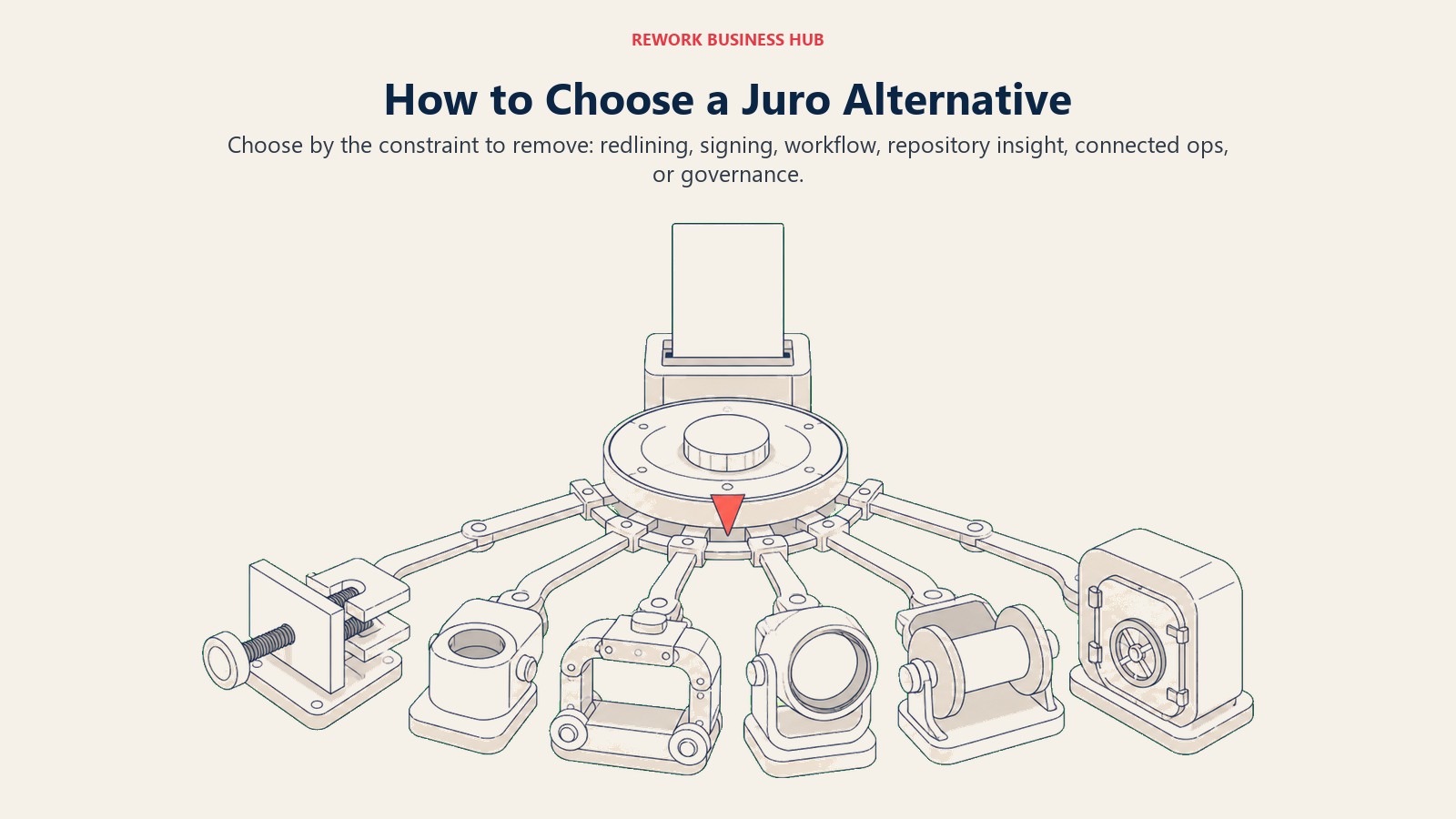
Choose the capability gap that is actually forcing the switch, then match it to the platform built deepest for that need instead of ranking every vendor on one generic score.
| If you need... | Best pick |
|---|---|
| Contracts tied to CRM, sales, and cross-team ops on one platform | Rework |
| Clause-level redlining and multi-round negotiation depth | Ironclad |
| A lightweight tool for standard proposals, not negotiated contracts | PandaDoc |
| Lifecycle management on top of an existing DocuSign eSignature setup | DocuSign CLM |
| A fully configurable no-code data model for non-standard workflows | Agiloft |
| AI-driven analytics across a growing contract repository | LinkSquares |
| Fortune 500-scale governance and compliance depth | Icertis |
| Contract generation triggered directly from Salesforce Opportunities | Conga CLM |
| AI contract intelligence layered on an existing Workday deployment | Workday CLM (formerly Evisort) |
| A simple, flat-rate contract repository without workflow complexity | ContractWorks |
| Contract data turned into commercial intelligence across departments | Malbek |
| AI-native review built specifically for in-house legal | SpotDraft |
| Transparent, published pricing for an SMB or mid-market team | Concord |
Frequently Asked Questions about Juro Alternatives
What's the biggest reason teams look for alternatives to Juro?
Pricing predictability is the most common trigger. Juro's quote-only, volume-based model makes cost hard to forecast as volume grows, and its redlining stops at document-level accept-or-reject rather than clause-by-clause negotiation. Template rigidity at scale and Word formatting friction round out the list.
How much does a typical Juro alternative cost per year?
It varies more by billing model than brand. Published, packaged tools like Concord start around $499/mo for 5 users, billed annually. Most enterprise CLM platforms, including Juro itself, are quote-only, with third-party analyses reporting Juro deployments from roughly $15,000 to $60,000-plus per year, and enterprise platforms like Icertis reaching six figures.
Which Juro alternative is easiest to set up without a legal ops function?
ContractWorks and Concord are both built for fast, largely self-serve setup, with ContractWorks focused on repository simplicity and Concord's flat, published pricing removing the sales-cycle delay. PandaDoc is simplest if the real need is signing standard documents, not negotiating contracts.
Which alternative fits a team that wants contracts tied to CRM and other business ops, not just legal?
Rework is the option here. Its Contract module keeps agreements on the same contact timeline as CRM, sales, Work Ops, and People (HR) data, something none of the dedicated legal CLM tools on this list attempt; they're built to stand alone as legal systems, the same way Juro is.
What happened to Evisort?
Workday acquired Evisort in a deal that closed in late 2024. Its AI engine now powers Workday Contract Lifecycle Management and Workday Contract Intelligence, sold as modules inside the Workday platform, not as a standalone CLM startup. It only makes sense as a Juro alternative for a company already on Workday.
Does it make sense for a small legal team to switch straight to Icertis-level platforms?
Rarely. Icertis is built for Fortune 500-scale governance, with pricing reported from $150,000 to $500,000-plus per year and implementations running 6 to 12 months. A team that has outgrown Juro is usually better served by Ironclad, LinkSquares, or Agiloft first.
When does it make sense to stay on Juro instead of switching?
Juro remains a strong choice for a fast-growing company that values implementation speed and a low-overhead admin footprint over deep negotiation tooling, and whose contract volume hasn't outpaced its template model yet. Teams that need more redlining depth, tighter CRM integration, or predictable flat pricing are the ones this guide is for.
What to Do Next
Pick two tools based on which part of Juro is actually costing you time today, not which demo looks best. If redlining depth is the pain, put Ironclad and Agiloft head to head against a real negotiated contract, not a template NDA. If it's pricing predictability, trial Concord's published tiers against your next Juro quote.
If your actual problem is that contracts, CRM records, and internal approvals live in separate systems, start with Rework. Pricing for Contract is quoted per organization; see rework.com/pricing. For the wider contract management landscape beyond this list, the Best Contract Management Software in 2026 roundup covers additional categories. If the shortlist has already narrowed to two, Juro vs PandaDoc settles that pair directly.

Principal Product Marketing Strategist
On this page
- Key Facts
- Quick Comparison Table
- Stage Fit Matrix
- Sizing and Persona Table
- 1. Ironclad: The Redlining Depth Juro Doesn't Have
- 2. PandaDoc: Simple Proposals, Not Negotiated Contracts
- 3. DocuSign CLM: Lifecycle Management on Top of eSignature You Already Use
- 4. Agiloft: No-Code Configurability for Non-Standard Contracts
- 5. LinkSquares: AI-Driven Analytics Once the Repository Gets Big
- 6. Rework: CRM, Contracts, and Ops on One Platform
- 7. Icertis: Fortune 500 Governance at Massive Scale
- 8. Conga CLM: Contract Generation Triggered From Salesforce
- 9. Workday CLM (formerly Evisort): Enterprise AI Inside a Workday Deployment
- 10. ContractWorks: A Flat-Rate Repository for Small Teams
- 11. Malbek: Contract Data as Business Intelligence
- 12. SpotDraft: AI-Native Review for In-House Legal
- 13. Concord: Transparent, Published Pricing for SMB Teams
- Why Teams Look Beyond Juro
- How to Choose: Decision Framework
- What to Do Next