Best LinkSquares Alternatives in 2026: 12 Contract Management Tools for Growing Legal Teams
Turn this article into takeaways for your work.


Each assistant summarizes the article only for you and suggests best practices for your work.
If your bottleneck is pre-signature, meaning contract intake, approval routing, and Word-based redlining, Ironclad is the strongest LinkSquares alternative, with ContractPodAi (Leah), Agiloft, and Sirion close behind for enterprises that want deeper AI or configurability layered over the whole contract lifecycle. That framing matters because LinkSquares earns its reputation honestly: its Analyze module is one of the fastest ways to point AI at a legacy pile of executed contracts and get usable metadata back out, and it holds a 4.7 out of 5 rating across 427 G2 reviews, with a Leader badge in G2's Summer 2026 Grid Report for Contract Lifecycle Management.
Teams don't usually leave LinkSquares because it's broken. They leave because the job changed shape: what started as "get our old contracts organized" becomes "route every new contract through intake, legal review, and multi-stage approval before it's ever signed," and that's a workflow-first problem LinkSquares' younger Finalize product wasn't built to lead on. This guide covers 12 alternatives, evaluated on pre-signature workflow depth, pricing transparency, and AI maturity, including Rework for teams that want contracts living on the same record as the deal and the customer.
Figures marked "reported" come from third-party pricing analyses and named sources, since most CLM vendors in this category don't publish rates.*
Key Facts
Contract Management Software and the Legal Ops Shift
- The global CLM software market was worth $3.39 billion in 2026 and is projected to reach $6.26 billion by 2031, a 13.06% compound annual growth rate. (Mordor Intelligence, 2026)
- Poor contract management leaks roughly 11% of contract value after signature, according to World Commerce & Contracting research conducted with Ironclad. (Procurement and Supply / PASA, 2026)
- 87% of general counsel now report using AI within their legal teams, up from 44% a year earlier. (FTI Consulting and Relativity General Counsel Report, 2026)
- Lawyers using AI contract review report saving an average of 14 hours per week and a 14% reduction in outside counsel spend. (GC AI customer survey, December 2025)
- LinkSquares holds a 4.7 out of 5 rating across 427 G2 reviews, with pricing transparency flagged as a recurring theme in buyer feedback.
Quick Comparison Table
| Tool | Best For | Starting Price | Key Strength | Key Limitation |
|---|---|---|---|---|
| Ironclad | Sales-driven pre-signature workflow + CPQ-to-CLM | Custom quote, no published price | Deepest workflow designer and Word-based redlining in the category | No public pricing, no free trial |
| DocuSign CLM | Teams already running DocuSign eSignature | Custom quote (reported $10K-$100K+/yr depending on scale) | Seamless eSignature-to-CLM handoff, 100+ AI extraction models | Most expensive option in the category (reported) |
| Agiloft | Complex, non-standard workflows across legal and procurement | Custom quote, no published price | Most configurable no-code CLM platform in the category | Slow implementation; customization needs technical upkeep |
| Conga CLM | Salesforce-native quote-to-contract at enterprise scale | Custom quote (reported ~$360-$889/user/yr, roughly $15K-$60K+/yr standalone) | Deepest native Salesforce document generation | Modular add-on pricing, steep learning curve |
| Juro | Fast-growing mid-market teams (Series B to D) | Custom quote (reported $15K-$60K+/yr) | Browser-native editing, unlimited users on every plan | Integration ecosystem thinner than legacy CLMs |
| Rework | CLM living on the same record as the deal and the customer | Quote on request (rework.com/pricing) | Contracts, CRM, and Work Ops share one contact timeline | Not built for clause-level AI redlining or deep obligation tracking |
| ContractPodAi (Leah) | Global enterprises wanting agentic AI across legal, procurement, finance | Custom quote (reported $50K-$200K+/yr) | Agentic OS extends past CLM into broader legal-ops automation | Enterprise-first design, heavy implementation lift |
| Concord | SMB and mid-market teams (200-2,000 contracts/yr) wanting ease of use | $499/mo, 5 users, billed annually (concord.app/pricing) | Google Docs-style editor, transparent published pricing | Interface reads dated to some reviewers at higher volume |
| SpotDraft | Startups to mid-market teams with a legal ops function | Custom quote (reported $5K-$50K+/yr) | Legal intake workflow keeps requests off legal's desk | Credit system can be unclear; overkill pre-legal-ops |
| Gatekeeper | Lean finance, procurement, and legal teams managing vendor risk | Quote-only; tiers set by third-party quota, no published price | Vendor, contract, and spend risk in one connected view | Lighter on core drafting and redlining than a dedicated CLM |
| ContractSafe | Small teams whose core problem is scattered contracts | Reported $450/mo, Organize tier, 100 or fewer contracts, annual (SignEasy) | Simple repository, unlimited users, fast to adopt | No workflow, negotiation, or AI-analytics depth |
| Icertis | Fortune 500 and mega-enterprise, $500M+ in contract spend | Custom quote (reported ~$88K median ACV, $150K-$500K+/yr at scale) | Deepest SAP and Oracle integration, FedRAMP-authorized | 6-12 month implementation, priciest at true enterprise scale |
| Sirion | Enterprises prioritizing post-signature obligation management | Quote-only, no public pricing page | Agentic AI for obligation tracking and supplier performance | Less accessible for mid-market or early CLM maturity |
1. Ironclad: The Deepest Pre-Signature Workflow in the Category
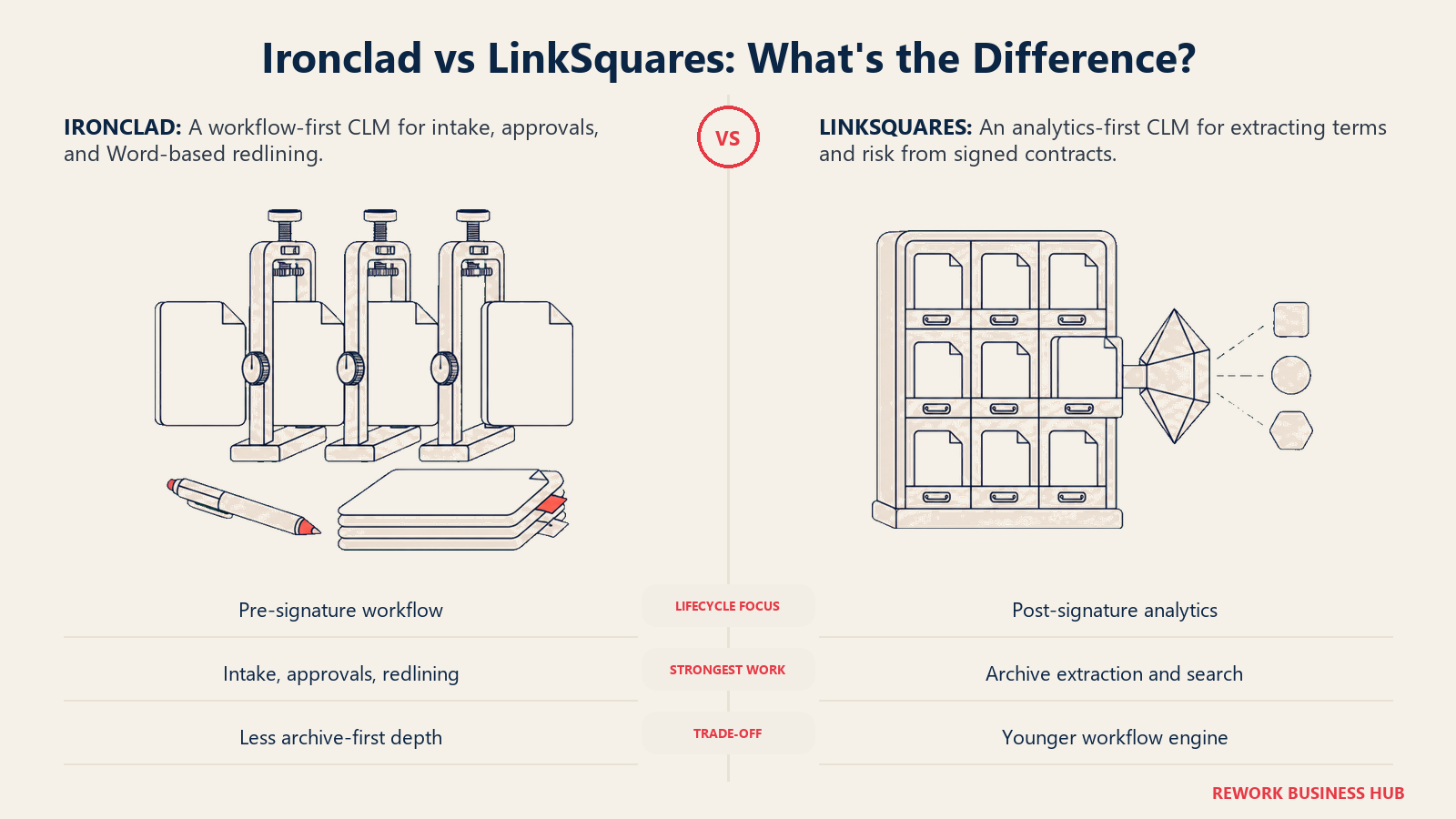
Ironclad and LinkSquares grew up on opposite ends of the contract lifecycle. Ironclad started as a workflow engine for contract creation and approval, the front end. LinkSquares started as an AI-driven repository for executed contracts, the back end. Both have grown into each other's territory since, but the DNA still shows: Ironclad's Workflow Designer remains the reference point for routing, conditional approvals, self-service intake, and Word-based redlining with real version control.
| What you get | What you don't |
|---|---|
| The category's most mature workflow builder for approvals and intake | Published pricing before a sales conversation |
| Deep Word integration for negotiation and redlining | A free trial to test before committing |
| A mature CPQ-to-CLM flow for Salesforce-driven sales contracts | A fast, self-serve setup |
| Strong clause libraries and playbook enforcement | LinkSquares' depth on an existing executed-contract archive |
Pricing: No public pricing. Ironclad quotes based on which products you choose (CLM, AI assistant, eSignature), support level, and add-ons like APIs or extra instances. No free trial is advertised. (ironcladapp.com/pricing)
Best for: Teams whose bottleneck is pre-signature: contract intake, multi-stage approvals, redline negotiation, and Salesforce-driven sales velocity. See the best Ironclad alternatives guide if Ironclad's own pricing or implementation lift is the sticking point instead. Not ideal for: Teams whose real problem is visibility into a large existing contract base; that's LinkSquares' strength, not Ironclad's starting point.
2. DocuSign CLM: For Teams Already Living in DocuSign eSignature
DocuSign folded its CLM product (originally SpringCM) into the broader Docusign IAM (Intelligent Agreement Management) platform. The pitch is straightforward: if your company already signs everything through DocuSign, extending that same account into contract lifecycle management removes a second login and a second vendor relationship.
| What you get | What you don't |
|---|---|
| Zero-friction handoff from contract generation to eSignature | A budget-friendly starting point; it's the priciest tool here (reported) |
| 100+ pre-trained AI models for clause and risk extraction | A short learning curve; complex workflows need dedicated admin time |
| A genuinely flexible workflow engine with conditional logic | Fast implementation; expect a multi-month rollout |
| Deep Salesforce, SAP Ariba, and Coupa integrations | The simplicity DocuSign's eSignature-only product is known for |
Pricing: No published pricing. DocuSign directs prospects to a sales conversation for CLM/IAM. Third-party reviewers consistently flag it as the most expensive tool in this category (reported), and it scores 4.5 out of 5 on G2 and 4.7 out of 5 on Capterra. (docusign.com/products/clm)
Best for: Mid-to-large enterprises already standardized on DocuSign eSignature that want end-to-end contract automation and audit trails without adding a new vendor. Ironclad vs DocuSign CLM works out the tradeoff if you're weighing these two head to head. Not ideal for: Teams that only need e-signature, not full CLM; the best DocuSign alternatives guide covers that lighter-weight comparison separately.
3. Agiloft: The Most Configurable No-Code CLM
Agiloft's pitch is flexibility: a no-code platform that lets legal, procurement, and operations teams build and modify their own workflows without waiting on a developer. For organizations with genuinely non-standard contract processes, that configurability is hard to match anywhere else on this list.
| What you get | What you don't |
|---|---|
| The most configurable no-code platform in the CLM category | A fast time to value; expect weeks to months of configuration |
| Drag-and-drop integration with 1,000+ business systems | Zero-code maintenance; customized workflows often need technical upkeep |
| Strong fit for complex, non-standard legal and procurement processes | A good ROI case under roughly 100 contracts a year |
| Automated approvals that reduce errors as volume scales | Simplicity for small firms or solo practitioners |
Pricing: No public pricing. Agiloft's site points to a "Get Pricing" contact flow and demo request rather than published tiers. (agiloft.com/pricing)
Best for: Enterprise legal, procurement, and operations teams with complex, non-standard workflows who want to configure the system themselves rather than wait on vendor roadmap requests. See the best Agiloft alternatives guide if that configuration burden turns out to be the problem, not the solution. Not ideal for: Small teams or low contract volume; the customization depth that makes Agiloft powerful also makes it slow to stand up.
4. Conga CLM: Salesforce-Native Quote-to-Contract
Conga's contract management lives inside Salesforce, and for RevOps and legal teams already running deep Salesforce CPQ, that proximity is the whole pitch. Quotes, contracts, and approvals stay in the same environment sales reps already work in daily.
| What you get | What you don't |
|---|---|
| The deepest native Salesforce document generation and CLM on this list | A modern interface; reviewers describe it as dated |
| Contract requests, drafting, approvals, and renewals in one system | Simple pricing; add-on creep and renewal surprises are common complaints |
| Strong fit for complex quote-to-contract operations | A short learning curve outside a Salesforce admin skill set |
| Enterprise-scale reliability inside an existing Salesforce investment | Standalone value if you ever leave or dual-run CRMs |
Pricing: No public pricing. Conga's pricing page routes to a "Get Conga Pricing" contact form rather than listing tiers. Implementation costs are commonly reported to rival the license fee itself. (conga.com/pricing)
Best for: Large enterprises already standardized on Salesforce that want contract generation and CLM to live close to the CRM sales reps already use. Not ideal for: Teams outside the Salesforce ecosystem; Conga's core value proposition weakens fast once you're not running Salesforce as the system of record.
5. Juro: Browser-Native Speed for Mid-Market Teams
Juro skips the Word-document workflow that most CLM tools are still built around. Contracts are created, negotiated, and signed inside the browser with real-time collaboration, which is a meaningfully different experience for teams used to emailing redlined Word files back and forth.
| What you get | What you don't |
|---|---|
| A browser-native editor with real-time collaborative redlining | The deepest legacy-system integrations; the ecosystem is newer |
| Unlimited users and unlimited workflows on every plan | An AI-first architecture; Juro's AI is supplementary, not foundational |
| One of the fastest implementation timelines in the category | Robust handling of complex, heavily formatted legacy Word contracts |
| A 4.7 out of 5 G2 rating with strong marks for ease of use | Practice-management features like matter tracking or billing |
Pricing: No published tiers; Juro prices by contract volume and integration complexity, with all basic integrations (Slack, Google Drive, Companies House) included and unlimited users on every plan. Third-party pricing analysis reports a $15,000-$60,000/yr range depending on scale. (juro.com/pricing; range reported by Bind Legal)
Best for: Series B to D technology companies and fast-growing commercial teams managing roughly 100-300 contracts a year that want speed and cross-team adoption over deep customization. Not ideal for: Teams with heavy legacy Word formatting to import, or those wanting AI as the platform's core architecture rather than an add-on layer.
6. Rework: Contracts on the Same Record as the Deal
Rework is the relevant comparison when the real problem isn't LinkSquares' workflow maturity, it's that contracts, the deal that produced them, and the customer relationship all live in separate systems. Rework's Contract module keeps agreements on the same contact timeline as CRM/Sales, Lead Management, and Work Ops, so a sales-driven or ops-heavy team gets one record per customer instead of a CRM deal that links out to a disconnected CLM.
| What you get | What you don't |
|---|---|
| Contracts attached to the same customer record as the deal, not a separate silo | Clause-level AI redlining or a dedicated negotiation workspace |
| CRM, Lead Management, and Work Ops on the same platform as Contract | Deep post-signature obligation tracking or supplier performance analytics |
| Multi-channel inbox (WhatsApp, Messenger, live chat) on the same contract-linked record | A standalone legal-team product; it's built for cross-functional teams |
| Packaged pricing, not a per-seat CLM sticker price | Legal-grade clause libraries or playbook enforcement at Ironclad's depth |
Pricing: Rework does not publish a price for the Contract module. Rework sells packaged plans, not per-seat licenses, and Contract is quoted per organization. See rework.com/pricing for the published product lines, or ask the team for a Contract quote.
Best for: Mid-size teams (roughly 10-200 people) where contracts, deals, and customer history need to live together, and where consolidating tools matters more than legal-grade CLM depth. Not ideal for: Legal teams needing clause-level AI redlining, formal obligation management, or the kind of deep post-signature analytics that LinkSquares itself is genuinely strong at. That's a real gap, not a marketing footnote.
7. ContractPodAi (Leah): Agentic AI Beyond CLM
ContractPodAi rebranded to Leah in 2026 and repositioned around "agentic" AI, meaning AI agents that execute multi-step workflows across legal, procurement, and finance rather than just flagging clauses for a human to review. It's the most ambitious platform on this list in terms of scope.
| What you get | What you don't |
|---|---|
| Agentic AI that executes workflows, not just flags risk for review | A fit for smaller legal teams needing a simple review tool |
| An Agentic OS that extends past CLM into broader legal-ops automation | A quick or inexpensive implementation |
| 15 years of end-to-end CLM depth behind the newer agentic layer | The most cutting-edge frontier agentic workflows; pure-play AI vendors push harder there |
| Strong fit for global enterprises with legal, procurement, and finance in scope | Simplicity; UI complexity is a recurring friction point in reviews |
Pricing: No published pricing. Third-party analysis reports mid-market deployments starting around $50,000/yr with enterprise deals reaching $200,000+/yr, and full enterprise deployments (with implementation and training) landing between $150,000 and $500,000+ annually. (Bind Legal; CheckThat.ai)
Best for: Global enterprises that want AI agents automating work across legal, procurement, and finance, not just a smarter contract repository. Not ideal for: Smaller legal teams that need a straightforward review or extraction tool; the enterprise-first design and cost don't pay back at that scale.
8. Concord: The Easiest CLM to Actually Adopt
Concord is built for the SMB and mid-market reality, not the enterprise fantasy. The editor looks and feels like Google Docs, templates are simple to build, and the platform is one of the few in this category that publishes real prices instead of routing everyone to a demo.
| What you get | What you don't |
|---|---|
| Transparent, published pricing you can check before a sales call | The deepest AI extraction on this list |
| A Google Docs-style editor that non-legal staff can use without training | Advanced customization on the entry tiers |
| Unlimited e-signatures and documents on every plan | A modern-feeling interface at higher volume, per some reviewers |
| Responsive support, frequently cited as a strength in reviews | Clause libraries or subsidiary management below the Enterprise tier |
Pricing: Essentials $499/mo (5 users included, $49/mo per additional user); Business $899/mo (5 users included, $69/mo per additional user, adds approval workflows and integrations); Enterprise $1,299/mo (5 users included, $89/mo per additional user, adds clause library and custom branding). All billed annually. (concord.app/pricing)
Best for: Growing businesses managing roughly 200-2,000 contracts a year that want genuine ease of use and transparent pricing without enterprise CLM overhead. Not ideal for: Enterprises with complex, multi-department approval chains; Concord deliberately trims features that would slow a smaller team down.
9. SpotDraft: Legal Intake That Keeps Requests Off Legal's Desk
SpotDraft's standout feature is its intake workflow: business users submit contract requests through a structured form instead of a Slack message or a hallway conversation, which keeps legal's queue organized as request volume grows.
| What you get | What you don't |
|---|---|
| A legal intake workflow that structures incoming requests | Full transparency on pricing before a sales call |
| AI-driven contract extraction and review alongside a central repository | Deep customization for complex, multi-department global workflows |
| Integrations with Salesforce, HubSpot, Slack, and Google Drive | A frictionless fit for startups without a legal ops function yet |
| A track record spanning fast-growing startups to global enterprises | Full clarity on how the credit-based pricing system scales |
Pricing: No published pricing. SpotDraft prices by user count or contract volume, with implementation, workflow setup, integrations, and 24/7 support included at no extra cost in every plan. (spotdraft.com/pricing)
Best for: Startups to mid-market companies that already have (or are building) a legal ops function and want contract requests to stop overwhelming legal directly. Not ideal for: Very early-stage startups without dedicated legal ops resources; reviewers flag the implementation lift as more than pre-legal-ops teams need.
10. Gatekeeper: Vendor Risk and Contracts in One View
Gatekeeper isn't trying to out-draft Ironclad or out-extract LinkSquares. It's built for lean finance, procurement, and legal teams that need every vendor, contract, obligation, renewal, and dollar of spend visible in one connected platform, closer to vendor risk management than pure CLM.
| What you get | What you don't |
|---|---|
| Vendor, contract, obligation, and spend risk in one connected view | The deepest contract drafting or redlining tools on this list |
| Automated renewal and deadline notifications | Unlimited customization; new features often require an Ideas Forum vote |
| Unlimited contracts, users, and eSign licenses on every tier | A simple learning curve; the UI can feel dense for new users |
| Strong fit across financial services, healthcare, and insurance | Manual data-summary uploads at scale for small legal teams |
Pricing: No public pricing. Tiers (Pro, Enterprise, Enterprise Plus) are set by third-party vendor quota rather than dollar amount, with pricing available only after a scoped demo. (gatekeeperhq.com/pricing)
Best for: Lean finance, procurement, or legal teams whose core pain is vendor and third-party risk visibility, not contract drafting depth. Not ideal for: Teams whose primary need is negotiation, redlining, or AI-driven clause extraction; Gatekeeper is closer to vendor management than a drafting-first CLM.
11. ContractSafe: A Simple Repository, Not a Full CLM
ContractSafe doesn't try to be a workflow engine or an AI analytics platform. It's a lightweight, searchable repository with automated renewal alerts, built for teams whose actual problem is scattered contracts and missed renewal dates, not contract creation or negotiation.
| What you get | What you don't |
|---|---|
| A genuinely simple interface with a short learning curve | Contract creation, negotiation, or e-signature workflows built in |
| Unlimited users at every tier, no per-seat pricing | AI-powered risk flagging or deep analytics; that's LinkSquares' territory |
| Automatic OCR and custom-field search across your archive | Value if you're managing under roughly 20 contracts |
| Consistently praised, responsive customer support | Enterprise-grade workflow or approval routing |
Pricing: Reported at $450/mo for the Organize tier (100 or fewer contracts, billed annually), scaling to $1,630/mo at 10,000+ contracts; Finalize adds e-signature and approval workflows from a reported $660/mo; Maximize adds lifecycle tracking and Salesforce integration from a reported $815/mo. Unlimited users on every tier. ContractSafe's own pricing page requires selecting a contract-volume bracket to display a number. (signeasy.com/blog/business/contractsafe-pricing; vendor page: contractsafe.com/pricing)
Best for: Small teams whose main problem is scattered contracts and missed renewals, not contract creation, negotiation, or AI analytics. Not ideal for: Teams wanting workflow, negotiation, e-signature, or AI-powered analytics; ContractSafe's own comparisons point buyers to Concord, Ironclad, or LinkSquares itself for those needs.
12. Icertis: Fortune 500-Scale Contract Intelligence
Icertis operates at a different altitude than most of this list. It's built for organizations spending hundreds of millions to billions of dollars through contracts, with the deepest SAP and Oracle integrations in the category and compliance credentials, including FedRAMP authorization, that matter for government and heavily regulated work.
| What you get | What you don't |
|---|---|
| The deepest ERP integration (SAP, Oracle) available in a CLM | An implementation measured in weeks; expect 6-12 months |
| Advanced AI-driven contract analytics at enterprise scale | A budget that fits mid-market; pricing runs well above category average |
| FedRAMP authorization plus HIPAA, GDPR, and CCPA compliance credentials | A modern-feeling interface; reviewers describe it as dated |
| Proven scale across Fortune 500 procurement and legal organizations | Fast time to value for a smaller legal team |
Pricing: No public pricing page. Third-party analysis reports a median annual contract value around $88,000, with first-year total cost of ownership (licensing, implementation, and training) commonly landing between $100,000 and $300,000, and pricing running roughly 34% above the CLM market average per G2 data. (hyperstart.com/blog/icertis-pricing)
Best for: Fortune 500 and mega-enterprise procurement and legal organizations with $500M+ in contract spend that need AI-powered compliance, risk, and commercial intelligence at scale. See the best Icertis alternatives guide if that price and implementation timeline don't fit. Not ideal for: Mid-market teams; the implementation cost and timeline rarely pay back below true enterprise scale.
13. Sirion: Agentic AI for Post-Signature Obligation Management
Sirion competes closest to LinkSquares on paper, both lean into AI-driven post-signature work, but Sirion goes further into obligation management and supplier performance tracking with an agentic AI layer built specifically for enterprises managing complex, high-value contracts after signature.
| What you get | What you don't |
|---|---|
| Agentic AI purpose-built for obligation tracking and supplier performance | A public pricing page; every quote is custom |
| Strong integration with existing ERP and CRM systems | Easy accessibility for mid-market or early CLM-maturity teams |
| High marks for contract authoring, negotiation, and analytics in industry evaluations | A short implementation; expect an enterprise-grade rollout |
| A collaborative UI that legal, procurement, and finance can share | Simplicity; the configurability that makes it powerful adds setup time |
Pricing: No public pricing page. Sirion is priced as enterprise-grade software with a custom quote based on contract volume and modules selected; implementation timelines are commonly reported in the 3-6 month range.
Best for: Enterprises that care most about what happens after signature: obligation tracking, supplier performance, and risk management on high-value, complex contracts. Not ideal for: Mid-market teams earlier in their CLM maturity; the configurability and price point are built for organizations with dedicated contract-ops resources.
Why Teams Outgrow LinkSquares
LinkSquares built a genuinely strong product for one half of the contract lifecycle. Most teams that leave aren't leaving because the tool is bad. They're leaving because the job in front of them moved to the other half.
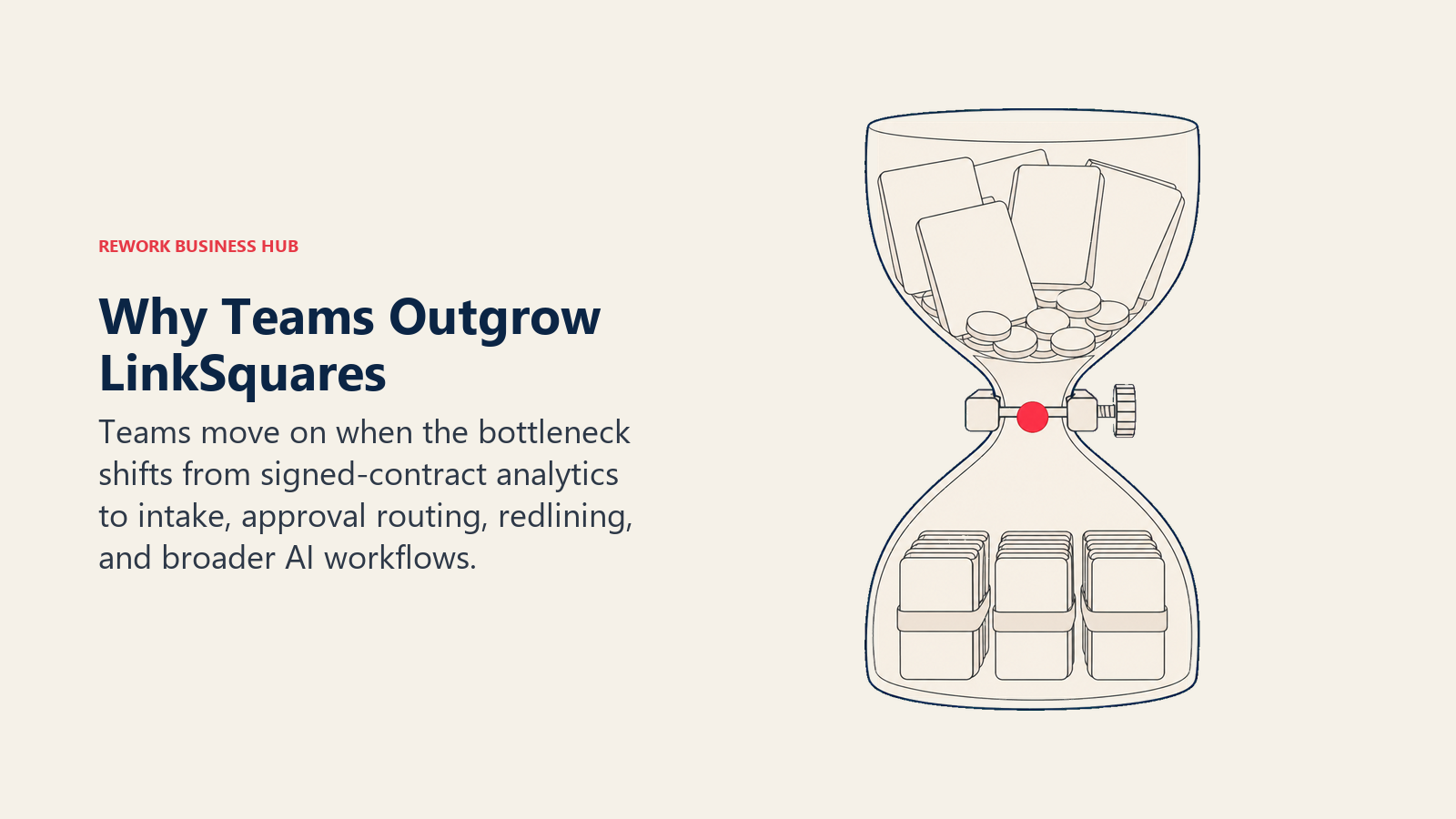
The Analyze module is the real draw, and it stays the real draw. LinkSquares' AI extraction, Smart Tags, and Smart Values (user-defined custom extraction points) genuinely eliminate the "triage" phase that quietly swallows hours before contract review even starts. That's why LinkSquares holds a 4.7 out of 5 rating across 427 G2 reviews and a Leader badge in G2's Summer 2026 Grid Report. None of the alternatives on this list beat that specific job outright.
Pre-signature workflow is where the friction shows up first. LinkSquares has a workflow product (Finalize), but it's newer and less battle-tested than Ironclad's Workflow Designer or Agiloft's no-code configuration engine. Once a team needs real intake forms, conditional approval chains, and self-service request routing for contracts that haven't been signed yet, LinkSquares starts to feel like the wrong tool for the next problem, not because Analyze got worse, but because the job changed.
AI adoption in legal is outpacing most legal departments' tooling. 87% of general counsel now report using AI within their teams, up from 44% a year earlier, per the FTI Consulting and Relativity General Counsel Report, and lawyers using AI contract review save an average of 14 hours a week per GC AI's December 2025 survey. That pace is pulling legal teams toward agentic AI (ContractPodAi/Leah, Sirion) or deeper workflow automation (Ironclad, Agiloft) faster than a single analytics-first tool can stretch to cover.
Pricing transparency is a recurring complaint, not a dealbreaker on its own. LinkSquares' custom pricing model is standard for this category, nearly every tool here quotes the same way, but G2 and Capterra reviewers consistently flag it as a consideration worth planning for, especially when sizing a multi-year contract against budget.
Value leakage after signature is the industry-wide problem underneath all of this. Poor contract management leaks roughly 11% of contract value once deals move into delivery, per World Commerce & Contracting research conducted with Ironclad. LinkSquares addresses that leakage from the analytics side; most alternatives here address it by fixing what happens before the contract is ever signed.
How to Choose: Decision Framework
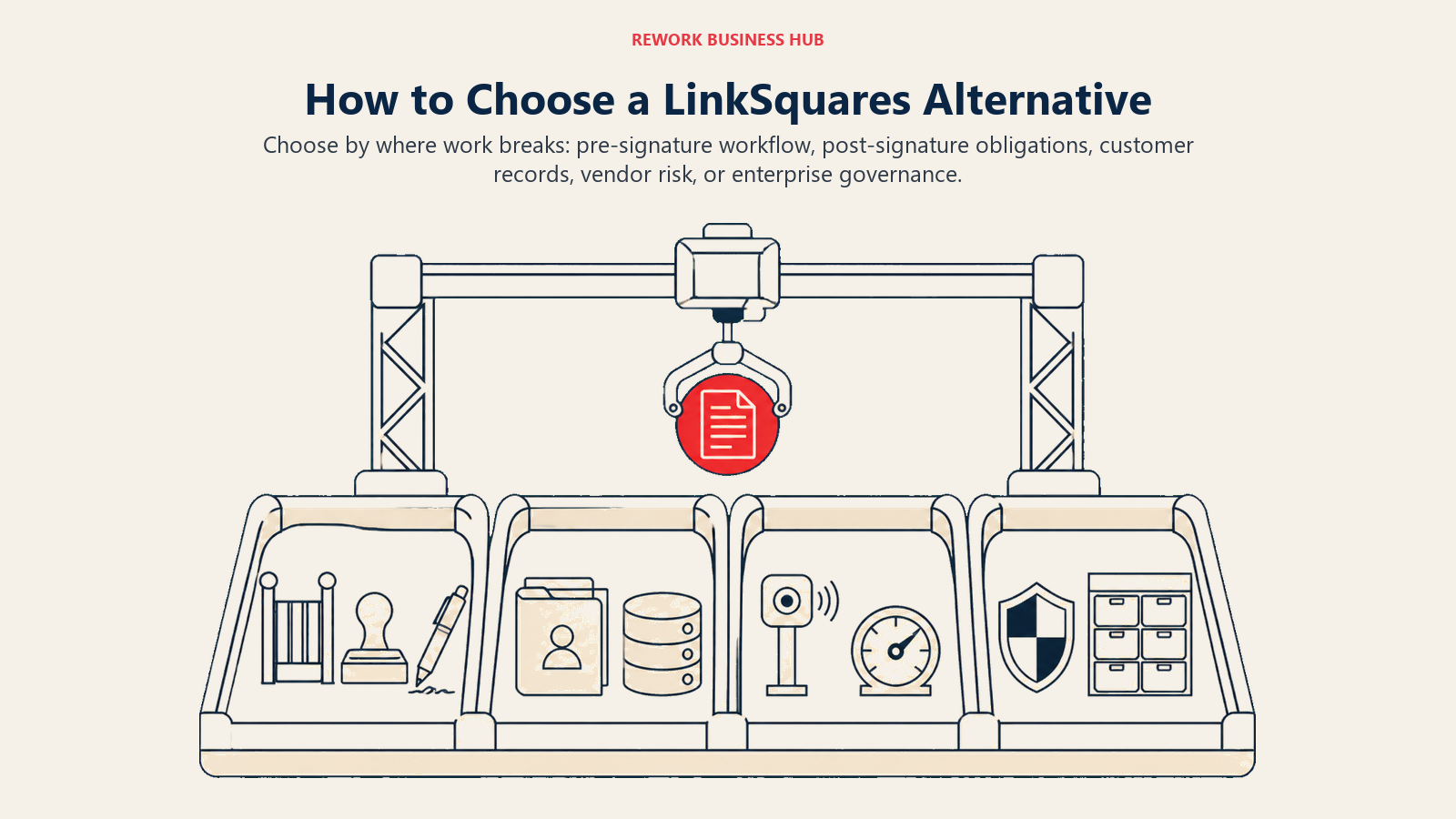
The best replacement depends on where the contract lifecycle breaks: before signature, after signature, across the customer record, or at enterprise governance scale.
| If you need... | Best pick |
|---|---|
| The deepest pre-signature workflow, approvals, and redlining | Ironclad |
| CLM tied to a DocuSign eSignature account you already run | DocuSign CLM |
| Fully configurable no-code workflows for non-standard processes | Agiloft |
| Contract management living inside Salesforce | Conga CLM |
| Browser-native speed for a fast-growing mid-market team | Juro |
| Contracts on the same record as the deal and the customer | Rework |
| Agentic AI automating legal, procurement, and finance workflows | ContractPodAi (Leah) |
| Transparent published pricing and genuine ease of use | Concord |
| A structured intake workflow to keep requests off legal's desk | SpotDraft |
| Vendor and third-party risk visibility alongside contracts | Gatekeeper |
| A simple repository fix for scattered contracts and missed renewals | ContractSafe |
| Fortune 500-scale ERP integration and compliance depth | Icertis |
| Agentic obligation management and supplier performance tracking | Sirion |
Frequently Asked Questions about LinkSquares Alternatives
What's the single biggest reason teams look for a LinkSquares alternative?
The bottleneck moves upstream. LinkSquares excels at mining an existing contract archive for terms and risk, but once a team needs real pre-signature workflow, intake forms, conditional approvals, redline negotiation, tools like Ironclad or Agiloft are built to lead there instead.
Is LinkSquares actually good at what it does?
Yes. It holds a 4.7 out of 5 rating across 427 G2 reviews and earned a Leader badge in G2's Summer 2026 Grid Report for Contract Lifecycle Management. Its AI extraction (Analyze, Smart Tags, Smart Values) is a genuine strength.
How much does a typical LinkSquares alternative cost?
Most vendors in this category, including LinkSquares itself, don't publish pricing; expect a custom quote scaled to users, contract volume, and modules. The exceptions are Concord (published tiers from $499/mo) and ContractSafe (reported from around $450/mo), both priced closer to SMB software than enterprise CLM.
Which alternative is closest to LinkSquares' actual strength, post-signature AI analytics?
Sirion and ContractPodAi (Leah) both lean into AI-driven post-signature work, Sirion on obligation management and supplier performance, Leah's Agentic OS extending that automation into procurement and finance too.
When does it make sense to add a workflow tool instead of replacing LinkSquares outright?
If Analyze is still solving the post-signature problem well, some teams keep LinkSquares for analytics and add a workflow-first tool like Ironclad or Agiloft for intake and approvals, depending on how much volume is now pre-signature versus post-signature.
Does it make sense for a small team to jump straight to Icertis or Sirion?
Rarely. Both are built for Fortune 500-scale contract volume, with implementation timelines of 6-12 months (Icertis) or 3-6 months (Sirion) and pricing to match. Juro, SpotDraft, or Concord are the more realistic first move for a mid-market team.
Which alternative is best for a team that wants contracts and CRM data on the same record?
Rework is the only tool here built around that consolidation: contracts sit on the same customer timeline as the deal, CRM, and Work Ops. It's not a substitute for clause-level AI redlining or deep obligation management, but it removes the disconnect between a CLM and a separate CRM.
How is Rework different from a dedicated legal-grade CLM like Ironclad or Icertis?
Rework isn't trying to out-redline Ironclad or out-scale Icertis. It's the option for a team where the deal, the customer relationship, and the contract need to live in one system rather than three logins. Teams needing clause-level AI redlining or formal obligation management are better served by a dedicated CLM.
What to Do Next
Start by identifying which half of the lifecycle is actually causing pain today. If it's pre-signature, intake forms sitting in someone's inbox, approval chains tracked in a spreadsheet, redlines bouncing over email, trial Ironclad or Agiloft against your real approval workflow, not a canned demo. If it's still post-signature and LinkSquares just needs deeper obligation tracking, look at Sirion or ContractPodAi (Leah) before assuming a full replacement is necessary.
If your actual problem is that contracts, deals, and customer history live in three different systems, start with Rework. Contract pricing is quoted per organization; see rework.com/pricing. For the wider category landscape beyond this list, the Best Contract Management Software in 2026 roundup covers additional options and a fuller decision framework.

Principal Product Marketing Strategist
On this page
- Key Facts
- Quick Comparison Table
- 1. Ironclad: The Deepest Pre-Signature Workflow in the Category
- 2. DocuSign CLM: For Teams Already Living in DocuSign eSignature
- 3. Agiloft: The Most Configurable No-Code CLM
- 4. Conga CLM: Salesforce-Native Quote-to-Contract
- 5. Juro: Browser-Native Speed for Mid-Market Teams
- 6. Rework: Contracts on the Same Record as the Deal
- 7. ContractPodAi (Leah): Agentic AI Beyond CLM
- 8. Concord: The Easiest CLM to Actually Adopt
- 9. SpotDraft: Legal Intake That Keeps Requests Off Legal's Desk
- 10. Gatekeeper: Vendor Risk and Contracts in One View
- 11. ContractSafe: A Simple Repository, Not a Full CLM
- 12. Icertis: Fortune 500-Scale Contract Intelligence
- 13. Sirion: Agentic AI for Post-Signature Obligation Management
- Why Teams Outgrow LinkSquares
- How to Choose: Decision Framework
- What to Do Next