Tawk.to vs Olark vs Chatwoot: What Does Budget Live Chat Actually Cost in 2026?
Turn this article into takeaways for your work.


Each assistant summarizes the article only for you and suggests best practices for your work.
Olark has quietly repositioned its entire pricing page. The homepage no longer leads with the familiar $29-a-agent plan and a shelf of PowerUps. It now leads with Aiden, a new AI website agent priced at $400 a month billed annually ($4,800 a year), with the classic per-agent human chat plan pushed down the page as a secondary option. Both are real, current offers listed on Olark's own pricing page, and we cover both below. But the classic plan is still the one that fits this comparison's actual question, so that's the number we price against Tawk.to and Chatwoot throughout.
Tawk.to, Olark, and Chatwoot all get recommended in the same breath as "cheap live chat," and that's about where the similarity ends. Each one gets to cheap through a completely different business model, and the model matters more than the sticker price because it determines where the real cost shows up later.
Tawk.to is free because the software isn't the product. The company gives away unlimited agents and unlimited chat volume, then sells you branding removal, an AI layer, and its own staff to answer your chats for you. Olark is free of that trade entirely: it's a straightforward, paid, per-agent product that has quietly stayed in business since 2009 by doing one thing (a website chat widget) reliably, with a genuine accessibility record most competitors can't match. Chatwoot is free in a third way. The core software is open source (MIT licensed) and costs nothing to run, but "nothing" doesn't mean "free": you're trading a license fee for infrastructure, upgrades, security patching, and uptime, all of which you now own. Chatwoot will also sell you out of that trade with a cloud subscription, at which point you're back to paying for someone else's time instead of spending your own.
This piece prices all three honestly, including the parts that don't show up on the pricing page: what Tawk.to's "free" plan actually costs once you add the pieces a real deployment needs, what Chatwoot's self-hosted option actually costs once you count server, database, and your own labor, and how that compares to Olark's simple per-seat number at 3, 10, and 25 agents. It also covers what most comparisons skip: where your conversation data actually lives, whether you can leave with it, and what happens the day your one chat widget needs to become a shared inbox across email and social.
Key Facts: Tawk.to vs Olark vs Chatwoot
- Tawk.to's core live chat product is free with unlimited agents and unlimited chat volume; the company monetizes through paid branding removal ($29/month), an AI Assist chatbot (from $29/month), and hired human chat agents at $1/hour, per tawk.to's own pricing page.
- Olark's homepage now leads with Aiden, a new AI website agent priced at $400/month billed annually ($4,800/year) with one human seat included; its long-standing per-agent human-chat plan is still sold as a secondary option at $29/agent/month, both per Olark's own pricing page.
- Chatwoot's core codebase is MIT licensed and free to self-host with unlimited agents, but its Enterprise Edition (SSO/SAML, SLA policies, custom branding, Captain AI, and more) sits under a separate, proprietary license and costs $99 per agent per month whether you run it in Chatwoot's cloud or on your own servers, according to Chatwoot's own GitHub license file and its self-hosted pricing page.
- Olark's chatbox is documented as WCAG 2.1 AA and Section 508 conforming, with a third-party audit and letter of conformance from Accessible360, according to Olark's own accessibility page.
- Chatwoot's documented minimum production server spec is 4 CPU cores and 4GB of RAM, enough to run Postgres, Redis, and the app together and handle up to roughly 10,000 conversations a day, according to Chatwoot's own developer documentation.
TL;DR
| Dimension | Tawk.to | Olark | Chatwoot |
|---|---|---|---|
| Core model | Free forever, monetized through add-ons and hired agents | Flat per-agent SaaS (Classic plan), plus a new $400/month AI-first tier (Aiden) | Open source: free self-hosted, or a per-agent cloud subscription |
| Entry price | $0, unlimited agents | $29/agent/month (Classic) | $0 self-hosted (unlimited agents), or free for 2 agents on Chatwoot Cloud's Hacker tier |
| Realistic working cost | About $58/month flat once you add branding removal and entry-level AI, any team size | $29 times your agent count, every month | $19/agent/month on Cloud Startups, or your own server plus labor if self-hosted |
| Native multi-channel (email, WhatsApp, social) | Email and a knowledge base; no WhatsApp or social | No; live chat only | Yes, email, WhatsApp, Messenger, Instagram, SMS, Telegram, and more, even on the free self-hosted tier |
| AI chatbot | AI Assist, from $29/month, scales with message volume | Aiden, bundled only into the separate $400/month plan | Captain AI, 300 to 800 credits included depending on cloud tier, then $20 per 1,000 credits |
| Standout strength | Genuinely free core product, no seat cap, ever | WCAG 2.1 AA and Section 508 accessibility, independently audited | MIT-licensed core, full data ownership if you self-host |
| Real cost at 25 agents | About $696/year, flat regardless of headcount | About $8,700/year (Classic, per-seat) | About $5,700/year (Cloud Startups), or roughly $600 to $750/year in infrastructure plus your own labor (self-hosted) |
| Best for | Solo founders and tiny sites that need a widget, not a platform | Small teams that want one predictable line item and provable accessibility compliance | Teams with real DevOps capacity who want to own their data, or anyone who wants omnichannel without an enterprise-sized bill |
What Each Tool Is Actually Built For
These three don't compete for the same buyer with the same objection. Tawk.to's pitch is that the software costs nothing, full stop, and it makes its money on everything around the software. Olark's pitch is the opposite: a simple, honest, paid product with no free tier to distrust and no hidden monetization angle. Chatwoot's pitch is neither: it hands you the source code and lets you decide whether your time or your budget is the scarcer resource.
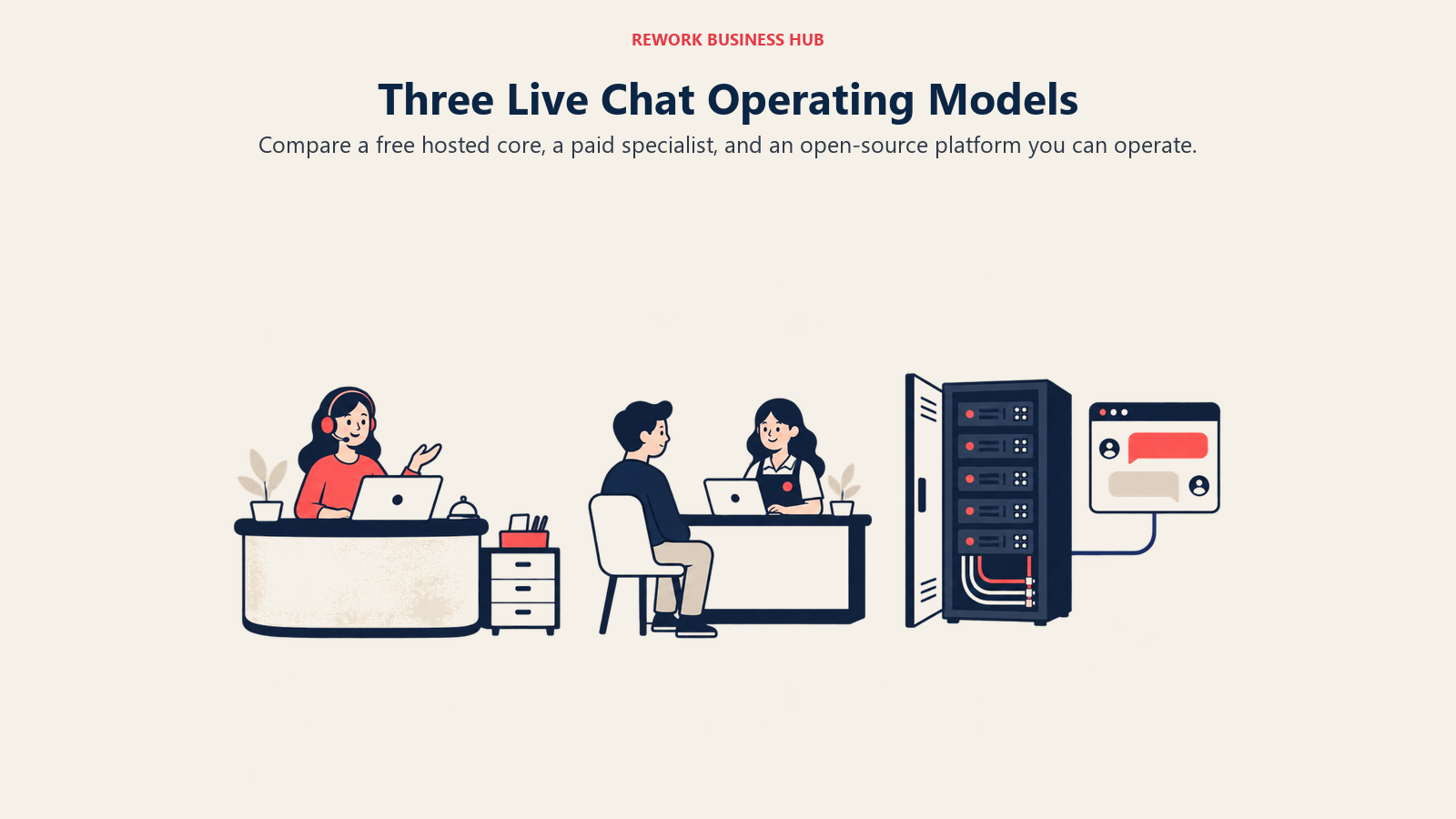
Tawk.to gives you a live chat widget, email ticketing, a hosted knowledge base, visitor analytics, and basic contact management, all for $0, with no agent limit and no message cap. That's not a stripped-down trial tier; it's the actual product, and it has been since the company's beginnings. The catch is structural, not contractual: a business that doesn't charge for its core product has to fund development somewhere else, and Tawk.to does that through paid branding removal, a metered AI layer, and a marketplace of hired human agents you can pay to staff your own chat. None of that is hidden, but it does mean the "free" plan is really a lead generator for a services business, which is worth knowing before you build a workflow around it.
Olark has been a straightforward paid product since 2009, and until recently that was the whole story: pay $29 an agent a month, get a reliable chat widget, add PowerUps if you want more. That story is still true today under what Olark now calls its Classic plan. What's new is Aiden, an AI website agent Olark now sells as its flagship offer at $400 a month, a genuinely different product built around unlimited AI-handled conversations rather than per-agent human chat. For a budget-focused team, the Classic plan is still the relevant comparison here: predictable, per-seat, no AI ambitions, and priced like the small, stable incumbent it has always been.
Chatwoot is the one open-source option in this set, and that changes the shape of the decision entirely. Self-host the Community Edition and the license costs nothing, forever, with no agent cap, because the core codebase is MIT licensed. What it costs instead is your own infrastructure: a server, a database, someone who can run Docker Compose and read an Nginx config, and an ongoing commitment to patch and upgrade it. Chatwoot will also sell you out of that commitment with a cloud subscription starting at $19 an agent a month, at which point you've simply moved the cost from your engineering time to a line item, which is a legitimate trade, just a different one than the "free" headline suggests.
| Tawk.to | Olark (Classic) | Chatwoot | |
|---|---|---|---|
| Sweet-spot buyer | Solo founder or tiny site needing a chat box with zero budget | Small support team that wants one predictable bill and no surprises | Team with DevOps capacity wanting full data control, or a budget buyer wanting real omnichannel |
| Company stage | Pre-revenue through small team | Small business through mid-market | Startup through mid-market, skews technical |
| What makes it a fit | You genuinely have no chat budget and can live with the trade-offs | You want simplicity, reliability, and accessibility compliance without add-on stacking | You have (or can hire) someone comfortable running a small production service |
| What breaks the fit | You need WhatsApp, social channels, or a support team big enough to need real automation | You need multi-channel messaging or any AI chatbot at the entry price | You have zero engineering capacity and no interest in a cloud subscription either |
Channel coverage is where the gap becomes concrete rather than philosophical. If your team's conversations are still 100% on your website, all three cover that job. The moment a customer messages you on WhatsApp or Instagram instead, only one of these three was actually built for that.
| Channel | Tawk.to | Olark (Classic) | Chatwoot (self-hosted or Cloud, Startups tier and up) |
|---|---|---|---|
| Web chat widget | Native | Native | Native |
| Email ticketing | Native | Not available | Native |
| Hosted knowledge base | Native | Not available | Native (Help Center) |
| Not native | Not native | Native | |
| Facebook Messenger | Not native | Not native | Native |
| Not native | Not native | Native | |
| SMS | Not native | Not native | Native |
| Telegram, LINE | Not native | Not native | Native |
| TikTok | Not native | Not native | Native |
| Voice | Not native | Not native | Business tier (cloud) or Enterprise Edition (self-hosted) |
Chatwoot's channel connectors live in the open core, not behind the gated enterprise license, so a self-hosted Community Edition install gets the same channel breadth as the paid cloud tiers. That's a genuinely unusual amount of native channel coverage to get at zero license cost, and it's the clearest argument for Chatwoot in this comparison if channel growth is the thing you're actually planning for.
Decision by Business Goal
| Your situation | Pick | Why |
|---|---|---|
| You have no chat budget at all and just need a widget on the site | Tawk.to | Free forever, unlimited agents, no credit card required |
| You want the simplest possible paid tool with no add-on stacking to manage | Olark Classic | Flat $29/agent/month, no AI upsell pressure at that tier |
| Accessibility compliance is a real procurement requirement, not a nice-to-have | Olark | WCAG 2.1 AA and Section 508 conforming, independently audited |
| You need WhatsApp, Instagram, or Messenger without paying for an Intercom-sized platform | Chatwoot | Native across all three, even on the free self-hosted tier |
| You have engineering capacity sitting idle and want to trade time for a license fee | Chatwoot (self-hosted) | Community Edition costs $0 regardless of agent count |
| You have no engineering capacity but still want omnichannel on a budget | Chatwoot Cloud | $19/agent/month, unlimited agents and conversations, no server to manage |
| Data residency or "which country is our chat data actually in" is a hard requirement | Chatwoot (self-hosted) | You choose the host, the region, and the provider yourself |
| You're evaluating whether "free" is a trap before committing a workflow to it | Read the true-cost math below | The honest bill for all three is rarely the number on the homepage |
Team and Role Fit
| Team | Tawk.to fit | Olark fit | Chatwoot fit |
|---|---|---|---|
| Support | Workable for a tiny team; thin reporting and no native ticketing SLA tooling | Strong for a small, focused support desk; no AI deflection at the entry tier | Strong, especially past 10 agents where omnichannel starts mattering |
| Sales | Weak; no CRM concept, no lead scoring | Weak; Classic plan has no CRM at all | Basic contact and conversation history only, not a pipeline |
| Ops / IT | Owns the branding and AI add-on decisions if you use them | Minimal ownership needed; it's a simple SaaS tool | Owns the server if self-hosted, or the vendor relationship if cloud |
| Engineering / DevOps | Not involved | Not involved | Central to the self-hosted decision; irrelevant if you choose Cloud |
| Compliance / Legal | Reviews the DPA and US data transfer terms | Reviews the DPA; accessibility documentation is a genuine asset here | Reviews self-hosting as a data-residency option, or the cloud DPA if not |
Pricing at Real Team Sizes
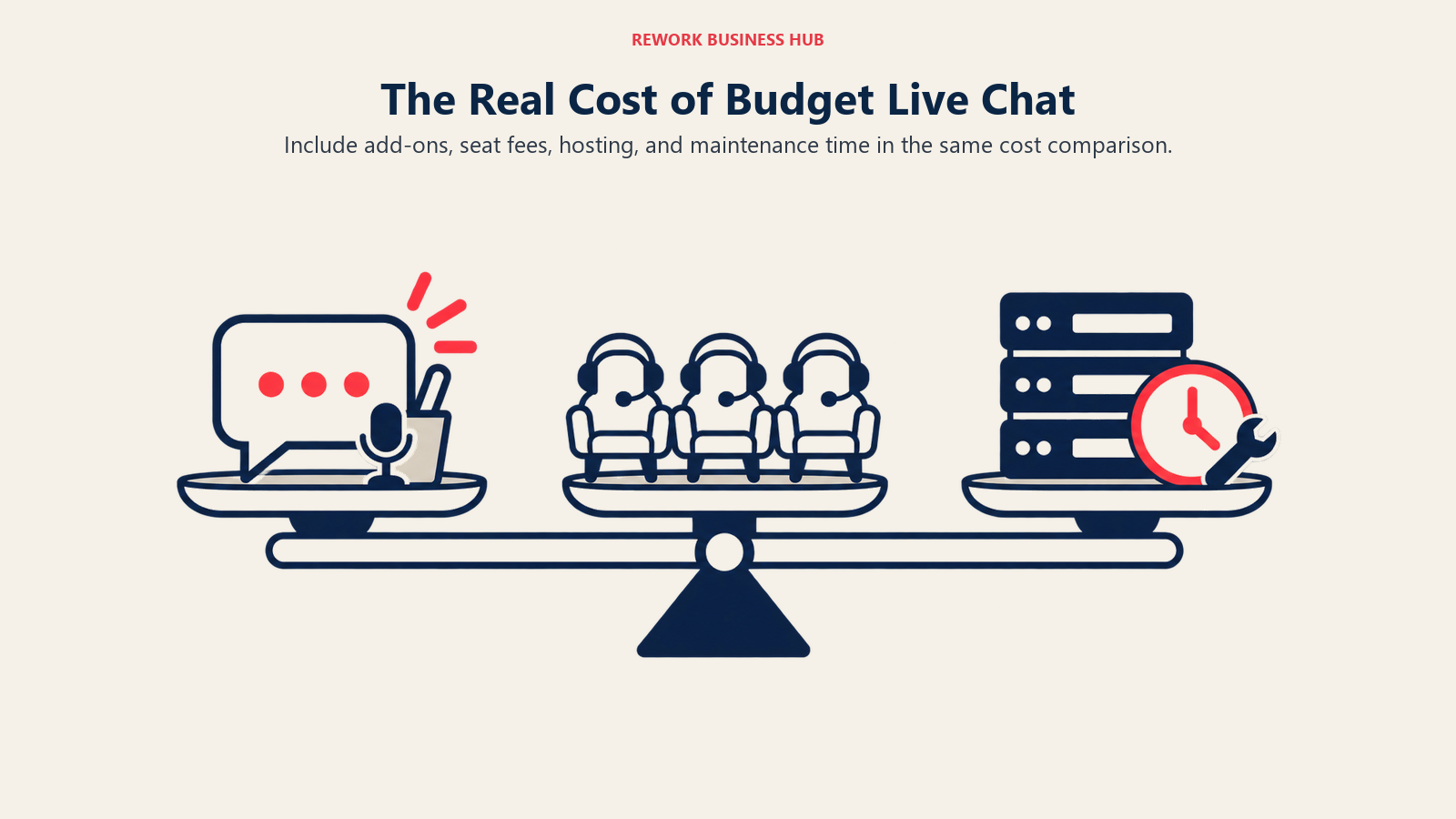
All three publish real, checkable pricing for at least one path to their product, which is more than a lot of categories manage. The complication is that each one has a second number hiding behind the first: Tawk.to's real cost is in the add-ons, Olark's real cost depends on which of its two very different plans you're actually pricing, and Chatwoot's real cost depends on whether you're paying in dollars or in your own engineering hours. This section prices all three properly, then puts them side by side at 3, 10, and 25 agents.
Tawk.to, per tawk.to's own pricing page:
| Item | Price | Notes |
|---|---|---|
| Core product | $0 | Unlimited agents, unlimited chat volume, no credit card required |
| Branding removal | $29/month | Removes the "Powered by tawk.to" mark from your widget |
| AI Assist (chatbot) | From $29/month | Scales with message volume; our own prior pricing research on this page found it running up to roughly $399/month at high volume, consistent with what's published today |
| Hired chat agents | $1/hour | Tawk.to's own trained staff answer chats on your behalf |
| Virtual assistants | From $7/hour | Design, admin, HR, bookkeeping, and data entry staffing, unrelated to chat itself but sold through the same marketplace |
The free core product is real, not a bait-and-switch trial. But a team that actually cares about brand presentation and wants any automated coverage is looking at branding removal plus entry-level AI Assist as the realistic floor: $58 a month, and that number doesn't move whether you have 2 agents or 20, because Tawk.to doesn't charge per seat at all.
Olark, per Olark's own pricing page:
| Plan | Price | What's included |
|---|---|---|
| Classic (Live Chat Only) | $29/agent/month | Human live chat, no AI, no conversation caps |
| Standard AI Website Agent (Aiden) | $400/month billed annually ($4,800/year) | Unlimited AI conversations, one human agent seat included, no token limits |
| Additional human seats on the Aiden plan | +$29/agent/month | Same per-seat rate as Classic |
| Custom / Enterprise | Contact sales | Regional routing, advanced integrations, custom SLAs, SSO |
Layered on top of Classic, Olark still sells PowerUps individually, each its own flat monthly add-on regardless of team size: Non-Branded Chatbox at $59/month, Live Chat Translation at $29/month, Visitor Insights at $59/month (social profiles) or $99/month (social and professional data), and Visitor Cobrowsing at $99/month, each listed on Olark's own PowerUp pages. Stack a couple of those onto Classic and a $29-a-seat tool can land closer to $150 to $200 a month before you've added a single extra agent.
Chatwoot, per Chatwoot's own cloud pricing page and self-hosted pricing page:
| Plan | Price | Agents | What's included |
|---|---|---|---|
| Self-hosted Community Edition | $0 | Unlimited | Full open-core feature set, all channels, MIT licensed, your own infrastructure |
| Cloud Hacker | $0 | Up to 2 | 500 conversations/month, live chat only, 30-day data retention |
| Cloud Startups | $19/agent/month (annual) | Unlimited | All channels, unlimited conversations (fair use), 300 Captain AI credits/month, 1-year retention |
| Cloud Business | $39/agent/month (annual) | Unlimited | Everything in Startups plus voice, automation rules, SLAs, 500 Captain AI credits, 2-year retention |
| Cloud Enterprise | $99/agent/month (annual) | Unlimited | Everything in Business plus SSO/SAML, audit logs, branding removal, 800 Captain AI credits, 3-year retention |
| Self-hosted Enterprise Edition license | $99/agent/month (annual) | Per your license count | Same enterprise feature set as Cloud Enterprise, layered on top of your own infrastructure |
The Enterprise Edition row is the one worth reading twice: self-hosting doesn't discount the license fee for enterprise features. It's the identical $99-a-seat rate whether Chatwoot runs the servers or you do, and if you're self-hosting Enterprise you're paying that rate on top of your own infrastructure and labor costs, not instead of them.
The true cost of self-hosting Chatwoot
Nobody publishes a bill for "self-hosted," so here's what it actually takes to run Chatwoot's free Community Edition in production, built up from the pieces rather than guessed at.
| Cost component | What it actually runs | Source or basis |
|---|---|---|
| Chatwoot Community Edition license | $0 | MIT licensed, confirmed on GitHub |
| Server, minimum spec (4 cores, 4GB RAM, up to ~10,000 conversations/day) | $24 to $48/month | Closest matching DigitalOcean Droplet tiers; runs Postgres, Redis, Rails, and Sidekiq together on one box |
| Server, recommended spec (8 cores, 8GB RAM, up to ~20,000 conversations/day) | Roughly $80 to $130/month | Only relevant once you're well past the volume a 25-agent team realistically generates |
| Database and Redis | $0 extra | Run on the same server at this scale; no managed database required per Chatwoot's own deployment docs |
| Storage | Bundled into the droplet, against Postgres's documented 5 to 10GB minimum | Grows with conversation and attachment volume; Chatwoot doesn't publish a hard ceiling |
| SSL certificate and reverse proxy | $0 | Let's Encrypt plus Nginx, both free; Chatwoot's containers bind to localhost and require this |
| Monitoring | $0 to start | Free-tier uptime checks cover the basics; add a paid tool only if you want deeper alerting |
| Initial setup labor | Roughly 6 to 8 hours, one time | Planning estimate for someone already comfortable with Docker Compose, DNS, and a reverse proxy, not a vendor-published figure |
| Ongoing labor | Roughly 2 to 5 hours a month | Planning estimate for OS patches, Chatwoot version upgrades, and occasional troubleshooting; more in the month a major version ships |
That labor line is the one every self-hosting pitch skips, so it's worth being explicit about what it means in dollars. If that time comes from an engineer who already has slack in their schedule, the cash cost genuinely is just the $24 to $48 a month in hosting, and Chatwoot becomes close to free in any real sense. If you're paying a contractor to maintain it, that's a separate, real bill: at a representative $75-an-hour loaded rate, 3 hours a month adds roughly $225, which is the number to weigh against a license fee, not against Chatwoot's own marketing. Either way, notice what doesn't happen: this cost doesn't climb as you add agents. Three agents and twenty-five agents put close to the same load on one small server, which is the entire argument for self-hosting once you're past a certain headcount.
What 3, 10, and 25 agents actually pay
The table below uses the plan a real budget-conscious buyer would actually land on: Tawk.to's free core plus a realistic add-on bundle (branding removal and entry-level AI Assist), Olark's Classic plan, Chatwoot Cloud's Startups tier, and Chatwoot self-hosted (cash infrastructure cost only, before labor).
| Team size | Tawk.to (free + add-ons) | Olark Classic ($29/agent/mo) | Chatwoot Cloud Startups ($19/agent/mo) | Chatwoot self-hosted (infrastructure only) |
|---|---|---|---|---|
| 3 agents | $696/year | $1,044/year | $684/year | $288 to $576/year |
| 10 agents | $696/year | $3,480/year | $2,280/year | $288 to $576/year |
| 25 agents | $696/year | $8,700/year | $5,700/year | $288 to $576/year |
Two things jump out immediately. First, Chatwoot Cloud's Startups tier undercuts Olark Classic at every single size tested, by a widening margin: at 25 agents the gap is roughly $3,000 a year, for a tool that natively covers WhatsApp, Instagram, and email where Olark Classic covers none of them. Second, Tawk.to and self-hosted Chatwoot are the only two options on this list whose cash cost doesn't move with headcount at all, because neither one charges per seat. That flat-cost property is worth more the bigger your team gets, and worth almost nothing at 2 or 3 agents, which is exactly why "cheapest" depends entirely on which size team is asking.
The AI layer, priced separately by all three
None of the three folds a capable AI agent into its cheapest tier, and the three approaches to selling it are different enough to be worth laying out directly. For more on how this pattern plays out across the wider category, see Seat-Based Pricing Is Dying.
| Tawk.to (AI Assist) | Olark (Aiden) | Chatwoot (Captain AI) | |
|---|---|---|---|
| Included on the entry plan | No | No, Classic has no AI at all | No, Community Edition and Cloud Hacker include none |
| Entry price | From $29/month | Not sold standalone; bundled only into the $400/month Standard plan | 300 credits/month included from Cloud Startups ($19/agent/month) |
| How it scales | Meters with message volume, reported up to roughly $399/month at high volume | Flat and unlimited within the $400/month plan, no per-conversation metering | Metered past the included allotment, at $20 per 1,000 credits |
| Where it fits this comparison | An optional add-on to a genuinely free base | A completely separate product tier from the budget Classic plan | A modest usage allowance bundled into an already-cheap seat price |
Implementation and Change Management
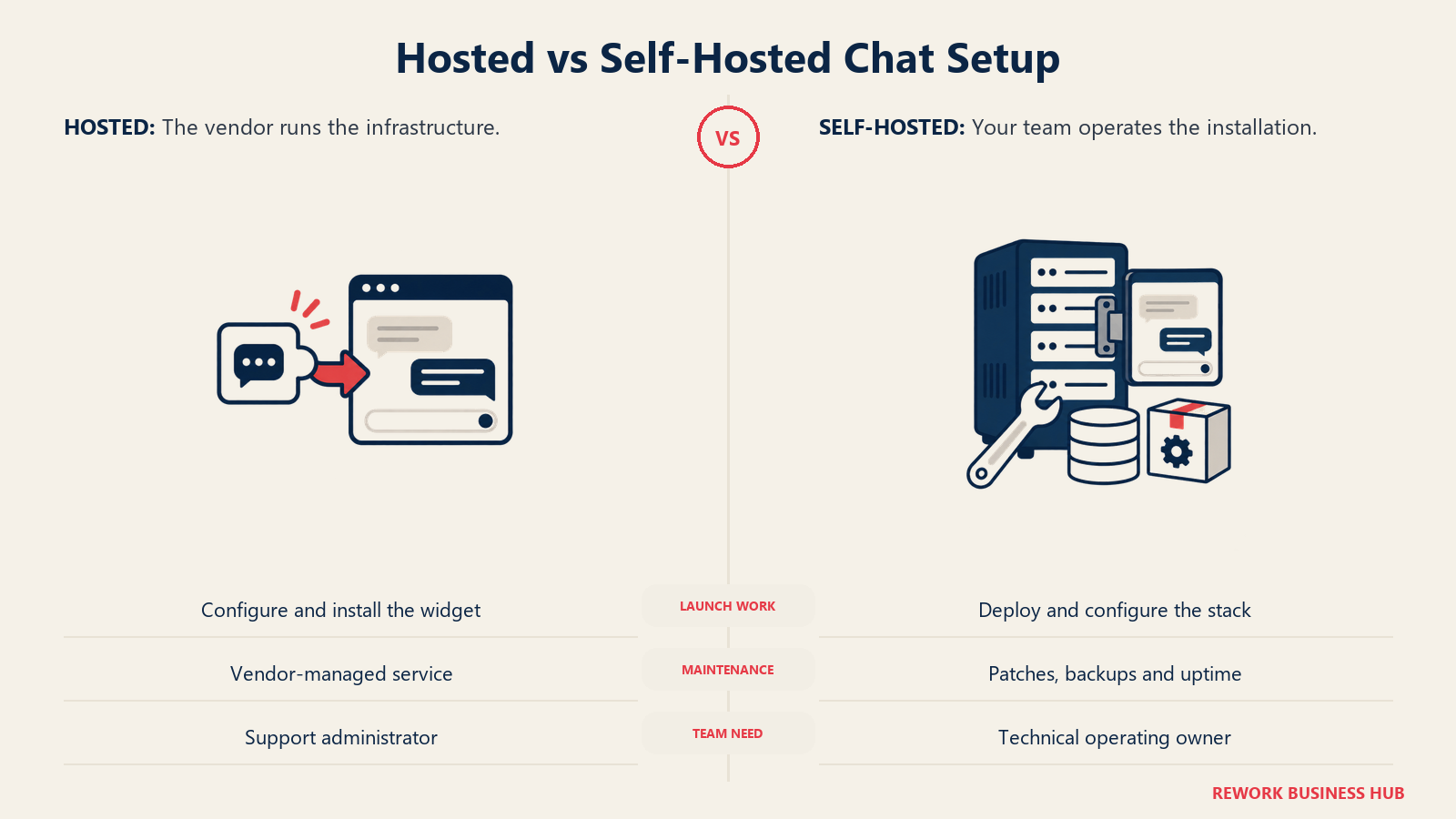
Hosted tools reduce infrastructure work; self-hosting gives your team ongoing operating responsibility.
| Tawk.to | Olark Classic | Chatwoot Cloud | Chatwoot self-hosted | |
|---|---|---|---|---|
| Time to first chat | Same day, paste the widget | Same day, paste the widget | Same day, paste the widget | Hours to a day, depending on DevOps availability |
| Who typically sets it up | Anyone, no technical skill required | Anyone, no technical skill required | Anyone, no technical skill required | Someone comfortable with Docker, DNS, and a reverse proxy |
| Training load | Low | Low | Low | Low for agents; moderate for whoever administers the server |
| Ongoing maintenance | None; tawk.to runs it | None; Olark runs it | None; Chatwoot runs it | Yours: OS patches, version upgrades, backups, uptime |
| Migration off a basic tool | Low | Low | Low | Low technically, but it's an ongoing operational commitment, not a one-time swap |
Risk and Governance
The three sit at genuinely different points on data ownership, and that's arguably the more consequential decision than price for a team that's still small enough to move fast if it picks wrong. Tawk.to and Olark both keep your conversation data on their own infrastructure, under their own DPA terms. Chatwoot, self-hosted, is the one option where that question has a definitive answer, because the server is yours.
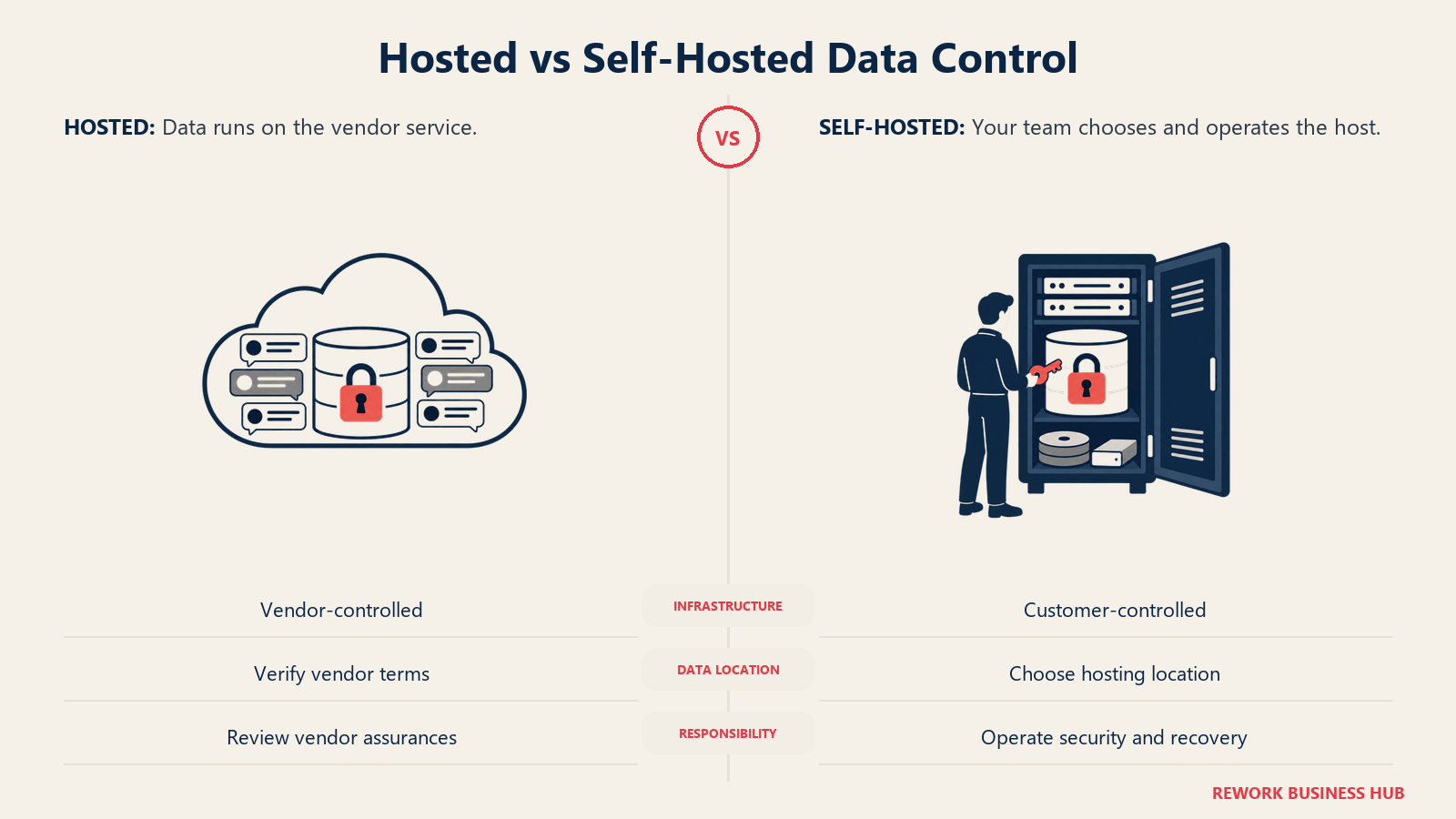
Tawk.to is a US-based company (tawk.to Inc., headquartered in Las Vegas, Nevada), and its Data Processing Addendum names tawk.to as the data importer and the customer as the data exporter for anything subject to GDPR; cross-border transfer relies on the GDPR Article 45 adequacy framework rather than the company holding EU-specific infrastructure. Olark processes data as a data processor acting on the customer's instructions, stores transcripts with AES encryption, and restricts access via whitelisting, VPN, and key-based authentication, all confirmed on Olark's own security documentation. Neither arrangement is unusual for a SaaS chat tool, and both are workable for most small teams, but neither gives you a definitive answer to "which country is our customer data actually stored in" the way self-hosting does by construction.
| Tawk.to | Olark | Chatwoot self-hosted | Chatwoot Cloud | |
|---|---|---|---|---|
| Where conversation data lives | Tawk.to Inc.'s infrastructure (US-based entity) | Olark's cloud infrastructure, on providers Olark describes as meeting GDPR Article 32 security standards | Wherever you deploy it; your choice of country and provider | Chatwoot's own hosted cloud infrastructure |
| GDPR mechanism | DPA available; EU-to-US transfer relies on the Article 45 adequacy decision | DPA available on request (gdpr@olark.com); processor acting on customer instructions | Not applicable; you are the data controller and processor both | Standard vendor DPA relationship; confirm current terms directly before committing |
| Data at rest | Confirm current encryption details with Tawk.to | Encrypted (AES); access via whitelist, VPN, and key-based auth | Whatever encryption you configure on your own database | Vendor-managed |
| Bulk conversation export | Agents can export tickets and chats from the interface | Export and redaction tools exist, but they're scoped to GDPR data-subject requests rather than a bulk "leave the platform" export | Complete; it's your own Postgres database | Confirm current export tooling directly with Chatwoot |
| What "leaving" actually looks like | Export what the interface gives you, then stop paying for add-ons; no infrastructure to unwind | Same pattern; no infrastructure to unwind | You already hold the data; migration is a database task, not a data-recovery negotiation | Standard SaaS offboarding |
On company stability, the three are hard to rank against each other because they're not really playing the same game. Tawk.to has run without outside venture funding since 2012, which is its own kind of stability, a business with no investor timeline pushing it toward an exit. Olark has operated as a straightforward paid business since 2009 and, as of this year, is visibly reinvesting in a new AI product line rather than winding down. Chatwoot took Y Combinator funding (its W21 batch) and a $1.6 million seed round in 2021 from Goat Capital, Uncorrelated Ventures, and Hack VC among others, a more conventional venture path that carries the usual venture-backed question of what happens at the next funding round, though the open-source license means a self-hosted install keeps working regardless of what happens to the company behind it.
| Tawk.to | Olark | Chatwoot | |
|---|---|---|---|
| Founded | 2012, launched publicly in 2013 | 2009 | 2017, open-sourced in 2019 |
| Funding | None disclosed; no venture capital | Not disclosed as venture-backed | $1.6M seed (2021), Y Combinator W21 batch |
| Revenue model | Free core, monetized through add-ons and hired human agents | Per-seat SaaS, plus a new AI-led product tier | Open-core: free self-hosted plus a paid cloud and enterprise layer |
| G2 rating | About 4.5 out of 5, roughly 190 reviews | About 4.3 out of 5, 224 reviews | About 4.5 out of 5, on a small sample of roughly 15 reviews |
| If the company disappeared tomorrow | Free tier likely stops working; you lose the add-ons you paid for | You lose the service; standard SaaS risk | Self-hosted installs keep running; only the cloud and enterprise license relationship ends |
When Tawk.to Is the Right Call
- You have genuinely no chat budget, and a free, functional widget matters more than polish or automation
- You're pre-revenue or running a very small site where unlimited agents at $0 beats any per-seat math
- You're comfortable with the branding, or willing to pay $29 a month the moment it starts to matter for how your business looks
- You'd rather pay $1 an hour for a human to cover chats overnight than build automation yourself
When Olark Is the Right Call
- Accessibility compliance is a genuine, documented requirement, not a nice-to-have, and you want a chat tool that's been independently audited for it
- You want one flat, predictable line item per agent with no free tier to second-guess and no AI upsell pressure at the entry price
- Your conversations happen entirely on your website, and you have no near-term plan to add WhatsApp, Instagram, or another channel
- You'd rather pay a known $29 a seat than take on any infrastructure of your own, and Chatwoot's self-hosted trade doesn't appeal
When Chatwoot Is the Right Call
- You have real DevOps capacity (in-house or a reliable contractor) and would rather spend engineering hours than a per-seat license fee
- Data residency or full control over where conversations are stored is a hard requirement, not a preference
- You need native WhatsApp, Instagram, or Messenger and don't want to pay Intercom- or Zendesk-level pricing to get it
- You want the option to start free and self-hosted, then move to Chatwoot Cloud later without switching platforms if the infrastructure trade stops making sense
Decision Framework
| If you are... | Pick |
|---|---|
| Pre-revenue or running a tiny site with zero chat budget | Tawk.to |
| A small team that wants accessibility compliance and one predictable bill | Olark (Classic plan) |
| A team with DevOps capacity that wants to trade engineering time for a license fee | Chatwoot (self-hosted) |
| Budget-conscious but need native WhatsApp, Instagram, or Messenger without infrastructure work | Chatwoot Cloud (Startups tier) |
| Evaluating whether you actually need an AI-first chat agent rather than a chat widget | Price Olark's Aiden plan or Chatwoot's Captain AI credits directly against your expected volume before committing |
| Comparing the wider live chat category beyond these three | See our full live chat software roundup |
| Currently on Tawk.to and outgrowing it | See our best Tawk.to alternatives guide |
| Currently on Olark and outgrowing it | See our best Olark alternatives guide |
What to Do Next
- Price your own realistic bundle, not the homepage number. Tawk.to's honest floor is closer to $58 a month than $0 once you add branding removal and basic AI. Olark's honest floor depends entirely on whether you're looking at the $29-a-seat Classic plan or the $400-a-month Aiden plan; confirm which one you were actually quoted.
- If you're considering self-hosting Chatwoot, get an honest read on your own team's spare engineering capacity before you commit. The infrastructure cost is genuinely small. The labor cost is real even when it doesn't show up on an invoice, and it's the number that decides whether self-hosting actually saves you money.
- Map your channel roadmap before you pick, not after. If WhatsApp or Instagram support is six months away rather than needed today, that's still worth pricing now; Chatwoot is the only one of the three that covers them natively, and switching platforms later costs more than choosing correctly now. Our guide to multi-channel inbox configuration covers what that setup should look like regardless of which tool you land on.
- If data residency is a real requirement, not a hypothetical, self-hosted Chatwoot is the only option here that answers it directly rather than asking you to trust a vendor's DPA.
- Run the true 3-year cost, not the first-year cost, especially for Chatwoot self-hosted versus Chatwoot Cloud. A cheap server bill in year one can look very different once you count the hours spent keeping it patched in year three. Our piece on the true cost of software sprawl covers this same trap across other tool categories.
One honest gap runs across all three tools here: none of them ties a chat conversation to a sales pipeline the way a CRM does. Tawk.to has a basic contacts view and nothing past that. Olark's Classic plan has no CRM concept at all, and even the new Aiden-powered plan is built to answer questions, not manage a deal. Chatwoot's contact and conversation history is genuinely useful context, but it stops short of deal stages, forecasting, or lead routing. If what you're actually missing isn't a cheaper chat widget but chat living in the same record as your pipeline from day one, that's a different category of tool. Rework builds its multi-channel inbox, WhatsApp, Messenger, Instagram DM, web chat, and email, directly into the same CRM timeline as the deal itself, worth a look if that handoff gap, not the chat bill, turns out to be your actual problem.
Frequently Asked Questions about Tawk.to vs Olark vs Chatwoot
Which is cheapest, Tawk.to, Olark, or Chatwoot?
It depends entirely on your team size, because only two of the four realistic options actually charge per seat. Tawk.to's honest floor (free core plus branding removal and entry AI) runs about $696 a year flat, regardless of headcount. Self-hosted Chatwoot's cash cost is roughly $288 to $576 a year in infrastructure, also flat, before counting your own labor. Olark Classic and Chatwoot Cloud both scale per agent, at $29 and $19 a month respectively, so they get relatively more expensive as your team grows while Tawk.to and self-hosted Chatwoot stay flat.
Is Tawk.to really free forever, with no catch?
The core product is genuinely free: unlimited agents, unlimited chat volume, no credit card required, no time-limited trial. The catch is what it doesn't include at $0: your branding stays on the widget unless you pay $29 a month to remove it, there's no AI chatbot unless you add AI Assist from $29 a month, and there's no native WhatsApp or social channel support at any price. For a team that only needs a basic widget, it's not a trap. For a team that wants those extras, it stops being free fast.
What changed with Olark's pricing in 2026?
Olark's homepage now leads with Aiden, a new AI website agent priced at $400 a month billed annually ($4,800 a year), which includes one human seat and unlimited AI-handled conversations. That's a genuinely different product from the classic per-agent human chat plan Olark has sold since 2009, which is still available at $29 an agent a month but is no longer the headline offer on Olark's own pricing page.
Is Chatwoot really free if I self-host it?
The software license is free, permanently, with unlimited agents, because the core codebase is MIT licensed. What isn't free is the infrastructure and your own time: budget roughly $24 to $48 a month for a small production server, plus somewhere around 2 to 5 hours a month of engineering time for patches and upgrades once it's running. If you need Chatwoot's enterprise features (SSO, SLA policies, custom branding), those require a separate paid license at $99 an agent a month even when you're self-hosting, the identical rate as Chatwoot's cloud Enterprise tier.
Which of the three natively supports WhatsApp and other social channels?
Only Chatwoot, and it's not a small gap. Chatwoot natively covers WhatsApp, Facebook Messenger, Instagram, SMS, Telegram, and even TikTok, on both the free self-hosted Community Edition and the paid cloud tiers. Tawk.to covers email and a knowledge base but not WhatsApp or social channels. Olark's Classic plan covers website chat only, with no email or social channel support at all.
Which tool is the safest choice for GDPR or data residency requirements?
Self-hosted Chatwoot is the only option that gives a definitive answer, because you choose the country and provider your server runs in, and you are the data controller and processor both. Tawk.to and Olark both offer standard Data Processing Addendums and reasonable security practices, but your data lives on their infrastructure under their terms, which is workable for most small teams but not the same guarantee as hosting it yourself.
Which tool has the strongest accessibility support?
Olark, clearly. Its chatbox is documented as WCAG 2.1 AA and Section 508 conforming, backed by an independent audit and letter of conformance from Accessible360. That's a meaningful differentiator for any organization in healthcare, government, education, or another sector where digital accessibility is a genuine procurement requirement rather than a nice-to-have.
Related Resources:
- Best Live Chat Software in 2026
- Best Tawk.to Alternatives in 2026
- Best Olark Alternatives in 2026
- Crisp vs Tidio
- Freshchat vs LiveChat vs Zoho SalesIQ
- How to Choose Live Chat Software
- Multi-Channel Inbox Configuration
- Chat-to-CRM Automation
- Seat-Based Pricing Is Dying
- The True Cost of Software Sprawl

Senior Implementation Consultant
On this page
- TL;DR
- What Each Tool Is Actually Built For
- Decision by Business Goal
- Team and Role Fit
- Pricing at Real Team Sizes
- The true cost of self-hosting Chatwoot
- What 3, 10, and 25 agents actually pay
- The AI layer, priced separately by all three
- Implementation and Change Management
- Risk and Governance
- When Tawk.to Is the Right Call
- When Olark Is the Right Call
- When Chatwoot Is the Right Call
- Decision Framework
- What to Do Next