Ordway vs Polar vs FastSpring: Billing Engine or Merchant of Record for B2B SaaS in 2026?
Turn this article into takeaways for your work.


Each assistant summarizes the article only for you and suggests best practices for your work.
Start with the question that actually sorts these three, not a feature grid. When a customer pays, whose name is on the sale? Ordway never touches that answer: your company is the seller on every invoice it generates, so your company registers for sales tax and VAT in every place you have customers, and Ordway's job is to get the billing logic and the revenue recognition right around that fact. Polar and FastSpring answer differently. Both step in as the legal seller, collect the payment under their own registration, remit the tax themselves, and hand you a net payout. That's the whole reason their fee is a percentage of revenue instead of a software subscription: it's pricing in a compliance obligation, not just a billing engine.
This matters more than usual for this specific trio because Ordway isn't a simple flat-fee alternative to a merchant of record the way a basic invoicing tool would be. It's built for the kind of B2B SaaS contract that a self-serve checkout was never meant to handle: usage tiers layered on a subscription, a ramp that steps pricing up over a multi-year term, a mid-quarter amendment that changes the deal without restarting it, and a revenue recognition schedule an auditor will actually read. Polar and FastSpring solve a different problem well: getting paid globally without becoming your own tax authority. Picking between them by price alone misses why each one exists.
Before comparing a single number, we verified Polar directly against its own site, since it's the youngest platform here and this collection has already caught comparison content describing products that no longer exist in the form they're described. Polar is live, self-serve, and still operating as a merchant of record today. But its pricing changed in a way the rest of this collection hasn't caught up on: since May 27, 2026, Polar's paid tiers carry a monthly platform fee on top of the declining percentage that earlier coverage here described, and accounts opened before that date sit on a separate grandfathered rate. Both are covered in full below with Polar's own pages as the source, so the numbers in this article are current even where they update what you'll read elsewhere in this collection.
Key Facts
- Polar restructured its pricing on May 27, 2026, moving from a flat 4% + $0.40 (plus 0.5% on subscriptions) to a tiered model that pairs a declining percentage with a monthly platform fee, per Polar's own pricing page and its announcement post.
- Ordway does not publish pricing anywhere on its own site; third-party deal data reported by Vendr puts the median buyer at $48,890 a year, ranging from $24,700 to $98,994 annually (reported, not vendor-confirmed), per Vendr's Ordway buyer guide.
- The median Avalara contract, the kind of tax-compliance tooling a company staying its own merchant of record typically needs, runs $16,851 a year based on 745 verified purchases, per Vendr's Avalara marketplace data.
- 101 countries now apply a VAT or GST to cross-border digital sales, the exact liability a merchant of record absorbs on a seller's behalf (Tax Foundation).
- A U.S. seller crossing common economic-nexus thresholds, commonly $100,000 in revenue or 200 transactions in a single state, can end up registering in as many as 45 separate states, while an EU-facing seller crossing a combined €10,000 a year in cross-border digital sales needs Union OSS to avoid registering separately in up to 27 member states (Numeral's economic nexus guide and EU VAT OSS guide).
TL;DR
| Ordway | Polar | FastSpring | |
|---|---|---|---|
| Model | Billing and revenue-automation software | Merchant of record | Merchant of record |
| Who's the seller of record | Your company | Polar | FastSpring |
| Headline price | No published price, reported median $48,890/year | 5.00% + 50c (Starter) down to 3.40% + 30c (Scale), plus a monthly platform fee on paid tiers | No published price, revenue-share negotiated |
| Monthly platform fee | N/A, annual license | $0 to $400/mo depending on tier | None disclosed |
| Payment processing included | No, bring your own gateway | Yes, bundled | Yes, bundled |
| Tax/VAT remittance included | No, your company's responsibility | Yes | Yes |
| Built for | Complex B2B contracts: usage tiers, ramps, amendments, revenue recognition | AI and usage-metered products, general SaaS checkout | Established software and digital-goods sellers, global scale |
| Track record | Since 2015, private, demo-only sales motion | Restructured pricing May 2026, self-serve since founding | Two decades, PE-backed since 2018 |
| Best for | Mid-market SaaS finance teams with negotiated, multi-element contracts | Early-stage and usage-billed AI/SaaS wanting self-serve global checkout | Larger software sellers wanting a negotiated, full-service MoR relationship |
Who's the Seller of Record: The Question That Decides Everything Else
This is worth sitting with before any pricing table, because it's the fact every other difference in this comparison traces back to.
Ordway generates the invoice, calculates what's owed under a subscription, a usage tier, or a negotiated contract, and tracks the revenue recognition schedule behind it. But the transaction itself still runs through a payment gateway you connect and control, and the money lands in an account that's yours. That means your company is the one that has to know where it has sales-tax nexus, register in each of those places, file the returns, and remit what's collected, either by hand, through an accountant, or through a dedicated tax-automation tool sitting next to Ordway rather than inside it.
Polar and FastSpring both flip that. Per Polar's own description, "Polar acts as the reseller of your product in over 100 markets. Payments, sales tax, fraud, refunds and chargebacks are our responsibility, never your paperwork." FastSpring's own site makes the same claim in different words: it positions itself as "the leading merchant of record for global digital product companies," meaning it's the legal seller on every transaction it processes. Neither platform asks you to register anywhere. Both bake that liability into the transaction fee instead of charging a separate software subscription for it.
| Ordway | Polar | FastSpring | |
|---|---|---|---|
| Legal seller on each transaction | Your company | Polar | FastSpring |
| Who registers for sales tax/VAT | Your company, in every jurisdiction with nexus | Polar, across 100+ markets | FastSpring, across the jurisdictions it operates in |
| Who remits the tax collected | Your company, directly or through a tax tool | Polar | FastSpring |
| Pricing shape | Negotiated annual license, no percentage of revenue | Percentage of transaction value plus a per-tier monthly fee | Negotiated revenue-share, no published rate |
| Where payment processing shows up | Billed separately by whichever gateway you connect | Bundled into the platform fee | Bundled into the platform fee |
| What you're actually buying | Billing logic and revenue-recognition accuracy for complex contracts | Compliance and liability transfer, tuned for usage-billed products | Compliance and liability transfer, tuned for established software sellers |
If you remember one sentence from this article, make it this: the percentage Polar or FastSpring charges isn't a markup on payment processing, it's the price of not having to think about tax registration in dozens of countries. Whether that's worth paying, and at what revenue, is a math problem, and we work through it below.
What Each Platform Is Actually Built For
Ordway is quote-to-cash software for B2B SaaS finance teams whose contracts don't fit a flat monthly plan. Its own site describes the product as "Quote-to-Cash Automation for AI, SaaS, and Subscription Business Models," covering invoicing for subscription, usage-based and other recurring-revenue models, automated payment collection and dunning, deferred and recognized revenue tracking, and automated contract modifications, the specific capability that matters when a customer upsizes, downsizes or renegotiates mid-term. It ships KPI reporting on MRR, ARR, net dollar retention, bookings, churn and renewals alongside the billing itself. What it doesn't do is take on the transaction: Ordway is not a payment processor and doesn't claim to be one.
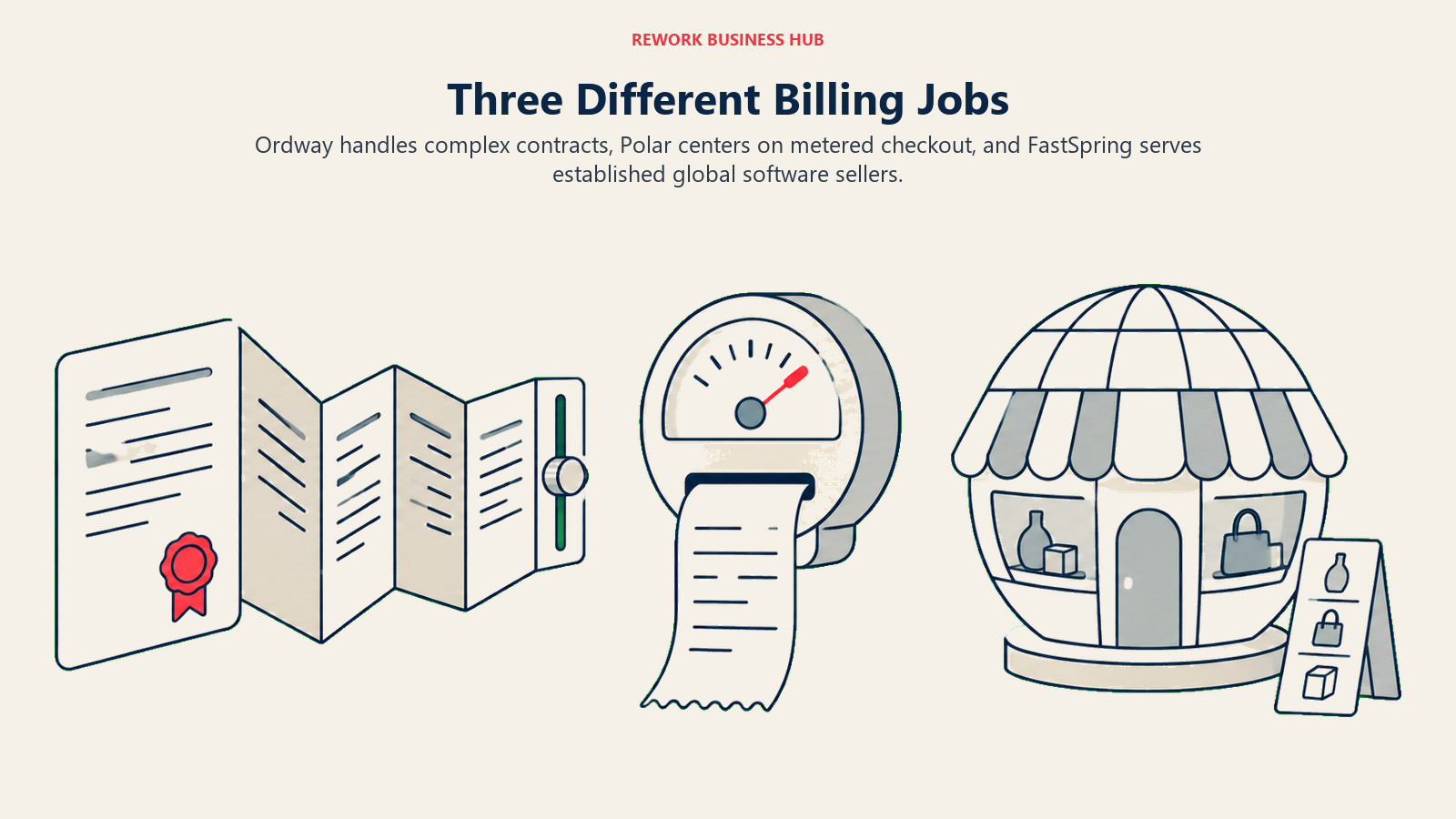
Polar has sharpened its positioning considerably since it first built a name as a developer-first, open-source-adjacent checkout tool. Its own homepage now describes it as "a billing platform for the intelligence era," built around metering usage events like tokens, API calls and GPU seconds, alongside standard subscription and seat billing, checkout, per-customer cost and margin insights, and payouts. It still serves general SaaS checkout, but the product and its newest offer, a Startup Program that gives qualifying early-stage AI companies its lowest-fee Scale tier free for 12 months, are unmistakably aimed at AI-native software businesses specifically, not indie software sellers broadly.
FastSpring is the establishment option. Operating as Bright Market, LLC dba FastSpring since 2006, per its own site's copyright notice, it's built a two-decade track record as merchant of record for software and digital-goods sellers, and states it now powers over a billion dollars in worldwide transactions every year. It's been investment-backed by Accel-KKR, a technology-focused private equity firm, since 2018, a stability signal rather than a concern: steady ownership, two decades of operating history, and a scale most newer entrants in this category haven't reached yet.
| Ordway | Polar | FastSpring | |
|---|---|---|---|
| Core positioning | Billing and revenue automation for complex B2B contracts | Billing platform for AI and usage-based software | Established merchant of record for global software sellers |
| Usage-based/metered billing | Native, ties to entitlements and revenue schedules | Native, purpose-built for token/API/compute metering | Supported, not the primary design center |
| Mid-term contract amendments | Named, automated capability | Not a product focus | Not a product focus |
| Revenue recognition (deferred/recognized schedules) | Native | Not offered | Not offered |
| Self-serve signup | No, demo-only | Yes, free Starter tier | No, sales-negotiated |
| Ideal seller profile | Negotiated, multi-element B2B contracts | Self-serve global checkout, usage-billed products | Larger, established software and digital-product catalogs |
Decision by Business Goal
| Your goal | Pick |
|---|---|
| "My contracts have ramps, mid-term amendments, or usage tiers our old billing tool can't model" | Ordway |
| "I need revenue recognition schedules that hold up when an auditor asks how we booked a modified contract" | Ordway |
| "I'm billing for AI usage, tokens, or API calls and want metering built into checkout" | Polar |
| "I want to start selling globally today without a sales call" | Polar |
| "I want an established, negotiated merchant-of-record relationship at real scale" | FastSpring |
| "I have no minimum volume yet, but I don't want to shop this decision again in two years" | FastSpring |
| "I want to stay the seller of record and keep full control of my payment gateway" | Ordway, paired with your own processor and tax tool |
| "I don't want to register for sales tax or VAT anywhere, full stop" | Polar or FastSpring |
Team and Role Fit
| Ordway | Polar | FastSpring | |
|---|---|---|---|
| Primary owner | RevOps, billing ops, or a finance systems lead | Founder or a small finance/ops function | VP of Finance or a finance lead managing a sales-negotiated MoR relationship |
| Deal desk / sales | Configures CPQ-adjacent quote-to-cash flows for negotiated contracts | Rarely involved, checkout is self-serve | Occasionally involved for custom terms |
| Accounting / controller | Relies on Ordway's deferred/recognized revenue schedules for close | Exports transaction and payout data into the GL manually or via integration | Exports transaction and payout data into the GL manually or via integration |
| External auditor | Reviews Ordway's contract-modification and revenue-recognition trail directly | Has no revenue-recognition trail to review inside the product | Has no revenue-recognition trail to review inside the product |
| Engineering | Integrates via API for provisioning tied to billing events | Integrates Polar's checkout and usage-metering API | Integrates FastSpring's checkout and webhook API |
The Real Cost at $50K, $500K and $5M in Annual Revenue
This is the section worth the most attention, because a percentage fee and a negotiated annual license don't compare cleanly without doing the arithmetic, and the arithmetic changes the answer depending on how big the business is.
Polar is the only one of the three with a published formula, so it's the one we can model precisely. Its four tiers each pair a monthly platform fee with a declining percentage plus a fixed per-transaction charge, per Polar's own pricing and fees pages.
| Tier | Monthly fee | Rate | Annual platform cost | Effective formula (revenue R, $100 average transaction) |
|---|---|---|---|---|
| Starter | $0 | 5.00% + 50c | $0 | 0.0550 × R |
| Pro | $20/mo | 3.80% + 40c | $240/yr | $240 + 0.0420 × R |
| Growth | $100/mo | 3.60% + 35c | $1,200/yr | $1,200 + 0.0395 × R |
| Scale | $400/mo | 3.40% + 30c | $4,800/yr | $4,800 + 0.0370 × R |
Assuming a $100 average transaction, the midpoint of a typical SaaS subscription range this collection has used before, here's what each Polar tier costs at three revenue levels, with the cheapest option at each level marked:
| Annual revenue | Starter | Pro | Growth | Scale |
|---|---|---|---|---|
| $50,000 | $2,750 | $2,340 | $3,175 | $6,650 |
| $500,000 | $27,500 | $21,240 | $20,950 | $23,300 |
| $5,000,000 | $275,000 | $210,240 | $198,700 | $189,800 |
The crossover points land at $18,462 (Starter beats Pro below this, Pro wins above it), $384,000 (Pro to Growth), and $1,440,000 (Growth to Scale). A business picking Polar's tier by habit rather than by its own volume is very likely overpaying: the gap between the right tier and the wrong one is a few thousand dollars a year at $500K in revenue and tens of thousands at $5M. None of this includes Polar's additional charges, which apply on every tier: a 1.5% surcharge on international (non-U.S.) cards, a flat $15 per dispute regardless of outcome, and payout fees of $2 for any month with an active payout plus 0.25% + $0.25 per payout (0.25% to 1% more on cross-border payouts), all confirmed on Polar's own fees page.
Ordway and FastSpring don't publish a formula, so they can't be modeled the same way, and pretending otherwise would be exactly the kind of fabricated precision this collection avoids. But we can still show what each actually costs a business at these three sizes, honestly labeled.
Ordway's reported median of $48,890 a year doesn't move with revenue the way a percentage fee does, it's priced to contract complexity, not to your top line. That makes it a bad deal in relative terms at $50,000 in revenue (97.8% of revenue, which confirms Ordway isn't built for a business this size, consistent with its own positioning toward Series B and later SaaS companies) and an increasingly reasonable one as revenue grows (9.8% of revenue at $500,000, 0.98% at $5,000,000). But that comparison is incomplete on its own, because Ordway's fee doesn't include what a merchant of record's fee does: payment processing and tax compliance. Add those back using this collection's own established Stripe processing rate (2.9% + 30c) and the current median Avalara contract ($16,851/year, per Vendr), and the real cost of staying your own merchant of record next to Ordway looks like this:
| Annual revenue | Ordway (reported median) | + Stripe processing (2.9% + 30c) | + Avalara-class tax tool (reported median) | Total "stay merchant of record" cost | Cheapest Polar tier (all-inclusive) |
|---|---|---|---|---|---|
| $50,000 | $48,890 | $1,600 | $16,851 | $67,341 (134.7% of revenue) | $2,340 (4.68%) |
| $500,000 | $48,890 | $16,000 | $16,851 | $81,741 (16.3% of revenue) | $20,950 (4.19%) |
| $5,000,000 | $48,890 | $160,000 | $16,851 | $225,741 (4.51% of revenue) | $189,800 (3.80%) |
This is the hidden half of the comparison the pricing pages don't show: once you count what it actually costs to remain the seller of record, tax tool and all, Polar's all-inclusive fee comes out cheaper than the Ordway-plus-processor-plus-tax-tool stack at every revenue level modeled here, including $5 million. The gap narrows sharply at scale (0.7 points of revenue at $5M versus 130 points at $50K), and your own average deal size, gateway rate and tax-tool contract will move every number in this table, so rerun it with your own figures before treating it as a verdict. It also isn't the whole story: Ordway is solving a problem Polar doesn't touch at all, contract-modification accuracy and audit-ready revenue recognition, so a business with genuinely complex, negotiated contracts may pay this premium on purpose. Cost and fit are two different questions, and this table only answers the first one.
FastSpring can't be modeled at all, and that's worth stating plainly rather than guessing. Its own pricing page says rates are "based on transaction type and your volume of business," negotiated directly with sales, with no minimum volume required to start the conversation. Its fee bundles the same things Polar's does, processing, fraud, tax remittance, so directionally it competes in the same range as Polar's percentage tiers rather than Ordway's flat license. But without a rate card, the only honest move is to get a written quote at your own volume before assuming any number here applies to FastSpring specifically.
What a Merchant of Record Actually Saves You
The tax-registration burden Ordway leaves with you, and that Polar and FastSpring absorb, isn't an abstraction. A U.S. seller crossing common economic-nexus thresholds, commonly $100,000 in revenue or 200 transactions in a single state, can end up needing to register, file and remit in as many as 45 separate states, according to Numeral's economic nexus guide. Sell into the EU and the math compounds: the first €10,000 a year in cross-border digital sales is exempt, but cross that line without using the EU's One Stop Shop scheme and you're registering separately in each of up to 27 member states rather than filing once, per Numeral's EU VAT OSS guide. Widen the lens further and 101 countries now apply some form of VAT or GST to cross-border digital sales specifically, per the Tax Foundation.

| What you're avoiding by using a merchant of record | The scale of it |
|---|---|
| U.S. state-level sales tax registration past economic nexus thresholds | Up to 45 states, at roughly $100K revenue or 200 transactions per state |
| EU VAT registration on cross-border digital sales | Up to 27 member states past a combined €10,000/year, or one OSS filing instead |
| Countries taxing cross-border digital sales globally | 101 countries and counting |
| The tooling cost of doing it yourself | Median $16,851/year for Avalara-class tax software alone, before filing fees or an accountant |
None of that is Ordway's job, and it shouldn't be: it's a billing and revenue-recognition platform, not a compliance platform. The tradeoff is real in both directions. Own the registrations yourself and you keep more of each dollar at scale, plus full control over your payment gateway and checkout. Hand it to Polar or FastSpring and you give up some of that margin and control in exchange for never having to explain a missed VAT filing to a board.
Implementation and Time to Value
| Ordway | Polar | FastSpring | |
|---|---|---|---|
| Setup path | Demo, scoping, and a negotiated implementation | Self-serve signup, live same day on Starter | Sales conversation, then guided onboarding |
| Typical timeline | Weeks to a few months, driven by contract-migration complexity and integrations | Minutes to hours for a basic integration | Days to weeks, depending on catalog and tax setup |
| What drives the timeline | Mapping existing contracts, ramps and usage tiers into Ordway's model | Connecting checkout and, if relevant, usage-metering events | Product catalog setup and payment-method configuration |
| Who needs to be involved | RevOps, finance systems owner, often an implementation partner | An engineer for API integration, otherwise self-serve | A finance or ops lead plus light engineering for checkout |
| Ongoing admin load | Real: contract modifications, revenue-schedule review, tier/module management | Low: mostly monitoring transaction volume against tier crossover points | Low to moderate: mostly monitoring payout and dispute activity |
Risk and Governance
Payout timing and reserves. None of the three publishes a fully detailed payout schedule, so treat this as a framework to confirm directly rather than settled numbers. Ordway sidesteps the question structurally: it never holds your funds, so payout timing is whatever your own gateway already offers. Polar routes payouts through Stripe and charges $2 for any month with an active payout plus 0.25% + $0.25 per payout, on top of whatever hold or reserve policy applies to a new or higher-risk account, per its own fees page. FastSpring doesn't publish payout cadence or reserve policy; get it in writing during onboarding.
Chargeback and dispute handling. Polar states plainly that disputes cost $15 each, "regardless of outcome," and that as merchant of record it absorbs the liability the dispute represents. FastSpring's own copy states it "assumes liability for fraud and chargebacks" as part of its merchant-of-record role, without a published per-incident fee. Ordway has no role in this at all, since it never processes the card charge.
What happens to subscriptions if you leave. This shows up months or years after the pricing decision, and it follows from who holds the merchant account. Because Polar and FastSpring are the legal seller on each transaction, the saved payment method lives inside their merchant account, not yours, and card tokens generally don't move between merchant accounts. Migrating away from either commonly means asking active subscribers to re-enter payment details, a real churn risk. Ordway sits on the other side of that line: your company already owns the gateway relationship, so swapping Ordway for a different billing engine later doesn't touch the underlying payment method at all.
Revenue recognition your auditor will actually ask about. This is where the three separate furthest. Ordway is built around deferred and recognized revenue schedules and automated contract modifications so a mid-term amendment doesn't break the revenue trail an audit needs. Neither Polar nor FastSpring offers anything comparable; both are transaction and tax-compliance platforms, not revenue-recognition engines, and a business relying on either for ASC 606-grade reporting is very likely reconciling that manually today.
| Risk factor | Ordway | Polar | FastSpring |
|---|---|---|---|
| Who holds payout timing risk | Your payment gateway, unrelated to Ordway | Polar (via Stripe), reserve/hold policy not fully published | FastSpring, reserve/hold policy not published |
| Chargeback liability | Yours, via your gateway | Polar's, $15 flat per dispute | FastSpring's, fee not published |
| Payment-method portability if you leave | High, gateway relationship is yours throughout | Low, tokens typically don't transfer to a new MoR | Low, tokens typically don't transfer to a new MoR |
| Revenue-recognition/audit support | Native, ASC 606-style deferred/recognized schedules | None | None |
| Vendor ownership/stability signal | Private company, demo-only sales motion since 2015 | Self-serve since founding, tiered pricing since May 2026 | PE-backed (Accel-KKR) since 2018, operating since 2006 |
When Ordway Is the Right Call
- Your contracts have real complexity. Usage tiers, multi-year ramps, and mid-term amendments are the norm, not the exception, and a billing tool that can't model them is already costing you finance-team hours every close.
- An auditor is going to ask about your revenue recognition. Deferred and recognized revenue schedules tied directly to contract modifications matter more to you than checkout simplicity.
- You already have, or are willing to build, your own tax-compliance stack. The math above only favors Ordway once you've priced in a real gateway and a real tax tool, and it still requires owning that relationship yourself.
- Your revenue is well past the point where a percentage-of-revenue fee gets expensive. The crossover in the table above lands around $1.2 million a year at Ordway's reported median price, though your own contract complexity should weigh at least as heavily as the math.
When Polar Is the Right Call
- You're billing for AI usage, tokens, API calls, or another metered resource. Polar's metering is native, not bolted onto a subscription model built for something else.
- You want to start selling globally today, self-serve. Signup is live immediately on the free Starter tier, with no sales conversation required.
- You're early-stage and might qualify for the Startup Program. Twelve months of Scale-tier pricing (3.40% + 30c) at no monthly cost is a meaningful discount if your company fits Polar's AI-startup criteria.
- You'd rather model a real tier crossover than accept a flat rate. Unlike Paddle or Lemon Squeezy's single published rate, Polar's four tiers reward doing the arithmetic in the table above before picking one.
When FastSpring Is the Right Call
- You want an established platform with two decades of tax-compliance track record, not a newer entrant still building its enterprise reference base.
- You're comfortable negotiating a rate rather than reading it off a page. No minimum volume requirement means the conversation can start at any size, and a negotiated rate may beat a published one at real scale.
- Your catalog or sales motion doesn't fit a purely self-serve checkout. FastSpring's onboarding assumes a real setup conversation, which suits a more complex digital-goods or software catalog better than a pure API-first product does.
- Stability matters as much as price. Consistent private-equity backing since 2018 and a billion-plus dollars processed annually are the kind of due-diligence answers a finance team can actually verify.
Decision Framework
| If this is true for you | Pick |
|---|---|
| Your contracts have ramps, usage tiers or mid-term amendments an auditor will review | Ordway |
| You're billing for AI/usage-metered consumption and want that native to checkout | Polar |
| You want to start selling globally today without a sales call | Polar |
| You qualify for Polar's Startup Program as an early-stage AI company | Polar |
| You want an established, negotiated MoR relationship at real scale | FastSpring |
| Your annual revenue is well past $1M and your tax stack is already built | Ordway, paired with your own gateway and tax tool |
| Your annual revenue is under roughly $1M and you don't want to own tax compliance | Polar or FastSpring |
| You need both complex-contract billing and merchant-of-record simplicity | No single platform here does both, see best subscription billing software for 2026 for the wider field |
What to Do Next
Answer the seller-of-record question before you demo anything. If your finance team already handles sales tax and VAT filings, or is willing to build that capability, Ordway's revenue-recognition depth is worth evaluating on its own terms against the best Zuora alternatives and best Chargebee alternatives roundups, since Ordway isn't the only billing engine built for complex contracts. If tax liability is the actual bottleneck, run Polar's tier table above against your own real transaction volume and average deal size before picking a tier, and get a written quote from FastSpring at the same volume so you're comparing two real numbers instead of one real number and a guess. Either way, price in a real payment processor and a real tax-compliance tool before comparing a billing engine's sticker price to a merchant of record's all-in fee. The Paddle vs. Lemon Squeezy and Lemon Squeezy vs. Paddle vs. Zoho Billing comparisons in this collection work through that same math for indie and small-team sellers, if your business turns out to be a better fit for that end of the market than for this one. And if a genuinely separate problem is that invoice data lives disconnected from the deal and contract history that produced it, that's outside what any of these three platforms solve, and worth naming rather than ignoring: Rework's Invoice module keeps invoicing on the same customer record as the CRM and the contract, though it isn't a metering, tax-remittance or revenue-recognition engine and won't replace Ordway, Polar or FastSpring for that job.
Frequently Asked Questions about Ordway vs Polar vs FastSpring
What's the real difference between Ordway, Polar and FastSpring?
Ordway is billing and revenue-automation software, your company stays the legal seller and keeps the sales-tax and VAT registration responsibility. Polar and FastSpring are both merchants of record: they become the legal seller, collect payment under their own registration, and remit tax on your behalf, in exchange for a percentage-based fee instead of a software subscription.
Is Polar still a real, purchasable product in 2026?
Yes. Polar is live and self-serve, with a free Starter tier and three paid tiers. Its pricing changed on May 27, 2026, moving from a flat 4% + $0.40 to a tiered model that pairs a declining percentage with a monthly platform fee, and accounts created before that date are grandfathered on the old rate.
How much does Ordway actually cost?
Ordway publishes no price on its own site; every evaluation starts with a demo. Third-party deal data reported by Vendr puts the median buyer at $48,890 a year, ranging from $24,700 to $98,994 annually. Treat that as a reported estimate, not a quote, since Ordway prices to contract complexity and module scope, not a published formula.
Does Ordway handle sales tax or VAT for me?
No. Ordway calculates and invoices what a customer owes but never becomes the legal seller of the transaction, so your company keeps the responsibility for registering, filing and remitting sales tax and VAT everywhere you have nexus, typically through an accountant or a separate tax-automation tool.
What happens to my subscriptions if I leave Polar or FastSpring?
Expect friction. Both hold the actual card-charging relationship inside their own merchant account, and card tokens generally don't transfer to a new merchant of record, so migrating away commonly means asking active subscribers to re-enter payment details rather than a silent handoff.
Does Polar or FastSpring support ASC 606 revenue recognition?
No. Both are transaction and tax-compliance platforms, not revenue-recognition engines. Ordway is the one built for deferred and recognized revenue schedules tied to contract modifications; a business needing that depth alongside Polar or FastSpring's checkout is typically reconciling revenue recognition in a separate tool.
Is Ordway or Polar cheaper at scale?
It depends on what you count. Ordway's reported median license cost alone looks cheaper than Polar's fee above roughly $1.2 million in annual revenue. But Ordway doesn't include payment processing or tax compliance, and once those are added back in using standard processing rates and the median cost of tax-compliance software, Polar's all-inclusive fee comes out cheaper than the full "stay merchant of record yourself" stack at every revenue level modeled in this article, including $5 million.
What is Polar's Startup Program?
It gives qualifying early-stage AI companies the benefits of Polar's lowest-fee Scale tier (3.40% + 30c per transaction) free of the tier's usual $400 monthly platform fee for 12 months. Eligibility criteria are set by Polar directly; confirm current requirements on Polar's own site before assuming a specific company qualifies.
Do I need a separate payment processor if I use Ordway?
Yes. Ordway is not a payment processor and doesn't move money itself. You connect your own payment gateway (commonly Stripe or a similar processor), and Ordway calculates and invoices around whatever that gateway settles.
Related Resources:
- Best Subscription Billing Software in 2026
- Best Chargebee Alternatives
- Best Paddle Alternatives
- Best Zuora Alternatives
- Chargebee vs Recurly
- Paddle vs Lemon Squeezy
- Lemon Squeezy vs Paddle vs Zoho Billing
- Best Accounts Receivable Software in 2026
- Best Stripe Alternatives
- How to Choose ERP Software
Camellia writes about billing, revenue operations, and finance tooling for B2B and digital-product teams.

On this page
- Key Facts
- TL;DR
- Who's the Seller of Record: The Question That Decides Everything Else
- What Each Platform Is Actually Built For
- Decision by Business Goal
- Team and Role Fit
- The Real Cost at $50K, $500K and $5M in Annual Revenue
- What a Merchant of Record Actually Saves You
- Implementation and Time to Value
- Risk and Governance
- When Ordway Is the Right Call
- When Polar Is the Right Call
- When FastSpring Is the Right Call
- Decision Framework
- What to Do Next