Best Paddle Alternatives in 2026: 13 Merchant of Record and Billing Platforms

Turn this article into takeaways for your work.


Each assistant summarizes the article only for you and suggests best practices for your work.
If you're running a SaaS or digital-product business on Paddle, you know the pitch: 5% plus 50 cents per transaction, and Paddle handles the sales tax, VAT, chargebacks, and buyer support that come with selling across borders. The question in 2026 is whether that all-inclusive rate is still the right trade, or whether a cheaper merchant of record, a different payout model, or a self-managed billing stack now serves you better. This guide covers 13 alternatives: Lemon Squeezy, FastSpring, Polar, Stripe, Chargebee, Rework, Recurly, Gumroad, Verifone (formerly 2Checkout), Digital River, PayPro Global, Maxio, and Zoho Billing.
Most "Paddle alternatives" roundups blur two categories together, and that's what misleads readers. A merchant of record takes on your sales-tax and VAT liability, owns chargebacks, and fields buyer support, then charges a percentage for absorbing all of it. A billing engine does none of that: it bills and collects for you, but registering for tax in every market you sell into and handling disputes stays your job, in exchange for a lower price at real volume. This guide keeps that line visible below and works through the real break-even math. Start with our subscription billing software roundup if you haven't narrowed the category yet.
Key Facts
- 101 countries now apply a VAT or GST to cross-border digital sales, exactly the compliance burden a merchant of record absorbs on your behalf (Tax Foundation).
- The EU applies a single 10,000 EUR annual threshold across combined B2C distance sales and digital services: below it, charge your home-country VAT; above it, you owe VAT in each buyer's country unless you register through the One Stop Shop (Marosa VAT).
- Card-not-present ecommerce chargeback rates run 0.6% to 1%, higher than the roughly 0.5% on card-present transactions, a gap that lands on whoever owns the merchant account (Chargebacks911).
- Global card fraud losses reached $33.41 billion in 2024, the exposure a merchant of record prices into its fee (The Nilson Report, via GlobeNewswire).
- The merchant-of-record software market is projected to grow from $13.20 billion in 2025 to $26.29 billion by 2030, a 14.59% CAGR (360iResearch).
Merchant of Record vs. Billing Engine: The Real Decision
Name the fork before the tool-by-tool breakdown, since it decides which half of this list is relevant to you.
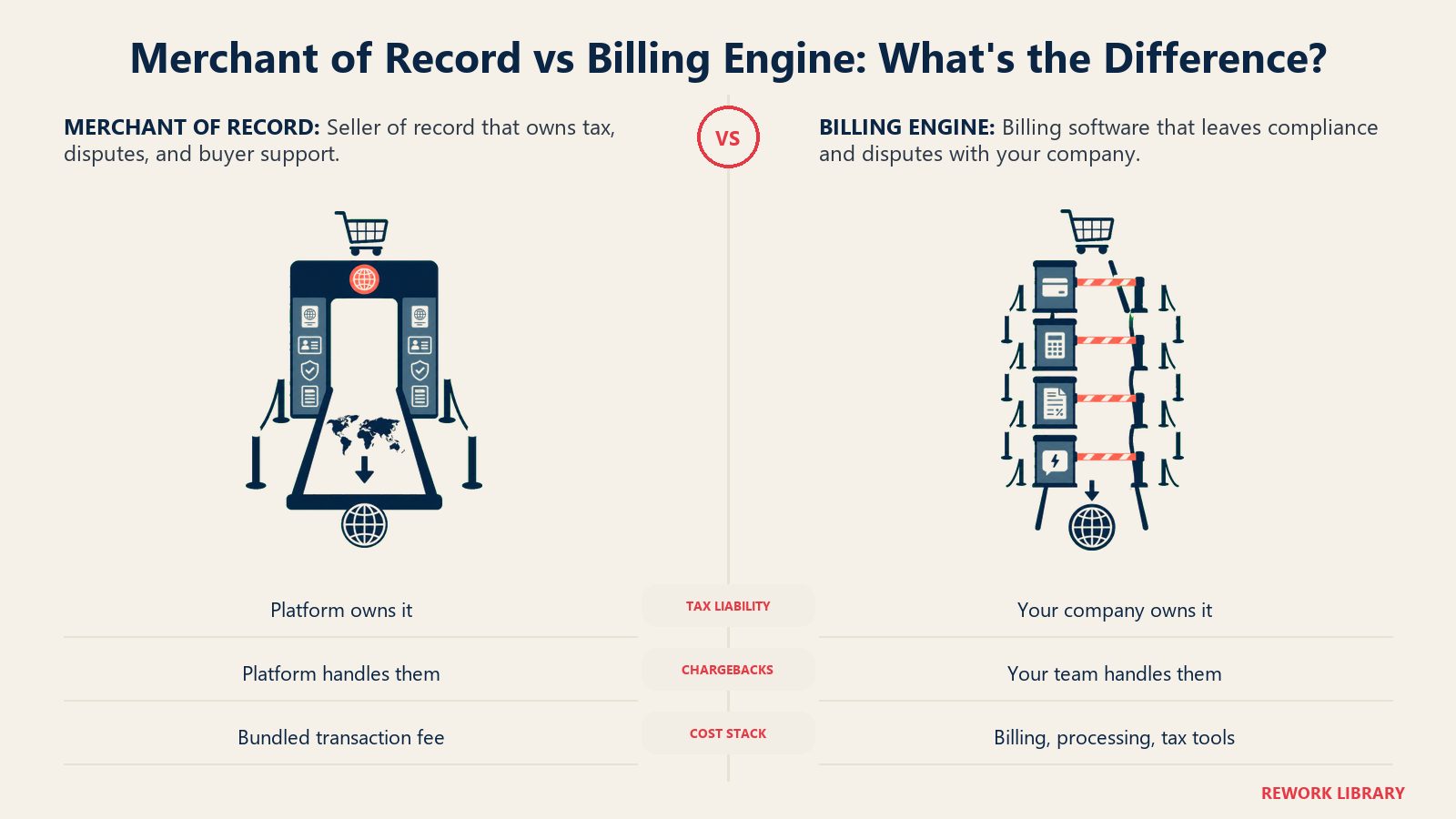
| Merchant of Record | Billing Engine | |
|---|---|---|
| Who owns tax liability | The platform (Lemon Squeezy, Polar, FastSpring, Gumroad, Verifone, PayPro Global, Managed Payments) | You (Stripe Billing, Chargebee, Recurly, Maxio, Zoho Billing) |
| Who handles chargebacks | The platform, its own merchant account | You, your own account |
| Typical cost | 3.4% to 6% of each transaction, plus a flat fee | A smaller % of volume, or a platform fee, plus processing and tax tooling |
| What you still buy | Usually nothing, genuinely all-inclusive | A payment processor, plus a dedicated tax/VAT compliance product |
| Best fit | Selling globally with no in-house tax team | A finance team willing to own tax registration at real volume |
When 5% + 50c Stops Being Worth It
Here's the math with vendor-verified numbers, corrected for how Chargebee Flow actually prices: Pay As You Go runs 0.80% of monthly billing value with no platform fee (the $400/mo and $424/mo figures on Chargebee's page are a calculator's output at $50,000 in monthly billings, not base fees). Assuming a $40 average transaction, here's Paddle against Chargebee Flow PAYG plus standard Stripe card processing (2.9% + 30c), before adding a dedicated tax-compliance tool.
| Monthly billing volume | Paddle (5% + 50c) | Chargebee Flow (0.80%) + Stripe processing | Budget left for a tax tool before Paddle wins again |
|---|---|---|---|
| $5,000 | $313 | $223 | $90/mo |
| $15,000 | $938 | $668 | $270/mo |
| $30,000 | $1,875 | $1,335 | $540/mo |
| $50,000 | $3,125 | $2,225 | $900/mo |
| $100,000 | $6,250 | $4,450 | $1,800/mo |
On processing math alone, the DIY stack beats Paddle at every volume shown, by a growing dollar amount as billings scale, since Chargebee Flow PAYG carries no platform fee at all. But "cheaper on processing" isn't "cheaper overall": none of this includes a dedicated tax-compliance tool, the real cost of doing yourself what Paddle's percentage covers. The honest question isn't a volume crossover, it's whether tax tooling and the work of registering across jurisdictions costs less than the right-hand column. Below roughly $15,000 a month, most tax tools would erase that gap.
Quick Comparison Table
| Tool | Model | Best For | Starting Price | Key Strength | Key Limitation |
|---|---|---|---|---|---|
| Lemon Squeezy | MoR | Simplest MoR for solo devs, small SaaS | 5% + 50c (+1.5% intl.) | Flat rate, no monthly fee | Roadmap points toward Stripe Managed Payments |
| FastSpring | MoR | Mid-market sellers wanting a negotiated rate | No published price | Custom rate can beat flat MoR at volume | Nothing to pre-qualify before a sales call |
| Polar | MoR | SaaS wanting rates that drop with volume | 5.00% + 50c to 3.40% + 30c | Only MoR here with volume discounts | Newer vendor, shorter track record |
| Stripe | Billing engine or MoR | Teams already on Stripe payments | 0.7% (Billing) or 3.5% + fees (Managed) | Two products, one incumbent | Managed Payments runs past 6% all-in |
| Chargebee | Billing engine | Mid-market/enterprise usage-based billing | 0.80% of billing value, no platform fee | Deep CPQ, metering, RevRec | Tax and MoR compliance stay yours |
| Rework | Neither (income ops on your CRM) | B2B teams invoicing directly | Quote on request | Incomes lives on the CRM record | Not a merchant of record |
| Recurly | Billing engine | Predictable entry price, modest volume | $249/mo + 0.9% (first $40K free) | Volume-based free floor | All-Access needs a $1M minimum |
| Gumroad | MoR | Individual creators, solo sellers | 10% + 50c, or 30% via Discover | Simplest setup, live in minutes | Take rate roughly double Paddle's |
| Verifone (2Checkout) | MoR | Established payments brand | 3.5%-6.0% by tier (reported) | Backed by a large payments company | Pricing not vendor-confirmed |
| Digital River | Formerly MoR, winding down | No one evaluating today | N/A, closing | Pioneered MoR in 2005 | Filed a WARN notice, shutting down |
| PayPro Global | MoR | Negotiated, all-inclusive MoR deal | No published price | No add-on menu to navigate | Zero published figures to benchmark |
| Maxio | Billing engine | Clear entry price tied to volume | $599/mo up to $100K/mo | Published entry price | Formed from Chargify + SaaSOptics |
| Zoho Billing | Billing engine | Small, budget-conscious subscriptions | $50/mo ($39/mo annual) | Lowest fixed cost here | Caps at $1M annual billed amount |
The Merchant of Record Alternatives
1. Lemon Squeezy: The Simplest MoR Setup, Now Inside Stripe's Orbit
Lemon Squeezy built its reputation as the fastest way for an indie developer to start selling software: connect a product, set a price, and it handles tax registration, remittance, fraud, and buyer-facing support at a flat 5% + 50c per transaction, plus 1.5% on international sales. No monthly fee, no tier to climb.
Worth naming plainly: Stripe acquired Lemon Squeezy in 2024, and in January 2026 the team confirmed it's building migration paths to Stripe Managed Payments, its own MoR product announced that February. Lemon Squeezy is still operating at the same rate, and no sunset date has been announced. It's not shutting down, but a new merchant should know where the roadmap points.
Fit. Solo to roughly 20 people, pre-$1M ARR, pre-seed through early growth: indie developers wanting the simplest path to selling globally.
| Pros | Cons |
|---|---|
| Flat 5% + 50c, no monthly fee, no tier to navigate | 1.5% surcharge on international sales |
| Full tax and compliance handled, nothing to register yourself | Roadmap points toward Stripe Managed Payments |
Pricing: 5% + 50c per transaction, all-inclusive. Plus 1.5% on non-US transactions. No monthly fee.
Best for: A solo developer or small SaaS team that wants to start selling today without touching tax registration, and is comfortable that the underlying product now sits inside Stripe.
2. FastSpring: A Negotiated Rate Instead of a Fixed One
FastSpring has run as an MoR since before the category had a name, and still doesn't publish a rate card. The pricing page describes "simple, flat-rate pricing based on transaction type and your volume of business," negotiated with sales, no stated minimum volume. For a business with real volume, that negotiation can land below Paddle's 5% + 50c; for one still finding its first hundred customers, it's a sales call with nothing to pre-qualify against.
Fit. Roughly 10 to 500 employees, growth stage with real revenue history to negotiate with, not first-time sellers.
| Pros | Cons |
|---|---|
| Negotiated rate can beat flat MoR pricing once you have volume | No published number to compare against upfront |
| No stated minimum volume required to start the conversation | Every evaluation starts with a sales cycle |
Pricing: No published price. Revenue-share negotiated per merchant based on transaction type and volume.
Best for: An established seller with real transaction history who wants to negotiate a rate rather than accept a flat one.
3. Polar: The Only MoR Here With Built-In Volume Discounts
Polar takes a different approach than the flat-rate MoRs here: its rate drops as volume grows, across four tiers. Starter runs 5.00% + 50c, matching Paddle almost exactly; Pro drops to 3.80% + 40c, Growth to 3.60% + 35c, Scale to 3.40% + 30c, the cheapest published MoR rate in this guide. Polar operates as a merchant of record in 100+ markets, built for a developer-first audience.
Fit. Solo to roughly 50 employees, pre-seed through Series A: technical founders who'd otherwise consider building tax handling themselves.
| Pros | Cons |
|---|---|
| The only MoR here where the rate itself drops with volume | Newer vendor, shorter track record than FastSpring or Paddle |
| Starter tier matches Paddle's flat rate, so switching costs nothing | Fewer enterprise features (CPQ, advanced RevRec) than Chargebee |
Pricing: Starter 5.00% + 50c, Pro 3.80% + 40c, Growth 3.60% + 35c, Scale 3.40% + 30c, all per transaction.
Best for: A developer-led SaaS business that expects real transaction volume and wants its MoR rate to improve as it scales, not stay flat.
4. Stripe: Billing Engine or Merchant of Record, Your Choice
Stripe is the one name here that shows up in both categories, because it sells two distinct products for this decision. Stripe Billing is a billing engine: pay-as-you-go pricing runs 0.7% of billing volume with no free threshold, or a Pay Monthly annual plan from $620/month up to $100K in volume, scaling up to $5,750/month at $1M. Card processing is billed separately at 2.9% + 30c, ACH at 0.8% capped at $5.00.
Stripe Managed Payments is the merchant-of-record answer, built from the Lemon Squeezy acquisition and announced in February 2026. It charges 3.5% per transaction on top of standard Payments fees, putting the all-in cost for a US card north of 6%, more than Paddle's 5% + 50c. What it buys is tax registration across 75+ countries, fraud prevention, dispute management, and support inside your existing Stripe dashboard.
| Product | Model | Price |
|---|---|---|
| Stripe Billing | Billing engine | 0.7% of billing volume (pay as you go), or tiered monthly plans from $620/mo, plus separate payment processing |
| Stripe Managed Payments | Merchant of Record | 3.5% per transaction plus standard Payments fees (roughly 6%+ all-in for a US card) |
Fit. Self-serve startups through enterprise, already on Stripe for payments, wanting either metered billing without switching platforms or to hand tax off entirely.
Best for: A team that doesn't want a second vendor relationship and is willing to pay Stripe's rate for either the billing engine or the full MoR product. For the wider payment and billing field, see our Stripe alternatives guide.
5. Chargebee: The Deepest Billing Engine on This List
Chargebee's billing product, sold as Flow, is built for SaaS companies whose billing has outgrown flat-rate subscriptions: usage metering, CPQ, revenue recognition, and retention tooling live under one roof. Pay As You Go charges 0.80% of monthly billing value with no platform fee (that's $400/month on $50,000 in monthly billings). Commit Monthly charges a $99 flat fee plus 0.65% of billing value ($424/month at that same benchmark). Both include 100 million usage events per month; Enterprise Plus is custom-priced with up to 500 million. Add-ons price separately. There's a free trial, no permanent free tier.
What Chargebee doesn't do is act as a merchant of record: tax, remittance, and chargeback ownership stay with you. See the Chargebee alternatives guide and the Chargebee vs. Recurly comparison for more.
Fit. Roughly 20 to 2,000+ employees, Series B and later, once billing complexity outgrows a flat-rate MoR.
| Pros | Cons |
|---|---|
| Usage metering, CPQ, and RevRec in one platform | No free permanent tier, trial only |
| Enterprise Plus scales to 500M usage events/month | Tax and MoR compliance stay entirely on you |
Pricing: Pay As You Go: 0.80% of billing value, no platform fee ($400/mo at $50K in monthly billings). Commit Monthly: $99 + 0.65% of billing value ($424/mo at that same benchmark). Enterprise Plus is custom.
Best for: A mid-market or larger SaaS company with usage-based billing that's ready to own its own tax compliance in exchange for deeper billing tooling.
6. Rework: Income Operations on the Same Record as Your CRM
Rework is not a merchant of record and does not remit sales tax or VAT on your behalf. It earns its place here for a different reader: a B2B team that invoices customers directly, rather than running a global self-serve checkout, and wants income operations sitting on the same platform and customer record as its CRM, lead pipeline, contracts, and bank feeds.
Instead of stitching together a checkout widget, a separate CRM, and a standalone AR tool, Rework's Incomes module lives next to Sales, Lead, Invoice, Contract, and Bankfeeds on one customer timeline, so a deal, its contract, invoices, and payment history are all visible without exporting anything between systems. For a team already running its pipeline in a CRM (see our CRM roundup), that's the reason to look here.
Fit. Roughly 5 to 200 employees (minimum package is 5 users): B2B teams invoicing directly where income ops, CRM, contracts, and payment history on one record matter more than checkout depth.
| Pros | Cons |
|---|---|
| Income operations on the same customer record as CRM, contracts, bank feeds | Not a merchant of record, no tax remittance |
| Removes a separate checkout, CRM, and AR tool stitched together by hand | No usage metering or CPQ depth for complex billing |
Pricing: Quote on request. Rework sells packages, not per-user licenses; see rework.com/pricing for current details.
Not ideal for: Merchant-of-record tax handling for global digital sales, high-volume SaaS billing needing usage metering or ASC 606 revenue recognition, enterprise AR teams needing HighRadius-grade collections AI, or solo operators (minimum package is 5 users).
Best for: A B2B team invoicing customers directly that wants income operations, its CRM pipeline, contracts, and bank feeds unified on one customer record instead of a global checkout.
7. Recurly: A Billing Engine With a Volume-Based Free Floor
Recurly's Starter plan runs $249/month plus 0.9% of billing volume, but the first $40,000 of monthly billings comes at no charge, with a 90-day free trial. That free floor makes Recurly meaningfully cheaper than a flat-percentage MoR for modest, predictable volume.
All-Access, the higher tier, prices "as low as under 1% of billing volume, billed annually," but requires a $1 million billing-volume minimum (same for All-Access for Shopify). Engage adds from $1,600/month, RevRec from $850/month, both billed annually. If Recurly is the tool you're shopping away from, see the Recurly alternatives guide and the Chargebee vs. Recurly comparison.
Fit. Startup through enterprise (gated by All-Access's $1M minimum), especially useful early thanks to the free floor.
| Pros | Cons |
|---|---|
| First $40K/month billed at no charge on Starter | All-Access requires $1M in billing volume to qualify |
| 90-day free trial, longer than most competitors offer | No tax or MoR coverage, compliance is on you |
Pricing: Starter $249/mo + 0.9% of billing volume (first $40K/mo free). All-Access as low as <1% of billing volume, billed annually, $1M minimum. Engage from $1,600/mo, RevRec from $850/mo, both billed annually.
Best for: A subscription business with modest, steady volume that wants a billing engine with a real free allowance built into the entry tier.
8. Gumroad: The Simplest Setup for a Solo Seller
Gumroad is the flattest, fastest MoR on this list: 10% + 50c on sales through your own profile or direct links, or 30% through Gumroad's Discover marketplace, no monthly fee, nothing to configure beyond listing a product and setting a price.
The trade-off is the rate. At real volume, Gumroad's 10% take is roughly double Paddle's 5% + 50c, and the 30% Discover rate makes marketplace discovery an expensive acquisition channel next to running your own funnel. Gumroad makes the most sense for testing whether a product sells at all, not for established revenue.
Fit. Solo to roughly 5 people, pre-revenue through early revenue: individual creators and small digital-product sellers (courses, ebooks, small tools) validating an idea before optimizing take rate.
| Pros | Cons |
|---|---|
| Dead simple, no tier, no negotiation, live in minutes | 10% direct / 30% Discover roughly doubles Paddle's rate |
| No monthly fee at any stage | Not built for teams with complex billing needs |
Pricing: 10% + 50c per transaction (direct sales), 30% (Discover marketplace sales). No monthly fee, no tiers.
Best for: A solo creator or first-time seller validating a digital product before optimizing for take rate.
9. Verifone (2Checkout): An Established Payments Brand's MoR
2Checkout, now sold under Verifone, offers three tiers scaled to how much of the merchant-of-record stack you need: 2Sell for basic processing and fraud protection, 2Subscribe adding billing and churn management, 2Monetize layering on full tax and localization. Independent sources (TrustRadius, Tekpon, G2) consistently report 2Sell at 3.5% + $0.35, 2Subscribe at 4.5% + $0.45, and 2Monetize at 6.0% + $0.60 per sale, no setup or monthly fees, with a reported ~1% FX markup.
The numbers above carry a (reported) label. Confirm current rates with Verifone's sales team before budgeting against them.
Fit. Small business through mid-market: sellers who want an established payments company behind their MoR relationship (the brand spans Avangate, then 2Checkout, now Verifone).
| Pros | Cons |
|---|---|
| Backed by Verifone, a large, established payments company | Pricing figures are third-party reported; confirm with Verifone |
| Three tiers let you pay only for the MoR depth you need | Reported ~1% FX markup adds to the headline rate |
Pricing (reported, see above): 2Sell 3.5% + $0.35, 2Subscribe 4.5% + $0.45, 2Monetize 6.0% + $0.60. Confirm current rates with Verifone.
Best for: A mid-market seller who wants an established payments incumbent behind its MoR and is willing to confirm exact rates directly with sales.
10. Digital River: Formerly a Pioneer, Now Winding Down
Skip this one for any new evaluation. Digital River pioneered the merchant-of-record model in 2005 and, at its 2013 peak, processed more than $30 billion in online transactions annually. But the company filed a WARN notice confirming it's closing its Minnetonka, Minnesota headquarters and laying off 122 employees, with insolvency proceedings underway for its German subsidiary and liquidators appointed for its Irish arm (Star Tribune). Leadership cited contracting key customers, shorter payment terms on new deals, and US trade policy pressure on a top customer.
| Status | What it means |
|---|---|
| Winding down | WARN notice filed, HQ closing, insolvency proceedings in Germany and Ireland |
| Existing customers | Source a replacement now, don't wait for a forced deadline |
| New evaluations | Not applicable, this guide's other 12 options are all live |
Best for: No one shopping today. If you're an existing Digital River customer, treat this as your migration signal and start evaluating the merchant-of-record options earlier in this list.
11. PayPro Global: A Fully Negotiated MoR With No Public Rate Card
PayPro Global runs on the same "one fair price, all features included" positioning as FastSpring: no percentage, no flat fee, no tiered plan on its pricing page. It frames this as avoiding "simple price tags" for a complex solution and directs every merchant to a "Get a Quote" flow. That's a legitimate model for a negotiated MoR, but it means nothing to compare against Paddle's 5% + 50c without a sales call first.
Fit. Small business through mid-market, quote-based regardless of size: sellers who'd rather negotiate an all-inclusive deal than accept a published flat rate.
| Pros | Cons |
|---|---|
| "All features included" avoids surprise add-on fees | Zero published figures to benchmark against competitors |
| Full MoR coverage, tax and compliance included | No way to pre-qualify budget before a sales call |
Pricing: No published price. Custom quote only, positioned as "one fair price, all features included."
Best for: A merchant comfortable running a sales process to negotiate an all-inclusive MoR rate rather than accepting a published one.
12. Maxio: A Billing Engine With a Clear Entry Price
Maxio (from the merger of Chargify and SaaSOptics) is one of the few billing engines here with a genuinely published starting price: Grow runs $599 a month for companies billing up to $100,000 a month. Cross that threshold and you move to Scale, quote-only. Default agreements are paid annually; monthly and quarterly options carry a premium.
Fit. Early growth through mid-market, post-product-market-fit with billings substantial enough to justify the $599/month floor: SaaS companies wanting a clear, published entry price over a quote-first process.
| Pros | Cons |
|---|---|
| Genuinely published starting price, unlike most competitors here | Scale tier reverts to quote-only past $100K/mo |
| Clear, single threshold for when to expect a plan change | No merchant-of-record option, tax stays your responsibility |
Pricing: Grow $599/mo, up to $100K in monthly billings. Scale is custom, "Get a Quote," for over $100K/mo. Default agreements are billed annually.
Best for: A SaaS company with substantial, predictable monthly billings that wants a billing engine with a real published starting price.
13. Zoho Billing: The Lowest Fixed Cost on This List
Zoho Billing is the budget option here: Standard runs $50/month month-to-month or $39/month annually for up to 3 users, Premium runs $100/month or $79/month annually for up to 10 users. Enterprise is custom. Both capped tiers max out at 100,000 invoices a year and $1 million in annual billed amount. No permanent free plan, but a 14-day trial is available.
Fit. Solo through roughly 50 employees, early stage and budget-conscious, bounded by the $1M annual billed-amount cap, especially teams already using or open to the broader Zoho suite.
| Pros | Cons |
|---|---|
| Lowest fixed monthly cost of any billing engine here | Caps at $1M in annual billed amount |
| Fits naturally alongside the rest of the Zoho ecosystem | No merchant-of-record option, tax compliance stays yours |
Pricing: Standard $50/mo ($39/mo annual), up to 3 users. Premium $100/mo ($79/mo annual), up to 10 users. Enterprise custom. Caps at 100,000 invoices/year and $1M annual billed amount.
Best for: A small, budget-conscious subscription business, particularly one already running other Zoho products, that doesn't yet need enterprise billing depth.
Sizing, Stage, and Persona Fit
The right platform model changes with team maturity, billing volume, tax ownership, and whether customers buy through self-serve checkout or direct invoices.
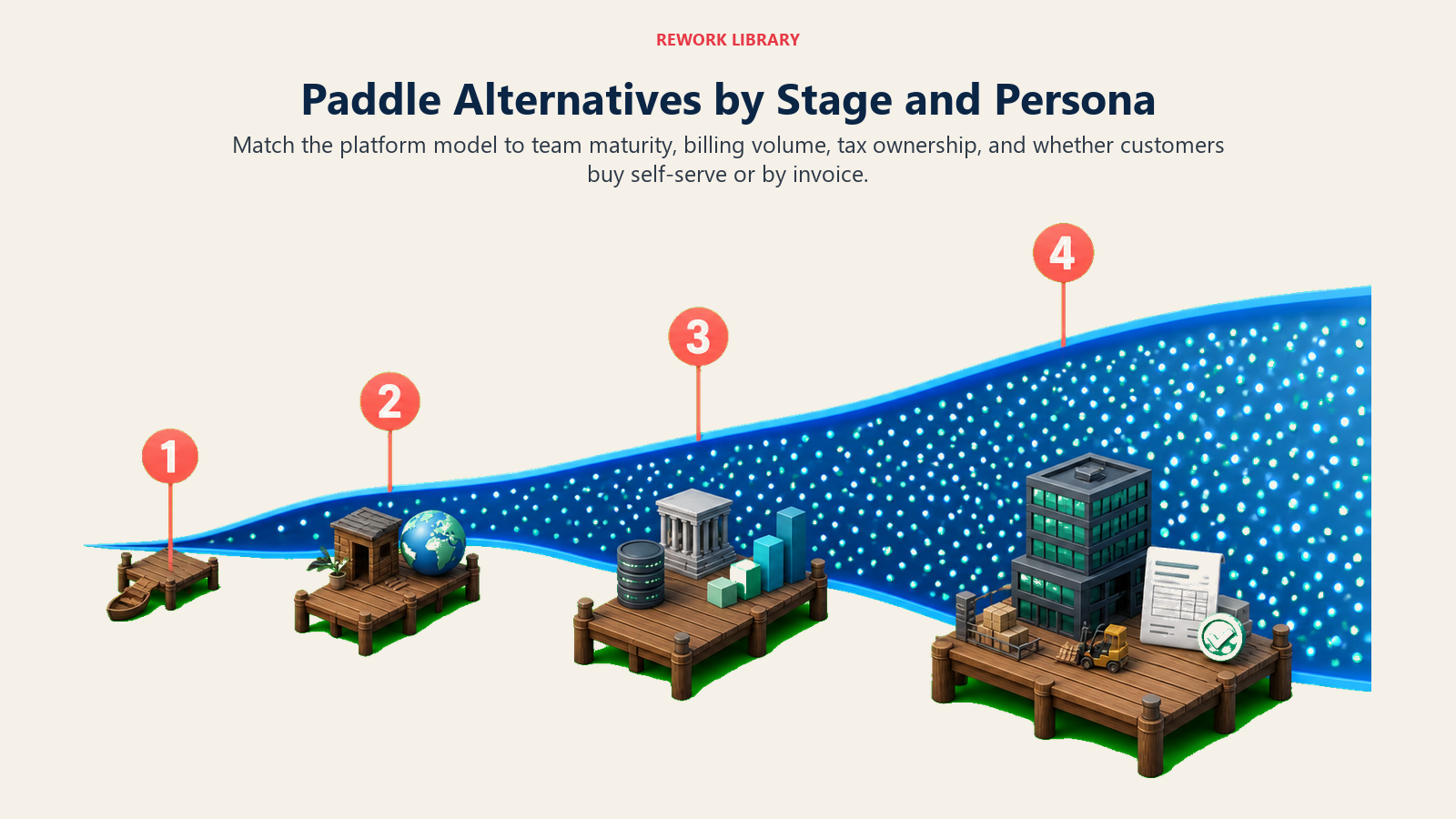
| Situation | What matters most | Best fits |
|---|---|---|
| Solo developer, first paid product, pre-revenue | Zero setup, no tax homework, get paid today | Gumroad, Lemon Squeezy |
| Small SaaS team (2 to 20), under ~$20K/mo | Full MoR coverage without a finance hire | Lemon Squeezy, Polar, FastSpring |
| Scaling past roughly $15K to $30K/month | Billing-engine math beats a flat MoR %, once tax tooling is weighed in | Chargebee, Stripe Billing, Recurly |
| Mid-market to Series B+, usage-based billing | Metering, CPQ, and RevRec depth | Chargebee, Maxio |
| Finance team ready to own tax registration | A billing engine plus your own tax/VAT tooling | Stripe Billing, Recurly, Maxio, Zoho Billing |
| B2B, direct invoicing, not a self-serve storefront | Income operations tied to the CRM record | Rework |
| Enterprise, or switching from an existing MoR | An established, negotiable relationship | FastSpring, PayPro Global, Verifone |
| Budget-constrained small business | Lowest fixed monthly cost | Zoho Billing |
How to Choose: Decision Framework
Decide who owns tax first, then filter by billing complexity, transaction volume, and direct-invoice versus self-serve sales.
| If you need... | Choose |
|---|---|
| The simplest MoR setup for a solo project | Gumroad or Lemon Squeezy |
| An MoR rate that drops as volume grows | Polar |
| A negotiated MoR deal, not a fixed percentage | FastSpring or PayPro Global |
| Usage-based billing, CPQ, and RevRec in one suite | Chargebee |
| To stay inside the Stripe ecosystem | Stripe (Billing or Managed Payments) |
| A billing engine with a volume-based free floor | Recurly |
| The lowest fixed monthly cost | Zoho Billing |
| A clear entry price tied to billing volume | Maxio |
| Income ops on your CRM record, not a global checkout | Rework |
| An established brand behind your merchant of record | Verifone (2Checkout) |
If accounts receivable matters as much as the checkout itself, our accounts receivable software roundup covers that adjacent decision; for a broader finance stack, see the QuickBooks alternatives and ecommerce platform roundups.
Frequently Asked Questions about Paddle Alternatives
What's the actual difference between a merchant of record and a billing engine?
A merchant of record takes on your sales-tax and VAT liability, owns chargebacks, and handles buyer support for a percentage fee. A billing engine bills and collects for you, but you register for tax and handle disputes yourself. The trade is price versus responsibility.
How does Paddle's pricing compare to these alternatives?
Paddle charges 5% + 50c per transaction, all-inclusive. Lemon Squeezy matches it exactly. Polar starts at the same rate and drops as low as 3.40% + 30c at volume. Gumroad runs higher at 10% (or 30% via Discover). The billing engines cost less on a percentage basis, but none includes tax registration the way Paddle does.
At what point does switching from a merchant of record to a billing engine actually save money?
On processing math alone, Chargebee Flow (0.80% of billing value, no platform fee) plus Stripe processing (2.9% + 30c) beats Paddle's 5% + 50c at any real volume, and the gap widens with billings: about $90/month at $5,000, up to $1,800/month at $100,000. But that gap is also your budget for a tax-compliance tool, since a billing engine doesn't register or remit tax the way Paddle does. Below roughly $15,000/month, most tax tools would erase it.
Is Lemon Squeezy shutting down?
No. Stripe acquired it in 2024, and in January 2026 the team confirmed it's building migration paths to Stripe Managed Payments, Stripe's own MoR product. Lemon Squeezy still operates at its original 5% + 50c rate, and no sunset date has been announced.
Is Digital River still a viable option?
No. It filed a WARN notice confirming it's closing its Minnetonka headquarters and laying off 122 employees, with insolvency proceedings underway in Germany and Ireland. It pioneered the MoR category in 2005, but existing customers should already be sourcing a replacement.
Is Rework a merchant of record?
No. Rework doesn't remit sales tax or VAT and doesn't own chargebacks. It earns a spot here for B2B teams that invoice customers directly and want income operations on the same customer record as their CRM, contracts, and bank feeds, a consolidation argument, not a billing-depth one.
If I use a billing engine, do I still need a separate tax compliance tool?
Yes. A billing engine doesn't register you for sales tax or VAT, remit it, or absorb chargeback liability. With 101 countries applying VAT or GST to cross-border digital sales, that work has to live somewhere, either a dedicated tax tool or inside an MoR's fee.
What to Do Next
Run the math against your own numbers, not the $40 average transaction assumed above. Pull your last three months of billing volume and average order value, then price a real tax-compliance tool against the processing gap in the break-even table. If that tool costs more than the gap, a cheaper or better-fit MoR like Polar or Lemon Squeezy is the higher-value move. If it costs less, pilot a billing engine plus a tax-compliance product for a full quarter before committing, since the switching cost is in the tax registration work, not the software contract.
Camellia writes about billing, revenue operations, and finance tooling for B2B and digital-product teams.

Principal Product Marketing Strategist
On this page
- Key Facts
- Merchant of Record vs. Billing Engine: The Real Decision
- When 5% + 50c Stops Being Worth It
- Quick Comparison Table
- The Merchant of Record Alternatives
- 1. Lemon Squeezy: The Simplest MoR Setup, Now Inside Stripe's Orbit
- 2. FastSpring: A Negotiated Rate Instead of a Fixed One
- 3. Polar: The Only MoR Here With Built-In Volume Discounts
- 4. Stripe: Billing Engine or Merchant of Record, Your Choice
- 5. Chargebee: The Deepest Billing Engine on This List
- 6. Rework: Income Operations on the Same Record as Your CRM
- 7. Recurly: A Billing Engine With a Volume-Based Free Floor
- 8. Gumroad: The Simplest Setup for a Solo Seller
- 9. Verifone (2Checkout): An Established Payments Brand's MoR
- 10. Digital River: Formerly a Pioneer, Now Winding Down
- 11. PayPro Global: A Fully Negotiated MoR With No Public Rate Card
- 12. Maxio: A Billing Engine With a Clear Entry Price
- 13. Zoho Billing: The Lowest Fixed Cost on This List
- Sizing, Stage, and Persona Fit
- How to Choose: Decision Framework
- What to Do Next