Best Zuora Alternatives in 2026: 14 Order-to-Cash Platforms for Faster Time to Value

Turn this article into takeaways for your work.


Each assistant summarizes the article only for you and suggests best practices for your work.
The 14 best Zuora alternatives in 2026 are Chargebee and Salesforce Revenue Cloud for teams that want enterprise-grade quote-to-cash without Zuora's implementation runway, Stripe Billing and Recurly for mid-market teams that want a published starting price on day one, Ordway for teams that want revenue recognition bundled with billing at a lighter weight than Zuora, and Rework for teams that want income tracking living on the same record as their CRM and contracts instead of a fourth logged-in tool.
Zuora's own pricing page offers a product tour, an AI Monetization Simulator and a "speak to an expert" link, nothing else: no tier names, no starting figure, no percentage or per-user rate appears publicly anywhere on the site. Vendr's deal-data benchmark, built from actual buyer contracts, puts the median Zuora buyer at $170,000 a year, ranging from $26,883 to $696,804 (reported, not vendor-confirmed), a spread wide enough that it tells you more about how customized every deal is than what you'd actually pay. That opacity sits alongside two other real reasons finance and RevOps teams start shopping: Zuora's enterprise-scale configurability means an implementation project measured in months against multi-entity rating rules and a full RevPro deployment, not weeks, and Zuora has been a private company since February 14, 2025, when Silver Lake and GIC completed a $1.7 billion take-private at $10.00 a share and delisted its Class A stock from the New York Stock Exchange, a fact worth understanding before signing a multi-year contract with a newly private-equity-owned vendor. None of that erases what Zuora does well, covered honestly further down. For the category-wide view before narrowing to Zuora specifically, start with the subscription billing software roundup.
Key Facts
- Zuora has been a private company since February 14, 2025, when Silver Lake and GIC completed a $1.7 billion take-private at $10.00 per share and delisted its Class A stock from the NYSE, per Silver Lake's acquisition announcement. Any pricing or roadmap conversation with Zuora today happens with a newly private-equity-owned vendor.
- The median Zuora buyer pays $170,000 a year, ranging from $26,883 to $696,804, per Vendr's deal-data benchmark built from 149 actual purchases (reported, not vendor-confirmed). Zuora's own pricing page publishes none of this.
- 33% of SaaS spending is reported as wasted, per Flexera's State of ITAM report, the exact risk of buying more platform configurability than a team will use.
- Broken order-to-cash processes cost a typical B2B company 3% to 5% of EBITDA, and in the worst cases eat 15% to 20% of revenue, according to McKinsey's order-to-cash optimization research. Billing and revenue recognition are links in that chain, not the whole thing.
- Typical SaaS billing system implementations run 4 to 12 weeks, per Ordway's own implementation timeline guide, a fraction of the months-long runway an enterprise-scale platform like Zuora typically needs.
Why Finance Teams Start Evaluating Zuora Alternatives
This opening section explains the pain that pushes finance teams to start comparing Zuora alternatives.
| Reason | What it looks like in practice | Who feels it most |
|---|---|---|
| Zero pricing transparency | No tier names, no starting figure, no percentage anywhere on the public site | Finance teams that want a budget range before a first sales call |
| Enterprise-scale implementation weight | A rollout measured in months against multi-entity rating rules and a full RevPro configuration | Mid-market teams without a dedicated implementation team |
| Buying more configurability than the team will use | Multi-entity billing, complex rating engines and RevPro sit mostly unused for a single-entity business | Companies under roughly $50M ARR evaluating Zuora mostly on brand reputation |
| New private-equity ownership | Silver Lake and GIC took Zuora private in February 2025; roadmap and pricing leverage questions follow any buyout | Teams weighing a multi-year contract with a newly private vendor |
| Wanting a published starting price | A budget range on the pricing page beats a "speak to an expert" link for an early-stage shortlist | Finance teams building a first-pass vendor comparison |
| RevRec and CPQ depth without the full platform | Ordway, Chargebee's RevRec add-on and Salesforce Revenue Cloud offer real revenue-recognition depth at a lighter implementation weight | Teams that need ASC 606 automation but not Zuora's full configurability |
Quick Comparison Table
| Tool | Best For | Starting Price | Key Strength | Key Limitation |
|---|---|---|---|---|
| Chargebee | Teams wanting CPQ, RevRec and retention tooling bundled with billing | 0.80% of billing value, no platform fee (Flow, Pay As You Go, monthly) | Broadest add-on suite here, 100 million usage events included | No free plan on core Billing; add-ons priced separately |
| Salesforce Revenue Cloud | Salesforce-native teams wanting quote-to-cash inside the CRM | $150/user/month, billed annually (Growth) | Billing, CPQ and revenue lifecycle live inside the CRM record | Requires an active Sales or Service Cloud license underneath it |
| Stripe Billing | Teams already processing payments through Stripe | 0.7% of billing volume, no free threshold, monthly | Native to the Stripe stack, transparent published rate | Percentage sits on top of 2.9% + 30c processing, not instead of it |
| Ordway | Teams wanting billing bundled with RevRec and investor-metrics reporting | No published price, demo only (reported median $48,890/year, Vendr) | Combines billing, AR and ASC 606 revenue recognition in one system | Zero pricing signal anywhere on the vendor's own site |
| Recurly | Mid-market teams wanting a published entry price and fast time to value | $249/month + 0.9% of billing volume, first $40K/month free (Starter) | Generous free threshold, 90-day trial before paying anything | All-Access tier requires $1M in annual billing volume to qualify |
| Rework | Teams wanting income operations on the same platform as CRM, leads and contracts | Quote on request | Income and revenue data live on the same customer record as sales, leads and contracts | Not a metering or proration engine; no dunning, tax remittance or revenue-recognition automation |
| Maxio | Teams under $100K/month in billings wanting a flat fee | $599/month flat (Grow), up to $100K/month billings | Unlimited users included, no per-seat charge | Scale tier above $100K/month is quote-only |
| HighRadius | Enterprise AR and collections teams wanting order-to-cash automation | No published price, consultation only | Deep collections, cash application and deduction automation at enterprise scale | No free trial and no self-serve entry point of any kind |
| Zoho Billing | Small teams wanting a flat, low-cost entry point | $39/month billed annually (Standard) | Cheapest named flat price in this guide | Caps at $1M annual revenue and 100,000 invoices/year |
| Paddle | Teams wanting one all-inclusive rate covering tax and processing | 5% + 50c per transaction, all-inclusive | No separate tax, fraud or processing vendor to manage | Costs more per dollar than orchestration-only tools at real scale |
| Polar | Developer-first teams selling digital products or SaaS | 5.00% + 50c (Starter), down to 3.40% + 30c (Scale) | Rate drops as volume grows, unlike Paddle's flat 5% | Newer entrant, smaller enterprise reference base |
| Lemon Squeezy | Small teams wanting merchant-of-record simplicity | 5% + 50c per transaction (+1.5% international) | Simple, single-rate pricing with no tiers to model | Signup access reported as gated in mid-2026, confirm directly |
| FastSpring | Teams wanting a negotiated revenue-share deal, no minimum volume | No published price, revenue-share negotiated with sales | No minimum volume requirement to start a conversation | Zero pricing transparency before a sales call |
| Billsby | Small teams wanting a flat fee with overage instead of a percentage | $45/month (Core), $15,000/month transaction allowance included | Lowest named base fee, flat overage above the allowance | Overage math needs modeling once volume exceeds the allowance |
The Real Cost-at-Volume Math
Zuora publishes no percentage or flat rate to anchor against, so the table below compares the named-price alternatives against each other instead. The assumptions:
- For percentage-of-volume and flat-fee billing engines (Chargebee, Stripe Billing, Recurly, Maxio), the figure is the billing-platform fee only. Card processing, typically about 2.9% + 30 cents through your own Stripe, Adyen or similar merchant account, is separate and not included.
- Zoho Billing doesn't price by volume at all; its fee is flat up to an annual cap ($1 million in revenue, 100,000 invoices). The figure shown is that flat fee, and rows past the cap read Custom.
- For all-inclusive merchant-of-record vendors (Paddle, Polar), the fee already bundles processing, fraud screening and tax remittance. Because these vendors charge per transaction rather than per dollar, the table assumes a $50 average transaction to translate the fee into a comparable monthly total.
- Zuora, Ordway, HighRadius and FastSpring publish no percentage or flat rate at all, so they're excluded from this table rather than estimated. Salesforce Revenue Cloud and Rework don't price by billing volume either; their sections below explain the actual cost driver for each.
| Monthly billing volume | Chargebee | Stripe Billing | Recurly | Maxio | Zoho Billing | Paddle | Polar (Scale) |
|---|---|---|---|---|---|---|---|
| $40,000 | $320 | $280 | $249 (first $40K free) | $599 (Grow) | $79 (Premium, annual) | $2,400 | $1,600 |
| $250,000 | $2,000 | $1,750 | $2,139 | Custom (Scale) | Custom (exceeds $1M/yr cap) | $15,000 | $10,000 |
| $1,000,000 | $8,000 | $7,000 (or $5,750/mo flat on annual commit) | Custom (All-Access requires $1M+ in annual volume) | Custom (Scale) | Custom (Enterprise) | $60,000 | $40,000 |
Two things jump out. First, at real volume the percentage-of-volume billing engines (Chargebee, Stripe Billing, Recurly) land within a few hundred dollars of each other, so the deciding factor for that group is almost never the base rate, it's which add-ons (RevRec, CPQ, dunning) come bundled versus purchased separately. Second, the all-inclusive merchant-of-record vendors cost meaningfully more per dollar at any real volume than orchestration-only billing platforms plus your own processor, because you're paying for tax remittance and fraud screening bundled into every transaction rather than added on top. That trade only makes sense if hiring or contracting for sales tax and VAT compliance yourself would cost more than the spread, which is common for a small digital-product business selling globally and rare for a finance team large enough to be evaluating Zuora in the first place.
What Zuora Still Does Best
An alternatives guide that only lists reasons to leave reads like a sales pitch, and Zuora earns a fair hearing on three fronts. Revenue recognition depth is the strongest one: Zuora Revenue (formerly RevPro) handles the full ASC 606 and IFRS 15 five-step model, complex SSP allocation, variable consideration and modification accounting, at a level of automation few billing-adjacent tools attempt, built up over close to a decade of enterprise deployments. Multi-entity support is a second real strength: teams running several legal entities, multiple currencies and different rating rules per business unit get one platform instead of stitching several together. And the enterprise track record is genuine. Zuora has one of the longest histories in this category, a mature systems-integrator ecosystem, and reference customers running some of the most complex subscription and usage-based pricing models in the industry. None of that disappears the moment a team starts shopping alternatives, and for a large, multi-entity subscription business whose actual complaint is the missing price tag rather than any functional gap, staying put and negotiating with a now-private, deal-hungry ownership group is a legitimate option this guide doesn't get to recommend.
1. Chargebee: The Broadest Add-On Suite, With a Published Rate
Chargebee, whose billing product is now called Flow, positions itself as more than billing: CPQ, RevRec and a Retention/Growth suite sit alongside the core subscription engine, aimed at teams that want one vendor for the whole quote-to-revenue chain the way Zuora tries to be, minus the months-long implementation runway.
Methodology and fit. Two entry paths exist in 2026: Pay As You Go at 0.80% of monthly billing value with no platform fee, or Commit Monthly at a $99 monthly platform fee plus 0.65%. Both include 100 million usage events a month. Enterprise Plus moves to a custom annual contract with usage caps up to 500 million events a month, the tier that actually competes with Zuora on scale. Unlike Zuora, every tier below Enterprise Plus has a published starting rate. For a Zuora-shaped head-to-head, the Chargebee vs. Zuora comparison works through the two side by side in more depth.
| Pros | Cons |
|---|---|
| Published starting rate on every tier below Enterprise Plus, unlike Zuora's zero pricing signal | No free tier at any billing volume |
| 100 million usage events included even on the entry tier | Add-ons (CPQ beyond the free 50-quote Lite tier, RevRec) priced separately |
| Enterprise Plus scales to 500 million events/month, real headroom against Zuora's target customer | Multi-entity and complex rating-rule depth is narrower than Zuora's, worth confirming for your exact use case |
Pricing. Pay As You Go: 0.80% of monthly billing value, no platform fee, monthly. Commit Monthly: $99/month platform fee + 0.65%, monthly. Enterprise Plus: custom, annual commitment, up to 500 million usage events/month. Source: chargebee.com/pricing.
Best for: Teams that want CPQ, RevRec and retention tooling bundled with billing, and who want at least a starting number to plan against instead of Zuora's blank pricing page. If Chargebee itself is now the incumbent you're shopping away from, the Chargebee alternatives guide covers that comparison directly.
2. Salesforce Revenue Cloud: Quote-to-Cash Inside the CRM You Already Run
Salesforce Revenue Cloud, the current name for what shipped as Salesforce CPQ and Billing, is the closest thing to a genuine head-to-head with Zuora for teams that are already Salesforce-native: both compete for the same enterprise quote-to-cash budget, and both expect a real implementation project.
Methodology and fit. Revenue Cloud's named editions price at $150 per user per month (Growth) and $200 per user per month (Advanced), both on annual contracts, and both require an active Sales Cloud or Service Cloud license underneath, a real dependency cost that isn't in the headline number. That's a fundamentally different cost driver than Zuora's platform-wide pricing: Revenue Cloud scales with how many people touch the quote-to-cash process, not with billing volume or entity count. For a Salesforce-native org, quoting, contracting, billing and revenue recognition all live inside the CRM record the sales team already works in, which removes the sync layer Zuora needs to build against Salesforce as an external system.
| Pros | Cons |
|---|---|
| Published per-user starting price, unlike Zuora's zero pricing signal | Requires an active Sales or Service Cloud license on top of the Revenue Cloud fee |
| Billing, CPQ and revenue lifecycle live inside the CRM record already in daily use | Per-user pricing means cost scales with headcount, not billing efficiency |
| No sync layer needed between CRM and billing for Salesforce-native teams | Not a fit for any team not already committed to Salesforce as the CRM of record |
Pricing. Growth: $150/user/month, billed annually. Advanced: $200/user/month, billed annually. Requires an underlying Sales Cloud or Service Cloud license. Source: salesforce.com/sales/revenue-lifecycle-management/pricing.
Best for: Salesforce-native sales and finance organizations that want quote-to-cash and revenue recognition living inside the CRM record instead of syncing to an external billing platform like Zuora. Teams comparing CRM platforms more broadly can start with the CRM software roundup.
3. Stripe Billing: Native to the Stripe Stack, Live in Days
Stripe Billing appeals to teams already processing payments through Stripe who want subscription and invoicing logic in the same account, live in days rather than the months a Zuora implementation typically takes.
Methodology and fit. Pay as you go pricing is 0.7% of billing volume, covering transactions on and off Stripe, with no free threshold. For predictable volume, an annual-subscription option offers flat monthly fees: $620/month up to $100K in volume, $1,500/month up to $250K, $2,950/month up to $500K, $5,750/month up to $1M, and 0.67% on volume above each tier, with custom pricing above $1M a month. This is a billing-orchestration fee only: payment processing is charged separately, 2.9% + 30 cents per successful card charge, or 0.8% capped at $5 for ACH. Every rate here is published; nothing requires a sales call to learn. Teams evaluating Stripe more broadly, not just its billing layer, should read the Stripe alternatives guide.
| Pros | Cons |
|---|---|
| Every tier published, live in days against Zuora's months-long enterprise rollout | 0.7% billing fee sits on top of 2.9% + 30c processing, not instead of it |
| Annual-commit flat tiers get meaningfully cheaper than pay-as-you-go past $100K/month | No free threshold at all |
| Deep native integration with Stripe's payments, tax and invoicing products | Multi-entity, complex rating-rule depth is narrower than Zuora's for genuinely complex enterprise billing |
Pricing. Pay as you go: 0.7% of billing volume, monthly, no free threshold. Pay monthly (annual subscription): $620/mo up to $100K; $1,500/mo up to $250K; $2,950/mo up to $500K; $5,750/mo up to $1M; 0.67% above. Custom above $1M/month. Processing extra: 2.9% + 30c per card charge. Source: stripe.com/billing/pricing.
Best for: Teams already standardized on Stripe for payments who want subscription logic live in weeks, not the multi-month runway a Zuora implementation typically requires.
4. Ordway: A Lighter-Weight Zuora, Reported at a Fraction of the Price
Ordway is the closest thing on this list to a lighter-weight Zuora: it covers the same core ground, billing, accounts receivable, ASC 606/IFRS 15 revenue recognition and investor-metrics reporting, for subscription, usage-based, transaction-based or hybrid pricing models, but with a smaller implementation footprint and a reported price point well under what Zuora typically costs.
Methodology and fit. Ordway's own site publishes no pricing figures anywhere; every path leads to a demo request, the same opacity Zuora has. But third-party deal data from Vendr puts the median Ordway buyer at $48,890 a year, ranging from $24,700 to $98,994 annually (reported, not vendor-confirmed), a fraction of Vendr's median for Zuora at $170,000 a year (also reported). Ordway's own guide cites 4 to 12 weeks for a typical SaaS billing system rollout, a real planning anchor next to Zuora's month-plus enterprise timelines.
| Pros | Cons |
|---|---|
| Combines billing, AR and ASC 606/IFRS 15 revenue recognition in one system, same scope as Zuora | Zero pricing figures published anywhere on the vendor's own site, matching Zuora's opacity |
| Reported median deal size runs well below Zuora's reported median (Vendr data for both) | Reported figures are third-party, not vendor-confirmed for either company |
| Documented 4-12 week implementation timeline against Zuora's typically longer rollout | Narrower enterprise track record and systems-integrator ecosystem than Zuora |
Pricing. No published price. Reported (Vendr): median $48,890/year, range $24,700-$98,994/year. Source: ordwaylabs.com; reported figures via vendr.com/marketplace/ordway.
Best for: Mid-market subscription businesses that want the same billing-plus-revenue-recognition scope Zuora covers, without Zuora's implementation weight or, based on reported deal data, its typical price.
5. Recurly: A Published Entry Price and a Real Trial
Recurly is the mid-market subscription-billing name most likely to come up as a Zuora alternative for one simple reason: it publishes an actual starting price, a real trial, and a rollout that doesn't require a systems integrator.
Methodology and fit. Recurly's Starter plan runs $249 a month plus 0.9% of billing volume, with the first $40,000 billed each month free and a 90-day trial to test it before paying anything. All-Access, the tier built for scale, prices "as low as under 1% of billing volume, billed annually" and requires $1 million in annual billing volume to qualify, with Engage (from $1,600/month) and RevRec (from $850/month) sold as separate line items. That's still more pricing signal than Zuora offers at any tier. Recurly's real limits next to Zuora: it doesn't handle multi-entity billing or the deepest rating-rule complexity, and All-Access itself becomes a custom quote past the $1M threshold. For a full treatment of Recurly specifically, the Recurly alternatives guide and the Chargebee vs. Recurly comparison cover that ground.
| Pros | Cons |
|---|---|
| Published Starter price and a 90-day trial, real signal Zuora doesn't offer | All-Access itself becomes a custom quote past $1M in annual volume |
| Strong churn-management and dunning tooling out of the box | No multi-entity billing or Zuora-level rating-rule complexity |
| Faster time to value than an enterprise Zuora rollout | Engage and RevRec priced separately on top of either tier |
Pricing. Starter: $249/month + 0.9% of billing volume, first $40K/month free, 90-day trial. All-Access: "as low as under 1%", billed annually, $1M annual volume minimum. Source: recurly.com/pricing.
Best for: Mid-market subscription businesses that want a published entry price and a real trial before committing, and whose billing complexity doesn't require Zuora's multi-entity depth.
6. Rework: Income Operations on the Same Record as CRM and Contracts
Rework's Incomes module doesn't compete with Zuora on enterprise billing depth, and it shouldn't be evaluated as if it does. What it offers instead is income and revenue operations sitting on the same platform and the same customer record as Rework's CRM, Lead, Invoice, Contract and Bankfeeds modules, so a sales-to-cash workflow doesn't require exporting data between a CRM and a separate enterprise billing vendor.
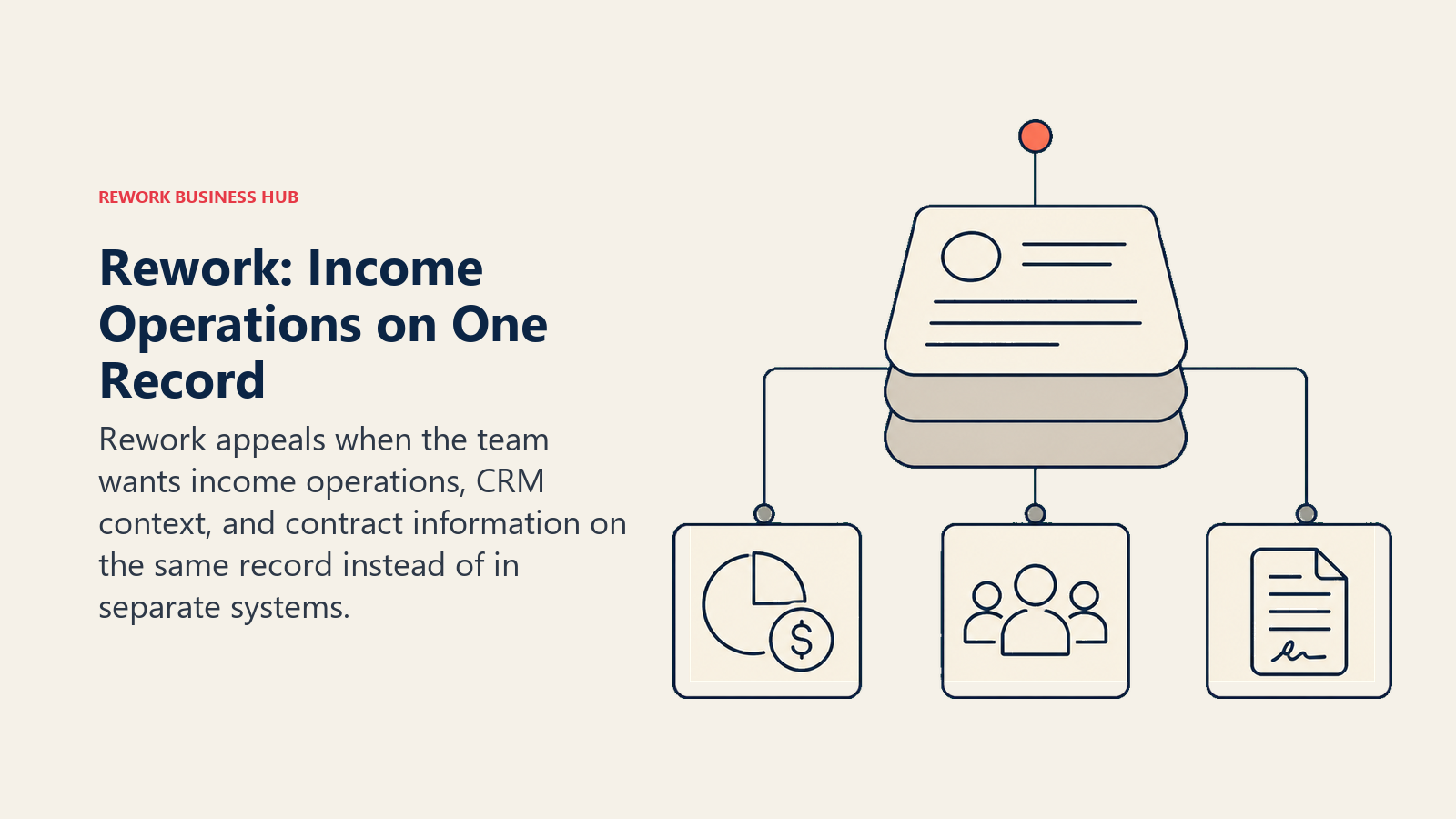
Methodology and fit. The argument for Rework here is consolidation, not billing depth. A deal closes in the CRM, the contract lives in the same record, and income tracking sits alongside it rather than in a fourth logged-in tab next to a Zuora subscription. For a mid-size company already running or evaluating Rework for sales and operations, adding income tracking on the same platform removes an integration rather than adding one, a materially different pitch than anything else in this guide, all of which, Zuora included, are billing specialists first. The fairness point deserves stating directly: Rework also doesn't publish a price for the Incomes module, the same criticism this guide levels at Zuora. The difference is scope. Zuora's opacity covers a full enterprise platform most teams need months to implement, while Rework's Incomes module is one line item inside a package a mid-size team can be running within weeks. It doesn't hold up if what you actually need is usage-based metering, complex proration schedules, multi-entity rating rules or ASC 606 revenue recognition automation, none of which is part of what Rework's product catalog documents today.
| Pros | Cons |
|---|---|
| Income operations live on the same customer record as CRM, contracts and invoicing | No usage-based metering, complex proration or ASC 606 revenue recognition automation documented |
| One platform instead of a CRM plus a separate enterprise billing vendor plus a separate AR tool | No dunning, multi-entity rating rules or merchant-of-record tax handling, real gaps against Zuora |
| Seats come in blocks of 5 rather than one at a time | No published price for the Incomes module specifically, so budgeting starts with a quote |
Pricing. Quote on request. Pricing for the Incomes module is quoted per organization; see rework.com/pricing.
Not ideal for: Large, multi-entity subscription businesses needing usage metering, complex proration or ASC 606 revenue recognition at Zuora's depth; global digital sellers needing merchant-of-record tax handling; enterprise AR teams needing HighRadius-grade collections automation; or solo operators, since Rework's minimum package covers 5 users.
Best for: Mid-size teams already running or evaluating Rework for CRM and operations who want income tracking on the same customer record rather than standing up a separate enterprise billing platform, not teams whose primary need is Zuora-level billing or revenue-recognition depth itself.
7. Maxio: A Flat Fee and Unlimited Users, Under $100K a Month
Maxio is the 2022 merger of Chargify and SaaSOptics, and it sits at the opposite end of the pricing-transparency spectrum from Zuora: a single flat number, published on the site, with no per-user or per-seat charge at all.
Methodology and fit. Maxio's Grow plan charges a flat $599 a month for up to $100,000 in monthly billings, unlimited users included, a distinctly different shape from both Zuora's silence and Recurly's percentage-of-volume model: the bill doesn't move at all within that cap. Past $100K a month, Scale moves to a custom quote, the point where Maxio starts resembling Zuora's opacity rather than its own published tier. Default agreements are paid annually; monthly and quarterly payment options carry a premium. Maxio also markets a SaaS metrics product alongside billing, aimed at finance teams that want cohort and retention reporting without exporting to a separate BI tool.
| Pros | Cons |
|---|---|
| Flat $599/month regardless of revenue growth, as long as you stay under $100K/month | Scale tier above $100K/month has no published price, same opacity as Zuora past that point |
| Unlimited users included, no per-seat charge at any tier | Narrower vendor track record than Zuora or Recurly in enterprise deployments |
| Built-in SaaS metrics reporting alongside billing | Monthly and quarterly payment options cost more than the default annual agreement |
Pricing. Grow: $599/month, for up to $100,000 in monthly billings, unlimited users. Scale: custom quote, for over $100,000 in monthly billings. Default agreements paid annually. Source: maxio.com/pricing.
Best for: Subscription businesses under roughly $100,000 a month in billings who want a flat, predictable fee and unlimited seats instead of Zuora's quote-only enterprise model. If Maxio itself is the incumbent you're evaluating away from, the Maxio alternatives guide covers that ground.
8. HighRadius: Enterprise Collections Depth Zuora Doesn't Attempt
HighRadius isn't a subscription-billing engine like the rest of this list, and it shouldn't be shortlisted as a straight Zuora swap. It's an order-to-cash automation platform, collections, cash application, deductions and credit management, worth naming here because some Zuora evaluations are really about order-to-cash breadth, not billing depth, and Zuora doesn't go nearly as deep on collections as HighRadius does.
Methodology and fit. HighRadius describes its model as subscription or pay-as-you-go with no upfront license cost, but publishes no tiers, ranges or a starting figure of any kind, an opacity that matches Zuora's exactly. There's no free trial and no SMB or lower-cost edition; every path leads to "speak with a consultant" and an ROI calculator. That's a deliberate enterprise sales motion aimed at large AR teams with real collections volume to automate, the same buyer profile that evaluates Zuora, just solving a different link in the order-to-cash chain.
| Pros | Cons |
|---|---|
| Deep collections, cash application and deduction automation most billing platforms, including Zuora, don't attempt | Zero pricing signal of any kind, matching Zuora's opacity exactly |
| Purpose-built for enterprise AR teams with real collections volume | No free trial and no self-serve entry point at any size |
| Complements rather than replaces a subscription-billing engine like Zuora, Chargebee or Recurly | Not a fit for teams whose actual need is billing or revenue recognition, not collections |
Pricing. No published price, tiers or ranges. The page routes to "speak with a consultant" and an ROI calculator. Source: highradius.com/pricing.
Best for: Enterprise AR and finance teams whose real complaint with their current stack is collections and cash-application automation, not the billing engine itself. The accounts receivable software roundup covers that adjacent category in full, and if HighRadius itself is the incumbent, the HighRadius alternatives guide goes deeper.
9. Zoho Billing: The Cheapest Named Price, Nowhere Near Zuora's Scale
Zoho Billing, formerly Zoho Subscriptions, sits at the opposite scale from Zuora entirely: small teams, transparent pricing, and the cheapest named price in this whole guide.
Methodology and fit. Standard runs $50/month month-to-month or $39/month billed annually, for up to 3 users. Premium runs $100/month month-to-month or $79/month billed annually, for up to 10 users. Enterprise is custom. Both named tiers cap at 100,000 invoices a year and $1,000,000 in annual revenue, a hard ceiling that matters more than the price: a business anywhere near Zuora's typical customer size blows past this cap immediately and needs Enterprise regardless of team size. There's no free plan, but a 14-day trial lets you test the workflow first.
| Pros | Cons |
|---|---|
| Cheapest named, transparent price in this guide, real signal Zuora never gives | Caps at $1M annual revenue and 100,000 invoices/year, ruling it out for Zuora-scale businesses |
| Native fit for teams already on Zoho CRM or Zoho Books | No free plan, only a 14-day trial |
| Flat monthly fee, not a percentage of billing volume | User caps (3 on Standard, 10 on Premium) limit it to a small finance team |
Pricing. Standard: $50/mo month-to-month, $39/mo billed annually, up to 3 users. Premium: $100/mo month-to-month, $79/mo billed annually, up to 10 users. Enterprise: custom. Caps at 100,000 invoices/year and $1M annual revenue. Source: zoho.com/billing/pricing.
Best for: Small teams under $1 million a year in revenue, nowhere near Zuora's target customer, who want the lowest transparent named price in this category.
10. Paddle: One All-Inclusive Rate for a Different Kind of Buyer
Paddle sells itself as a Merchant of Record: it becomes the seller on every transaction, handling global sales tax and VAT remittance, fraud screening and payment processing as one bundled fee, a fundamentally different job than what Zuora does.
Methodology and fit. The rate is 5% + 50 cents per checkout transaction, all-inclusive, with no separate monthly platform fee. Custom pricing exists for products priced under $10 or for businesses needing invoicing rather than checkout-based billing. Paddle isn't really a Zuora alternative for the enterprise, multi-entity buyer this guide mostly addresses; it's the right comparison for a team whose Zuora evaluation was a mismatch from the start, a smaller, globally selling digital-product business that never needed enterprise billing orchestration in the first place. The Paddle alternatives guide covers that trade-off against Lemon Squeezy and Polar specifically.
| Pros | Cons |
|---|---|
| One rate covers tax, fraud, processing and billing, no separate vendor for each | Not built for multi-entity enterprise billing, the segment actually evaluating Zuora |
| No sales tax or VAT compliance burden on your own finance team | 5% + 50c all-in costs more per dollar than orchestration-only billing at real scale |
| Custom pricing available for sub-$10 products or invoicing-based businesses | No published volume discount for standard checkout transactions |
Pricing. 5% + 50 cents per checkout transaction, all-inclusive (tax, fraud, billing, support). No monthly fee. Custom pricing for products under $10 or invoicing needs. Source: paddle.com/pricing.
Best for: Smaller, globally selling digital-product or SaaS teams who'd rather pay one bundled rate than assemble tax, fraud and processing vendors, not the multi-entity enterprise buyer Zuora is actually built for.
11. Polar: A Merchant-of-Record Rate That Drops as Volume Grows
Polar is a newer merchant-of-record platform aimed at developer-first teams, worth naming here mostly to rule out: like Paddle, it solves a different problem than Zuora does, and belongs on a shortlist only if a Zuora evaluation was a scale mismatch to begin with.
Methodology and fit. Four named tiers, each a percentage plus a fixed fee per transaction: Starter at 5.00% + 50 cents, Pro at 3.80% + 40 cents, Growth at 3.60% + 35 cents, and Scale at 3.40% + 30 cents. Polar operates as merchant of record in more than 100 markets. The declining rate is the real differentiator against Paddle and Lemon Squeezy, both of which charge a flat 5% + 50 cents regardless of volume, while Polar's Scale tier drops to 3.40% + 30 cents.
| Pros | Cons |
|---|---|
| Rate declines from 5.00% at Starter to 3.40% at Scale, unlike Paddle's flat 5% | Not built for multi-entity enterprise billing or revenue recognition, Zuora's core job |
| Merchant of record in 100+ markets, same tax-compliance simplicity as Paddle | Newer entrant with a smaller enterprise reference base than Paddle |
| Cheapest merchant-of-record option in this guide at real volume (Scale tier) | Developer-first positioning may mean less finance-team-facing tooling out of the box |
Pricing. Starter 5.00% + 50c; Pro 3.80% + 40c; Growth 3.60% + 35c; Scale 3.40% + 30c per transaction. Merchant of record in 100+ markets. Source: polar.sh.
Best for: Developer-first teams selling digital products or SaaS who want merchant-of-record simplicity and expect real volume growth, not enterprise teams whose Zuora evaluation was ever really about multi-entity billing depth.
12. Lemon Squeezy: Solo-Founder Simplicity, Not an Enterprise Fit
Lemon Squeezy targets solo founders and small teams selling digital products, a buyer profile about as far from Zuora's enterprise customer as this guide gets, included here mainly to rule out for anyone whose Zuora shortlist somehow includes it.
Methodology and fit. The rate is 5% + 50 cents per transaction, all-inclusive of processing, currency conversion and tax, plus an additional 1.5% on international transactions. Stripe acquired Lemon Squeezy in 2024, and its technology became the foundation of Stripe Managed Payments, which entered public preview in February 2026. The successor is not priced the same: Managed Payments costs 3.5% per transaction on top of standard Stripe Payments fees, north of 6% all-in for a US card. Lemon Squeezy is still operating with no announced shutdown date, though several third-party reports describe new merchant signups as waitlist or invite-gated since mid-2026. That is worth confirming directly, since Lemon Squeezy's own site could not be reached to verify it.
| Pros | Cons |
|---|---|
| All-inclusive rate with no separate tax, fraud or processing vendor needed | Signup access reported as gated in mid-2026, confirm directly |
| Purpose-built for solo founders and small digital-product teams | Roadmap points toward Stripe Managed Payments as the forward path |
| Simple, single-rate pricing with no tiers to model | Not built for anything resembling Zuora's enterprise, multi-entity customer |
Pricing. 5% + 50 cents per transaction, all-inclusive (processing, currency conversion, tax). Plus 1.5% on international (non-US) transactions. Source: lemonsqueezy.com/pricing.
Best for: Solo founders and small teams shipping a single digital product, not a real alternative for anyone whose Zuora evaluation involves multi-entity billing or enterprise revenue recognition.
13. FastSpring: A Negotiated Deal With the Same Opacity as Zuora
FastSpring is another merchant-of-record platform, and like Ordway and Zuora itself, it doesn't publish a rate card at all: every deal is negotiated directly with sales.
Methodology and fit. FastSpring describes its pricing as revenue-sharing, based on transaction type and volume of business, with no minimum volume requirement to start a conversation. That's the one meaningful similarity to Zuora on this list: both require a sales conversation before any number appears. The difference is scope. FastSpring's negotiation covers a merchant-of-record digital-goods relationship, not the multi-entity subscription billing and revenue-recognition depth Zuora is built for.
| Pros | Cons |
|---|---|
| No minimum volume requirement, unlike Zuora's implicit enterprise-scale expectation | Zero published pricing to budget against before a sales conversation, matching Zuora's opacity |
| Revenue-share negotiation may undercut published per-transaction rates at scale | No way to comparison-shop against Paddle or Polar's published rates without calling both |
| Established merchant-of-record track record in digital goods and SaaS | Not a subscription-billing or revenue-recognition engine in the way Zuora is |
Pricing. No published price. The page describes flat-rate pricing based on transaction type and volume of business, on a revenue-sharing model, negotiated with sales. No minimum volume. Source: fastspring.com/pricing.
Best for: Digital-goods and SaaS teams that want to negotiate a merchant-of-record rate directly, not enterprise buyers evaluating subscription-billing or revenue-recognition depth against Zuora.
14. Billsby: The Smallest Name on This List
Billsby closes this list at the small end, a transparently priced platform built around a flat monthly fee plus a transaction allowance, about as far from Zuora's enterprise, quote-only model as a billing platform gets.
Methodology and fit. The Core plan costs $45 a month and includes a $15,000 monthly transaction allowance, with a flat 0.4% overage fee charged only on volume above that allowance. The Pro plan costs $135 a month with a $30,000 monthly transaction allowance and a 0.5% overage fee above it. Billsby lets teams build and configure their billing setup for free, charging only once you go live, a lower-commitment on-ramp than any enterprise sales process.
| Pros | Cons |
|---|---|
| Lowest named base fee in this guide at $45/month | Smaller vendor track record and integration ecosystem than any enterprise name on this list |
| Free to build and configure; charges start only at go-live | Two named tiers only; no clearly published path for enterprise-scale needs |
| Transaction allowance included in the base fee, not charged from dollar one | Not a realistic Zuora alternative for any team with genuine multi-entity or RevRec requirements |
Pricing. Core: $45/month, $15,000 monthly transaction allowance, 0.4% overage above that. Pro: $135/month, $30,000 monthly transaction allowance, 0.5% overage above that. Source: articles.billsby.com/en/articles/5667989-how-does-billsby-s-pricing-work.
Best for: Small subscription businesses that want a low, named flat fee, not a fit for anyone whose Zuora evaluation involves real enterprise scale.
Stage Fit Matrix
| Tool | Startup 0-50 | Growth 50-250 | Mid-Market 250-1,000 | Enterprise 1,000+ |
|---|---|---|---|---|
| Chargebee | Moderate | Strong | Strong | Moderate |
| Salesforce Revenue Cloud | Weak | Weak | Strong | Strong |
| Stripe Billing | Strong | Strong | Moderate | Weak |
| Ordway | Weak | Moderate | Strong | Moderate |
| Recurly | Moderate | Strong | Strong | Moderate |
| Rework | Moderate | Strong | Moderate | Weak |
| Maxio | Strong | Strong | Moderate | Weak |
| HighRadius | Weak | Weak | Moderate | Strong |
| Zoho Billing | Strong | Moderate | Weak | Weak |
| Paddle | Strong | Moderate | Weak | Weak |
| Polar | Strong | Moderate | Weak | Weak |
| Lemon Squeezy | Strong | Weak | Weak | Weak |
| FastSpring | Moderate | Strong | Moderate | Weak |
| Billsby | Strong | Moderate | Weak | Weak |
Sizing and Persona Table
| Tool | Headcount / billing sweet spot | Primary buyer | Secondary buyer |
|---|---|---|---|
| Chargebee | $500K-$50M ARR | VP of Finance | RevOps lead |
| Salesforce Revenue Cloud | Salesforce-native, any size with budget | CFO | VP of Sales Operations |
| Stripe Billing | Any size already on Stripe | CTO / Head of Engineering | Finance Director |
| Ordway | $5M-$100M ARR | VP of Finance | Controller |
| Recurly | $1M-$50M ARR | VP of Finance | Controller |
| Rework | 20-500 employees, cross-functional ops | COO / Head of Ops | RevOps lead |
| Maxio | Under $1.2M/year in billings | Controller | Finance Director |
| HighRadius | Enterprise AR teams, large invoice volume | VP of Finance / Controller | Head of Collections |
| Zoho Billing | Under $1M/year, small teams | Controller | Founder |
| Paddle | Solo to mid-size, global digital products | Founder | Head of Finance |
| Polar | Solo to growth-stage, developer teams | Founder / CTO | Head of Finance |
| Lemon Squeezy | Solo founders, single product | Founder | (none) |
| FastSpring | Mid-size digital goods and SaaS | VP of Finance | Founder |
| Billsby | Under $360K/year in transaction volume | Founder | Finance Manager |
How to Choose: Decision Framework
| If you need... | Choose |
|---|---|
| The broadest add-on suite (CPQ, RevRec, retention) with transparent published pricing | Chargebee |
| Quote-to-cash and billing living inside a Salesforce CRM record you already run | Salesforce Revenue Cloud |
| Billing logic native to a Stripe account you already use for processing | Stripe Billing |
| Billing bundled with ASC 606 revenue recognition and investor-metrics reporting, lighter than Zuora | Ordway |
| A published entry price and a generous free billing threshold before paying anything | Recurly |
| Income operations on the same record as your CRM, leads and contracts | Rework |
| A flat, predictable fee and unlimited users instead of a percentage, under $100K/month | Maxio |
| One all-inclusive rate covering tax, fraud and processing, no separate vendor | Paddle |
What to Do Next
Don't start with a feature list. Start by classifying your own evaluation: are you shopping Zuora alternatives because the missing price tag makes budgeting impossible, because the implementation timeline doesn't match how fast you need to go live, or because you're genuinely buying more multi-entity, multi-currency configurability than your business has entities or currencies to use? That answer narrows 14 tools to two or three fast. If it's the first two, Chargebee, Recurly or Ordway cover similar ground with real published pricing signal or a documented implementation timeline. If it's the third, and you're a mid-size, single-entity business, look harder at whether you needed enterprise billing software at all versus a platform like Rework that consolidates income tracking with the CRM and contracts you already run. Get every add-on, RevRec, CPQ, dunning tooling equivalent to Recurly's Engage, priced in writing before you sign anything with any vendor on this list, since almost every one prices its most important feature separately from the base plan or base quote. For the category-wide comparison before you narrow further, the subscription billing software roundup is the place to start.
Camellia covers billing, revenue operations and finance tooling for B2B teams.

Principal Product Marketing Strategist
On this page
- Key Facts
- Why Finance Teams Start Evaluating Zuora Alternatives
- Quick Comparison Table
- The Real Cost-at-Volume Math
- What Zuora Still Does Best
- 1. Chargebee: The Broadest Add-On Suite, With a Published Rate
- 2. Salesforce Revenue Cloud: Quote-to-Cash Inside the CRM You Already Run
- 3. Stripe Billing: Native to the Stripe Stack, Live in Days
- 4. Ordway: A Lighter-Weight Zuora, Reported at a Fraction of the Price
- 5. Recurly: A Published Entry Price and a Real Trial
- 6. Rework: Income Operations on the Same Record as CRM and Contracts
- 7. Maxio: A Flat Fee and Unlimited Users, Under $100K a Month
- 8. HighRadius: Enterprise Collections Depth Zuora Doesn't Attempt
- 9. Zoho Billing: The Cheapest Named Price, Nowhere Near Zuora's Scale
- 10. Paddle: One All-Inclusive Rate for a Different Kind of Buyer
- 11. Polar: A Merchant-of-Record Rate That Drops as Volume Grows
- 12. Lemon Squeezy: Solo-Founder Simplicity, Not an Enterprise Fit
- 13. FastSpring: A Negotiated Deal With the Same Opacity as Zuora
- 14. Billsby: The Smallest Name on This List
- Stage Fit Matrix
- Sizing and Persona Table
- How to Choose: Decision Framework
- What to Do Next