Chargebee vs Recurly: Which Subscription Billing Platform Fits Your Team in 2026?
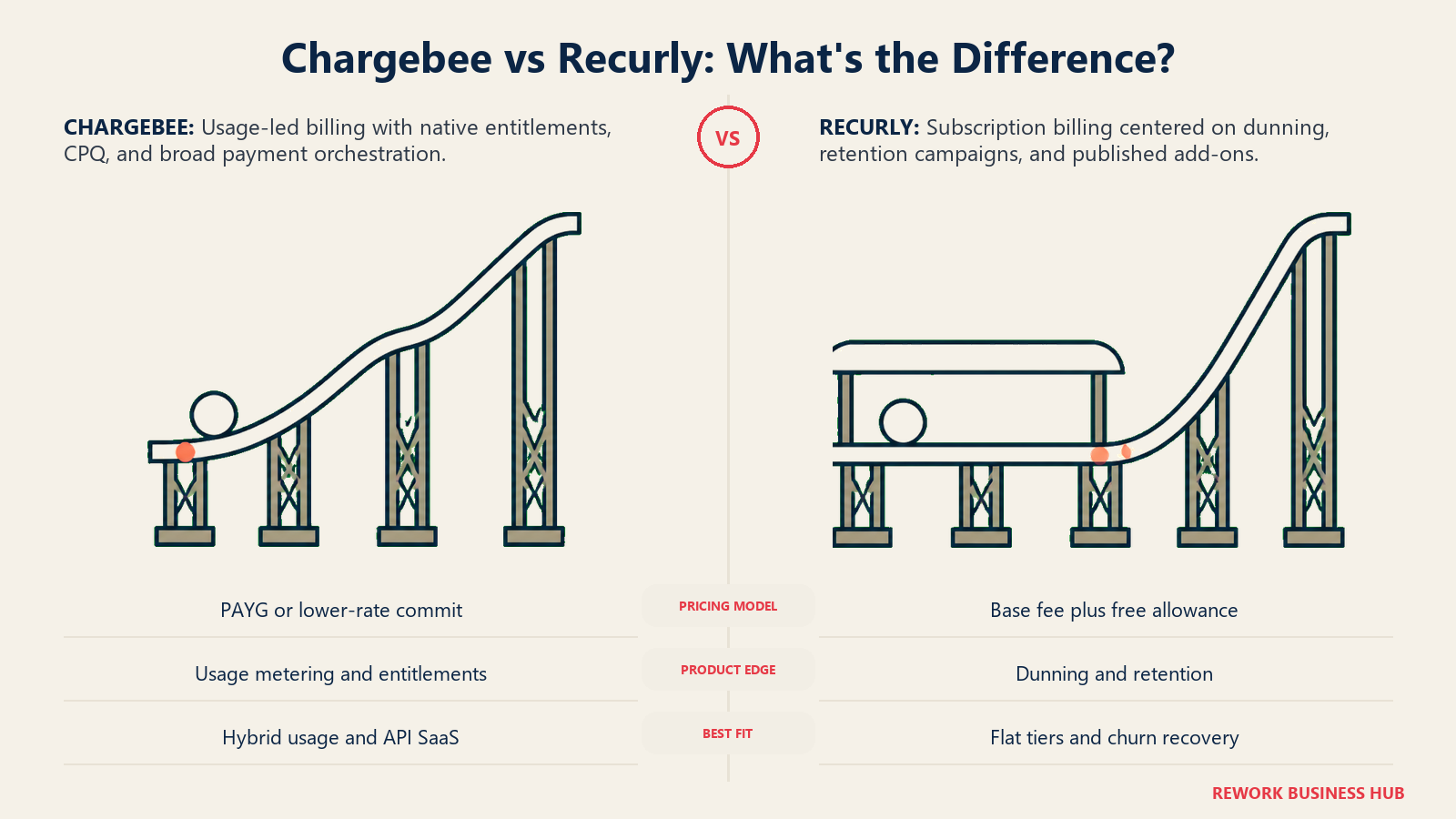
Turn this article into takeaways for your work.


Each assistant summarizes the article only for you and suggests best practices for your work.
If Chargebee and Recurly are the last two names on your shortlist, you're past the "do we even need a billing platform" conversation. What's left is a genuinely close call, and most comparisons online are years out of date on the one thing that should be easy to get right: price. Chargebee dropped its old free tier a while back. Recurly's entry plan isn't called Core anymore. If an article states either of those, close the tab.
This one works from each vendor's own published pricing page as of August 2026, and does the arithmetic you'd otherwise do yourself. Chargebee Flow and Recurly Starter price on different shapes entirely, a flat fee plus a percentage of what you bill versus a free allowance plus a percentage above it, so the cheaper option flips depending on how much you invoice each month. We'll show you where that crossover sits, then work through dunning, revenue recognition, tax, gateways, and the rest of what a finance systems owner lives with after signing.
Key Facts
- Chargebee's billing product, Flow, has no free tier. Entry pricing is 0.80% of monthly billing volume with no platform fee on the pay-as-you-go plan, or a $99/month platform fee plus 0.65% on the monthly commit plan, per Chargebee's own pricing page.
- Recurly's entry plan is Starter, at $249/month plus 0.9% of billing volume, with the first $40,000 billed each month at no charge, per Recurly's pricing page.
- Involuntary churn (failed payments that are never recovered) runs at a median 1.06% annually for SaaS specifically, against 2.16% voluntary churn, per Recurly's own July 2026 network research across its subscription business customers (Recurly Research).
- Billing-related revenue leakage, invoices that never get raised correctly or payments that quietly fail to recover, costs the typical company at least 3% to 5% of revenue every year, according to independent research firm MGI Research (MGI Research).
- Chargebee states that on average 10% of a subscription business's customers are susceptible to involuntary churn from a failed payment in any given period, per its own revenue recovery page.
TL;DR
| Chargebee (Flow) | Recurly | |
|---|---|---|
| Entry pricing | 0.80% of volume, no platform fee (pay as you go), or $99/mo + 0.65% (monthly commit) | $249/mo + 0.9% of volume, first $40,000/mo free |
| Top published tier | Enterprise Plus, custom annual commitment, up to 500M usage events/mo | All-Access, "as low as <1% of billing volume," $1M minimum, billed annually |
| Free trial | Yes, no fixed length published | Yes, 90 days |
| Usage-based billing | Native EBUB, unifies provisioning and access control with metering | Metered add-ons on subscription plans, invoiced next cycle |
| Revenue recognition | RevRec module, ASC 606/IFRS 15, priced separately | RevRec module, ASC 606, IFRS 15/16, ASC 842, from $850/mo |
| Tax handling | Native tax engine plus Avalara and Anrok integrations | Built-in Avalara, plus your own Avalara/Vertex/Anrok account |
| Best for | Usage metering and entitlements built into core billing | Under roughly $84,000/mo volume, or a bundled retention layer via Engage |
Who Each Platform Is Really For
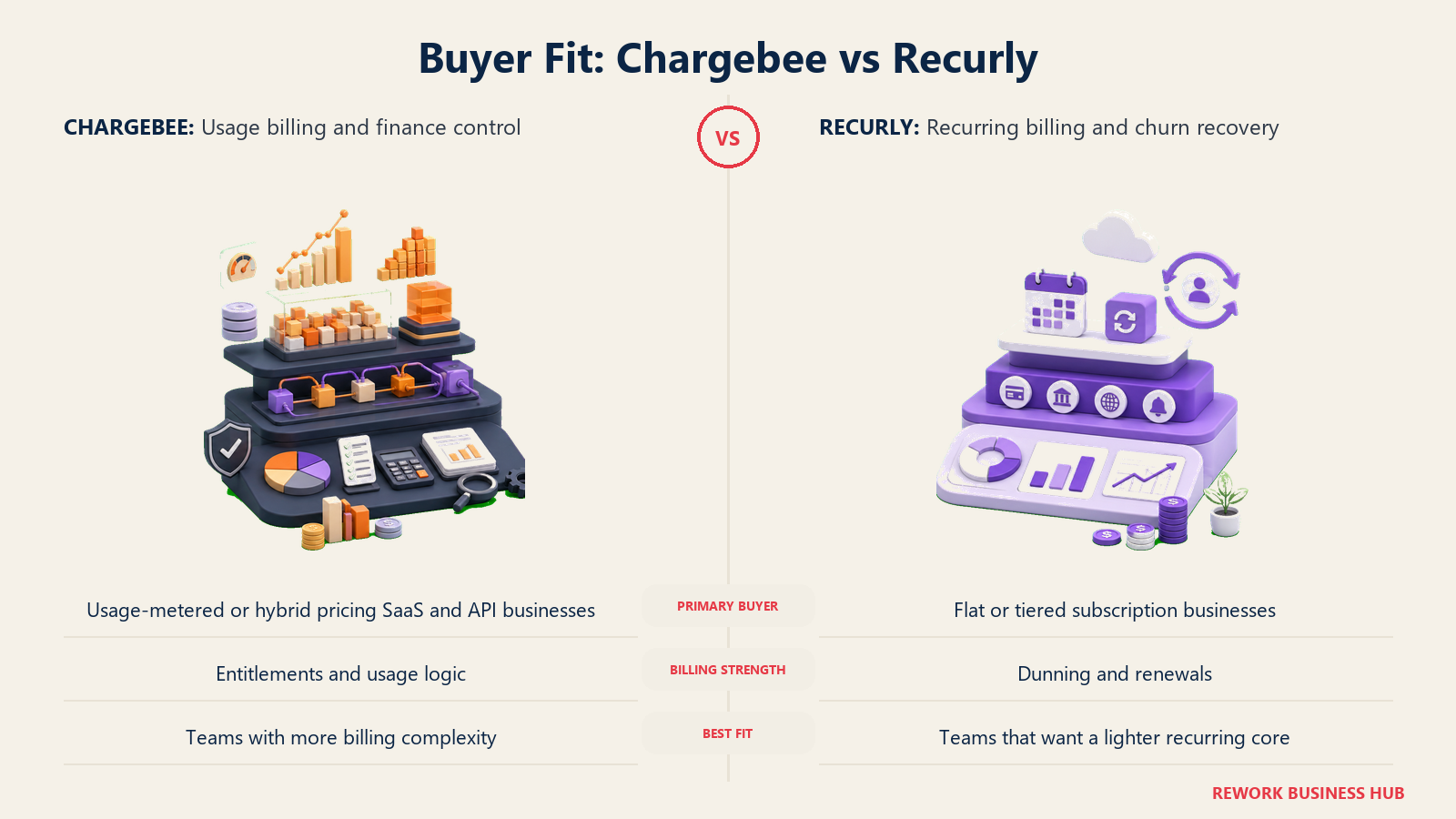
Both vendors sell to subscription and usage-based businesses that have outgrown manual invoicing, but the buyer who gets the best deal differs once you look past the homepage pitch. Chargebee's natural buyer is a product-led or usage-metered business, often API-consumption or seat-plus-overage priced, that wants provisioning, entitlements, and billing in one system rather than stitched together with a separate feature-flagging tool. Recurly's natural buyer runs a flat or tiered subscription model, SaaS, media, or D2C, and wants mature dunning and retention without building a custom usage-metering pipeline first.
| Chargebee | Recurly | |
|---|---|---|
| Primary buyer | Usage-metered or hybrid pricing SaaS and API businesses | Flat or tiered subscription businesses, SaaS, media, D2C |
| The question they're solving | "How do we bill on consumption while keeping entitlements in sync?" | "How do we stop losing subscribers to failed payments?" |
| Where the platform is strongest | Entitlements-based usage billing, CPQ for sales-led motions | Dunning depth, churn analytics, RevRec breadth (ASC 842) |
| Where it disappoints | Add-on pricing beyond the free tiers isn't published | No native entitlements product, usage billing is add-on style |
| Team maturity assumed | Comfortable configuring metered features and entitlements | Comfortable running dunning campaigns and cohort analysis |
| Buying trigger | Launching or scaling a usage-based pricing model | Rising involuntary churn or an outgrown dunning process |
If neither profile matches because you need the full category view first, our best subscription billing software for 2026 roundup covers the wider field, including platforms priced on a flat SaaS-seat model instead of a percentage of volume.
Pricing and Cost at Volume
This is the section most competing comparisons get wrong, either quoting Chargebee's old free tier (gone) or Recurly's old $199/month Core plan (also gone, replaced by Starter at $249/month). Here's what each vendor actually publishes today.
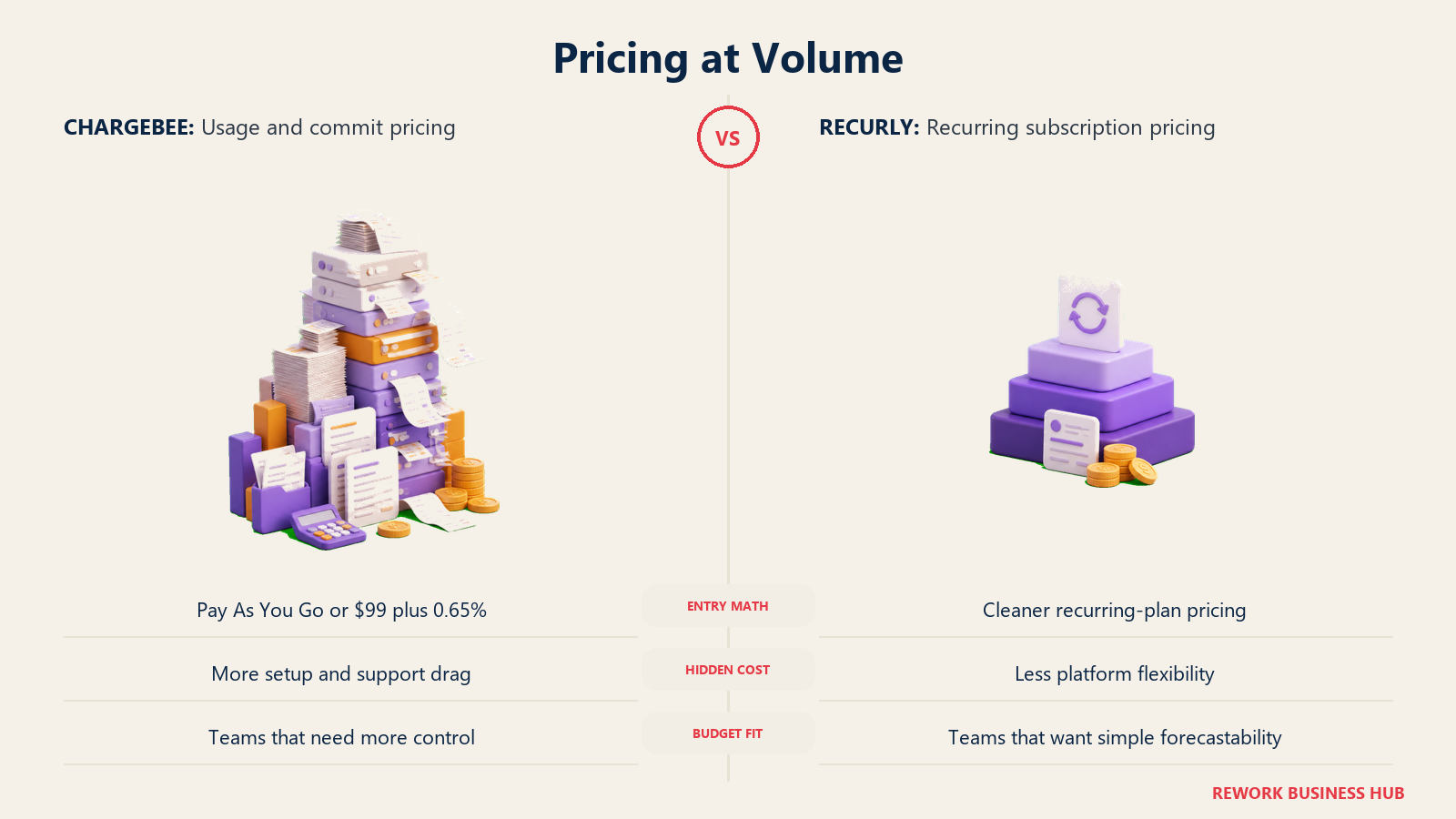
Chargebee Flow has two published tiers below its custom Enterprise Plus plan: Pay As You Go at 0.80% of monthly billing volume with no platform fee, and Commit Monthly at a $99/month platform fee plus 0.65%. Both include up to 100 million usage events per month.
Recurly has two published tiers: Starter at $249/month plus 0.9% of volume, with the first $40,000 billed each month free of that fee, plus a 90-day free trial. All-Access is priced "as low as <1% of billing volume, billed annually," with a stated $1,000,000 billing-volume minimum to qualify.
Assumptions behind the table below
"Monthly billing volume" means the total dollar amount invoiced through the platform each month, not net revenue after refunds. Each row uses the formulas above: Chargebee Pay As You Go = 0.80% of volume with no platform fee; Chargebee Commit Monthly = $99 + 0.65% of volume; Recurly Starter = $249 + 0.9% of volume above the first $40,000. As a sanity check, both Chargebee formulas reproduce the $400 and $424 figures shown on its pricing page exactly at $50,000 of volume, which is the default its own calculator uses. Recurly doesn't specify whether its $1,000,000 All-Access minimum is monthly or annual, so we treat it conservatively as monthly and show it only at that row; if it's actually annual, All-Access may be reachable lower than shown, so confirm directly. None of this is a sales quote, just each vendor's own published formula.
| Monthly billing volume | Chargebee (Pay As You Go) | Chargebee (Commit Monthly) | Recurly (Starter) | Recurly (All-Access) |
|---|---|---|---|---|
| $25,000 | $200 | $261.50 | $249 | Not eligible (below stated minimum) |
| $50,000 | $400 | $424 | $339 | Not eligible |
| $100,000 | $800 | $749 | $789 | Not eligible |
| $250,000 | $2,000 | $1,724 | $2,139 | Not eligible |
| $500,000 | $4,000 | $3,349 | $4,389 | Not eligible |
| $1,000,000 | $8,000 | $6,599 | $8,889 | Under $10,000 (exact rate undisclosed) |
The ordering changes three times, which is why a single "which is cheaper" answer is wrong. Below about $31,125 a month, Chargebee Pay As You Go is the cheapest of the three, because a pure 0.80% with no platform fee beats Recurly's $249 floor. Between roughly $31,125 and $111,000, Recurly Starter wins, and its free first $40,000 is doing most of that work. Above about $111,000, Chargebee Pay As You Go is cheaper again and stays cheaper. Chargebee's Commit Monthly plan follows its own curve: it overtakes Pay As You Go at $66,000, where the $99 platform fee is repaid by the lower 0.65% rate, and it overtakes Recurly Starter at $84,000. So the practical reading is that Recurly owns the middle of this range, Chargebee owns both ends, and a team sitting near any of those four numbers should model its own volume rather than trust a headline.
Neither crossover is a universal verdict. They show where the published formulas cross, not what either vendor will quote you in a real negotiation, and add-ons change the total meaningfully.
What add-ons cost on top
| Add-on | Chargebee | Recurly |
|---|---|---|
| CPQ / quote-to-cash | Priced separately; CPQ Lite is free for the first 50 quotes | Not a separate named product |
| Revenue recognition (RevRec) | Priced separately, figure not published | From $850/month, billed annually |
| Retention / churn analytics | Retention/Growth Starter tier is $0 for existing Chargebee Billing customers; higher tiers priced separately | Engage, from $1,600/month, billed annually |
| What's published vs. not | Only the free-tier thresholds are public; full add-on pricing requires a quote | Starting prices are public for both named add-ons |
If a bundled retention layer matters, Recurly's published $1,600/month Engage price budgets more easily than Chargebee's unpublished Retention tier, and the same holds for RevRec at a known $850/month.
Billing Model Depth: Usage-Based Pricing, Proration, and Entitlements
Both platforms handle standard subscription mechanics, upgrades, downgrades, mid-cycle proration, trials, coupons, without much daylight between them. The real difference shows up once usage enters the picture, which matters more every year: 85% of the 100 SaaS companies surveyed in Metronome and Greyhound Capital's January 2025 study had adopted usage-based pricing in some form (Metronome).
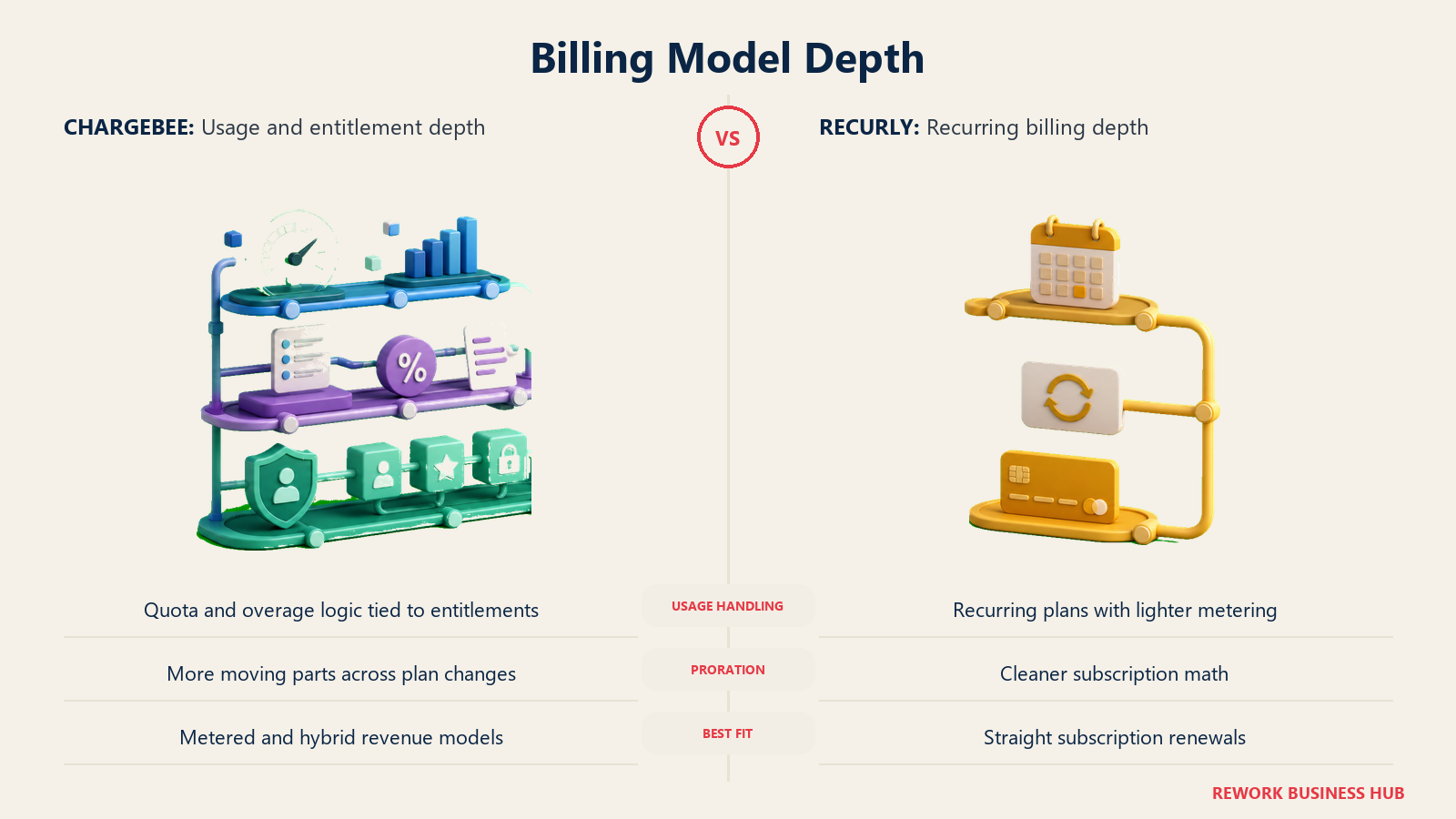
Chargebee's Entitlements-based Usage Billing (EBUB) unifies provisioning, feature access control, and metered billing, three things that often live in separate systems elsewhere. A plan grants a defined quota of included usage, overages bill at a per-unit rate, and entitlement grants can refresh on a different cadence than the billing cycle, useful for annual contracts with monthly usage resets.
Recurly's usage-based billing works through metered add-ons layered onto a subscription plan: you report usage via API, and Recurly bills it on the next invoice. That's fine for straightforward metered charges, but Recurly doesn't ship a distinct entitlements product analogous to EBUB, so provisioning and access control typically stay a separate concern in your application layer.
| Billing depth factor | Chargebee | Recurly |
|---|---|---|
| Native entitlements product | Yes, EBUB unifies provisioning, access, and metering | No distinct entitlements product |
| Usage reporting model | Real-time usage tracking tied to entitlement grants | Metered add-ons reported via API, billed next cycle |
| Hybrid (flat fee + overage) pricing | Native, included usage plus per-unit overage | Via metered add-ons on top of a plan |
| Proration on plan changes | Standard, mid-cycle | Standard, mid-cycle |
| Best fit | API-consumption or hybrid pricing models | Flat or tiered pricing with occasional metered add-ons |
Dunning and Churn Recovery
This is where both vendors compete hardest. Payment failures aren't rare: an average of 5% to 9% of credit card charges fail each month across Recurly's customer base, largely due to expired cards, insufficient funds, or bank-side declines, not because the customer wants to cancel (Recurly). What happens after that failure is the whole game.
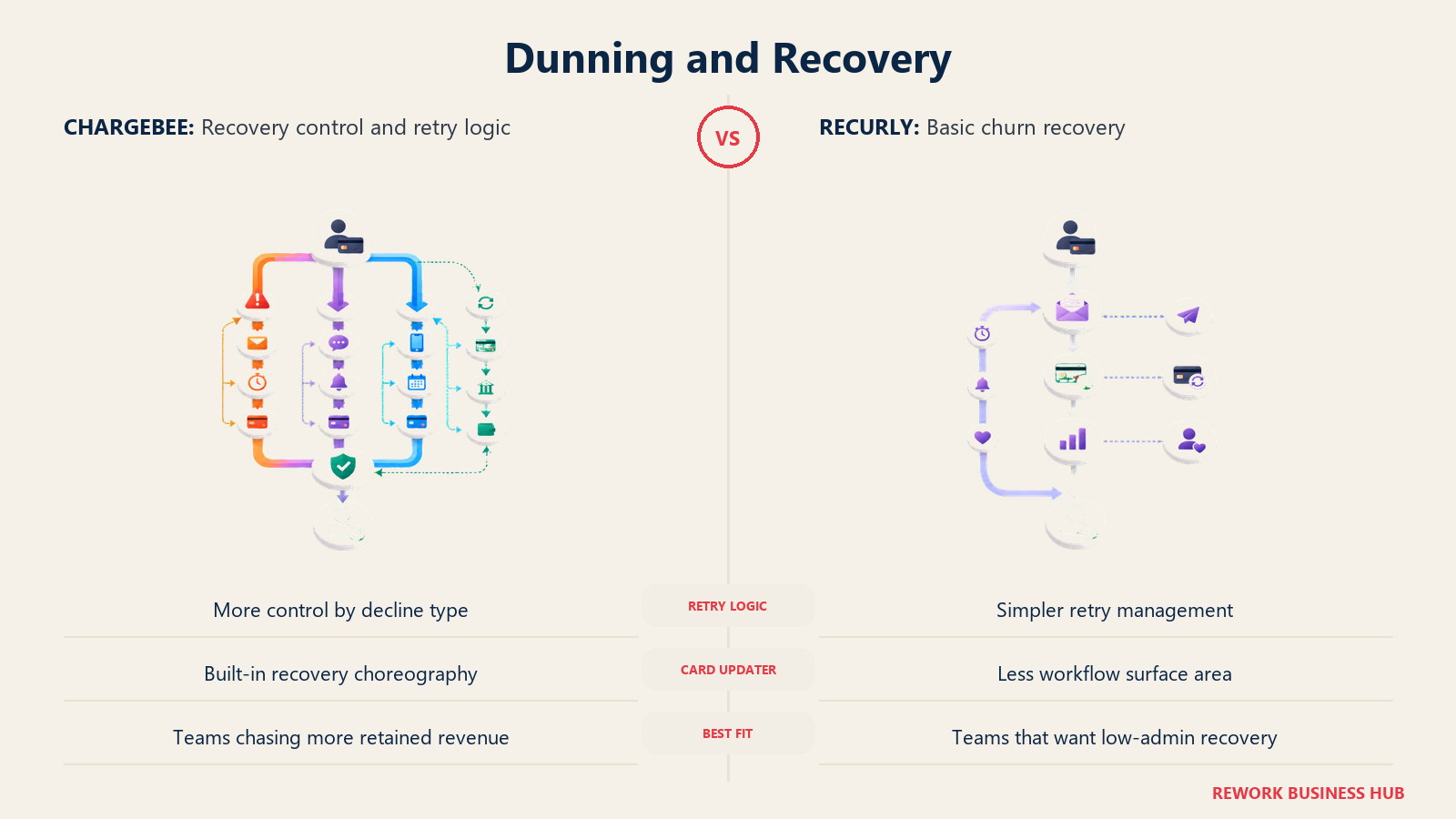
Chargebee's Smart Dunning reads the specific gateway decline code and responds accordingly: hard declines (a card reported lost or stolen) wait for the customer to update payment details, while soft declines (insufficient funds, temporary holds) get retried at the moments most likely to succeed, up to 12 attempts, with automatic card updating built in.
Recurly's Intelligent Retries uses a machine-learning model to time each retry for the highest success probability, paired with a no-additional-charge Account Updater that refreshes expired card details ahead of renewal. Recurly also lets merchants build multiple targeted dunning campaigns by segment or plan, rather than one sequence for everyone.
| Dunning factor | Chargebee | Recurly |
|---|---|---|
| Retry logic | Smart Retry, reads decline codes, dynamic intervals, up to 12 attempts | Intelligent Retries, machine-learning-timed scheduling |
| Card updater | Built into the baseline Billing plan | Automated Account Updater, no added charge |
| Segmented campaigns | Configurable dunning sequences | Multiple targeted campaigns by segment or plan |
| Multi-gateway routing | Yes, routes for best authorization odds | Not marketed as a distinct feature |
| Where the depth shows | Decline-code-aware retry branching | ML retry timing plus segmented campaigns |
The stakes are real either way: at a median SaaS involuntary churn rate of 1.06% annually, a meaningful share of "lost" subscribers were never a retention problem, they were a payments problem nobody automated (Recurly Research). If AR and collections matter as much to your team as subscriber dunning, our best accounts receivable software for 2026 guide covers that side directly.
Revenue Recognition and Compliance
Both platforms sell revenue recognition as a distinct, priced module rather than a bundled feature, a sign it's a specialist workflow, not an afterthought.
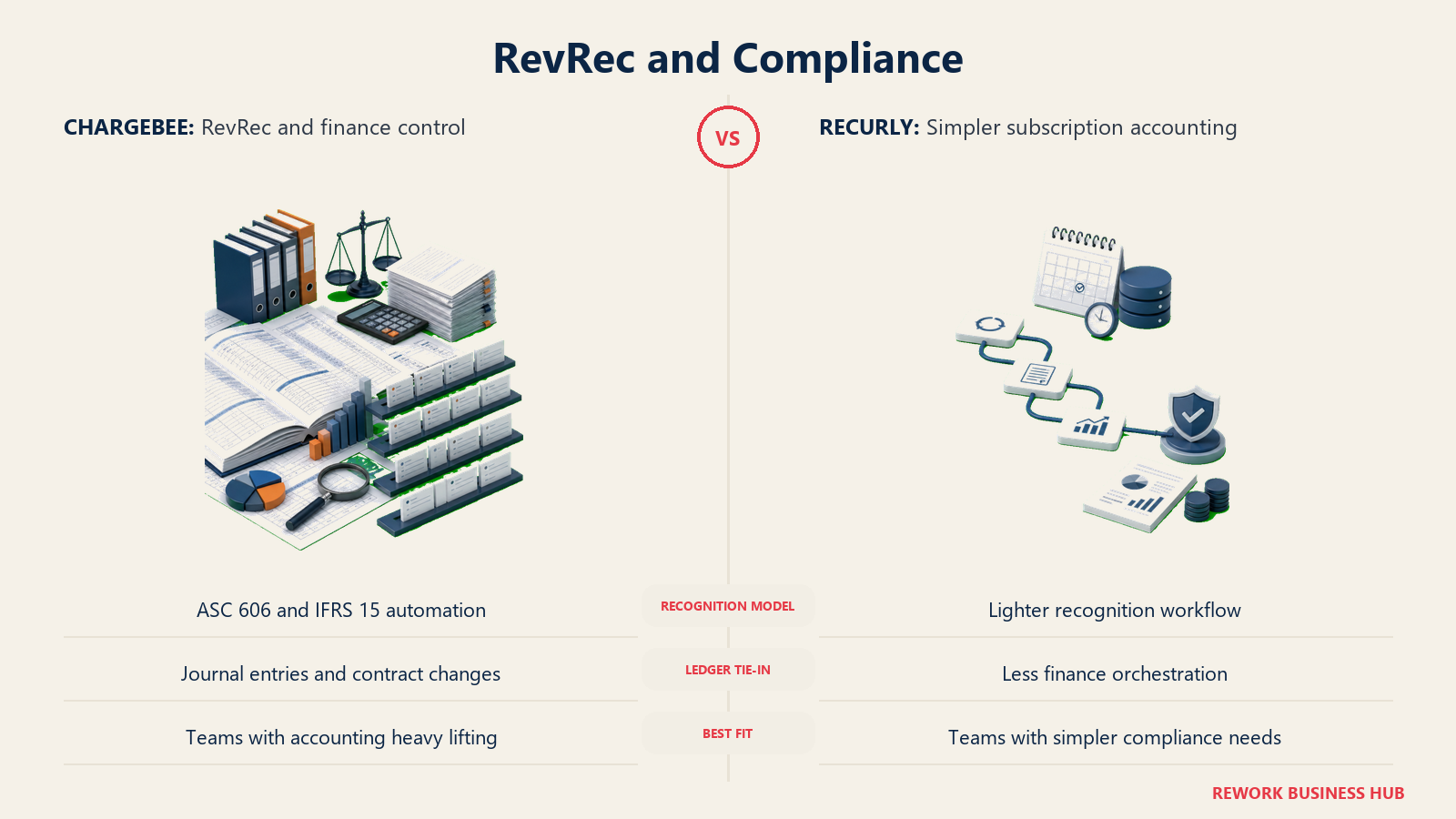
Chargebee RevRec automates the ASC 606 and IFRS 15 five-step model: it reconciles revenue across contracts, invoices, and payments, and posts journal entries to your general ledger. It handles contract modifications, renewals, cancellations, partner commission arrangements, and multi-currency transactions, with a RevRec Premium tier adding an AR workflow on top.
Recurly RevRec covers a wider named compliance list, ASC 606, IFRS 15, IFRS 16, ASC 842 (lease accounting), and ASC 340-40 (contract cost capitalization), with multi-currency, multi-book support. It starts at a published $850/month billed annually, a number Chargebee doesn't publish for its equivalent module.
| Revenue recognition factor | Chargebee (RevRec) | Recurly (RevRec) |
|---|---|---|
| Core standard | ASC 606, IFRS 15 | ASC 606, IFRS 15 |
| Additional standards named | Not specified beyond ASC 606/IFRS 15 | IFRS 16, ASC 842, ASC 340-40 |
| Multi-currency, multi-book | Yes | Yes |
| GL posting | Automatic journal entries to the general ledger | Automated revenue recognition and expense allocation |
| Published starting price | Not published | $850/month, billed annually |
| Bundled AR workflow | Yes, on RevRec Premium | Not marketed as a bundled AR feature |
If ASC 842 lease accounting or ASC 340-40 contract cost capitalization is genuinely in scope for your close process, that's a real point in Recurly's favor since Chargebee doesn't name either standard in its own materials. If a bundled AR workflow alongside revenue recognition matters more, Chargebee's RevRec Premium is built for that pairing.
Tax Handling
Neither vendor built its own tax engine from scratch; both lean on established tax partners, but what's native versus bolted-on differs.
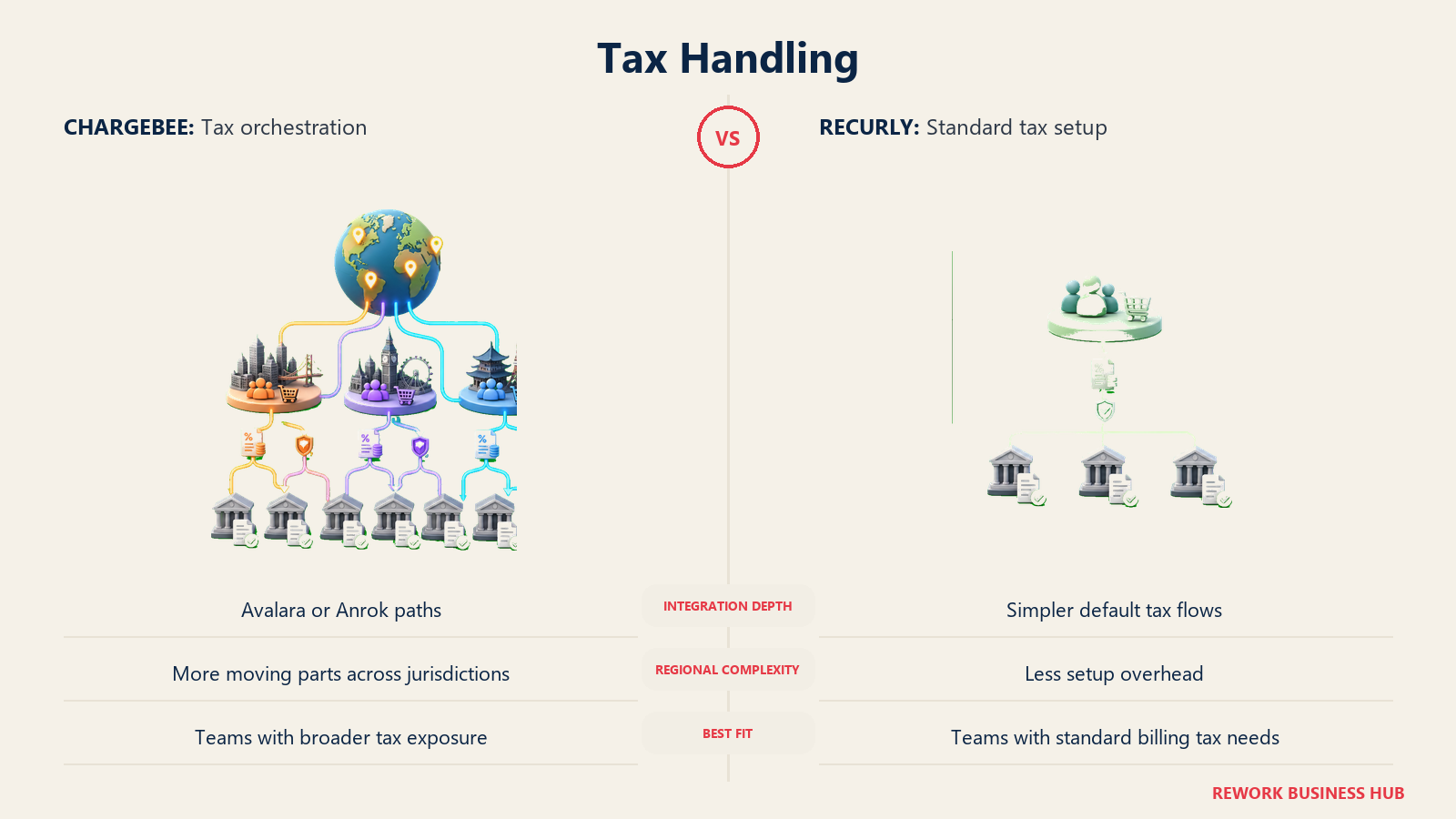
Chargebee integrates with both Avalara AvaTax and Anrok. Avalara calculates sales tax, VAT, GST, and communications tax on every invoice, automating rate determination, address validation, filing, and reporting. Anrok adds real-time calculation, nexus tracking, and automated filing specifically for U.S. jurisdictions.
Recurly ships a built-in tax solution powered by Avalara out of the box, calculating and collecting sales tax, VAT, and GST across supported regions with address validation and line-item reporting by state, county, and local rate. For advanced needs, you can connect your own Avalara or Vertex account, and Anrok also integrates with Recurly.
| Tax factor | Chargebee | Recurly |
|---|---|---|
| Default engine | Avalara AvaTax or Anrok integration | Built-in, powered by Avalara |
| Bring-your-own tax engine | Via Avalara or Anrok | Via your own Avalara or Vertex account |
| U.S. nexus tracking | Through Anrok | Through Anrok or Vertex |
| Global VAT/GST | Yes, via Avalara | Yes, via built-in engine |
| Line-item tax reporting | Via Avalara integration | Native, by state/county/local |
This matters more than it used to. Every U.S. state that charges sales tax now enforces economic nexus rules, meaning a remote seller must register and collect tax once it crosses a threshold, commonly $100,000 in annual revenue or 200 transactions in that state, with no physical presence required, per Numeral's 2026 economic nexus handbook (Numeral). A subscription business selling nationwide is, in practice, managing tax in 45 separate jurisdictions once it clears those thresholds.
Payment Gateways and Orchestration
Both platforms are gateway-agnostic, routing payments through third-party processors rather than acting as the processor, the opposite model from a merchant-of-record platform like Paddle.
Chargebee connects to 35-plus payment gateways, including Stripe, Adyen, Braintree, Razorpay, and GoCardless, plus 60-plus payment methods (cards, ACH, PayPal, Amazon Pay, Apple Pay), per its own gateway coverage page. Recurly documents roughly 20 gateways, including Stripe, Adyen, Braintree, Cybersource, Checkout.com, and Worldpay, per its gateway documentation.
| Gateway factor | Chargebee | Recurly |
|---|---|---|
| Published gateway count | 35+ | ~20 |
| Multi-gateway routing for recovery | Yes, part of the dunning retry logic | Supported through multiple gateway configuration |
| Payment method breadth | 60+ methods (cards, ACH, wallets, bank transfers) | Broad, gateway-dependent method coverage |
| Merchant-of-record option | No, gateway pass-through only | No, gateway pass-through only |
If your actual need is a merchant-of-record model that absorbs tax and compliance into the transaction fee instead, that's a different category; our best Paddle alternatives roundup covers that side of the market. And if you're weighing Stripe directly against an orchestration layer on top of it, our best Stripe alternatives guide is worth a look first.
Integrations and ERP Fit
Both vendors ship native connectors to the accounting and CRM tools finance teams actually run, which matters because billing data is only useful once it lands correctly in the general ledger.
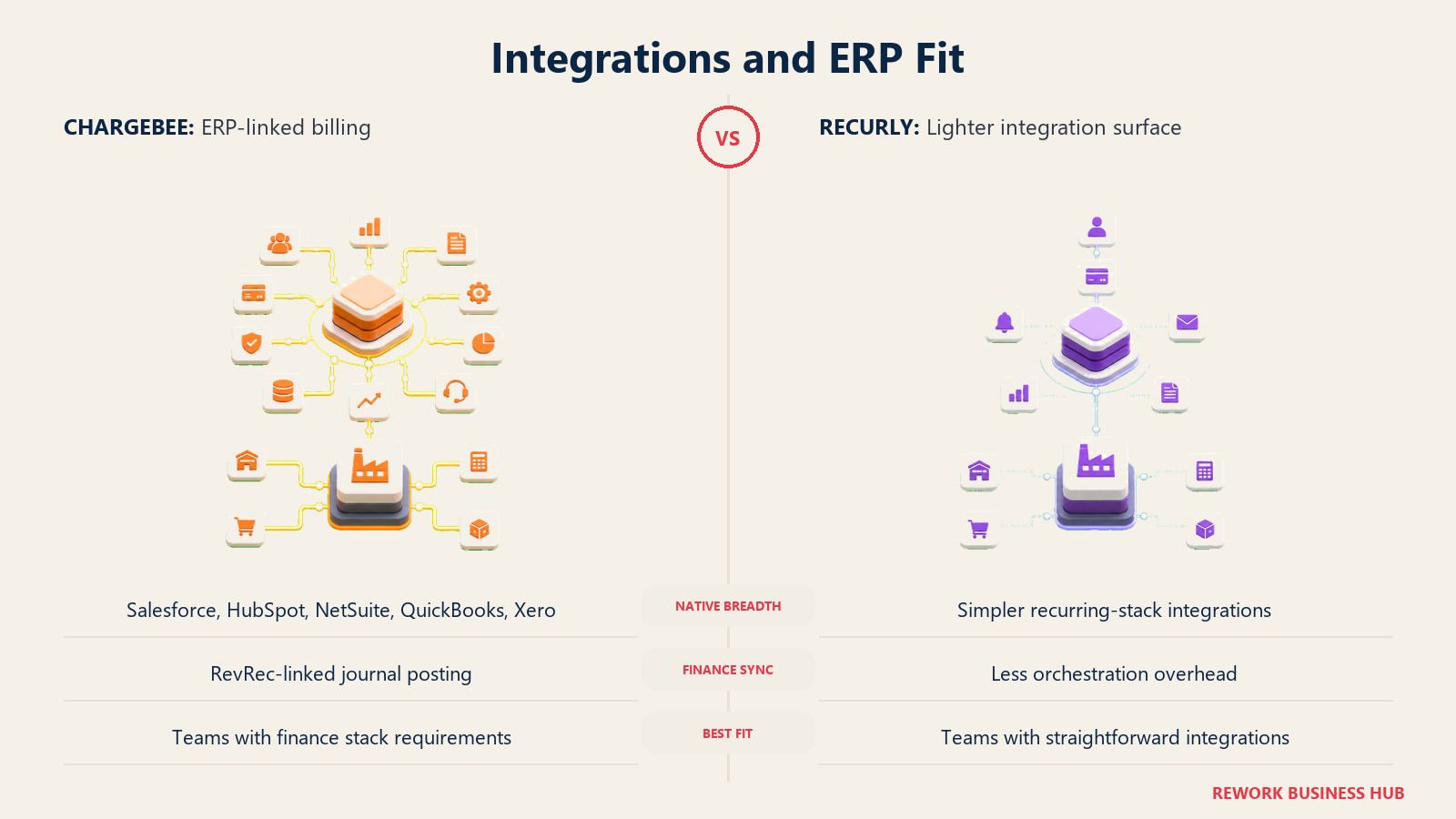
Chargebee ships 60 or more native integrations, including Salesforce, HubSpot, NetSuite, QuickBooks Online, Xero, Avalara, and Slack, plus a REST API for custom work. Its NetSuite and Salesforce connections route through RevRec, syncing billing records and posting monthly journal entries, and its HubSpot integration includes a quote-to-cash flow so sales can create subscriptions without leaving the CRM.
Recurly integrates natively with QuickBooks, Xero, and NetSuite for invoice, refund, and credit memo syncing, and with Salesforce and HubSpot to keep subscription data visible to sales and CS. It leans more on iPaaS partners like Zapier, Celigo, and Tray.ai to extend connectivity beyond its native list.
| Integration factor | Chargebee | Recurly |
|---|---|---|
| Native integration count | 60+ | Smaller native list, extended via iPaaS |
| NetSuite | Native, routed through RevRec | Native, invoice/refund/credit memo sync |
| QuickBooks / Xero | Native, plus RevRec sync | Native |
| Salesforce | Native, RevRec-connected | Native, CRM data sync |
| HubSpot | Native, quote-to-cash flow | Native, onboarding automation |
| Extended connectivity | REST API | Zapier, Celigo, Tray.ai |
If NetSuite is your system of record and journal-entry automation is non-negotiable, it's worth comparing both against the wider ecosystem in our best NetSuite alternatives guide. Sage Intacct shops should check our best Sage Intacct alternatives roundup, since neither vendor names a dedicated Sage Intacct connector. And if QuickBooks is where your books actually close, our best QuickBooks alternatives guide covers that layer directly.
Implementation Weight and Time to Value
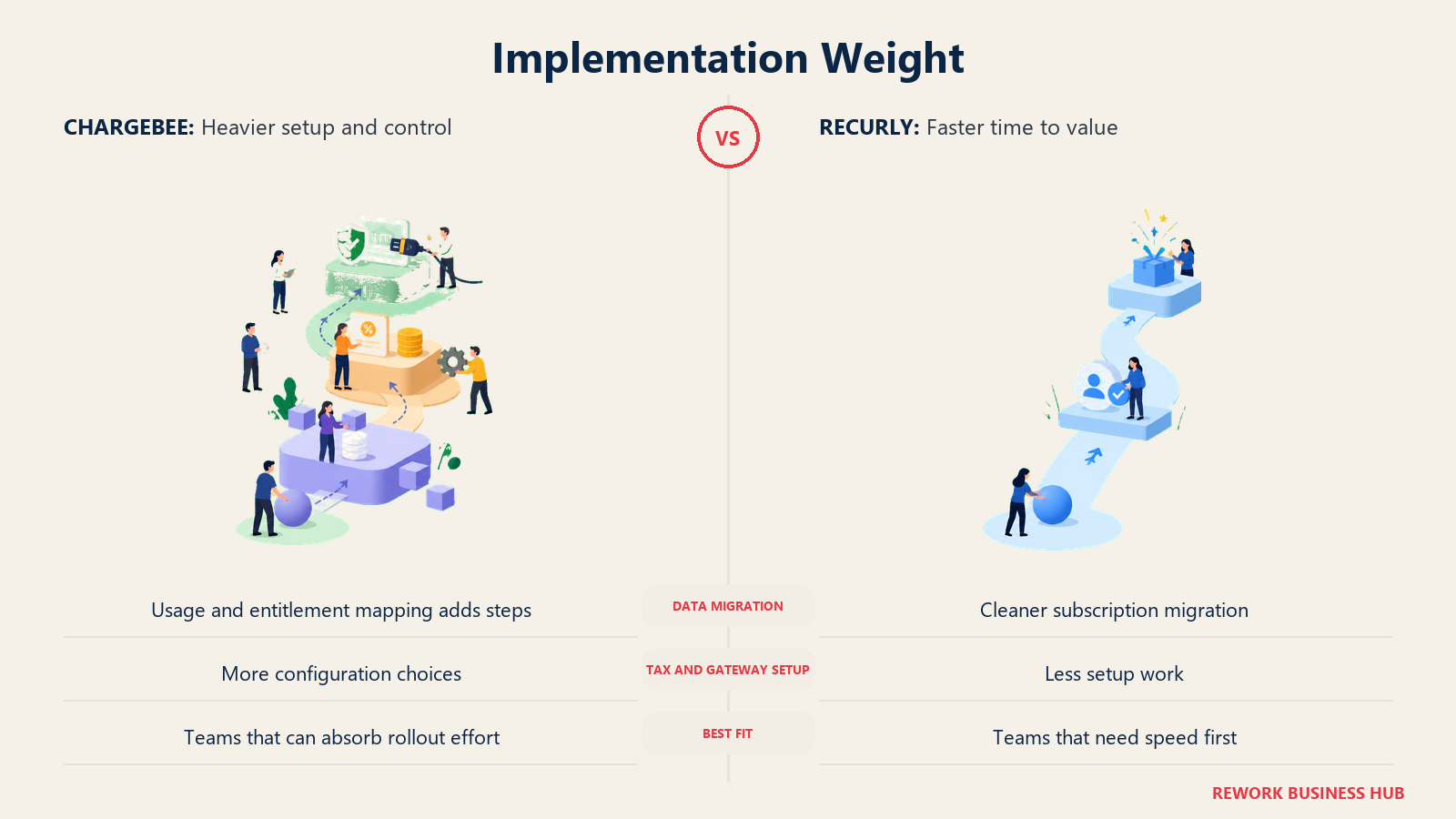
Neither vendor publishes an audited implementation study, so treat the following as an industry range to verify in your own demo, not a guarantee. General billing-platform guidance puts a typical rollout at 6 to 12 weeks: finance-led teams with clean CRM data can go live in 30 to 45 days, while migrations involving usage-based billing or messy legacy data commonly run 10 to 12 weeks, per billing consultancy Ordway's published guidance (Ordway). That range applies to both platforms, since the heavier lift is data migration and tax/gateway configuration, not core software setup.
| Implementation factor | What drives it | Chargebee | Recurly |
|---|---|---|---|
| Data migration | Historical subscriptions, invoices, payment methods | Entitlement/metered-feature mapping adds steps for usage plans | Dunning campaign and add-on setup adds steps |
| Tax configuration | Nexus mapping across active states/countries | Choice of Avalara or Anrok integration path | Built-in Avalara engine reduces initial setup |
| Gateway setup | Number of active gateways and methods | Broader list (35+) means more configuration surface | Smaller list (~20) typically configures faster |
| Typical timeline | Industry guidance, not vendor-audited | 6-12 weeks, longer for complex usage mapping | 6-12 weeks, shorter end common for flat plans |
Who Administers It Day to Day
Both platforms are built to be finance-owned rather than engineering-owned once initial integration is done, though the assumed skill set differs. Chargebee leans toward whoever owns pricing and packaging, since entitlement grants and CPQ configuration touch product and revenue operations as much as finance. Recurly leans toward whoever owns collections, since dunning tuning and cohort review need the most regular attention.
| Administration factor | Chargebee | Recurly |
|---|---|---|
| Who typically owns it | RevOps or finance systems owner, with product/pricing input | Finance or collections lead |
| Recurring configuration work | Entitlement grants, metered feature definitions, CPQ quotes | Dunning campaign tuning, churn segment review |
| Reporting cadence needed | Usage and overage reconciliation | Recovery rate and churn cohort review |
| Technical depth assumed | Moderate, entitlement logic can get complex at scale | Moderate, dunning campaign logic is more configuration than code |
Reporting and Dashboards
Both platforms ship standard subscription reporting (MRR, ARR, churn, LTV, cohorts) out of the box, so the difference is less about whether the numbers exist and more about drill-down depth. Chargebee's reporting connects into RevRec and CPQ, so a revenue leader can move from a top-line MRR view into a specific contract's recognition schedule without leaving the platform. Recurly leans on dunning effectiveness dashboards, a collections-focused view of how much failed-payment volume was won back each month.
| Reporting factor | Chargebee | Recurly |
|---|---|---|
| Standard subscription metrics | MRR, ARR, churn, LTV, cohorts | MRR, ARR, churn, LTV, cohorts |
| Revenue recognition drill-down | Native, connects to RevRec | Native, connects to RevRec |
| Dunning-specific dashboards | Within Smart Dunning | Dedicated effectiveness and recovered-revenue dashboards |
| External BI export | Via API and native integrations | Via API and native integrations |
Scale Ceiling: Where Each Platform Tops Out
Neither vendor publishes a hard technical ceiling, but the published tier structure hints at where each is built to stretch. Chargebee's top tier, Enterprise Plus, supports up to 500 million usage events per month on a custom annual commitment, aimed at high-volume, usage-metered businesses (API platforms, infrastructure vendors, consumption-billed AI products). Recurly's top tier, All-Access, gates on a $1,000,000 billing-volume minimum rather than an event count, a structure aimed more at subscription-volume scale than raw metering throughput.
| Scale factor | Chargebee | Recurly |
|---|---|---|
| Top tier name | Enterprise Plus | All-Access |
| What gates the top tier | Usage event volume (up to 500M/mo) | Billing volume ($1M minimum, monthly or annual unspecified) |
| What it signals about fit | Built to stretch with usage-metering intensity | Built to stretch with billing volume |
| Custom pricing at the top | Yes, custom annual commitment | Yes, "as low as <1%," annual |
Switching and Migration Considerations
If you're moving to either platform from spreadsheets, a different billing tool, or a homegrown Stripe integration, the friction lives in historical data and tax/gateway reconfiguration, not the core software.
| Switching factor | What to check |
|---|---|
| Historical subscription and invoice data | Both support data import, but validate proration history and credit balances migrate correctly, don't assume a clean lift-and-shift |
| Active payment gateways | Confirm your gateway is on each platform's list first; Chargebee's broader list (35+) reduces this risk versus Recurly's narrower one (~20) |
| Tax engine continuity | If you already run Avalara or Vertex, confirm the integration path (native vs. bring-your-own) matches your current setup |
| Entitlements/feature-flag logic | Moving to Chargebee for EBUB means budgeting real time to map feature-flag logic into entitlement grants, net-new modeling, not a straight import |
| Dunning history | Recurly's segmented campaigns may require rebuilding dunning logic rather than importing it from a simpler prior system |
| Add-on continuity | Confirm a bundled retention or RevRec module you rely on (or plan to add) is priced and available on the tier you're migrating to |
When Chargebee Is the Right Call
- You run usage-based, hybrid, or seat-plus-overage pricing. EBUB genuinely unifies provisioning and metering in a way Recurly's add-on-style usage billing doesn't match.
- You need a broad gateway list or specific regional payment methods. 35+ gateways and 60+ payment methods cover more ground than Recurly's roughly 20.
- You want CPQ and quote-to-cash in the same platform as billing. Chargebee names this as a distinct module; Recurly doesn't offer an equivalent.
- You're scaling toward very high usage-event volume. Enterprise Plus is built around a 500M events/month ceiling.
If Chargebee's unpublished add-on pricing is a dealbreaker for budgeting, our best Chargebee alternatives roundup is worth a look first.
When Recurly Is the Right Call
- Your monthly billing volume sits under roughly $84,000. Below that crossover, Recurly Starter's free first $40,000 makes it the cheaper published option against Chargebee's Commit Monthly plan.
- You run a flat or tiered subscription model without heavy usage metering. Dunning and churn tooling is mature without modeling entitlements you don't need.
- You want published starting prices on add-ons. Engage at $1,600/month and RevRec at $850/month are actual numbers, not a quote request.
- ASC 842 or ASC 340-40 compliance is in scope. Recurly names both standards; Chargebee's materials don't.
If Recurly's narrower gateway list or lighter usage-billing model rules it out, our best Recurly alternatives roundup and the wider best subscription billing software for 2026 guide are both useful next stops.
Decision Framework
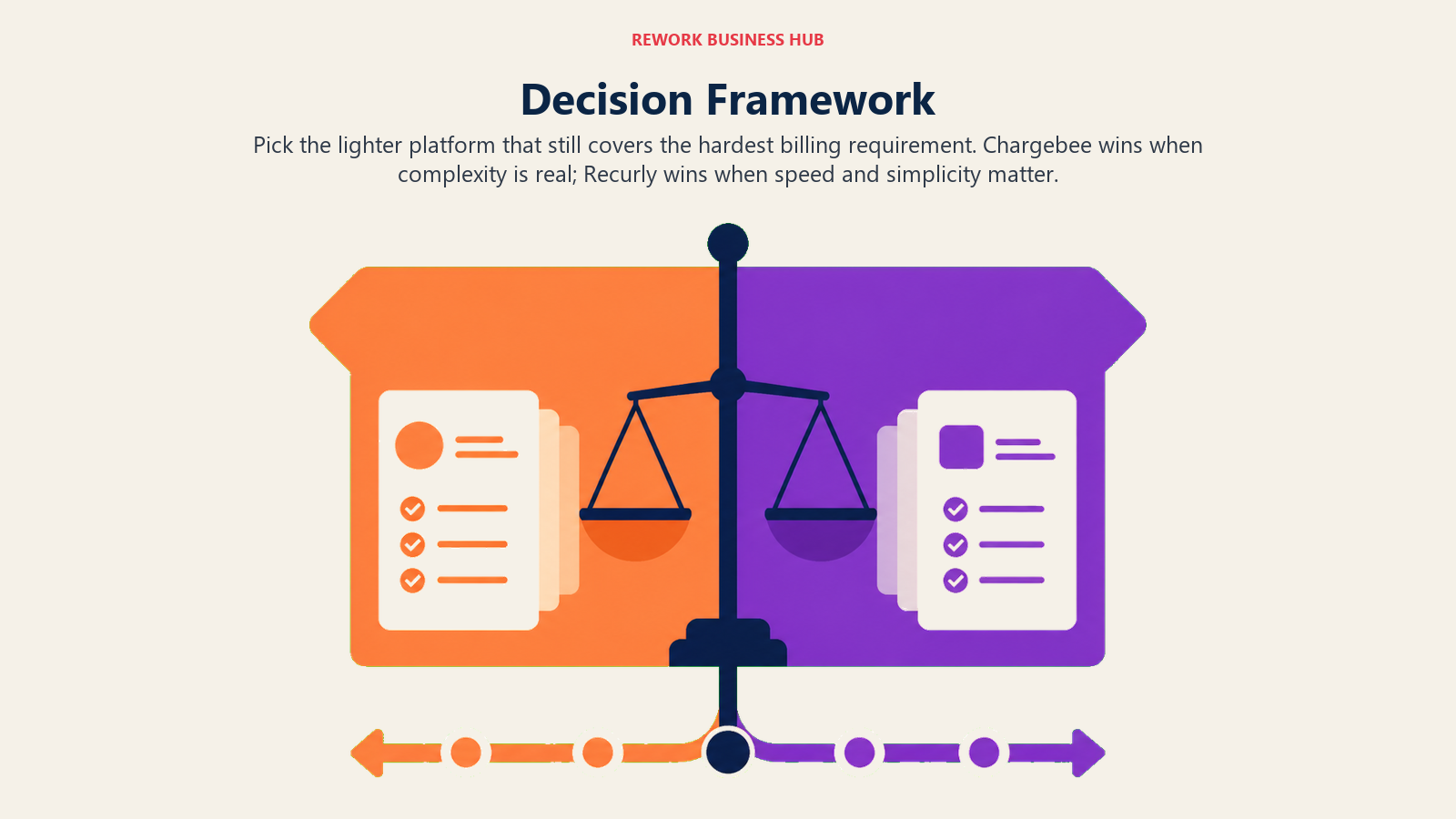
By the time you get to the choice section, the decision is really about billing complexity, finance controls, and how much implementation drag your team can absorb.
| If this is true for you | Pick |
|---|---|
| Monthly billing volume is under about $84,000 | Recurly, Starter's free allowance wins here |
| Monthly billing volume is well above $84,000, and you're not on All-Access | Chargebee, Commit Monthly's lower rate wins here |
| You run usage-based, hybrid, or entitlement-heavy pricing | Chargebee, native EBUB is the differentiator |
| You run flat or tiered subscriptions focused on churn recovery | Recurly, dunning and retention tooling is the differentiator |
| You need ASC 842 or ASC 340-40 compliance named explicitly | Recurly |
| You need CPQ and quote-to-cash bundled with billing | Chargebee |
| You need 35+ gateways or broad payment-method coverage | Chargebee |
| You need a merchant-of-record model, not gateway pass-through | See best Paddle alternatives instead |
What to Do Next
- Model your actual monthly billing volume against the cost table above, not a single anchor number. The answer changes meaningfully between $25,000 and $1,000,000 a month.
- List which add-ons are genuinely in scope. If RevRec or a retention layer is likely within 12 months, Recurly's published $850 and $1,600 starting prices budget more easily than Chargebee's unpublished equivalents.
- Confirm your active payment gateways are supported, especially if you're leaning toward Recurly's shorter list.
- Ask each vendor for a written, volume-specific quote, not a range, and get a reference customer near your volume and industry.
- Loop in FP&A and AP early. Billing data feeds forecasting and reconciliation elsewhere in the stack; our best FP&A software for 2026 and best CRM software for 2026 guides cover those adjacent systems.
Frequently Asked Questions about Chargebee vs Recurly
Does Chargebee still have a free tier?
No. Chargebee's older free launch tier is gone as of 2026. Entry pricing on Chargebee Flow starts at 0.80% of billing volume with no platform fee pay-as-you-go, or a $99/month platform fee plus 0.65% on the monthly commit plan, per Chargebee's own pricing page.
Is Recurly's entry plan called Core?
Not anymore. Recurly's current entry plan is Starter, at $249/month plus 0.9% of billing volume, with the first $40,000 billed each month free. A $199/month Core plan is a stale reference to a structure Recurly no longer publishes.
Which platform is cheaper for a small subscription business?
At low monthly volumes, Recurly Starter is generally cheaper because the first $40,000/month is free. Working the published formulas against each other, that advantage holds until roughly $84,000/month, above which Chargebee's Commit Monthly plan and its lower 0.65% rate becomes cheaper.
Does either platform handle usage-based billing?
Both do, differently. Chargebee's Entitlements-based Usage Billing (EBUB) natively unifies provisioning, feature access, and metered billing. Recurly supports usage through metered add-ons layered onto a subscription plan, reported via API and billed next cycle, without a comparable native entitlements product.
Which platform has better dunning and failed-payment recovery?
Both take it seriously. Chargebee's Smart Retry reads the gateway decline code and adjusts retry timing, with built-in card updating. Recurly's Intelligent Retries uses machine learning to time retries, paired with a free Account Updater and multiple segmented dunning campaigns. Neither publishes a directly comparable recovery rate, so ask both for data from a customer near your volume.
Do Chargebee and Recurly handle sales tax and VAT automatically?
Both do, through Avalara. Recurly ships a built-in tax engine powered by Avalara, with the option to connect your own Avalara or Vertex account. Chargebee integrates with both Avalara and Anrok, the latter adding real-time U.S. nexus tracking and automated filing.
How many payment gateways does each platform support?
Chargebee supports 35 or more gateways and 60-plus payment methods, per its own coverage page. Recurly documents roughly 20 gateways. Confirm your specific processor is on the current list before committing.
Does either platform replace the need for a separate revenue recognition tool?
Both sell revenue recognition as a separate, priced module. Chargebee RevRec covers ASC 606 and IFRS 15 with GL posting and an optional AR add-on; pricing isn't published. Recurly RevRec covers ASC 606, IFRS 15, IFRS 16, ASC 842, and ASC 340-40, from a published $850/month billed annually.
Related Resources:
- Best Subscription Billing Software in 2026
- Best Chargebee Alternatives
- Best Recurly Alternatives
- Best Paddle Alternatives
- Best Accounts Receivable Software in 2026
- Best NetSuite Alternatives
- Best Sage Intacct Alternatives
- Best QuickBooks Alternatives
- Best Stripe Alternatives
- Best FP&A Software in 2026
- Best CRM Software in 2026

Principal Product Marketing Strategist
On this page
- Key Facts
- TL;DR
- Who Each Platform Is Really For
- Pricing and Cost at Volume
- Assumptions behind the table below
- What add-ons cost on top
- Billing Model Depth: Usage-Based Pricing, Proration, and Entitlements
- Dunning and Churn Recovery
- Revenue Recognition and Compliance
- Tax Handling
- Payment Gateways and Orchestration
- Integrations and ERP Fit
- Implementation Weight and Time to Value
- Who Administers It Day to Day
- Reporting and Dashboards
- Scale Ceiling: Where Each Platform Tops Out
- Switching and Migration Considerations
- When Chargebee Is the Right Call
- When Recurly Is the Right Call
- Decision Framework
- What to Do Next