Best Subscription Billing Software in 2026: 15 Platforms for Recurring Revenue Teams
Turn this article into takeaways for your work.


Each assistant summarizes the article only for you and suggests best practices for your work.
The best subscription billing software in 2026 depends on a decision most shortlists skip past: do you need a billing engine, or do you need a merchant of record? Chargebee, Recurly, Stripe Billing, Zuora and Maxio are billing engines. They calculate what a customer owes, generate the invoice, and run the dunning sequence, but your company stays the merchant of record, meaning you register for sales tax and VAT everywhere you sell and you carry the compliance risk. Paddle, Lemon Squeezy, Polar and FastSpring are merchants of record. They sit between you and the customer, collect the payment under their own registration, remit the tax in every jurisdiction, and hand you a net payout. A finance team that picks Paddle when the real need was Chargebee's proration logic, or picks Chargebee when the real need was Paddle's tax remittance, ends up either overpaying for compliance it didn't need or quietly under-collecting VAT in a dozen countries.
This guide ranks 15 platforms for CFOs, VPs of Finance, RevOps leaders, finance systems owners and controllers at B2B SaaS and subscription companies roughly 20 to 500 employees, weighted toward the system-of-record decision: whether you need a billing engine or a merchant of record, how usage-based and hybrid pricing gets metered, what dunning and recovery actually looks like, and how the platform ties back to the general ledger. If accounts receivable and collections are the more pressing gap than billing itself, the sibling best accounts receivable software guide covers that angle instead.
Key Facts
- SaaS subscription businesses churn at a median 3.22% annually, split into 2.16% voluntary and 1.06% involuntary (failed-payment) churn, per Recurly's 2026 churn rate research.
- Involuntary churn from failed payments falls sharply with deal size: 1.30% at the $10 to $25/month tier versus just 0.18% at $250+/month, the same Recurly data shows, which is why dunning and payment retry logic matters most for low-ACV subscription businesses.
- Companies in Zuora's Subscription Economy Index grew revenue 11% faster than the S&P 500 over the two years ending in 2025, according to Zuora's Subscription Economy Index press release.
- Private B2B SaaS companies with $25,000 to $50,000 average contract value post a median 102% net revenue retention, per SaaS Capital's 2025 retention benchmarking survey.
- 43% of B2B credit sales in the United States go overdue, according to the Atradius Payment Practices Barometer for North America, a gap that billing and collections tooling is built to close.
Billing Engine vs Merchant of Record: The Decision That Matters Most
Before comparing feature lists, decide which job you're actually hiring for. The two models solve different problems, and getting it backward is expensive.
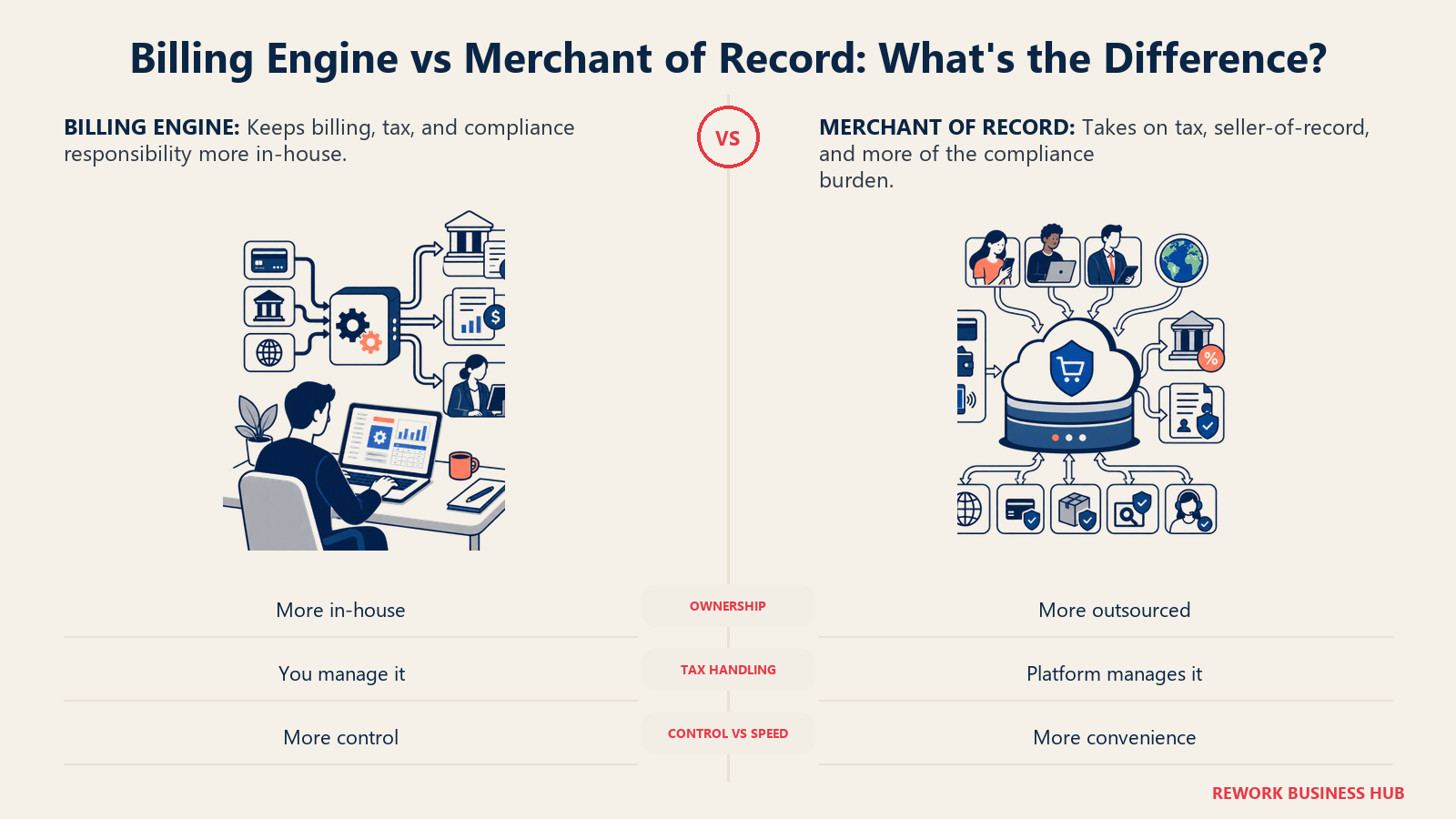
| Billing engine | Merchant of record (MoR) | |
|---|---|---|
| Who's the seller of record | Your company | The platform (Paddle, Lemon Squeezy, Polar, FastSpring) |
| Who registers and remits sales tax/VAT | Your finance team, in every jurisdiction you sell into | The platform, bundled into its fee |
| Pricing model | Flat monthly/annual fee, often plus a small percentage of billing volume | A single percentage plus a fixed fee per transaction, all-inclusive |
| Where payment processing fees show up | Billed separately by your processor (for example, Stripe at 2.9% + 30c per card charge) | Bundled into the one MoR fee |
| Best fit | Companies with in-house finance ops, complex B2B contracts, usage-based or hybrid pricing, existing ERP integration | Companies selling digital products or SaaS globally without a dedicated tax/compliance team |
| On this list | Chargebee, Recurly, Stripe Billing, Zuora, Maxio, Zoho Billing, Ordway, Salesforce Revenue Cloud, Younium, Billsby | Paddle, Lemon Squeezy, Polar, FastSpring |
The tradeoff is control versus liability. A billing engine gives you full control over invoice terms, proration rules and revenue recognition, but you own every tax registration. An MoR takes tax and compliance off your plate entirely, but you give up some pricing and checkout flexibility and hand over a materially bigger cut of revenue (5% or more per transaction versus a flat fee plus under 1% of volume for most billing engines). A mid-market B2B SaaS company selling mostly to US and EU enterprise accounts with a finance team that already handles tax filings usually wants a billing engine. A smaller software company or indie SaaS selling globally with no dedicated tax function usually wants an MoR. Some companies genuinely need both: an MoR for self-serve global checkout and a billing engine for negotiated enterprise contracts.
Quick Comparison Table
| Tool | Best For | Starting Price | Key Strength | Key Limitation |
|---|---|---|---|---|
| Chargebee | Mid-market to enterprise SaaS wanting a full billing engine plus add-on modules | 0.80% of billing value, no platform fee (pay as you go) | Handles complex subscription logic with CPQ and RevRec add-ons | No free tier anymore; add-ons priced separately from core billing |
| Recurly | Subscription businesses that prioritize churn reduction and dunning | $249/mo + 0.9% of billing, first $40K/mo billing free | Strong involuntary-churn recovery tooling built into the core product | All-Access tier needs a $1M/year billing-volume minimum |
| Stripe Billing | Companies already processing payments on Stripe | 0.7% of billing volume (pay as you go), on top of processing fees | Deep API flexibility, tightly integrated with Stripe payments | Billing percentage sits on top of, not instead of, 2.9% + 30c processing |
| Zuora | Large enterprises running complex, multi-entity subscription and order-to-cash | No published price, quote only | Deepest order-to-cash and revenue recognition depth in the category | Zero pricing transparency, implementation typically enterprise-scale |
| Maxio | B2B SaaS finance teams that want billing tied to SaaS metrics (ARR, MRR) | $599/mo (Grow), up to $100K in monthly billings | Purpose-built for SaaS metrics, born from the Chargify and SaaSOptics merger | Grow tier caps at $100K/month billings before requiring a custom quote |
| Rework | Teams wanting income operations on the same platform as CRM, leads and contracts | Quote on request | Income and revenue data live on the same customer record as sales, leads and contracts | Not a metering or proration engine; no dunning, tax remittance or revenue-recognition automation |
| Paddle | Software and SaaS companies selling globally without an in-house tax team | 5% + 50c per transaction, all-inclusive | Merchant of record handles global tax, fraud and billing in one fee | Flat percentage fee gets expensive fast at high transaction volume |
| Lemon Squeezy | Small SaaS and digital-product sellers wanting simple global checkout | 5% + 50c per transaction, plus 1.5% on international transactions | Fast setup for indie and small-team sellers, Stripe-backed reliability | Stripe (its owner) is steering merchants toward Stripe Managed Payments |
| Polar | Developer-first and open-source-adjacent SaaS wanting volume-based MoR pricing | 5.00% + 50c (Starter), down to 3.40% + 30c at the Scale tier | Fee percentage actually drops as volume grows, unlike flat-rate competitors | Younger platform with a thinner enterprise track record |
| FastSpring | Larger software and digital-goods sellers needing full-service global commerce | No published price, revenue-share negotiated with sales | Two-decade track record in global tax compliance for software sellers | No self-serve pricing, every deal requires a sales conversation |
| Zoho Billing | SMBs already standardized on the Zoho ecosystem | $39/mo billed annually (Standard), up to 3 users | Native tie-in to Zoho Books, Zoho CRM and Zoho One at a low published price | Caps at 100,000 invoices/year and $1M annual billed amount on entry tiers |
| Ordway | Mid-market SaaS wanting configurable billing between Stripe's simplicity and Zuora's depth | No published price, demo only | Flexible billing plus subscription management and revenue recognition together | No pricing transparency at all, not even a published range |
| Salesforce Revenue Cloud | Companies already running Sales Cloud or CPQ on Salesforce | $150/user/month (Growth), billed annually | Quote-to-cash lives inside the same Salesforce org as the CRM | Requires an existing Salesforce investment to make sense; per-user pricing adds up |
| Younium | B2B SaaS finance teams wanting subscription management tied tightly to CRM/ERP | No published price, demo only | Purpose-built for B2B recurring revenue with strong ERP and CRM sync | No pricing transparency; smaller vendor with a thinner partner bench |
| Billsby | Small subscription businesses wanting a low flat monthly fee | $45/mo + 0.4% of billings over $15K/mo | Low entry cost relative to percentage-of-volume billing engines | Pricing is published in the docs |
Stage Fit Matrix
Stage fit matters because the right billing stack changes as the business grows from simple checkout into tax-heavy operations.

| Company stage | What the billing decision actually means here | Best fits |
|---|---|---|
| Pre-seed to seed, first paying customers | Get invoices out the door without building custom logic | Stripe Billing, Zoho Billing, Lemon Squeezy |
| Seed to Series A, first dedicated finance hire | Billing volume and plan complexity outgrow spreadsheets and manual Stripe charges | Chargebee, Recurly, Maxio, Billsby |
| Series A to Series C, selling globally without a tax function | Global tax and VAT compliance becomes the actual bottleneck, not the billing logic itself | Paddle, Lemon Squeezy, Polar, FastSpring |
| Series B to growth stage, multiple pricing models in production | Usage-based, hybrid and negotiated-contract pricing need to coexist | Chargebee, Recurly, Ordway, Younium |
| Growth stage, already on Salesforce | Quote-to-cash needs to live inside the existing CRM, not a bolted-on tool | Salesforce Revenue Cloud |
| Enterprise, multi-entity or multi-GAAP | Order-to-cash and revenue recognition matter as much as the invoice itself | Zuora |
| Any stage, consolidating CRM, leads and income onto one platform | The buying trigger is tool sprawl, not billing depth | Rework |
Sizing and Persona Table
| Who owns the billing decision | Their real problem | What to evaluate first | What to skip |
|---|---|---|---|
| Founder or first finance hire, under 20 employees | Manual invoicing in Stripe or a spreadsheet is eating a day a week | Stripe Billing, Zoho Billing, Billsby | Quote-only enterprise platforms with a multi-week sales cycle |
| Finance lead, SaaS company selling internationally, no tax team | Sales tax and VAT registration across a dozen countries is a real liability | Paddle, Lemon Squeezy, Polar, FastSpring | Billing engines that leave tax remittance entirely on your team |
| RevOps or billing ops lead, B2B SaaS, 50 to 300 employees | Usage-based and hybrid pricing don't fit the old flat-fee subscription model | Chargebee, Recurly, Maxio, Ordway, Younium | Simple flat-rate MoR tools built for smaller digital-product sellers |
| VP of Finance, already running Salesforce CPQ | Quote-to-cash keeps breaking at the handoff between CRM and billing | Salesforce Revenue Cloud | Standalone billing tools that require a separate data sync |
| Controller or CFO, multi-entity, multi-currency enterprise | Revenue recognition and consolidation need to run on the same data model as billing | Zuora | Point billing tools with no consolidation layer |
| Ops leader consolidating CRM, leads and billing onto one system | Income data is stuck in a billing tool that doesn't talk to the CRM | Rework | Any tool if the real gap is usage metering or tax remittance, not consolidation |
1. Chargebee
Chargebee's core billing product, now branded Flow, is the platform most mid-market SaaS finance teams shortlist first because it handles complex subscription logic (proration, add-ons, multi-currency, usage-based metering) without requiring custom engineering. It sits squarely in the billing-engine camp: your company stays the merchant of record, and Chargebee calculates what's owed and manages the invoice and dunning cycle around it.
Pricing changed meaningfully from what older comparison articles still repeat. Chargebee no longer has a free tier. Pay As You Go runs 0.80% of monthly billing value with no platform fee, and Commit Monthly charges a $99/month platform fee plus 0.65%. Chargebee's own calculator defaults to $50,000 of monthly billings, where those work out to $400/month and $424/month respectively, both including 100 million usage events per month. Enterprise Plus is custom-quoted with an annual commitment for organizations processing up to 500 million usage events monthly. CPQ, RevRec and the Retention/Growth module are priced as separate add-ons, though CPQ Lite is free for the first 50 quotes.
| Pros | Cons |
|---|---|
| Handles complex proration, add-ons and usage-based billing out of the box | No free tier, entry price is a real monthly commitment |
| CPQ and RevRec add-ons extend into quote-to-cash and revenue recognition | Add-ons priced and sold separately from core billing |
| 100M usage events included even on the entry tier | Percentage-of-billing fee scales with revenue, not just seat count |
| Strong ecosystem of native integrations into CRM and accounting tools | Commit Monthly's lower percentage requires locking in a monthly commitment |
If Chargebee doesn't fit, the sibling best Chargebee alternatives guide covers the wider field, and Chargebee vs Recurly takes the two most-compared billing engines head to head.
Best for: Mid-market to enterprise SaaS companies needing a full-featured billing engine with room to add CPQ and revenue recognition. Sizing fit: 50 to 2,000 employees. Stage fit: Series A through growth stage.
2. Recurly
Recurly built its reputation on the failed-payment problem specifically: its dunning and payment-recovery logic is the reason subscription businesses with thinner margins (media, ecommerce, lower-ACV SaaS) keep it on the shortlist even when a competitor has a flashier feature list. Given that involuntary churn falls from 1.30% to 0.18% simply by moving up in average revenue per customer, per the Recurly data cited above, a platform built to recover more of those failed payments pays for itself directly.
Recurly's entry plan is Starter at $249/month plus 0.9% of billing volume, with the first $40,000 of monthly billings free, backed by a 90-day free trial, the longest trial evaluation window on this list. All-Access is priced as "as low as under 1% of billing volume, billed annually," but requires a $1 million annual billing-volume minimum, which rules it out for smaller teams. Add-ons are priced separately: Engage starts at $1,600/month billed annually, and RevRec starts at $850/month billed annually.
| Pros | Cons |
|---|---|
| Best-in-class dunning and payment-recovery tooling reduces involuntary churn | All-Access tier locked behind a $1M/year billing-volume minimum |
| 90-day free trial, longest on this list | Engage and RevRec add-ons carry meaningful separate monthly fees |
| First $40K/month in billings free on the Starter plan | Starter's 0.9% rate is higher than several billing-engine competitors |
| Strong native support for media, ecommerce and subscription-box billing models | Less quote-to-cash depth than Chargebee or Zuora for complex B2B contracts |
For a direct comparison against the platform it's most often shortlisted against, see Chargebee vs Recurly, and the wider field is in best Recurly alternatives.
Best for: Subscription businesses where reducing failed-payment churn matters as much as the billing logic itself. Sizing fit: 20 to 500 employees. Stage fit: Series A through established mid-market.
3. Stripe Billing
Stripe Billing's pitch is simple: if you're already processing payments through Stripe, layering its billing product on top means one vendor, one dashboard, and an API-first team can build custom logic instead of configuring around a rigid UI. It handles subscriptions, invoicing and usage-based metering natively inside the Stripe ecosystem, which matters for engineering-led finance teams comparing it against a full switch to Stripe alternatives for payments generally.
The number that trips up the most comparisons: Stripe Billing itself costs 0.7% of billing volume on the pay-as-you-go plan, not 0.5%, and there's no free threshold. For predictable annual pricing, Pay Monthly starts at $620/month for up to $100K in monthly volume, scaling to $1,500/month up to $250K, $2,950/month up to $500K, and $5,750/month up to $1M, with 0.67% charged on volume above each tier (custom pricing above $1M/month). Critically, this billing fee sits on top of, not instead of, Stripe's payment processing charge of 2.9% + 30c per successful card transaction (ACH runs 0.8%, capped at $5.00). A team budgeting only the billing percentage and forgetting the processing fee will be surprised by the actual bill.
| Pros | Cons |
|---|---|
| One vendor for payments and billing, deep API for custom logic | Billing fee (0.7%) is additive to processing fees (2.9% + 30c), not inclusive |
| Pay Monthly tiers give predictable annual budgeting | No free tier or free-billing threshold |
| Native usage-based metering and invoicing | Less opinionated dunning and recovery tooling than Recurly out of the box |
| Tight integration with the broader Stripe product suite | Best value requires being comfortable building around Stripe's API, not a turnkey UI |
Best for: Engineering-led SaaS teams already processing payments on Stripe who want billing in the same platform. Sizing fit: 10 to 1,000 employees. Stage fit: Seed through growth stage.
4. Zuora
Zuora is the platform every enterprise subscription and order-to-cash comparison still measures against, built around the idea that quoting, billing, revenue recognition and renewals should run on one shared data model rather than four disconnected tools. For a multi-entity, multi-currency organization running complex hybrid pricing (subscription plus usage plus one-time charges in the same contract), that unified model is the actual differentiator, not a longer feature list.
Zuora publishes no pricing at all. The pricing page offers only "Tour the product" and "Speak to an expert," with every deal quoted on modules, billing volume and implementation scope. Zuora has been a private company since February 14, 2025, when Silver Lake and GIC completed a $1.7 billion take-private at $10.00 per share and its Class A stock was delisted from the NYSE, so treat any present-tense reference to "NYSE: ZUO" as outdated. That matters going forward because there is far less public benchmarking data on a private company. If Zuora is the incumbent you are evaluating away from, the Zuora alternatives guide covers the field, and the Chargebee vs. Zuora comparison works through the two head to head.
| Pros | Cons |
|---|---|
| Deepest order-to-cash and revenue recognition depth in this category | Zero published pricing, every deal is a custom quote |
| Handles complex, multi-entity, multi-currency subscription models | Implementation typically runs enterprise-scale, measured in months |
| RevPro module adds ASC 606/IFRS 15 revenue recognition on the same platform | Overkill and overpriced for companies under roughly 500 employees |
| Long enterprise track record with deep partner and integrator ecosystem | Recently taken private, less public benchmarking data going forward |
Best for: Large enterprises running complex, multi-entity subscription and order-to-cash operations. Sizing fit: 500 to 20,000+ employees. Stage fit: Large enterprise, often multi-entity or multi-GAAP.
5. Maxio
Maxio is the product of Chargify and SaaSOptics merging into one company, and the combined platform reflects that lineage directly: billing logic from Chargify's engine, paired with the SaaS metrics and financial reporting (ARR, MRR, cohort analysis) that made SaaSOptics useful to finance teams. If a comparison article still lists Chargify as a separately purchasable tool, that's stale; it no longer exists as a standalone product.
Maxio's Grow plan is published at $599/month for up to $100,000 in monthly billings. Above that threshold, Scale requires a custom quote ("Get a Quote"). Default agreements are billed annually; monthly and quarterly payment options carry a premium over the annual rate. That $100K/month billings cap on Grow is worth watching closely for any company on a fast growth trajectory, since it forces a re-negotiation right when finance has the least bandwidth for a vendor conversation.
| Pros | Cons |
|---|---|
| Billing and SaaS metrics (ARR, MRR, cohorts) built on the same data model | Grow tier caps at $100K/month billings before requiring a custom quote |
| Published entry price, rare at this level of billing sophistication | Monthly and quarterly payment options cost more than the annual default |
| Purpose-built for B2B SaaS finance teams, not adapted from ecommerce billing | Smaller ecosystem and partner bench than Chargebee or Zuora |
| Direct successor to two well-known tools (Chargify, SaaSOptics), mature product | Scale tier pricing is opaque once a company outgrows Grow |
If Maxio itself is the platform you are shopping away from, or you want to see how its flat fee compares against percentage-of-volume rivals at your billing volume, the Maxio alternatives guide runs that math directly.
Best for: B2B SaaS finance teams that want billing and SaaS metrics reporting native to the same platform. Sizing fit: 20 to 300 employees. Stage fit: Series A through Series C.
6. Rework
Rework is not a subscription billing engine and doesn't try to be one. Its Incomes module handles income and revenue operations on the same platform and the same customer record as Rework's CRM, Lead Ops, Invoice, Contract and Bankfeeds modules, which is a genuinely different pitch from anything else on this list: instead of a CRM, a separate billing engine and a separate AR tool each holding a partial view of the customer, income data lives next to the deal, the contract and the conversation history that produced it.
That consolidation argument is the honest reason to consider Rework here, not billing depth. Pricing for the Incomes module is quoted per organization; see rework.com/pricing. For teams evaluating Rework primarily as a CRM rather than for income operations, best CRM software in 2026 covers that broader comparison.
| Pros | Cons |
|---|---|
| Income and revenue data live on the same record as CRM, leads and contracts | No usage-based metering, proration or complex subscription billing logic |
| One platform instead of a CRM plus a billing engine plus a separate AR tool | No dunning, revenue recognition or sales-tax remittance automation |
| Seats come in blocks of 5 rather than one at a time | Pricing not published; requires a sales conversation to get a number |
| Strong fit for teams already consolidating GTM and ops tools | Minimum package requires 5 users, not a fit for solo operators |
Not ideal for: high-volume SaaS companies needing usage metering, complex proration or ASC 606 revenue recognition; global digital sellers needing merchant-of-record tax handling; enterprise AR teams needing collections automation at HighRadius-grade depth; and solo operators, since Rework's minimum package is 5 users.
Best for: Mid-size teams (roughly 20 to 500 employees) that want income operations consolidated with CRM, leads and contracts on one platform. Sizing fit: 20 to 500 employees. Stage fit: Growth-stage through established mid-market.
7. Paddle
Paddle is a merchant of record built specifically for software and SaaS companies, meaning Paddle, not your company, is the legal seller on every transaction. That single design choice is the whole pitch: Paddle registers for sales tax and VAT in every jurisdiction it operates in, handles fraud screening, generates compliant invoices, and pays out net revenue, so a finance team selling software into 40 countries doesn't need 40 tax registrations.
Pricing is a flat 5% plus 50c per checkout transaction, all-inclusive of tax handling, fraud protection, billing and support, with no separate monthly fee. Paddle offers custom pricing for products priced under $10 or for companies with invoicing-heavy sales motions that don't fit the standard checkout flow.
| Pros | Cons |
|---|---|
| Merchant of record removes global tax and VAT registration burden entirely | Flat 5% + 50c fee is materially higher than a billing engine's percentage |
| One all-inclusive fee covers tax, fraud, billing and support | Less pricing flexibility for negotiated, non-standard enterprise contracts |
| No separate monthly platform fee | Custom pricing required for sub-$10 products |
| Purpose-built for SaaS and software, not adapted from general ecommerce | Not the right fit if your finance team already handles tax compliance in-house |
The wider merchant-of-record field, including where Paddle's fee structure stops making sense, is covered in best Paddle alternatives.
Best for: Software and SaaS companies selling globally without an in-house tax and compliance team. Sizing fit: 5 to 500 employees. Stage fit: Seed through growth stage.
8. Lemon Squeezy
Lemon Squeezy built a reputation as the fastest way for an indie developer or small SaaS team to start selling globally, with checkout, billing and merchant-of-record tax handling live in under an hour. Stripe acquired Lemon Squeezy in 2024, and the product still operates independently with the same fee structure.
Pricing is 5% plus 50c per transaction, all-inclusive of processing, currency conversion and tax, plus an additional 1.5% on international (non-US) transactions. One development worth knowing: in January 2026, Lemon Squeezy confirmed it's building migration paths to Stripe Managed Payments, Stripe's own merchant-of-record product announced that February. Lemon Squeezy is still operating normally with no sunset date announced, but new merchants should know where the roadmap is heading before treating it as a permanent home.
| Pros | Cons |
|---|---|
| Fastest setup on this list for small teams and indie sellers | Additional 1.5% fee on international transactions on top of the base 5% + 50c |
| Merchant of record handles global tax without a separate registration | Owned by Stripe, which is steering merchants toward its own Stripe Managed Payments |
| Reliable payment infrastructure backed by Stripe's processing network | Less depth for complex, negotiated B2B contract terms |
| Simple, transparent flat-rate pricing with no hidden monthly fee | No committed long-term roadmap independent of Stripe's own MoR product |
For the two flat-rate merchant-of-record options weighed directly against each other, including what Stripe ownership means for Lemon Squeezy, see the Paddle vs. Lemon Squeezy comparison.
Best for: Small SaaS and digital-product sellers wanting the fastest path to global checkout. Sizing fit: 1 to 50 employees. Stage fit: Pre-seed through Series A.
9. Polar
Polar is the newest merchant of record on this list, built with a developer-first and open-source-adjacent audience in mind, and it differentiates on pricing structure rather than feature breadth: its fee percentage actually drops as a merchant's volume grows, instead of staying flat like most MoR competitors.
Published tiers: Starter at 5.00% + 50c per transaction, Pro at 3.80% + 40c, Growth at 3.60% + 35c, and Scale at 3.40% + 30c, all merchant-of-record pricing covering 100+ markets. That declining-fee structure means a merchant doing meaningful volume pays noticeably less proportionally than on Paddle or Lemon Squeezy's flat 5% + 50c.
| Pros | Cons |
|---|---|
| Fee percentage drops with volume, unlike flat-rate MoR competitors | Younger platform with a shorter enterprise track record |
| Merchant of record covering 100+ markets | Smaller integration and partner ecosystem than Paddle or FastSpring |
| Developer-first positioning resonates with open-source and indie SaaS teams | Less proven at higher transaction volumes than established competitors |
| Transparent, tiered pricing published directly on the site | No published enterprise or custom tier beyond Scale |
Best for: Developer-first and open-source-adjacent SaaS companies wanting volume-based MoR pricing that improves as they grow. Sizing fit: 1 to 100 employees. Stage fit: Pre-seed through Series A.
10. FastSpring
FastSpring has run as a merchant of record for software and digital-goods sellers for over two decades, which shows up in its pricing model: rather than a single published percentage, FastSpring negotiates a revenue-share rate based on transaction type and volume, closer to an enterprise contract than a self-serve checkout tool.
The vendor states pricing is "simple, flat-rate pricing based on transaction type and your volume of business," negotiated directly with sales, with no minimum volume requirement to get started. That negotiated model can work in a larger seller's favor at scale, but it means there's no number to check against a self-serve competitor before talking to a sales team.
| Pros | Cons |
|---|---|
| Two-decade track record in global tax compliance for software sellers | No published pricing, every deal requires a sales conversation |
| No minimum volume requirement to start | Negotiated rate makes apples-to-apples comparison against self-serve MoRs harder |
| Handles complex digital-goods and software licensing scenarios | Slower onboarding than instant-signup competitors like Lemon Squeezy or Polar |
| Established reputation with larger software and digital-product sellers | Less appeal for a small team wanting to start selling within the hour |
Best for: Larger software and digital-goods sellers needing full-service global commerce with a negotiated rate. Sizing fit: 20 to 1,000 employees. Stage fit: Series A through established enterprise.
11. Zoho Billing
Zoho Billing is the budget entry point on this list with an actual published price, and its real value shows up for companies already running other Zoho products (Zoho Books for accounting, Zoho CRM for sales, or the broader Zoho One suite), where billing data flows natively into the rest of the stack without a separate integration project.
Published pricing: Standard at $50/month month-to-month or $39/month billed annually, covering up to 3 users; Premium at $100/month month-to-month or $79/month billed annually, covering up to 10 users; Enterprise is custom-quoted. Standard and Premium both cap at 100,000 invoices per year and $1 million in annual billed amount. There's no free plan, but a 14-day trial is available, and pricing is quoted in USD.
| Pros | Cons |
|---|---|
| Real published pricing starting under $50/month, lowest on this list | Caps at 100,000 invoices/year and $1M annual billed amount before Enterprise |
| Native integration with Zoho Books, Zoho CRM and Zoho One | Less billing sophistication than dedicated engines like Chargebee or Recurly |
| Straightforward annual-vs-monthly pricing with no percentage-of-volume fee | No free plan, only a 14-day trial |
| Good fit for teams comparing against QuickBooks alternatives already leaning toward Zoho's ecosystem | Support and integration depth trail larger, SaaS-focused billing engines |
Best for: SMBs already standardized on the Zoho ecosystem wanting billing at a low, published price. Sizing fit: 1 to 100 employees. Stage fit: Pre-seed through established SMB.
12. Ordway
Ordway positions itself as the configurable middle ground in this category: more billing and revenue-recognition depth than Stripe Billing's developer-first approach, without the implementation weight and cost of Zuora. The platform combines subscription billing, invoicing, revenue recognition and reporting in one product aimed at mid-market SaaS finance teams that have outgrown a simpler tool but don't need enterprise-scale order-to-cash.
Ordway does not publish pricing anywhere on its site. The homepage and product pages route every visitor to "Get a Demo" rather than a pricing page or even a published range, so there's no number to check before a sales conversation.
| Pros | Cons |
|---|---|
| Combines billing, revenue recognition and reporting on one platform | No published pricing anywhere, not even a range |
| Positioned as more configurable than Zuora without Zuora's implementation weight | Smaller brand recognition than Chargebee, Recurly or Zuora |
| Aimed specifically at mid-market SaaS finance teams | Every evaluation starts with a demo request, no self-serve trial |
| Handles complex, negotiated B2B contract terms well | Thinner public case-study and integration-partner base than category leaders |
Best for: Mid-market SaaS finance teams wanting billing and revenue recognition together without Zuora-level implementation weight. Sizing fit: 50 to 500 employees. Stage fit: Series B through growth stage.
13. Salesforce Revenue Cloud
Salesforce Revenue Cloud (marketed as part of Agentforce Revenue Management, and formerly known separately as CPQ and Billing) makes the most sense as an extension of an existing Salesforce investment rather than a standalone billing decision. Its entire pitch is that quoting, contracts, billing and revenue data live in the same org as the CRM, removing the handoff between a sales-side CPQ tool and a finance-side billing system.
Published pricing, per user per month, billed annually: Revenue Cloud Growth at $150 (quoting, configurator, order capture, subscriptions), and Revenue Cloud Advanced at $200 (everything in Growth plus contracts and orders, consumption and invoicing, and AI and analytics). Both require an annual contract, and Salesforce's own page notes pricing is subject to change and to confirm details with a sales representative.
| Pros | Cons |
|---|---|
| Quote-to-cash lives inside the same Salesforce org as the CRM and CPQ | Per-user pricing ($150 to $200/month) adds up fast across a finance and RevOps team |
| Published, transparent per-user pricing, rare at this depth of functionality | Full value requires an existing Salesforce investment; weak standalone case |
| Advanced tier adds consumption billing and AI-driven analytics | Requires an annual contract, no month-to-month flexibility |
| Deep native reporting alongside Salesforce's broader CRM data | Implementation and configuration typically need a Salesforce admin or partner |
Best for: Companies already running Sales Cloud or CPQ on Salesforce wanting billing in the same org. Sizing fit: 50 to 2,000+ employees. Stage fit: Growth stage through large enterprise, existing Salesforce shops.
14. Younium
Younium is a Sweden-founded B2B subscription management platform built specifically around recurring revenue metrics and tight synchronization with CRM and ERP systems, an explicitly B2B-first alternative to billing tools that started out serving consumer subscription or ecommerce use cases.
Younium does not publish pricing on its site. Third-party estimates place typical costs in a broad range, but none of that is confirmed by the vendor's own page as of August 2026, so treat any number from a third party as unverified and get a direct quote.
| Pros | Cons |
|---|---|
| Purpose-built for B2B recurring revenue, not adapted from consumer billing | No published pricing, demo and contact-sales only |
| Strong native sync with CRM and ERP systems for B2B contract data | Smaller vendor with a thinner partner and integration ecosystem than category leaders |
| European roots give it strong footing for EU-based subscription businesses | Less brand recognition in North America than Chargebee, Recurly or Zuora |
| Subscription management and billing built on the same underlying data model | No self-serve trial; every evaluation starts with a sales conversation |
Best for: B2B SaaS finance teams wanting subscription management tightly synced with existing CRM and ERP systems. Sizing fit: 20 to 300 employees. Stage fit: Series A through growth stage.
15. Billsby
Billsby's pitch is a low, predictable flat monthly fee instead of a straight percentage of billing volume, aimed at smaller subscription businesses that want billing costs to stay flat as revenue grows, at least up to a defined threshold.
Billsby publishes its rates in its own documentation: the Core plan is $45/month with a $15,000 monthly transaction allowance and a 0.4% overage above it, and the Pro plan is $135/month with a $30,000 allowance and a 0.5% overage, per Billsby's pricing documentation. A Custom plan covers higher revenue or unusual requirements. Confirm the figures with Billsby before budgeting against them.
| Pros | Cons |
|---|---|
| Low flat monthly fee model, appealing versus straight percentage-of-volume billing engines | Confirm current pricing with Billsby |
| Revenue-based overage only kicks in above a defined monthly threshold | Reported pricing, not independently confirmed by the vendor at time of publication |
| Simple enough for a small team to configure without dedicated billing ops staff | Smaller ecosystem and support bench than Chargebee, Recurly or Maxio |
| Custom plan available for higher-revenue businesses | Site accessibility itself is a signal worth investigating before committing |
Best for: Small subscription businesses wanting a predictable flat monthly fee over straight percentage-of-volume pricing. Sizing fit: 1 to 50 employees. Stage fit: Pre-seed through Series A.
Platform Buying Mistakes to Avoid
The common mistakes show up when teams buy billing software for feature lists instead of their actual operating model.

| Mistake | What it looks like | What to do instead |
|---|---|---|
| Picking a billing engine when the real gap is tax compliance | A company selling into 30 countries licenses Chargebee, then still has to register for VAT in each one by hand | If global tax registration is the actual bottleneck, evaluate an MoR (Paddle, Lemon Squeezy, Polar, FastSpring) first |
| Picking an MoR when the real need is negotiated B2B contracts | A company with complex enterprise proration and custom terms signs an MoR built for self-serve checkout | Match the model to the sales motion: MoR for self-serve, a billing engine for negotiated contracts |
| Forgetting payment processing fees sit on top of billing fees | Budgeting Stripe Billing at 0.7% and being surprised by the 2.9% + 30c processing charge on top | Add both line items into the total cost model before comparing against an MoR's all-inclusive fee |
| Treating a quote-only price as a fixed number | Budgeting Zuora, Ordway or Younium at whatever a sales rep mentioned in the first call | Get the number in writing before it goes near a budget line |
| Ignoring involuntary churn until it's a revenue problem | A low-ACV subscription business has no dunning strategy and quietly loses over 1% of revenue to failed payments monthly | Weight dunning and payment-recovery tooling as heavily as invoicing features for lower-ACV businesses |
| Assuming the billing tool replaces accounts receivable | A finance team licenses a billing engine and expects it to also chase down aging invoices and collections | Billing generates the invoice; a dedicated AR tool like the ones in best accounts receivable software handles what happens after it goes unpaid |
| Skipping the ERP or accounting sync test in the trial | Evaluating a platform on its checkout UI without connecting real chart-of-accounts data | Run the trial against your actual accounting system, whether that's NetSuite or something lighter, before signing |
That last point compounds fast. 43% of B2B credit sales in the US go overdue, per the Atradius data cited above, and a billing platform that can't cleanly hand off to real accounts receivable and collections processes just moves the manual work downstream instead of removing it.
How to Choose: Decision Framework
The decision usually comes down to how much control the team wants versus how much billing work it is willing to own.
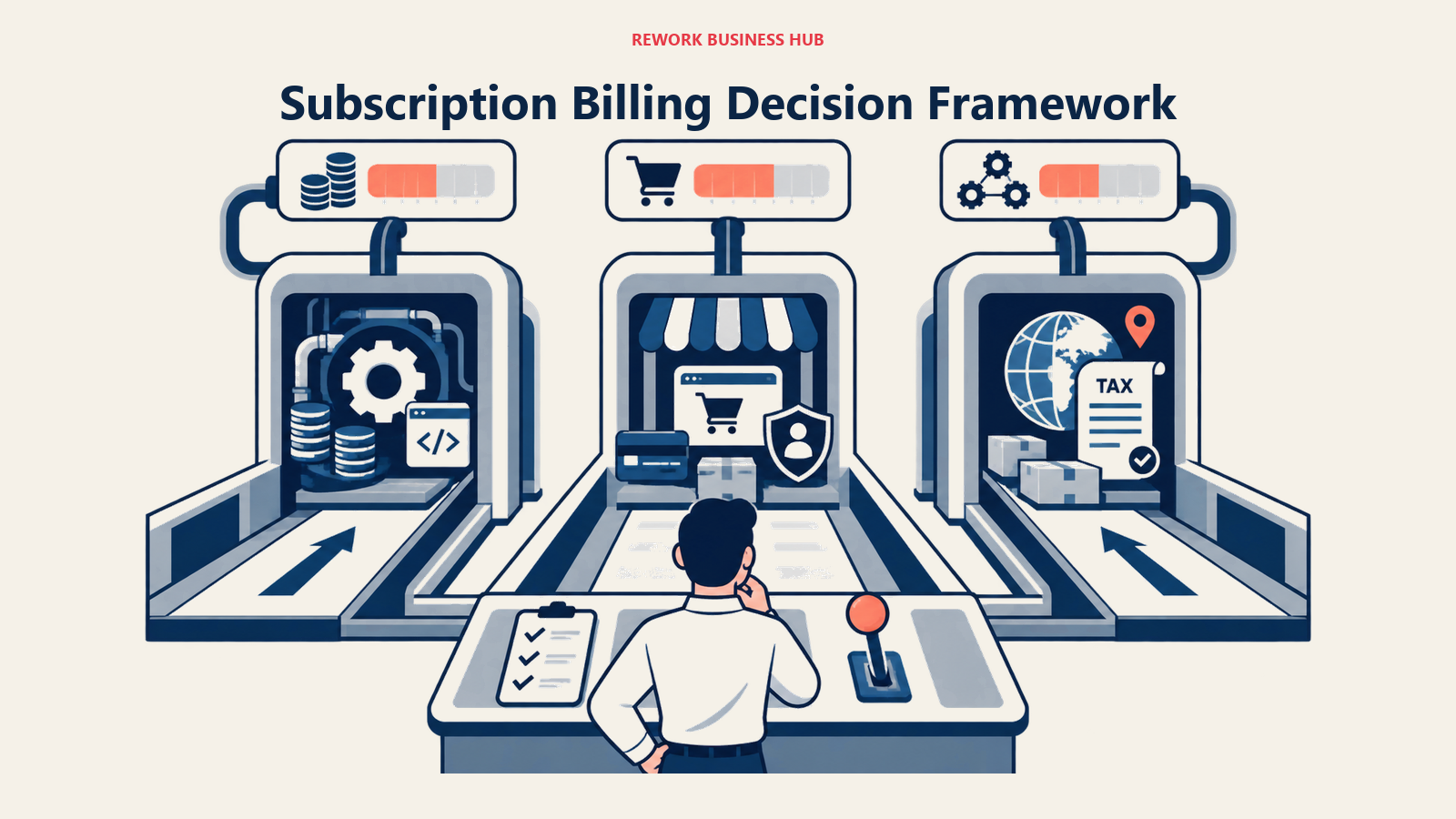
| If you need... | Pick... | Why |
|---|---|---|
| A merchant of record because you have no in-house tax function | Paddle or FastSpring | Both handle global tax registration and remittance as the seller of record |
| The lowest-cost merchant of record at meaningful volume | Polar | Fee percentage drops from 5.00% to 3.40% as volume scales, unlike flat-rate competitors |
| The fastest self-serve setup for a small team selling digital products | Lemon Squeezy | Live checkout and MoR tax handling in under an hour |
| A billing engine with the strongest dunning and payment recovery | Recurly | Purpose-built involuntary-churn recovery tooling, backed by a 90-day trial |
| Billing tied natively to SaaS metrics (ARR, MRR, cohorts) | Maxio | Born from the Chargify/SaaSOptics merger, built specifically for SaaS finance |
| Enterprise-grade order-to-cash and revenue recognition on one data model | Zuora | Deepest quote-to-cash and RevPro depth in this category |
| Billing to live inside an existing Salesforce org | Salesforce Revenue Cloud | Quote-to-cash runs in the same org as Sales Cloud and CPQ, no separate sync |
| Income operations consolidated with your CRM, leads and contracts | Rework | Income data sits on the same customer record as the rest of your GTM stack |
Frequently Asked Questions about Subscription Billing Software
What is the best subscription billing software in 2026?
There's no single best platform, only the best fit for whether you need a billing engine or a merchant of record. Chargebee and Recurly lead for mid-market SaaS wanting a full-featured billing engine, Zuora leads for enterprise order-to-cash, and Paddle or FastSpring lead when the real gap is global tax compliance rather than billing logic itself.
What's the difference between a billing engine and a merchant of record?
A billing engine (Chargebee, Recurly, Stripe Billing, Zuora, Maxio, Zoho Billing, Ordway, Salesforce Revenue Cloud, Younium, Billsby) calculates and invoices what customers owe while your company stays the legal seller and handles its own tax registration. A merchant of record (Paddle, Lemon Squeezy, Polar, FastSpring) becomes the seller of record itself, collecting payment and remitting sales tax and VAT on your behalf in every jurisdiction, for a materially higher per-transaction fee.
How much does subscription billing software cost?
It depends heavily on the model. Billing engines charge a small percentage of billing volume, sometimes on top of a platform fee and sometimes not. Chargebee Pay As You Go is 0.80% of billing value with no platform fee at all, while Recurly Starter pairs a $249/month floor with 0.9% above its first $40,000 of monthly billings. Merchants of record charge a single higher percentage per transaction, all-inclusive of tax and compliance, ranging from Polar's volume-scaled 3.40% to 5.00% plus a fixed fee, up to Paddle and Lemon Squeezy's flat 5% plus 50c.
Is Stripe Billing the same as Stripe's payment processing fees?
No, and this is the most common pricing mistake in the category. Stripe Billing charges 0.7% of billing volume for the subscription and invoicing logic itself. Stripe's payment processing, the actual card transaction, is a separate charge of 2.9% plus 30c per successful charge (or 0.8% for ACH, capped at $5.00). Budget both together.
Does Chargebee still have a free tier?
No. Chargebee's previously well-known free tier (free until roughly $50,000 to $250,000 in cumulative revenue) has been discontinued. Entry pricing is now 0.80% of billing value on the Pay As You Go plan, with no platform fee, so a team billing $50,000 a month pays $400.
What happened to Chargify?
Chargify no longer exists as a standalone product. It merged with SaaSOptics to form Maxio, which combines Chargify's billing engine with SaaSOptics' SaaS metrics and reporting on one platform.
Is Lemon Squeezy shutting down?
No. Lemon Squeezy, acquired by Stripe in 2024, is still operating and still charges its standard 5% plus 50c fee, with no sunset date announced as of August 2026. Stripe confirmed in January 2026 that it's building migration paths to Stripe Managed Payments, its own merchant-of-record product, so new merchants should factor that roadmap direction into a long-term decision.
Does Rework handle sales tax remittance or revenue recognition?
No. Rework's Incomes module handles income and revenue operations on the same platform as its CRM, leads and contracts, but it is not a merchant of record and does not automate sales tax remittance, dunning or ASC 606 revenue recognition. Teams needing those specific capabilities should evaluate a dedicated billing engine or merchant of record from this list alongside Rework.
How do I decide between a billing engine and a merchant of record if I'm not sure?
Ask who currently registers for sales tax and VAT in the countries you sell into. If your finance team already does that work, a billing engine gives you more control over invoice terms and proration at a lower per-transaction cost. If nobody on your team handles that today, a merchant of record removes the liability entirely, at a higher fee that's often worth it for a smaller team.
What to Do Next
Answer the billing-engine-versus-merchant-of-record question before you demo a single tool. Pull up your current sales-tax and VAT registrations (or the lack of them) and your finance team's actual bandwidth to manage that compliance work, since that answer eliminates roughly half of this list immediately.
Once the model is decided, shortlist two platforms and run the same three tests on both before a contract reaches legal. First, connect a real invoice history or a test batch of your actual pricing plans, including any usage-based or hybrid terms, and see how much manual configuration the platform still requires. Second, get every fee in writing: the base rate, the percentage of volume, payment processing costs if they're separate, and what a 3x growth in billing volume does to the total, since several platforms on this list publish no number at all. Third, test the dunning and payment-recovery flow specifically if your average contract value is under $250 a month, since that's where involuntary churn does the most damage.
If the shortlist still feels wide, decide whether the real gap is billing logic, tax compliance, revenue recognition, or getting income data out of a standalone tool and onto the same record as the rest of your revenue operations. Those are four different problems, and only one platform on this list solves more than one of them at once.

Principal Product Marketing Strategist
On this page
- Key Facts
- Billing Engine vs Merchant of Record: The Decision That Matters Most
- Quick Comparison Table
- Stage Fit Matrix
- Sizing and Persona Table
- 1. Chargebee
- 2. Recurly
- 3. Stripe Billing
- 4. Zuora
- 5. Maxio
- 6. Rework
- 7. Paddle
- 8. Lemon Squeezy
- 9. Polar
- 10. FastSpring
- 11. Zoho Billing
- 12. Ordway
- 13. Salesforce Revenue Cloud
- 14. Younium
- 15. Billsby
- Platform Buying Mistakes to Avoid
- How to Choose: Decision Framework
- What to Do Next