Lemon Squeezy vs Paddle vs Zoho Billing: Merchant of Record or Your Own Billing Stack in 2026?
Turn this article into takeaways for your work.


Each assistant summarizes the article only for you and suggests best practices for your work.
Before you compare a single feature, settle this question: do you want to hand someone else the legal responsibility for collecting and remitting sales tax and VAT on every sale, or keep it yourself? That's not a stylistic difference between these three products, it's a structural one. Lemon Squeezy and Paddle are merchants of record. They legally sell your product to your customer, not you, so their business entity, not yours, registers for tax in every jurisdiction where you have customers and remits it on your behalf out of the fee they charge. Zoho Billing is different in kind, not just in price: it's subscription-management software. It calculates what a customer owes, generates the invoice, and runs the dunning sequence, but your company stays the seller of record, carrying the tax registration, filing and remittance burden everywhere you sell.
That one distinction decides most of what follows, so it's worth understanding the mechanics before looking at a single price. The honest trade: a merchant of record charges a percentage of revenue, which sounds simple until you model it against a flat software fee at real dollar amounts, where the percentage gets expensive fast, though not as fast or as simply as the "software is always cheaper" pitch suggests. This article models that crossover explicitly, verifies where Lemon Squeezy actually stands now that its technology sits inside Stripe, and covers what most comparisons skip: payout timing, who owns a chargeback, and what happens to your customer relationships if you migrate away. If you haven't settled the billing-engine-versus-merchant-of-record question at all yet, the wider best subscription billing software guide covers that decision across 15 platforms.
Key Facts
- Paddle charges 5% plus 50 cents per checkout transaction, all-inclusive, with no separate monthly platform fee, per Paddle's own pricing page.
- Zoho Billing's Standard plan starts at $39 a month billed annually for up to 3 users, capped at 100,000 invoices a year and $1 million in annual billed amount, per Zoho's own pricing page.
- Stripe's own standard card-processing fee, the baseline cost sitting underneath any billing software that isn't itself a merchant of record, is 2.9% plus $0.30 per successful domestic transaction, per Stripe's own pricing page.
- Stripe Managed Payments, the product Lemon Squeezy's technology now feeds, charges 3.5% per transaction on top of standard processing fees and covers tax, VAT and GST compliance in more than 80 countries, per Stripe's own Managed Payments documentation.
- TaxJar, one way to replicate a merchant of record's tax compliance without becoming one, starts at $39/month for up to 200 orders a month, a cap a high-volume seller outgrows fast, per TaxJar's own pricing page.
TL;DR
| Lemon Squeezy | Paddle | Zoho Billing | |
|---|---|---|---|
| Model | Merchant of record | Merchant of record | Billing software, you're the merchant of record |
| Who owns tax registration | Lemon Squeezy | Paddle | You |
| Headline price | 5% + 50c, plus 1.5% on international transactions | 5% + 50c flat, no international surcharge | $39 to $79/month (Standard/Premium), Enterprise custom |
| Monthly platform fee | None | None | Yes, $39 to $100/month depending on tier |
| New merchant signups | Reported waitlist, public access said to be coming | Open, self-serve | Open, self-serve, 14-day trial |
| Corporate status | Owned by Stripe since July 2024, still operating | Independent, privately held since 2012 | Part of the privately held Zoho suite |
| Cheapest below roughly $40K/year revenue | Yes, if you can get an account | Yes | Usually not, fixed costs dominate at low volume |
| Cheapest above roughly $40K/year revenue | No, percentage cost climbs | No, percentage cost climbs | Usually, until real tax-compliance cost is added back in |
| Who owns a chargeback | Lemon Squeezy | Paddle | You, via your payment gateway |
| Best for | Existing account holders wanting simple global checkout | SaaS teams wanting one flat global rate, open today | Teams past the crossover point, or already on Zoho |
The Real Distinction: Merchant of Record vs. Running Your Own Billing Stack
Most shortlists compare these three products on features when the actual decision is about who's legally on the hook.
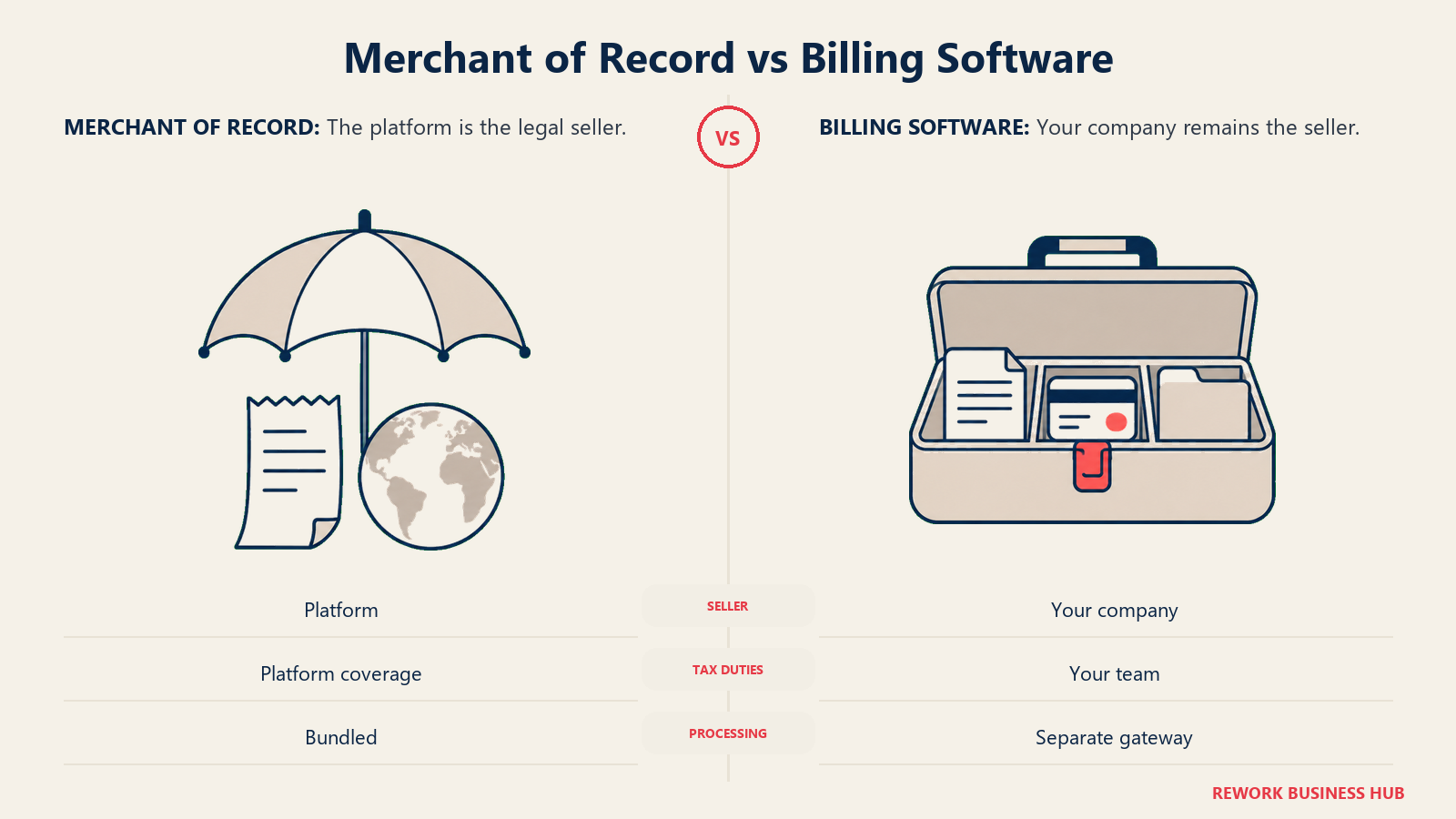
When Paddle or Lemon Squeezy processes a sale, the transaction happens between the platform and your customer, not between you and your customer. The platform issues the receipt, and its own business entity, not yours, is the one registered for VAT, GST or sales tax in the buyer's jurisdiction, remitting it out of the fee it charges you. That's why the fee is a percentage of revenue rather than a flat number: it prices in a real, ongoing compliance obligation across every country you sell into, not just software. You never register for tax anywhere the platform already covers, and in exchange you give up the direct legal relationship with the sale itself.
Zoho Billing works completely differently, and the difference isn't a smaller feature set, it's a different category. It never takes legal title to a transaction. It calculates what your customer owes, generates the invoice in your company's name, and hands the charge to a payment gateway you connect (typically Stripe or PayPal) that settles funds into your own account. Your company is the seller of record on every transaction, full stop, so your company registers for sales tax or VAT everywhere you have nexus, files the returns, and remits the money, whether that's by hand, through an accountant, or through a tax-automation tool stacked on top.
| Merchant of record (Lemon Squeezy, Paddle) | Billing software (Zoho Billing) | |
|---|---|---|
| Legal seller on each transaction | The platform | Your company |
| Who registers for sales tax/VAT | The platform, in every jurisdiction it covers | Your company, in every jurisdiction with nexus |
| Who remits the tax collected | The platform | Your company, directly or through a tax tool |
| Pricing shape | Percentage of revenue plus a fixed fee, all-inclusive | Flat software fee, processing and tax handled separately |
| Where payment processing shows up | Bundled into the one fee | Billed separately by whichever gateway you connect |
| What you're actually buying | Compliance and liability transfer | Calculation, invoicing and subscription logic |
If you remember one thing here: the percentage a merchant of record charges isn't a markup on a payment fee, it's the price of never registering for tax in 40 countries. Whether that's worth paying is a math problem, and the next section does the math.
Who Each Platform Is Really For
| Lemon Squeezy | Paddle | Zoho Billing | |
|---|---|---|---|
| Primary buyer | Indie developers and small SaaS teams, historically | SaaS companies from indie through scaling stage wanting a single global rate | SMBs already inside or evaluating the Zoho ecosystem |
| The question they're solving | "How do I sell software globally without registering for tax myself?" | Same question, with a flat rate regardless of geography | "How do I get real invoicing and subscription logic without a percentage-of-revenue fee?" |
| Where it's strongest | Historically fast, low-friction setup for solo sellers | One flat rate, no international surcharge, open signup today | Transparent published pricing, native tie-in to Zoho Books, Zoho CRM and Zoho One |
| Where it disappoints | New merchants can't self-serve their way in right now | Under-$10 products and invoicing both need a custom-pricing conversation | You own tax compliance entirely, and it caps at $1M in annual billed amount before Enterprise |
| Team maturity assumed | Comfortable that the product now sits inside Stripe's roadmap | Comfortable with Paddle's checkout and webhook integration | Has, or is willing to build, a real tax-compliance process |
| Buying trigger | Already have (or can get) an account and want to keep shipping | Launching global SaaS and wanting predictable, geography-agnostic pricing | Past the point where a percentage-of-revenue fee costs more than owning the process |
The Crossover Point: What Each Model Actually Costs at $10K, $100K and $1M a Year
The "merchant of record is dramatically more expensive at scale" claim needs a real model behind it: true in one direction, overstated in another. The numbers below assume a $100 average transaction, the midpoint of the $20 to $200 range typical SaaS subscriptions sit in, and a mostly domestic customer base. Your own deal size, and which processor you'd pair with a billing engine (see best Stripe alternatives if Stripe isn't the fit), will move every number, so treat this as a model to rerun, not a fixed verdict.
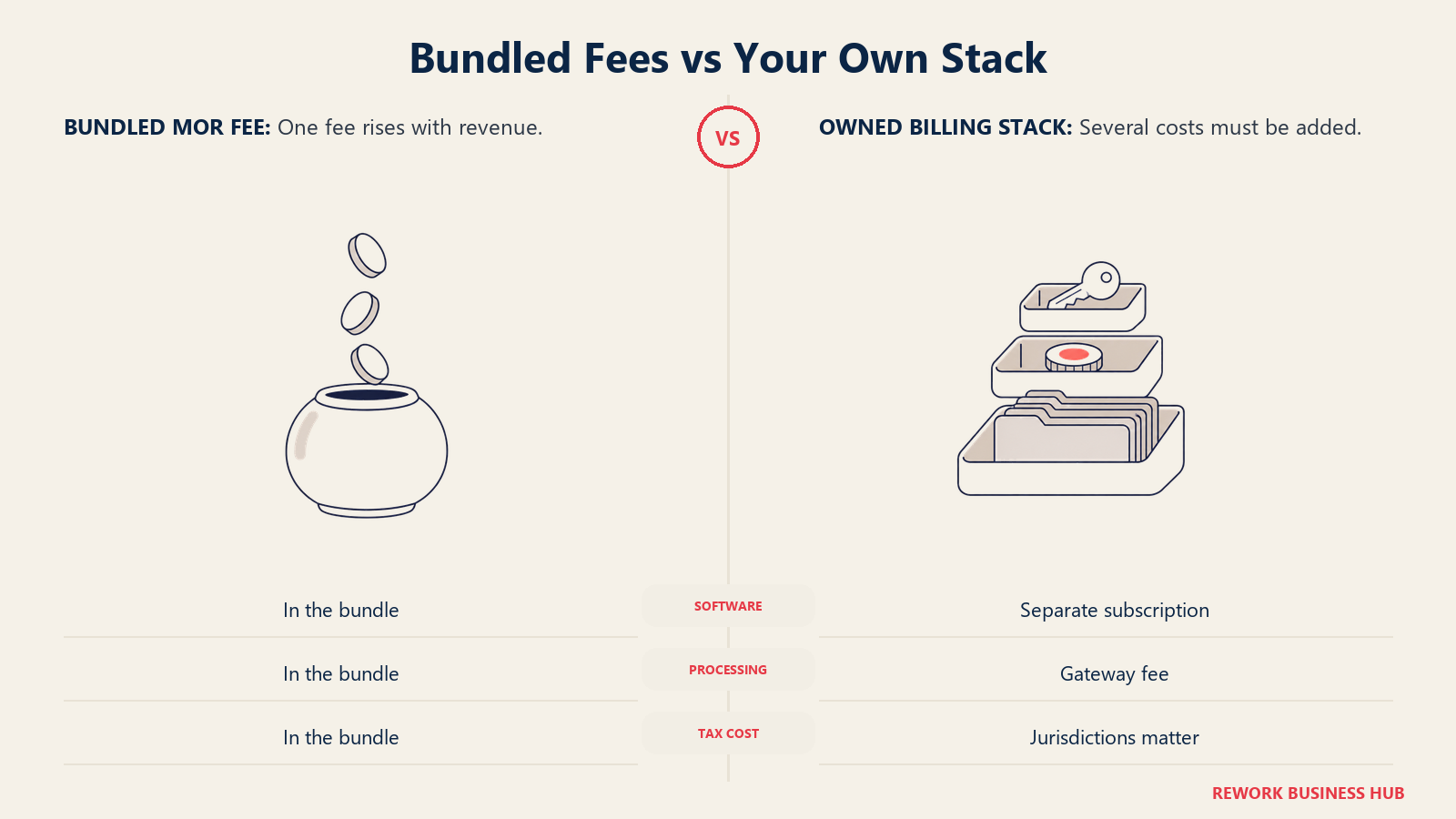
What the merchant-of-record route costs
| Annual revenue | Transactions/year (at $100 avg) | Paddle (5% + 50c flat) | Lemon Squeezy (5% + 50c, +1.5% on a 30% international mix) |
|---|---|---|---|
| $10,000 | 100 | $550 | $595 |
| $100,000 | 1,000 | $5,500 | $5,950 |
| $1,000,000 | 10,000 | $55,000 | $59,500 |
Both figures follow each vendor's published fee formula. Paddle's is flat regardless of where the customer sits; Lemon Squeezy's climbs with international mix, the same surcharge the Paddle vs. Lemon Squeezy comparison models.
What running your own stack actually costs
Most "just switch to a billing engine" arguments skip this: Zoho Billing's subscription fee isn't the whole bill. You still need a payment gateway, billed separately at Stripe's standard 2.9% + $0.30, and you still need to handle tax yourself, in-house or through a tool like TaxJar or Avalara, since Zoho Billing calculates tax on an invoice without registering or remitting anything for you.
| Annual revenue | Zoho Billing (annual) | Stripe processing (2.9% + 30c) | Tax compliance layer | Total |
|---|---|---|---|---|
| $10,000 | $468 (Standard) | $320 | $468 (TaxJar Starter) | $1,256 |
| $100,000 | $468 (Standard) | $3,200 | $1,188 (TaxJar Professional) | $4,856 |
| $1,000,000 | Enterprise, custom quoted (Standard/Premium cap at $1M billed) | $32,000 | ~$19,356 median (Avalara-class; reportedly $7,404 to $69,996/year, not vendor-published) | $51,356 plus an unpublished Zoho Enterprise fee |
TaxJar's published tiers cap at 200 orders a month, roughly $240,000 a year at $100 a transaction, comfortably past the $100K tier modeled here. By $1M a year, a seller is running roughly 833 orders a month, well past what either published TaxJar tier covers, the point at which a business typically graduates to an enterprise-grade platform like Avalara, priced by quote only. Real Avalara contracts, per reported third-party aggregated data, range widely from $7,404 to $69,996 a year, median near $19,356, which is itself the honest answer to "how much does owning tax compliance cost at scale": it depends on how many jurisdictions you're registered in, not your revenue number alone.
The crossover, side by side
| Annual revenue | Cheaper route in this model | The gap |
|---|---|---|
| $10,000 | Paddle or Lemon Squeezy | Your own stack costs roughly $660 to $700 more, since fixed subscriptions don't scale down |
| $100,000 | Zoho Billing plus Stripe plus a tax tool | The merchant-of-record fee costs roughly $650 to $1,100 more |
| $1,000,000 | Close to a wash, tilts software with a simple tax footprint | Narrows to low single digits of thousands, or reverses, by jurisdiction count |
At this article's stated assumptions, the two routes cost about the same once annual revenue crosses roughly $40,000. Below that line, a merchant of record's percentage is genuinely cheaper, not just simpler, because a flat software subscription plus a separate processor plus a separate tax tool adds up to more real dollars than 5% of a small revenue number. Above it, the software route's advantage is real but not a free lunch: it only holds if tax-compliance cost stays reasonable, and that's a function of jurisdiction count, not revenue. A company selling into 60 countries at $1M a year should rerun this model against its own nexus footprint before assuming the software route wins.
The Lemon Squeezy Acquisition: Where Stripe Ownership Actually Stands in 2026
Worth reading twice if Lemon Squeezy is on your shortlist: the two easy takes on it, "it's dying" and "it's business as usual," are both wrong.
It is not shutting down. Stripe acquired Lemon Squeezy in July 2024, and it's still processing transactions at its existing rate with no sunset date announced. Lemon Squeezy's own leadership has publicly framed Stripe Managed Payments, not a shutdown, as the forward path, and says the team is actively building migration tooling toward it rather than winding the product down.
New signups are gated, and the timeline for opening back up keeps moving. Multiple reports through 2026 describe new merchant access as waitlist-based, with leadership saying in mid-2026 that public signup without an invite is coming. Treat "waitlist, opening soon" as the current read rather than a settled fact, and confirm access directly with Lemon Squeezy before building a plan around it.
The real successor costs more than Lemon Squeezy's current rate, and isn't a drop-in replacement. Stripe Managed Payments entered public preview in February 2026 and, per Stripe's own documentation, charges 3.5% per transaction on top of standard processing fees, an effective all-in rate north of 6% domestically and higher internationally, materially more than Lemon Squeezy's flat 5% + 50c. It's also not functionally equivalent: it only works with Stripe Checkout and Payment Links, needs Stripe Billing layered on top for subscriptions, and doesn't support Stripe Connect, third-party tax integrations, or one-off invoices on a customer object. A buyer evaluating Lemon Squeezy today isn't choosing a platform with an identical, cheaper successor waiting; they're choosing one whose likely replacement costs more and does less.
| Lemon Squeezy status, stated plainly | What it means for a buyer |
|---|---|
| Still live, actively processing transactions | Not a reason to rule it out on stability alone |
| No shutdown date announced | Don't repeat "discontinued," it isn't accurate |
| New signups reported waitlist-gated through 2026 | You may not be able to open an account today regardless of fit |
| Technology feeds Stripe Managed Payments, in public preview since February 2026 | The likely long-term path, at a meaningfully higher effective rate |
| Managed Payments limited to Checkout and Payment Links, needs Billing for subscriptions | Not a functional drop-in even once it's fully open |
Payout Timing
Treat the payout specifics below as a framework to confirm directly with each vendor rather than a fixed number.
| Lemon Squeezy | Paddle | Zoho Billing | |
|---|---|---|---|
| Who controls payout timing | Lemon Squeezy, as merchant of record | Paddle, as merchant of record | Whichever gateway you connect (Stripe, PayPal, etc.) |
| Typical cadence | Not published; confirm during onboarding | Reportedly monthly; confirm directly | Your gateway's own schedule, typically a rolling multi-day cycle |
| Transfer method cost | Not published; confirm directly | Wire transfers reportedly ~$15 each; ACH/SEPA reportedly free | Set by your gateway, not Zoho Billing |
| New or high-risk accounts | Reserve/hold periods are standard; confirm current policy | Same; confirm current policy | Set by your gateway's own risk model |
The structural point matters more than any single number: with a merchant of record, you're on their payout clock, set by their own policies for new accounts, risk holds and transfer fees. With Zoho Billing, you inherit whatever terms your payment gateway offers, so you can shop that relationship independently, and switching billing tools later doesn't mean switching who holds your money.
Chargeback and Dispute Handling
| Lemon Squeezy | Paddle | Zoho Billing | |
|---|---|---|---|
| Who faces the card network on a dispute | Lemon Squeezy | Paddle | Your payment gateway, not Zoho Billing |
| Who assembles representment evidence | Lemon Squeezy, as merchant of record | Paddle, as merchant of record | Your team, or a tool layered on top |
| Per-chargeback fee | Not published | Reportedly $15 to $20, deducted from balance; confirm directly | Set by your gateway's own fee schedule |
| Protection bundled into the base fee | Implied by the model, not separately itemized | Reported as bundled into the 5% + 50c rate | Not applicable, no dispute role at all |
This follows directly from who's the merchant of record. Paddle and Lemon Squeezy sit between you and the card networks, so a dispute is legally theirs to fight, for a per-incident fee that's small relative to the percentage they already charge. Zoho Billing was never party to the charge in the first place, so it has no dispute role at all: your gateway sets the fee and keeps it regardless of outcome, and building or buying a chargeback-response process is entirely on you. Teams whose real gap is chasing unpaid invoices rather than card disputes will get more direct use out of the best accounts receivable software guide than any of the three platforms compared here.
What Happens to Your Customer and Subscription Data If You Migrate
This part of the decision shows up months or years later, after the pricing call has already been made, so it's worth understanding upfront.
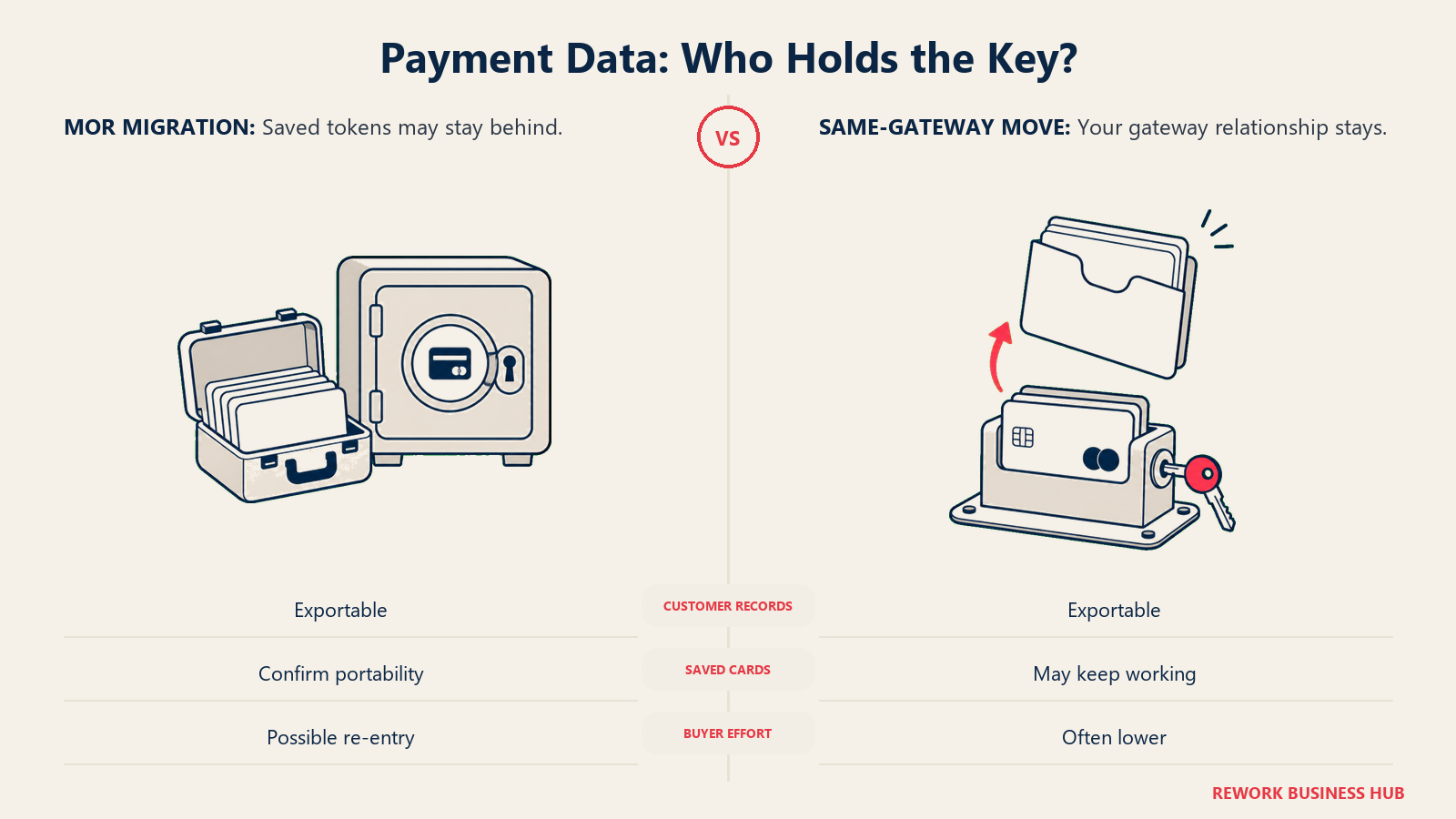
Because Paddle and Lemon Squeezy are the legal merchant on every transaction, the saved payment method, the token that lets a subscription renew without asking the customer to re-enter their card, lives inside the platform's own merchant account, not yours. Migrate away from either one, and the standard pattern is that you can export customer records, subscription history and invoice data, but the saved payment method generally doesn't travel with it, since card tokens don't move between merchant accounts. In practice, that means asking every active customer to re-enter payment details on whatever you move to next, a real churn risk on a subscription base of any size.
Zoho Billing sits on the other side of that line. Your company is the merchant of record throughout, on whatever payment gateway you've connected, so the customer payment relationship already lives in an account you own, independent of Zoho Billing itself. Move to a different billing engine later while keeping the same gateway, and the payment method often keeps working, because you're swapping the invoicing layer on top of a processor relationship you already control, not swapping merchant accounts.
| Lemon Squeezy / Paddle | Zoho Billing | |
|---|---|---|
| Who holds the payment method on file | The platform's own merchant account | Your payment gateway account, which you own |
| What typically transfers on migration | Customer and subscription records, invoice history | Everything, including the live payment method, if the gateway stays the same |
| What typically doesn't transfer | The saved card token, generally | N/A, the token was never inside the billing tool |
| Practical migration risk | Customers likely re-enter payment details | Lower, the processor relationship doesn't change |
That's the clearest argument for treating "which is cheaper" as only half the question. A merchant of record's fee also buys convenience today at the cost of switching friction later, a fair trade for a lot of businesses, but a trade, not a free upgrade.
Implementation, Risk and Governance
| Lemon Squeezy | Paddle | Zoho Billing | |
|---|---|---|---|
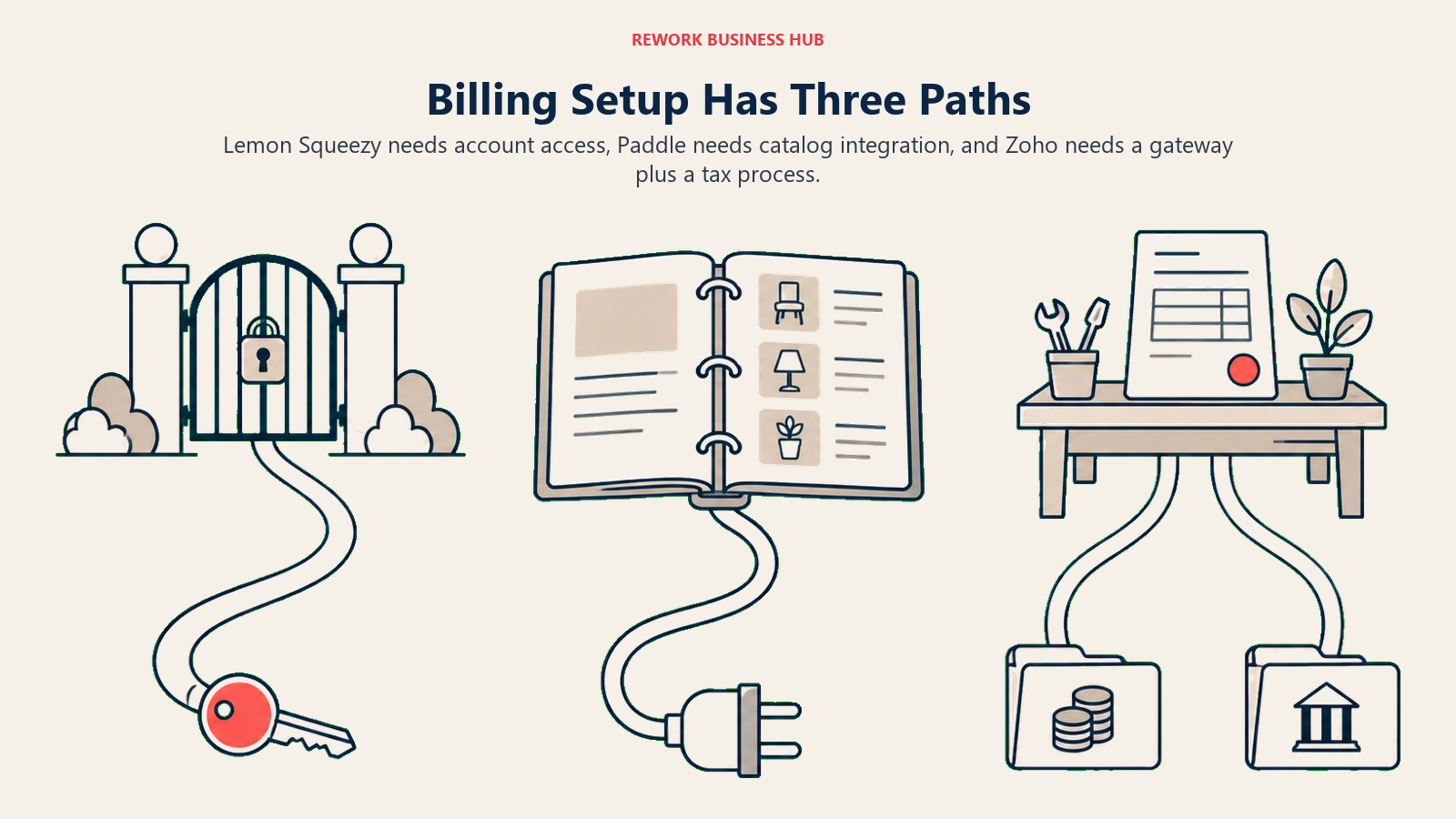
| Setup complexity | Historically low-friction once an account is approved | Moderate: product catalog configuration plus webhook integration for provisioning | Higher upfront: connect a payment gateway separately, configure tax rates, build or buy a compliance process |
| Blocked by anything before you start | Reported waitlist access | No, open signup | No, open signup, 14-day trial |
| Who carries tax compliance risk | The platform | The platform | Your company, including audit and penalty exposure if it's done wrong |
| Vendor concentration risk | Higher right now, signup access and long-term pricing both depend on Stripe's roadmap | Lower, independent and standalone | Lower on billing, but now dependent on your gateway and tax-tool vendors instead |
| Growth ceiling built into the product | None published | Custom pricing available at high scale | Standard/Premium cap at 100,000 invoices/year and $1M in annual billed amount before Enterprise |
| Data and relationship control | Lower, the platform owns the transaction and payment method | Lower, same reason | Higher, you control checkout, dunning language and the processor relationship directly |
A merchant of record's implementation cost is mostly a signup and integration step, with the tax and fraud burden absorbed by the platform going forward. Zoho Billing's cost runs the other way: smaller on day one, larger ongoing, since your team owns a compliance function most businesses have never built in-house. Its caps are worth flagging too. A company approaching $1M in annual billed amount needs the Enterprise conversation before hitting the ceiling, since Standard and Premium stop working past that line rather than degrading gracefully. If staying the merchant of record yourself is the goal but Zoho Billing isn't the right engine, Chargebee vs. Recurly covers two billing engines built for more complex subscription logic.
When Lemon Squeezy Is the Right Call
- You already hold an active account. Nothing about its current status requires migrating away today.
- Your customer base is close to 100% domestic, so the 1.5% international surcharge never applies, and you can actually get through the current waitlist.
- You're comfortable planning for an eventual migration, most likely toward Stripe Managed Payments at a higher effective rate, rather than treating this as a permanent home.
When Paddle Is the Right Call
- You need to start selling globally today and can't wait on account access, or you sell heavily across borders and want one flat rate with no stacking surcharge to model.
- You're under roughly $40,000 a year in revenue, where a merchant of record's percentage genuinely beats the fixed cost of running your own stack, not just the operational simplicity of it.
- You want tax and chargeback liability fully off your plate and you've decided that's worth a premium even above the crossover point. If Paddle's fee structure still doesn't fit, best Paddle alternatives covers the wider merchant-of-record field.
When Zoho Billing Is the Right Call
- You're already running Zoho Books, Zoho CRM or Zoho One and want billing data flowing natively into that stack.
- You're comfortably past the crossover point, roughly $40,000 a year at this article's assumptions, and willing to own tax registration, or already have an accountant or tax-automation tool in place.
- You want direct control over checkout, dunning language and the payment relationship, and transparent published pricing to budget against instead of a percentage that scales unpredictably with revenue.
Decision Framework
| If this is true for you | Pick |
|---|---|
| You're under roughly $40K/year in revenue and want the least operational overhead | Paddle (open today) or Lemon Squeezy (if you can get an account) |
| You sell heavily across borders and want one flat rate with no surcharge | Paddle |
| You already hold a working Lemon Squeezy account | Lemon Squeezy, keep using it and watch for migration guidance |
| You're past roughly $40K/year and willing to own tax registration | Zoho Billing, paired with a payment gateway and a tax tool |
| You're already standardized on Zoho Books, Zoho CRM or Zoho One | Zoho Billing |
| You need real B2B invoicing and net terms | Paddle (via custom pricing) or Zoho Billing (native to the product) |
| Your nexus footprint spans dozens of jurisdictions even at high revenue | Rerun the math yourself, a merchant of record can still win here |
What to Do Next
- Count your actual jurisdictions and estimate your real average transaction size. Both move the crossover point, and this article's $100 assumption may not match your business.
- Confirm Lemon Squeezy access directly rather than planning around waitlist status you read secondhand.
- Price out a real tax-compliance layer (TaxJar, Avalara, or an accountant's quote) before assuming Zoho Billing's flat fee is the whole bill. It almost never is.
- Get chargeback fees and payout terms in writing, and weigh migration risk now, before your subscriber base grows large enough to make it expensive.
One adjacent problem worth naming: none of these three solve it if your real friction isn't billing mechanics, but that revenue data sits disconnected from your CRM and deal history. Rework's Incomes module keeps that data on the same customer record as the rest of a sales pipeline, though it isn't a metering, proration or tax-remittance engine and won't replace any of the three platforms above for that job.
Frequently Asked Questions about Lemon Squeezy vs Paddle vs Zoho Billing
What's the real difference between Lemon Squeezy, Paddle and Zoho Billing?
Lemon Squeezy and Paddle are merchants of record: they legally sell your product, register for tax everywhere they operate, and remit it on your behalf out of a percentage fee. Zoho Billing is billing software: it calculates invoices and manages subscriptions, but your company stays the merchant of record and keeps the tax responsibility.
Is Lemon Squeezy shutting down?
No. Stripe acquired Lemon Squeezy in July 2024, and it's still processing transactions at its existing rate with no shutdown date announced. Leadership has said public signup access without an invite is coming, though that hadn't landed.
Can I sign up for Lemon Squeezy today?
Possibly, but don't assume it's self-serve. Multiple reports describe new signups as waitlist-gated through 2026, so confirm current access directly with Lemon Squeezy. An existing account continues to work as before.
Is Paddle, Lemon Squeezy or Zoho Billing cheaper?
It depends on your revenue and transaction size. At this article's modeled $100 average transaction, the merchant-of-record fee is cheaper below roughly $40,000 a year in revenue, and a self-run stack tends to pull ahead above that, though the gap narrows again at real scale once multi-jurisdiction tax compliance cost enters the math.
Does Zoho Billing handle my sales tax and VAT for me?
It calculates tax on each invoice using rates you configure, but doesn't register you for tax anywhere or remit anything on your behalf. That responsibility, and the liability if it's done wrong, stays with your company, typically handled through an accountant or a tax-automation tool layered on top.
What happens to my customers if I switch away from a merchant of record?
Expect friction. Paddle and Lemon Squeezy hold the card-charging relationship inside their own merchant accounts, so migrating away commonly means customers re-enter payment details rather than a silent carryover, since card tokens generally don't move between merchant accounts. Moving between billing tools that sit on top of your own payment processor is usually less disruptive, since you already own that underlying relationship.
Who handles chargebacks differently between these three?
Paddle and Lemon Squeezy, as merchants of record, own the dispute relationship with the card networks and handle representment for a per-incident fee. Zoho Billing has no role in disputes since it doesn't process the card charge; your gateway sets the terms, and your team, or a tool layered on top, assembles the evidence.
Where's the crossover point between a merchant of record and running my own stack?
At this article's stated assumptions, roughly a $100 average transaction and a mostly domestic customer base, the two routes cost about the same near $40,000 a year in revenue. Below that, a merchant of record's percentage is typically cheaper. Your own transaction size and jurisdiction count will move that number, so treat it as a model to rerun, not a fixed rule.
Related Resources:
- Paddle vs Lemon Squeezy: Which Merchant of Record Fits Your SaaS in 2026?
- Best Subscription Billing Software in 2026
- Best Paddle Alternatives
- Best Accounts Receivable Software in 2026
- Chargebee vs Recurly
- Best Stripe Alternatives
Camellia writes about billing, revenue operations, and finance tooling for B2B and digital-product teams.

On this page
- Key Facts
- TL;DR
- The Real Distinction: Merchant of Record vs. Running Your Own Billing Stack
- Who Each Platform Is Really For
- The Crossover Point: What Each Model Actually Costs at $10K, $100K and $1M a Year
- What the merchant-of-record route costs
- What running your own stack actually costs
- The crossover, side by side
- The Lemon Squeezy Acquisition: Where Stripe Ownership Actually Stands in 2026
- Payout Timing
- Chargeback and Dispute Handling
- What Happens to Your Customer and Subscription Data If You Migrate
- Implementation, Risk and Governance
- When Lemon Squeezy Is the Right Call
- When Paddle Is the Right Call
- When Zoho Billing Is the Right Call
- Decision Framework
- What to Do Next