Chargebee vs Zuora: Self-Serve Billing or Enterprise Order-to-Cash in 2026?
Turn this article into takeaways for your work.


Each assistant summarizes the article only for you and suggests best practices for your work.
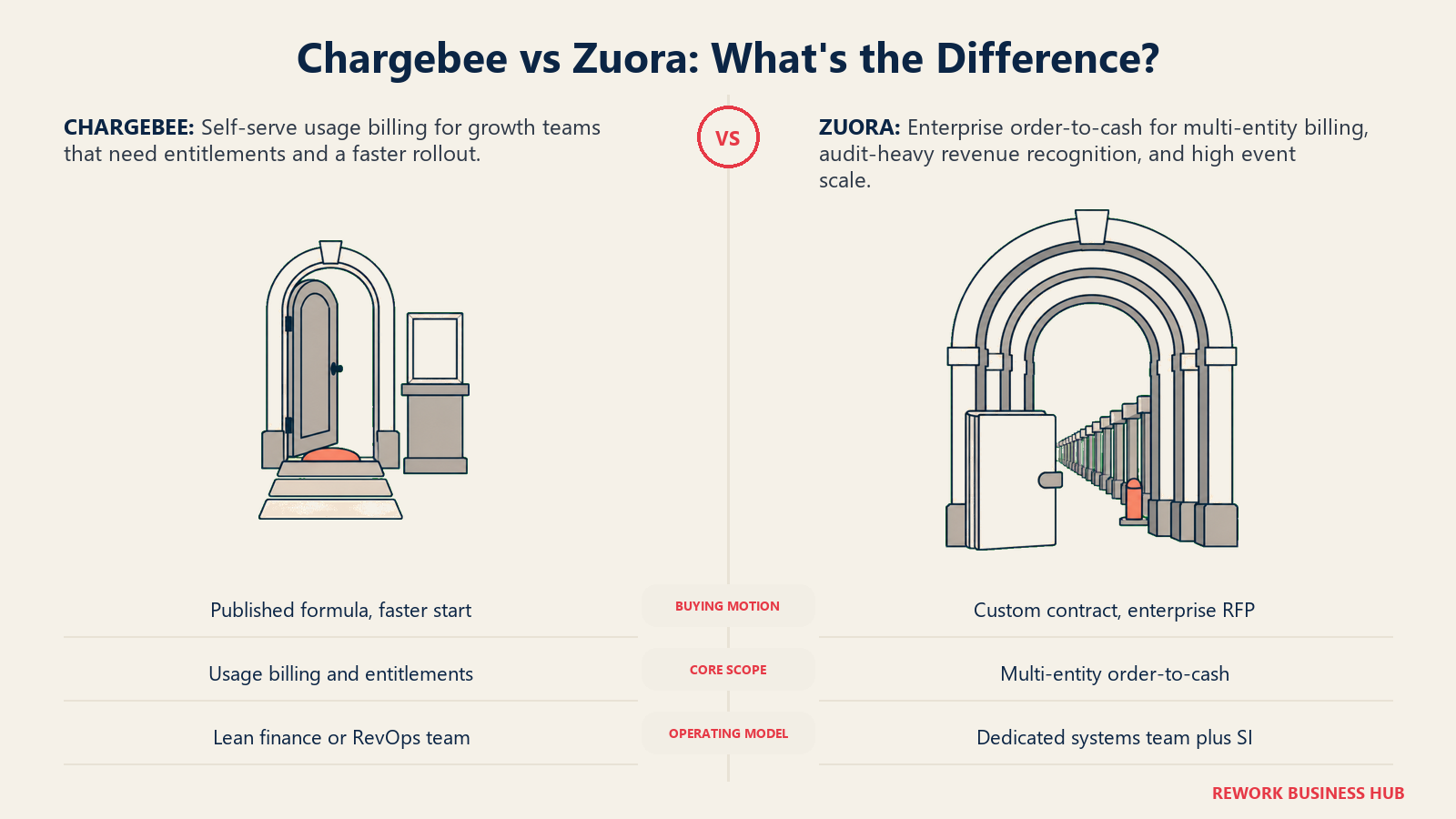
If Chargebee and Zuora are both on your shortlist, you're not really comparing two similar products. You're comparing two different buying processes wearing the same product category. Chargebee publishes a rate card you can read right now, no login or sales call required: 0.80% of your billing value with no platform fee if you want to start today. Zuora publishes nothing. Not a starting price, not a range, not a "starting at $X/month." Every Zuora deal opens with a form that reads "Speak to an expert."
That gap is the real story here, more than any single feature. It isn't purely "which billing engine is better," because on raw depth Zuora usually wins: it's the deepest order-to-cash and revenue recognition platform in this category, built for the multi-entity, audit-heavy close process a large enterprise finance team runs every month. The real question is whether you're buying a self-serve engine you can be live on this quarter, or entering a sales process built around six-figure annual contracts and a dedicated implementation project.
Key Facts
- Chargebee's billing product, Flow, has no free plan. Entry pricing is 0.80% of monthly billing volume with no platform fee, or a $99/month platform fee plus 0.65% of volume, with 100 million usage events a month included, per Chargebee's own pricing page.
- Zuora publishes no price of any kind on its pricing page: no tiers, no ranges, no "starting at," only a demo request and "Speak to an expert," per Zuora's own pricing page.
- Zuora has been a private company since February 14, 2025, when Silver Lake and GIC completed their take-private at $10.00 per share and its Class A stock stopped trading on the NYSE, per Silver Lake's own announcement. Zuora valued the deal at $1.7 billion when it was announced in October 2024.
- The median Zuora buyer pays $170,000 a year, in a reported range from $26,883 to $696,804 across 149 tracked purchases, per SaaS-purchasing platform Vendr's aggregated buyer data (reported, not a vendor-confirmed figure) (Vendr).
- Zuora Revenue automates all five steps of ASC 606 and IFRS 15 and processes more than $300 billion in annual revenue volume for customers including Salesforce and Microsoft, per Zuora's own product page.
- Zuora Billing serves more than 1,000 enterprise customers and processes over $96 billion annually, with a mediation engine built to stream up to 200,000 usage events per second, per Zuora's own product page.
TL;DR
| Chargebee (Flow) | Zuora | |
|---|---|---|
| Published pricing | Yes, formula on the website | No, quote only |
| Entry pricing | 0.80% of volume with $0 fee, or $99/mo + 0.65% | Not published; reported median $170,000/year (Vendr) |
| Top published tier | Enterprise, custom quote, up to 500M events/mo as a paid add-on | No tiers named; every deal is a custom quote |
| Corporate status | Privately held, venture-backed, never traded publicly | Private since Feb 2025 (Silver Lake/GIC take-private, delisted from NYSE) |
| Revenue recognition | RevRec module, ASC 606/IFRS 15, priced separately, not published | Zuora Revenue, ASC 606/IFRS 15, built for revenue accountants, priced separately, not published |
| Usage-based billing | Native EBUB, unifies entitlements, provisioning, metering | Native mediation engine, up to 200,000 events/second |
| Best for | Usage-metered or hybrid SaaS wanting a fast, self-serve start | Enterprise, multi-entity order-to-cash with dedicated finance/IT |
Who Each Platform Is Really For
These two rarely get shortlisted for the same deal for long. A team that seriously weighs both usually has one of two things happening: a growing mid-market company nervous it's about to outgrow a lighter tool, wondering if Zuora is really necessary, or an enterprise finance team evaluating Zuora wants a gut check on whether a leaner platform like Chargebee covers the same ground for less money and a shorter implementation.
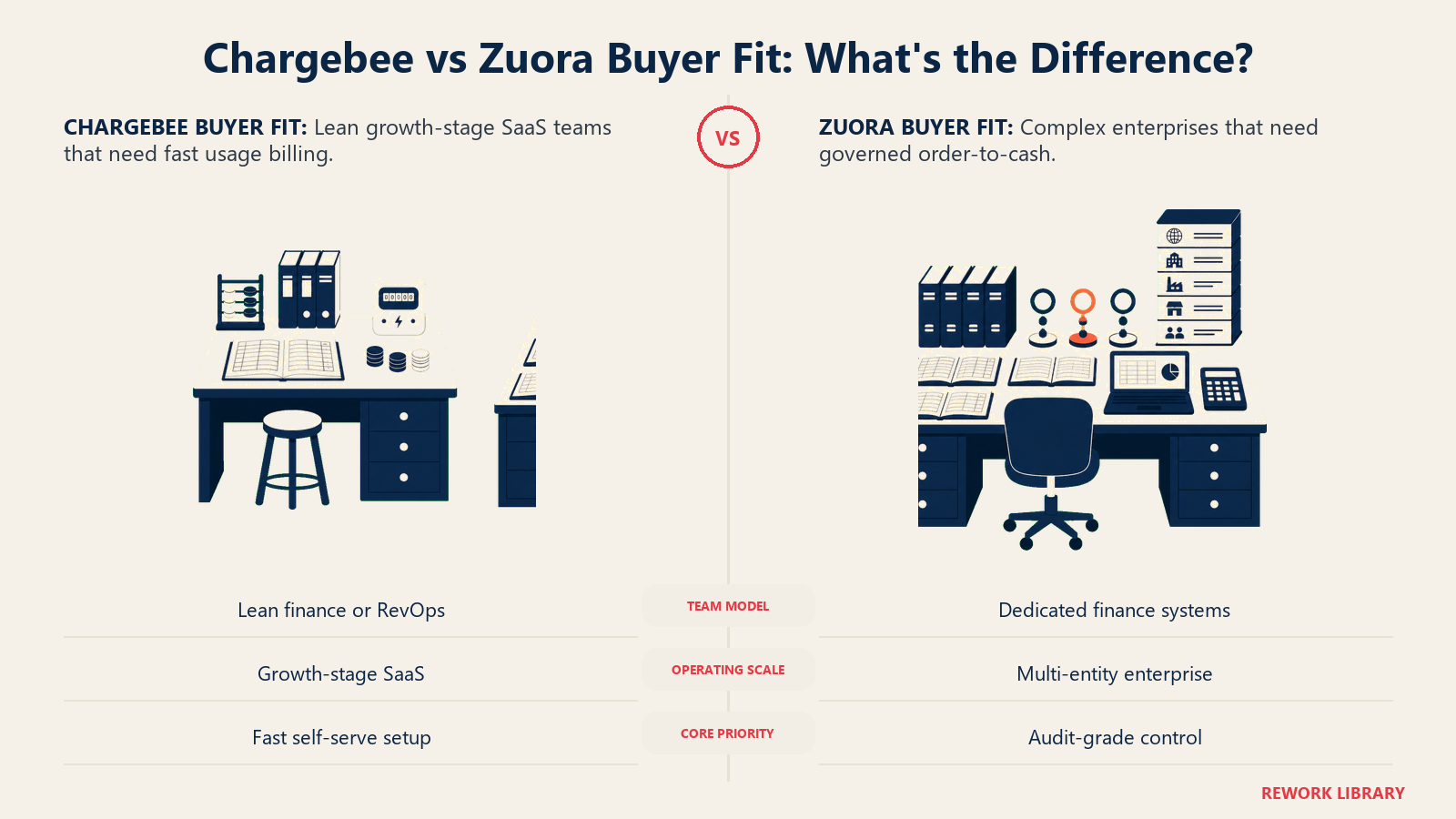
Chargebee's natural buyer is a product-led or usage-metered SaaS business that wants to be live in weeks and doesn't need multi-entity consolidation or a specialist revenue-accounting team on day one. Zuora's natural buyer already has, or is actively building, a dedicated RevOps or finance-systems function, runs billing across multiple legal entities or currencies, and treats revenue recognition as a specialist accounting workflow with its own audit-trail requirements, not a checkbox.
| Chargebee | Zuora | |
|---|---|---|
| Primary buyer | Growing SaaS/usage-based business, finance team of 1-5 | Enterprise finance and RevOps org, dedicated systems owner |
| The question they're solving | "How do we bill on consumption, without a big project?" | "How do we run order-to-cash across entities and standards with a clean audit trail?" |
| Where the platform is strongest | Fast self-serve setup, entitlements-based usage billing, CPQ | Multi-entity consolidation, revenue recognition breadth, event throughput |
| Where it disappoints the other buyer | Add-on pricing beyond the two Flow tiers isn't published either | Nothing is published; even a rough number requires a sales call |
| Team maturity assumed | Comfortable configuring entitlements in a self-serve UI | Comfortable running an RFP, an SI-led implementation, and change management |
| Typical company size | Growth-stage SaaS, tens to low hundreds of employees | Large enterprise, often public or PE-backed, hundreds to thousands |
If neither of those buyer profiles is quite you, our best subscription billing software for 2026 roundup covers the wider field, including platforms priced on a flat SaaS-seat model instead of a percentage of billing volume.
Pricing and Cost at Volume
This is where the two vendors stop being comparable in the same way. Chargebee's model is a public formula, so its cost at any volume can be worked out in advance. Zuora's model is not public at all. This section shows what Chargebee costs at real volumes, then explains what to ask Zuora for in writing before assuming anything about price.
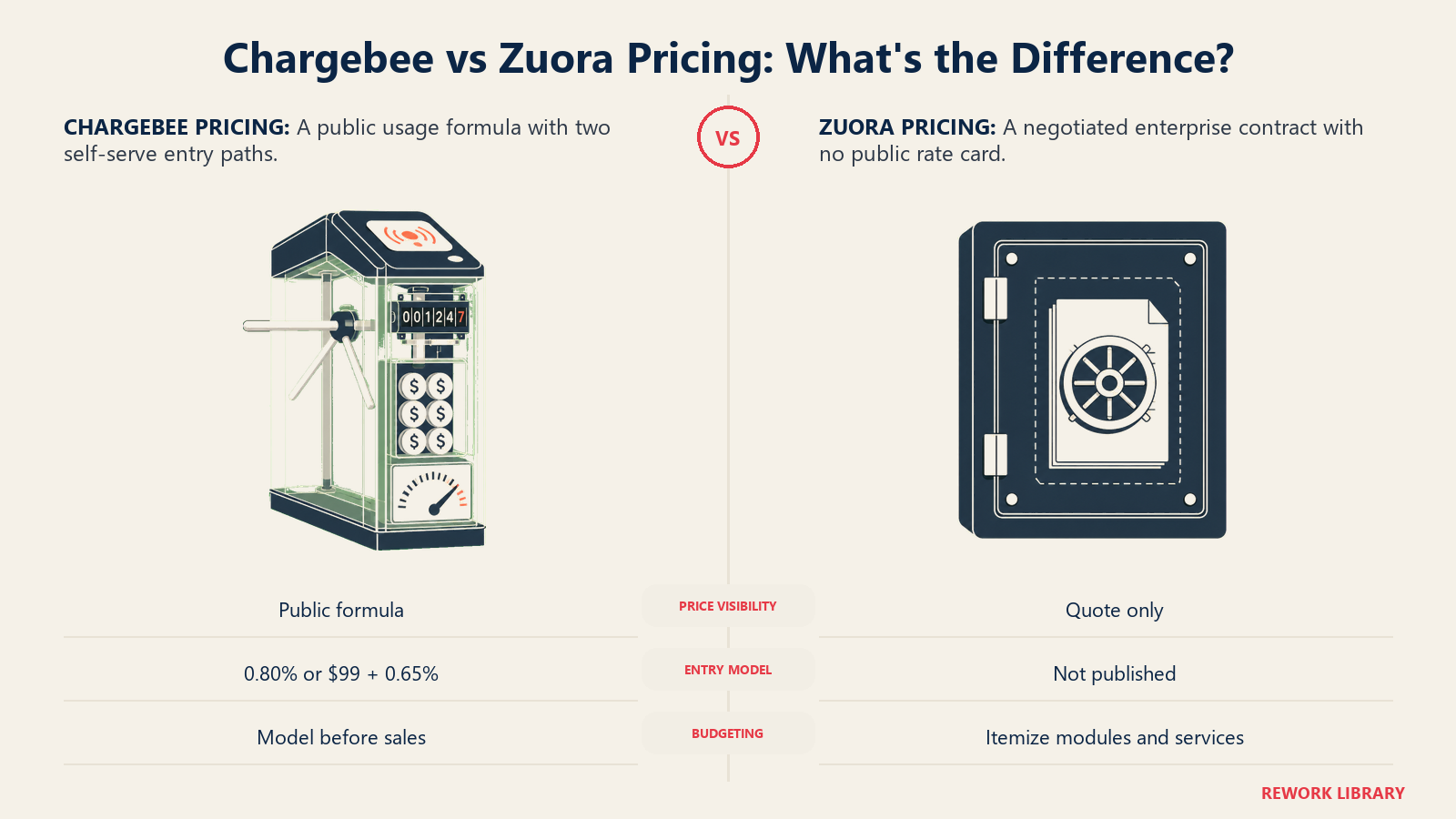
Chargebee Flow has two published pricing options below its custom-quoted Enterprise plan. The first costs 0.80% of monthly billing volume with no platform fee. The second costs a $99/month platform fee plus 0.65% of volume. Both include up to 100 million usage events per month.
| Monthly billing volume | Chargebee ($0 + 0.80%) | Chargebee ($99 + 0.65%) | Zuora |
|---|---|---|---|
| $25,000 | $200 | $261.50 | Quote required |
| $50,000 | $400 | $424 | Quote required |
| $100,000 | $800 | $749 | Quote required |
| $250,000 | $2,000 | $1,724 | Quote required |
| $500,000 | $4,000 | $3,349 | Quote required |
| $1,000,000 | $8,000 | $6,599 | Quote required |
Between Chargebee's two options, the $99 platform-fee option becomes cheaper at $66,000 of monthly volume, where the $99 fee is repaid by the lower 0.65% rate. Neither number tells you anything about Zuora, which doesn't publish a formula to compare against. The one reference point that exists is third-party, not vendor-confirmed: Vendr, a SaaS-purchasing platform aggregating real buyer contract data, reports a median Zuora buyer pays $170,000 a year, ranging roughly $26,900 to $696,800 across 149 tracked purchases (reported, Vendr). Treat that as a directional signal, not a quote you can hold Zuora to.
What to ask Zuora for in writing before you budget anything
Because nothing is published, the burden falls on the buyer to extract the real shape of the deal during the sales process. Ask for each of these explicitly, in writing, before budgeting around a verbal number.
| Ask for this | Why it matters |
|---|---|
| Implementation fee, itemized separately | Zuora deals commonly include a system-integrator-led build priced apart from the subscription |
| Platform fee vs. usage-based fee | Confirm whether the base price is flat, a percentage of volume, per-subscriber, or a blend |
| Which modules are bundled vs. separate | Billing, Revenue, Payments, and Zephr are distinct products on zuora.com; assume each is priced separately |
| Minimum contract term and volume commitment | Enterprise contracts typically require an annual or multi-year commitment |
| Uplift cap at renewal | A contractual cap on the renewal increase, not a verbal assurance |
| What triggers an overage or true-up | How volume, subscriber count, or usage above the contracted level gets charged |
None of this is unusual for an enterprise purchase, just a heavier process than reading a rate card.
Corporate Ownership: What Zuora's Take-Private Means for a Buyer
As noted above, Zuora has been private since February 14, 2025, when Silver Lake and GIC completed a take-private at $10.00 per share and its Class A stock was delisted from the NYSE, per Silver Lake's own press release. The deal was valued at $1.7 billion when announced. If you're reading an older comparison that calls it "NYSE: ZUO" or publicly traded, that comparison is out of date.

What the change means for a buyer is worth thinking through without guessing at outcomes. Private equity ownership of an enterprise vendor typically changes three things worth asking about directly, rather than assuming either way.
- Product roadmap priorities. Ask whether current roadmap commitments survive the ownership transition, and get commitments in writing where they matter to your rollout.
- Renewal and pricing leverage. Ask whether pricing discipline tightens post-take-private, since private ownership removes the public quarterly-earnings pressure that can otherwise keep enterprise renewal increases predictable.
- Support and account team stability. Ask whether your named account team and escalation path are stable through any post-acquisition reorganization.
Chargebee, by contrast, is privately held and venture-backed and has never traded publicly, so there's no "still public or not" question to get wrong.
Billing Model Depth: Usage-Based Pricing, Entitlements, and Multi-Entity Scale
Both platforms handle standard subscription mechanics, upgrades, downgrades, mid-cycle proration, trials, and coupons without much daylight between them. The real difference shows up in usage metering at scale and multi-entity support.
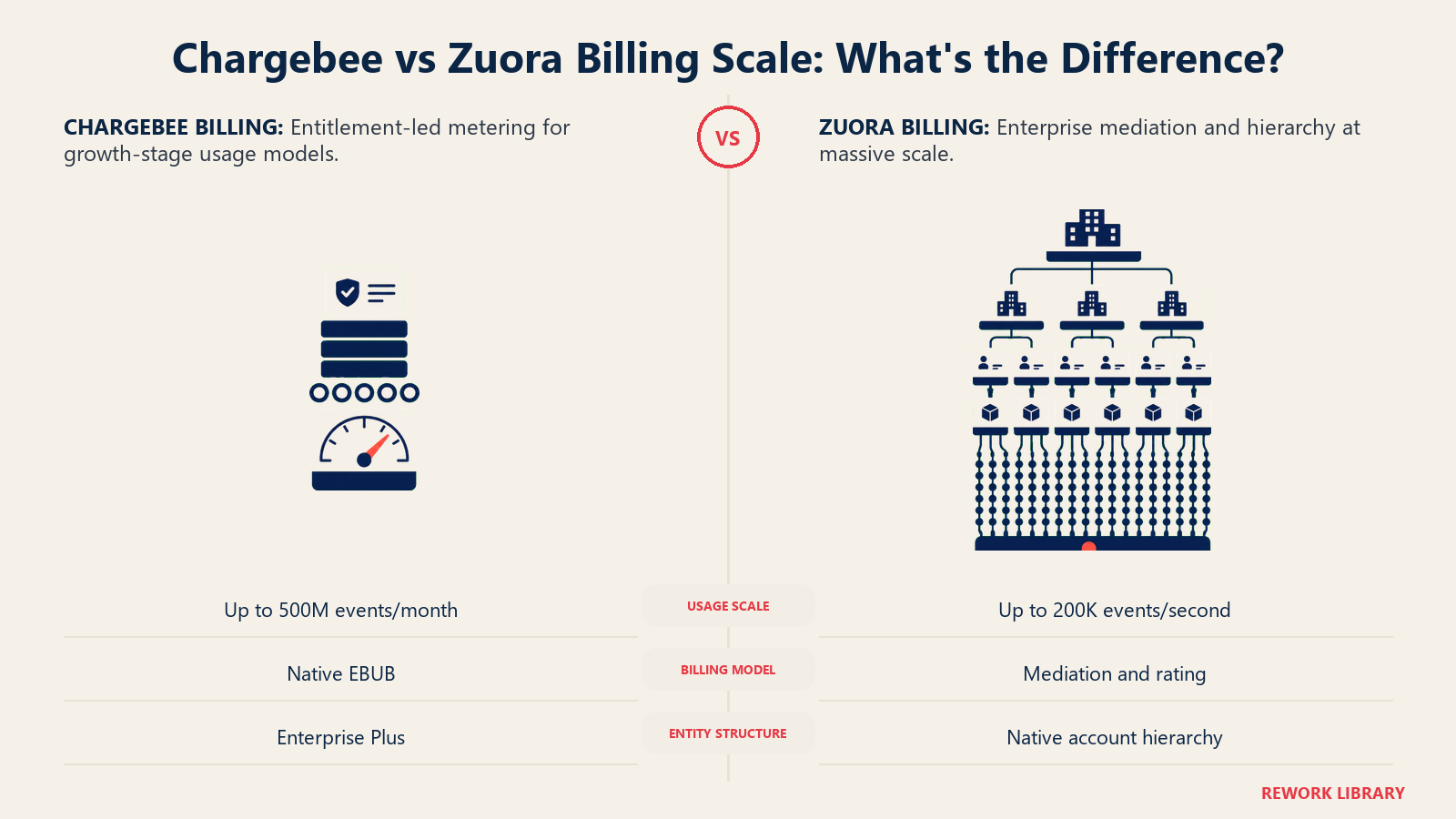
Chargebee's Entitlements-based Usage Billing (EBUB) unifies provisioning, feature access control, and metered billing, three things that often live in separate systems elsewhere. A plan grants a defined quota of included usage, overages bill at a per-unit rate, and entitlement grants can refresh on a different cadence than the billing cycle, useful for annual contracts with monthly usage resets.
Zuora's mediation and rating engine is built for a different order of magnitude: it streams up to 200,000 usage events per second and processes billions of events per month, with AI-powered anomaly detection layered on top, per Zuora's own product page. Zuora also supports account hierarchies for parent-child entity structures out of the box, useful for billing customers across multiple subsidiaries, currencies, or legal entities under one consolidated view.
| Billing depth factor | Chargebee | Zuora |
|---|---|---|
| Native entitlements product | Yes, EBUB unifies provisioning, access, and metering | Mediation and rating engine, not branded as an entitlements product |
| Usage event throughput | Up to 100M events/month on Flow, up to 500M/month as a paid add-on on Enterprise | Up to 200,000 events/second, billions of events/month |
| Multi-entity / account hierarchy | Multi-entity management on Enterprise | Native account hierarchy support, a core enterprise use case |
| Reported usage-based adoption among customers | Not published | 46% of Zuora customers use usage-based monetization, per Zuora's own product page |
| Best fit | API-consumption or hybrid pricing at growth-stage volume | Very high-volume metering or complex multi-entity billing structures |
Dunning and Churn Recovery
Payment failures are a routine cost of recurring billing, and both vendors treat recovery as an automated workflow, not an afterthought.
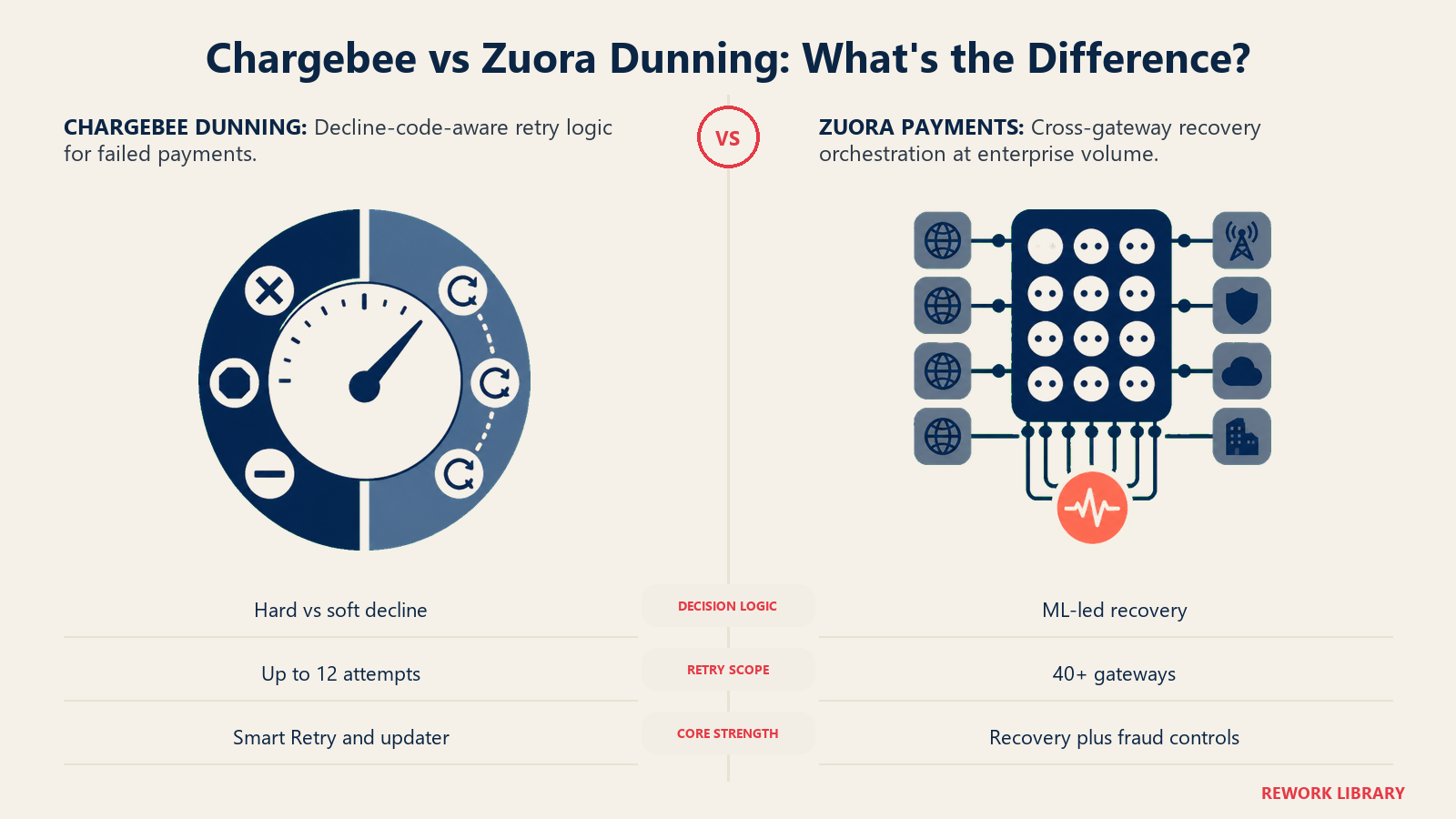
Chargebee's Smart Dunning reads the specific gateway decline code and responds accordingly: hard declines (a card reported lost or stolen) wait for the customer to update payment details, while soft declines (insufficient funds, temporary holds) get retried at the moments most likely to succeed, up to 12 attempts, with automatic card updating built in.
Zuora Payments layers machine learning into failed-payment recovery and fraud reduction across its 40-plus supported gateways, orchestrating retries rather than leaving that logic to a single processor, per Zuora's own product page. For an enterprise running payments across multiple regions, that orchestration layer is arguably more central to Zuora's pitch than dunning tactics alone.
| Dunning factor | Chargebee | Zuora |
|---|---|---|
| Retry logic | Smart Retry, reads decline codes, dynamic intervals, up to 12 attempts | ML-driven recovery and fraud reduction across gateways |
| Card updater | Built into the baseline Billing plan | Part of the Zuora Payments orchestration layer |
| Multi-gateway routing | Yes, part of the dunning retry logic | Yes, across 40-plus gateways |
| Where the depth shows | Decline-code-aware retry branching | Cross-gateway orchestration at enterprise transaction volume |
If AR and collections outside subscriber dunning matter just as much to your team, our best accounts receivable software for 2026 guide covers that side of the workflow directly.
Revenue Recognition and Order-to-Cash Depth
This is where Zuora earns most of its reputation, and where the gap between the two platforms is the widest.
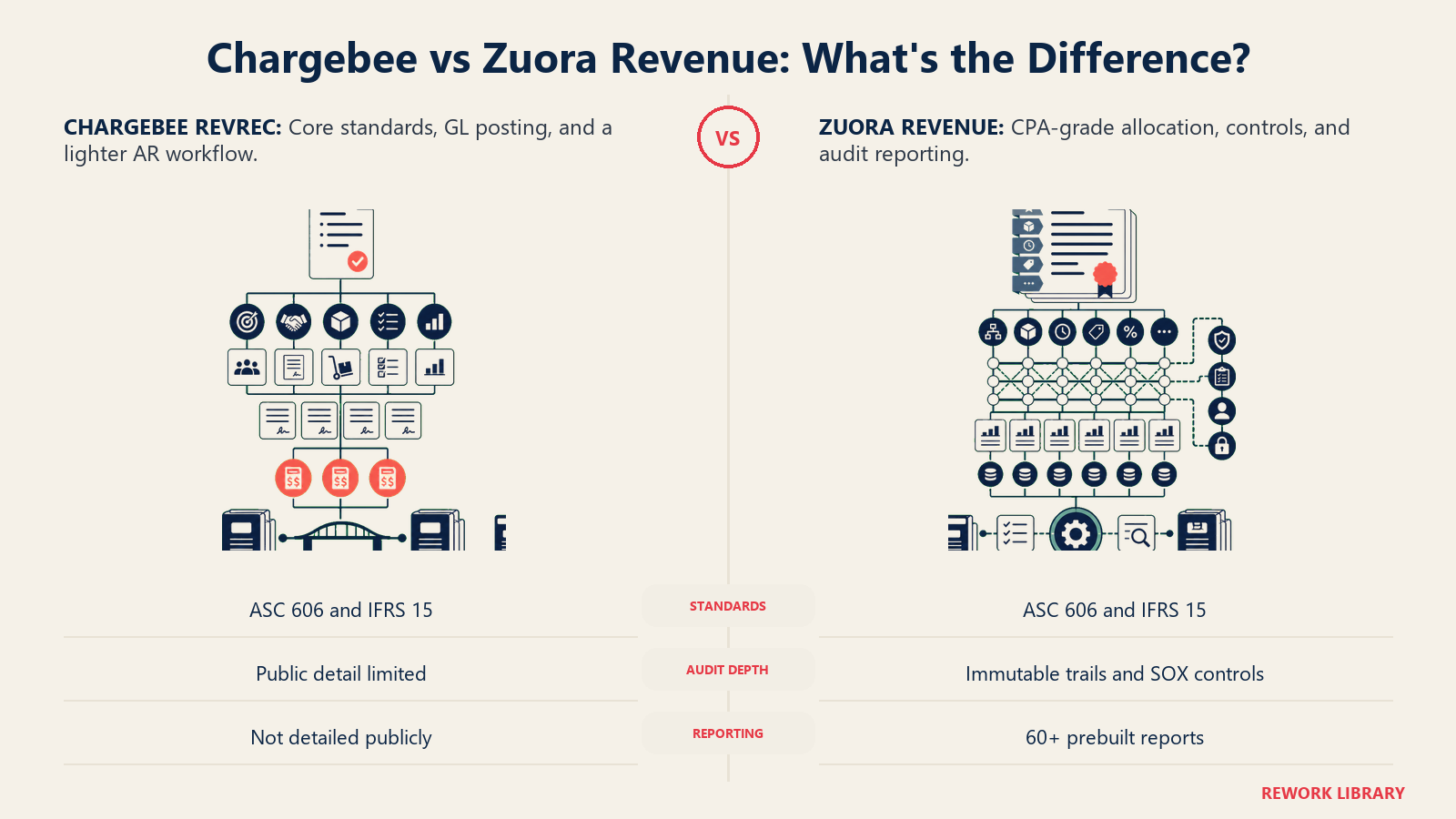
Chargebee RevRec automates the ASC 606 and IFRS 15 five-step model, reconciling revenue across contracts, invoices, and payments, and posting journal entries to the general ledger. It handles contract modifications, renewals, cancellations, partner commission arrangements, and multi-currency transactions, with a RevRec Premium tier adding a bundled AR workflow. Pricing isn't published; Chargebee's own pricing page routes both RevRec tiers to a demo request or a custom quote.
Zuora Revenue is pitched at revenue accountants and automates all five steps of ASC 606 and IFRS 15, including standalone selling price (SSP) allocation across complex, multi-element contracts. It adds continuous accounting through event-driven schedules, journal-entry generation with anomaly detection, SOX and SOC controls, immutable audit trails, and 60-plus pre-built reports covering waterfalls, disclosures, and variance analysis. Zuora states its customers see roughly a 60% reduction in manual recognition steps and up to a 50% reduction in audit prep time, per Zuora's own product page; treat those as vendor-reported, not independently audited.
| Revenue recognition factor | Chargebee (RevRec) | Zuora (Revenue) |
|---|---|---|
| Core standard | ASC 606, IFRS 15 | ASC 606, IFRS 15 |
| Complex multi-element contract handling (SSP allocation) | Handled within RevRec, not a named capability | Named capability, built for CPA-level SSP allocation |
| Audit trail and controls | Not detailed on the public page | Immutable audit trails, SOX/SOC controls, PBC reports |
| Pre-built reporting | Not detailed on the public page | 60+ reports (waterfalls, disclosures, variance) |
| GL posting | Automatic journal entries | Automated with anomaly detection |
| Published starting price | Not published | Not published |
| Scale proof point | Not published | $300B+ in annual revenue processed (Salesforce, Microsoft) |
If revenue recognition runs through a specialist accounting team with SOX obligations and an auditor wanting a clean PBC package, that's the scenario Zuora Revenue is built around. If your close is simpler and RevRec is one workflow among several, Chargebee's bundled RevRec Premium may be a lighter lift.
Tax Handling
Neither vendor built its own tax engine from scratch; both lean on established tax partners, but what's native versus bolted-on differs slightly.
Chargebee integrates with both Avalara AvaTax and Anrok. Avalara calculates sales tax, VAT, GST, and communications tax on every invoice, automating rate determination, address validation, filing, and reporting. Anrok adds real-time calculation and nexus tracking specifically for U.S. jurisdictions.
Zuora offers native tax engine capability alongside pre-built connectors to Avalara and Sovos, plus country-specific templates and e-invoice archiving, a detail that matters for enterprises operating in jurisdictions that require e-invoicing compliance (much of Latin America and a growing share of Europe).
| Tax factor | Chargebee | Zuora |
|---|---|---|
| Default engine | Avalara AvaTax or Anrok integration | Native engine plus Avalara or Sovos connectors |
| E-invoicing / archiving | Not named as a distinct capability | Named capability, relevant for e-invoicing mandates |
| Global VAT/GST | Yes, via Avalara | Yes, native plus partner engines |
| Country-specific templates | Via Avalara integration | Native, named on Zuora's own product page |
Payment Gateways and Orchestration
Both platforms are gateway-agnostic, routing payments through third-party processors rather than acting as the processor, the opposite model from a merchant-of-record platform.
Chargebee connects to dozens of payment gateways, including Stripe, Adyen, Braintree, PayPal Commerce, and GoCardless, per its own pricing page. Zuora Payments orchestrates across 40-plus gateways and uses machine learning to reduce fraud and recover failed transactions, per Zuora's own product page, treating gateway orchestration as a distinct product rather than a bolted-on feature.
| Gateway factor | Chargebee | Zuora |
|---|---|---|
| Named gateways | Stripe, Adyen, Braintree, PayPal Commerce, GoCardless, and others (40+) | 40-plus gateways, orchestrated as a distinct Zuora Payments product |
| Multi-gateway routing for recovery | Yes, part of the dunning retry logic | Yes, with ML-driven fraud reduction layered in |
| Merchant-of-record option | No, gateway pass-through only | No, gateway pass-through only |
If your actual need is a merchant-of-record model that absorbs tax and compliance into the transaction fee instead of routing through your own gateways, that's a different category entirely; our best Paddle alternatives roundup covers that side of the market.
Integrations and ERP Fit
Both vendors ship native connectors to the accounting and CRM tools finance teams actually run, because billing data is only useful once it lands correctly in the general ledger.
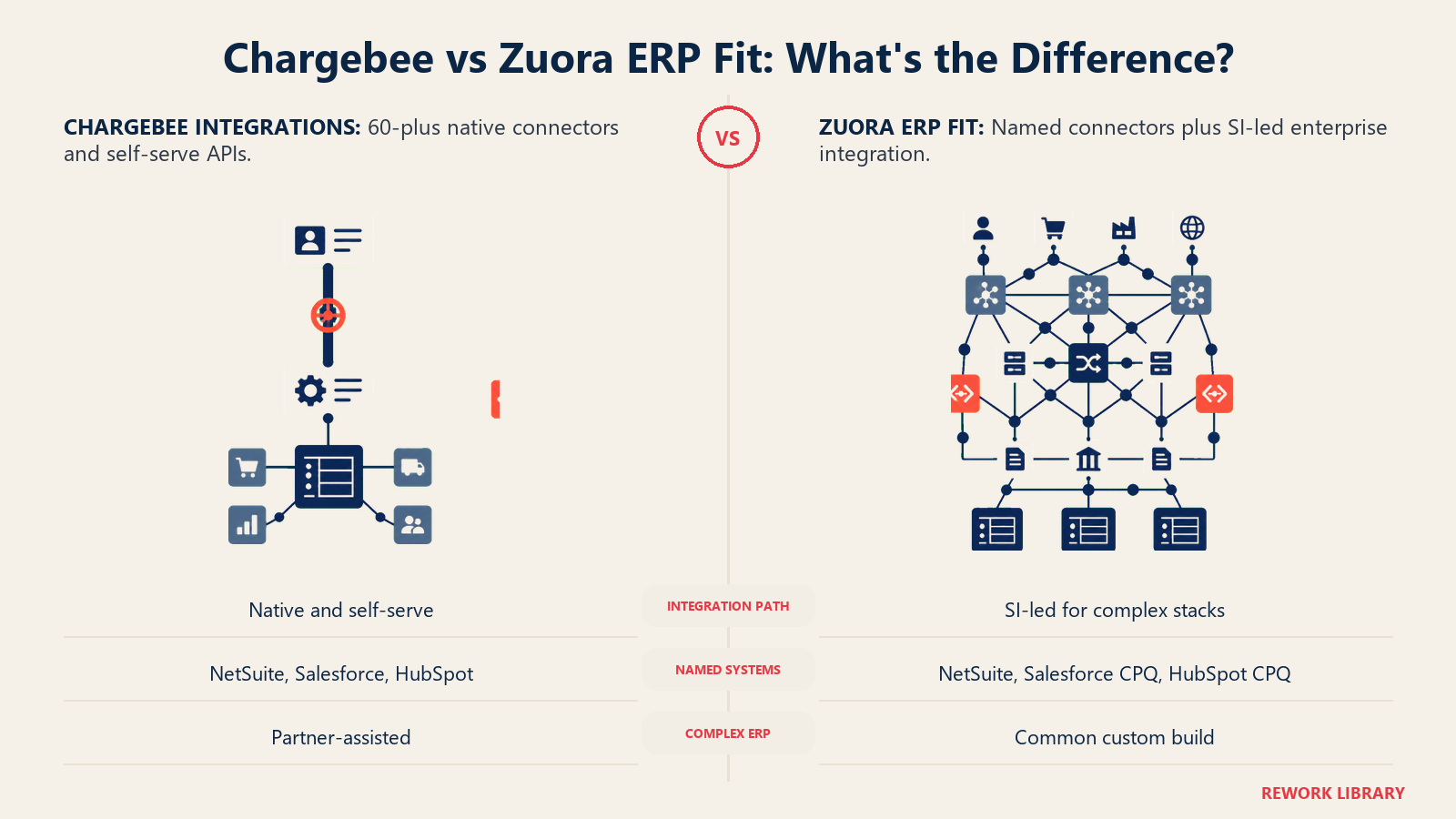
Chargebee ships 60 or more native integrations, including Salesforce, HubSpot, NetSuite, QuickBooks Online, Xero, Avalara, and Slack, plus a REST API for custom work. Its NetSuite and Salesforce connections route through RevRec, syncing billing records and posting monthly journal entries, and its HubSpot integration includes a quote-to-cash flow.
Zuora names Salesforce CPQ and HubSpot CPQ for quoting, plus NetSuite for financial sync, alongside its 40-plus gateway connections and pre-built tax connectors. Given Zuora's enterprise orientation, expect more integration work through a system integrator's custom build than a self-serve app marketplace, especially for SAP or Oracle-based ERP stacks.
| Integration factor | Chargebee | Zuora |
|---|---|---|
| Native integration count | 60+ | Named integrations (Salesforce, HubSpot, NetSuite); broader SI-built connections common |
| NetSuite | Native, routed through RevRec | Named integration |
| Salesforce | Native, RevRec-connected | Named (Salesforce CPQ) |
| HubSpot | Native, quote-to-cash flow | Named (HubSpot CPQ) |
| Typical integration path for complex ERP (SAP, Oracle) | Self-serve or partner-assisted | Commonly system-integrator-led |
If NetSuite is your system of record and journal-entry automation is non-negotiable, it's worth comparing both against the wider field in our best NetSuite alternatives guide. If QuickBooks is where a leaner finance team actually closes the books, our best QuickBooks alternatives guide covers that layer directly, and it's a strong signal you're closer to Chargebee's buyer profile than Zuora's.
Implementation Weight and Who Administers It Day to Day
Neither vendor publishes an audited implementation study, so treat the following as general guidance to verify in your own sales process. For a Chargebee rollout, finance-led teams with clean CRM data commonly go live within 30 to 45 days, while migrations involving usage-based billing or messy legacy data commonly run 10 to 12 weeks, per general billing-platform guidance from consultancy Ordway (Ordway). A Zuora rollout is a different order of project: Zuora itself says complex billing and revenue systems are often taking more than six months and a dedicated team to go live, and enterprise deployments are commonly led by a system integrator, with implementation fees negotiated separately from the subscription.
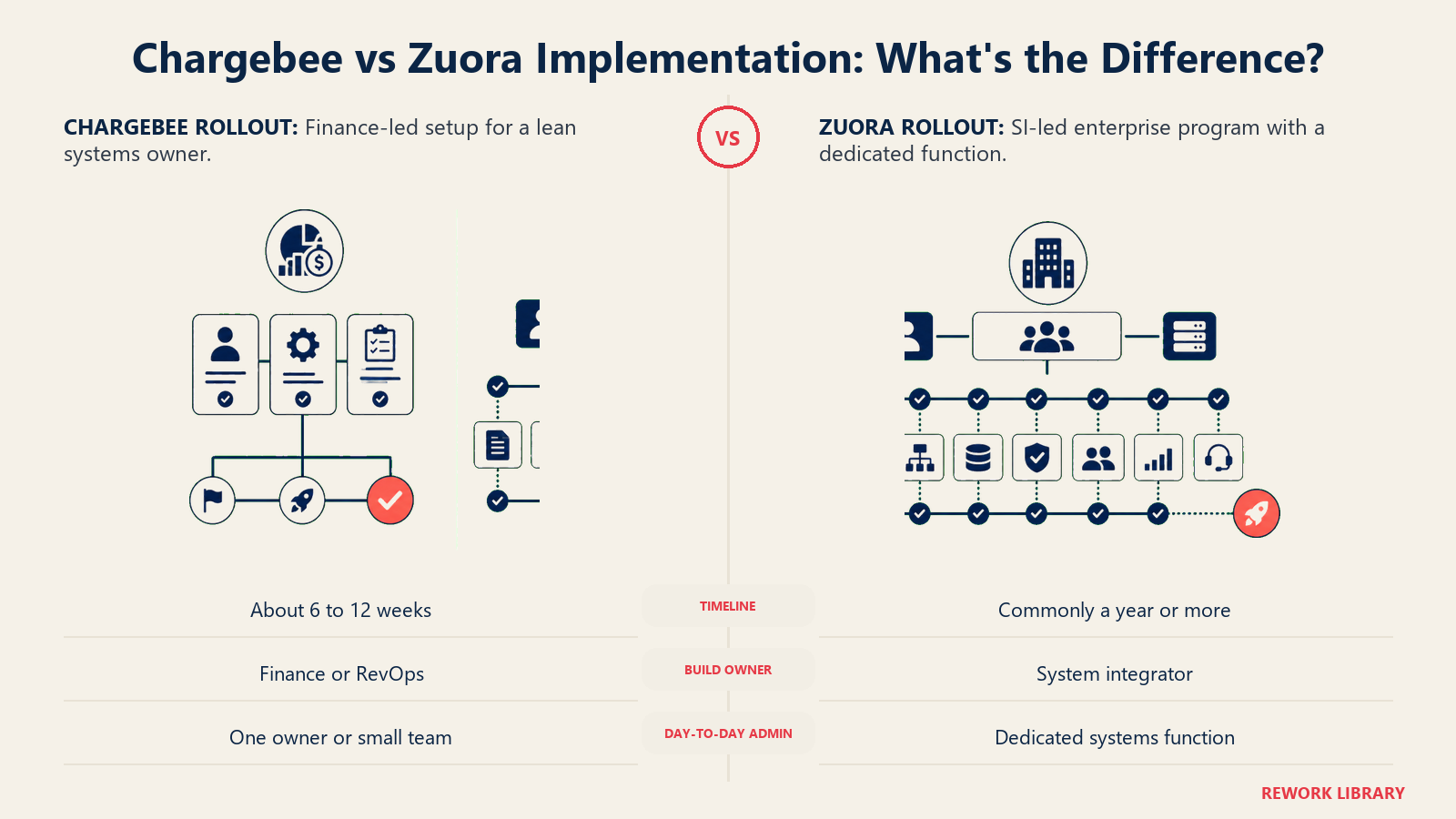
Both platforms are built to be finance-owned rather than engineering-owned once integration is done, but the assumed team size differs meaningfully. Chargebee is realistic for a lean finance or RevOps function, sometimes a single systems owner, to configure and maintain. Zuora assumes a dedicated finance-systems function exists or is being built, someone who owns the revenue-recognition rule engine, the account hierarchy, and the ongoing relationship with a system integrator.
| Factor | Chargebee | Zuora |
|---|---|---|
| Typical implementation timeline (general guidance, not vendor-audited) | 30-45 days with clean data, 10-12 weeks for complex migrations | Often more than six months for complex programs |
| Who typically leads the build | In-house finance/RevOps, self-serve setup | System integrator, often with Zuora's own solution architects |
| Implementation fee | Not itemized on the public pricing page | Commonly negotiated separately; ask for it itemized in writing |
| Who typically administers it day to day | RevOps or finance systems owner, often solo | Dedicated finance-systems function or team |
| Recurring configuration work | Entitlement grants, metered feature definitions, CPQ quotes | Revenue-recognition rule maintenance, account hierarchy upkeep, ongoing SI relationship |
| Team size this realistically needs | 1 to a small team | A dedicated function, commonly with external SI support |
Reporting and Dashboards
Both platforms ship standard subscription reporting (MRR, ARR, churn, LTV, cohorts) out of the box, so the difference is less about whether the numbers exist and more about audit-grade drill-down depth. Chargebee's reporting connects into RevRec and CPQ, so a revenue leader can move from a top-line MRR view into a specific contract's recognition schedule without leaving the platform. Zuora's reporting leans on the same audit-readiness Zuora Revenue markets elsewhere: pre-built PBC (prepared-by-client) reports, trial balances, and reconciliation views built to shorten an external audit, on top of the standard MRR/ARR/churn/cohort metrics both platforms ship.
Scale Ceiling: Where Each Platform Tops Out
Neither vendor publishes a hard technical ceiling, but the published figures hint at where each stretches.
| Scale factor | Chargebee | Zuora |
|---|---|---|
| Top published tier | Enterprise, custom quote | No named tier; every deal is custom |
| What gates the top tier | Multi-entity needs and usage event volume (up to 500M/mo as a paid add-on) | Not published, negotiated per contract |
| Event throughput | Up to 500M events/mo (Enterprise add-on) | Up to 200,000 events/second, billions/month |
| Reported customer/revenue scale | Not published | 1,000+ customers, $96B+ processed (Billing), $300B+ (Revenue) |
| What it signals | Built for growth-stage usage-metering intensity | Built for the largest, most complex enterprise programs |
Switching and Migration Considerations
If you're moving to either platform from spreadsheets, a lighter billing tool, or a homegrown Stripe integration, the friction lives in historical data, revenue-recognition rule rebuilding, and tax/gateway reconfiguration, not the core software itself.
- Historical subscription and invoice data. Both support data import, but validate proration history and credit balances migrate correctly before assuming a clean lift-and-shift.
- Revenue recognition rule rebuild. Moving into either RevRec module means re-modeling your existing recognition schedules, not a straight import. Budget real time for this with Zuora especially, given its multi-standard scope.
- Active payment gateways. Confirm your specific processor and region are supported on each platform's current list before committing.
- Entity and hierarchy structure. If you bill across multiple legal entities, confirm account hierarchy setup is scoped explicitly in the implementation plan. This is where Zuora projects commonly expand in timeline.
- Implementation ownership. Confirm in writing whether your team, a system integrator, or the vendor's own professional services owns the build, and who is accountable if the timeline slips.
- Contract minimums. Confirm the minimum committed term and billing volume before signing, especially with Zuora, where nothing is public to benchmark against.
When Chargebee Is the Right Call
- You want to see and understand the price before talking to sales. The Flow formula is public; model your own cost before a single call.
- You're a growth-stage, usage-metered, or hybrid-pricing SaaS business. EBUB unifies provisioning and metering without a large implementation project.
- You need to be live in weeks, not months. A finance-led rollout with clean data commonly closes in 30 to 45 days.
- A lean finance or RevOps function will own this day to day. Chargebee is realistic for a team of one to configure and maintain.
If Chargebee's unpublished add-on pricing is still a dealbreaker, our best Chargebee alternatives roundup is worth a look first.
When Zuora Is the Right Call
- You run billing and revenue recognition across multiple legal entities, currencies, or accounting standards. Native account hierarchies and SSP allocation are built for exactly this.
- Your close process is genuinely audit-heavy. Immutable audit trails, SOX/SOC controls, and pre-built PBC reports are named capabilities, not a checkbox.
- You're processing usage events at true enterprise scale. A 200,000-events-per-second mediation engine is a different order of magnitude than growth-stage metering.
- You already have, or are building, a dedicated finance-systems function. A system-integrator-led implementation assumes real internal capacity to manage the relationship.
If Zuora's opacity on price and its multi-month timeline rule it out for your stage, our best Zuora alternatives roundup and the wider best subscription billing software for 2026 guide are useful next stops.
Decision Framework
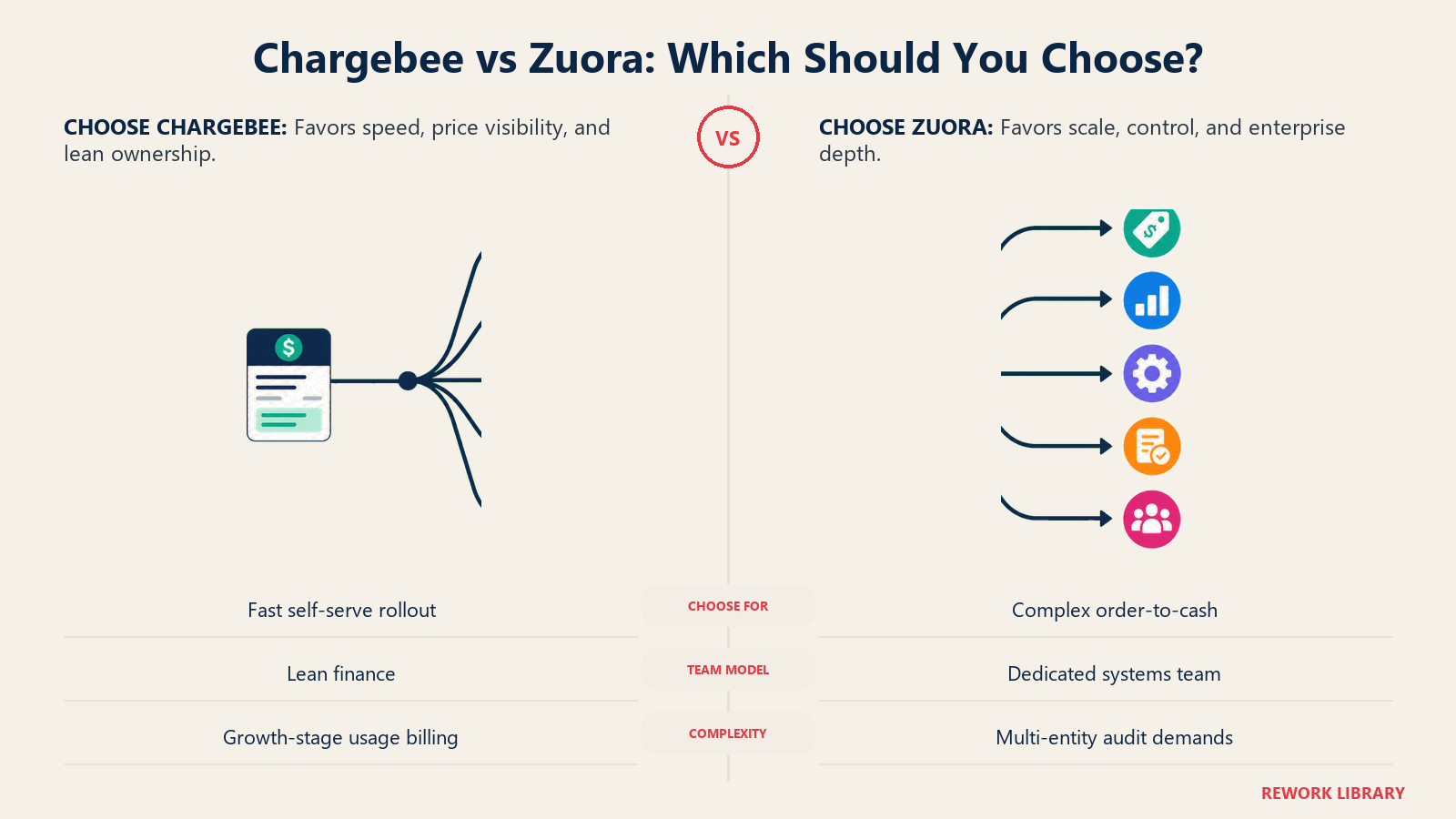
The choice comes down to how much billing complexity your finance team can absorb and how quickly you need to go live.
| If this is true for you | Pick |
|---|---|
| You want a published price you can model before talking to sales | Chargebee |
| You run billing across multiple legal entities, currencies, or accounting standards | Zuora |
| You need to be live within a quarter | Chargebee |
| Your close process is audit-heavy with SOX/SOC controls in scope | Zuora |
| You're a lean finance team without a dedicated systems function | Chargebee |
| You have (or plan to build) a dedicated finance-systems team and SI relationship | Zuora |
| Usage-metering volume is in the hundreds of millions of events per month, not billions | Chargebee |
| Usage-metering volume is in the billions of events per month | Zuora |
| You need a merchant-of-record model instead of gateway pass-through | See best Paddle alternatives instead |
What to Do Next
- Model your own monthly billing volume against Chargebee's published formula. That's the one number you can calculate today without a sales call.
- If Zuora is on your shortlist, request the implementation fee, annual platform fee, and renewal uplift cap in writing before your first budget conversation. Nothing about its pricing is public, so the burden is on you to extract these terms early.
- Confirm which modules you actually need priced. Billing, Revenue, Payments, and CPQ are separate products for both vendors; a "starting price" for one rarely covers the whole stack.
- Ask each vendor for a reference customer near your entity structure, volume, and industry, not just your billing volume.
- Loop in FP&A and AP early. Billing and revenue-recognition data feeds forecasting elsewhere in the stack; our best FP&A software for 2026 and best CRM software for 2026 guides cover those adjacent systems.
Frequently Asked Questions about Chargebee vs Zuora
Is Zuora still a publicly traded company?
No. Zuora has been private since February 14, 2025, when Silver Lake and GIC completed a $1.7 billion take-private at $10.00 per share. Its Class A stock was delisted from the NYSE shortly after.
Does Chargebee have a free plan?
No. Chargebee's billing product, Flow, has no free tier. Entry pricing starts at 0.80% of monthly billing volume with no platform fee, or $99/month plus 0.65% of volume.
Why doesn't Zuora publish any pricing at all?
Zuora's pricing page shows no tiers, ranges, or starting figures, only a demo request and a sales contact form. This is typical for enterprise software sold through a negotiated contract process, and it means a buyer has to extract real numbers directly from the sales conversation.
How much does Zuora actually cost?
Zuora doesn't publish a price, but SaaS-purchasing platform Vendr reports a median buyer pays $170,000 a year, in a range from roughly $26,900 to $696,800 based on 149 tracked purchases. That's third-party reported data, not a confirmed Zuora quote, so treat it only as a directional signal.
Which platform has deeper revenue recognition capability?
Zuora Revenue generally goes deeper. It names standalone selling price (SSP) allocation, immutable audit trails, SOX and SOC controls, and 60-plus audit-focused reports as distinct capabilities. Chargebee RevRec covers the same ASC 606 and IFRS 15 core standard with GL posting and an optional AR workflow, but doesn't name equivalent audit-trail capabilities on its public pages.
How long does implementation typically take?
A Chargebee rollout with clean data commonly goes live in 30 to 45 days. Zuora says complex billing and revenue deployments often take more than six months and a dedicated team, and enterprise projects are usually led by a system integrator. Confirm your own timeline in the sales process.
Does either platform handle usage-based billing at real scale?
Both do, at different orders of magnitude. Chargebee's Entitlements-based Usage Billing (EBUB) supports up to 500 million usage events per month as a paid add-on on its Enterprise plan. Zuora's mediation engine streams up to 200,000 events per second and processes billions of events per month.
What does Zuora going private mean for a buyer today?
It means Zuora no longer faces public-market earnings pressure, which can cut either way. Ask directly about roadmap commitments, renewal pricing discipline, and account team stability during the sales process rather than assuming either outcome.
Related Resources:

Principal Product Marketing Strategist
On this page
- Key Facts
- TL;DR
- Who Each Platform Is Really For
- Pricing and Cost at Volume
- What to ask Zuora for in writing before you budget anything
- Corporate Ownership: What Zuora's Take-Private Means for a Buyer
- Billing Model Depth: Usage-Based Pricing, Entitlements, and Multi-Entity Scale
- Dunning and Churn Recovery
- Revenue Recognition and Order-to-Cash Depth
- Tax Handling
- Payment Gateways and Orchestration
- Integrations and ERP Fit
- Implementation Weight and Who Administers It Day to Day
- Reporting and Dashboards
- Scale Ceiling: Where Each Platform Tops Out
- Switching and Migration Considerations
- When Chargebee Is the Right Call
- When Zuora Is the Right Call
- Decision Framework
- What to Do Next